

Pollinator Post 3/21/26
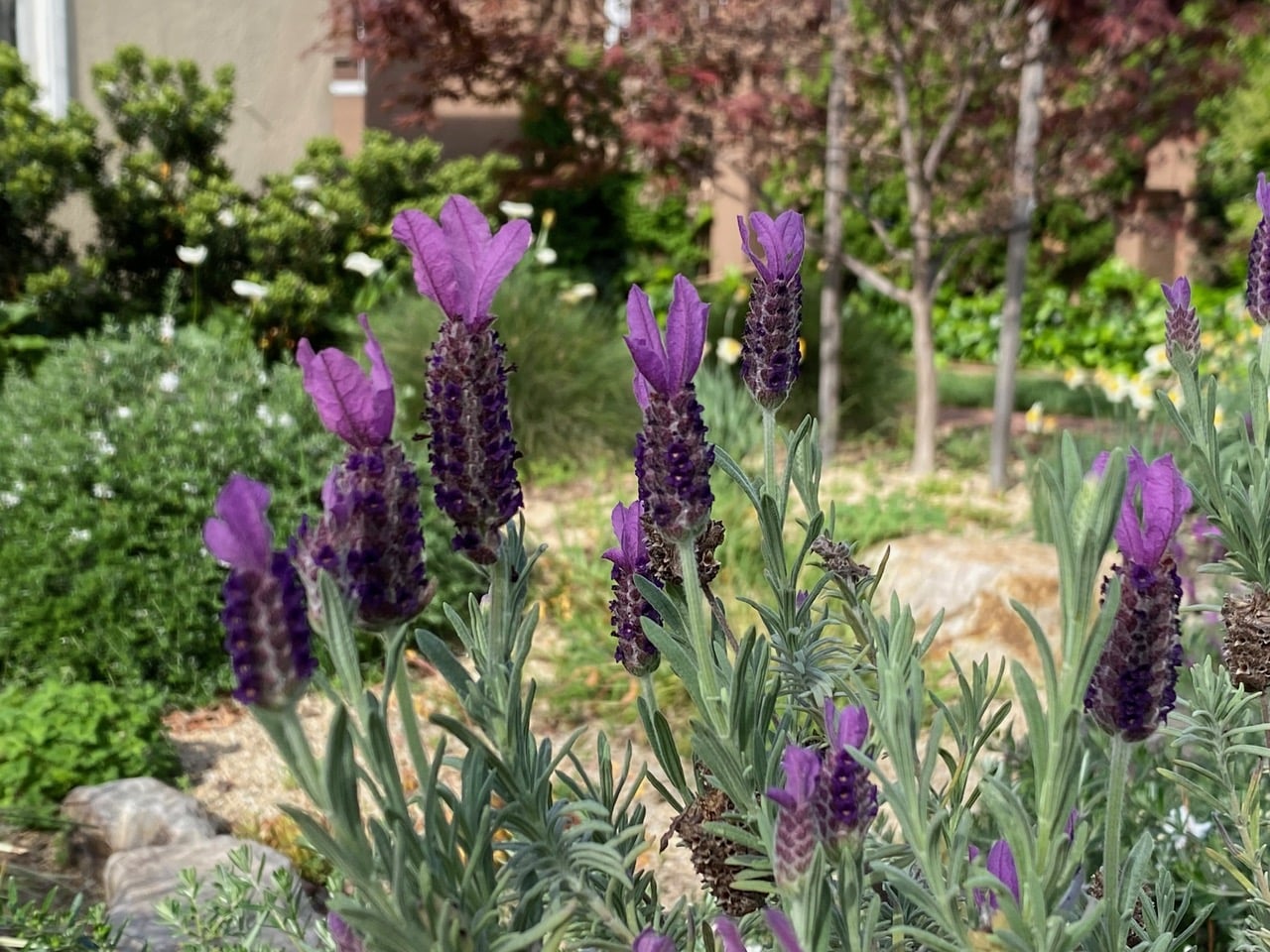
Relieved that the worst of the heat wave is over, I take a walk in a leafy neighborhood in Alameda, along Thompson Ave. Although most of the plants in these gardens are non-native, I do see some interesting insects on them sometimes.
The Topped Lavender, Lavandula stoechas is a popular plant is these gardens. The evergreen shrub is native to the Mediterranean Basin, and its inflorescences attract many Honey Bees, as well as native bees.
The tiny two-lipped flowers are borne on spikes 2 cm long at the top of slender, leafless stems. At the top of the spike are a number of large, lavender-purple bracts.

A large bee with a glossy black abdomen lands on a spike of the Topped Lavender flowers, and proceeds to take nectar. It is a male Foothill Carpenter Bee, Xylocopa tabaniformis orpifex (family Apidae).
The common name “carpenter bees” derives from their nesting behavior; nearly all species burrow into hard plant material such as dead wood or bamboo. These robust bees are often mistaken for bumble bees. The simplest way to tell them apart is that most carpenter bees have a shiny abdomen, whereas bumble bees abdomens are completely covered with dense hair. Males of some species of carpenter bees have a white or yellow face, unlike bumble bees, while females lack the bare corbicula (pollen baskets) of bumble bees; the hind leg is entirely hairy and includes the scopa.
Carpenter Bees are traditionally considered solitary bees, though some species, including our Foothill Carpenter Bee, have simple social nests in which mothers and daughters may cohabit. Carpenter Bees make nests by tunneling into wood, bamboo and similar hard plant materials. They vibrate their bodies as they rasp their mandibles against the wood, each nest having a single entrance which may have many adjacent tunnels. The entrance is often a perfect circular hole measuring about 0.6in. on the underside of a beam, bench, or tree limb. Carpenter Bees do not eat wood; they discard the bits of wood, or reuse the sawdust to build partitions between cells. The tunnel functions as a nursery for brood and storage for the pollen/nectar upon which the brood subsists. Carpenter can be timber pests, and cause substantial damage to buildings.
Carpenter Bees have short mouthparts and are important pollinators on some open-faced or shallow flowers. They also are important pollinators of flowers with various forms of lids, such as Salvia species, and some members of the Fabaceae such as Lupinus. Many Carpenter Bees are known to “rob” nectar by cutting slits on the sides of flowers with deep corolla that they cannot enter. In doing so, the bees can access the nectar directly with their short tongue. This move precludes contact with the reproductive parts of the flower, and results in no pollination.
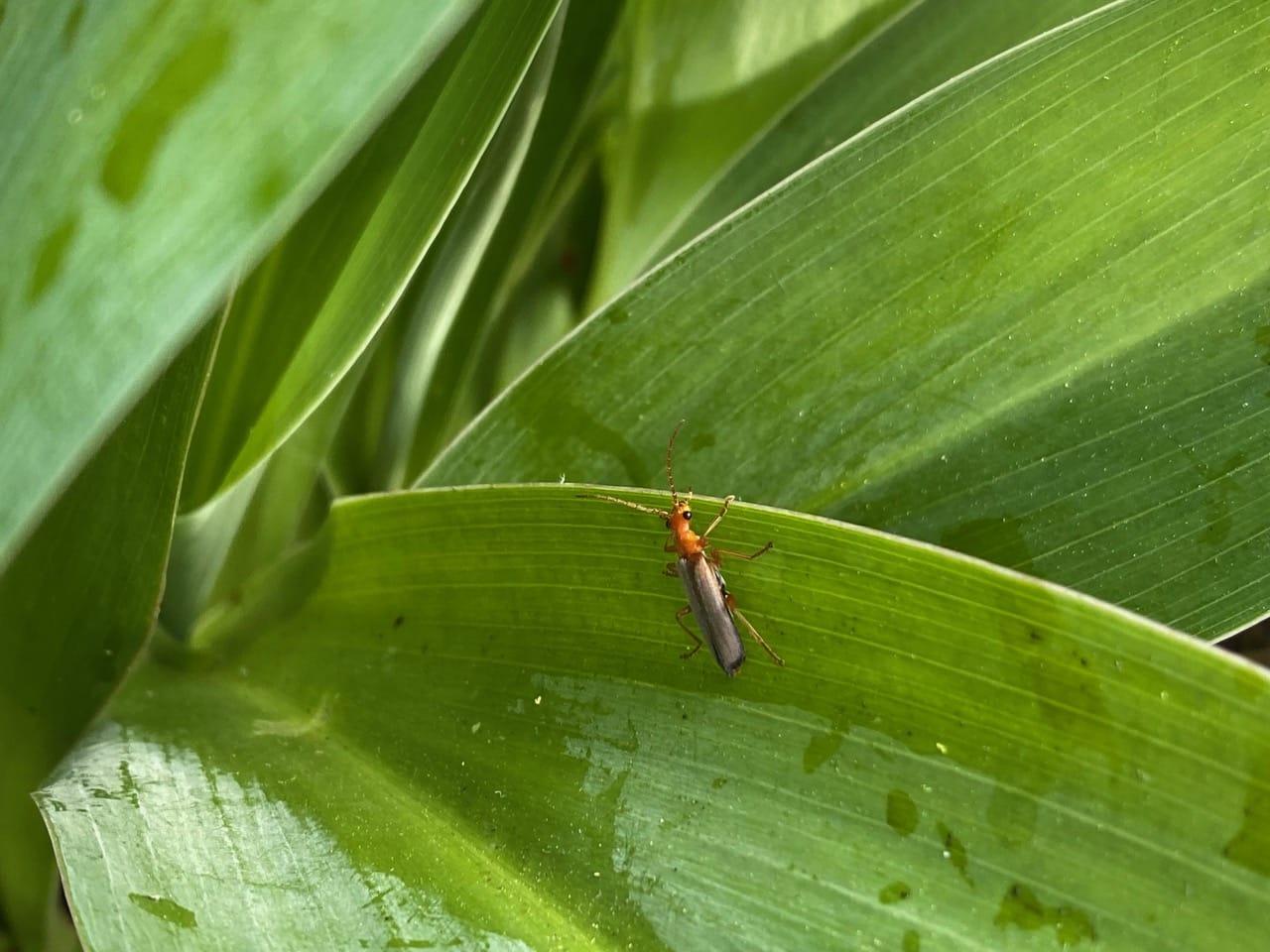
A Soldier Beetle, Podabrus sp. (family Cantharidae) has landed on a leaf.
The Soldier Beetles, family Cantharidae are relatively soft-bodied, straight-sided beetles. One of the first described species has a color pattern reminiscent of the red coats of early British soldiers, hence the common name. They are also known commonly as Leatherwings because of their soft elytra.
Soldier beetles often feed on both nectar and pollen as well as predating on other small insects. The larvae are often active, and feed on the ground, hunting snails and other small creatures. Adult beetles also contribute to pollination as they feed on nectar and pollen. Soldier beetles are generally considered beneficial insects by gardeners.
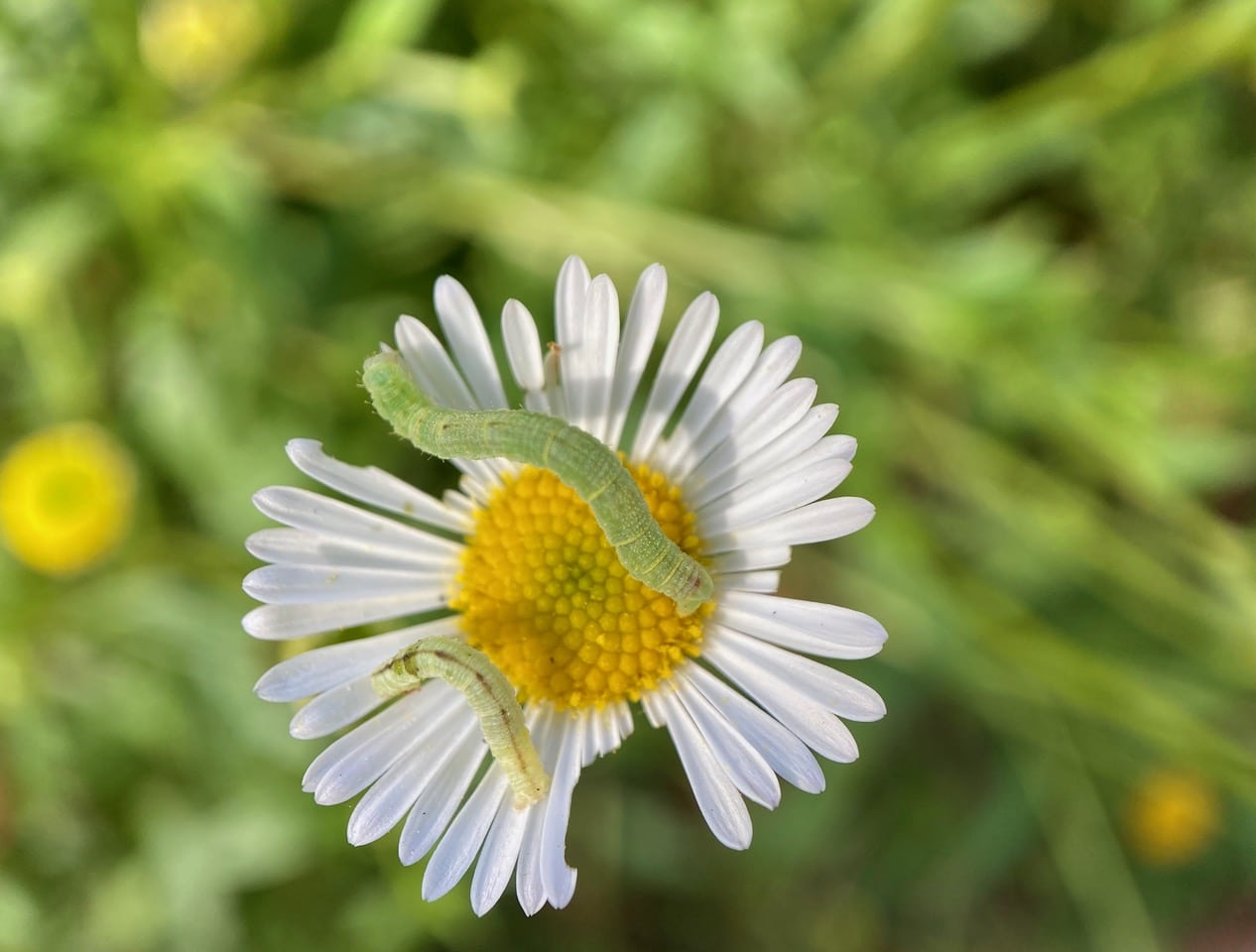
Ooh, two Inchworms on the same flowerhead of English Daisy, Bellis perennis. I think both are larvae of the Pug Moth, Eupithecia sp. (family Geometridae). Note the damage they have done to the ray flowers.
Inchworms are also called loopers and measuring worms. The majority of the inchworms are the larvae of moths in the family Geometridae. The name comes from the Greek “geo” for earth and “metro” from measure, because the caterpillars seem to be measuring the surface on which they are walking. The “looping” locomotion is mandated by the absence of prolegs in the middle section of the caterpillar’s body.
Eupithecia is the largest genus of moths of the family Geometridae. Occurring worldwide except for Australasia, species in the genus are commonly known as pugs. The caterpillars move in a looping manner and are commonly called inchworms. Adults are typically small, 12 – 35 mm, with muted colors. Most species rest with forewings held flat at right angles to the body, while the hindwing are largely covered by the forewings. They are generally nocturnal. Larvae mostly feed from the flowers and seeds of their food plants rather than the foliage. Many species have a very specific food plant. Many are commonly found on Asteraceae flowers.
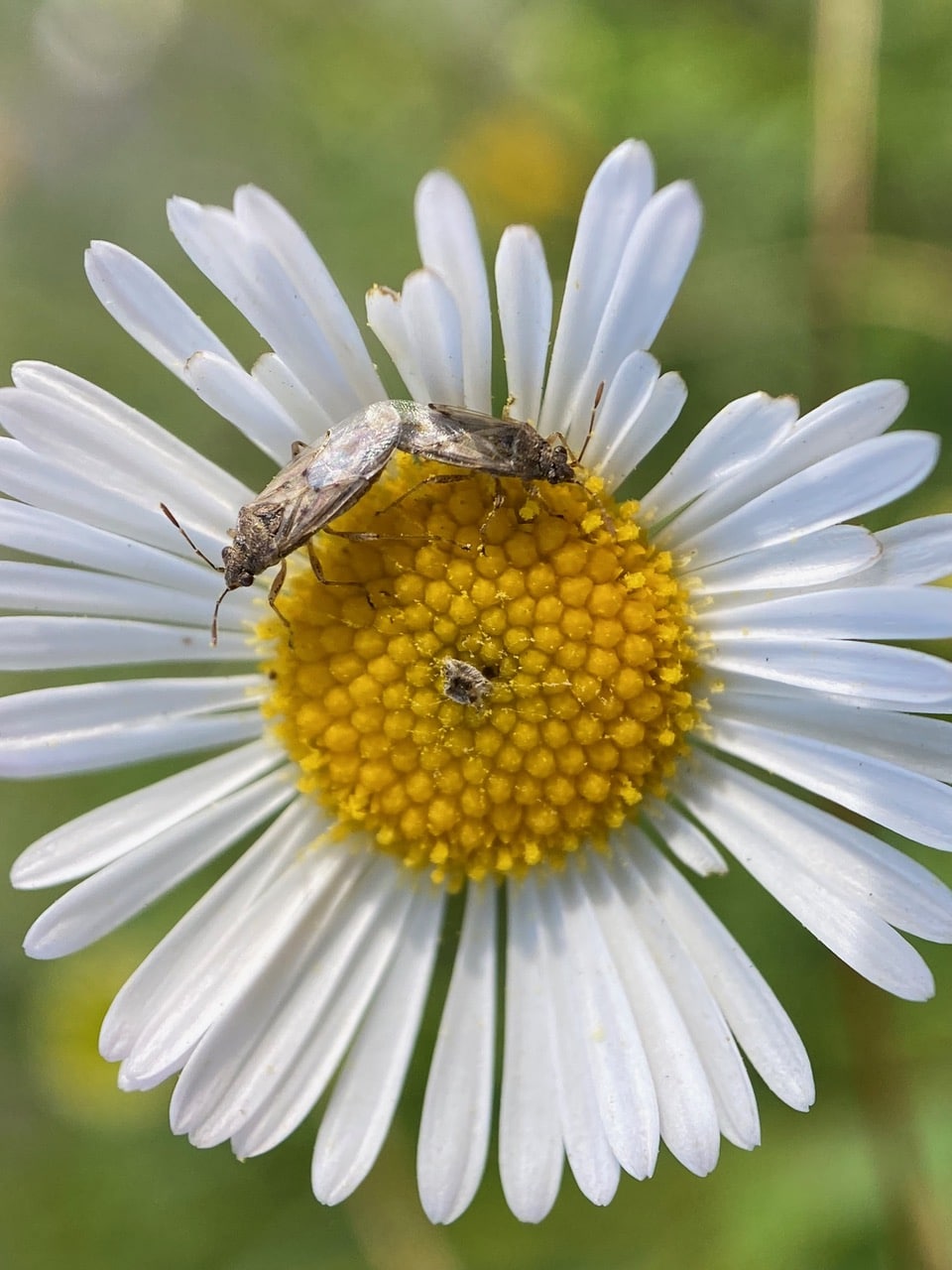
A pair of Scentless Plant Bugs, Arhyssus sp. (family Rhopalidae) is mating on an English Daisy flowerhead, Bellis perennis.

Most species of Arhyssus are found in the western states, often in fields, weedy areas and savanna. The Rhopalidae are distinguished by many veins on the membranous portion of the forewings. They differ from coreids and other hemipterans in lacking functional scent glands. All are plant-feeders, usually on ripe seeds. Like other “true bugs” in the order Hemiptera, Rhopalids have piercing-sucking mouthparts that they use to extract plant tissues. They are able to feed on seeds by injecting digestive juices into the seeds and sucking up the digested contents as a liquid. The mouthparts, collectively called a rostrum, is folded under the body when not in use.
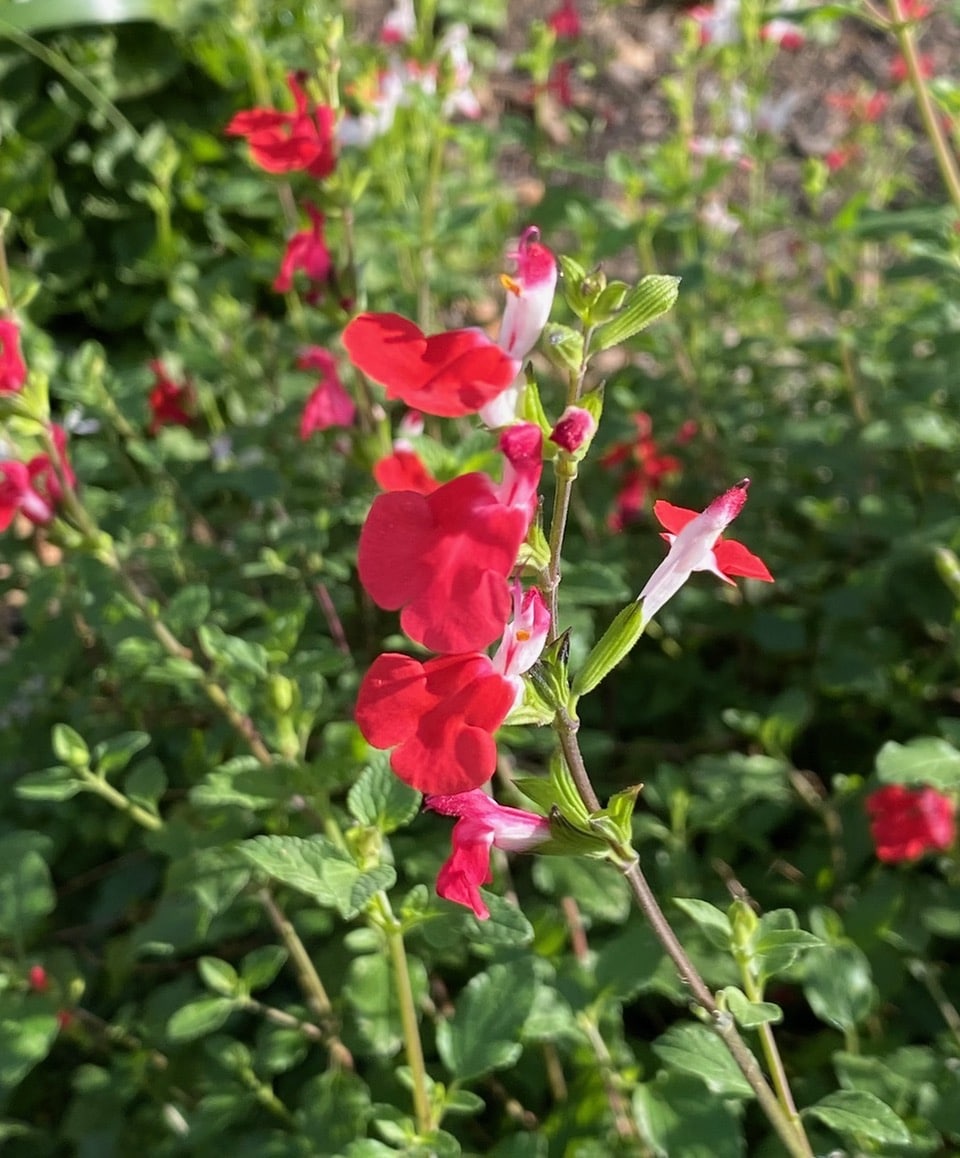
I stop to observe the insect activity on a large shrub of Hot Lips Sage, Salvia microphylla ‘hot lips’ which is blooming in profusion. Given the red color of the flowers, the Sage is probably pollinated by Hummingbirds. The reproductive structures are located right under the hooded upper lip, perfect place to dab pollen on the head of a visiting hummer as it dips its beak into the tubular flower.
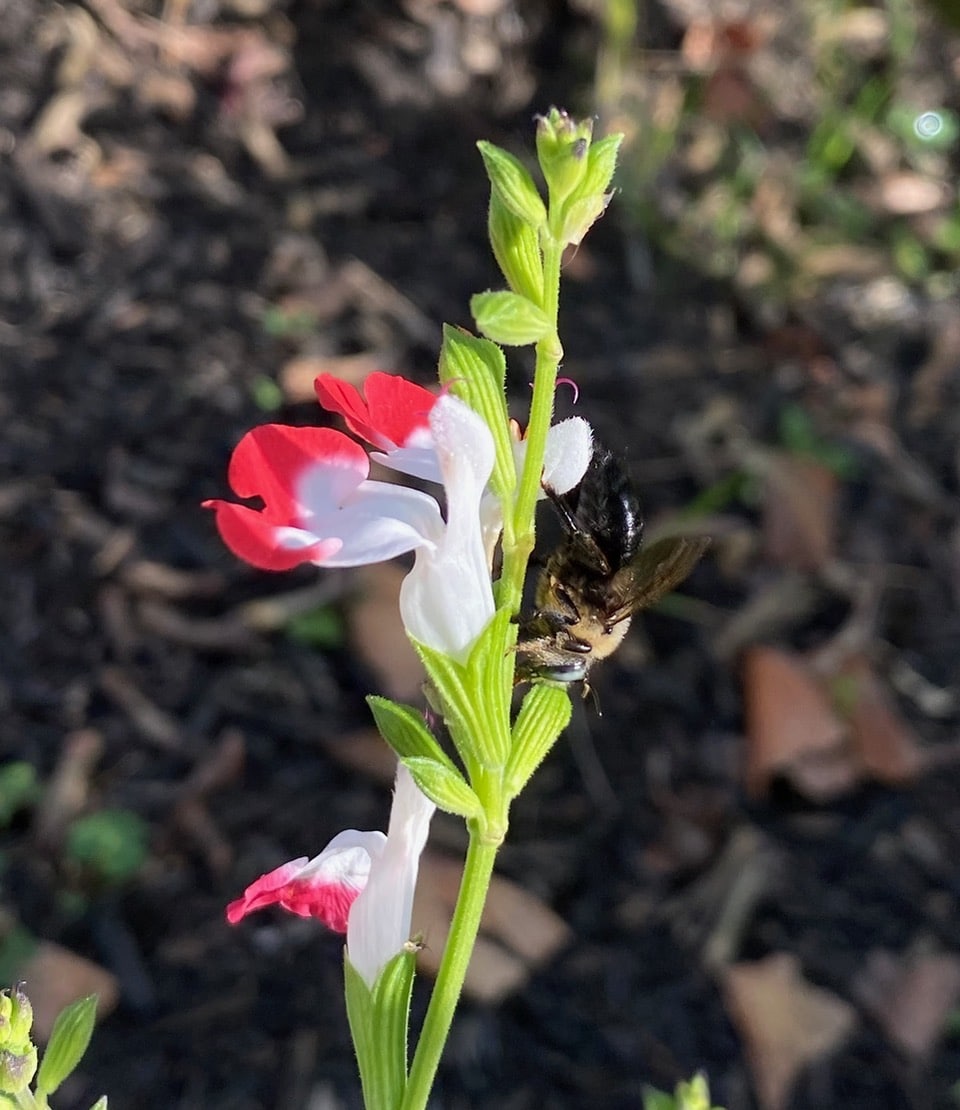
Several large bees with glossy black abdomen are flying excitedly around the sage bush. Ah, they are the Foothill Carpenter Bees, Xylocopa tabaniformis orpifex (family Apidae). Most of them are males. They never land on the lower lip of the sage flower to access nectar. Instead they invariably perch on the back of the flower…
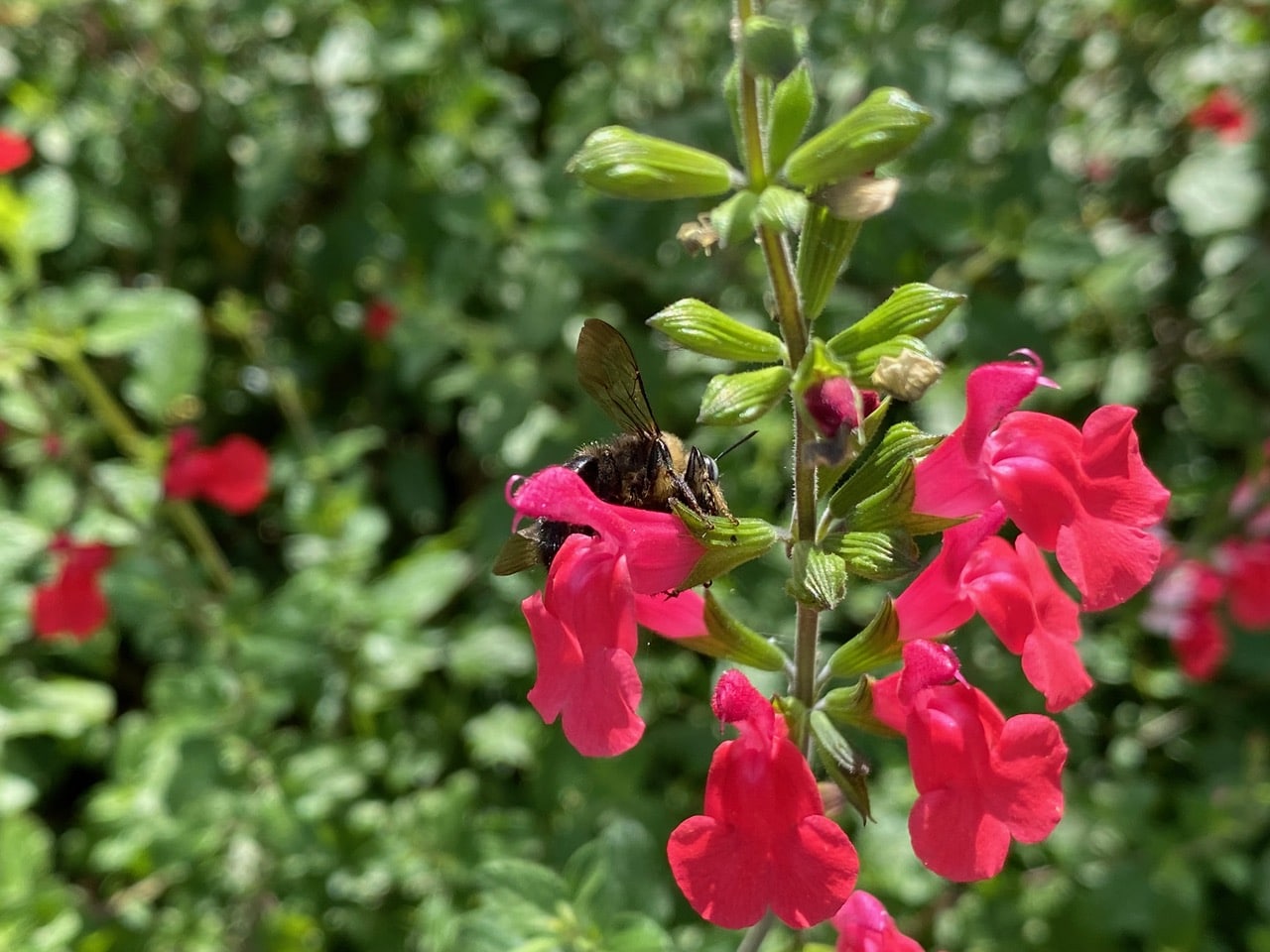
What is the Carpenter Bee doing in that position?
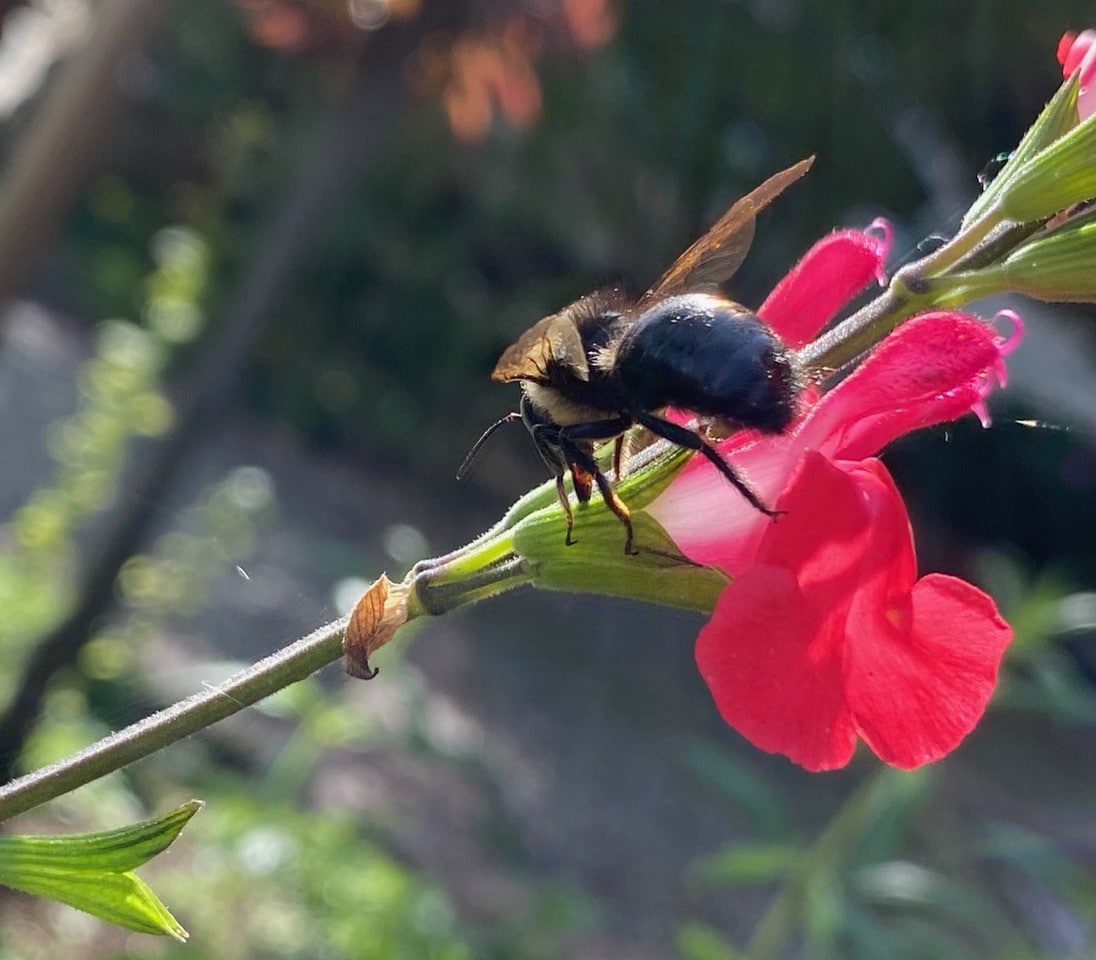
The bee has extended its tongue to take nectar through a slit it has made at the base of the flower, through the calyx. Sneaky!

Carpenter Bees (genus Xylocopa) are notorious nectar robbers. Instead of entering the front of the flower, they cut a slit at the base of the corolla (petals) with their sharp mandibles to reach the nectar. These large bees resort to this behavior when they cannot fit into certain flowers, especially tubular flowers like Salvia and Penstemon. By stealing nectar through the back door, they bypass the flower’s reproductive parts, and do not contribute to pollination. Other insects, such as Honey Bees, often follow behind and use the holes made by carpenter bees to take nectar themselves, acting as “secondary nectar robbers”. Though nectar robbing is considered “cheating”, carpenter bees are not always harmful and do serve as pollinators for other flower types, such as Lupines, Redbuds and Flannel Bush.

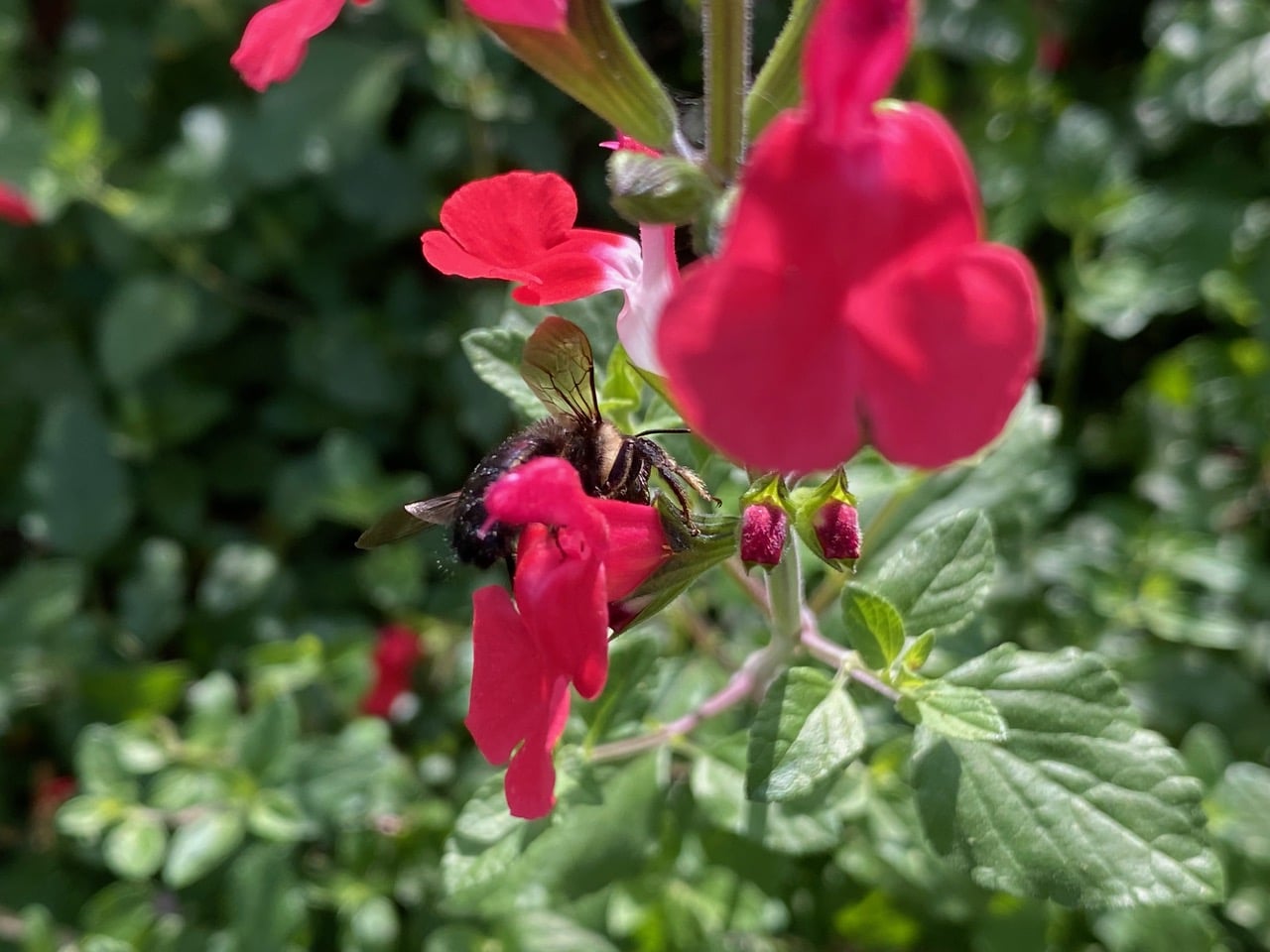
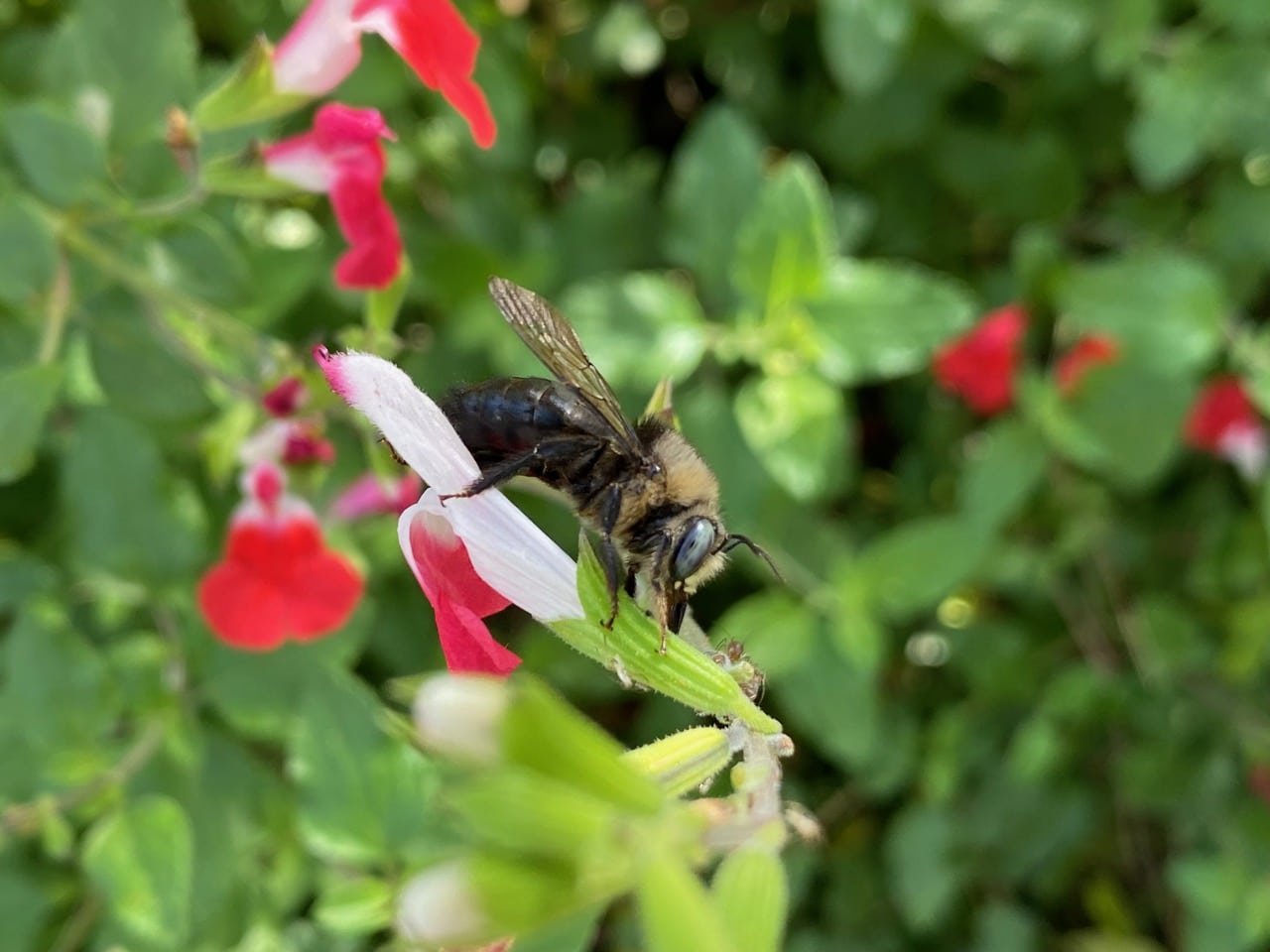
Is the bee cutting a slit in the calyx with its mandibles ?
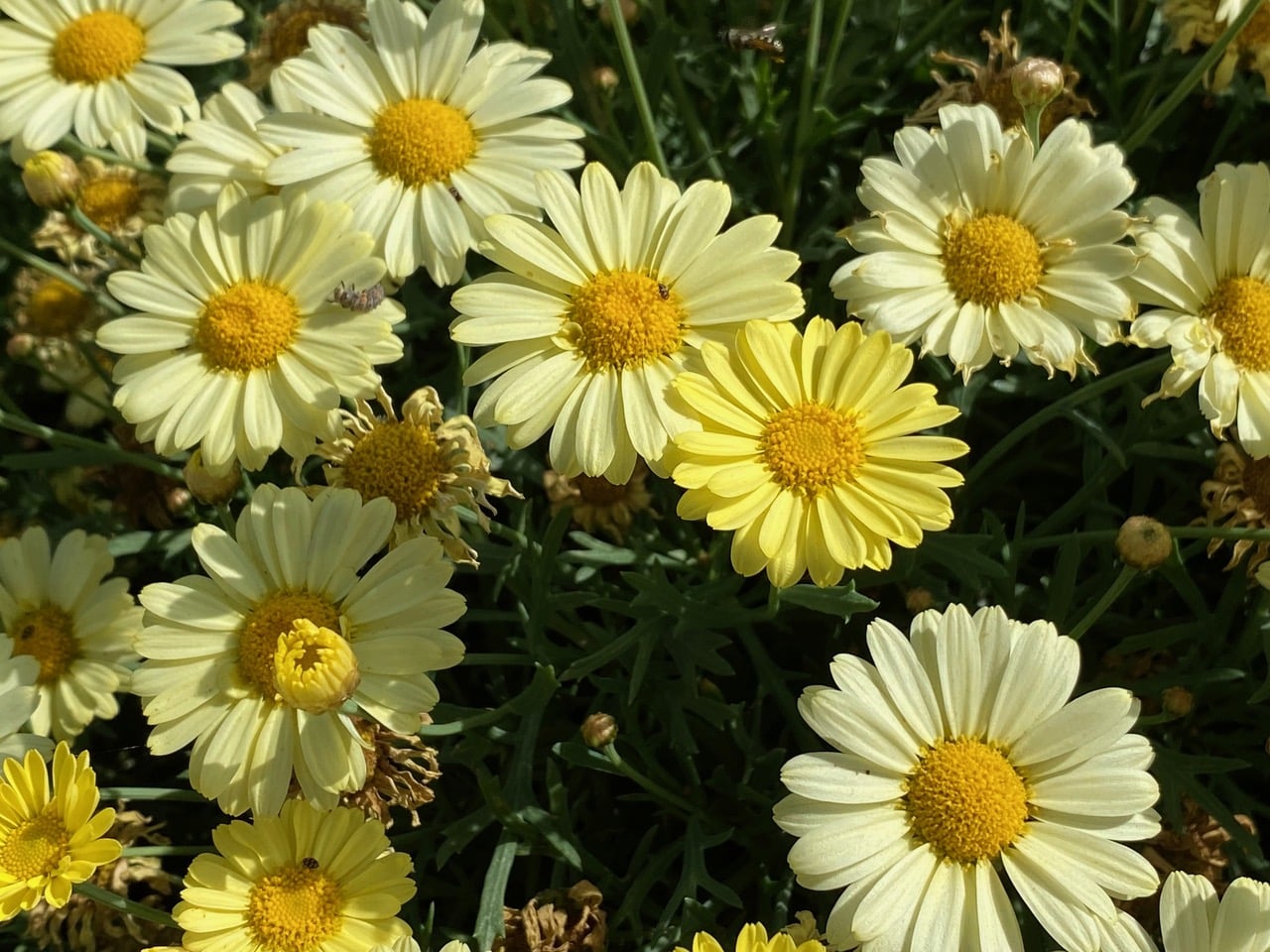
I am not familiar with these pale yellow daisy-like flowers. iNaturalist has helped identify them as Marguerite Daisy, Argyranthemum frutescens.
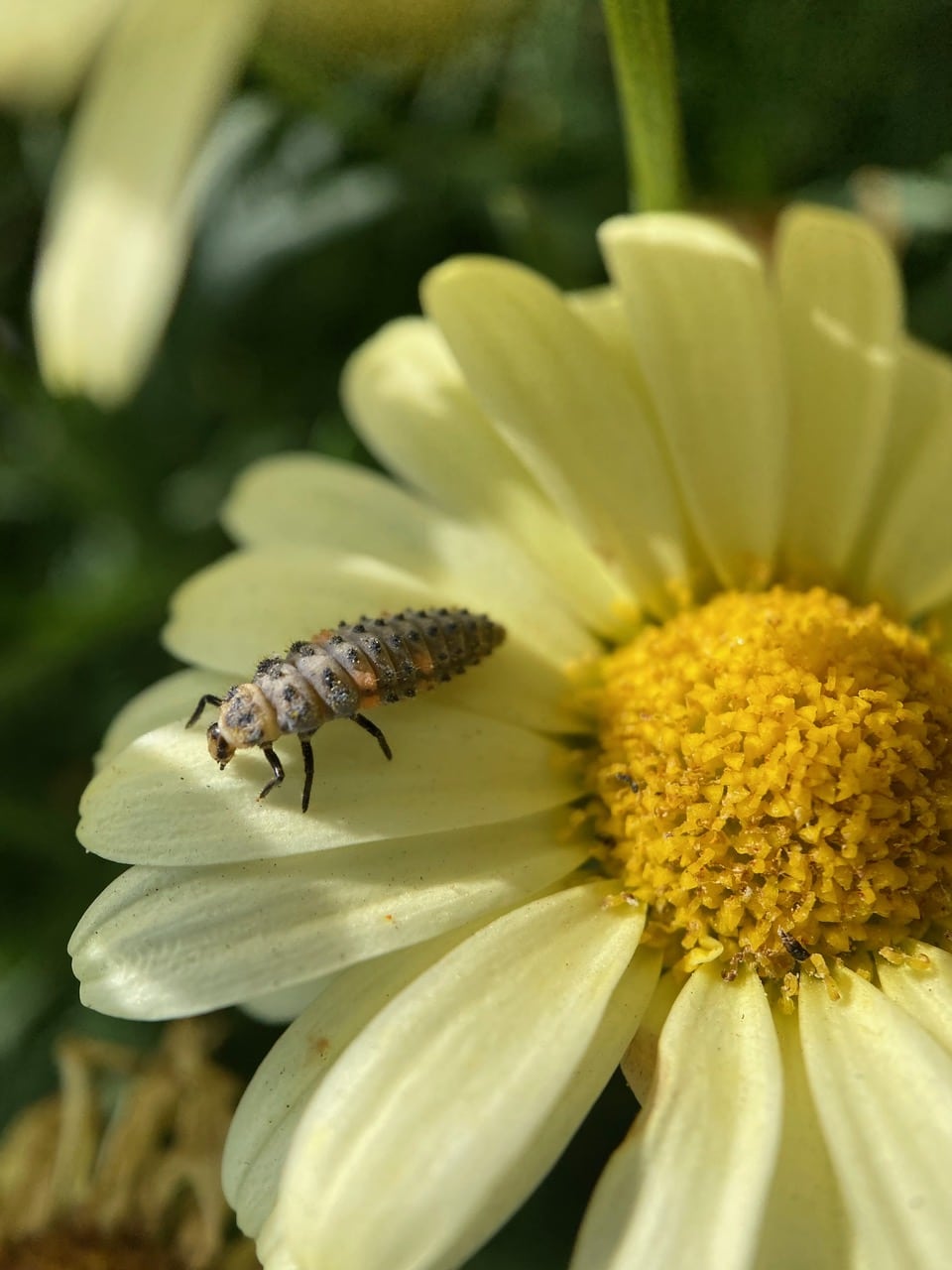
A Lady Beetle larva is moving sluggishly on the ray petals of the Marguerite Daisy.
Lady Beetles (family Coccinellidae), in both larval and adult forms, are voracious predators of aphids and other soft-bodied insects.

A Varied Carpet Beetle, Anthrenus verbasci (family Dermestidae) is feeding on pollen in the middle of a flowerhead of Marguerite Daisy.
The Varied Carpet Beetle, Anthrenus verbasci is a 3 mm-long beetle in the family Dermestidae. The elytra and pronotum are covered in fine scales of different colors, creating an irregular pattern of white, brownish, and yellowish patches. The beetles have clubbed antennae that fit into deep grooves. The species is found in most of Europe, North Africa, and North Asia. The beetles can be found both indoors and outdoors; its typical habitat is usually open areas with many flowers and trees, but it can also be found in houses, bird nests and other places. The eggs are laid in dry places, in bird nests in tree hollows where there are dead insects, or in dry dead insects, in dry dead animal parts or plant products, on windowsills in houses. Larvae feed on keratin and chitin of natural fibers (dead insects, animal hair and feathers) throughout their development. They are a common pest in museums, causing damage to biological collections. The larvae are used in taxidermy and by natural history museums to clean animal skeletons. Adults feed on the pollen and nectar of flowering plants, with a preference for flowers in the daisy family, Asteraceae.

Sensing the approach of my camera, a large black Jumping Spider on a flowerhead looks up at me, its hairy pedipalps partially covering the iridescent green chelicerae. The chelicerae are articulated fangs that are hollow and contain venom glands, used to inject venom into prey. The pedipalps are jointed appendages, much like small legs. They are used by the spider to sense objects, shape their webs, and to aid in prey capture and feeding. In male spiders, the pedipalps are also used to deliver sperm during mating.
The genus Phidippus comprises some of the largest jumping spiders, and many species are characterized by their brilliant, iridescent green chelicerae. Phidippus is distributed almost exclusively in North America.
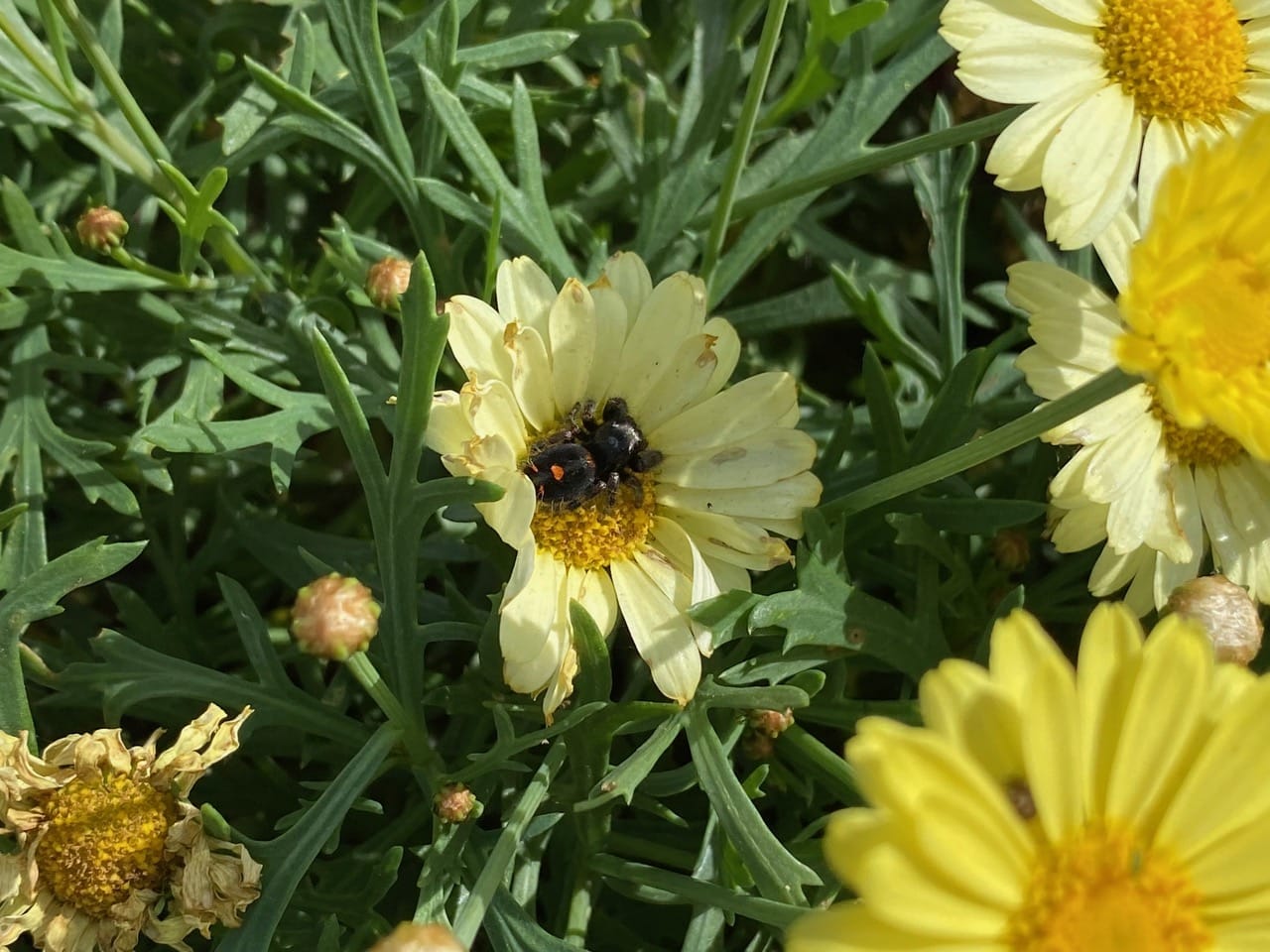
What a beauty – it’s a female Bold Jumping Spider, Phidippus audax (family Salticidae).
Phidippus audax (family Salticidae) is commonly referred to as Bold Jumping Spider. The species name, audax, is a Latin adjective meaning “audacious” or “bold”. These spiders are commonly found in grasslands, chaparrals, open woodlands, and agricultural fields. It is one of the most commonly occurring spider species within its range and is often found living in close proximity to humans. The adult female ranges from 8-15 mm in body length; the smaller males range from 6-13 mm. They are typically black with an ovoid abdomen and round cephalothorax. The presence of a large triangular white spot in the center of the abdomen with two smaller spots below it is often used to distinguish this species. These spiders are diurnal hunters, using their excellent eyesight for hunting, courtship and observational learning. They are often found hunting on fence posts and plant leaves, stems, and branches. At night, they hide in a crevice or small cavity and make a silk retreat to avoid predators. Bold jumpers prey on a variety of insects including caterpillars, dragonflies and grasshoppers, and other spiders. The species overwinters as immatures in sac-like silk shelters hidden underneath rocks and bark. Spiders emerge in the spring to complete their final molts, mating in late spring and early summer.

The spider decides to go hunting on the foliage.
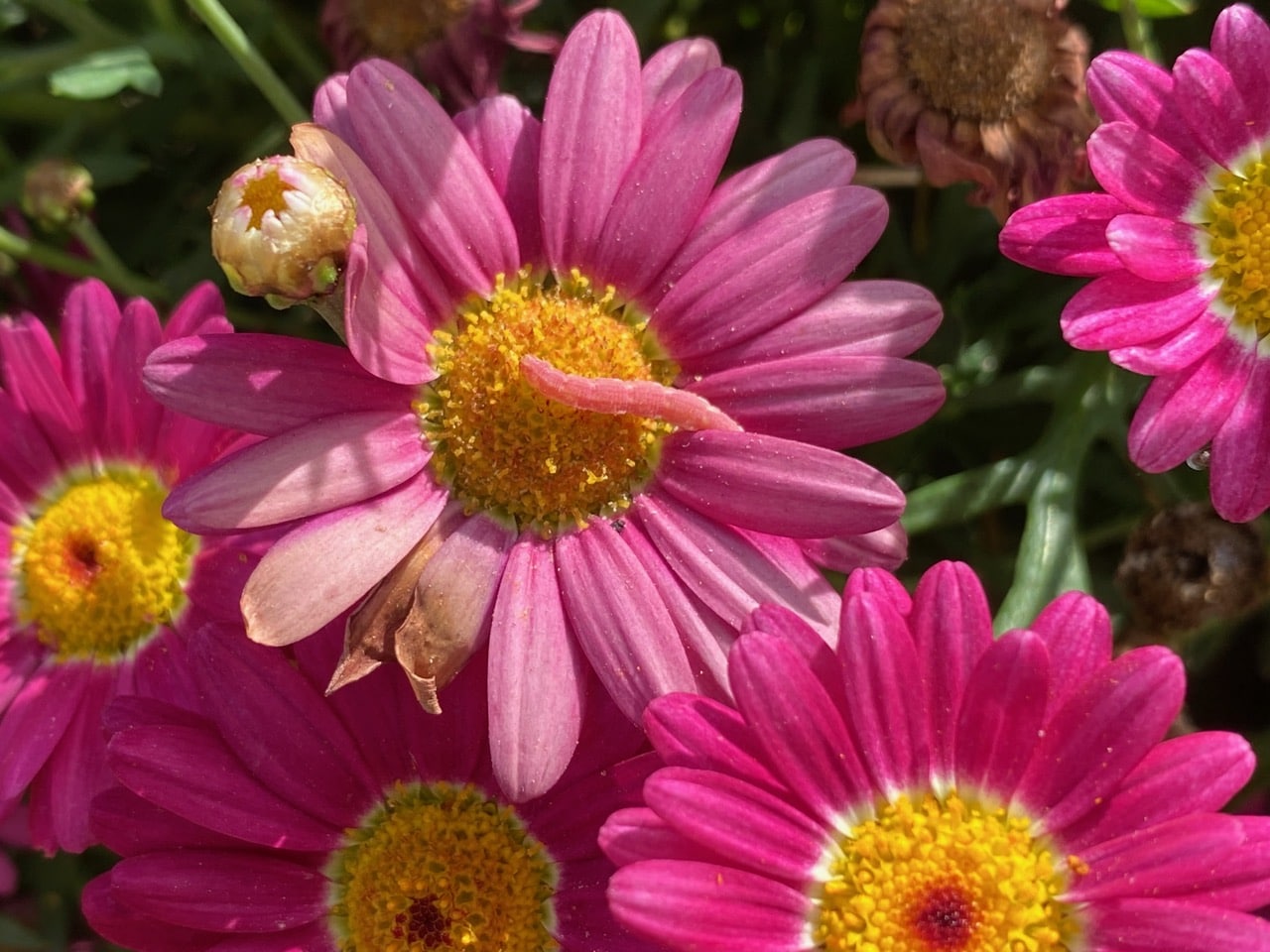
Ooh, do you see the pink caterpillar on the pink flowerhead of Marguerite Daisy, Argyranthemum frutescens? It is another Pug Moth caterpillar, Epithecia sp. (family Geometridae).
Pug Moth caterpillars (especially the Common Pug, Eupithecia miserulata) are well-known for adapting their coloration to match the flowers they feed on. These “flower-feeders” commonly take on the color of petals to camouflage themselves from predators.
Pug Moth caterpillars are generalist feeders that consume pollen, nectar, and petals of flowers rather than just leaves. They appear to pick up pigments from their diet, allowing them to remain hidden on the very food they are eating. They often feed at night and hide under flowers during the day to avoid detection. They are commonly found in gardens and meadows, and do not usually cause significant damage.
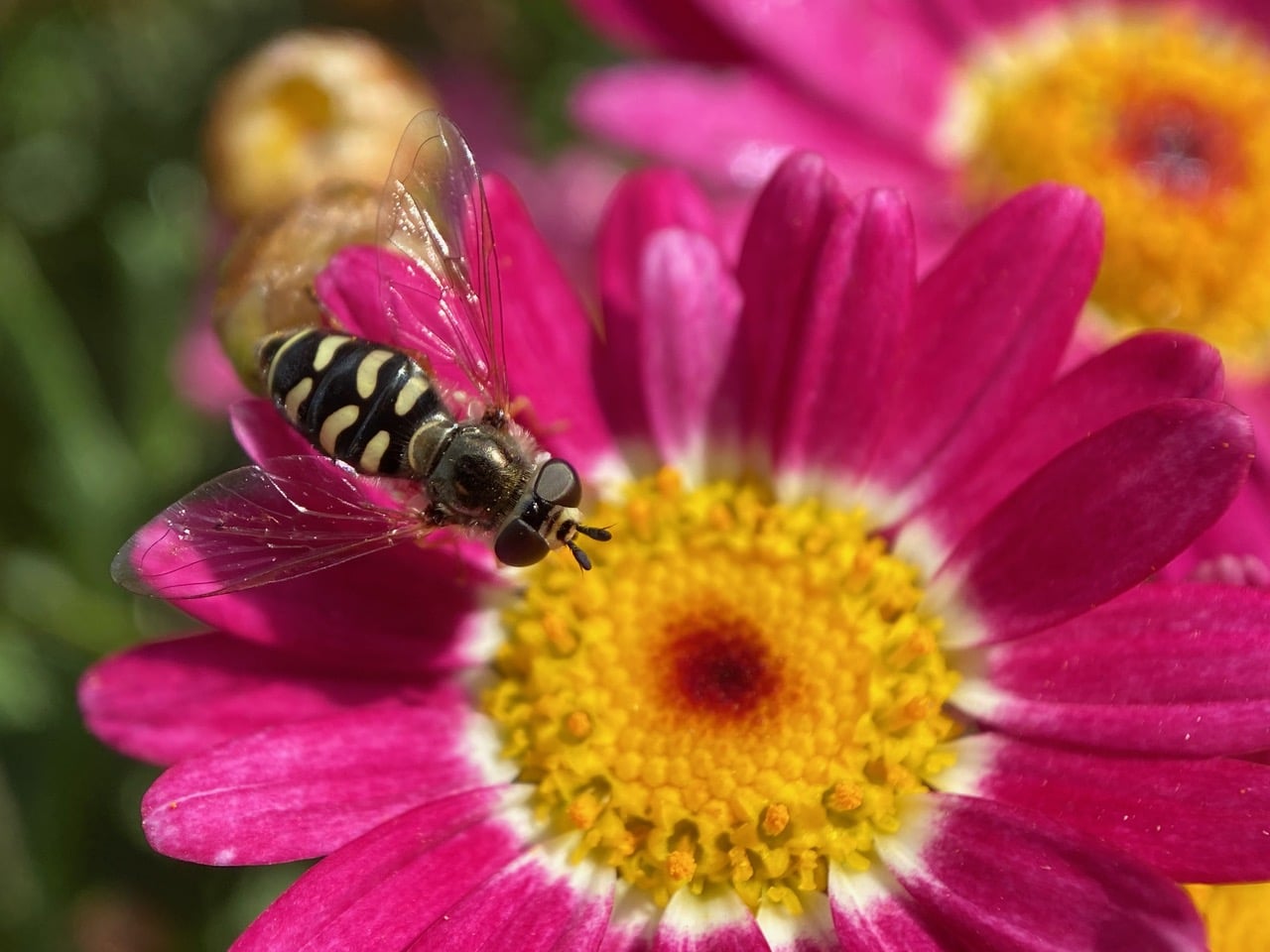
A female Large-tailed Aphideater, Eupeodes volucris (family Syrphidae) lands on a pink Marguerite Daisy flowerhead.
The Large-tailed Aphideater, Eupeodes volucris (family Syrphidae) is found in western North America, and is active March through November. The common name of the species refers to the distinctive “large tail” or projecting cylindrical abdomen of the males. As the rest of the common name implies, the larvae of the species are voracious predators of small plant-sucking insects such as aphids. Females seek out dense aphid colonies on plants to lay eggs among them. Adults visit flowers for nectar and pollen.