

Pollinator Post 3/20/24 (4)
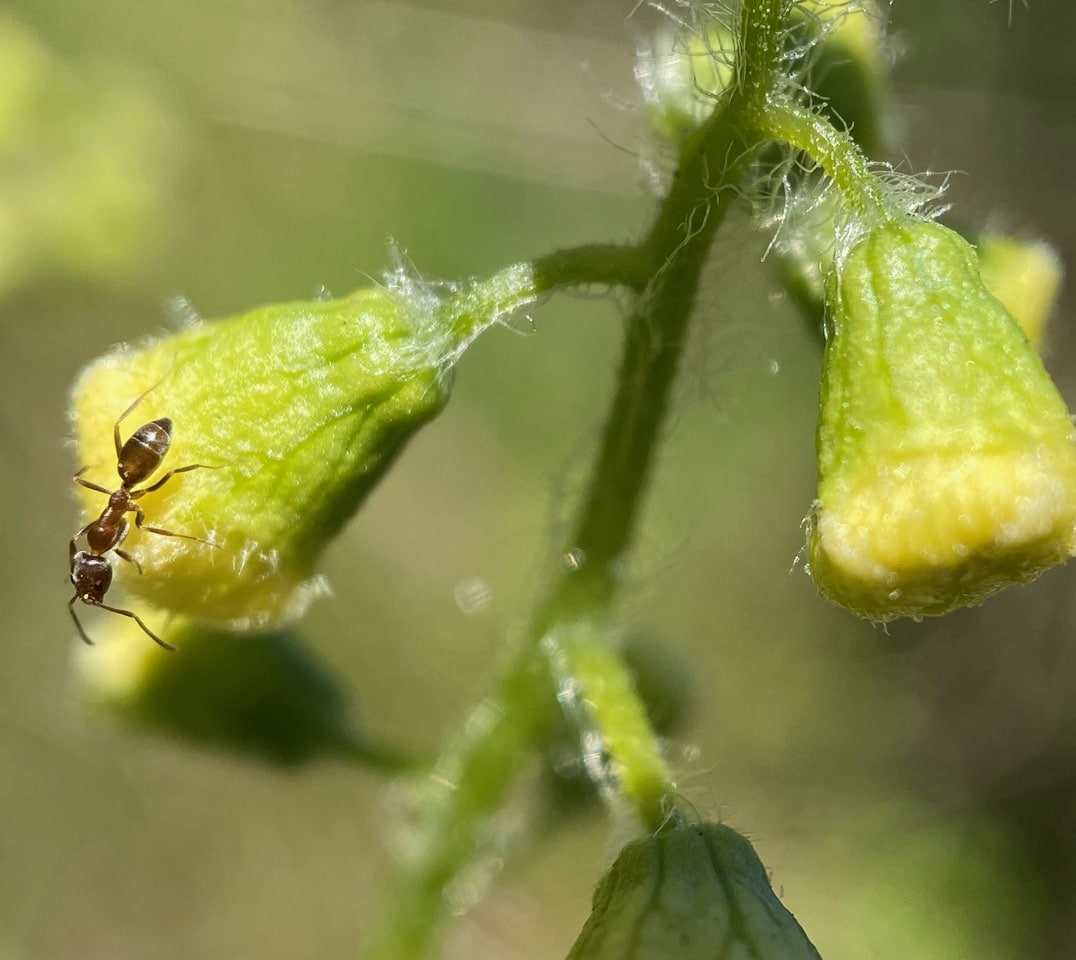
An Argentine Ant is roaming the flower buds of a Wild Cucumber, Marah oregana.
The Argentine Ant, Linepithema humile (family Formicidae) is native to Northern Argentina, but it has been inadvertently introduced by humans to many countries, and is now an established invasive species in many Mediterranean climate areas worldwide. The success of the species can be attributed to their lack of aggression between the colonies. There is no apparent antagonism between separate colonies of its own kind, resulting in “super-colonies” that extend across hundreds or thousands of kilometers in different parts of the their range. Genetic, behavioral, and chemical analyses show that introduced Argentine Ants on separate continents actually represent a single global supercolony.
The Argentine Ants are ranked among the world’s worst invasive animal species. In its introduced range, the Argentine ant often displaces most or all native ants and can threaten native invertebrates and even small vertebrates that are not accustomed to defending against the aggressive ants. This can, in turn, imperil other species in the ecosystem, such as native plants that depend on native ants for seed dispersal, or lizards that depend on native ants for food.
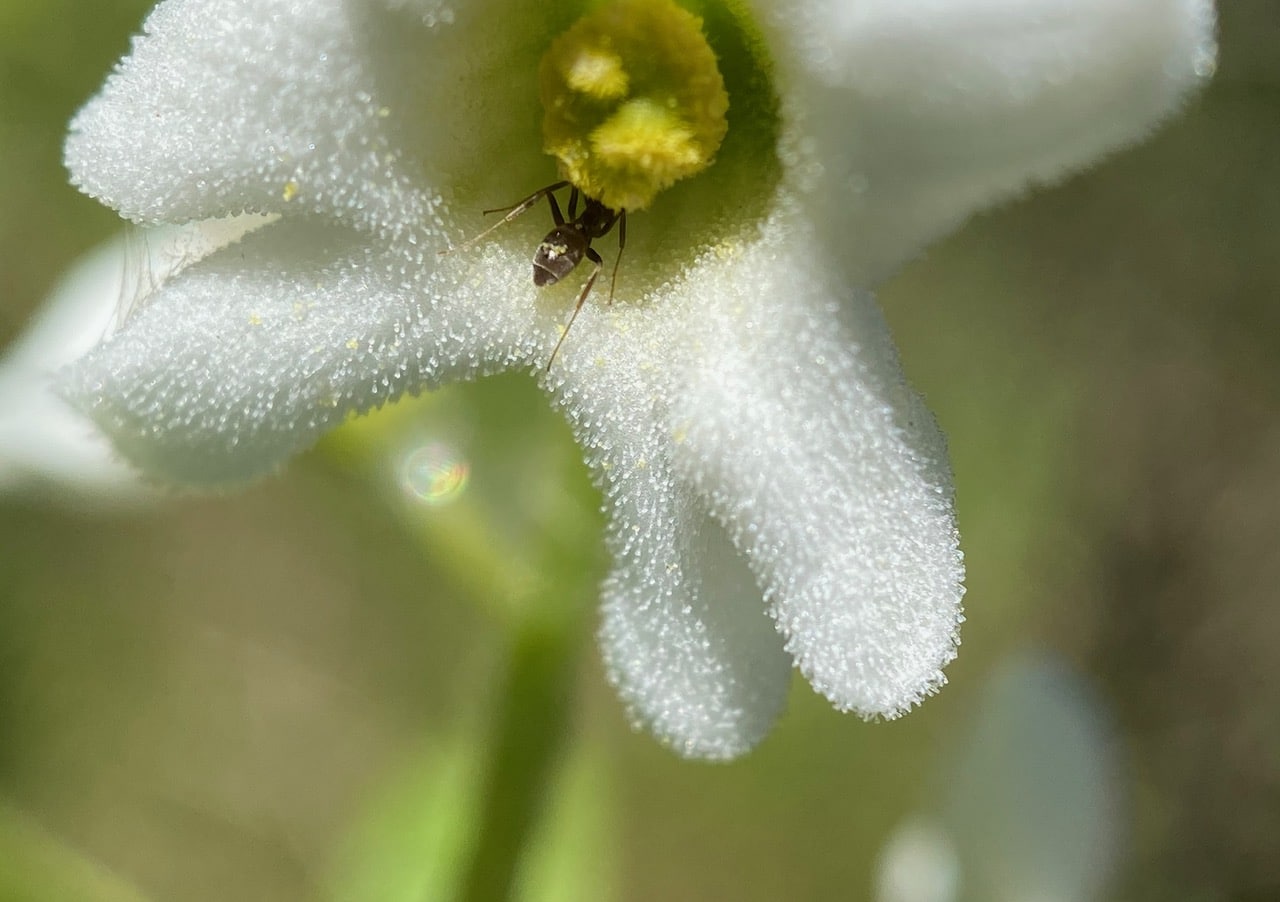 Another ant is going down the corolla of a male flower for nectar, passing the yellow knobby structure (fused stamens) in the middle of the flower.
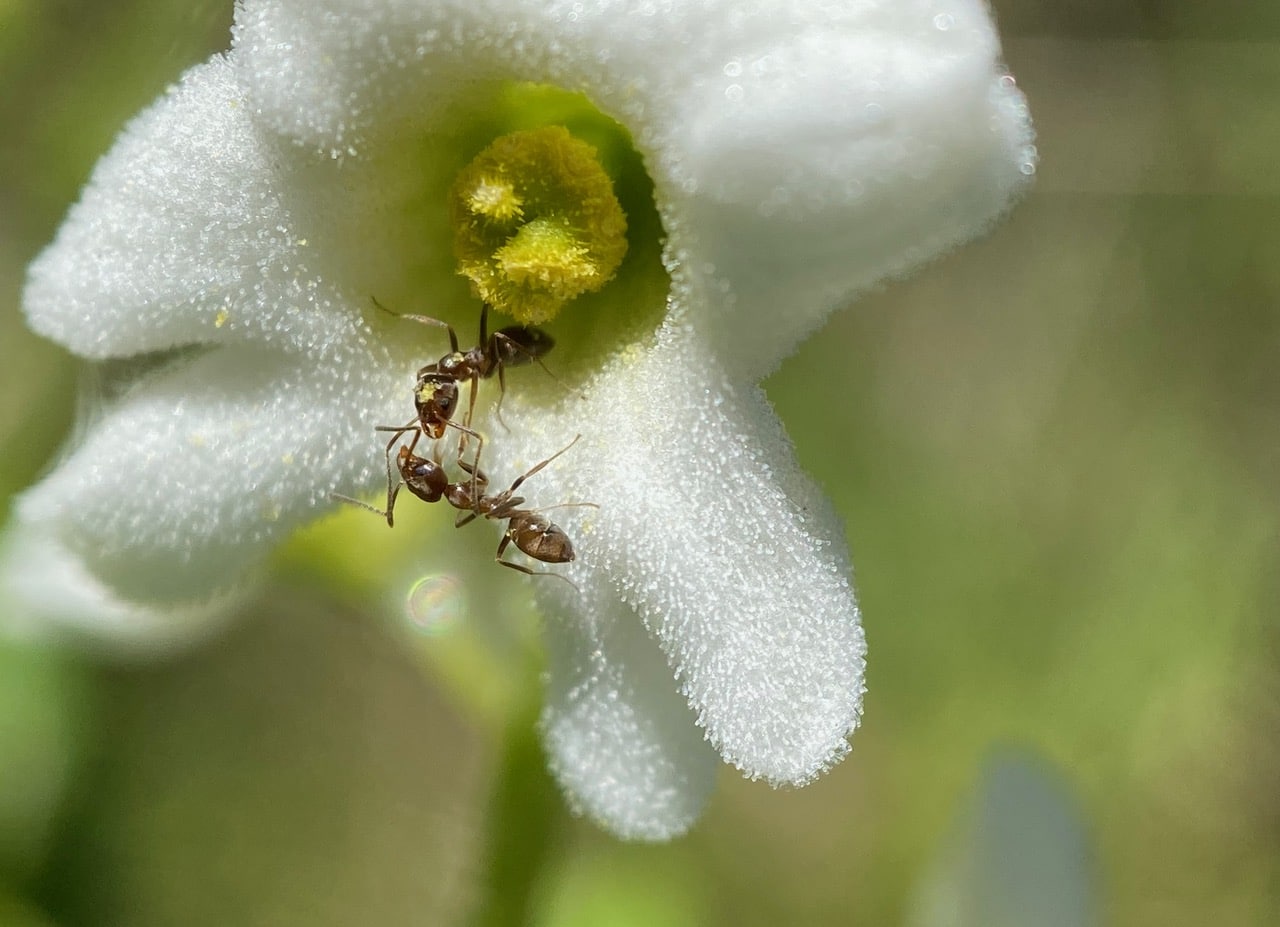 When the ant emerges with pollen stuck to its head, it is greeted by a comrade.
Apparently the Argentine Ants are capable of ferrying pollen between the flowers of Wild Cucumber, potentially serving as pollinators.
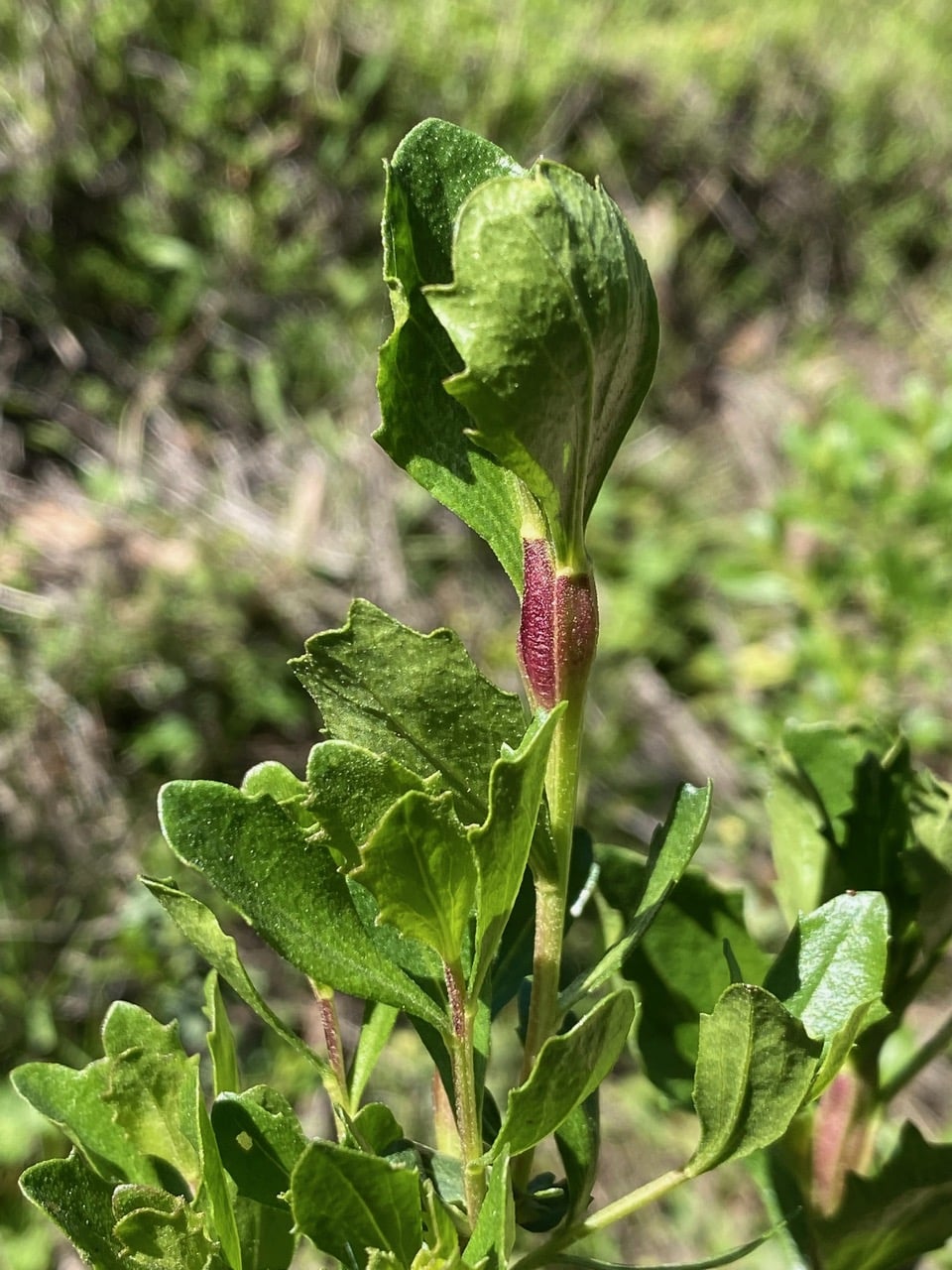
The Coyote Brush, Baccharis pilularis along the trail is vibrant with fresh new leaves. There are also new galls developing on many of the stem tips.
Galls are tumor-like growths of plant tissue produced by the host plant in response to the chemical and/or mechanical stimuli of invading organisms (insects, mites, fungi). The galls of many insects are specific to their species in size, shape, and color. The insect larvae feed on the gall tissues from within, hence the galls are essentially “edible nurseries” for the young.
This spindle-shaped gall on the Coyote Brush stem is made by a small moth, Gnorimoschema baccharisella (family Gelechiidae). Each gall holds only a single larva. Gall development begins after overwintering eggs hatch in the spring and the larvae burrow into new terminal shoots. The occupied stems swell around the larvae, leaving large cavities within which the larvae feed. When mature the larvae cut exit holes through the gall walls and drop to the ground to pupate. The galls are often parasitized or lost to predators, creating a complex food web on the plant.
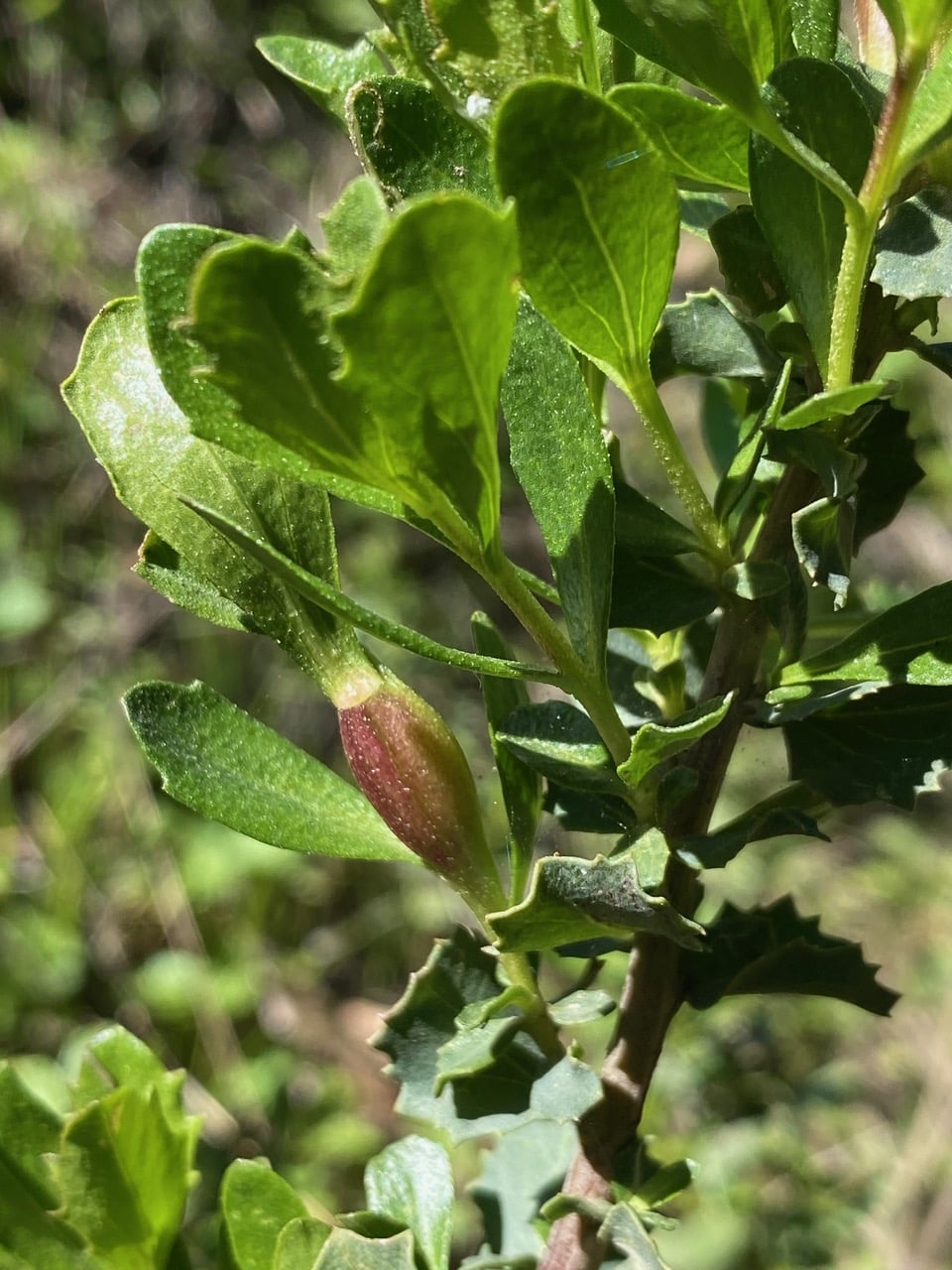
Lower down on the same plant is another young gall induced by the Coyote Brush Stem Gall Moth.
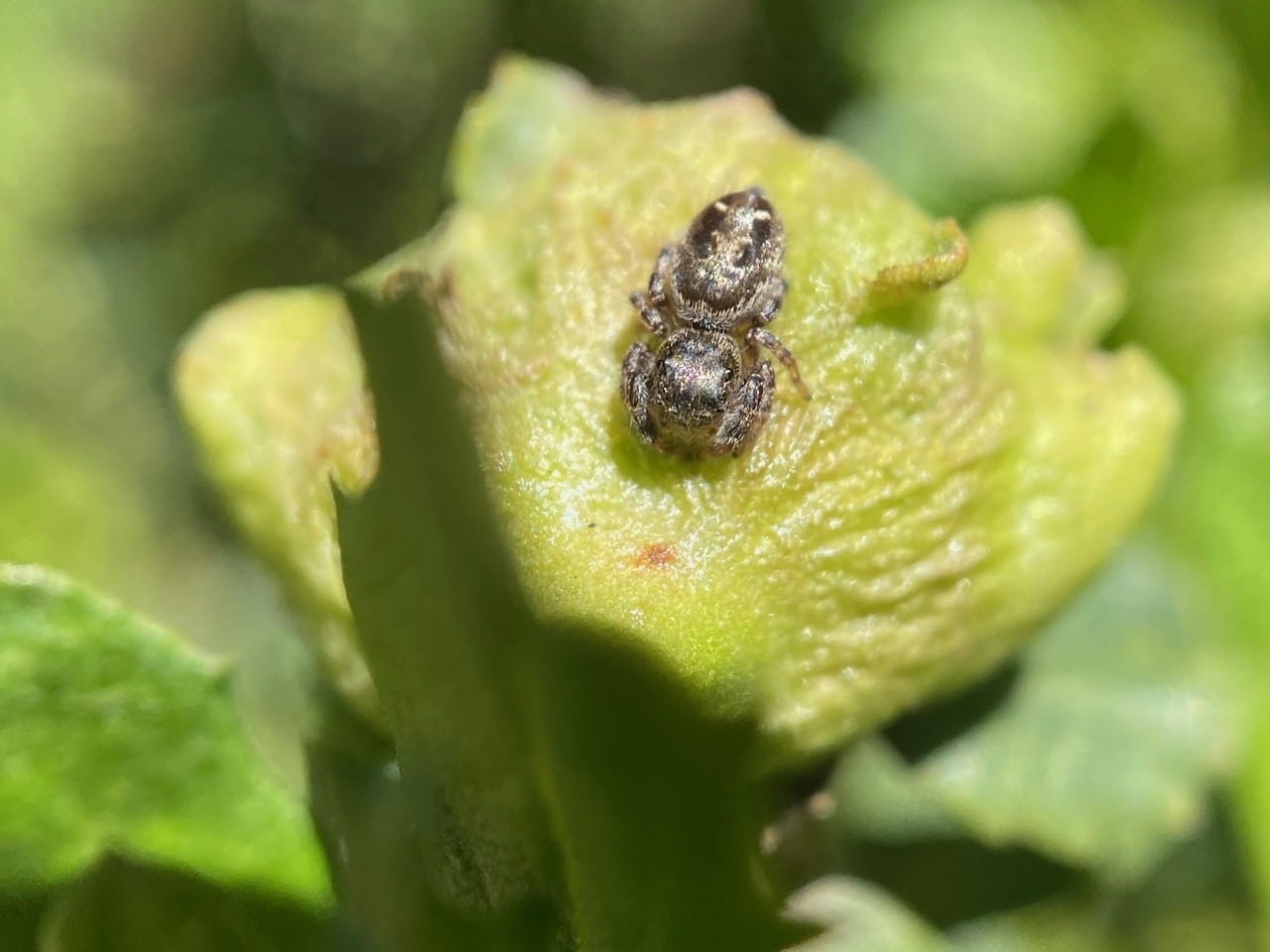
Shining brilliantly in the midday sun, a tiny Jumping Spider is moving around on a Coyote Brush Bud Gall on the tip of a stem. It is a Coppered White-cheeked Jumping Spider, Pelegrina aeneola (family Salticidae).
Salticids are free-roaming hunting spiders. They do not weave a web to catch prey. They stalk, then pounce on their prey. Just before jumping, the spider fastens a safety line to the substrate. It can leap 10-20 times their body length to capture prey. Their movement is achieved by rapid changes in hydraulic pressure of the blood. Muscular contractions force fluids into the hind legs, which cause them to extend extremely quickly.
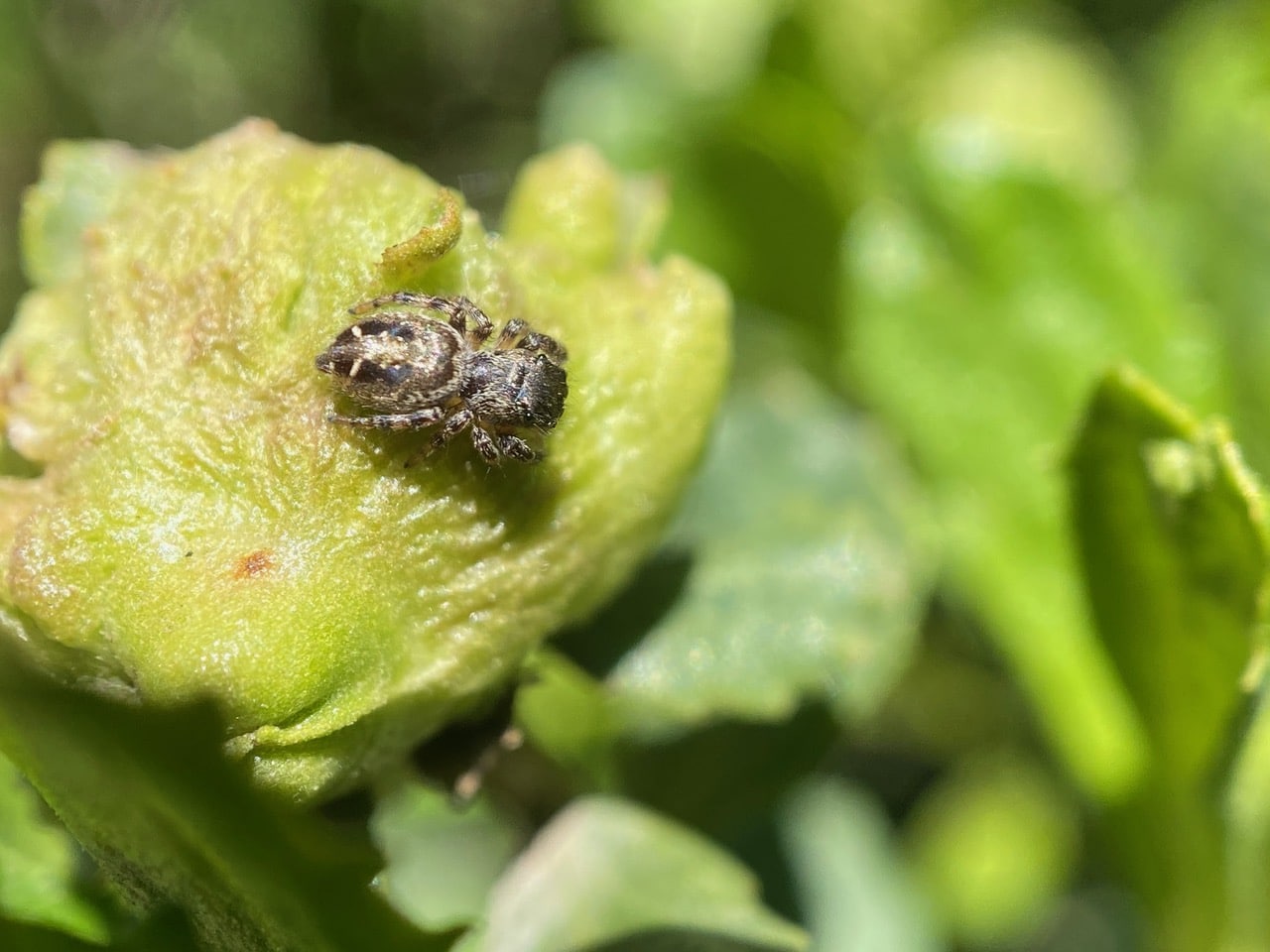
Why would a spider be so shiny? Unfortunately little is known about the biology of this species.
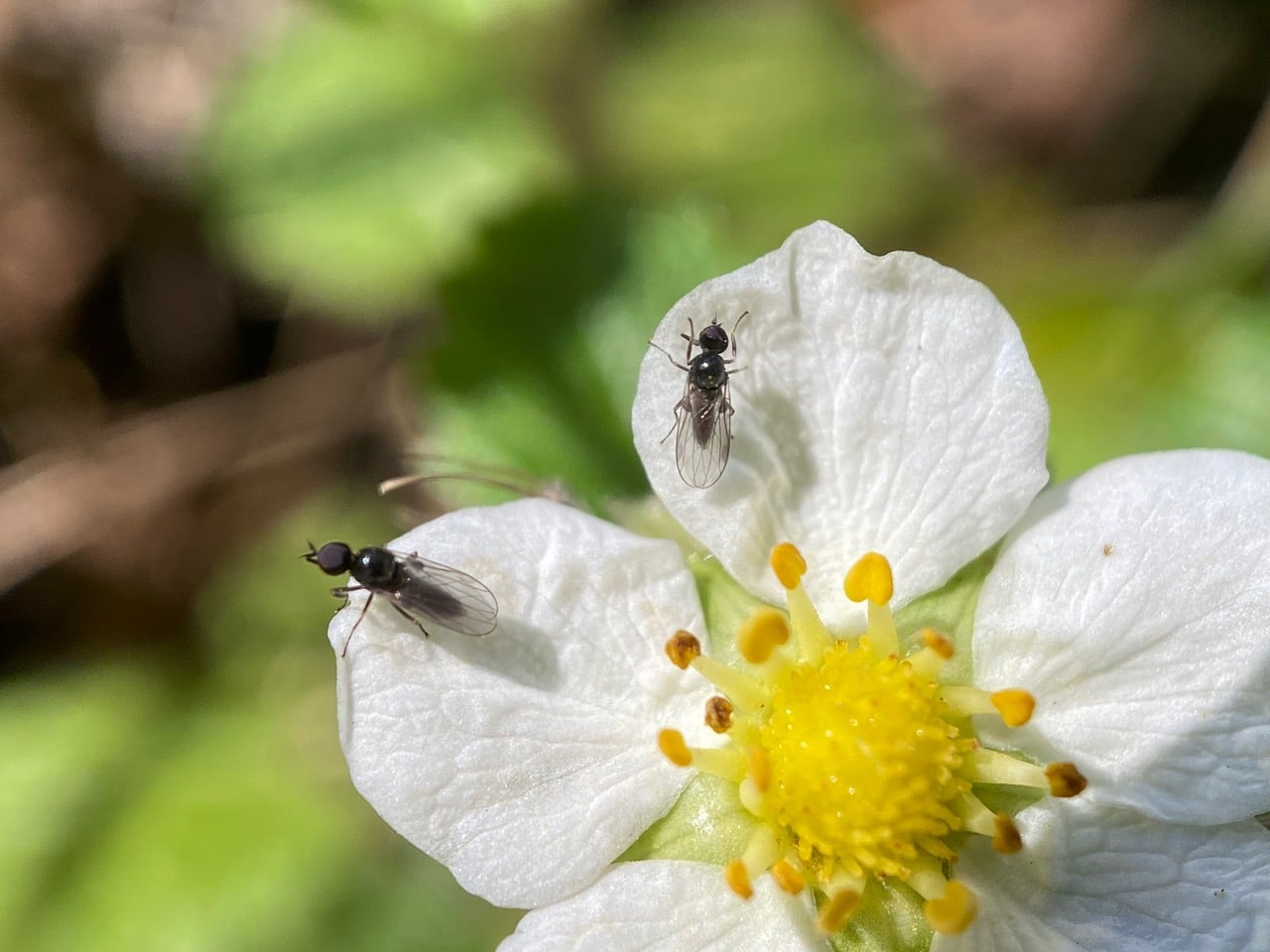
Two Hybotid Dance Flies (family Hybotidae) are resting on a flower of Woodland Strawberry, Fragaria vesca. These flies feed on nectar and pollen from a wide range of early-blooming wildflowers, especially the small ones.
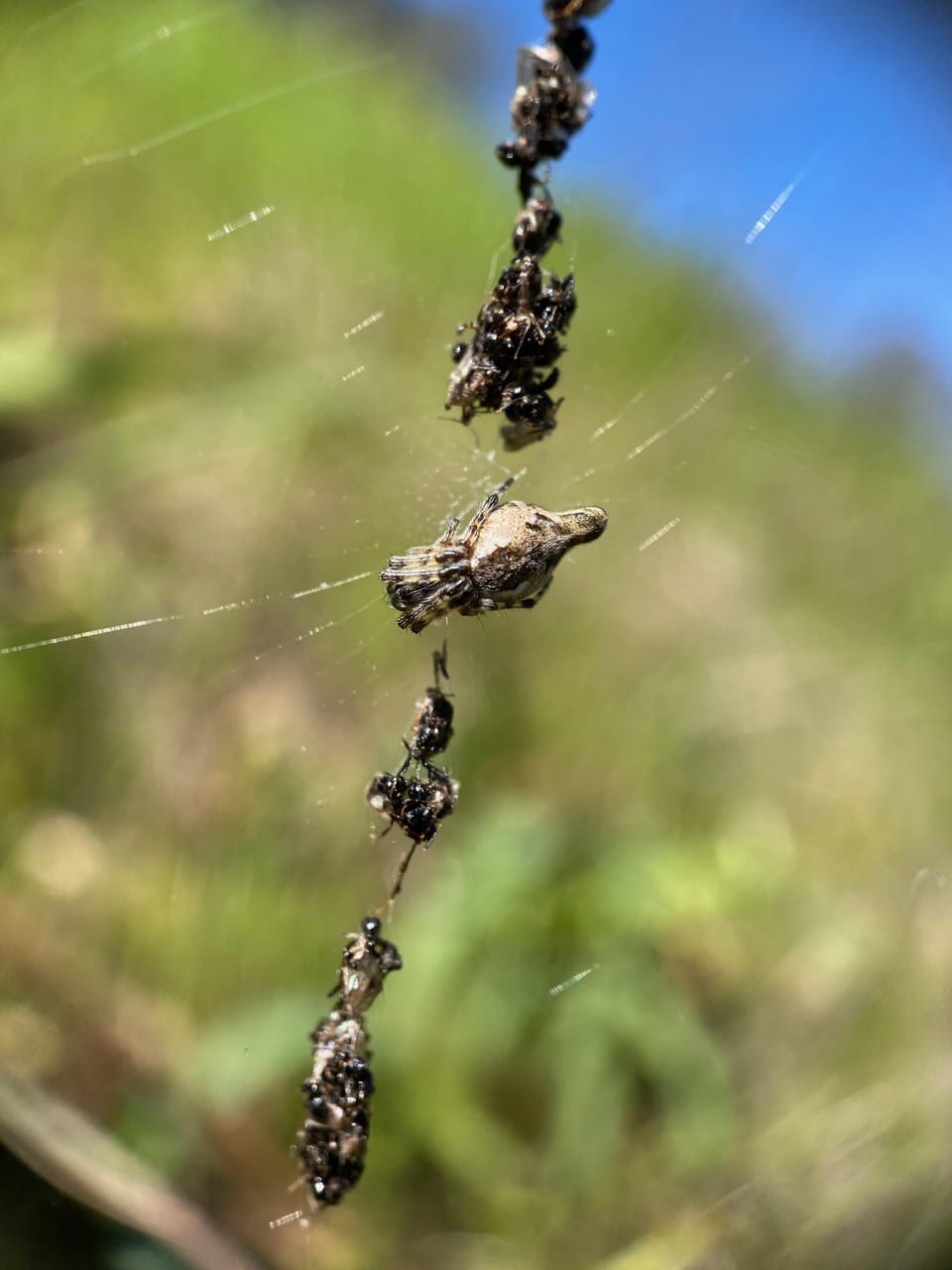
A Humped Trashline Orbweaver sits in the middle of her web in a row of bulging bundles of trash. It is one of the largest individuals of the species I have ever seen, with oversized trash heaps to match. Taking a closer look at her trash on display, I find mostly glossy black insect parts. Wow, has there been a nuptial flight of the American Winter Ants here in the last couple of days? The winged ant reproductives would provide a sumptuous windfall for many predators, such as lizards, birds, and – spiders!
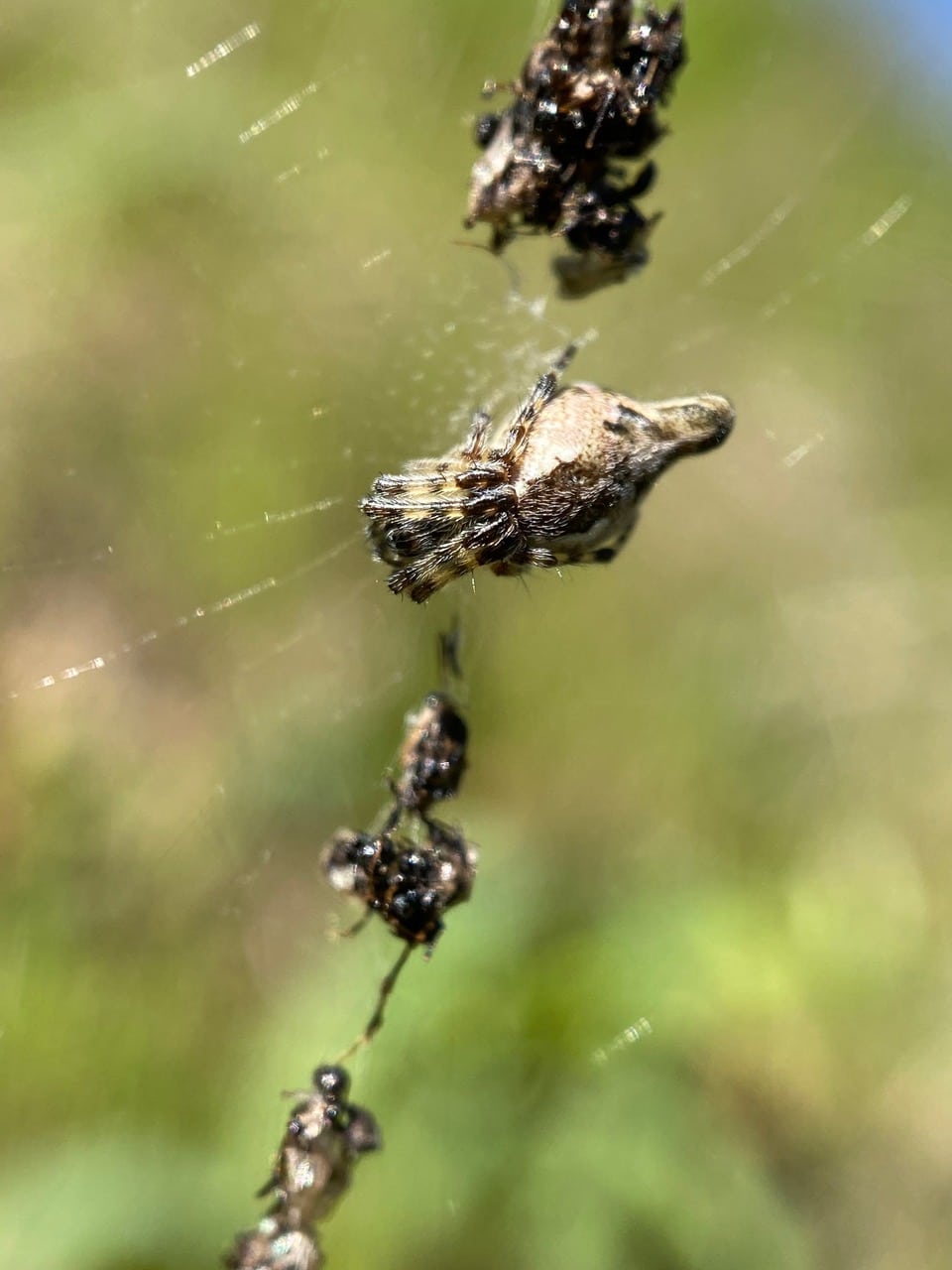
Close-up of the Humped Trashline Orbweaver. She is so plump that the “humps” on her abdomen are hardly visible! The spider has neatly wrapped her two front pairs of legs around her cephalothorax, concealing the usual shape of a spider.
Humped Trashline Orbweaver, Cyclosa turbinata (family Araneidae) is native to the continental United States. It is a small species, about 4-7 mm in length. Their color is a mix of browns, blacks, and whites, and their abdomen tapers to a rounded point. C. turbinate is distinguished from the others in the genus by the presence of two anterior dorsal humps.
Trashline spiders are so-called for their web decoration. Cyclosa create orb-shaped webs using both the sticky and non-sticky threads, mostly during times of complete darkness. Across its spiral wheel-shaped web, Cyclosa fashions a vertical “trashline” made of various components such as prey’s carcasses, detritus, and at times, egg cases. The trashline helps the spider to camouflage exceptionally well from predators. The spider sits in the web hub to conduct its sit-and-wait hunting, ensnaring prey at nearly any time of day; it only leaves its spot to replace the web prior to sunrise.
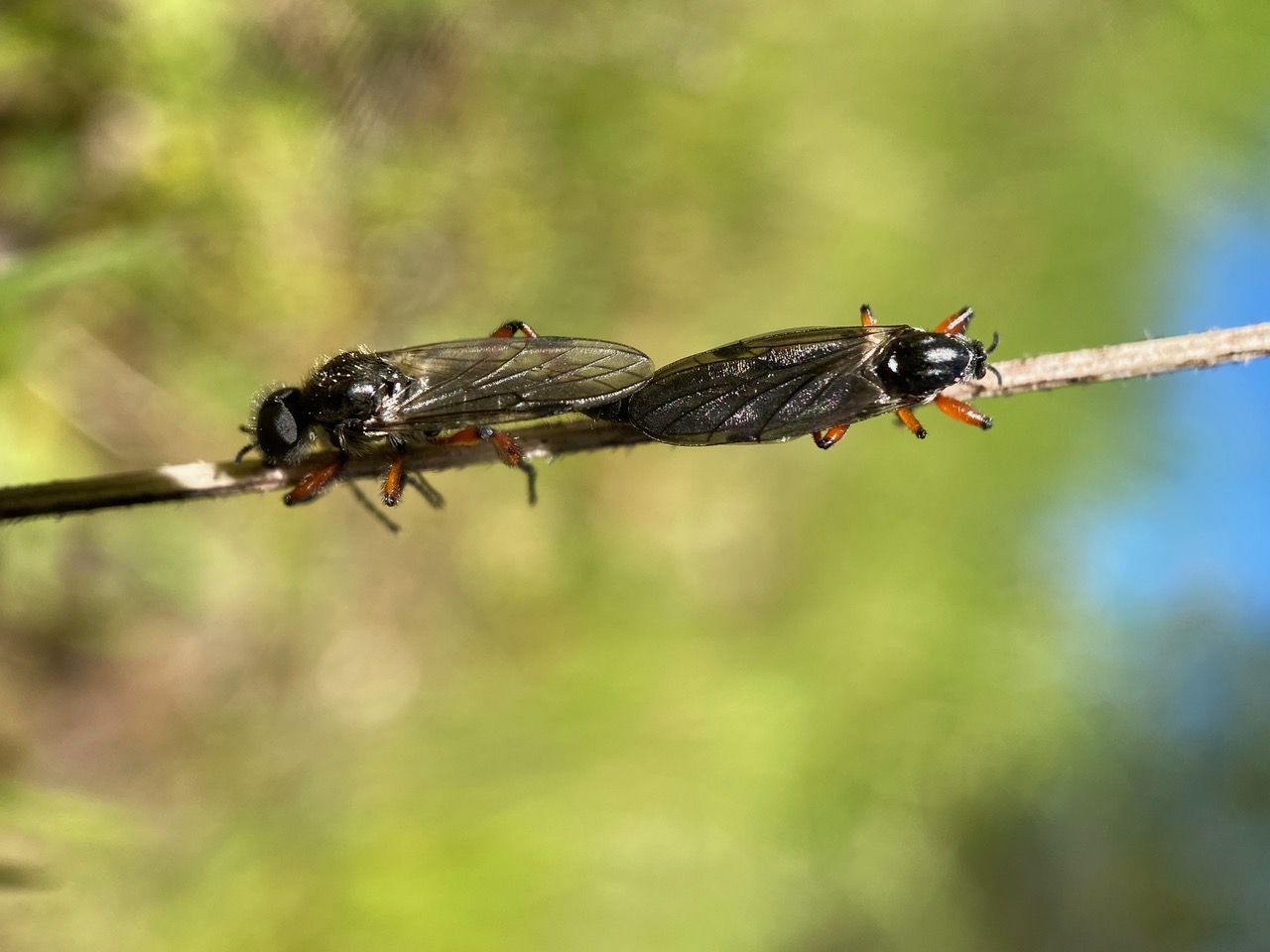
Spring is in the air! A pair of March Flies, Bibio xanthopus (family Bibionidae) are mating on a vertical twig by the side of the trail. The sexual dimorphism is in full display – the female on top has a narrow head and small eyes, while the male below has eyes so large that they literally take up his whole head.
March Flies (family Bibionidae) generally live in wooded areas and are often found on flowers – adults of some species feed on nectar, pollen, and honeydew, while adults of other species don’t feed at all; and in either case, they are very short-lived. They are considered important pollinators in orchards. They are also important food for other insects and spiders. The larvae feed en masse on rotting organic materials like leaves, wood, compost, and rich soil.
March flies exhibit extreme sexual dimorphism – the sexes are morphologically distinct. The female is usually more colorful, has small eyes on the sides of long, narrow head, while the all-black males have huge eyes that touch in the middle and are split in half horizontally. Scientists speculate that the split makes it easier for them to see the other males that are above and below them in a mating swarm. Males gather in swarms that can blanket the ground and low vegetation. Female are attracted to the party and select mates in the frenzy of fly bodies.
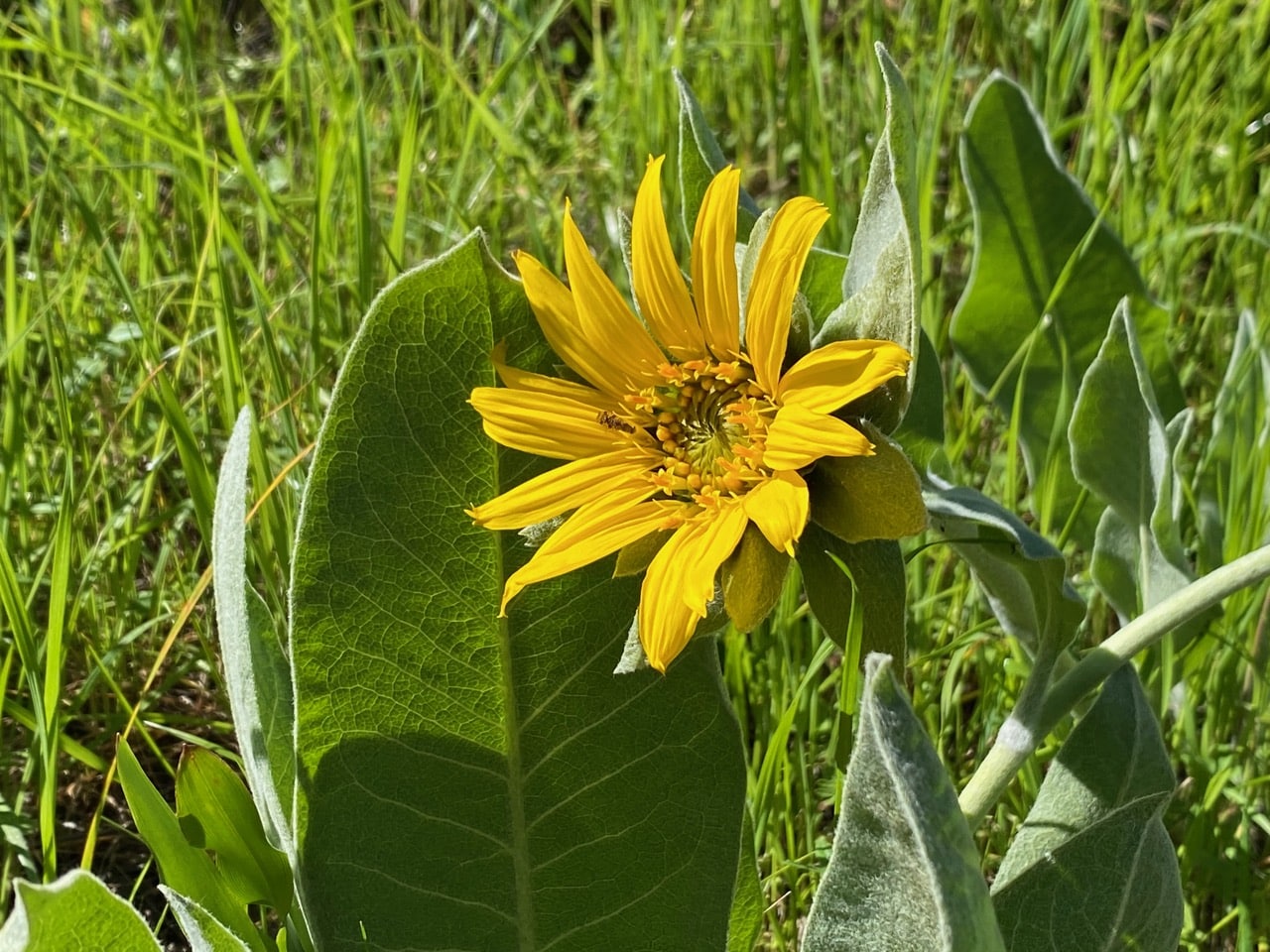
Ah, the much anticipated blooming of the Woolly Mule’s Ear, Wyethia helenioides along Skyline Trail. Look, there’s already a fruit fly on one of the petals (actually ligules or rays). The yellow structures are not petals because this is a member of the Asteraceae. They are ligules of the ray florets on the rim of the flowerhead.
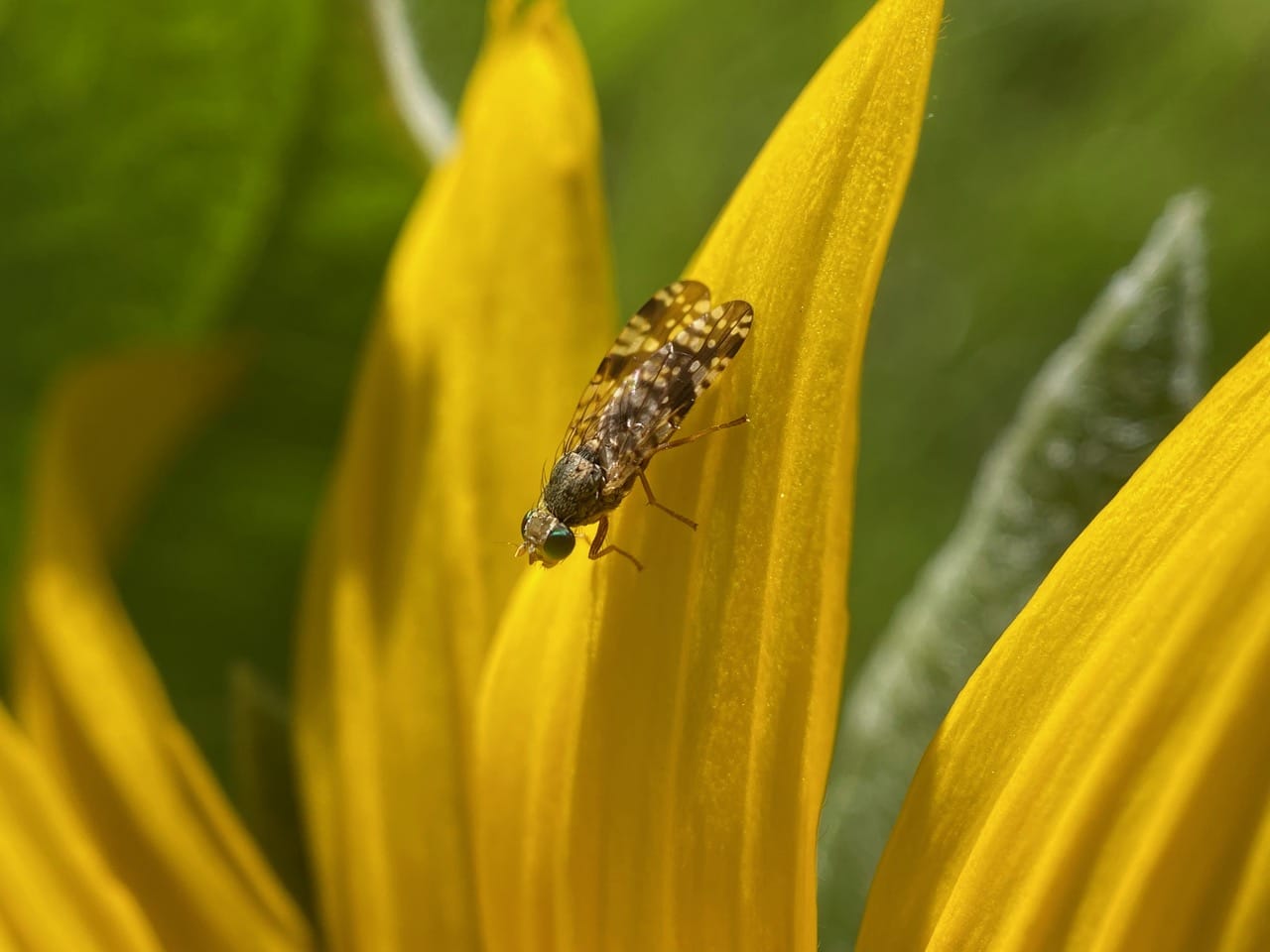
Close-up of a Sunflower Seed Maggot, Neotephritis finalis (family Tephritidae).
Commonly called Fruit Flies, Tephritids are small to medium-sized flies that are often colorful, and usually with picture wings. The larvae of almost all Tephritidae are phytophagous. Females deposit eggs in living, healthy plant tissues using their telescopic ovipositors. Here the larvae find their food upon emerging. The larvae develop in leaves, stems, flowers, seeds, fruits, and roots of the host plant, depending on the species. Adults are often found on the host plant and feeding on pollen, nectar, rotting plant debris, or honeydew. Tephritid flies are of major economic importance as they can cause damage to fruit and other plant crops. On the other hand, some Tephritids are used as agents of biological control of noxious weeds.
The Sunflower Seed Maggot is a sunflower specialist, found on over 20 species of Asteraceae. Larvae feed on immature seeds and pupate in flowerheads.

Many Tephritids have picture wings that they use in courtship or territorial displays. To communicate with members of their own species, the flies open and close, and wave the wings to send signals resembling semaphore.
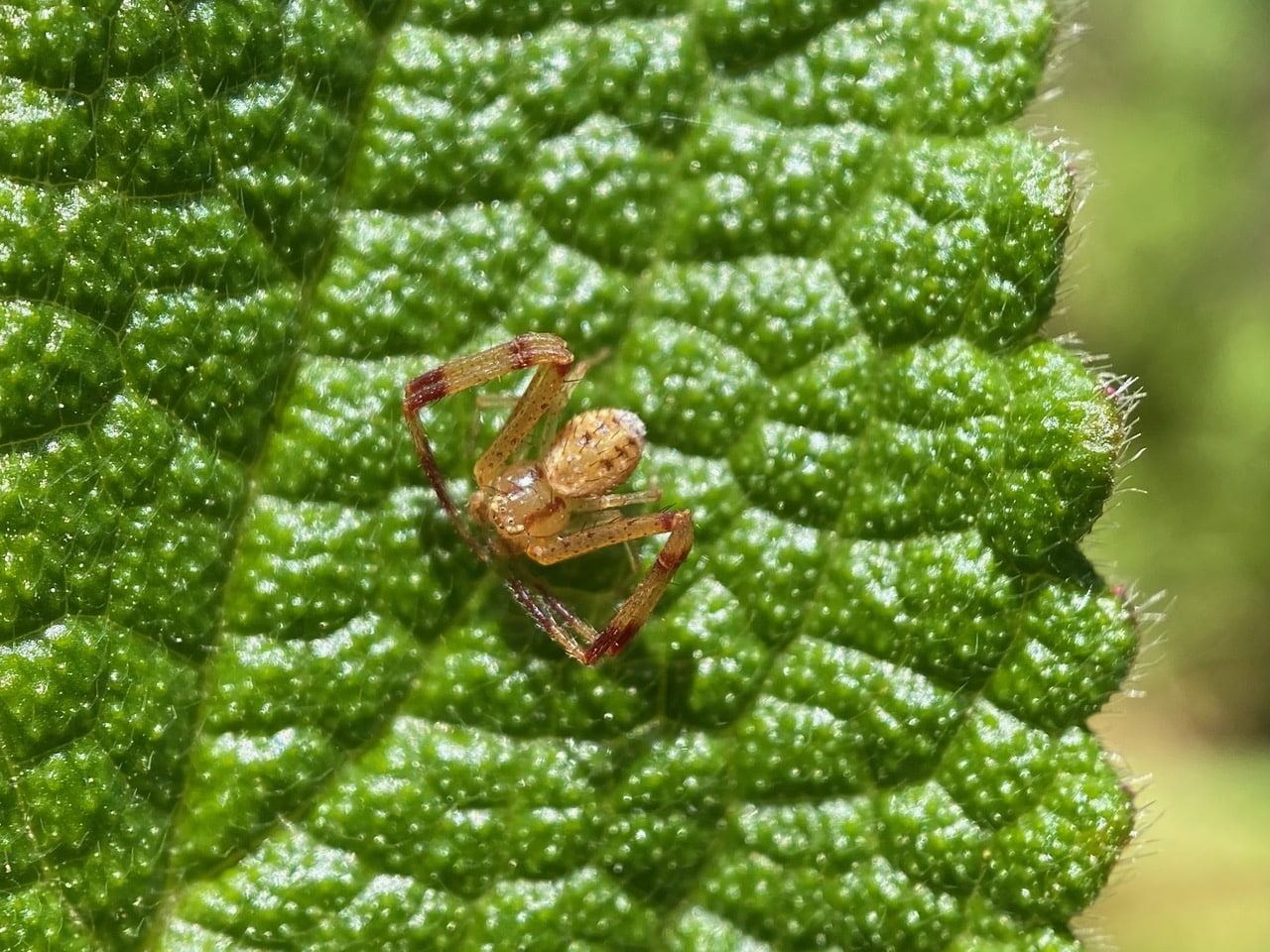
A male Crab Spider, Mecaphesa sp. (family Thomisidae) is resting on a leaf of Wood Mint, Stachys ajugoides, its impossibly long front legs folded by its sides.
Crab Spiders (family Thomisidae) do not make webs to catch prey. They are ambush predators that silently wait in the flowers until the prey appears. The spider grabs the prey with the long front legs and delivers a deadly dose of venom using its slender fangs. Females are generally larger than males, sometimes many times larger. Males have more slender body and longer legs. They are darker in color and have brown markings on the abdomen. Females are more sedentary, while the males tend to wander in search of mating opportunities by following the silk threads laid down by the females.

3/8/24 A pair of Stilt Bugs, Neoneides muticus (family Berytidae) is mating on a leaf of California Bee Plant, Scrophularia californica. The larger one on the right is the female.
The Berytidae are extremely gracile insects with legs so long and slender as to suggest common names such as “thread bugs” and “stilt bugs”. They resemble some Assassin Bugs, but lack the raptorial forelegs of the predators. Antennae have 4 segments, the fourth enlarged, appearing as a swelling at the tip.
Stilt Bugs occur worldwide and throughout North America. Most are phytophagous (plant-feeders); many may be host-specific, often associated with plants with glandular hairs in Geraniaceae, Onagraceae, Scrophulariaceae, and Solanaceae. Some are occasionally omnivorous, feeding opportunistically on insects entrapped in plant exudates or on lepidopteran eggs or aphids.
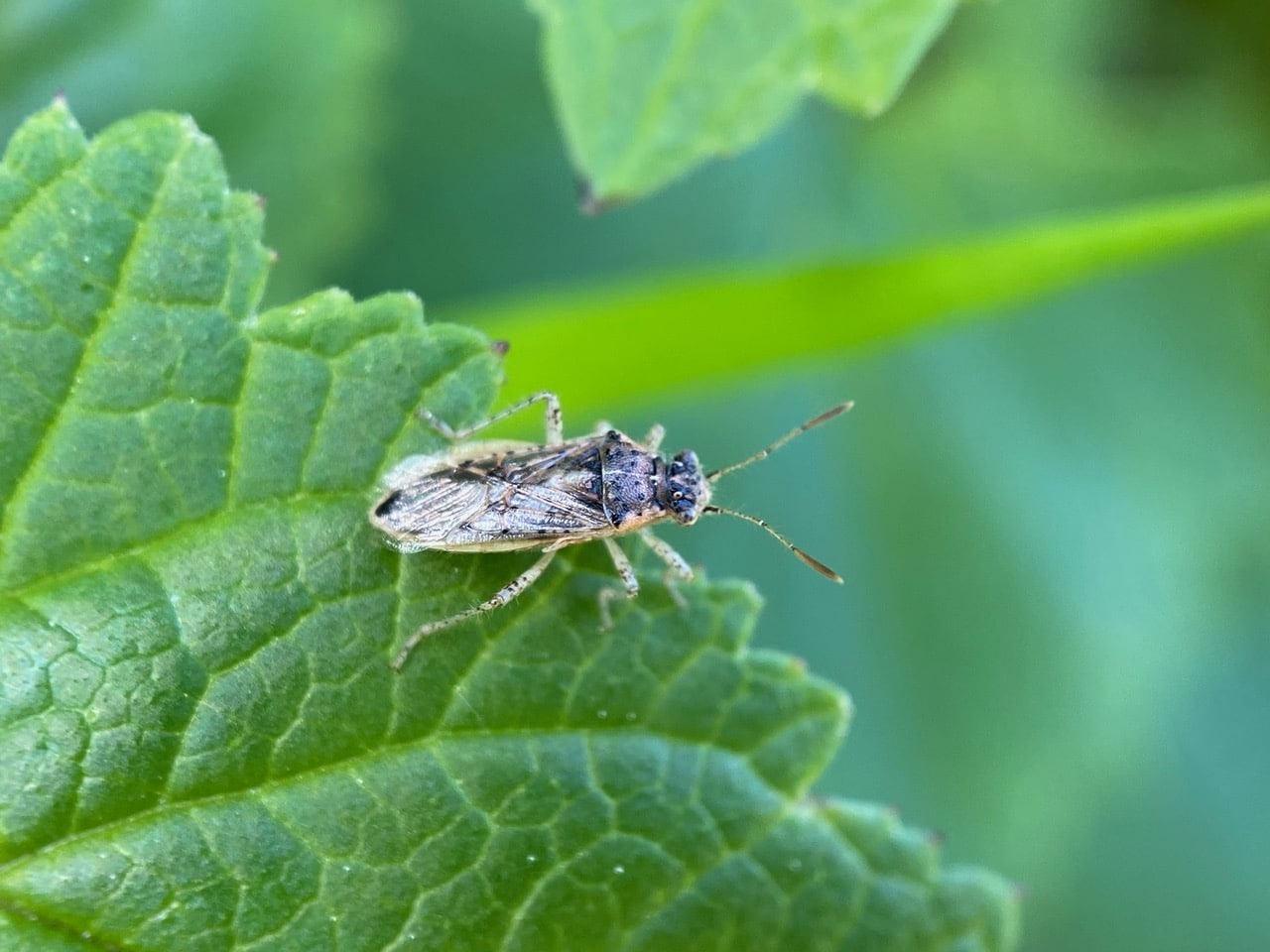
3/8/24 A Scentless Plant Bug, Brachycarenus tigrinus (family Rhopalidae) is resting on a leaf of California Bee Plant, Scrophularia californica.
The Rhopalidae are distinguished by many veins on the membranous portion of the forewings. They differ from coreids and other hemipterans in lacking functional scent glands. All are plant-feeders, usually on ripe seeds.
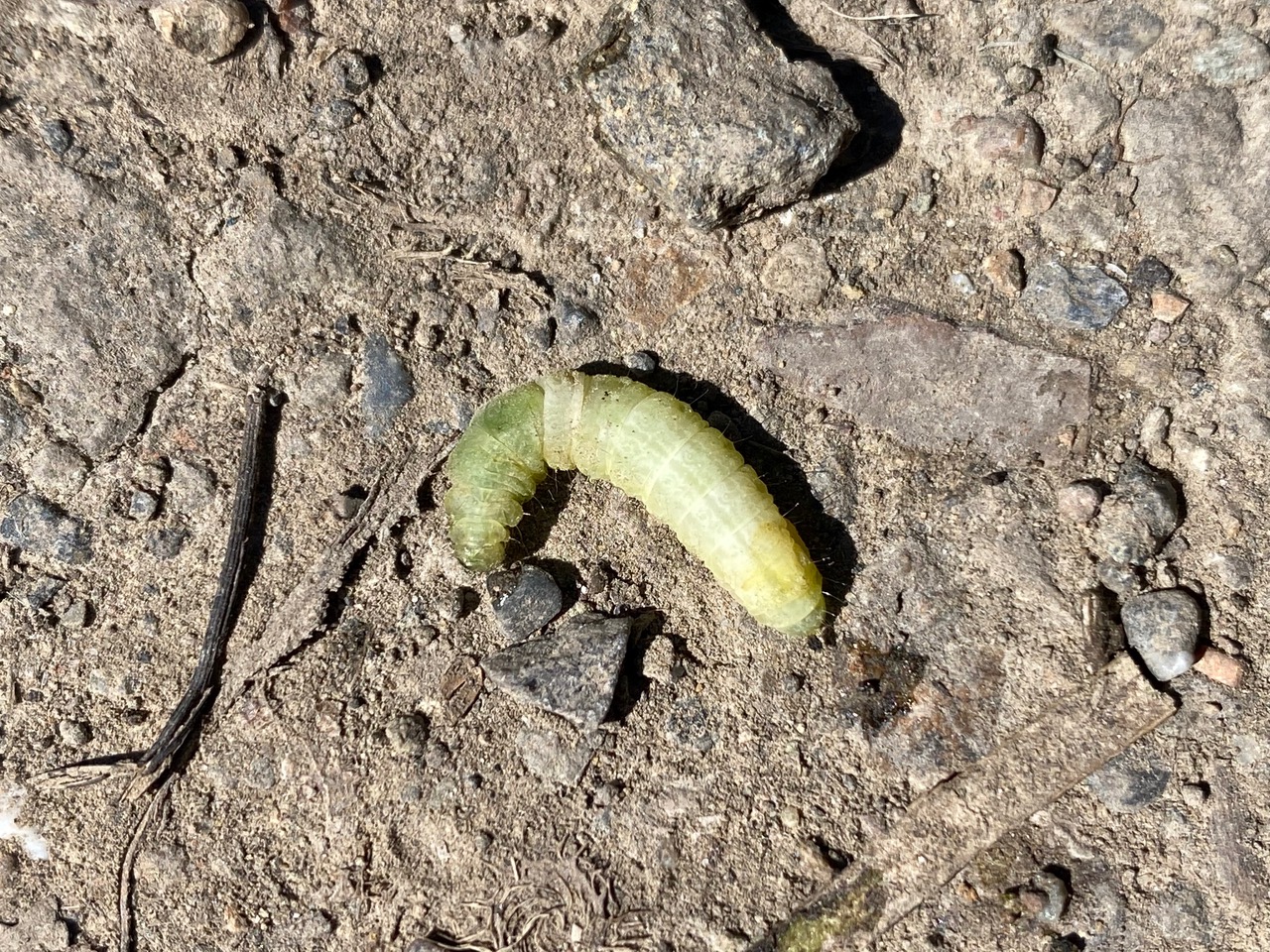
Just as I take the last steps up to Siesta Gate, I spot a green caterpillar, about 1.5 in. long, lying motionless in the middle of the trail. Why would a caterpillar be on the bare ground? It is probably trying to find a place to pupate. When mature, most caterpillars wander quite a distance from their food plant in search for a good site to pupate. Is this caterpillar alive? When I gently prod it with my finger, it writhes vigorously. Ah, good, maybe it was just exhausted from its walk-about and needed to rest. I move the caterpillar to the side of the trail where it is safe from foot traffic.