

Pollinator Post 3/19/25 (2)
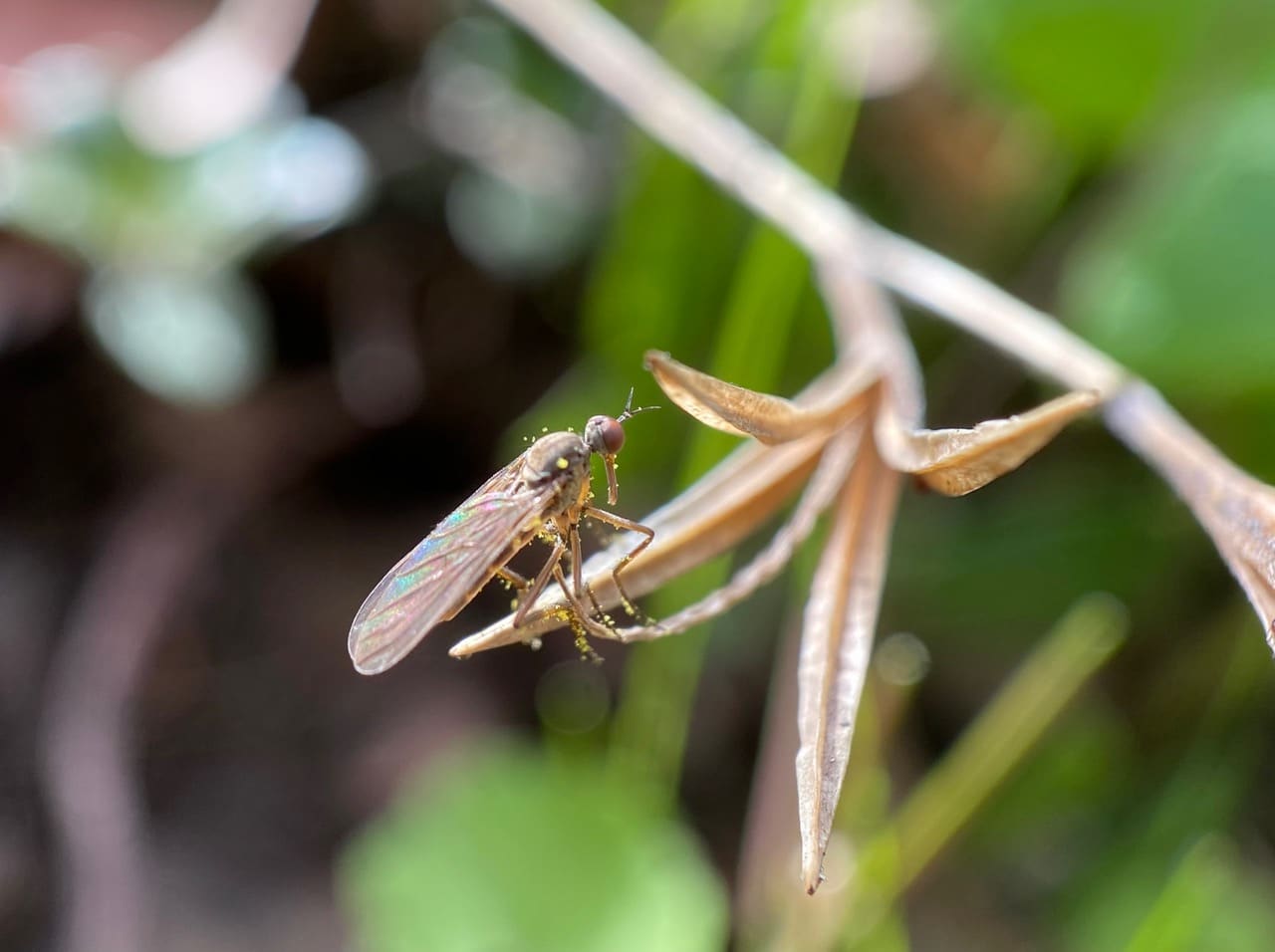
Bumped from a Woodland Strawberry flower by a similar fly, an Empidid Dance Fly perches on a dry seed capsule to steady itself. Note that its body is covered with stray pollen. Even predators seek nectar sometimes, and can transport pollen on their body.

Dance Flies, in the family Empididae, get their name from the habit of males of some species to gather in large groups and dance up and down in the air in the hopes of attracting females. They are predominantly predatory and they are often found hunting for small insects on and under vegetation in shady areas. Both genders may also drink nectar. Male dance flies give their sweeties a nuptial gift to eat while they mate. The gift is thought to enable her to complete the development of her eggs. Males may wrap their gifts in balloons of silk or spit, hence the other common name of Balloon Flies.
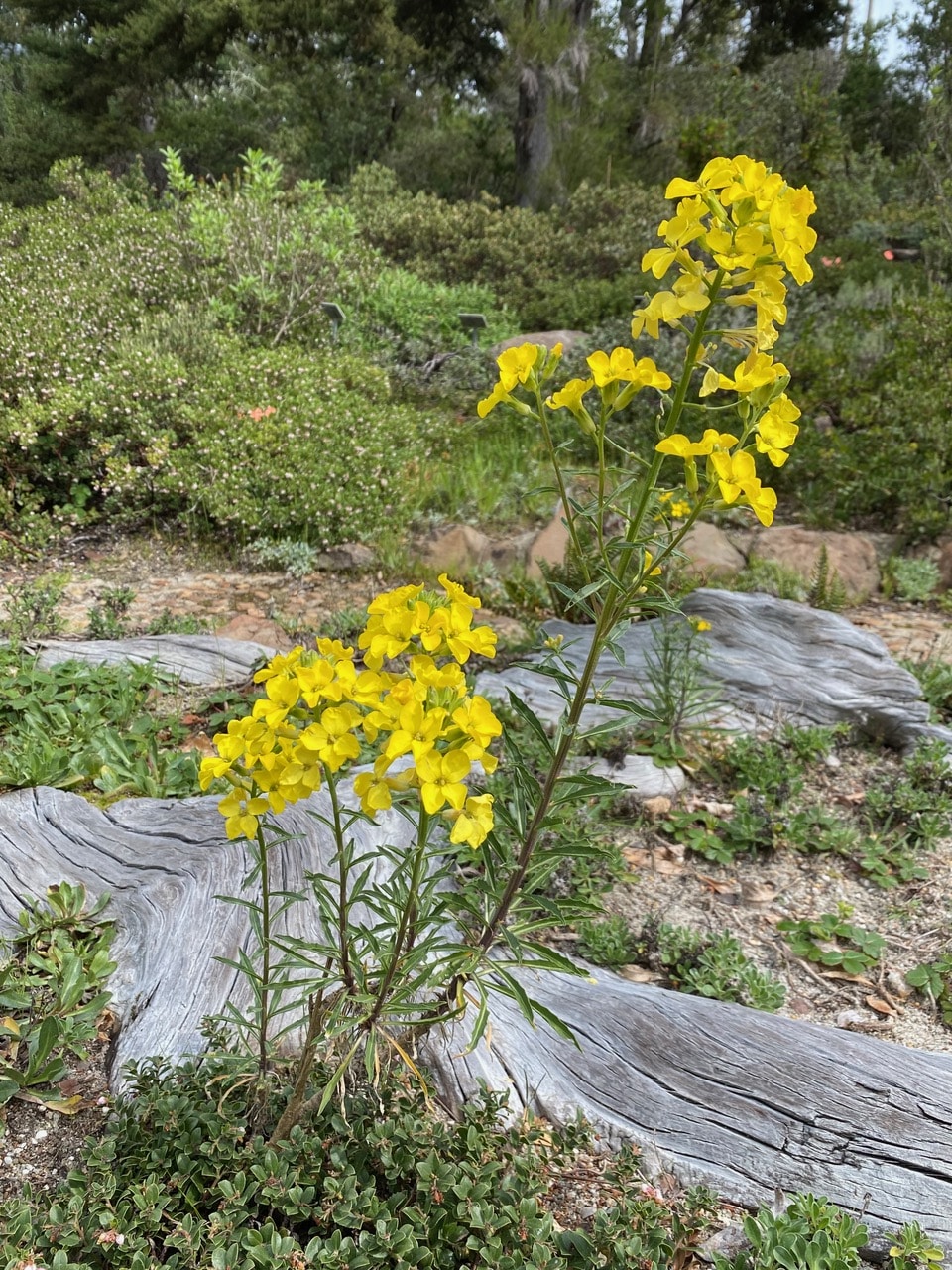
In the sand dune section of the garden, the Western Wallflower, Erysimum capitatum (family Brassicaceae) is in peak bloom.
Western Wallflower is a widespread and variable biennial or short-lived perennial herb in the mustard family, Brassicaceae. The family is of major economic importance and includes many common vegetable crops such as cabbage, cauliflower, broccoli, turnips, watercress and radish, and also invasive weeds such as wild mustard and wild radish. Members of the mustard family are characterized by four petals in a cross shape (from which came the former name Cruciferae, or cross-bearing); and by six stamens, four long and two short. The anthers curl backward after the pollen has been released. There is one pistil with a straight-sided, superior two-chambered ovary, a short style, and a two-lobed, capitate stigma.
Western wallflower is a pollinator-generalist, pollinated by a large diversity of insects. Plants that are pollinator-generalists are not adapted either to attract or to exclude any type of insect. The advantage is that it provides reproductive security especially when pollinator populations are low or fluctuate widely. Thus, these generalists may be more easily able to disperse into other habitats or to survive in extreme habitats.
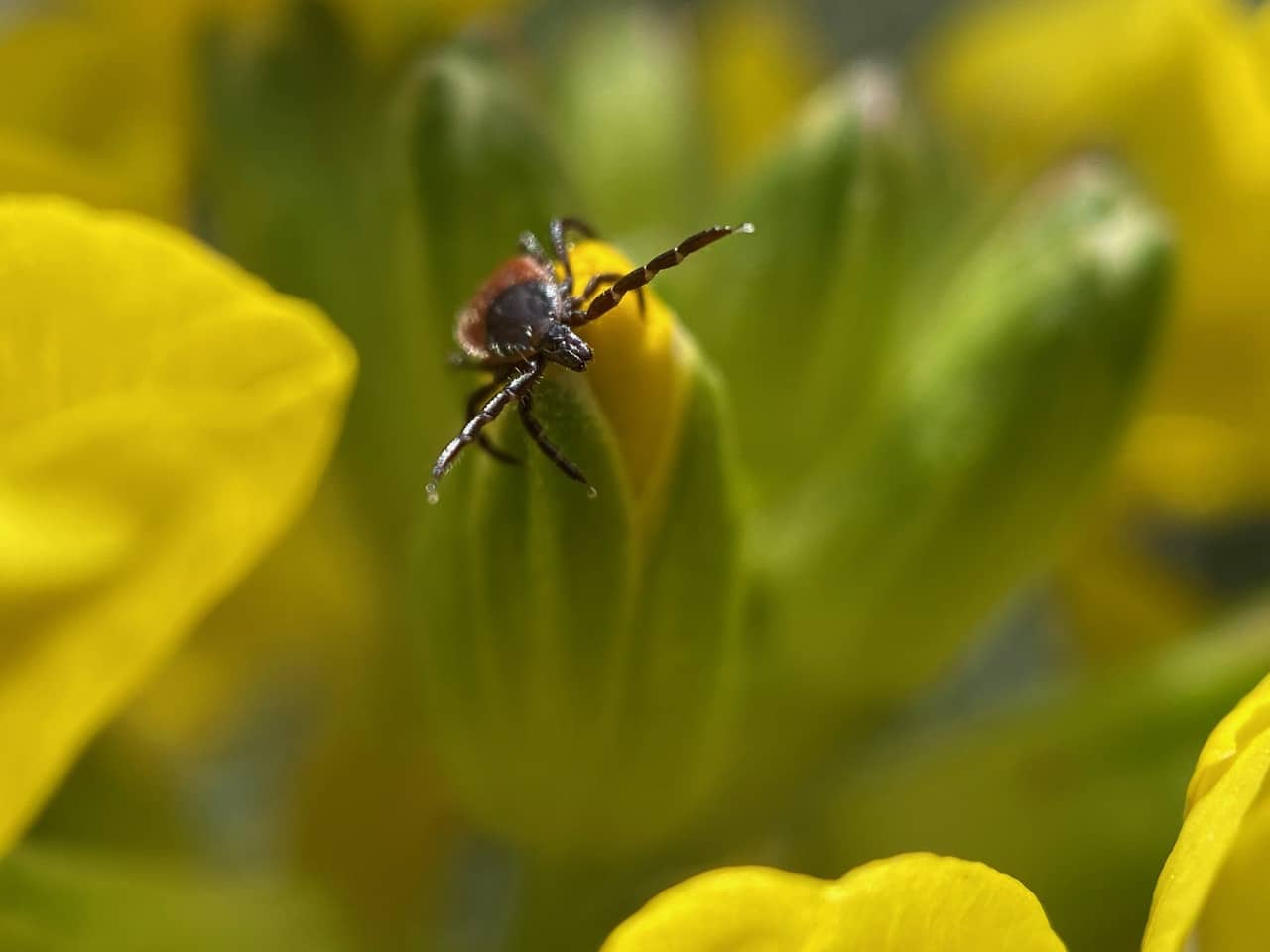
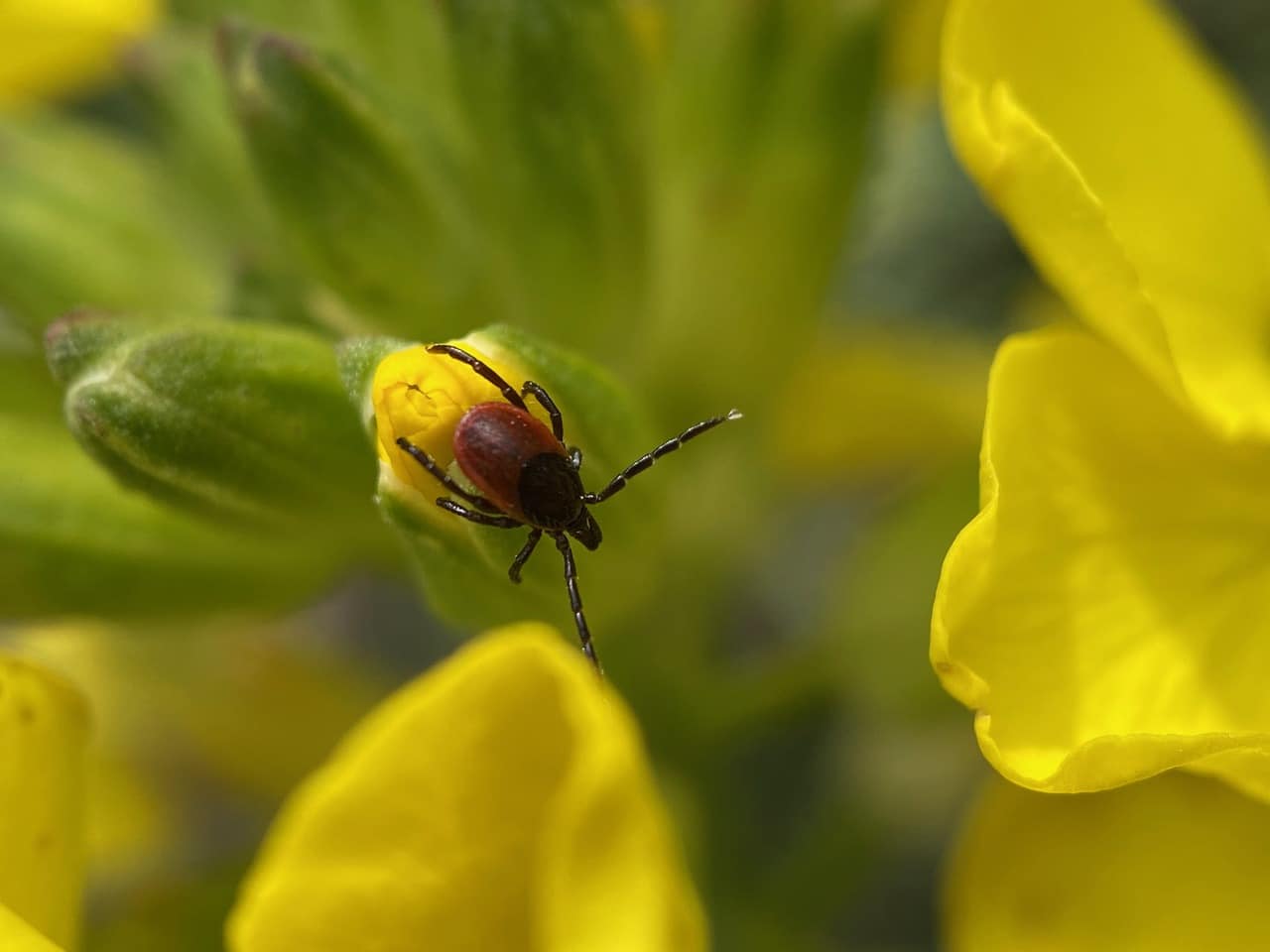


Whoa, a female Western Black-legged Tick is questing on a flower bud of Western Wallflower!
The Western Black-legged Tick, Ixodes pacificus (family Ixodidae) is commonly found in the western United States and British Columbia. It is a vector for several diseases, including Lyme disease, anaplasmosis, and babesiosis. The ticks are typically found in moist, wooded areas, such as forests, brush, and grasslands. They are most active during the spring and summer months. The tick has a four-stage life cycle: egg, larva, nymph, and adult. Each stage beyond the egg requires a blood meal from a host, such as a small mammal, bird, or lizard. The life cycle can take up to three years.
Ticks pick a place to wait by identifying well-used paths, resting on the tips of grasses and shrubs. They find their hosts by detecting animals’ breath and body odors, or by sensing body heat, moisture, and vibrations. Some species can even recognize a shadow. Ticks can’t fly or jump, but many species wait in a search position known as “questing”. Holding onto leaves or grass by their third and fourth pair of legs, they hold the first pair of legs outstretched, waiting to climb on to a passing host. When a host brushes the spot where the tick is waiting, it quickly climbs aboard. Recent research has shown that ticks are significantly aided by electrostatic forces (static electricity) when attaching to their hosts, allowing them to be passively attracted across air gaps to land on potential hosts due to the natural electrical charges animals accumulate on their bodies.
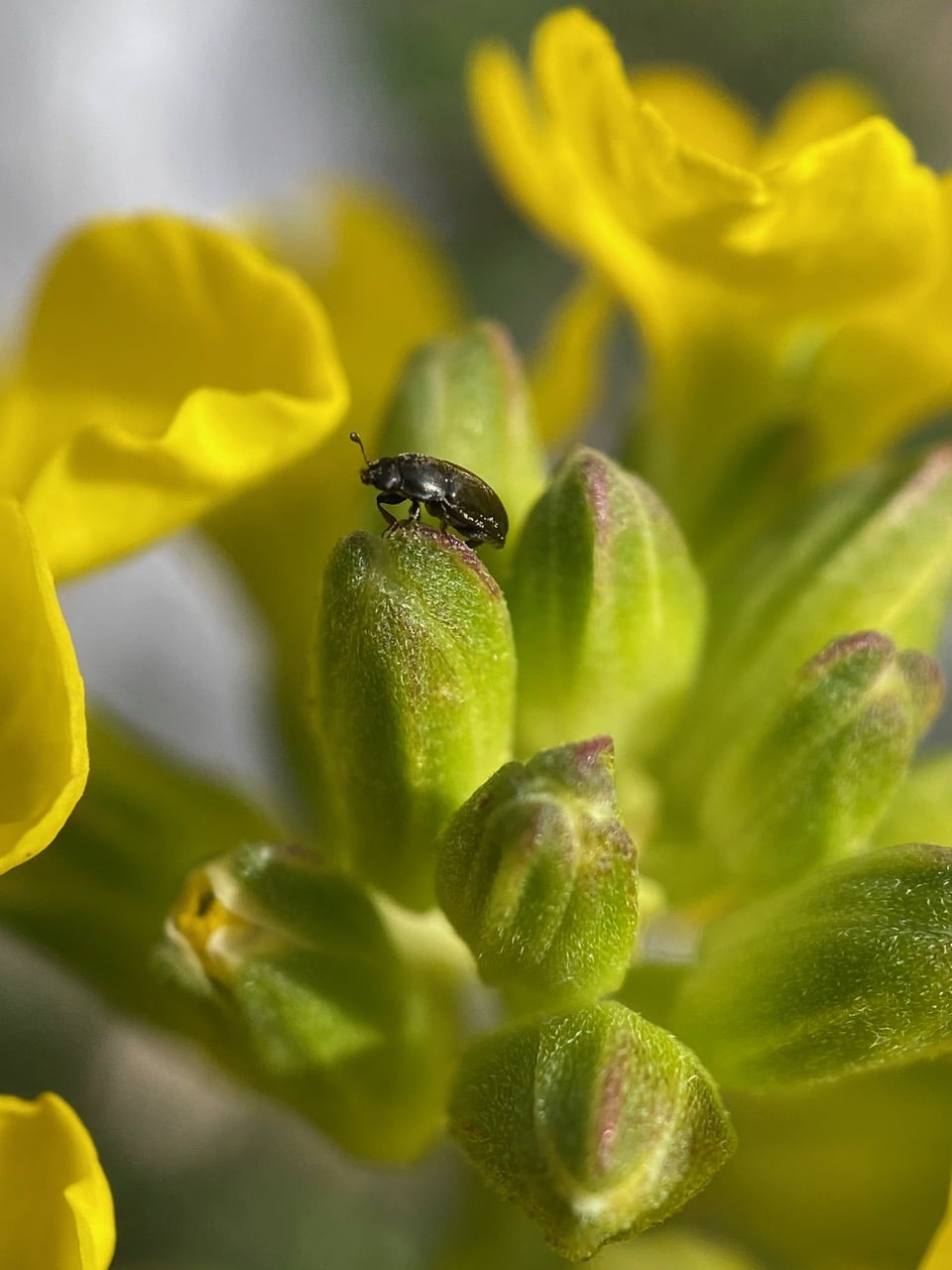
A small black beetle is perched atop a flower bud of Western Wallflower.
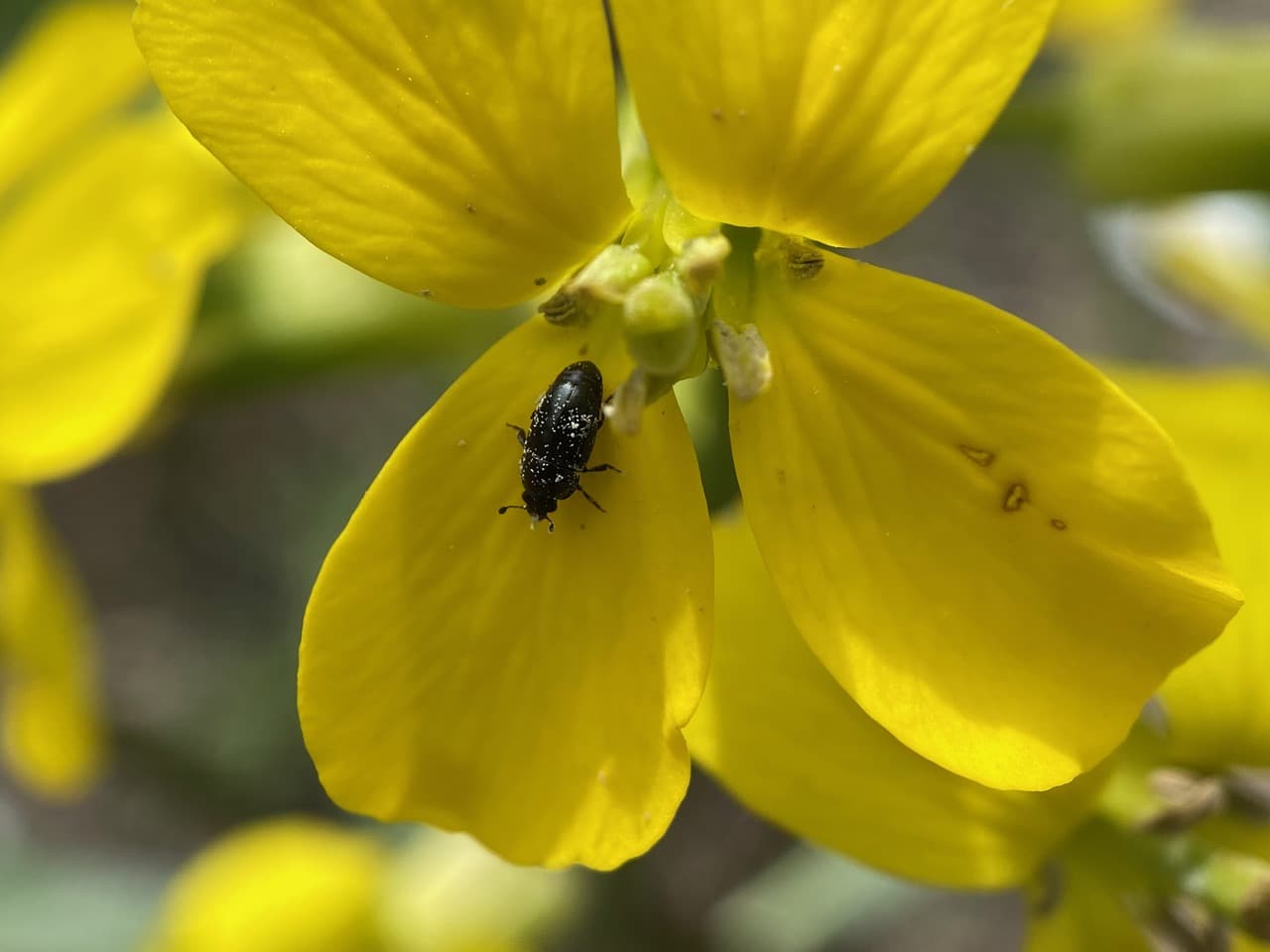
Another one is crawling out of the center of a wallflower, its body sprinkled with pollen. It is a Common Pollen Beetle, Brassicogethes aeneus (family Nitidulidae).
The Common Pollen Beetle, Brassicogethes aeneus (family Nitidulidae) is found in Europe, Northern Asia and North America. Adults are 2-3 mm long, black with a hint of metallic green, and have knobbed antennae. It is a known pest of oilseed rape. It is unclear whether the beetles contribute to the pollination of the crop. The female beetle lays its eggs in the flower buds of the host-plant and the larvae develop within the flowers. Both adults and larvae feed on the pollen and nectar in the flowers.
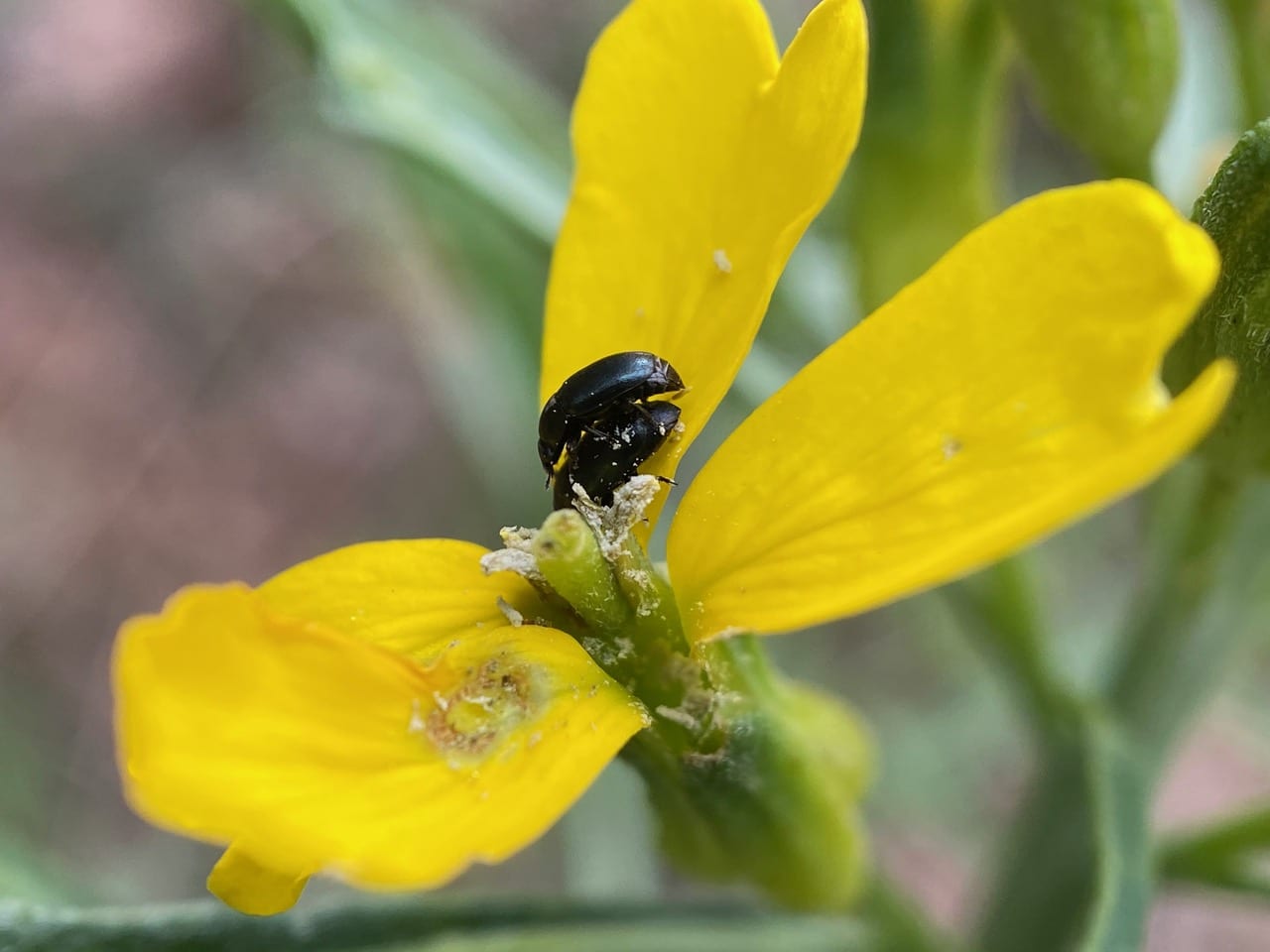
Ooh, three beetles are on this flower, two of them mating. The third one on the left is probably reaching down to feed on pollen from one of the shorter stamens.
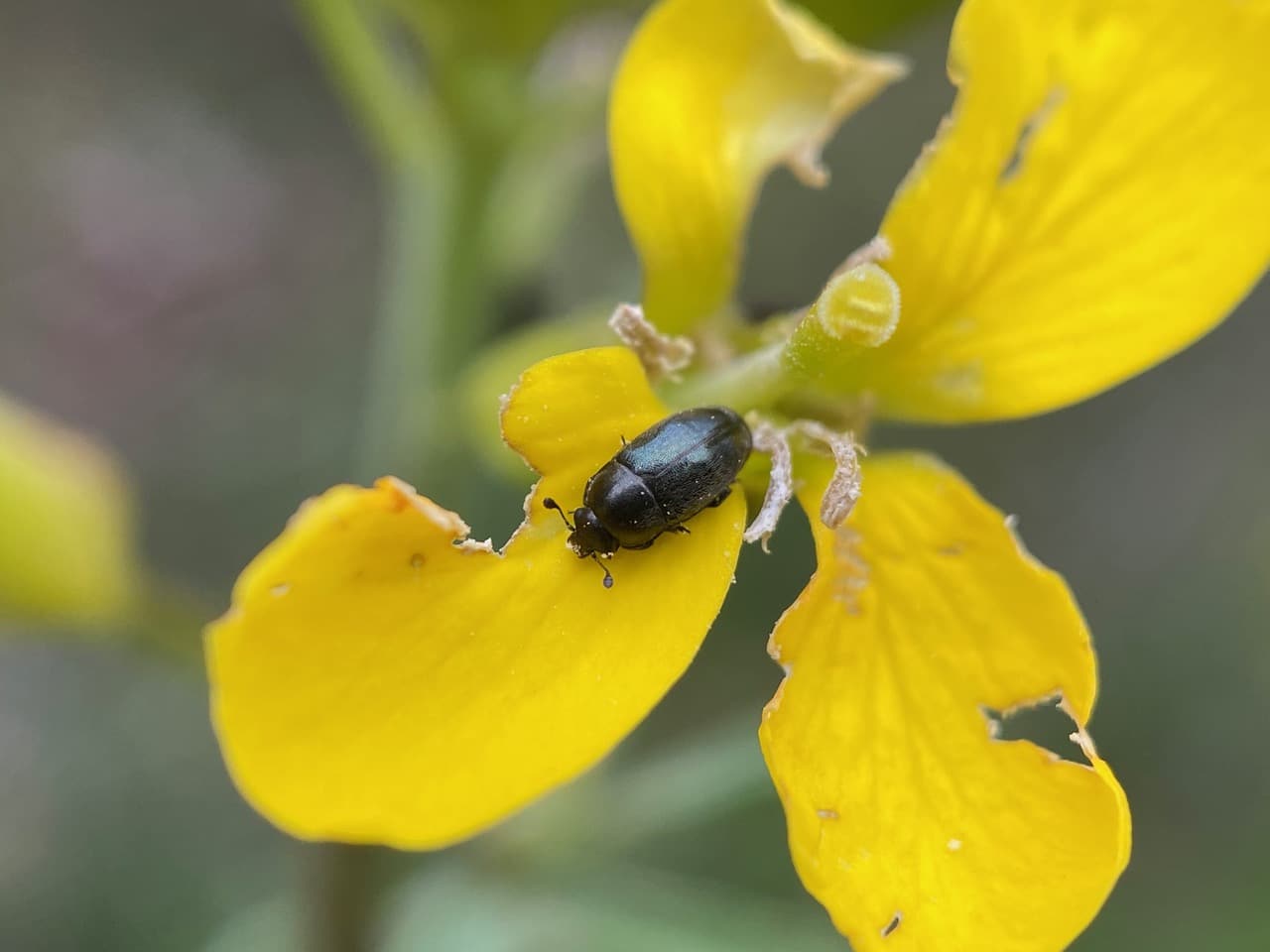
A mating pair of beetles on a wallflower that has been badly damaged. Note that most of the stamens are missing.
Beetles are among the first insects to visit flowers and they remain essential pollinators today. They are especially important pollinators of ancient species such as magnolias and spicebush. The beetles eat their way through petals and other floral parts. They often mate and defecate within flowers, generally making a mess. This behavior has earned them the nickname of “mess and soil” pollinators.
While pollen beetles can cause severe damage to a flower, they are also capable of serving as pollinators. The beetles fly easily between flowers, transferring pollen on their bodies. Note that while the stamens and the petals of this flower have been damaged, the pistil has been left untouched. The flower is still able to set seed.
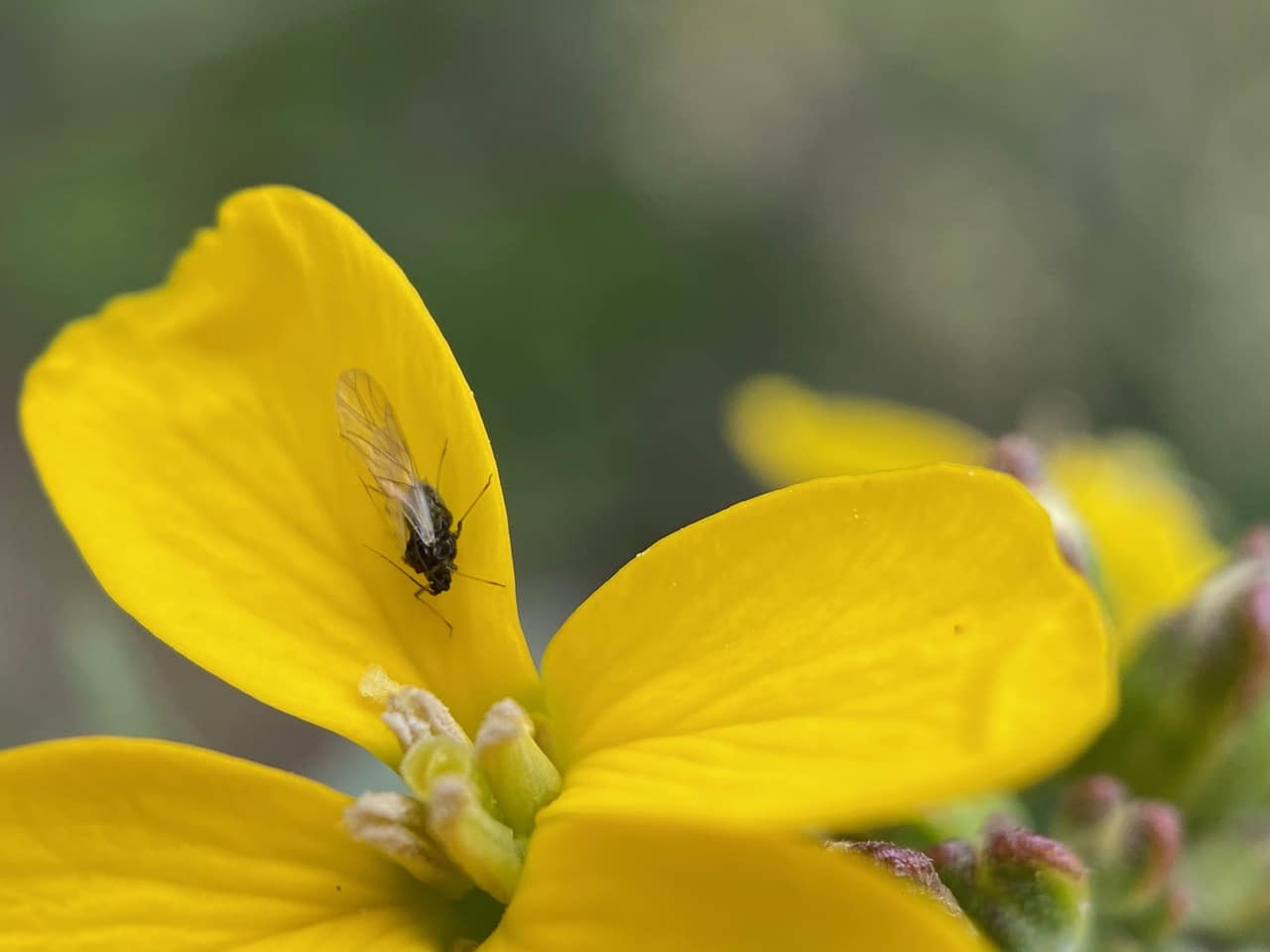
A winged aphid is perched on the petal of a Western Wallflower. I am rather surprised to see an aphid alate so early in the season.
Aphids (family Aphididae) are small sap-sucking insects in the order Hemiptera (true bugs). A typical life cycle involves flightless females giving live birth to female nymphs, – who may also be already pregnant, an adaptation called telescoping generations – without the involvement of males. Maturing rapidly, females breed profusely so that the population multiplies quickly. Winged (alate) females may develop later in the season, allowing the insects to colonize new plants. In temperate regions, a phase of sexual reproduction occurs in the autumn, with the insects often overwintering as eggs.
The life cycle of some species involves an alternation between two species of host plants. Some species feed on only one type of plant, while others are generalists, colonizing many plant groups. Some ants have a mutualistic relationship with aphids, tending them for their honeydew and protecting them from predators.
Aphids usually feed passively on phloem of plants. Once the phloem vessel is punctured, the sap, which is under pressure, is forced into the aphid’s food canal. Aphids produce large amounts of a sugary liquid waste called “honeydew”. A fungus called sooty mold can grow on honeydew deposits that accumulate on leaves and branches, turning them black.
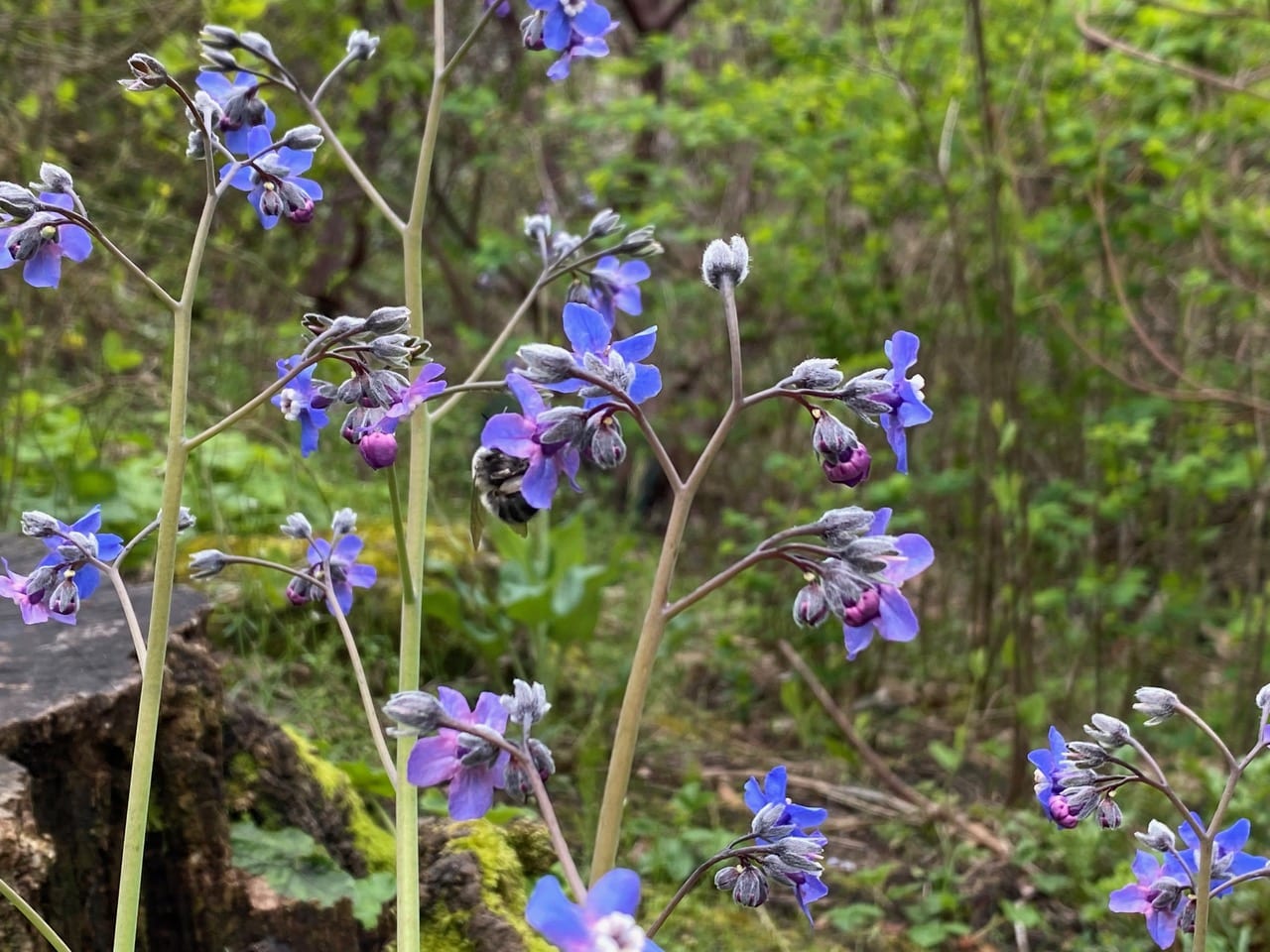
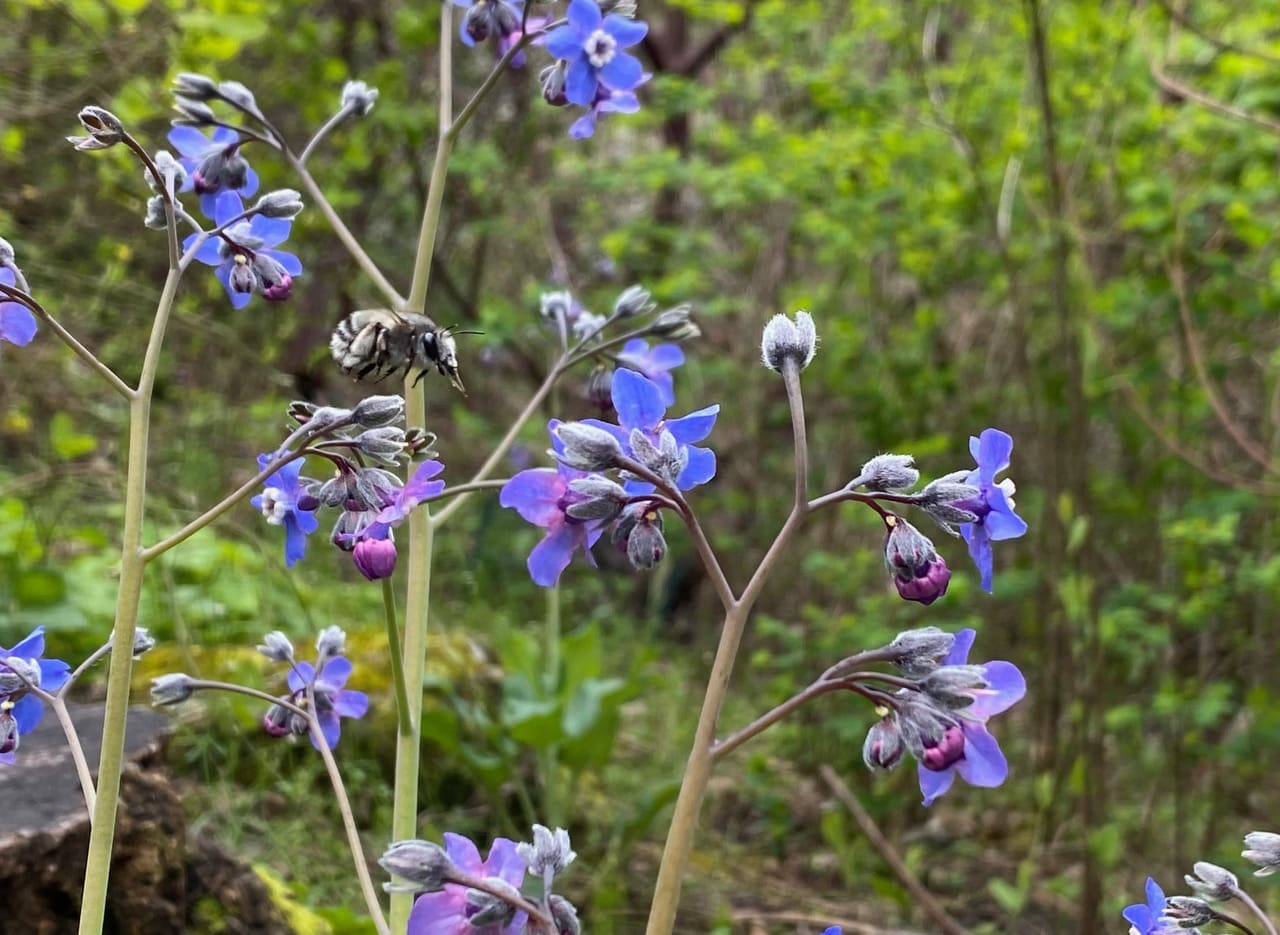
I sit on the stone steps by a good patch of the Pacific Hound’s Tongue, Adelinia grandis to watch several Pacific Digger Bees, Anthophora pacifica (family Apidae) forage on the flowers, buzzing noisily. Their flight fast and erratic, the bees seem to be bouncing from one flower to the next. Here a female makes a quick stop on a flower.
As their name implies, the Digger Bees nest in the ground, sometimes in huge aggregations. These fast and noisy flyers buzz around flowers, appearing to “hop” from flower to flower while foraging. The chubby, furry Digger Bees resemble the bumble bees in many ways, but are a lot noisier. They are a fearless, rowdy lot – fun to watch but a challenge to photograph. Male digger bees of many species have white or yellow integuments on their faces. Females have shaggy hairs on their back legs, used to carry pollen. Female Anthophora are capable of buzz pollination – i.e. they vibrate their wing muscles to shake pollen from the anthers of some flowers. Digger bees are generalist pollinators that visit an impressively wide range of plants. They are exceptionally effective pollinators and play an important role in maintaining wildflower diversity, in part because their long tongues allow them to pollinate deep-throated and tubular blossoms inaccessible to other bees.
As the bee lifts off, I can see the white scopae on her hind legs, composed of special pollen-collecting hairs. Male bees do not have scopae. Since the reproductive structures of the Hound’s Tongue flower are hidden deep within the narrow tube of the corolla, I think the most likely way pollination could be performed by the bees is to have the pollen adhere to their tongues while they probe for nectar. The digger bees are known for their long tongues.
Some fruits are already developing on the Hound’s Tongue after the petals drop off. The fruit comprises a set of 4 nutlets (small, dry fruit that does not split open, derived from a multi-chambered ovary). The seed has evolved hook-like appendages on the seed coat that grab onto anything that brushes against it, including animals or human socks.
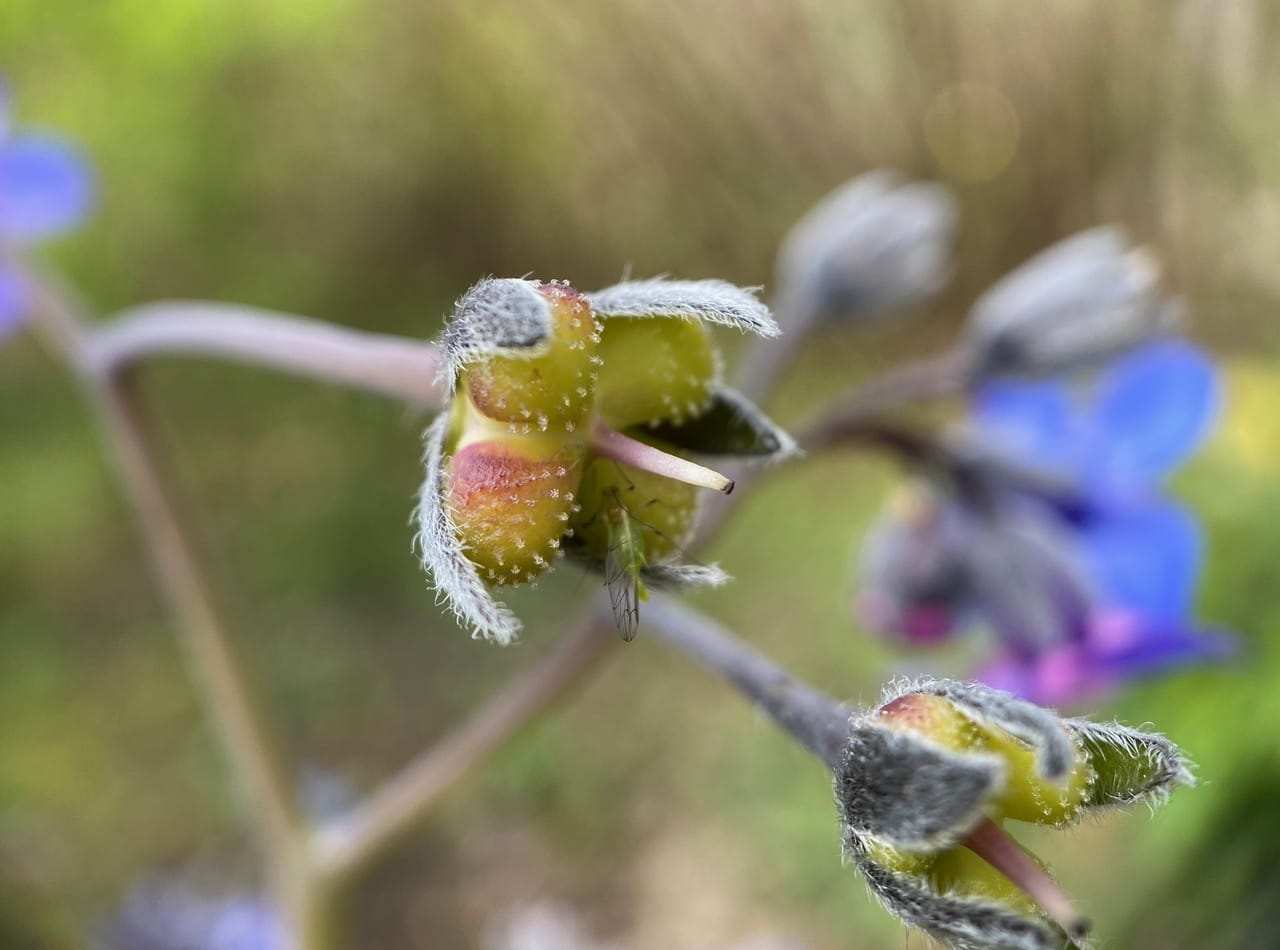
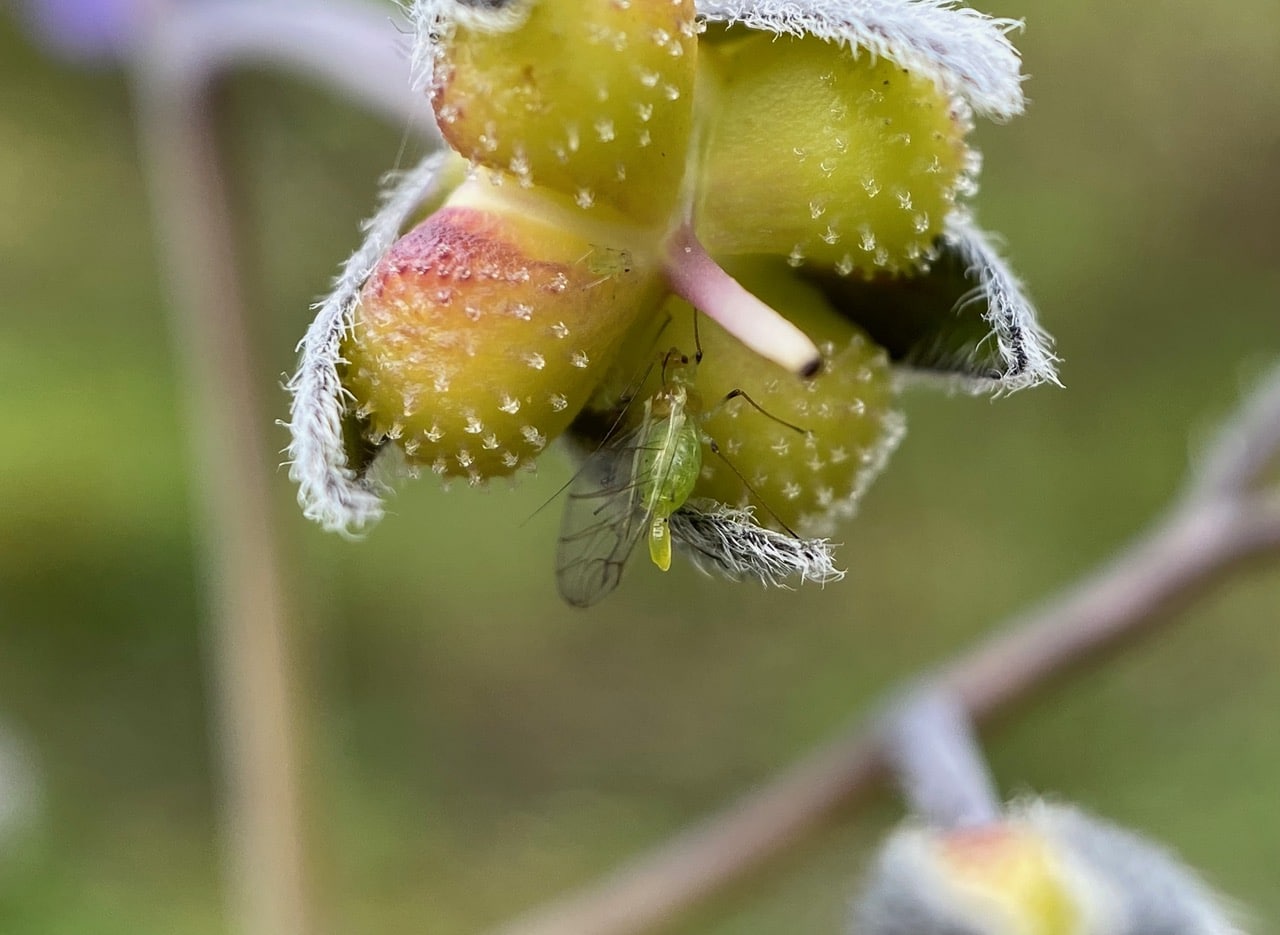
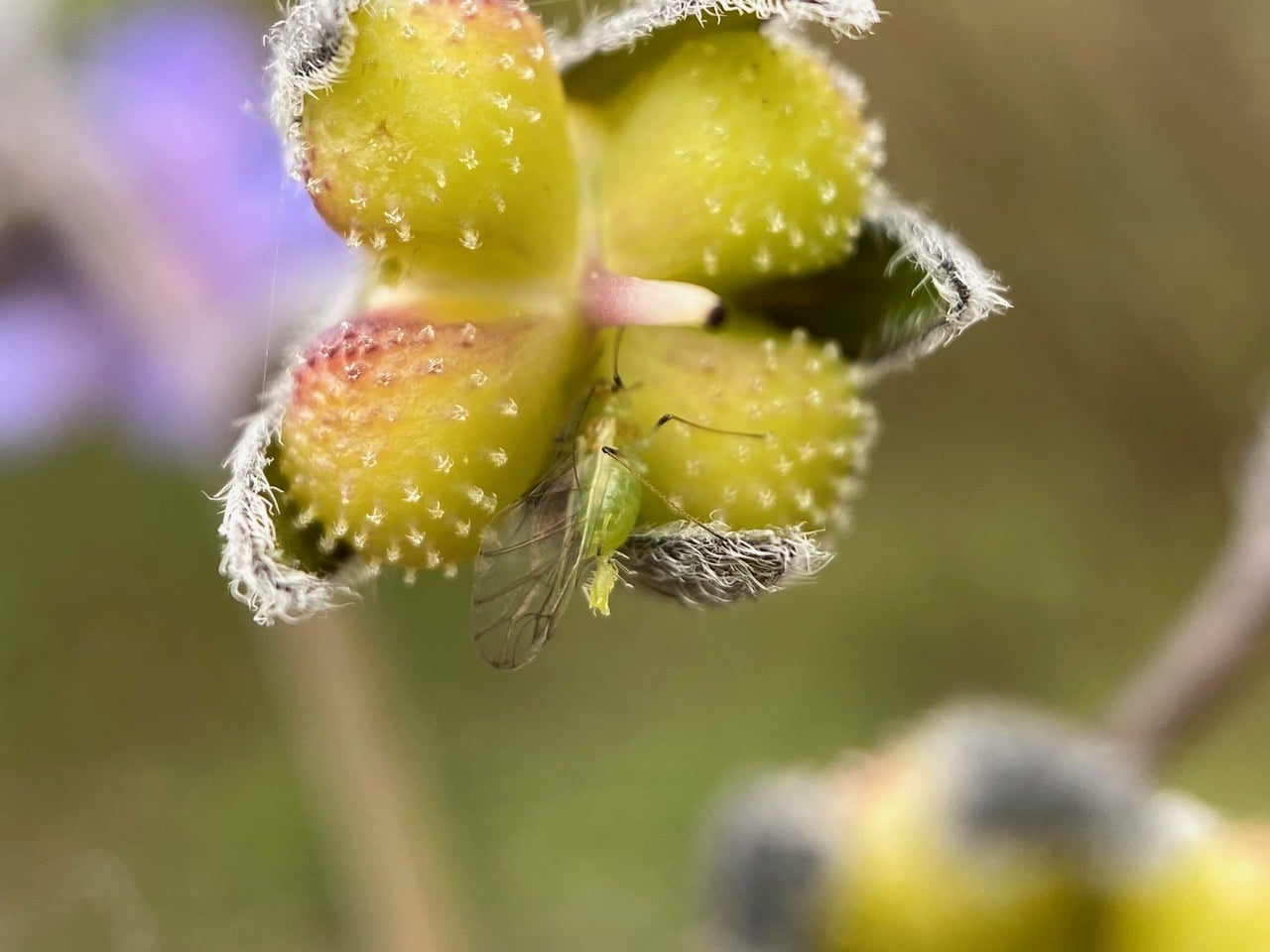
There appears to be something on the lower nutlet in the back?
12:01:50 pm Closing in with the macro lens, I discover that it is a winged aphid, and it appears to be giving birth to a baby! This is the first time I see a winged aphid give birth!
Aphids have many generations a year. Most aphids in California’s mild climate reproduce asexually throughout most or all of the year with adult females giving birth to live offspring – often as many as 12 per day – all clones of the mother. The young aphids or nymphs molt, shedding their skin about four times before becoming adults. When the weather is warm, many species can develop from newborn to reproductive adult in 7-8 days. Because each adult aphid can produce up to 80 offspring in a matter of a week, aphid populations can increase in staggering speed.
Generally adult aphids are wingless, but most species also occur in winged forms, especially when populations are high or during spring and fall. The ability to produce winged individuals provides the aphids with a way to disperse to other plants when the quality of the food source deteriorates, or when predation pressure is high.
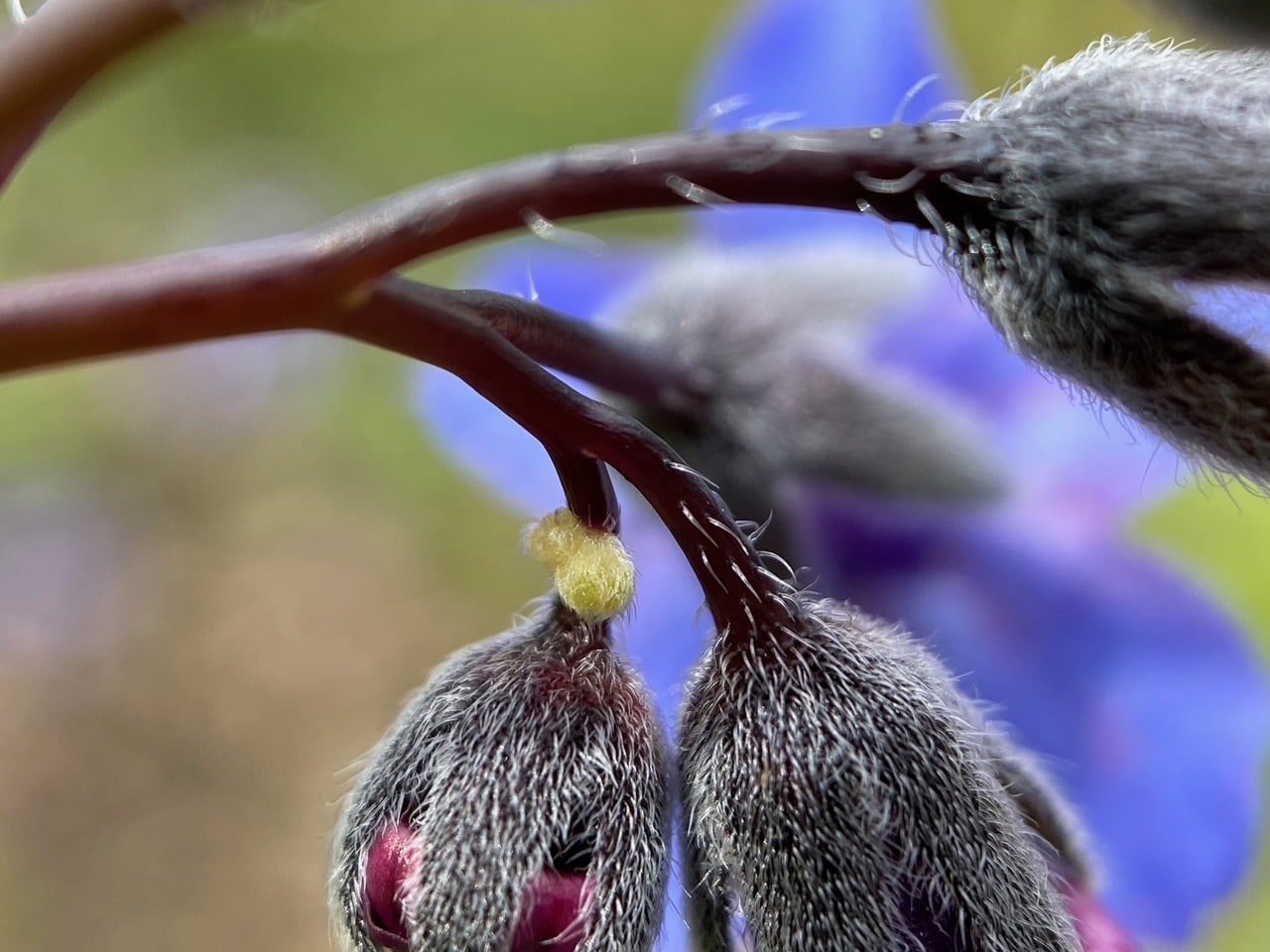
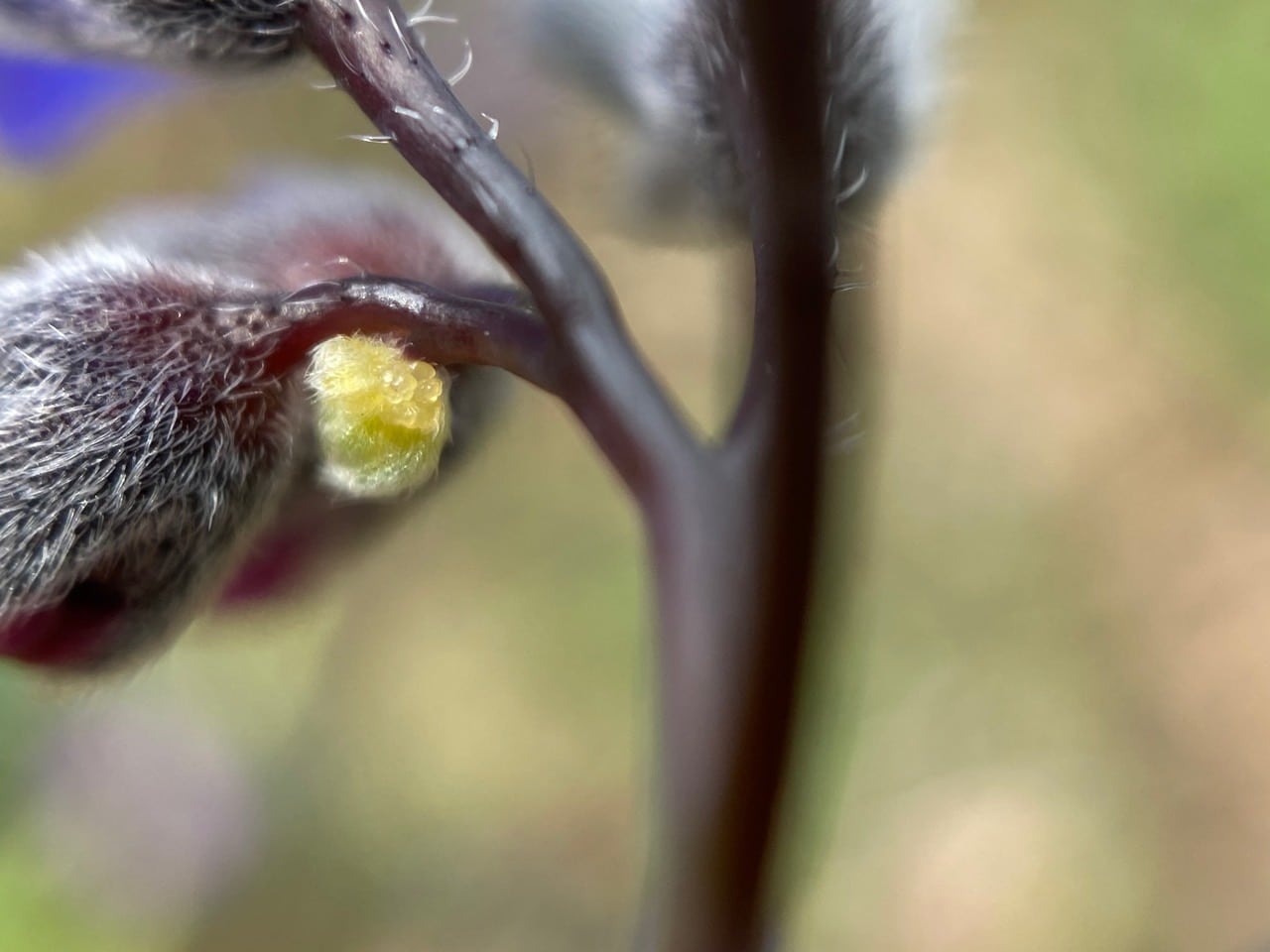
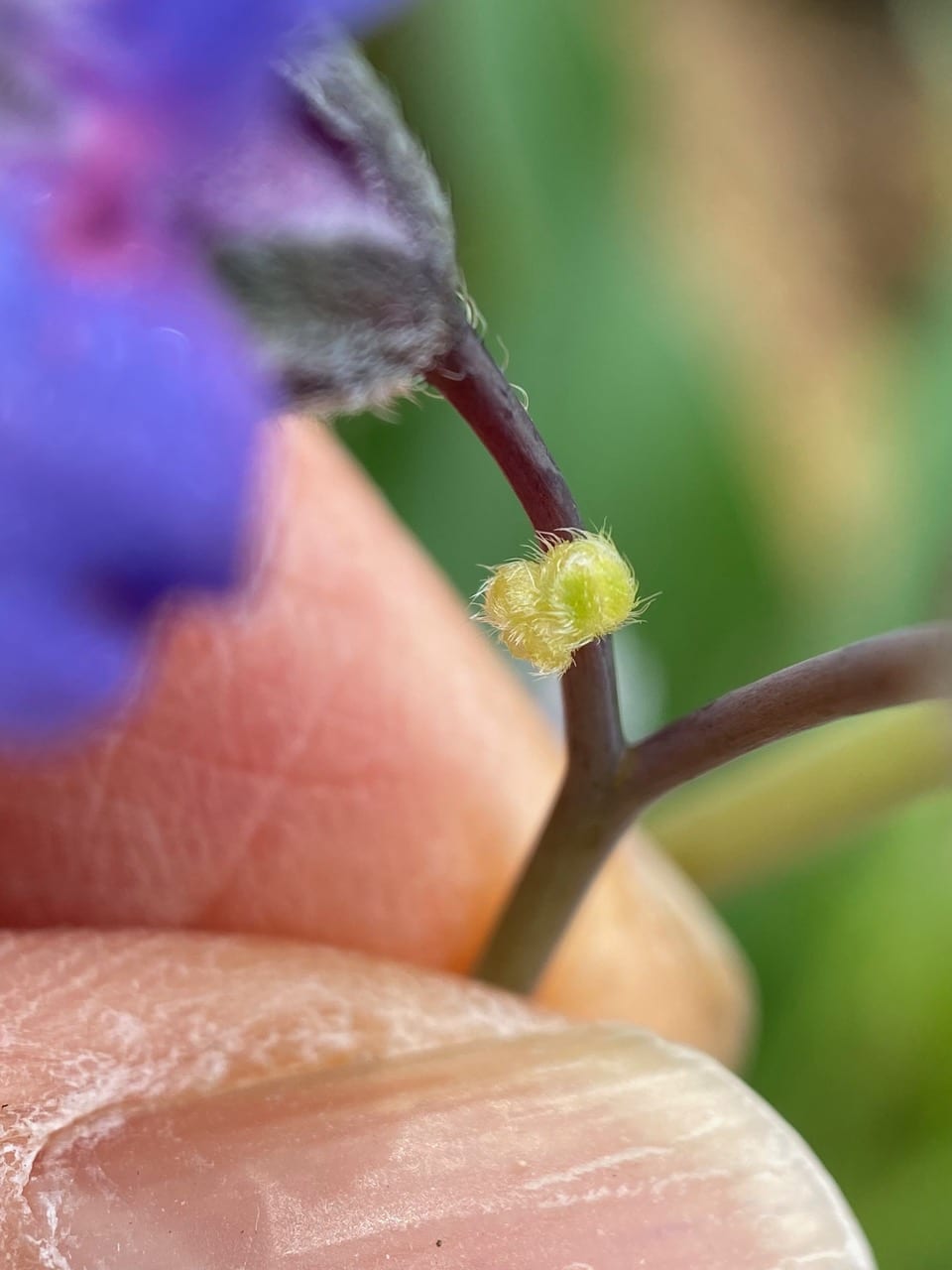
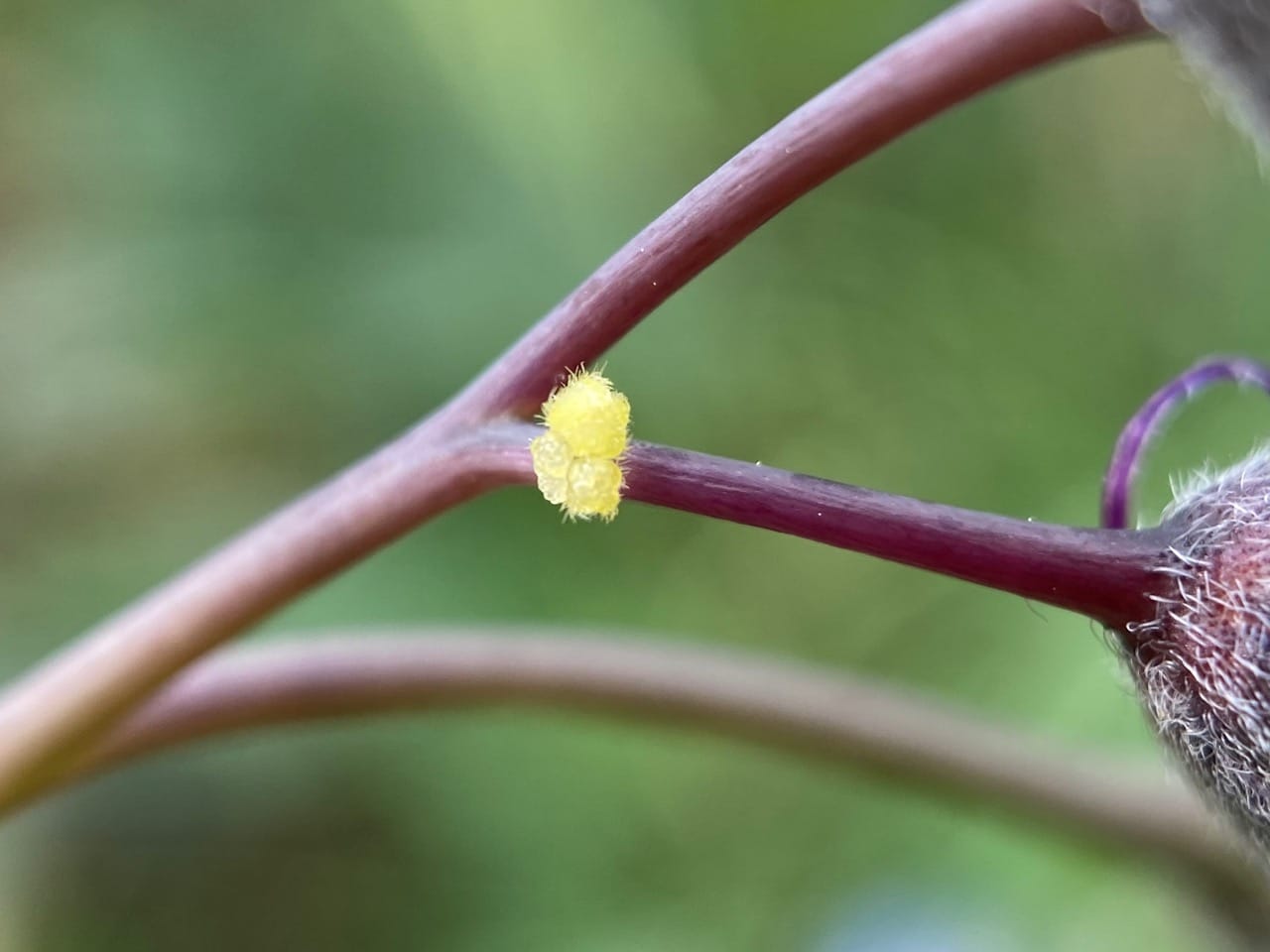
I begin to notice tiny greenish-white things on the pedicels (flower stalks) of the Hound’s Tongue. They look like butterfly eggs. But seen under the macro lens, they appear fuzzy, and more like plant material. Galls?
Plant galls are abnormal growths, resembling tumors or warts, that form on plants due to the influence of other organisms such as insects, mites, bacteria, fungi, or nematodes, providing them with food, shelter, and protection. The gall-inducing organism lays eggs or penetrates the plant tissue, triggering a response in the plant. The plant cells begin to proliferate and reorganize, forming the gall tissue within which the gall organism feeds, protected from predators and harsh environmental conditions. Different gall-inducing organisms can create galls with unique appearances, shapes, and colors, allowing for identification of the gall-maker.
I take as many photos of the suspected “galls” as I can find on the few Hound’s Tongue in the patch.
I sent the photos to Ron Russo, a friend and author of the Field Guide to Plant Galls of California and Other Western States. Here’s Ron’s reply:
“I can’t find anything that matches this. It could be a midge gall. If you can, cut one open and see if there are white or orange larvae inside. That would tell us a lot.” I have learned previously from Ron that the larvae of gall midges (family Cecidomyiidae) are orange in color.
Cut open a gall the size of a butterfly egg? I don’t think I have the dexterity for that. Maybe I will wait a while – hopefully the galls will grow bigger?
12:19:33 pm Time to check on mama aphid and her baby. Hey, the baby has extended its legs, ready for landing! Interestingly, aphid babies are born breech (rear end first).
I can’t help but stop to admire this mesmerizing tangle of curly cues. Young fronds of the Western Sword Fern, Polystichum munitum are unfurling from their fiddleheads. Somehow in that seemingly wild randomness, one can sense an inherent order.
Fern fiddleheads, the curled tips of young fern fronds, are one of the many examples found in nature of the mathematical pattern known as the Fibonacci sequence. In this sequence, each number is the sum of the two preceding numbers, beginning with 1, 1, 2, 3, 5, 8, 13, 21, 34, and so on. The longer you keep calculating the numbers in the sequence, the closer the ratio between each pair of numbers comes to another important mathematical concept: the “golden ratio”, a ratio between two numbers that was thought to represent the most beautiful and natural proportions. The Fibonacci spiral and the golden ratio describe growth patterns all through the natural world, from the whorls of snail shells and the interlocking spirals of sunflower seeds, to the furled centers of succulents.
But it is not just a matter of esthetics. Because the spiral pattern doesn’t repeat in a neat, predictable way – because it increases in irregular, ever-larger loops, each of the unfurling fronds is offset just slightly from all the rest; none sits directly underneath another. In fact, the pattern is so irregular, it optimizes the amount of growth the plant can produce, without each uncurling frond blocking the other’s access to light and water. This in turn allows the fern to pack an astonishing number of leaflets into each tightly coiled fiddlehead, ready to burst into life a soon as spring arrives.