

Pollinator Post 3/19/25 (1)
I head to the Regional Parks Botanic Gardens in the Berkeley hills to check for new developments.






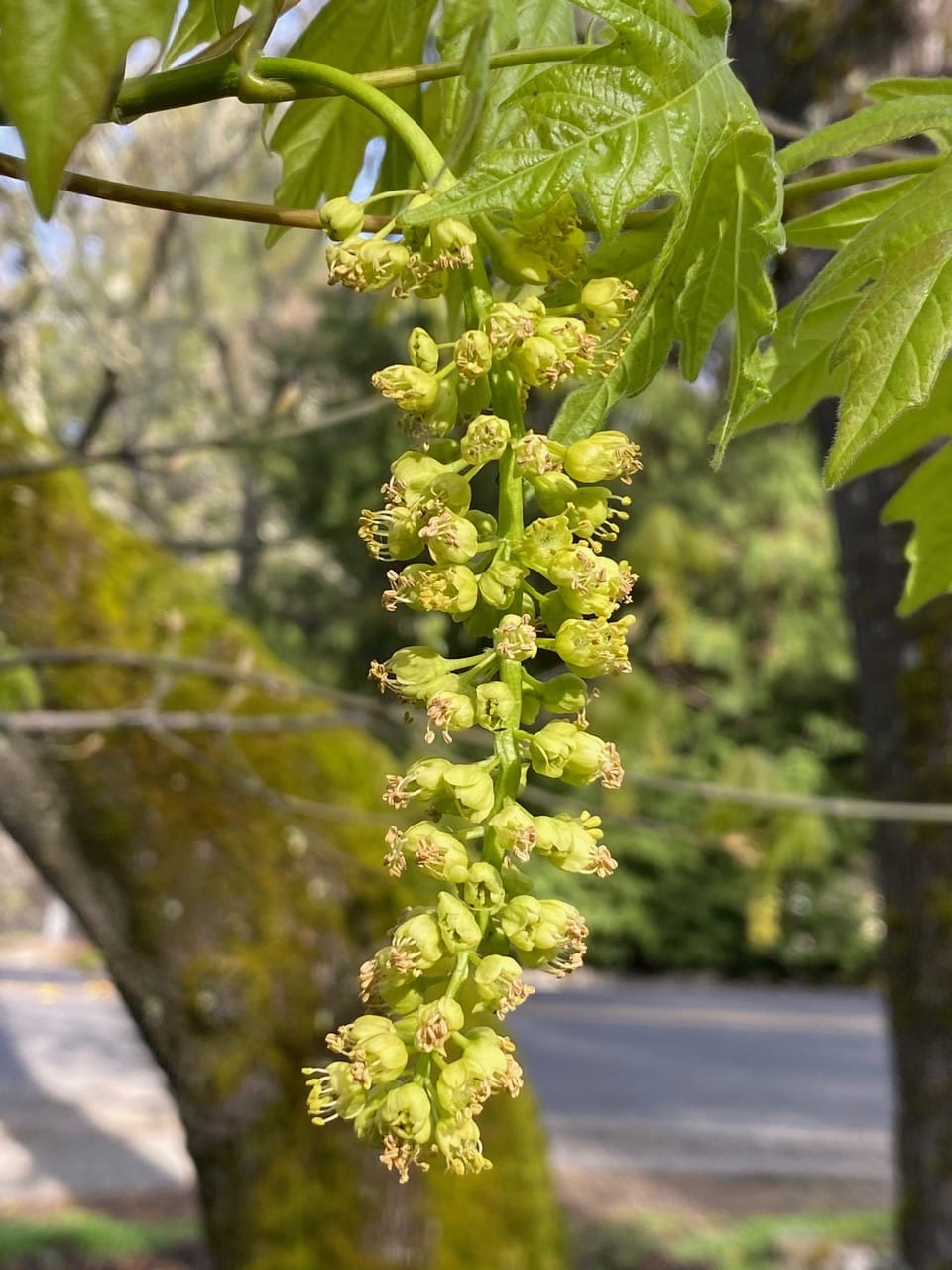
In front of the parking lot next to the footbridge over the stream, the large Big-leaf Maple, Acer macrophyllum is in glorious bloom, aglow with tender new leaves and hanging racemes of greenish-yellow flowers. I stop to examine the flowers up close. Hmm, this inflorescence seems to be made up of all male flowers, with prominent exserted stamens….. Aren’t the flowers supposed to be bisexual?
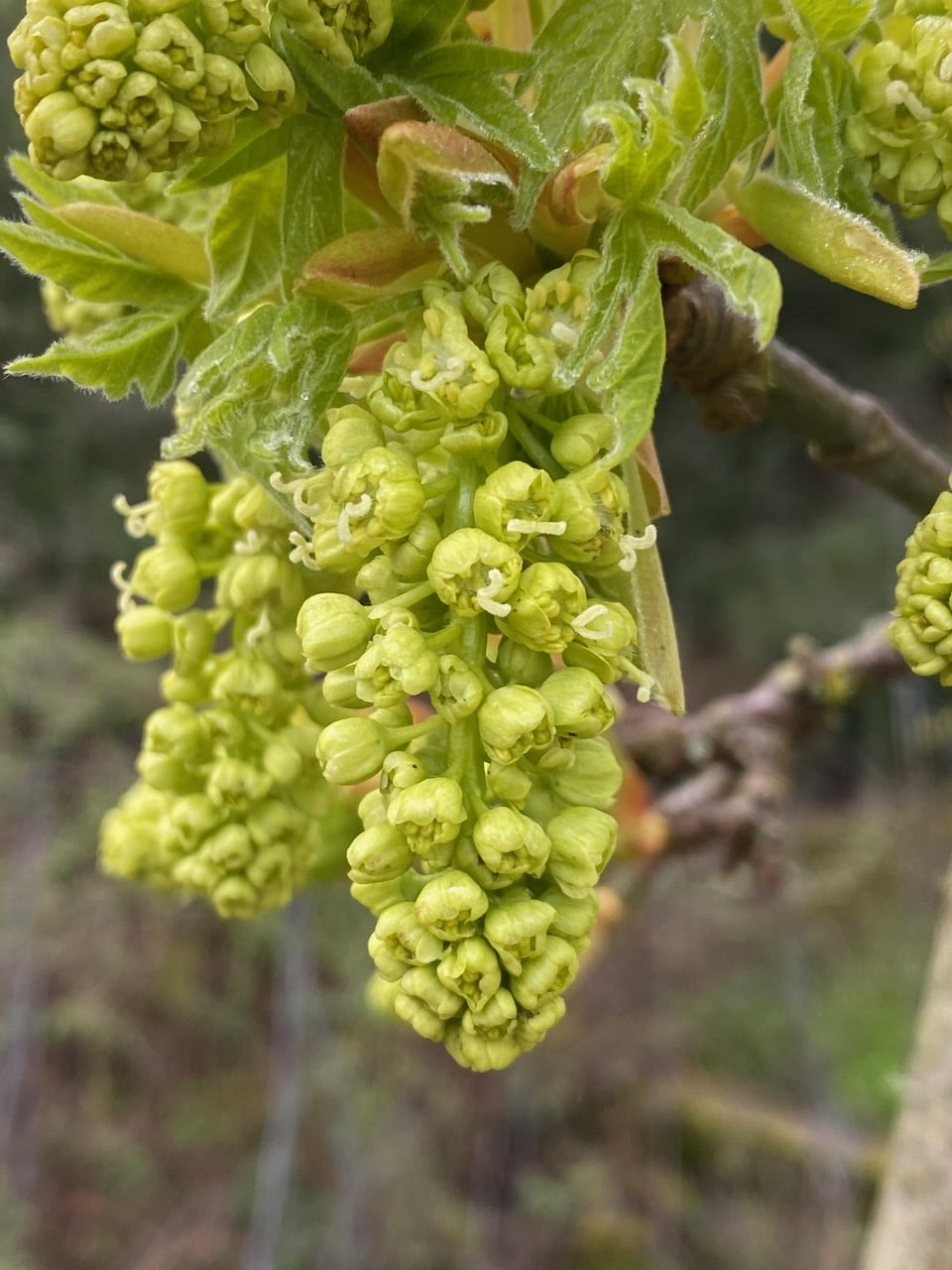
Then my attention is drawn to another Big-leaf Maple tree about 100 feet away, on the bank of the stream. The blooms on this tree are less mature – the racemes are just emerging from the bud scales on the branch tips.
See the freshly opened flowers at the base of the pendant raceme? They are all displaying protruding whitish two-lobed styles – female reproductive structures that are receptive to pollen. Each is surrounded by tightly packed, immature stamens (male parts) in the cup-shaped corollas. Ah, now I get it! The flower of Big-leaf Maple is indeed bisexual, but the genders are separated in time to avoid self-pollination. This phenomenon is called dichogamy. The Big-leaf Maple flowers are protogynous, meaning the female parts mature before the male parts. In the female phase seen here, the flowers can only receive in-coming pollen from other flowers, possibly from the neighboring tree already well into its male phase. By the time the male parts mature and peek out of the corolla to release their pollen, the female parts would have shriveled up and are no longer functional. What perfect arrangement to ensure cross-pollination! And how fortuitous that I happen to come across two trees in different stages of floral development!
So who pollinate these flowers? There is no insect activity around the flowers of either of these two trees as I watch. Perhaps it is too cold – temperatures hover around the mid-40s F right now. From what I could gather, the Big-leaf Maple flowers are pollinated within 2 to 4 weeks after bud-burst by insects such as bees and butterflies.
The pale blue flowers of this Ceanothus are very loosely clustered, but the little Black-tailed Bumble Bee, Bombus melanopygus (family Apidae) is able to forage among them with agility.
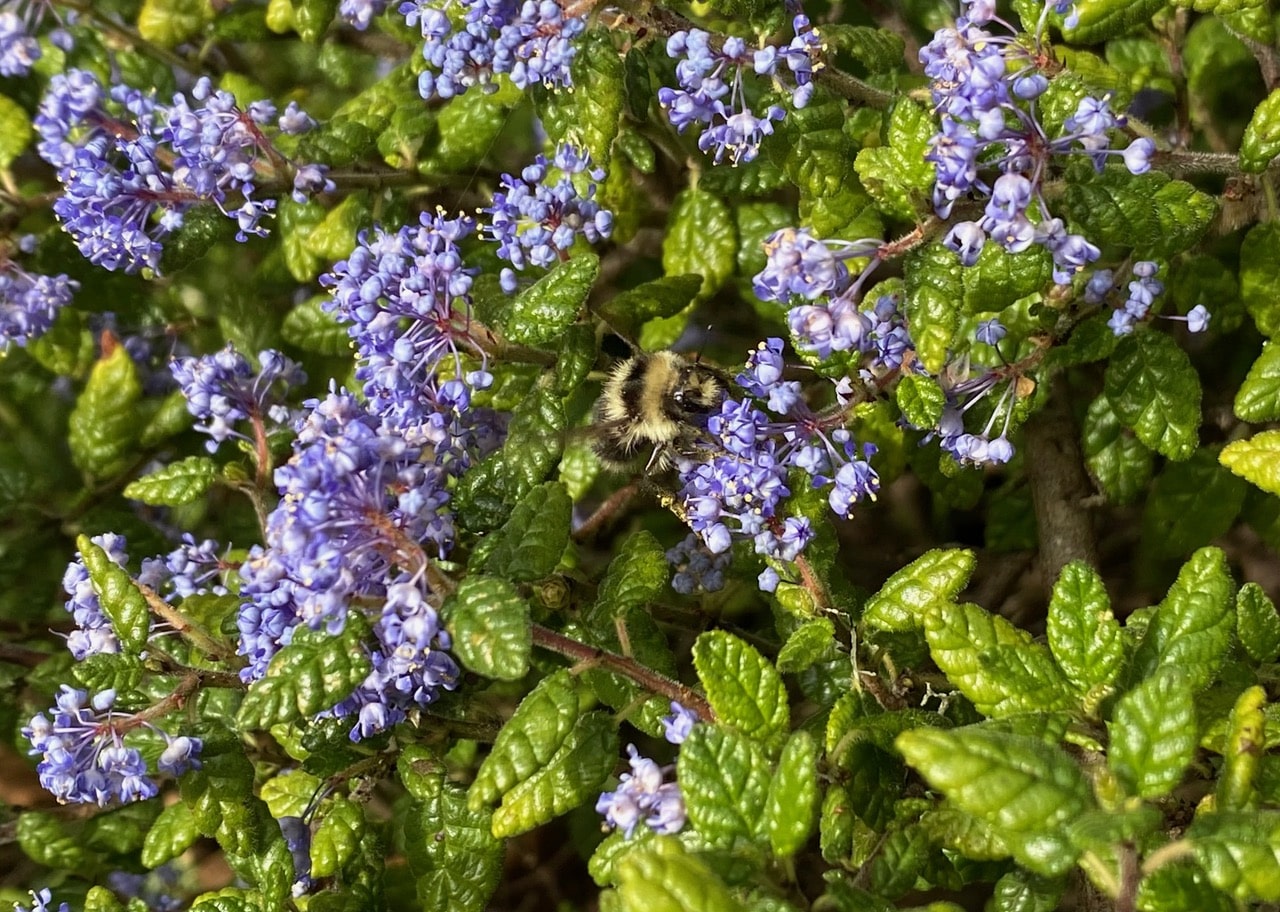
At the other extreme, this Ceanothus is a compact and dense shrub with small, crinkled leaves. A worker Black-tailed Bumble Bee is almost invisible amidst the foliage as she visits the flowers.
Running over the inflorescence or hanging from them, the bees seem ecstatic being able to forage on a sunny day after a long stretch of damp weather.
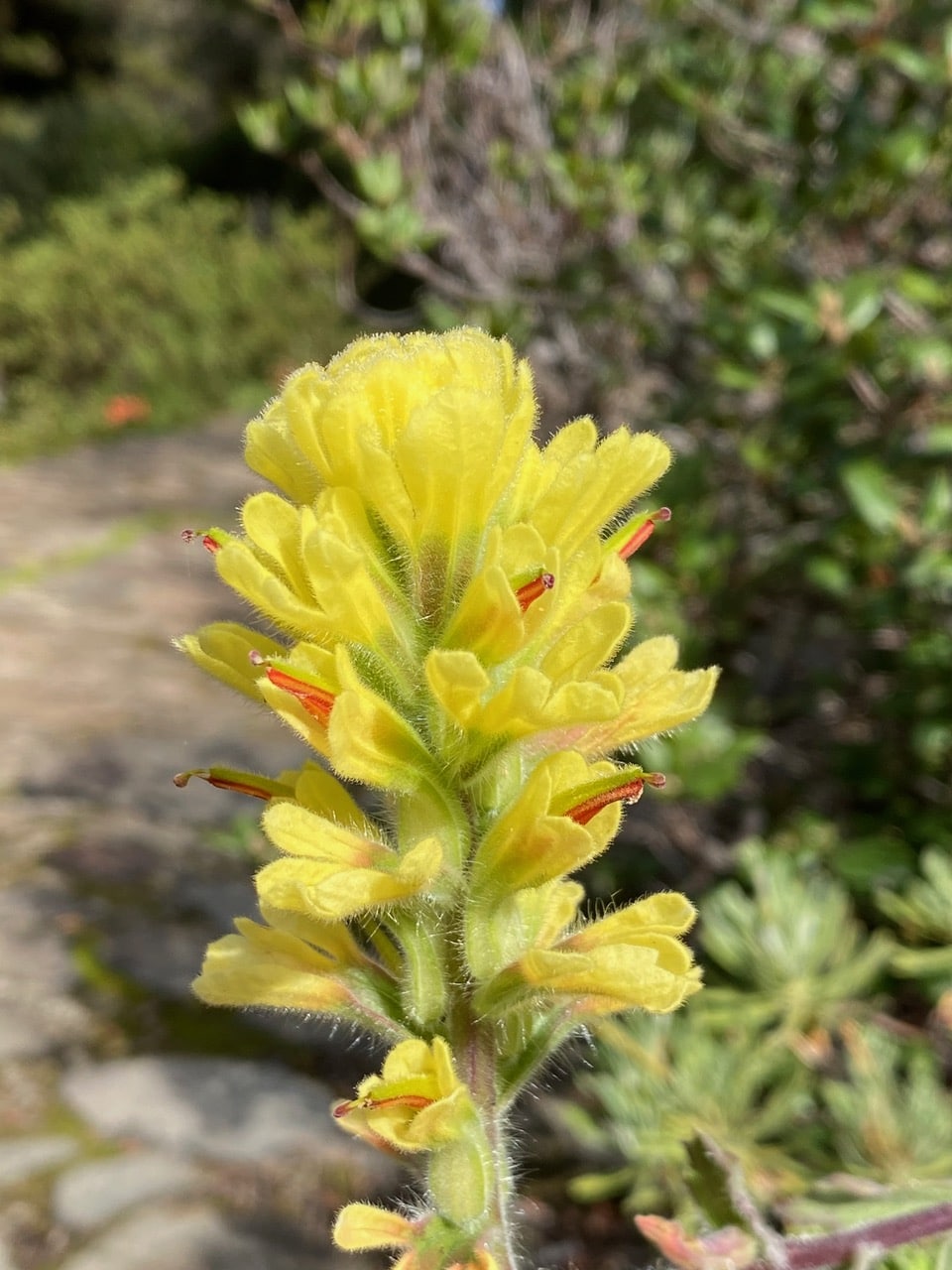
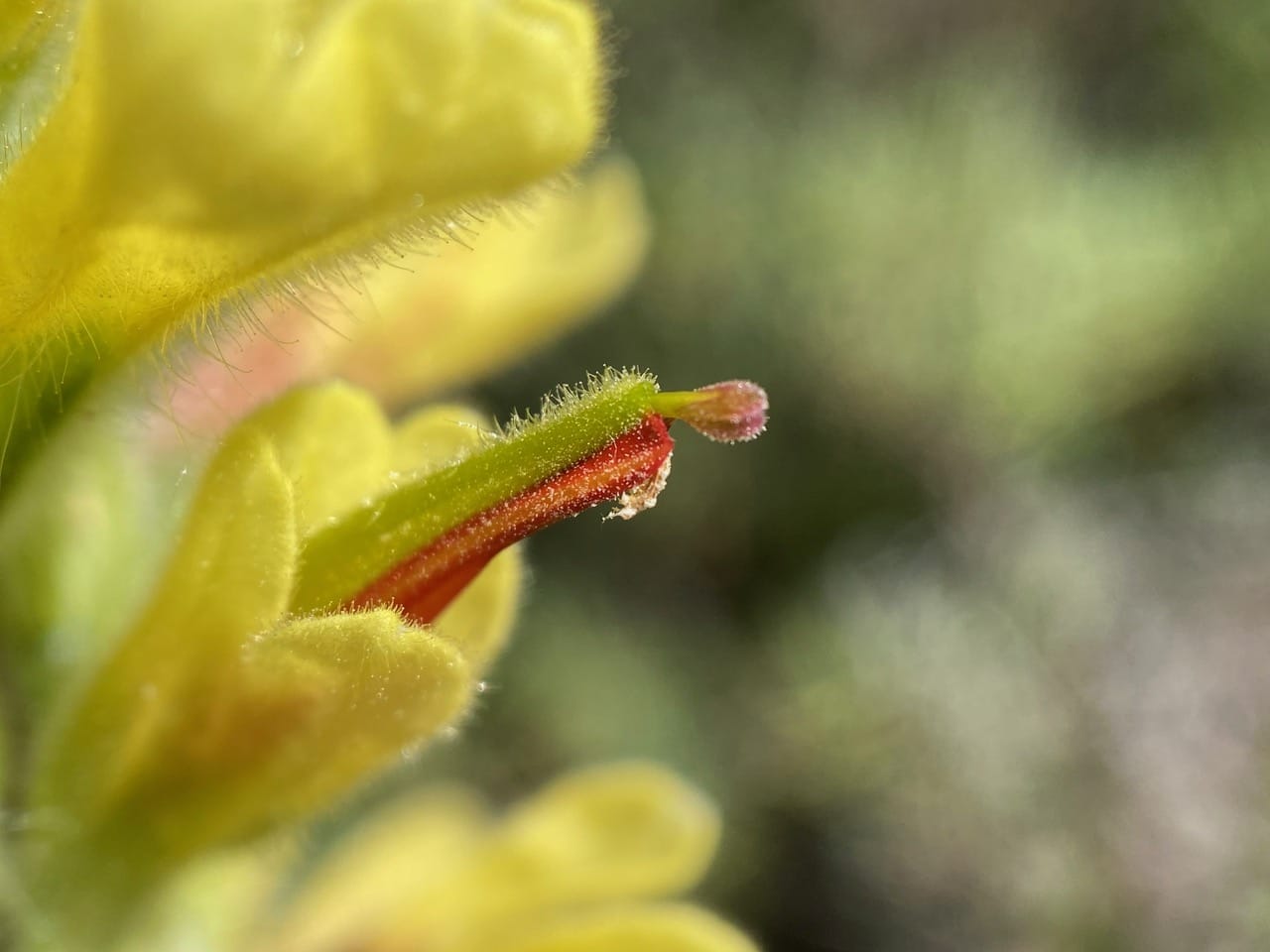
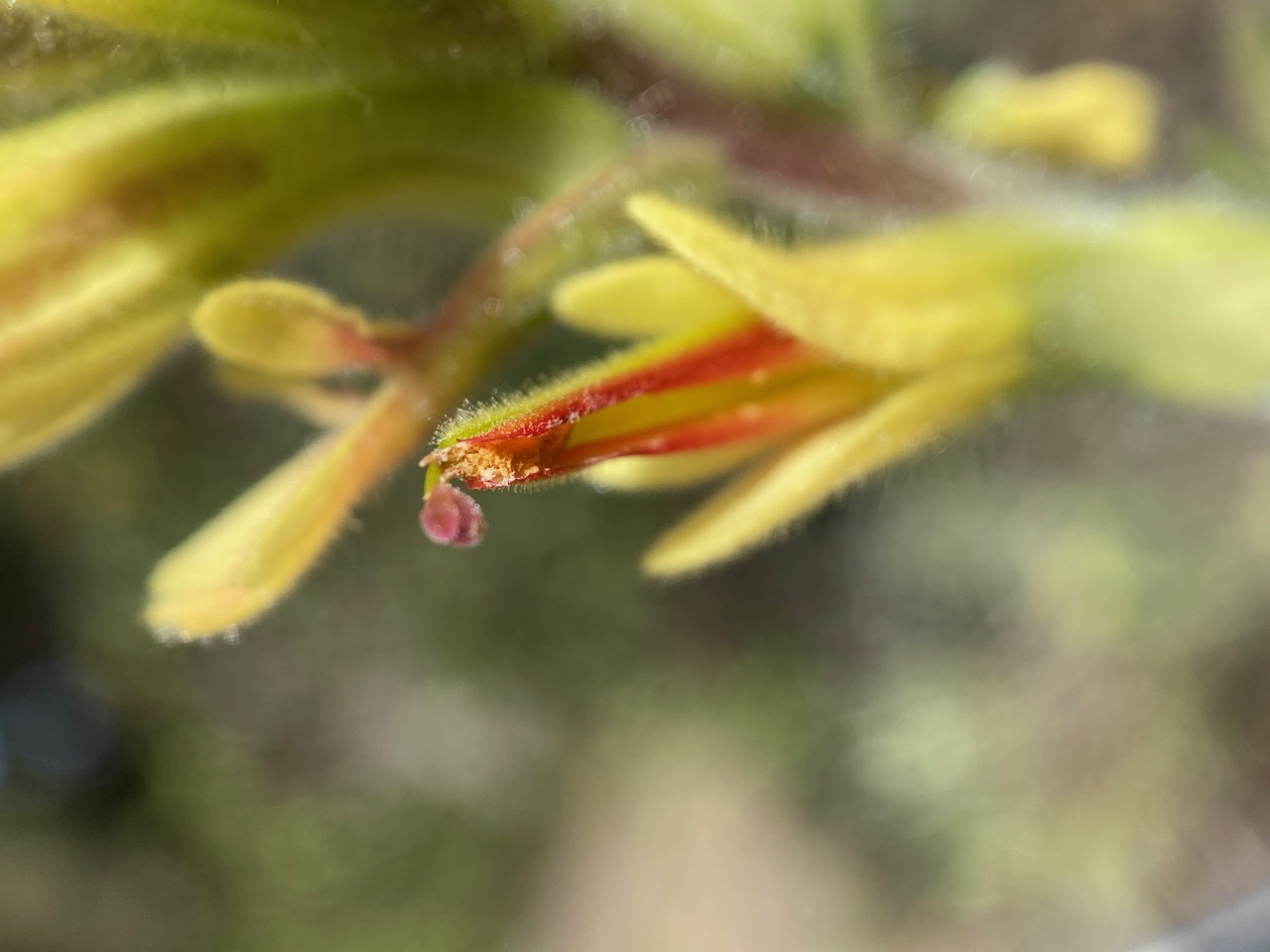
The yellow Coast Paintbrush, Castilleja affinis ssp. affinis is looking festive, with several green-and-red flowers peeking conspicuously from their yellow calyces.
This close-up of the flower shows some withered stamens spilling out from the lower red lip of the corolla under the protruding two-lobed style. The flower has probably been probed by the bill of a hummingbird?
This other flower is showing a split along the length of the lower red lip. Damage incurred by the probing bill of a hummer?
The red tubular flowers of Castilleja are specifically adapted for pollination by hummingbirds. The birds are attracted to red color, and their long thin bills can access the nectar at the base of the tubular flowers. In probing the flowers, the bird’s bill and/or head may be coated with pollen, and whatever pollen already on the bird is likely to be deposited on the overhanging stigmas.
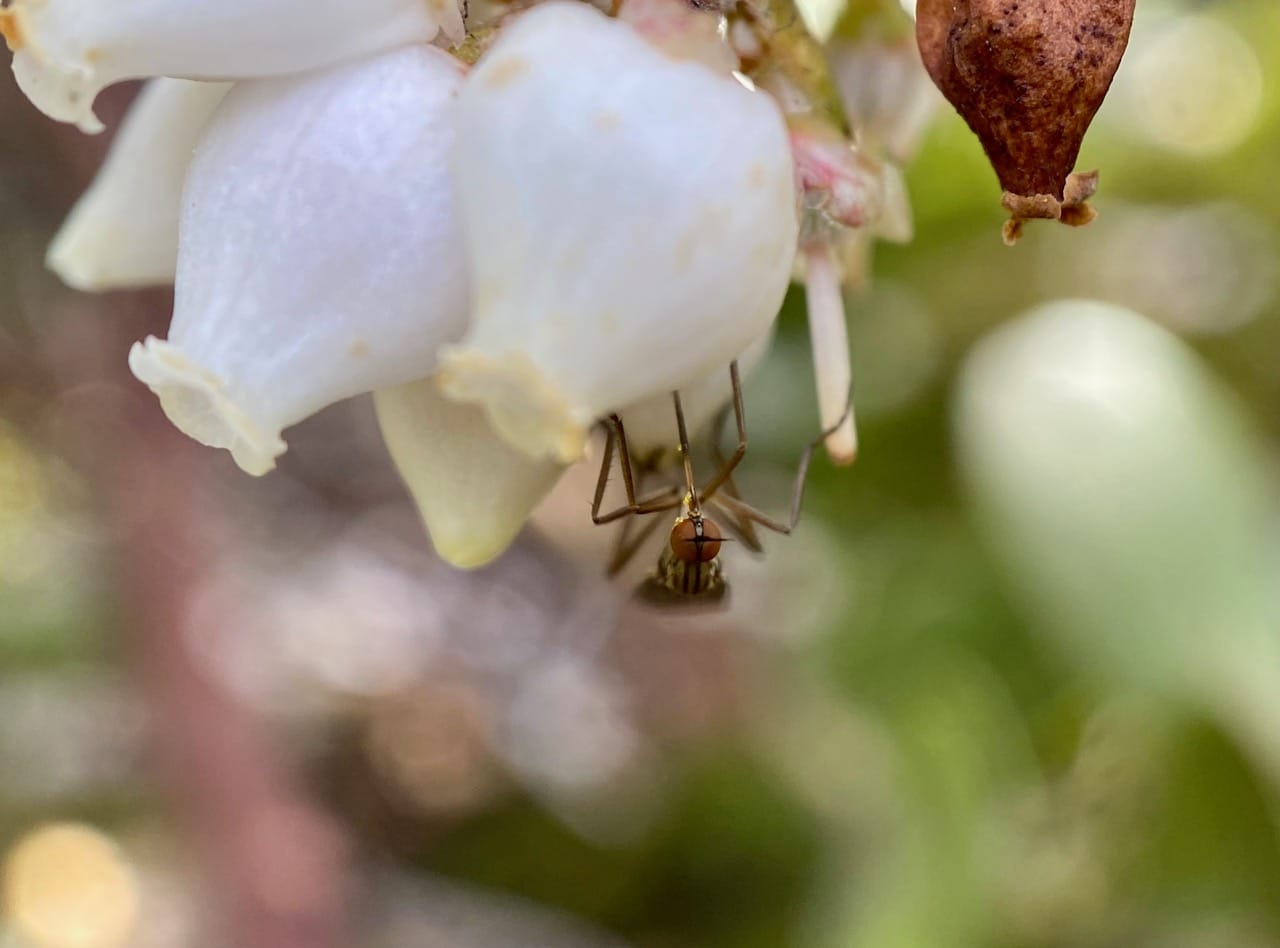
In the dim recesses of a manzanita, a Empidid Dance Fly (family Empididae) fly is perched motionless on a flower. What is it doing?
Dance Flies, in the family Empididae, get their name from the habit of males of some species to gather in large groups and dance up and down in the air in the hopes of attracting females. They are predominantly predatory and they are often found hunting for small insects on and under vegetation in shady areas. Both genders may also drink nectar. Male dance flies give their sweeties a nuptial gift to eat while they mate. The gift is thought to enable her to complete the development of her eggs. Males may wrap their gifts in balloons of silk or spit, hence the other common name of Balloon Flies.
As the fly finally shifts its position, I can see that it has a long proboscis. The proboscis is not aimed at the opening of the flower, but I can’t see whether or where it is penetrating the flower. Is the fly robbing nectar by poking a hole on the side? These are not even fresh flowers. Note the yellow pollen stuck to the base of the fly’s proboscis.
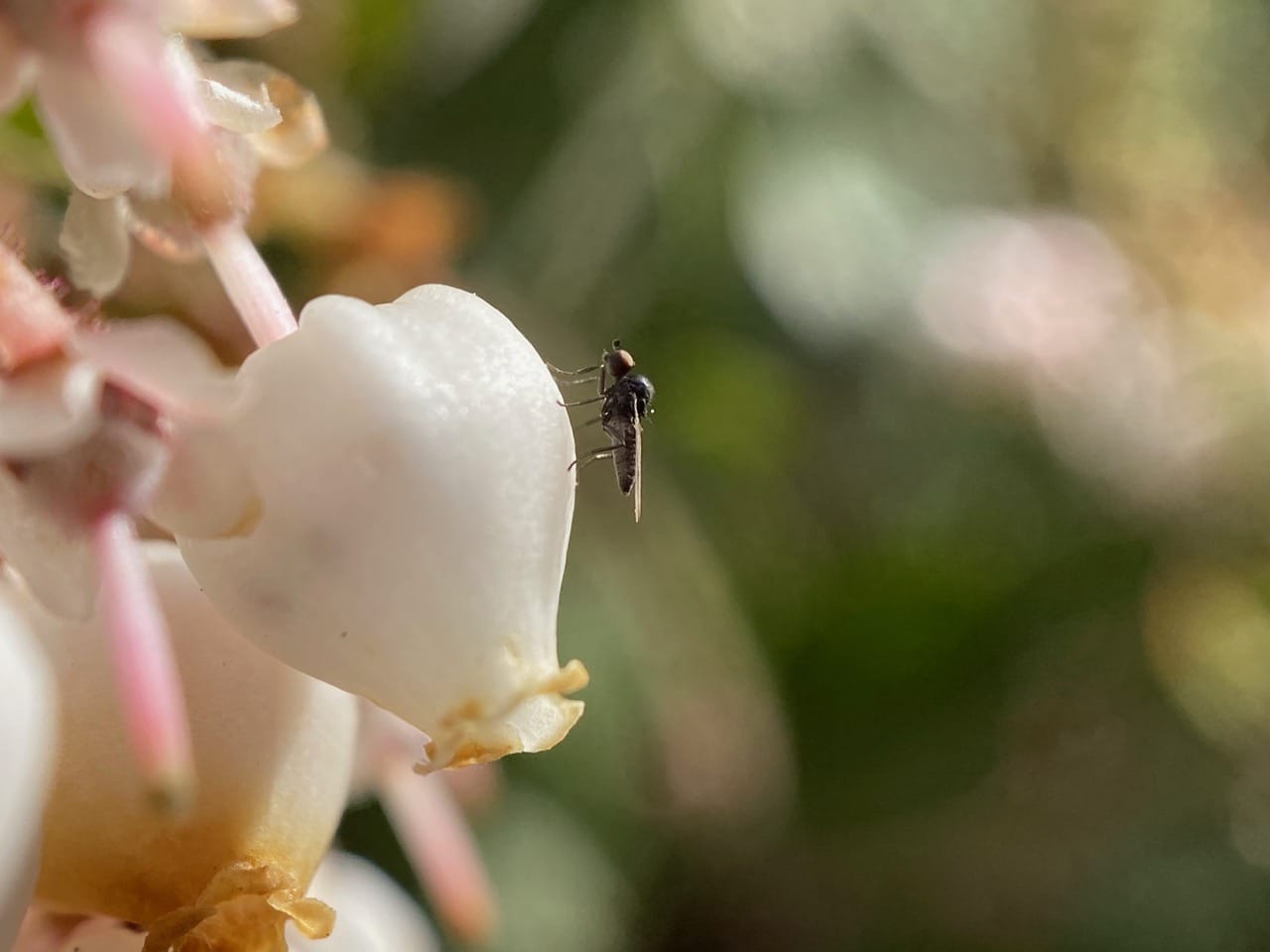
Ooh, here’s another, much smaller Dance Fly. From its humped thorax, globular head made up mostly of eyes, and short forward pointing proboscis, I recognize it as a Hybotid Dance Fly, Anthalia sp. (family Hybotidae). The fly is small enough to enter the manzanita flower. Does it feed on manzanita pollen and help pollinate the flowers?
The Hybotid Dance Flies belong to the superfamily Empidoidea and were formerly included in the Empididae as a subfamily. Empididae generally have a thick beak pointing down, while Hybotidae have a thinner beak, or a thick beak pointing forwards or diagonally. Some crucial wing venation further distinguishes the two families. Precious little is known about the life cycle and biology of Hybotids because they are not considered of economic consequence. Many Hybotids are known to eat pollen.
Why the name “dance fly”? This is derived from the mating swarms of males of many species. They gather in clouds over prominent objects, each individual seeming to bounce or “dance” in mid-air. Many other flies do this, notably midges, but the Empidids and the Hybotids got the moniker.
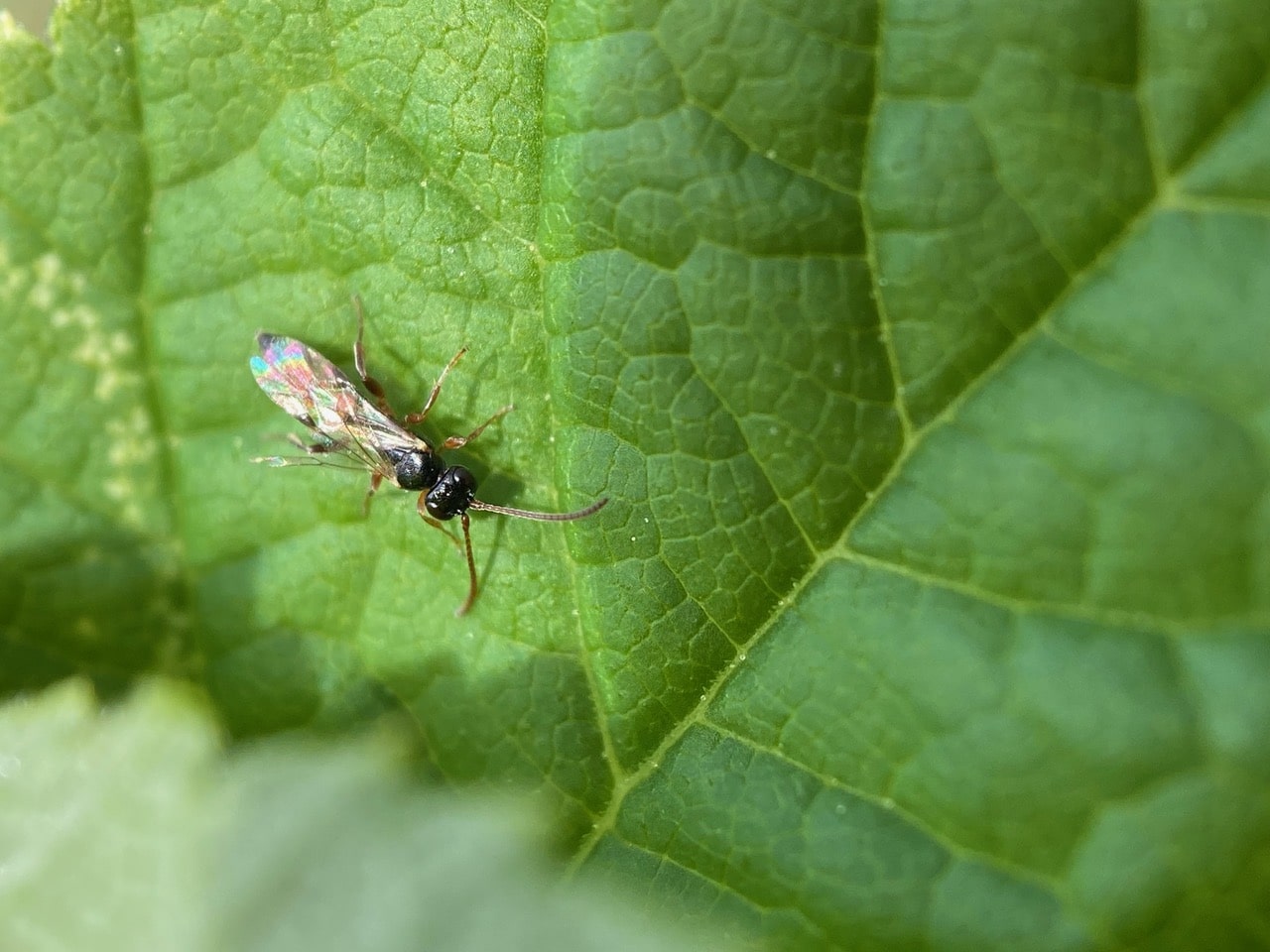
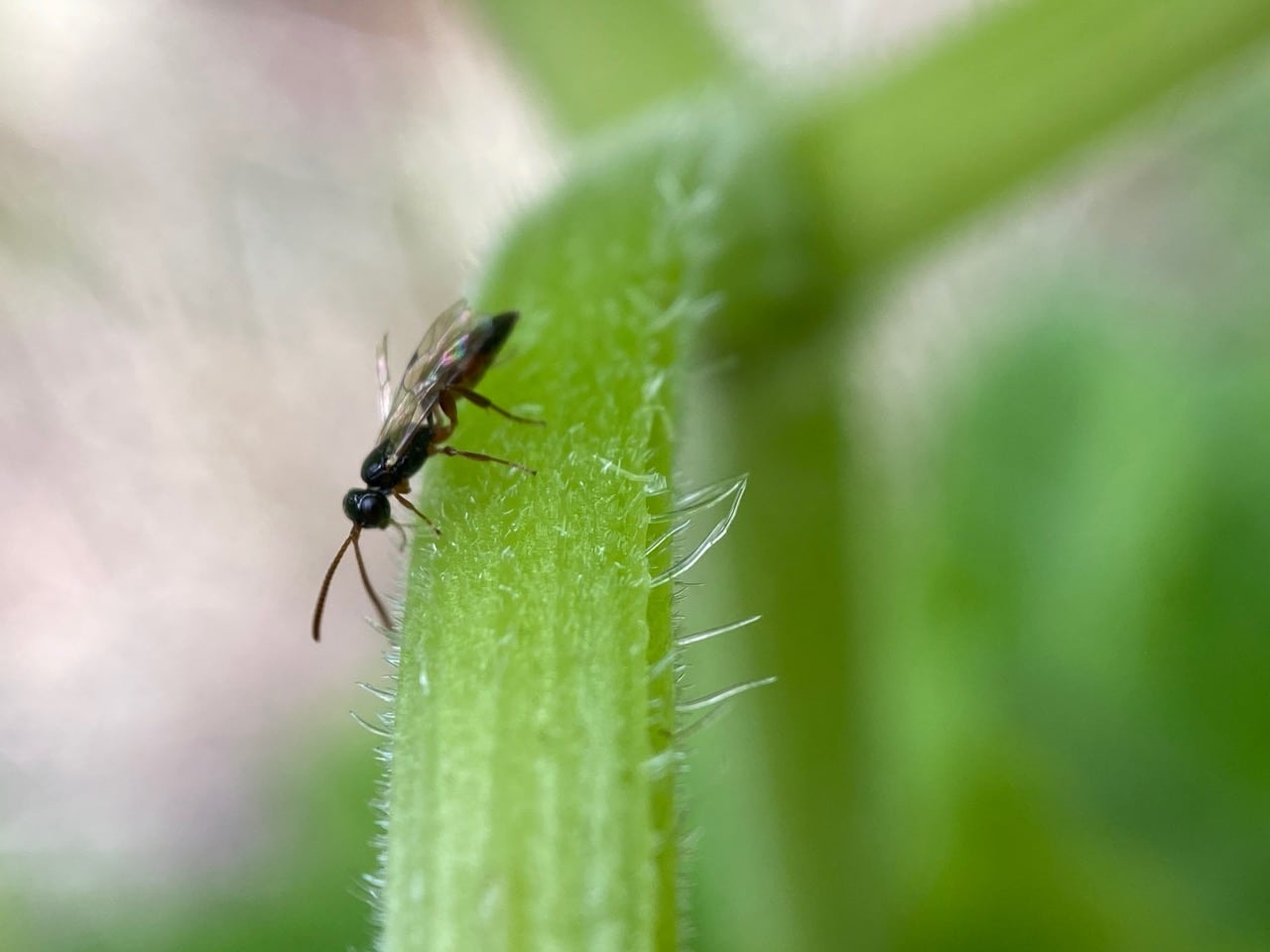
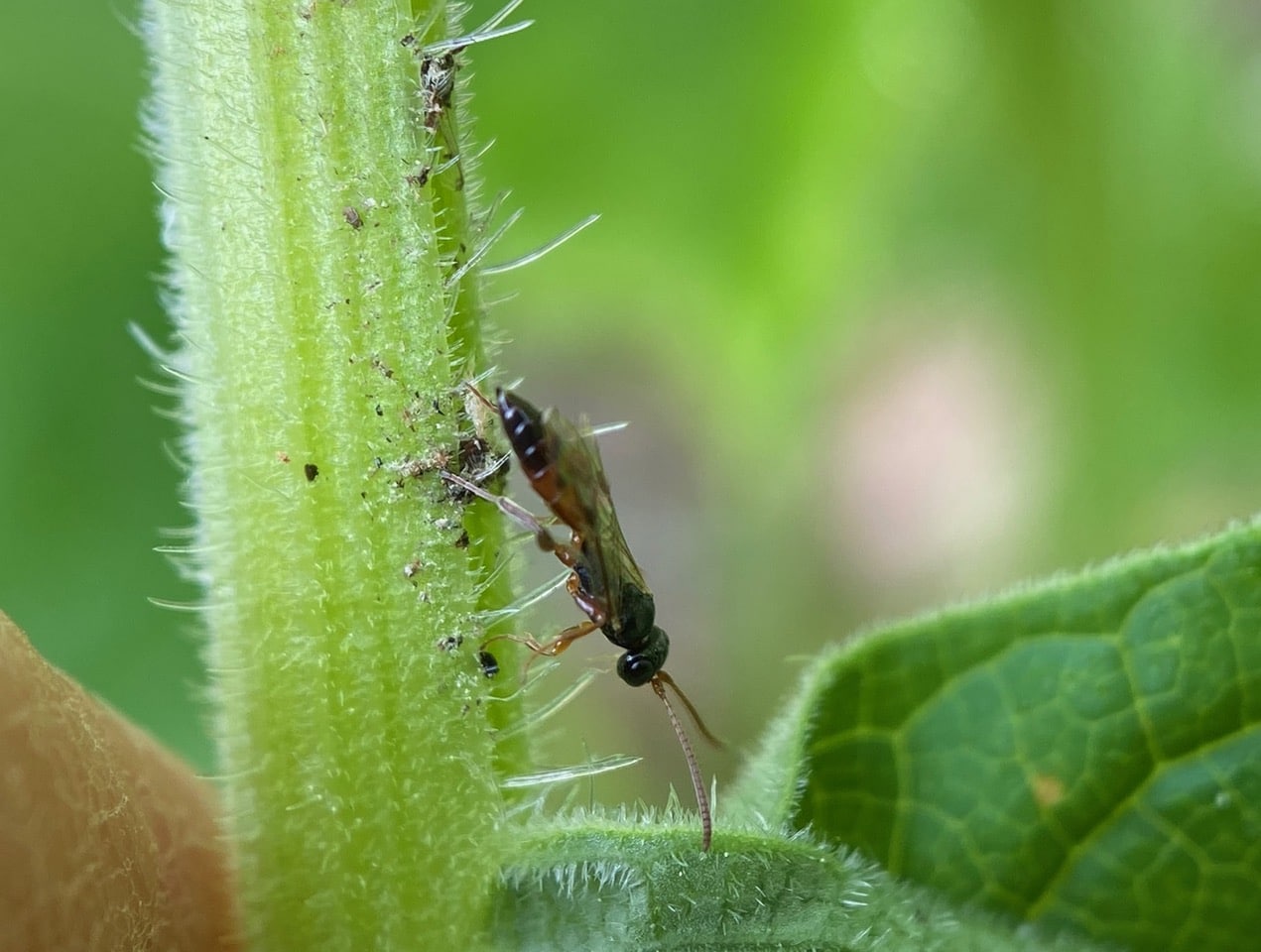
A small black wasp is exploring the leaf of a Cow Parsnip. iNaturalist has helped identify it as a member of the tribe Phaeogenini (family Ichneumonidae).
The Ichneumonidae, also known as the Ichneumon Wasps, or Ichneumonids, are a family of parasitoid wasps. They are one of the most diverse groups within the Hymenoptera (the order that includes the ants, wasps and bees) with about 25,000 species and counting. Ichneumon Wasps attack the immature stages of insects and spiders, eventually killing their hosts. They play an important role in the ecosystem as regulators of insect populations.
The Ichneumon wasps have longer antennae than typical wasps, with 16 segments or more as opposed to 13 or fewer. Ichneumonid females have an unmodified ovipositor for laying eggs. They generally inject eggs either directly into their host’s body or onto its surface, and the process may require penetration of wood. After hatching, the Ichneumonid larva consumes its still living host. The most common hosts are larvae or pupae of Lepidoptera (butterflies and moths), Coleoptera (beetles) and Hymenoptera. Adult Ichneumonids feed on plant sap and nectar. Females spend much of their active time searching for hosts while the males are constantly on the look out for females. Many Ichneumonids are associated with specific prey, and Ichneumonids are considered effective biological controls of some pest species.
Ichneumon wasps drill into wood using their ovipositor, which is a long, needle-like structure that consists of three filaments, with two acting as a protective sheath around a central drilling filament. This central filament can move back and forth in a reciprocating motion, essentially “sawing” through the wood while secreting enzymes that help soften the wood fibers, making penetration easier. The wasp can precisely locate the host larva within the wood using its antennae and other sensory abilities.
Is the Ichneumon wasp searching for a host?
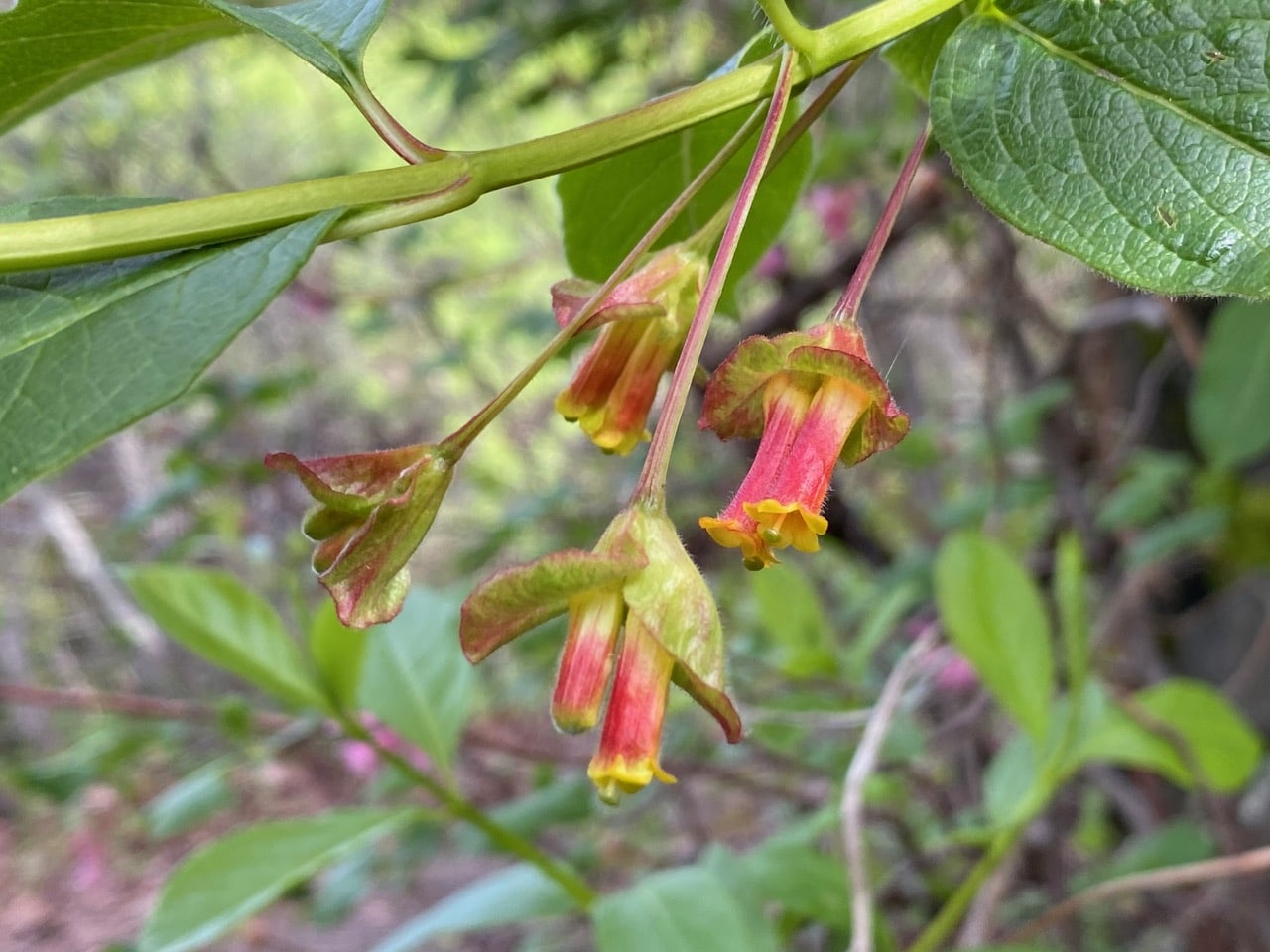
Way in the back of the garden, in a shady spot below the greenhouse a Twinberry Honeysuckle is in bloom! What a surprise – the plant typically blooms in late spring to early summer.
Twinberry Honeysuckle, Lonicera involucrata is a large, deciduous shrub found in western North America. Small, hairy, tubular, reddish-yellow flowers grow in pairs surrounded by two leafy bracts. The bracts turn from green to a striking dark red in late summer as fruits ripen. The name involucrata refers to these bracts, which are collectively called an “involucre”. The paired black berries are about one-third inch in diameter and are unpleasantly bitter tasting. The flowers attract hummingbirds and other birds feed on the fruits.
I am surprised to learn that the Twinberry flowers are monoecious, meaning separate male and female flowers are borne on the same plant. All the flowers pictured here appear to be female, with prominent style and stigma protruding slightly beyond the corolla. I have to look for the male flowers on my next visit to the garden.
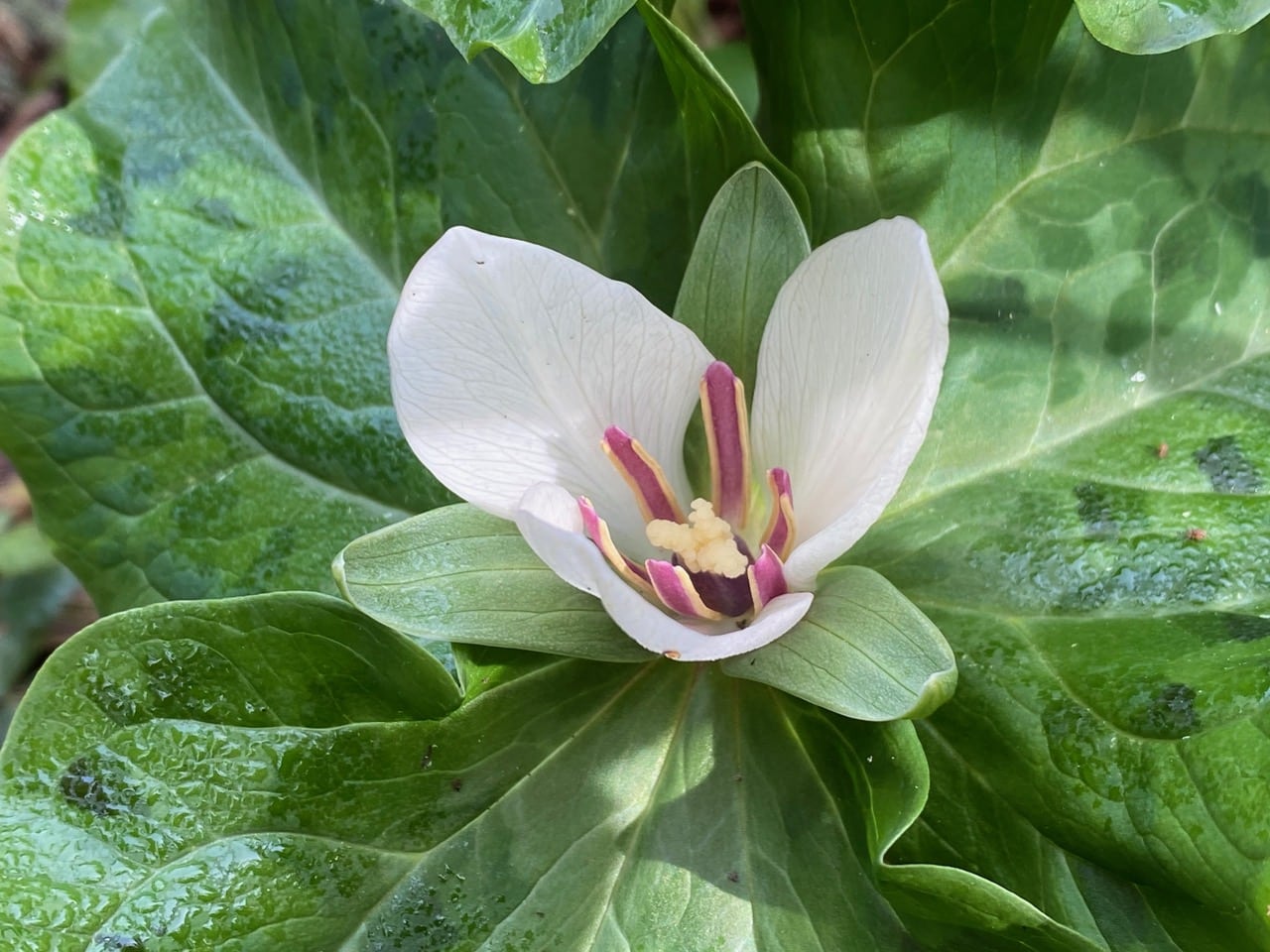
Although its petals are white, unlike the typical deep red of the Giant Trillium, Trillium chloropetalum, one can still identify the plant from the dark blotches on the leaves and the fact that the flower is sessile, without a pedicel.
Nearby, we have a different species of Trillium, Trillium ovatum or the Western or Pacific Trillium. Its typically white petals have withered, showing the long pedicel or flower stalk that holds the flower above the leaves. Given its swelling ovary, the flower has obviously been successfully pollinated. By whom? I have yet to see an insect visit these Trillium flowers.
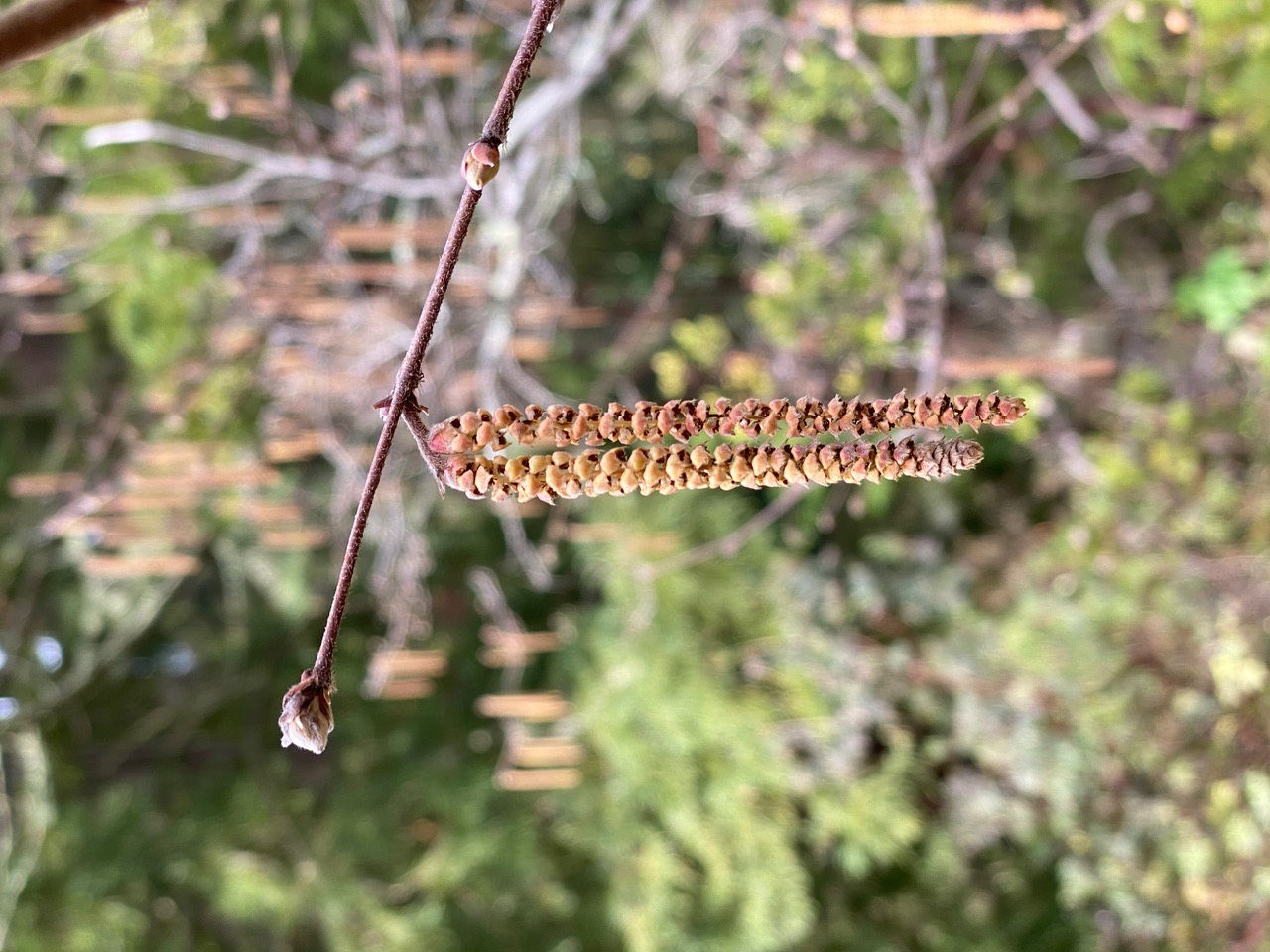
The male catkins on the large Beaked Hazelnut, Corylus cornuta are mostly spent now, hanging in loose, dry chains from the bare branches. Ah, it’s time to look for the female flowers!
The Hazelnut is monoecious, with separate male and female flowers borne on the same plant. The tree/shrub also exhibits dichogamy, with temporal separation of the male and female phases. The male flowers of Hazelnut show up before the female flowers, exhibiting protandry. Both genders usually show up before the leaves emerge, increasing the odds that the wind will successfully transport the pollen grains from the dangling male flowers to a compatible female flower without leaf surfaces disrupting air movements and pollen delivery.
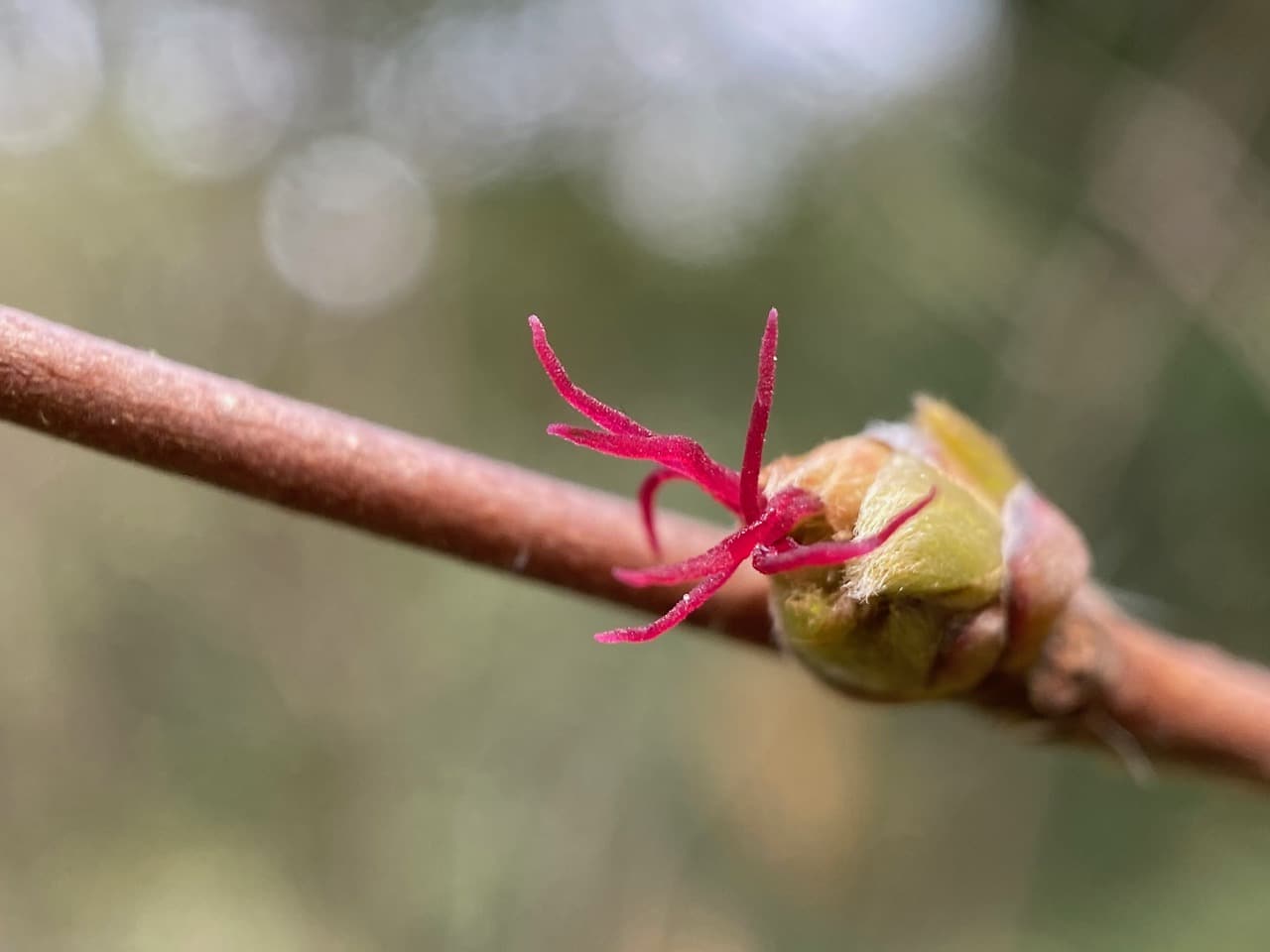
It takes a bit of searching, but I am happy to finally find a couple of female flowers on the Beaked Hazelnut.
The female flowers of the Beaked Hazelnut are inconspicuous, appearing as tiny, bud-like structures with a spray of red stigmas protruding from the center. They are found at the tips of the branches, often near the male catkins. After pollination, the female flowers will develop into the fruits/nuts in the fall. The nuts are enclosed in a husk with a tubular extension that resembles a beak, giving the plant its common name.