

Pollinator Post 3/18/25 (1)

While my aching right knee still complains, I am thrilled to be able to take a walk in the sun again after a week of cold and wet weather. The obvious choice of location is Crab Cove, with its open, flat terrain by the shore and the native gardens.
All the various species of Ceanothus at Crab Cove are in bloom now. Since they are not labeled, I am not sure of their species. The colors of the flowers range from creamy white, pale lavender to electric blue. Some of the plants are tree size, many are small shrubs, and some are sprawling prostrate ground covers, all enticing with their perfume. It’s a visual and olfactory extravaganza. The bees are just as delighted with the smorgasbord as I am. The Honey Bees, Apis mellifera (family Apidae) is the predominant bee at the Ceanothus flowers.

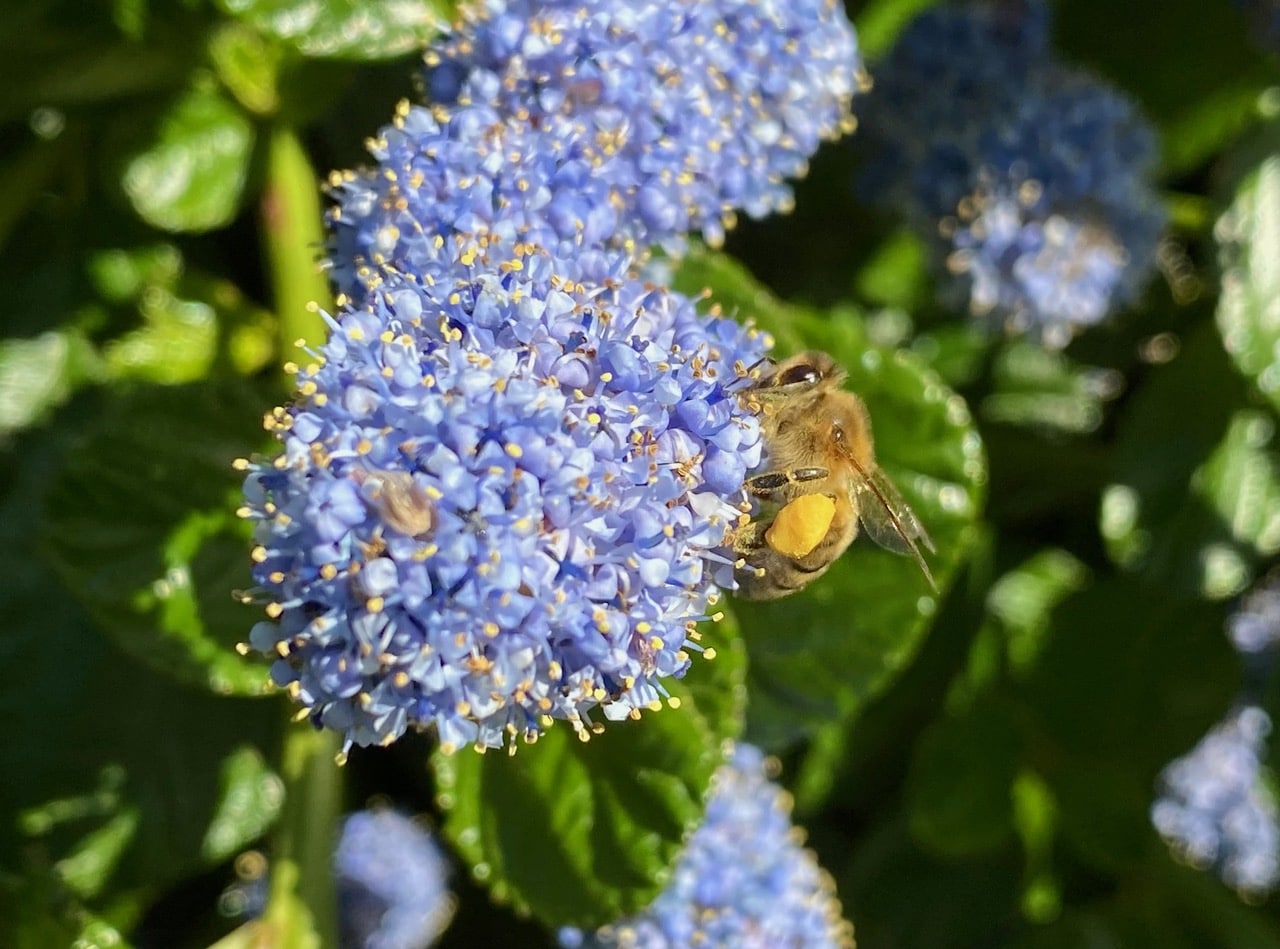

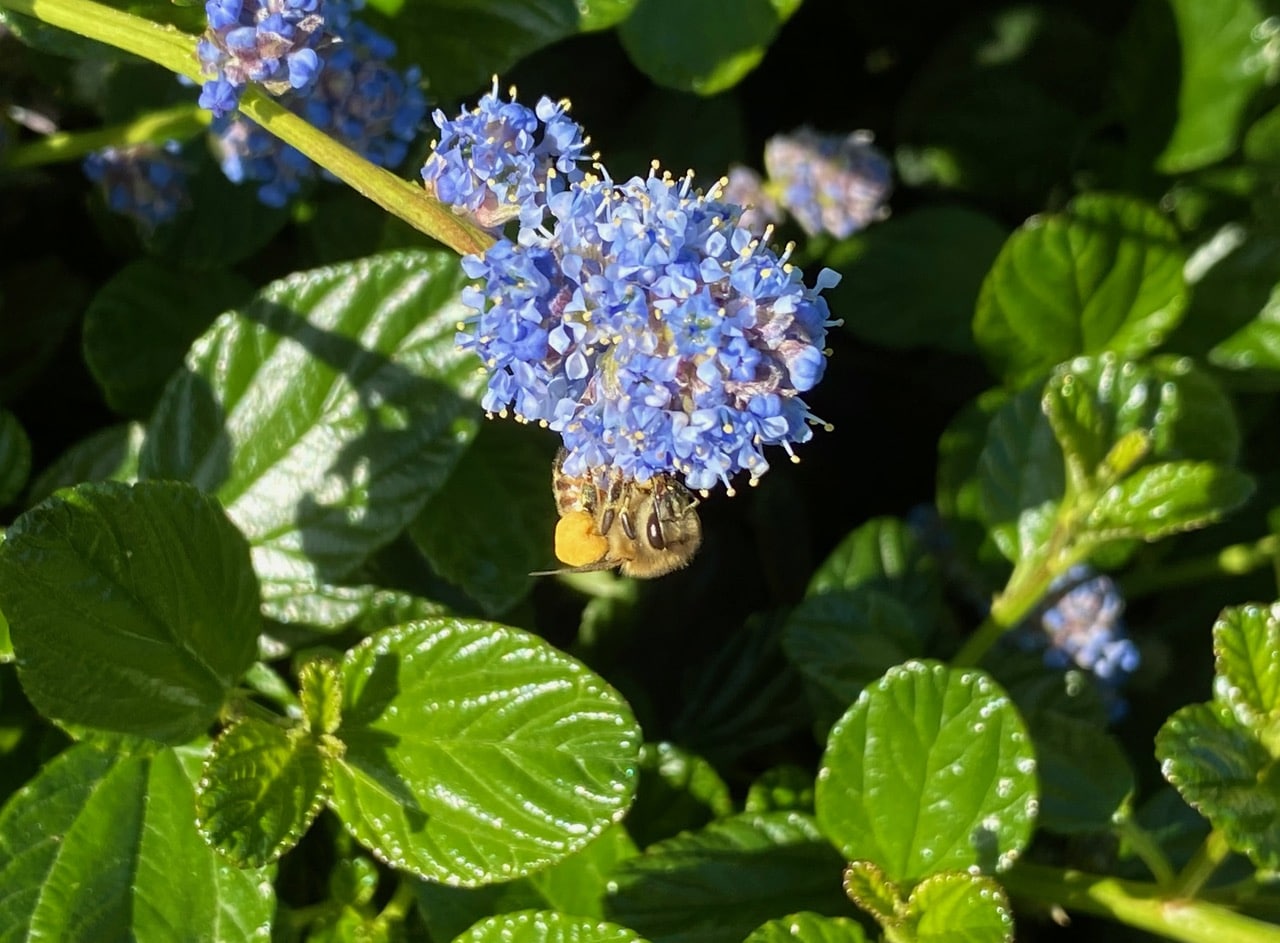
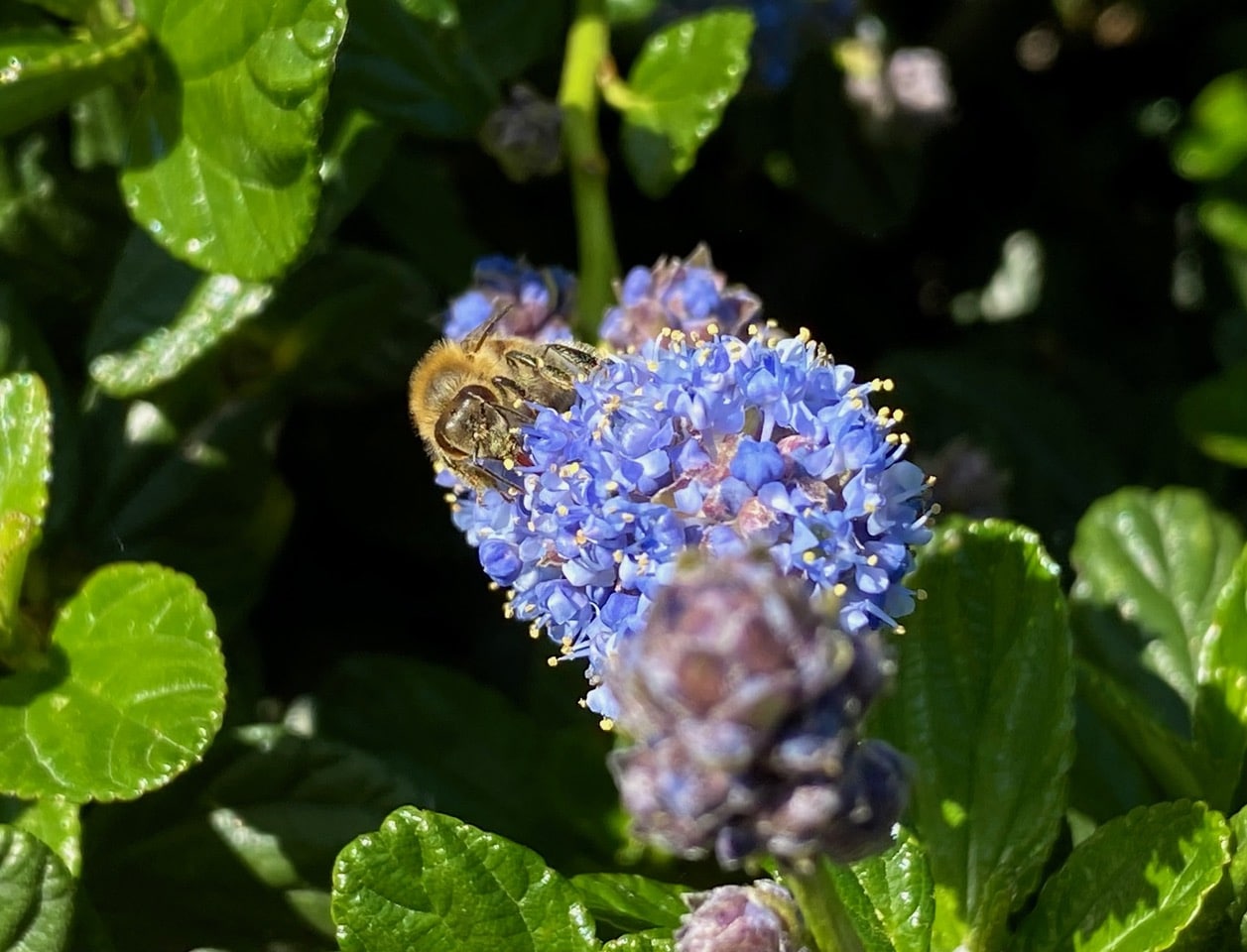

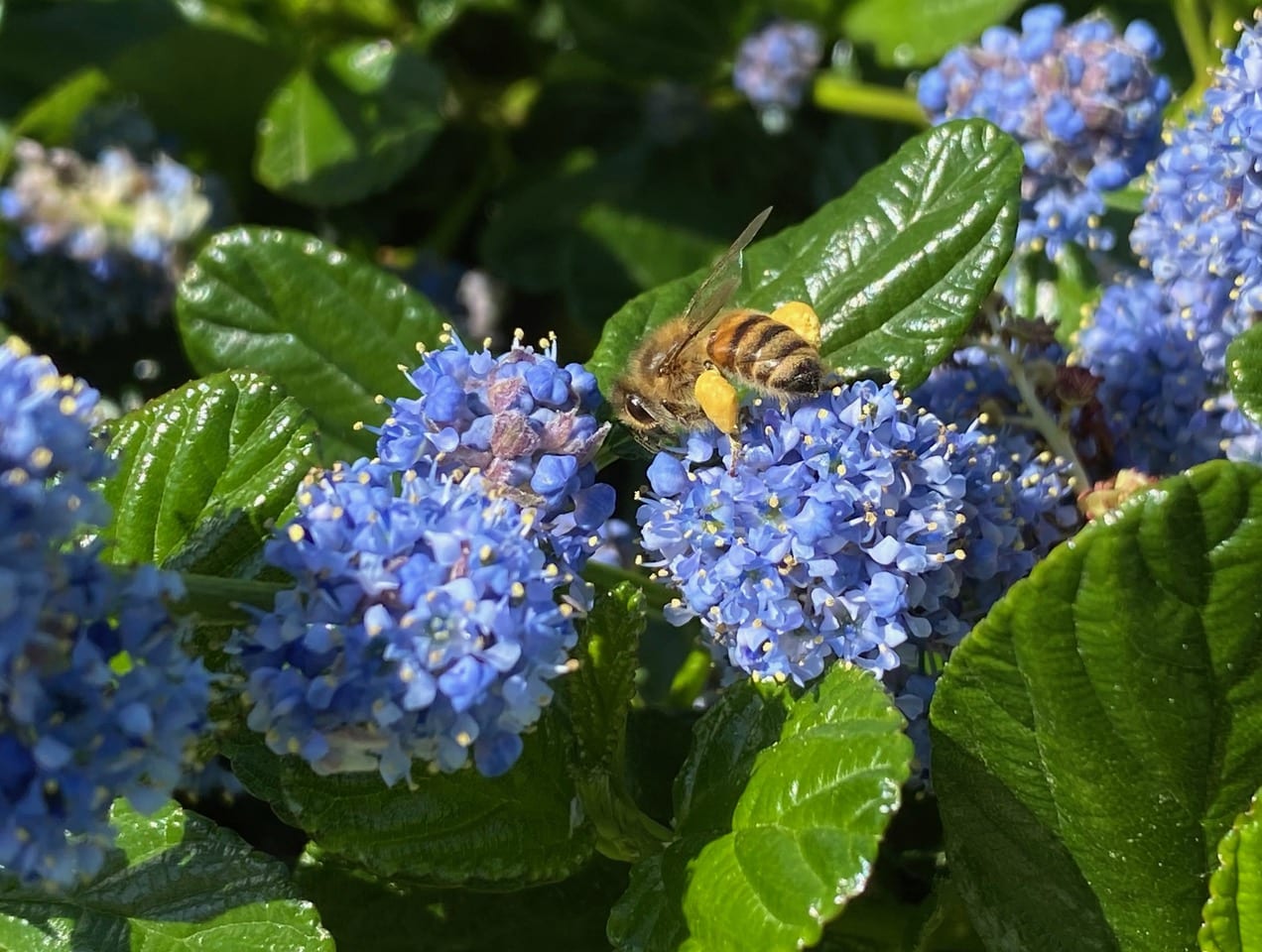

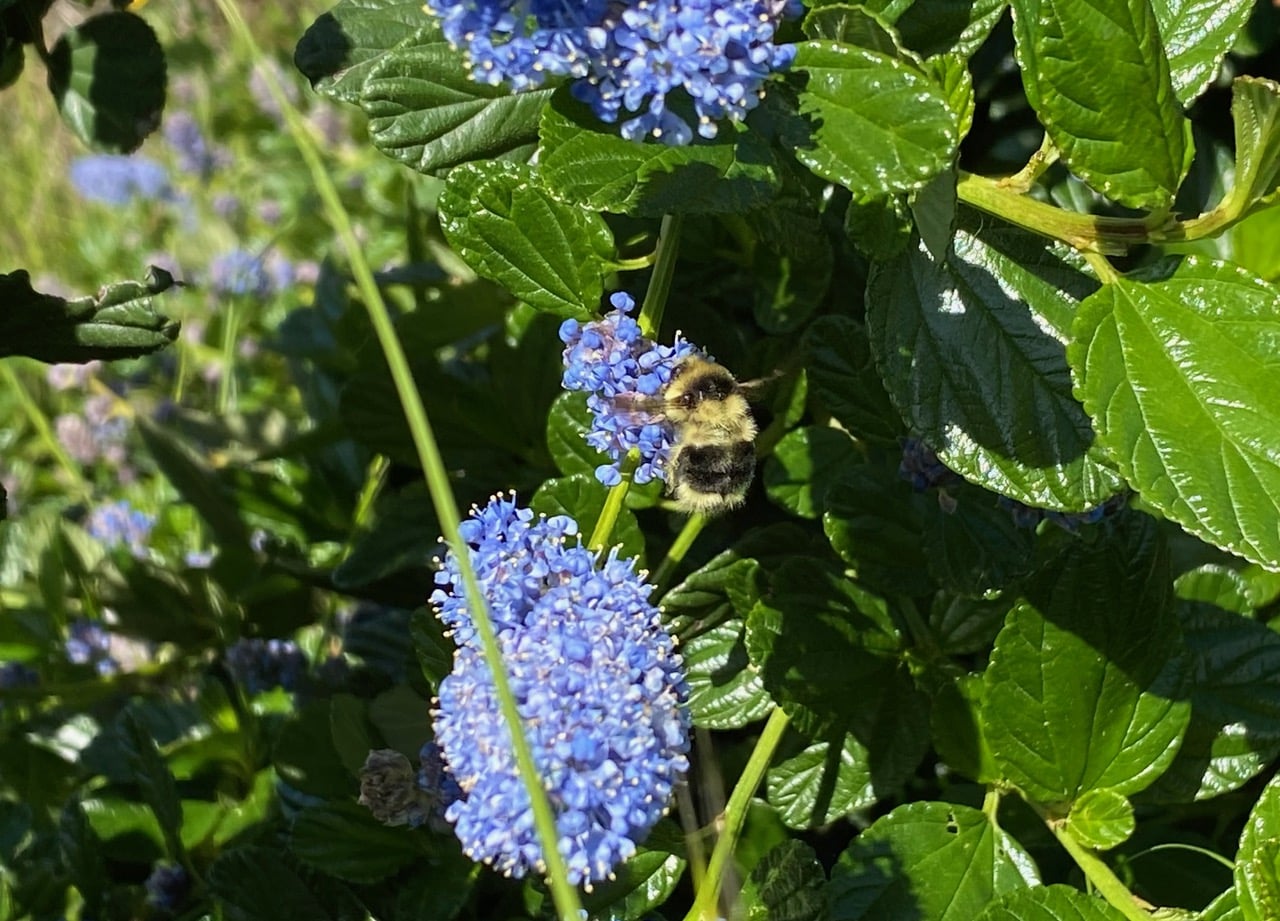
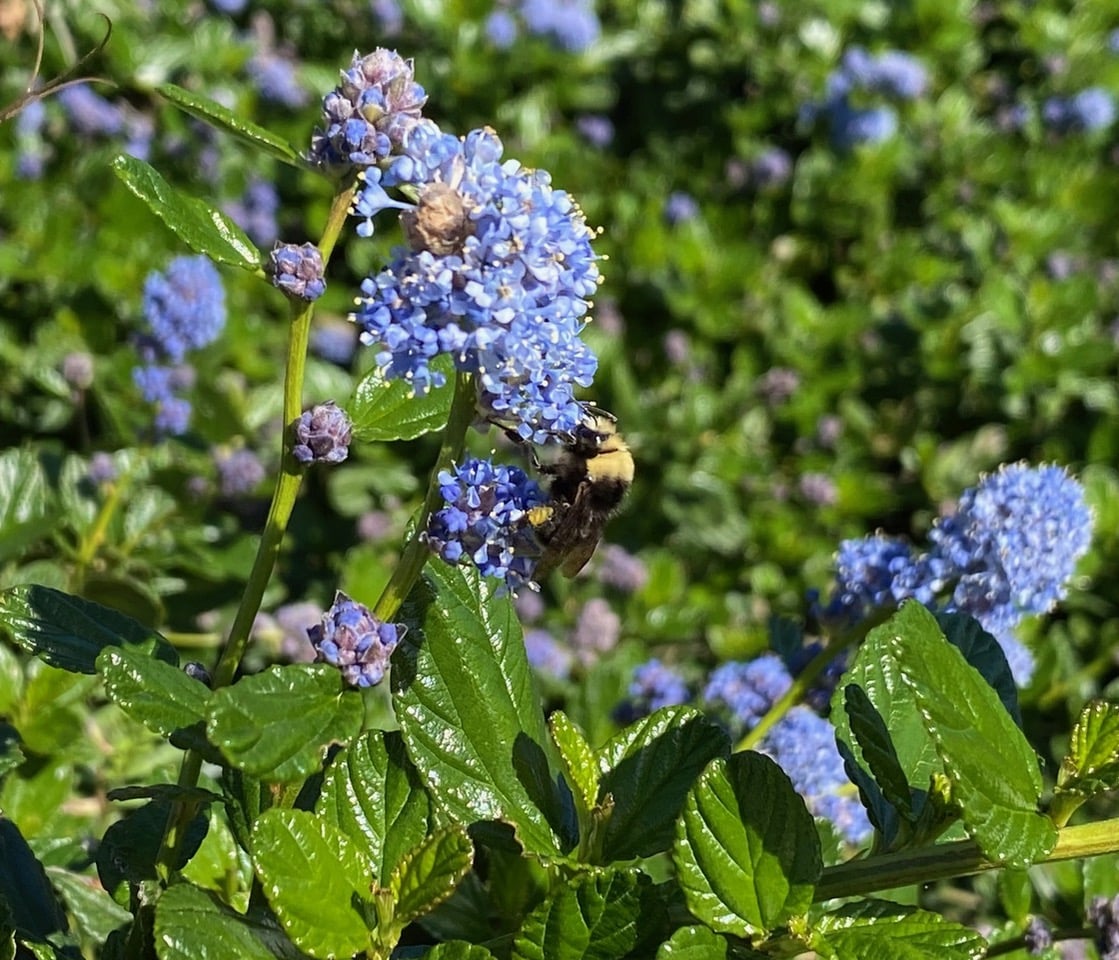



The Ceanothus flowers are small and tightly clustered. With shallow, open-faced corolla and fully exserted stamens offering an abundance of pollen, Ceanothus is an excellent source of easily accessible nectar and pollen in early spring. It never fails to lift my spirit to watch a bee gather pollen by doing a quick shimmy through a Ceanothus inflorescence.
Watching honey bees forage, I am reminded of a fellow docent at the Oakland Museum Natural Sciences Gallery many years ago. Bud, a retired entomologist, taught me that every honey bee worker out foraging should be treated with respect – they are all little old ladies. Bud was absolutely correct. All Honey Bee foragers are female, and they are the oldest of their hive mates. How do honey bees get their job assignments within their social organization?
“A bee’s job is, first of all, determined by its sex. Male bees, or drones, don’t do any work. Making up roughly 10% of the colony’s population, they spend their whole lives eating honey and waiting for the opportunity to mate with the queen. The queen mates with up to 20 drones and will store their sperm in her spermatheca for the rest of her life. That’s where male duties end. Female bees, known as worker bees, make up the vast majority of a hive’s population, and they do all the work to keep it functioning. Females are responsible for the construction, maintenance, and proliferation of the nest and the colony. When a worker bee emerges as an adult, she immediately starts cleaning the cell from which she hatched. Her first 3 days are spent cleaning cells to prepare them for the queen’s next round of eggs. Then her hormones kick in to initiate the next phase of work: nursing the young. The worker bee spends about a week nursing the brood, feeding larvae with royal jelly. Next, the worker bee enters the third phase, as a sort of utility worker, moving farther away from the nest’s center. Here she builds cells and stores food in the edge of the nest for about a week. A worker’s hormone shifts into the final phase of work at around 41st day: foraging. This work is the most dangerous and arguably the most important. It’s only done by older bees who are closer to death. As the worker bee approaches her fourth week of nonstop work, she senses her end of days, and removes herself from the hive, so as not the become a burden to the colony. If she dies in the hive, her hive mates would have to remove her corpse. Thus is the life of a female honey bee during the active seasons of spring and summer, compulsively working from the day she’s born until the day she expires.” – excerpt from an article in National Geographic by Richie Hertzberg.
So, don’t forget to tip your hat to the “little old ladies” you see in the garden!
Wow, that’s an impressive pollen load on that Honey Bee!
The pollen collecting apparatus in Apidae bees, which include honey bees and bumble bees, is commonly called a “pollen basket” or corbicula. This region is located on the tibia of the hind legs and consists of hairs surrounding a concave region. After the bee visits a flower, she begins to groom herself and brushes the pollen down toward her hind legs and packs the pollen into her pollen basket. A little nectar mixed with the pollen keeps it all together like putty, and the stiff hairs surrounding the pollen basket hold it in place. Remarkably bees are able to fly while carrying up to a third of their body weight in pollen.
.jpg)
Its tongue extended, the Honey Bee is taking nectar from the Ceanothus flowers. Back in its hive, the nectar will be transformed into honey.
Honey Bees use their long tongues (proboscis) to suck nectar from flowers. The nectar is stored in a special sac in the bee’s abdomen, the proventriculus, commonly called the “honey stomach” or “nectar sac”. As the nectar travels through the honey stomach, enzymes begin to break down the complex sugars into simpler ones, and water is absorbed. Back at the hive, forager bees regurgitate the nectar to other worker bees, who further refine it by adding more enzymes and reducing water content. The bees fan the nectar with their wings to evaporate excess water, concentrating the sugars and turning the nectar into honey. Once the water content is low enough (around 18%), the honey is stored in honeycomb cells, which are made of beeswax. The cells are then sealed with a thin layer of beeswax to protect the honey. Honey is a high-energy food source for bees. It is also fed to the growing larvae. Bees store honey in the hive to ensure they have enough food during the winter when there are fewer flowers and they can’t forage as easily. Honey’s low water content and natural acidity make it a great food preservation method, preventing spoilage and ensuring the bees have a reliable food source. Bees will produce more honey than they need, which is why beekeepers can harvest the excess.
There is an occasional Black-tailed Bumble Bee, Bombus melanopygus (family Apidae) visiting the Ceanothus flowers.
Bombus melanopygus is a species of bumble bee native to western North America, widely distributed from the Pacific to the Rocky Mountains, and from Alaska to Baja California. The species is found in various habitats, including agricultural and urban areas. The bees feed on many types of plants, including manzanitas, Ceanothus, golden bushes, wild buckwheats, lupines, penstemons, rhododendrons, willows, sages, and clovers. They nest underground or aboveground in structures.
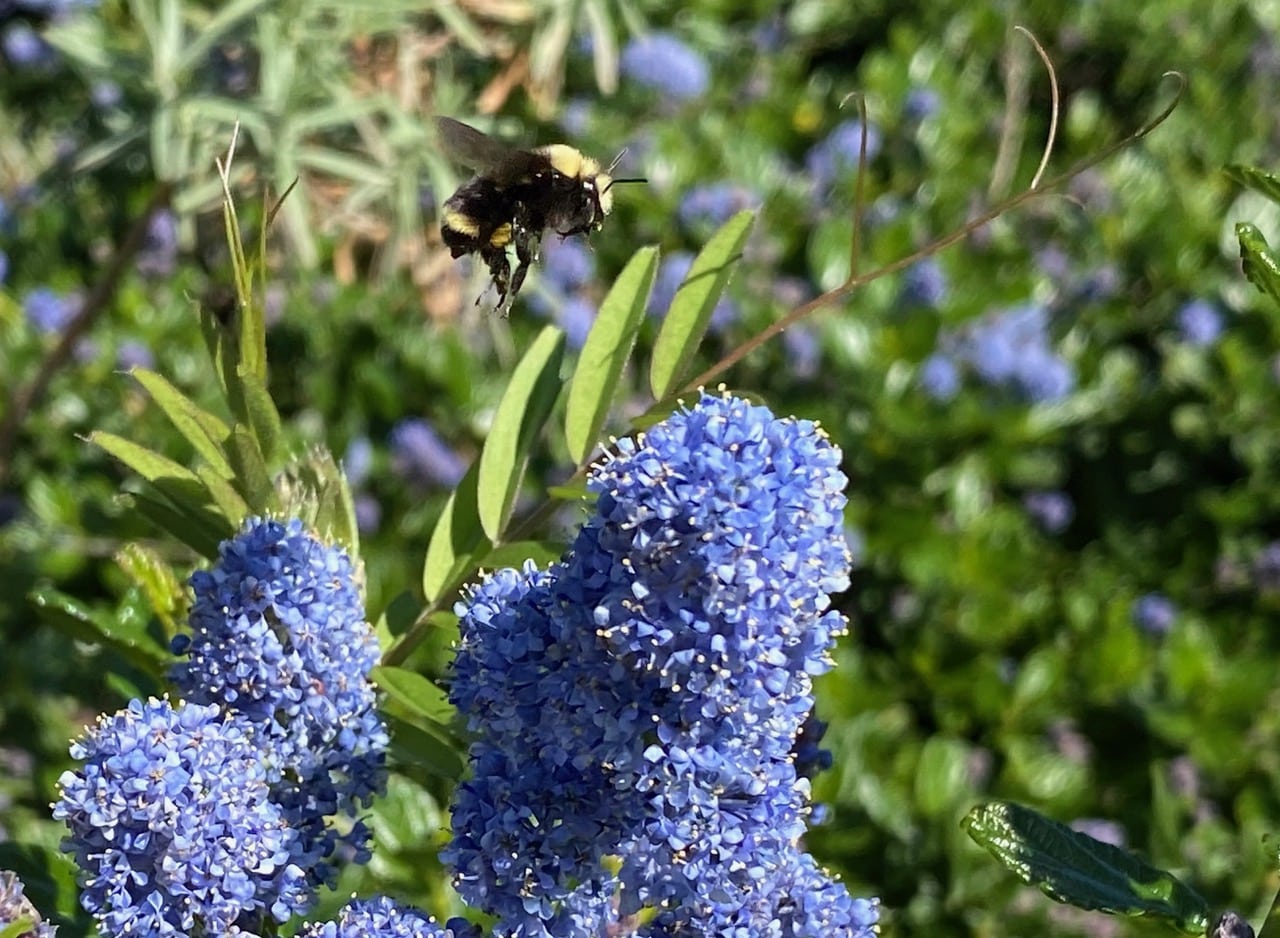
Very few Yellow-faced Bumble Bees, subgenus Pyrobombus (genus Bombus, family Apidae) are visiting on the Ceanothus flowers.
Retracting its tongue, a Yellow-faced Bumble Bee lifts off from a Ceanothus inflorescence.
A fly has landed on a cluster of Ceanothus flowers. iNaturalist could only identify it generally as a Muscoid Fly in the superfamily Muscoidea.
Muscoidea is a superfamily of flies that makes up nearly 5% of the known species level diversity of the order Diptera, the true flies. Most muscoid flies are saprophagous (feeding on decaying organic matter), coprophagous (feeding on dung or excrement) or necrophagous (feeding on carrion) as larvae, serving an important role as decomposers/recyclers of organic matter in the ecosystem. Many adults visit flowers for nectar and/or pollen.
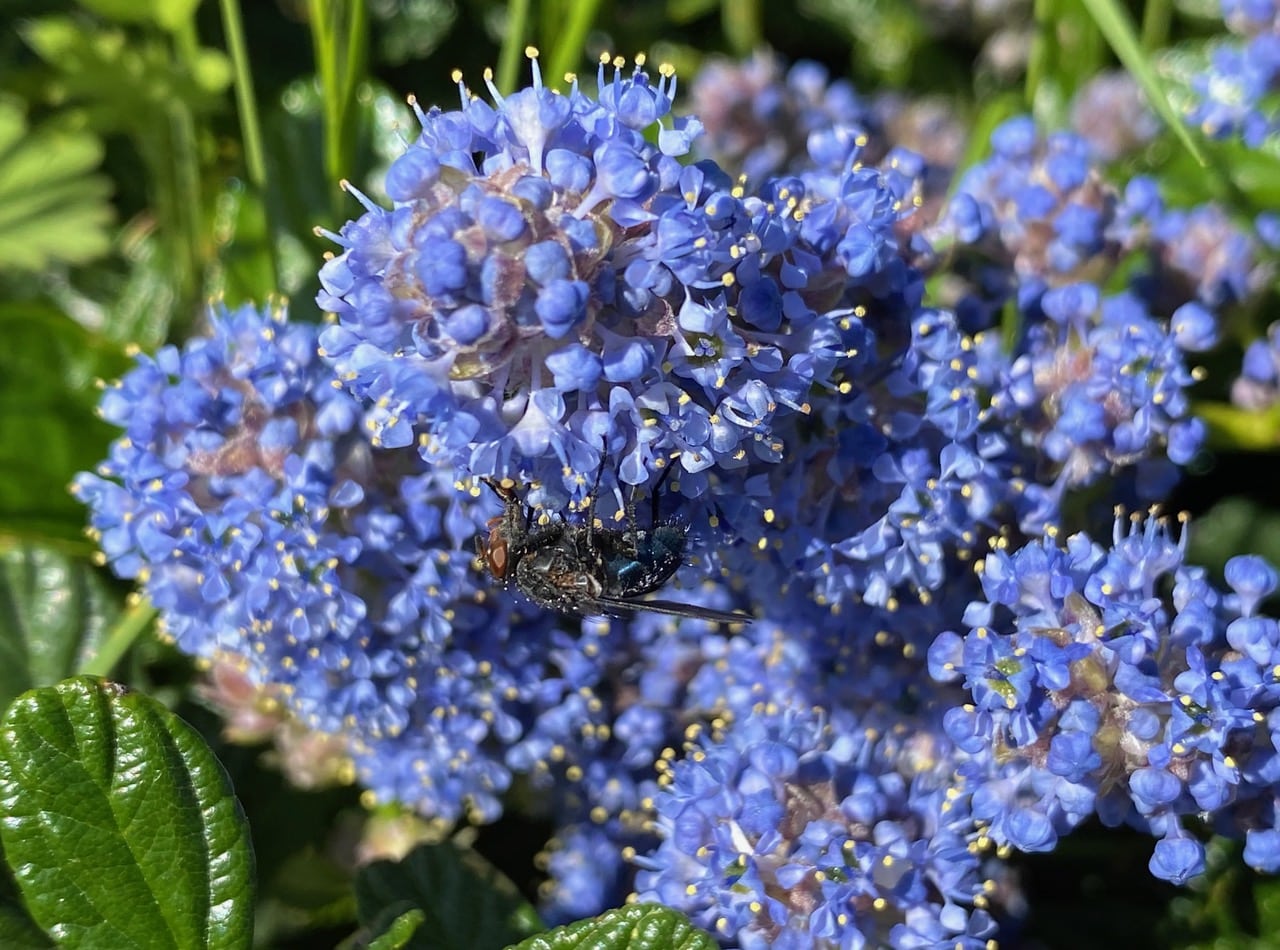
A Bluebottle Fly, Calliphora sp. (family Calliphoridae) blends in so well with these blue Ceanothus flowers it is almost invisible. Note the pollen adhering to the hairs of its body.
The Calliphoridae are variously known as blow flies, carrion flies, greenbottles, and bluebottles. Adults are usually brilliant with metallic sheen, often with blue, green, or black thoraces and abdomens. There are three cross-grooves on the thorax; calypters are well developed. Females visit carrion both for proteins and egg laying. The larvae that hatch feed on dead or necrotic tissue, passing through three instars before pupation. After the third instar, the larva leaves the corpse and burrows into the ground to pupate. Adult blow flies are occasional pollinators, being attracted to flowers with strong odors resembling rotting meat. The flies use nectar as a source of carbohydrates to fuel flight.
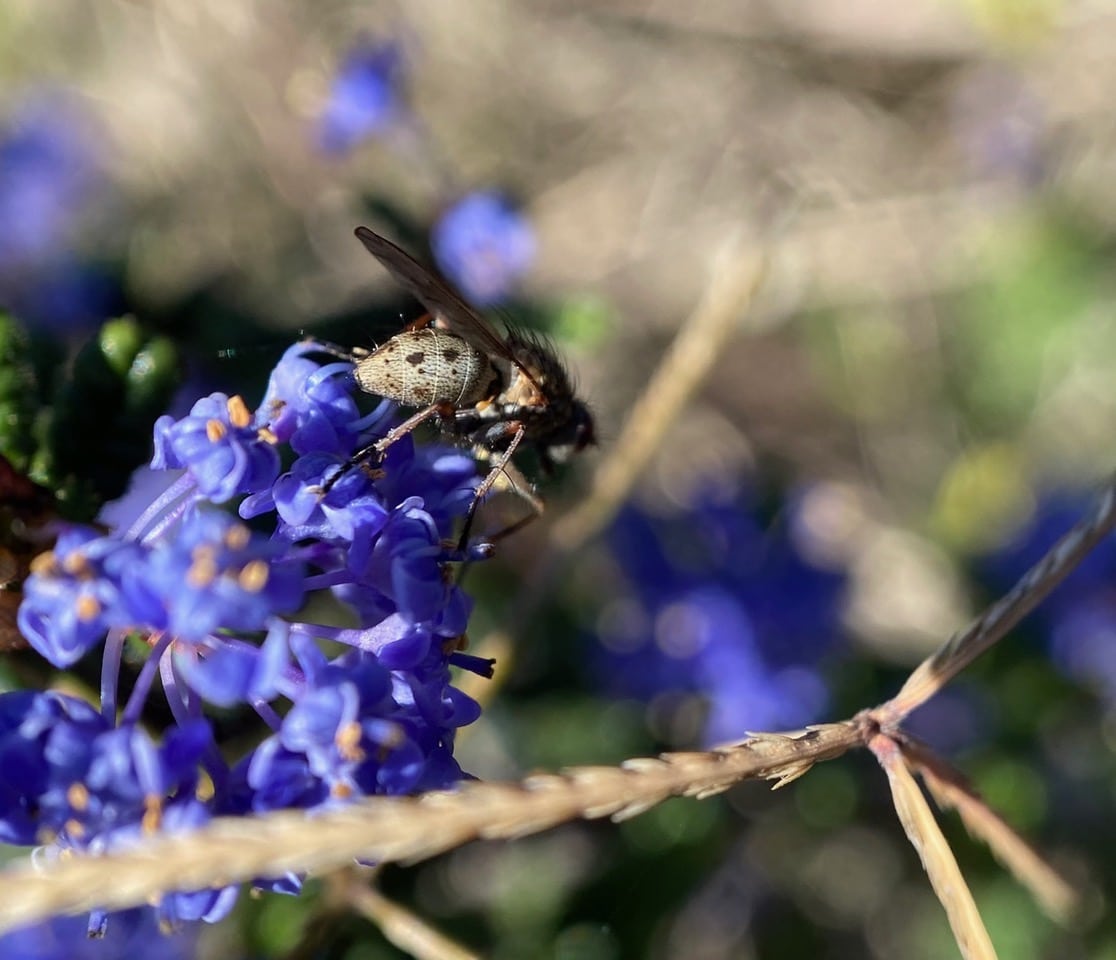
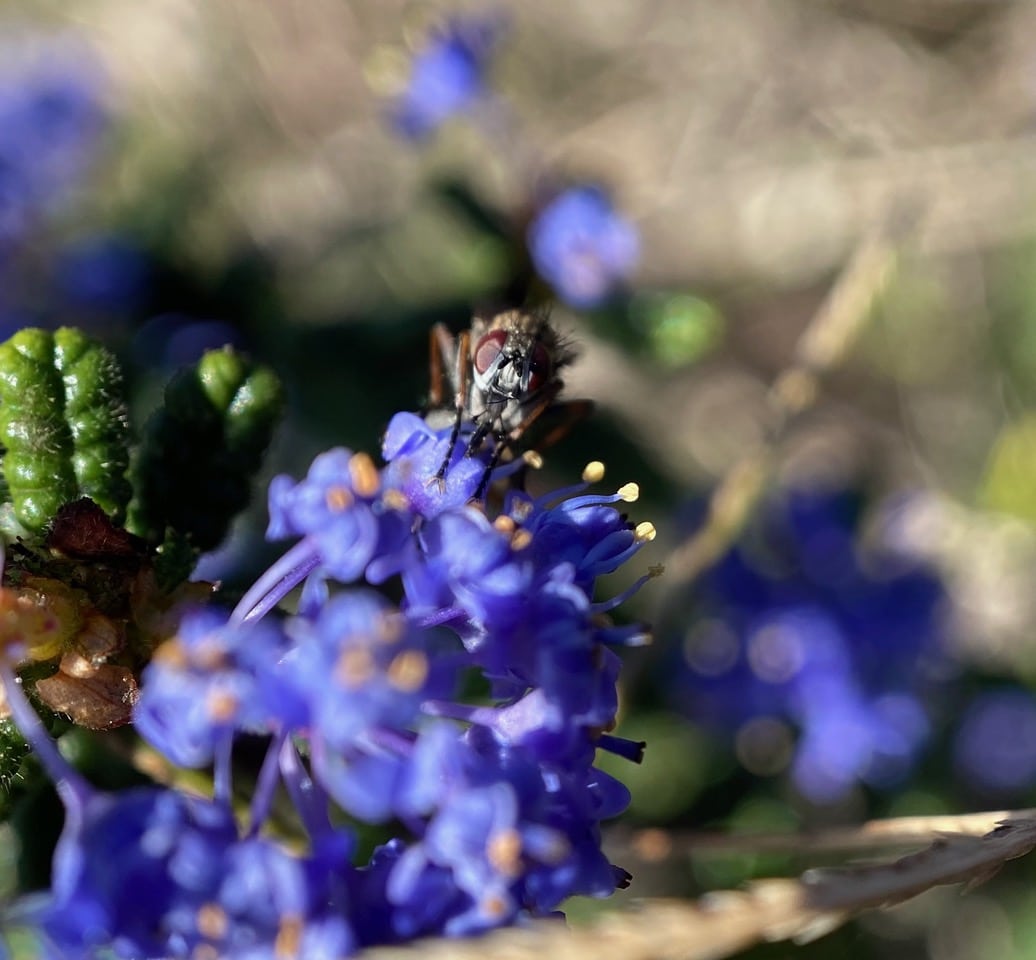
Ooh, a Tiger Fly, Coenosia tigrina (family Muscidae) is hunting among the Ceanothus flowers! The red tip of the femur of its middle and hind legs is diagnostic for the species.
The Common Tiger Fly, also known as the Hunter Fly or Killer Fly, Coenosia Tigrina is a species of fly in the same family as the common house fly, Muscidae. It is a small fly, 6-7 mm long. Their common name reflects the fact that they are predatory as both maggots and adults. Like other members of the genus, adults are predators that hunt flying insects, while larvae feed on earthworms.
The Common Tiger Flies attack from behind, and after catching their prey in midair with their front legs, immediately drop to the ground, and insert their mouthparts to feed. Their prey are mostly equal or smaller size flies. The Tiger Flies are triggered by motion, ignoring immobile prey species that are located nearby. Cannibalism is not uncommon. Because of their effectiveness and voraciousness as predators they are being investigated as a biocontrol for pest control in greenhouses. Adult females lay eggs in the soil, and larvae follow slime trails and earthworm tunnels to find their host.
Hey, there’s another hunter on the Ceanothus – a Johnson’s Jumping Spider, Phidippus johnsoni (family Salticidae).
Also known as the Red-backed Jumping Spider, the species is one of the largest and most commonly encountered jumping spiders in western North America. This individual is a female. Males have an all-red abdomen. Salticids are free-roaming hunters. They do not weave a web to catch prey. They stalk, then pounce on their prey. Just before jumping, the spider fastens a safety line to the substrate. It can leap 10-20 times their body length to capture prey. Their movement is achieved by rapid changes in hydraulic pressure of the blood. Muscular contractions force fluids into the hind legs, which cause them to extend extremely quickly.
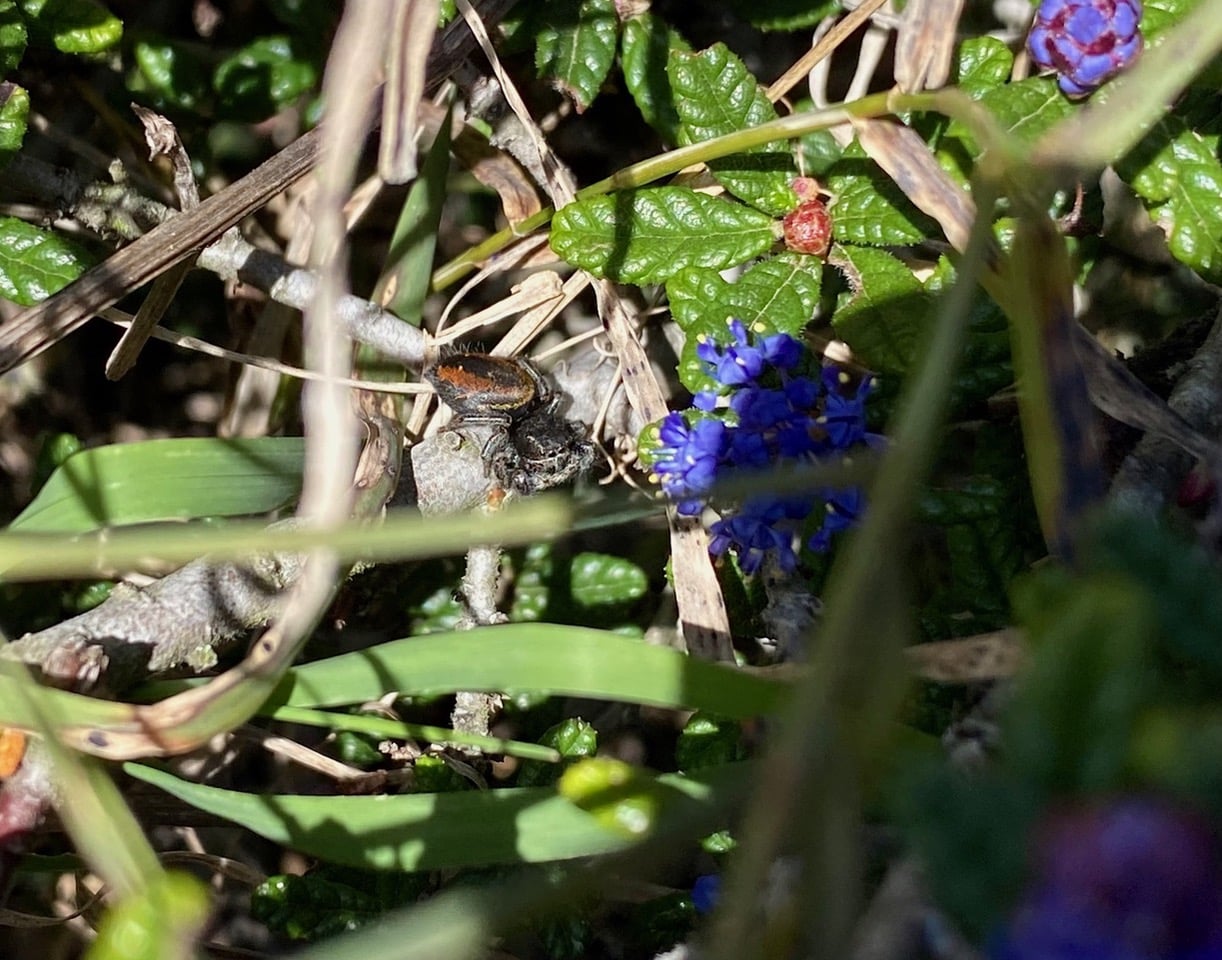
The spider slips into the tangle of the Ceanothus foliage, almost disappearing once its red abdomen is longer visible. Can you find it, in side profile here?
I manage to locate the jumping spider once again in a sunlit patch of the plant. Eyes focused and body tense, she appears to be ready to pounce on something.
Jumping spiders have excellent vision, with among the highest acuities in invertebrates. The 8 eyes are grouped four on the face (the two big Anterior Median Eyes in the middle, and two smaller Anterior Lateral eyes to the side), and four on top of the carapace. The anterior median eyes provide high acuity but small field of view, while the other six eyes act like our peripheral vision, with lower resolution but broad field of view. Since all eight eyes are fixed in place and can’t pivot independently from the body like human eyes can, jumping spiders must turn to face whatever they want to see well. This includes moving their cephalothorax up and down, an endearing behavior.
