

Pollinator Post 3/17/24 (1)
Andy and I are thrilled to explore the Cascade Canyon Open Space Preserve in Marin County this warm, sunny day.
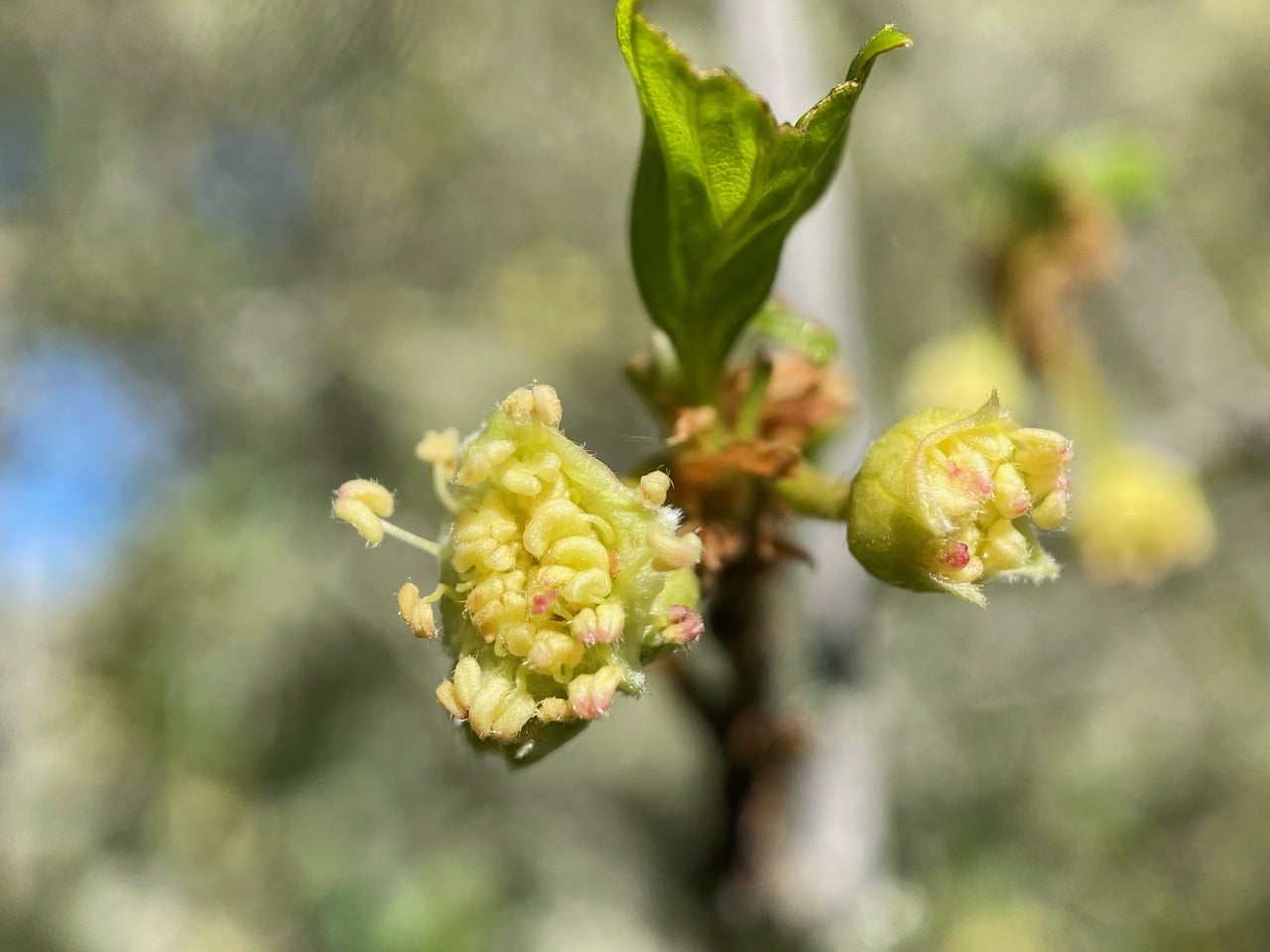
Near the entrance gate, there is a large Western Mountain Mahogany, Cercocarpus betuloides (family Rosaceae) in full bloom, with flowers in various stages of early development. The small green to cream-colored flowers lack petals and appear in clusters of two or three on the short branches. In the bud stage, the large stamens are packed tightly into drooping bell-shaped calyces.
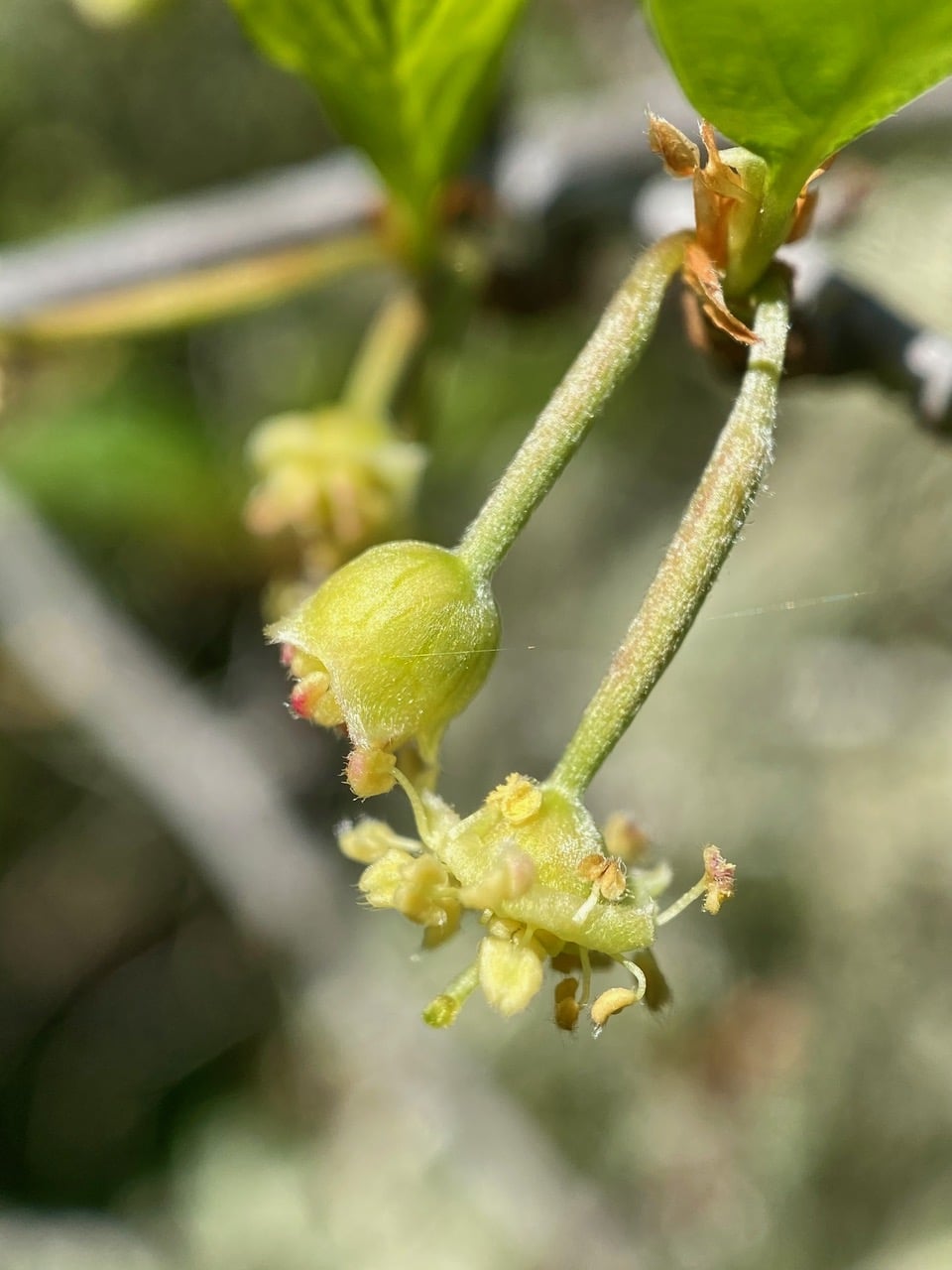
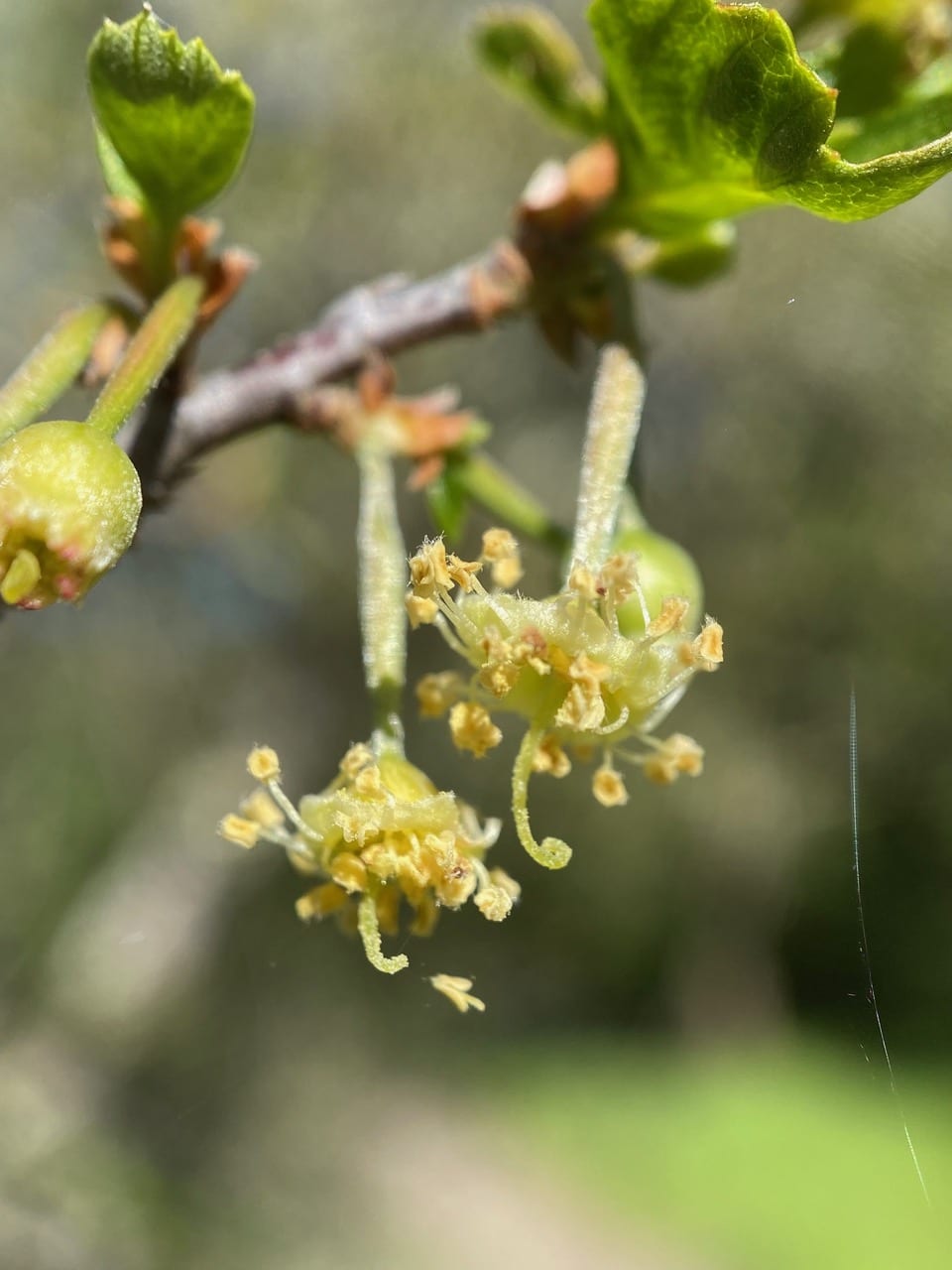




As the bud opens, the edges of the calyx curl back, exposing all the stamens.
Although not the classic wind-pollinated catkins, the solitary Mountain Mahogany flowers have their large anthers fully exposed to the wind. These flowers are mostly pollinated by the wind, although they are also popular with a host of insect pollinators, including some native bees. Although I don’t smell anything, the flowers are known to emit a sweet scent. Wind-pollinted flowers generally do not have a fragrance to attract insects. Note the single long curly style that protrudes from the middle of the flower.
The flowers of Mountain Mahogany are small and inconspicuous. It is the spectacular seeds that provide visual interest in the landscape. As the pollinated flower fades, the persistent style continues to elongate, eventually elaborating into a long, feathery tail that is attached to the single seed. The plume helps disperse the seed in the wind. The genus name Cerco-carpus is derived from Greek for “tailed-fruits”.
From afar, I spot a pair of mating Lady Beetles (family Coccinellidae) on a blade of grass. I am confused as I close in for a picture – are there actually three insects here? No, the female seems to have a discolored elytra, with the hind portion tan-colored instead of the normal red. A genetic anomaly or disease?
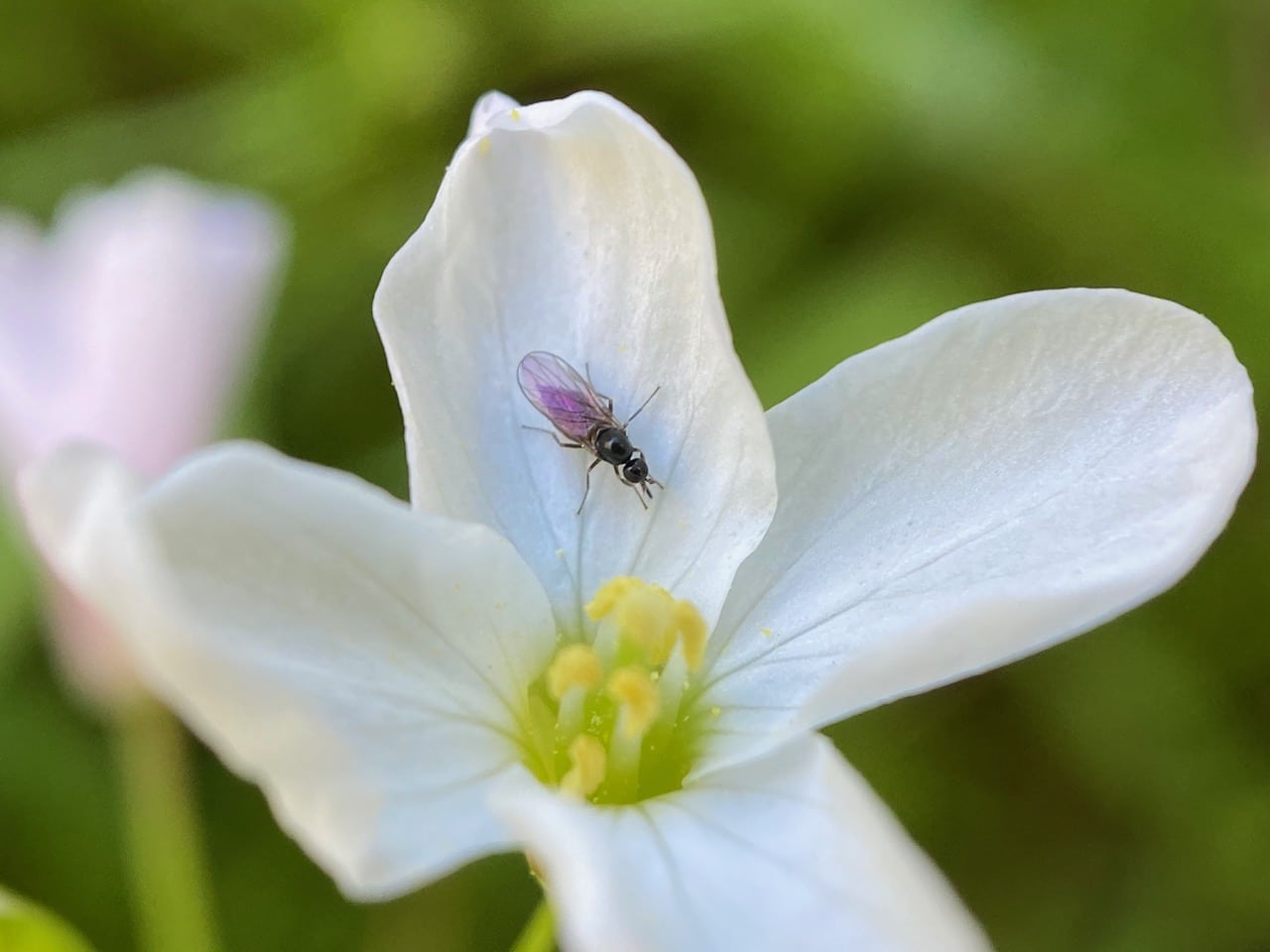
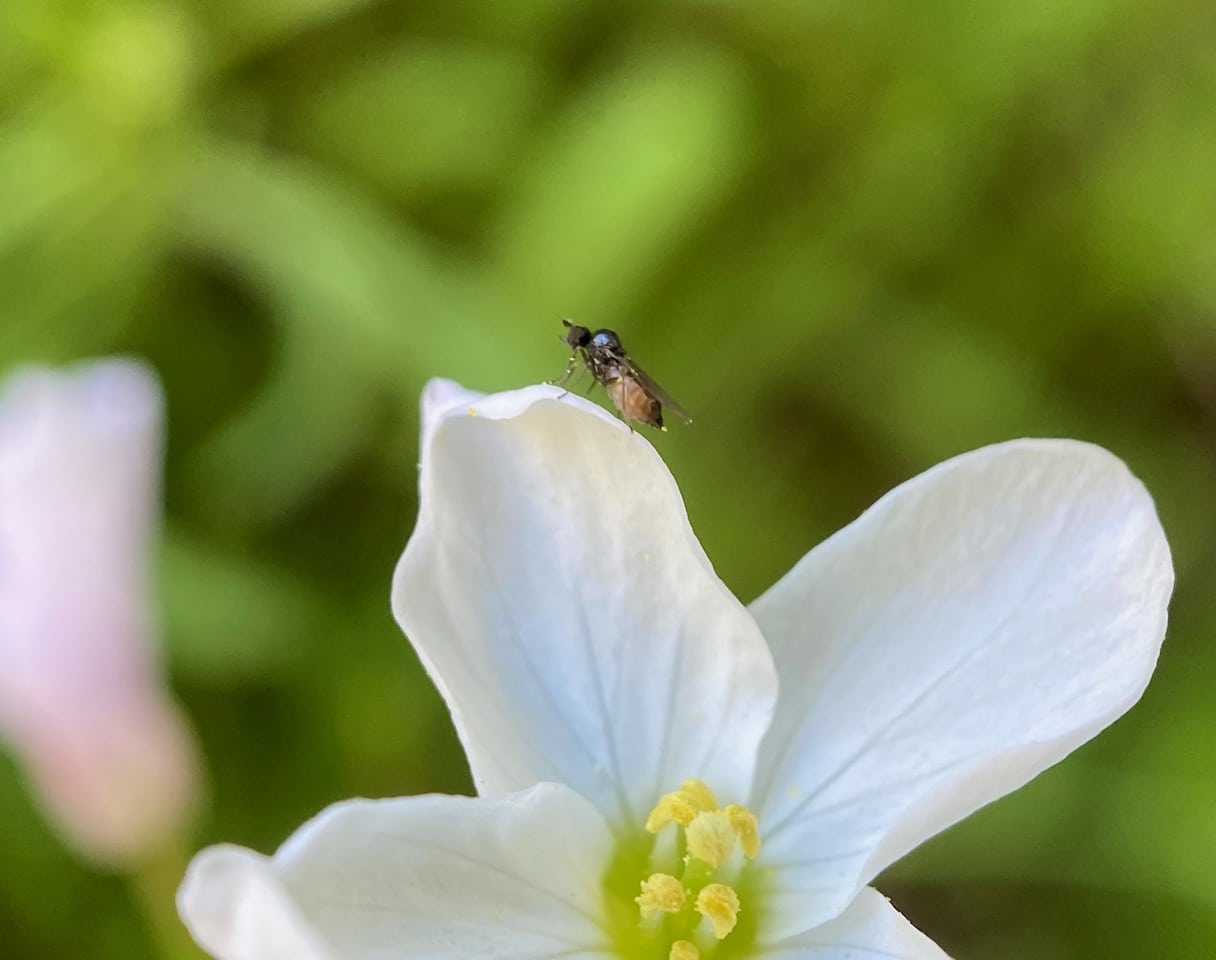
A day doesn’t go by without seeing one of these Hybotid Dance Flies (family Hybotidae). They seem to be found on a wide variety of early-blooming native wildflowers, such as this Milk Maid, Cardamine californica.
This fly just fed on the anthers, and emerges with pollen grains stuck to its body.
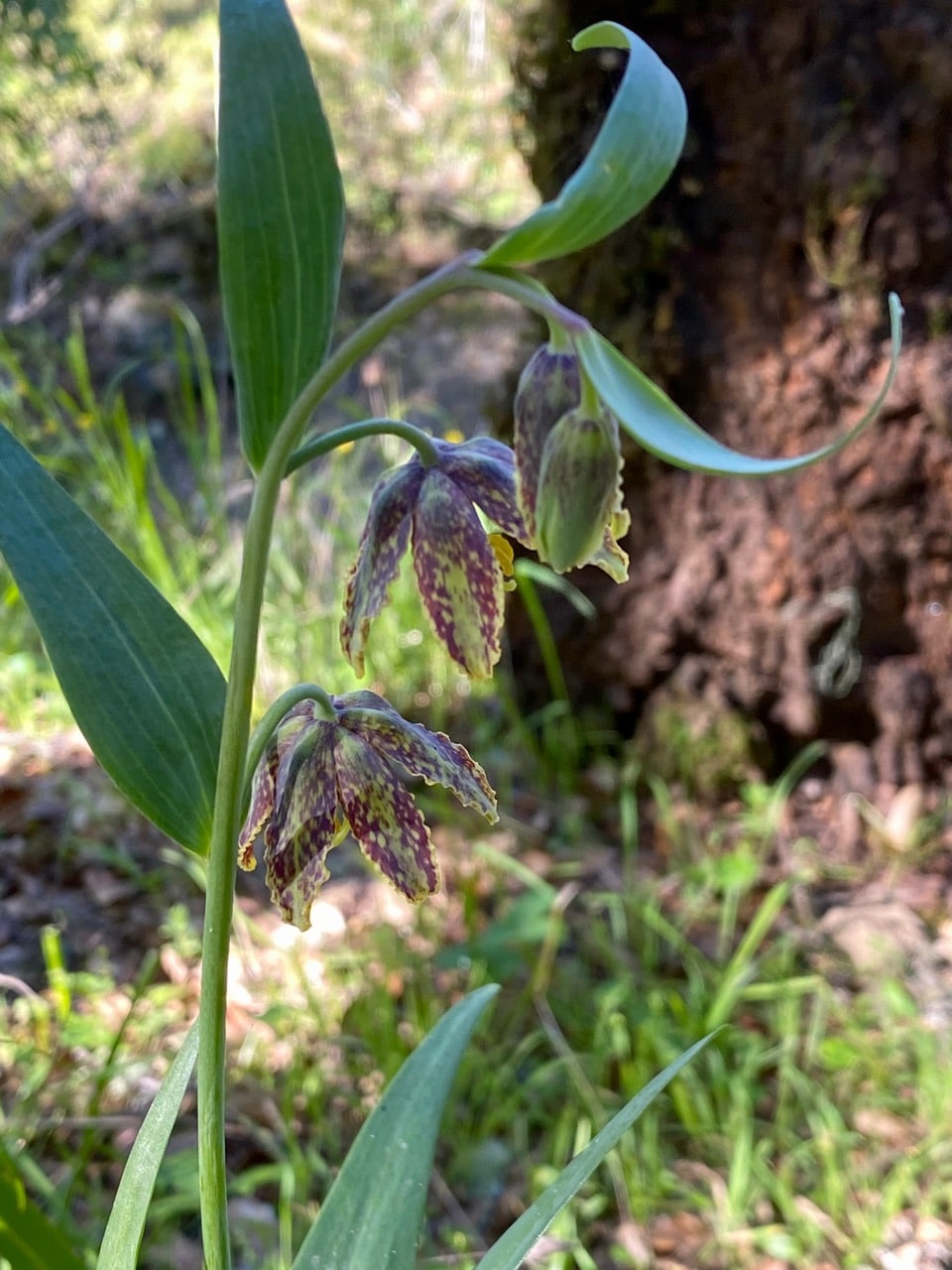
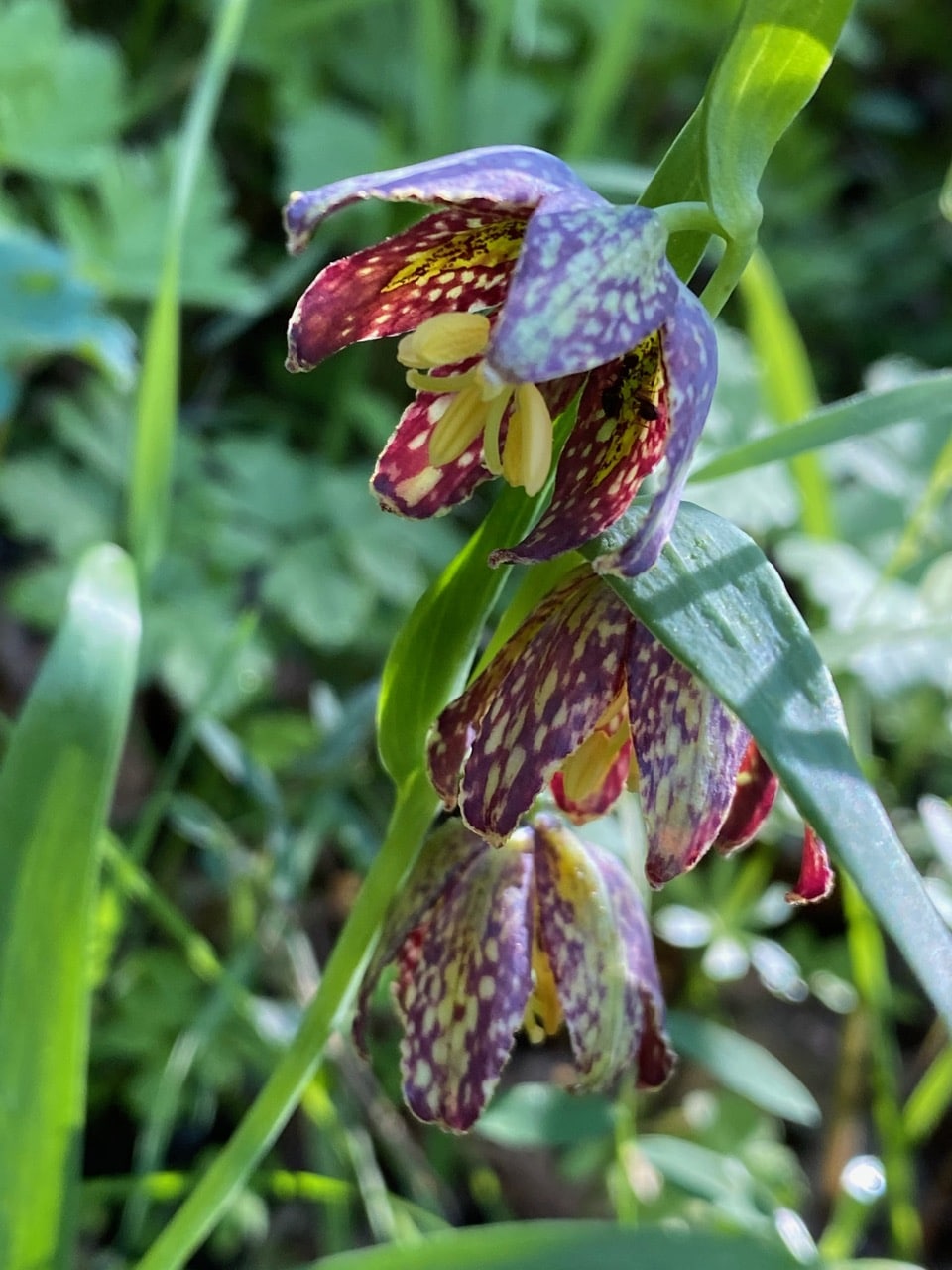
In the dappled shade under the trees, Mission Bells, Fritillaria affinis (family Liliaceae) bloom in profusion. Also known as Checkered Lily, the species is native to western North America. The perennial grows from a bulb that resembles a small mass of rice grains. While the flowers are large, they blend in imperceptibly with the landscape. However, once you find one, the rest seem to appear everywhere you look. Mission Bells hunting is a joyous early spring ritual for me.
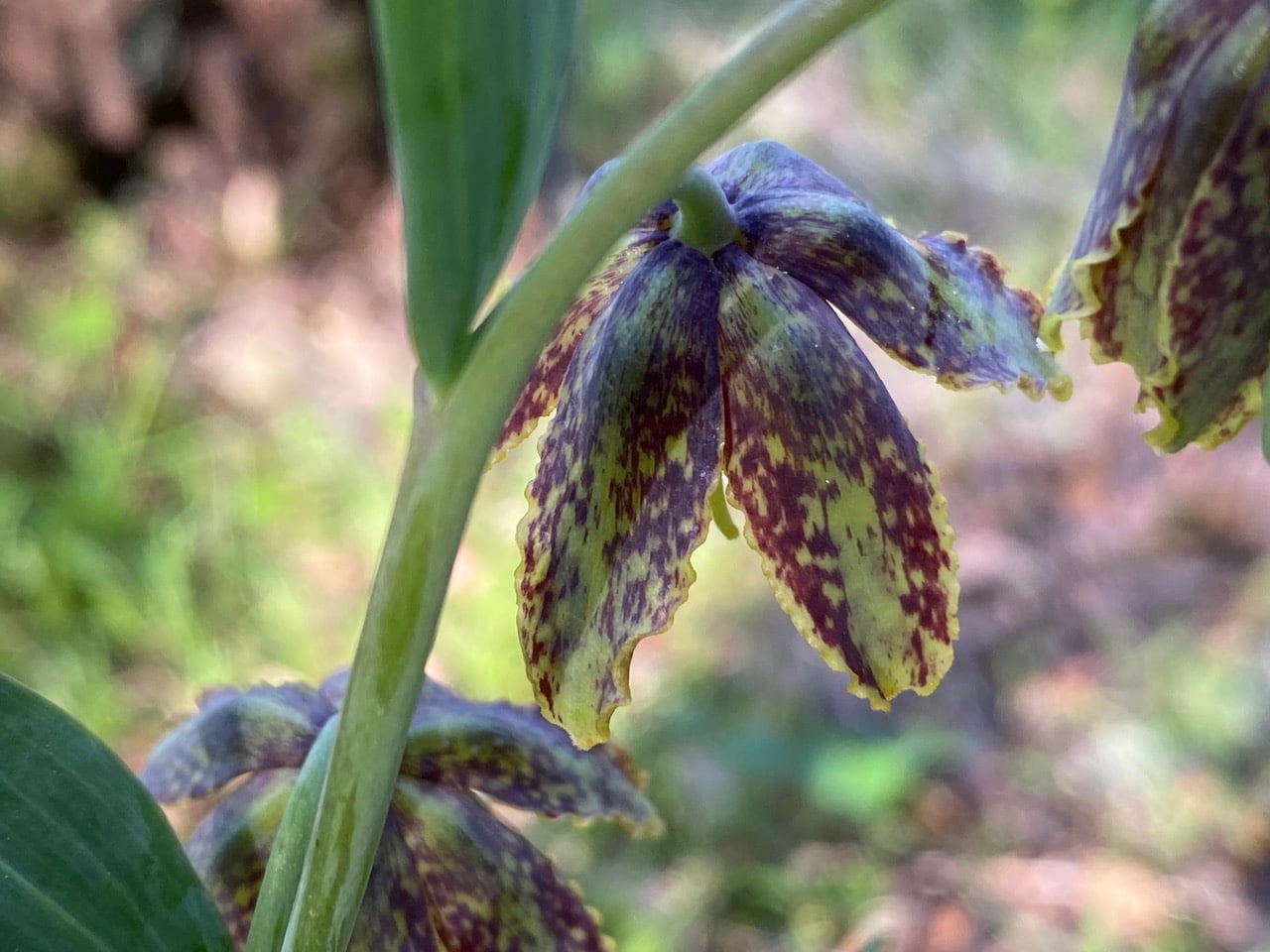
The striking nodding flowers, 1-4 cm, are yellowish or greenish with strong purplish-brown mottling. See the slight bumps where the tepals curve? That’s where the nectaries are located on the inside of the corolla. The wavy margins of the tepals add charm to the flowers. Why would a flower be dressed in camouflage? From whom are they hiding? Who pollinates these flowers? These questions have been on my mind for years, and I have yet to see an insect visit these flowers.
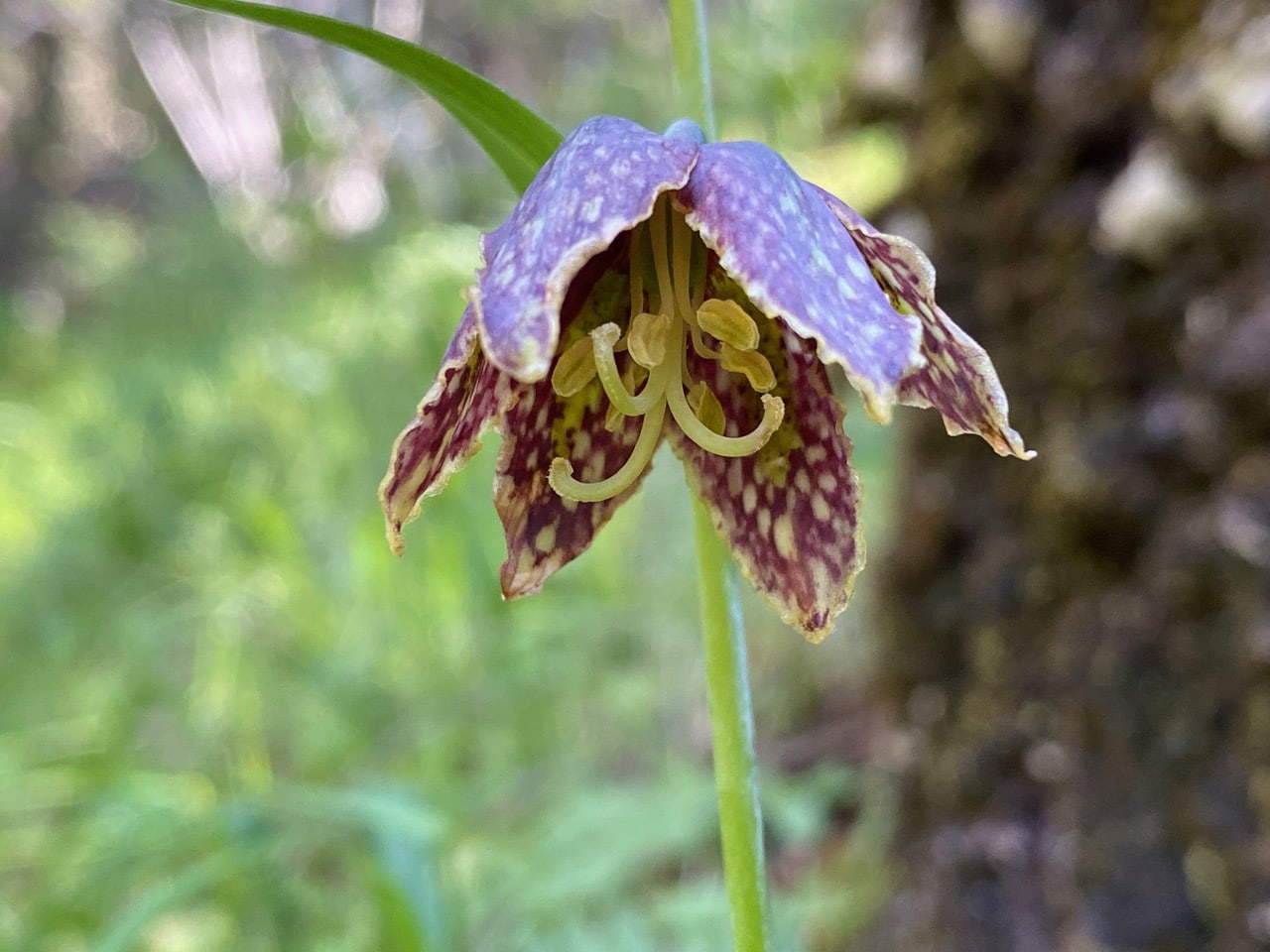
To see the reproductive parts of the Mission Bells flowers, one invariably has to stoop down to look inside. There are 6 tepals, each with a prominent nectary in its lower half. There are 6 stamens, and the robust style is branched into three lobes.
While reviewing this photo at home, I notice two ants checking out a nectary in the upper most flower. Do you see them?
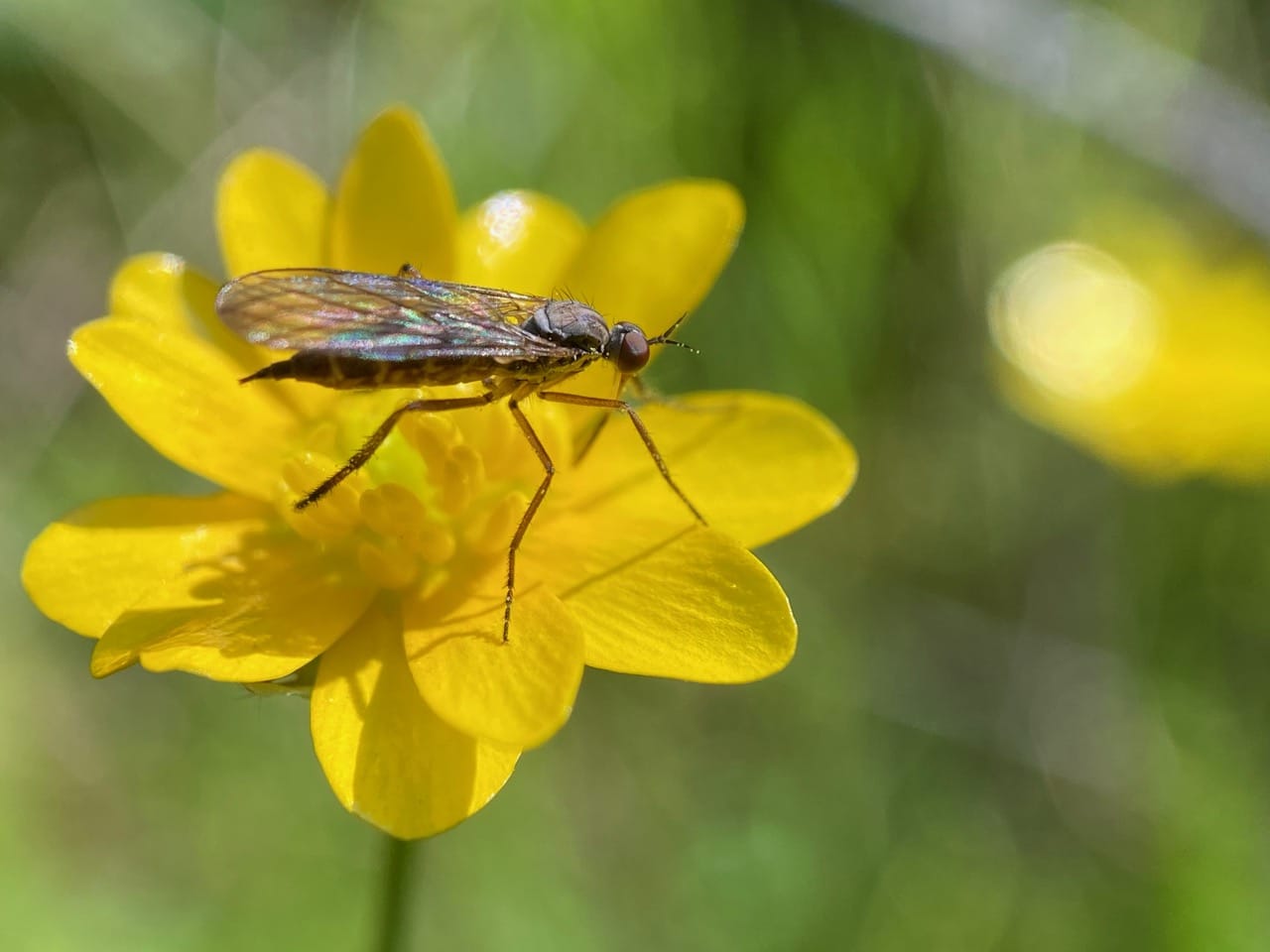
In a sunny patch, a Dance Fly (family Empididae) is foraging on a Calfornia Buttercup flower, Ranunculus californicus. Note its long, piercing-sucking proboscis (faintly visible in this photo).
Dance Flies, in the family Empididae, get their name from the habit of males of some species to gather in large groups and dance up and down in the air in the hopes of attracting females. They are predominantly predatory and they are often found hunting for small insects on and under vegetation in shady areas. Both genders may also drink nectar. Male dance flies give their sweeties a nuptial gift to eat while they mate. The gift is thought to enable her to complete the development of her eggs. Males may wrap their gifts in balloons of silk or spit.
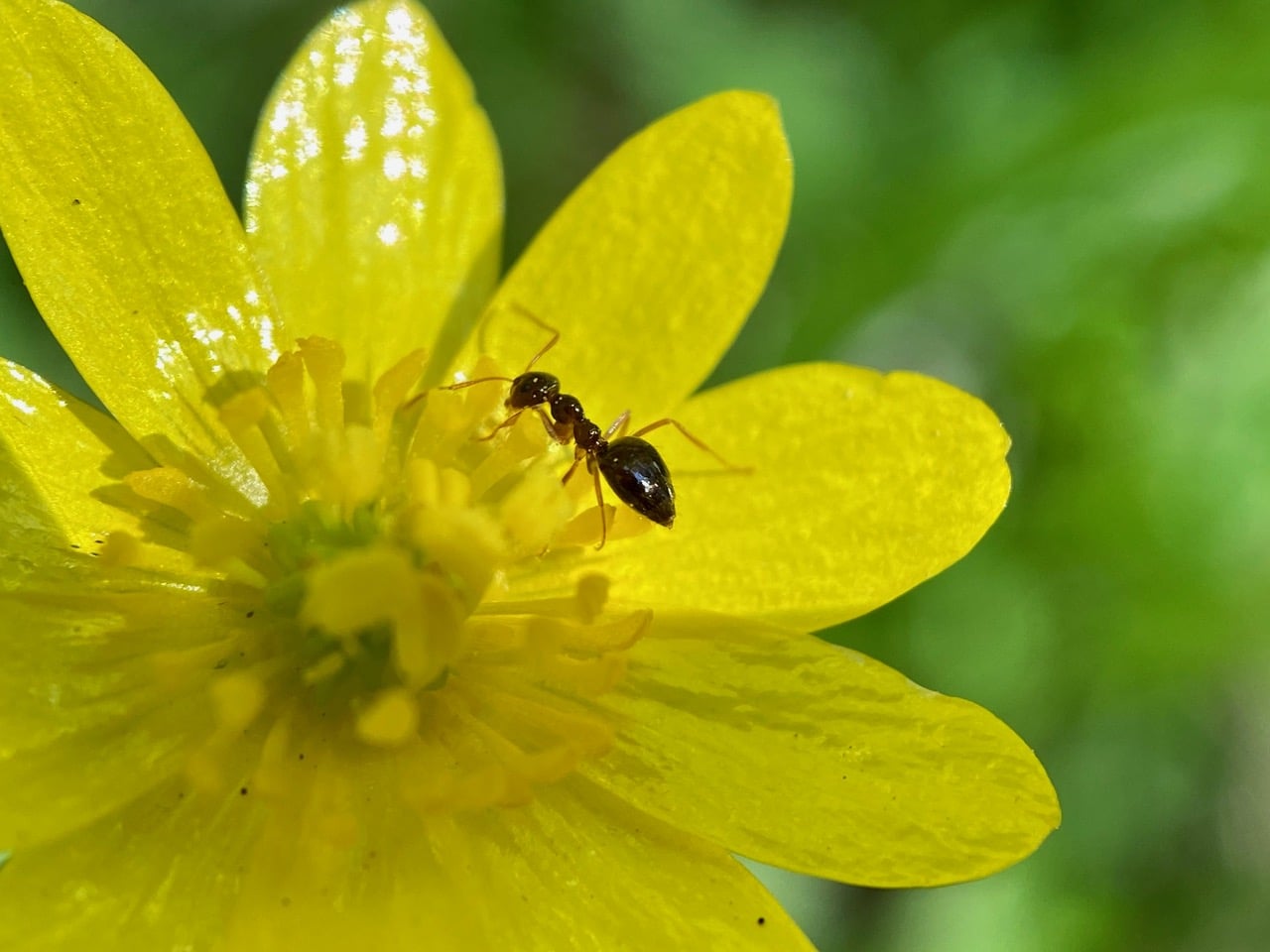
An American Winter Ant, Prenolepis imparis (family Formicidae) is foraging on a California Buttercup flower.
The American Ant, Prenolepis imparis is a widespread North American ant. A dominant woodland species, it is most active during cool weather, when most other ant species are less likely to forage. This species is one of a few native ants capable of tolerating competition with the invasive Argentine Ant, Linepithema humile. They are also aggressive toward other ants and produce abdominal secretions that are lethal to Argentine Ants. Prenolepis imparis is a generalist omnivore. Foragers are known for tending to aphids or scale insects from which they consume excreted honeydew, aggregating on rotting fruit, and exploiting protein-rich sources such as dead worms. The colony enters estivation (a hibernation-like state) and becomes inactive above ground for the warmer months, during which time eggs are laid and brood are reared. Reproductives overwinter and emerge on the first warm day of spring for their nuptial flight.
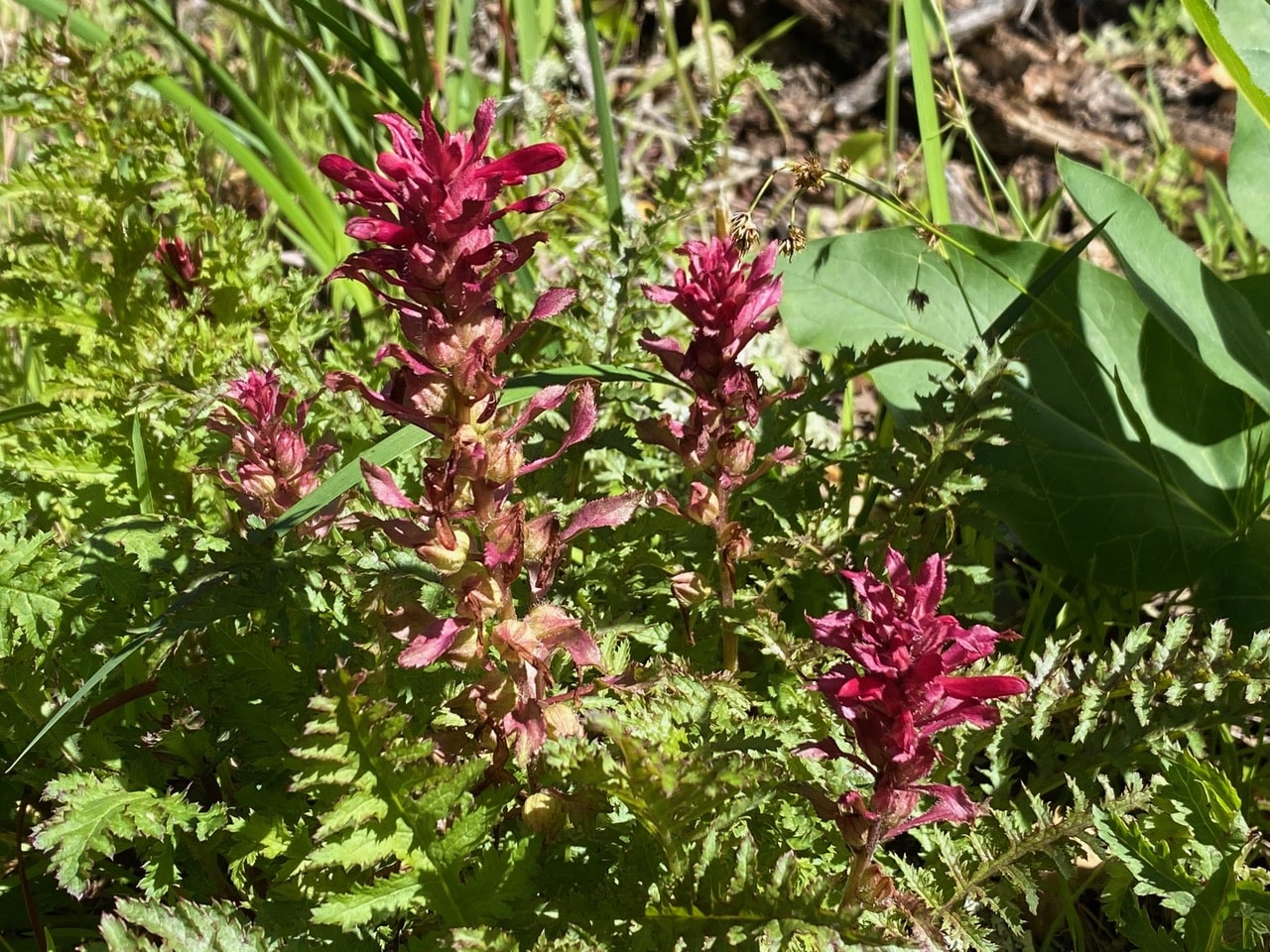
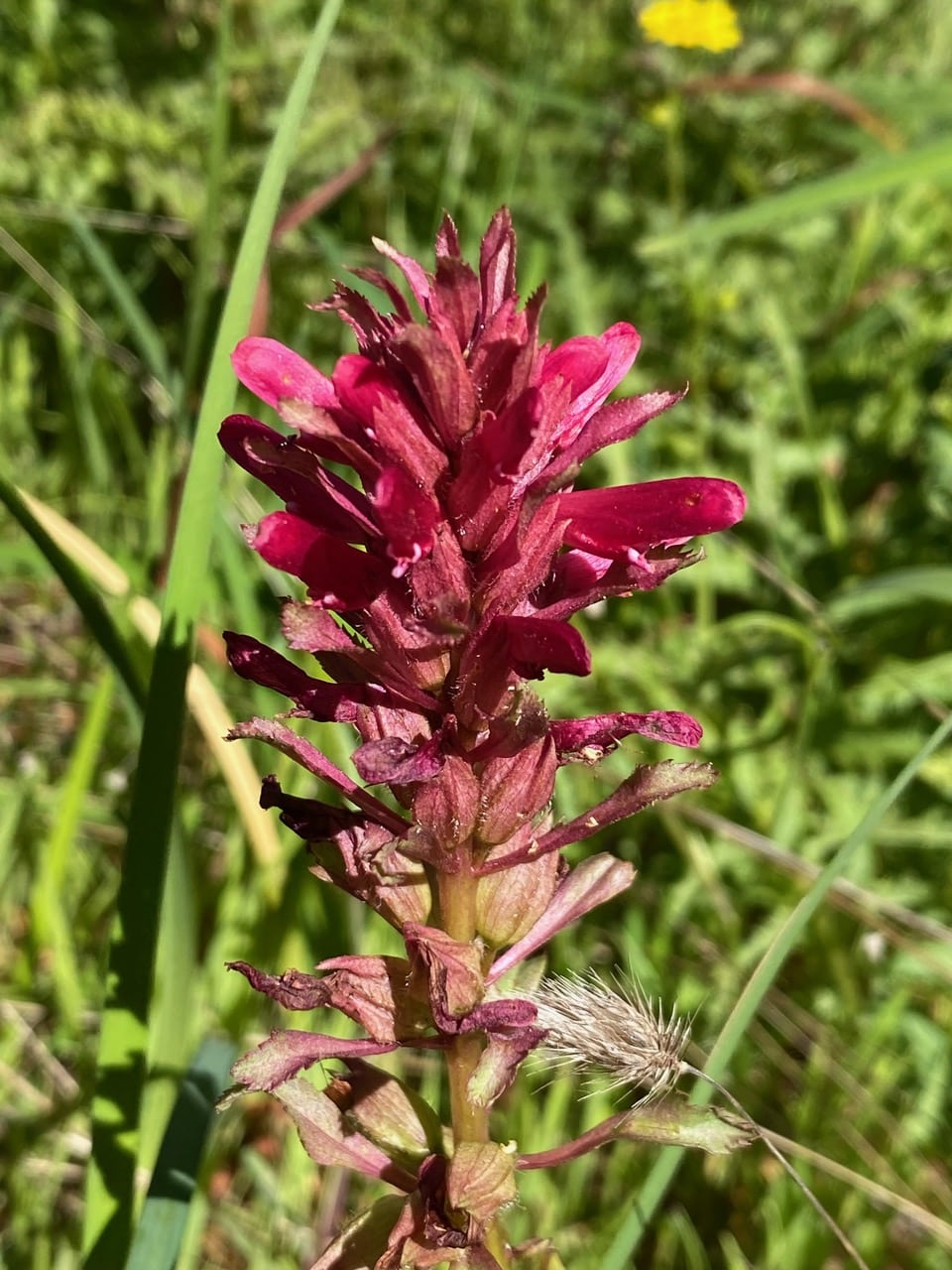
A patch of Indian Warrior or Warrior’s Plume, Pedicularis densiflora (family Orobanchaceae) is blooming nicely on a slope above the trail. This perennial herb is native to western North America, and is found in chaparral, forests, oak woodlands at low elevations. The striking inflorescences are reminiscent of those of Indian Paint Brush, and like the latter, are hemiparasitic on the roots of other plants for nutrients and water.
I closely examine an inflorescence of Indian Warrior to try and locate the individual flowers. Like the Indian Paint Brush, much of the inflorescence consists of colorful bracts to enhance the visual attraction to pollinators. But where are the true flowers?
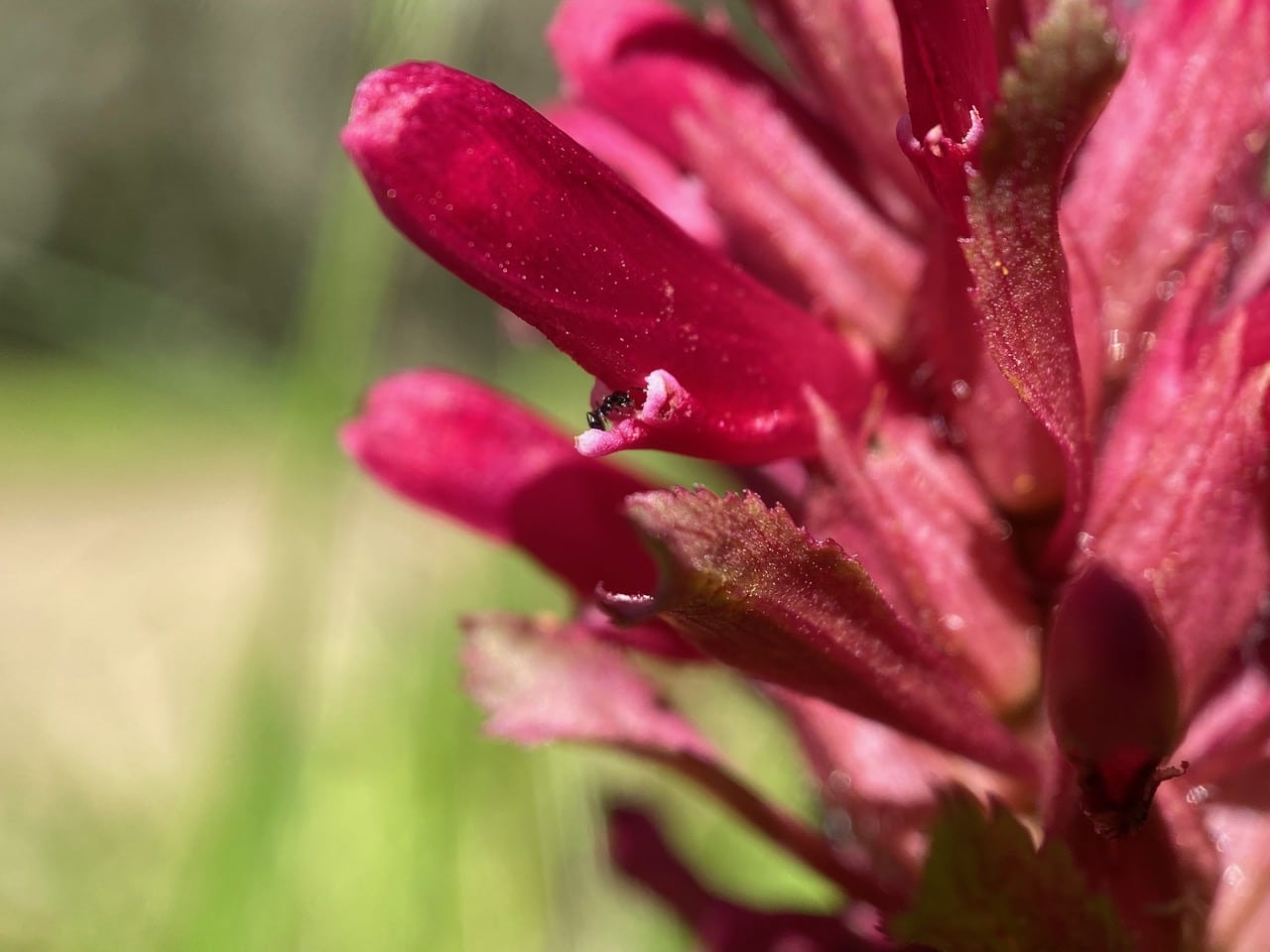
My eyes fall on several of these white-tipped appendages that protrude from the inflorescence. Are these the actual flowers? Where are the reproductive parts? Hey, there’s even a tiny ant, probably an Odorous House Ant, lingering here. Imagine my surprise when I get home and read up on the floral structure of Indian Warrior! The white-tipped appendage is actually part of the lower lip of the flower, while the bloated elongate red structure above it is the hooded upper lip, enclosing the reproductive structures. I think the white tip might serve as a visual signal to the pollinators (most likely hummingbirds, and perhaps some large, long-tongued bees such as bumble bees). These are immature flowers I am looking at. When mature, the sexual parts are exposed under the hood. The hummingbird might receive pollen on their head of neck when probing for nectar at the base of the tubular flower.
Sections of the trail are still wet and muddy from recent rains. How delightful – puddling butterflies up ahead!
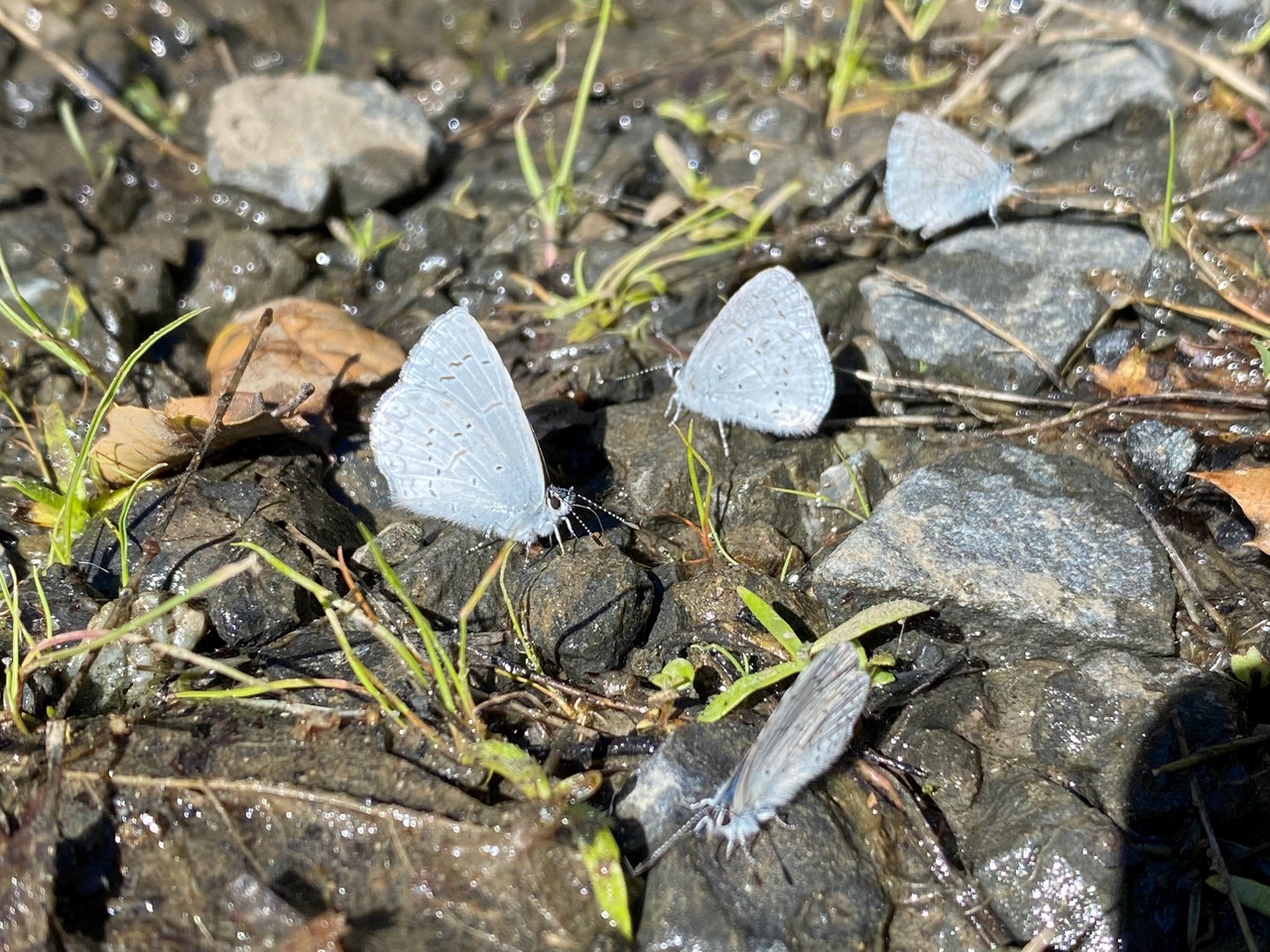
While Andy watches the puddling butterflies from a respectful distance through her binoculars, I venture closer for a photo. These Echo Azure butterflies, Celastrina echo (family Lycaenidae) are so focused on what they are doing that they seem oblivious to the camera only 5 in. from them. There are four of them in this frame. I watch as they extend their long flexible proboscis to probe the wet gravel.
Puddling is a behavior many butterflies and some moths engage in. Puddling sites can include mud, dung, fermenting fruit, carrion, urine. The butterflies are specifically after the salt (sodium) and minerals dissolved in the fluids. Most of the puddlers are males who ingest the salts, minerals and amino acids that the liquified source provides. During mating, the male passes these goodies along to the female as a nuptial gift in his spermatophore. The gift provides the female with an “extra boost” that is passed along to her eggs to enhance her reproductive success.
We also see a couple of the Greater Bee Flies hover over the mud puddles.
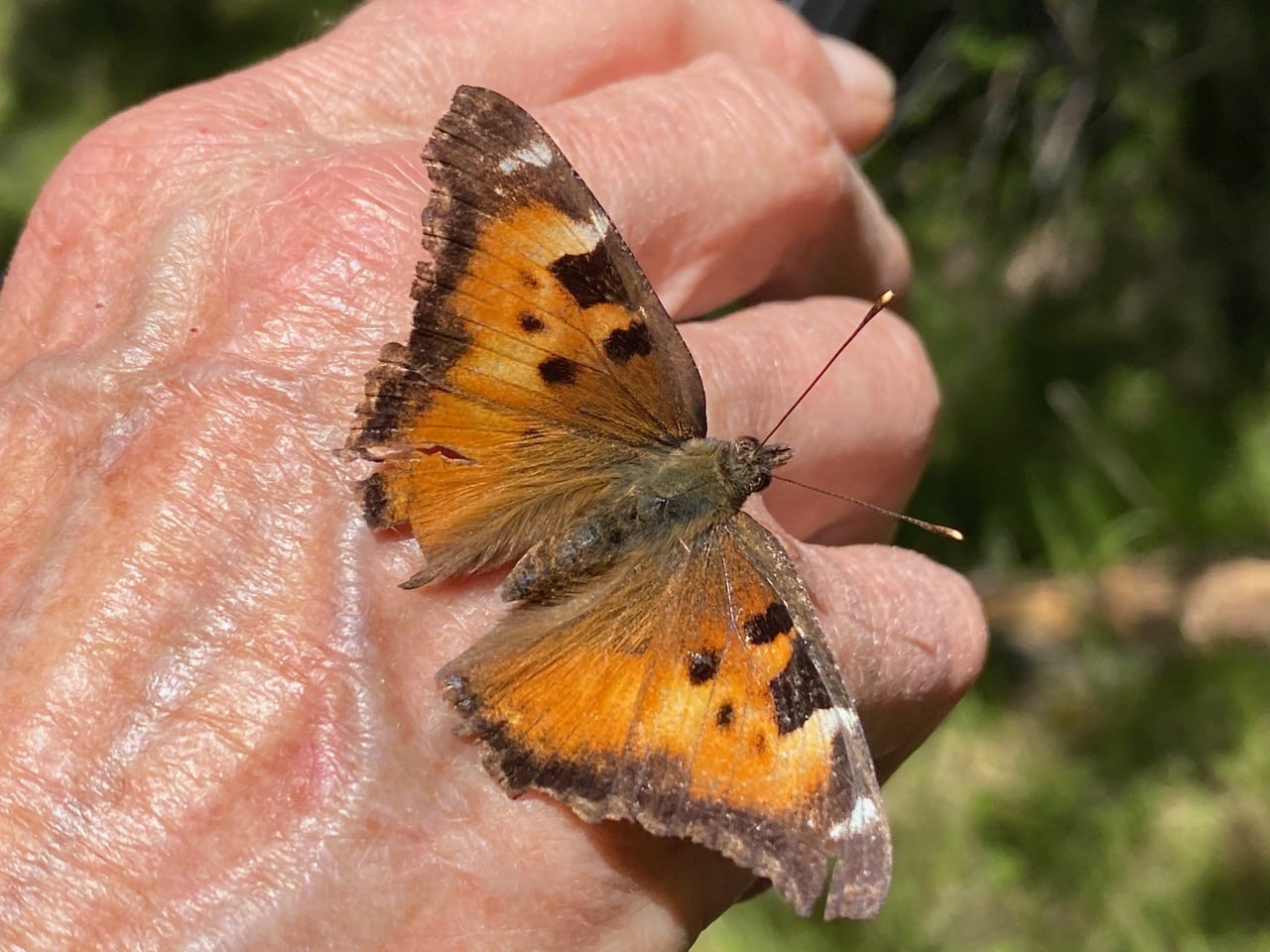
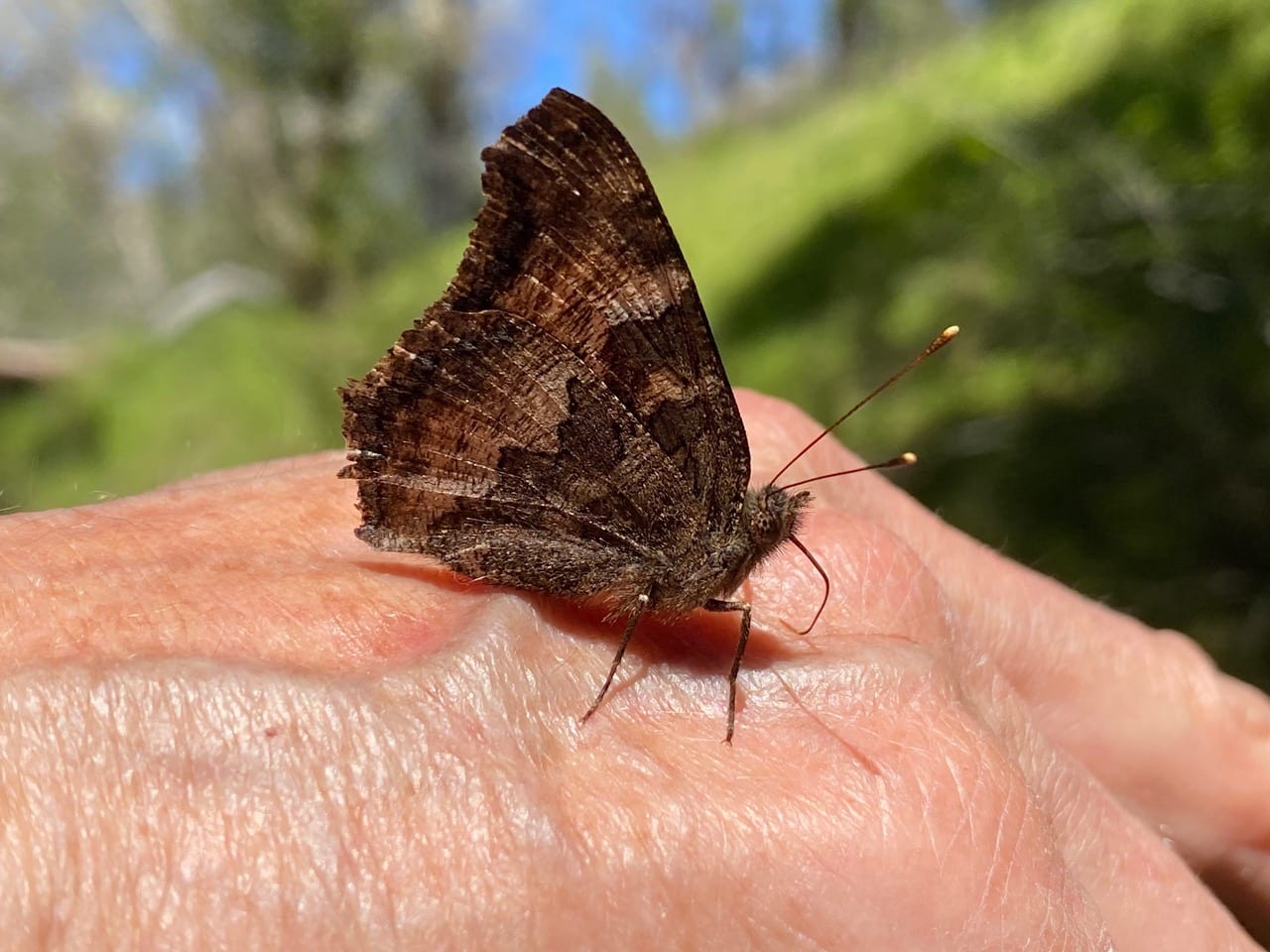
Several California Tortoiseshell butterflies are also seen puddling close to the Echo Azure butterflies, but they are much more wary, and fly away at my approach. Disappointed, I join Andy watching them from a distance. Soon, one “Tortie” lands on my sleeve. After Andy takes a few pictures, the butterfly flies over to her hand and allows me the honor. It is one of the long-lived individuals that have flown down from the mountains recently – no wonder that its wings are well worn.
The California Tortoiseshell, Nymphalis californica (family Nymphalidae) is a species known for its seasonal and altitudinal migrations. The butterflies overwinter as adults, and are often seen sunning themselves in midwinter on mild days. They are common in foothill canyons in late winter, ovipositing on the young, tender growth of various species of Wild Lilac (Ceanothus), their larval food plants. The spiny, black-marked-with-yellow caterpillars feed gregariously, sometimes defoliating whole stands of the plants in big years. Adults emerge in late May to early June and almost immediately migrate, flying north or east and upslope. Summer breeding localities include the Sierra and the Cascades. The migrant females lay eggs on the tender growth of high-altitude Ceanothus. Adults emerge in late July and migrate to estivating grounds, generally above tree-line in the high country of Yosemite, Sequoia and Kings Canyon National Parks. Estivating Torties do little but “hang out” until late September when these butterflies scatter downslope to hibernate in the foothills – they are the late-winter butterflies of the new year. Estivators-hibernators thus may live 9-10 months as adults. Adult Torties visit flowers of many kinds, aphid and scale honeydew, rotten fruits, sap, – and mud.
The underwings of the California Tortoiseshell are surprisingly dark and somber, well adapted for camouflage on the ground or in the leaf litter. Guess what the butterfly is doing on Andy’s hand? It is sucking up her sweat. This is a form of puddling too!
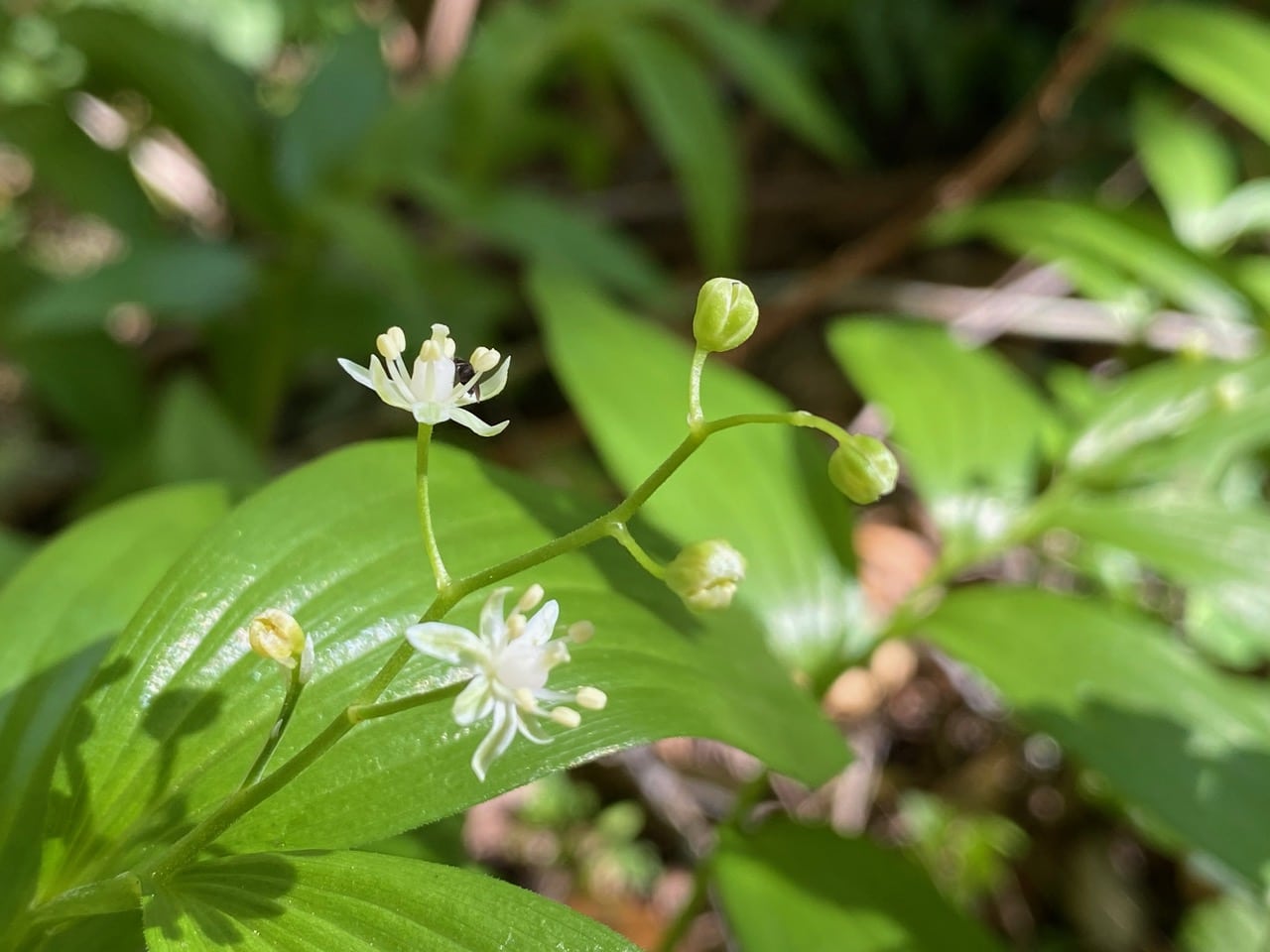
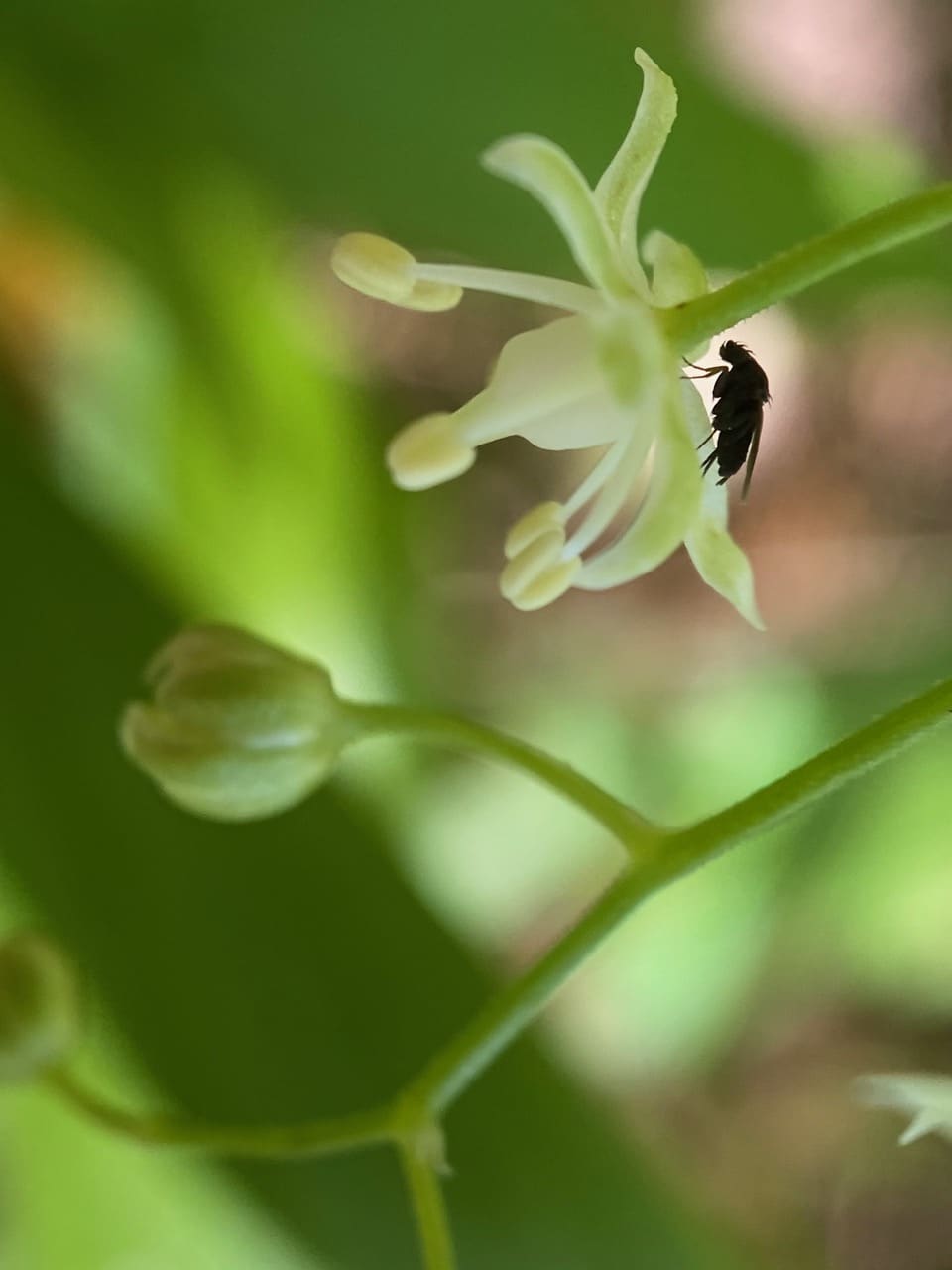
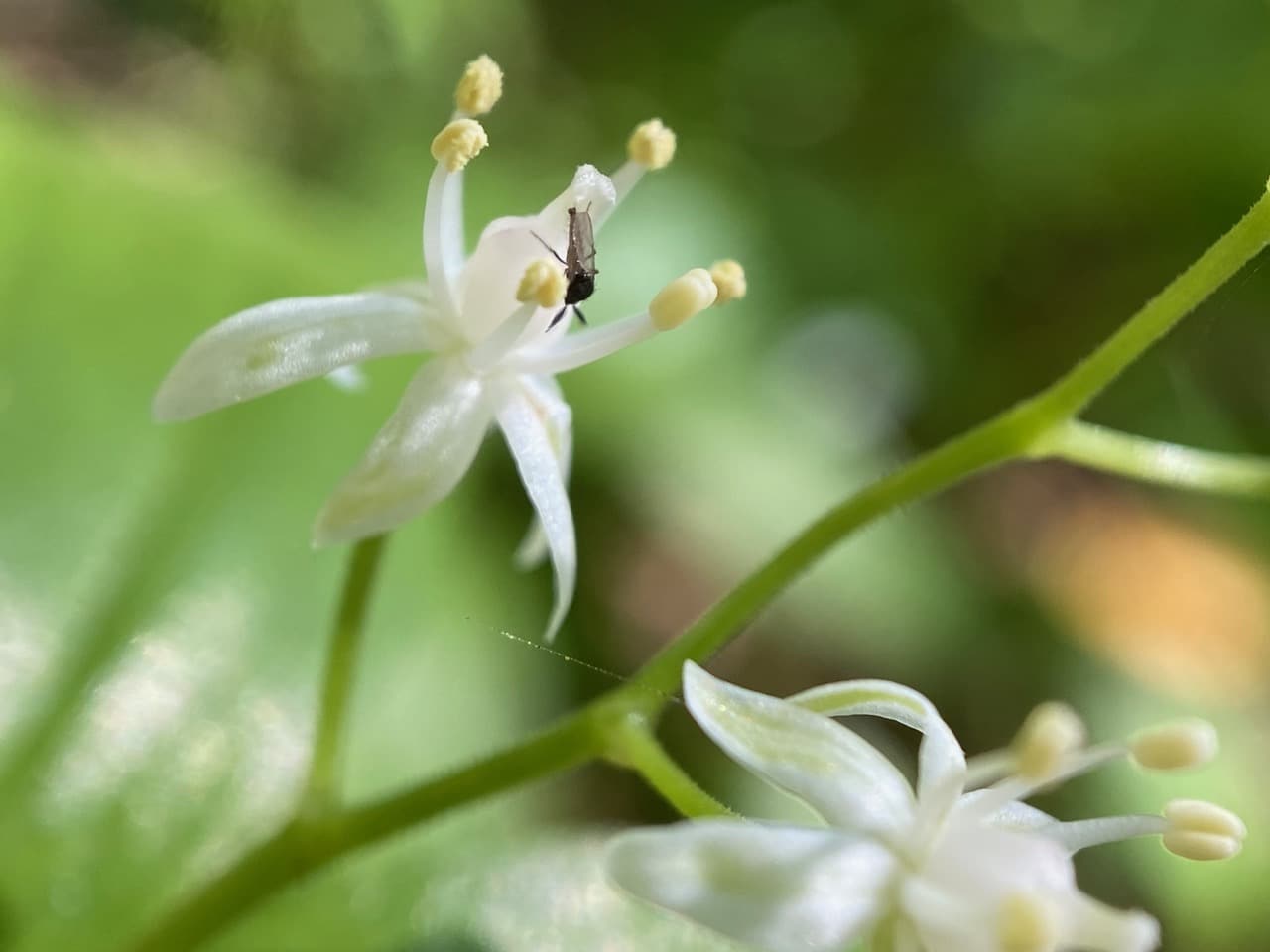
The Star-flowered Lily-of-the-Valley, Maianthemum stellatum is blooming in partial shade. Who’s that black insect in the upper flower?
A close-up presents an interesting silhouette that I don’t recognize.
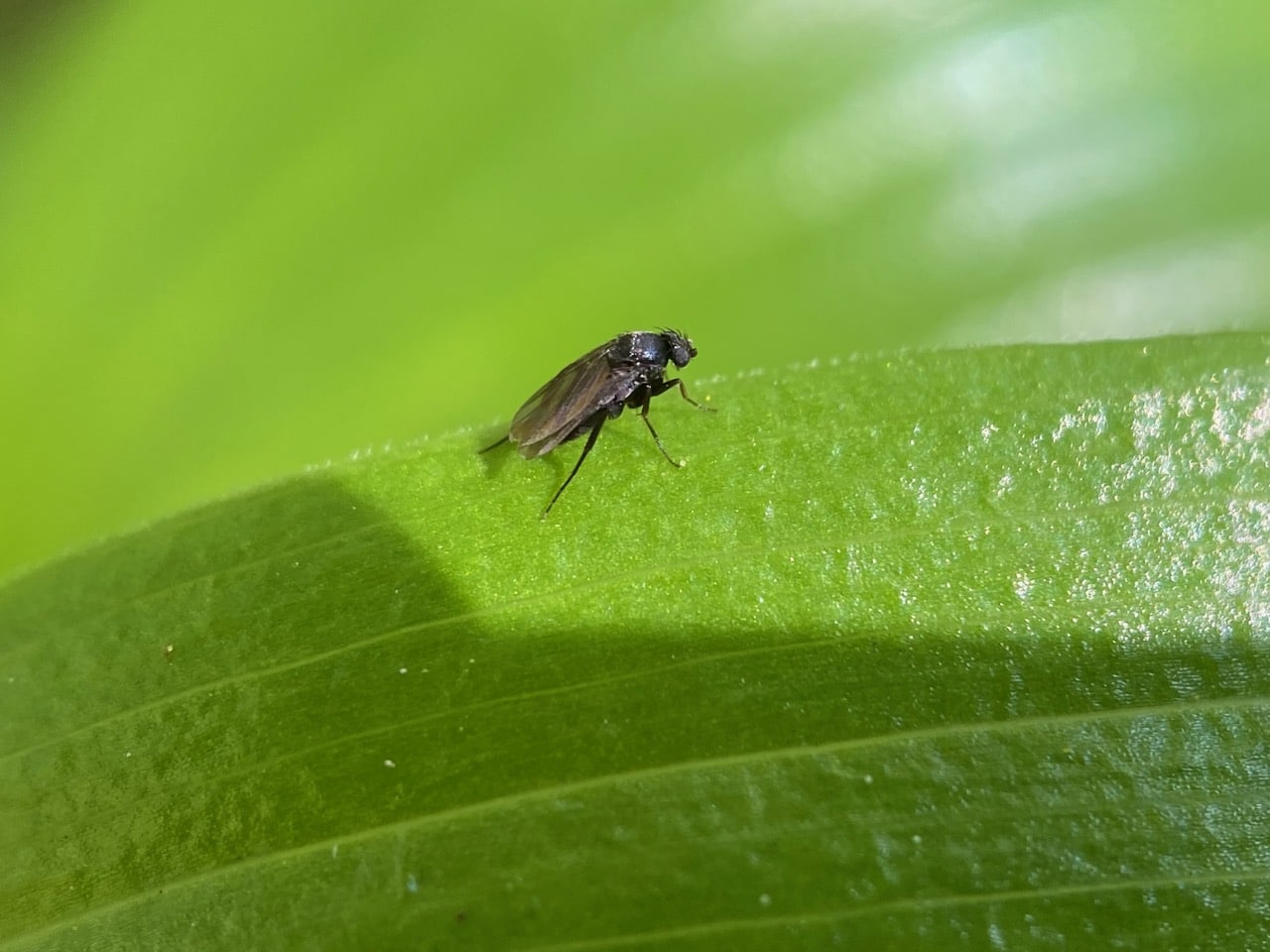
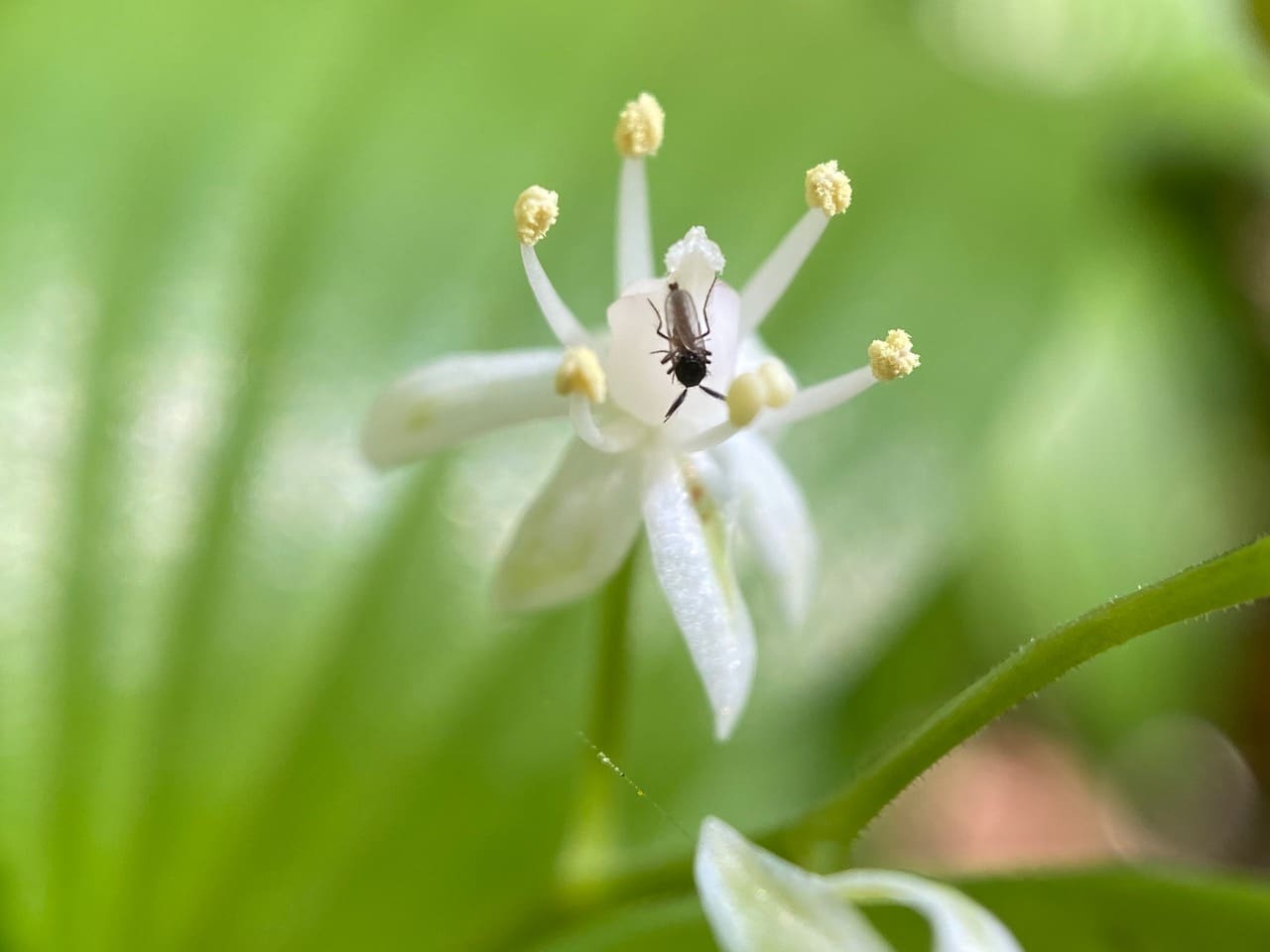
Here’s the fly out of the shadows, running in short bursts on a leaf. A fly expert I have befriended on iNaturalist has kindly identified the insect as a Humpbacked Fly (family Phoridae).
The Phoridae are a family of small, hump-backed flies with a low small head and dark eyes. They are minute or small, 0.5 – 6 mm. Phorid flies can often be identified by their escape habit of running rapidly across a surface rather than taking to the wing, hence the other common name of Scuttle Fly. Most synanthropic species (that are ecologically associated with humans) live in decaying organic material. Most species are probably specialized scavengers, predators, parasitoids, or even true parasites. Some feed on fungi, carrion. The adults feed on nectar, honeydew, and the juices exuding from fresh carrion and dung. Many species are associated with ants, as commensals in ant nests or as parasitoids. The genus Pseudacteon is used as biological control of fire ants in southern U.S. The larvae feed on the ant’s hemolymph, muscle and nerve tissue, eventually decapitating the ant. A Phorid fly is found to parasitize honey bees. The female fly lays eggs on the bee’s abdomen, which hatch and feed on the bee. Infected bees act oddly, foraging at night and gathering around lights like moths. Eventually the bee leaves the colony to die.
Another very small insect on the flower of the Star-flowered Lily-of-the-Valley.
Look at those strange antennae! A fly expert on iNaturalist has helped identify it as a Biting Midge (family Ceratopogonidae). It is likely a member of the genus Dasyhelea.
Ceratopogonidae is a family of flies commonly known as Biting Midges or No-see-ums. They are minute, generally 1-3 mm in length. Both adult males and females feed on nectar. Most females also feed on the blood of vertebrates, including humans, to get protein for egg-laying. Their bites are painful, and can cause itchy lesions. Some species prey on other insects. Larvae need moisture for development.
The genus Dasyhelea has larvae that are aquatic, and adults do not feed on vertebrate blood, nor do they prey on other insects. They take nectar only, in contrast to the other members of the family Ceratopogonidae.
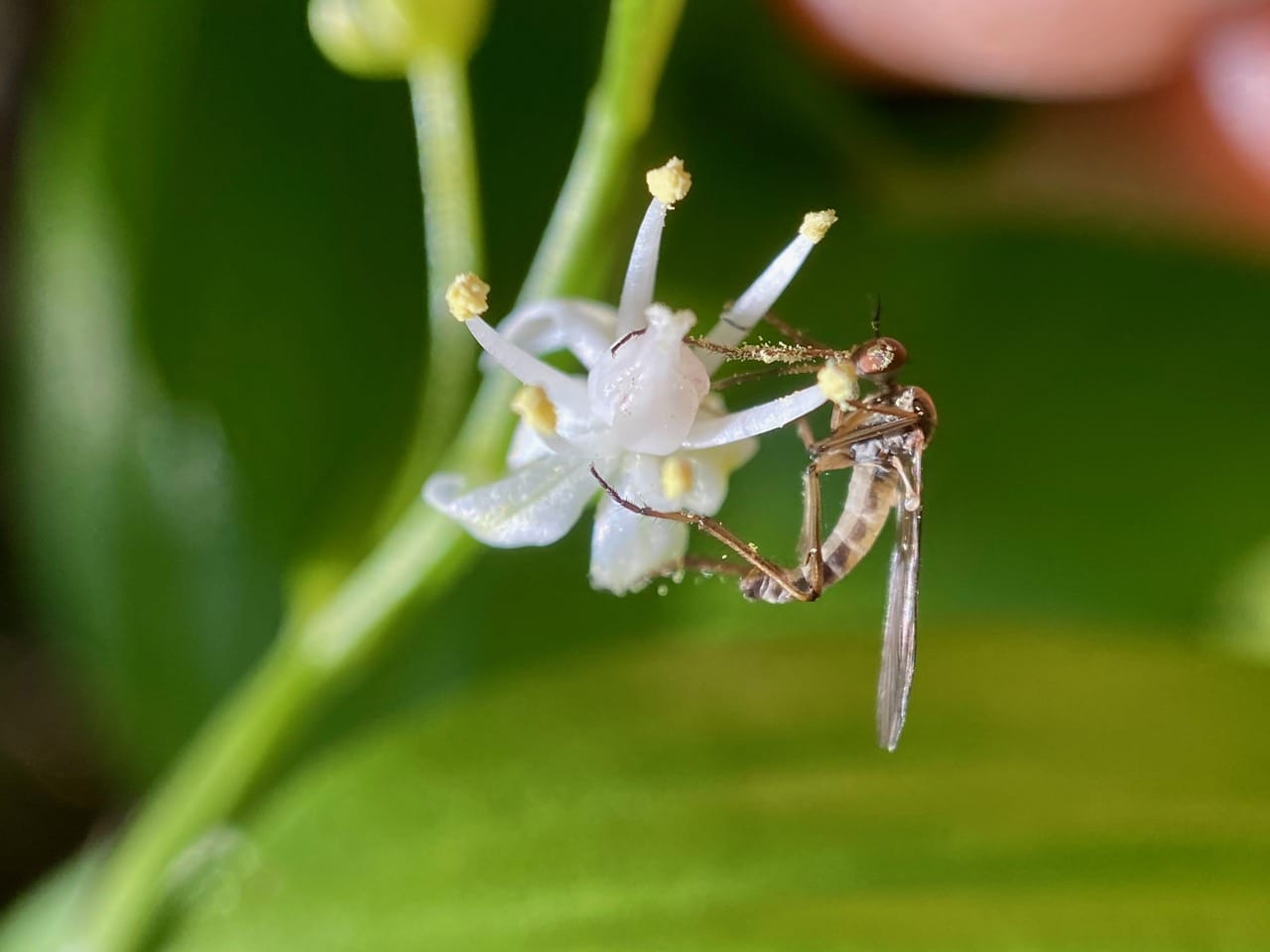
A Dance Fly (family Empididae) is taking nectar from a flower of the Star-flowered Lily-of-the-Valley. Its legs and eyes are smeared with pollen.
Empididae is a family of flies commonly called Dance Flies, Dagger Flies (referring to the sharp piercing mouthparts of some species) or Balloon Flies. They are small to medium-sized, non-metallic and rather bristly. The body is slender, the head often small and rounded with relatively large eyes. The legs are usually long and slender, and in some the forelegs are raptorial, adapted for catching and holding prey. Adult Empidids are found in a variety of forest habitats, and open grasslands. They are predominantly predator, often found hunting for small insects on and under vegetation in shady areas. Both genders may also drink nectar. A few species obtain all their protein needs by feeding on pollen. Larvae are generally found in moist soil, rotten wood, dung, or in aquatic habitats and also appear to be predaceous on various arthropods, particularly other Diptera larvae.
Dance Flies get their name from the habit of males of some species to gather in large groups and dance up and down in the air in the hopes of attracting females. Male dance flies give their sweeties a nuptial gift to eat while they mate. The gift is thought to enable her to complete the development of her eggs. Males may wrap their gifts in balloons of silk or spit, hence the other common name of Balloon Flies.
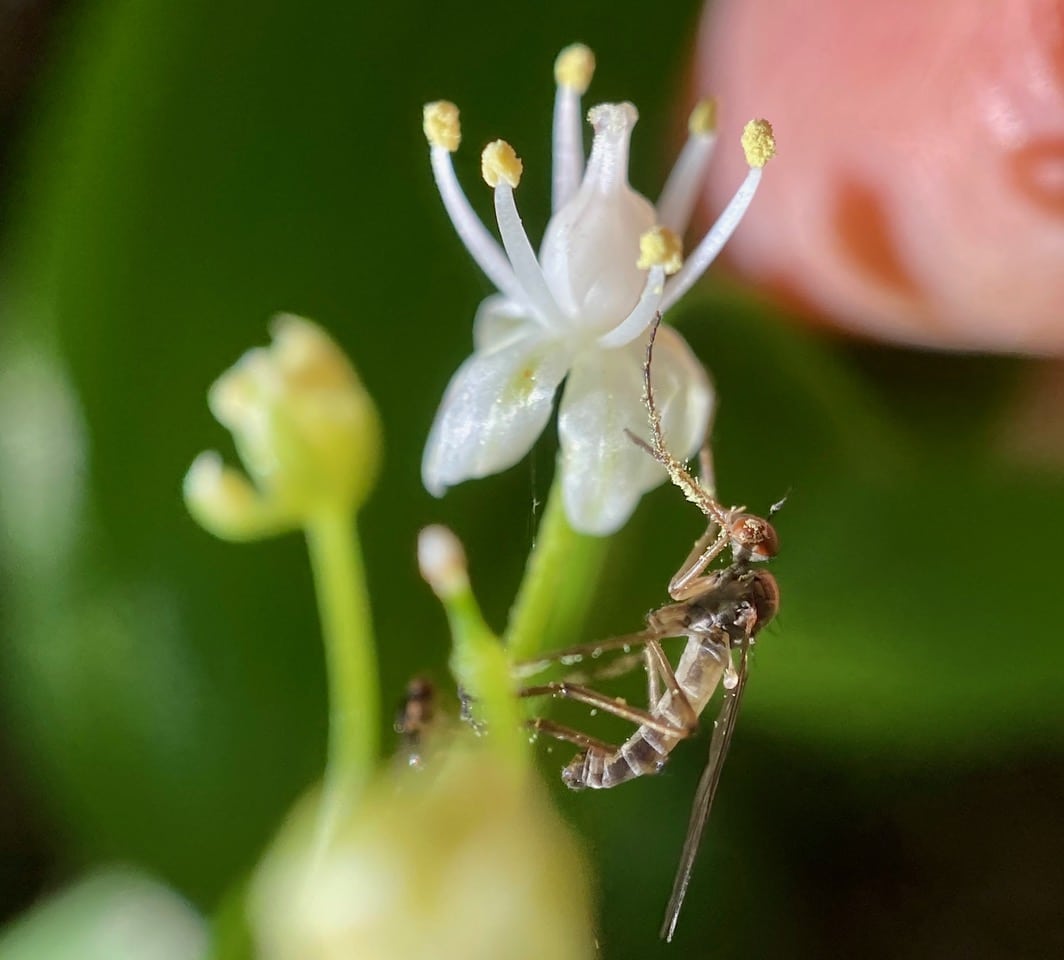
The Dance Fly steps off the flower for a moment to try to clean the pollen off its eyes. Much as these flies intrigue us with their predatory prowess and charismatic courtship behaviors, I think their role as pollinators of small native wildflowers maybe much under-appreciated.