

Pollinator Post 3/17/23 (1)
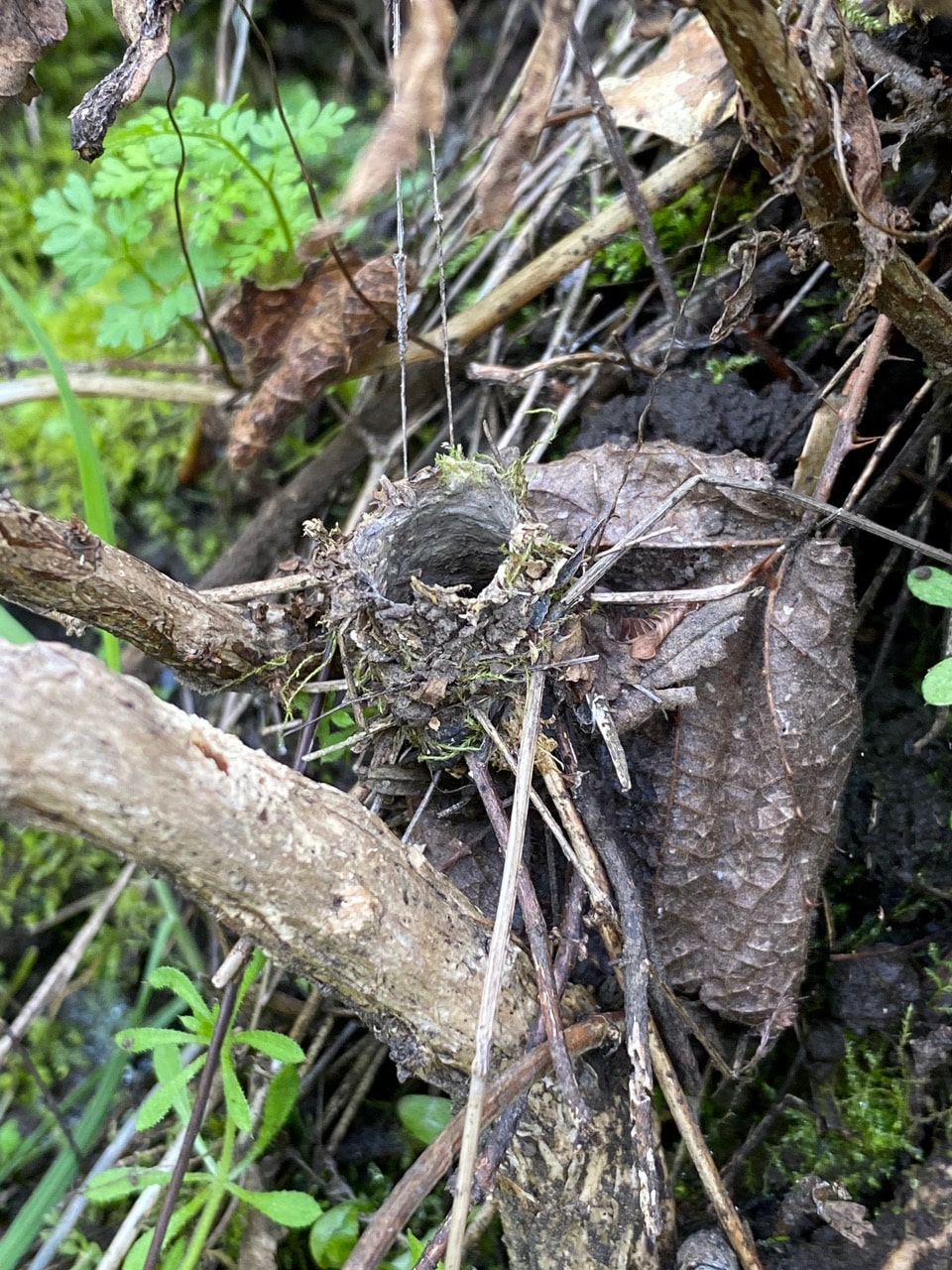
Just when I think that I know where everything is along this familiar stretch of the Skyline Trail, I still continue to be surprised. Take this beautifully constructed turret of a California Turret Spider, for instance. It is wedged between two broken branches that stick out from the bank. I stare in awe of its ingenuity. The turret is constructed of soil, silk and plant debris. Usually the attached twigs and leaves radiate outward, spoke-like, from the turret, extending the spider’s sensory reach to detect passing prey.



The California Turret Spiders, Atypoides riversi are found only in California, in the Coast Range and Sierra foothills, limited to moist woodlands, often on north-facing slopes, and near shady streams and thickets. They belong to an ancient lineage of spiders, the mygalomorphs, which includes the tarantulas and trapdoor spiders. Mygalomorph fangs swing straight down like pickaxes, instead of from side-to-side like pincers. Turret spiders are ambush predators. At dusk, the spider comes up for food, poised just inside the turret, ready to grab any passing prey.
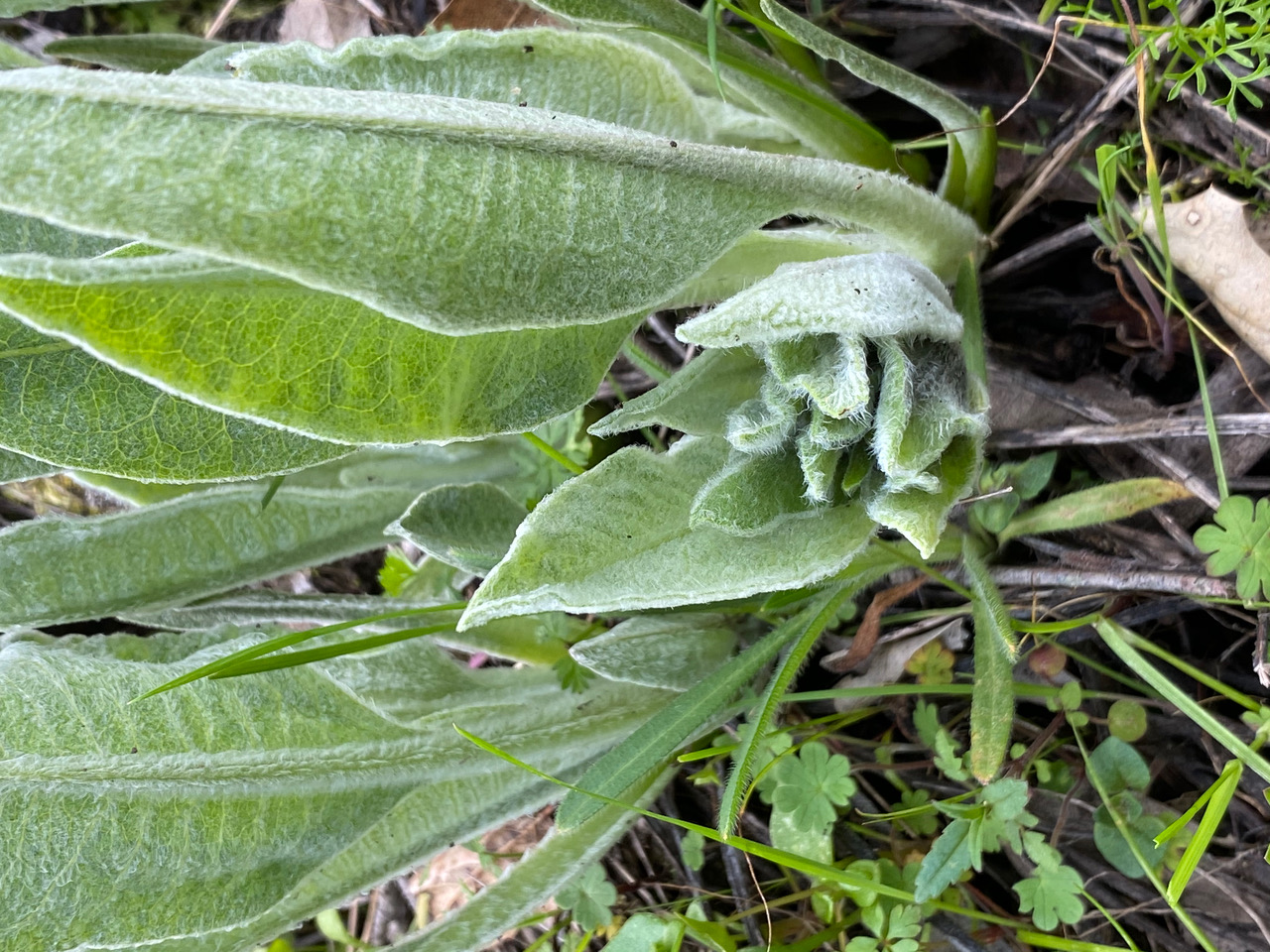
Ah, I think that’s a new flower bud on the Woolly Mule’s Ears, Wyethia helenioides. It won’t be long before we see its sunny face!
I am intrigued by the Miner’s Lettuce and all its variations. Glen just informed me that the variations I have been observing at Skyline are actually three different species. Apparently, beside the familiar Claytonia perfoliata, there’s C. parviflora and C. rubra, each with its own traits. Why pull my hair out trying to distinguish one species from another? I would rather focus on enjoying the charms of the plant. Today I am in search of the smallest Miner’s Lettuce leaf I can find. The one pictured above comes close, but it is outcompeted by one that is barely bigger than the single flower that it supports. Cheers to diversity!
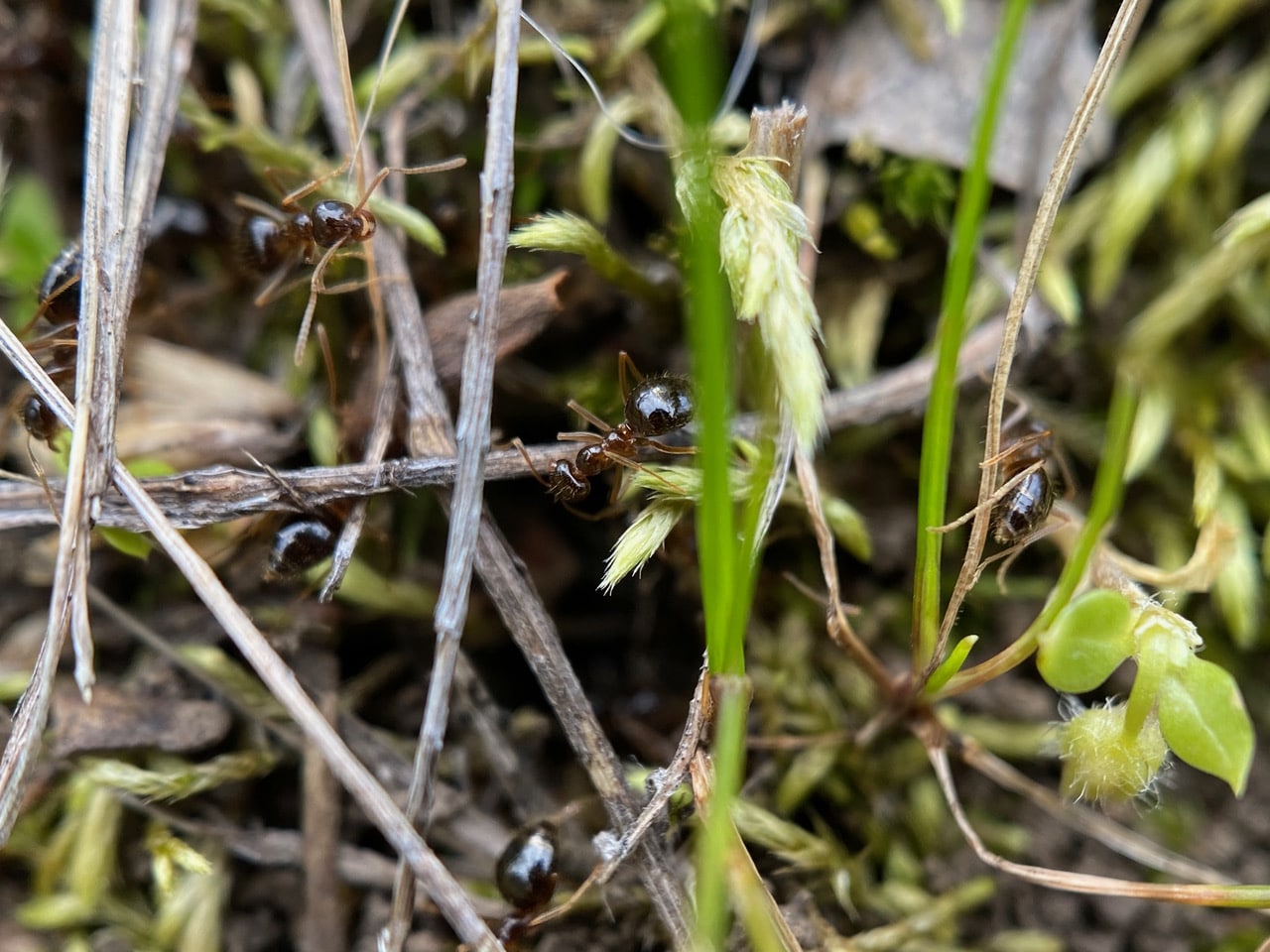
Just then I notice a lot of movements in the weedy grasses behind the Miner’s Lettuce I am photographing. Hundreds of ants are moving around in the undergrowth.
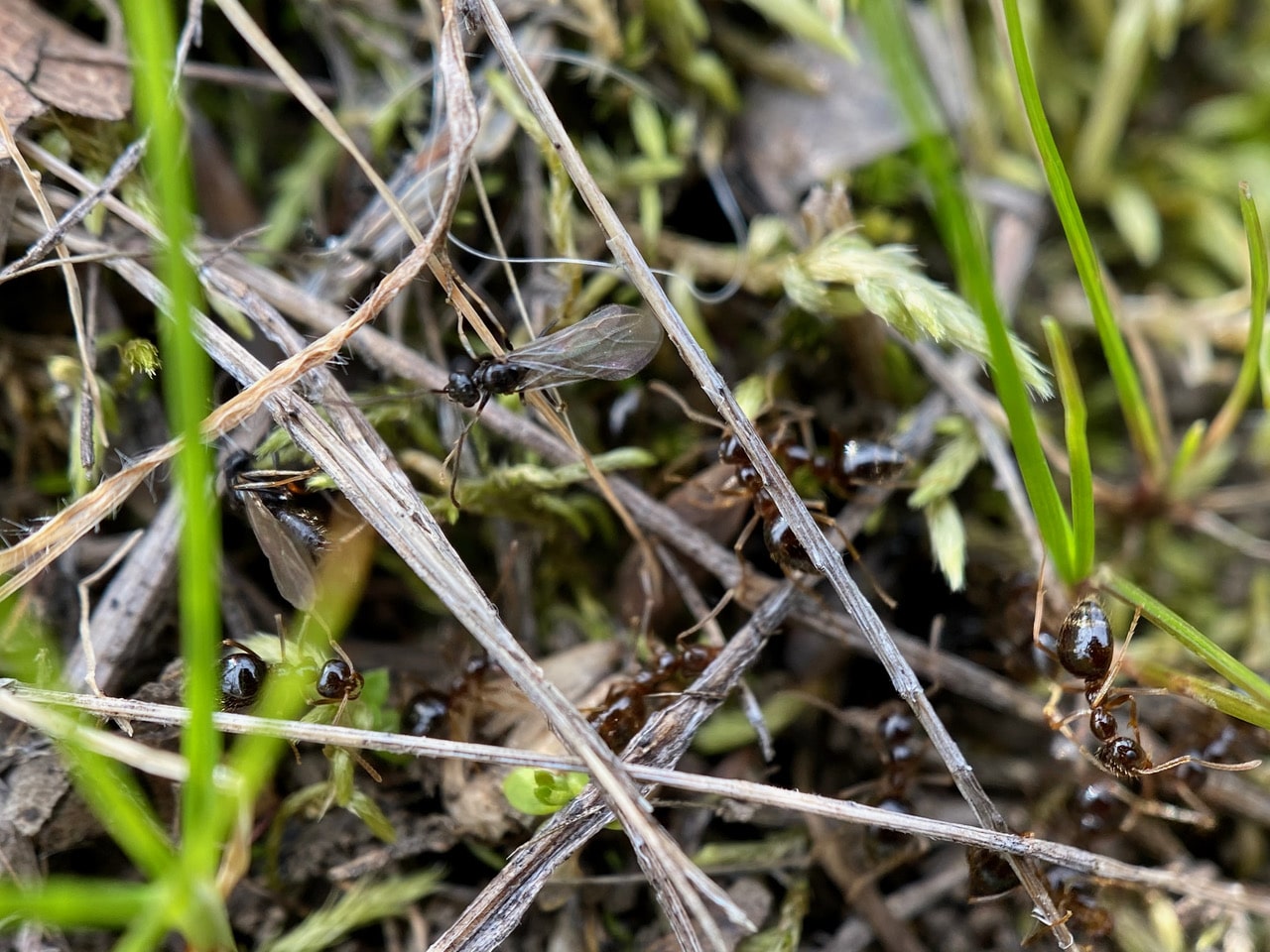
I finally realize what the commotion is about – preparations for the launch of a nuptial flight! Some alates (winged reproductives) appear from below chaperoned by the workers. I am amazed by how different the winged ones look in comparison to the brown workers – besides the possession of wings, the reproductives are darker in color, almost black, smaller and slimer in build. Unfortunately, conditions are probably not right for the launch. It is unseasonably warm and humid this afternoon, with temperatures hovering in the low 60 F. The alates mill around on the surface momentarily, then promptly descend into the undergrowth. I am ready to call these Argentine Ants, Linepithema humile, but then recall that the species does not swarm.
iNaturalist has helped identify these ants as the American Winter Ants, Prenolepis imparis (family Formicidae). Native to North America, these generalist omnivores nest deep within the ground. Unusual among ants, Prenolepis imparis prefers lower temperatures, including near freezing, and is only active outside the nest during winter and early spring. The colony enters estivation (a hibernation-like state) and becomes inactive above ground for the warmer months, during which time eggs are laid and brood are reared. Reproductives overwinter and emerge on the first warm day of spring for their nuptial flight. The queens are much larger and distinctly lighter in color than males.

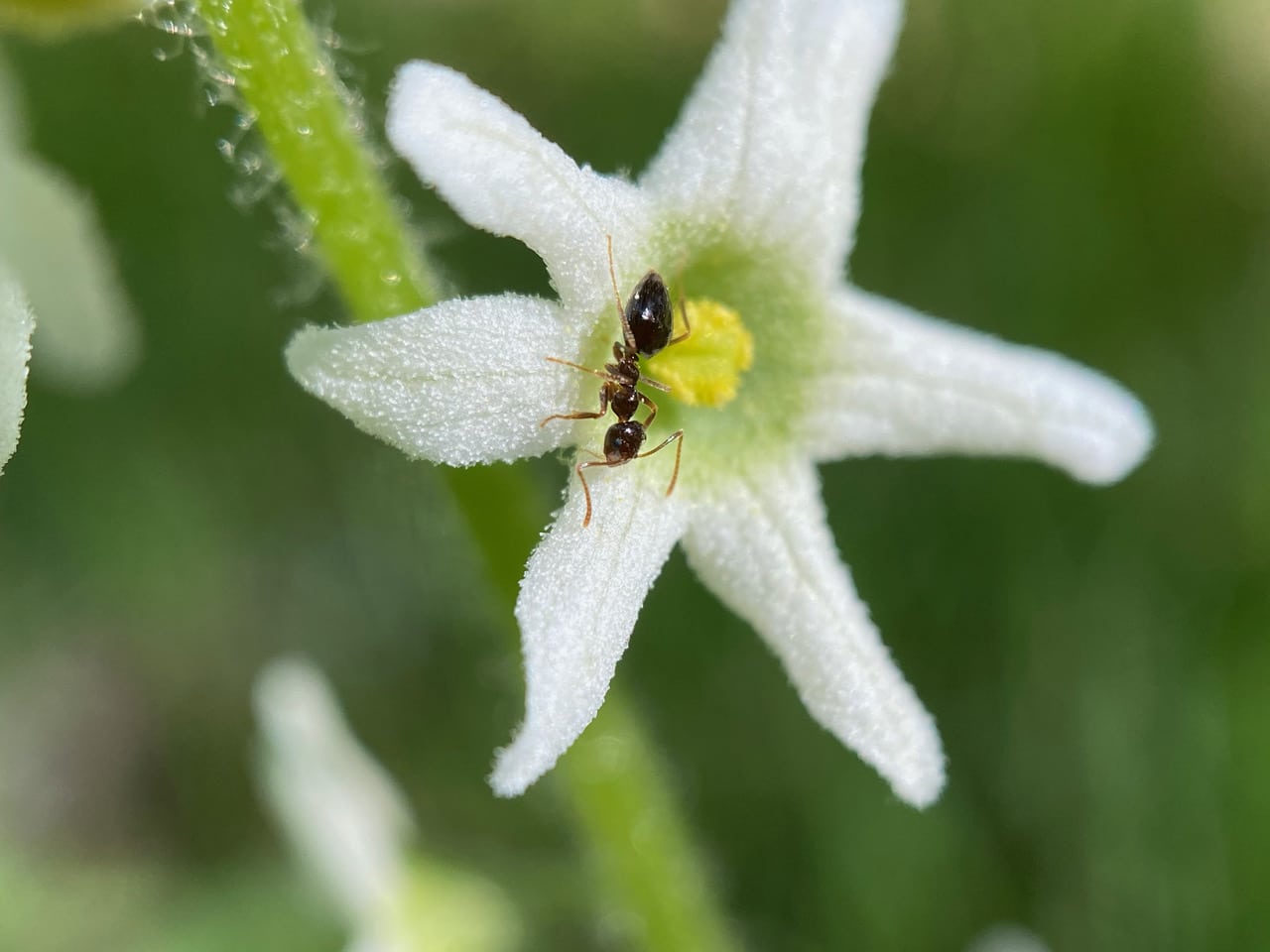
Remember is picture taken on 2/20 of an ant foraging on an Marah oreganus flower? I had misidentified the ant as an Argentine Ant. It is actually an American Winter Ant, Prenolepis imparis!
I often walk pass this large Gooseberry shrub, Ribes sp. that is buzzing with bees, notably bumble bees and Digger Bees lately. The shrub grows on a precariously steep slope and I have so far failed in every attempt to photograph the bee activities on it.
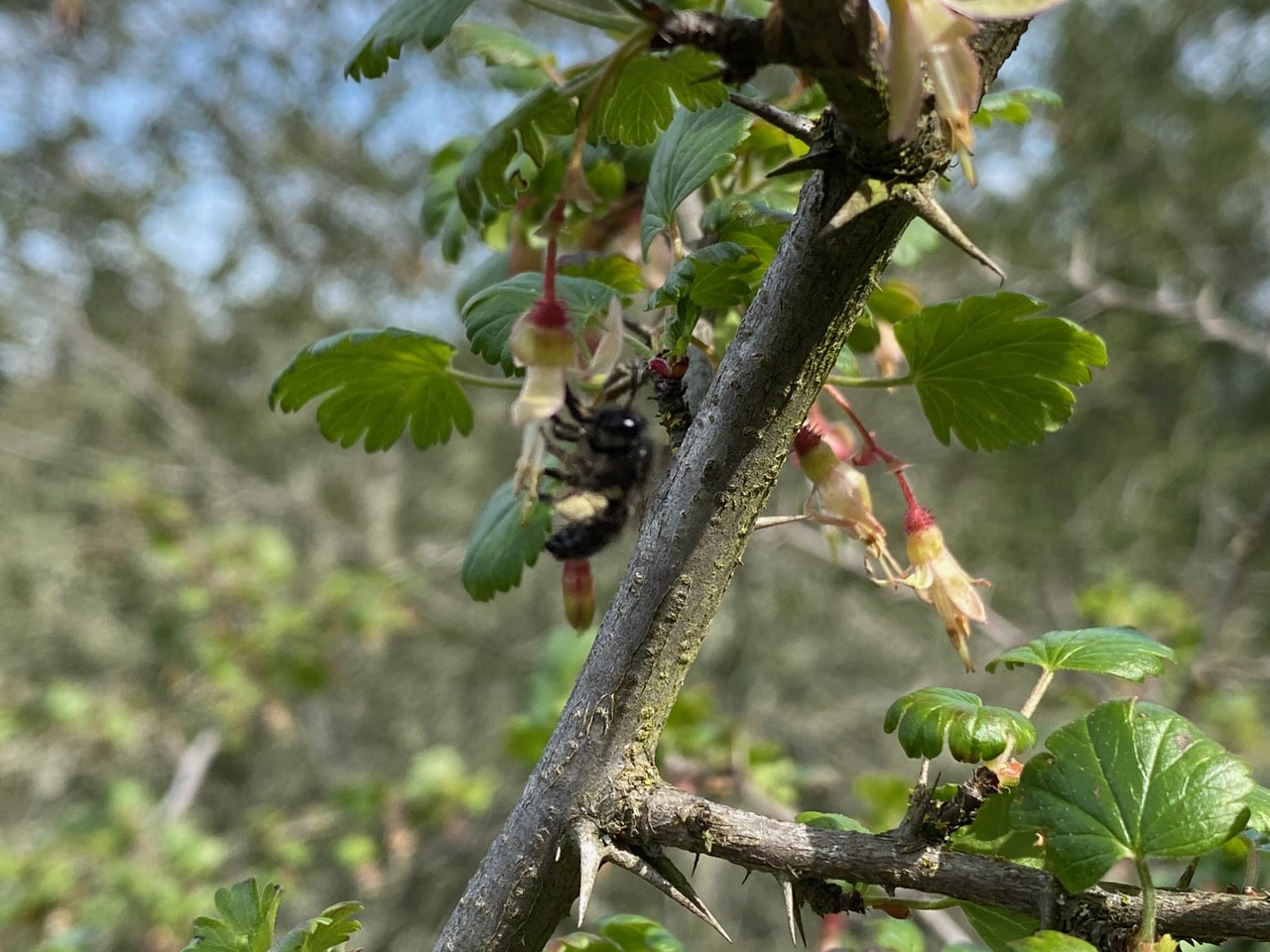
There is a newcomer on the Gooseberry today. The small, black hairy bee is not as frenetic as its bigger relatives. It takes its time, hanging on the pendant flowers to collect pollen.
The picture is not in good focus, but it shows enough details to allow a guess on the identity of the bee. The bee already has a big load of pollen in the scopae (special pollen collecting hairs) on its hind legs. And the scopa is not limited to its tibia (shin-like segment of the leg) but extends all the way to the base of its leg. This is a good clue that it might be a member of the family Andrenidae or miner bees.
The andrenids are typically small to moderate-sized bees, which often have scopae on the basal segments of the leg in addition to the tibia. Most of these solitary ground-nesters are specialist pollinators whose life cycle is timed to correspond precisely to the blooming of specific flowers. These bees are often seen in early spring on the early blooming wildflowers.