

Pollinator Post 3/15/24

Winds are not in the weather forecast, so I am rather surprised to be met by strong gusts as I climb the hill on the paved road at Skyline Gardens this morning. No self-respecting insect will be out; nevertheless I’ll get some fresh air and sunshine, and check on what’s in bloom here.
The Common or Coast Fiddleneck, Amsinckia intermedia (family Boraginaceae) has started to bloom along the upper stretch of the road.
The annual is native to western North America, and is common and widespread throughout California. Inflorescences of yellow to orange tubular flowers are borne along one side of a terminal stalk that is initially tightly coiled, unfurling as the buds mature. Flowers open near the top of the coil, and seeds develop below along the elongating stalk. The structure of the one-sided cyme resembles the end of a fiddle, hence the common name “fiddle neck”.
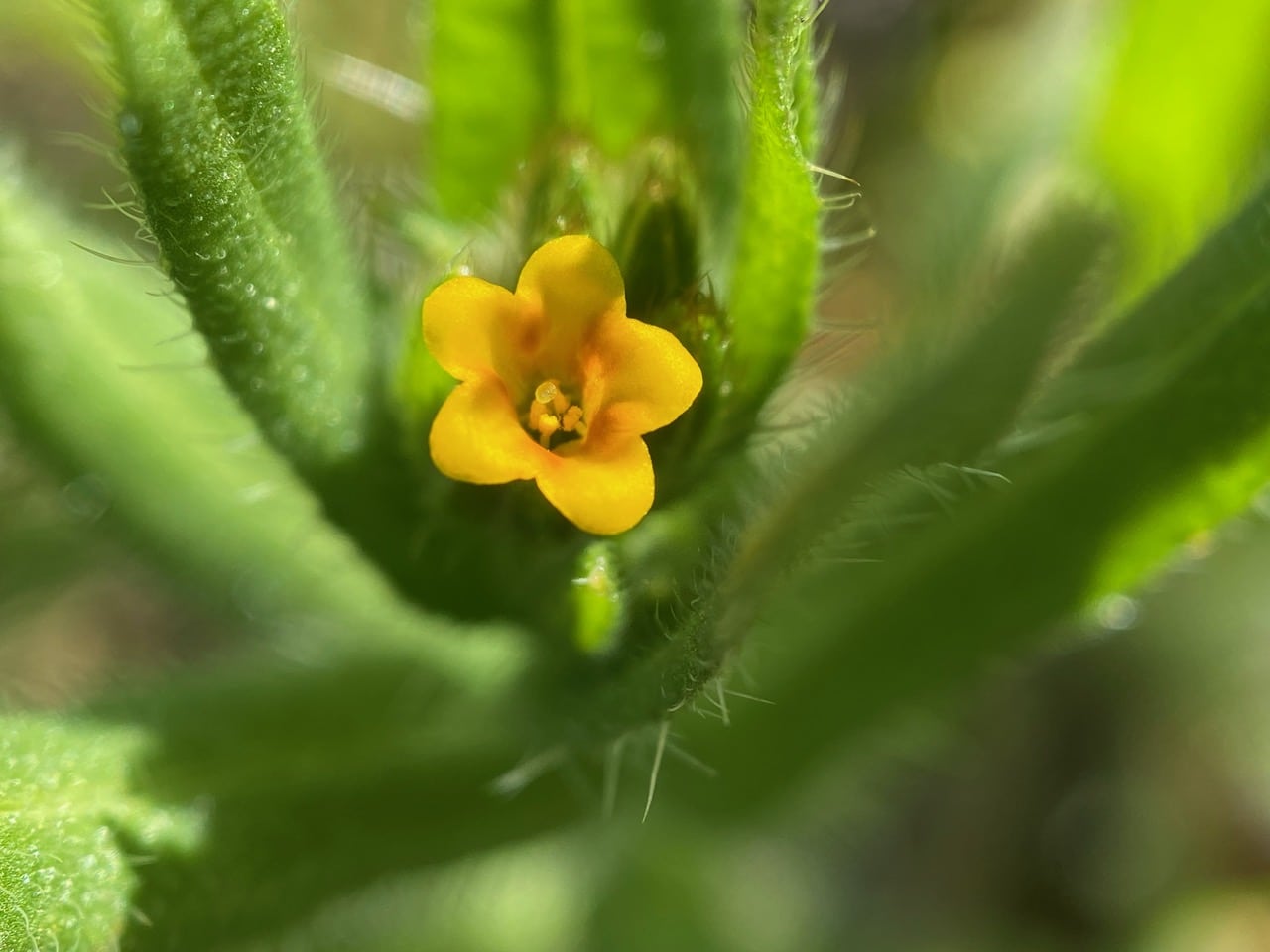
This is the first flower to open on its inflorescence.
The flowers of Amsinckia are bisexual and radially symmetrical. The five petals are united into a five-lobed funnel with a flaring mouth. Each flower is less than 1/2 in. long, yellow-orange in color and usually has five orange-red defused spots near the top of the throat. The 5 stamens are fused to the corolla throat and do not extend beyond the corolla tube. There is a single pistil with a superior ovary, a single style and a two-lobed stigma.
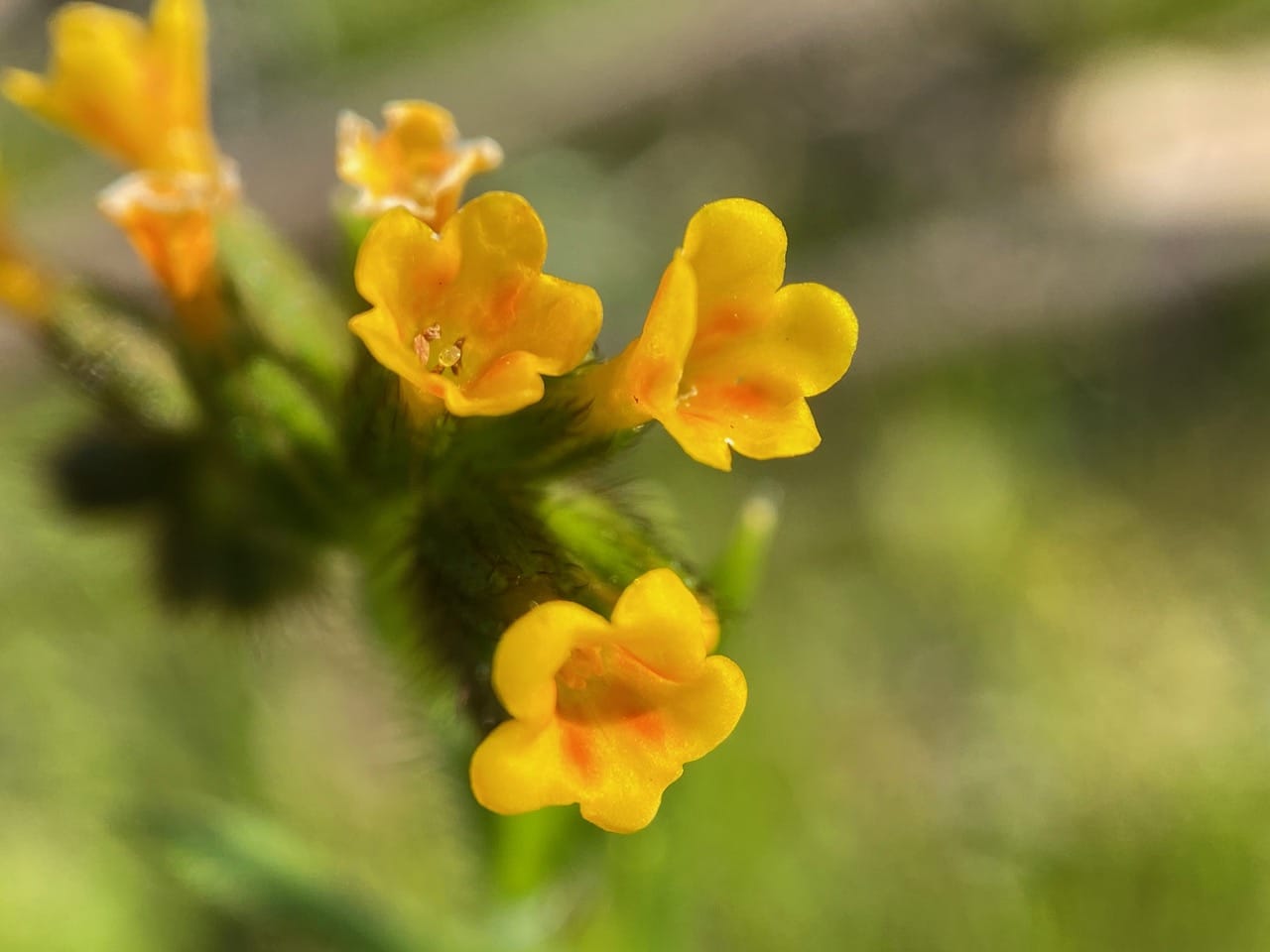
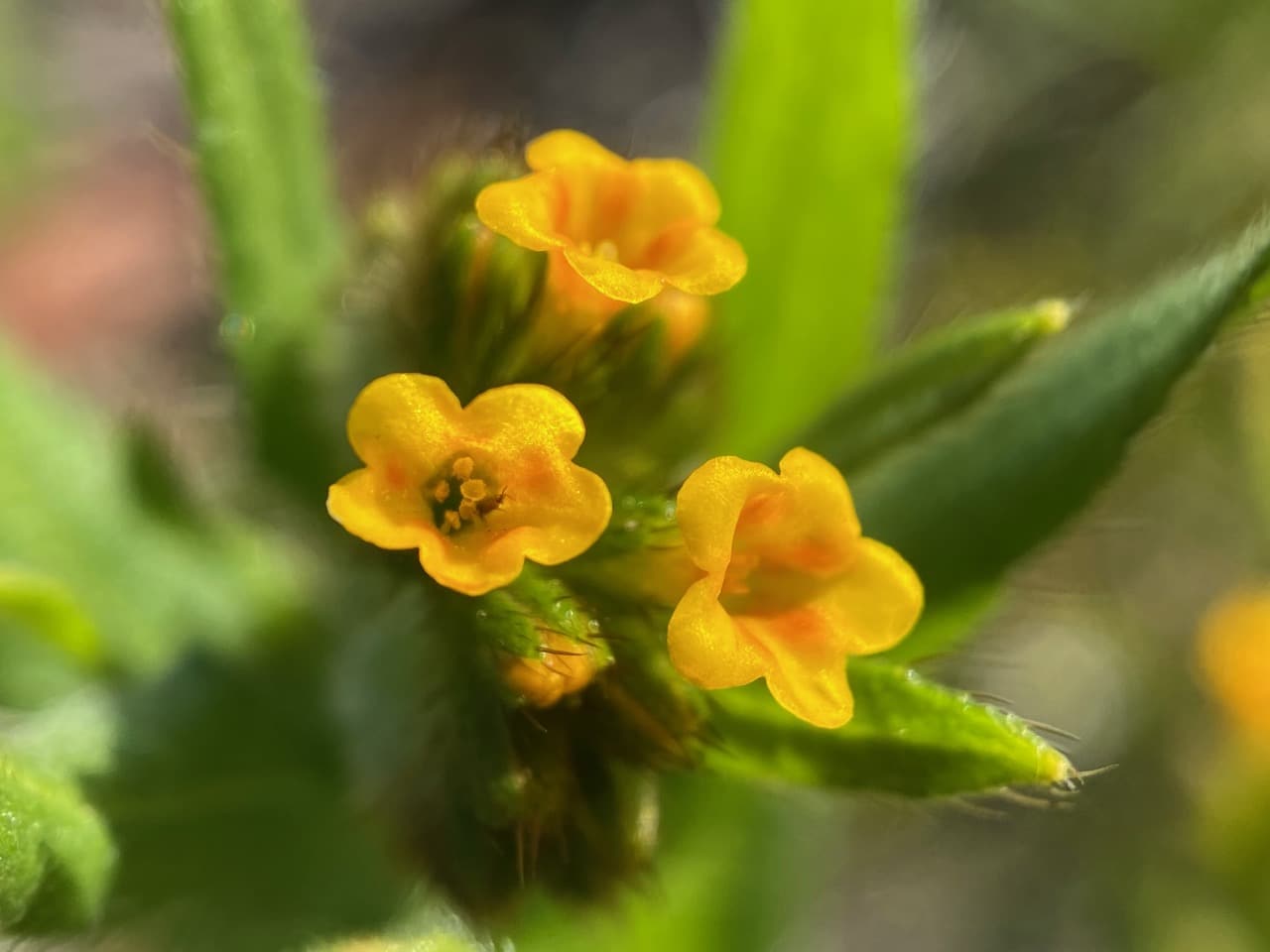
Hey, there’s a tiny insect in the flower – an aphid?

The anthers of the mature flowers are releasing pollen. How does Amsinckia prevent self-pollination, the male and female reproductive structures being so close together? Perhaps at this stage, the stigma is no longer receptive to pollen? Or maybe the plant is self-fertile?
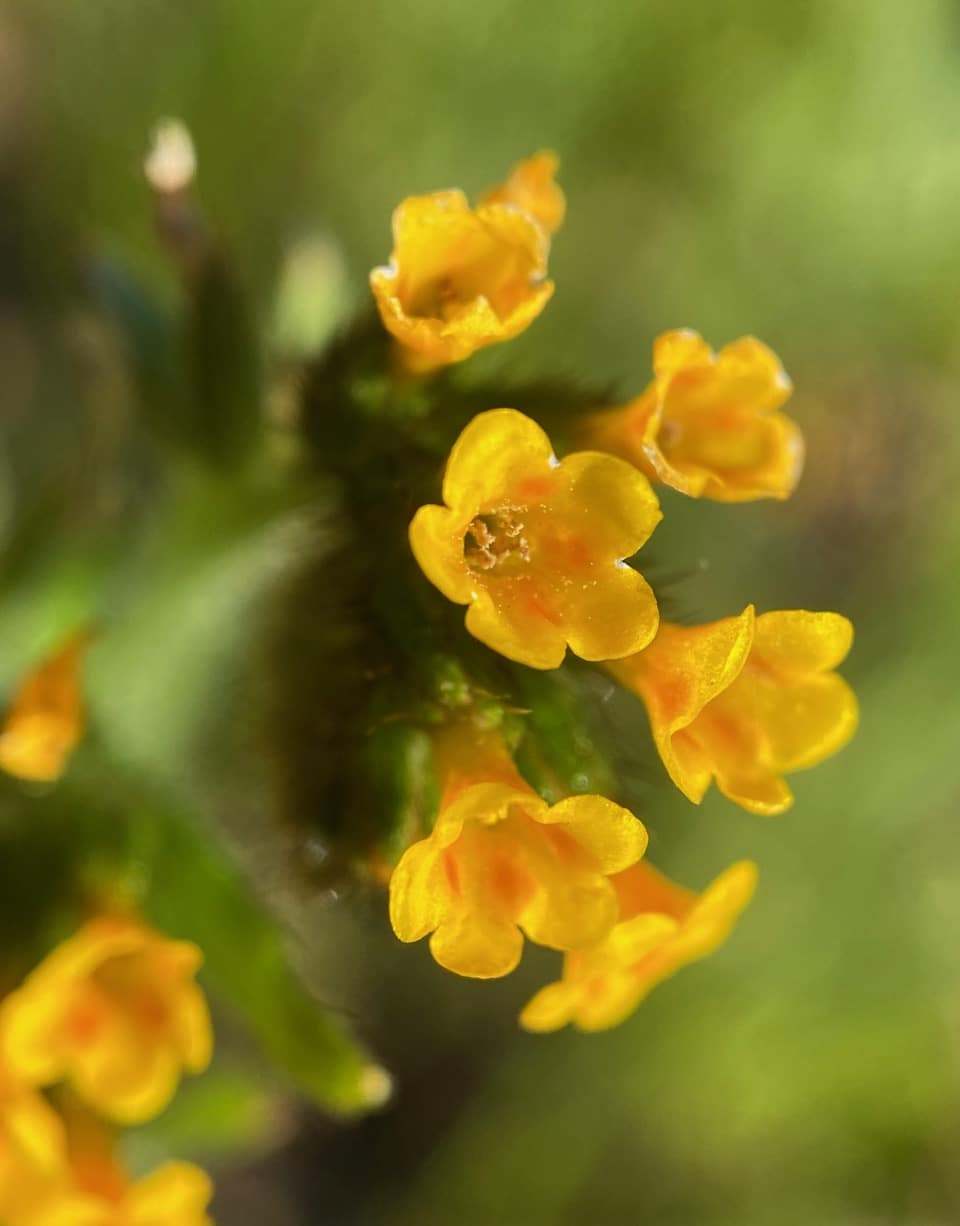
For pollination, the small tubular flowers require the services of insects with long tongues. While observing this population of Amsinckia over the past two springs, I have seen the flowers visited by the Greater Bee Flies (family Bombiliidae), Digger Bees (Anthophora sp.), Bumble Bees (Bombus sp.) and the Sarah Orange-tip butterflies.
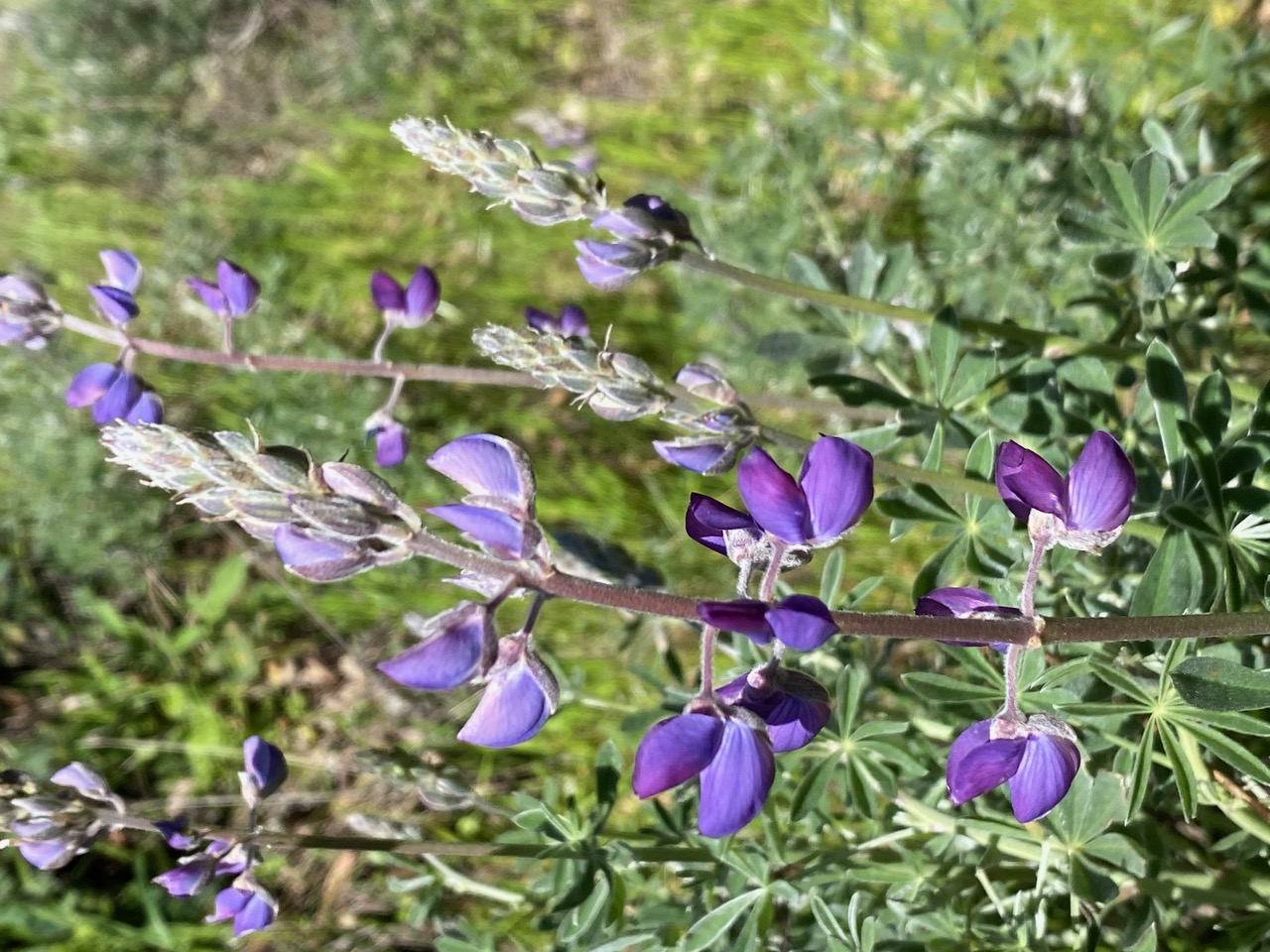
Along Skyline Trail, precious few Silverleaf Lupine, Lupinus albifrons are in bloom. The flowers are scant and spaced far apart on the vertical stalks. Are they also late this year because we have had little sunshine?
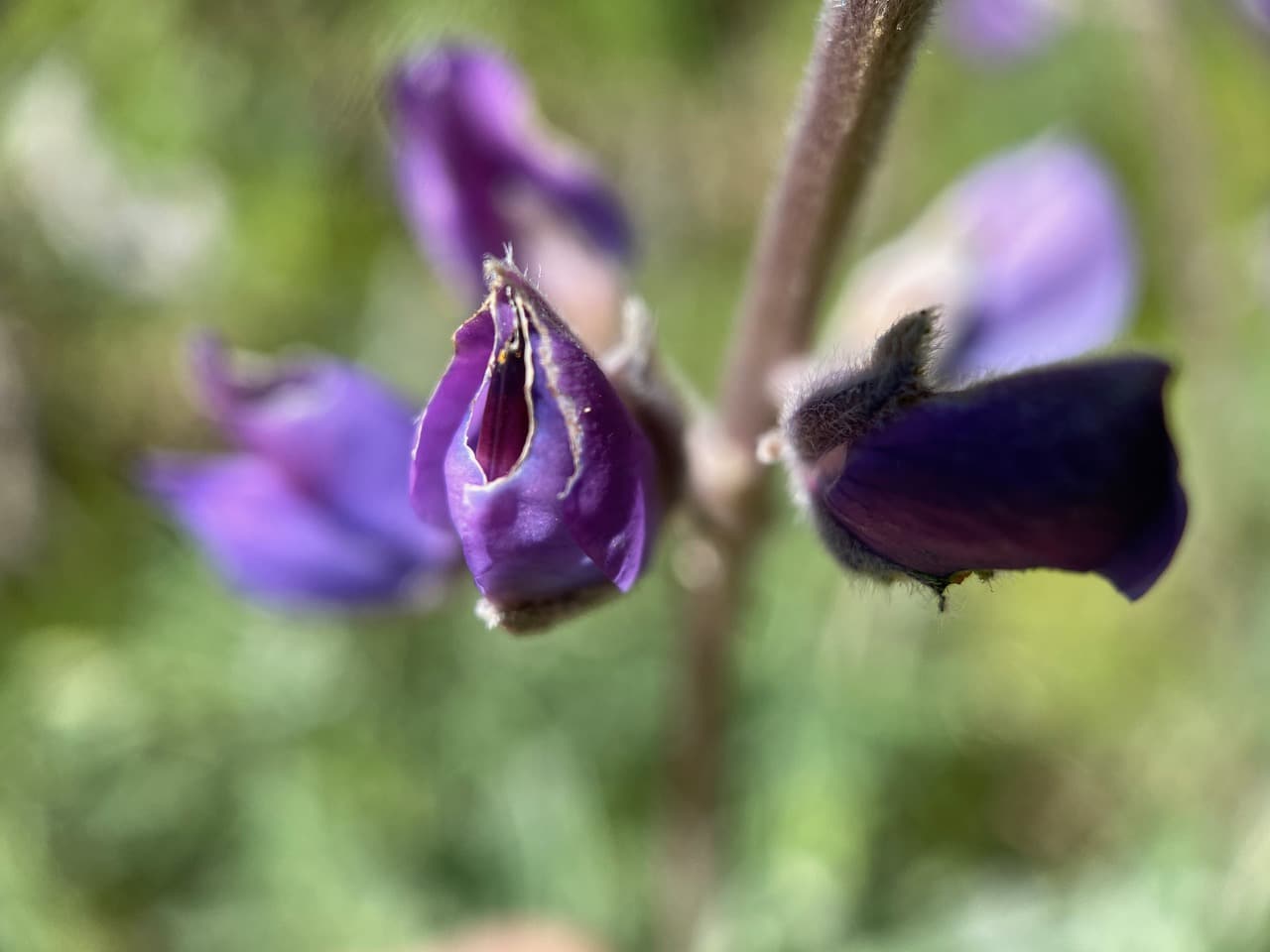
There are no insects around, but there are abundant signs of insect activity. Who has been chewing through this lupine bud before it is even open? It’s a lot of work cutting through so many petal layers – the banners, the wings and the keel. The breached flower bud has been emptied of its reproductive parts. Pollen thief?
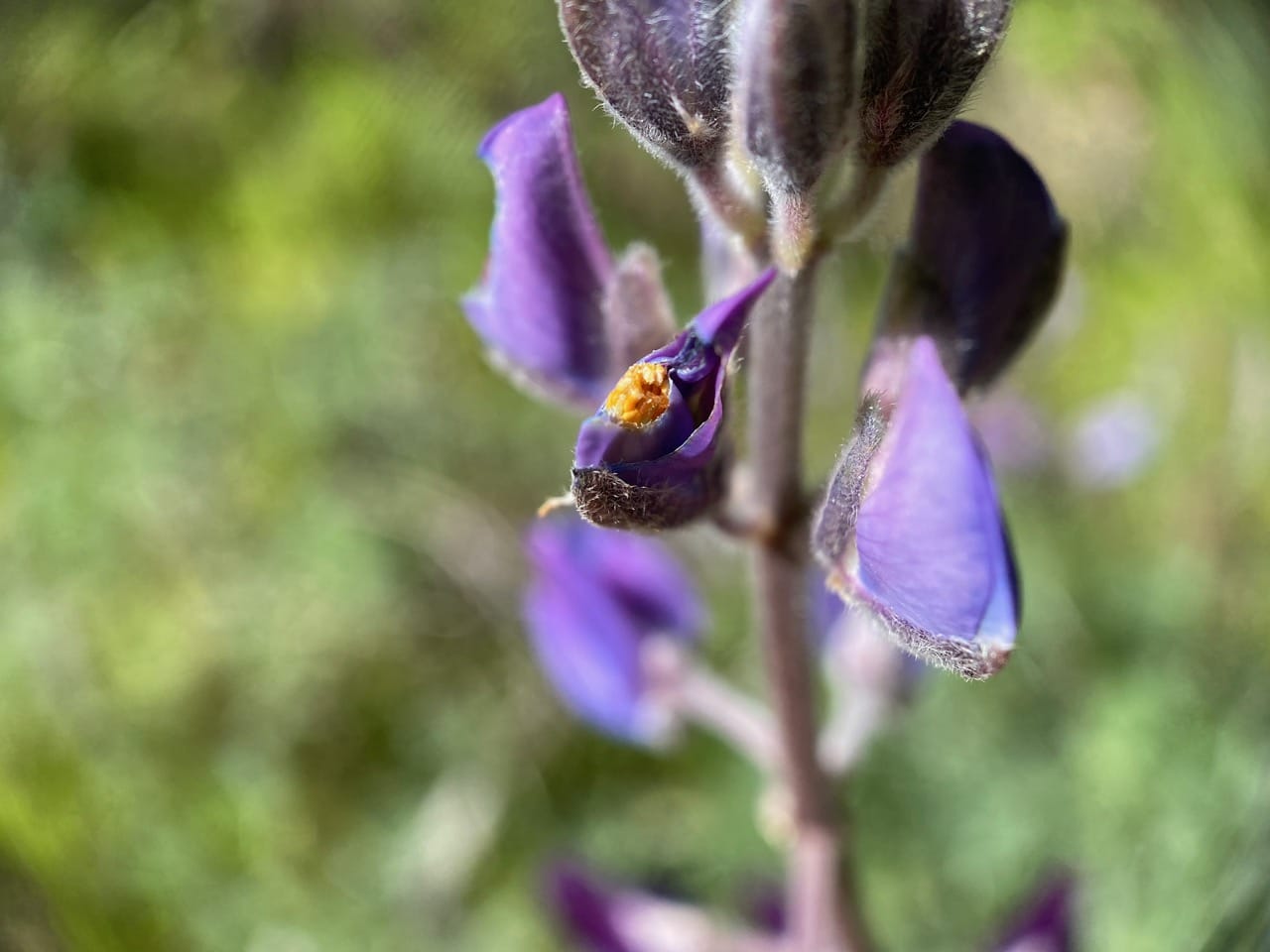
This young bud has been chewed through, but the anthers are hardly touched. What was the thief after? Nectar in the back of the flower?
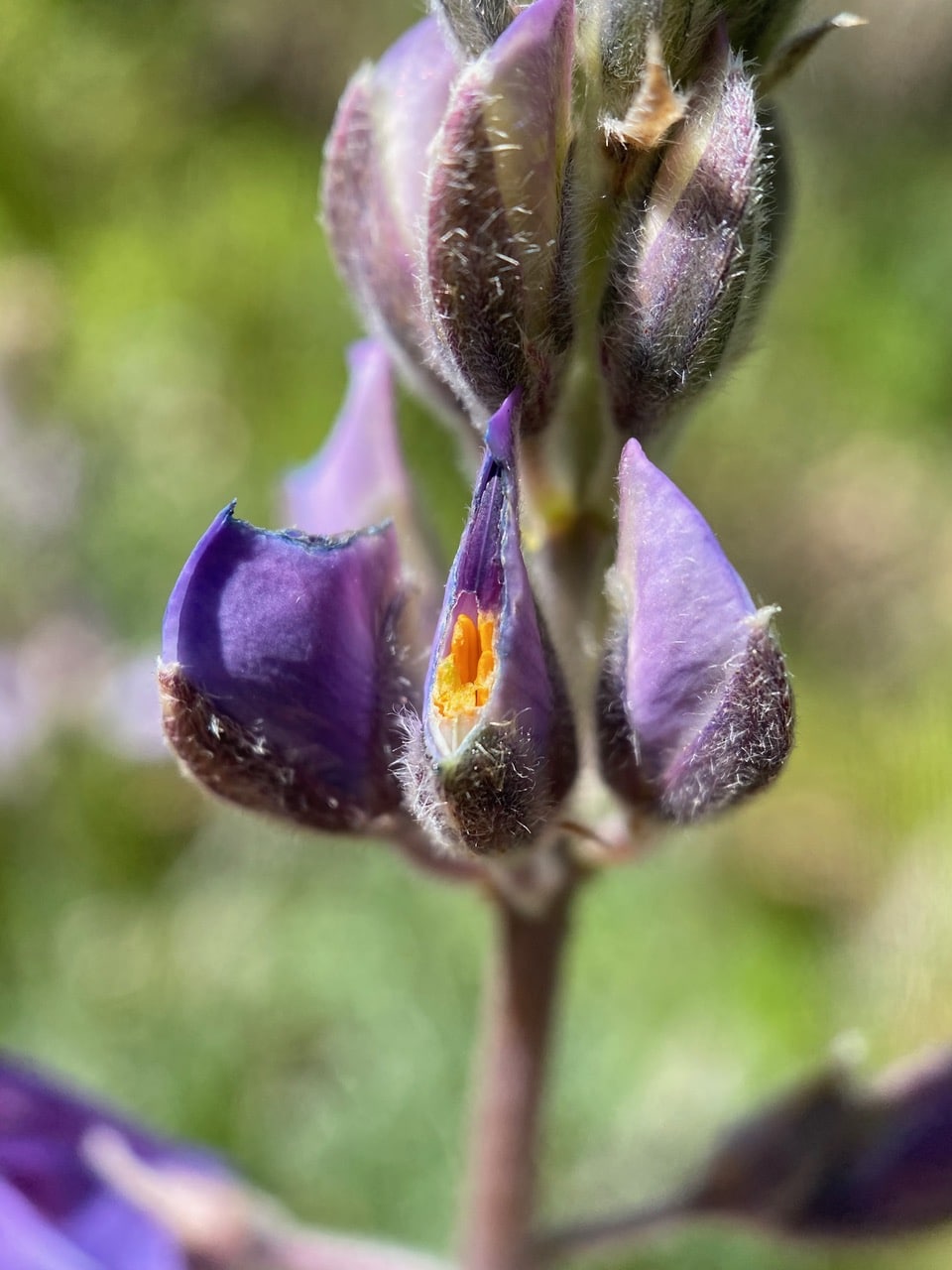
Same with this lupine bud.
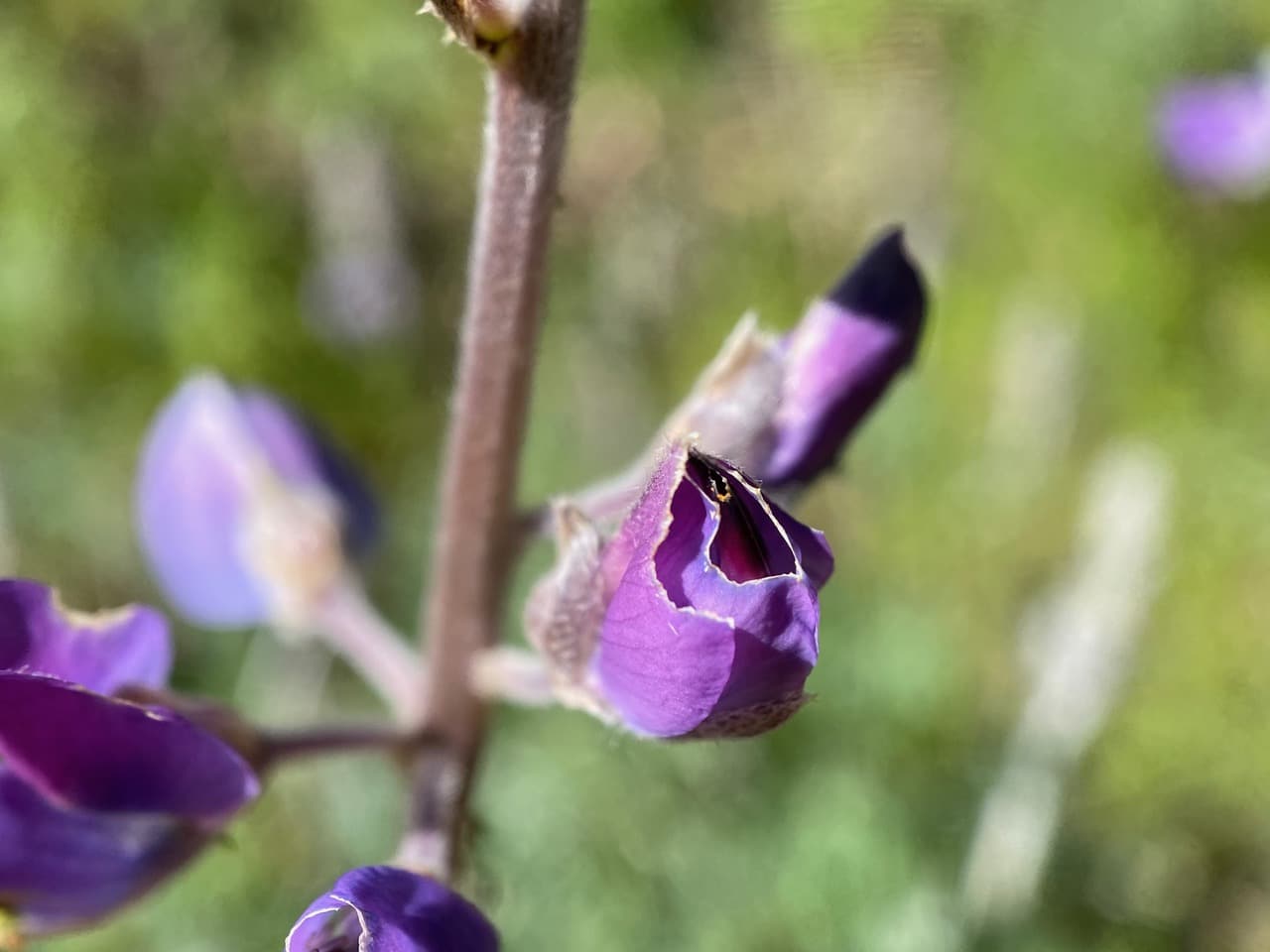
What was the thief after? And who’s responsible for these damages? The Digger Bees (Anthophora sp.) and the Bumble Bees (Bombus sp.) are capable of this. Maybe there are too few flowers for the desperate bees that have emerged, and they had to resort to breaking into the unopened buds for the nectar and pollen? That’s a sad thought. Alternatively, there are other insects with chewing mouthparts capable of this – ants, crickets/katydids, beetles. I’ll have to keep my eyes peeled for these clandestine activities.

Ooh, the banner (upper petal) of this lupine flower is freshly chewed, with liquid still oozing from the wound.
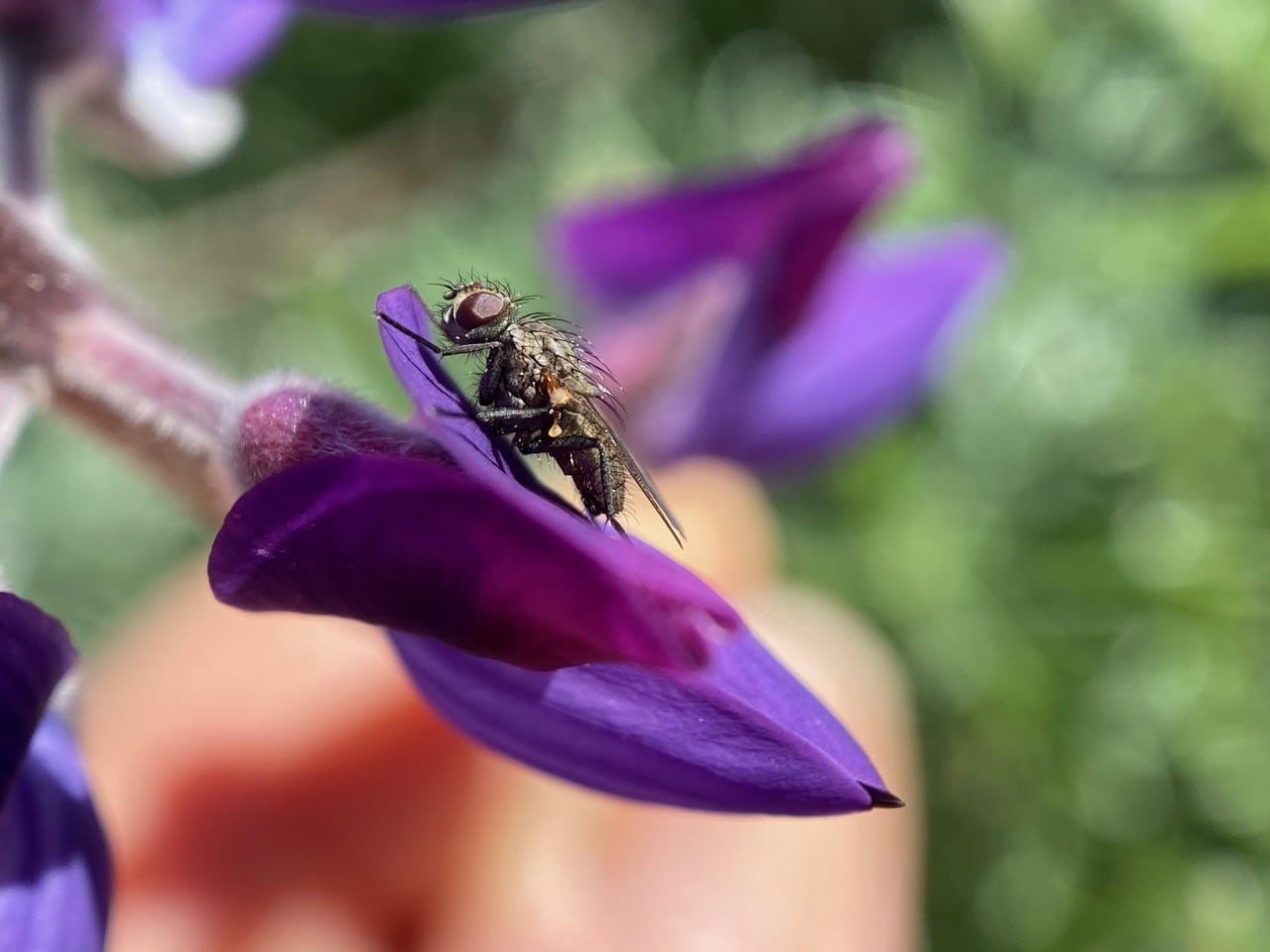
Disoriented by the winds, a small unidentified fly lands unsteadily on a lupine flower and holds on tight.
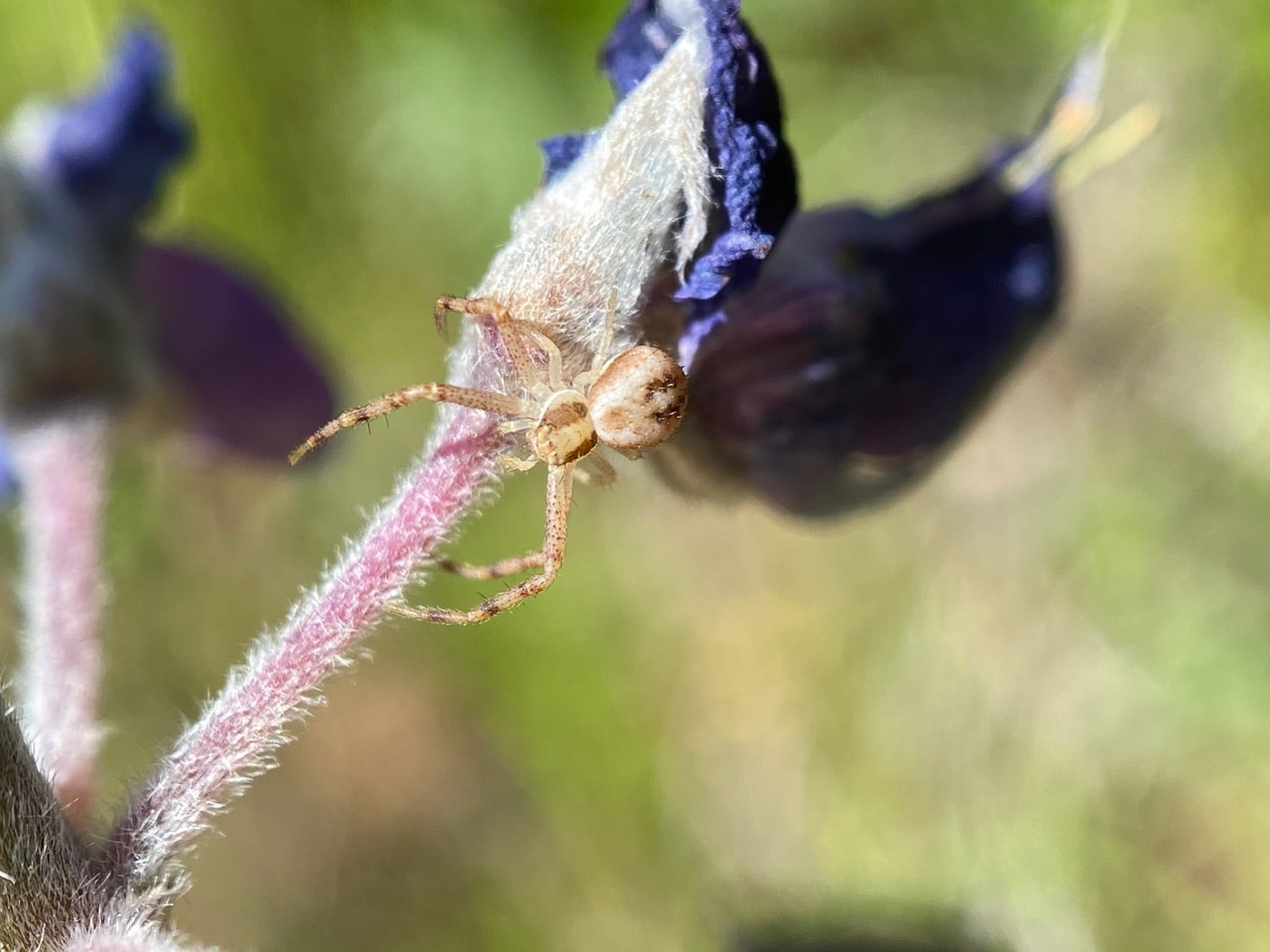
On an old inflorescence of lupine flowers, I watch as a young Crab Spider, Mecaphesa sp. (family Thomisidae) scrambles from one withered flower to the next. This is not exactly a good hunting ground for a spider. Surely no insect will be visiting these spent flowers.
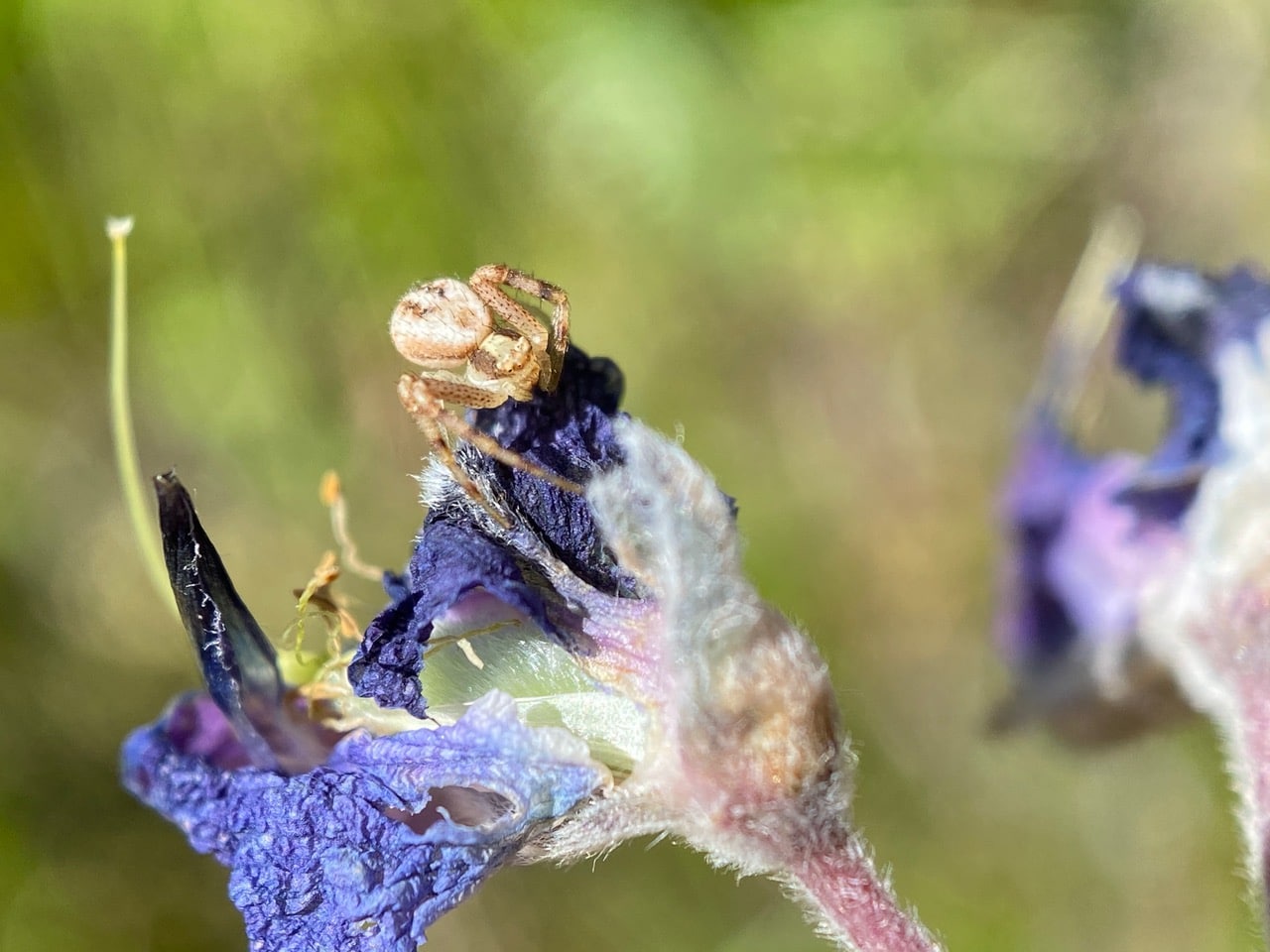
Members of the family Thomisidae do not spin webs, and are ambush predators. The two pairs of front legs are usually long and more robust than the rest of the legs. Their common name derives from their ability to move sideways or backwards like crabs. Most Crab Spiders sit on or beside flowers, where they grab visiting insects. Some species are able to change color over a period of some days, to match the flower on which they are sitting.
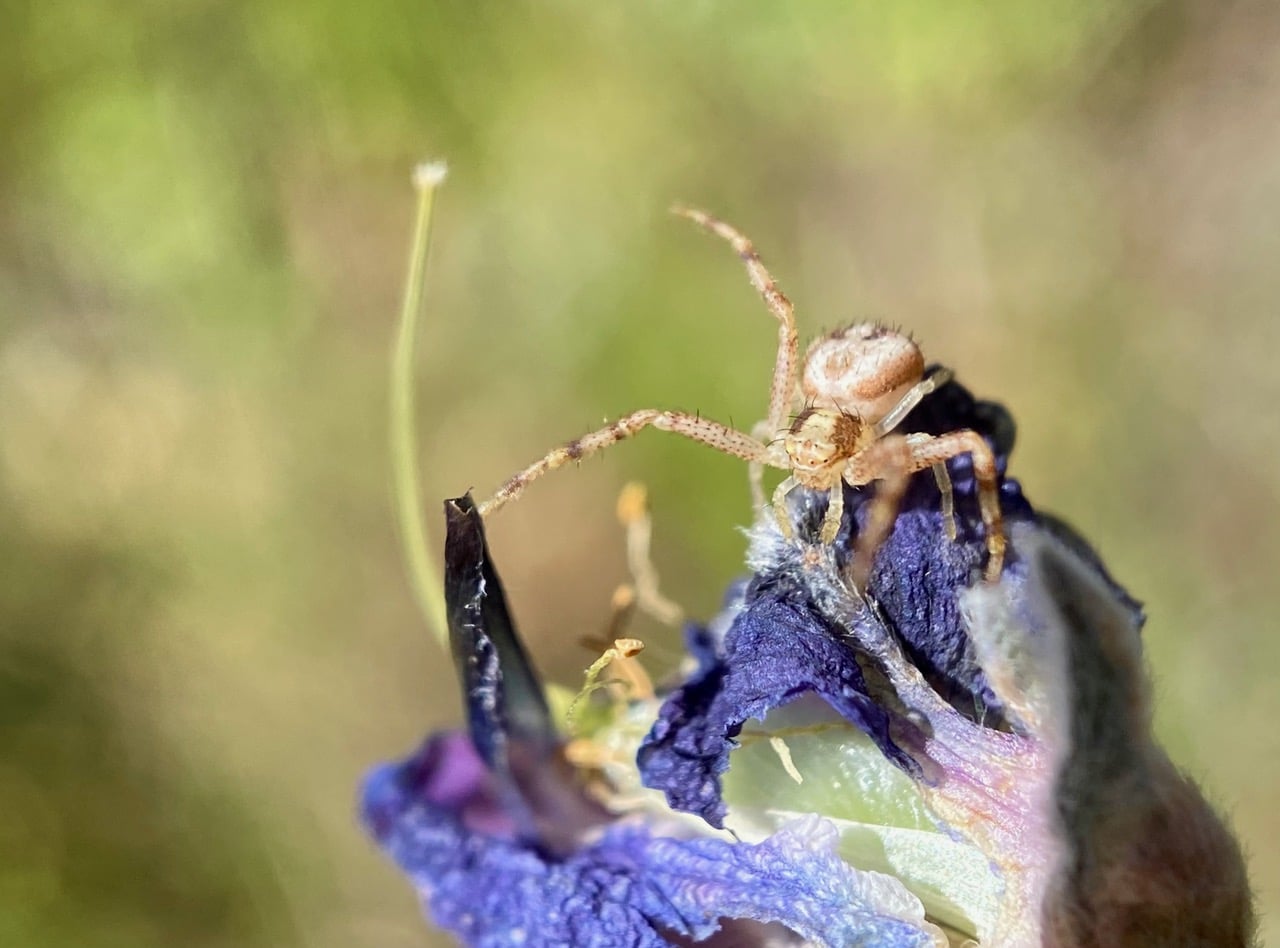
The spider seems agitated by the winds. Mecaphesa is distinguished from the other genera of Crab Spider by the size and arrangement of the eight eyes (in two curved rows of four). Mecaphesa is also often hairy, with tiny hairs protruding from the head, legs, and body.
The arrangement of spiders’ eyes varies significantly by family, so is often used as a diagnostic feature to identify them.

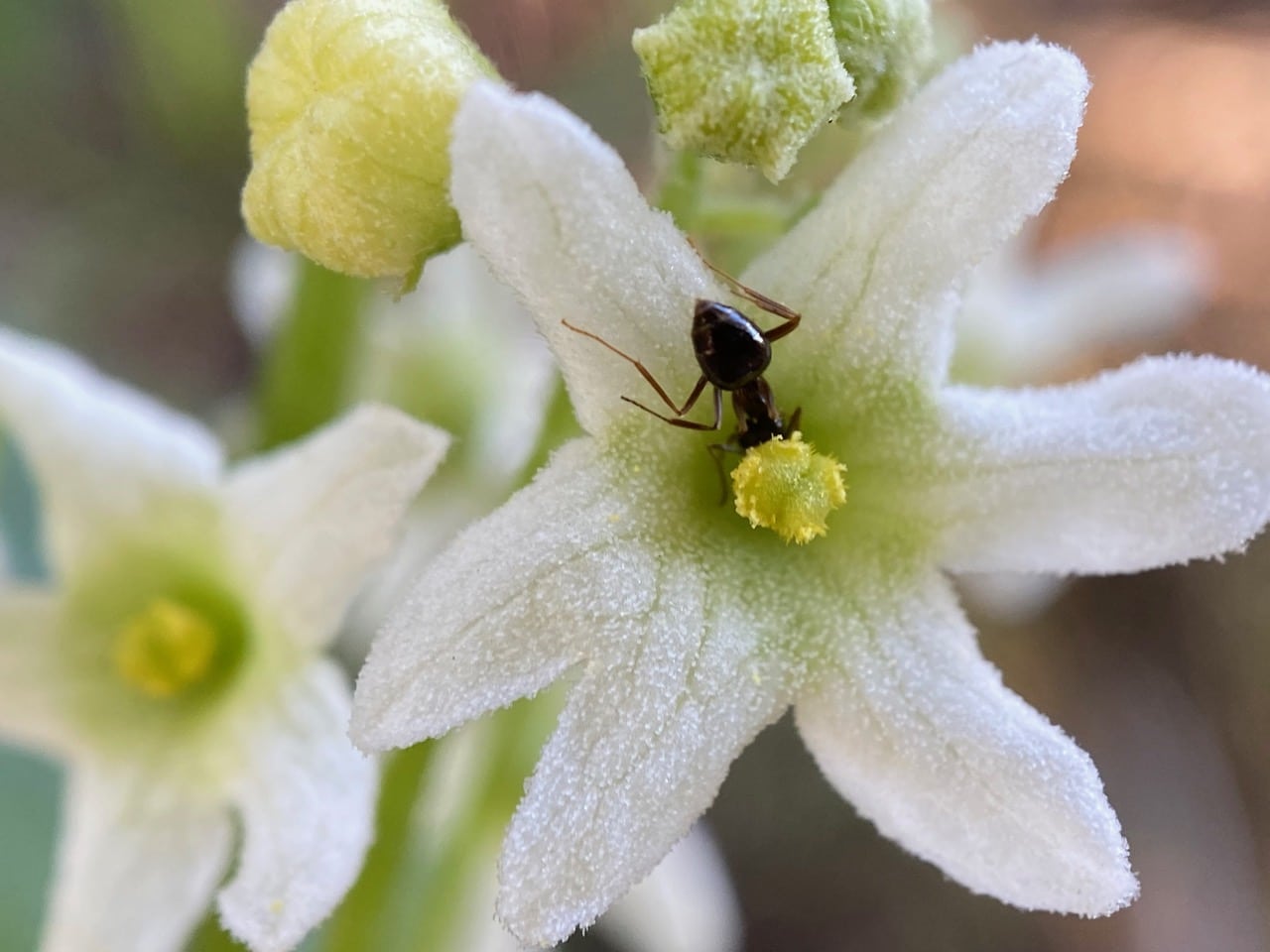
To access nectar, an American Winter Ant, Prenolepis imparis (family Formicidae) is reaching down the corolla of a male Wild Cucumber flower, Marah oregana. The winds don’t affect the wingless insects as much.
There are two species of Marah growing in the Skyline Gardens. More prevalent by far is the California Manroot, Marah fabacea, with smaller, cream-colored flowers. As I pass them today, I don’t see any ants on the California Manroot flowers. Maybe the species depends on a different kind of ants for pollination, such as the minute Odorous House Ants? These ants are less common as they are vulnerable to the invasion of the Argentine Ants, and they probably won’t be out until the weather warms up anyway.
The American Ant, Prenolepis imparis (family Formicidae) is a widespread North American ant. A dominant woodland species, it is most active during cool weather, when most other ant species are less likely to forage. This species is one of a few native ants capable of tolerating competition with the invasive Argentine Ant, Linepithema humile. They are also aggressive toward other ants and produce abdominal secretions that are lethal to Argentine Ants. Prenolepis imparis is a generalist omnivore. Foragers are known for tending to aphids or scale insects from which they consume excreted honeydew, aggregating on rotting fruit, and exploiting protein-rich sources such as dead worms. The colony enters estivation (a hibernation-like state) and becomes inactive above ground for the warmer months, during which time eggs are laid and brood are reared. Reproductives overwinter and emerge on the first warm day of spring for their nuptial flight.
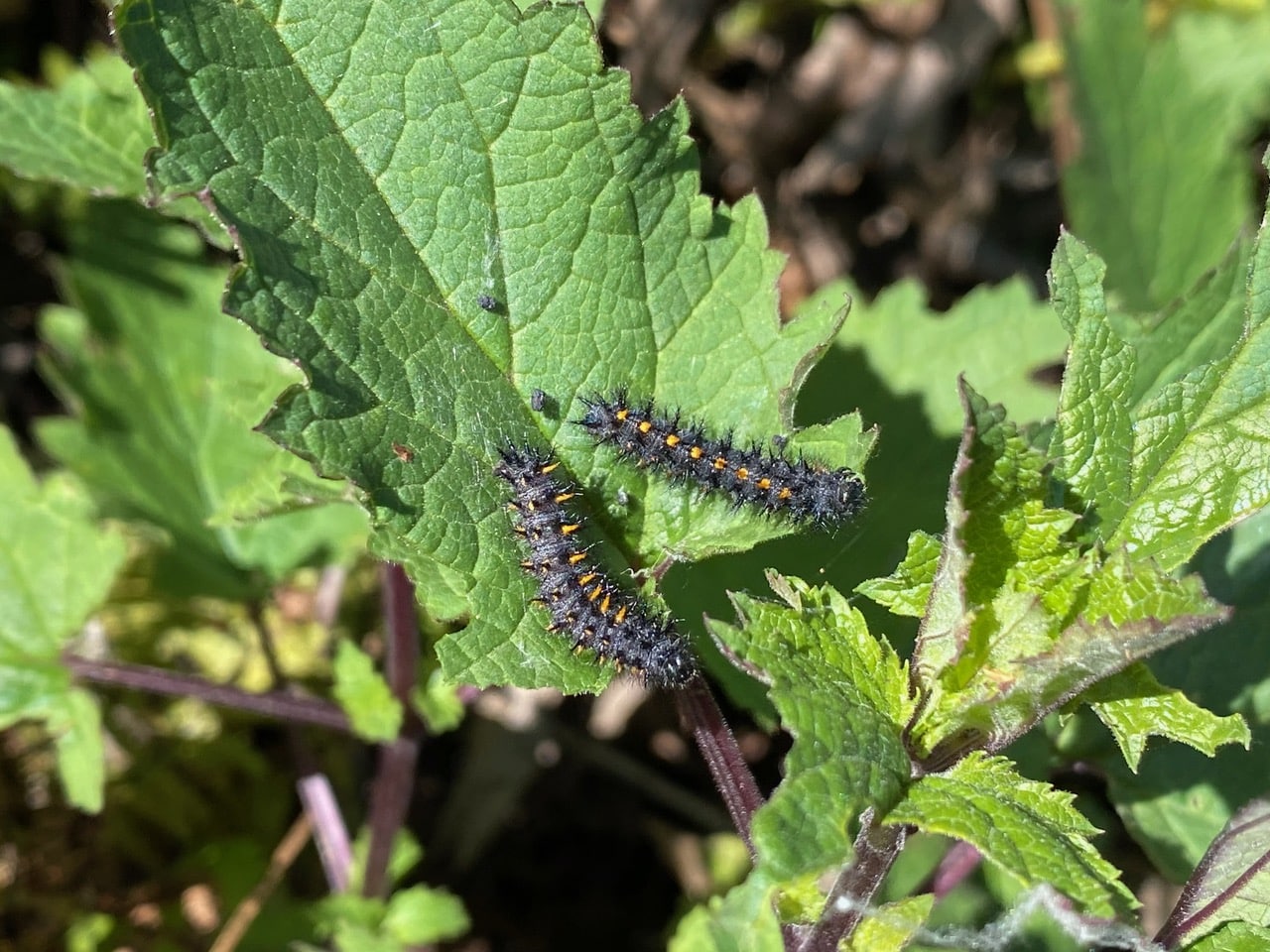
Side by side, two small caterpillars of the Variable Checkerspot butterfly are busy spinning a web of silk on a leaf of California Bee Plant, Scrophularia californica. They have recently emerged from their diapause (insect version of hibernation) to continue their growth and development on their food plant. They still have to undergo a few more molts before pupation.
The Variable Checkerspot, Euphydryas chalcedona (family Nymphalidae) is found across western North America. The butterfly occupies a wide range of habitats, including sagebrush flats, desert hills, prairies, open forests and alpine tundra. Males perch or patrol around larval host plants to encounter females. Eggs are laid in large groups on underside of leaves of host plants. Host plants include California Bee Plant, Scrophularia californica, and Sticky Monkeyflower, Diplacus aurantiacus. These plants provide the caterpillars with iridoid glycoside, a chemical that imparts unpalatable taste to birds, protecting the caterpillars from predators. Larvae feed in large, loose groups on the host plants. Individuals overwinter (enter diapause or hibernation) as third or fourth instar larvae in sheltered sites under bark or dead branches, in hollow stems and in rock crevices. Pupation begins in early to mid April and the adult flight season begins between mid-April and May and continues into June. The adults feed exclusively on nectar, and have a life span of about 15 days.
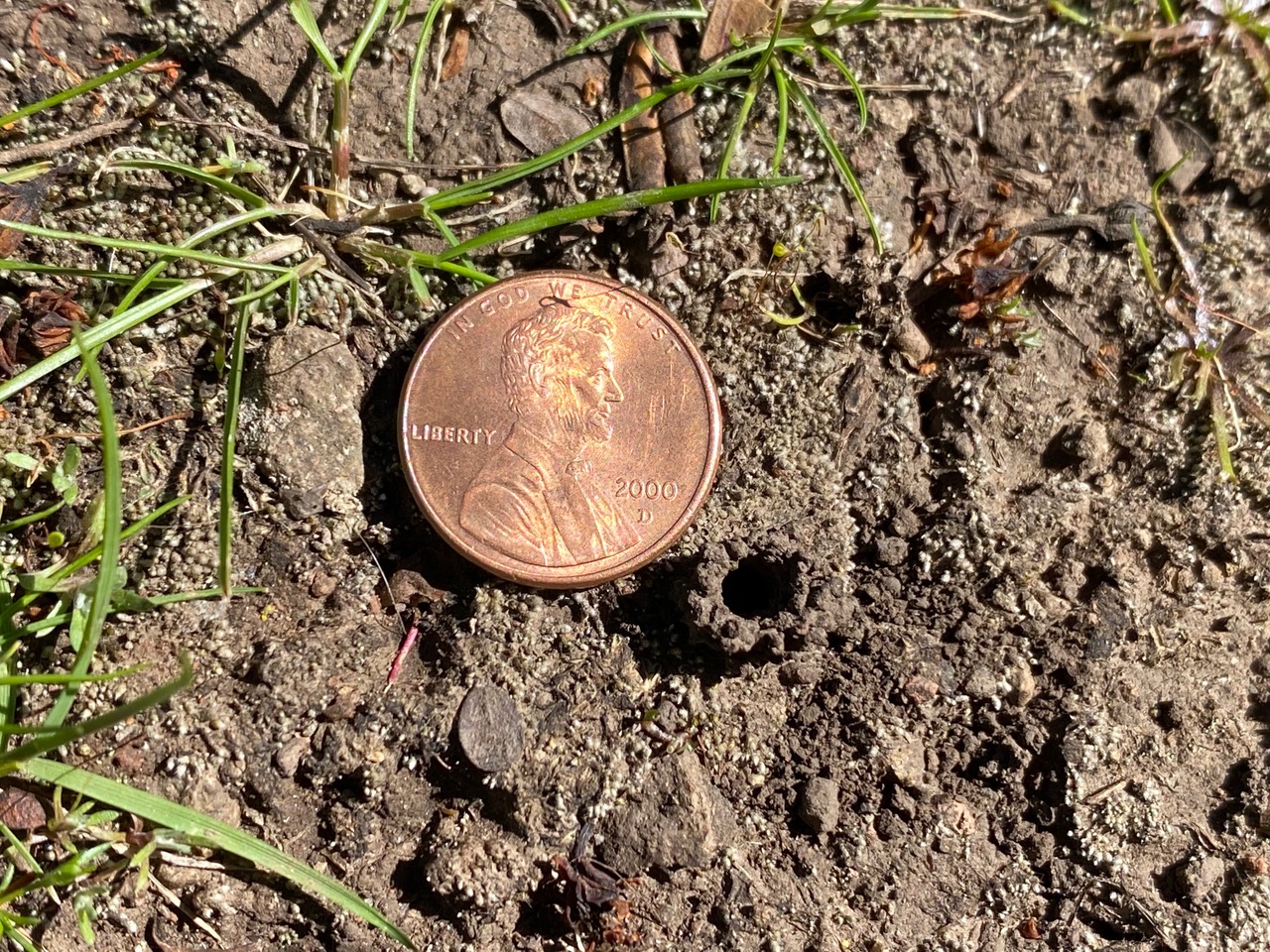
In the bare soil at the edge of the trail I notice a small hole with raised rims. Might it be the entrance to the nest of a small ground-nesting bee? About 70% of our native solitary bees nest in the ground.
 Not far from the spot I find similar holes in the ground with raised mud rims. This one is somewhat taller, akin to the turrets made by the California Turret Spider; however, unlike the spider’s turrets, this is completely unadorned with plant debris, and there’s no sign of silk being used in the construction.
Here’s another hole by a green leaf, about the same diameter as the others. I mark the spots so I can check for insect activity in the future.
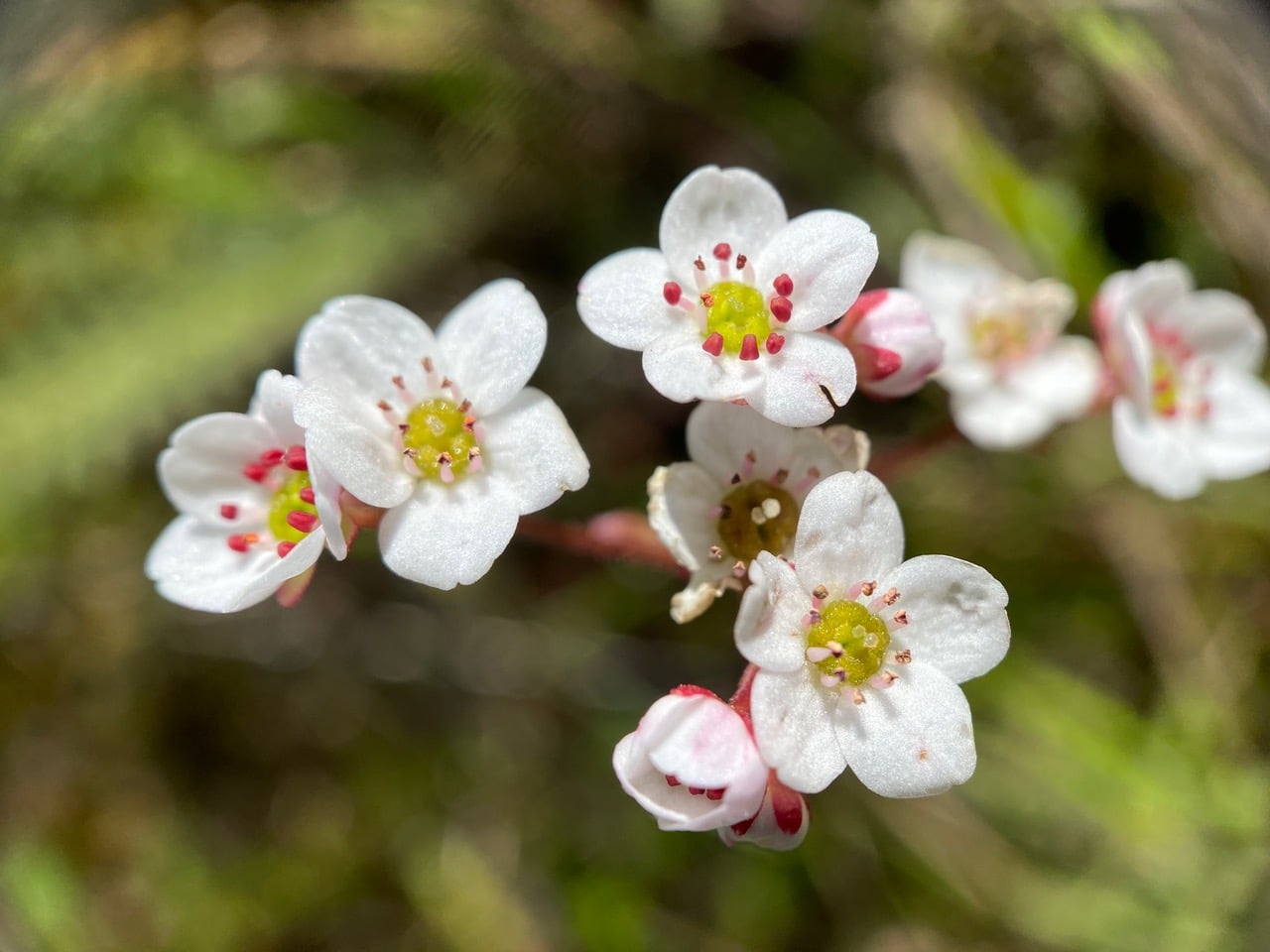
On the shady, moist banks along Skyline Trail, the California Saxifrage is blooming profusely on long stalks. The diminutive white flowers bear Christmas-colored reproductive parts – bright red anthers and green ovaries – quite a delightful sight if one cares to look closely. In past years, I have observed Hybotid Dance Flies and various midges visit these flowers, but none is around today. I wonder how long these delicate flowers would last given these drying winds and warm spells.
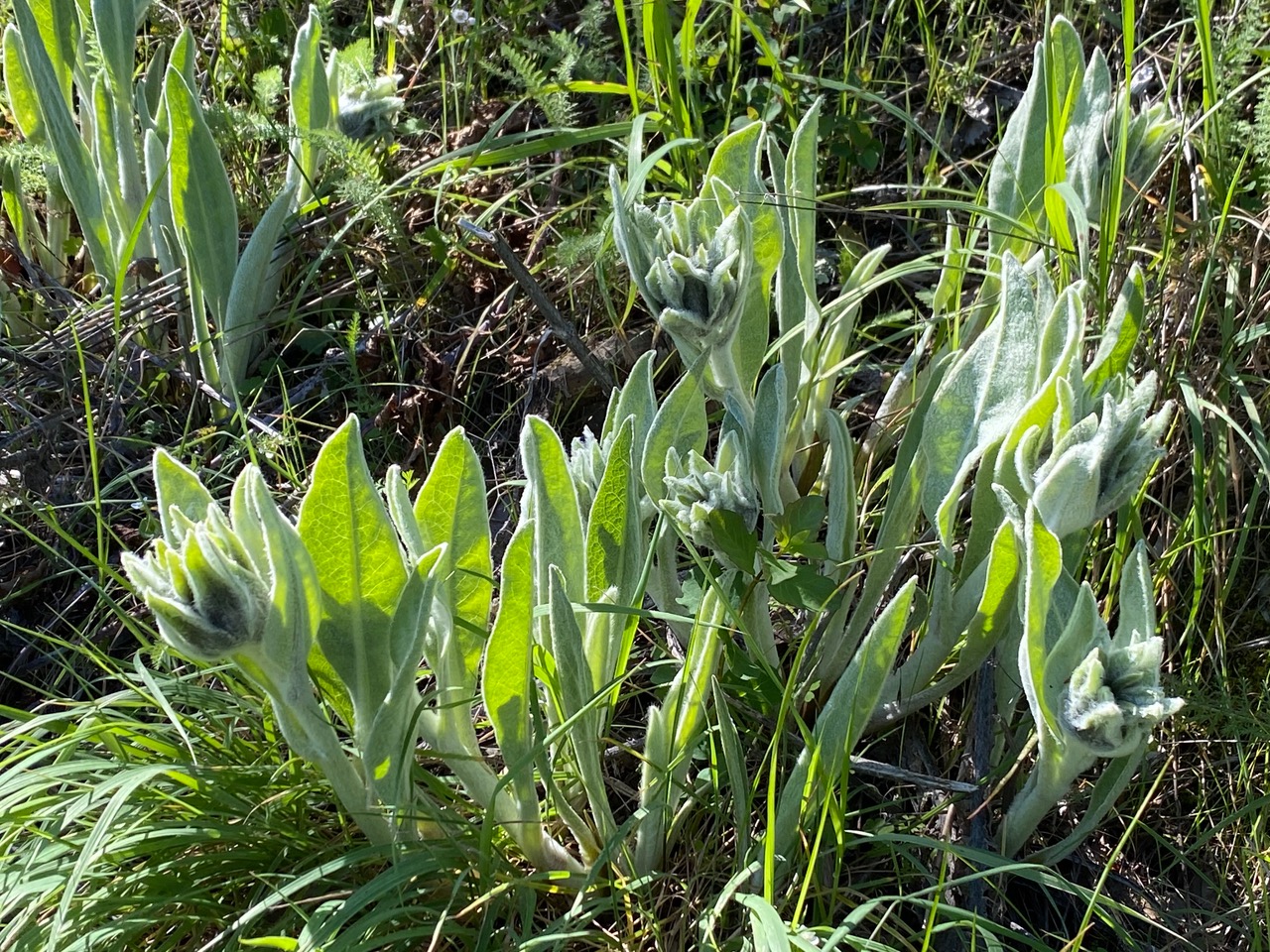
More young leaves and flower buds of the Woolly Mule’s Ears, Wyethia helenioides have emerged from the grassy slopes along Skyline Trail.
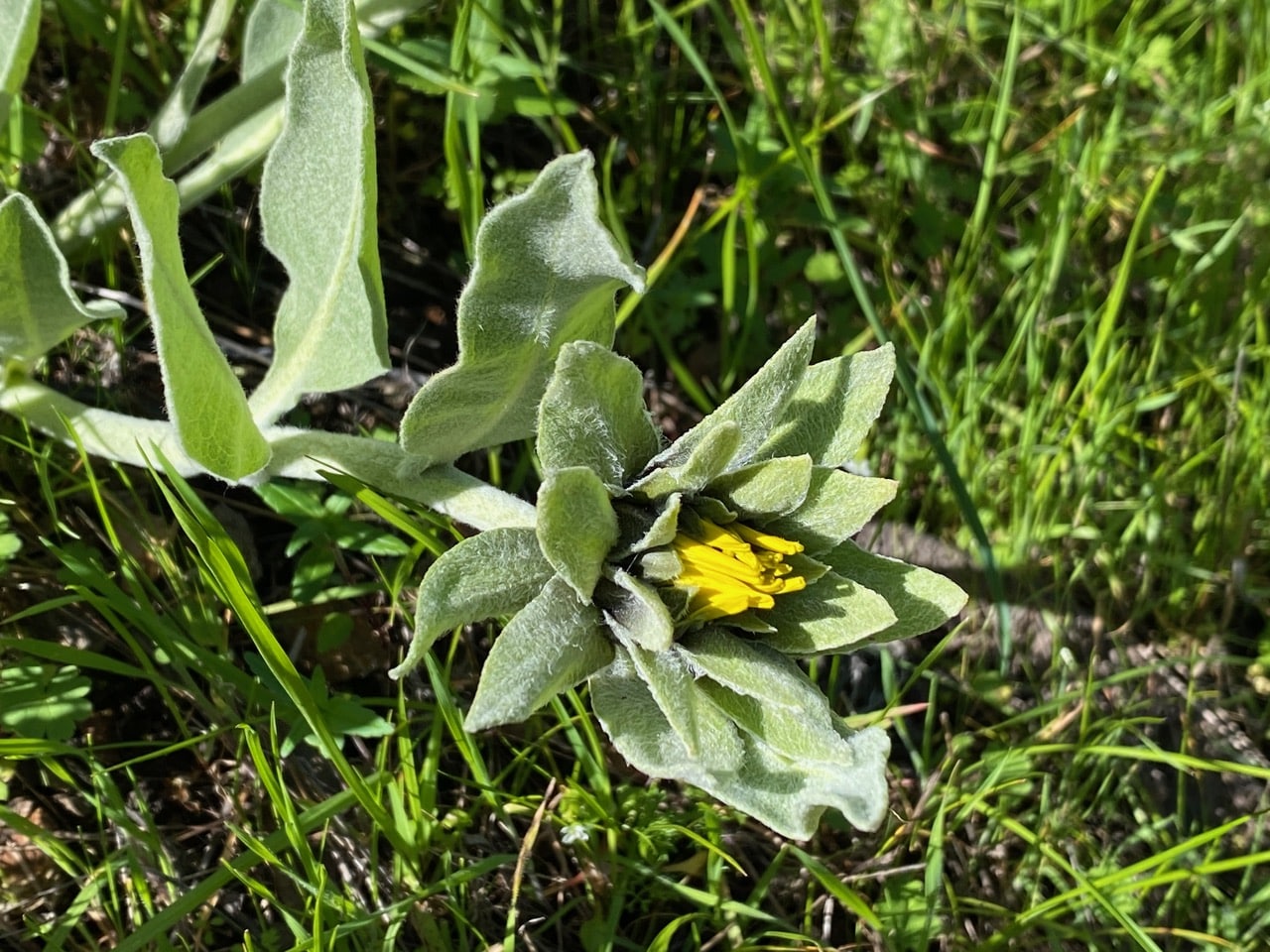
This bud is a preview of the big sunny flower that will soon greet the world. So much color and cheer to look forward to in spring!