

Pollinator Post 3/13/26 (3)
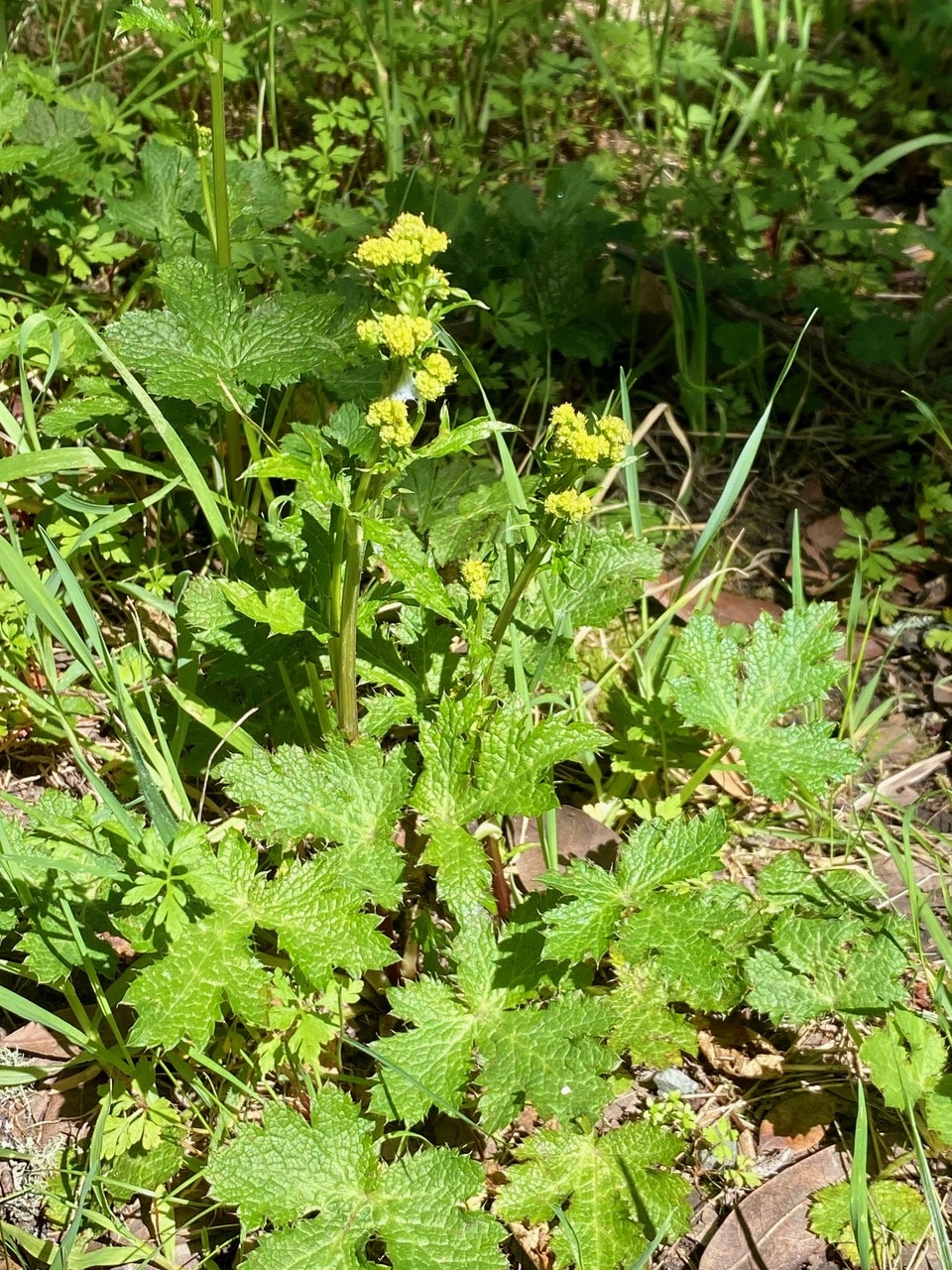
Pacific Sanicle, Sanicula crassicaulis is blooming in profusion along the northern section of Skyline Trail. The perennial herb is best identified by its large leaves that are divided into a few deep lobes and edged with small teeth. The inflorescence is made up of one or more heads of bisexual and male-only flowers with tiny, curving, yellow petals.
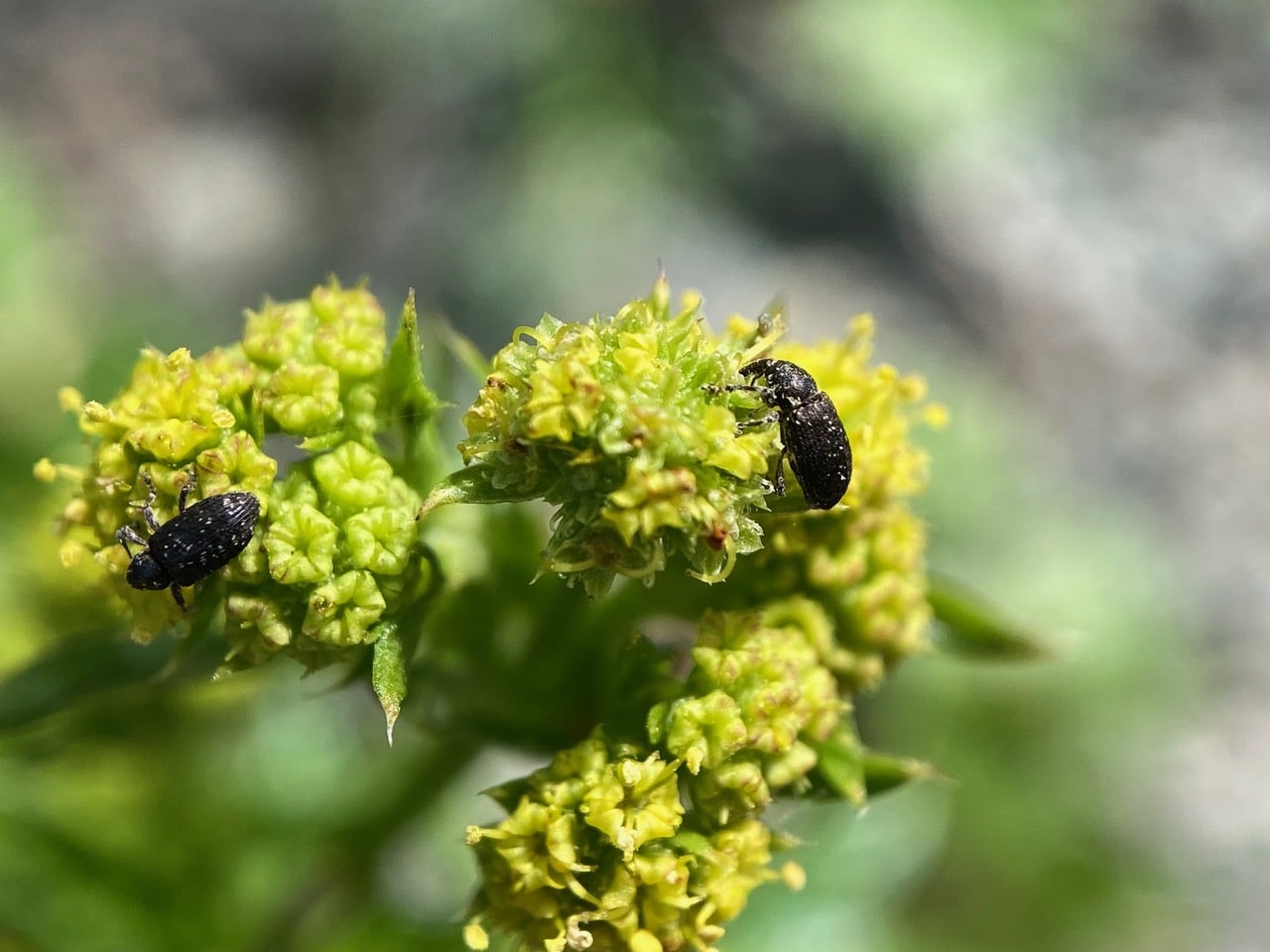
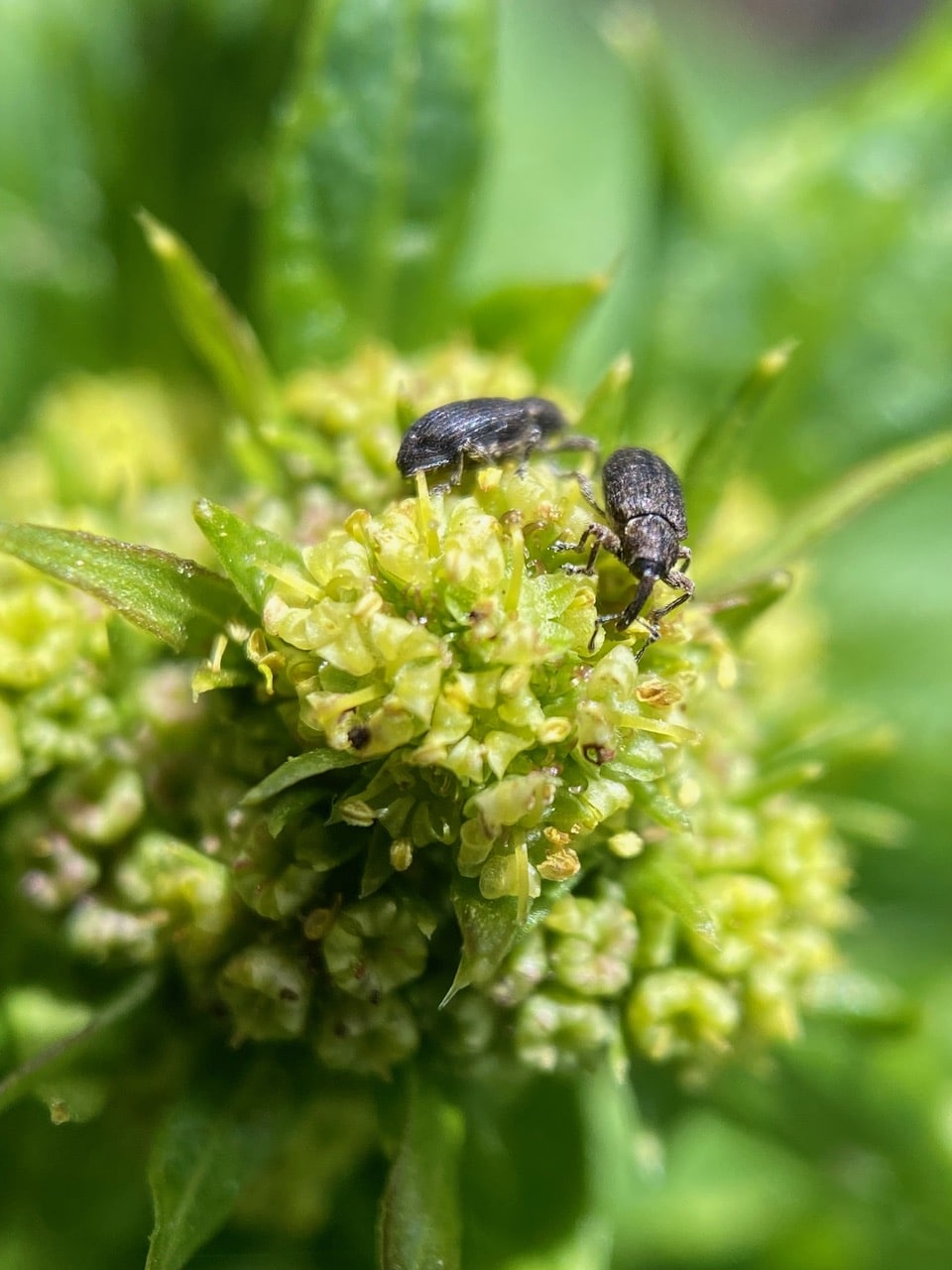




Two black weevils, only 3-4 mm long, are foraging among the inflorescences of Pacific Sanicle, their bodies speckled with pollen. I have seen these weevils every year on the Pacific Sanicle when the plant is in bloom, and have wondered if the beetle was specific to the plant. So far iNaturalist has not been able to identify them beyond the family level.
Weevils, family Curculionidae, are also called snout beetles. Curculionidae is one of the largest beetle families (about 40,000 species). Most weevils have long, distinctly elbowed antennae that may fold into special grooves on the snout. The snout is used not only for penetration and feeding but also for boring holes in which to lay eggs. The mouthparts are quite small and located at the end of the rostrum (snout), designed for chewing. Many weevils have no wings, while others are excellent fliers. Most are less than 6 mm in length. The majority of weevils feed exclusively on plants. The fleshy, legless larvae of most species feed only on a certain part of a plant – i.e., the flower head, seeds, fleshy fruits, stems, or roots. Many larvae feed either on a single plant species or on closely related ones. Adult weevils tend to be less specialized in their feeding habits. The family includes some very destructive agricultural pests.
Here’s a front view of the weevil showing its characteristic long snout, and elbowed antennae that can be folded into special grooves on the snout.
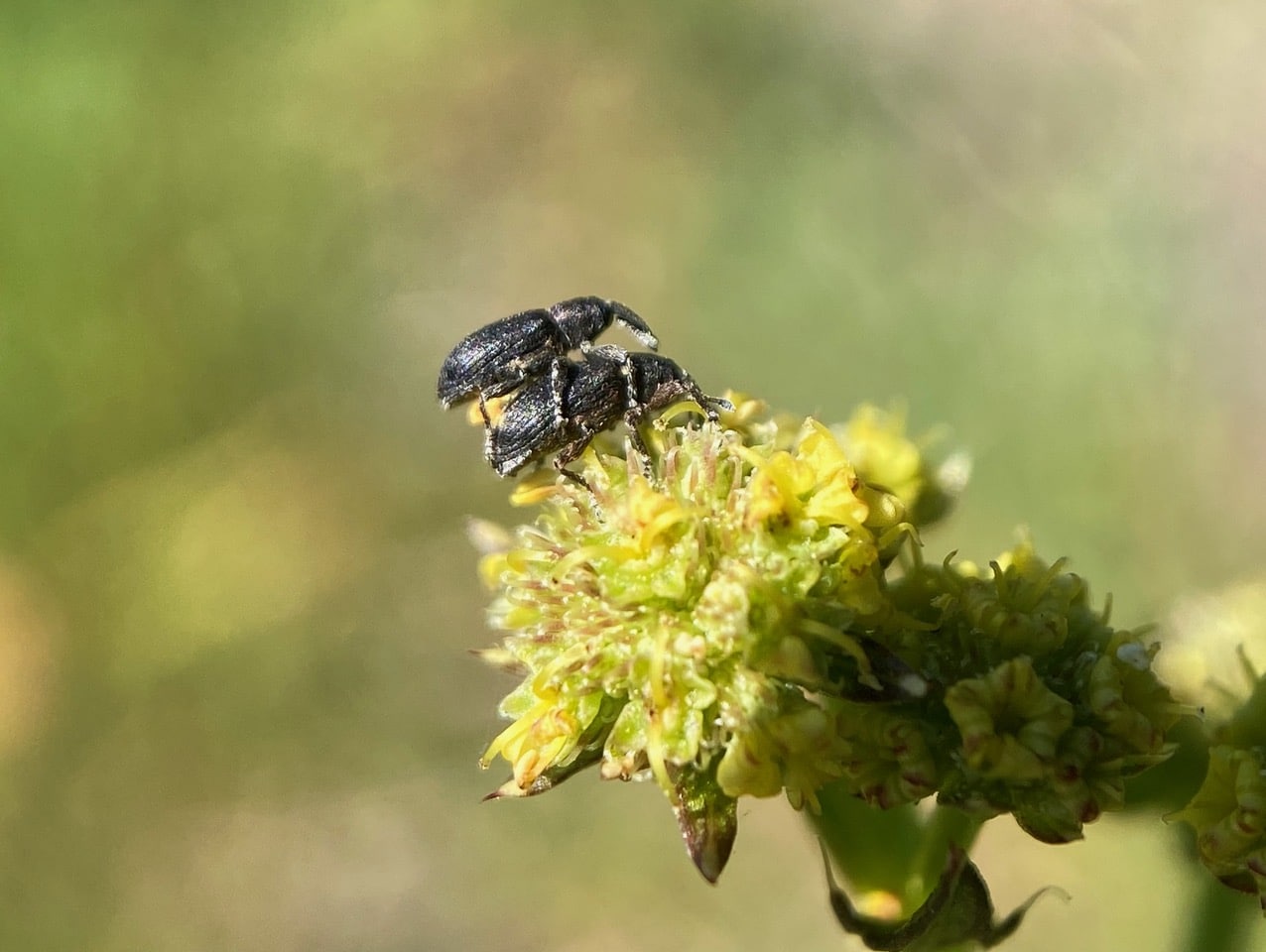
A magnificent pair of the weevils is traveling in tandem on a senescing inflorescence of Pacifc Sanicle. Does the female lay her eggs in the developing fruits after mating? I have never seen these weevils fly. When disturbed, they simply drop to the ground. Some species of weevils have evolved fused elytra (wing covers) and lack functional flight wings, rendering them completely flightless.
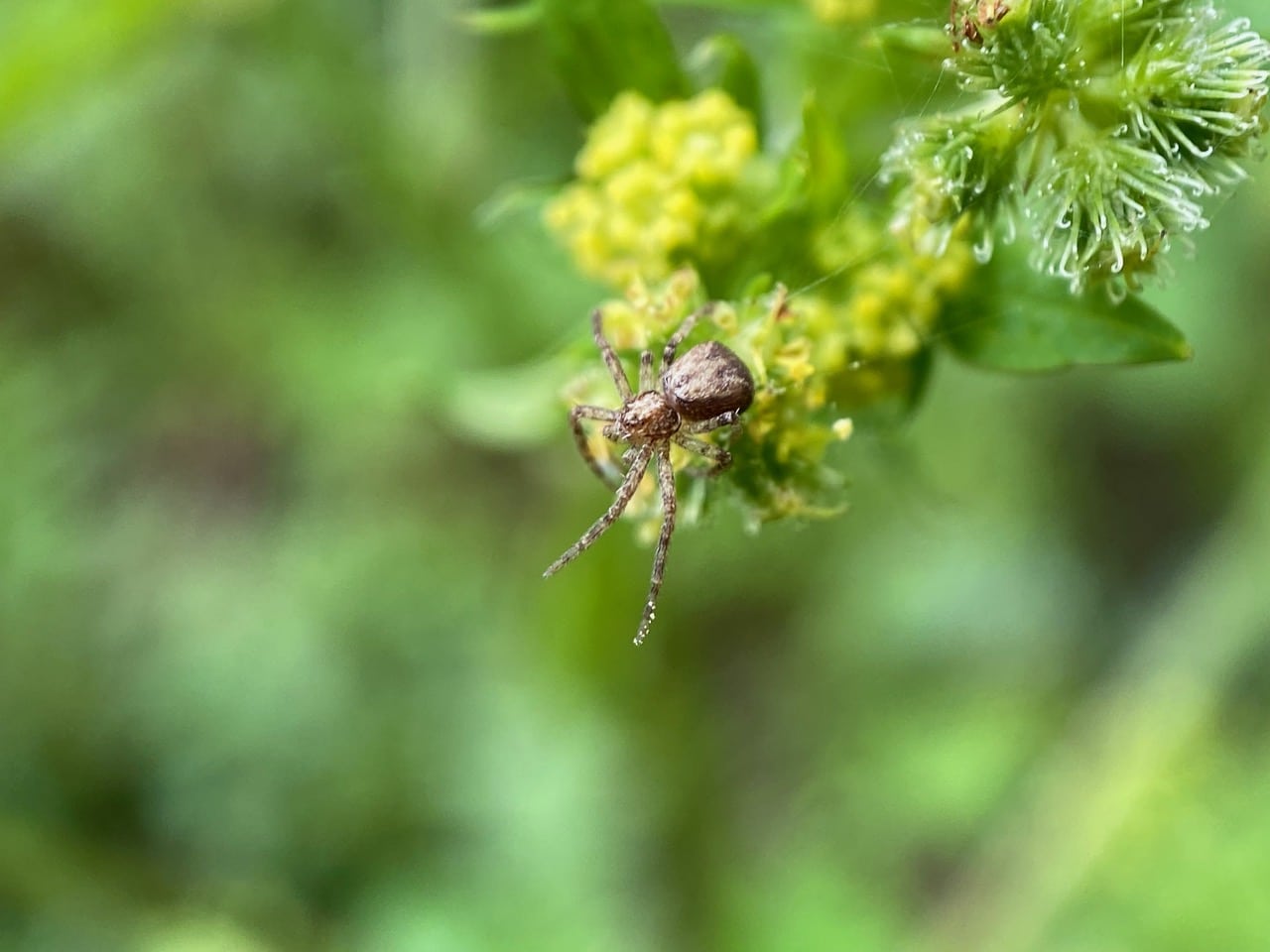
A small brown spider is waving its front legs on top of a Pacific Sanicle inflorescence. iNaturalist has helped identify it as a Eurasian Running Crab Spider, Philodromus dispar (family Philodromidae).
The Eurasian Crab Spider, Philodromus dispar is one of many species in the Philodromidae family, often referred to as running crab spiders. The species is native to Europe, North Africa, and parts of Asia. They are typically found in trees and bushes and are known to be agile hunters that run down prey rather than using webs. These spiders exhibit a high degree of sexual dimorphism (males and females look different), which is why the species is named dispar. The male is a shiny, iridescent black or dark brown, while the female is a lighter, variable, and pale brown color. They are active between April and October, often seen running on low-growing vegetation and in gardens.
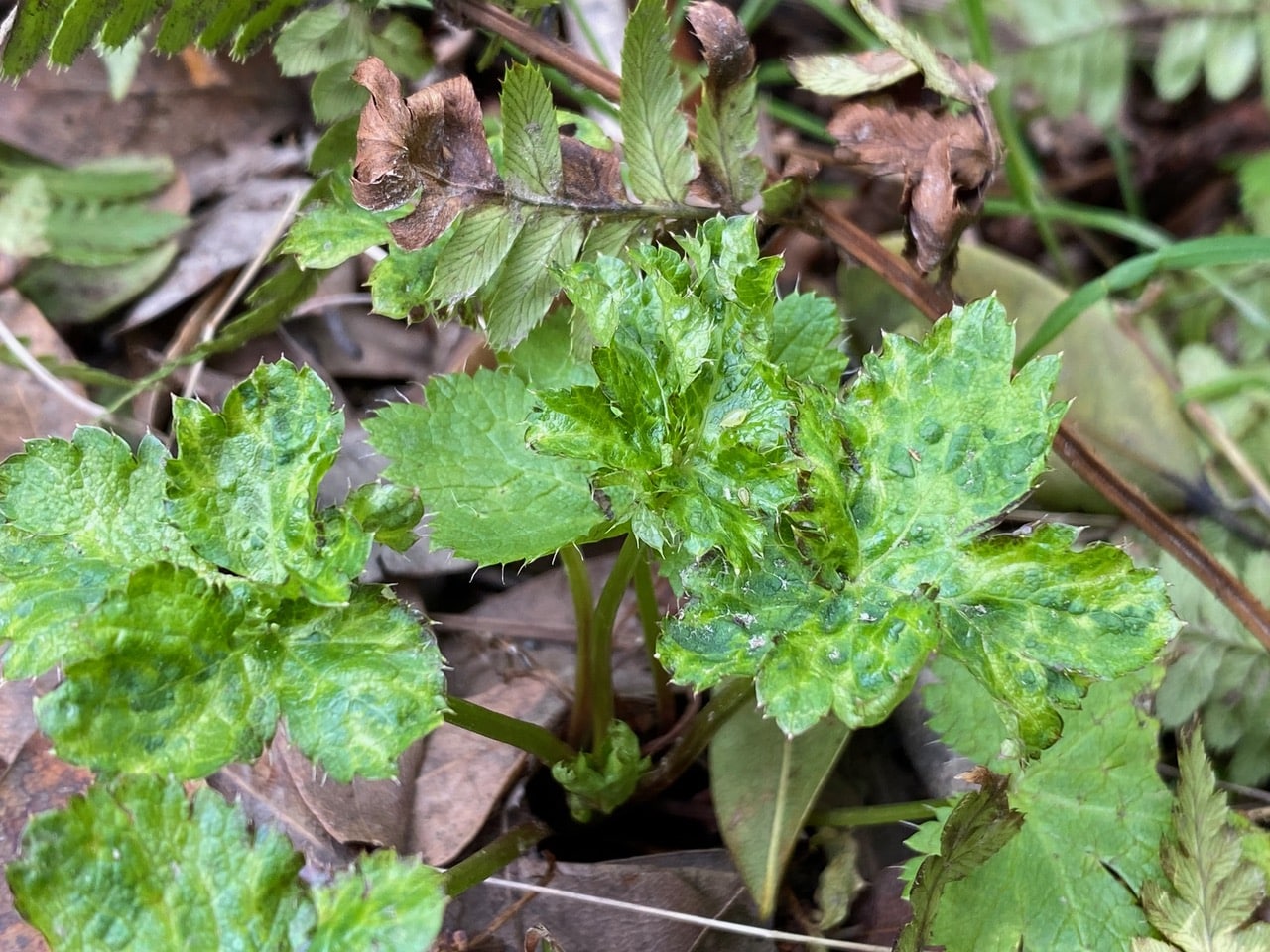
That Pacific Sanicle looks sick. The plant is stunted, barely inches off the ground, its leaves somewhat yellowed, crinkled and deformed.
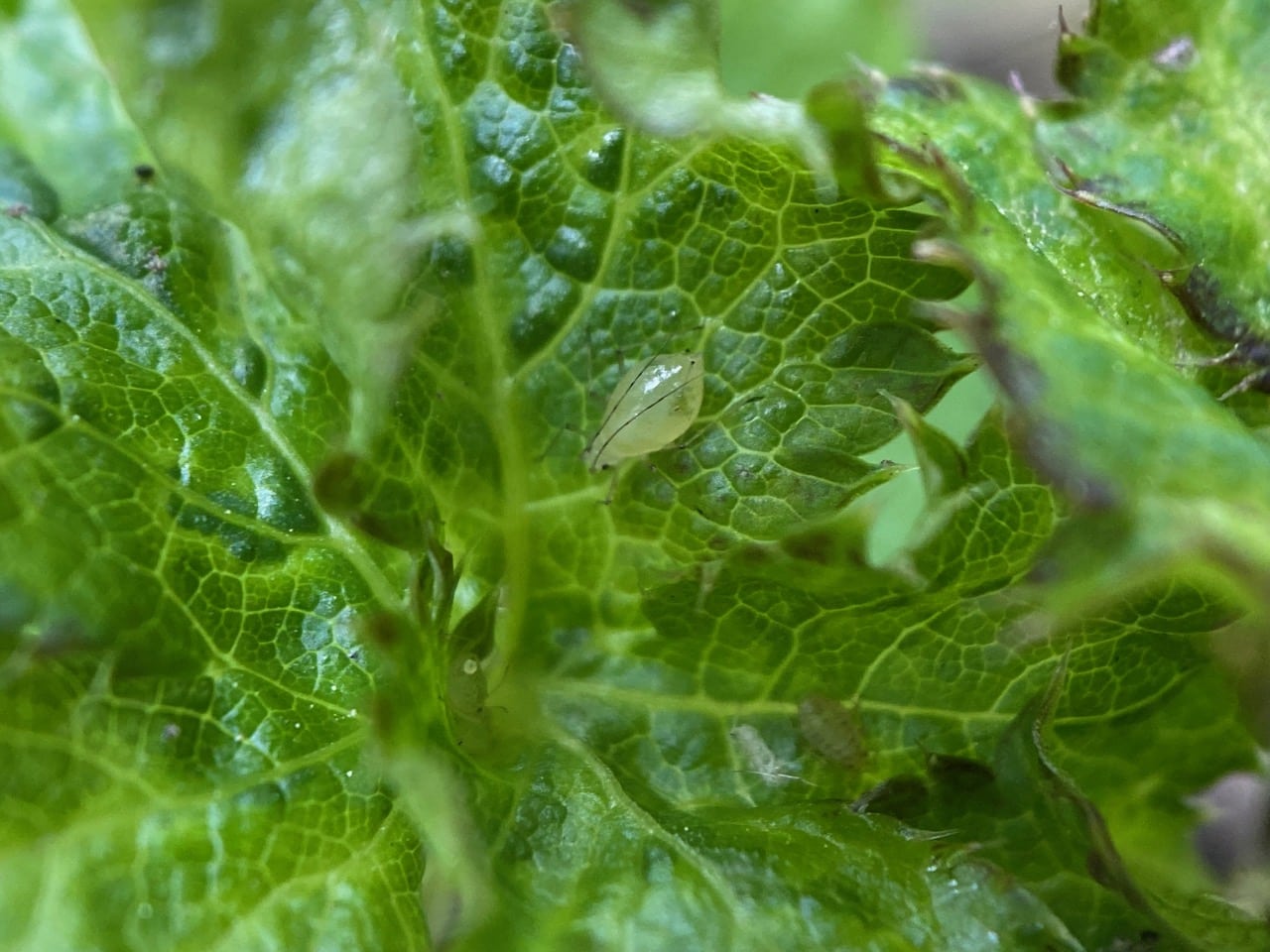
I take a closer look. Ah, aphids!
Aphids (family Aphididae) are small sap-sucking insects in the order Hemiptera. Aphids usually feed passively on phloem of plants. Once the phloem vessel is punctured, the sap, which is under pressure, is forced into the aphid’s food canal. Aphids produce large amounts of a sugary liquid waste called “honeydew”. A fungus called sooty mold can grow on honeydew deposits that accumulate on leaves and branches, turning them black.
A typical life cycle involves flightless females giving live birth to female nymphs, – who may also be already pregnant, an adaptation called telescoping generations – without the involvement of males. Maturing rapidly, females breed profusely so that the population multiplies quickly. Winged females may develop later in the season, allowing the insects to colonize new plants. In temperate regions, a phase of sexual reproduction occurs in the autumn, with the insects often overwintering as eggs. The life cycle of some species involves an alternation between two species of host plants. Some species feed on only one type of plant, while others are generalists, colonizing many plant groups. Some ants have a mutualistic relationship with aphids, tending them for their honeydew and protecting them from predators.
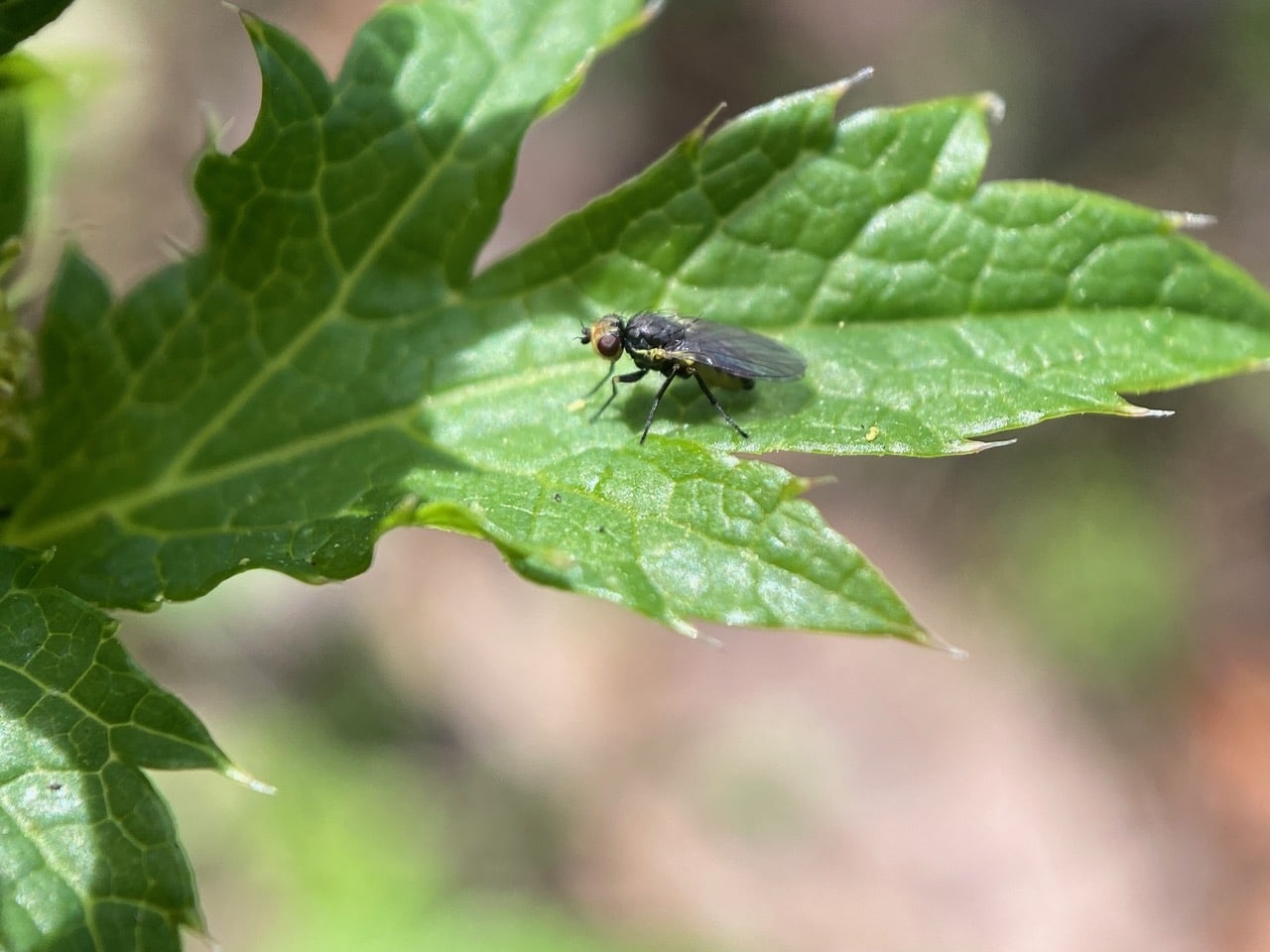
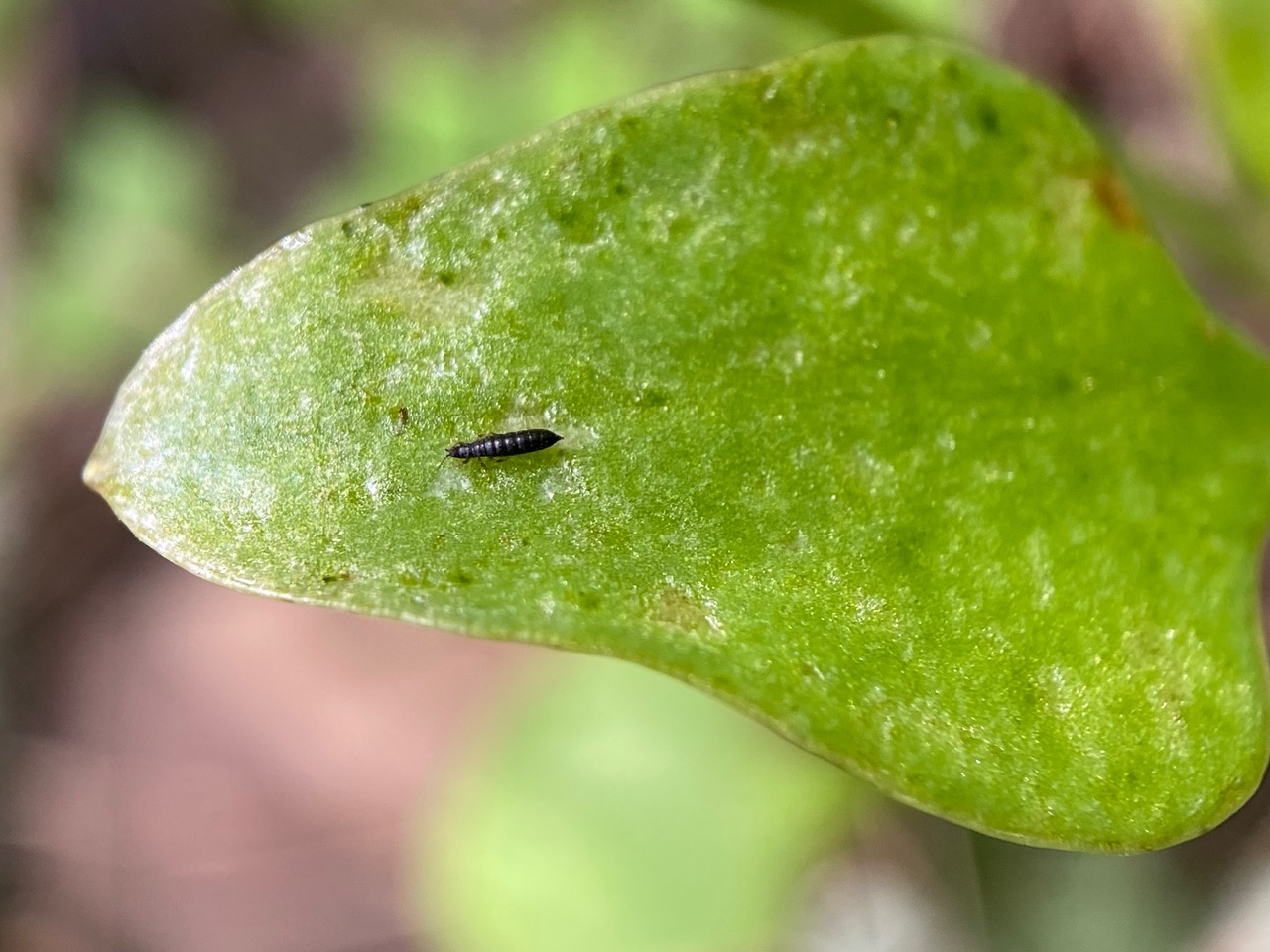
A tiny fly is perched on a leaf of Winter Cress. iNaturalist has helped identify it as a Leaf-miner Fly (family Agromyzidae).
The Agromyzidae are a family commonly referred to as the Leaf-miner Flies, for the feeding habits of their larvae, most of which are leaf miners on various plants. They are small flies, most species in the range of 2-3 mm. Agromyzidae larvae are phytophagous, feeding as leaf miners, less frequently as stem miners or stem borers. A few live on developing seeds, or produce galls. There is a high degree of host specificity. A number of species attack plants of agricultural or ornamental value, so are considered pests. The shape of the mine is often characteristic of the species and therefore useful for identification. Adults occur in a variety of habitats, depending on the larval host plants.
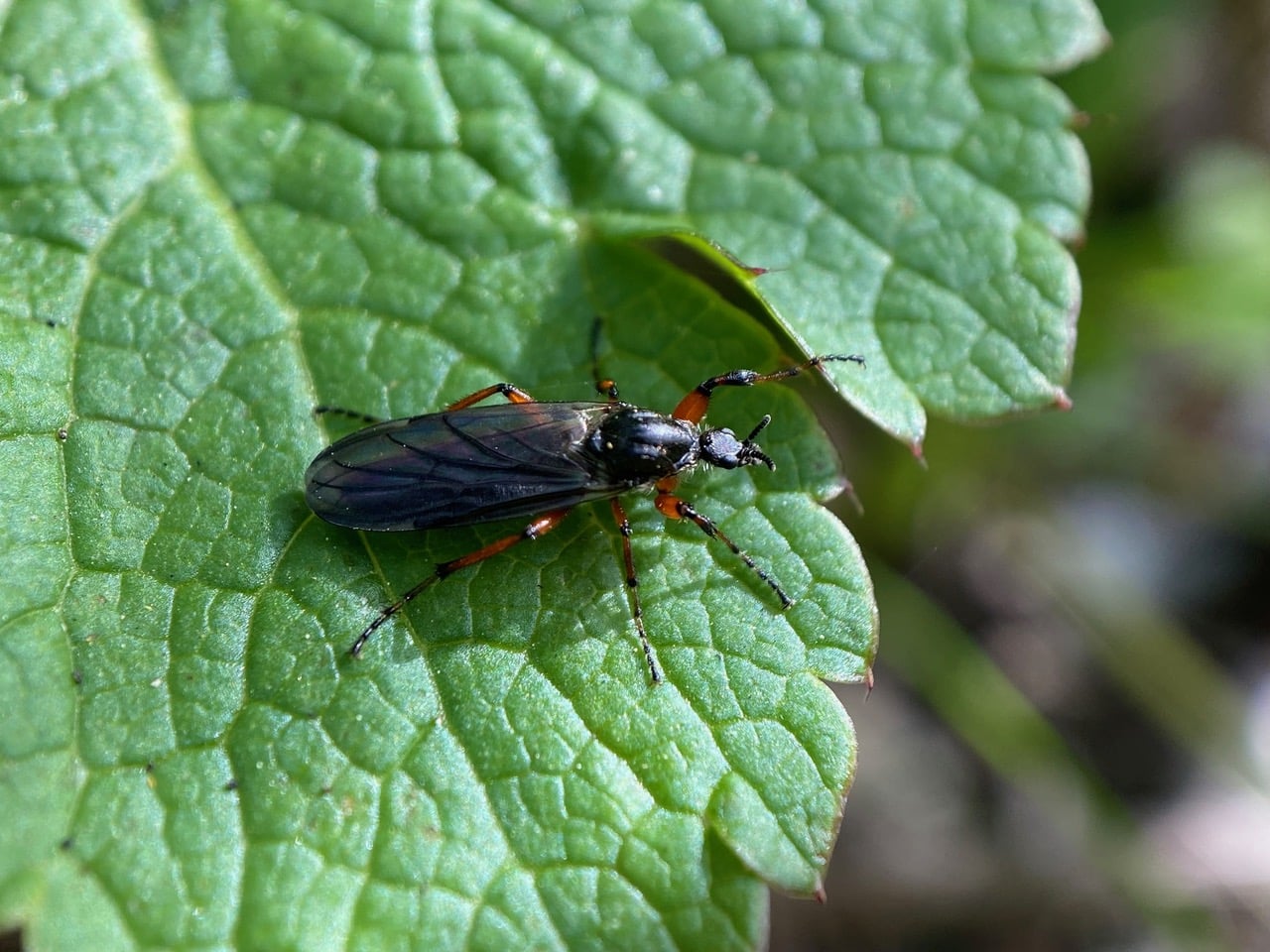
A large female March Fly, Bibio palliatus (family Bibionidae) is sprawled on a leaf, apparently enjoying the morning sun.
March Flies (family Bibionidae) generally live in wooded areas and are often found on flowers – adults of some species feed on nectar, pollen, and honeydew, while adults of other species don’t feed at all; and in either case, they are very short-lived. They are considered important pollinators in orchards. They are also important food for other insects and spiders. The larvae feed en masse on rotting organic material like leaves, wood, compost, and rich soil.
March flies exhibit extreme sexual dimorphism – the sexes are morphologically distinct. The female is usually more colorful, has small eyes on the sides of long, narrow head, while the all-black males have huge eyes that touch in the middle and are split in half horizontally. Scientists speculate that the split makes it easier for them to see the other males that are above and below them in a mating swarm. Males gather in swarms that can blanket the ground and low vegetation. Female are attracted to the party and select mates in the frenzy of fly bodies.
The Star-flowered Lily-of-the-Valley, Maianthemum stellatum is blooming in partial shade by the trail. Sometimes called the False Solomon Seal, the dainty perennial has a single, unbranched, arching stem, bearing a small, terminal cluster of white, star-shaped flowers.
Holding on delicately to a stamen of a flower of Star-flowered Lily-of-the-Valley, a small chestnut-brown beetle is feeding on pollen from the anther.
iNaturalist has helped identify the beetle as a member of Sap-feedig Beetles, Epuraea sp. (family Nitidulidae). The beetle is startled as a small fly lands on the flower.
Epuraea beetles are considered one of the “pollen beetles”, an informal term for any species of beetle associated intimately with suitably pollen-rich species of flowers. These include members of the families Melyridae, Nitidulidae and Oedemeridae.
Epuraea is a genus of sap-feeding beetles in the family Nitidulidae. Their primary food source is sap but many also feed on organic matter such as fruits, flowers, fungi, decaying plant tissue, and the tissue of dead animals. Many Epuraea beetles feed on nectar, pollen, and flower parts, acting as important pollinators as they move between flowers. These beetles commonly overwinter underneath logs or in soil. They are often found in early spring. Epuraea beetles are typically very small, flat, and possess clubbed antennae. While some species can be crop pests, many serve as overlooked pollinators that play a key role in ecological communities, especially in forests and meadows.
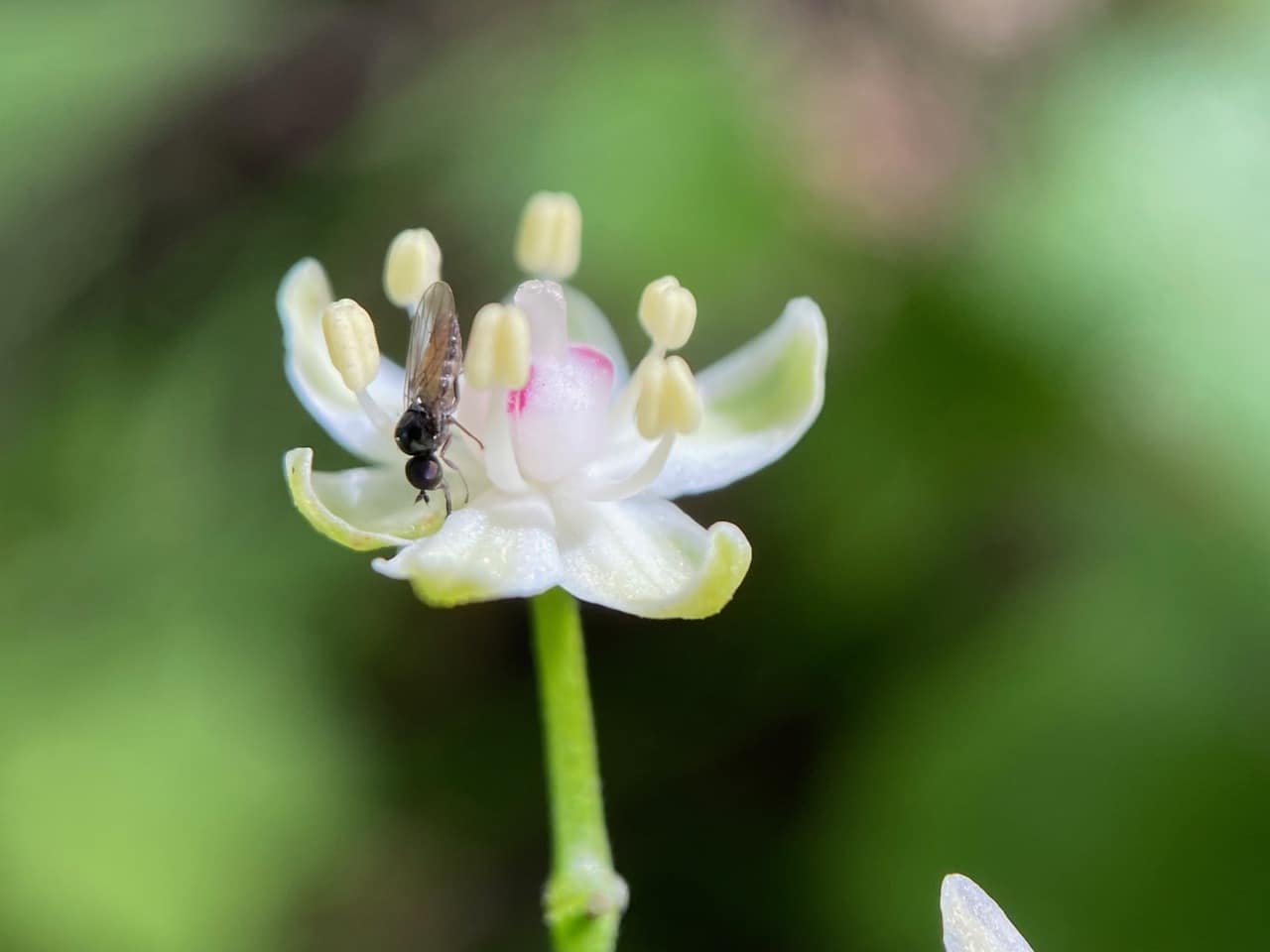
After the beetle leaves, the Hybotid Dance Fly (family Hybotidae) reaches down to take nectar at the base of the flower.
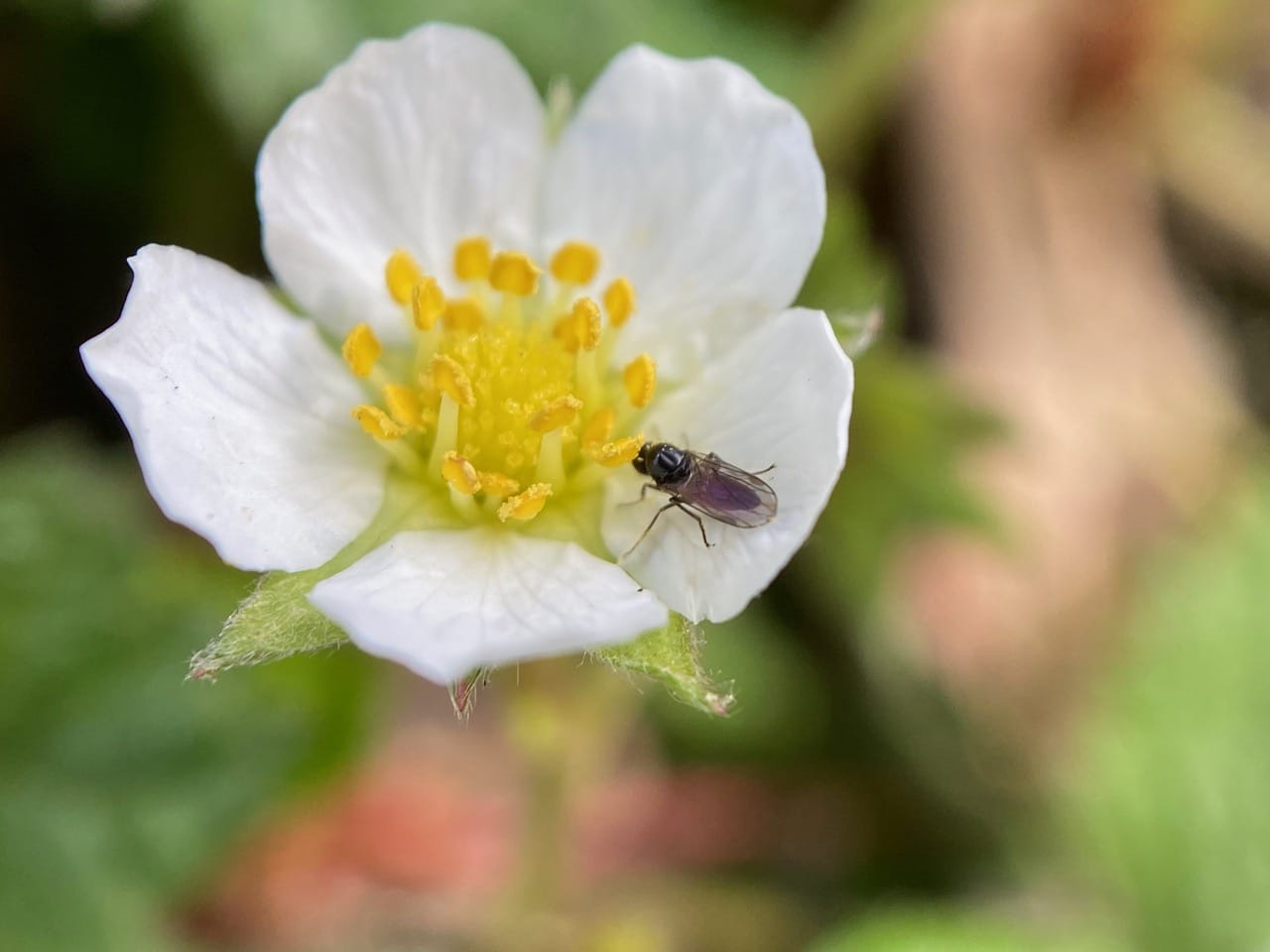
The small fly, under 3 mm long, is a member of the Typical Dance Flies or Hybotid Dance flies (family Hybotidae). These flies have compound eyes that seem to take up most of their spherical head. They belong to the superfamily Empidoidea and were formerly included in the Empididae as a subfamily. The mostly predatory Empididae generally have a thick beak pointing down, while Hybotidae have a thinner beak, or a thick beak pointing forwards or diagonally. Some crucial wing venation further distinguishes the two families. Precious little is known about the life cycle and biology of Hybotids because they are not considered of economic consequence. Since their forelegs are generally not raptorial, I wonder if they’re predaceous like the Empidids. I have seen the Hybotids visit flowers for nectar and pollen, notably on Soap Plant, Miner’s Lettuce, California Saxifrage, Wild Geranium, Woodland Strawberry, etc. and I believe they may be significant pollinators for these small flowers in the wild.
A classic pose of the Hybotid Dance Fly standing regal over the flower. Note the pollen grains on its thorax.
A Hybotid Dance Fly is foraging on a flower of Woodland Strawberry, Fragaria vesca.
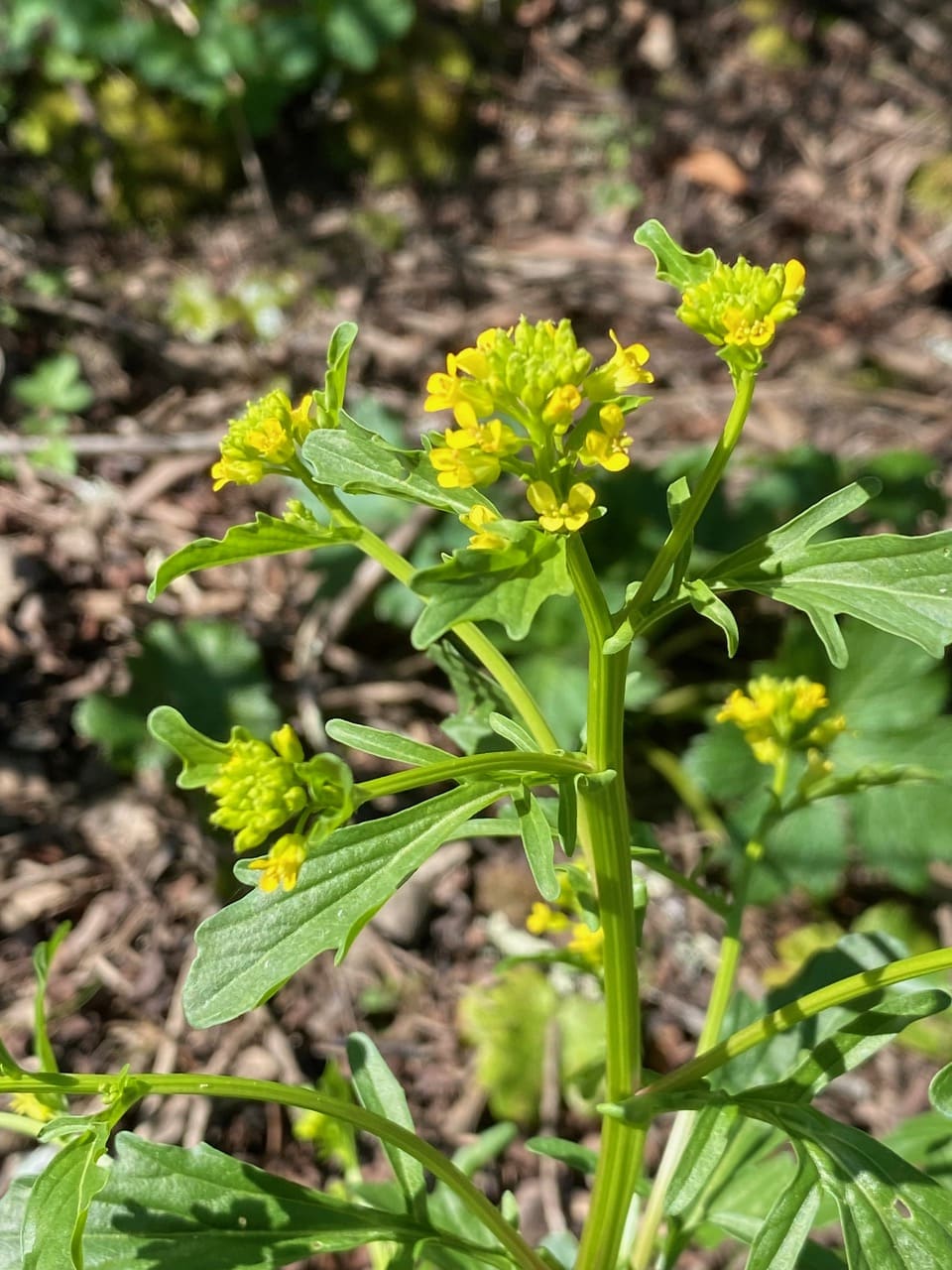
The American Winter Cress, Barbarea orthoceras is blooming along the side of the trail.
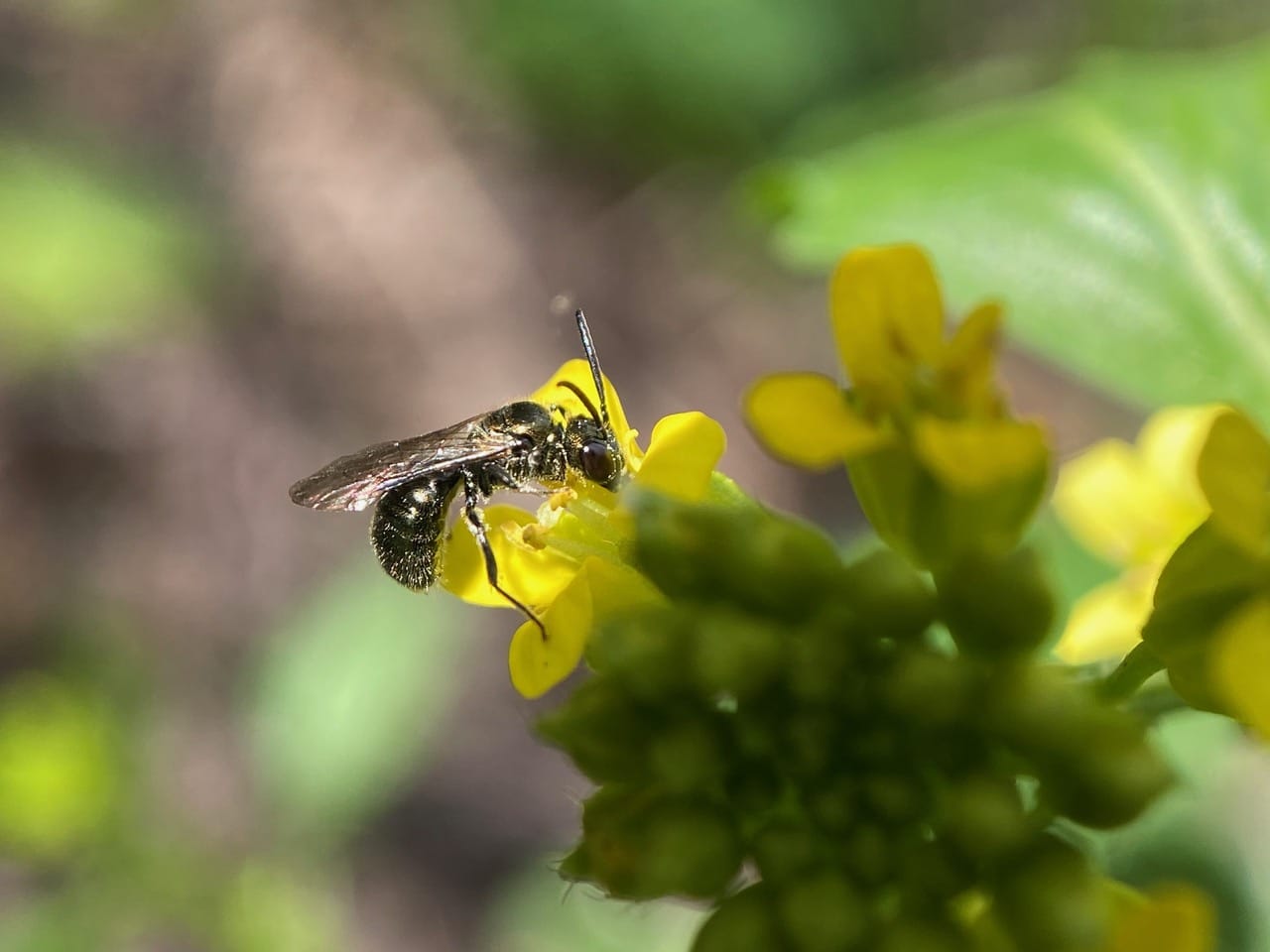
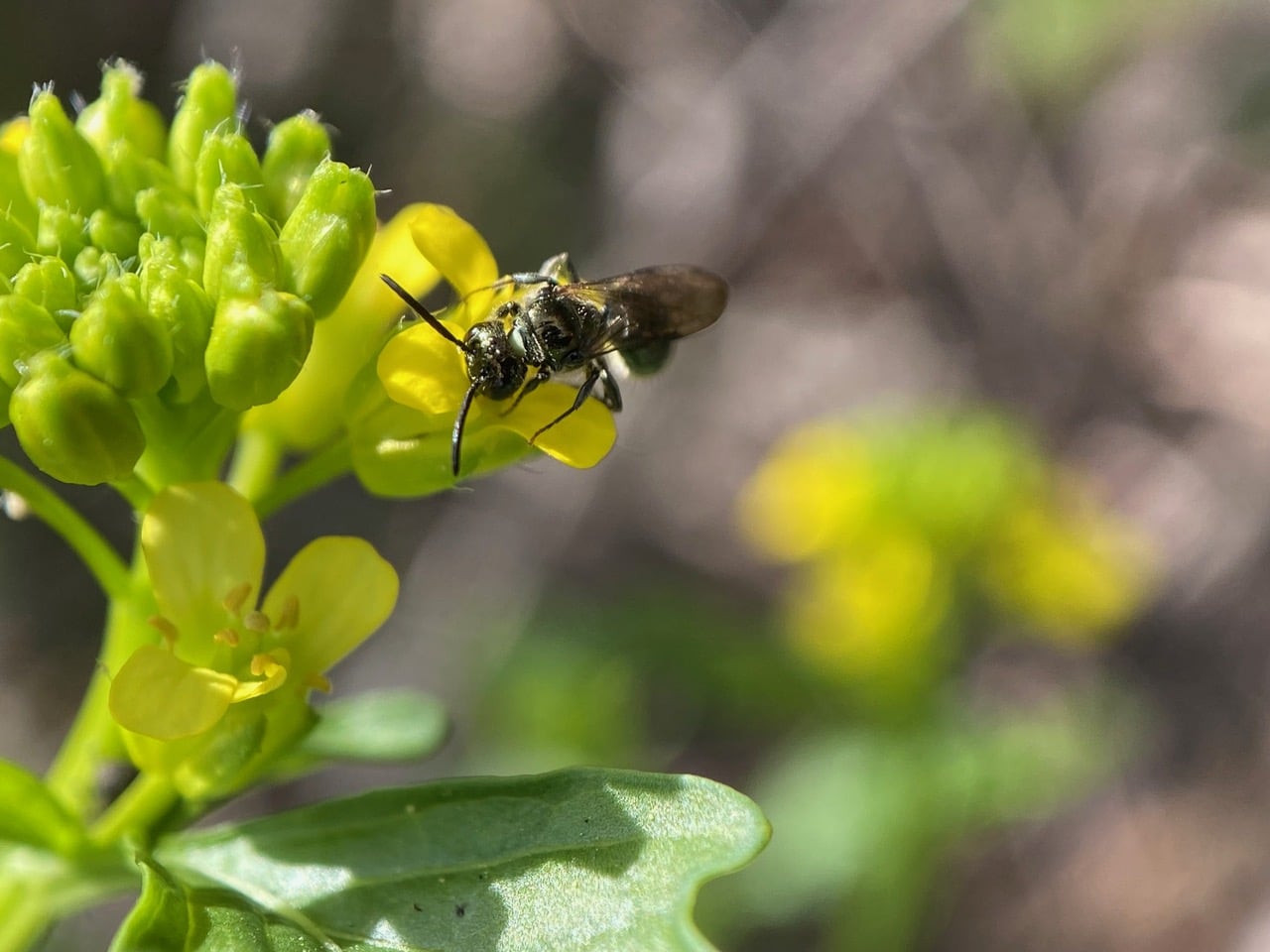
A small, glossy black bee is reaching into an American Winter Cress flower to take nectar. It is a Small Carpenter Bee, Ceratina sp. (family Apidae). From the length of its antennae, and absence of scopa on its hind legs, I figure the bee is a male.
The Small Carpenter Bee genus Ceratina is closely related to the more familiar, and much larger Carpenter Bees (genus Xylocopa). Ceratina are typically dark, shiny, even metallic bees, with fairly sparse body hairs and a weak scopa on the hind leg. The shield-shaped abdomen comes to a point at the tip. Some species have yellow markings, often on the face.
Females excavate nests with their mandibles in the pith of broken or burned plant twigs and stems. While many species are solitary, a number are subsocial. Both male and female carpenter bees overwinter as adults within their old nest tunnels, emerging in the spring to mate. In the spring, this resting place (hibernaculum) is modified into a brood nest by further excavation. The female collects pollen and nectar, places this mixture (called bee bread) inside the cavity, lays an egg on the provision, and then caps off the cell with chewed plant material. Several cells are constructed end to end in each plant stem.

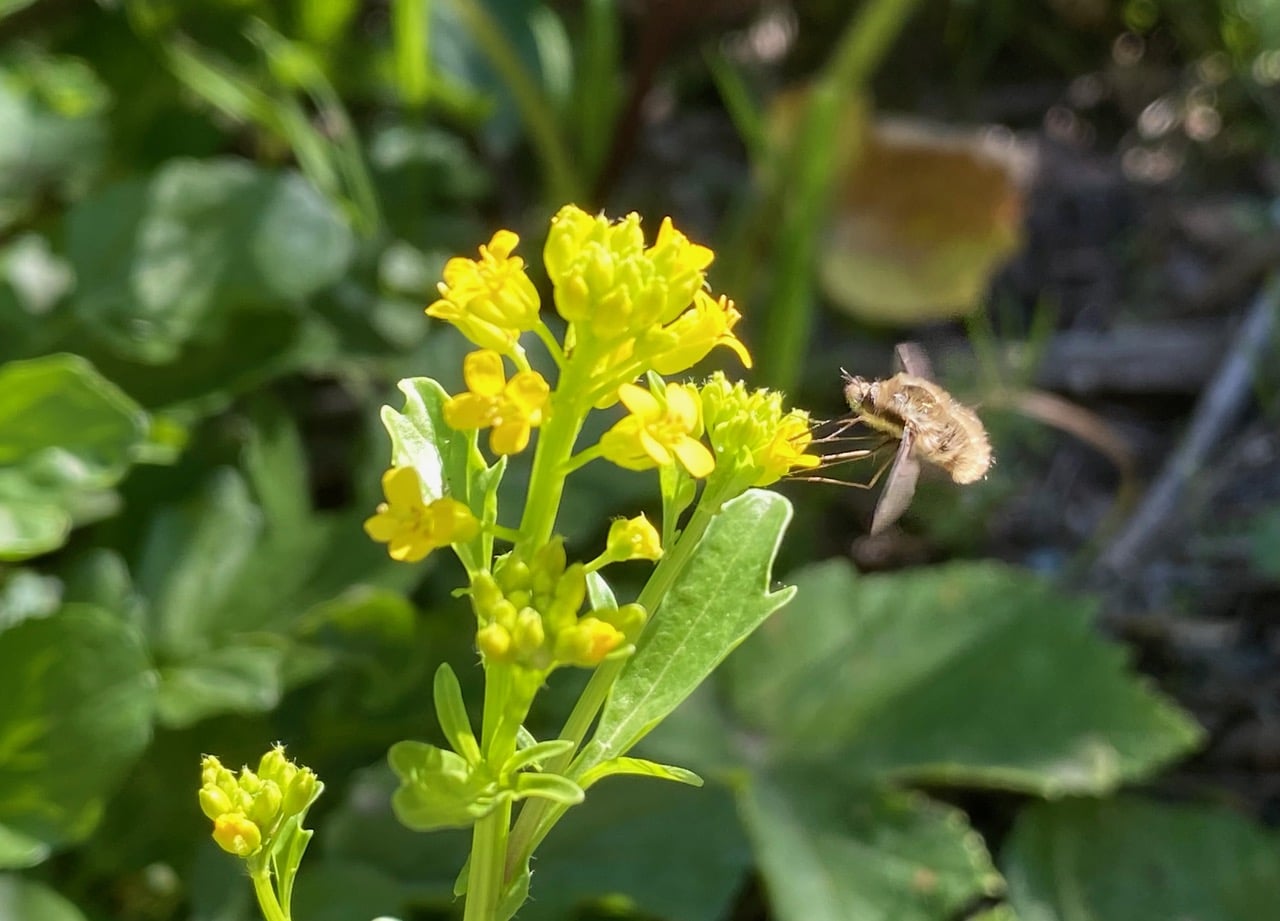
Over there in a bright sunny spot, a fuzzy Greater Bee Fly is hovering around a cluster of American Winter Cress flowers, sticking its long proboscis into individual flowers. I quickly turn on the video to capture the action. Note that the fly steadies itself by lightly placing its long, skinny legs on the flower while hovering with fast wing beats to take nectar.
A Greater Bee Fly is taking nectar from the small flowers of Winter Cress. – YouTube
Bombylius major, commonly known as the Greater Bee Fly is a parasitic bee mimic fly in the family Bombyliidae. It derives its name from its close resemblance to bumble bees. Its flight is quite distinctive – hovering in place to feed, and darting between locations. The species has long skinny legs and a long rigid proboscis held in front of the head. Bombylius major is easily distinguished from the other local species of Bombylius for having wings with dark leading edge, hyaline trailing edge with sharp dividing border. This feature is visible even as the fly is hovering. Adults visit flowers for nectar (and sometimes pollen) from a wide variety of plant families, excelling at small tubular flowers, and are considered good generalist pollinators. Often the pollen is transferred between flowers on the fly’s proboscis.
The bee fly larvae, however, have a sinister side. They are parasitoids of ground-nesting bees and wasps, including the brood of digger bees in the family Andrenidae. Egg deposition takes place by the female hovering above the entrance of a host nest, and throwing down her eggs using a flicking movement. The larvae then make their way into the host nest or attach themselves to the bees to be carried into the nest. There the fly larvae feed on the food provisions, as well as the young solitary bees.
Barely visible to the naked eye, a Thrips is moving on a leaf of Miner’s Lettuce.
Thrips (order Thysanoptera) are minute (mostly 1 mm long or less), slender insects with fringed wings and unique asymmetrical mouthparts. They feed mostly on plants by puncturing and sucking up the contents, although a few are predators. Some flower-feeding thrips pollinate the flowers they are feeding on, and some scientists believe that they may have been among the first insects to evolve a pollinating relationship with their host plants. A genus is notable for being the specialist pollinator of cycads. Thrips are likewise the primary pollinators of heathers in the family Ericaceae, and play a significant role in the pollination of pointleaf manzanita. Electron microscopy has shown thrips carrying pollen grains adhering to their backs, and their fringed wings are perfectly capable of allowing them to fly from plant to plant.
BTW, there’s no such thing as a “thrip”. It’s always “thrips”, singular or plural!
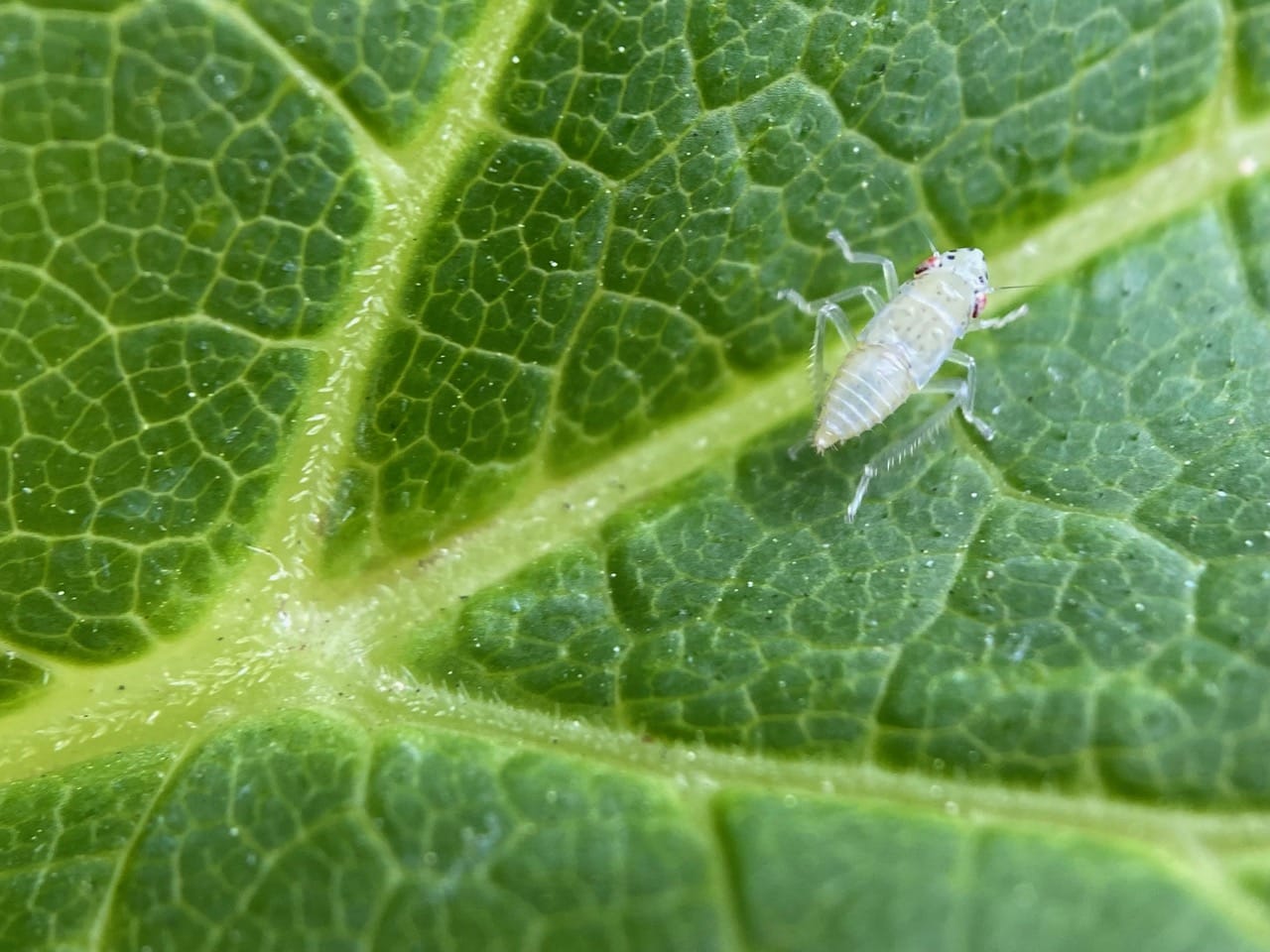
A whitish, translucent insect is fleeing from my camera. From the row of neatly spaced spines on its long hind legs, and the absence of wings, I figure it is a young nymph of a Leafhopper (family Cicadellidae). Insects are usually difficult to identify in their nymphal stages, but because of the distinctive spots on this species, iNaturalist is able to identify the leafhopper to the species Pagaronia triunata .
Leafhopper is the common name given to true bugs in the family Cicadellidae. The bugs are plant feeders that suck plant sap from grass, shrubs, or trees. Their hind legs are modified for jumping, and are covered with hairs that facilitate the spreading of a secretion over their bodies that act as a water repellent and carrier of pheromones. Leafhoppers undergo partial metamorphosis, and have various host associations, varying from very generalized to very specific.
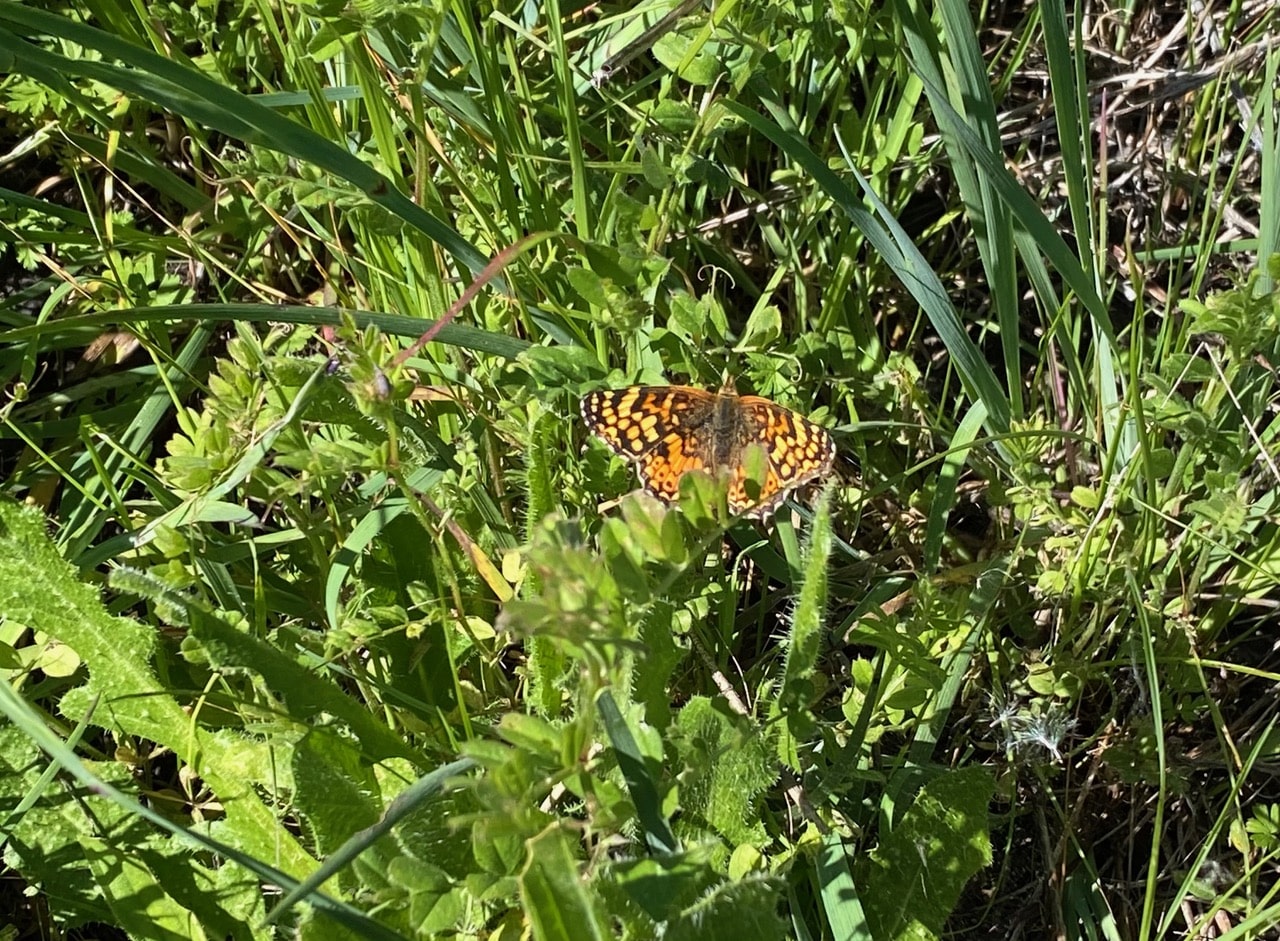
Out in the sunny stretch, a little orange butterfly flits past me and lands in the brushy undergrowths. It is a Mylitta Crescent, Phyciodes mylitta (family Nymphalidae).
Crescent butterflies (genus Phyciodes) are so-called for their crescent-shaped spots on the underside of their hindwing, but their intricate orange-and-black patterns on the upper side are more likely to catch your eye. Mylitta Crescent, Phyciodes mylitta (family Nmyphalidae) is found in western North America. Wingspan is 26-37 mm. Wings are orange with black markings and white fringe on the edges. The females are darker than the males. The butterfly flies from June until fall in California. They grace a wide variety of habitats, including urban areas, dry fields and wet meadows, woodland openings and mountain canyons, from sea level to treelike. Caterpillars are black with spines and white markings. They primarily feed on thistles. Adults feed on flower nectar.
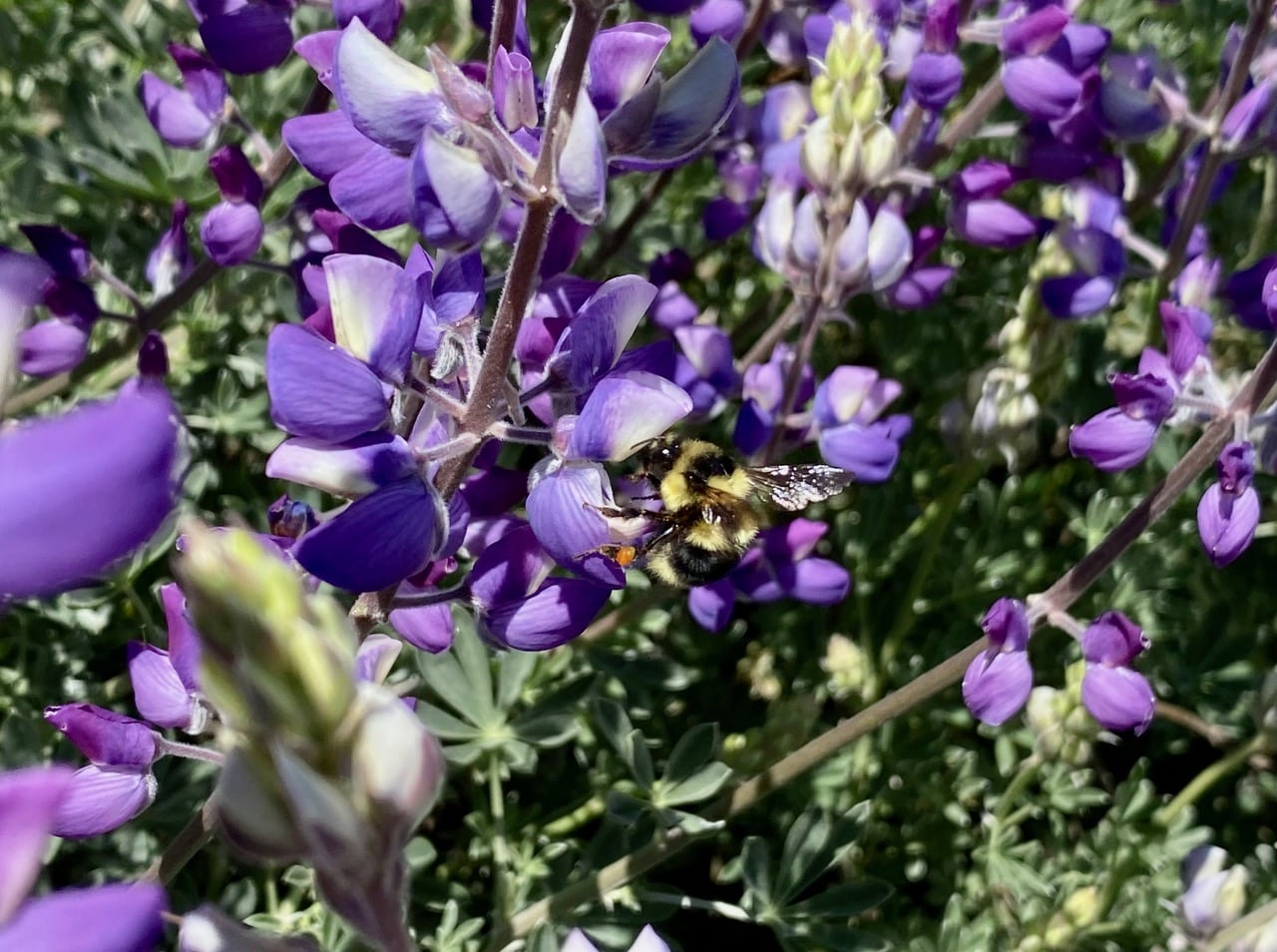
Back at the north end of Skyline Trail, Noor and I are again treated to the colorful wildflower display of yellow Mule’s Ear and purple Silver-leaf Lupine.
And who can resist stopping to watch a Black-tailed Bumble Bee, Bombus melanopygus (family Apidae) dance with Silver-leaf Lupine?