

Pollinator Post 3/13/26 (2)
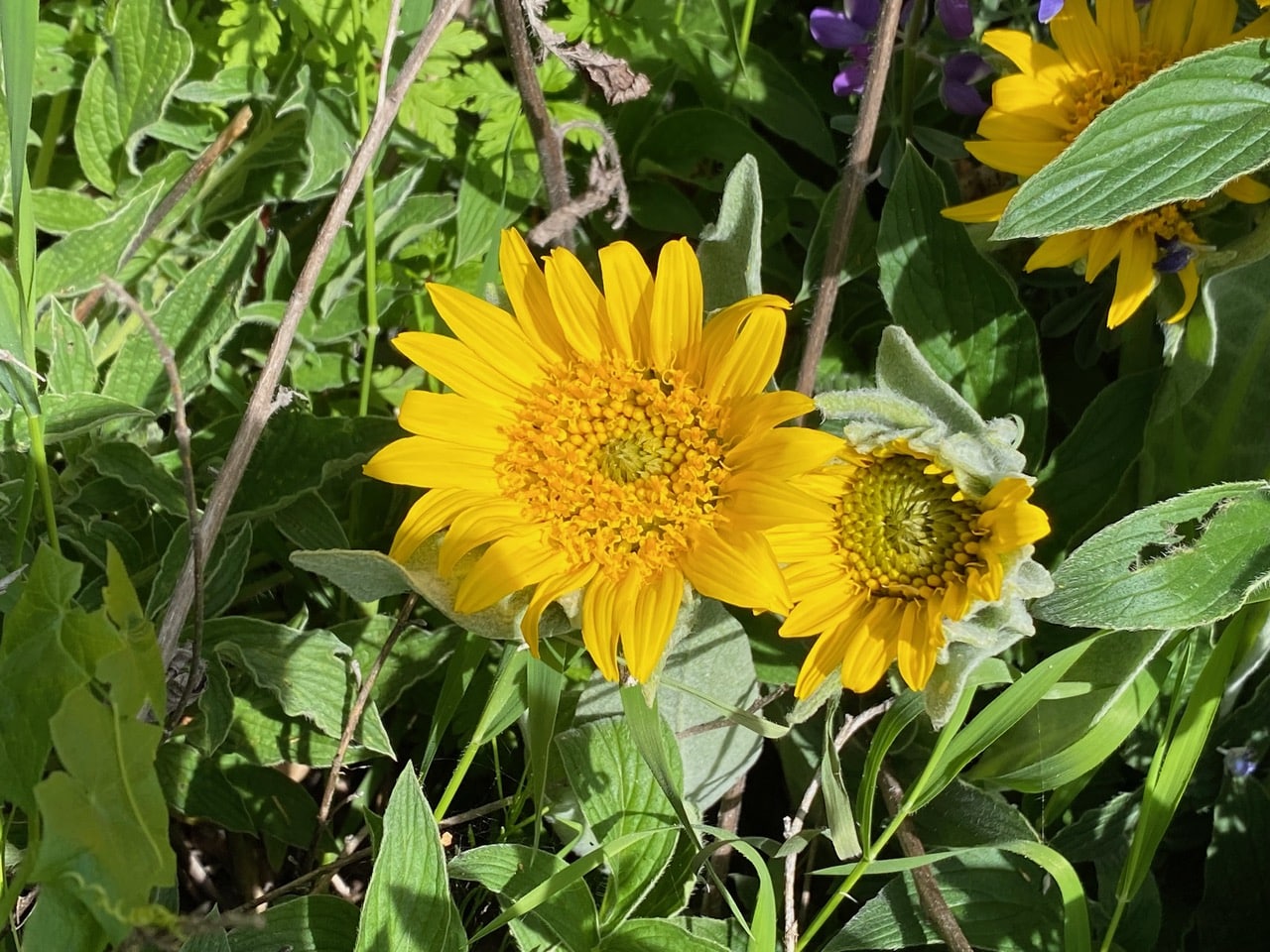
Tucked among the Silver-leaf Lupine and other vegetation, the Narrow-leaf Mule Ears, Wyethia angustifolia is putting on its own show.
Mule Ears (Wyethia spp.) features large, solitary or few, sun-like yellow flowerheads, 2-3 inches wide resembling sunflowers. These members of the Asteraceae family have 8-21+ showy ray florets and many central, tubular disk florets. Flowering occurs on long peduncles (stems) in spring/summer, often with sticky bracts, producing dry, one-seeded achenes.
Narrow Leaf Mule Ears, Wyethia angustifolia
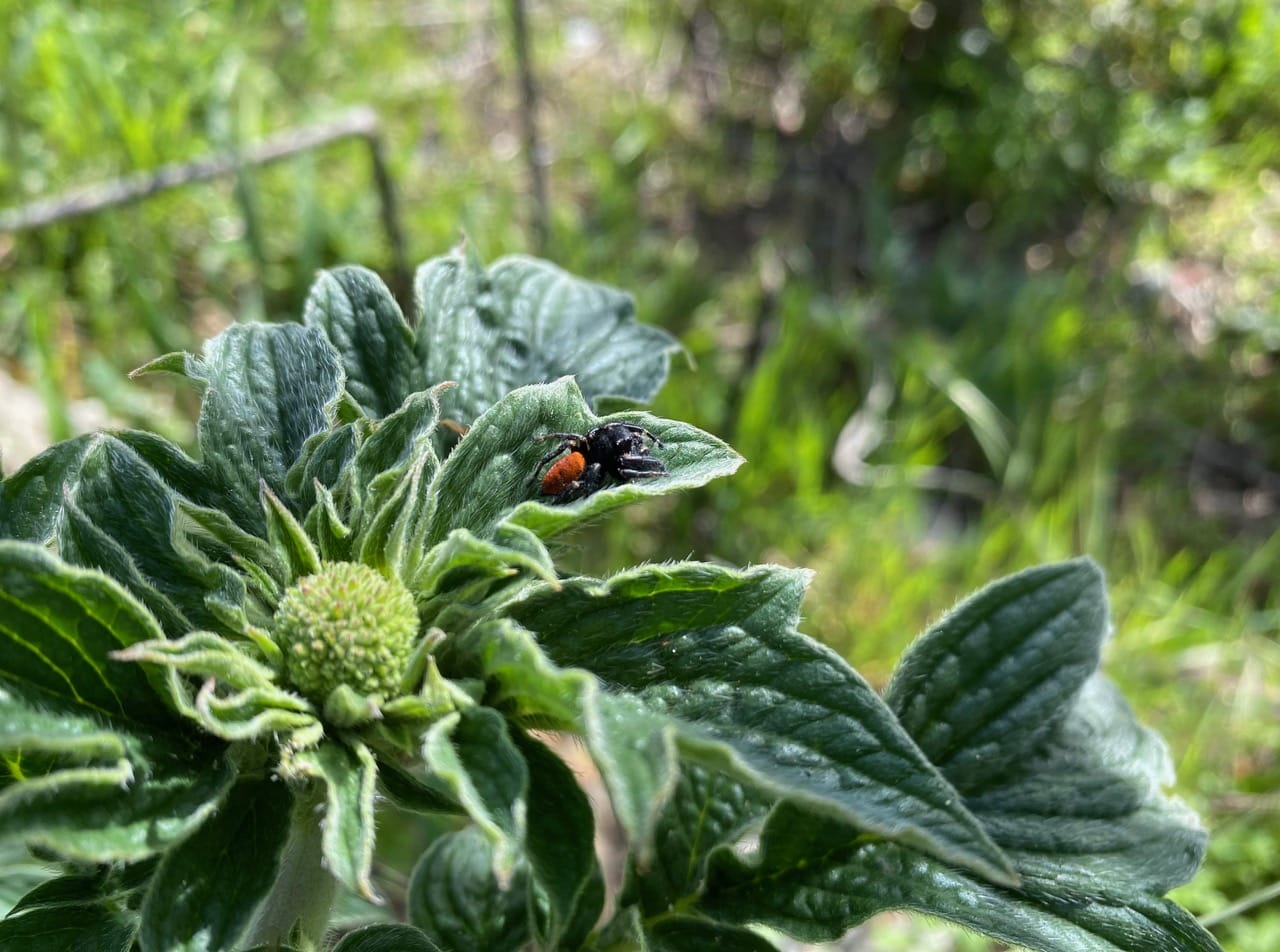



A large Jumping Spider with bright red abdomen is resting on a leaf of California Phacelia, Phacelia californica. It is the Johnson’s Jumping Spider, Phidippus johnsoni (family Salticidae).
Also known as the Red-backed Jumping Spider, Phidippus johnsoni is one of the largest and most commonly encountered jumping spiders in western North America. This individual appears to be a male with an all-red abdomen. Salticids are free-roaming hunters. They do not weave a web to catch prey. They stalk, then pounce on their prey. Just before jumping, the spider fastens a safety line to the substrate. It can leap 10-20 times their body length to capture prey. Their movement is achieved by rapid changes in hydraulic pressure of the blood. Muscular contractions force fluids into the hind legs, which cause them to extend extremely quickly.
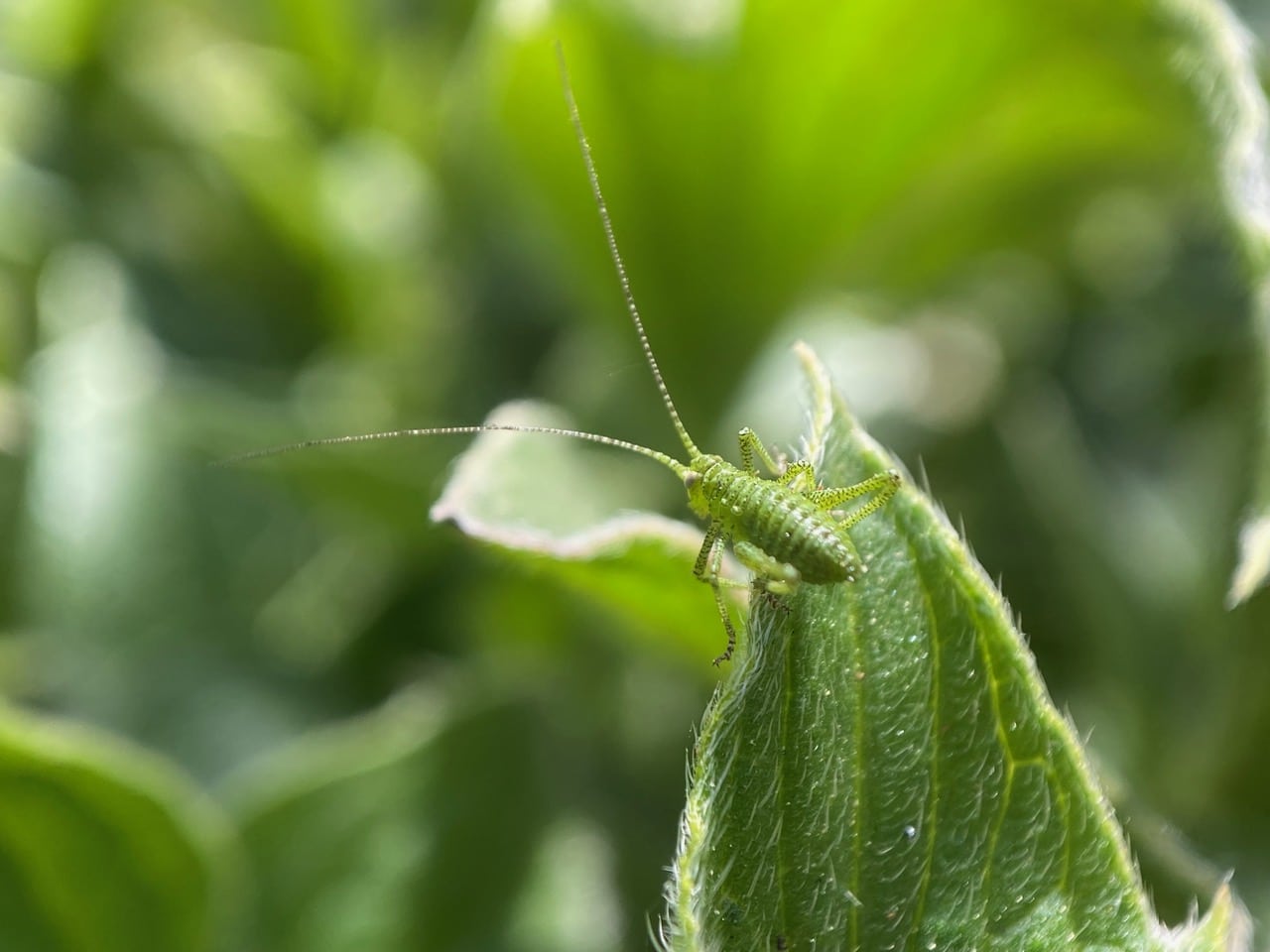
Sharp-eyed Noor spots this tiny, well-camouflaged katydid among the foliage of California Phacelia. iNaturalist has helped identify it as a nymph of California Chaparral Katydid, Platylyra californica (family Tettigoniidae).
The California Chaparral Katydid, Platylyra californica is a common but rarely seen orthopteran in the Tettigoniidae family, endemic to California’s native chaparral ecosystems. They are angle-winged insects, often camouflaged among shrubs, and represent a key native species within the state’s Mediterranean climate habitats. As with many katydids, they likely feed on leaves, but they are not known to be an agricultural pest. The nymphs are wingless. The adults have angle-wings that have evolved to perfectly mimic the appearance of a leaf. Their wings are held in a tent-like shape over their bodies, often featuring veins, spots, and edges that look like a real leaf to provide camouflage from predators. While these insects have wings, they are not always strong fliers and prefer to rely on their camouflage.
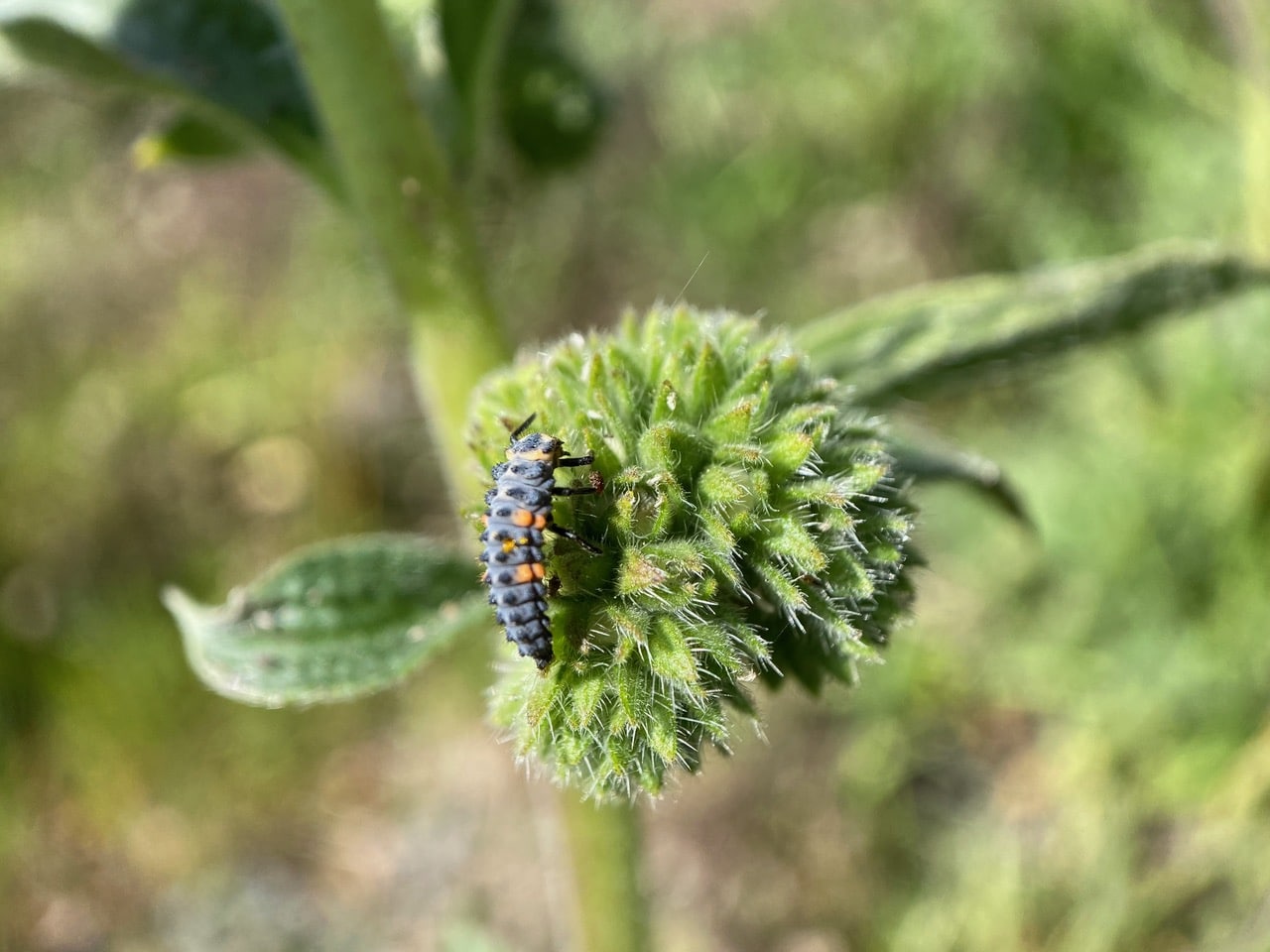
A Lady Beetle larva (family Coccinellidae) is moving slowly on a cluster of California Phacelia flower buds.
Lady Beetles (family Coccinellidae), in both larval and adult forms, are voracious predators of aphids and other soft-bodied insects.
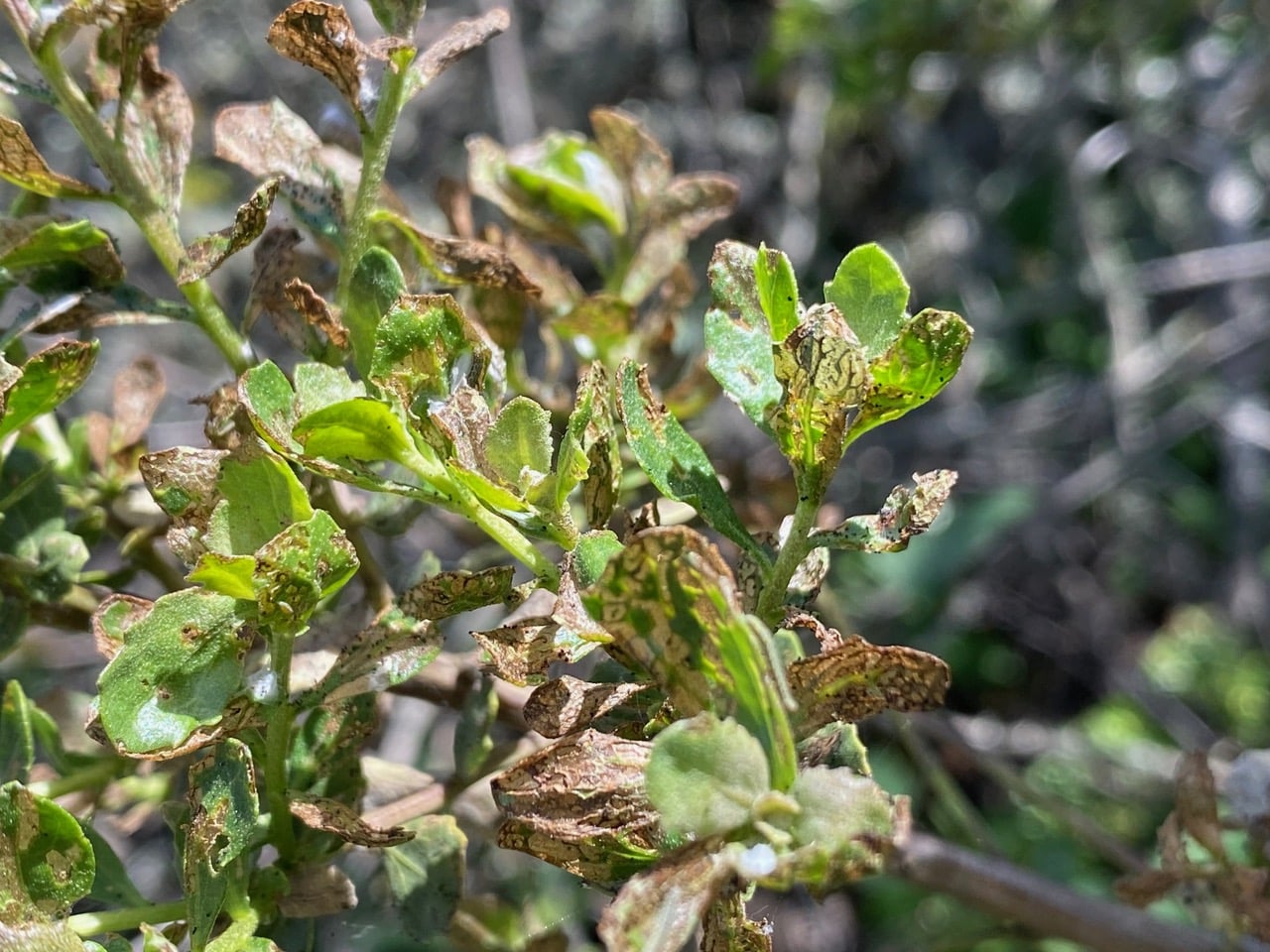
Most of the Coyote Brush, Baccharis pilularis along the trail near the cattle gate look sick, their foliage a strange shade of brown. Closer examination shows extensive feeding damage. Someone has been feeding on the soft surface tissues, leaving brown scars on the leaves. Yet, I don’t see any caterpillars.
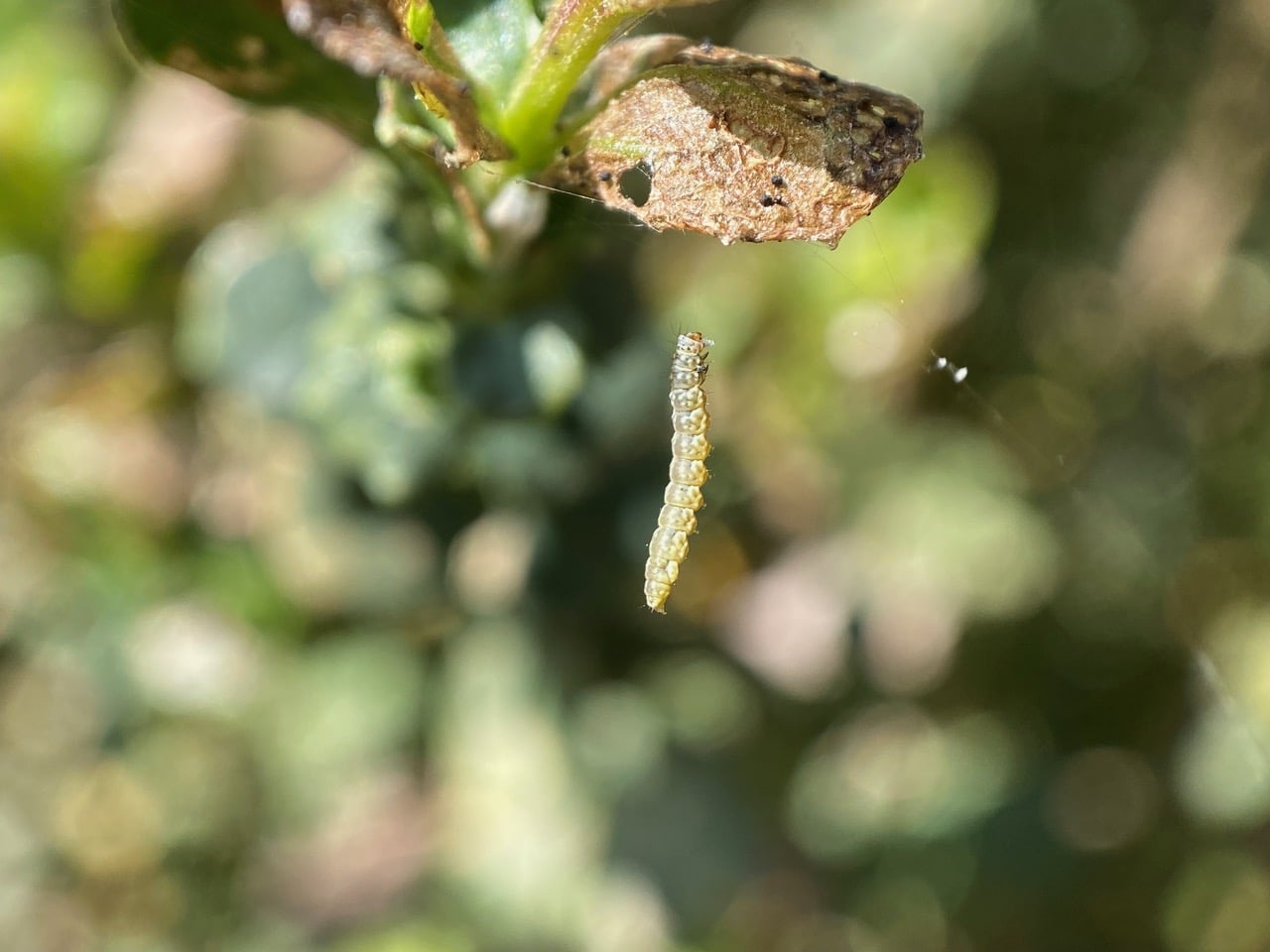
I accidentally brush against a branch of the Coyote Brush while photographing the plant. Immediately, a dozen small caterpillars drop from the shrub, each dangling freely on its strand of silk. When the branch stops shaking, the caterpillars start to make their way back to their leaves. Many species of small moths use Coyote Brush as their larval food plant. I wonder which species these caterpillars belong to?
Caterpillars of both moths and butterflies are able to produce silk. Like spiders, they produce silk through a spinneret. This tube-like structure is located on the lower lip of the caterpillar’s mouth. Silk is generated as a liquid in modified salivary glands and secreted through the spinneret. As it makes contact with air, it solidifies into a silk strand. Silk is one of the strongest natural fibers – pound for pound, silk outperforms steel in tensile strength.
Many kinds of caterpillars use a single strand of silk as a “safety line” to anchor themselves to the plant on which they feed. When disturbed, they “spit and jump”, dropping down and hanging from the silk line. When the danger has passed, the caterpillar draws the silk back in and makes its way back to the leaf to resume feeding.
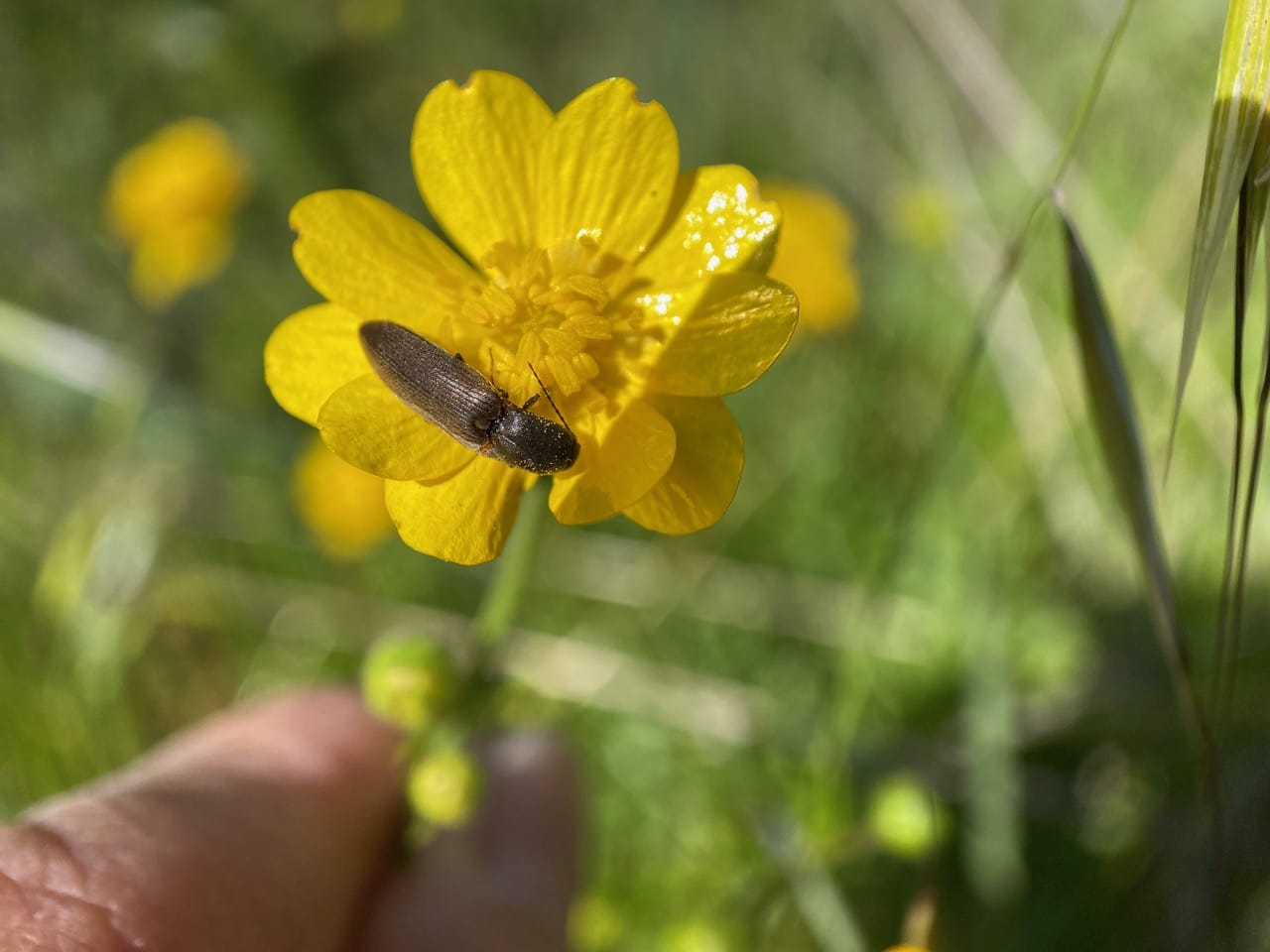
A Click Beetle (family Elateridae) is feeding on a flower of California Buttercup, Ranunculus californicus.
Elateridae or Click Beeltes are a cosmopolitan beetle family characterized by the unusual click mechanism they possess. A spine on the prosternum can be snapped into a corresponding notch on the mesosternum, producing a violent “click” that can bounce the beetle into the air. Clicking is mainly used to avoid predation, although it is also useful when the beetle is on its back and needs to right itself.
Adult Click Beetles are typically nocturnal and phytophagous (feeding on plants). Their larvae, called wireworms, are usually saprophagous, living on dead organisms, but some species are agricultural pest, and others are active predators of other insect larvae.
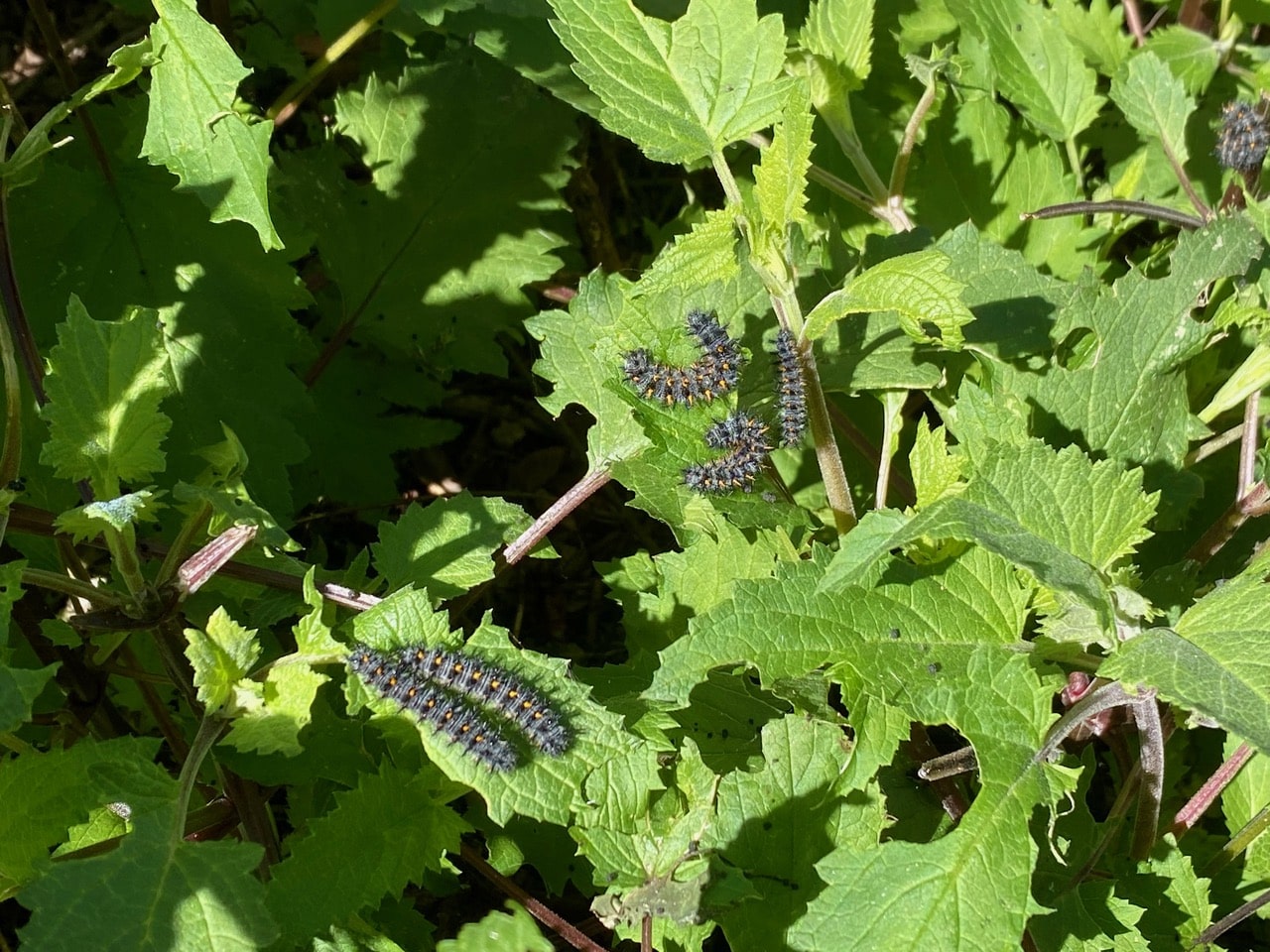
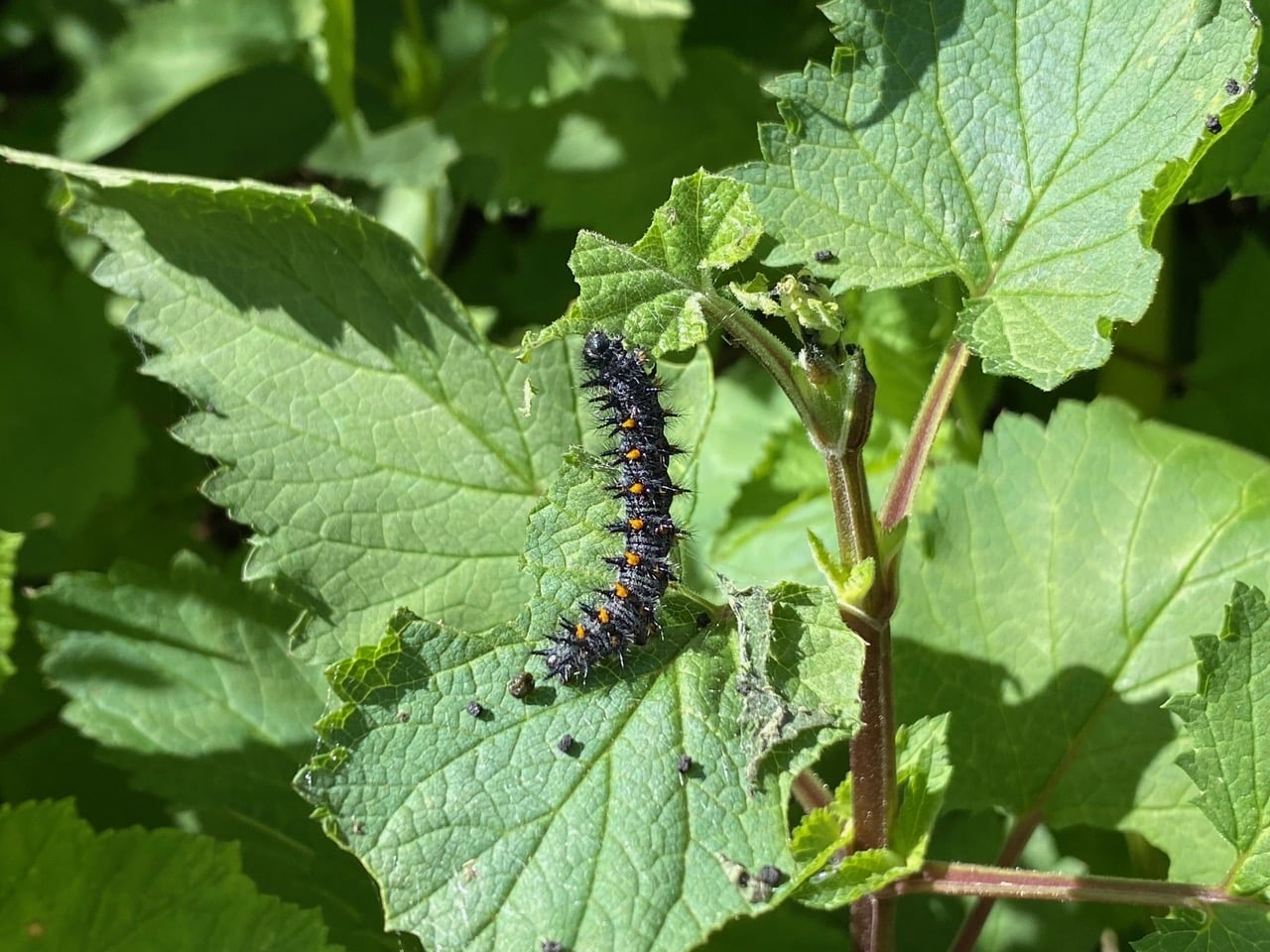
Along the stretch of trail lined with California Bee Plants, Scrophularia californica, the size and numbers of the caterpillars of the Variable Checkerspot butterflies seem to have grown!
The Variable Checkerspot, Euphydryas chalcedona (family Nymphalidae) is found across western North America. The butterfly occupies a wide range of habitats, including sagebrush flats, desert hills, prairies, open forests and alpine tundra. Males perch or patrol around larval host plants to encounter females. Eggs are laid in large groups on underside of leaves of host plants. Host plants include California Bee Plant, Scrophularia californica, and Sticky Monkeyflower, Diplacus aurantiacus. These plants provide the caterpillars with iridoid glycoside, a chemical that imparts unpalatable taste to birds, protecting the caterpillars from predators. Larvae feed in large, loose groups on the host plants. Individuals overwinter (enter diapause or hibernation) as third or fourth instar larvae in sheltered sites under bark or dead branches, in hollow stems and in rock crevices. Pupation begins in early to mid April and the adult flight season begins between mid-April and May and continues into June. The adults feed exclusively on nectar, and have a life span of about 15 days.
This Variable Checkerspot caterpillar is reaching up to feed on a higher leaf. It is securely anchored to a fine layer of silk on the lower leaf.
Caterpillars spin a fine, sticky layer of silk onto plants to anchor themselves securely while feeding and resting, especially on windy days. The silk webbing provides stability against wind and rain, preventing them from falling. If knocked off a leaf, caterpillars often drop on a thread of silk to avoid falling to the ground, which they can climb back up later.
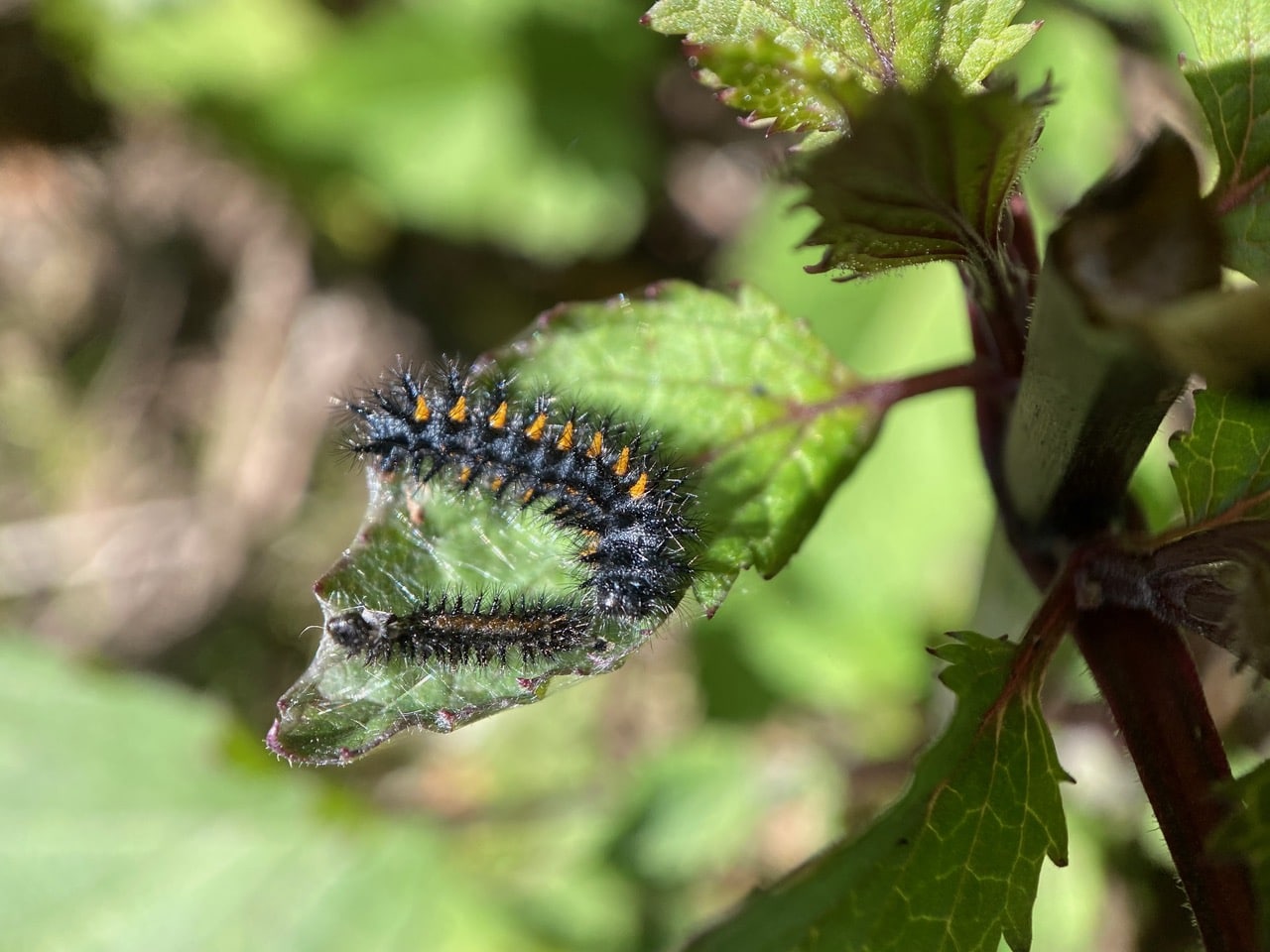
This caterpillar is resting on its silk mat next to its exuvia (shed skin left after a molt).
The Variable Checkerspot caterpillar typically goes through five instar stages, which means it molts four or five times before becoming a chrysalis. When preparing to molt, caterpillars create a thick pad of silk, to which they attach their prolegs. This allows them to stay in place (often for 24 hours) as they wriggle free from their old skin.
I have never seen anything like this! A spider has made a home in the hollow broken stem of Cow Parsnip, Heracleum maximum. It has sent out straight, long strands of silk from the opening of the stem attached to surrounding vegetation, spanning about 14 inches! What kind of spider made this?
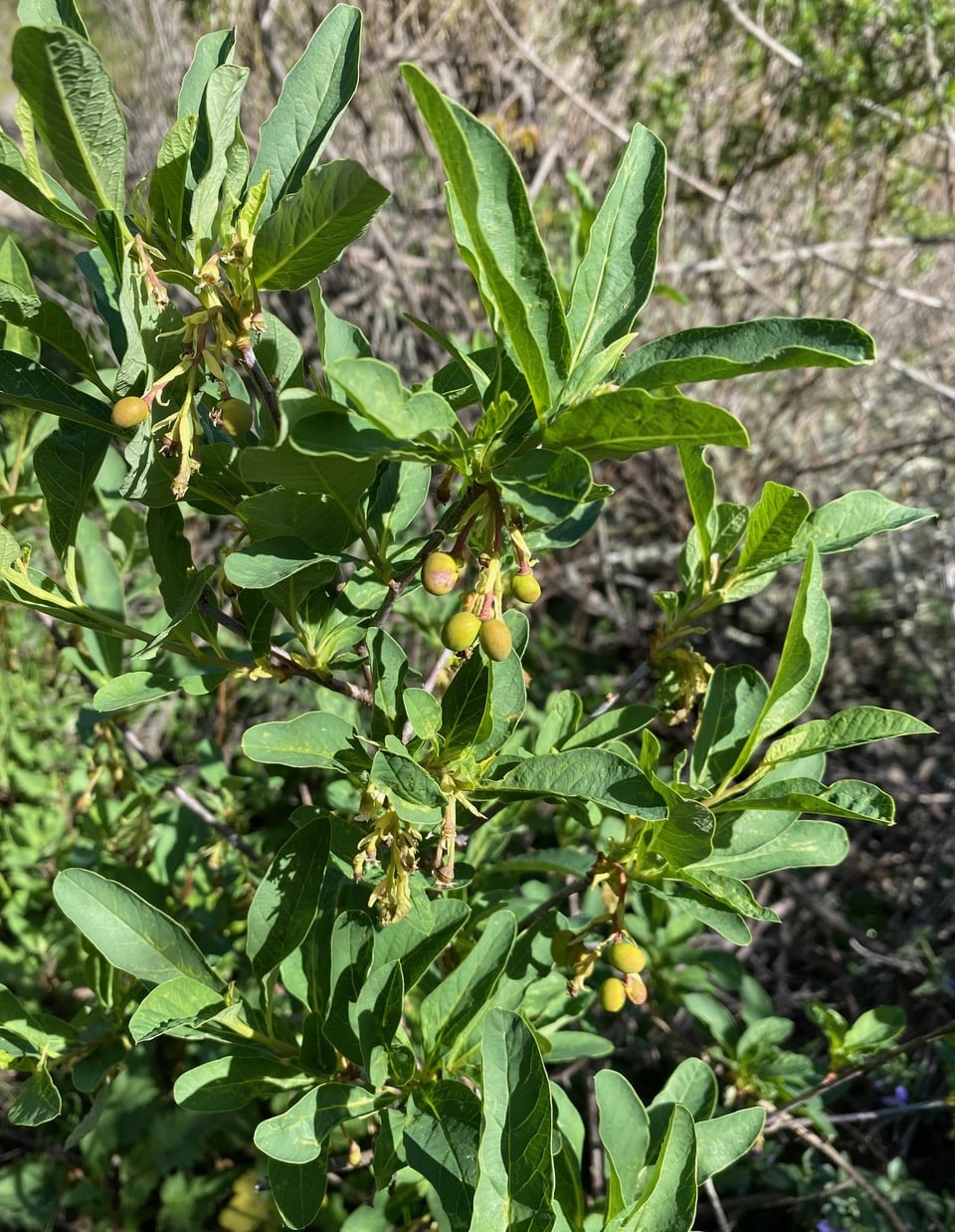
Ooh, young fruits are developing on that female Osoberry, Oemleria cerasiformis! This is a rare sight, as male plants of the species far outnumber the females.
The Osoberry, Oemleria cerasiformis is dioecious – male and female flowers are borne on separate plants. There are 5 petals and 5 sepals. There are numerous stamens (15, to be exact), in 3 series in the tubular portion of the calyx. Male flowers have prominent stamens that produce prodigious pollen. Female flowers have shriveled, pollen-less stamens and prominent carpels consisting of five styles and five separate ovaries. When fertilized, the ovaries develop into drupes (stone fruits), the so-called “Indian Plums”, up to five per flower.
Osoberry is pollinated by bees, moths, butterflies, hummingbirds, and more. The nectar in the flowers of osoberry is an important source of food for these pollinators in the early spring. Osoberry seeds are dispersed by birds and small mammals in their droppings.
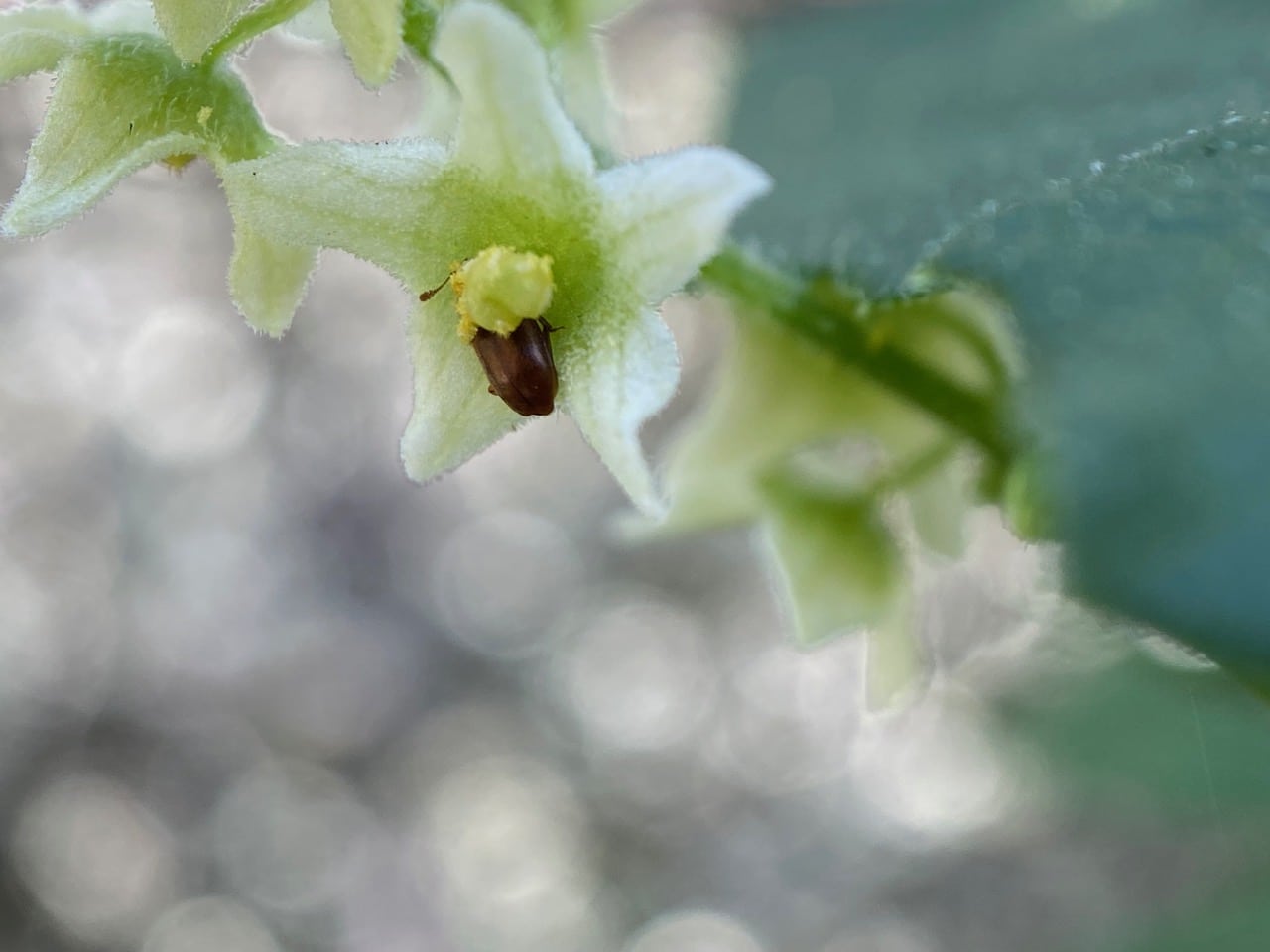
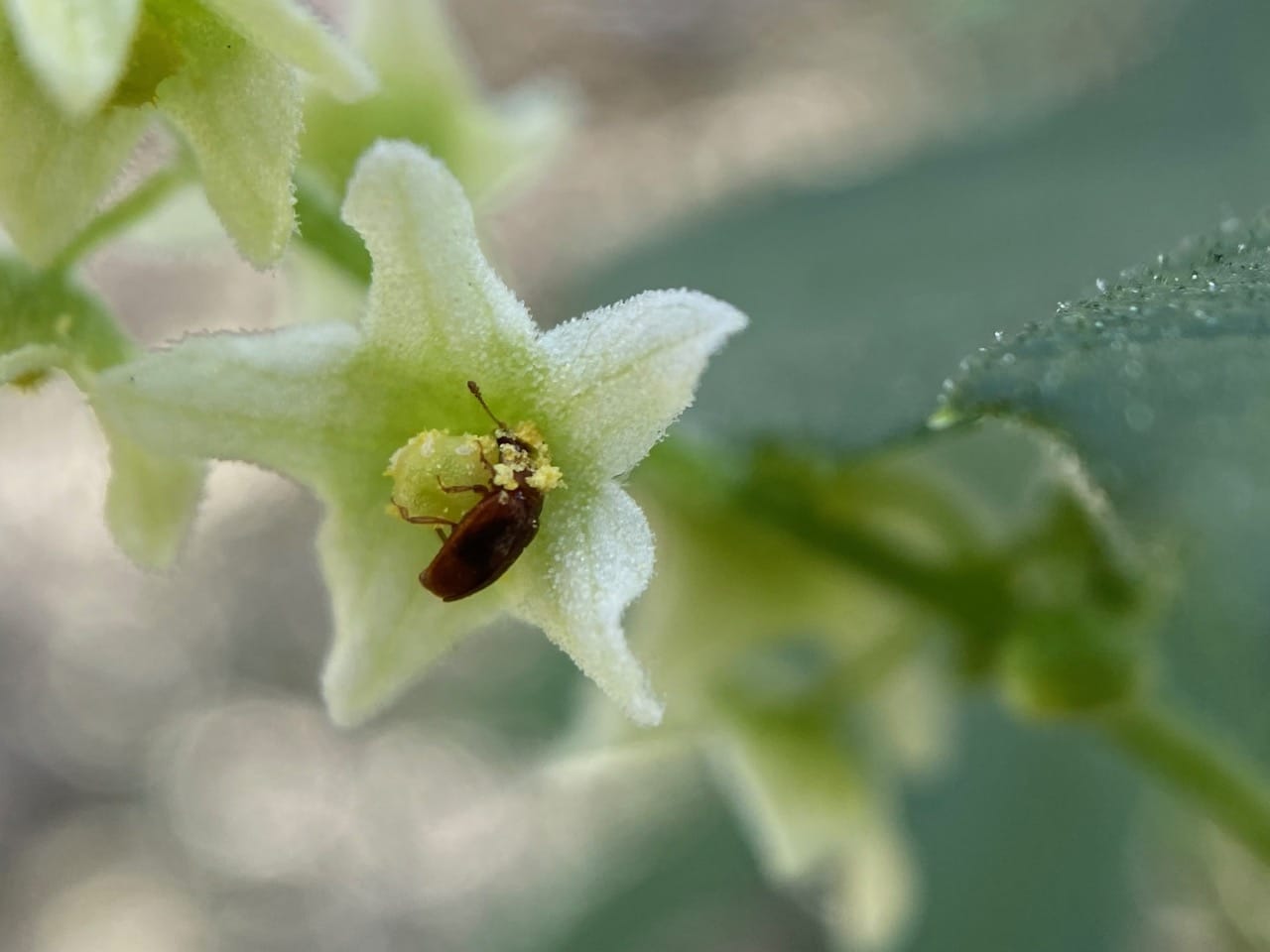
Noor points out a small brown insect in a flower of California Manroot, Marah fabacea. The beetle is half hidden behind the fused stamens in the center of the male flower.
As the beetle moves, I see that its head and thorax are covered with the sticky pollen of Marah. The beetle has almost completely stripped the fused stamens of its pollen!
Here’s another view of the beetle. iNaturalist has helped identify it as Epuraea sp. (family Nitidulidae).
Epuraea beetles are considered one of the “pollen beetles”, an informal term for any species of beetle associated intimately with suitably pollen-rich species of flowers. These include members of the families Melyridae, Nitidulidae and Oedemeridae.
Epuraea is a genus of sap-feeding beetles in the family Nitidulidae. Their primary food source is sap but many also feed on organic matter such as fruits, flowers, fungi, decaying plant tissue, and the tissue of dead animals. Many Epuraea beetles feed on nectar, pollen, and flower parts, acting as important pollinators as they move between flowers. These beetles commonly overwinter underneath logs or in soil. They are often found in early spring. Epuraea beetles are typically very small, flat, and possess clubbed antennae. While some species can be crop pests, many serve as overlooked pollinators that play a key role in ecological communities, especially in forests and meadows.
Beetles are among the first insects to visit flowers and they remain essential pollinators today. They are especially important pollinators of ancient species such as magnolias and spicebush. The beetles eat their way through petals and other floral parts. They often mate and defecate within flowers, generally making a mess. This behavior has earned them the nickname of “mess and soil” pollinators.
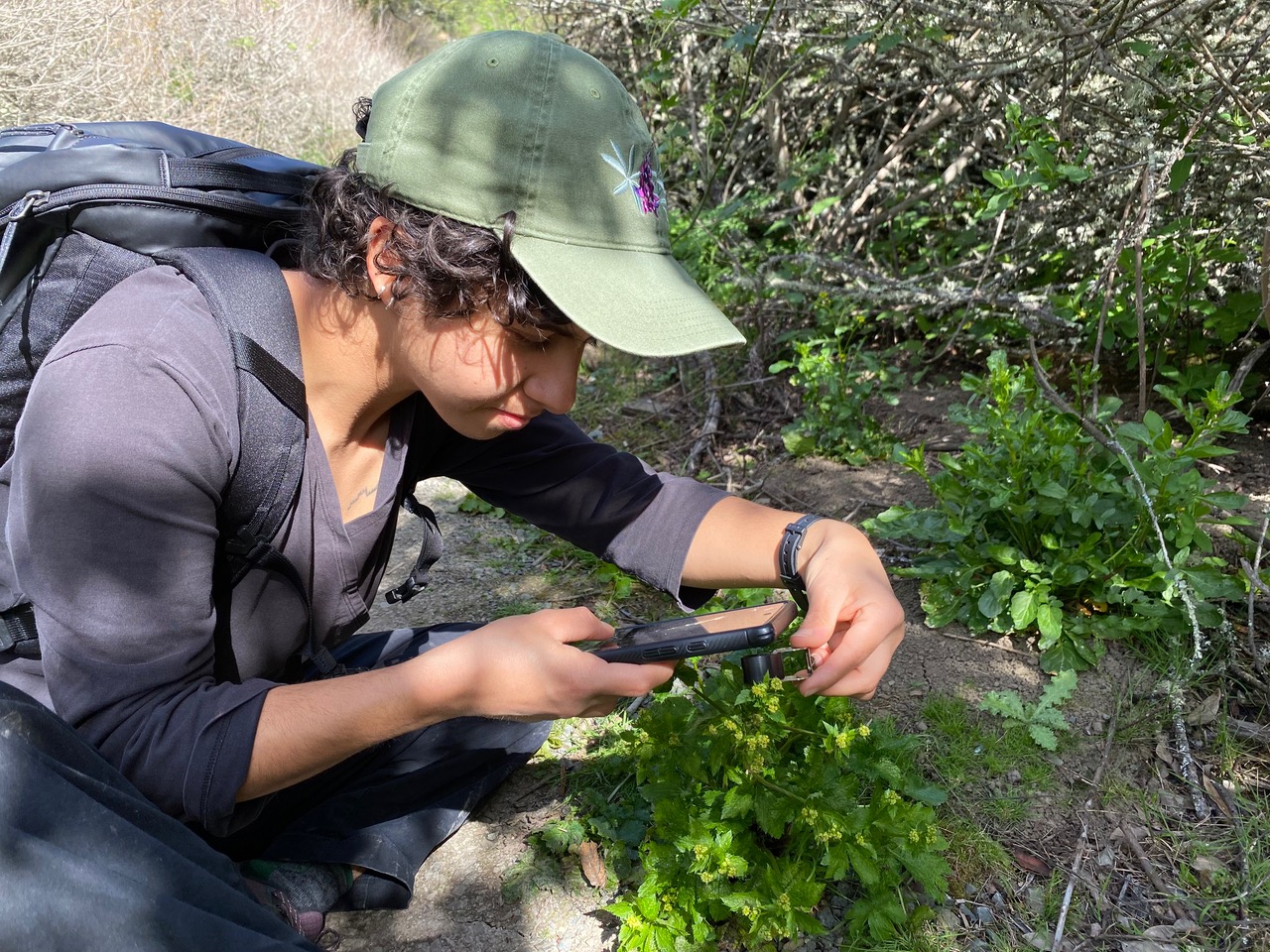
Noor does not have an attachable macro lens like mine, but she has quickly adapted to taking macro shots with her cellphone by placing her 10X hand lens in front of it. With steady hands and laser focus, she is able to take some remarkably good pictures of tiny insects this way!
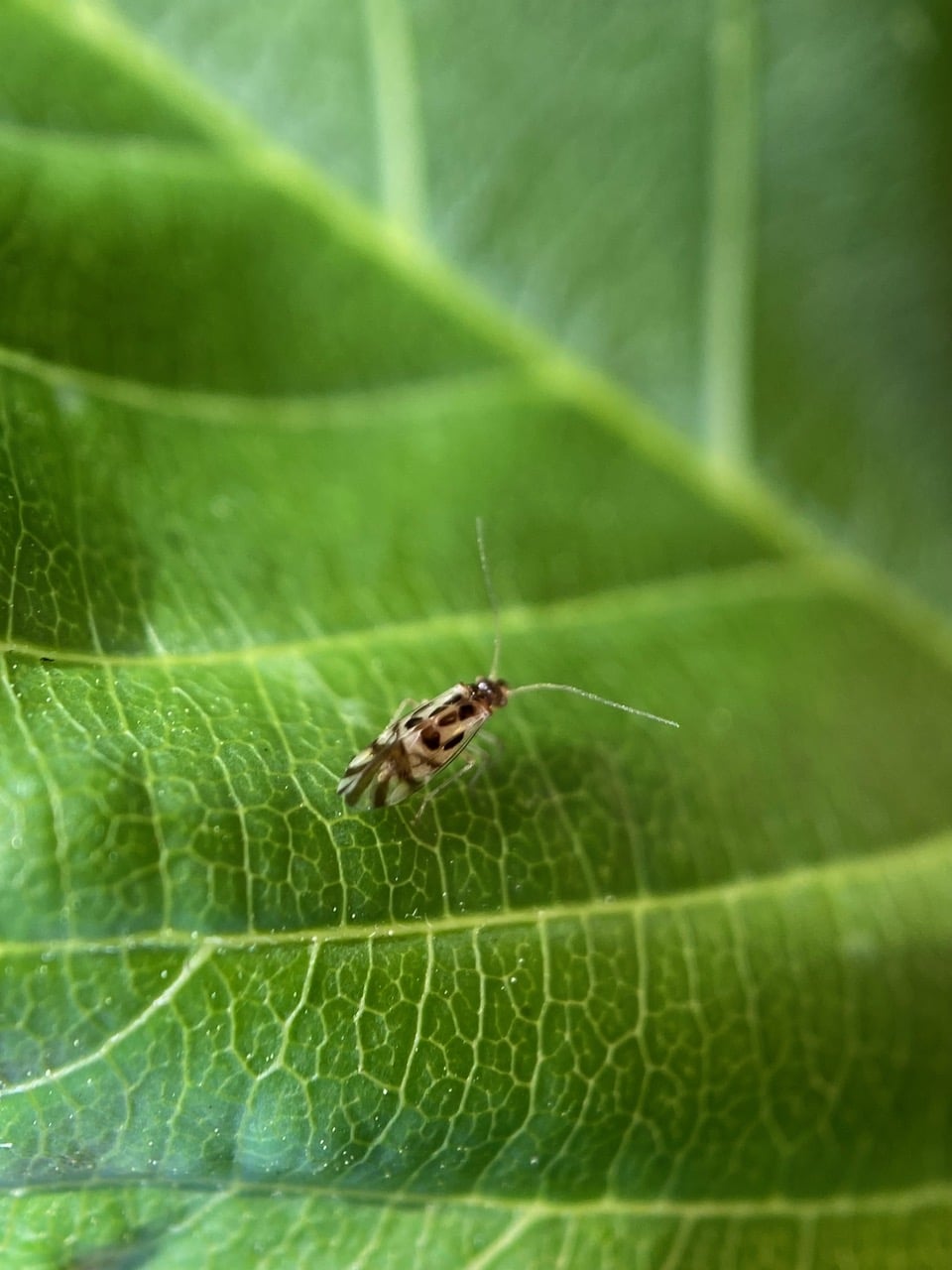
Ooh, that tiny insect with beautiful wing markings is a F-winged Barklouse!
The F-winged Barklouse, Graphopsocus cruciatus (family Stenopsocidae) belongs to an ancient lineage of insects in the order Psocodea (formerly Psocoptera). The scientific name comes from the Greek psocus (to grind) referring to the psocodean jaws, which are shaped to grind food, rather like a pestle and mortar. These insects are conveniently divided into two groups – barklice that live outdoors, and booklice that are found in human habitations.
Barklice are usually found in moist places, such as leaf litter, under stones, on vegetation or under tree bark. They have long antennae, broad heads and bulging eyes. They feed on algae, lichens, fungi and various plant matter, such as pollen. Barklice are usually less than 6 mm, and the adults are often winged. The wings are held roof-like over their bodies. Some species are gregarious, living in small colonies beneath a gossamer blanket spun with silk from labial glands in their mouth. Sometimes the colonies seem to move in coordinated fashion, rather like sheep.
Booklice are wingless and are much smaller (less than 2 mm). They are commonly found in human dwellings, feeding on stored grain, book bindings, wallpaper paste and other starchy products, and on the minute traces of mold found in old books.
Psocodea undergo incomplete metamorphosis. They are regarded as the most primitive amongst the hemipteroids (true bugs, the thrips and lice) because their mouthpart show the least modification from those of the earliest known fossils.
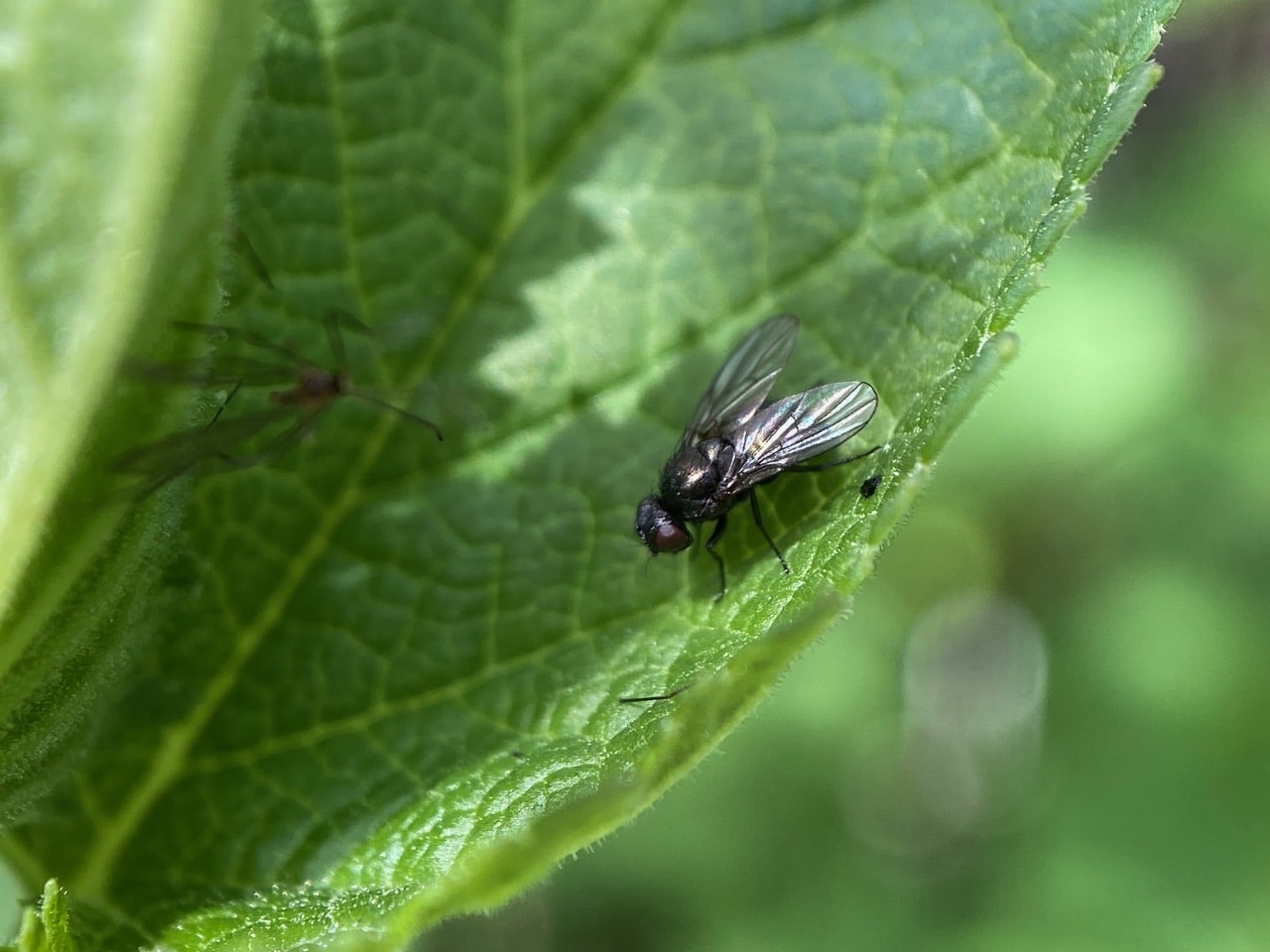
A dark, glossy fly lands on a leaf. iNaturalist is only able to identify it to the family Muscidae.
Muscidae, some of which are commonly known as house flies or stable flies due to their synanthropy, are worldwide in distribution and contain almost 4,000 described species in over 100 genera. (Synanthropic refers to organisms that live near, and benefit from, human-created environments. They thrive on human waste, crops, or shelter often adapting to urban ecosystems to become more abundant than in the wild.) Most species of Muscidae, however, are not synanthropic. Adults can be predatory, hematophagous, saprophagous, or feed on various plant and animal exudates. Larvae occur in various habitats including decaying vegetation, dry and wet soil, nests of insects and birds, fresh water, and carrion.
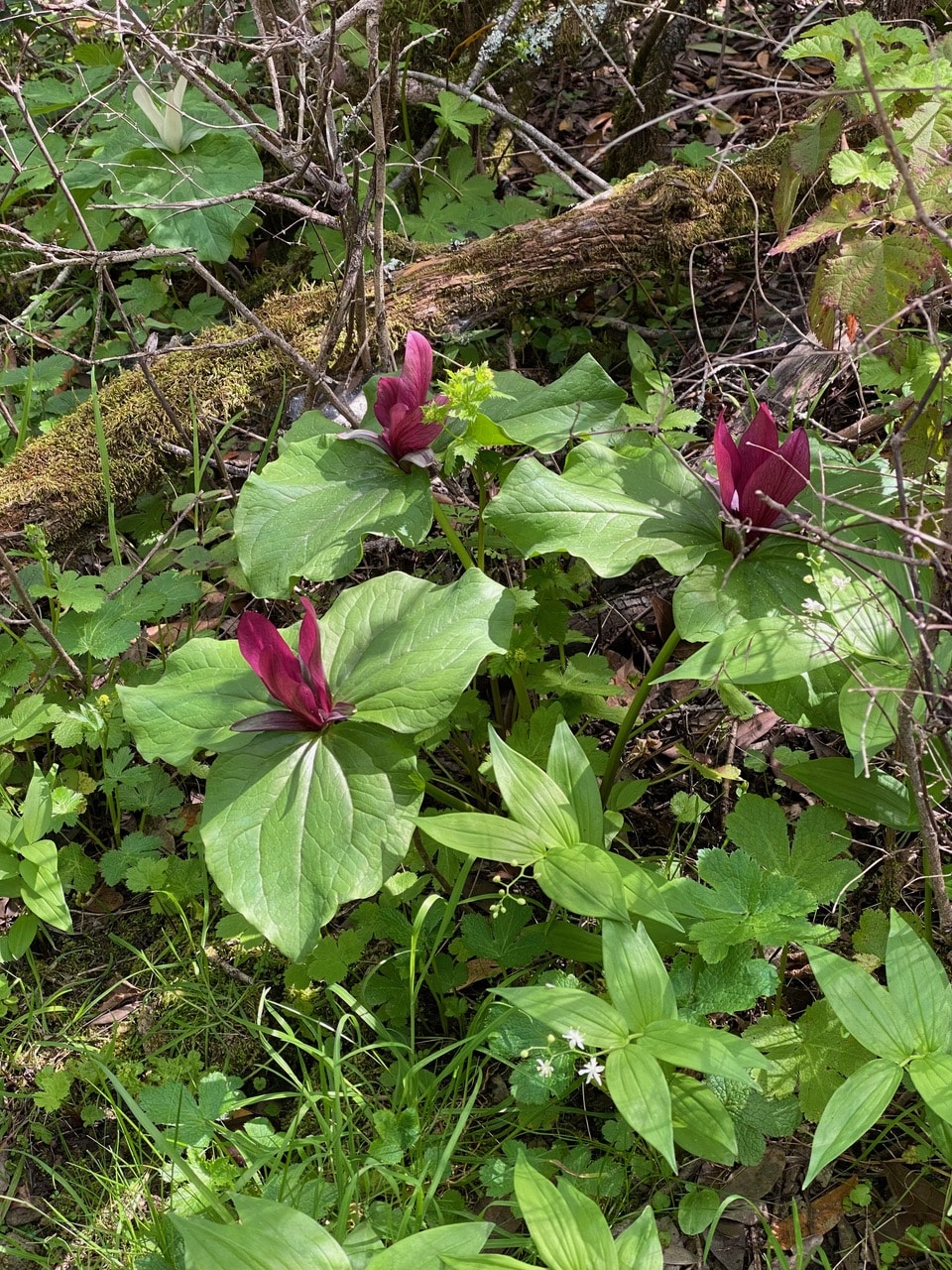
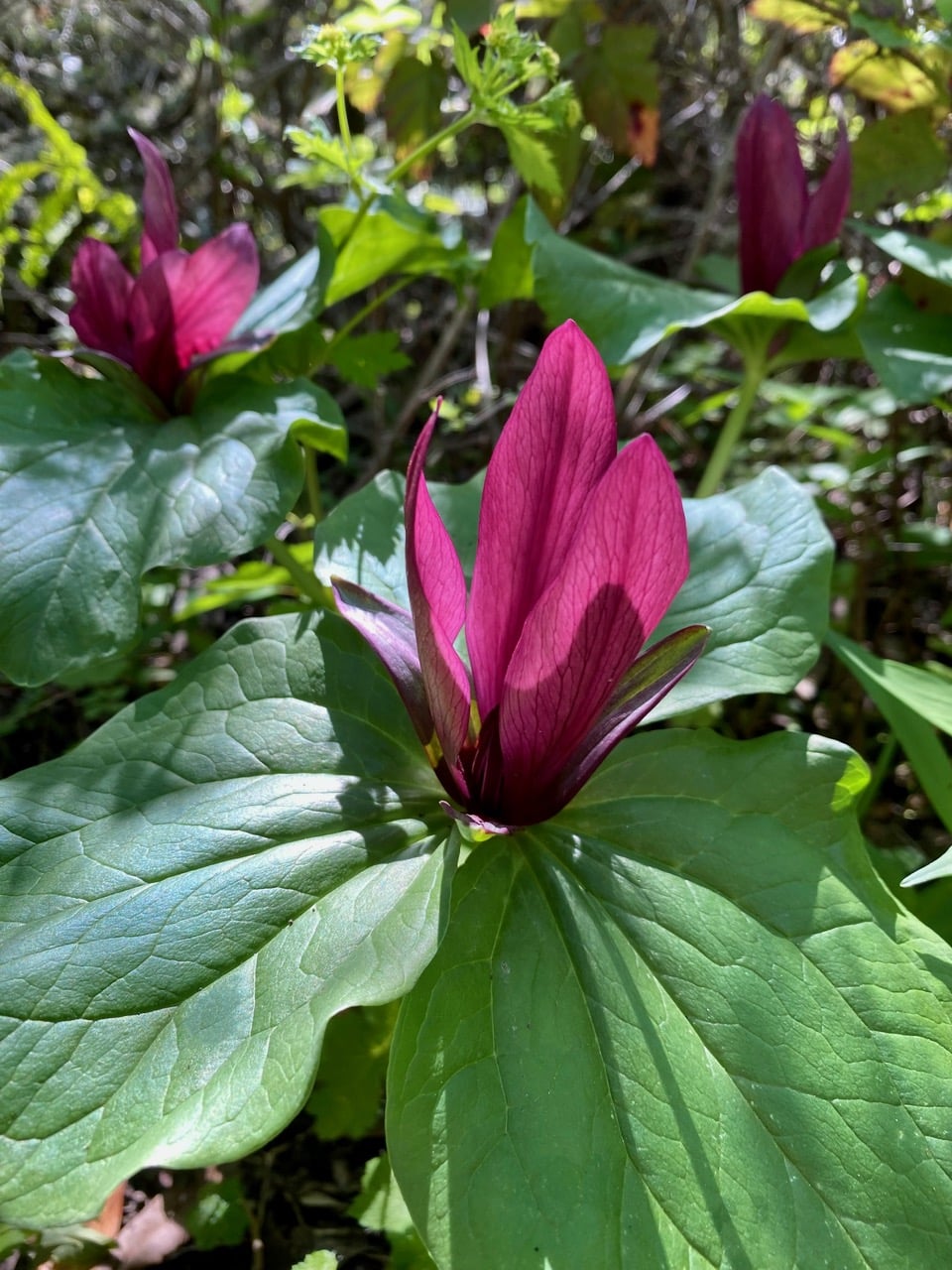
In the dappled shade, the Giant Trillium, Trillium chloropetalum is in glorious bloom. Because these plants propagate through the slow growth and division of underground rhizomes, creating dense clumps over time, I can reliably find them blooming in the same spots at Skyline Gardens every year.
Trillium flowers are characterized by a strict structure of threes, featuring three green sepals, three petals, six stamens, and a three-parted ovary. Above a whorl of three leaf-like bracts, the flower is either sessile (stalkless) or borne on a pedicel (stalk). They are herbaceous perennials with underground rhizomes.
Although I have never seen an insect come close to the Trillium flowers, these giant flowers are known to be pollinated by insects, particularly bees, flies, and beetles which visit for pollen. Red-flowered species often mimic rotting flesh to attract flies while white species often attract bees. After successful pollination, seeds are mainly dispersed by ants, which are attracted to a nutrient-rich structure on the seed known as an elaiosome.