

Pollinator Post 3/13/26 (1)
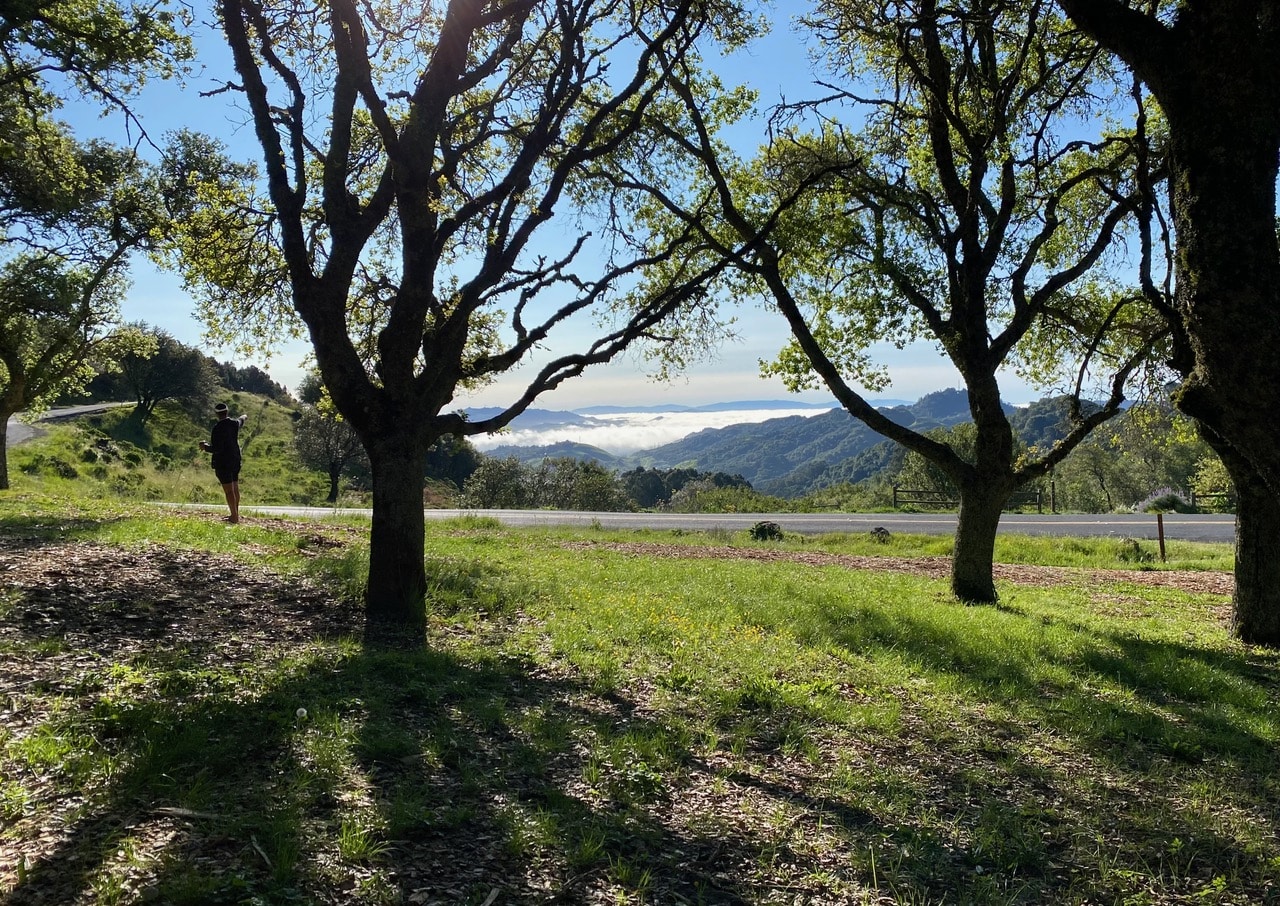
I am excited to meet a new friend today. Noor, a volunteer with the Skyline Gardens has asked if she could join me on a walk. We have arranged to meet at the small park across from the Tilden Steam Train parking lot at 10 am to explore the northern section of the Skyline Trail together.

While waiting for Noor, I am delighted to find California Buttercups, Ranunculus californicus blooming in profusion under the oak trees.
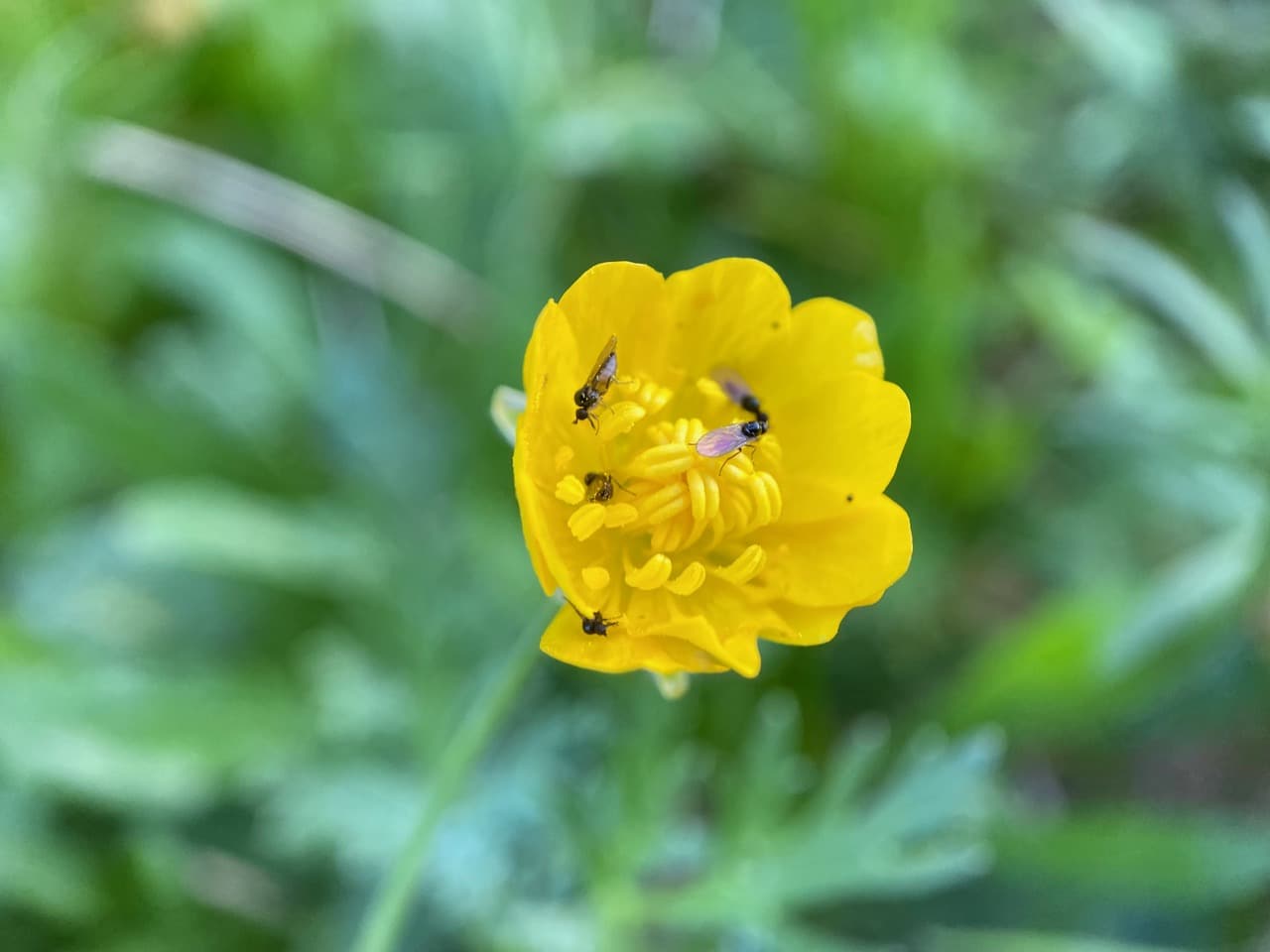
Numerous small insects are crawling over the stamens in this young buttercup flower in the shade. I recognize them as Hybotid Dance Flies (family Hybotidae).
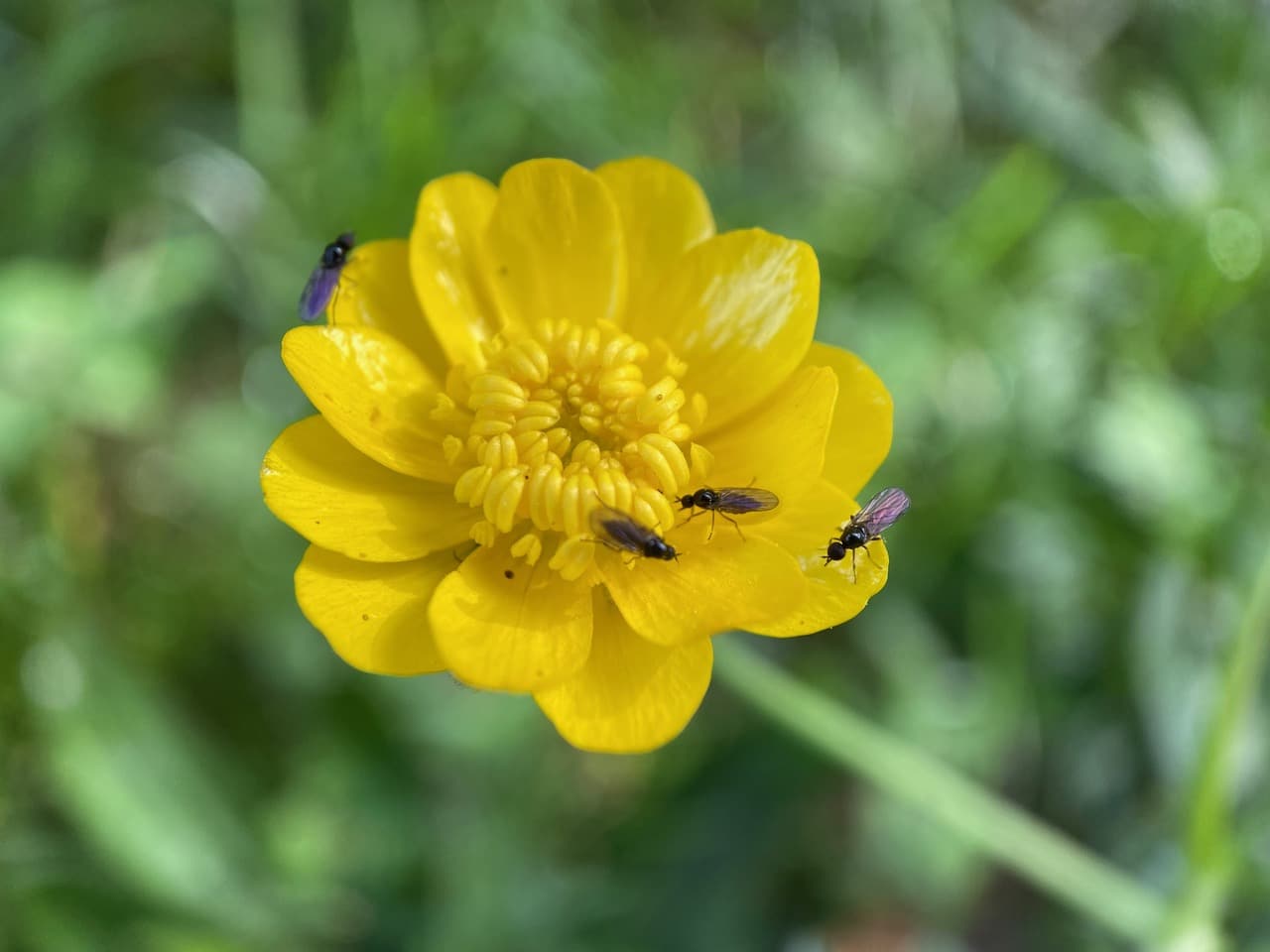
The small flies, under 3 mm long, are members of the Typical Dance Flies or Hybotid Dance flies (family Hybotidae). Their compound eyes seem to take up most of their spherical head. These flies belong to the superfamily Empidoidea and were formerly included in the Empididae as a subfamily. Empididae generally have a thick beak pointing down, while Hybotidae have a thinner beak, or a thick beak pointing forwards or diagonally. Some crucial wing venation further distinguishes the two families. Precious little is known about the life cycle and biology of Hybotids because they are not considered of economic consequence. Since their forelegs are generally not raptorial, I wonder if they’re predaceous like the Empidids. I have seen the Hybotids visit flowers for nectar and pollen, notably on Soap Plant, Miner’s Lettuce, California Saxifrage, Wild Geranium, Woodland Strawberry, etc. and I believe they may be significant pollinators for these small flowers.


Ooh, here’s a winged aphid on a buttercup flower. Alates (winged reproductives) so early in the season?
Aphids are small sap-sucking insects in the order Hemiptera. A typical life cycle involves flightless females giving live birth to female nymphs, – who may also be already pregnant, an adaptation called telescoping generations – without the involvement of males. Maturing rapidly, females breed profusely so that the population multiplies quickly. Winged females may develop later in the season, allowing the insects to colonize new plants. In temperate regions, a phase of sexual reproduction occurs in the autumn, with the insects often overwintering as eggs.
The life cycle of some species involves an alternation between two species of host plants. Some species feed on only one type of plant, while others are generalists, colonizing many plant groups. Some ants have a mutualistic relationship with aphids, tending them for their honeydew and protecting them from predators.
Aphids usually feed passively on phloem of plants. Once the phloem vessel is punctured, the sap, which is under pressure, is forced into the aphid’s food canal. Aphids produce large amounts of a sugary liquid waste called “honeydew”. A fungus called sooty mold can grow on honeydew deposits that accumulate on leaves and branches, turning them black.
Generally adult aphids are wingless, but most species also occur in winged forms, especially when populations are high or during spring and fall. The ability to produce winged individuals provides the aphids with a way to disperse to other plants when the quality of the food source deteriorates, or when predation pressure is high. Winged aphids (known as alates) fly to new plants, and upon landing, deposit live, wingless young, often referred to as nymphs or “babies”, to start a new colony. Winged aphids are typically weak fliers, but use wind currents to travel significant distances in search of new plants to colonize.
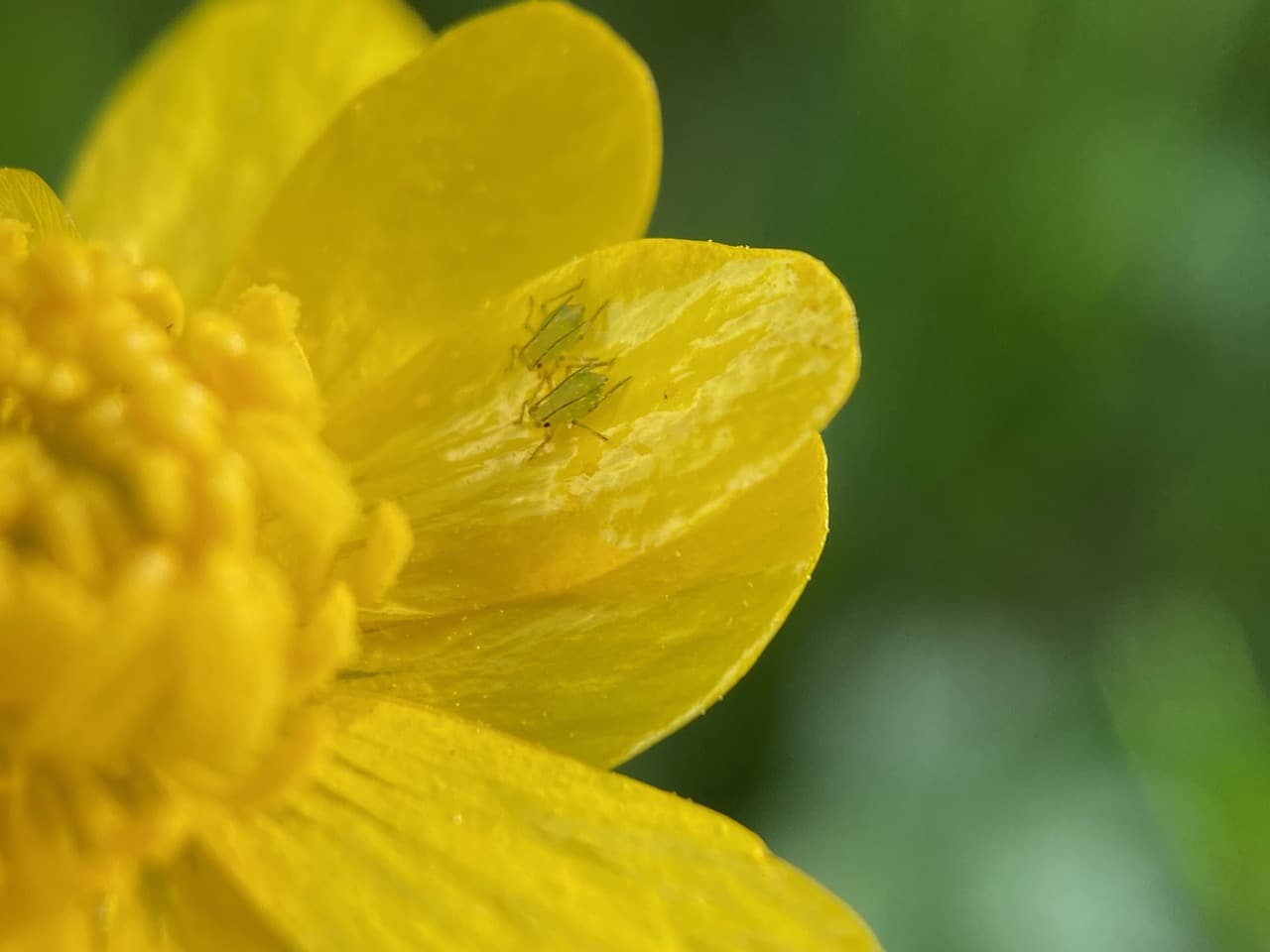
Two tiny aphids are perched on a buttercup petal. Where’s your Mama? It is rather unusual to see baby aphids on their own, unattended by adults. Have they been dropped off by a winged mother? Watch out, these youngsters may be the start of a whole new colony!
Aphids achieve rapid population explosions, often in just a few weeks, through a unique combination of asexual reproduction, giving birth to live young without mating (parthenogenesis), and rapid maturation (7-10 days). Females, which are often clones, can produce 40-60 offspring each, and nymphs are born pregnant with their own developing daughters, creating a “telescoping of generations” that leads to intense, sudden infestations.

A male Mining Bee, Andrena sp. (family Andrenidae) is foraging for nectar on a buttercup flower. Males are easily identified by their longer antennae.

Andrena is likely the largest and most species-diverse bee genus in California. It is one of the largest bee genera in the world. The floral preferences of Andrena species span the range of bee diets; some are broad generalists, and a number are strict specialists. Andrena are among the first bees to fly in the spring; their ability to withstand the chill is still a puzzle to scientists. The bees can’t fly until their body temperatures reach 50-60 F. They rely on the warmth of the sun to get them to speed, and it is not uncommon to see them warming up on leaves or rocks. This cold-hardiness makes Andrena excellent pollinators of early spring wildflowers and cultivated crops.
Andrena are solitary, ground-nesting bees, but often nest in large, close groups, digging burrows in sunny, sparse soil. These medium-sized pollinators (8-17 mm) are generally brown to black, often with white or tan hair. They have a “furry” thorax. Females are identified by facial foveae (velvety patches), and carry pollen on scopae (specialized pollen-carrying hairs) on their hind legs and thorax. Females use a specialized “pygidial plate” on the abdomen to apply waterproofing secretions to their nest chambers.

A Western Forest Sedgesitter, Platycheirus trichopus (family Syrphidae) is feeding on pollen from the buttercup flower.
The Sedgesitter, Platycheirus sp. (family Syrphidae) is found in grass and herb vegetation. Adults of many species feed on pollen of wind-pollinated plants, such as Salix, Plantago, Poaceae, Cyperaceae, but they also visit other flowers. Many stay active during cold and rainy weather. Larvae feed on aphids. The Western Forest Sedgesitter, P. trichopus is typically found west of the Rocky Mountains in North America.

Noor and I cross the road to enter Skyline Garden. What a beautiful day it is!

We pause before descending the steps to admire the large Silver-leaf Lupine, Lupinus albifrons blooming in profusion on the side of the trail.

It’s a challenge to follow the movement of a little Black-tailed Bumble Bee, Bombus melanopygus (family Apidae) through the dense thicket of lupine flowers. Good thing the bee is brightly colored!
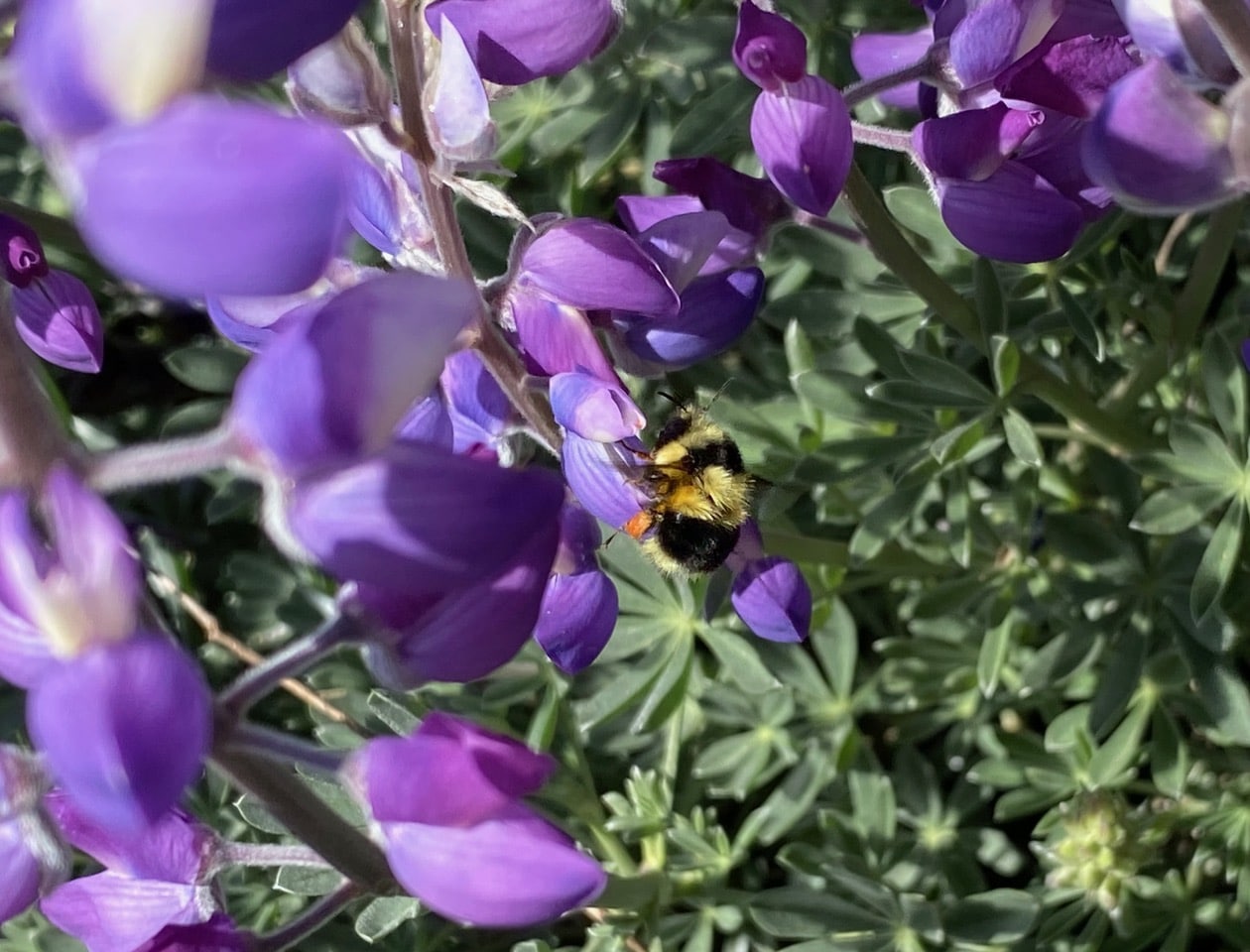
The Black-tailed Bumble Bee lands on the wing petals of a lupine flower. Her weight depresses the wing petals, allowing the keel to spring up, hitting her abdomen with the extruded reproductive parts. Then off she goes, grooming the pollen into her pollen baskets. Watching bumble bees pollinate lupine flowers is a joyous pastime!

Ever wondered why the upper flowers on a spike of lupine flowers have white banners (upper, erect petals) while the lower ones have reddish-purple banners.? This is how lupine talks to bees!
When the flowers of Silverleaf Lupine, Lupinus albifrons first open, they have white banners. After the flowers are pollinated, the banners turn reddish-purple when the levels of the anthocyanin pigment rises 3-5 time. The color change is a response to ethylene (a gaseous plant hormone) produced by the pistil (female part of the flower) after it has been pollinated and is no longer receptive. The color change is also a consequence of the flower’s natural senescence. Bees’ eyes are sensitive to white, but are blind to red hues. Bumble Bees, who are the lupine’s principal pollinators use the color change to guide them to the fresh flowers with the biggest rewards. This arrangement benefits both the plant and pollinator, maximizing pollination efficiency.

See that dark, pointed structure sticking out of the lupine flower? That’s the keel, made up of a pair of petals that together enclose the reproductive structures. When a heavy-bodied bee lands on the wing petals and lowers them, the keel springs up between the wing petals. Simultaneously, the reproductive structures within the keel extrude momentarily to deposit or receive pollen on the bee’s belly. Often when the action is vigorous enough, the keel and even sometimes the stamens and stigma do not return to their original positions. An extruded keel is a sure sign that the flower has been “tripped” by a bee.

This “tripped” lupine flower has the dark tip of the keel, the stigma and a couple of stamens protruding from between the two wing petals.

Wow, that lupine flower must have been “tripped” by a heavy bumble bee queen. All the reproductive structures have been violently extruded!
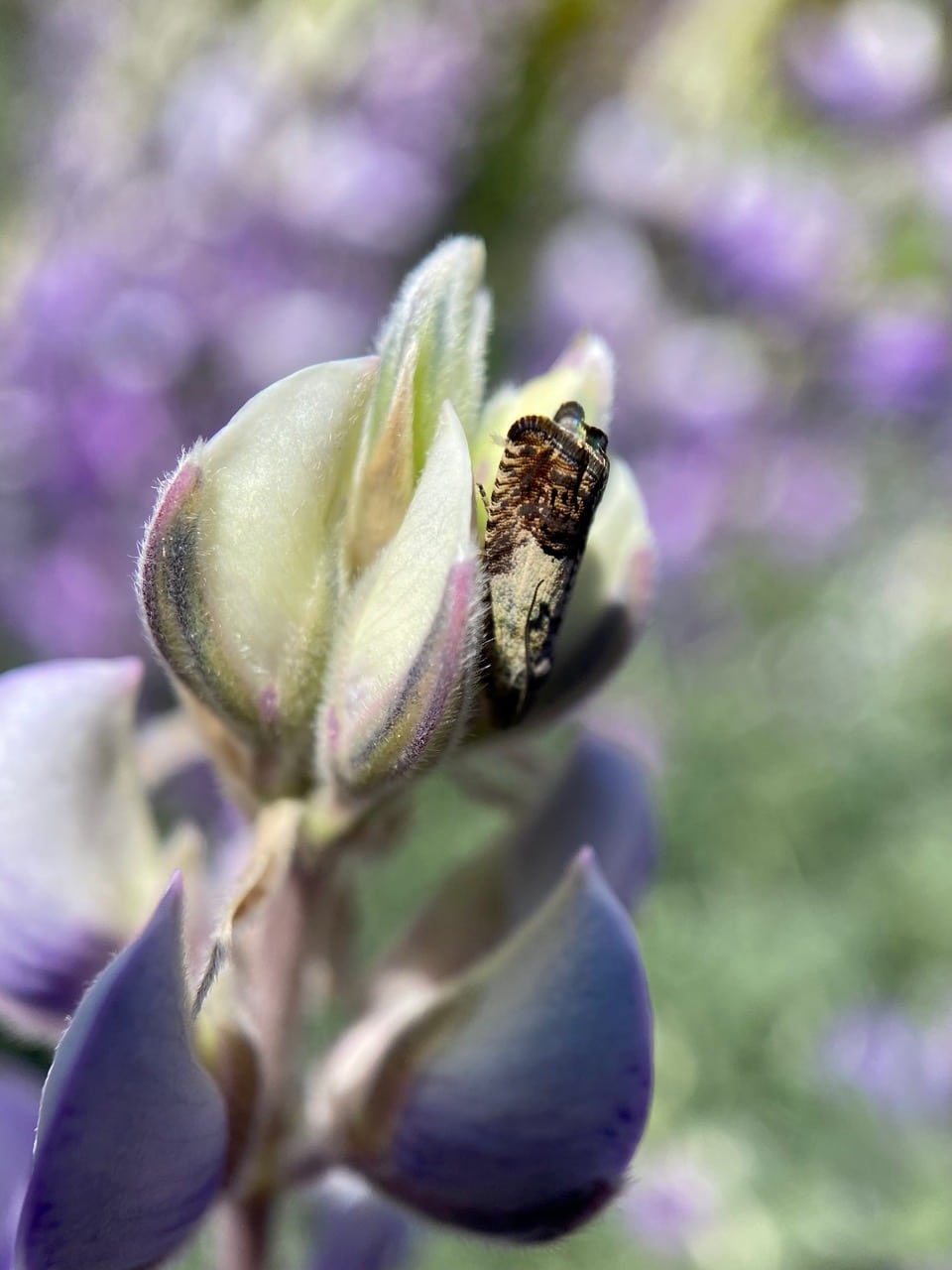
A small moth is resting between the flower buds of a Silver-leaf Lupine. iNaturalist is not able to identify the moth from this incomplete view.

A metallic green glint on a leaflet of Silver-leaf Lupine directs my eyes to a tiny, iridescent green insect with highly sculptured body. I thought it was a Cuckoo Wasp (family Chrysididae), but a wasp expert on iNaturalist disagreed and claimed that it is instead a Chacid wasp (superfamily Chalcidoidea).
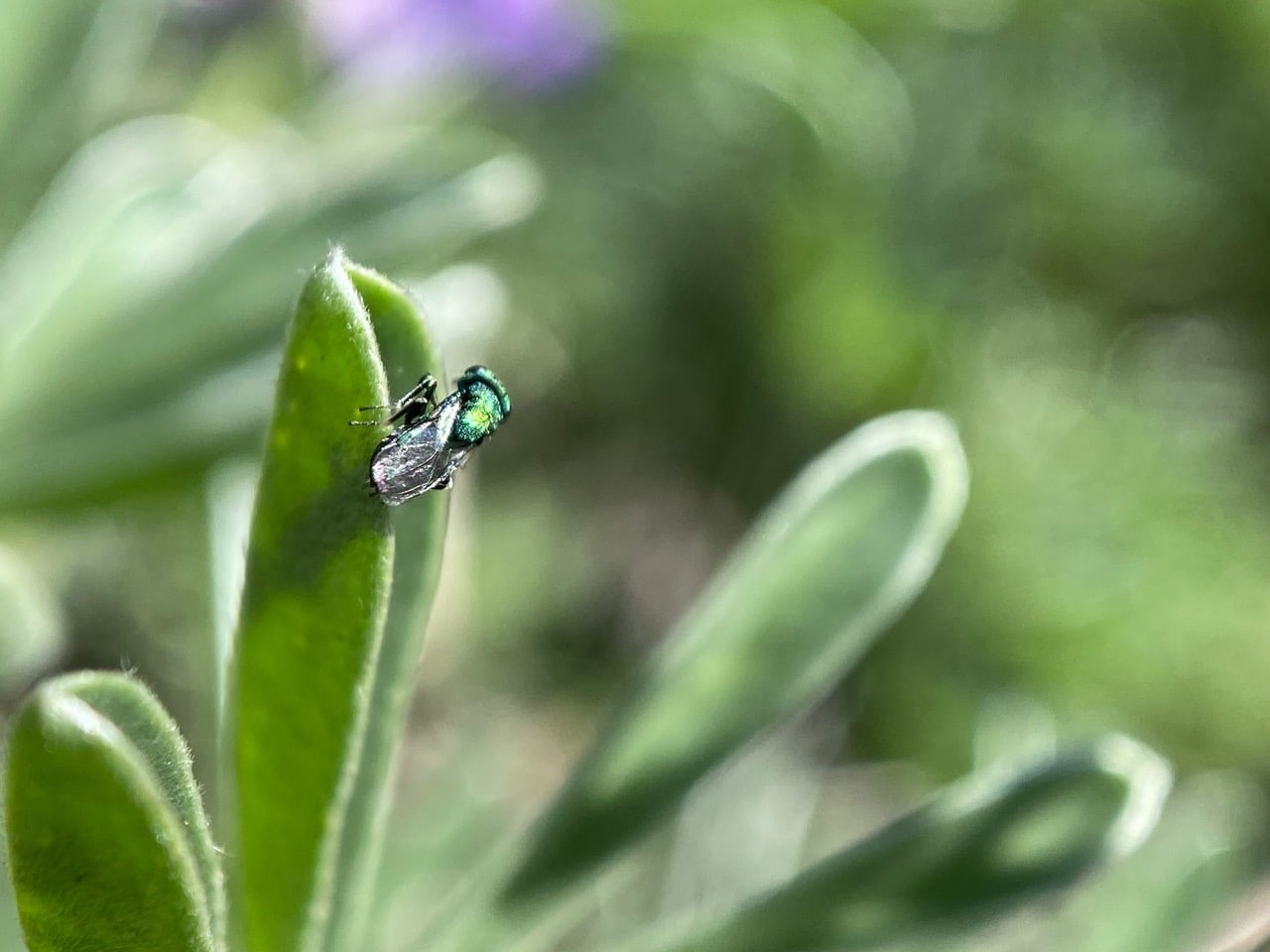
After careful sleuthing, I manage to narrow down the ID of the wasp to the family Perilampidae (superfamily Chalcidoidea). A very cool wasp!
The Perilampidae are a small family within the superfamily Chalcidoidea, composed mostly of hyperparasitoids. They are compact little wasps, ranging in size from 1.3 to 5.5 mm in length. Most are brilliant metallic green or blue, and are generally very strongly sculptured. They can be easily confused with small cuckoo wasps in the family Chrysididae, and are sometimes found in similar situations. Perilampids can be distinguished by their short, strongly elbowed antennae, and the triangular-shaped abdomen.
Perilampids are parasitic in the larval stage, usually on other parasitic insects like the larvae of Tachinid flies, or Ichneumon wasps or Braconid wasps living as parasites inside caterpillars or other insect larvae. This is known as “hyperparasitism”, whereby they are parasites of parasites. The first instar larvae (called “planidia”) are responsible for gaining access to the host, rather than egg-laying females. The female Perilampid “broadcasts” large numbers of eggs, leaving them on vegetation. The planidia that hatch attempt to attach themselves to any moving objects by their mandibles. Once on an appropriate host, the Perilampid larva penetrates the host, and seeks out and penetrates the host’s parasite. When the primary host pupates, the Perilampid larva then exits, molting into a grub-like larva that feeds as an external parasite. After going through two or three instars (the intervals between molts), the larva pupates inside the host cocoon.

Noor’s sharp eyes picked up this tiny black beetle on the banner of a lupine flower. iNaturalist has help identify it as a member of the Pea and Bean Weevils, Bruchidius sp. (subfamily Bruchinae, family Chrysomelidae). The larvae of these beetles feed on plants in the pea family, Fabaceas.
Bruchidius beetles are specialized seed predators that primarily feed inside leguminous seeds during their larval stage, destroying the seed’s cotyledons for development. The larvae are highly host-specific, often restricted to particular legume genera, such as Acacia, Gleditsia, or beans. After hatching on a seed or pod, the first-instar larva bores into the seed, where it feeds, grows, and pupates. They create distinct, round exit holes when emerging from the seed, a hall mark of their presence. Adults generally feed on pollen and nectar, although many are short-lived and rely on stored larval energy to reproduce.

A young Crab Spider, Macaphesa sp. (family Thomisidae) is waiting in ambush on a lupine flower.
Members of the family Thomisidae do not spin webs, and are ambush predators. The two front legs are usually long and more robust than the rest of the legs. Their common name derives from their ability to move sideways or backwards like crabs. Most Crab Spiders sit on or beside flowers, where they grab visiting insects. Some species are able to change color over a period of some days, to match the flower on which they are sitting.
Mecaphesa asperata, the Northern Crab Spider is found in North and Central America, and the Caribbean. The ambush predator generally lurks in similarly colored flowers for visitors such as bees and flies. It is similar in appearance to the better-known Goldenrod Spider, Misumena vatia. Mecaphesa can be distinguished in that the carapace, abdomen and legs are covered with numerous short stiff spines.