

Pollinator Post 3/13/24 (2)
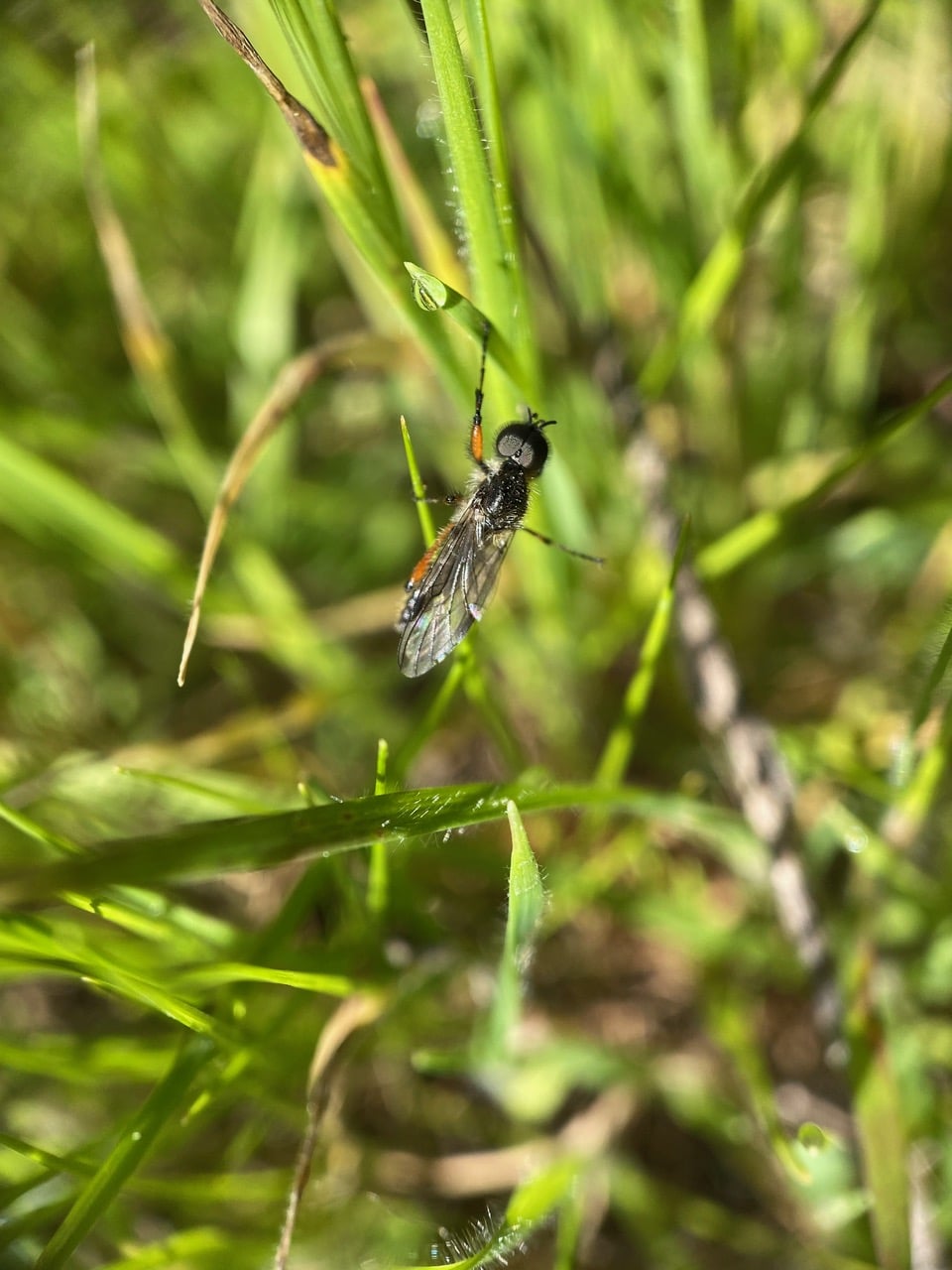
There’s movements in the short weedy grasses along Nimitz Trail. An insect is struggling to take flight.
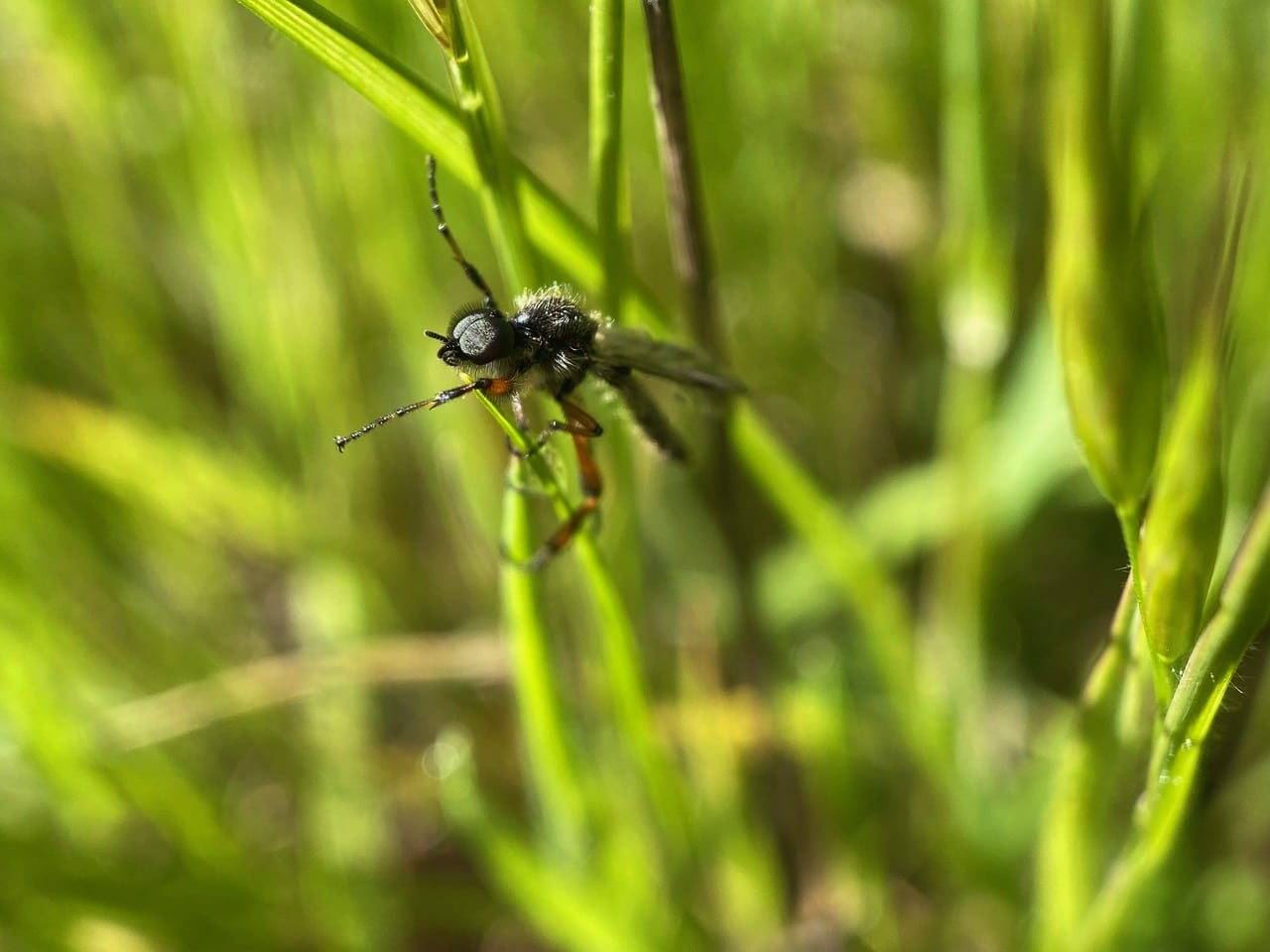
Its large compound eyes cover most of its head, meeting almost seamlessly on top of its head.

Ah, it’s a male March Fly, Bibio xanthopus (family Bibionidae).
March Flies (family Bibionidae) generally live in wooded areas and are often found on flowers – adults of some species feed on nectar, pollen, and honeydew, while adults of other species don’t feed at all; and in either case, they are very short-lived. They are considered important pollinators in orchards. They are also important food for other insects and spiders. The larvae feed en masse on rotting organic materials like leaves, wood, compost, and rich soil.
March flies exhibit extreme sexual dimorphism – the sexes are morphologically distinct. The female is usually more colorful, has small eyes on the sides of long, narrow head, while the all-black males have huge eyes that touch in the middle and are split in half horizontally. Scientists speculate that the split makes it easier for them to see the other males that are above and below them in a mating swarm. Males gather in swarms that can blanket the ground and low vegetation. Female are attracted to the party and select mates in the frenzy of fly bodies.
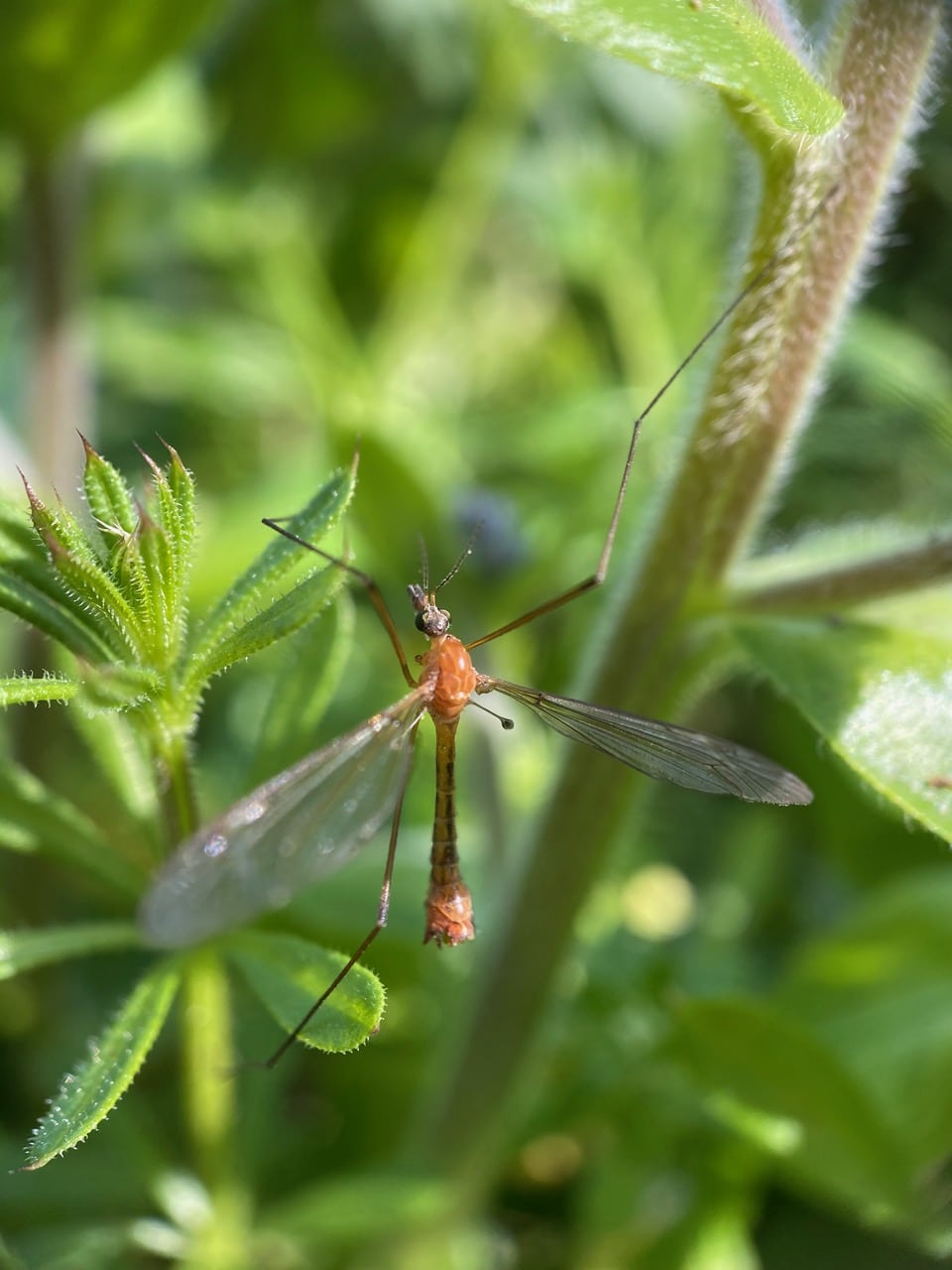
A Large Crane Fly (family Tipulidae) lands clumsily on a bedstraw. Gee, what happened to the fly – it only has 3 of its 6 legs, and only one of the two halteres! Note the lollipop-like structure under its right wing. That’s a haltere, the club-shaped organ that is modified second pair of wings of a Diptera (flies), and serves to maintain balance in flight.
Crane flies resemble oversized mosquitos. They typically have a slender body and long, stilt-like legs that are deciduous, easily coming off the body. They occur in moist, temperate environments such as vegetation near lakes and streams. Adults generally do not feed, but some species consume nectar and pollen. Larval habitats include all kinds of freshwater, semiaquatic environments. They generally feed on decaying plant matter and microbes associated with decomposition. Their activity is important in the soil ecosystem, as they process organic material and increase microbial activity. Larvae and adult crane flies are also valuable prey items for many animals, such as insects, spiders, fish, amphibians, birds, and mammals.
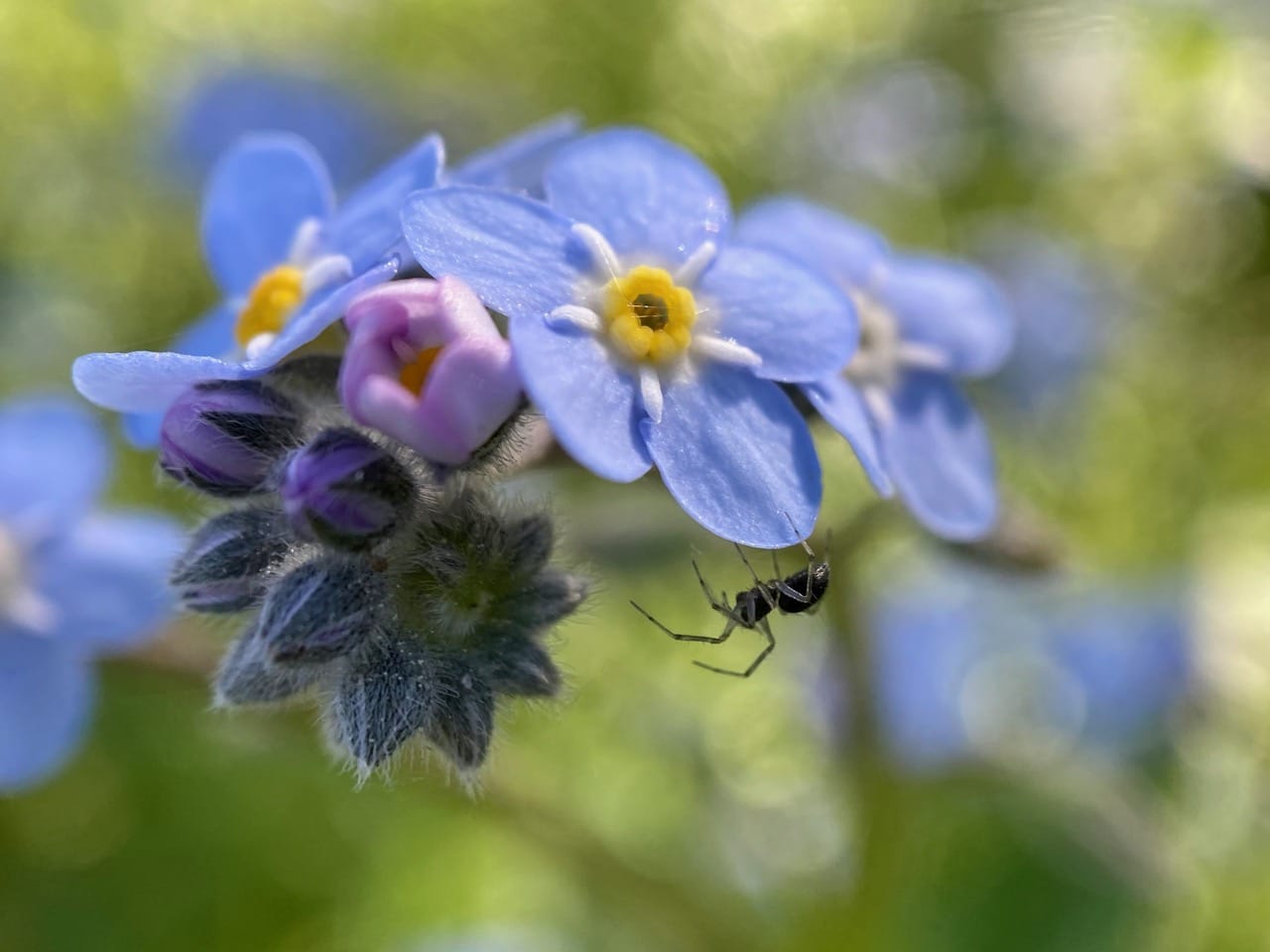
A Cobweb Spider hangs under a cluster of Forget-me-not flowers, Myosotis sp., spinning its tangled web.
Spiders in the family Theridiidae are called Cobweb Spiders. They make a messy, tangled scaffold with a central area consisting of a three-dimensional trellis of silk. From the web to the ground are vertical threads with sticky glue at the bottom. If an insect crawls against the thread it will break and the prey will hang in the air awaiting the attack of the spider. Although Cobweb Spiders are small, they are violent attackers that can take down prey much larger than themselves.

In this light, I can see parts of the spider’s silken scaffold that it has wrapped around the flowers.
Members of the Theridiidae family are also called Comb-footed Spiders because they have a “comb” on their last pair of legs. The comb is a series of serrated spines which they use to comb out the silk from the spinnerets. Theridiids are cribellate spiders with a specialized organ called a cribellum, which makes silk with “mechanical stickiness” instead of the liquid glue of other spiders. Unlike a typical spinneret, the cribellum has thousands of tiny spigots, all producing extremely thin threads that the spider combs into a single, wooly fiber. Instead of glue, nanofibers from this silk seem to trap prey by fusing with a waxy coating on an insect’s body.
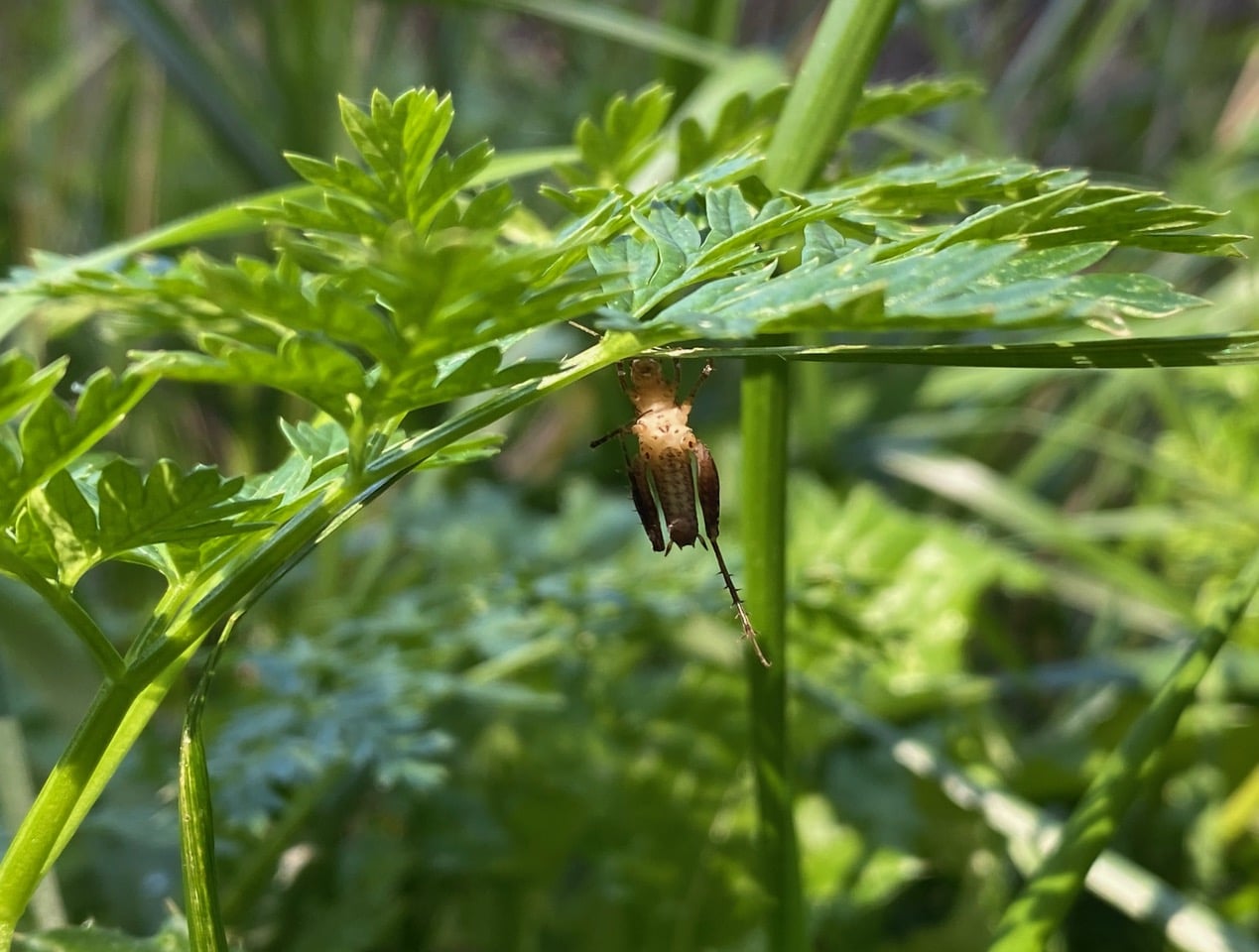
Who’s that insect hanging on a grass blade under a Poison Hemlock leaf?
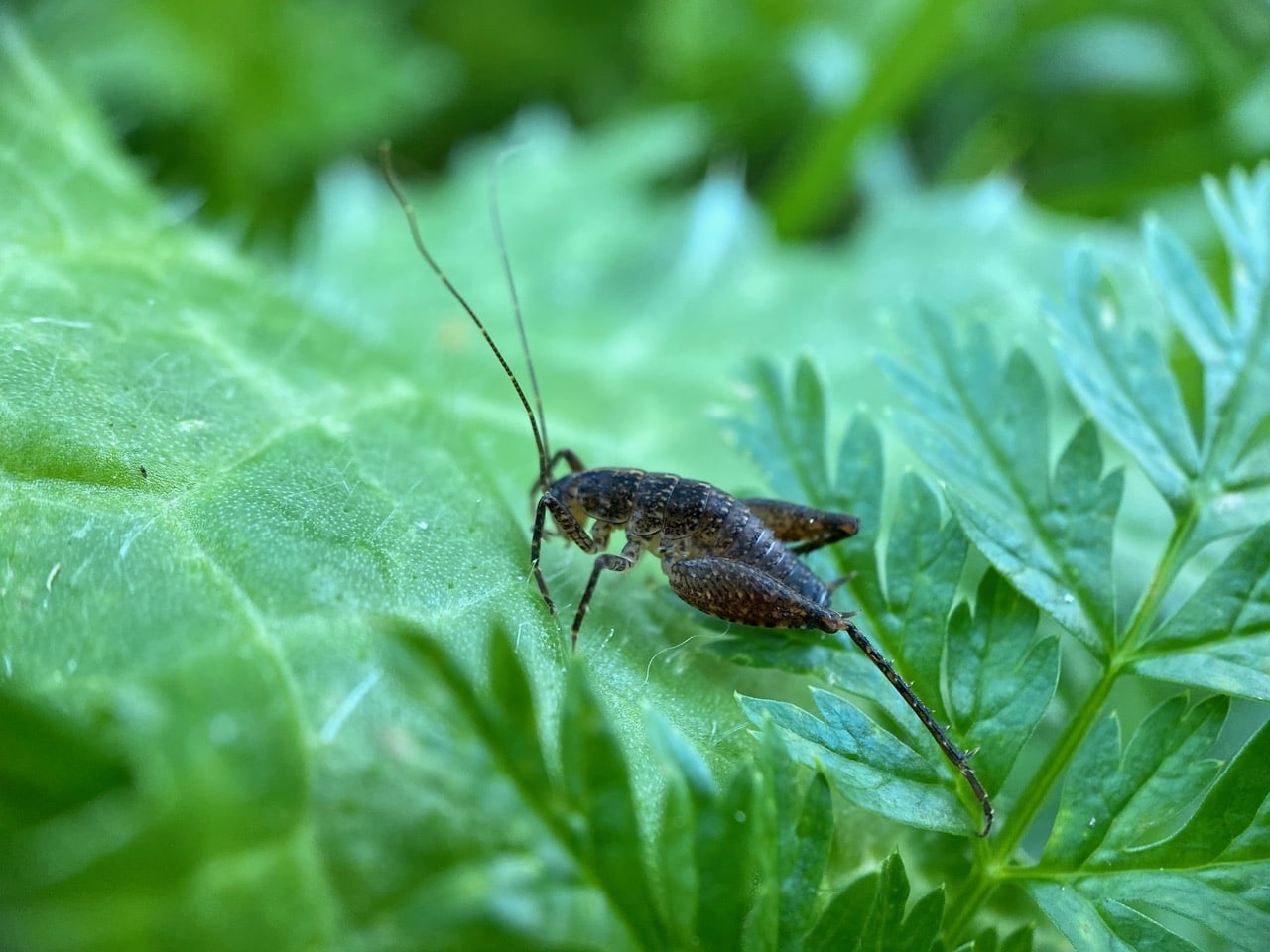
As I close in for a photo, the insect drops to a Thistle leaf below. It is a Camel Cricket (family Rhaphidophoridae).
Most camel crickets have very large hind legs with “drumstick-shaped” femora and long, thin tibia, and long, slender antennae. They are brownish in color and humpbacked in appearance, always wingless. Some species are cave dwellers. Most of these nocturnal insects inhabit cool, damp environments, such as rotten logs, stumps and hollow trees, and under damp leaves, stones, boards, and logs. The cricket’s distinctive limbs and antennae serve a double purpose. Typically living in a lightless environment, or active at night, they rely heavily on their sense of touch, which is limited by reach. Given their limited vision, these crickets often jump to avoid predation. Rhaphidophoridae are primarily omnivores/detritivores, feeding on fungus, bits of decaying plants and animals, plus the occasional live insect. Unlike other members of Orthoptera, Camel Crickets do not have the ability to make sound, or to stridulate. They are silent.
Camel crickets are important members of the ecosystem; as decomposers they break down food items into smaller pieces for smaller animals, and they are a major food source for insectivores such as voles, moles and other nocturnal animals.