

Pollinator Post 3/13/24 (1)
The day promises to be rainless and clear. Excited, I arrive at Inspiration Point a little before 10 am, and am surprised that the car’s thermometer registers a chilly 45 degrees F!
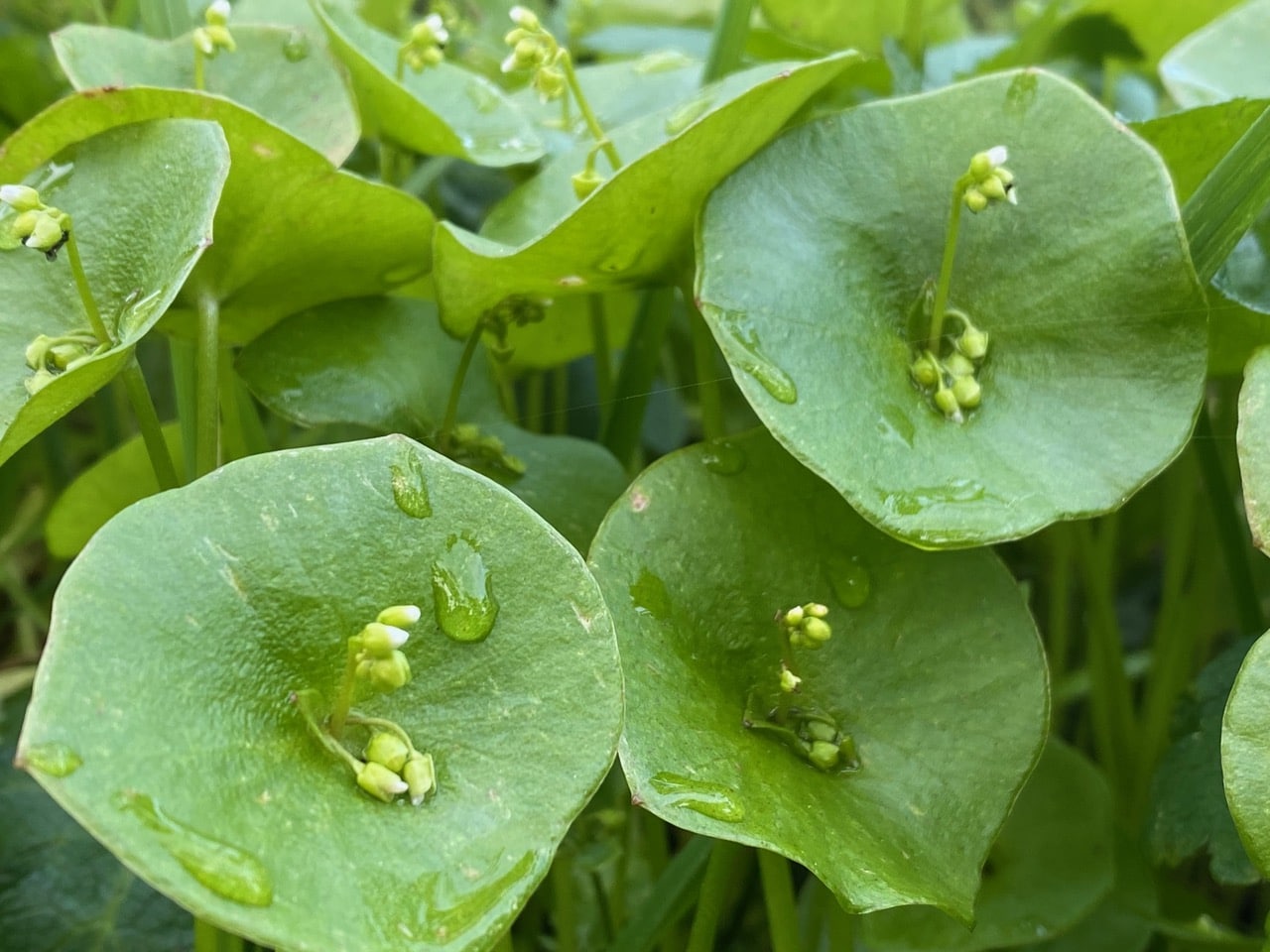
Along the trail, every leaf of Miner’s Lettuce, Claytonia perfoliata is bearing a posy of little white flowers or buds in the center.
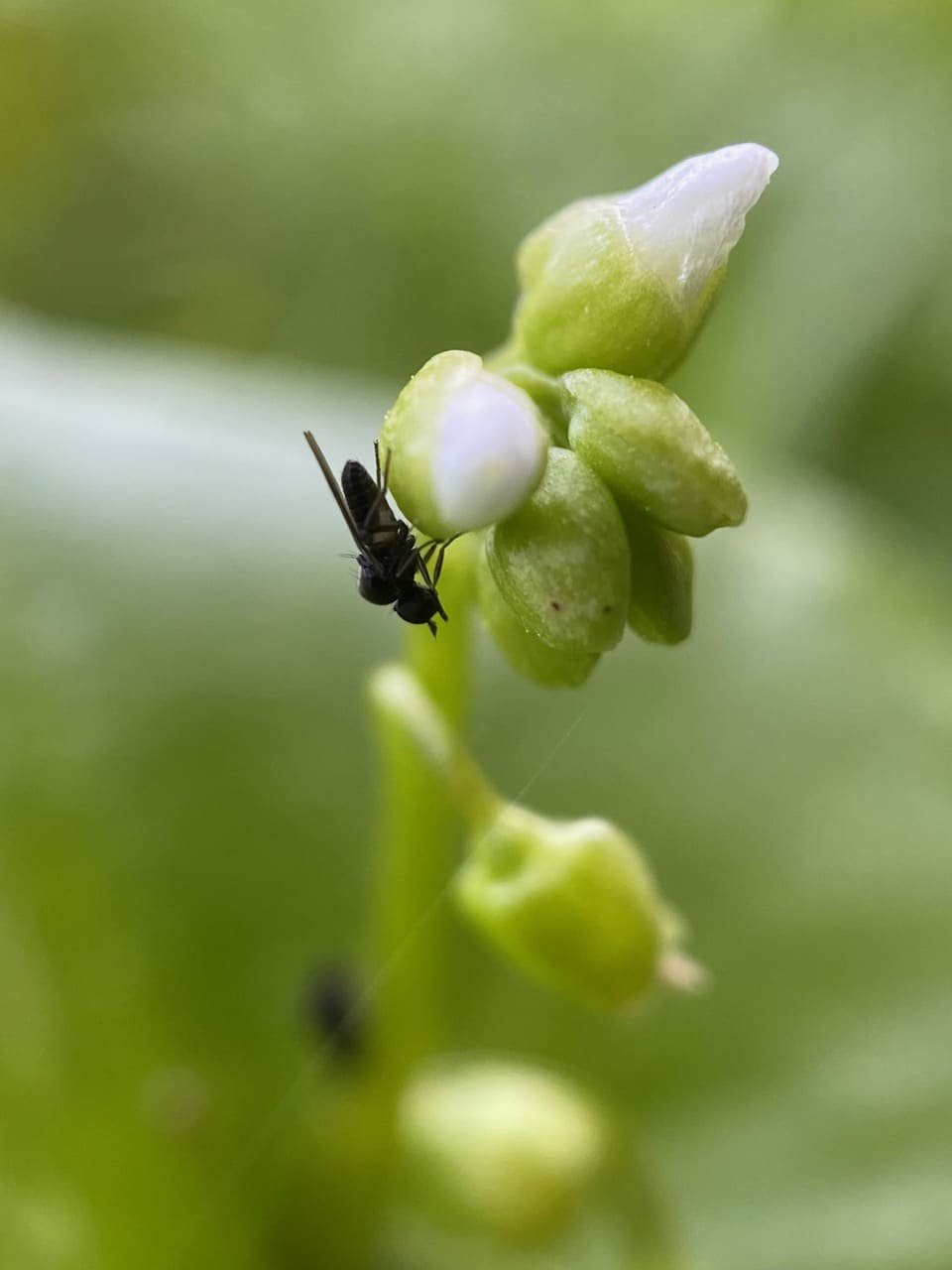

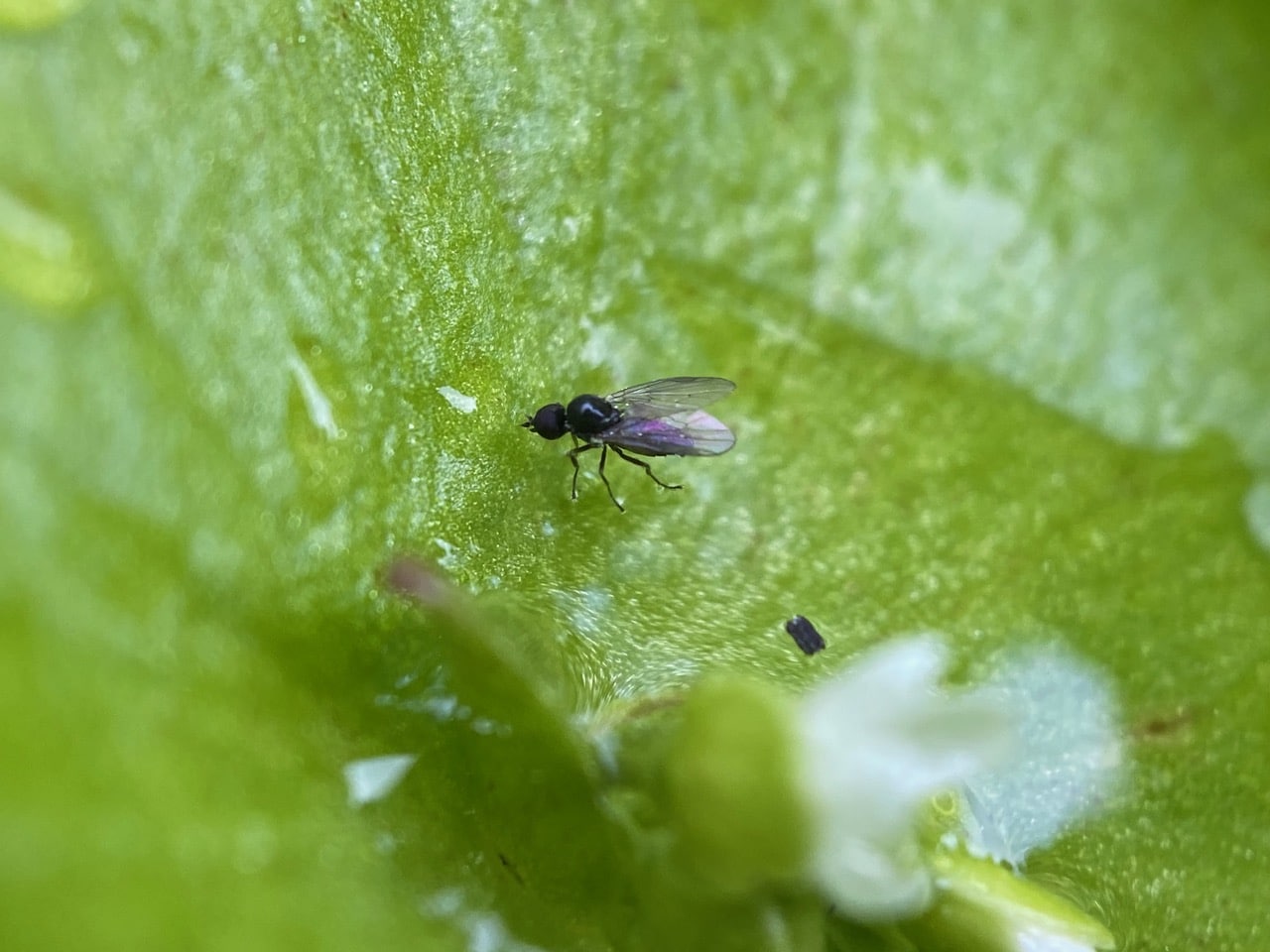
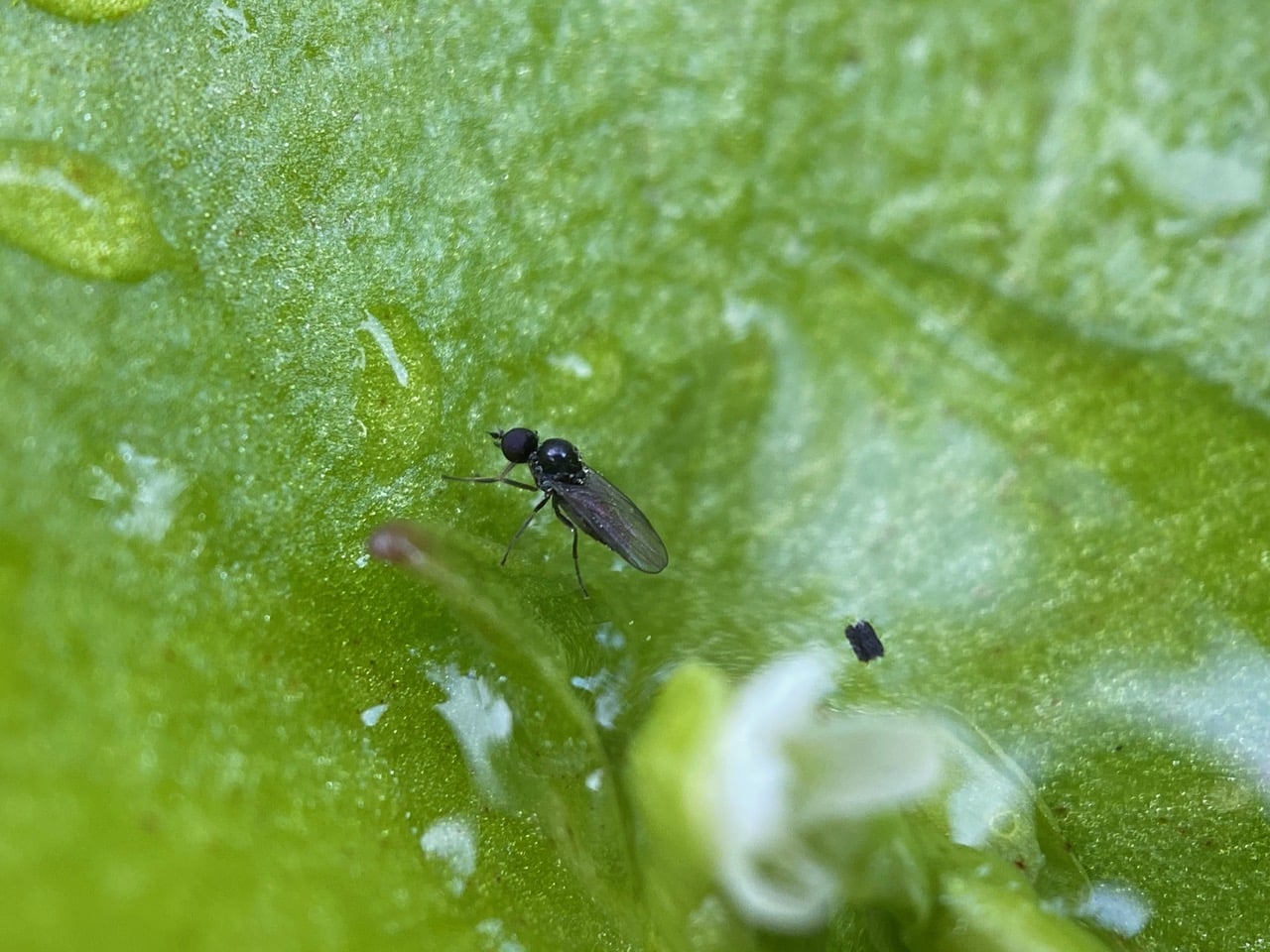


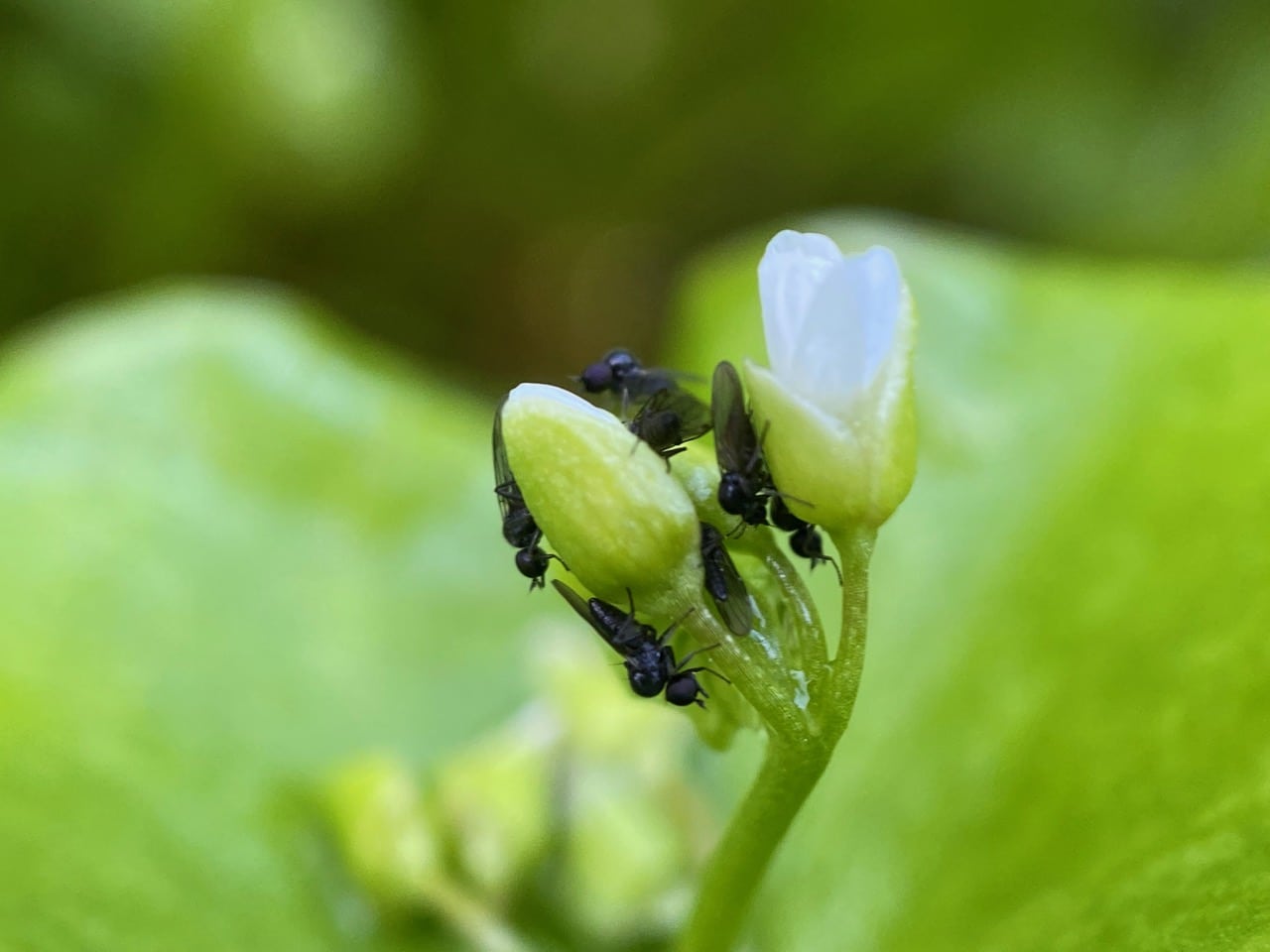

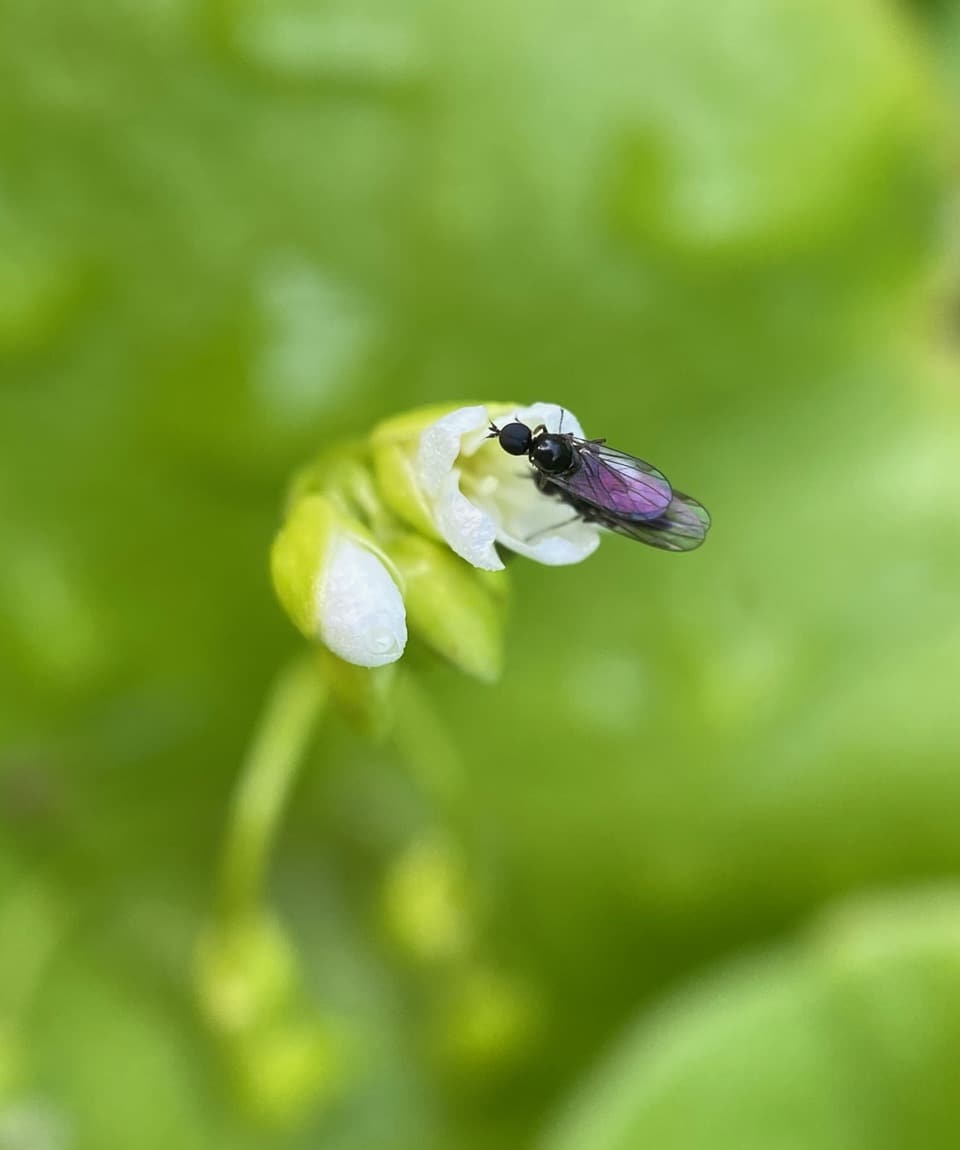


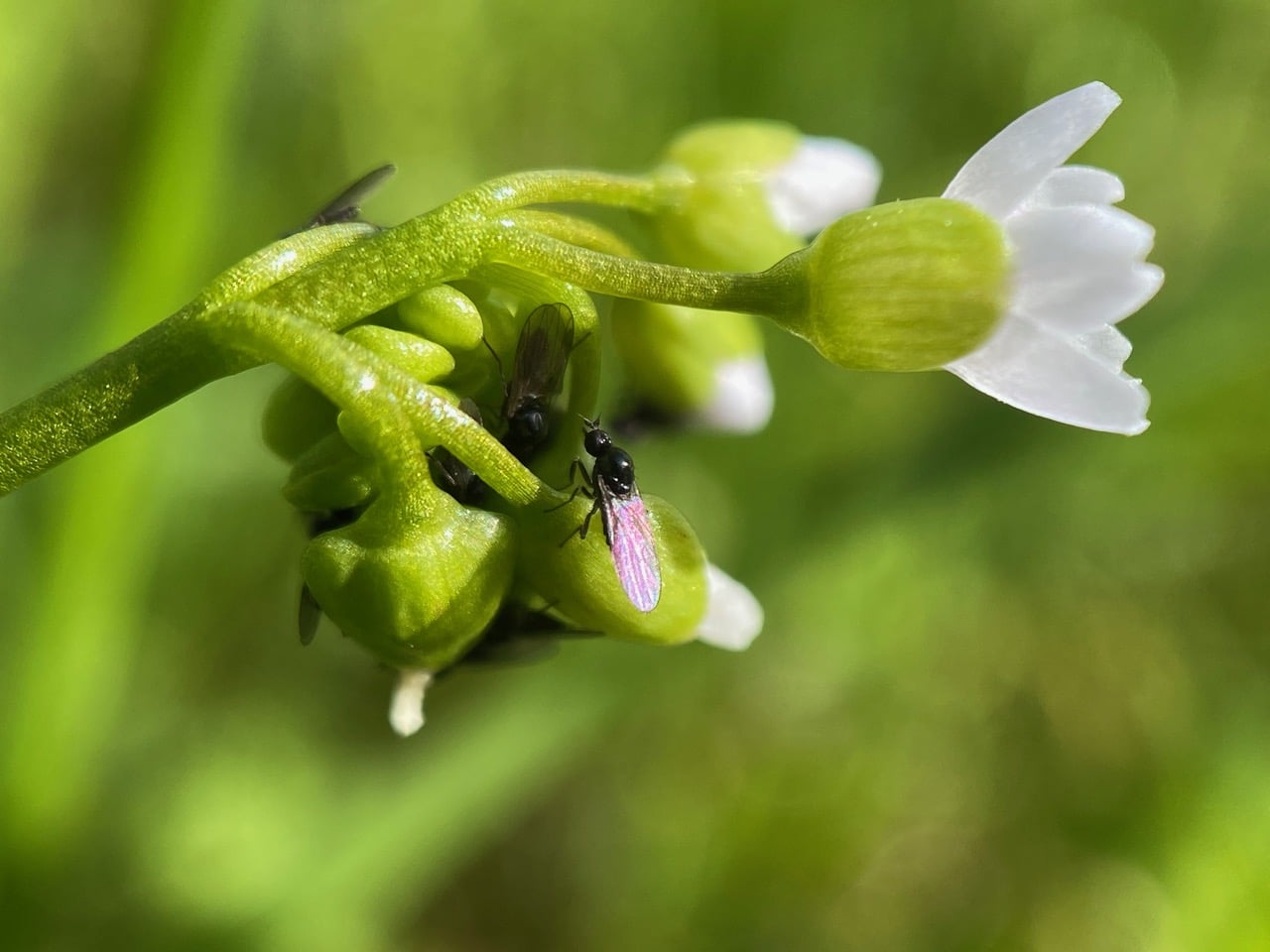

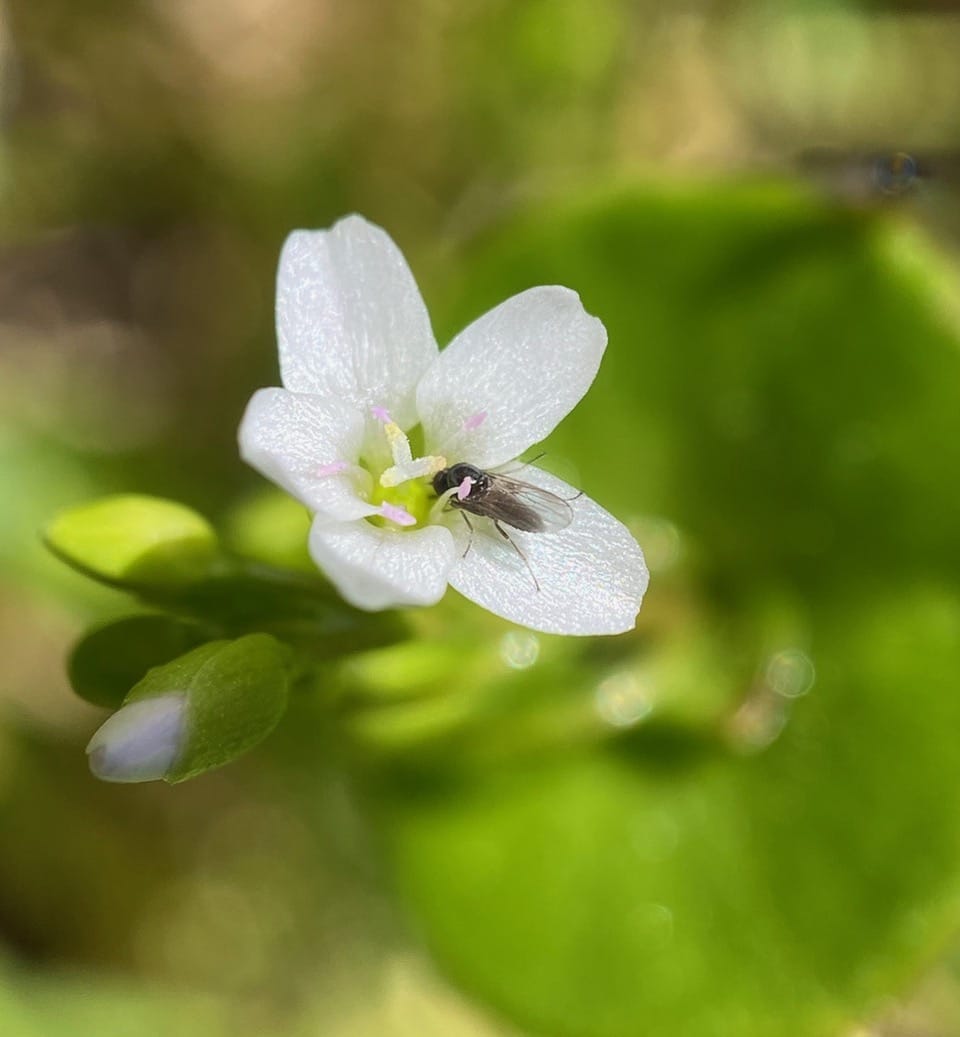
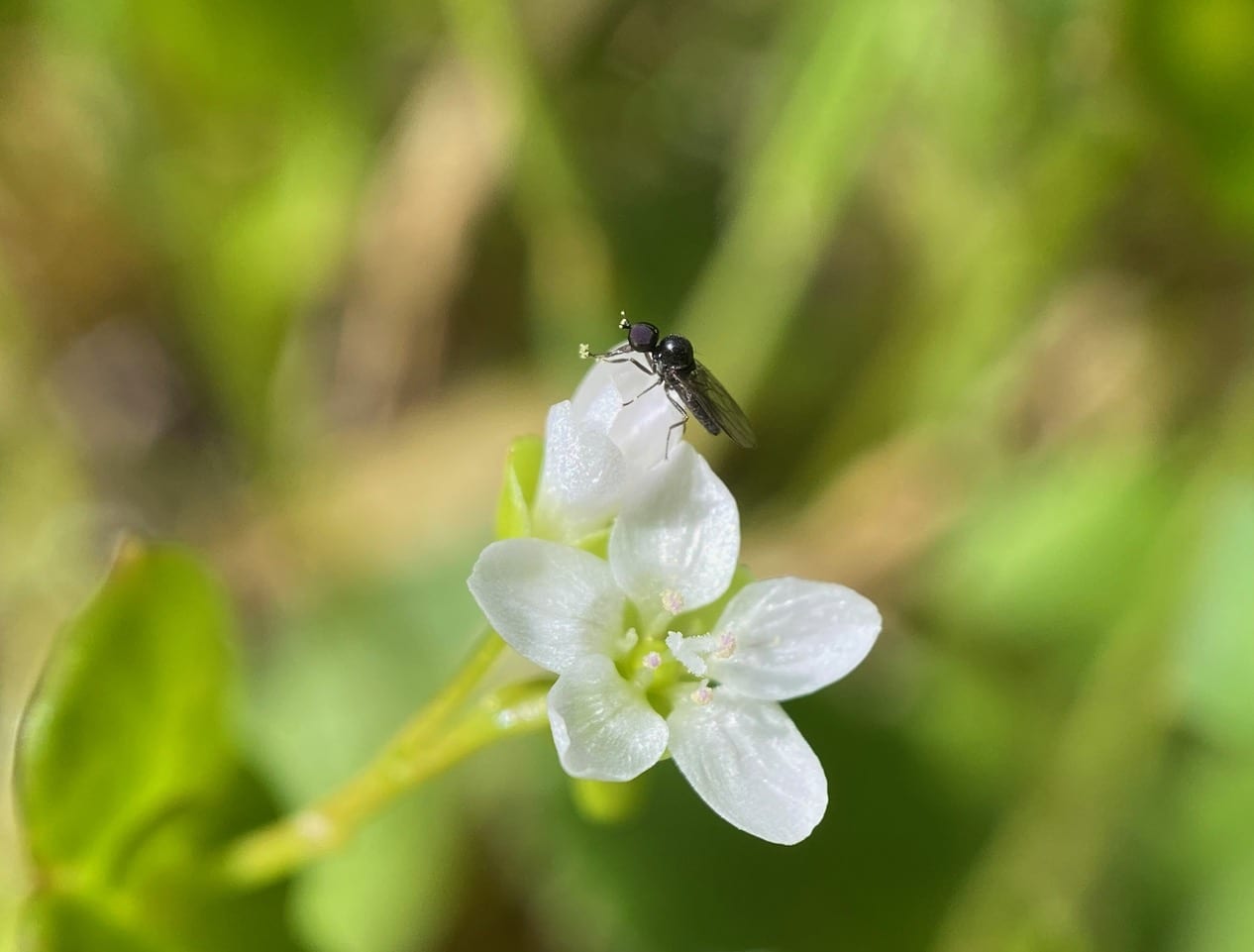
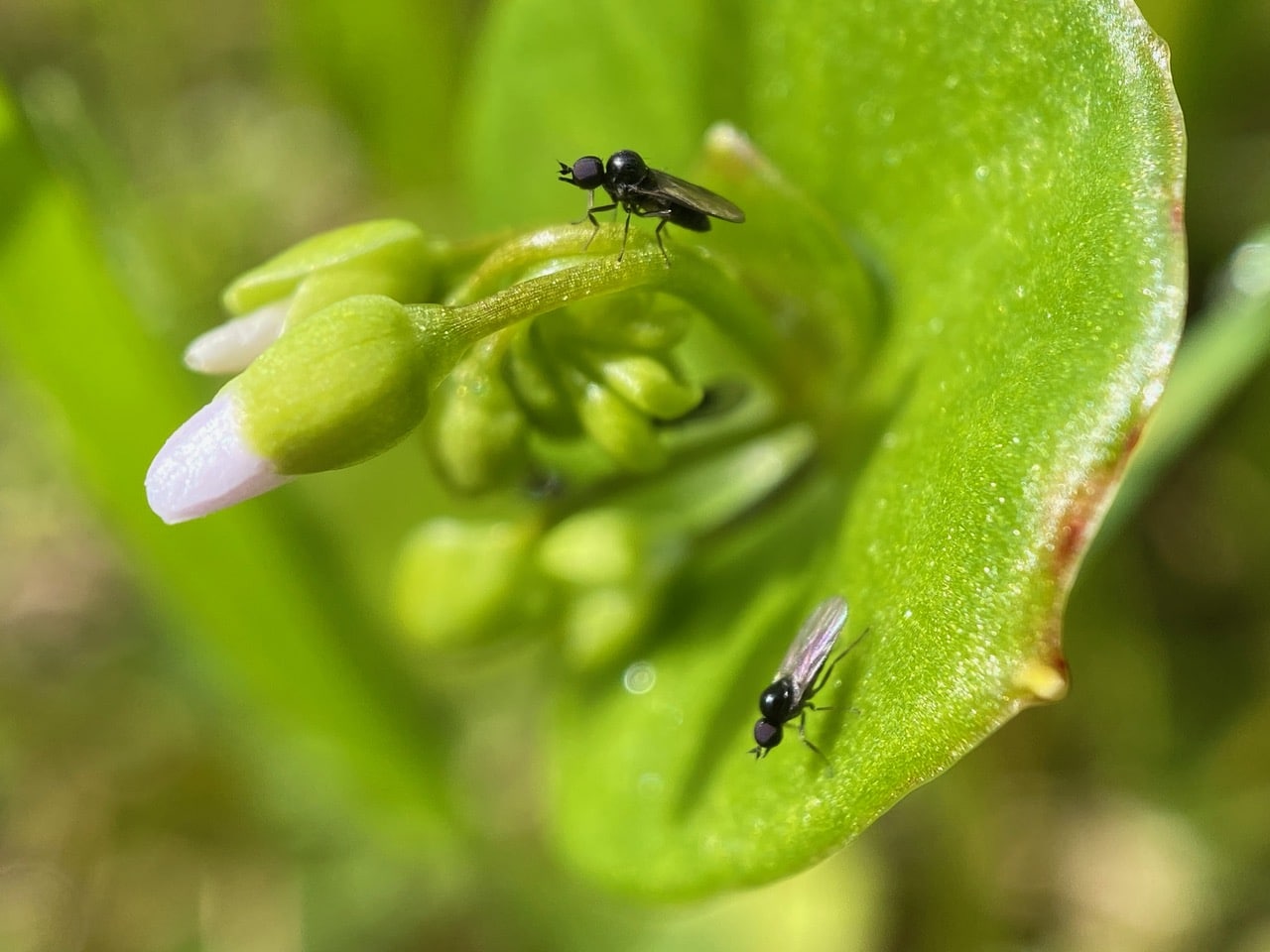
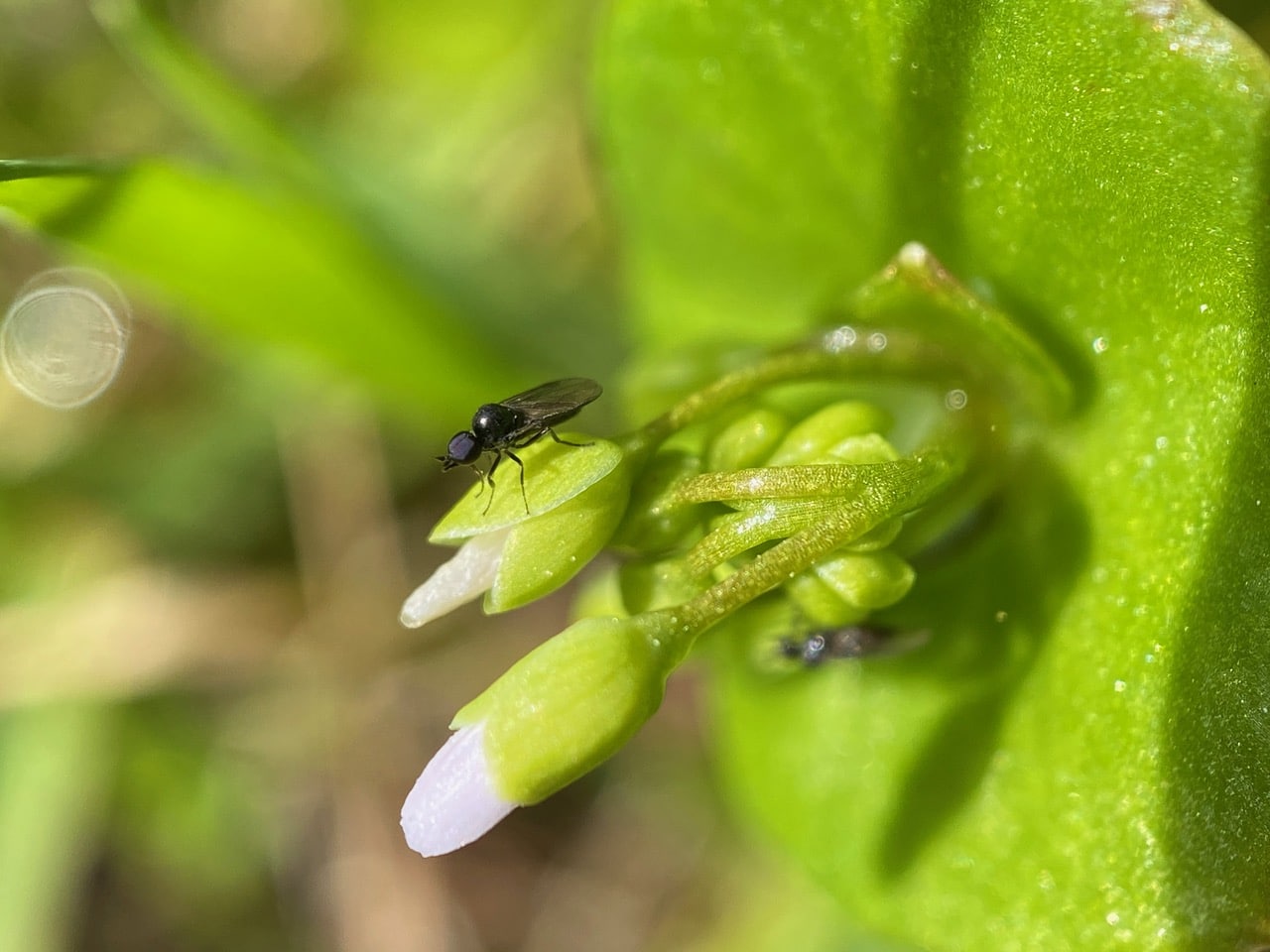
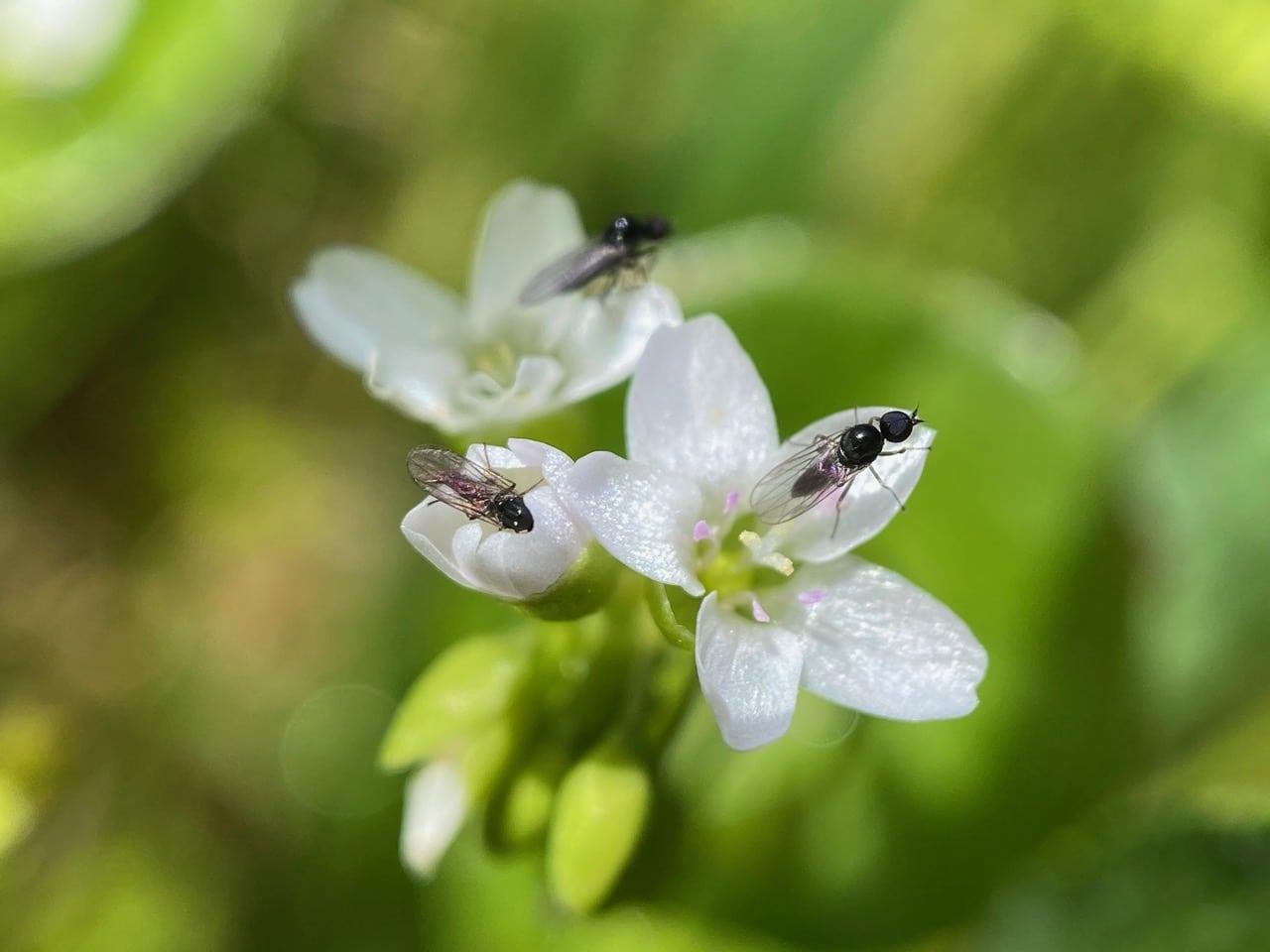




Many small dark insects are perched motionless among the flower buds. I recognize them as the Hybotid Dance Flies (family Hybotidae).
Measuring merely 2-3 mm, these flies have large compound eyes that seem to take up most of their spherical heads. These flies belong to the superfamily Empidoidea and were formerly included in the Empididae as a subfamily. Empididae generally have a thick beak pointing down, while Hybotidae have a thinner beak, or a thick beak pointing forwards or diagonally. Some crucial wing venation further distinguishes the two families. Precious little is known about the life cycle and biology of Hybotids because they are not considered of economic consequence. Since their forelegs are generally not raptorial, I wonder if they’re predaceous like the Empidids. I have seen the Hybotids visit flowers for nectar and pollen, notably on Soap Plant, Miner’s Lettuce, California Saxifrage, and Wild Geranium, and I believe they may contribute to the pollination of these flowers.
A Hybotid Dance Fly has fallen into the pool of water that has collected in the depression in the middle of the perfoliate leaf. Amazingly it is small and light enough to walk on the water, thanks to surface tension…
The fly makes it to shore, none the worse for wear. For an insect that is active during California’s wet winter/early spring, that is a useful survival skill!
There’s quite an aggregation of the flies among the flower buds. Perhaps they have been sleeping overnight here sheltered from the cold?
Here’s another aggregation. The flies are obviously sleeping in, daylight-saving not withstanding.
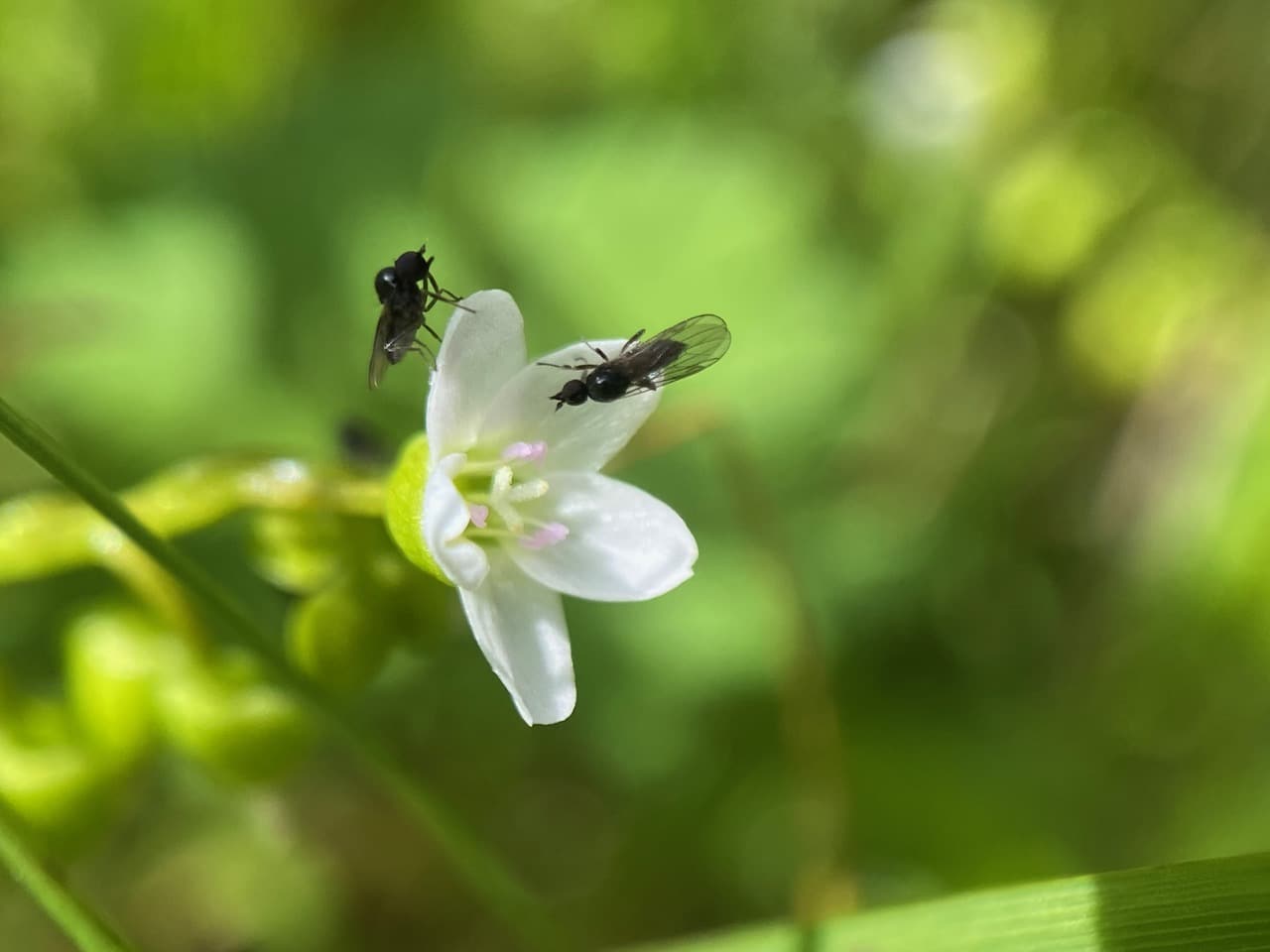
I thought these two are mating, but they are simply converging on the same freshly opened flower.
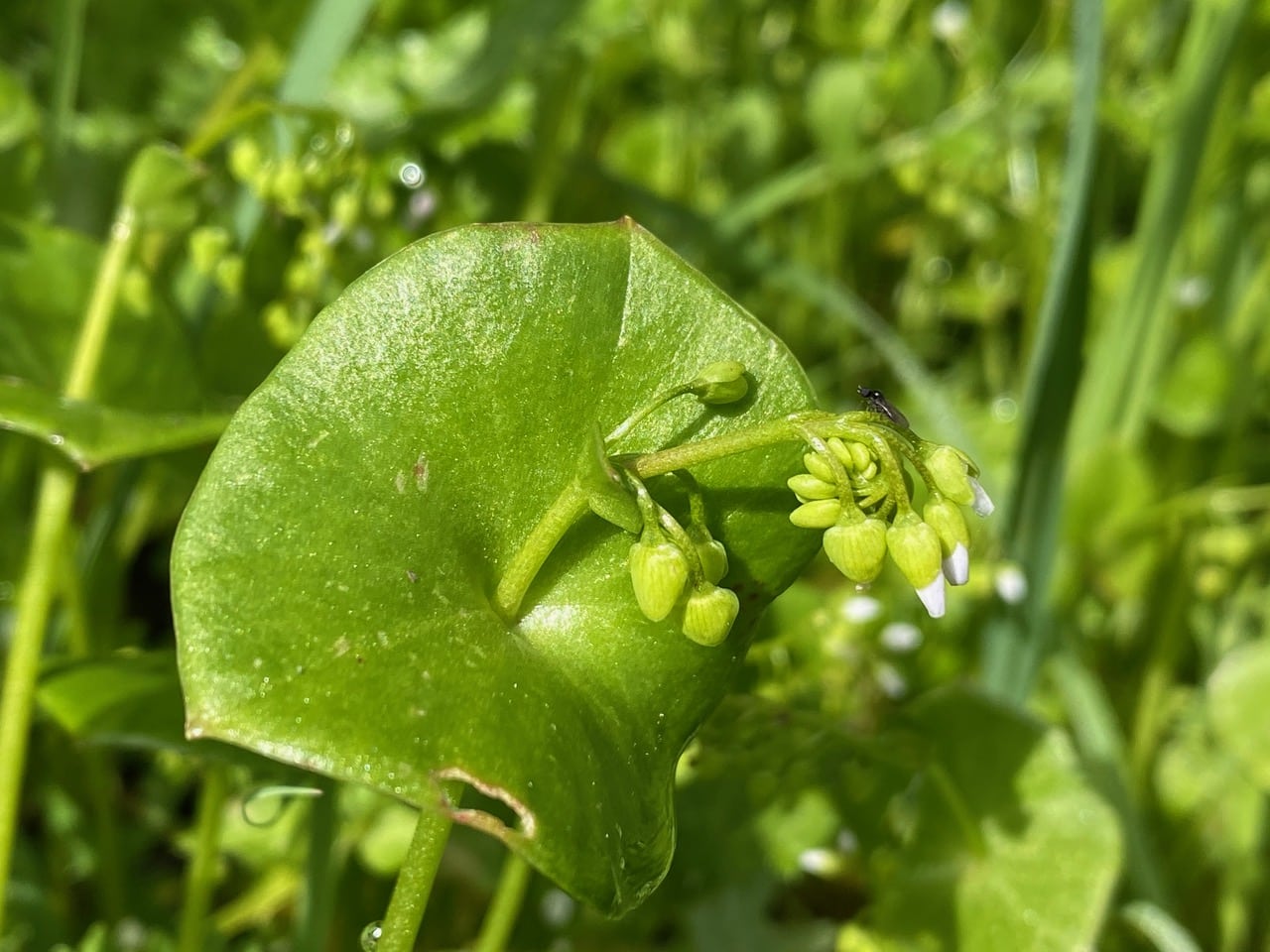
This Miner’s Lettuce has obviously been pollinated. Some fruits are already developing at the bottom of the pedicle. The fruit is a green egg-shaped capsule enclosed by two sepals. The pedicel continues to lengthen producing more flowers as the season progresses.
Do you see the Hybotid Dance Fly on top of the flower buds?
Here it is close-up.
Another aggregation of sleeping Hybotid Dance Flies hidden within the cluster of Miner’s Lettuce flower buds. Such a cozy relationship between the plant and its pollinators!
As the morning warms up, the Hybotid Dance Flies become more active. Many are seen feeding on the pollen of the Miner’s Lettuce flowers.
This individual is reaching down to feed on nectar at the base of the flower.
This fly has just emerged from a Miner’s Lettuce flower with pollen stuck to its antennae and leg.
With these pictures, iNaturalist is able to narrow down the ID to genus Anthalia (family Hybotidae).
The Hybotid Dance Flies are the perfect size to serve as pollinators for the Miner’s Lettuce – they are a good match! I notice from these photos that these flies might be dimorphic – the males having larger eyes than the females. I think the one on the far right is probably a female.
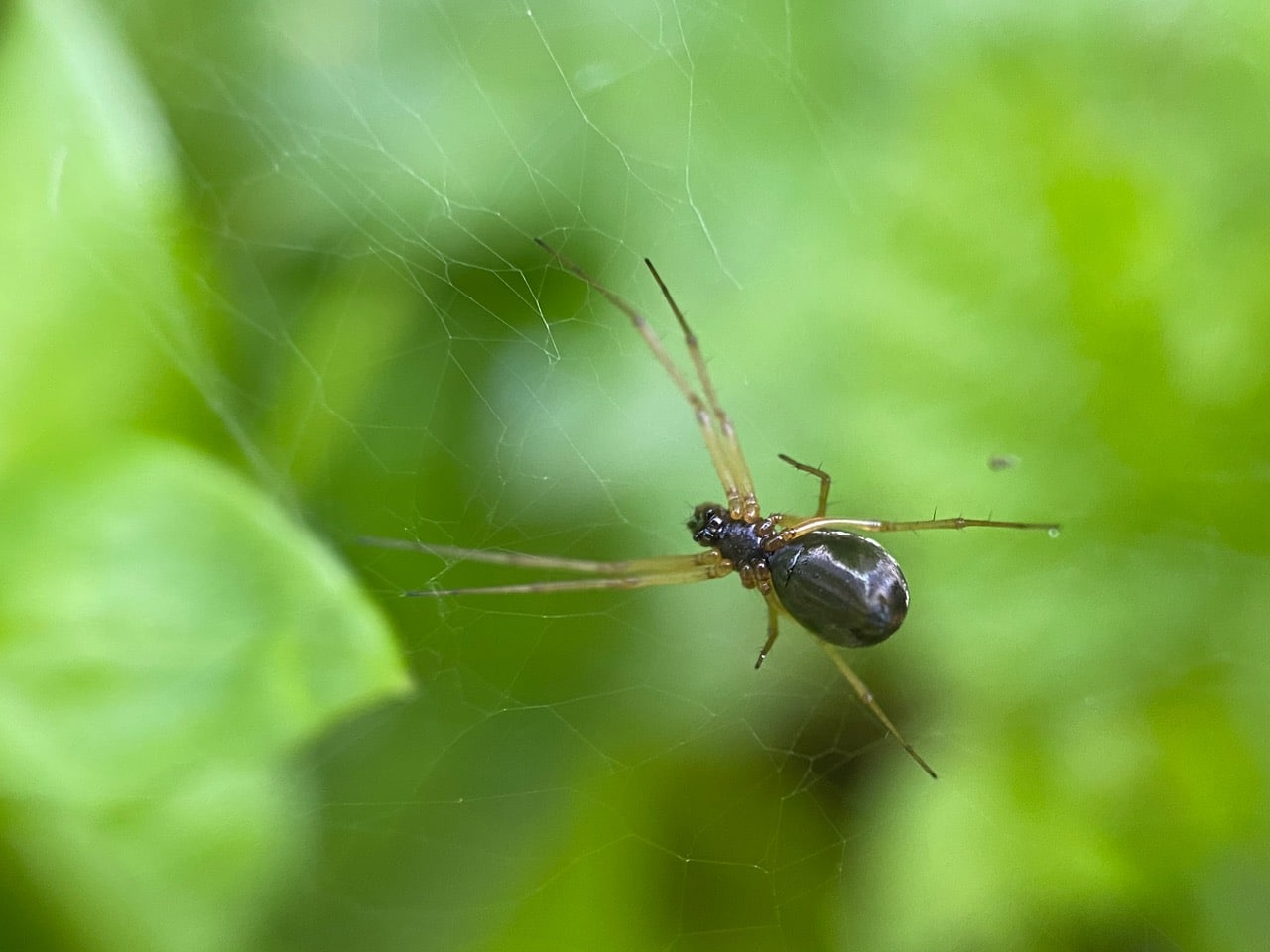
A Sheet-weaver Spider (family Linyphiidae) is weaving her web between the Miner’s Lettuce leaves. The spider probably feeds on many of these tiny flies that frequent the flowers.
Growing among the Miner’s Lettuce is the Common Chickweed, Stellaria media, with similar sized white flowers. These too are frequented by the Hybotid Dance Flies.
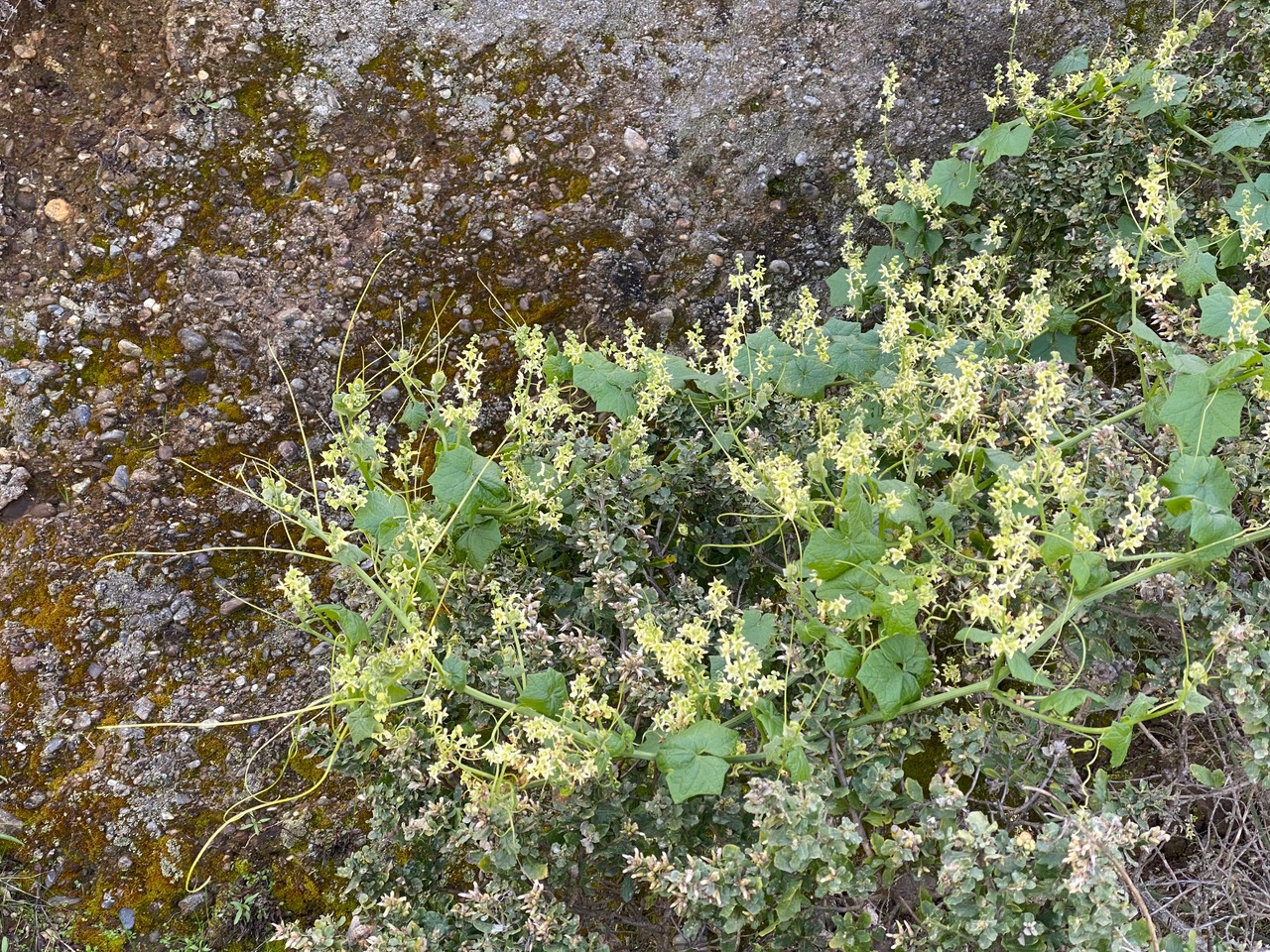
A California Manroot, Marah fabacea is blooming profusely on top of a Coyote Brush next to a rock wall.
Not far away, a few Blue Dicks, Dipterostemon capitatus have sent out their lovely blue flowers on long stems. Do you see a Hybotid Dance Fly on the flower bud in the back? These flies seem to be everywhere today!
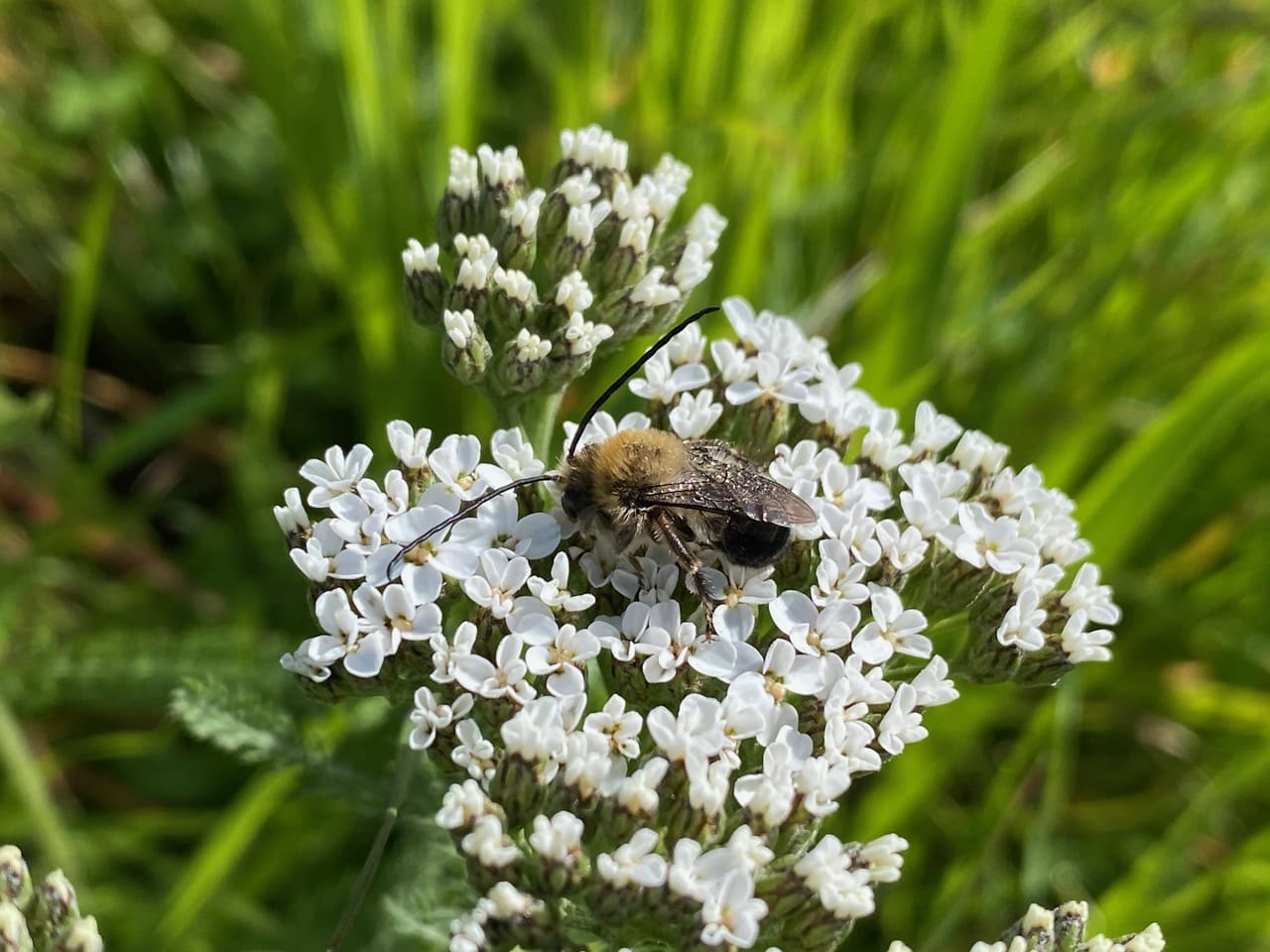
I clamber up a steep bank to photograph a freshly blooming Yarrow, Achillea millefolium, my first for the year, and am delighted to find a Spring Longhorn Bee, subgenus Synhalonia, genus Eucera (family Apidae). It is fast asleep, dew drops still clinging to its wings. Judging by the long antennae, the bee is a male. Just a couple of days ago, I saw one of these visiting the Manzanita flowers at the Regional Parks Botanic Garden, but it was too fast for me to get a picture. So much easier to photograph a sleeping bee!
The name Eucera is Greek for “well-horned”, a reference to the long antennae of the males. Only one subgenus, Synhalonia occurs in the United States and Canada, and are especially common in the west. These fast flying bees are hairy and generally large. Males have extraordinarily long antennae. Eucera includes both specialist and generalist bees. Specialists often limit themselves to the flowers of the pea family. Eucera are among the first to emerge in the spring and most fly exclusively in the spring. They are solitary ground-nesters. Each female excavates her own nest, and provides for her own young. Nest entrances have a mound of excavated soil heaped symmetrically around them. Since males do not build nests, they sleep out in the open, usually on flowers, sometimes in aggregation with other males, which help them maintain higher body temperature, or as a dilution effect against predators.