

Pollinator Post 3/11/26
I visit Stefanie’s garden in San Leandro this morning. It is well-tended and easy to access, and Stefanie’s choice of native plants usually attract a great diversity of insects. To me, her garden is a model of plant and insect health in general.








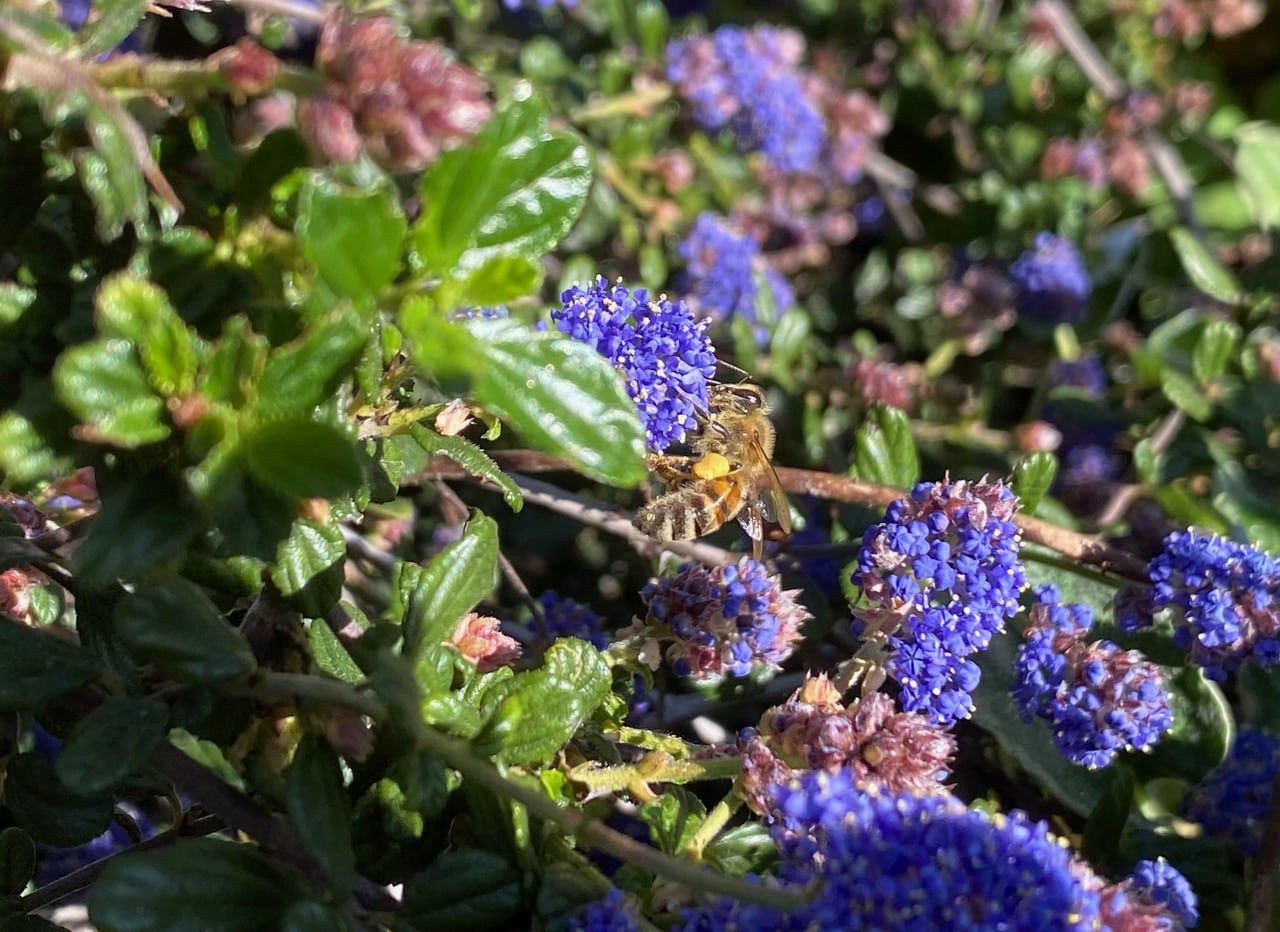
The blooming Ceanothus is much loved by the Honey Bees, Apis mellifera (family Apidae). The workers are carrying large loads of pollen. The fragrant flowers also attract some bumble bees, but not in the numbers I would expect this time of year.
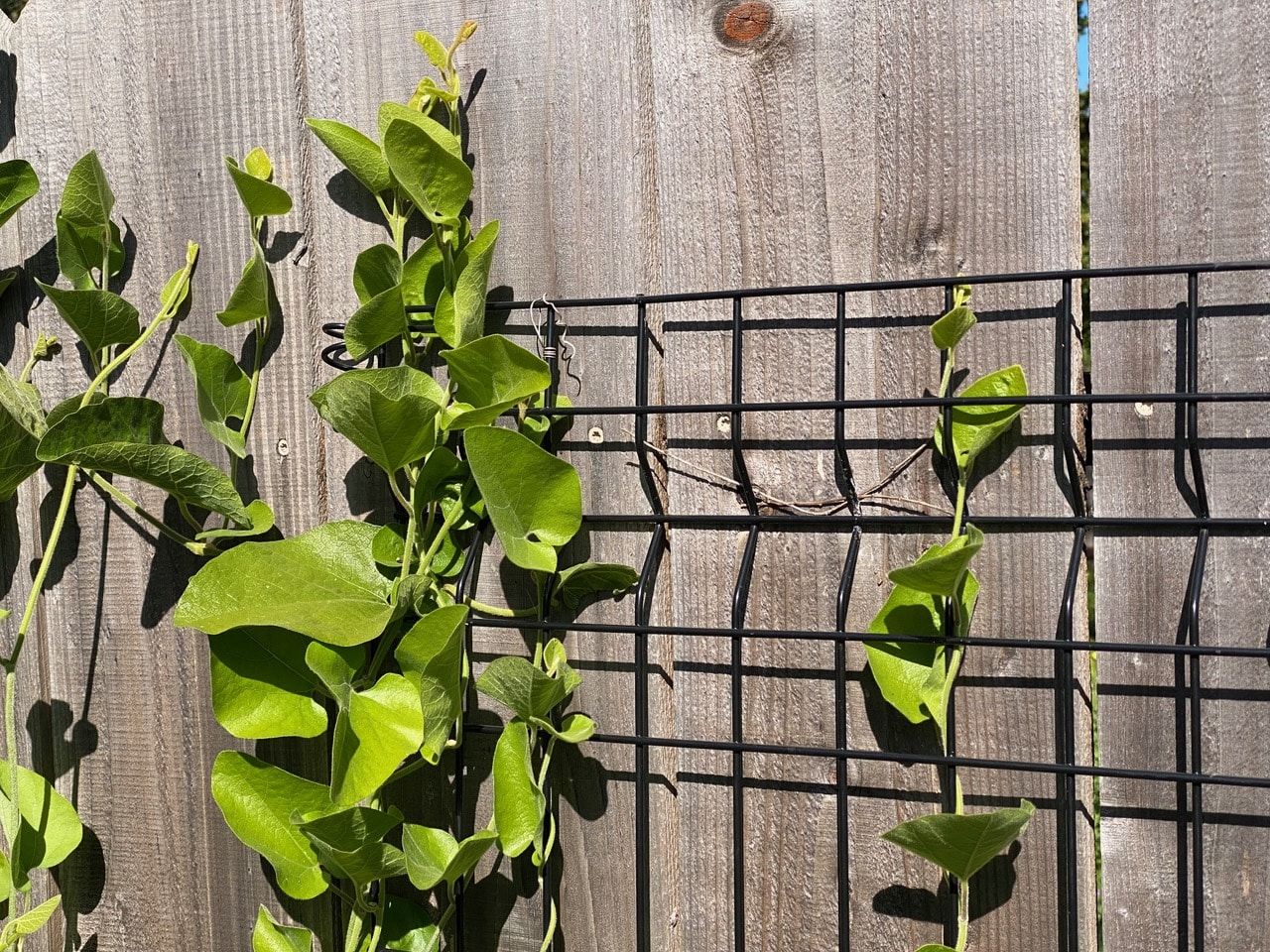
The exuberant California Pipevine, Aristolochia californica has climbed up the new trellis by the fence. Interestingly there are no flowers. The vine usually produces leaves after blooming. Did the plant bloom well earlier? The absence of feeding damage and frass on the leaves tells me I don’t need to look for caterpillars of the Pipevine Swallowtail. I search hopefully for the orange eggs, but there was none.
The California Pipevine, Aristolochia californica is a deciduous vine with unique, pipe-shaped flowers that thrives along streams in Northern California. The plant is the exclusive larval host plant for the California Pipevine Swallowtail, Battus philenor hirsuta (family Papilionidae). The caterpillars rely on this plant for food, and sequester toxic aristolochic acid, making them unpalatable to predators. The flowers of California Pipevine emit an odd smell that attracts Fungus Gnats (family Mycetophilidae) which serve as pollinators for the plant.
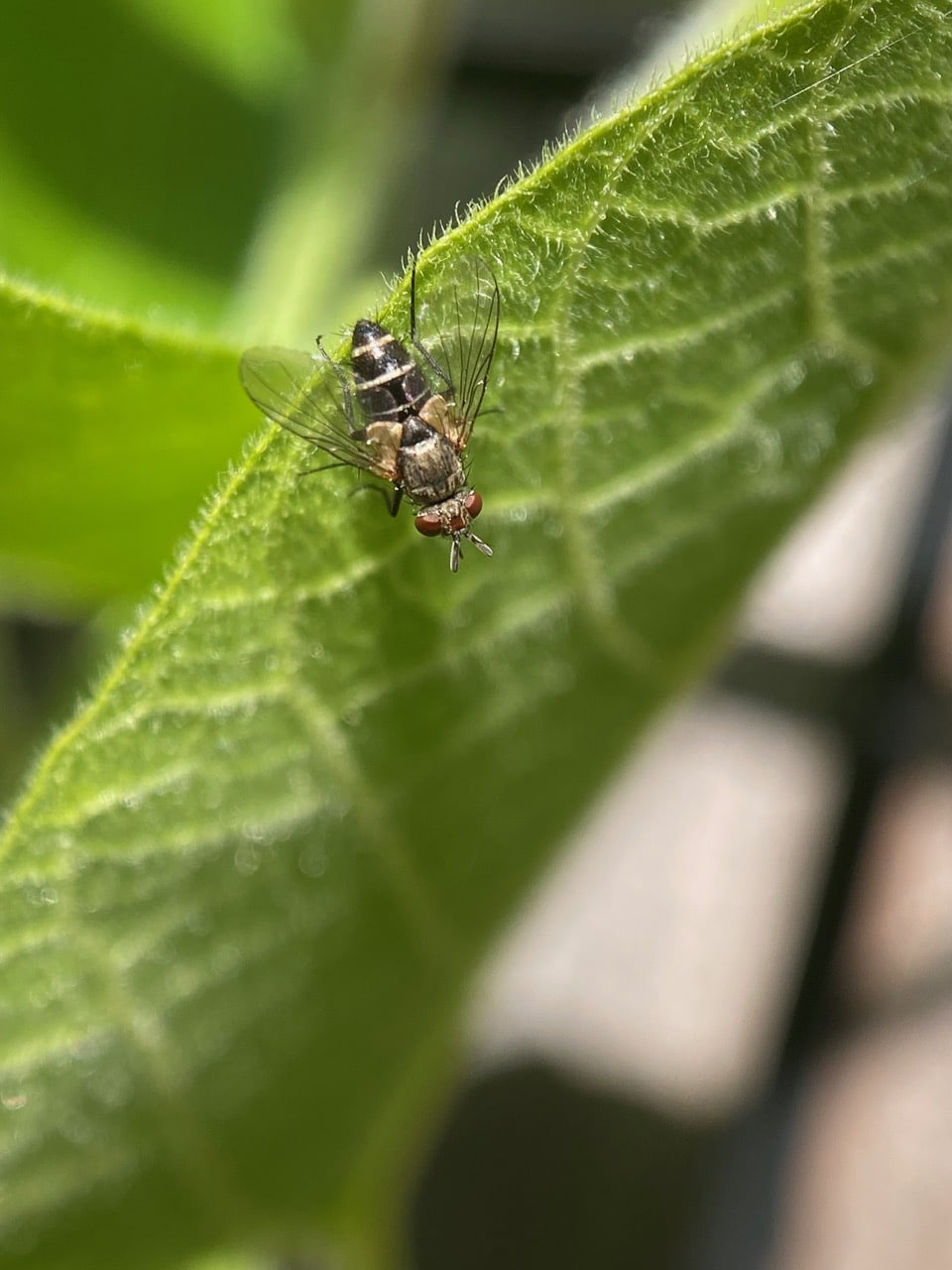
A small fly lands on a California Pipevine leaf. iNaturalist has helped identify it as a Bristle Fly, Clausicella sp. (family Tachinidae).
Clausicella is a genus of parasitic flies in the family Tachinidae. The fly is found in the United States and most of Canada. Clausicella species are endoparasitoids that primarily target larvae of moths in the families such as Pyralidae, Noctuidae, Tortricidae, and Olethreutidae. The flies are ovolarviparous endoparasitoids, with females depositing eggs externally on or near potential host habitats. These eggs hatch immediately into mobile first-instar larvae, often referred to as planidia, which actively search for and penetrate suitable hosts. Once inside the host, the parasitoid employs a koinobiont strategy, allowing the host to continue development while the three larval instars feed internally. The mature larva ultimately kills the host and exits to pupate, often within the host’s cocoon or pupal case. Clausicella larvae develop solitarily, with only one individual completing maturation per host as competing larvae typically fail to survive.
White, foamy masses have appeared on the foliage of California Goldenrod, Solidago velutina ssp. californica. It’s Spittlebug time!
Spittlebugs, also known as Froghoppers belong to the superfamily Cercopoidea within the order Hemiptera (true bugs). While sometimes generally referred to as the family Cercopidae, they are scientifically divided into several families, primarily Aphrophoridae (common spittlebugs), Cercopidae (froghopper), and Clastopteridae.
Why the common name of “spittlebug”? The nymphs (immatures) of these bugs create foam masses on plants in which they live and feed. Like the adults, the nymphs use their piercing, sucking mouthparts to feed on plant juices. The nymph produces a cover of foamed-up plant sap reminiscent of saliva, hence the common name of spittlebug. Whereas most insects that feed on sap feed on the nutrient-rich fluid from the phloem, Spittlebugs tap into the much more dilute sap flowing upward via the xylem. The large amount of excess water that must be excreted and the evolution of special breathing tubes allow the young spittlebug nymphs to grow in the relatively protective environment of the spittle. Symbiotic bacteria in the insects’ digestive system provides them with the essential amino acids that their diet lacks. The foam serves a number of purposes. It hides the nymph from the view of predators and parasites, and it insulates against heat and cold, and protects the delicate nymphs from desiccation. Moreover, the foam has an acrid taste that deters predators.
Unlike their young, adult spittlebugs (also known as Froghoppers) are efficient flyers and hoppers, feeding on diverse plant species. They pierce plant stems to feed on xylem. To get enough nutrients, they consume massive quantities of sap, drinking up to 280 times their body weight daily, resulting in high waste excretion. Froghoppers can cause damage by distorting plant leaves and causing shoot tips to die back.
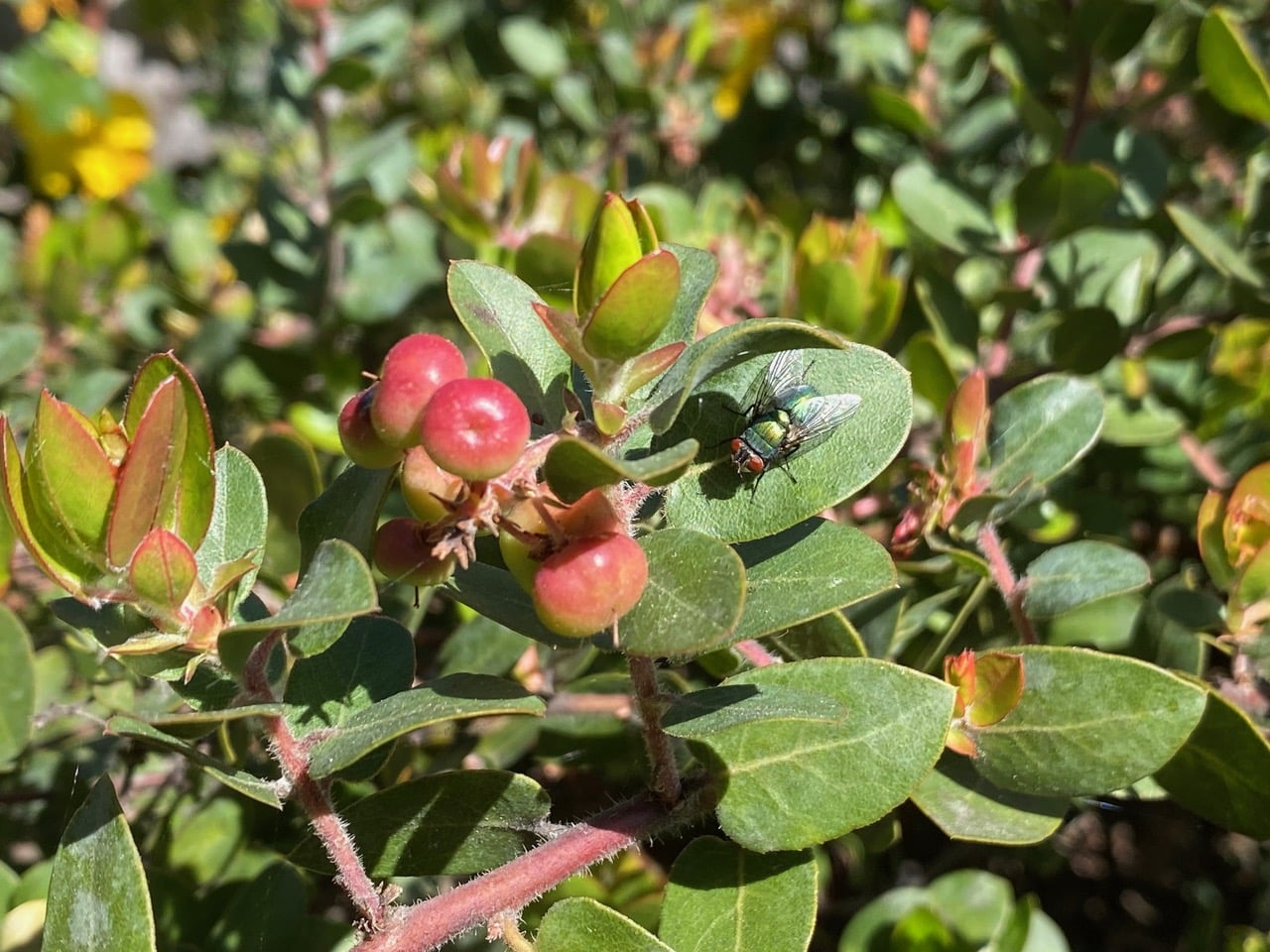
Luscious “little apples” have appeared on the manzanitas. Manzanita is a common name for many species of the genus Arctostrphylos. The word manzanita is the Spanish diminutive of manzana meaning “little apples”. Manzanita fruit is technically a drupe, which means it has a large seed in the center surrounded by fleshy tissue and thin skin. Many animals eat manzanita fruits, including bears, deer, birds, and rodents. Coyotes and foxes help disperse the seeds in their droppings.
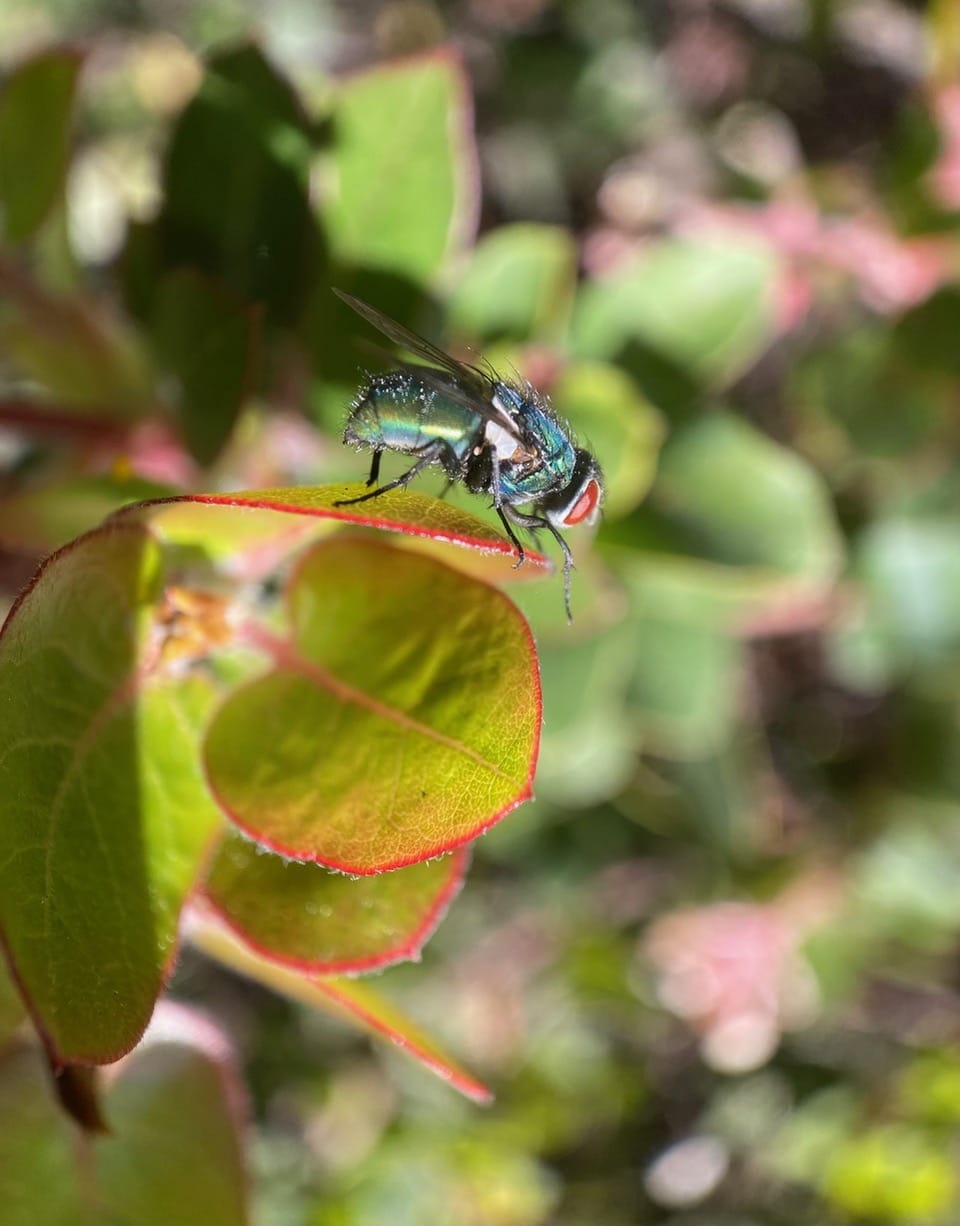
A Greenbottle Fly (family Calliphoridae) is basking on a leaf behind the manzanita fruits.
The Common European Greenbottle Fly, Lucilia sericata (family Calliphoridae) is a Blowfly found in most areas of the world and is the most well-known of the numerous green bottle fly species. The lifecycle of Lucilia sericata is typical of blowflies. Females lay masses of eggs in fresh carrion. The flies are extremely prolific – a single female may produce 2,000 to 3,000 eggs in her lifetime. The larvae feed on dead or necrotic tissue, passing through 3 larval instars. Third-instar larvae drop off the host to pupate in the soil. The adults feed opportunistically on nectar, pollen, feces, or carrion; they are important pollinators as well as important agents of decomposition. Pollen is used as an alternative protein source, especially for gravid females who need large amounts of protein and cannot reliably find carrion.
While we may find the blowflies disgusting for their association with filth and carrion, they are important decomposers/ recyclers in the ecosystem. What’s more, their larvae are used in maggot therapy to clean wounds by consuming only dead and infected tissue, helping to promote faster healing and prevent infection.
The large Bush Poppy, Dendromecon rigida is covered with cheery yellow flowers. I stand by the shrub for a while, but see and hear no insects.
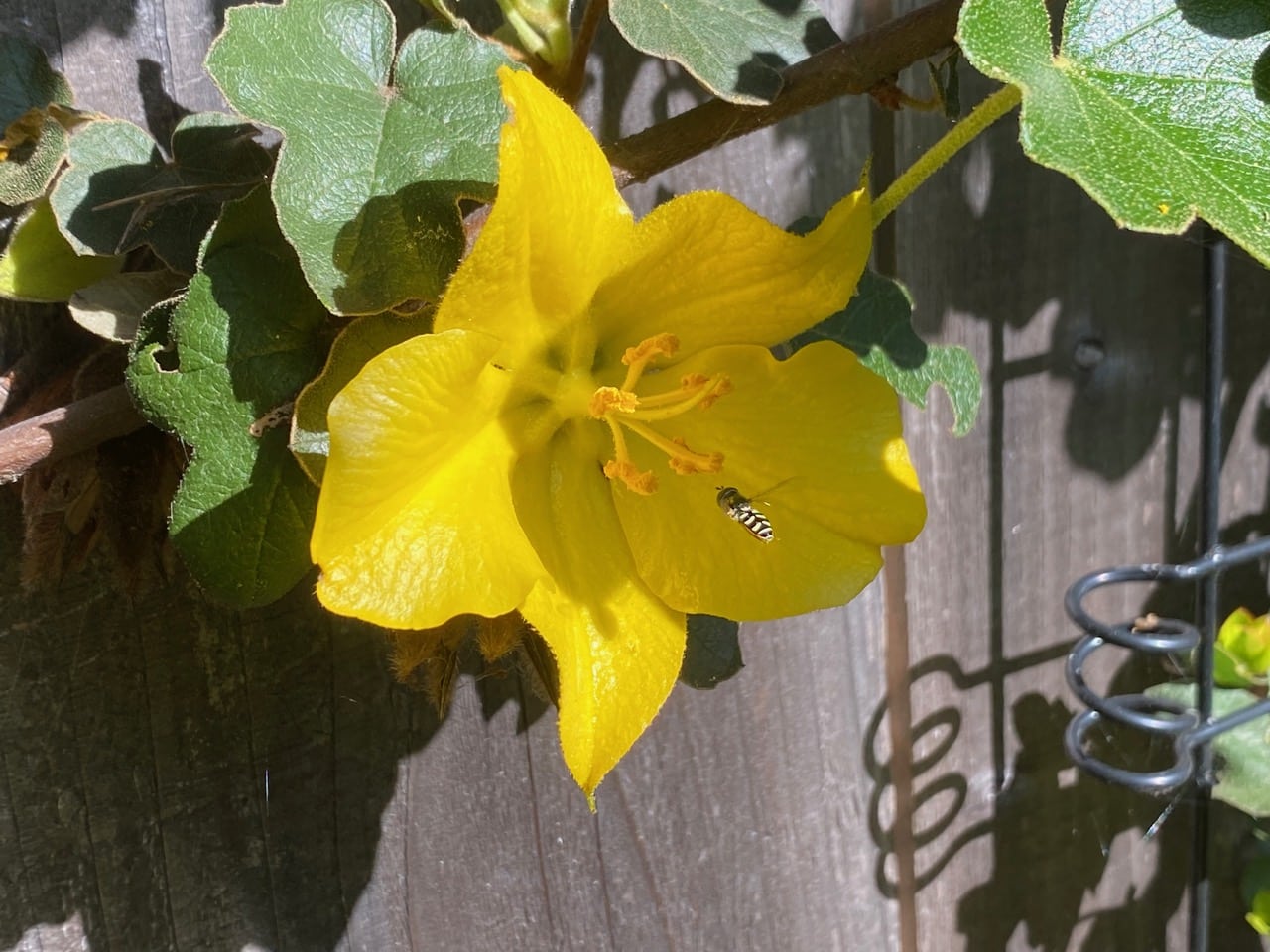
By the fence in the backyard, a hover fly with black-and-white abdominal markings is flying towards a large yellow flower of the California Flannelbush, Fremontodendron californicum.
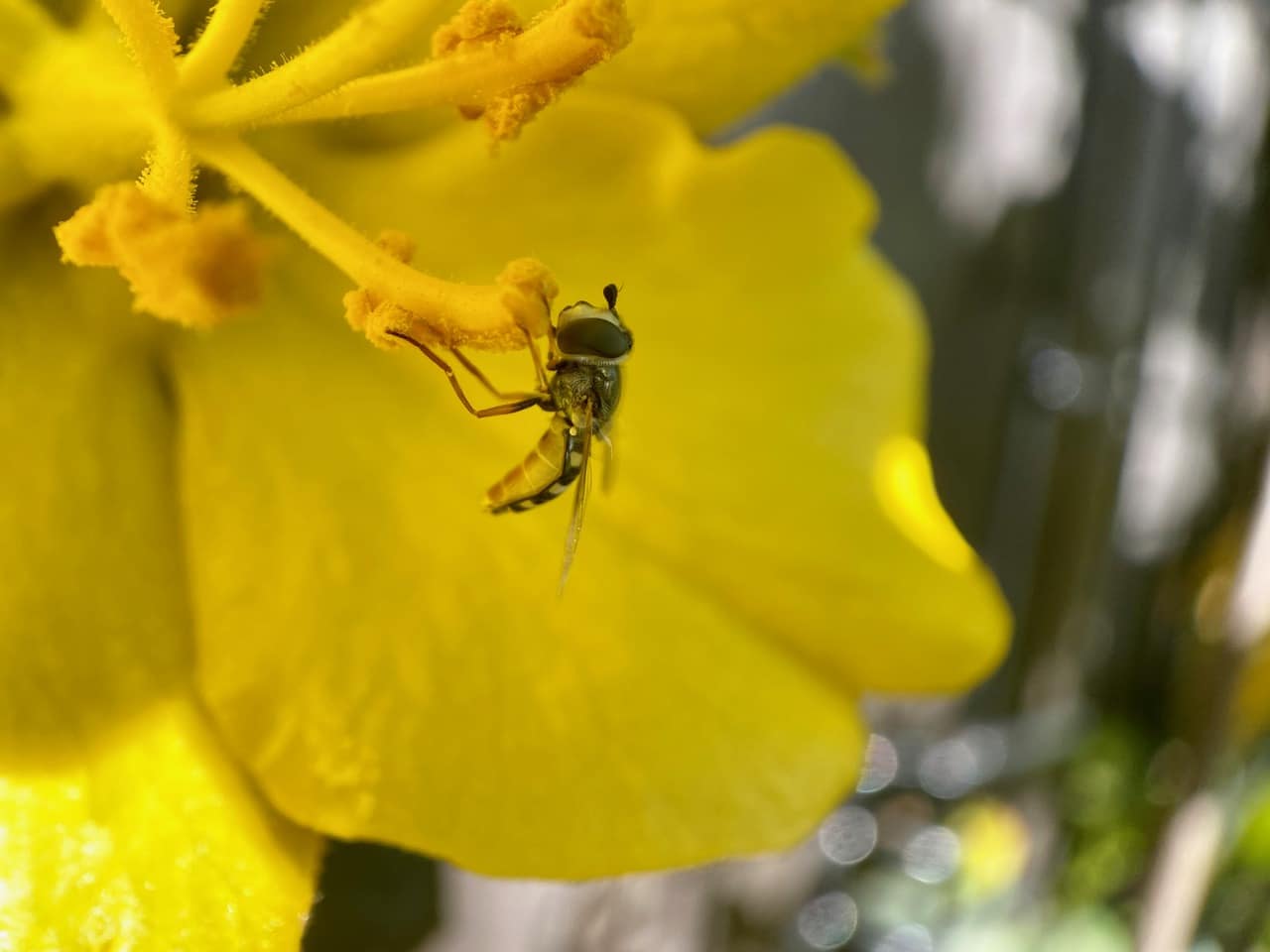
The hover fly settles on an anther to feed on pollen. It is a Large-tailed Aphideater, Eupeodes volucris (family Syrphidae).
The Large-tailed Aphideater, Eupeodes volucris (family Syrphidae) is found in western North America, and is active March through November. The common name of the species refers to the distinctive “large tail” or projecting cylindrical abdomen of the males. As the rest of the common name implies, the larvae of the species are voracious predators of small plant-sucking insects such as aphids. Females seek out dense aphid colonies on plants to lay eggs among them. Adults visit flowers for nectar and pollen.
The Red Bush Monkeyflower, Diplacus puniceus is blooming gloriously. The evergreen perennial shrub is native to coastal southern California and northern Baja California. Its dark orange or red flowers are adapted for hummingbird pollination.
Monkeyflowers (species within the Diplacus genus) are well-known for having thigmonastic stigmas. The flat, white, two-lobed stigma closes immediately (often within 2 seconds) when touched by a pollinator (such as bee or hummingbird) or a foreign object. The movement is designed to capture pollen carried by pollinators and, crucially, to prevent self-pollination as the pollinator backs out of the narrow, tubular flower. If pollen is deposited, the stigma remains closed. If no pollen is deposited, the stigma will reopen in a few minutes, allowing for future pollination attempts. The rapid, touch-sensitive movement is referred to as a “seismonastic” or “thigmonastic” response.
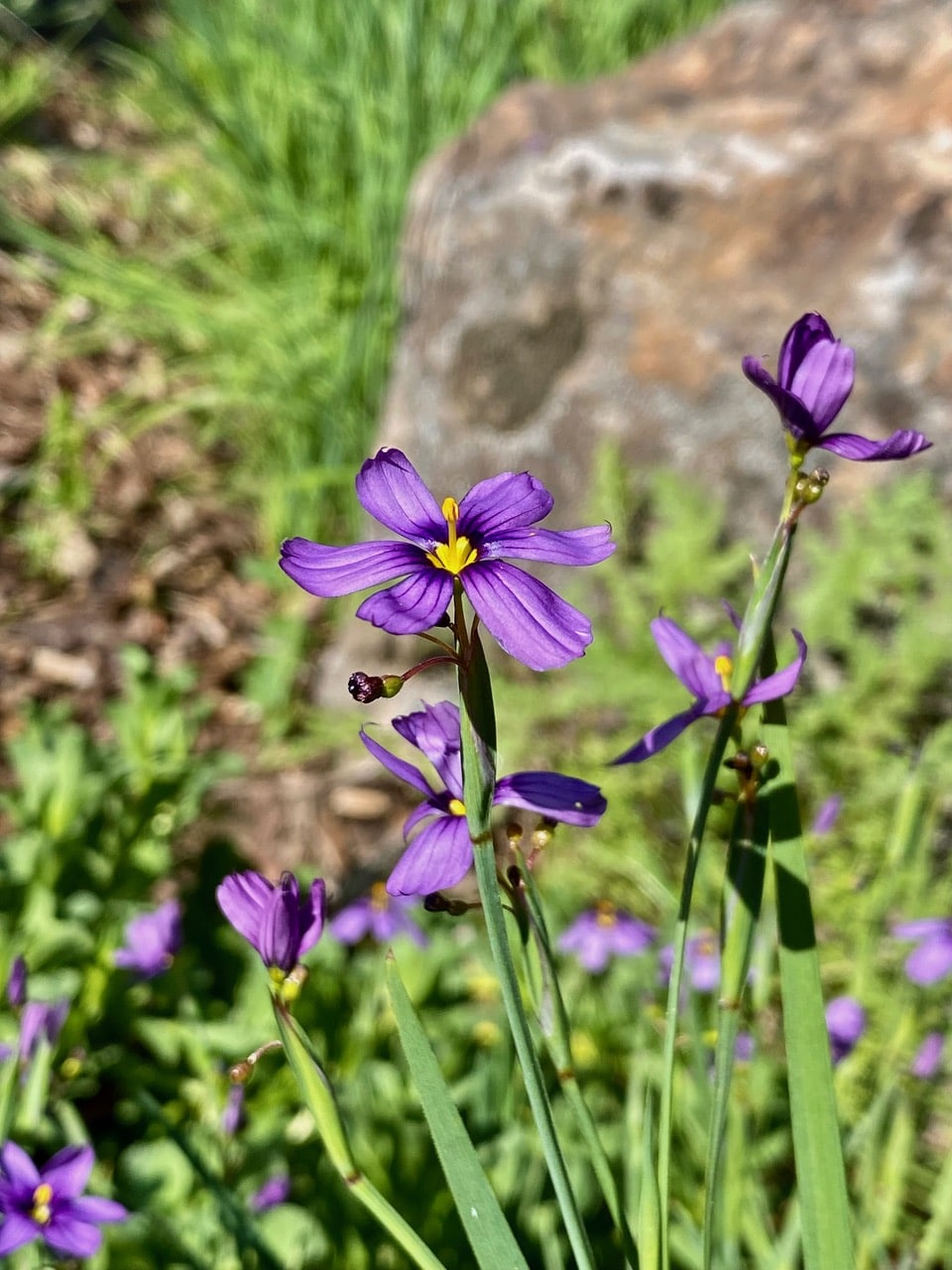
Blue-eye Grass, Sisyrinchium bellum is blooming profusely, but their pretty flowers seem to go unnoticed by insects.
When there are few plants in bloom, one would expect the insects to converge on the limited floral resources that are available. But it does not seem to be the case here. There simply is a dearth of bees, and insects in general – a far cry from my observations over the past couple of years. Sure hope things improve as the season progresses.
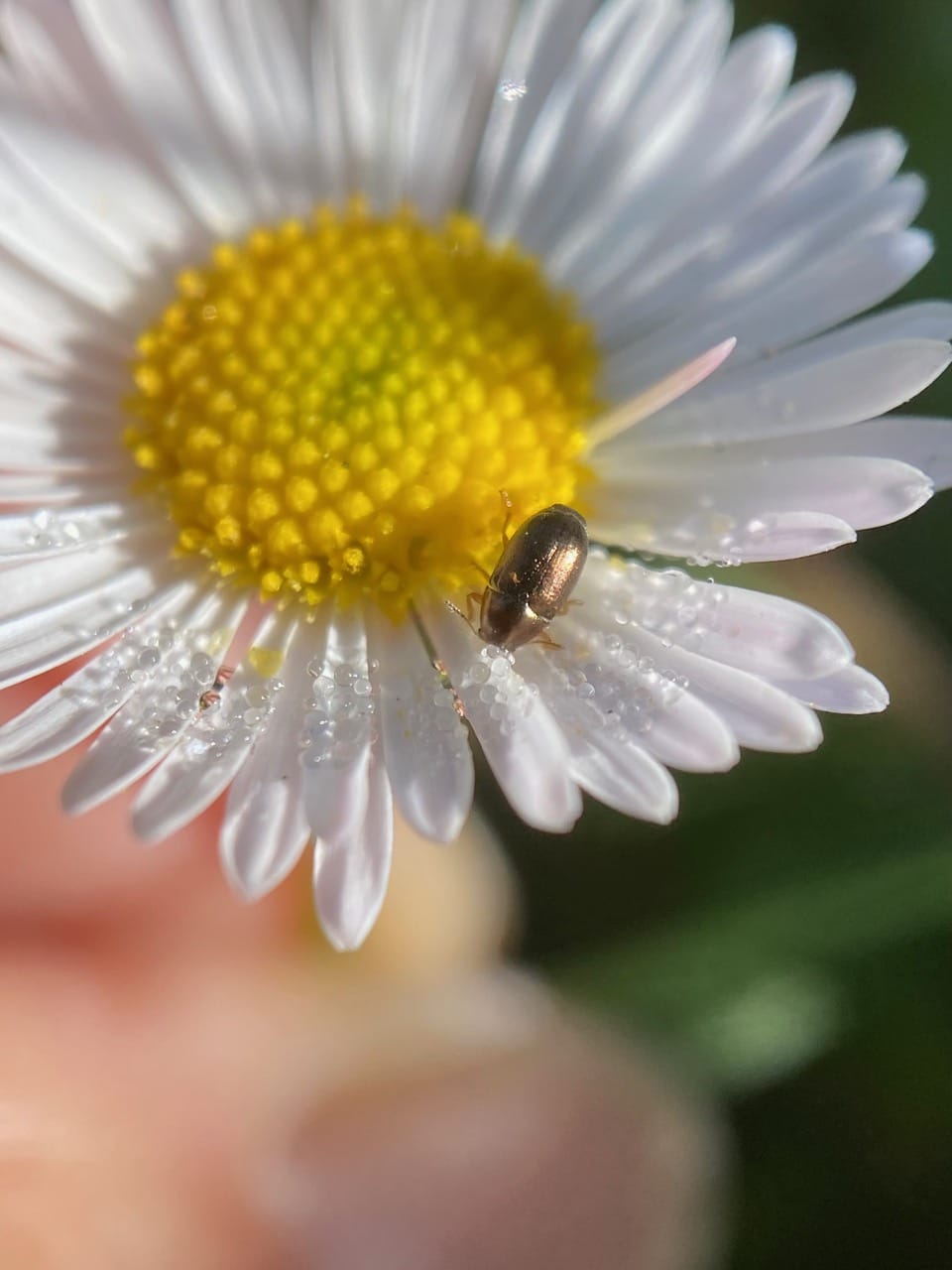
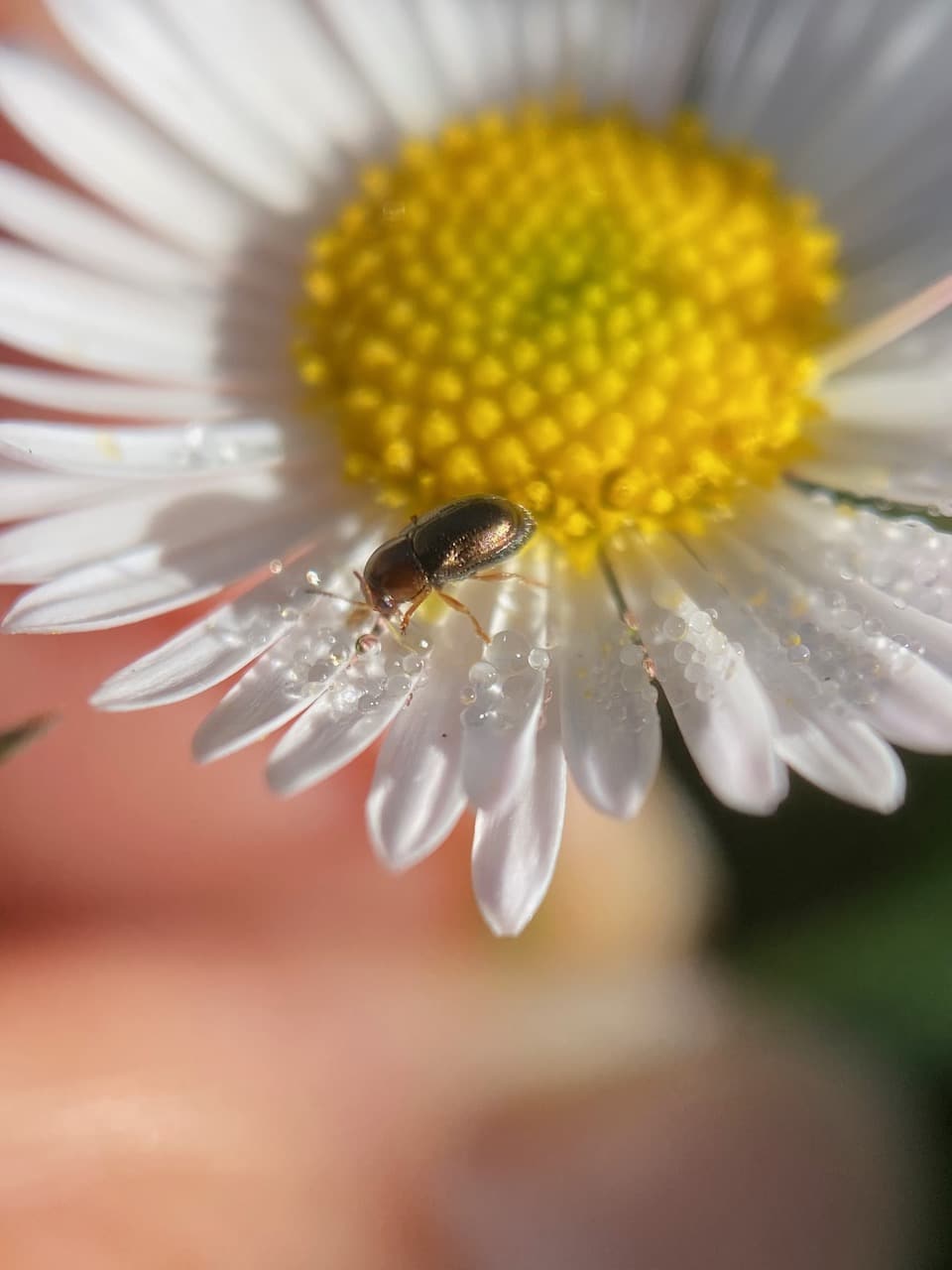
A metallic glint on the flowerhead of an English Daisy alerts me to the presence of a Bronze Leaf Beetle, Diachus auratus (family Chrysomelidae).
What are those tiny transparent droplets on the ray petals? Eggs? The Bronze Leaf Beetle seems to be feeding on them.
The Bronze Leaf Beetle, Diachus auratus is a species of case-bearing leaf beetle in the family Chrysomelidae, subfamily Cryptocephalina. It is found in Australia, the Caribbean, the Americas, Oceania, and Southern Asia. Adults, 1-2 mm, are found on many unrelated plants, especially plants in bloom. Case-bearing leaf beetles are found in two subfamilies within Chrysomelidae. As she lays her eggs, the female case-bearing leaf beetle covers each one with a layer of excrement. After the larvae hatch, they retain this covering (case) as camouflage and add to it throughout their larval life. When disturbed, the larvae pull in their head and legs; because their color and shape resemble caterpillar droppings they are ignored by predators. Eventually the larva seals the case to pupate inside, before emerging as an adult. Some species are myrmecophiles, living near or even inside ant nests.
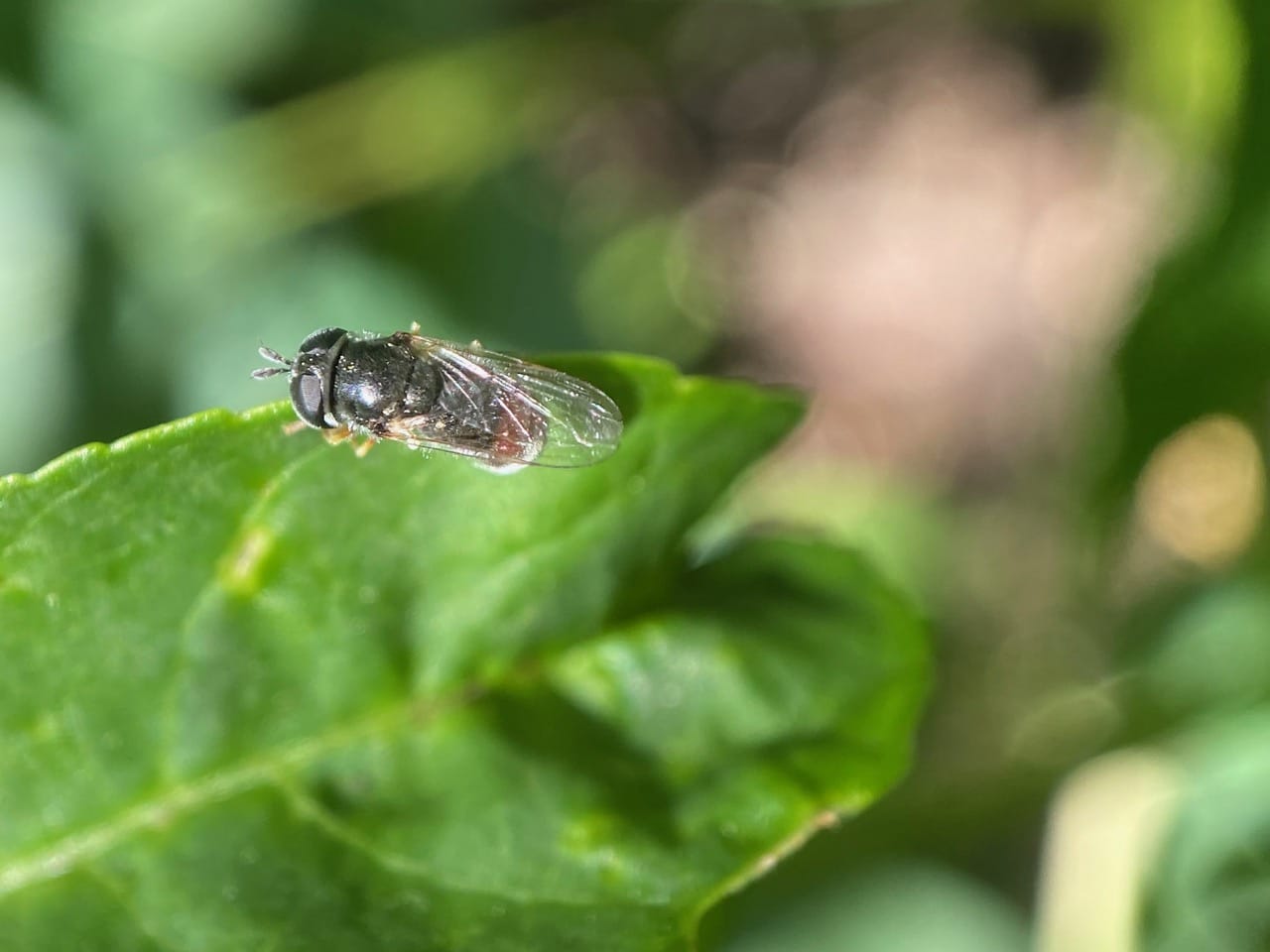
A Common Grass Skimmer, Paragus haemorrhous (family Syrphidae) has landed on a leaf.
The Common Grass Skimmer, Paragus haemorrhous (family Syrphidae) is easily the smallest hover fly I know, measuring only about 4 mm in length. The species has a world-wide distribution, found in unimproved grassland, dune grass, open areas and pathsides in forest, and meadows. Adults visit flowers for nectar and pollen. Larvae feed on aphids on low herbaceous plants.
Photos of Common Grass Skimmer (Paragus haemorrhous) · iNaturalist
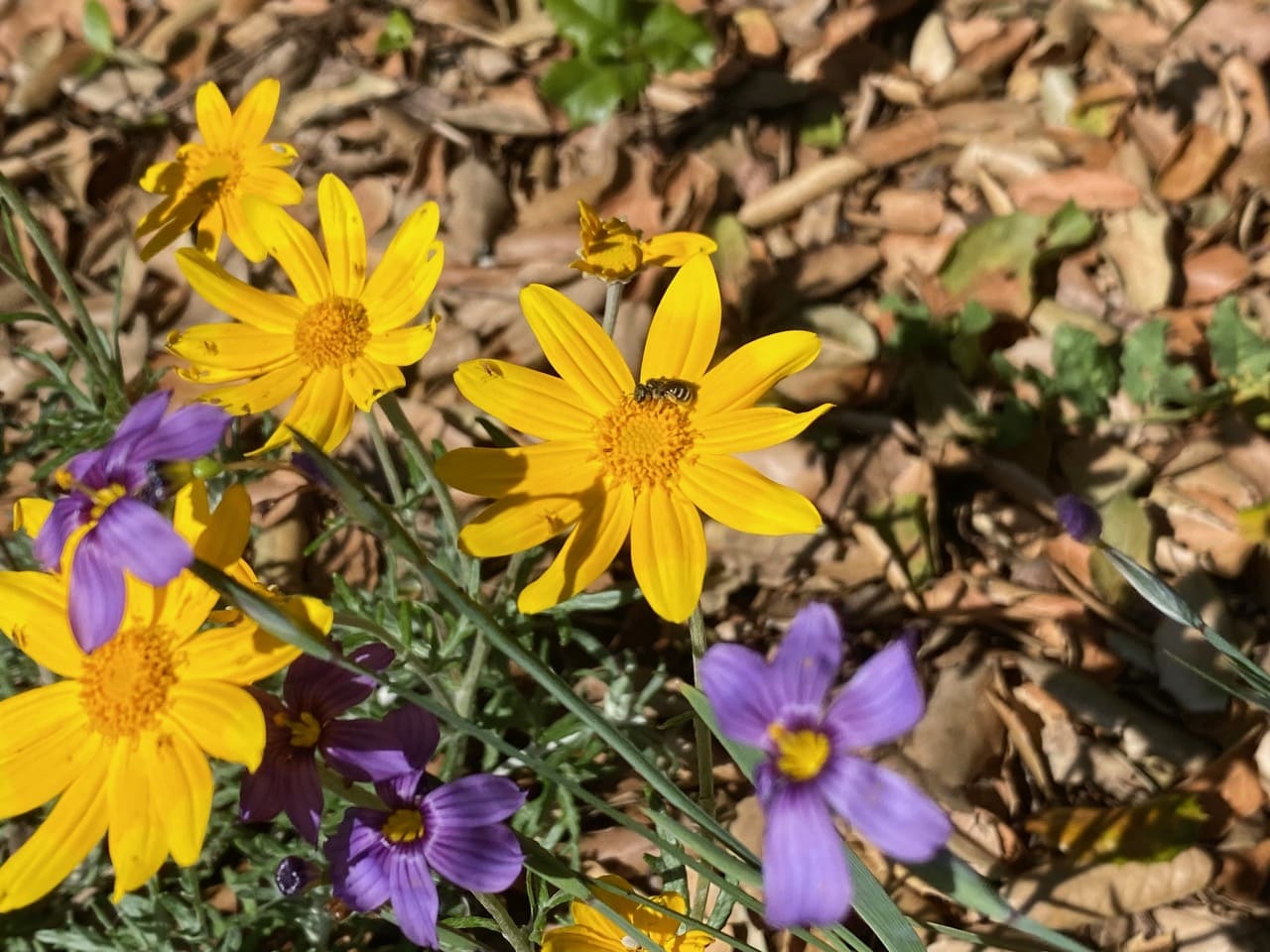
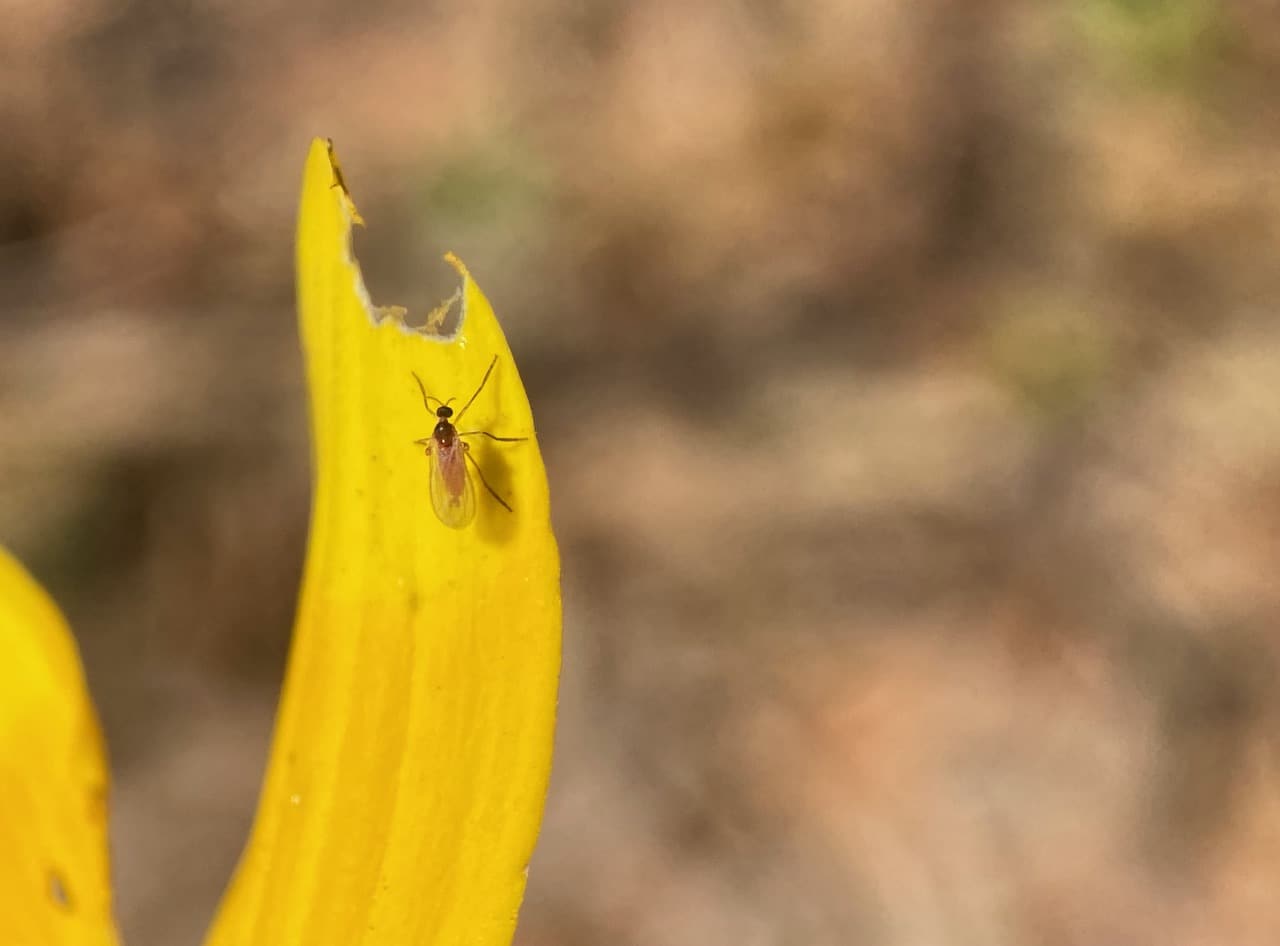
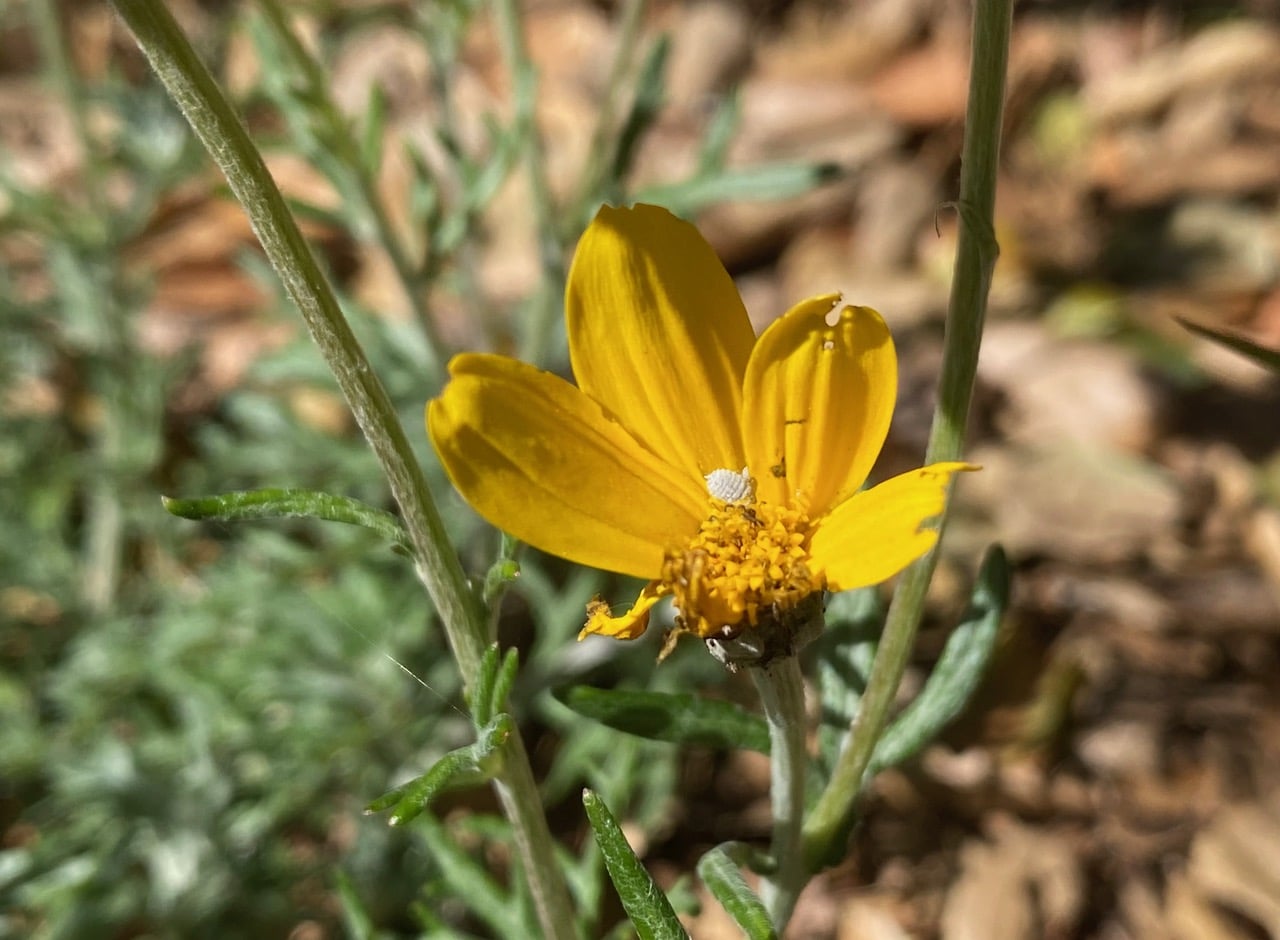
By the side of the house, the Common Woolly Sunflower, Eriophyllum lanatum has started to bloom. A small bee, probably a Sweat Bee (family Halictidae) is foraging on one of the flowerheads. Several tiny midges have landed on the adjacent flowerhead.
iNaturalist has helped identify the tiny midges as members of the superfamily Sciaroidea that includes Fungus Gnats and Gall Midges.
As nematoceran flies, sciaroid adults generally have long segmented antennae, while their larvae have a well-developed head and mouthparts. Most fungus gnats live in forests with their larvae occurring in fungi, dead wood and soil. The larvae of Mycetophilids form plant galls.
I take a closer look at a small whitish creature resting on a ray flower of the Common Woolly Sunflower, and realize that it is a Mealybug (family Pseudococcidae)
Mealybugs are insects in the family Pseudococcidae, unarmed scale insects found in moist, warm habitats. Many species are considered pests as they feed on plant juices of garden as well as crop plants, sometimes acting as vectors for several plant diseases..
Mealybugs are sexually dimorphic. Females appear as nymphs, with reduced morphology, and lack wings. Males are smaller, gnat-like and have wings. Females feed on plant sap. They attach themselves to the plant and secrete a powdery wax layer used for protection while they suck plant juices. Males are short-lived, as they do not feed at all as adults and only live to fertilize the females. Mealybugs have a highly sophisticated metabolism that involves two bacterial endosymbionts, one inside the other. The bacteria make essential amino acids that the mealybugs do not get from their diet. Mealybugs only tend to be serious pests in the presence of ants. Some ants live in symbiotic relationships with them, protecting them from predators and feeding off the honeydew which they excrete.
Ooh, there’s a tiny fly on that Woolly Sunflower! Closing in with my macro lens, I recognize it as an Aphid Fly, Leucopis sp. (family Chamaemyiidae).
The Chamaemyiidae are a small family of acalyptrate flies with less than 200 species described worldwide. Members of the genus Leucopis (aphid flies) are very small, measuring approximately 2-4 mm in length. These grayish flies often have black abdominal spots. The larvae are active and predatory and are often used for biological control of aphids, scale insect, mealybugs, and similar pests. The predatory maggots, about 3 mm long and yellowish, are often found within colonies of their prey, moving slowly with a wrinkled appearance and distinct, two-stalked breathing tubes (spiracles) at their rear.
Doesn’t that look like a Mealybug on that other flowerhead?
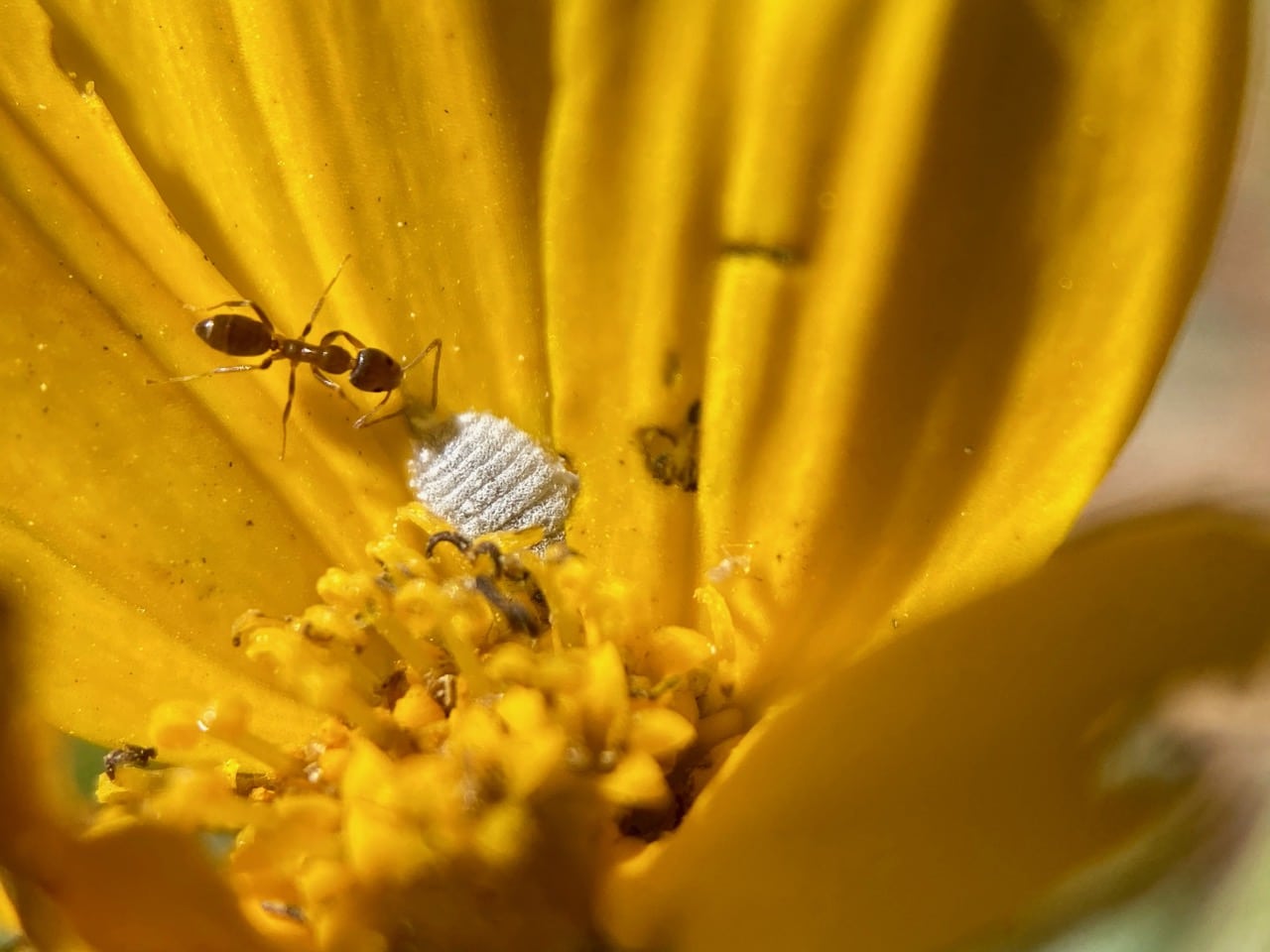
There’s a constant flow of ants visiting the large Mealybug. These Argentine Ants, Linepithema humile (family Formicidae) tap the mealybug with their antennae to prompt the bug to excrete honeydew for them.
Mealybugs are phloem-feeders that excrete excess sugary waste (honeydew), providing a vital carbohydrate source for ants. Ants and mealybugs share a mutualistic relationship where ants protect mealybugs from predators and parasites in exchange for honeydew. The ants defend mealybugs against natural enemies like ladybugs, lacewings, and parasitic wasps. They also actively transport mealybugs to new, succulent parts of plant and protect them from adverse weather. This partnership often boosts mealybug population growth, and can have a significant negative impact on plant health.
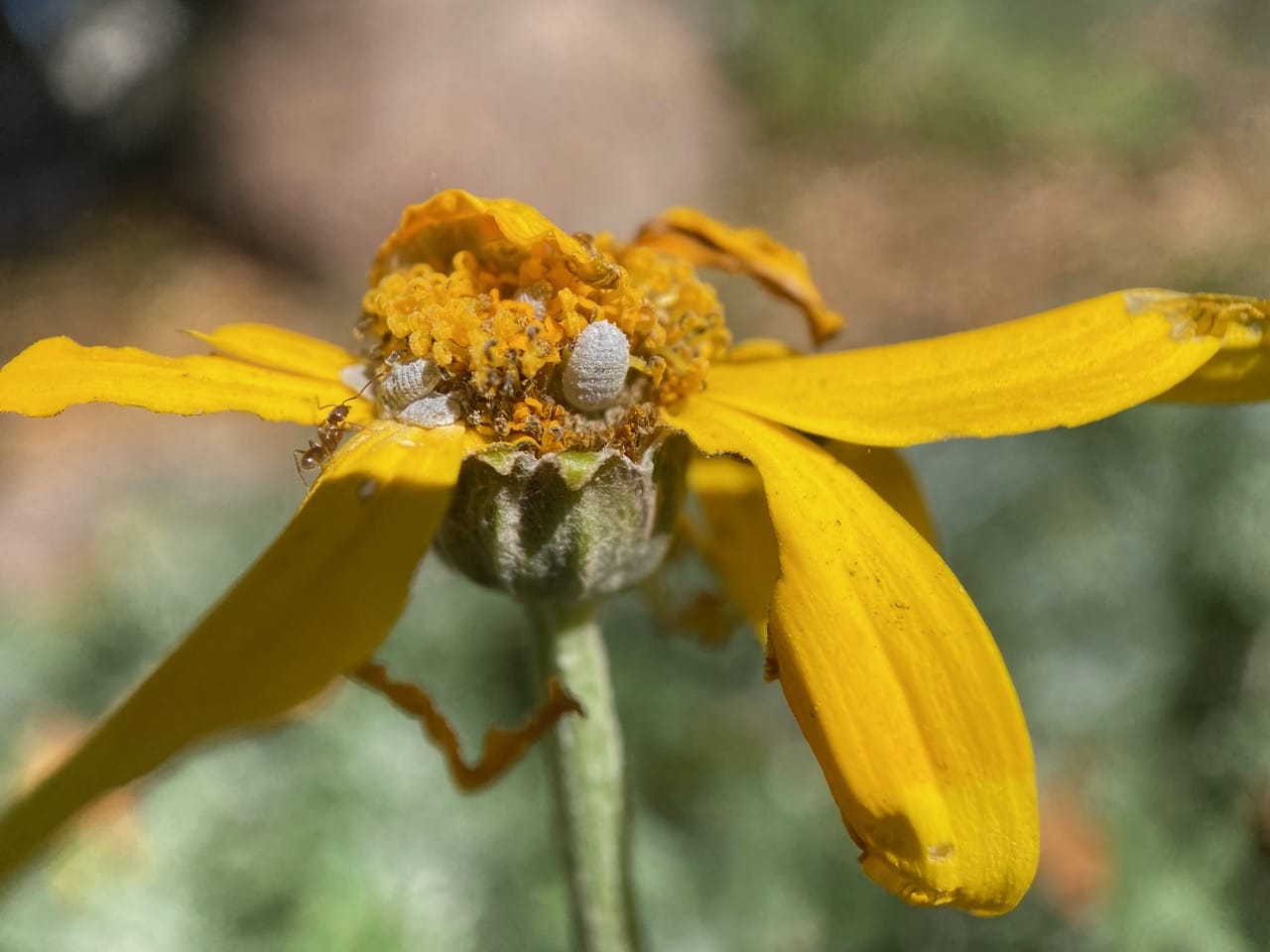
Argentine Ants are actively patrolling this flowerhead that is infested with mealybugs. The flower appears wilted and damaged, missing some ray petals.
The Argentine Ant, Linepithema humile (family Formicidae) is native to Northern Argentina, but it has been inadvertently introduced by humans to many countries, and is now an established invasive species in many Mediterranean climate areas worldwide. The success of the species can be attributed to their lack of aggression between the colonies. There is no apparent antagonism between separate colonies of its own kind, resulting in “super-colonies” that extend across hundreds or thousands of kilometers in different parts of the their range. Genetic, behavioral, and chemical analyses show that introduced Argentine Ants on separate continents actually represent a single global supercolony.
The Argentine Ants are ranked among the world’s worst invasive animal species. In its introduced range, the Argentine ant often displaces most or all native ants and can threaten native invertebrates and even small vertebrates that are not accustomed to defending against the aggressive ants. This can, in turn, imperil other species in the ecosystem, such as native plants that depend on native ants for seed dispersal, or lizards that depend on native ants for food.
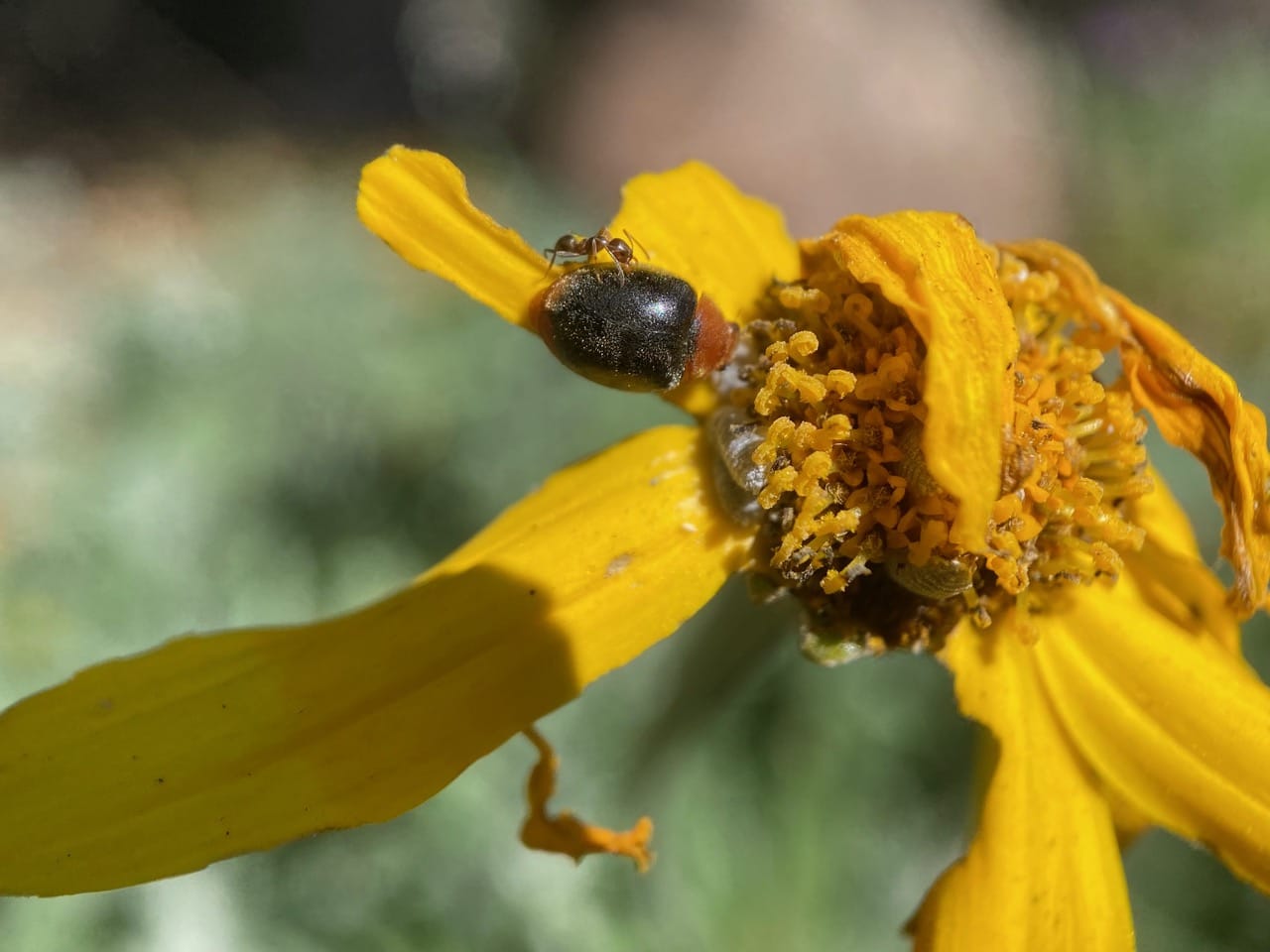
Look, an ant has climbed on to attack a beetle that is feeding on a mealybug. I recognize the beetle as a Mealybug Destroyer, Cryptolaemus montrouzieri (family Coccinellidae).
The Mealybug Destroyer, Cryptolaemus montrouzieri (family Coccinellidae) was imported into the United States in 1891 from Australia to control citrus mealybug in California. It is a small (about 6 mm), dark brown lady beetle with a tan to orange head and posterior. Larvae grow up to 15 mm, and secrete a waxy covering that makes them look like the mealybugs they prey on, a case of aggressive mimicry. The camouflage allows the larvae to avoid the wrath of ants that protect the mealybugs. The Mealybug Destroyer is a voracious feeder of mealybugs in both the larval and adult stages. A single larva may consume up to 250 small mealybugs.
Adult females lay eggs among the cottony egg sac of mealybugs. During her lifespan of up to 2 months, a female may lay as many as 400 eggs. Larvae feed on mealybug eggs, young crawlers, and the honeydew produced by the mealybugs. Mature larvae pupate in sheltered places on stems
It is interesting that the mealybug infestation on the Common Woolly Sunflower has gathered a small community of naturally-occurring friends and enemies. The ants protect the mealybugs for the honeydew they offer in exchange; the larvae of the Aphid Fly, Leucopis sp. (family Chamaemyiidae), and both adult and larvae of the Mealybug Destroyer, Cryptolaemus montrouzieri (family Coccinellidae) prey on the mealybugs. Will the balance of these interactions be able to keep the plant healthy in the long term?