

Pollinator Post 3/10/26 (1)
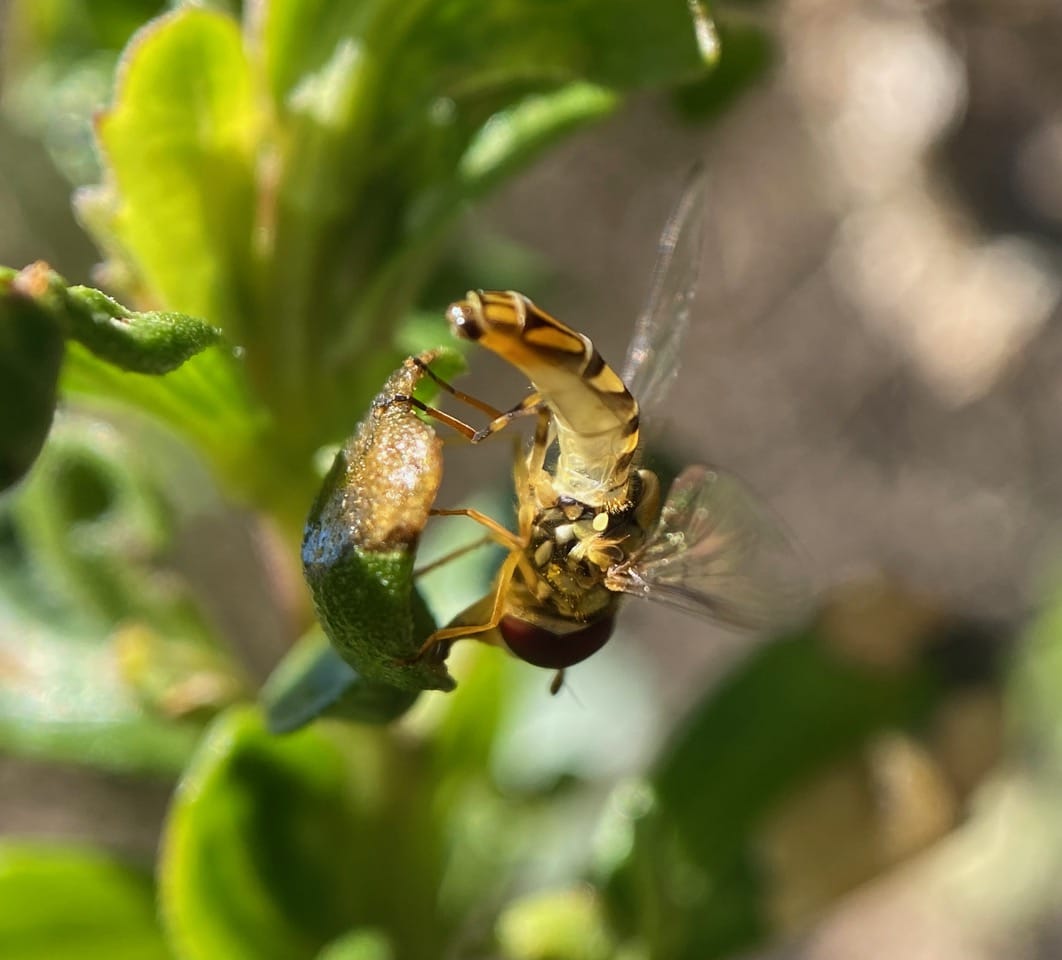
Remember this picture from 3/8/26? It is an Oblique Streaktail, Allograpta obliqua (family Syrphidae) lapping up honeydew from Coyote Brush foliage. I have wondered out loud what those whitish objects under the hover fly’s thorax might be. My entomologist friend, Nancy has kindly responded, suggesting that they were Phoretic Mites. Ah, mystery solved!
Phoretic Mites are “hitch-hikers” using insects like beetles and bees as transport to new habitats or food sources. They attach temporarily, often in large numbers, to move long distances efficiently without harming the host, acting as a form of commensalism. They are often highly specific to their host. They use specialized structures for attachment to the host, sometimes hiding under wings to avoid desiccation. Phoretic mites have been observed on Allograpta species. Phoretic mites on flies often belong to families such as Uropodidae, which travel in their deutonymph stage. Uropodidae are tortoise-like mites with an oval to circular outline, and with armor both dorsally and ventrally. They attach themselves to their host by means of a pedicel of translucent material that the mite extrudes from its anus.
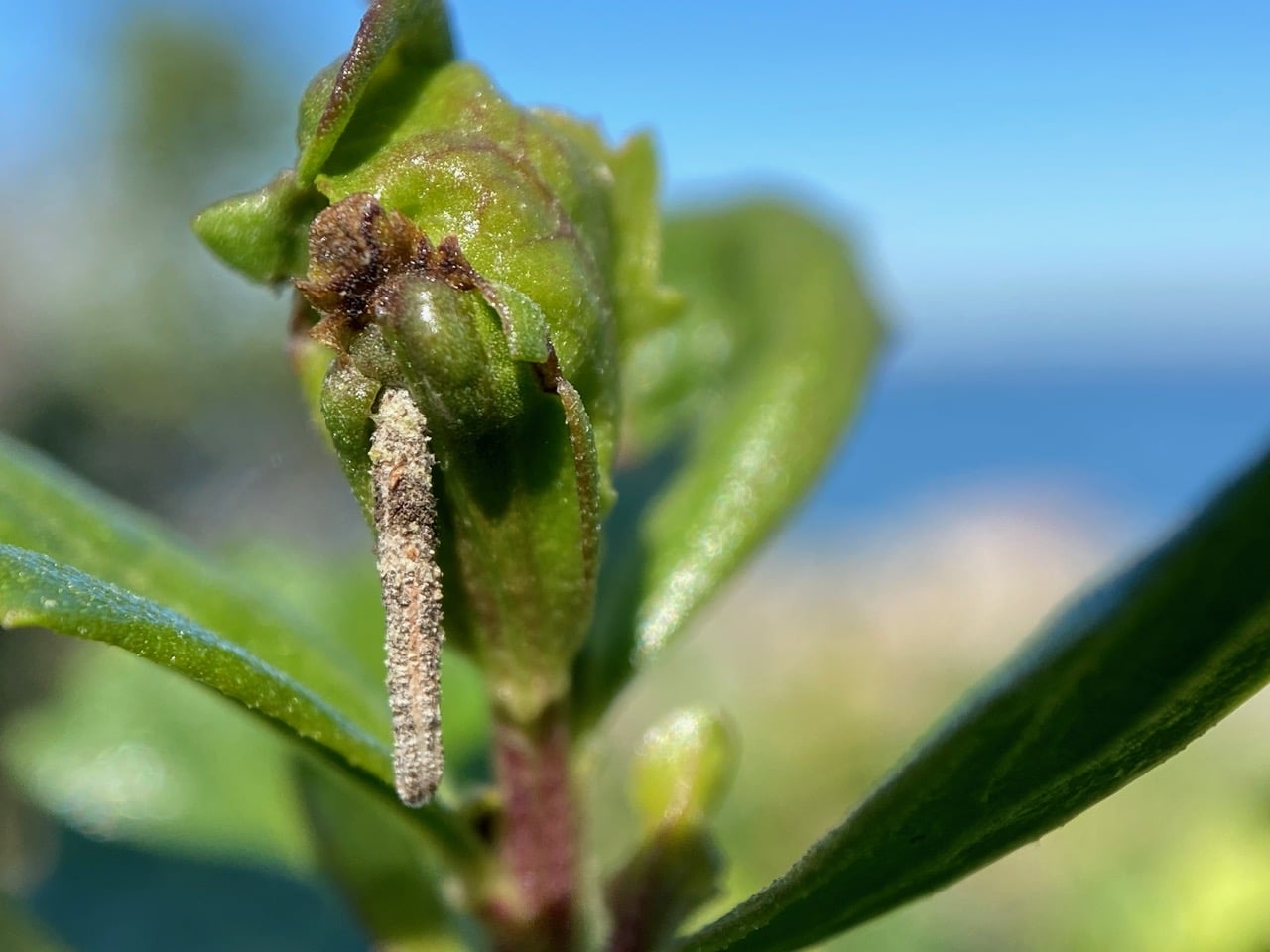





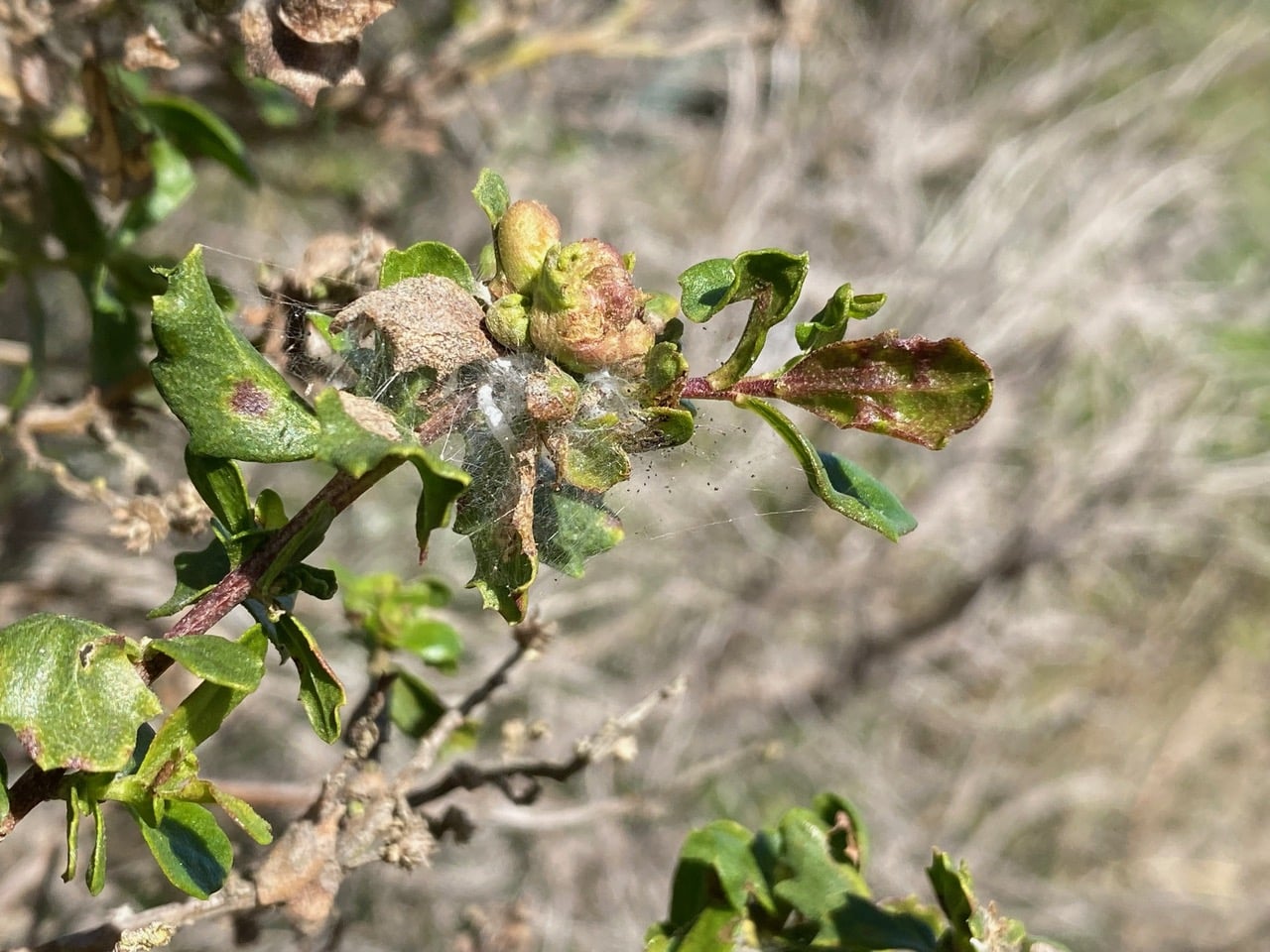


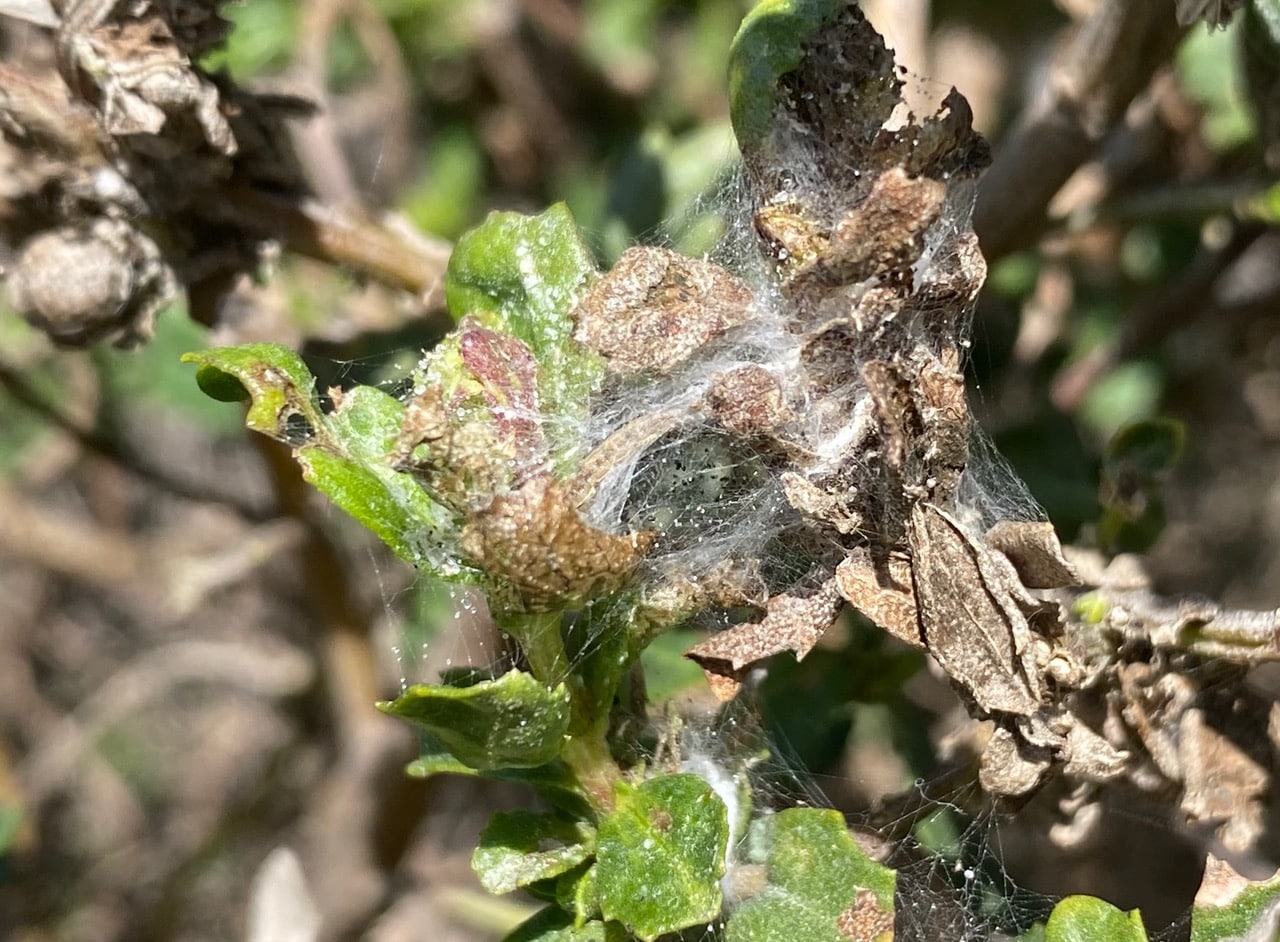
Nancy has helped me identify this mysterious creature too. After being initially misled by iNaturalist, Nancy has successfully narrowed down the ID of the case-making caterpillar to the family Tineidae.
Pupae of Tineid Moths (family Tineidae) are typically found encased in protective, silk-lined cocoons, often incorporating debris, food particles, or frass. They are small, 2-13 mm long, and usually develop within 8 to 28 days inside these camouflaged, stationary cocoons. Larvae construct, or in some cases carry, a protective, hardened case made of silk and fibers and excrement before transforming into a pupa. After the pupal stage, they emerge as small moths that do not feed.
Tineid moths on Baccharis are usually small, mottled brown or gray moths whose larvae act as scavengers or leaf miners on the plant, often causing defoliation. They are strongly associated with Baccharis in disturbed areas, with larvae creating silk-lined mines, cocoons, or cases on leaves and stems during warmer months. The moths are multivoltine, with larvae active throughout warmer months, completing their cycle in 4-6 weeks. Tineids are small, delicate moths with narrow, fringed wings, often holding them in a tent-like fashion.
Calscape lists four moth species that use Baccharis pilularis as host plant, none of which is a Tineid. I would like to rear the mystery larvae/pupae to adulthood to confirm their identity.

The other larva/pupa photographed on Coyote Brush, Baccharis pilularis on 3/8/26.
I arrive at Bay Farm this morning with small bug containers and scissors, hoping to collect these mystery creatures. Alas, neither is there where I photographed them before. Maybe they were not pupae, but sedentary case-making caterpillars that have decided to move on. Better luck next time!
The tall Fennel bushes that have been severely pruned back last season have sprouted fresh leaves at the base of the plant. I often see Anise Swallowtail butterflies flutter around these bushes, courting or checking for places to lay eggs. The butterfly’s major larval food plants are members of the carrot family, Apiaceae, and also some members of the citrus family, Rutaceae. Although Fennel is not native to California, the butterfly has adapted to use this ubiquitous member of Apiaceae as a larval food plant.
Hey, an Anise Swallowtail has landed on the ground close to the Fennel bushes. What a beauty – a freshly eclosed butterfly?
The Anise Swallowtail, Papilio zelicaon (family Papilionidae), is a common swallowtail butterfly of western North America. It is found in fairly open country, most likely seen on bare hills or mountains, in fields or at the roadside. Adult females lay eggs singly on the underside of host plant leaves. In the first two instars, the caterpillar is a bird poop mimic – dark brown, almost black, with an irregular white band at its middle. After that it becomes more green at each successive molt until, in the fifth (last) instar, it is predominantly green, with markings in black, orange, and light blue. Its major food plants are members of the carrot family, Apiaceae (including fennel), and also some members of the citrus family, Rutaceae.
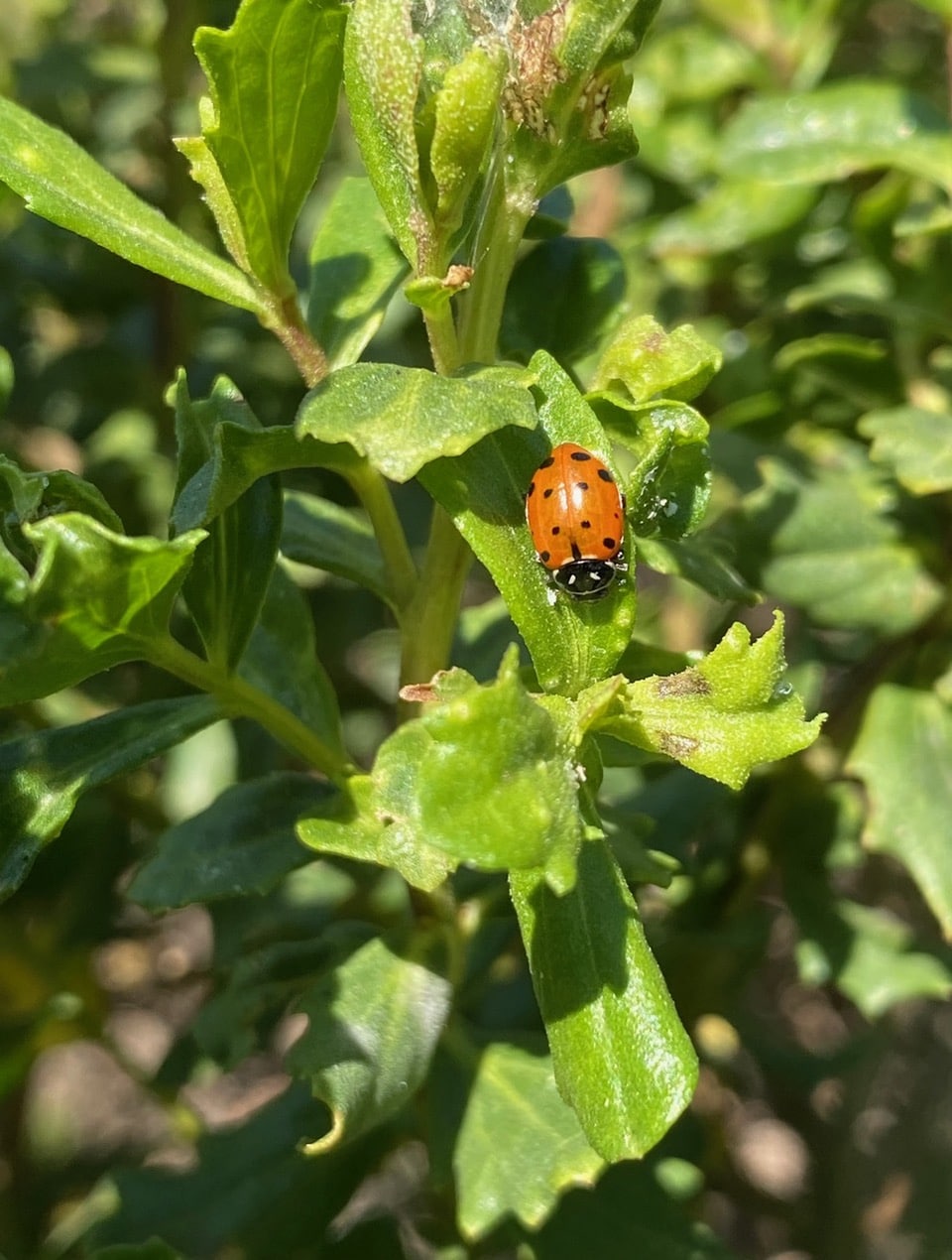
A Convergent Lady Beetle is resting on a Baccharis shoot littered with some white flakes of wax. Although I have not seen them, there must be aphids, mealybugs or scale insects on the shrub that have attracted the predators. Both adult and larval lady beetles are voracious predators of these small sap-suckers. The species is easily recognizable from the two converging white lines on the black pronotum. The red elytra are usually spotted, but spotless individuals are often seen.
An Asian Lady Beetle, Harmonia axyridis (family Coccinellidae) is resting on a leaf of the Coyote Brush, seemingly enjoying the sun.
The beetle is a voracious predator of arthropod pests such as aphids, mites, thrips, scale and Lepidoptera eggs. Introduced from Asia for biological control of arthropod pests during the twentieth century, it has since become established all over the US. The adult beetles are highly variable in appearance, varying in color as well as the number and size of spots. It is believed that the Asian Lady Beetles are aggressive competitors of native ladybeetles. This supposition remains to be proven scientifically. Adult beetles aggregate in high numbers to overwinter, favoring human dwellings. When threatened the beetle produces a yellow viscous, foul-smelling defensive compound, making themselves unwelcome house guests.
An Asian Lady Beetle, Harmonia axyridis (family Coccinellidae) is checking every nook and cranny of a Baccharis shoot, apparently hunting for prey. The shoot is shrouded in a fine silk mesh, and spotted with frass (insect poop) and white flakes of wax. Brown feeding scars can be seen on the leaves. Are there two different creatures here – one that created the silk webbing (eg. caterpillar), and another that sheds the waxy debris (eg. aphids, mealybugs, scales)? It is difficult to unravel what exactly is ailing the plant when so much is going on simultaneously.
Suddenly a wasp comes into my view. Its colorful, banded hind legs give away its identity – the Common Hover Fly Parasitoid Wasp, Diplazon laetatorius (family Ichneumonidae). What’s the white stuff on its thorax? The wasp must have been poking its head into nooks and crannies with wax debris – places where aphids and their predators, the hover fly larvae are likely to be found.
Diplazon laetatorius is a member of the Ichneumonid wasp family and is 4-7 mm long. The body is mostly black; front two pairs of legs are orange, while the hind legs are highly distinctive and key for identification, featuring a tricolored pattern of black, white and orange. The species has a wide geographic range, from the Canadian Arctic to Argentina, Norway to South Africa, and Japan to New Zealand. Human agriculture is thought to have spread it along with aphids and syrphid flies. Adults feed on floral nectar, with a preference for flowers in the Apiaceae family. Females lay their eggs on or near the eggs and larvae of hover flies (family Syrphidae). The developing parasitoid larvae consume the host from within, eventually completing development and emerging as adult wasps.
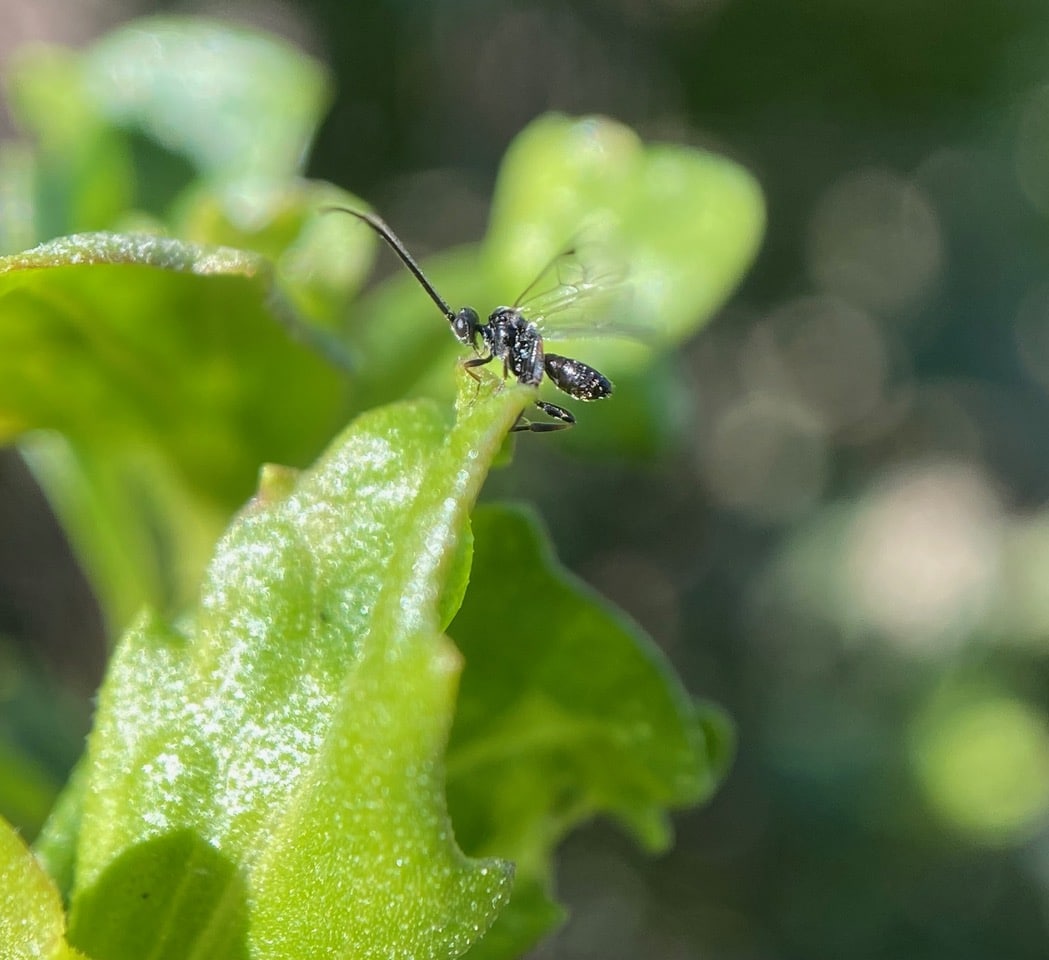
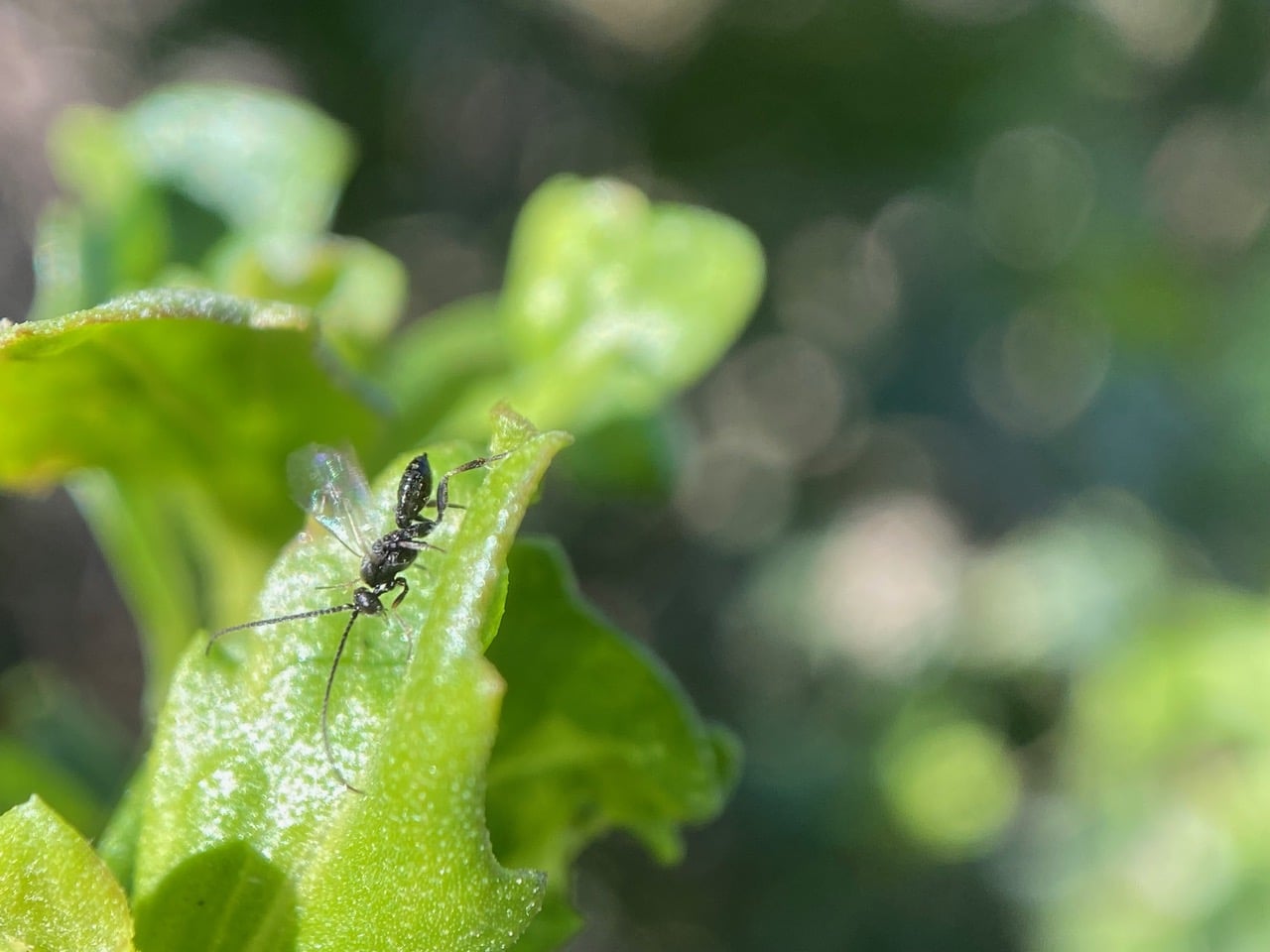
A tiny wasp with very long antennae has landed on a Baccharis leaf. iNaturalist has helped identify it as a Braconid Wasp (family Braconidae).
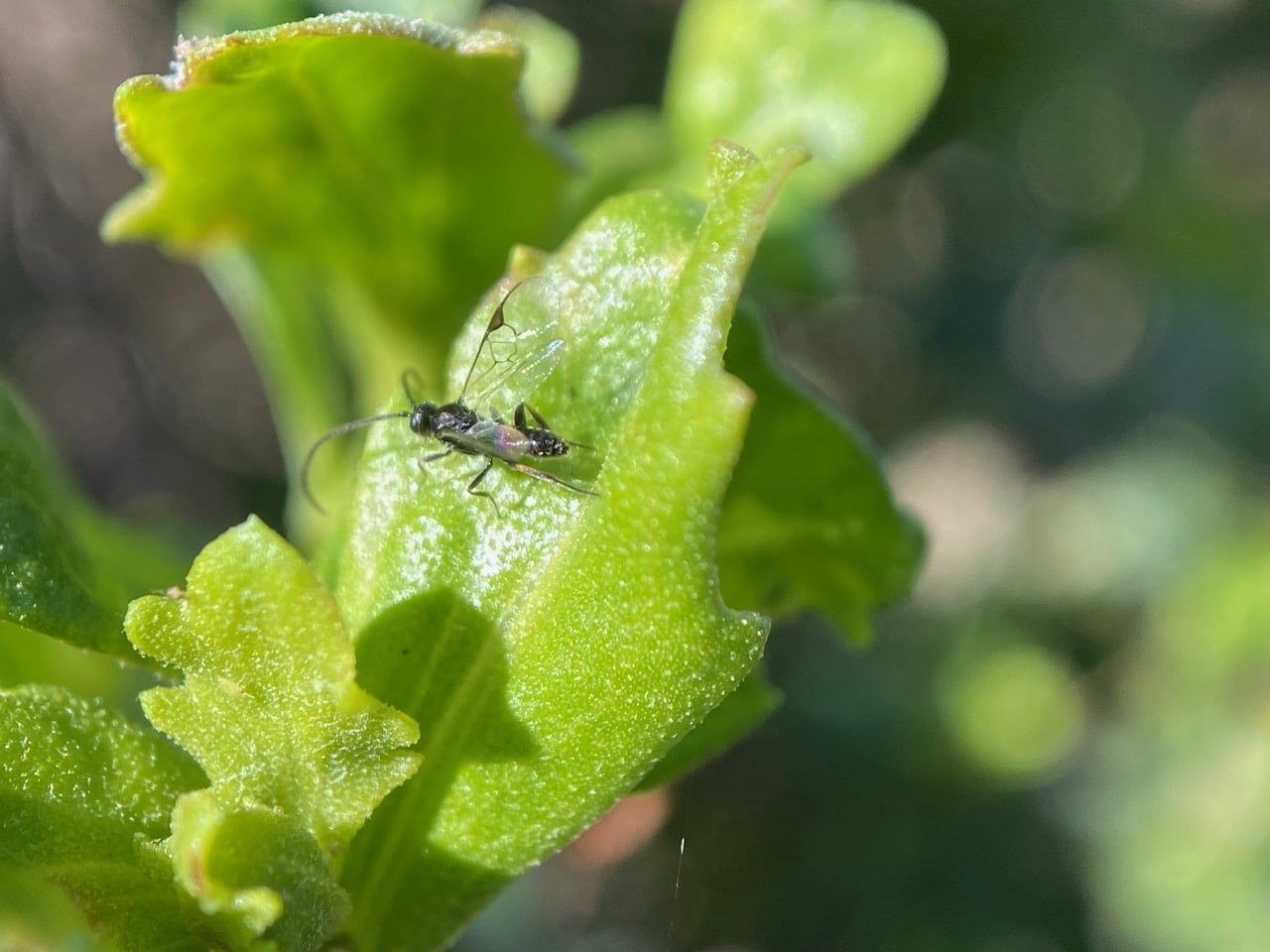
The Braconidae are a family of parasitoid wasps. After the closely related Ichneumonidae, braconids make up the second-largest family in the order Hymenoptera, with about 17,000 recognized species. Females often have long ovipositors to lay eggs on or in their hosts. The larvae of most braconids are internal primary parasitoids of other insects, especially the larval stages of Coleoptera, Diptera, and Lepidoptera. Generally, the braconid life cycle begins when the female wasp deposits her eggs in the host insect, and the braconid larvae develop in the host body, eating it from the inside out. When the wasp larvae are ready to pupate, they may do so in or on the host insect. The new generation of adult braconid wasps emerges from their cocoons and begins the life cycle again.
Braconid wasps use a remarkable weapon to disable the defenses of their host insects – a virus. These parasitic wasps coevolved with polydnaviruses (read poly-DNA-virus), which they carry and inject into the host insects along with their eggs. The virus attacks the host’s immune system and renders it unable to encapsulate the wasp egg; it also halts the host’s development, so it can’t pupate and transform into an adult. Amazingly, the “bracovirus” also changes the host’s metabolism so that it can survive longer without food or water – thus ensuring a nurturing environment for all the young wasps to come.
Here’s another Braconid wasp. It has landed on a clean Baccharis leaf that is not mired with caterpillar silk.
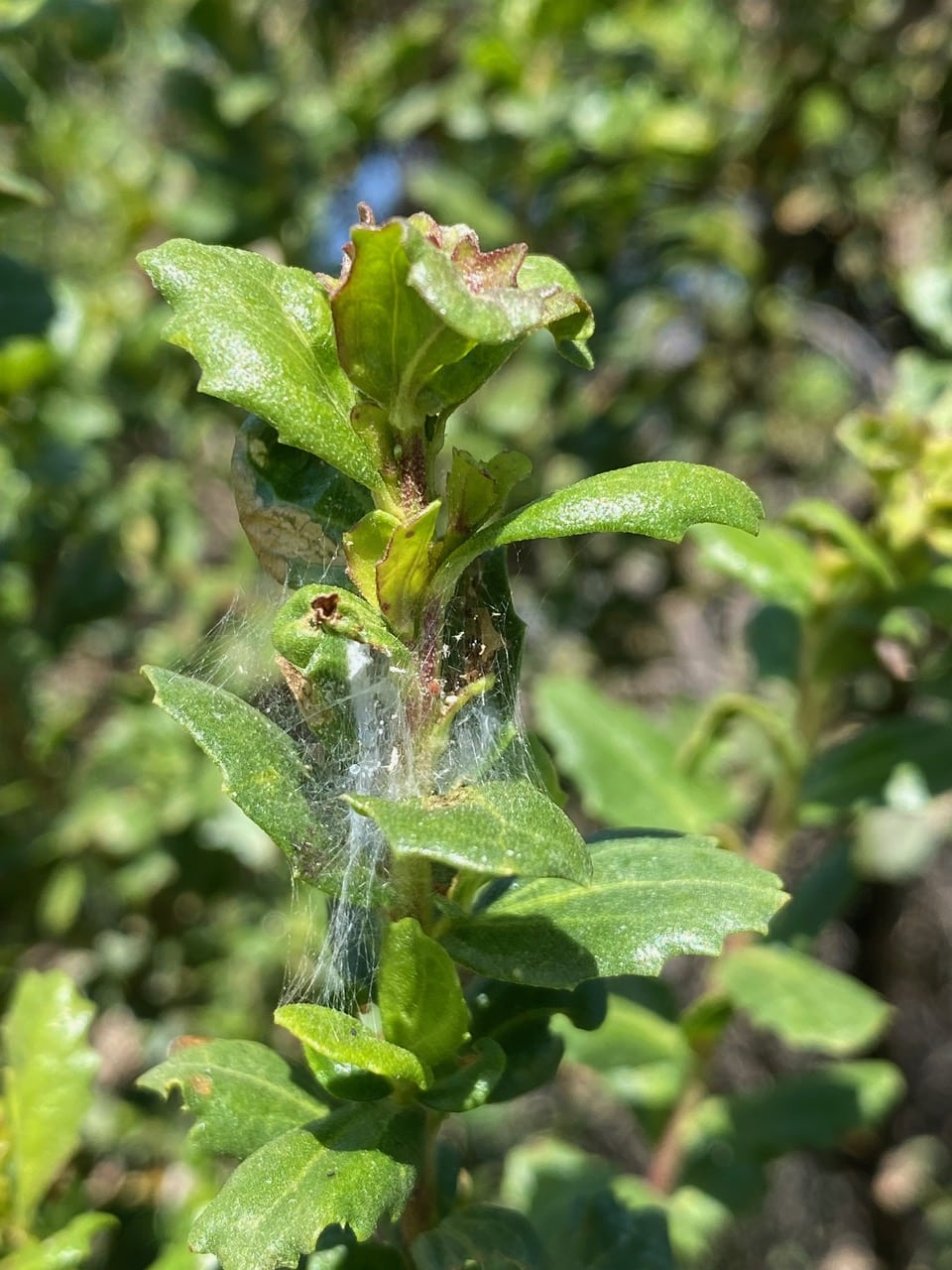
Looking through the mad tangles of silk on the Coyote Brush, I am beginning to see a pattern. When the webbing is not too thick, especially around freshly invaded foliage, one can often see silken tunnels linking leaves. The tunnel makers, most likely caterpillars, have apparently created these linear tubes in which to travel safely.
Another silk tunnel?
As the infestation progresses, a matrix of silk is woven around the tunnels. The silk is usually peppered with caterpillar frass.
See the white silk tunnel in that matrix of silk?
I gently pull apart the terminal leaves of this Baccharis that have been webbed together with silk. Whoa, do you see that tiny brown caterpillar? It is suspended in a filmy silk tunnel.
Close-up of the caterpillar, showing the silk tube in which it moves.
Do you see a similar caterpillar here? I didn’t see it until I reviewed the image at home. Its faint body is barely visible through the silk above the dark opening in the clump of brown leaves.
Apparently these caterpillars travel around in a silk tunnel that they construct around themselves. They like to tie together the terminal leaves at the tip of the branches, creating a tangled matrix of silk. They can then feed on the leaves from within the enclosed space, hidden from predators and parasites. I wonder what moth they will grow up to be?

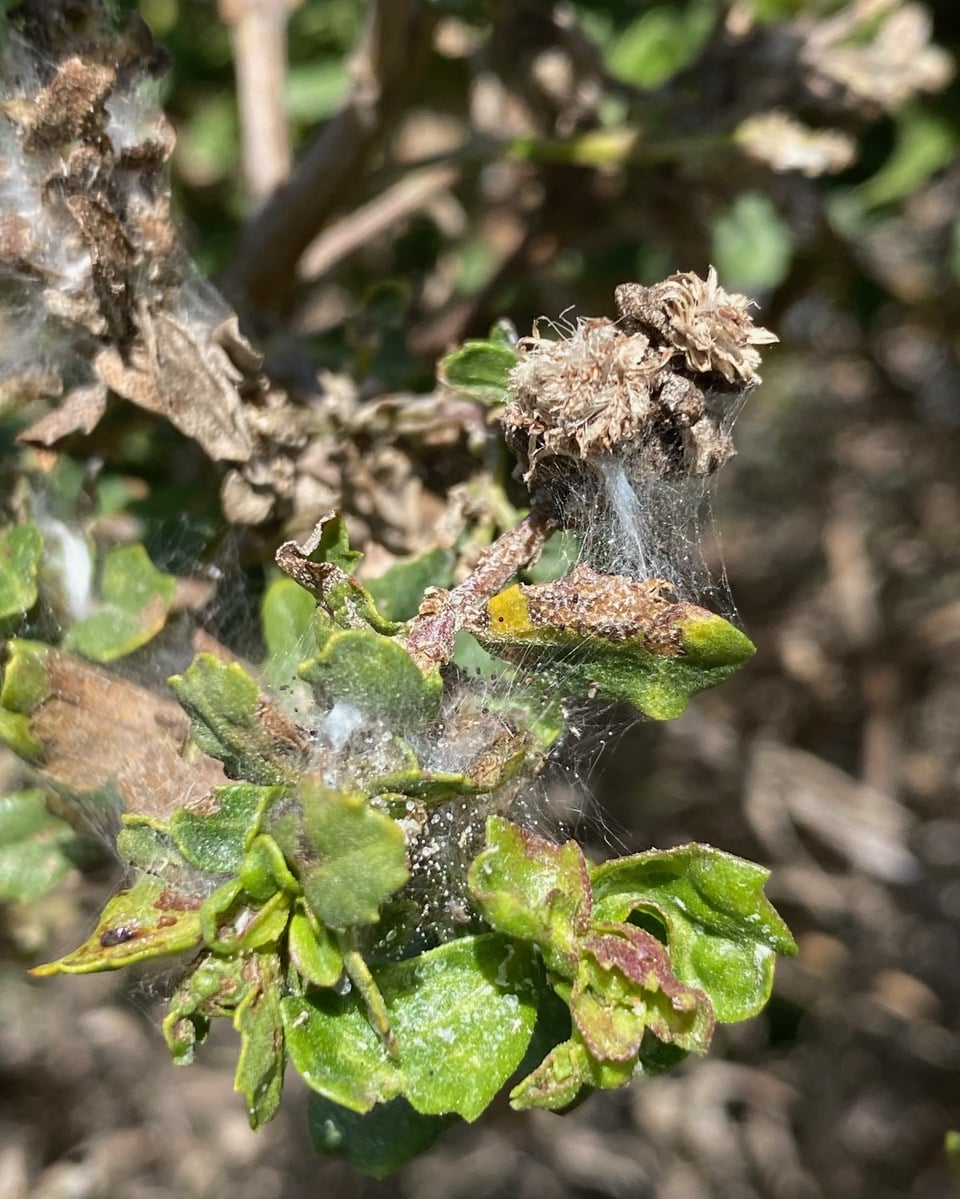
Photo taken on 9/4/25 of the same Coyote Brush at the height of caterpillar infestation.
When I recall the situation last year, I have a nagging feeling that a similar infestation is building up on the shrub again this year.
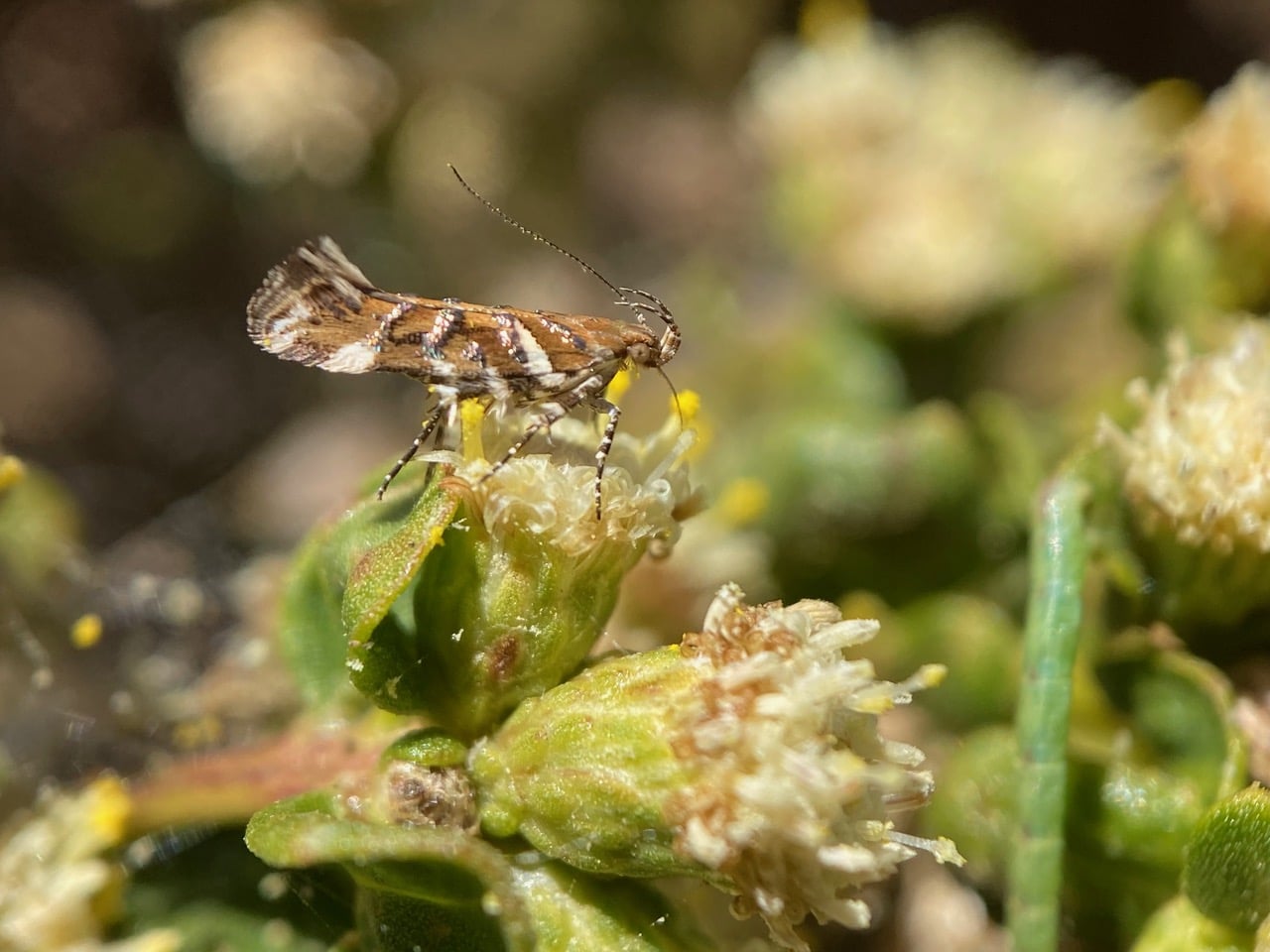
Photo taken on 8/24/25 on the same Coyote Brush. iNaturalist helped identify the moth as the Twirler Moth, Aristotelia argentifera (family Gelechiidae).
Last year I had strong suspicions that this moth was responsible for the devastation of the Coyote Brush as a huge number of the adult moths were flying around the shrub from late August through early September. I am now prompted to search for information about the behavior of Gelechiidae larvae. To my delight, this is what I found:
“Gelechiidae moth larvae often create protective silk tunnels or tubes on foliage to feed, move safely, and hide from predators. These larvae, known as webworms, often feed within these structures, often leaving frass behind. The larvae use silk to bind leaves, create, or web together, forming shelters to feed securely on foliage, stems, or inside fruits. The tunnels allow the larvae to travel safely between food sources.”
All the puzzle pieces are falling into place nicely. While I am happy to discover what is happening to the Coyote Brush, I wonder whether the shrub would survive a repeat infestation this year.