

Pollinator Post 3/10/24

I take a late morning walk at the Sibley Volcanic Regional Preserve under heavily overcast skies.
Passing a Pink-flowering Currant, Ribes sanguineum in peak bloom, I pause to look for insects. But none appears. Perhaps it’s too cold. I wonder what the fruit set would be for these early bloomers this year. We have had few sunny days when the pollinators are out foraging.
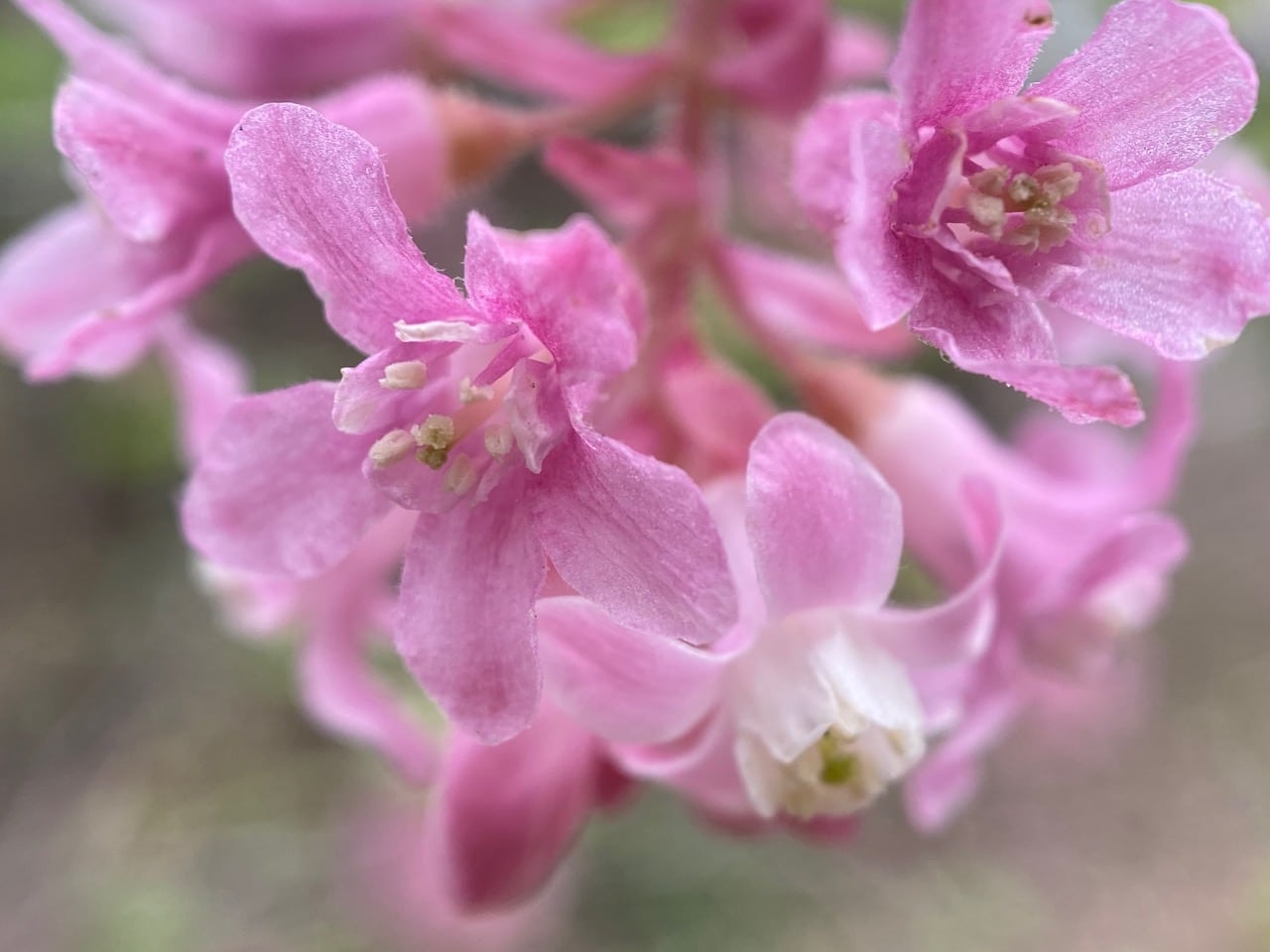







The overall pink parts of the flower are actually the sepals that have fused into a tube with flaring tips. The white petals stand erect, surrounding the reproductive structures within. As the flower matures, the petals also turn pink, indistinguishable from the sepal color. It is interesting that the whole inflorescence droop. The orientation might serve to protect the reproductive parts of the flowers from the winter rains. The flowers requite pollinators with fairly long tongues to reach the nectar at the base of the tubes. Besides hummingbirds, I have seen Bumble Bees, Digger Bees, and Greater Bee Flies take nectar from R. sanguineum.
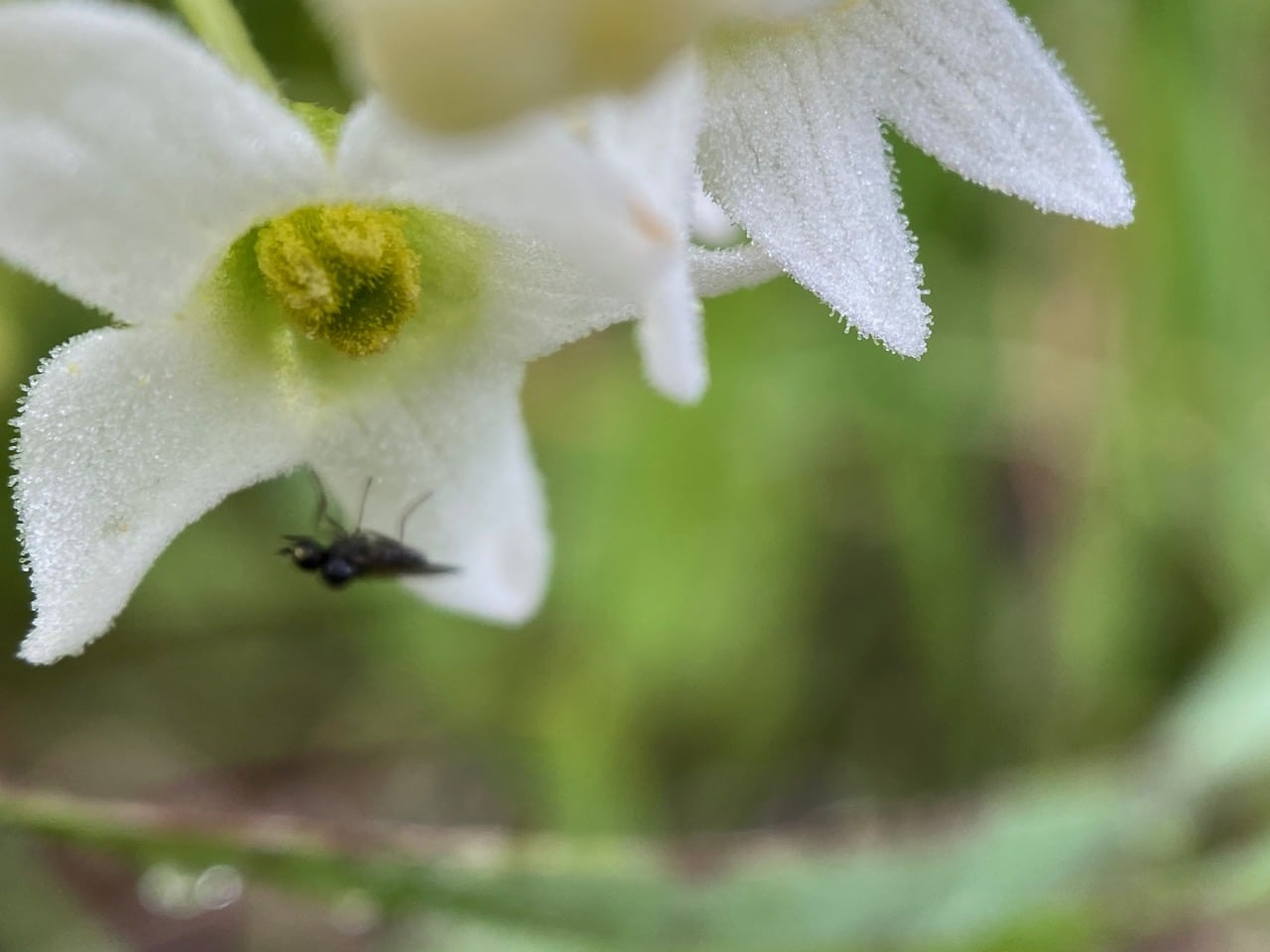
Hey, there’s a tiny black insect on the male flower of Wild Cucumber, Marah oregana. It flies away before I can get a good picture, but the fuzzy profile showing a humped thorax and straight, forward pointing proboscis tells me it is probably a Hybotid Dance Fly (family Hybotidae). The fly even has some yellow pollen stuck to its head.
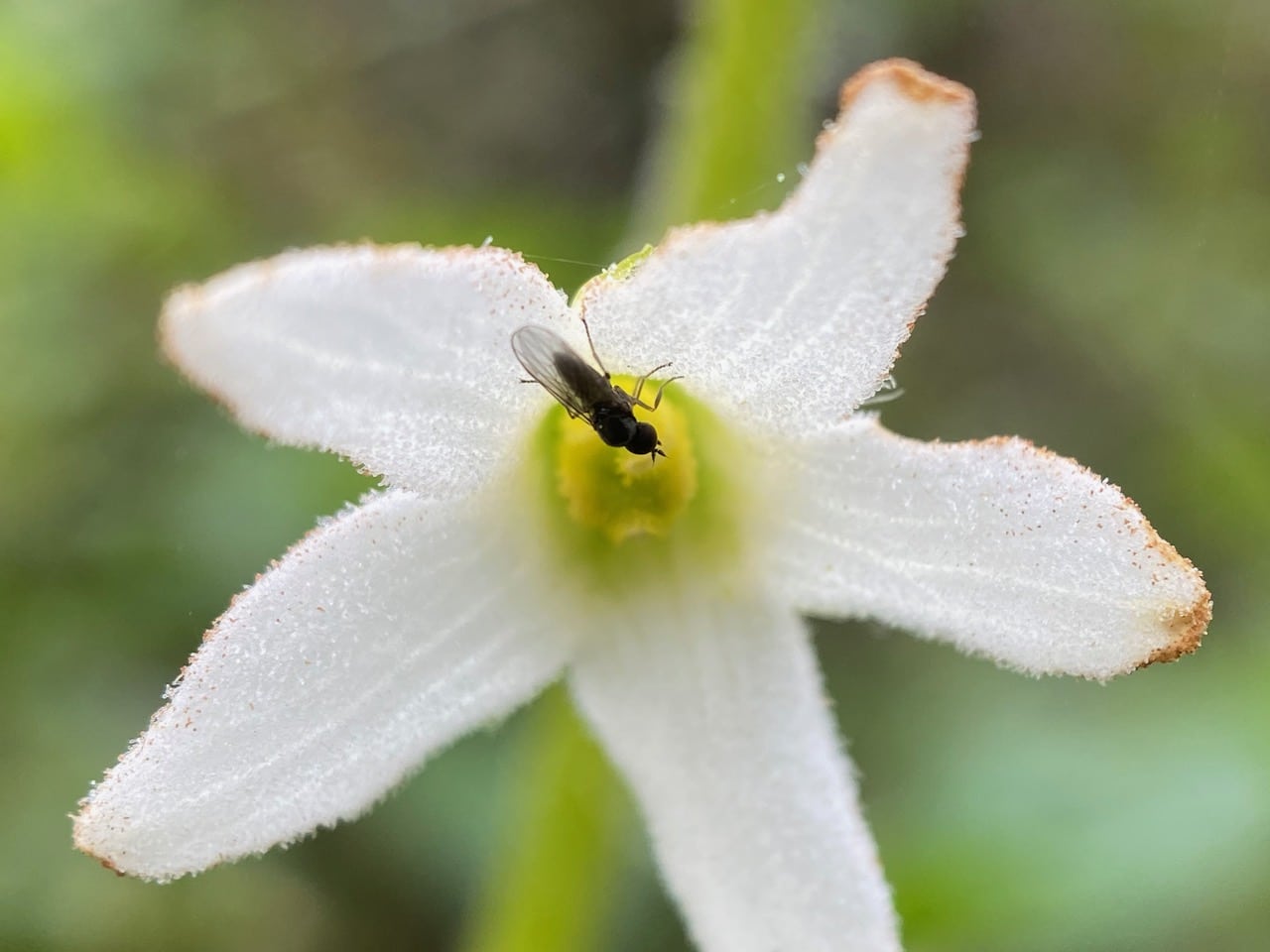
Ooh, here’s another one perched on the rim of a male flower. Yep, sure looks like a Hybotid Dance Fly. Do the Hybotids pollinate the Wild Cucumber flowers?
The Typical Dance Flies or Hybotid Dance flies (family Hybotidae) are generally under 3mm long. Their compound eyes seem to take up most of their spherical head. These flies belong to the superfamily Empidoidea and were formerly included in the Empididae as a subfamily. Empididae generally have a thick beak pointing down, while Hybotidae have a thinner beak, or a thick beak pointing forwards or diagonally. Some crucial wing venation further distinguishes the two families. Precious little is known about the life cycle and biology of Hybotids because they are not considered of economic consequence. Since their forelegs are generally not raptorial, I wonder if they’re predaceous like the Empidids. I have seen the Hybotids visit flowers for nectar and pollen, notably on Soap Plant, Miner’s Lettuce, California Saxifrage, and Wild Geranium, and I believe they may contribute to the pollination of these flowers. Now perhaps we can add Marah to the list.
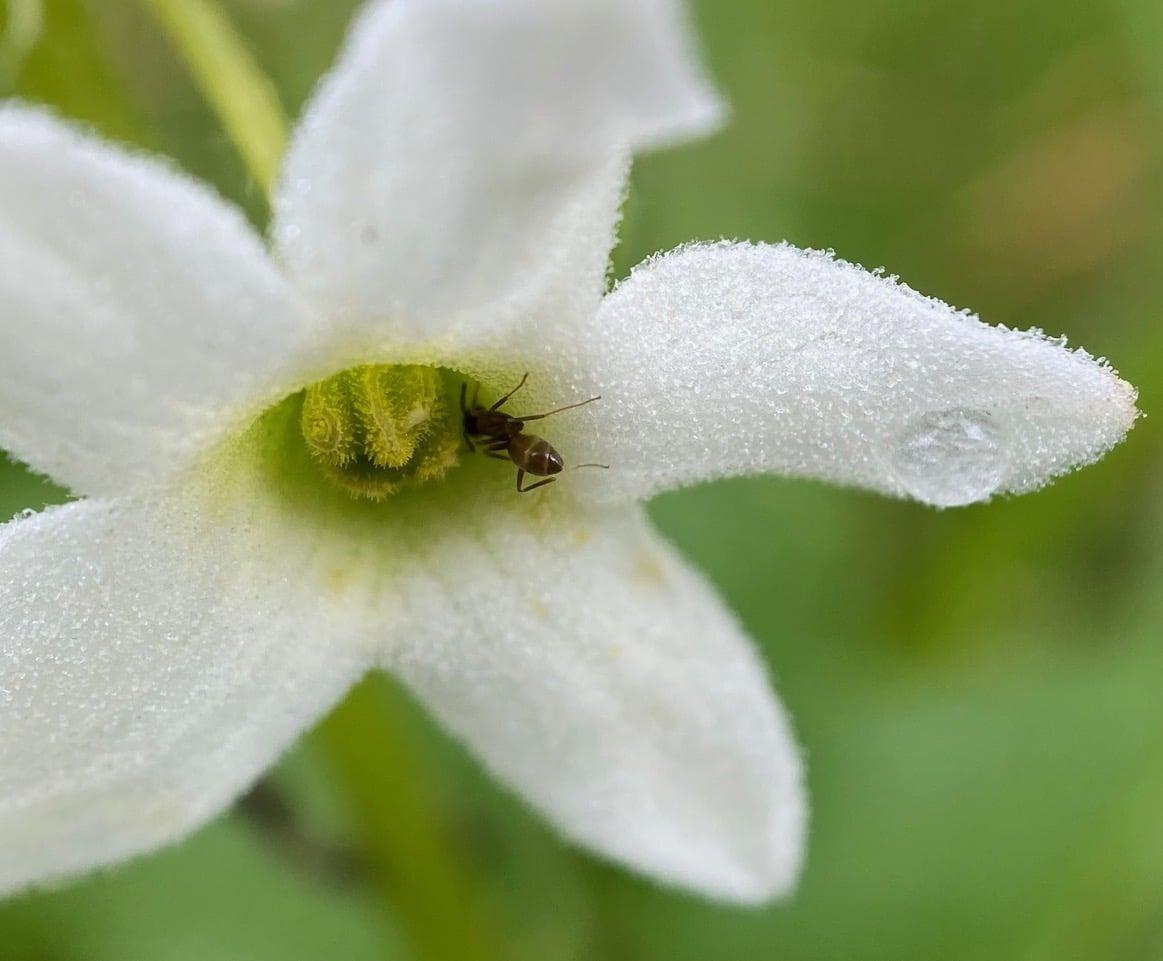
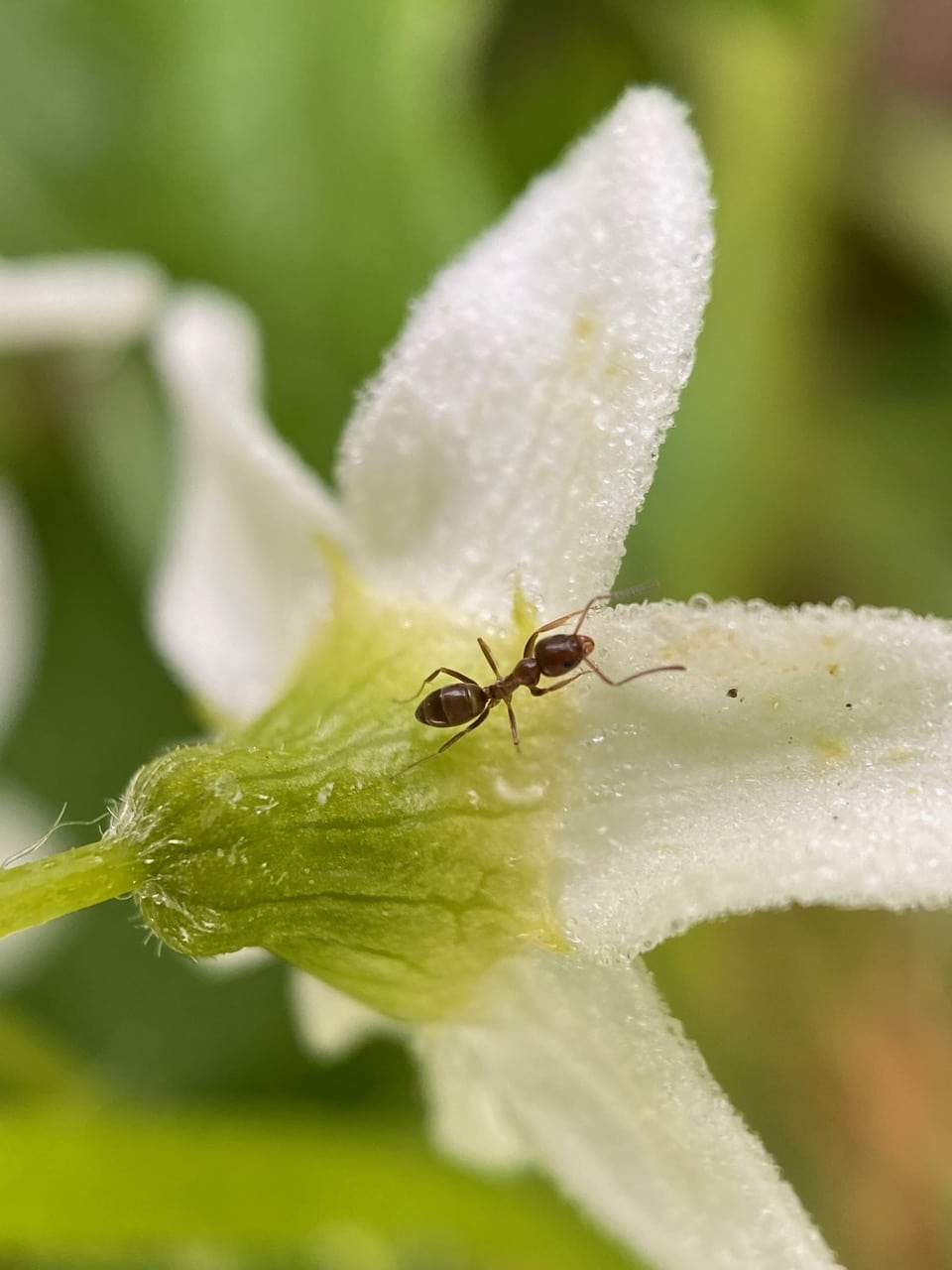
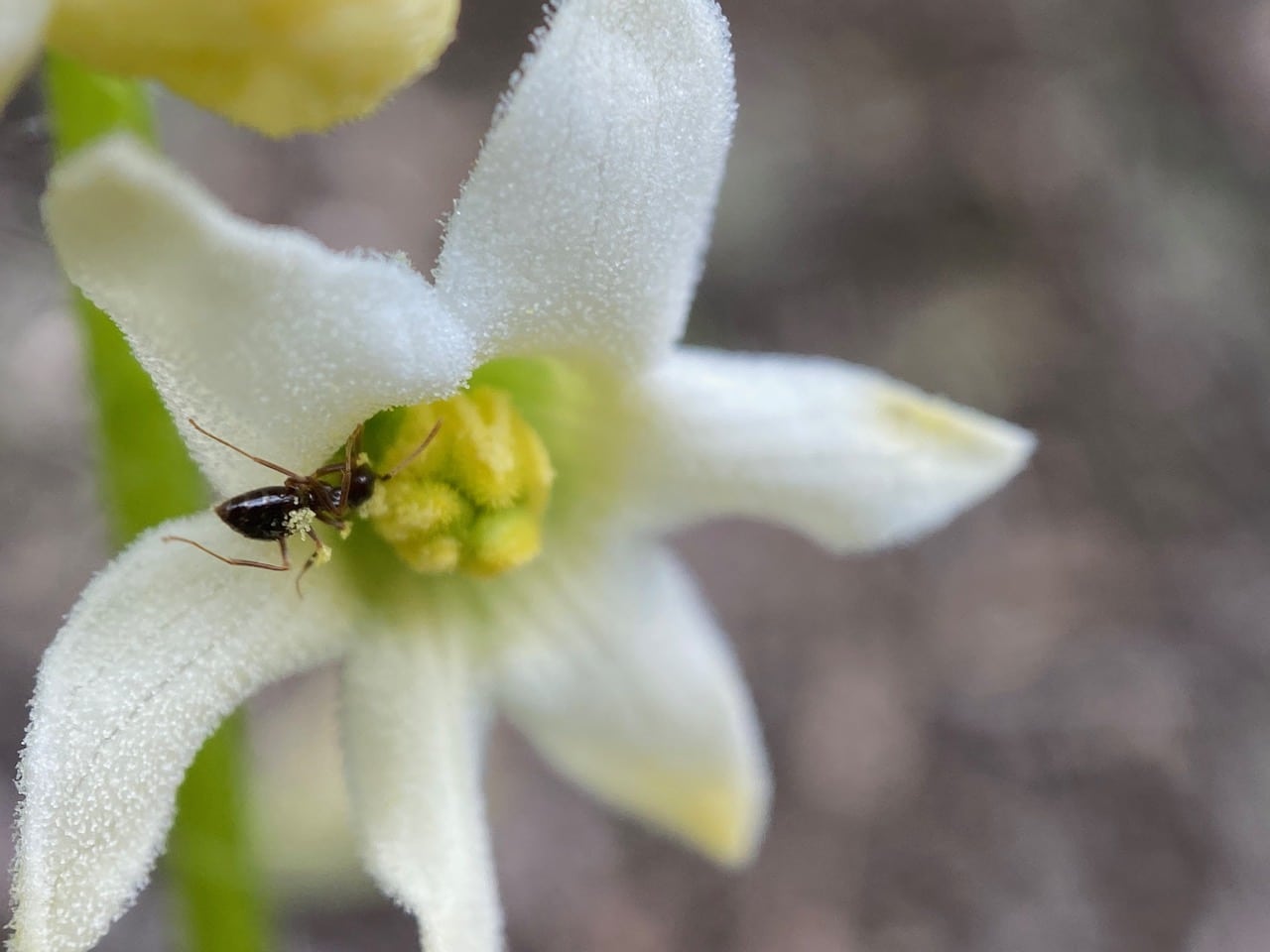
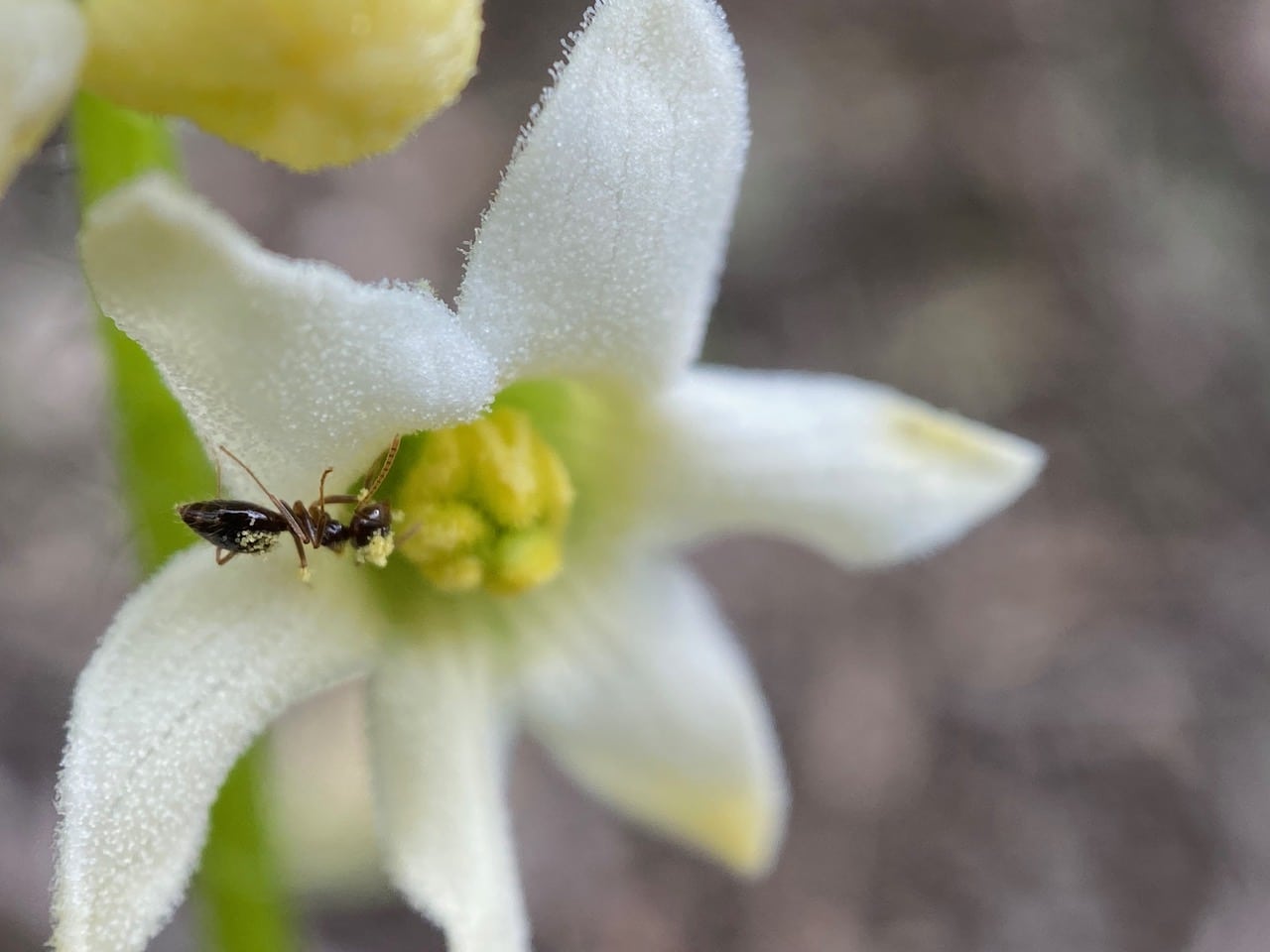
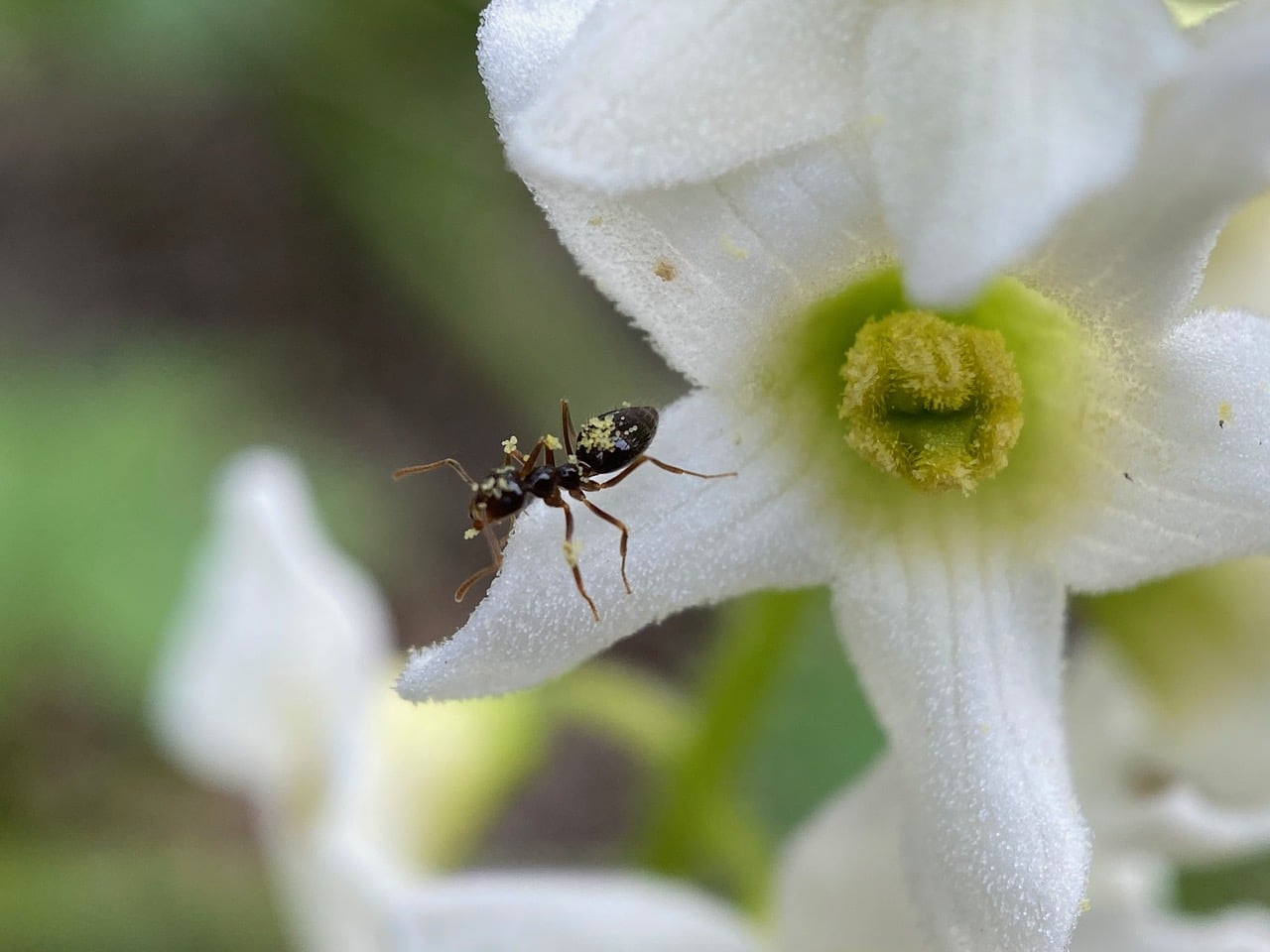
An ant is crawling down the corolla of a male Wild Cucumber flower. I think it is an Argentine Ant.
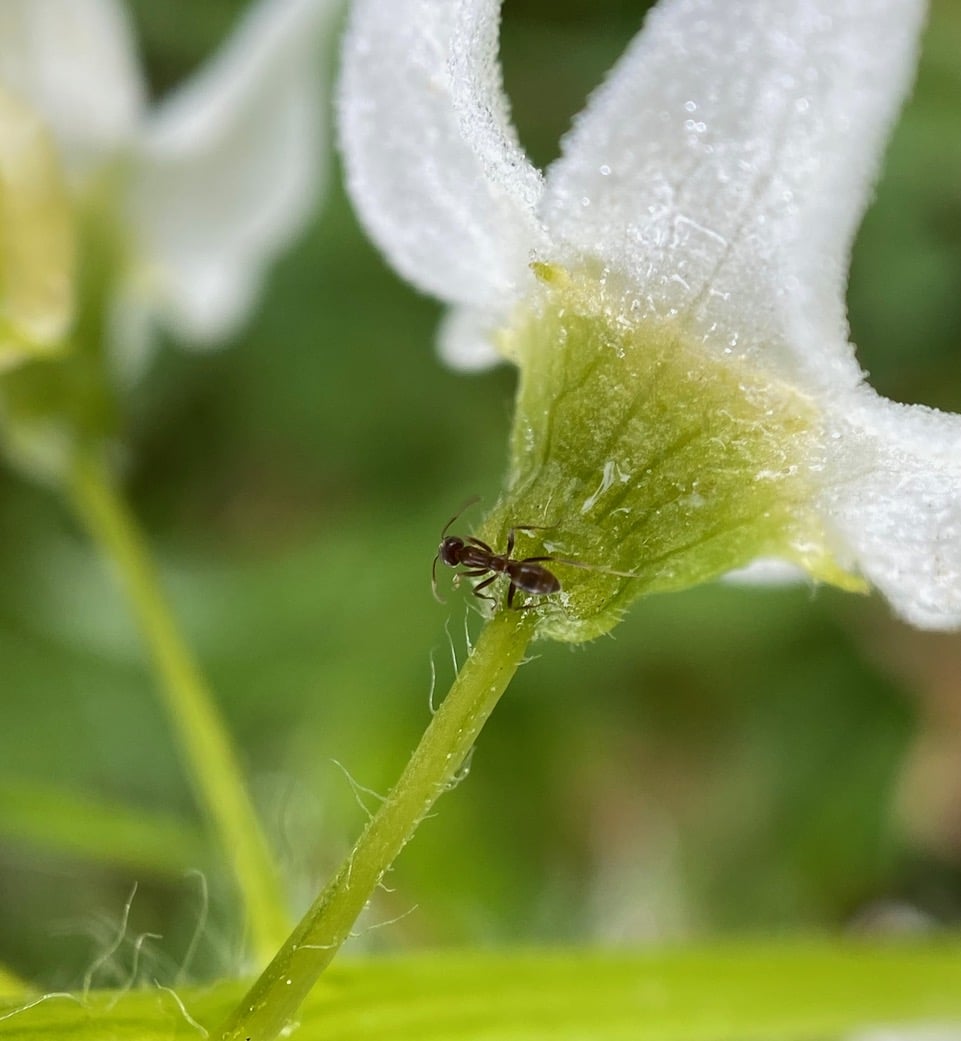
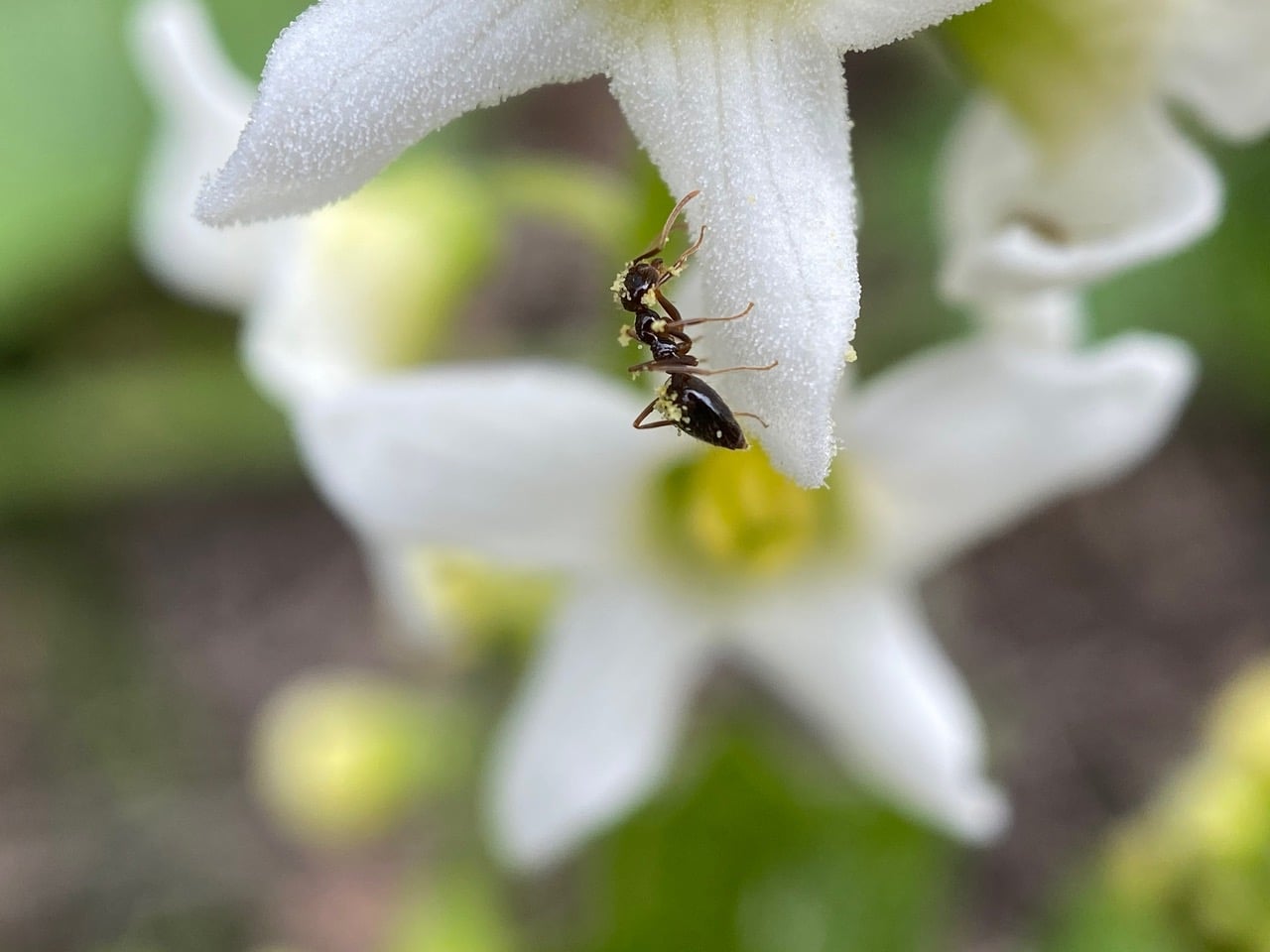
Here’s a close-up of the same ant outside the flower. iNaturalist has confirmed that it is an Argentine Ant.
The Argentine Ant, Linepithema humile (family Formicidae) is native to Northern Argentina, but it has been inadvertently introduced by humans to many countries, and is now an established invasive species in many Mediterranean climate areas worldwide. The success of the species can be attributed to their lack of aggression between the colonies. There is no apparent antagonism between separate colonies of its own kind, resulting in “super-colonies” that extend across hundreds or thousands of kilometers in different parts of the their range. Genetic, behavioral, and chemical analyses show that introduced Argentine Ants on separate continents actually represent a single global supercolony.
The Argentine Ants are ranked among the world’s worst invasive animal species. In its introduced range, the Argentine ant often displaces most or all native ants and can threaten native invertebrates and even small vertebrates that are not accustomed to defending against the aggressive ants. This can, in turn, imperil other species in the ecosystem, such as native plants that depend on native ants for seed dispersal, or lizards that depend on native ants for food.
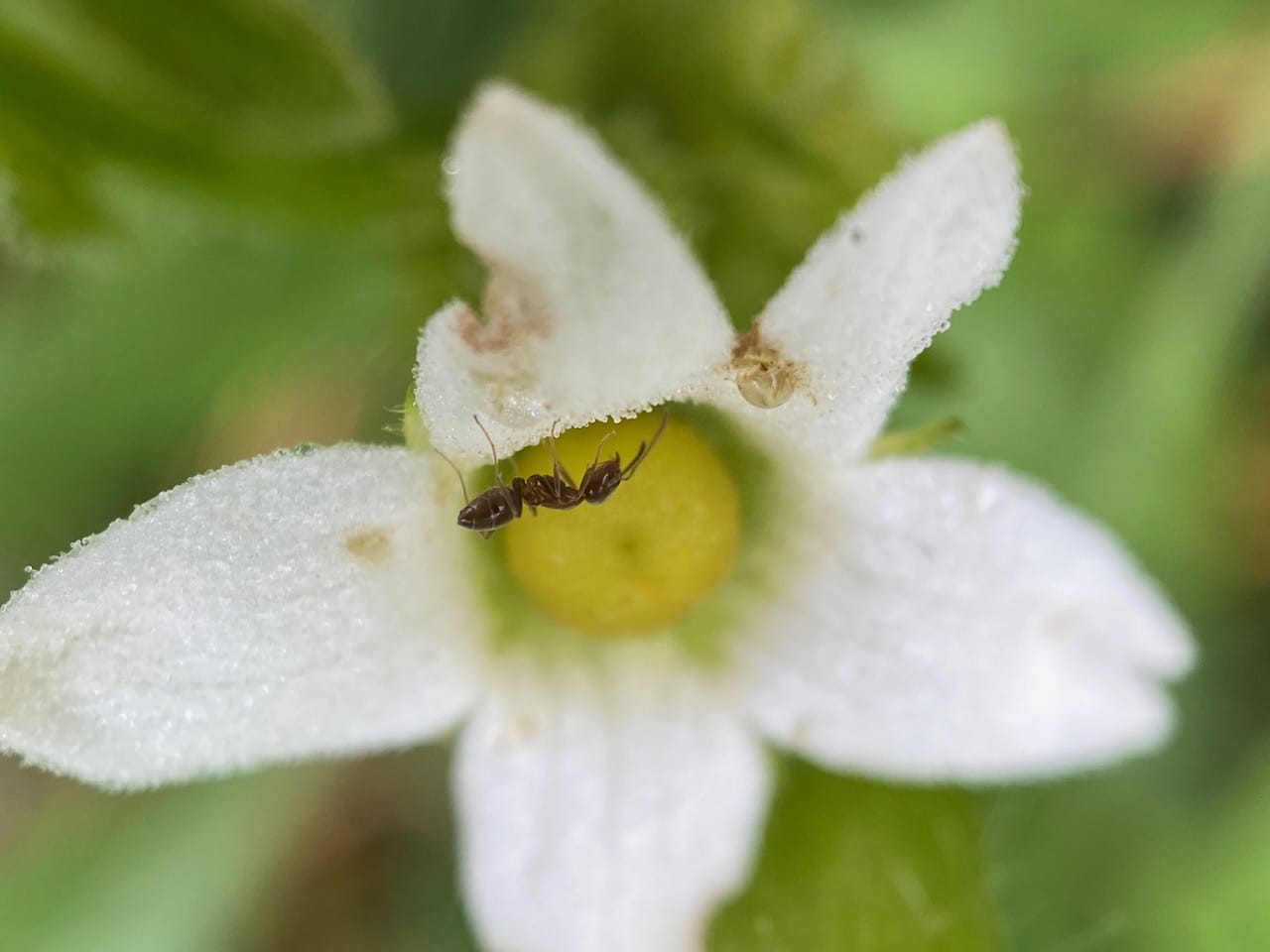
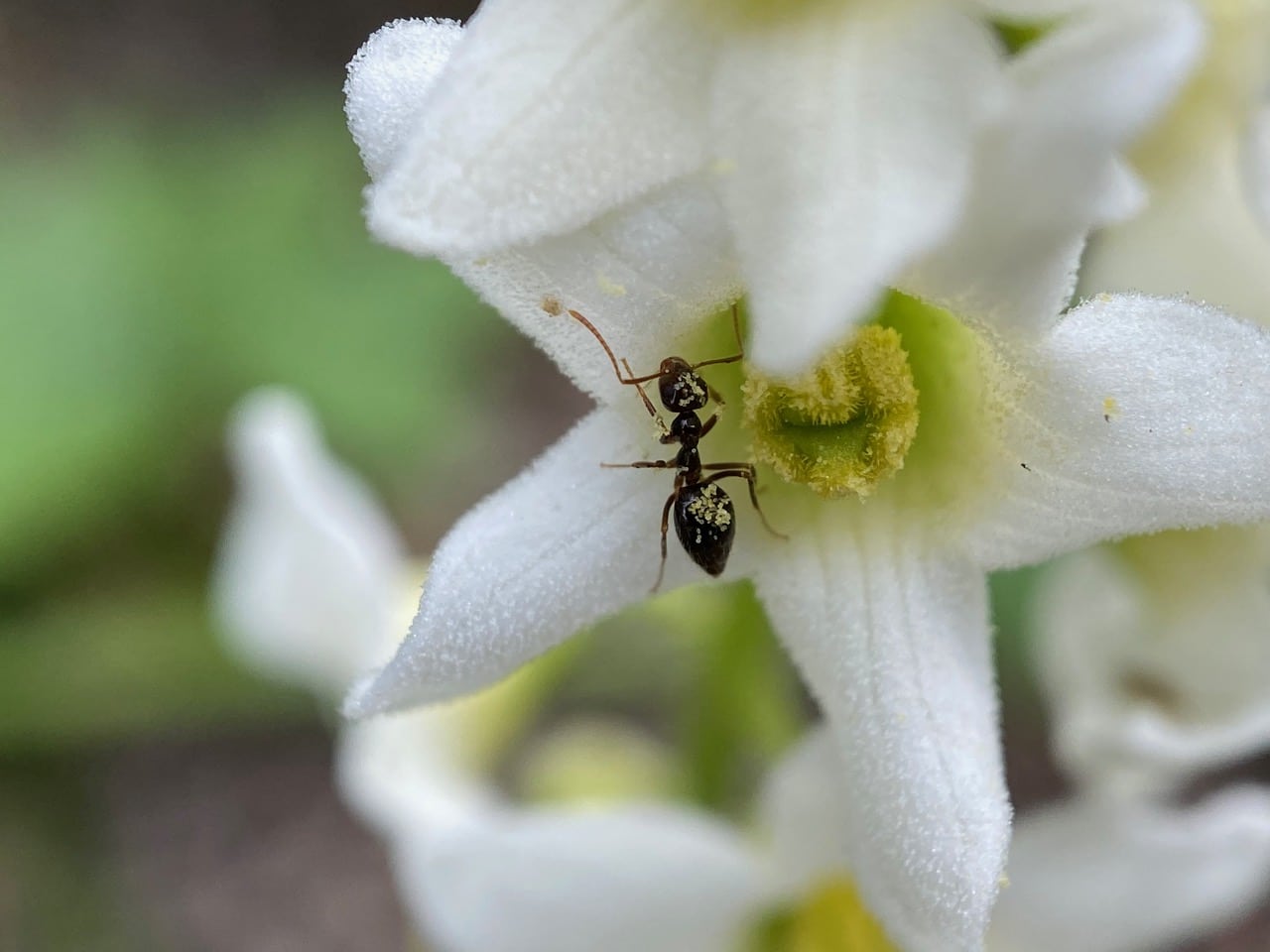
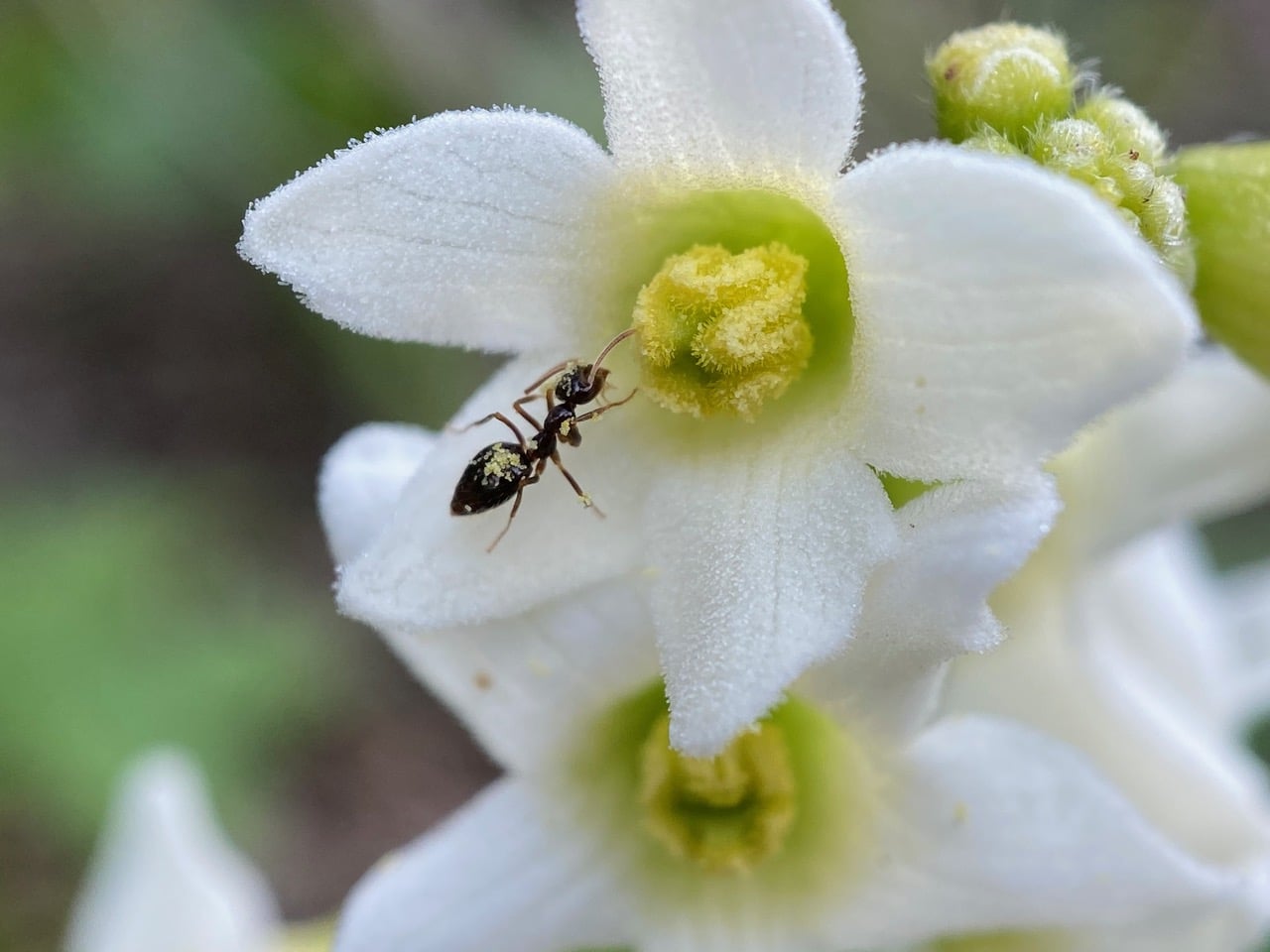
Yet another Argentine Ant, this one on a female Marah flower.
The Argentine Ant is tiny, and has a slim body. Can it pollinate Marah like the native ants? The individuals I see today do not have any pollen on their body. Perhaps they are too small to make contact with the reproductive parts of the flower when they take nectar?
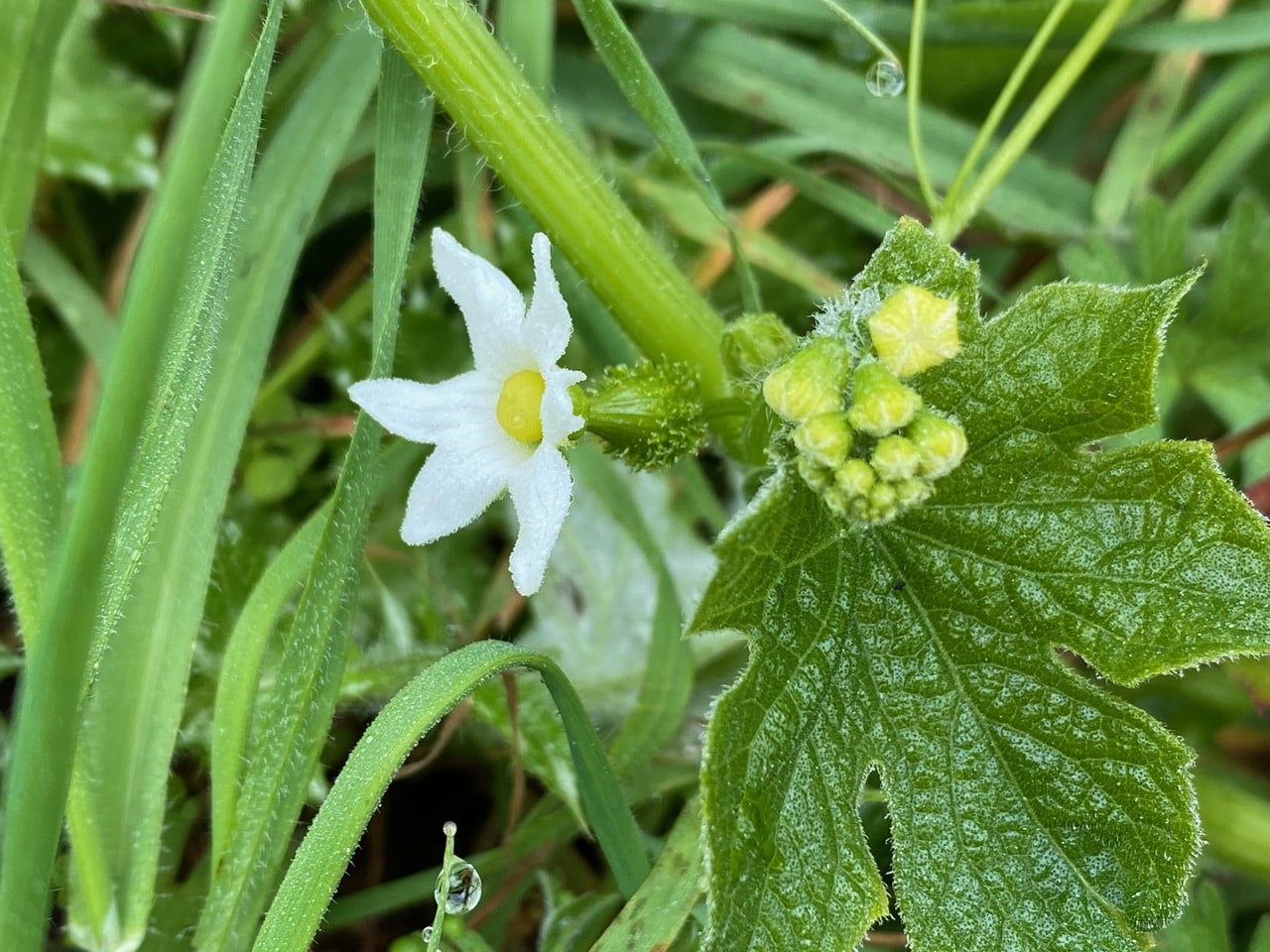
The Wild Cucumber is monoecious – separate male and female flowers are borne on the same plant. Here a freshly opened female flower with a fuzzy inferior ovary beneath it has emerged from a leaf axial under a stalk of male flowers that are still in bud. The yellow globular stigma in the middle of the female flower is receptive to incoming pollen at the moment. Since the accompanying male flowers are not yet mature, there’s no risk of self-pollination. For cross-pollination to occur, the pollen has to come from further afield. Since the Marah vines sprawl extensively on the ground, it is conceivable that ants can easily crawl from one plant to another, transferring pollen between them.
The temporal separation of the sexes is termed dichogamy. It’s a plant’s strategy for avoiding self-pollination. When the female reproductive organ (or female flower) matures first, the phenomenon is called protogyny.
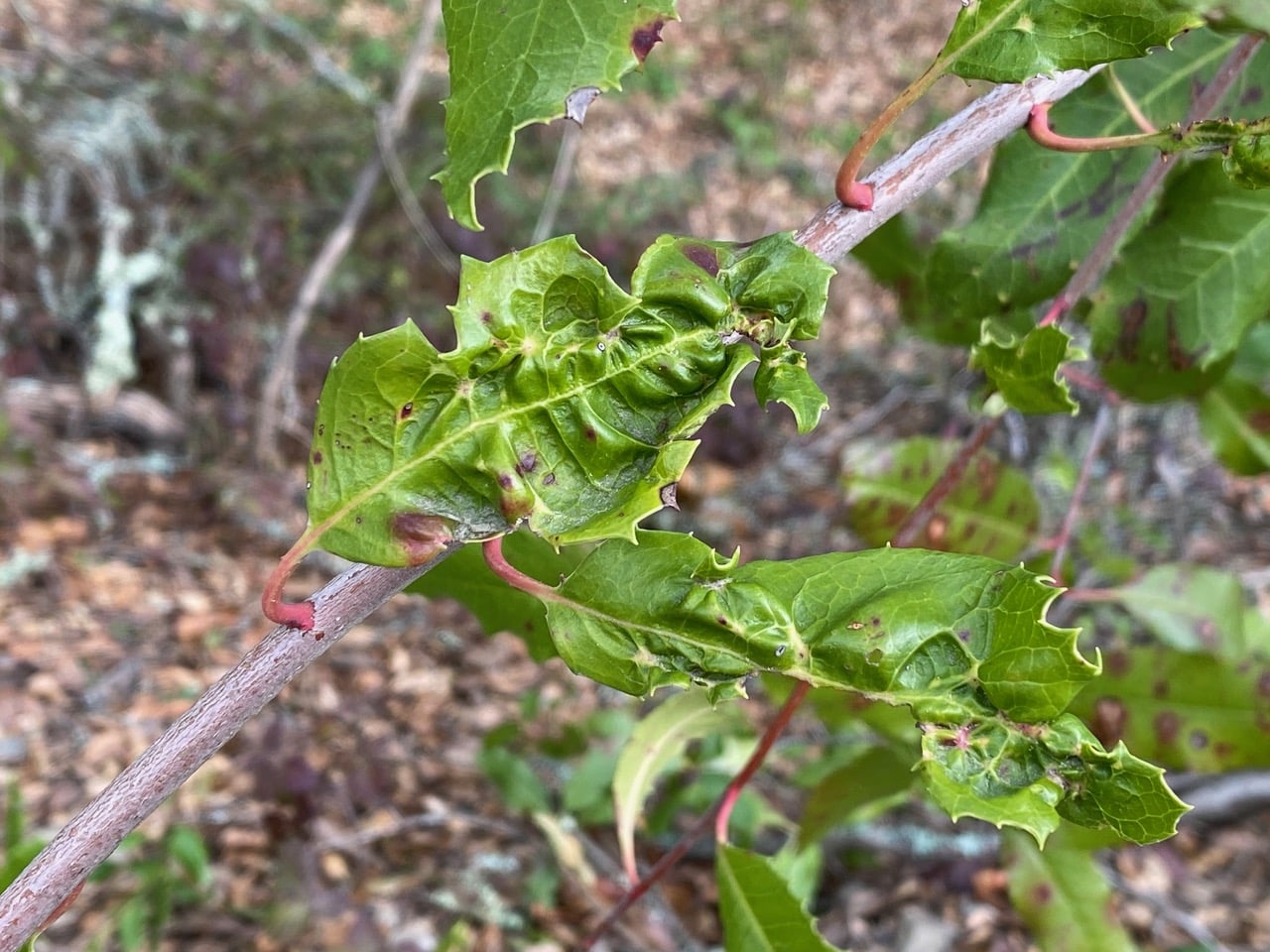
What is happening to the leaves on this Toyon, Heteromeles arbutifolia? I have seen these badly misshapen, crimped and puckered leaves on Toyon in just about every park I have visited lately. I suspect small insects with piercing-sucking mouthparts, but have never been able to find the culprits. The closest answer I can find online is that the condition is Scab, caused by various types of fungus. Scab is spread through the air, and more importantly by splashing water. The infection is most active during spring rains.
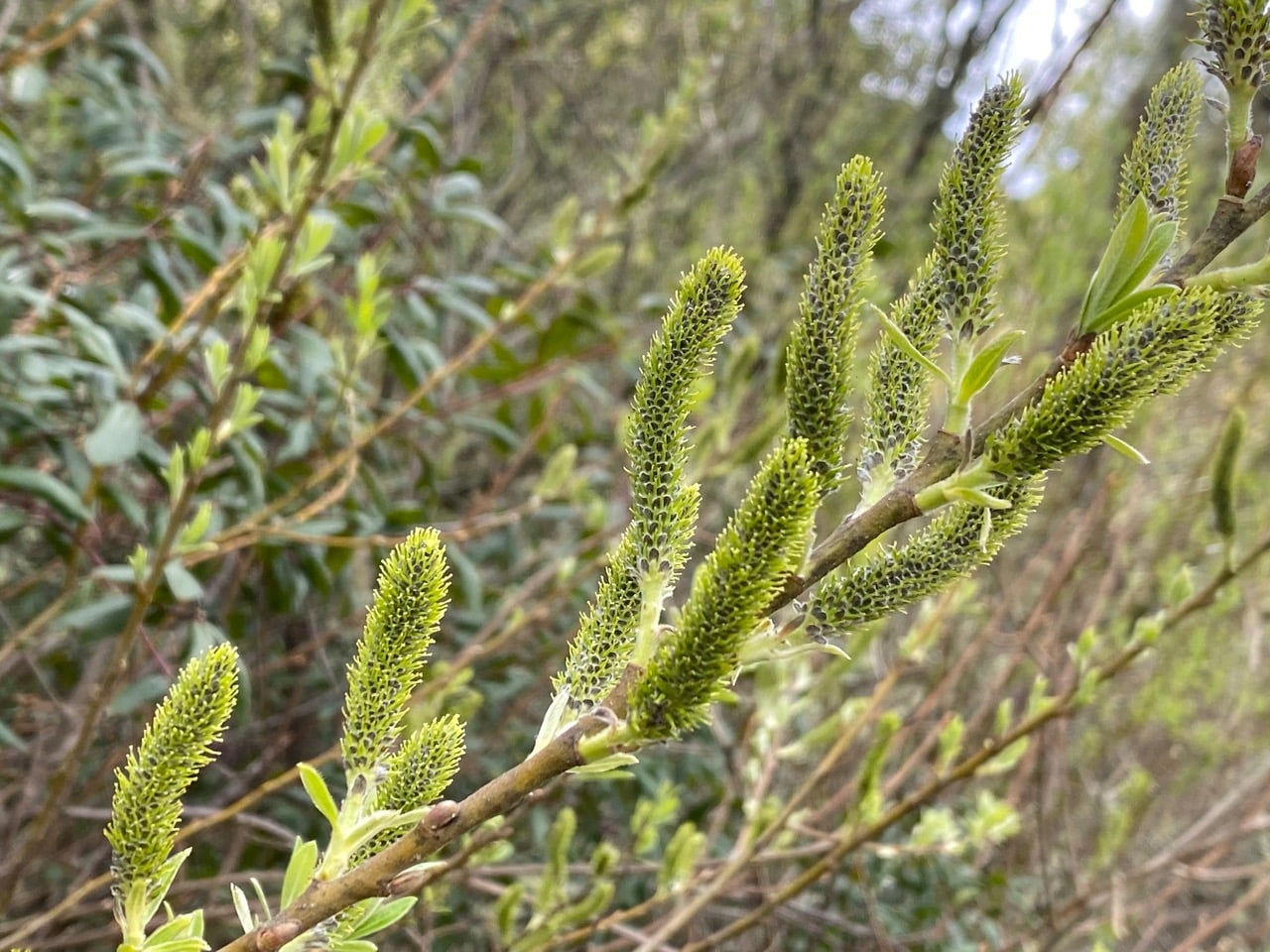
Ah, that glorious stand of Arroyo Willow, Salix lasiolepis. Willows are dioecious, meaning male and female flowers are borne on separate plants. On this female plant, there are still some catkins bearing receptive stigmas.
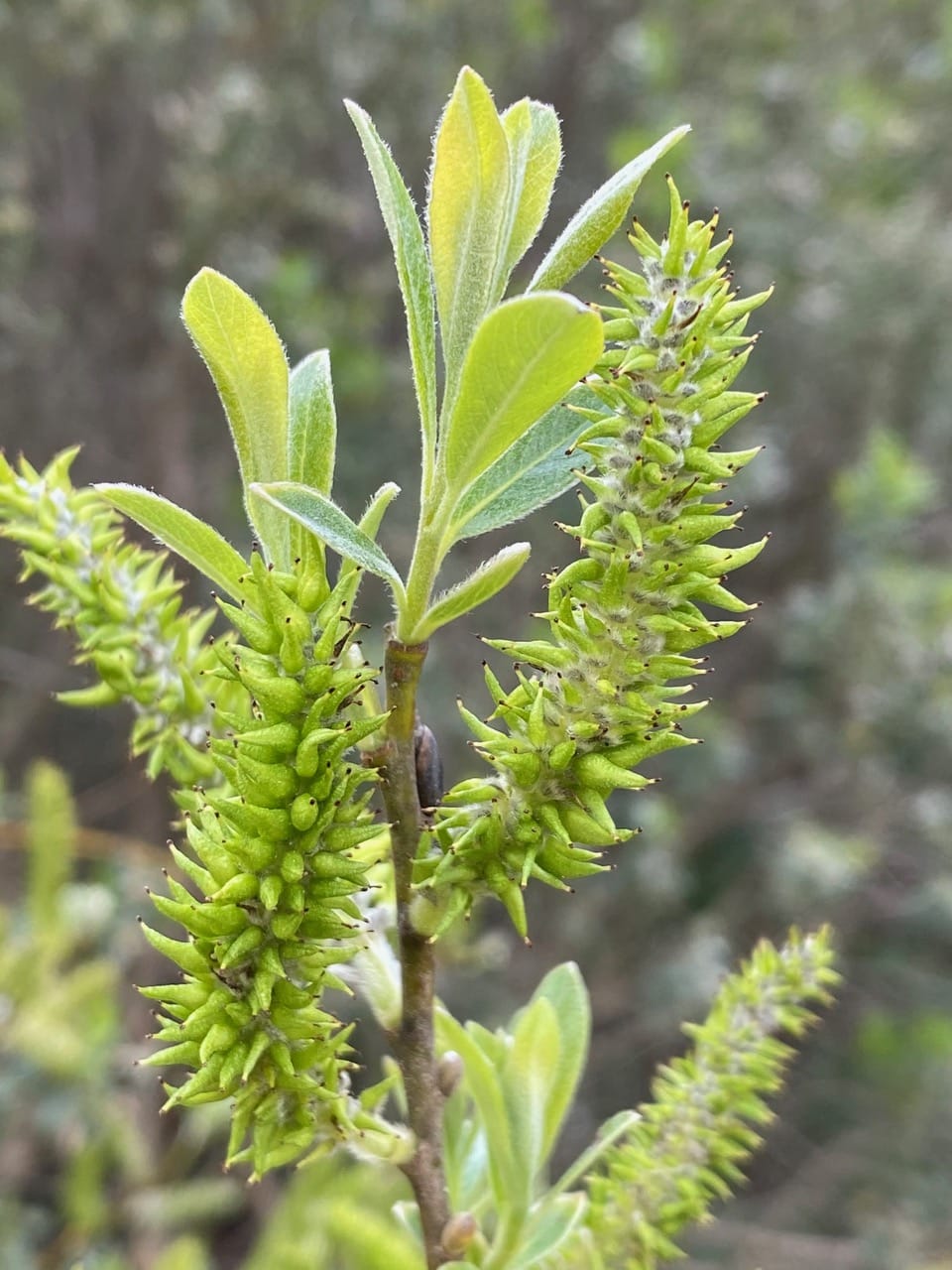
But most of the female catkins are developing into fruits. The plant is also leafing out.
The bowling-pin-shaped ovaries have swollen into green fruits on the stalk.
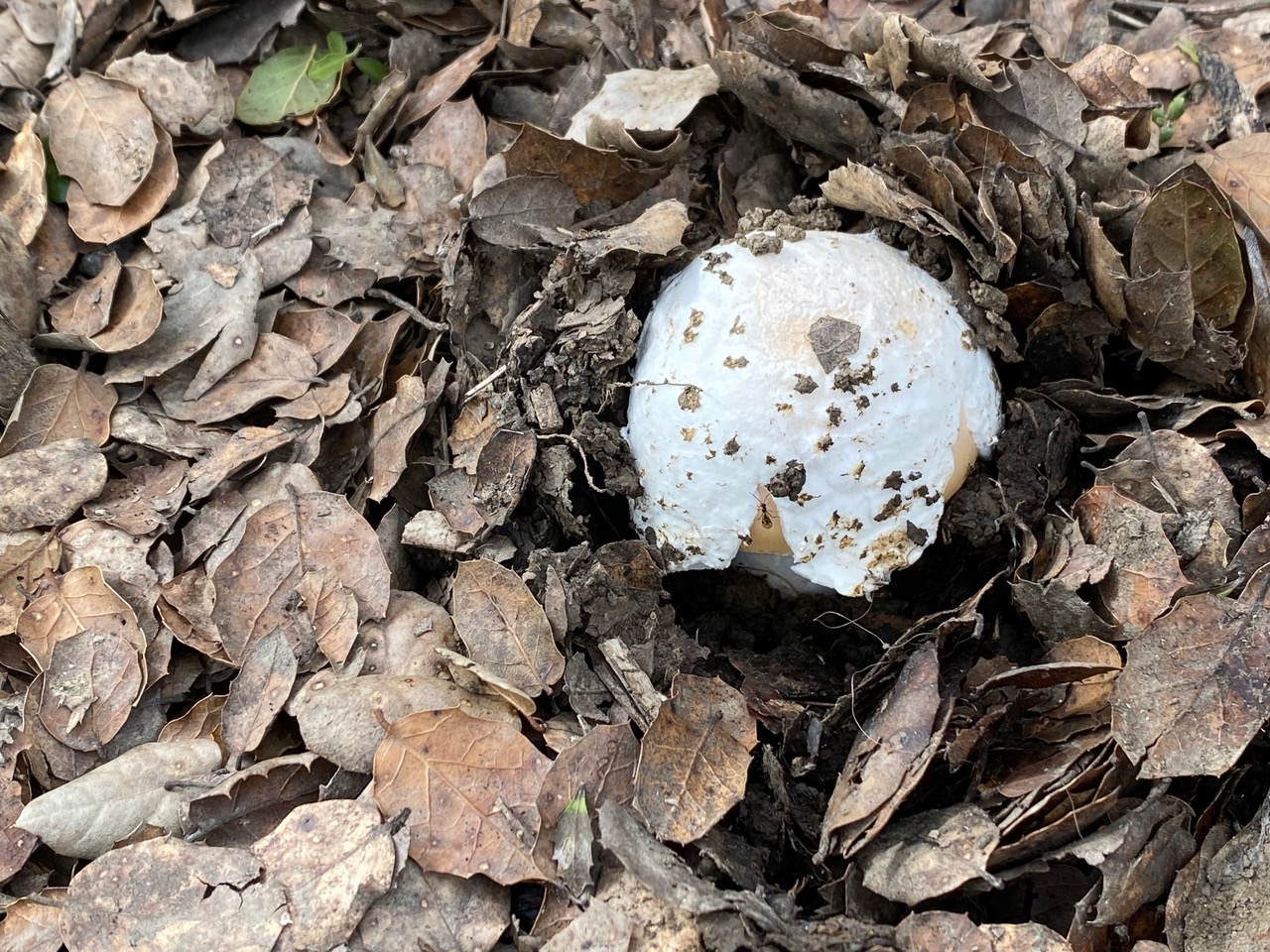
A large mushroom, about 4 in. across is emerging from the leaf litter under a Coat Live Oak. It has a very thick universal veil on a pale cool-toned yellow cap. Coccora?
One of the most beautiful early season mushrooms in the Bay Area is the distinctive Amanita calyptroderma, or Coccora. These mushrooms are found under Live Oak and Madrone, with which they have a mycorrhizal relationship. The thick universal veil is always white, and forms a loose sac at the base of the stipe, and a thick patch of tissue on the cap. When young, all amanitas are covered by a membrane called a universal veil. In the case of Coccora, this veil is extremely thick and cottony, and the top of the mushroom egg is wider than the bottom – a useful distinction from the local deadly species of amanita. I am in no mood to dig out this beautiful mushroom to find out. The darker fall version of the Coccora is one of the most commonly eaten West Coast amanitas. The pale spring form is not recommended for the table, since it can be difficult to distinguish from the poisonous species.
Hey, more ants on the Wild Cucumber! This one is an American Winter Ant, and as it backs out of the male flower, it has pollen all over its body.
There’s a big glob of pollen on top of its head.
Here’s another American Winter Ant loosely covered with pollen.
The American Ant, Prenolepis imparis is a widespread North American ant. A dominant woodland species, it is most active during cool weather, when most other ant species are less likely to forage. This species is one of a few native ants capable of tolerating competition with the invasive Argentine Ant, Linepithema humile. They are also aggressive toward other ants and produce abdominal secretions that are lethal to Argentine Ants. Prenolepis imparis is a generalist omnivore. Foragers are known for tending to aphids or scale insects from which they consume excreted honeydew, aggregating on rotting fruit, and exploiting protein-rich sources such as dead worms. The colony enters estivation (a hibernation-like state) and becomes inactive above ground for the warmer months, during which time eggs are laid and brood are reared. Reproductives overwinter and emerge on the first warm day of spring for their nuptial flight.
I watch as this American Winter Ant gingerly crawls down the corolla of a male flower.
It stays in this position for a while, apparently drinking nectar.
When it emerges, it is covered with pollen. It spends some time trying to brush off pollen from its face.
Then undeterred, it climbs onto the next male flower above…
… and approaches the fresh stamens in the middle of the flower.
I am not sure if the ant actually eats the pollen.
The ant heads down to the basement for nectar. Apparently the main attraction is the nectar.
Such fun – I can watch this forever! I think the American Winter Ant is the perfect size for pollinating the Wild Cucumber flowers.