

Pollinator Post 2/8/24 (4)
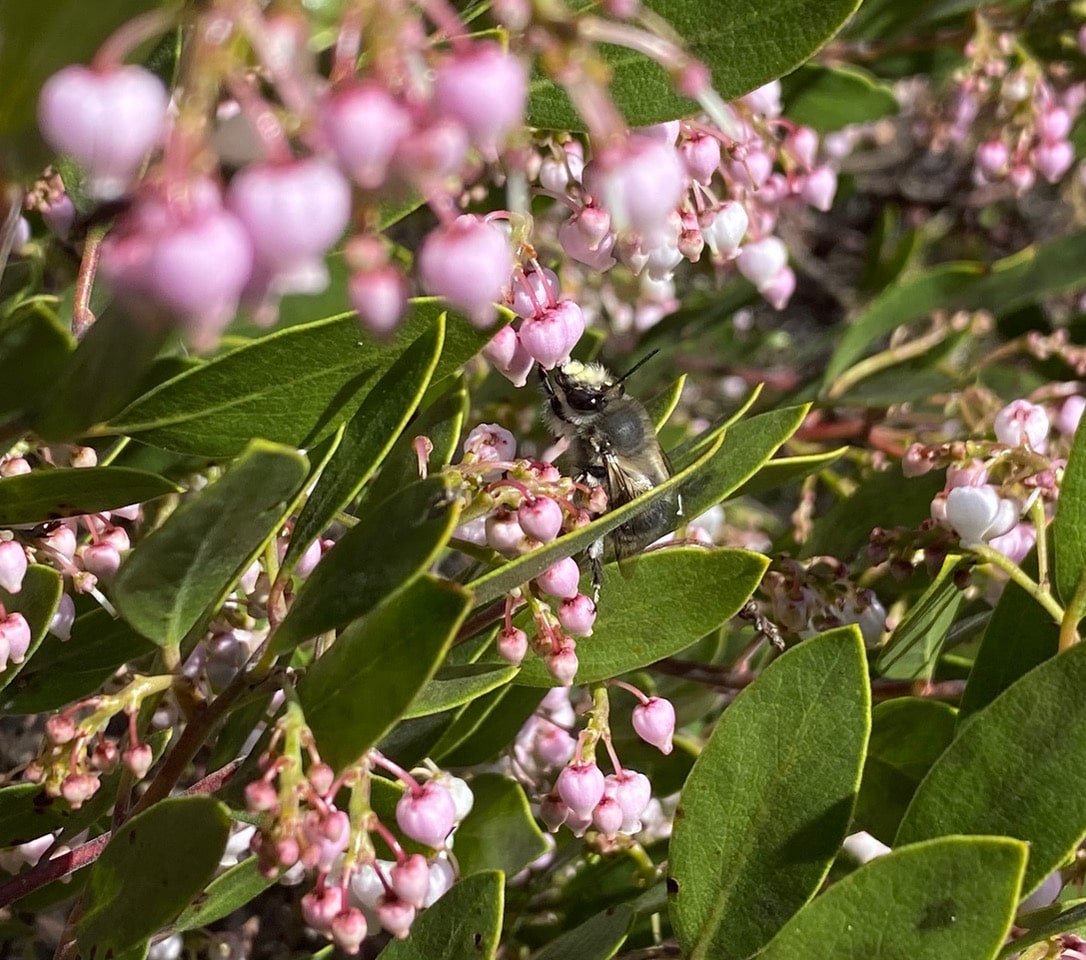
More numerous than the bumble bees at the blooming Manzanita are these gray, stout-bodied bees that fly around noisily. They are the California Mountain-Digger Bees, Habropoda depressa (family Apidae). Interestingly none of them seems to be collecting pollen. They are all sticking their tongues into the flowers to access nectar. Then I realize that they are mostly males – males do not gather pollen to provision the nest, neither do they have the equipment (scopae or special pollen collecting hairs on the hind legs) for the job.
Habropoda depressa are large, stout-bodied, gray bees. The species is widespread, commonly seen visiting urban gardens in early spring, foraging from early blooming plants like Manzanita and Ceanothus. The flight season is from February into May, with peak activity in March and April. They are fast and noisy flyers. Females are solitary and nest in soil, often in vertical banks but also in flat ground. Pollen is transported in white scopae on the outer part of their hind legs. The bees have the ability to do buzz pollination.
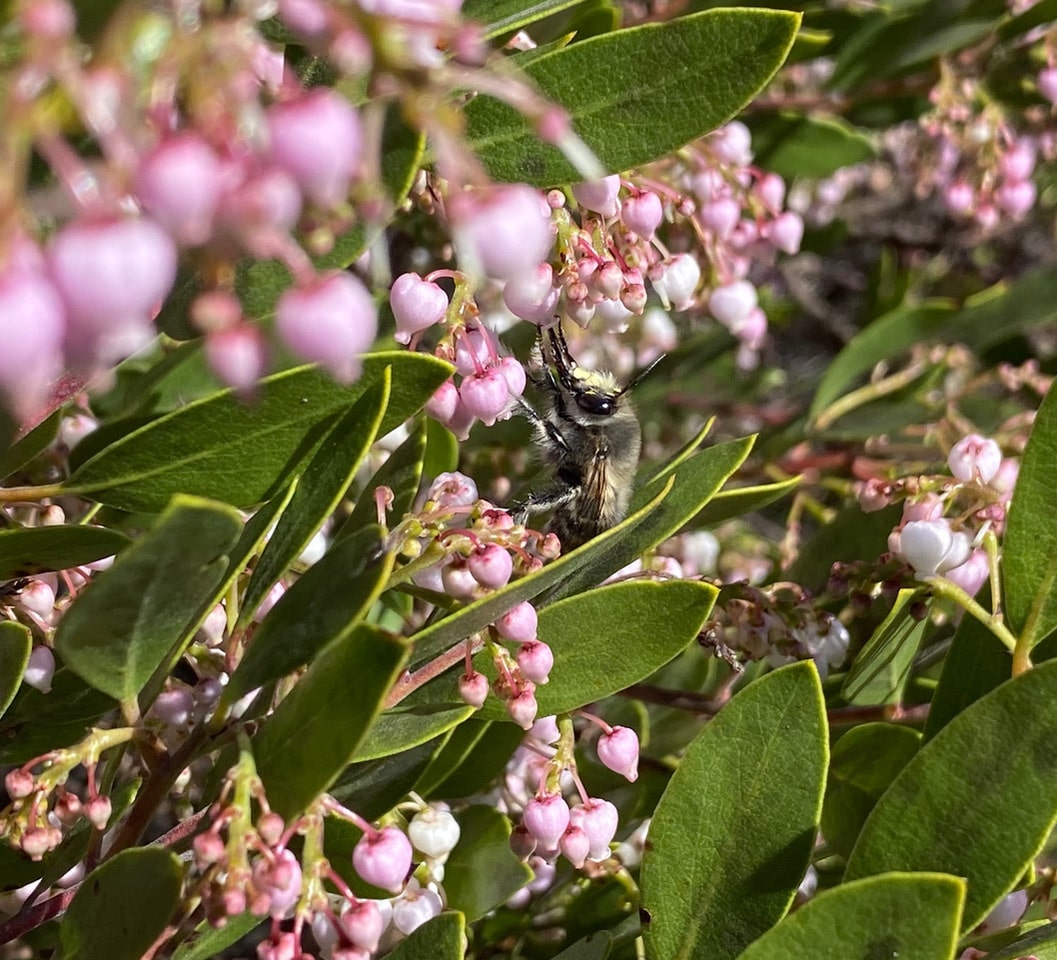
This is a male California Mountain-Digger Bee, Habropoda depressa (family Apidae). Females of the species lack the yellow plates on the face. Why am I seeing mostly males today? Perhaps the females have yet to emerged from their nests?
Generally (across the species) solitary bees emerge from their nests in the spring. Males emerge first and, after feeding, they hang around the nest waiting for the females. Mama bees usually lay female eggs in the back of the burrow, followed by male eggs that are laid closer to the entrance. This orderly sequence ensures that the males that develop faster and emerge earlier will not block their sisters from the exit.
How can a female bee determine the sex of her offspring? Sex determination in bees follows a system called haplodiploidy, in which males develop from unfertilized eggs and are haploid, and females develop from fertilized eggs and are diploid.
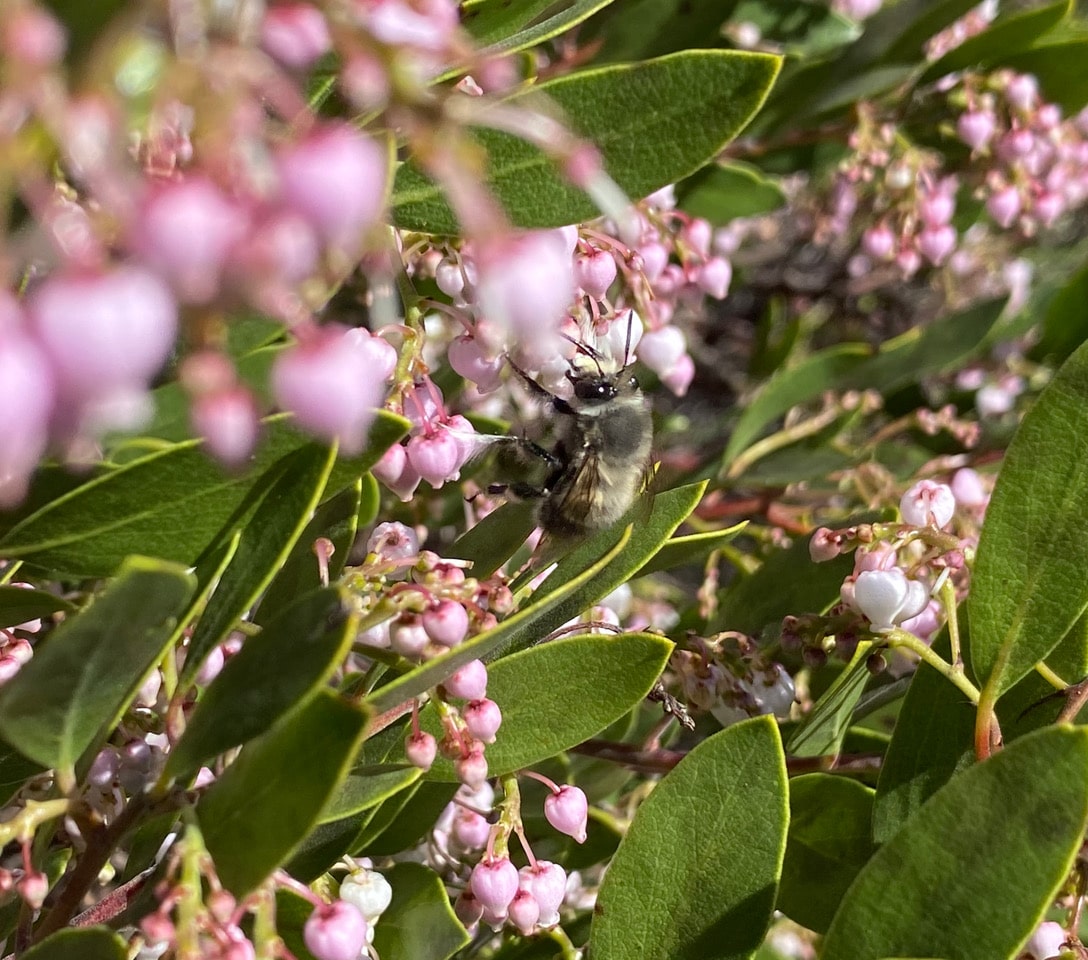
The California Mountain-Digger Bee is hairy, gray overall with little markings.
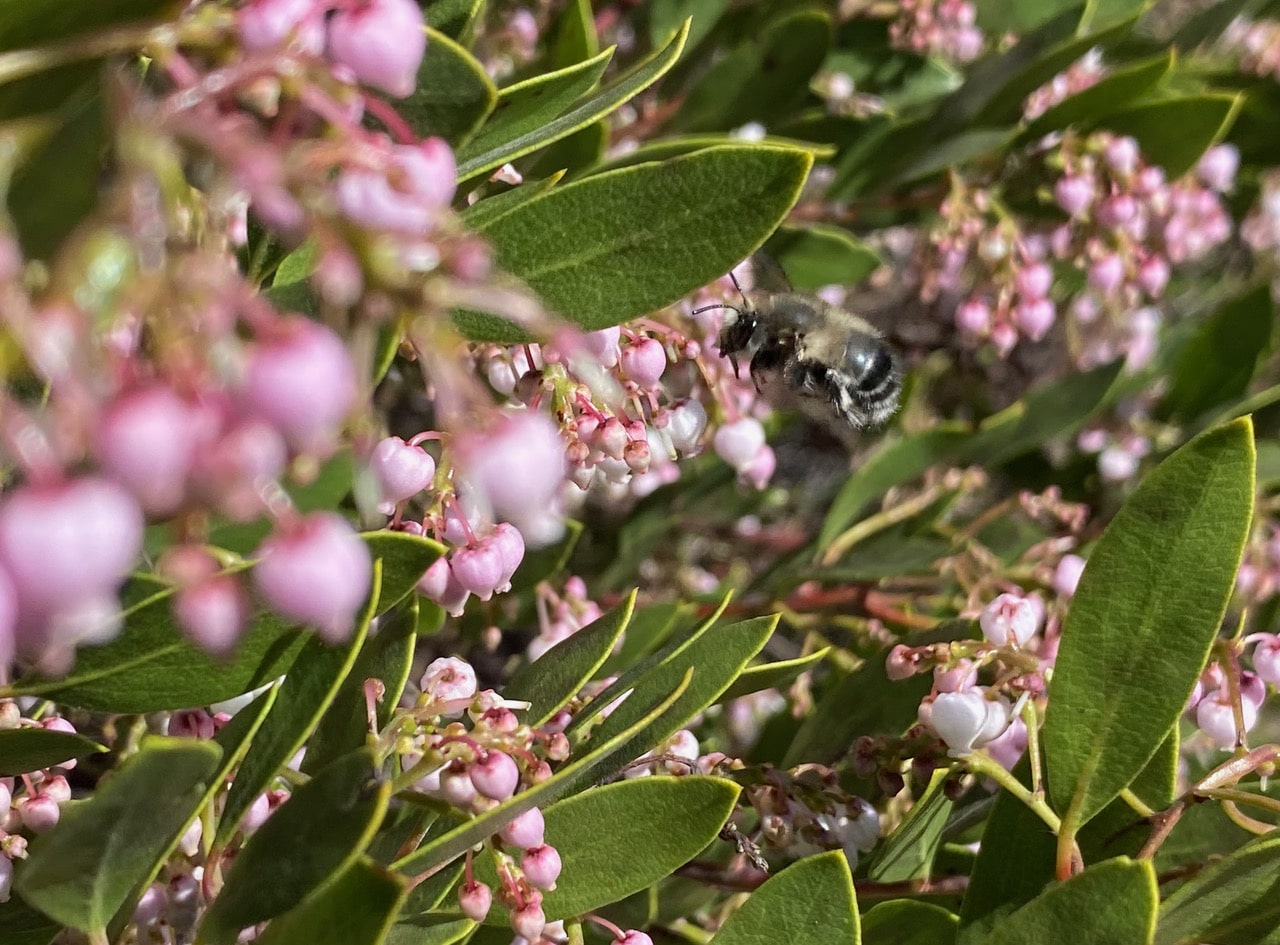
Off to the next flowers!
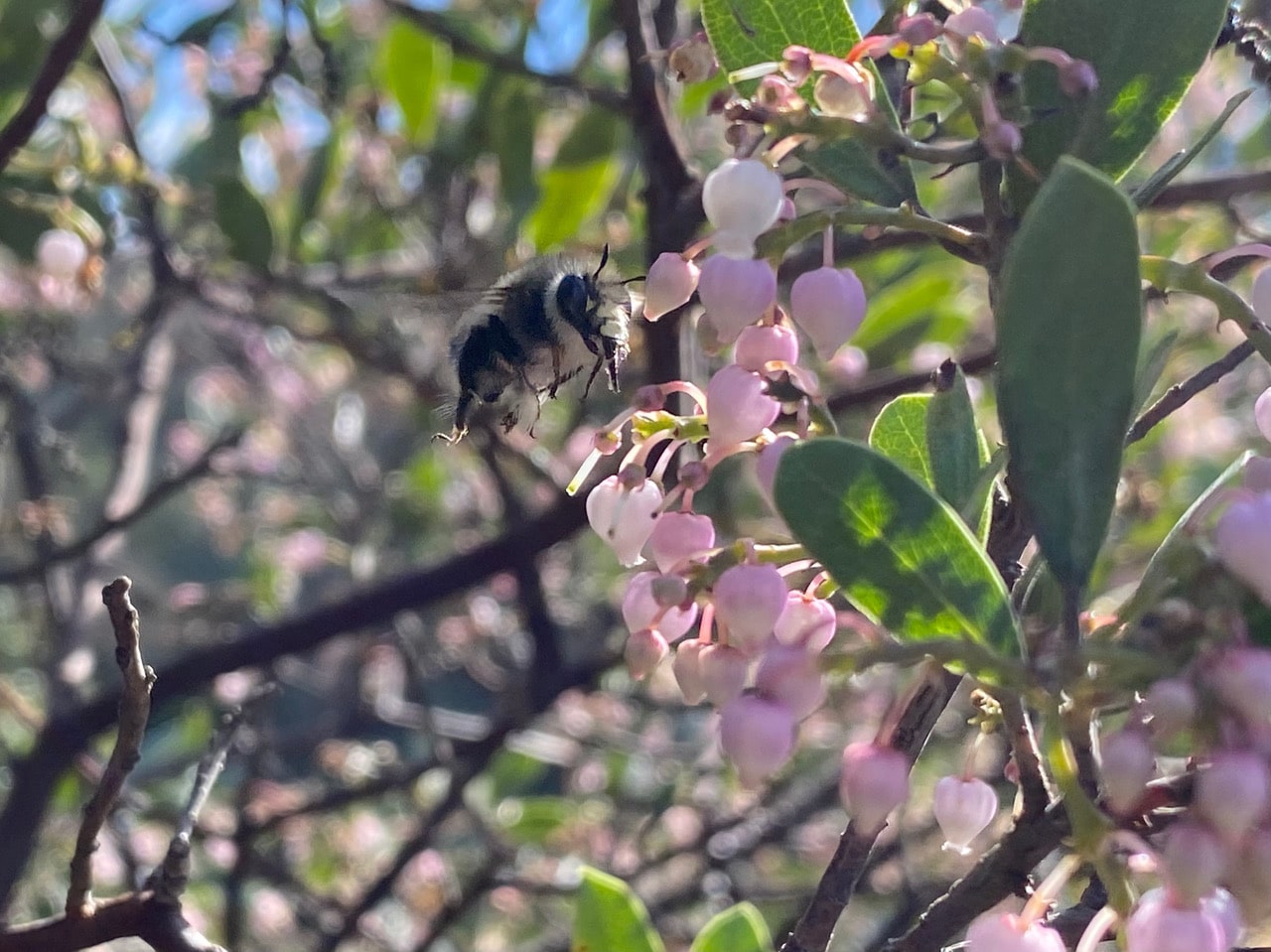
Another male Habropoda depressa, with the yellowish plates on the lower part of its face.
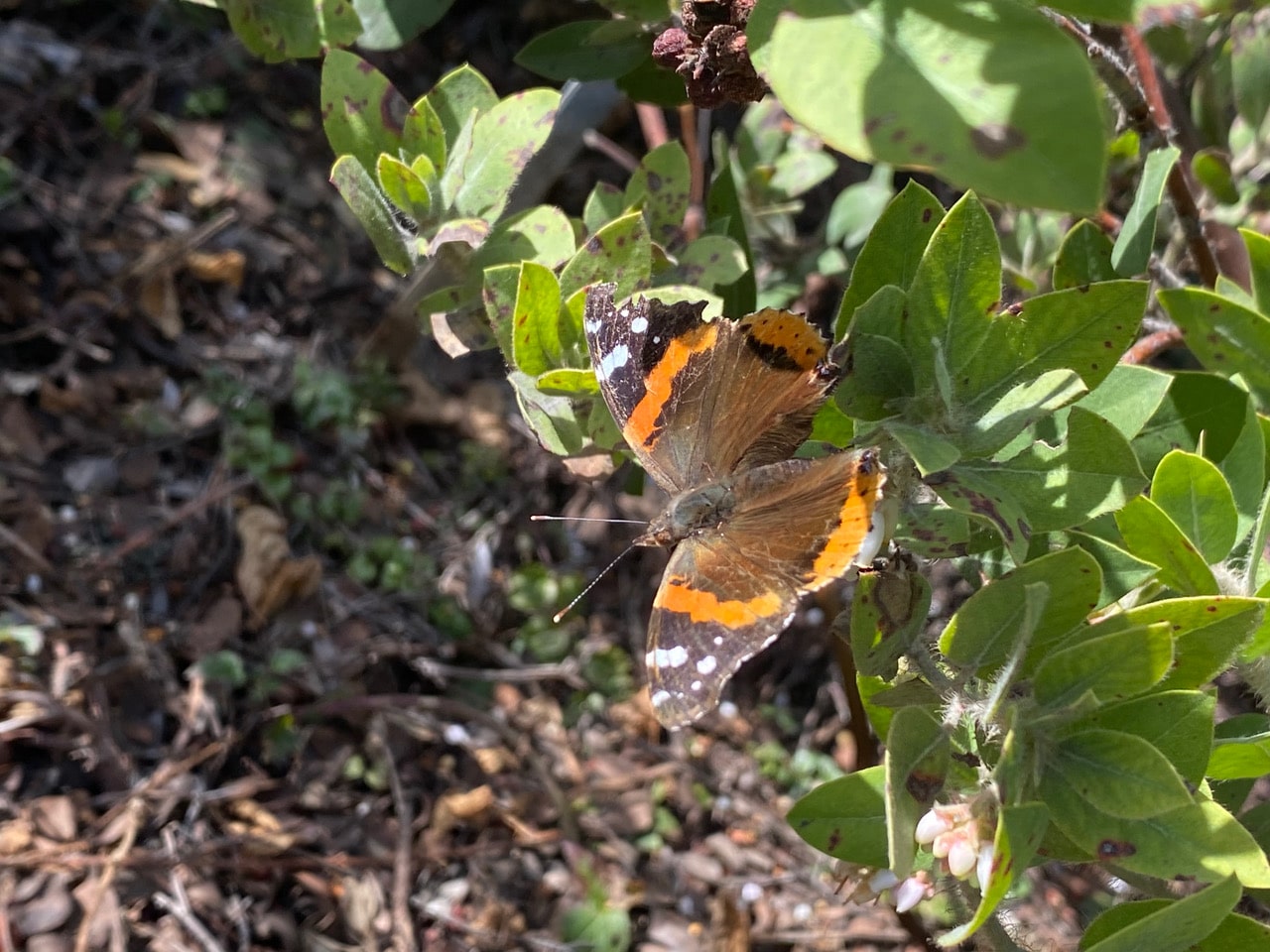
A tattered Red Admiral butterfly lands on a Manzanita to take nectar from the flowers. Its faded wings are worn and tattered on the edges. How did it manage to survive the rain storm and bomb cyclone we just experienced?
The Red Admiral, Vanessa atalanta (family Nymphalidae) is a striking butterfly with wings of black, red and white. Green eggs are laid singly on the tips of host plant leaves, notably plants in the nettle family, Urticaceae. Young caterpillars eat and live within a shelter of folded leaves; older caterpillars make a nest of leaves tied together with silk. Adult butterflies prefer sap flows on trees, fermenting fruit, and bird droppings, visiting flowers only when these are not available. The species is found in almost any habitat, from tundra to subtropics.
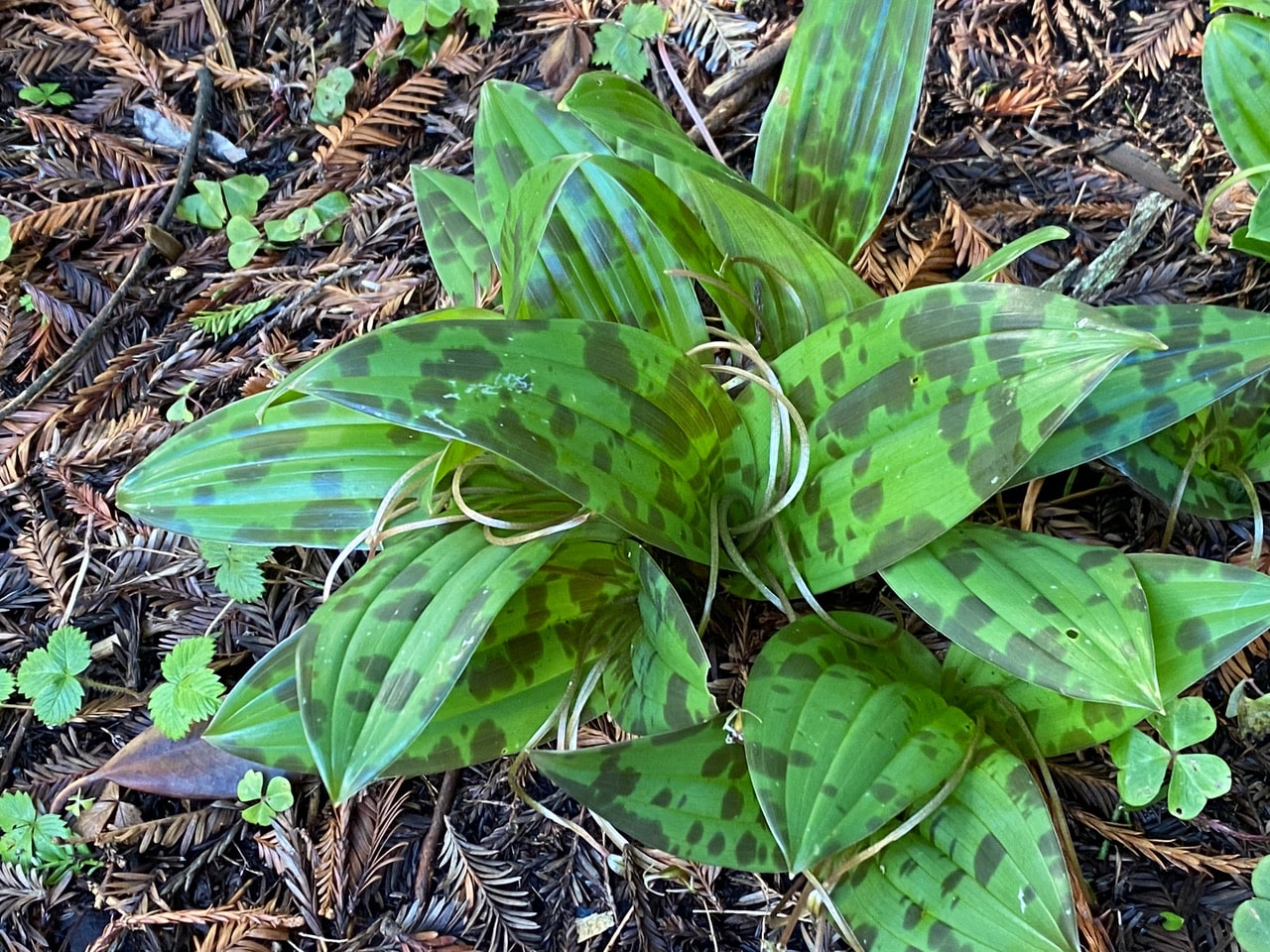
My heart sinks when I finally find the plant I was looking for under the redwoods. The bright green, mottled leaves of the Fetid Adder’s Tongue are easy enough to spot, but when the leaves are fully developed, the flowers are mostly gone. Every sinuous flower stalk ends with not a flower, but a developing fruit. Am I too late for the flowers?
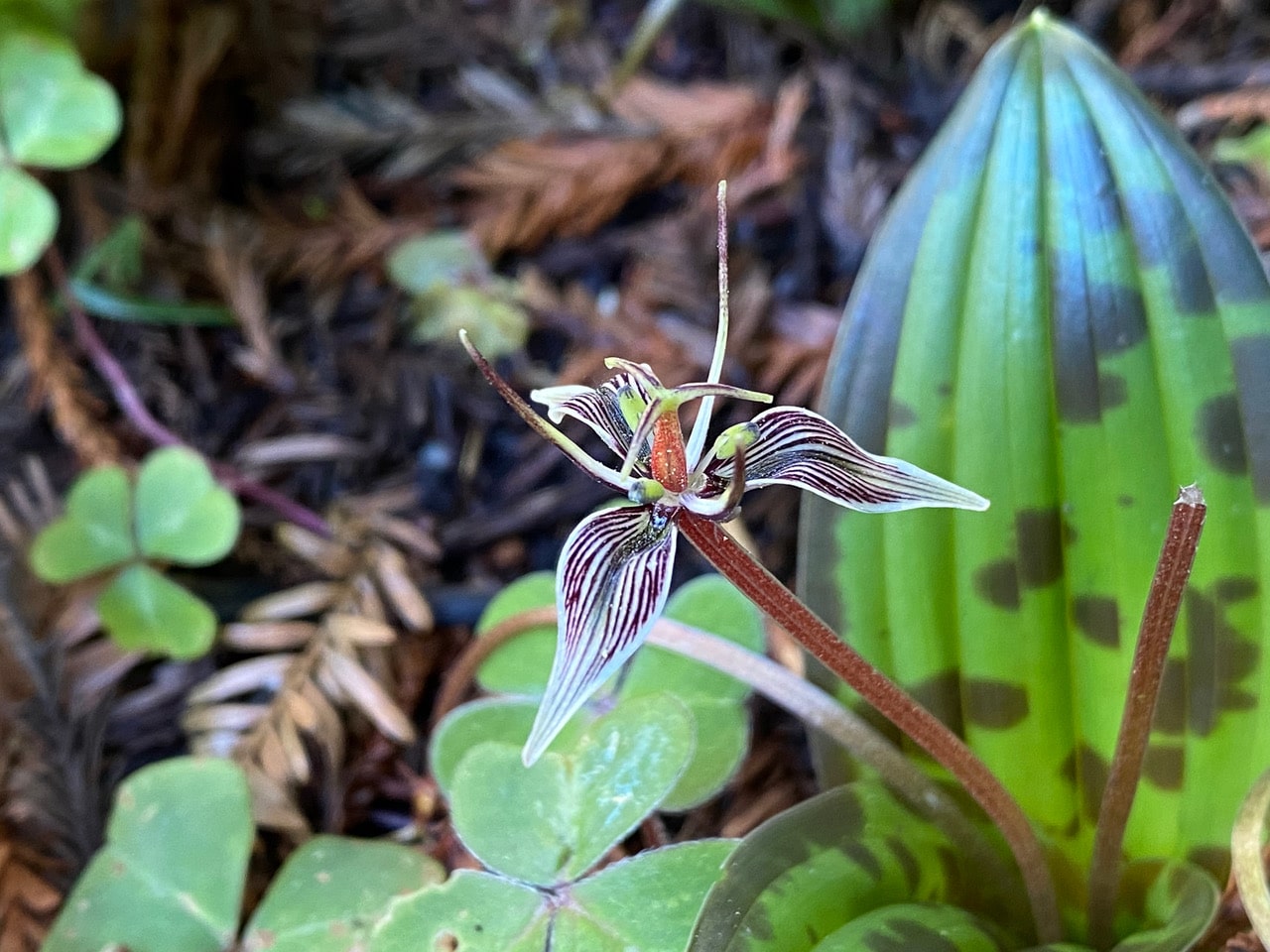
Late, but not too late! My heart misses a beat as I find a single flower of Fetid Adder’s Tongue, Scoliopus bigelovii peeking out from a young plant. This odd lily has striking flowers and handsome leaves.
“Fetid” refers to the flower’s smell. You have to get down on your hands and knees to be offended by it, though. The odor is part of the plant’s reproductive strategy, attracting the fungus gnats that pollinate it.
The most conspicuous part of the flower are not the petals, but rather the sepals. These are lance-shaped, pale and striped with dark purple. The narrow, horn-like petals are shown here curving over the reproductive parts. The three short stamens are located at the bases of the sepals. The stout, erect style in the center has three long lobes. The whole arrangement is optimized for showering the fungus gnat with pollen from the ripe anthers while the insect, guided by the nectar guides, makes its way down the center of the flower for the sweet reward. Whatever pollen from another flower that is already on the gnat’s back might be rubbed off on the stigmatic surfaces of the style arms looming over the insect. Pollination accomplished!
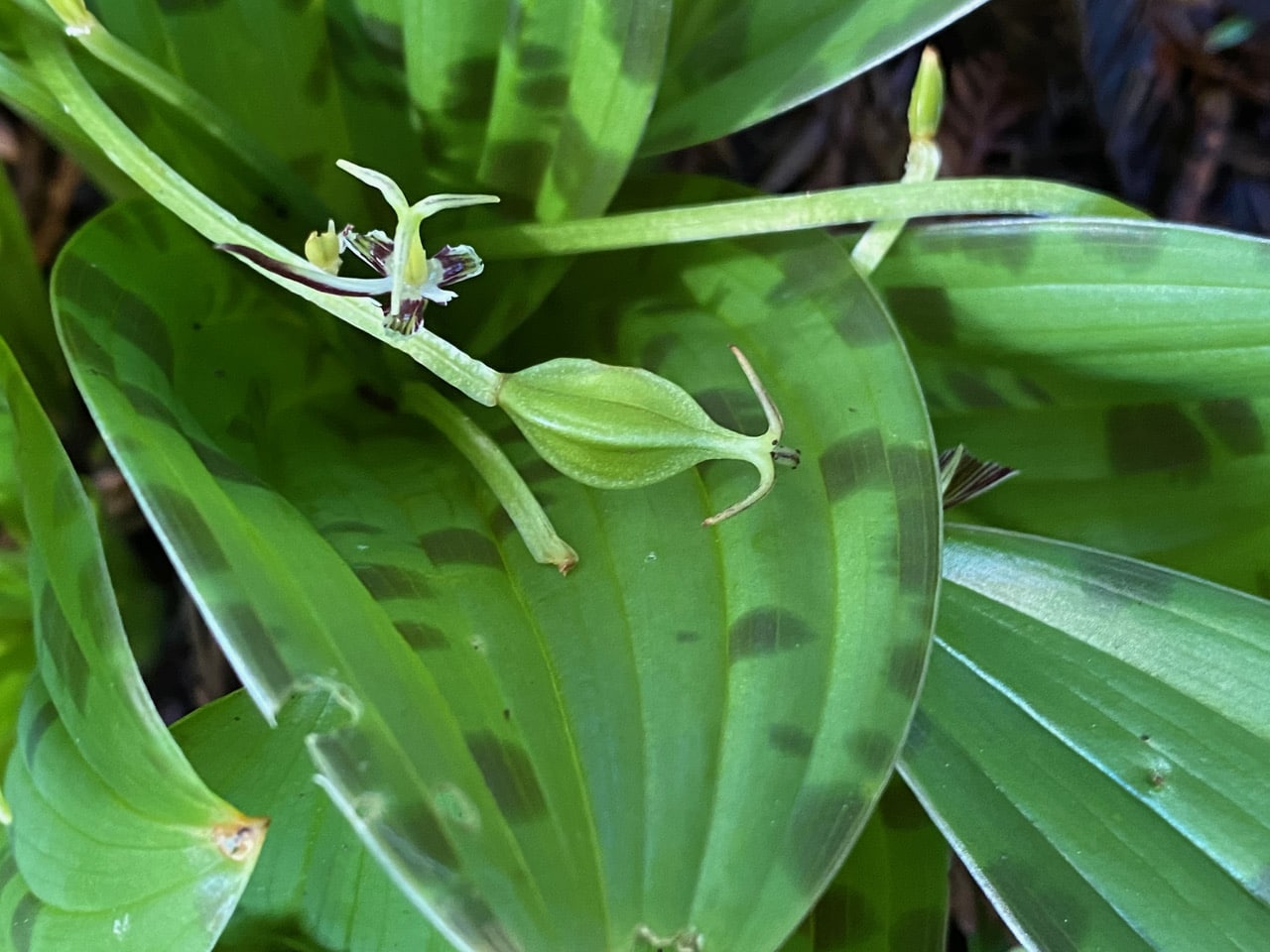
A young seed pod of Fetid Adder’s Tongue hangs loosely at the end of an elongated flower stalk.
Once pollinated, the flower stalks begin to lengthen and bend over, placing the developing fruits closer to the ground. The seed pod has three curved appendages resembling a ship’s anchor (actually the persistent style of the flower) that now serve as grappling hooks to hold the pods against the ground. The sinuous stalks give rise to another common name for the plant, Slinkpod.
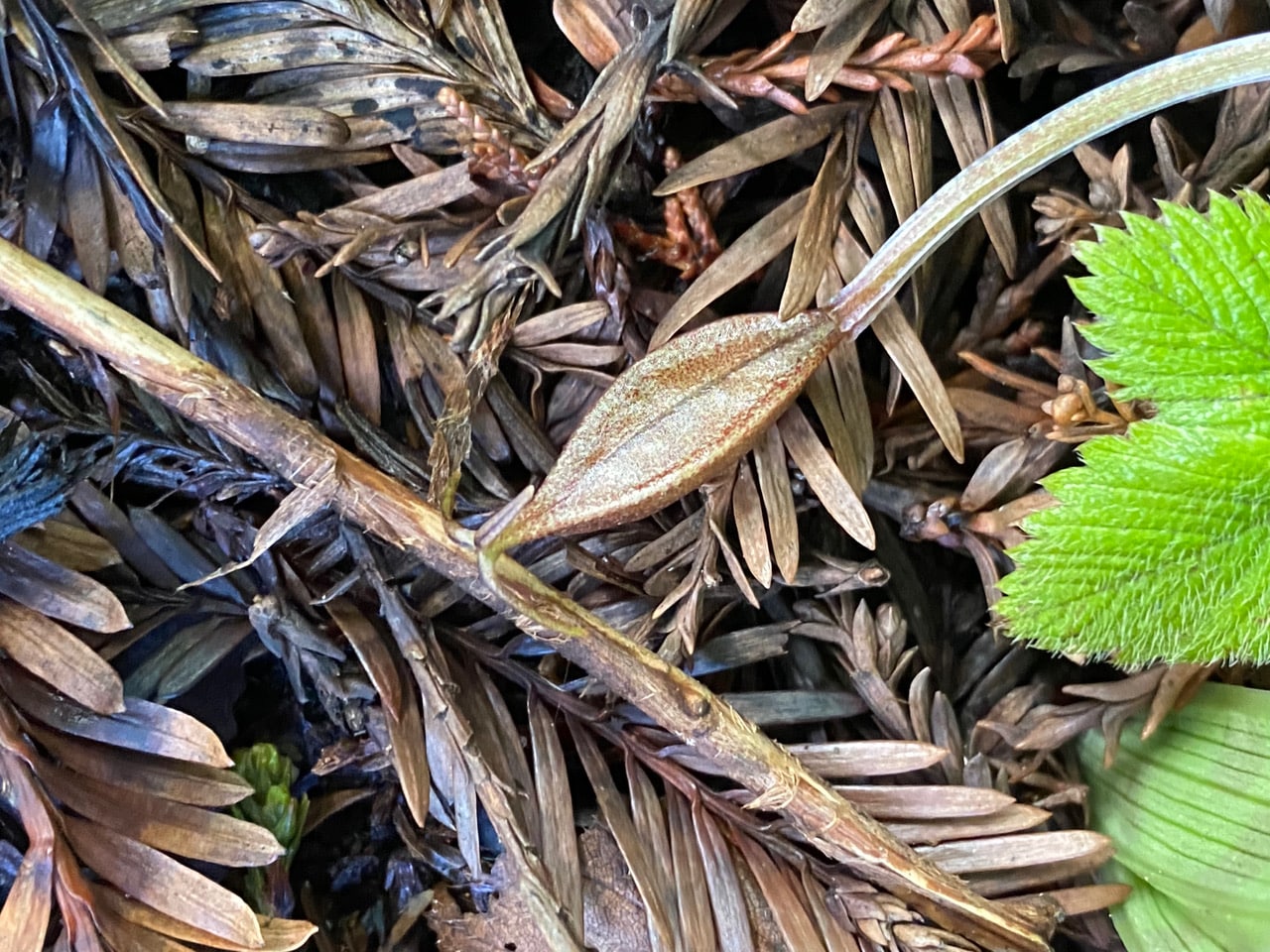
Totally camouflaged, a mature brown seed pod has come to lie on the redwood duff.
Besides the fungus gnats, Scoliopus bigelovii has a fascinating relationship with another insect – ants. Each seed comes equipped with a fleshy little attachment called an elaiosome that is attractive to ants. The ants collect the seeds, eat the elaiosomes, and discard the seeds in their trash midden. Here the seeds are well protected from predators and pathogens, surrounded by nutrient-rich compost – perfect conditions for germination! Seed dispersal by ants is termed myrmecochory.

The old wooden fence under the big oak tree is still sopping wet from the rains. Look at those happy mosses and lichens!

Before I leave the garden, I stop by the blooming Ceanothus near the gate. Much to my delight, the shrub is abuzz with insect activity although the plant is past peak bloom.
This White-bowed Smoothwing, Scaeva affinis (family Syrphidae) is visiting the few fresh flowers left on the plant. All the reproductive structures of the Ceanothus flower are fully exserted, extending beyond the corolla. Nectar is easily available, and collecting pollen is a mere cake-walk over the tightly clustered flowers.
Scaeva affinis, commonly known as the White-bowed Smoothwing, is a species of hover fly found in western North America. The larvae feed voraciously on aphids. Adults are good pollinators.
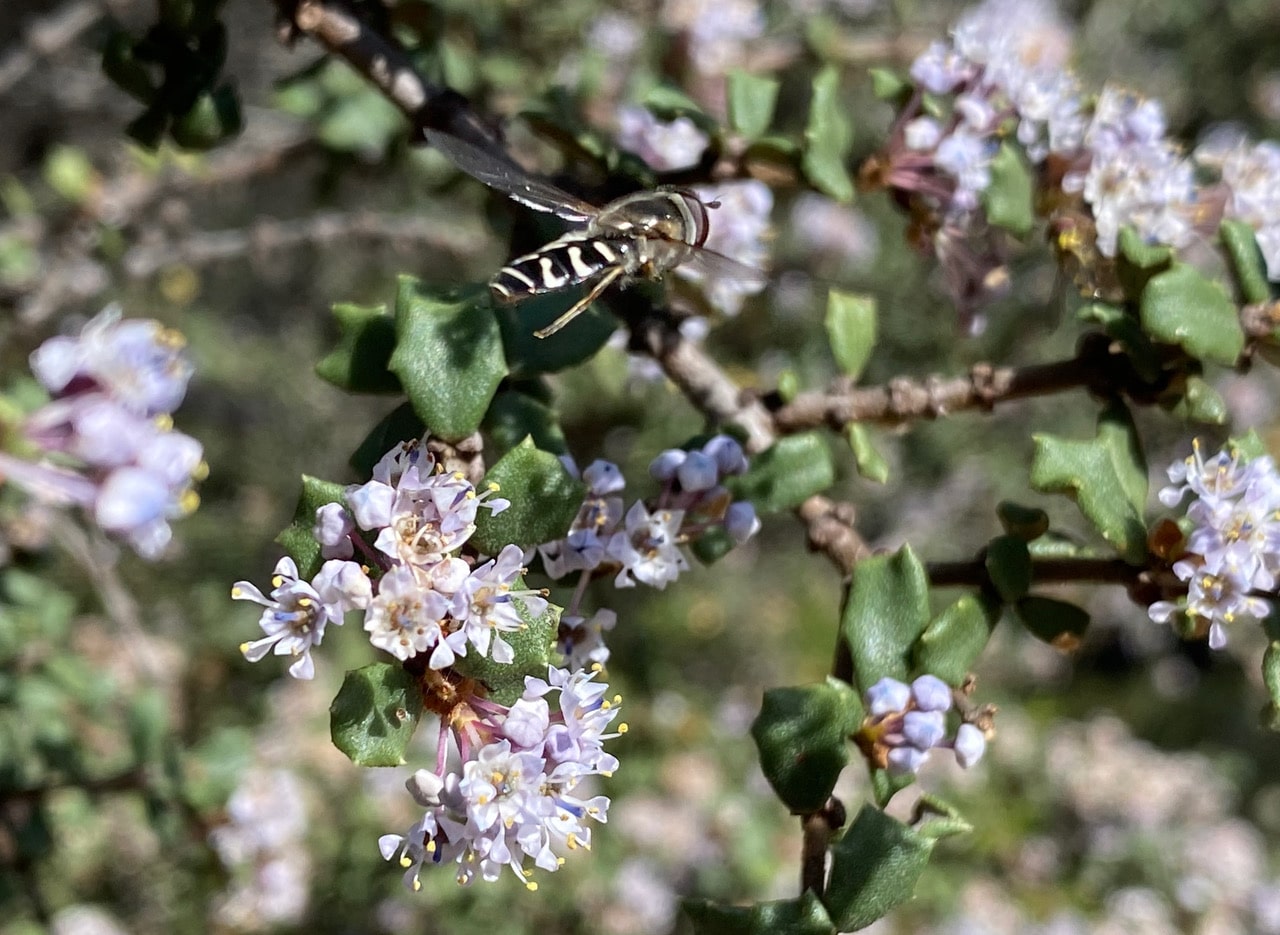
The profile of the hover fly as it flies away shows how ridiculously flat its abdomen is. This feature seems to be shared by many Syrphid species. Does it help the insect hover?
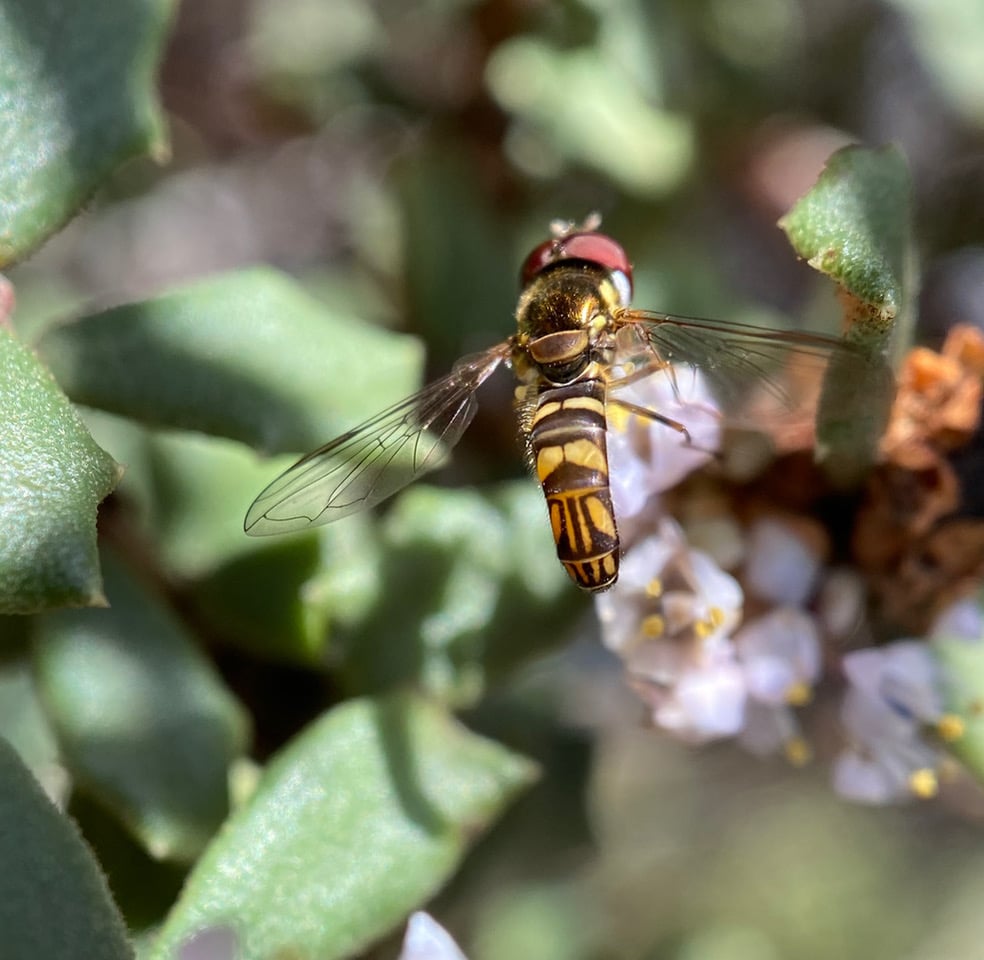
Because of the unique pattern on its abdomen, the Oblique Streaktail, Allograpta obliqua (family Syrphidae) is one of the most easily recognizable hover flies despite its small size.
The Oblique Streaktail is a common North American species of hoverfly. Adults are 6-7 mm long. Males have holoptic eyes (that meet on top of the head), while females have dichoptic eyes. Eggs are laid on surfaces of leaves or stems near aphids. The larvae are important predators of aphids while adults are pollinators.
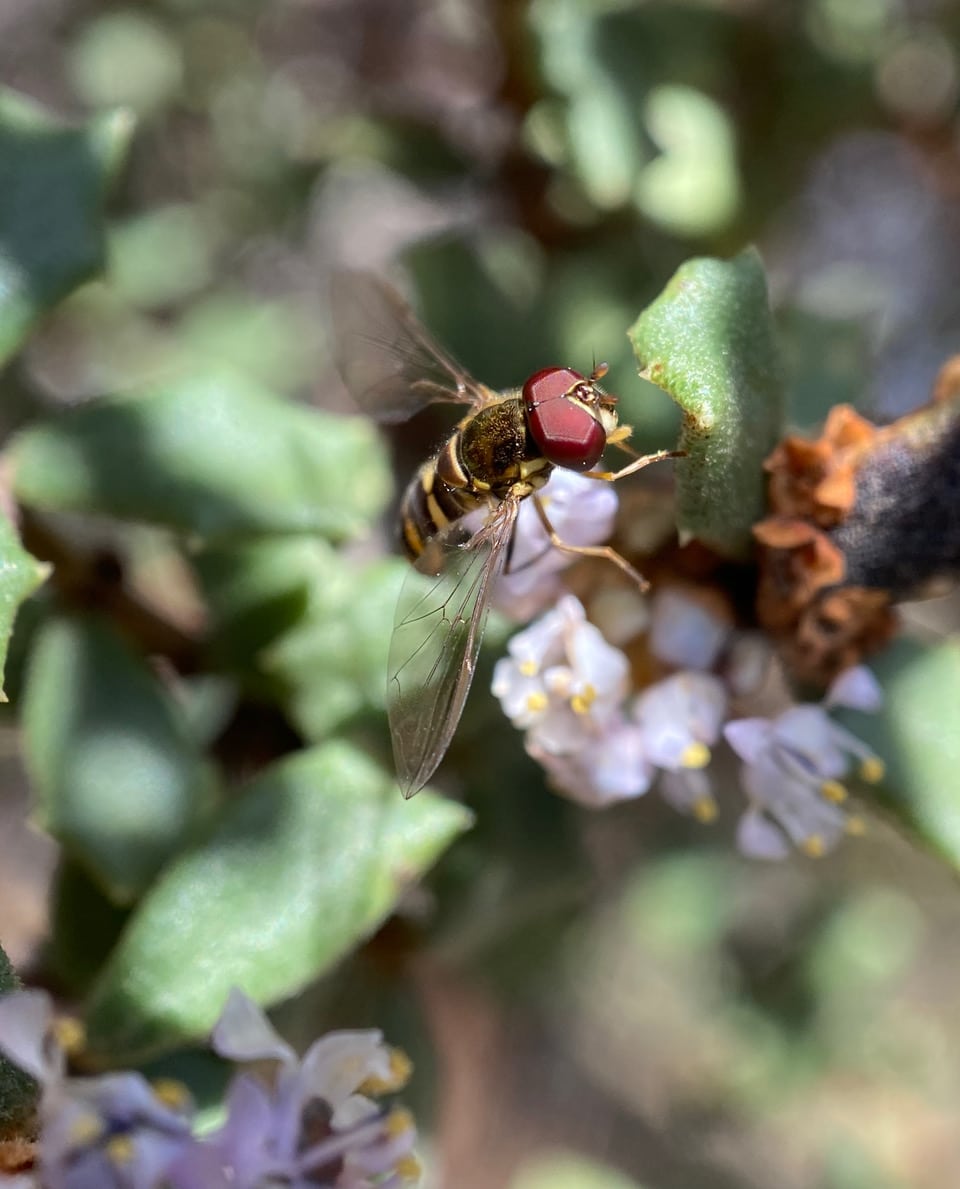
This individual is male, as evidenced by his holoptic eyes that meet along a central line on top of the head. The eyes of a female Syrphid fly are set apart and don’t touch each other.
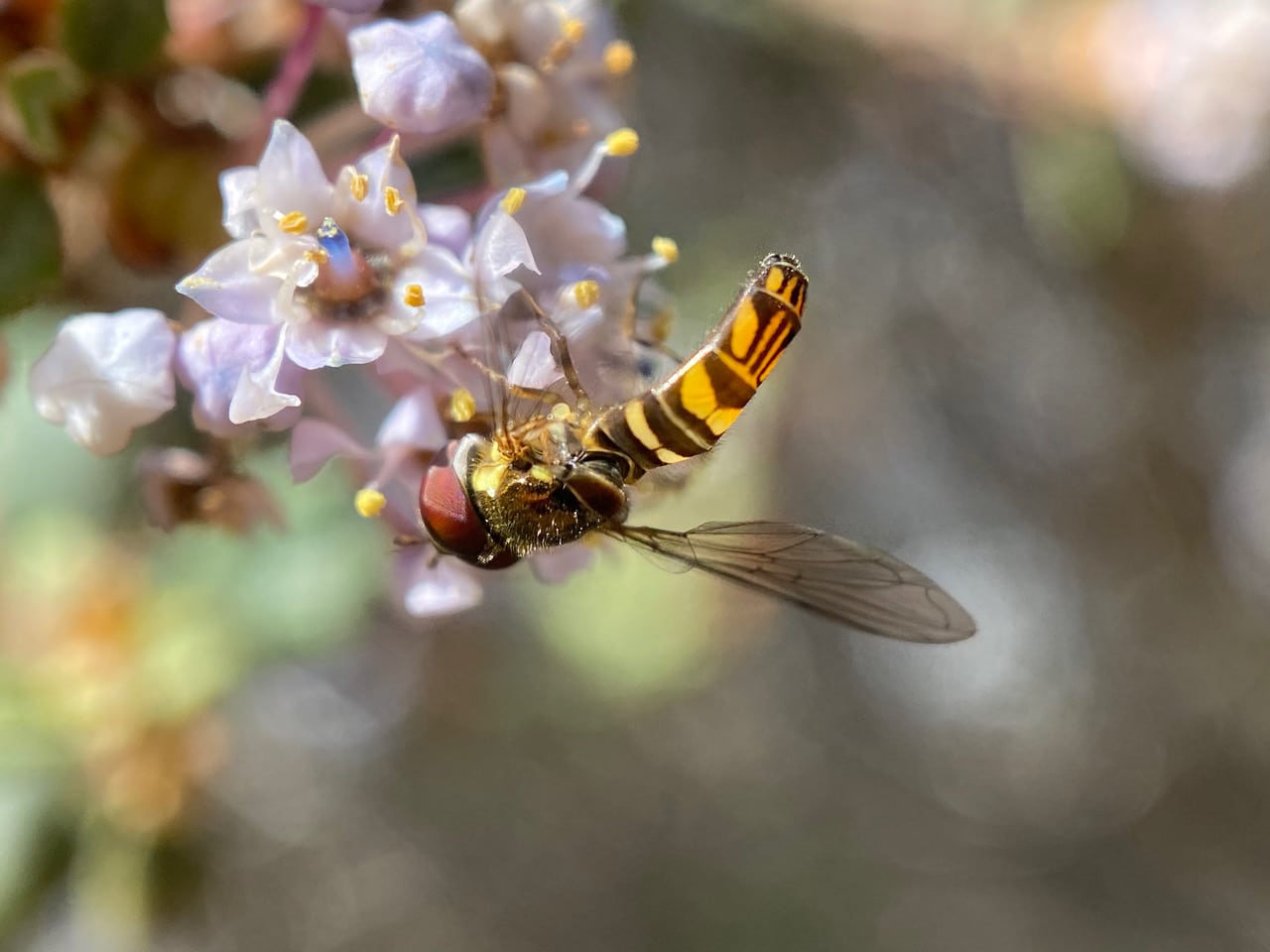
What’s with the scutellum of the fly? I have never seen one open up like this. “Wing-wing coordination is mediated via linkages within the scutellum”, I read in a scientific paper. Apparently the scutellum has to do with flight and balance.
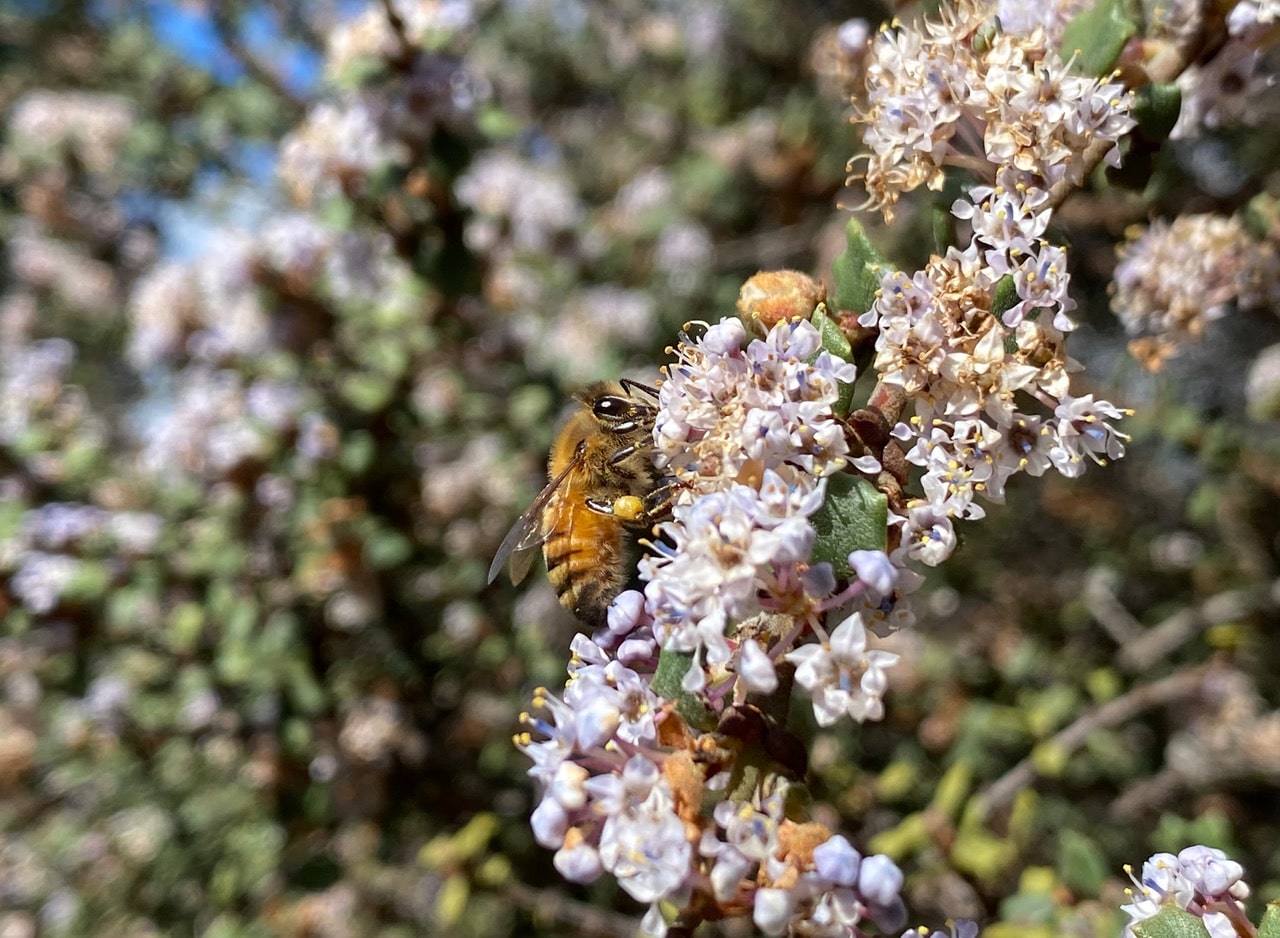
The only bees I see visiting the Ceanothus are a few Honey Bees, Apis mellifera (family Apidae). Maybe it’s because the flowers are past their prime. This worker bee has actually collected some pollen in her pollen basket.
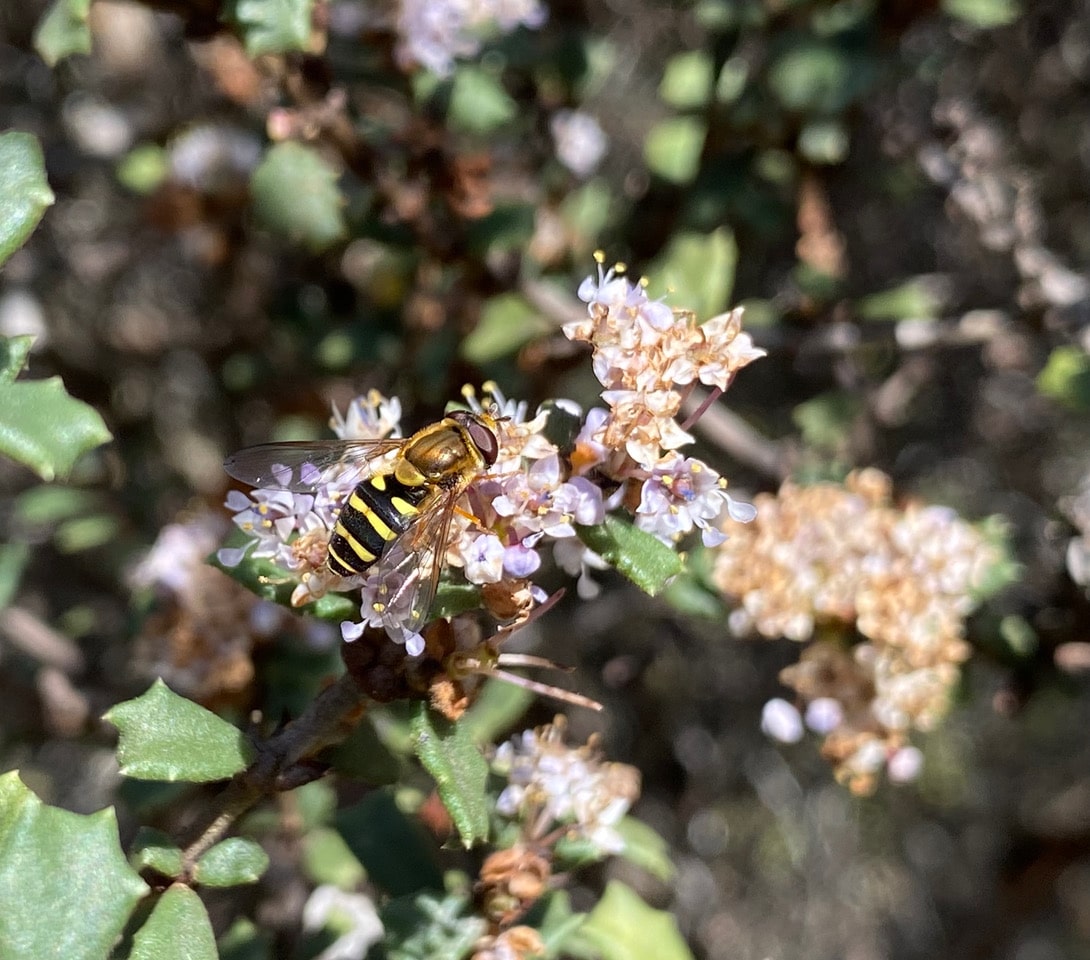
Ooh, another hover fly on the Ceanothus! The Black-margined Flower Fly, Syrphus opinator (family Syrphidae) has been seen a lot lately on many different plants. The species is common in central California during winter months. It can be distinguished from similar species by the abdominal fascia restricted to the sides and isolated from the margins. It is the quintessential hover fly that mimics bees or wasps. The black-and-yellow banding on the abdomen serves to ward off potential predators that want to avoid prey with stings – a form of Batesian mimicry.