

Pollinator Post 2/8/24 (2)
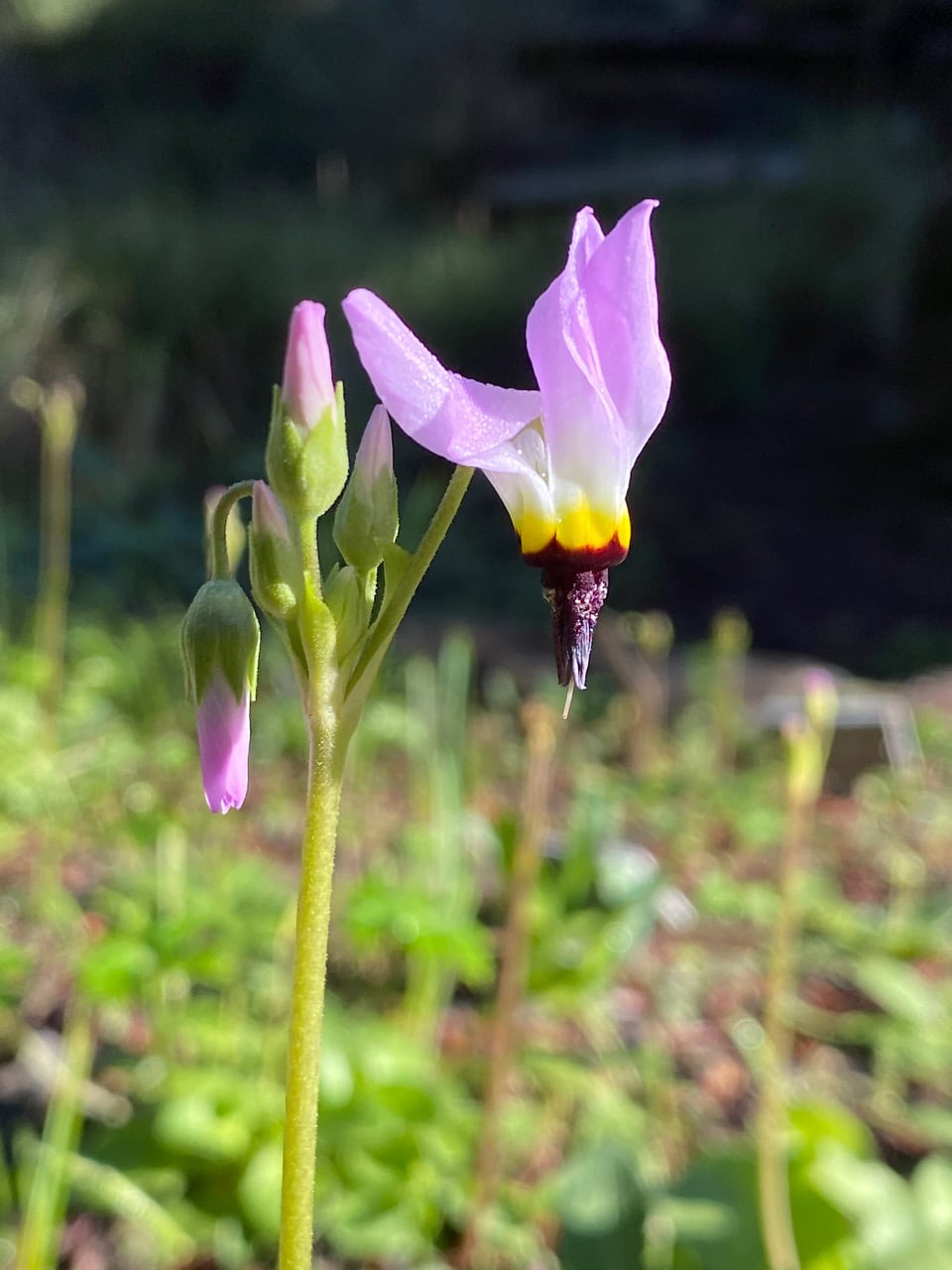
Serendipitously I find my way to the raised bulb bed in the botanic garden. There aren’t many things in bloom right now. The most eye-catching are the attractive flowers of Shooting Stars, Primula sp. (formerly Dodecatheon).
You may familiarize yourself to the unusual flower structure of Shooting Stars here:
The Shooting Star flower droops downward with petals reflexed, or bent back. Most of the petals are a lovely pink, but toward the base a fringe of white blends into yellow – colors most attractive to a bee’s eyes. A squiggly line of burgundy marks the spot where the petal bends. A conical purple column hangs below the petals. This is the anther cone, a fusion of the anthers where pollen is produced. Surrounded by the cone, and extending beyond is a thin, needle-like style with a stigma at the tip – the female portion of the flower.
Shooting star flowers do not produce nectar, but pollination is most often accomplished by bumble bees foraging for pollen, and using a specialized method called “buzz pollination”. A bumble bee arrives at the flower, grasps the anther cone with its feet and mandibles and hangs upside-down. It disengages its flight muscles from the wings, then vibrates the muscles at a specific frequency, causing the anthers to vibrate, showering pollen onto the bee’s belly. When the bee next visits another shooting star, the pollen on its belly may be rubbed off on the flower’s stigma. Pollination accomplished!
Honey bees do not have this special skill. Only native bees such as Bumble Bees, Digger Bees and a few others are able to buzz pollinate. Blueberries, cranberries, and plants in the Nightshade family such as tomatoes, eggplants and peppers also require buzz pollination.
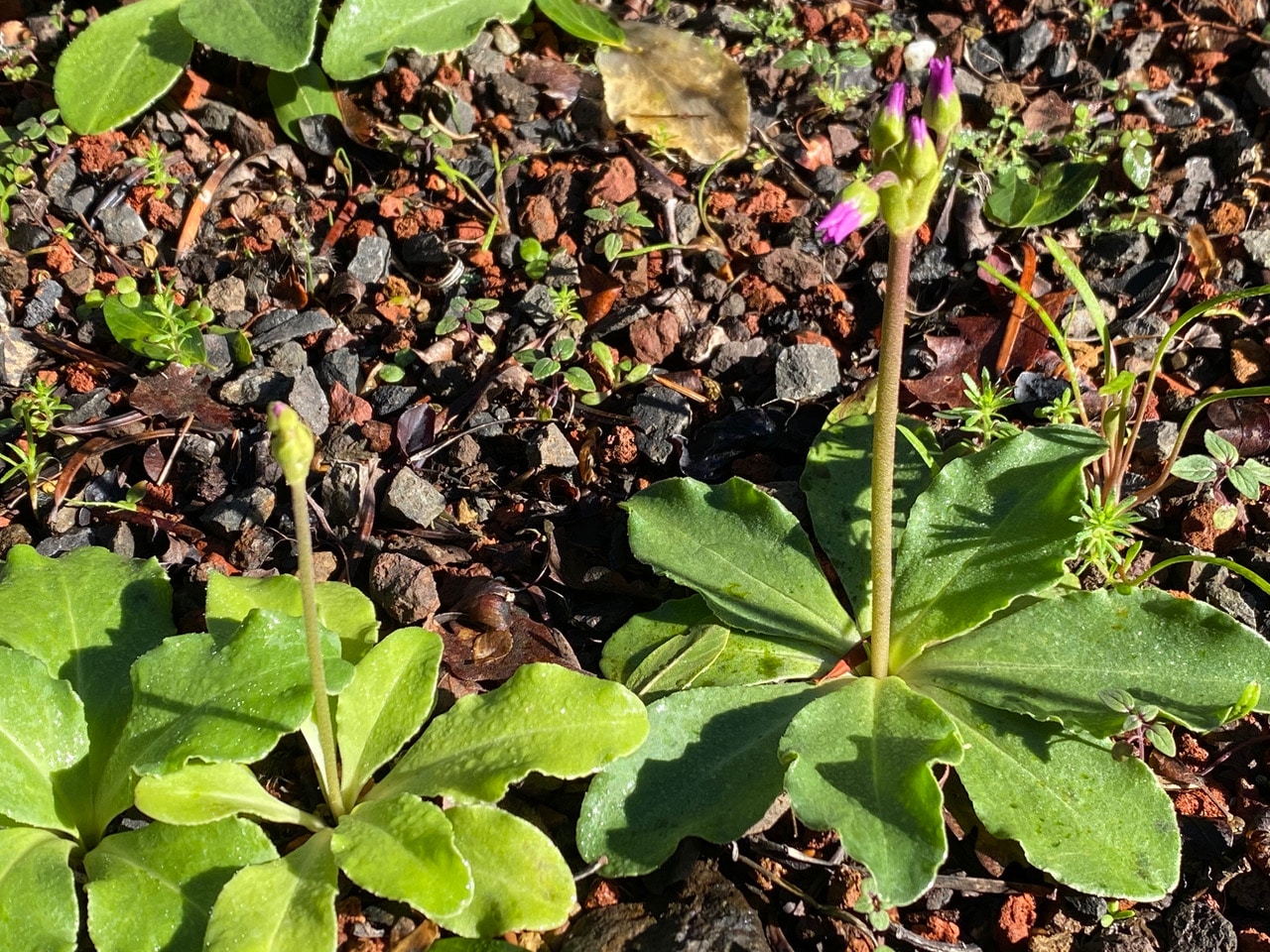
Ooh, more flowers have been produced on long flower stalks growing from the rosettes of spoon-shaped leaves at the base of these Shooting Star plants. The Bumble Bees will be quite happy foraging here!
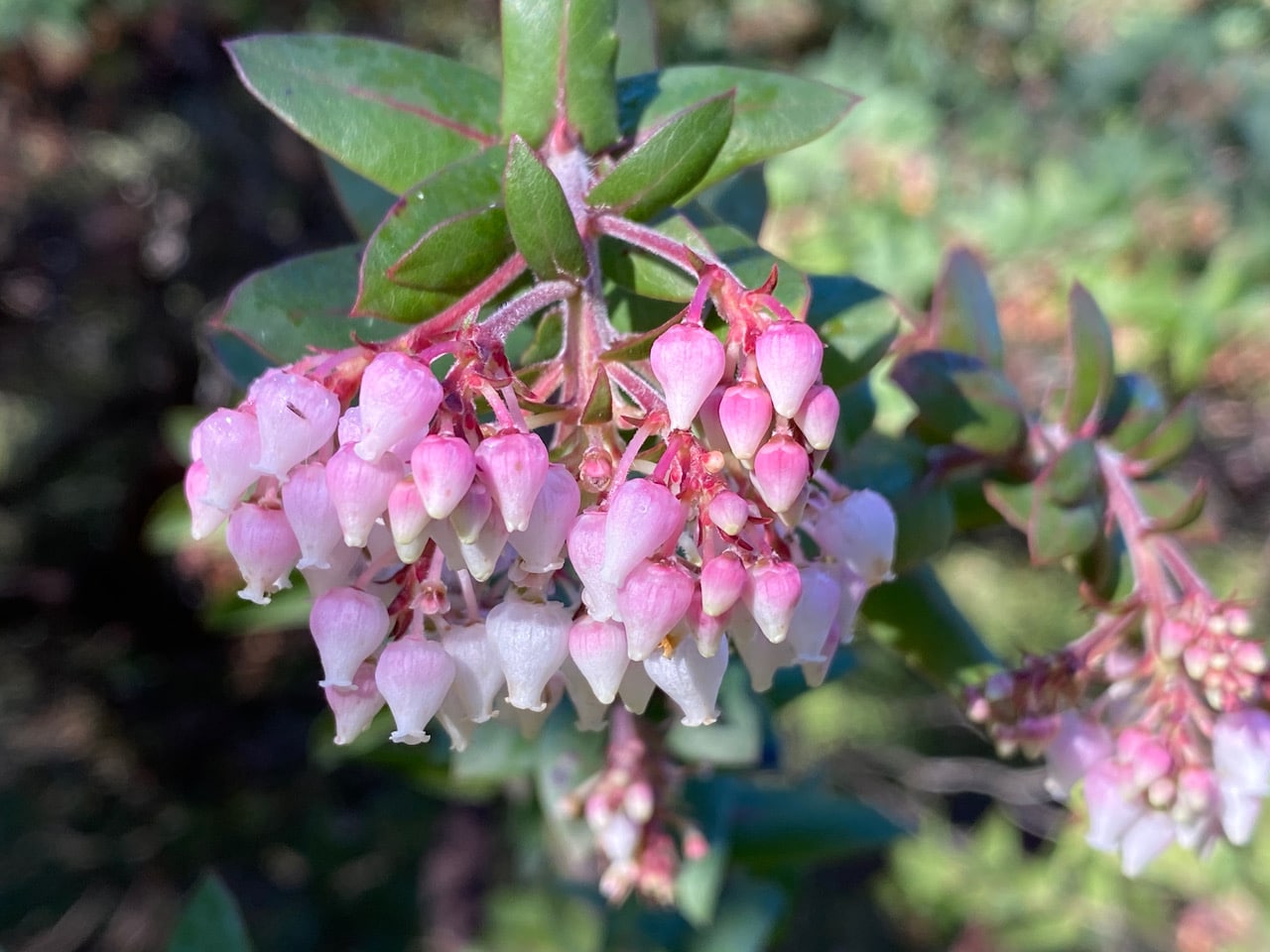
The East Bay Regional Parks Botanic Gardens is well-known for its diversity of Manzanita. Most are in full bloom now. The flowers have fared remarkably well through the winter storms, thanks to the tight clustering of small, urn-shaped, downward pointing flowers with small openings. I imagine the protected reproductive parts inside are none the worse for wear. These flowers, remarkably, are also buzz pollinated by Bumble Bees and Digger Bees.
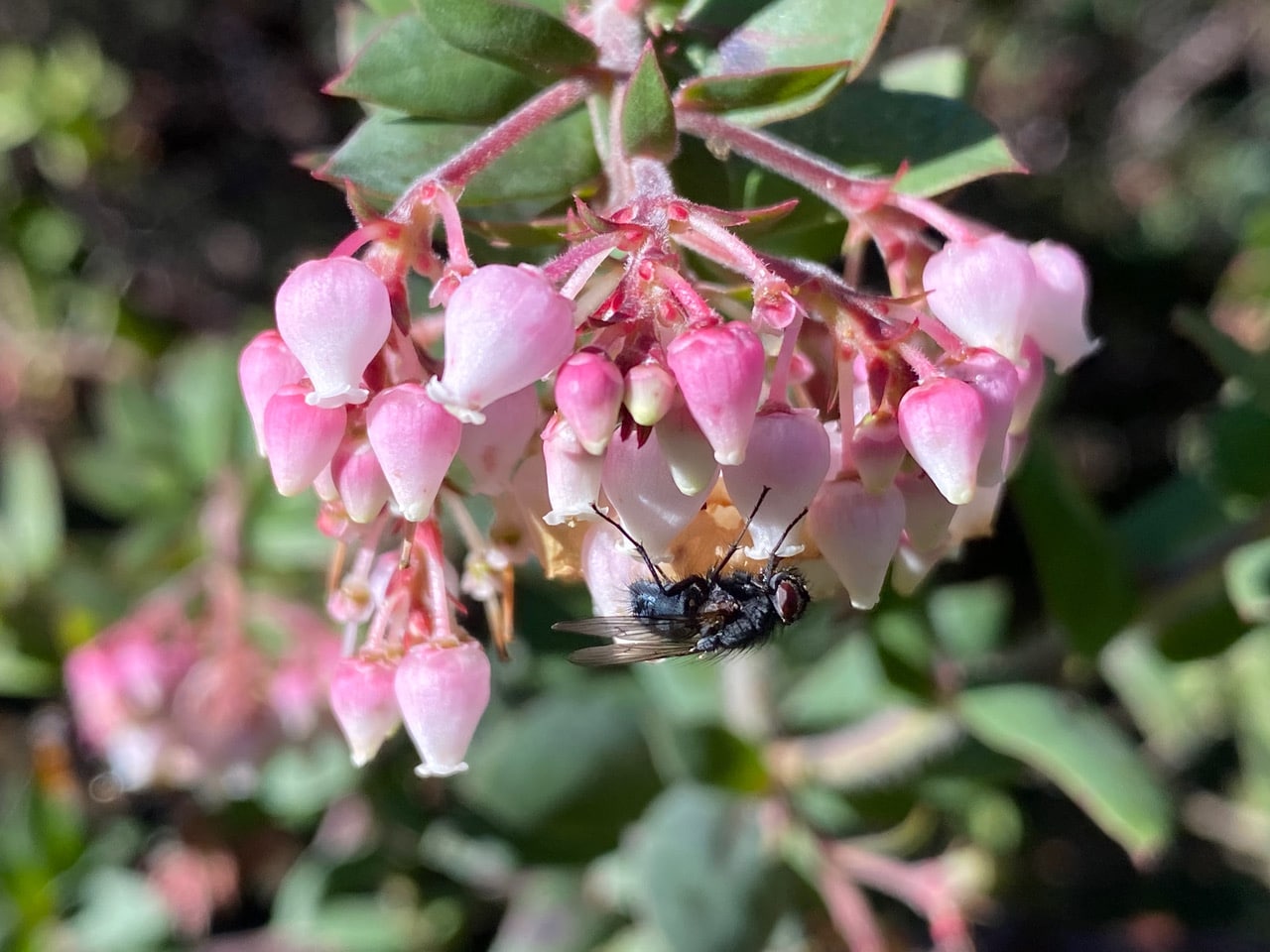
An unidentified fly is visiting a cluster of Manzanita flowers. Surely its tongue is not long enough to access the nectar at the base of the flowers? Maybe it is scavenging for goodies – nectar or pollen spilled by other insects.
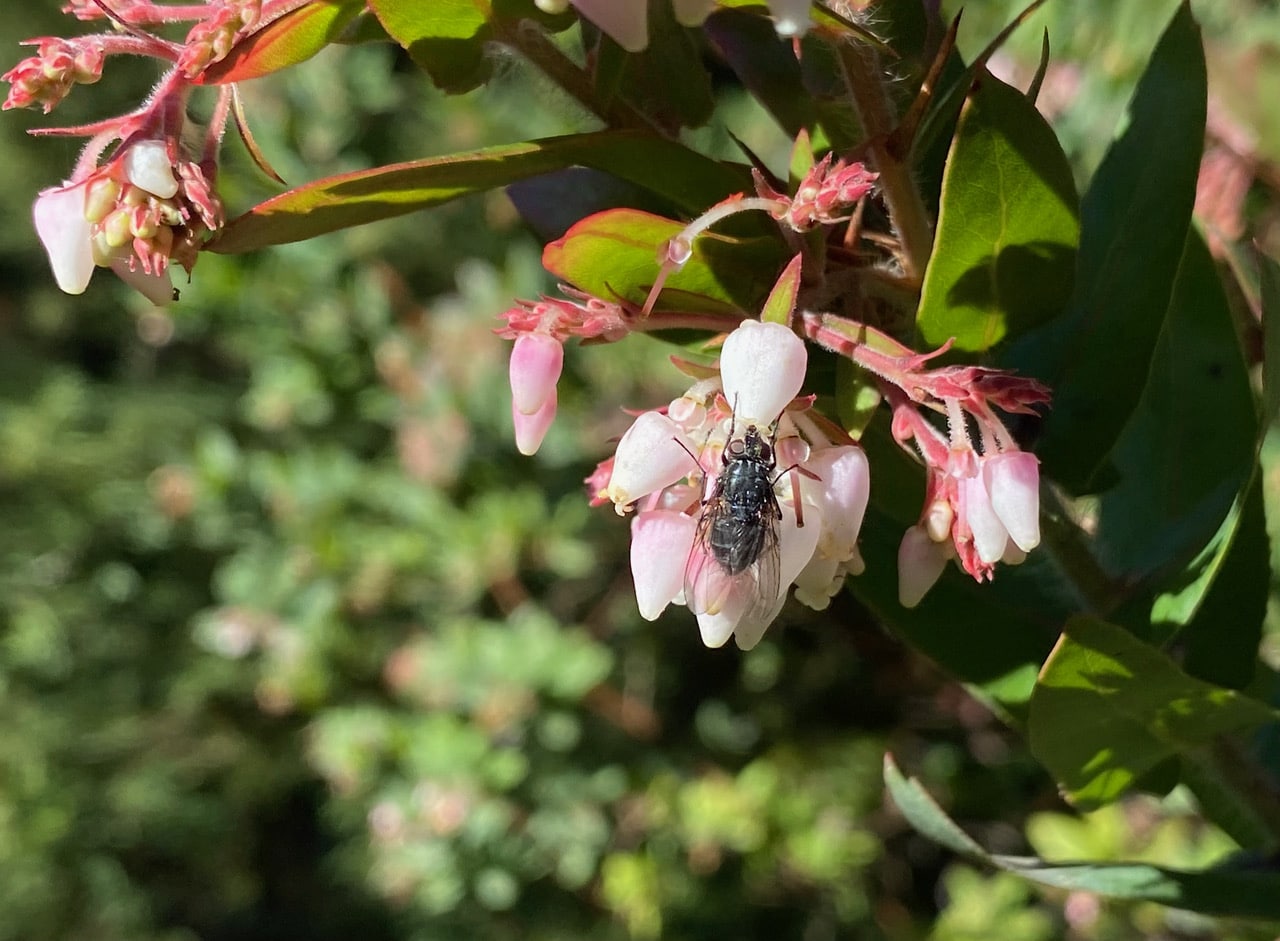
The fly tries hard to stick its short tongue through the narrow opening of a flower.
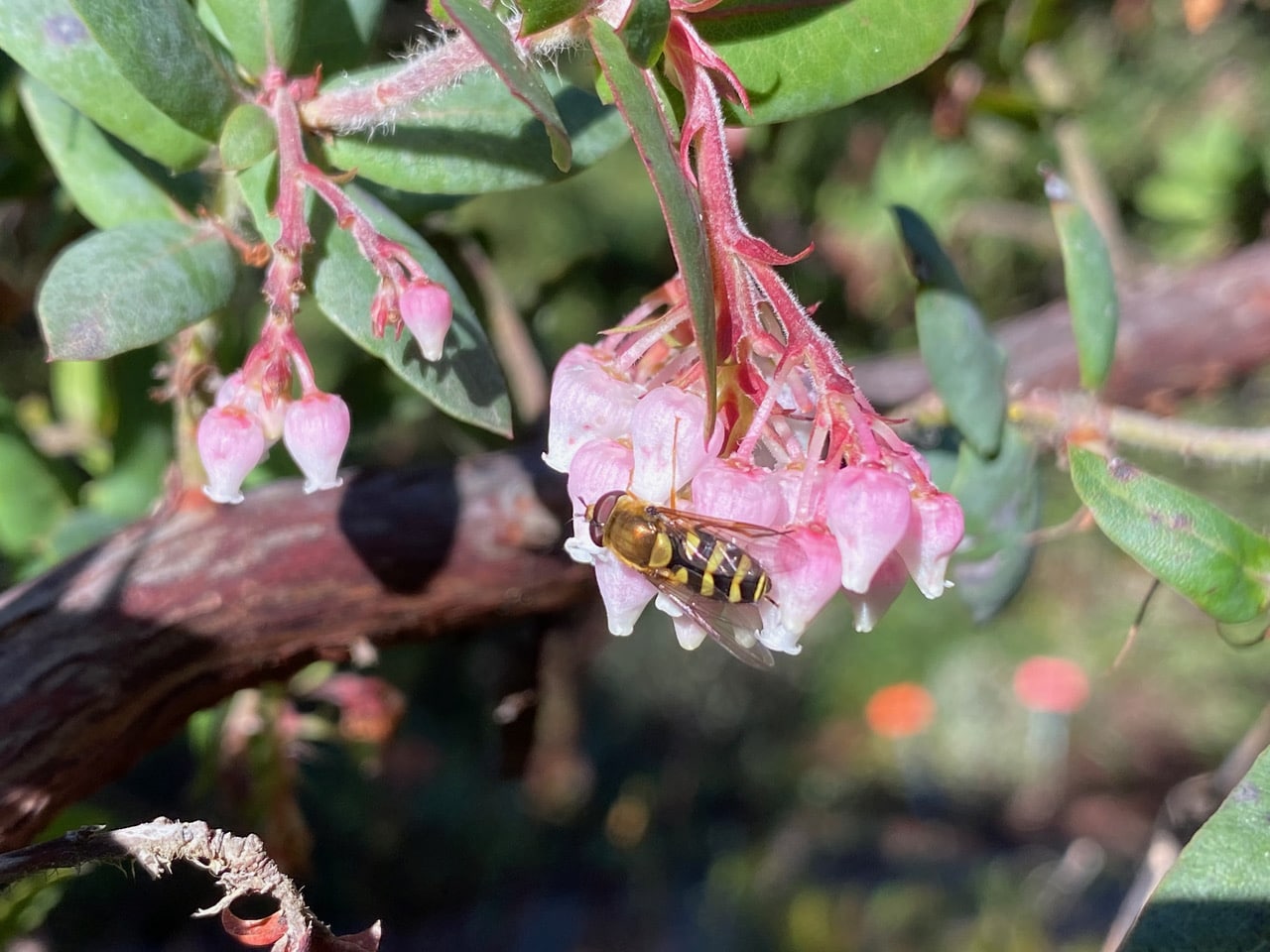
Here’s another scavenger – a Black-margined Flower Fly, Syrphus opinator (family Syrphidae). Since these insects do not come in contact with the Manzanita pollen, they are not likely to serve as pollinators for the plant.
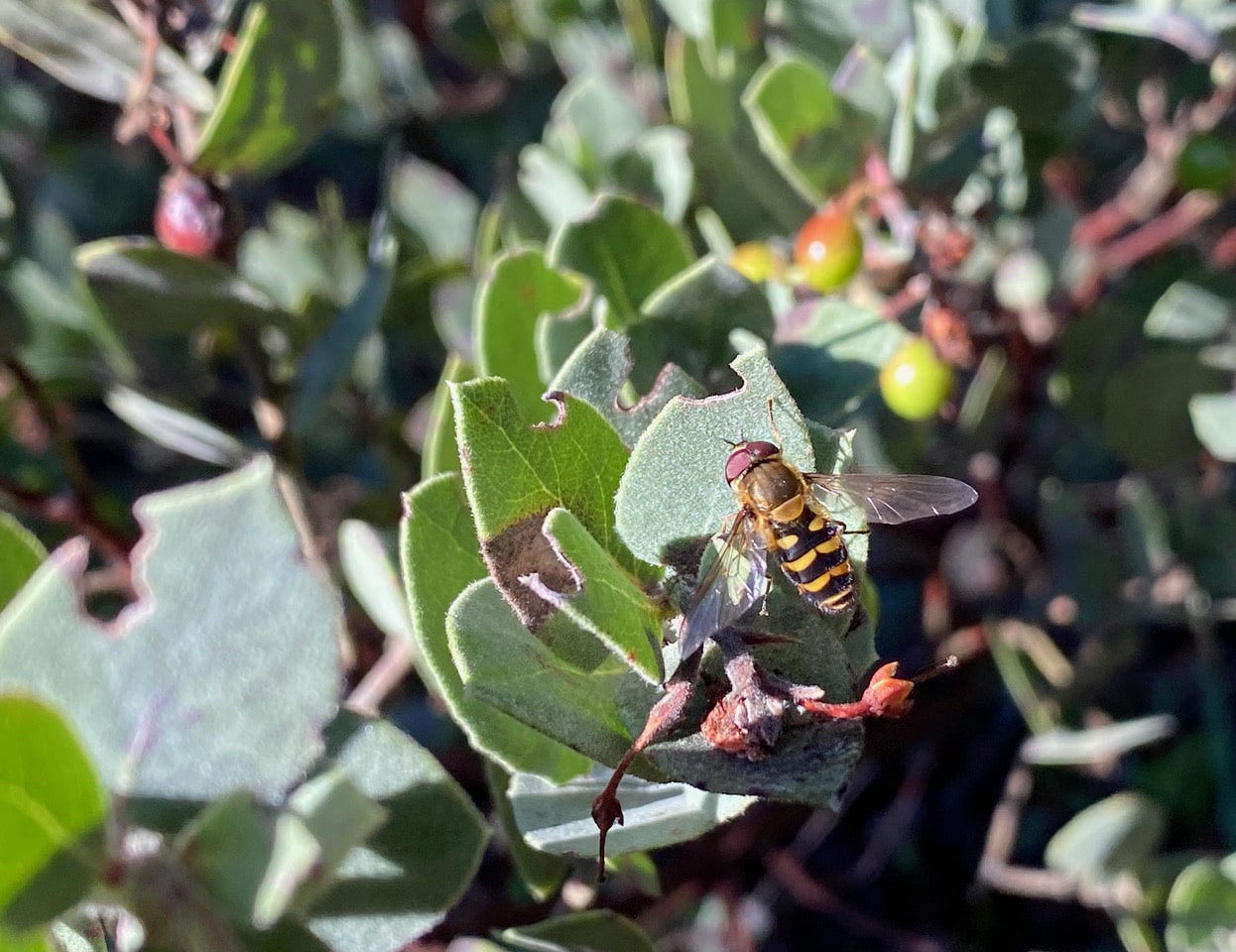
The Black-margined Flower Fly, Syrphus opinator is common in central California during winter months. It can be distinguished from similar species by the abdominal fascia restricted to the sides and isolated from the margins. It is the quintessential hover fly that mimics bees or wasps. The black-and-yellow banding on the abdomen serves to ward off potential predators that want to avoid prey with stings – a form of Batesian mimicry.
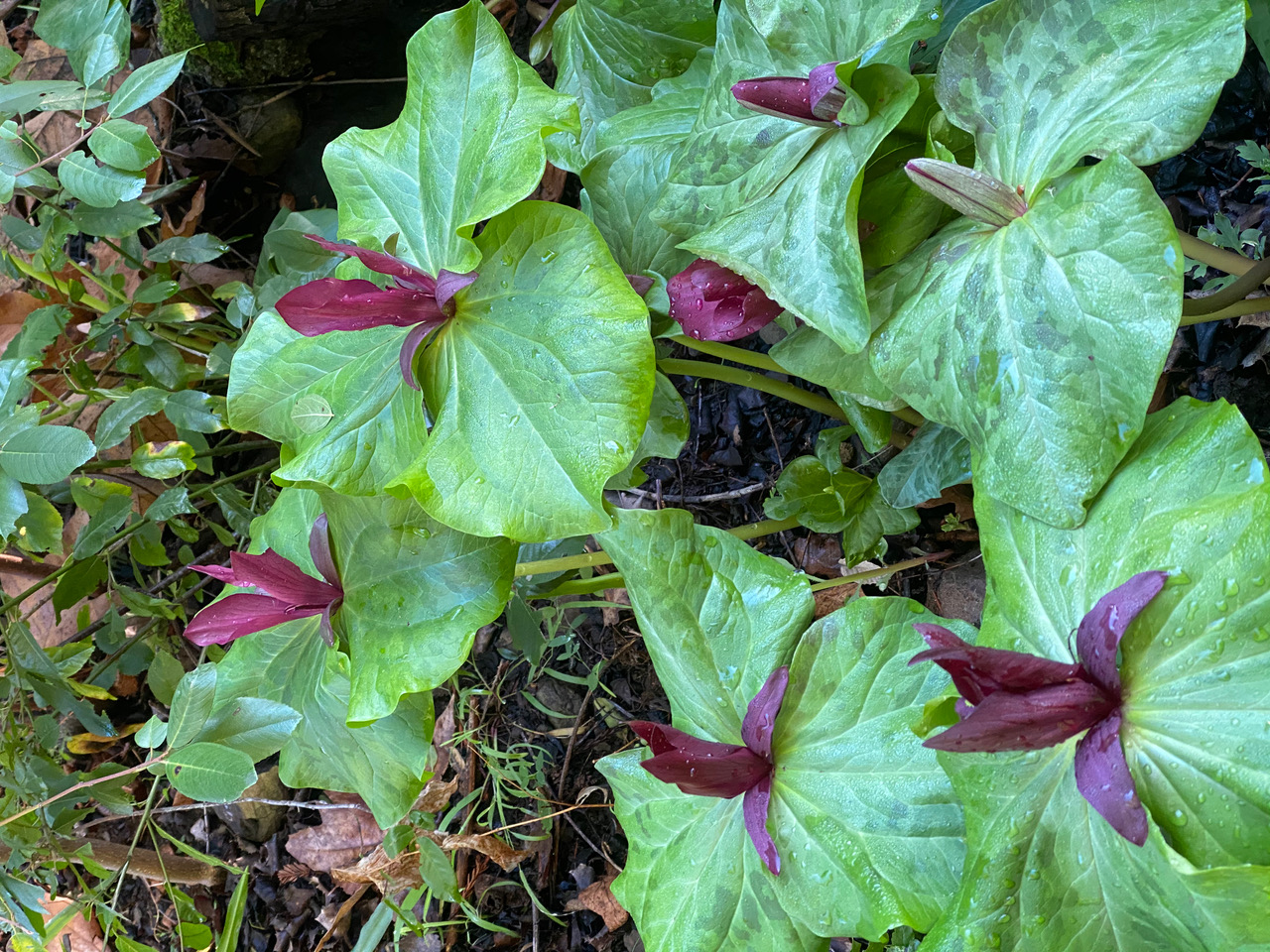
In the shade, the patch of Giant Trillium, Trillium chloropetalum is blooming gloriously with dark maroon flowers.
The name “trillium” incorporates the Latin word for three (“tri”), which refers to the three-part symmetry around which the plant parts are organized – in a single blossom there are three petals, three sepals, and likewise, the leaves (technically, bracts) also come three to a plant. Trilliums are divided into two groups, sessile or pedicellate. In the Giant Trillium, the flowers are sessile, meaning they are not subtended by a stalk or pedicel, but sit upright directly on the leaves.
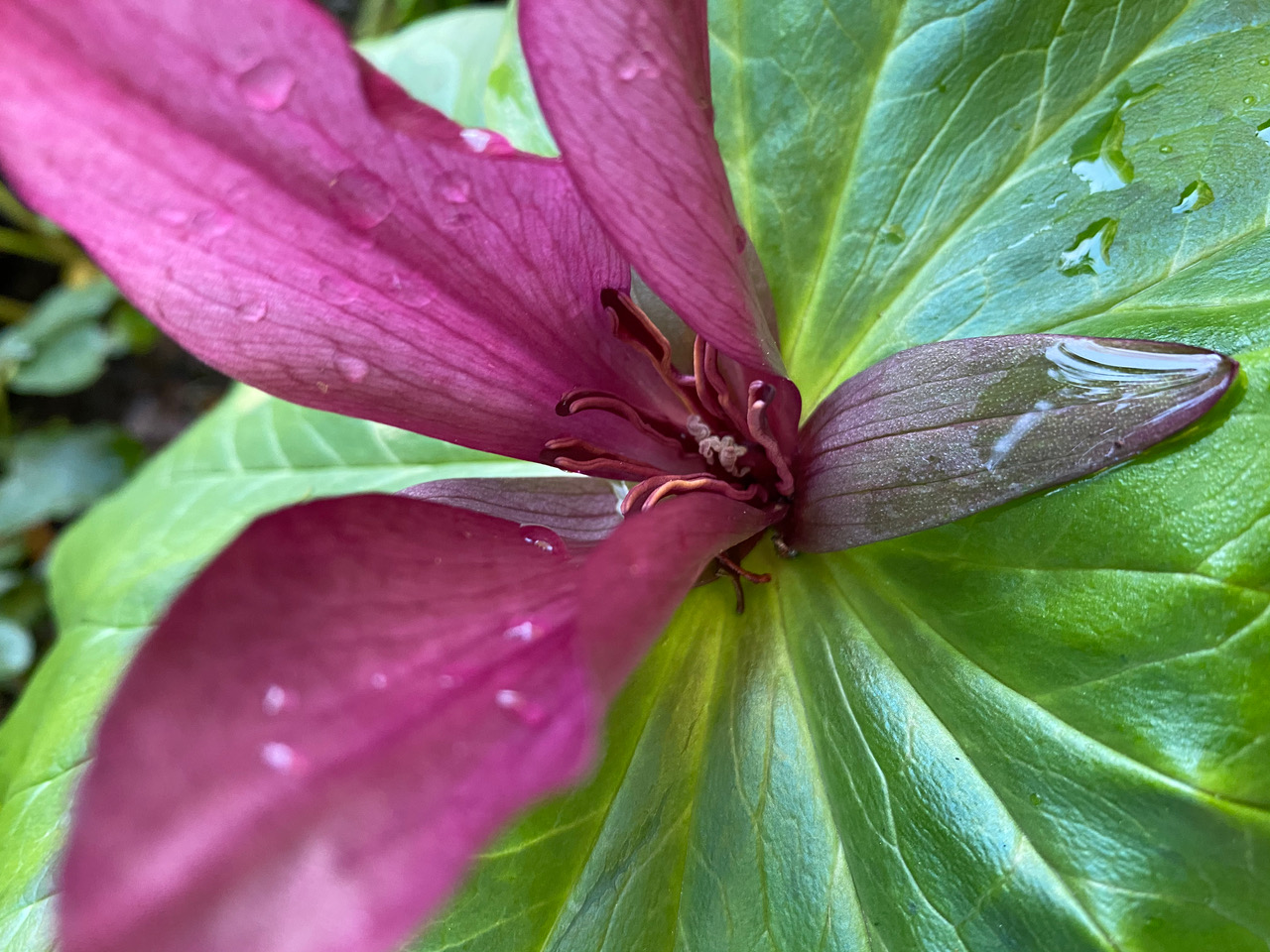
Closer inspection of the Giant Trillium reveals the reproductive structures of the flower. Large, erect, fleshy stamens surround a shorter, purplish, wrinkled pistil in the center. How are these flowers pollinated? From the literature, I gather that various species of trilliums are pollinated in different ways. Red trilliums that do not produce nectar are apparently pollinated by flies (Diptera) and beetles (Coleoptera). Their petals exude an odor that attract carrion flies and beetles which pollinate the flowers. Another source claims that white and drooping trilliums are pollinated by bumble bees and related insects, whereas flies and beetles visit sessile trillium flowers. I have yet to evaluate these claims by my own observations.
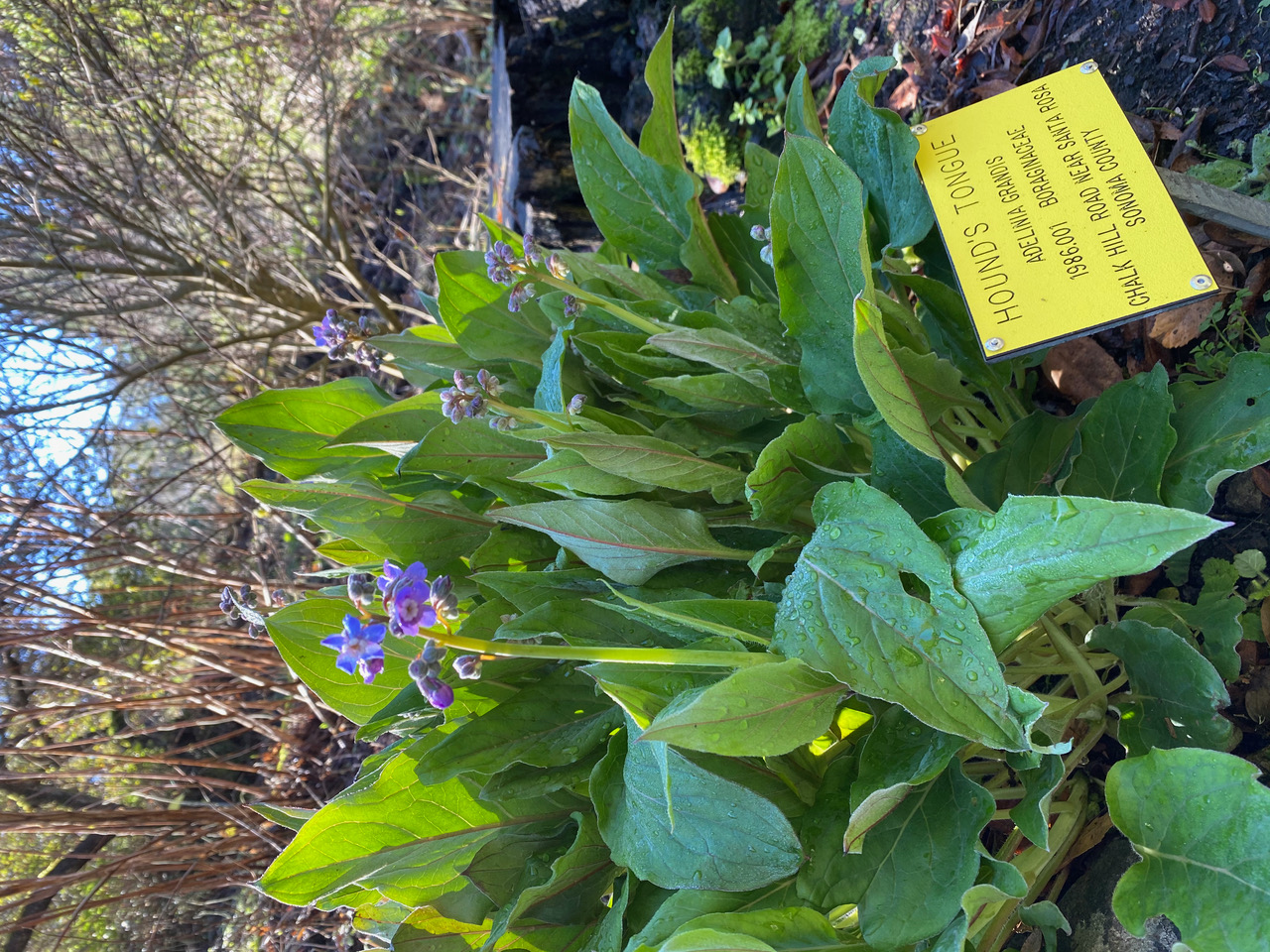
Hey, here’s another early blooming native – the Hound’s Tongue, Adelinia grandis. The plant is named after the shape of the large leaves.
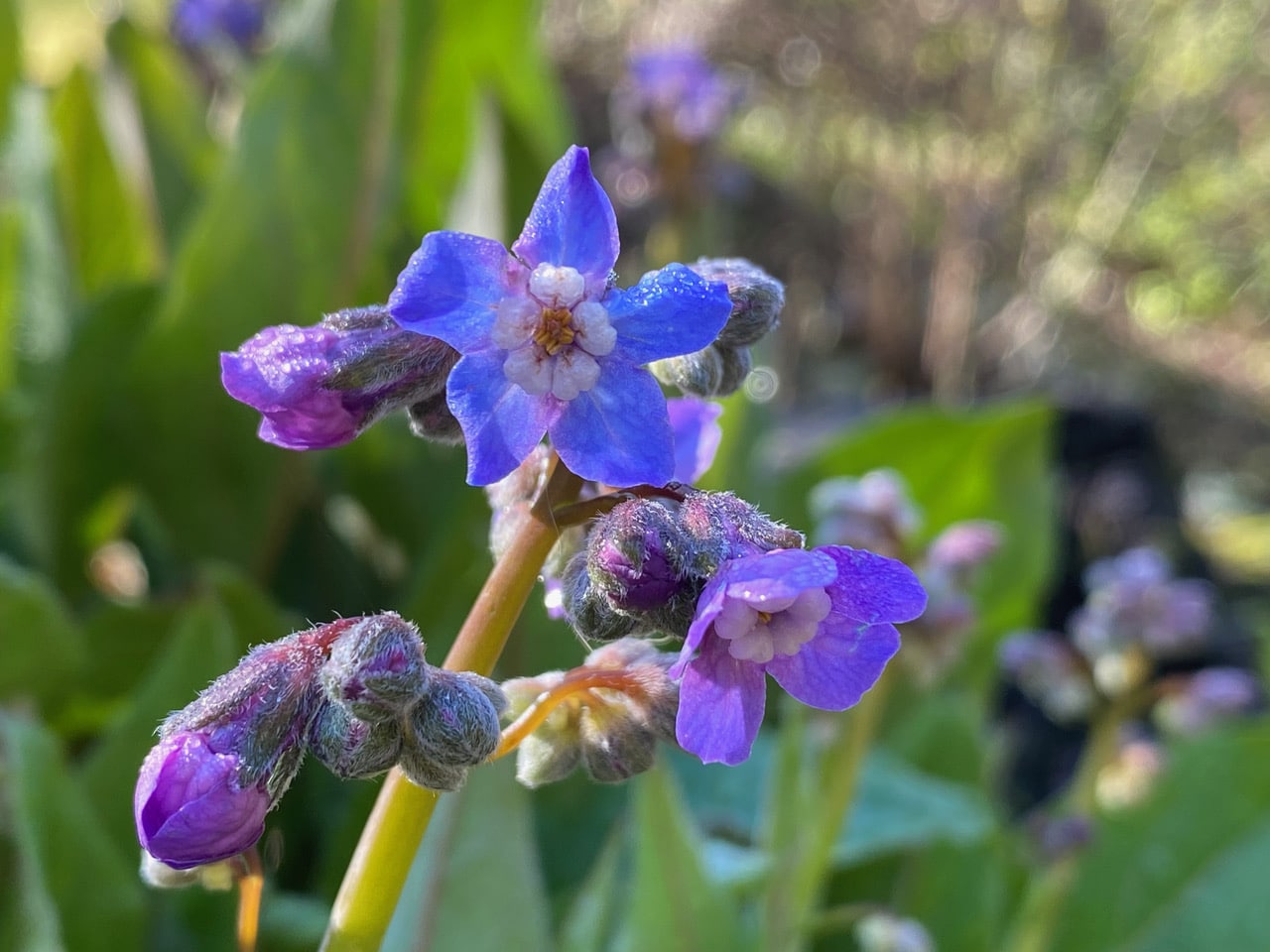
Clusters of flowers are borne on long stalks, pink in bud changing to blue. There are five fused petals with white appendages forming a central crown around the reproductive parts. Flowers change color, perhaps guiding pollinators whether a specific flower is worth visiting for pollen and nectar. Color signaling occurs in the flowers of more than 70 plant families to direct pollinators. Examples include Forget-me-nots, and Heliotrope, also in the Borage family. Bees see blue colors well, but not reds. Hound’s Tongue flowers contain anthocyanin, a pigment that changes color with pH. Immature pink flowers may signal to bees, “Not ready; move on.”, the mature blue flowers, “Ready for pollination.”; and the fading blue-purple of the aging flowers, “I’m done; don’t bother.” What’s more, bees perceive ultraviolet colors of the nectar appendages, which appear white to us. There’s so much more than meets our eyes!

Most of the Coast Silk Tassels in the garden are beat up, tattered and worn. I am happy to come across this large male shrub whose flowers for some reason seem to have withstood the storms well. Maybe it’s because it is surrounded by tall trees that shelter it from the worst winds?
The Coast Silk Tassel, Garrya elliptica (family Garryaceae) is an evergreen shrub or small tree. It is dioecious, meaning male and female flowers are borne on separate plants. Flowers appear in winter, male catkin-like clusters are yellowish to greenish then gray, 8-20 cm long (“silk tassels”), female flower clusters are shorter, 5-9 cm long.
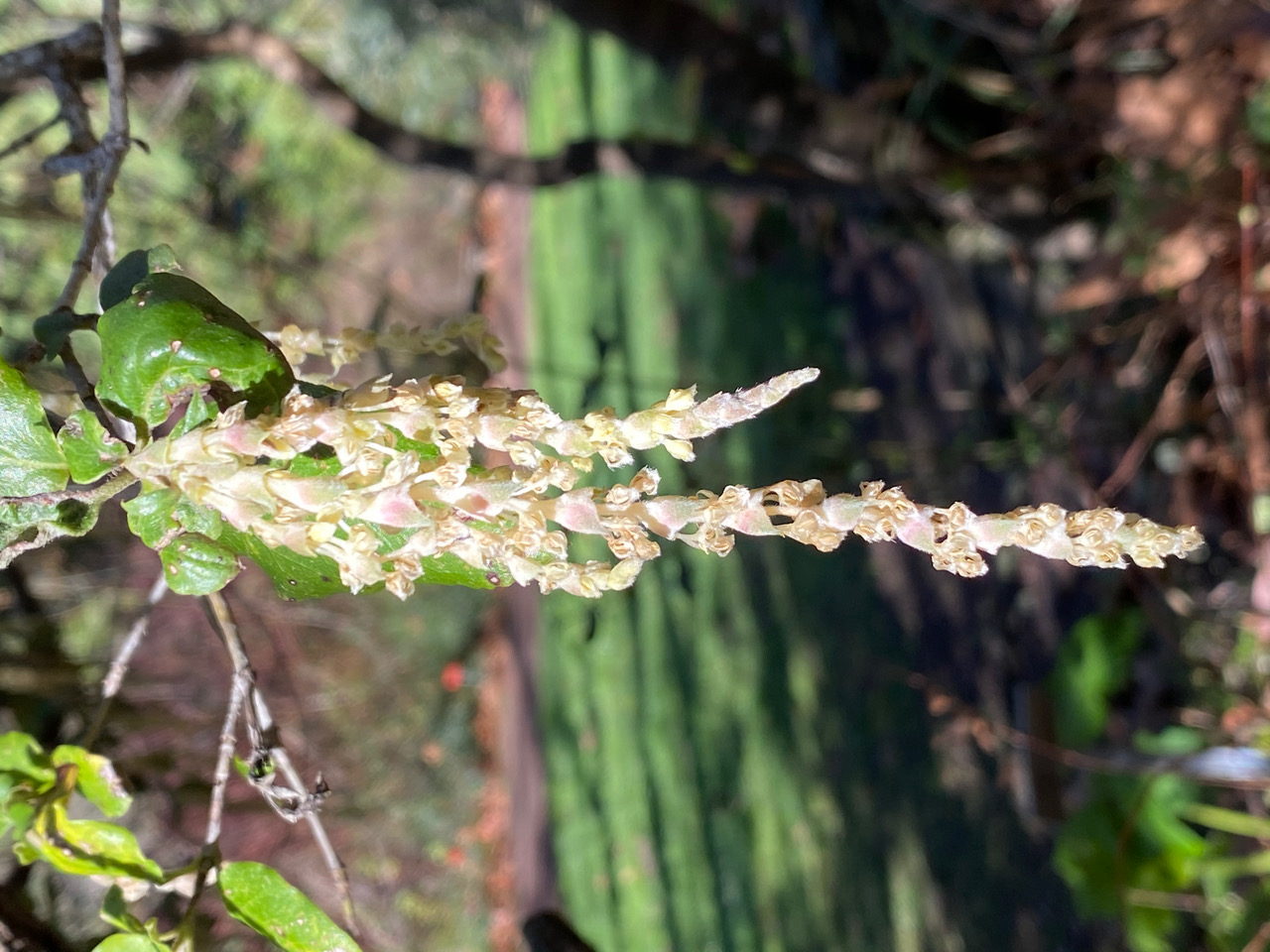
Male flowers of Coast Silk Tassel, Garrya elliptica. The flower clusters usually hang straighter; these have been deranged by the wind storm.
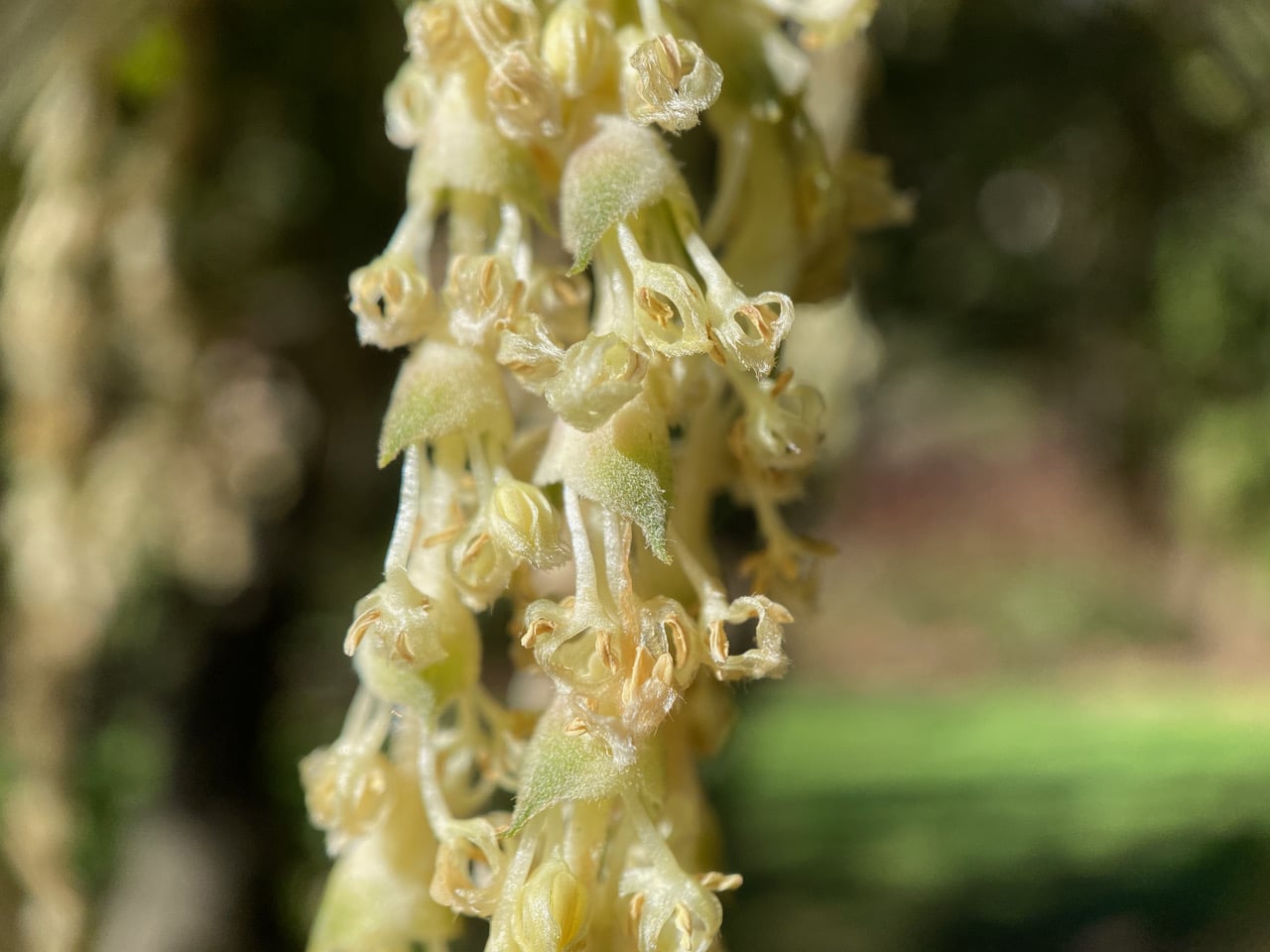
Close-up shows that the flowers are petelless. At maturity, the elongated stamens dangle freely, releasing pollen when shaken by the wind.
Coast Silk Tassel is an example of plants that are wind pollinated. About 12% of flowering plants and most conifers are wind pollinated. These plants do not waste energy on flower features that attract animal pollinators; instead, their flowers generally have these characteristics:
– Small, petalless, and unscented, with muted colors.
– No nectar
– Stamen (male flower part) and stigma (female pollen-receiving part) are exposed to air currents.
– Male flowers produce a great deal of pollen, which is very small, dry, and easily airborne.