

Pollinator Post 2/7/23 (2)
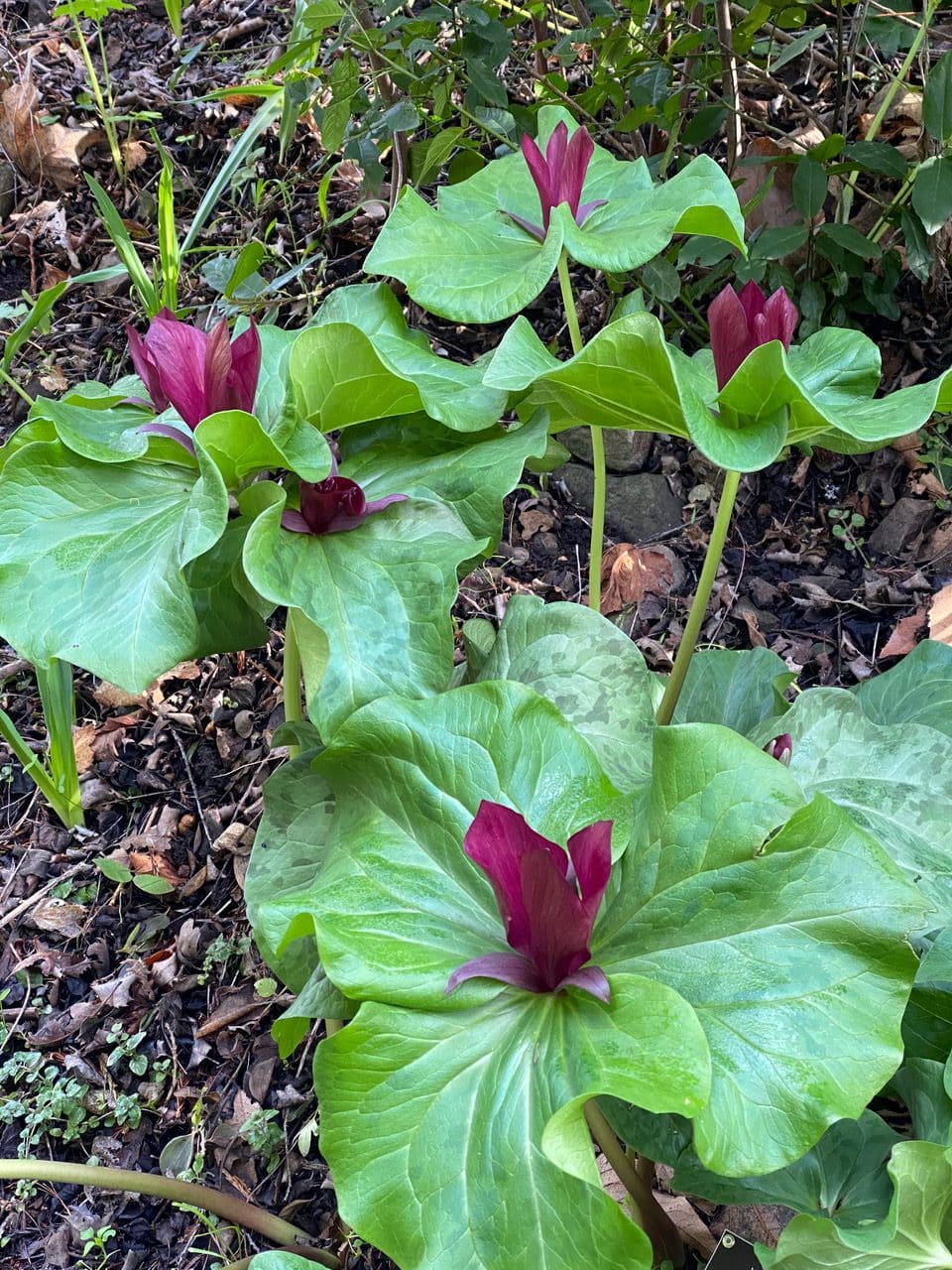

In a shady corner of the East Bay Regional Parks Botanic Garden under oak trees, the Giant Trillium or Wake Robin, Chloropetalum gigantium is blooming brilliantly.
The name “trillium” incorporates the Latin word for three (“tri”), which refers to the three-part symmetry around which the plant parts are organized – in a single blossom there are three petals, three sepals, and likewise, the leaves (technically, bracts) also come three to a plant. Trilliums are divided into two groups, sessile or pedicellate. In the Giant Trillium, the flowers are sessile, meaning they are not subtended by a stalk or pedicel, but sit upright directly on the leaves.


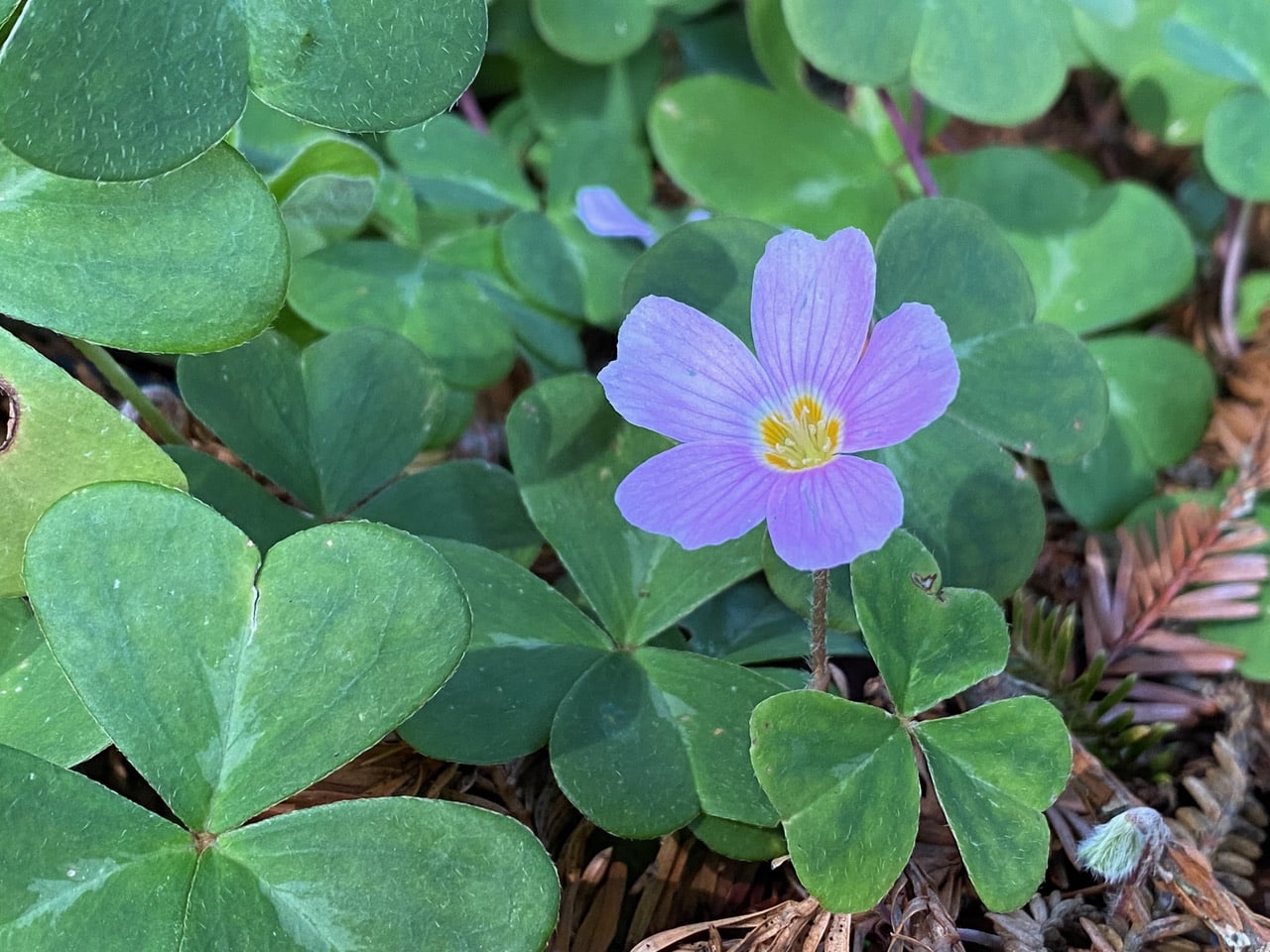
 Large patches of Redwood Sorrel, Oxalis oregana (family Oxalidaceae) cover the soft duff in the Redwood section of the garden. Each clover-like leaf is composed of three heart-shaped leaflets, with purplish undersides. The species, native to moist and shady coast redwood forests of western North America, is able to photosynthesize at relatively low levels of ambient sunlight. Normally the red or purple pigments in plants, called anthocyanin, serves as a sunscreen in leaves, protecting them from high light stress. So why is the pigment on the underside of the sorrel leaves? Probably to sequester every photon of light coming through for photosynthesis. When direct sunlight strikes the leaves they fold downward; when shade returns, the leaves reopen. This is a protective response to prevent the shade-loving plant from getting sunburned. Taking only a few minutes, this movement is observable in real time.
 My heart sinks when I finally find the plant I was looking for under the redwoods. The bright green, mottled leaves of the Fetid Adder’s Tongue are easy enough to spot, but when the leaves are fully developed, the flowers are mostly gone. Note that every sinuous flower stalk ends with not a flower, but a developing fruit. Am I too late for the flowers?

Closer inspection of the Giant Trillium reveals the reproductive structures of the flower. Large, erect, fleshy stamens surround a shorter, purplish, wrinkled pistil in the center. The stamens have released some yellow pollen. I take a whiff of the flower, but don’t detect any odor.
I wait around for insects, but none came. This is the same situation at the Giant Trillium patch at the Skyline Garden. I have never seen an insect approach these spectacular flowers. How are they pollinated? From the literature, I gather that various species of trilliums are pollinated in different ways. Red trilliums that do not produce nectar are apparently pollinated by flies (Diptera) and beetles (Coleoptera). Their petals exude an odor that attract carrion flies and beetles which pollinate the flowers. Another source claims that white and drooping trilliums are pollinated by bumble bees and related insects, whereas flies and beetles visit sessile trillium flowers. I have yet to ascertain these claims by my own observations.
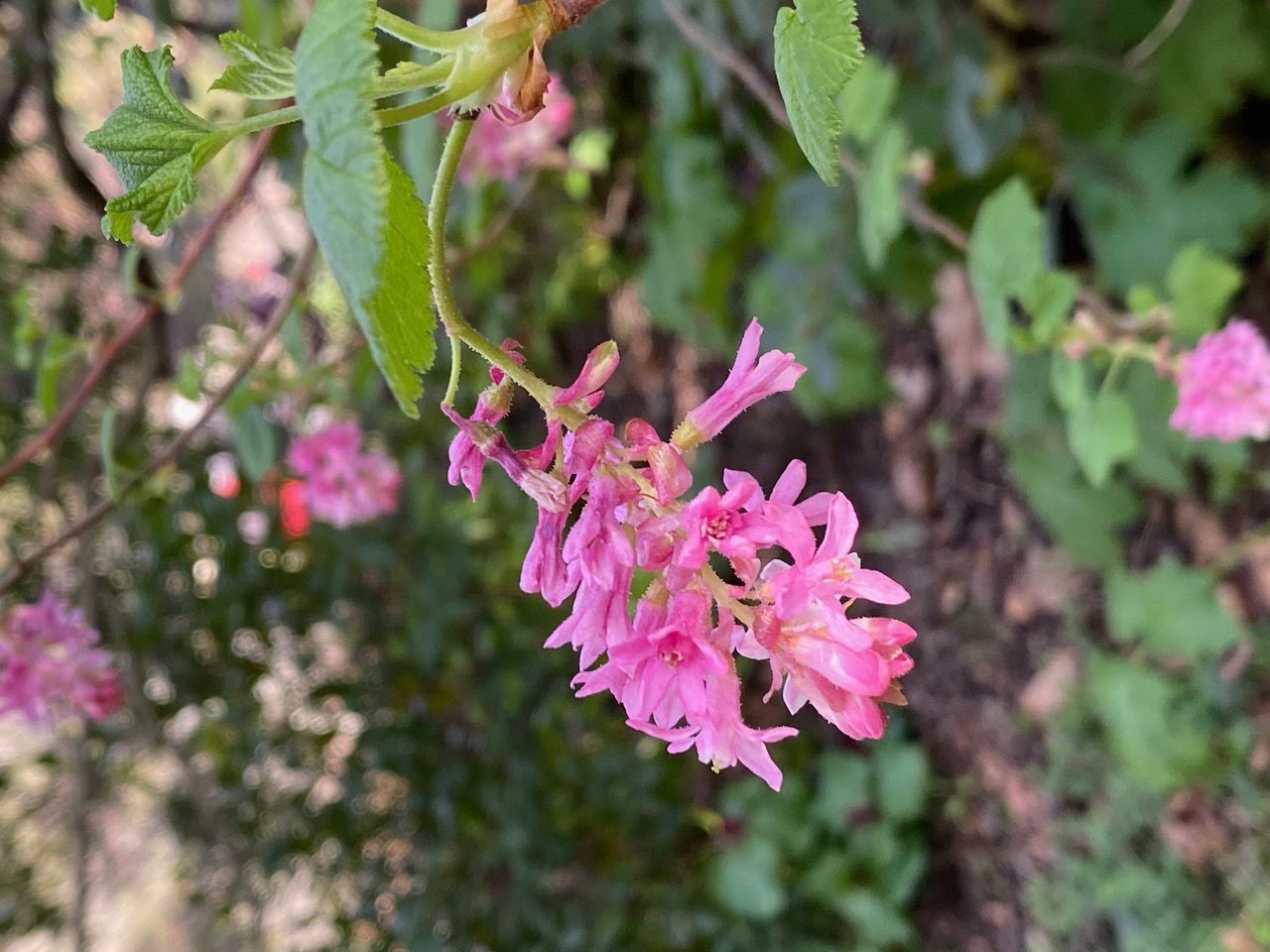
Next to the trillium patch is a blooming Pink-flowering Currant, Ribes sanguineum. I enjoy the sight of a Black-tailed Bumble Bee work the flowers. This is another early bloomer that supports bumble bees. It is a popular garden plant because of its attractive, nodding pink inflorescences.
Some of the Barberry are already in bloom, showing their bright yellow, tightly clustered flowers. I wonder who pollinates these flowers.
Large patches of Redwood Sorrel, Oxalis oregana (family Oxalidaceae) cover the soft duff in the Redwood section of the garden. Each clover-like leaf is composed of three heart-shaped leaflets, with purplish undersides. The species, native to moist and shady coast redwood forests of western North America, is able to photosynthesize at relatively low levels of ambient sunlight. Normally the red or purple pigments in plants, called anthocyanin, serves as a sunscreen in leaves, protecting them from high light stress. So why is the pigment on the underside of the sorrel leaves? Probably to sequester every photon of light coming through for photosynthesis. When direct sunlight strikes the leaves they fold downward; when shade returns, the leaves reopen. This is a protective response to prevent the shade-loving plant from getting sunburned. Taking only a few minutes, this movement is observable in real time. Flowers, up to 2 cm in diameter, are borne on solitary stalks. The yellow patches at the base of each petal are the nectar glands. The dark veins on the petals all converge on the glands – these are the “nectar guides”, showing pollinators where the nectaries are. Seeking sweet rewards, the insect’s body comes into contact with the reproductive structures of the flower, pollinating it. The flower is pollinated by bees, Syrphid flies, and butterflies.
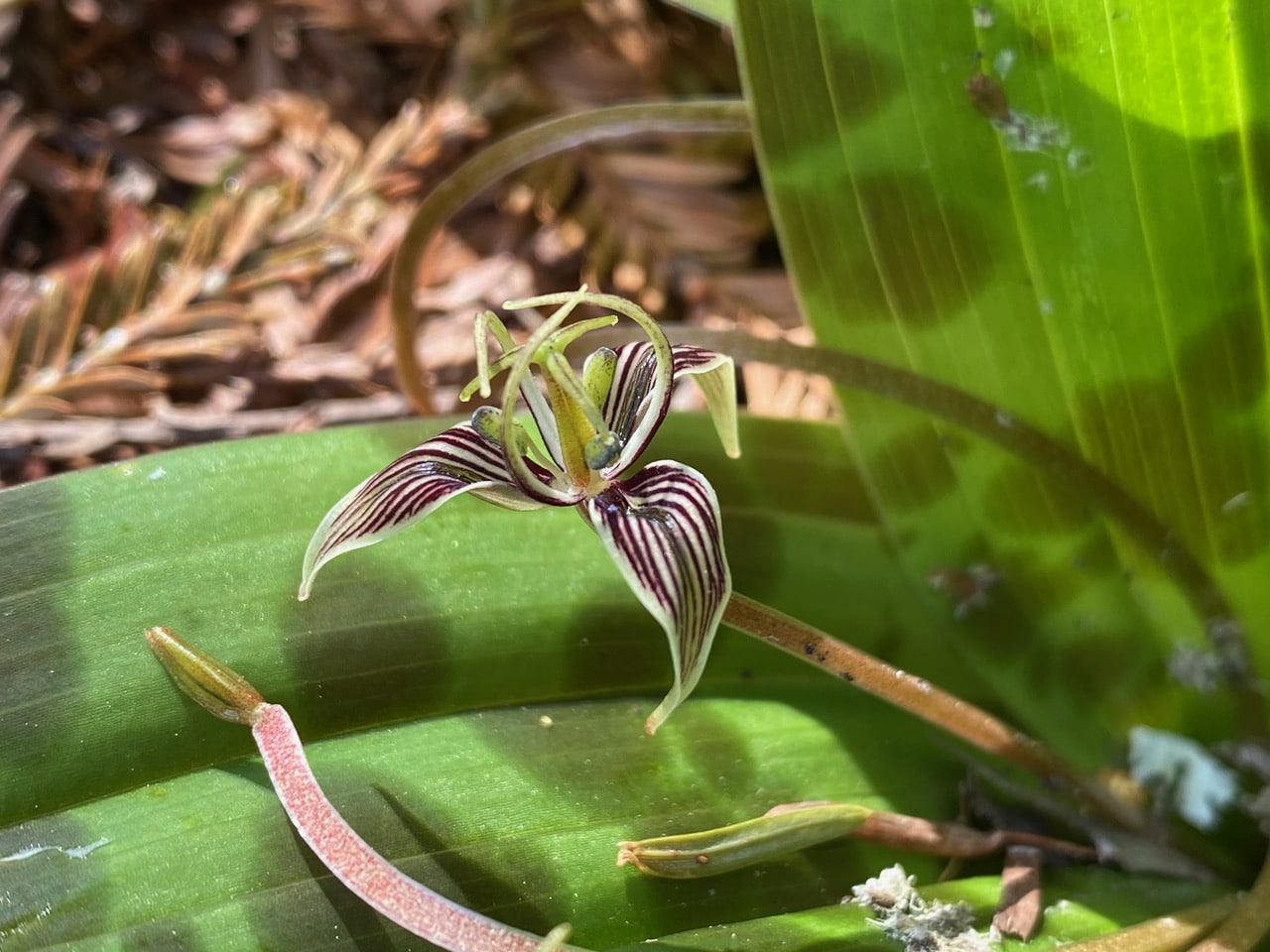
My heart sinks when I finally find the plant I was looking for under the redwoods. The bright green, mottled leaves of the Fetid Adder’s Tongue are easy enough to spot, but when the leaves are fully developed, the flowers are mostly gone. Note that every sinuous flower stalk ends with not a flower, but a developing fruit. Am I too late for the flowers?Late, but not too late! Fortunately, I find a fresh flower of Fetid Adder’s Tongue, Scoliopus bigelovii peeking out from a young plant. This odd lily has striking flowers and handsome leaves.
“Fetid” refers to the flower’s smell. You have to get down on your hands and knees to be offended by it, though. The odor is part of the plant’s reproductive strategy, attracting the fungus gnats that pollinate it. Once pollinated, the flower stalks begin to lengthen and bend over, placing the developing fruits closer to the ground. Note the fruit next to the flower in this photo. It has three curved appendages resembling a ship’s anchor that later serve as grappling hooks to hold the pods against the ground. The sinuous stalks give rise to another common name for the plant, Slinkpod.
Besides the fungus gnats, Scoliopus bigelovii has a fascinating relationship with another insect – ants. Each seed comes equipped with a fleshy little attachment called an elaiosome that is attractive to ants. The ants collect the seeds, eat the elaiosomes, and discard the seeds in their trash midden. Here the seeds are well protected from predators and pathogens, surrounded by nutrient-rich compost – perfect conditions for germination!
The most conspicuous part of the flower are not the petals, but rather the sepals. These are lance-shaped, pale and striped with dark purple. The narrow, linear petals are shown here curving over the reproductive parts. The three short stamens are located at the bases of the sepals. The stout, erect style in the center has three long lobes. The whole arrangement is optimized for showering the fungus gnat with pollen from the ripe anthers while the insect, guided by the nectar guides, makes its way down the center of the flower for the sweet reward. Whatever pollen from another flower that is already on the gnat’s back might be rubbed off on the stigmatic surfaces of the style arms looming over the insect. Pollination accomplished!