

Pollinator Post 2/5/24 (5)

Wait, is that some kind of Vespid Wasp on the Ceanothus flowers?
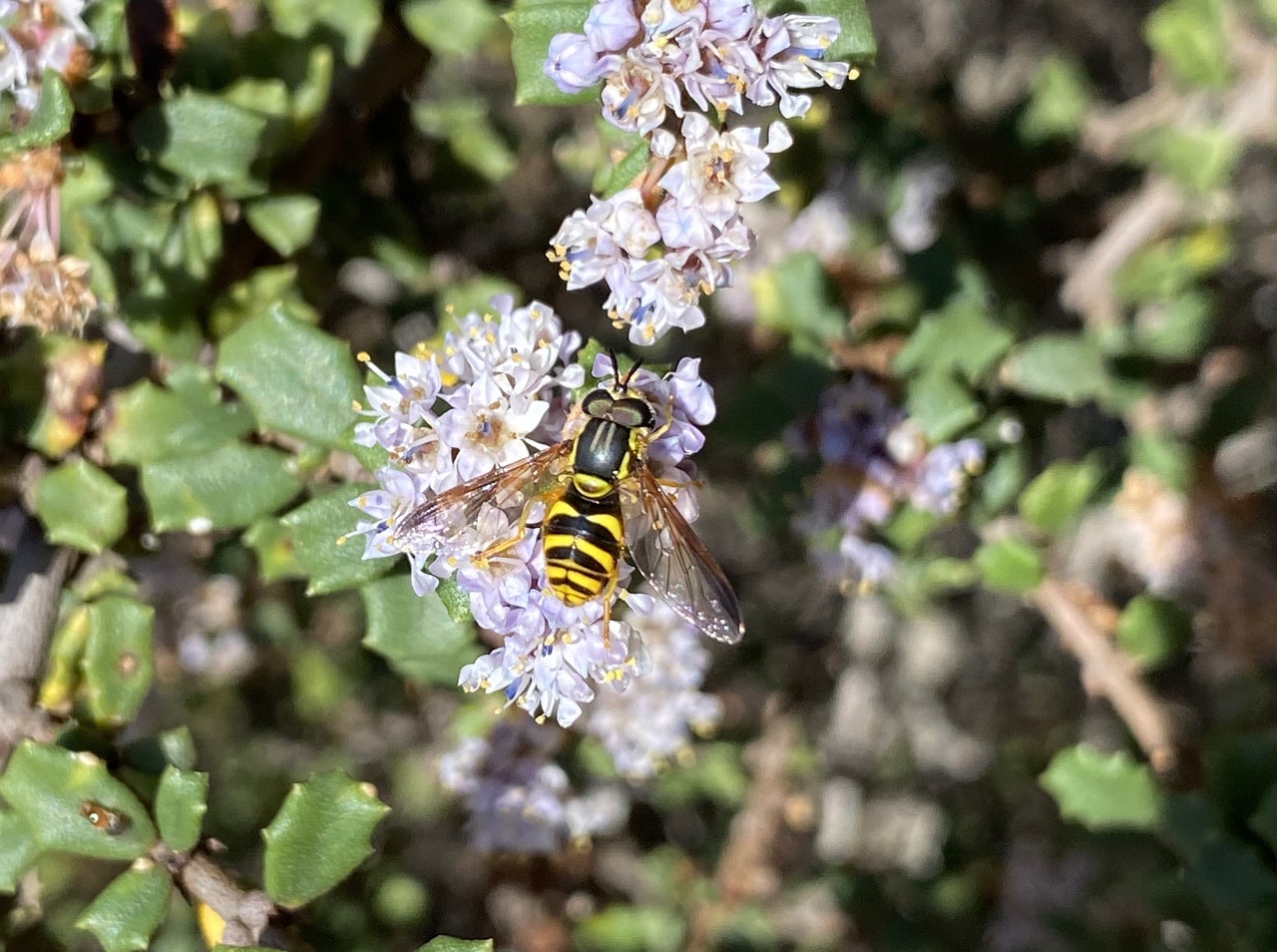
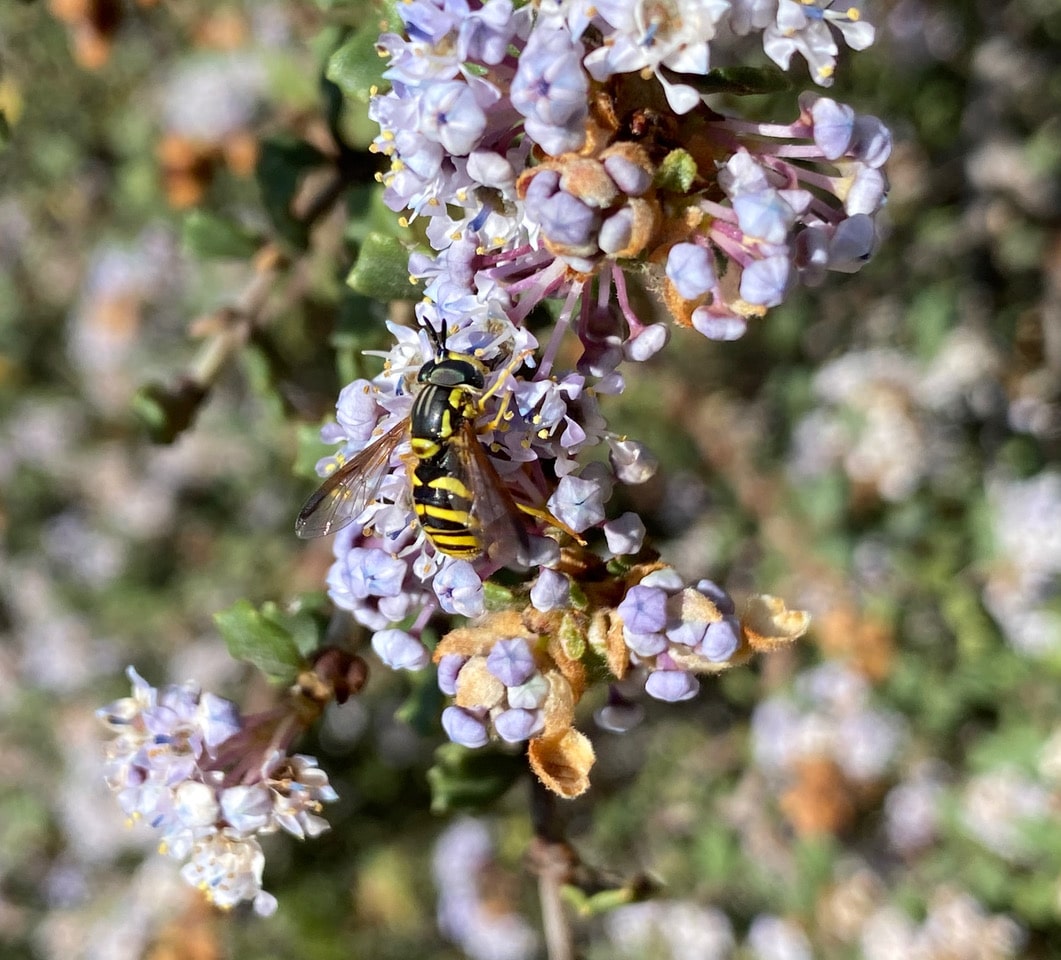
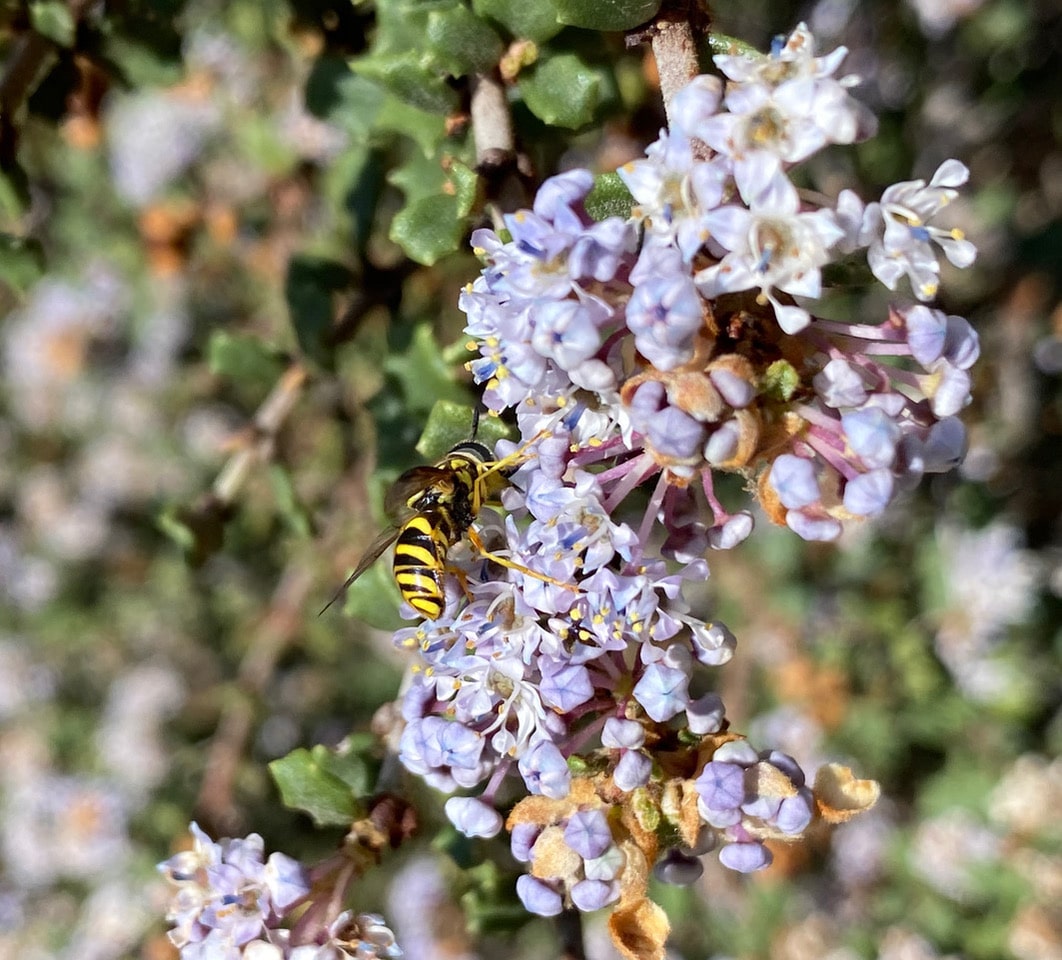
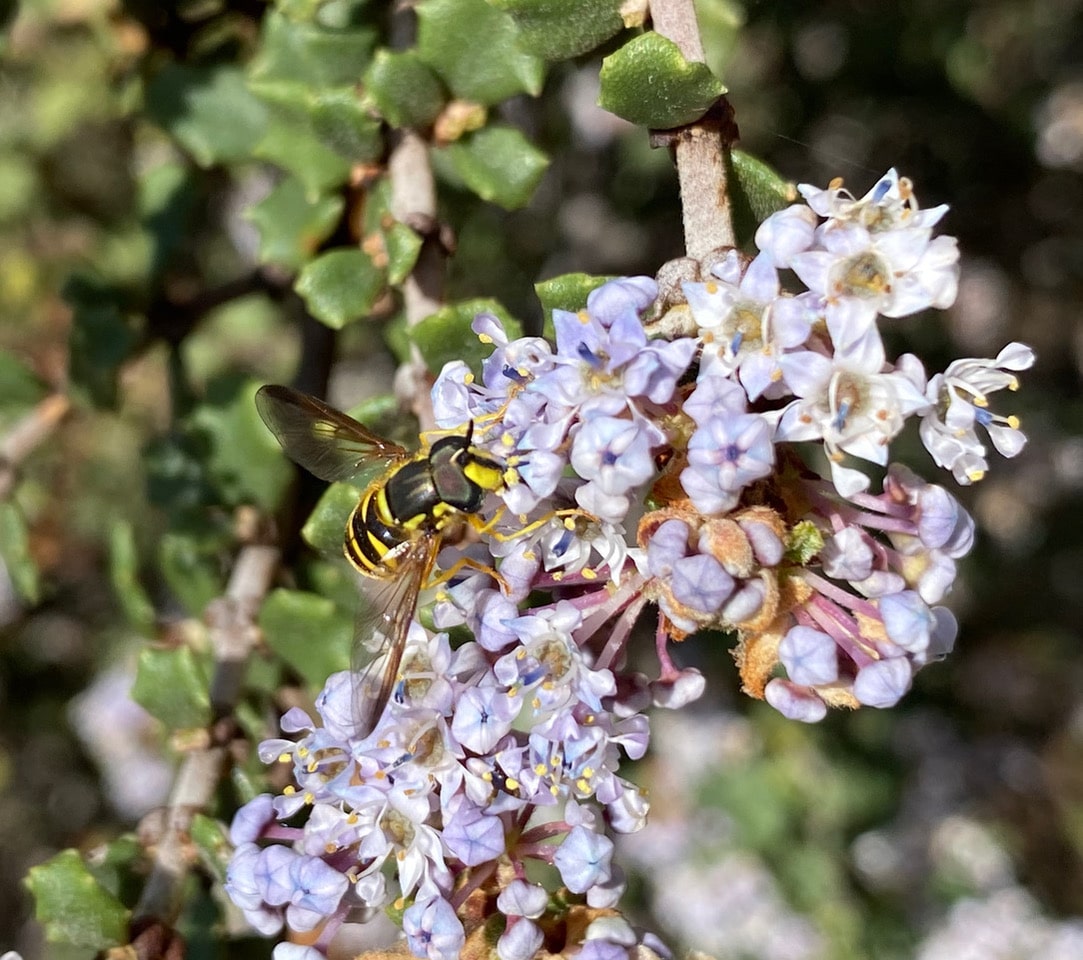

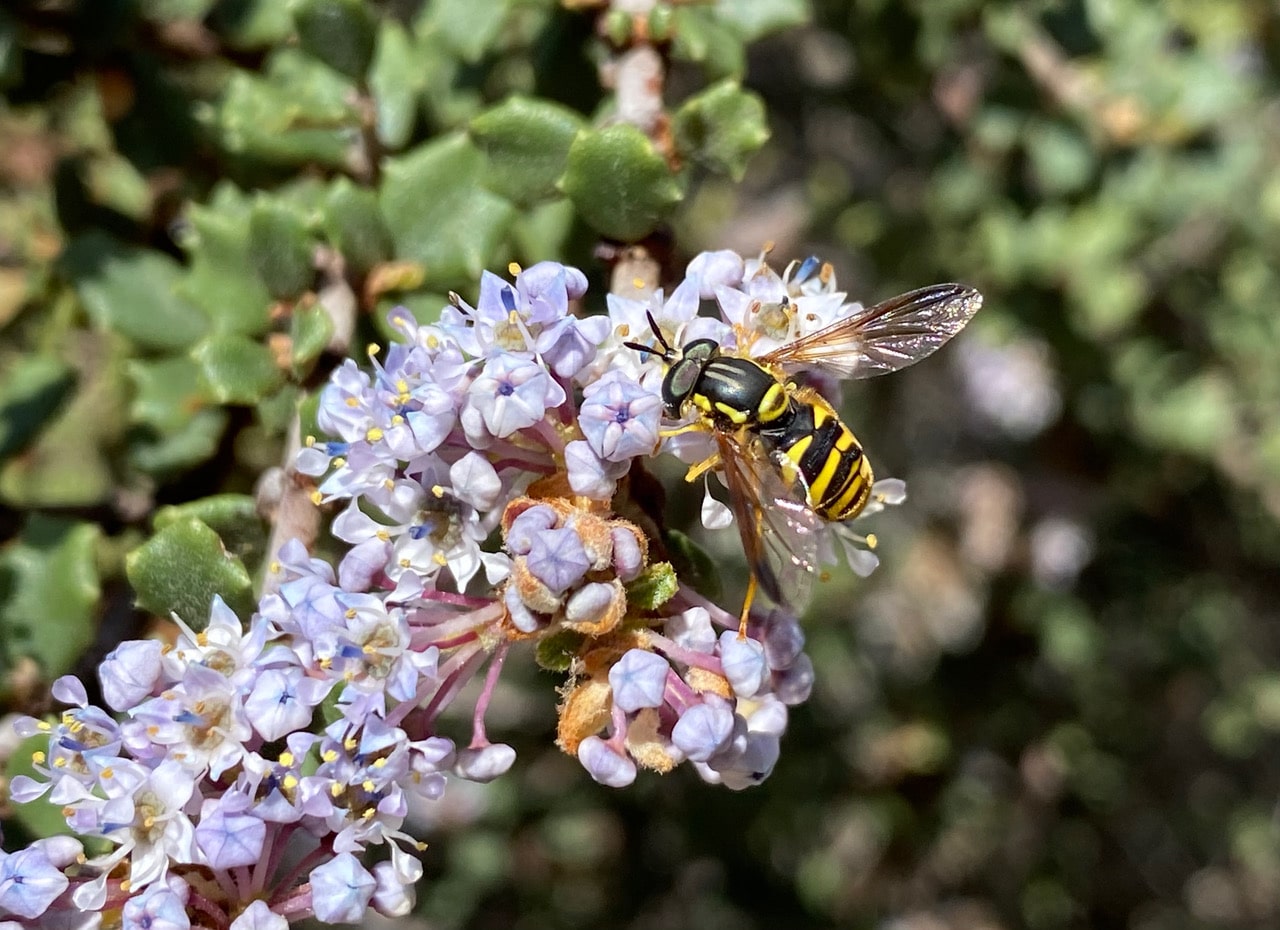

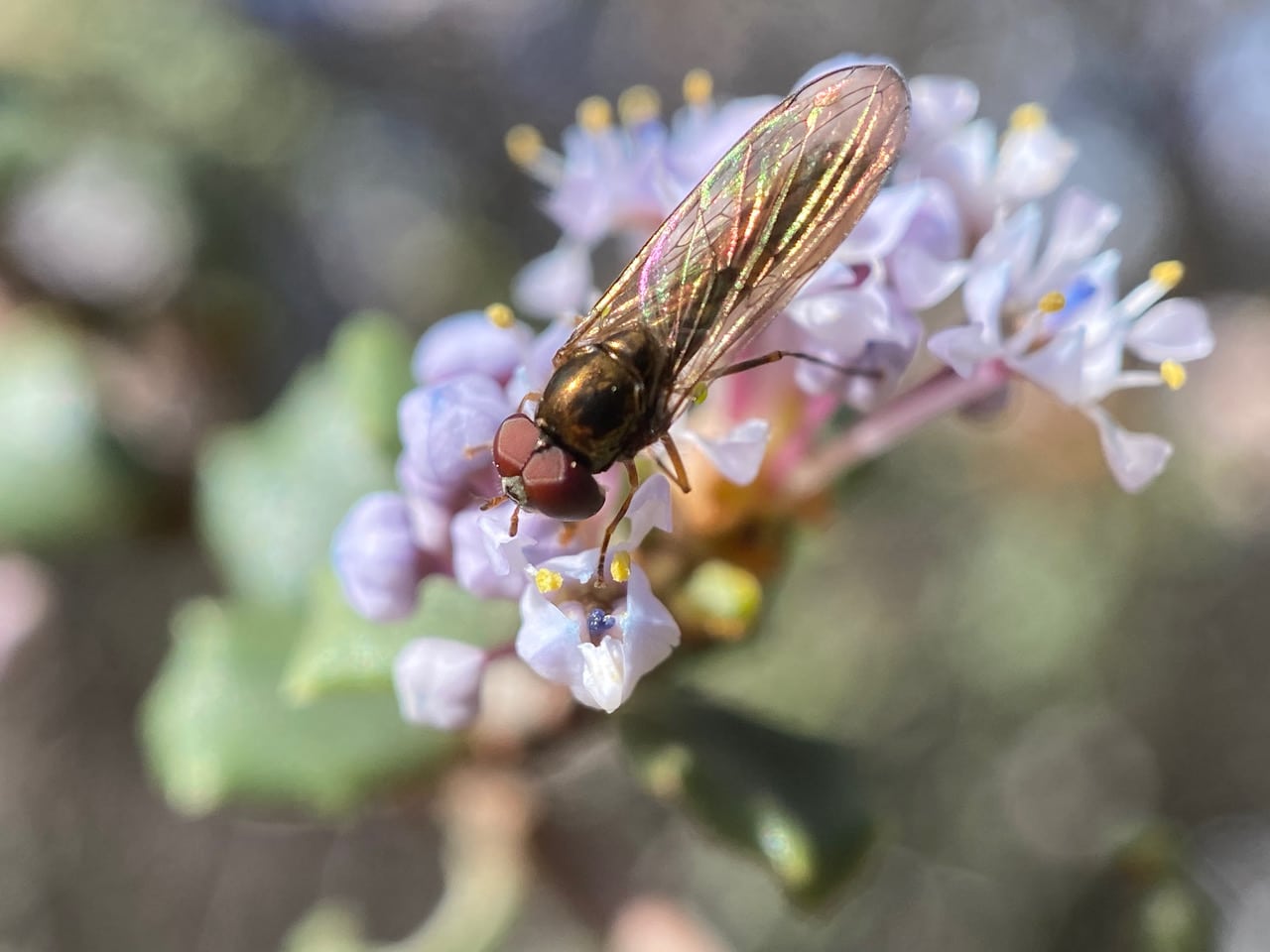
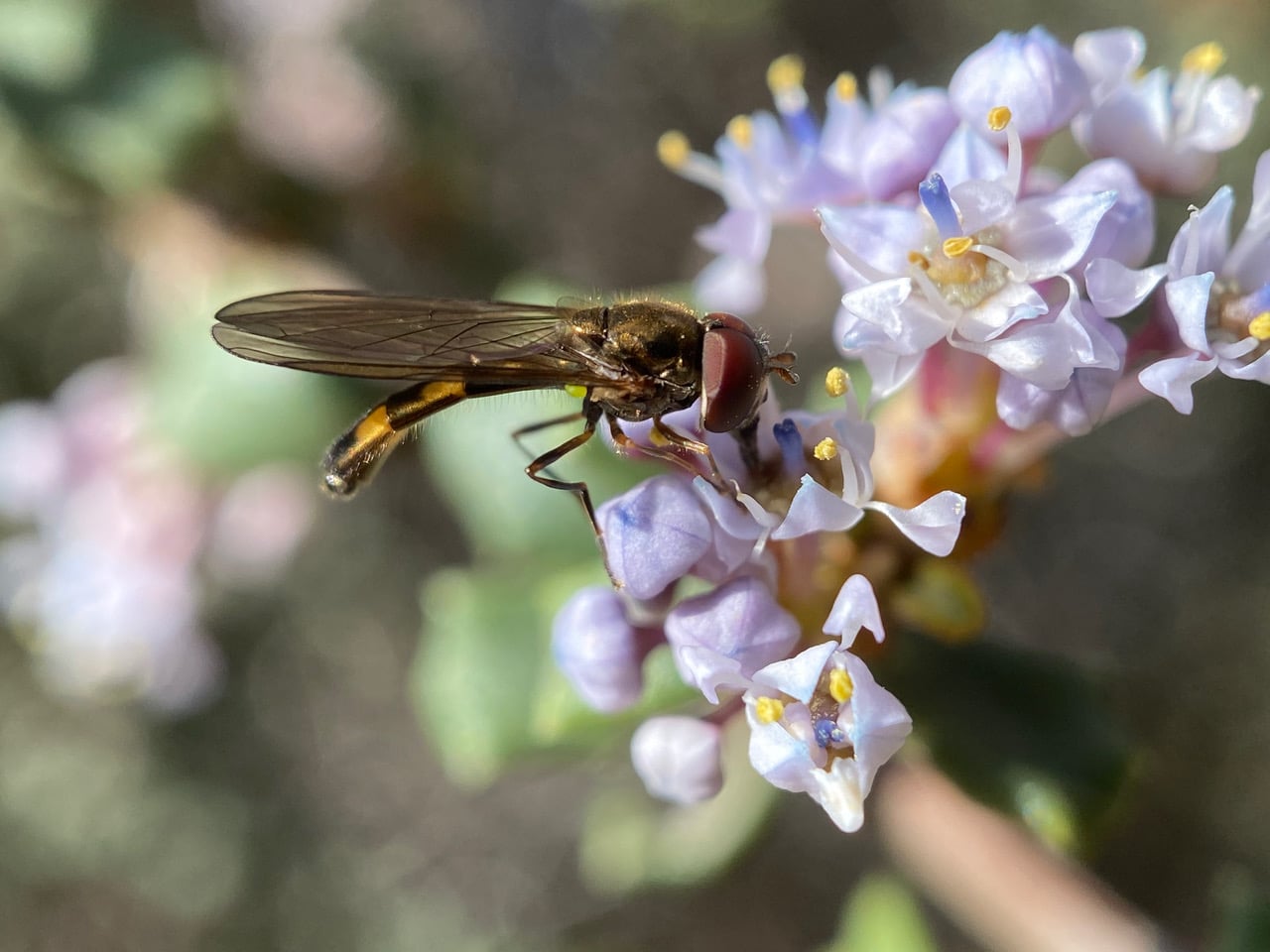
I zoom in and quickly realize that it is not a wasp at all. Look at those eyes and the antennae! Definitely a fly, and most likely a hover fly.
I don’t think I have ever seen this hover fly before, so I try to take pictures of the insect from many different angles. Hopefully someone from iNaturalist can help identify it.
Wow, the fly’s mimicry of a Vespid wasp is impressive! Note the darker leading edge of its wings. The wings of most Vespids (including paper wasps) are folded longitudinally when at rest. This creates a darker area along the leading edge and gives the appearance that the wings are half as wide as other wasps.
Interesting yellow beak-like structures on the face.
Abdomen is strongly convex dorsally.
When I first submitted the pictures of this hover fly to iNaturalist, their Computer Vision (AI) was roundly duped. The line-up of identifications offered consisted of all wasps, with only one exception of a hover fly. But I know that hover fly and it is not the correct one. Fortunately, a couple of fly experts on iNaturalist came to the rescue, and offered the correct identification of Meadow Fly, genus Chrysotoxum (family Syrphidae). Yay, a new hover fly for me!
The genus Chrysotoxum consists of large, wasp-mimicking species. The adults are distinguished by long antennae that are held erect, oval abdomen with yellow stripes, and yellow patterns on the thoracic pleurae (sides of the thorax). The abdomen is strongly convex dorsally. The species of Chrysotoxum mainly occurs in the northern hemisphere. Larvae are specialized in preying upon root aphids associated with ant nests. Wow, what a specialized niche!
Why are aphids found in ants’ nests?
Ants and aphids share a well-known mutualistic relationship. The aphids produce honeydew, a sugary food for the ants; in exchange, the ants care for and protect the aphids from predators and parasites. Some ants will “milk” the aphids to make them excrete the sugary substance. The ants stroke the aphids with their antennae, stimulating them to release the honeydew. Aphid-herding ants make sure the aphids are well-fed and safe. When the host plant is depleted of nutrients, the ants carry their aphids to a new food source. If predatory insects or parasites attempt to harm the aphids, the ants will defend them aggressively. Some species of ants continue to care for aphids during winter. The ants carry the aphids to their nest for the winter months, and transport them to a host plant to feed the following spring.
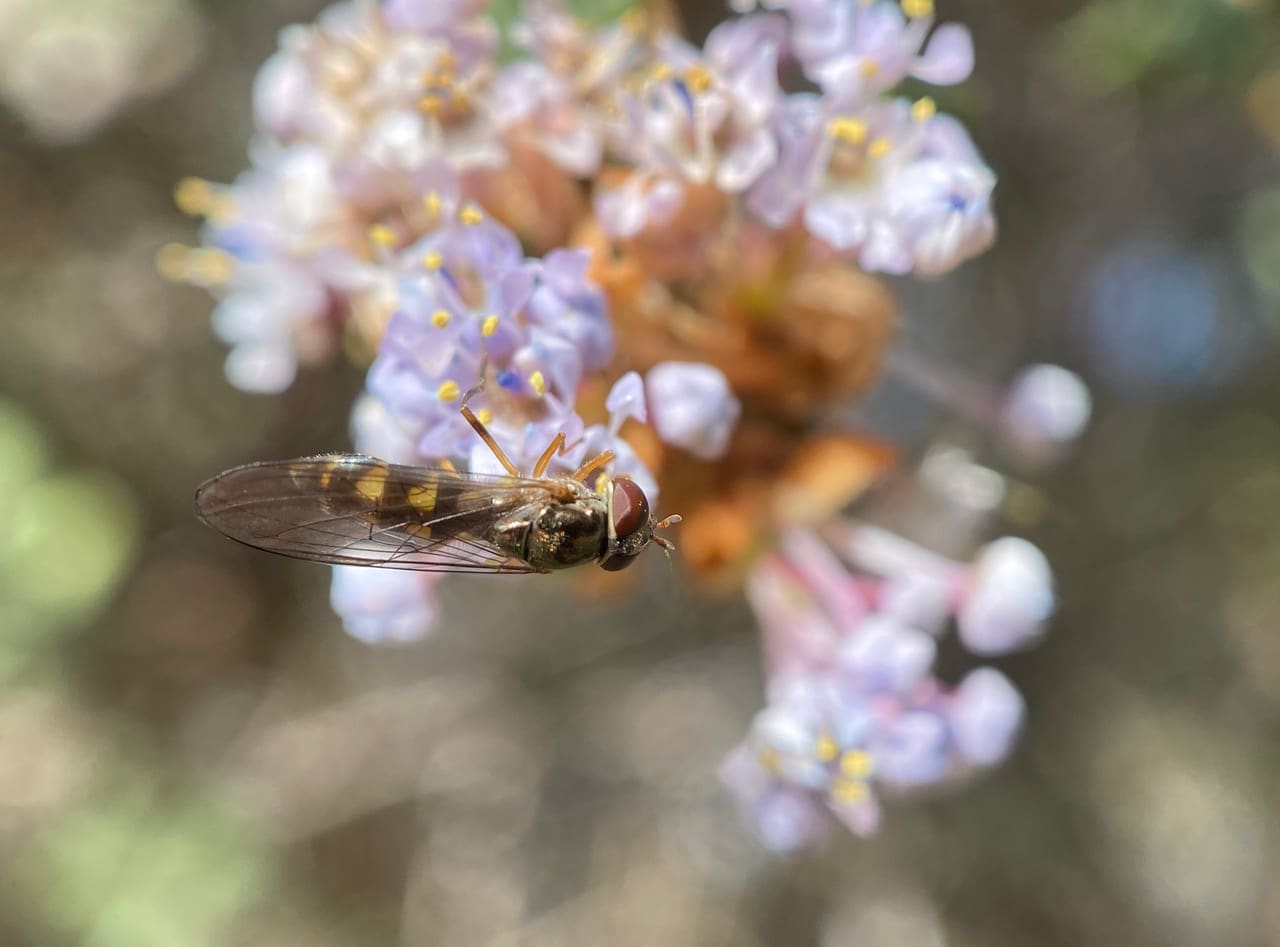
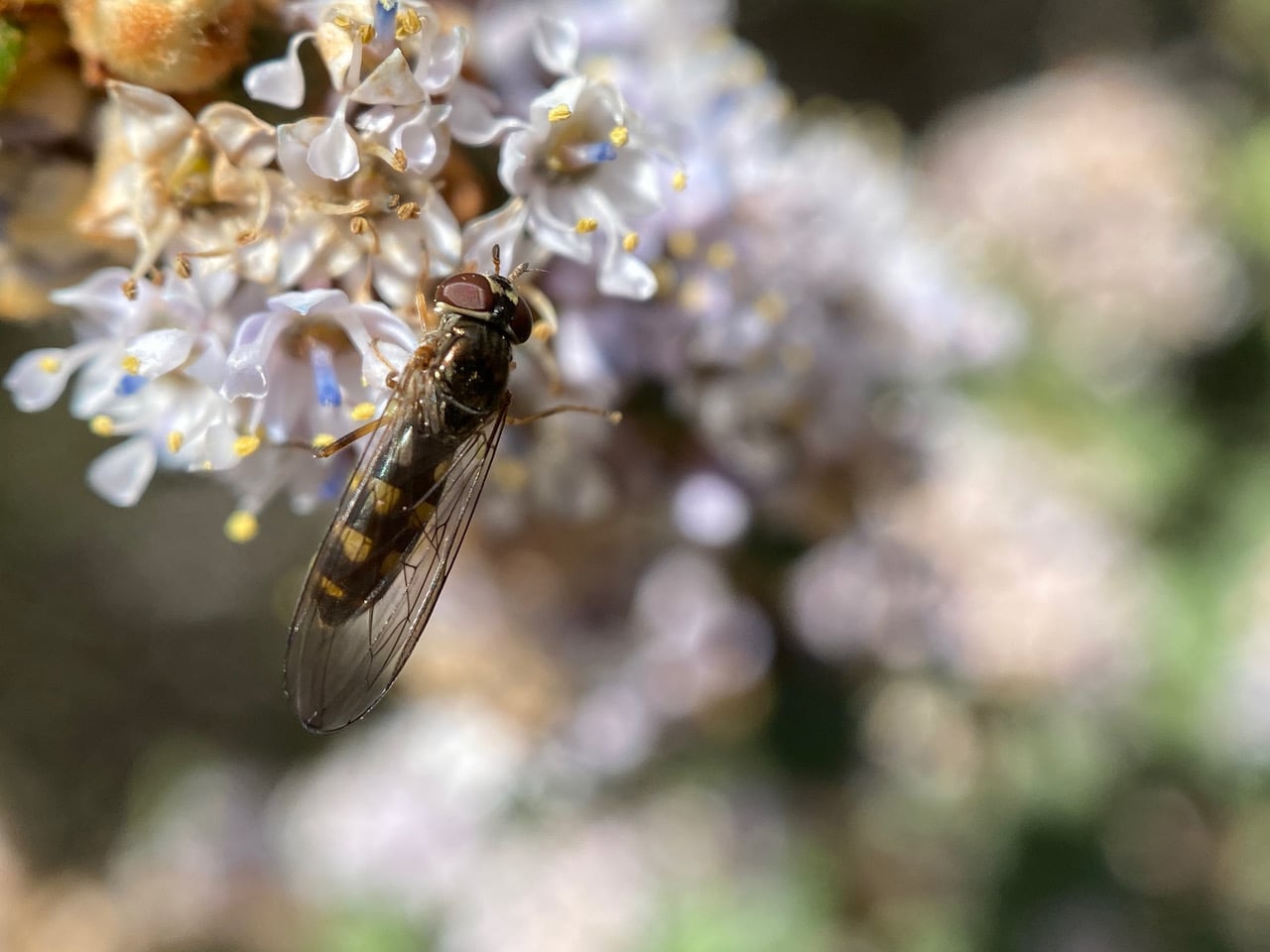
Here’s yet another hover fly on the Ceanothus flowers! It’s the Variable Duskyface Fly, Melanostoma mellinum (family Syrphidae). Foraging on the fresh flowers, it is already lightly dusted with pollen.
Ah, it’s a female as the eyes do not meet on top of the head. And now I see why it’s called “duskyface”.
It’s difficult to see her abdominal pattern as her wings are stubbornly held closed. There’s another feature I’m after under her wings – the halteres.
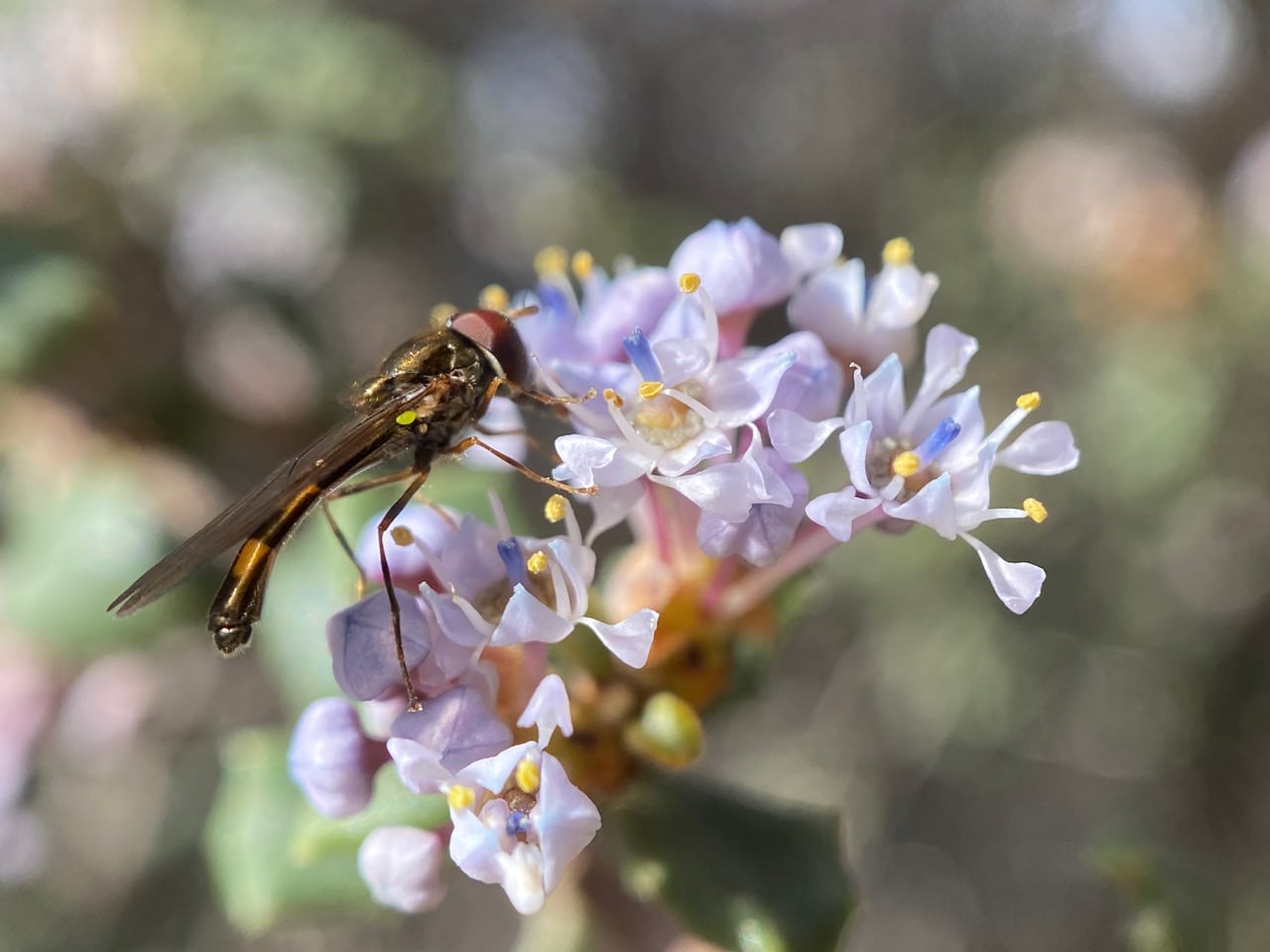
Ah, finally I can see a green haltere under the wing!
Halteres are the modified hind wings in Diptera (flies). They are shaped like ‘drum sticks’ with a slender shaft connected to the thorax. Halteres are highly sophisticated balance organs and they oscillate during flight.
Melanostoma mellinum is a very common species of hover fly found in many parts of Europe including the Mediterranean basin and North Africa, the East Palearctic, and North America. A small species, their wingspan between 4.7 and 7.0 mm. Very similar to Platycheirus, but can be distinguished by fine details. In M. mellinum, the normally pale halteres turn bright blueish-green in females about to lay eggs.
The species’ preferred habitat include grasslands and moorlands, including those in hilly and mountainous regions. Adults can be found feeding on pollen of grasses and other wind-pollinated plants. Little is known of their biology, but the larvae are suspected to be a general predator of small insects in the leaf litter.
Here’s a male of the same species, the Variable Duskyface Fly, Melanostoma mellinum (family Syrphidae). His eyes cover most of his face, meeting on top of the head.
With its proboscis extended, the fly is probing for nectar at the base of the flower.
The picture shows the floral structure of Ceanothus reasonably well. The individual flowers consists of 5 hooded sepals, 5 scoop-like petals, 5 stamens attached to a nectar-bearing disc, and a superior 3-lobed ovary. Both the sepals and petals are similarly colored. In this species, they are a very pale lavender, while the style and stigma stand out in blue.