

Pollinator Post 2/28/26 (2)

Strolling along a path through Sequoia Arena, I come across an old decayed log. Spots of white bumps on the bark stop me on my tracks. Slime mold?

Closer inspection reveals mature sporangia of a slime mold ready to release their spores. iNaturalist has helped identify it as a member of the family Physaraceae, in the order Physarales.
Slime Molds are fungus-like organisms that have previously been classified as fungi, but are now placed in Myxomycetes, in the kingdom Protista. The life cycle of slime molds consists of two distinct stages. During the amoeboflagellate stage, slime molds exist as typical single celled organisms. These amoeboid cells feed on bacteria, grow and multiply by fission. This stage eventually progresses to the plasmodium stage, usually by fusion of compatible amoeboflagellates. Morphologically the plasmodium is a veiny network with a viscous, slimy consistency. The plasmodium is multinucleate and can occupy an area larger than one square meter. However, it is technically still a single cell, as it undergoes many nuclear divisions without cellular divisions. The plasmodium feeds on bacteria, fungi, and other microorganisms, ingesting them through phagocytosis.
When conditions are right, the plasmodium will begin to produce fruiting bodies, or sporangia. Slime mold sporangia exhibit a wide variety of colors, shapes and sizes and are often quite beautiful. The primary function of sporangia is to produce and disperse the spores by which slime molds are propagated. The spores of Myxomycetes are microscopic and lightweight, and can be carried by wind for considerable distances. Under the right conditions, the spores germinate into the single-celled amoeboflagellates, and the cycle is repeated.
Mostly associated with cool and moist habitats, slime molds are commonly found in forests, often developing on the bark of living trees, on decaying logs, stumps, dead leaves and other organic litter.
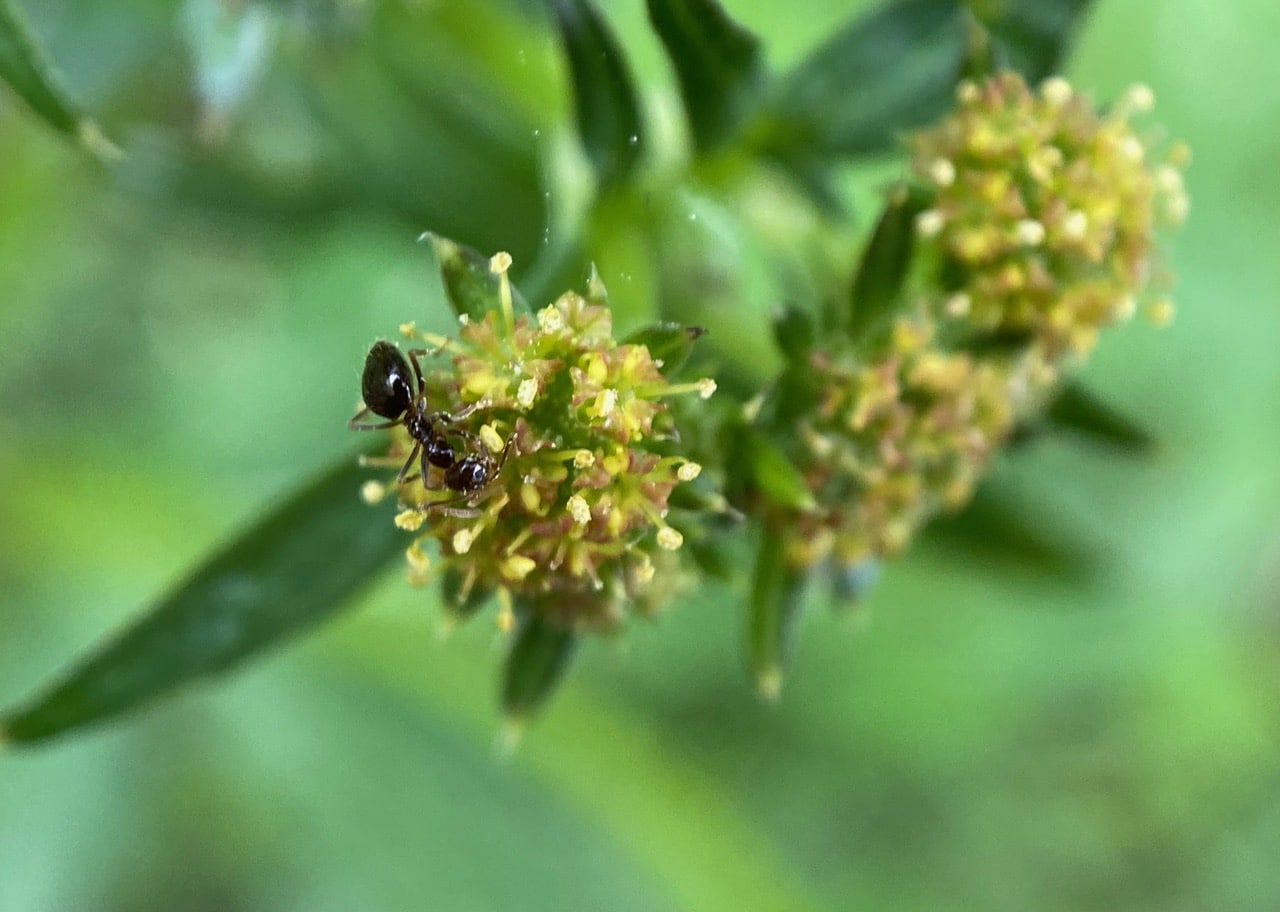
An American Winter Ant, Prenolepis imparis (family Formicidae) is foraging on an inflorescence of Pacific Sanicle, Sanicula crassicaulis that has been bent over by the rain. Note that pollen from the numerous stamens of the tiny flowers have adhered to the body of the ant.
The American Ant, Prenolepis imparis is a widespread North American ant. A dominant woodland species, it is most active during cool weather, when most other ant species are less likely to forage. This species is one of a few native ants capable of tolerating competition with the invasive Argentine Ant, Linepithema humile. They are also aggressive toward other ants and produce abdominal secretions that are lethal to Argentine Ants. Prenolepis imparis is a generalist omnivore. Foragers are known for tending to aphids or scale insects from which they consume excreted honeydew, aggregating on rotting fruit, and exploiting protein-rich sources such as dead worms. The colony enters estivation (a hibernation-like state) and becomes inactive above ground for the warmer months, during which time eggs are laid and brood are reared. Reproductives overwinter and emerge on the first warm day of spring for their nuptial flight.
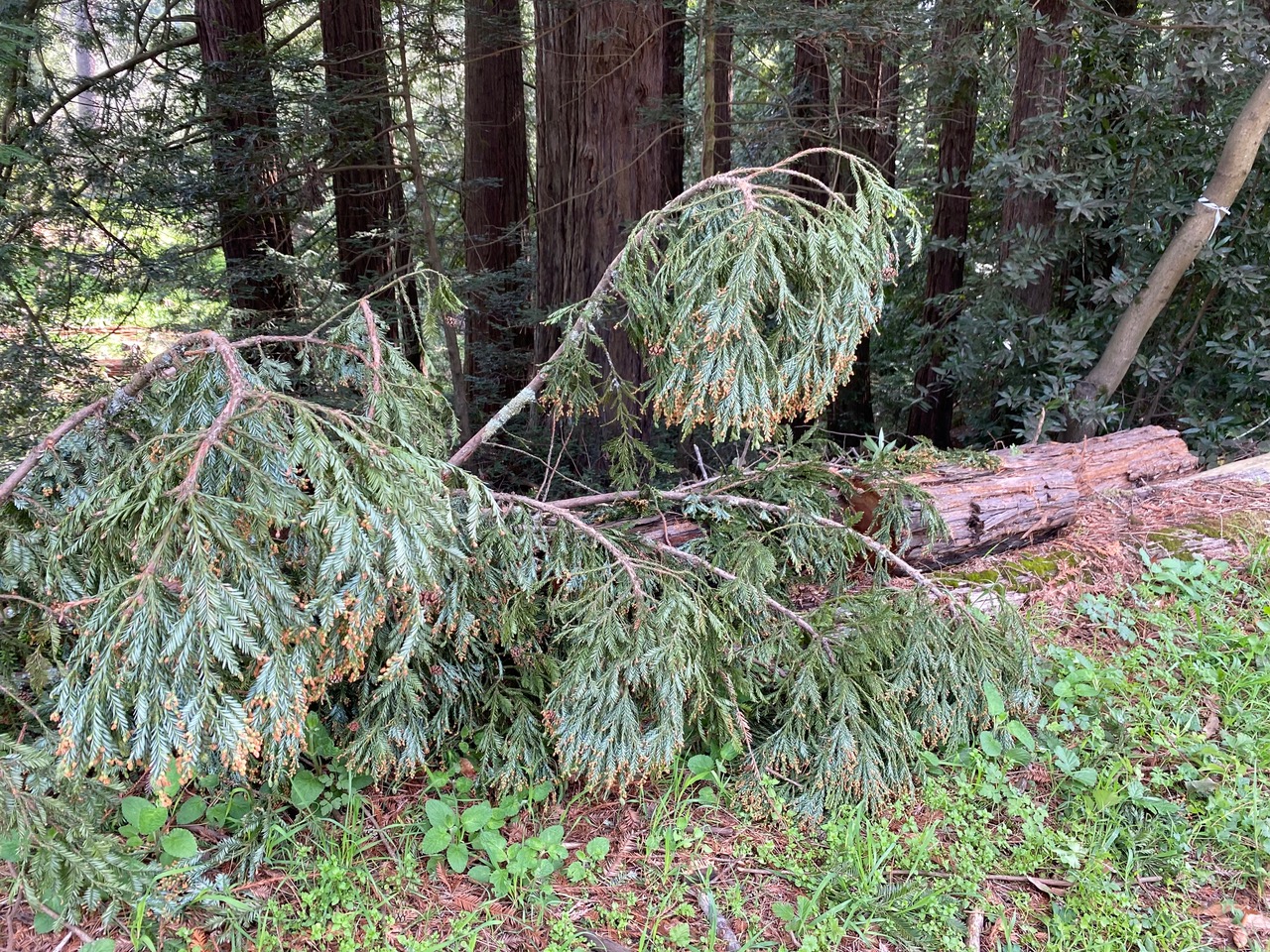
A large branch of Coast Redwood, Sequoia sempervirens has been blown down by the recent rain storm, looking sad and bedraggled on the ground.

Numerous small male cones can be seen on the downed branches. (We are looking at the underside of the foliage.) Most of the cones are spent, devoid of pollen. It’s a rare glimpse into reproductive life in the upper canopy of the redwood tree.
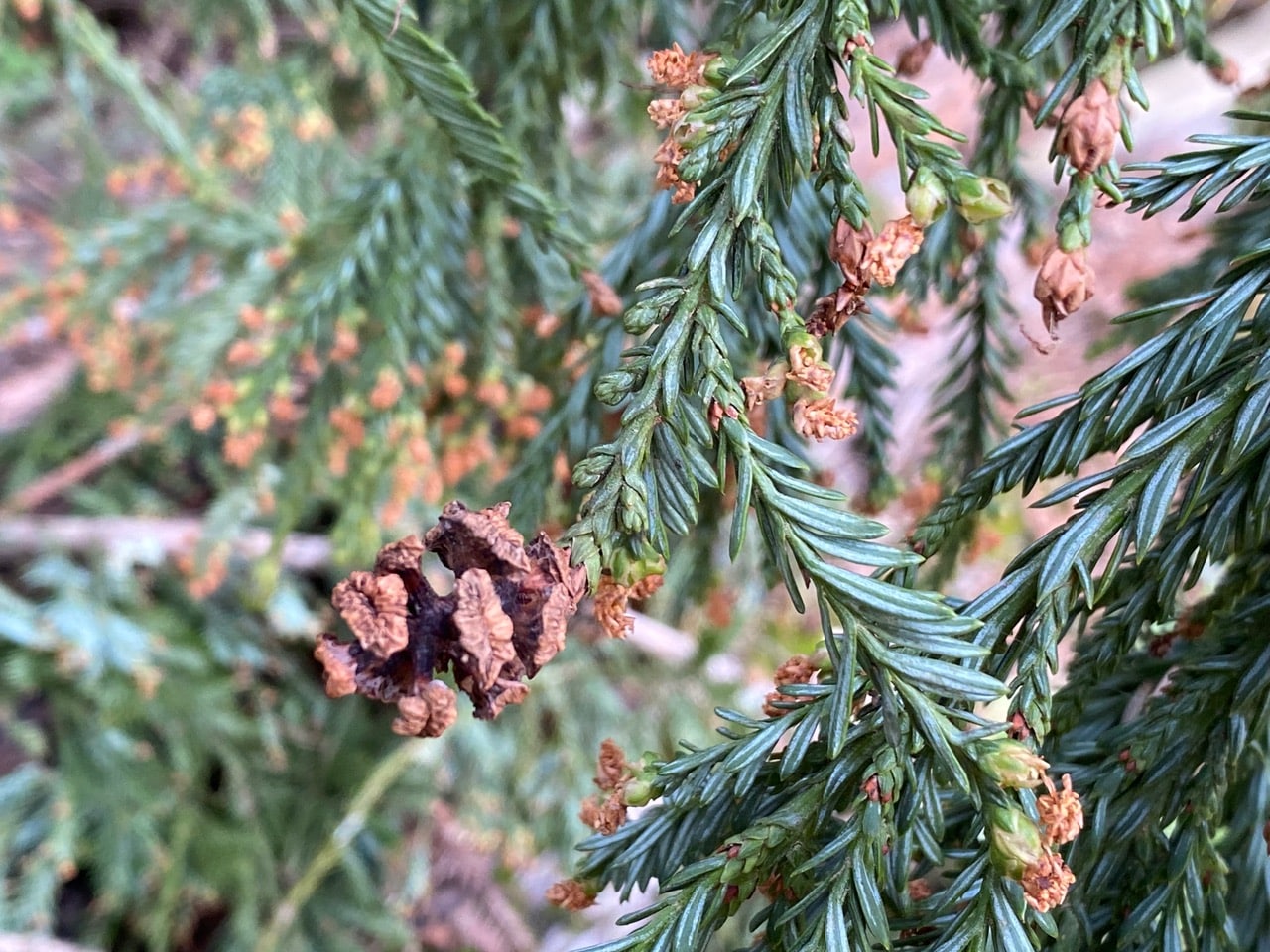
Much more rare are the occasional large female cones at the tips of the branches. This one here is an old cone from the previous year that has released all its seeds.
Coast Redwood pollination occurs during the winter, typically between late November and early March, with peak activity often in January. As monoecious trees (producing both male and female cones on the same tree), they release pollen from male cones to fertilize female cones via wind, a crucial process for their reproductive cycle. Pollination is primarily wind-driven, allowing for widespread distribution of pollen across the forest canopy. Female cones, mostly located high on the tree, mature over a roughly one-year cycle, starting as receptive conelets in winter (Nov-Mar), growing through the summer, and ripening in the fall.
Small female conelets are receptive to pollen during the rainy season. They gape open to receive pollen during this period. Following fertilization the cones close, changing from green to yellow-brown, eventually growing into woody structures about 1 inch long, containing 30-100 winged seeds. The dry cones open, dispersing seeds from October and February. Empty brown cones often remain on the tree for some time before falling.

Ooh, a Banana Slug, Ariolimax sp. sliding over the redwood duff!
Banana Slugs thrive in redwood forests because the dense canopy creates a perfect, year-round cool, moist, and shady microclimate necessary to prevent dehydration. The slugs act as vital decomposers (detritivores) in the ecosystem, recycling nutrients by eating dead organic material, while feeding on plants that compete with redwood seedlings. The slugs also consume fungus, manure, and decaying matter, which are plentiful in the environment.
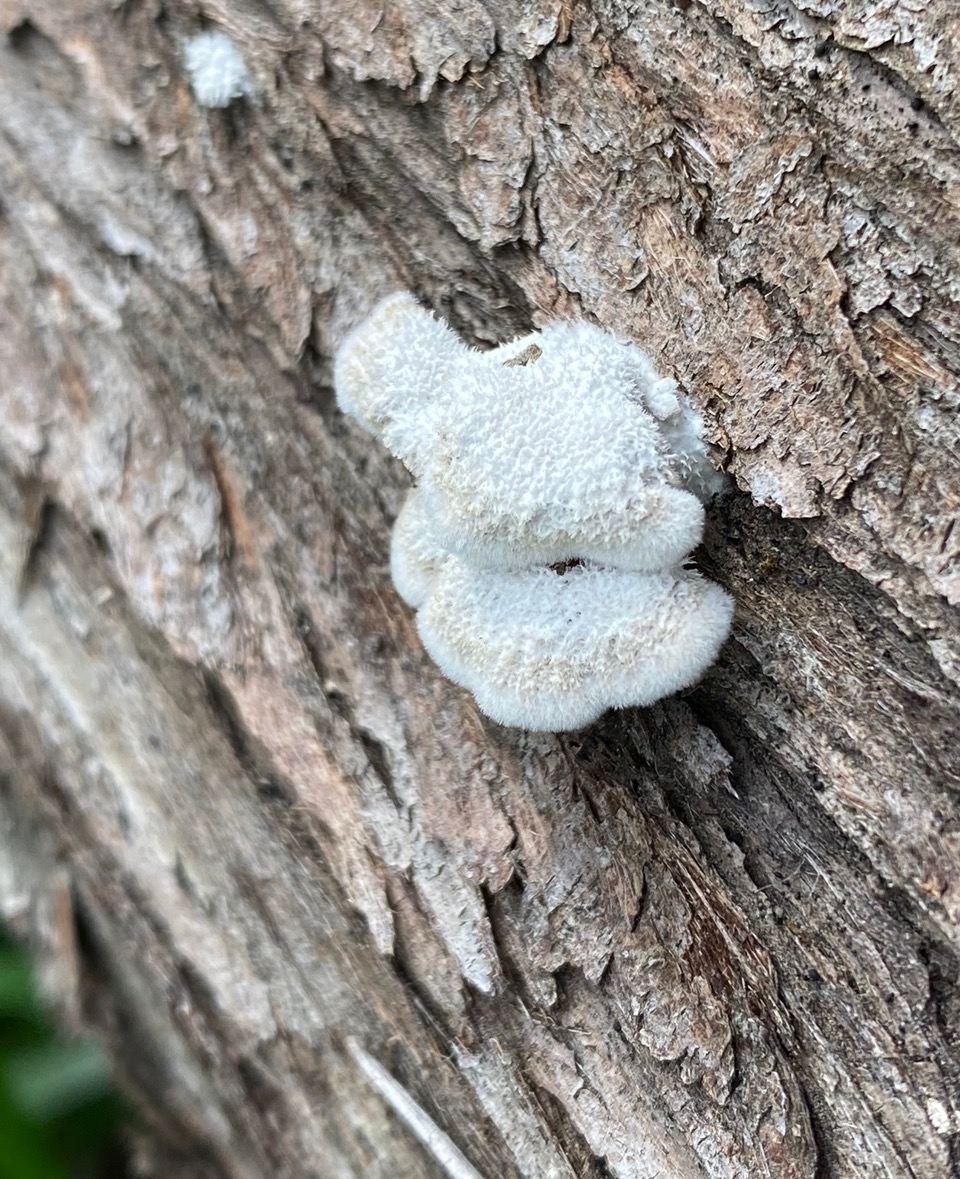
A small fungus with white caps has grown shelf-like from a log.

Here are more of the same fungus. Schizophyllum?
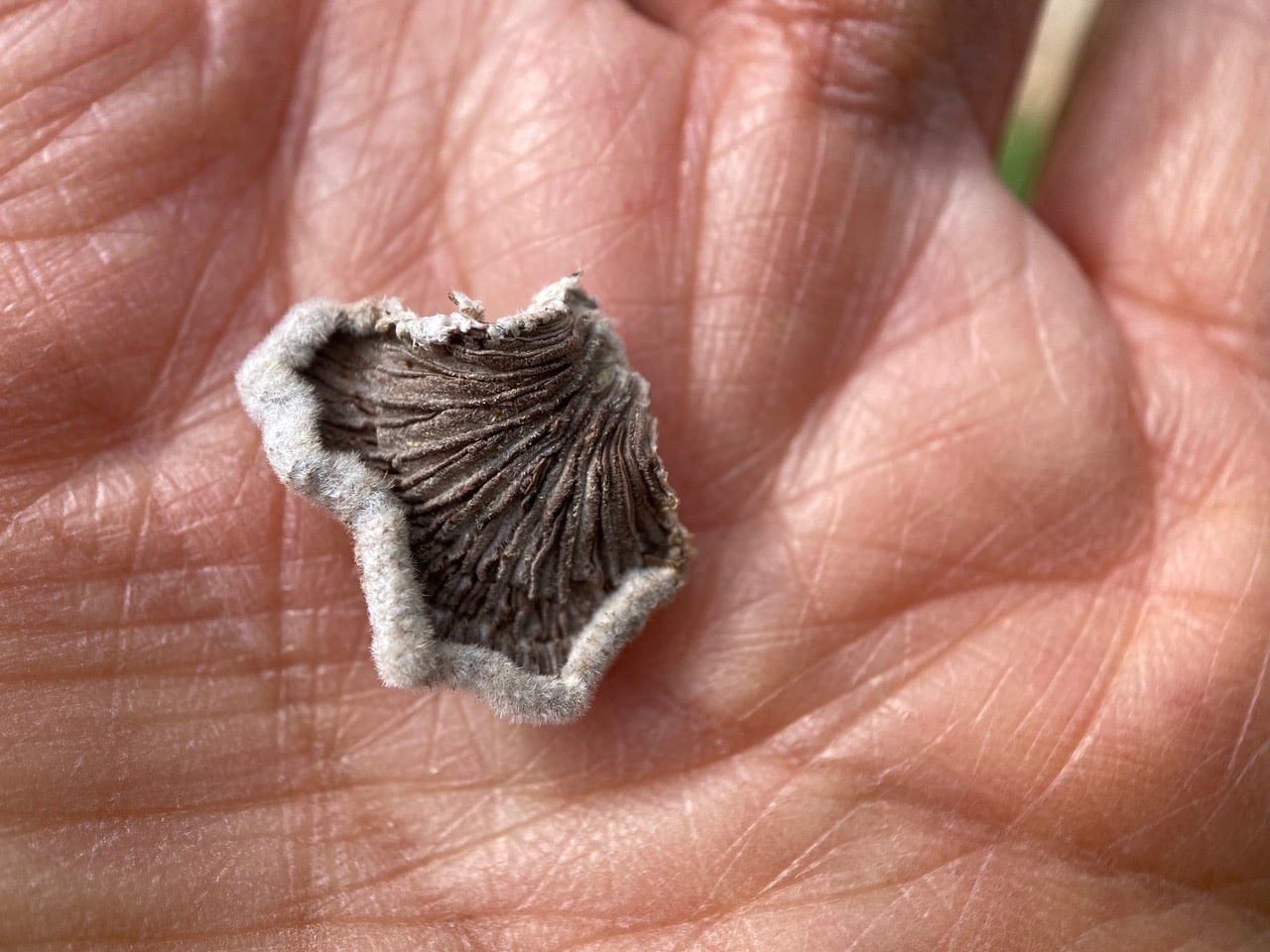
I remove one of the caps and turn it over. Yes, indeed, it is Schizophyllum commune, commonly known as the Splitgill Mushroom. It is the sexiest mushroom in the world!
S. commune is found worldwide on decaying wood, except in Antarctica. It is a small, white, fan-shaped mushroom with gills that appear to be split lengthwise. The name Schizophyllum is derived from Greek Schiza meaning split because of the appearance of radial, centrally split, gill-like folds. The mushrooms grow in shelf-like arrangements, without stalks. The gills, which produce basidiospore on their surface, split when the mushroom dries out, earning this mushroom its common name. The mushrooms can remain dry for decades and then be revived with moisture.
Splitgill Mushroom’s claim to fame is its reproductive promiscuity. Animals typically have two biological sexes, male and female, defined by the presence of specific reproductive organs and differences in gametes, such as sperm and eggs. ‘Mating types’ are the fungi equivalent to sexes, and only individuals with different mating types can engage in sexual reproduction. The Splitgill Mushroom is the world’s most sexually compatible organism, boasting over 23,000 distinct mating types. This enormous diversity allows the fungus to maximize outbreeding, with almost any individual able to find a compatible partner among thousands.

A flock of beautiful Turkey-tail Fungi, Trametes versicolor crowds a rotting tree stump.
Trametes versicolor is a common polypore mushroom found throughout the world. Its fan-shaped caps reminiscent of a wild turkey’s tail, the fungus is most commonly referred to as turkey tail.
Versicolor, meaning ‘of several colors’, accurately describes this fungus that displays a unique blend of markings. The mushroom commonly grows in overlapping layers in groups or rows on logs and stumps of deciduous trees. It is a white rot fungus which degrades lignin from wood. The fruiting body is somewhat fan-shaped, with no discernible stalk, and the tough flesh is 1-3 mm thick. The flat cap is roundish, with zones of fine hairs colored rust-brown or darker brown. The bottom surface is white, covered with fine pores from which spores are dispersed. The pores are round, becoming twisted and labyrinthine with age.
T. versicolor is considered too tough to eat, but it is recognized as a healing mushroom for its longevity and health-related effects. Its use dates back centuries when Traditional Chinese Medicine practitioners brewed turkey tail mushrooms into soothing teas. In Japan its extract is used in cancer treatment. The fungus is commonly marketed as a dietary supplement for various health benefits.
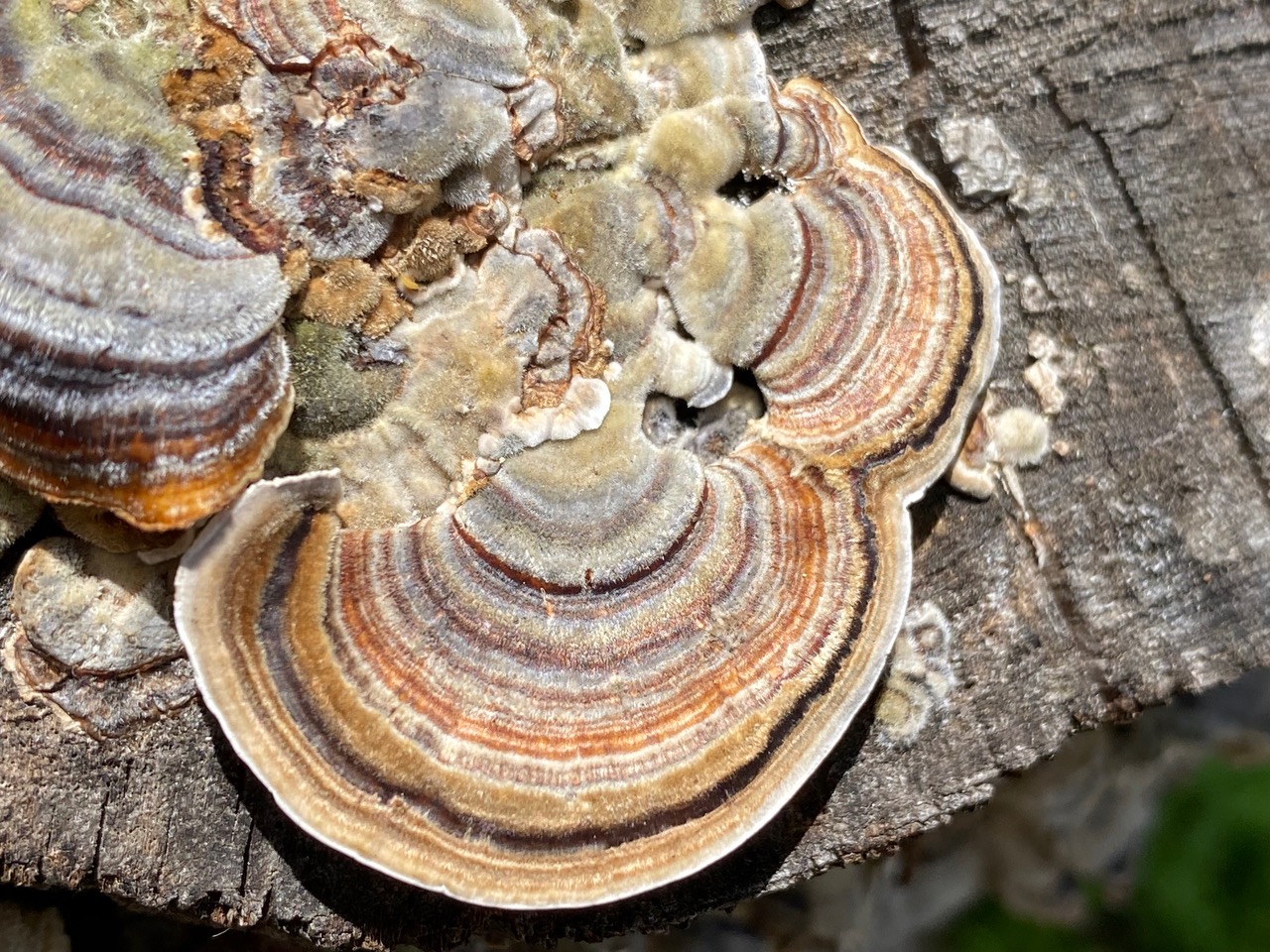
The Turkey-tail Fungi growing atop the stump are visibly lighter in color than the ones below.
Turkey-tail Fungi form their characteristic, multicolored, concentric zones through incremental, uneven growth patterns on the cap’s edge. These rings represent different stages of development, heavily influenced by environmental conditions (like light and moisture) and nutrient availability during the growth of the fruiting body. The outermost zone is typically white and represents the most recently formed, actively growing tissue. The result is a leathery, velvety, and “donate” cap that appears to have ripples of color across its surface, creating a characteristic “turkey tail” appearance.

A cluster of crowded buds has grown from a node on the woody vine of the California Honeysuckle, Lonicera hispidula. It is a gall indued by the Cabbage Bud Gall Midge, Lonicerae russoi (family Cecidomyiidae).
The Cabbage-bud-gall Midge, Lonicerae russoi (family Cecidomyiidae) induces conical, leafy bud galls on the honeysuckle. While these rosette galls can occur singly, they usually appear in congested clusters that can reach 3 cm across. Each gall has a dense arrangement of white hairs filling its center, marking the entrance to the larval chamber. The galls exposed to direct sun often turn wine red. The larvae feed and eventually pupate within the galls. Adults emerge in late February and March by pushing through the hairs.

Here’s another cluster of those bud galls on the California Honeysuckle. Look, there’s a midge with red abdomen perched under the vine next to the gall! Has the midge just emerged from one of the galls? I have reared midges from the honeysuckle galls in the past, and know that the females have red abdomen. I have to pinch myself to make sure I’m not dreaming.

The midge slowly moves from the stem to perch on one of the Cabbage Bud Galls. Is it revisiting its larval home? iNaturalist has confirmed that the fly is indeed a Cabbage Bud Gall Midge, Lonicerae russoi !