

Pollinator Post 2/28/25 (2)
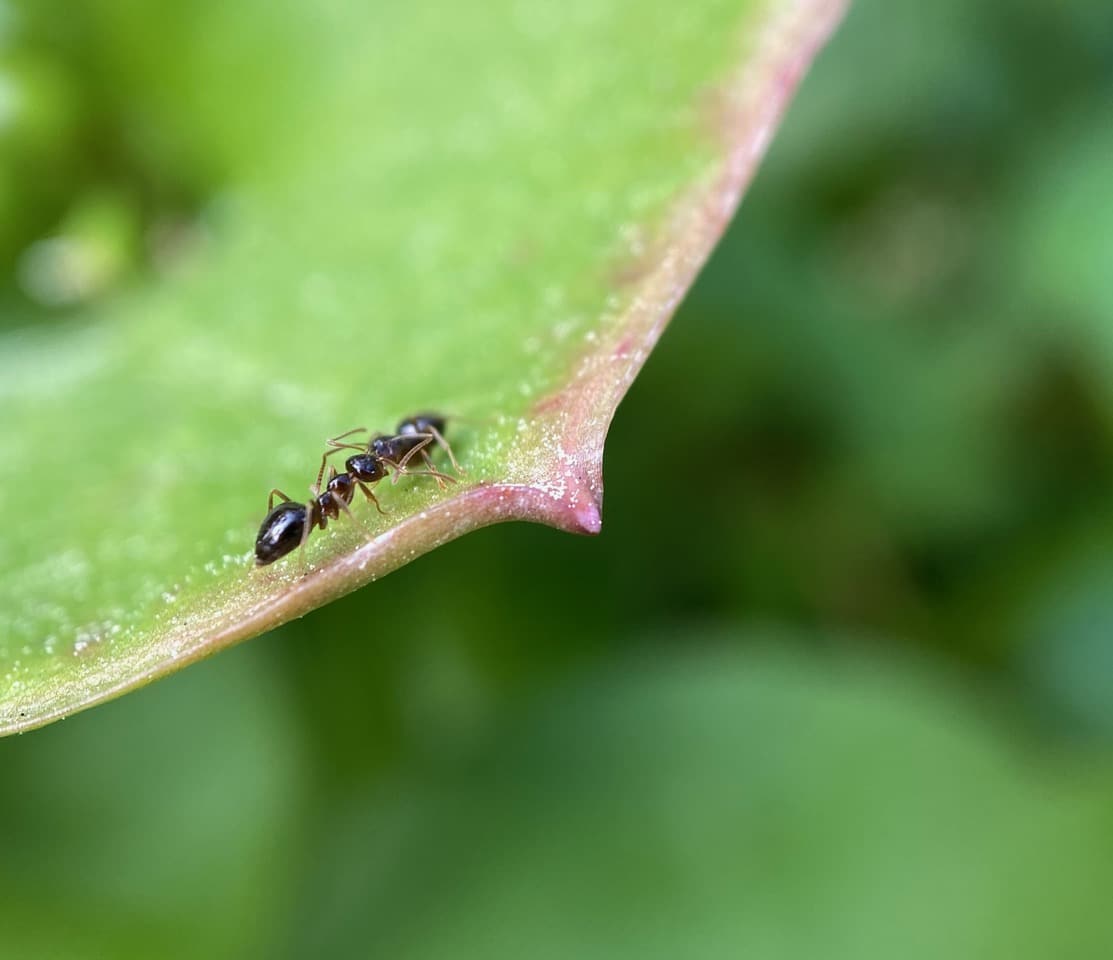
Two American Winter Ants meet on the edge of a Miner’s Lettuce leaf, exchanging messages by touching antennae.
The American Ant, Prenolepis imparis is a widespread North American ant. A dominant woodland species, it is most active during cool weather, when most other ant species are less likely to forage. This species is one of a few native ants capable of tolerating competition with the invasive Argentine Ant, Linepithema humile. They are also aggressive toward other ants and produce abdominal secretions that are lethal to Argentine Ants. Prenolepis imparis is a generalist omnivore. Foragers are known for tending to aphids or scale insects from which they consume excreted honeydew, aggregating on rotting fruit, and exploiting protein-rich sources such as dead worms. The colony enters estivation (a hibernation-like state) and becomes inactive above ground for the warmer months, during which time eggs are laid and brood are reared. Reproductives overwinter and emerge on the first warm day of spring for their nuptial flight.
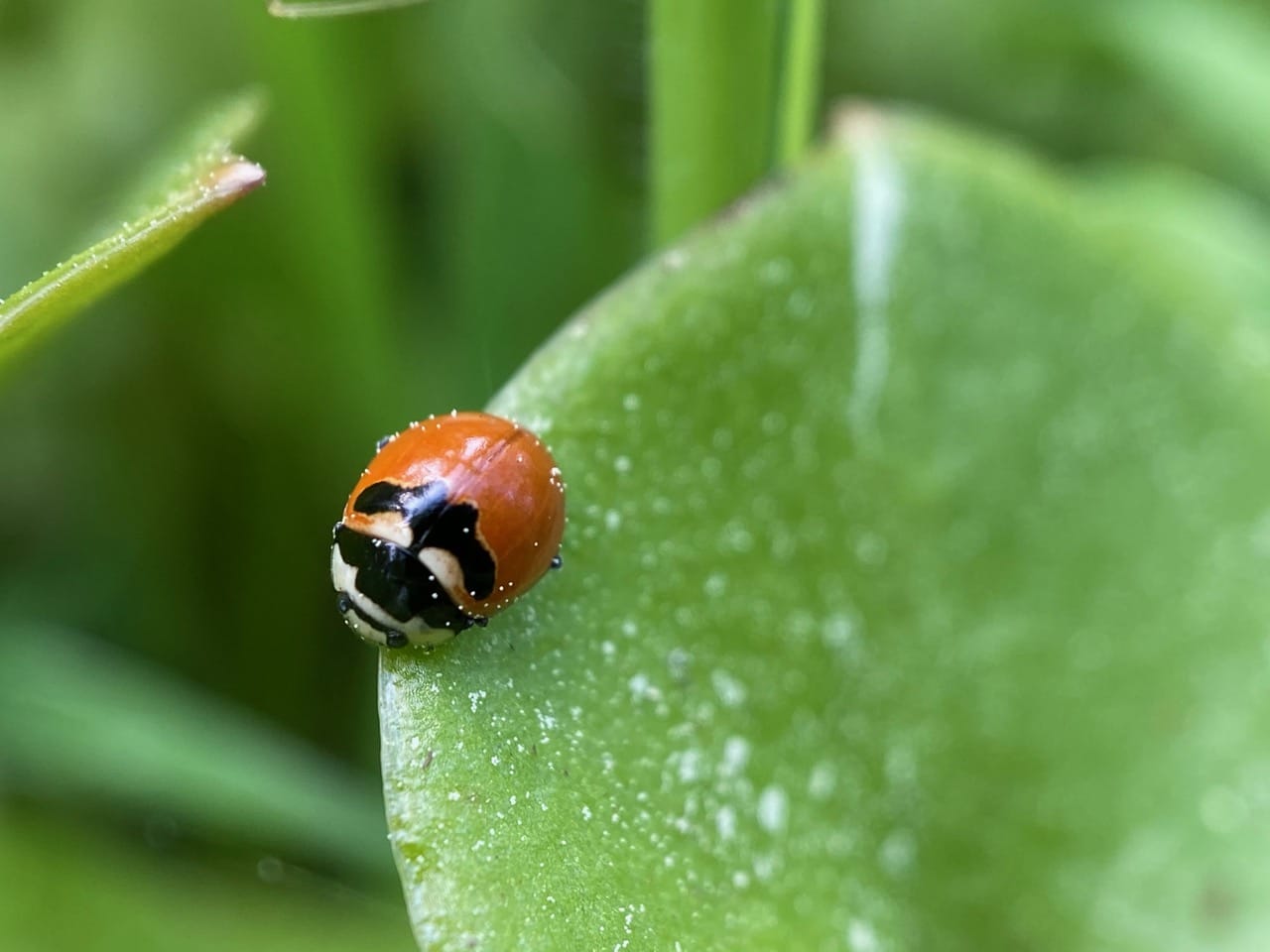
A Three-banded Lady Beetle, Coccinella trifasciata (family Coccinellidae) is resting on the edge of a Miner’s Lettuce leaf. There are pollen grains scattered over its elytra. I wonder what plant the pollen came from.
“Three-banded” Lady Beetle? The species is rather variable depending on its range. The ones found east of the Rockies are indeed three-banded. Species Coccinella trifasciata – Three-banded Lady Beetle – BugGuide.Net Here in California, we have the subspecies Coccinella trifasciata subversa, also known as the Pacific Three-banded Ladybeetle. Photos of Pacific Three-banded Lady Beetle (Subspecies Coccinella trifasciata subversa) · iNaturalist These beetles are active from spring through summer months and on warm days of fall; diapausing (insect version of hibernation) through the colder winter months.
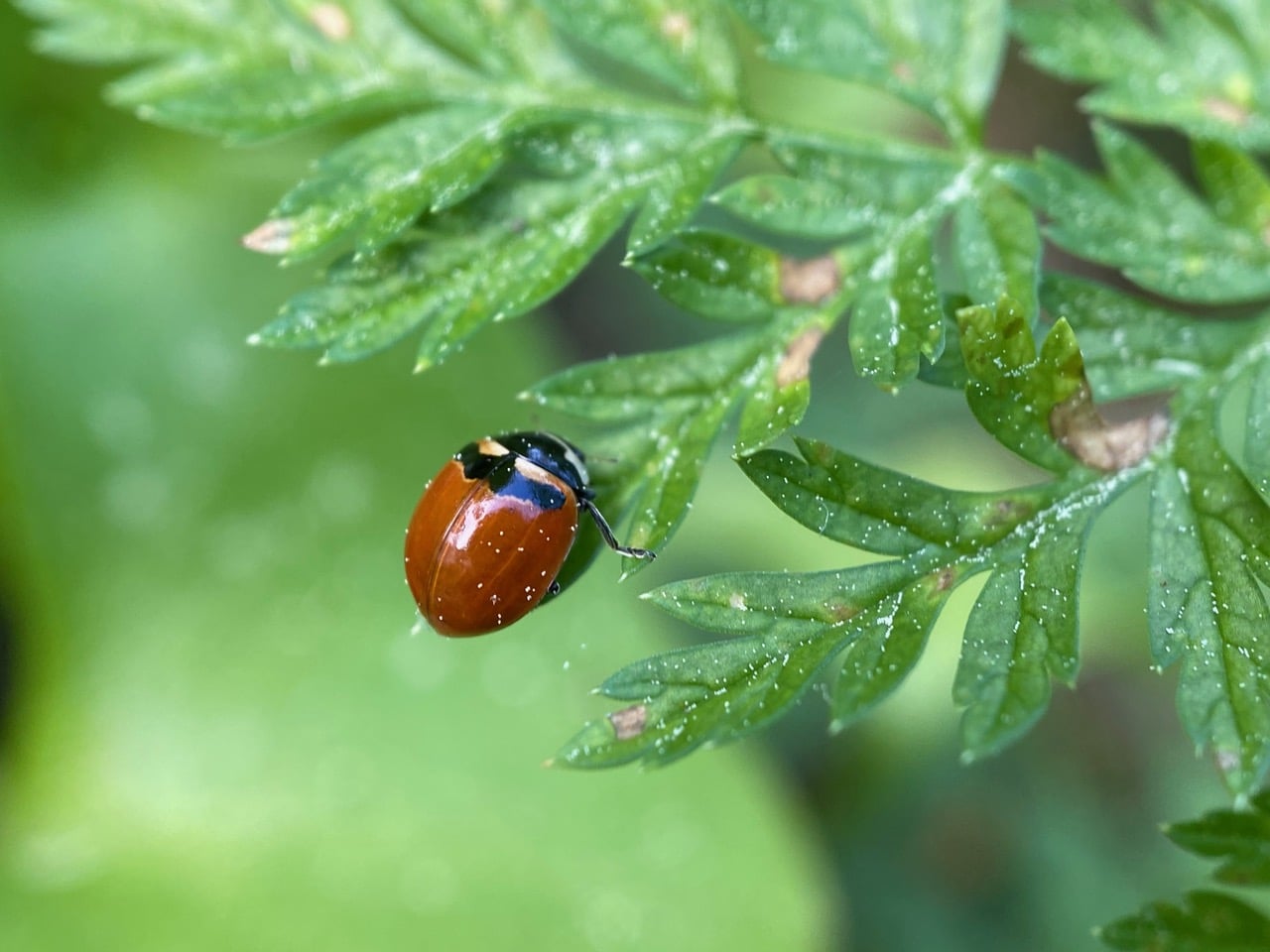
Another Three-banded Lady Beetle is perched on a leaf of Poison Hemlock, Conium maculatum. Why is the beetle and the vegetation around here covered with pollen? Perhaps the pollen is shed by the wind-pollinated Monterey Pines, Pinus radiata so prevalent in the park?
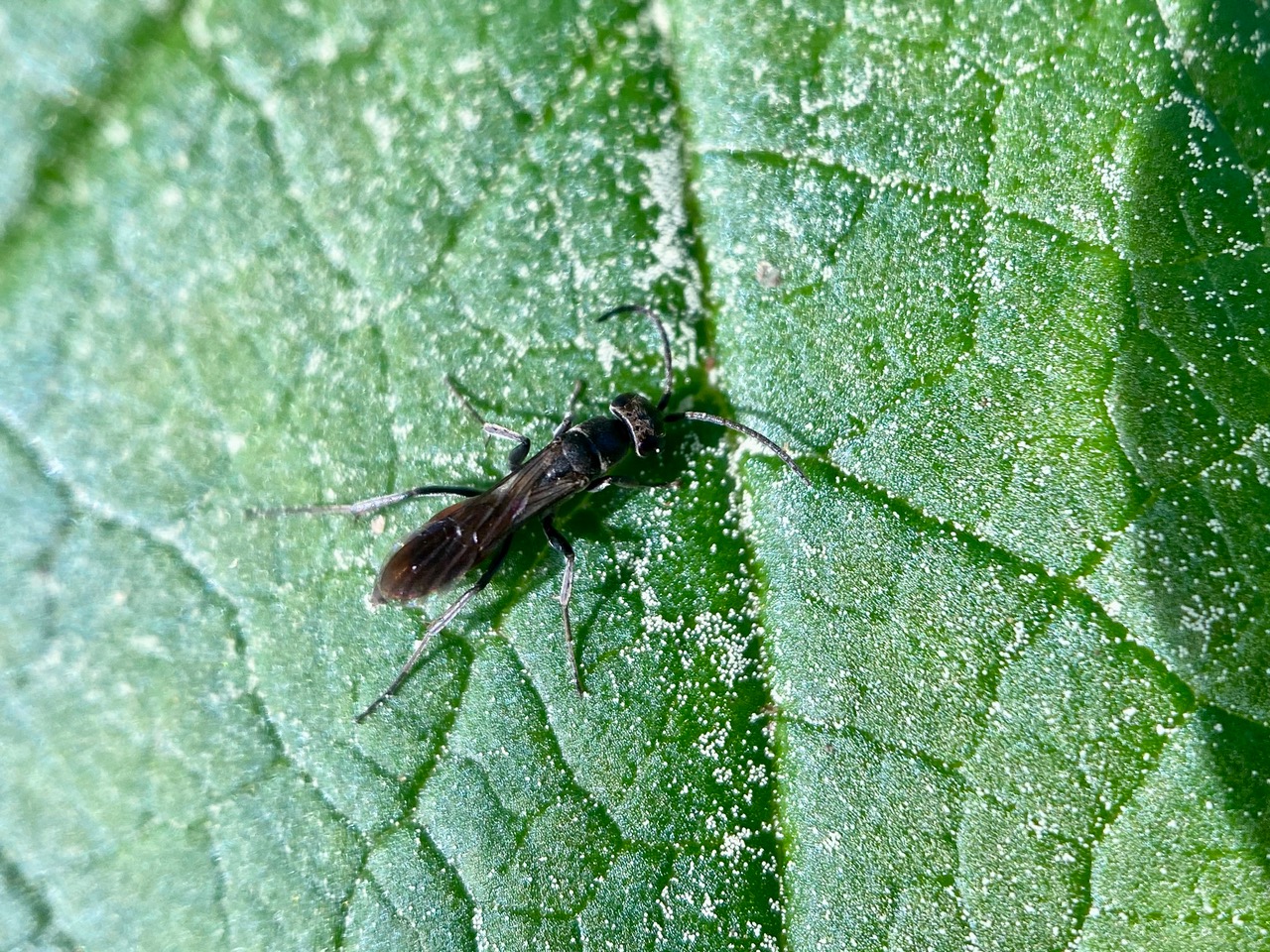
This is a terrible photo by any measure, but amazingly iNaturalist was able to identify the dark insect as a Spider Wasp, Aporus sp. (family Pompilidae).
Wasps in the family Pompilidae are commonly called spider wasps or pompilid wasps. Nearly all are solitary, and most capture and paralyze spiders to provision for their offspring. Pompilids typically have long, spiny legs; the third femur is often long enough to reach past the tip of the abdomen. The tibiae of the rear legs usually have a conspicuous spine at their distal end. The wasps are typically dark (black or blue, sometimes with metallic reflections).
Adult pompilids visit flowers for nectar. Depending on genus and species, pompilids capture a variety of spiders for their larvae to feed on. Any given pompilid tends to attack only a limited diversity of spiders. The female wasp searches the ground and/or vegetation for a spider, and upon finding one, stings it, paralyzing the spider. She then digs a burrow, or flies or drags the spider to a previously made burrow. Most pompilids provide each of their larvae with a single prey, which must be large enough to serve as its food source throughout its development. Typically, a single egg is laid on the spider, and the nest or burrow is closed. When the egg hatches, the larva feeds on the spider, saving the vital organs for last, ensuring that the food remains fresh to the end. The final, fifth instar spins a durable silk cocoon in which it pupates, emerging as an adult later in the season or the following year.
Aporus is a genus of spider wasps from the family Pompilidae. They specialize in hunting ground-dwelling spiders in their burrows for laying eggs on.

Seeking shade under an oak tree, I come across an American Vetch, Vicia americana twined on a small shrub. Close examination of the flowers show that some of them have been tripped, probably by a heavy-bodied bee such as bumble bee. I focus in on this flower that has had all its reproductive structures extruded from the dark-tipped keel. This is how the pea flower is pollinated. When a heavy-bodied bee lands on the wing petals that loosely cover the keel, the keel pops up through the wing petals, and with it the reproductive structures hidden inside. The bee is forcefully dabbed on the belly with pollen from the anthers, and any pollen already present on the bee is picked up by the fuzzy stigma on an erect style. The dark lines on the lavender banners (upper erect fused petals) are “nectar guides” that tell the bee where to find nectar.

As I ponder the ingenuity of the flower design, several American Winter Ants, Prenolepis imparis (family Formicidae) appear on the scene to forage on the flower. In this picture, the ant on the left is on a wing petal. The other two ants converge on the keel to scavenge for pollen from the stamens. The ants benefit from the work of the bumble bee who opened up the flower.
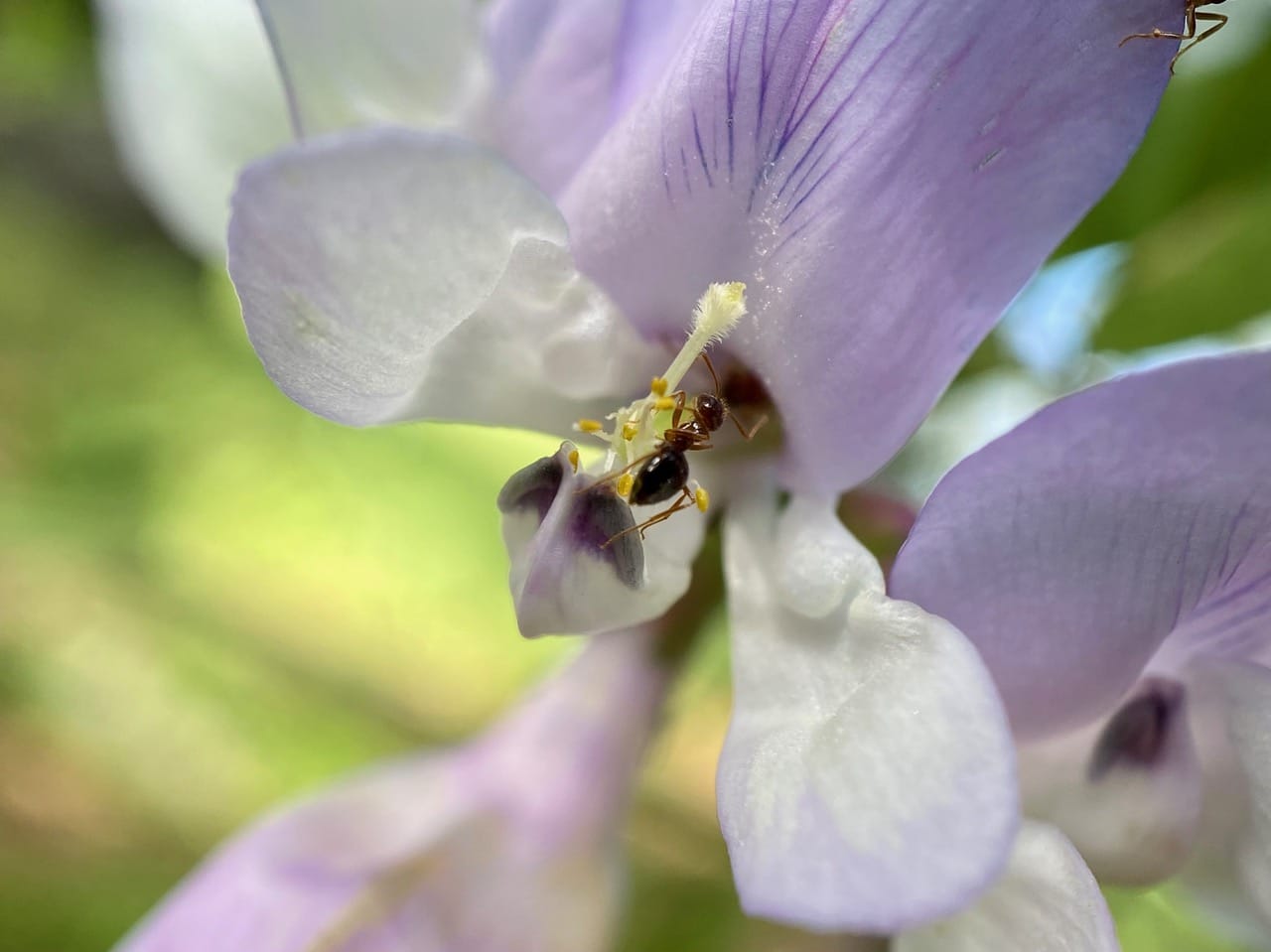
Standing on the keel of a tripped American Vetch flower, an American Winter Ant is scavenging pollen from the exposed stamens. Nothing in nature goes to waste!
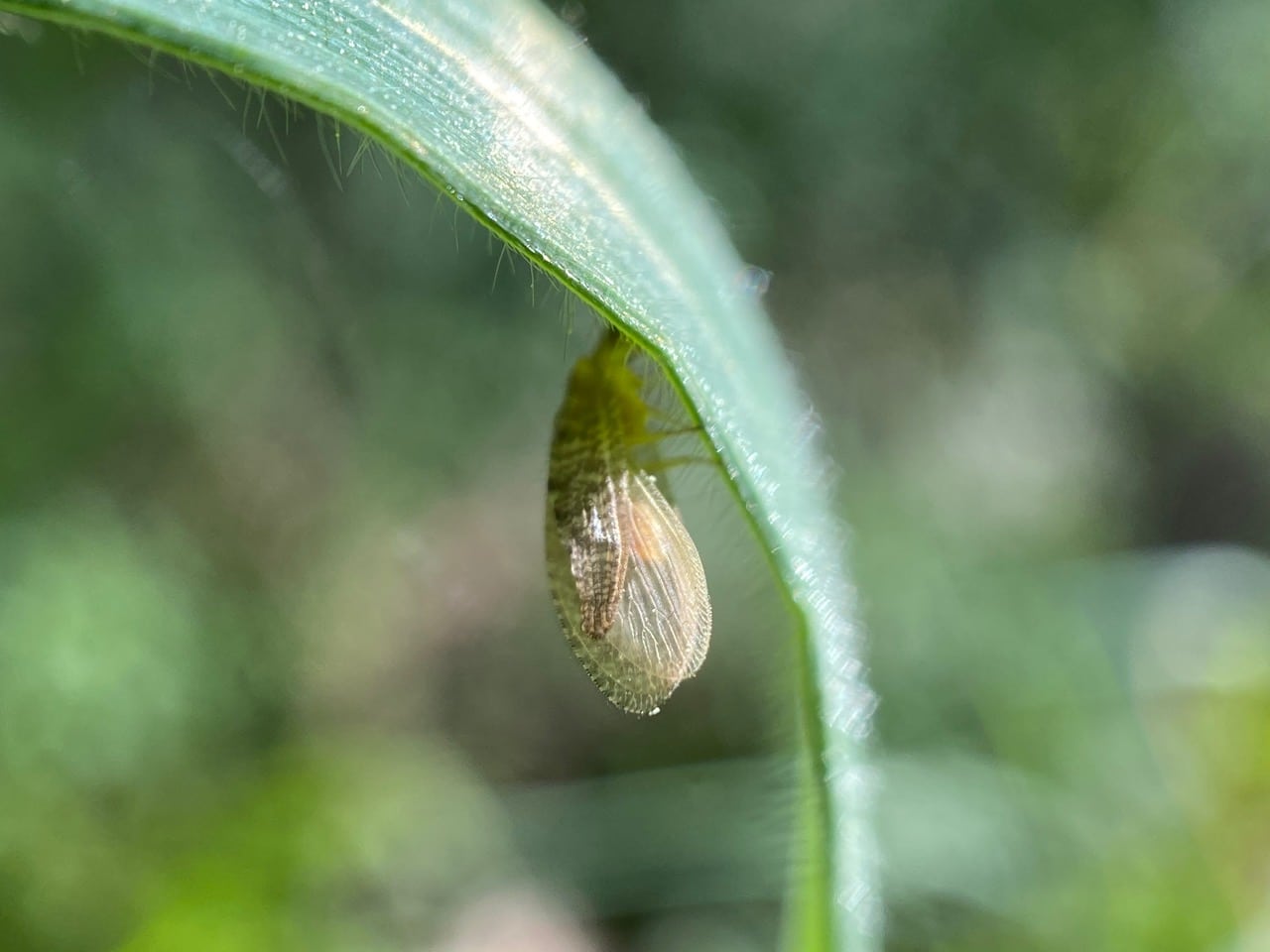
Hey, there’s an insect resting on the underside of that blade of grass.

Hoping for a better look, I gently turn the leaf over. Surprise, the insect doesn’t fly away! It is a Brown Pine Lacewing, Hemerobius stigma (family Hemerobiidae).
Less common than Green Lacewings (family Chrysopidae), Brown Lacewings (family Hemerobiidae) are small to medium in size (3-9 mm). They resemble green lacewings but are brownish in color, and their wings are more curved over their abdomen, and have different venation. The white eggs are laid on plants, but are not stalked (as are green lacewing eggs). The larvae are similar to lady beetle larvae, but have large jaws and long bodies. Found in wooded areas throughout the United States, Brown Lacewings prey on aphids, mealybugs, insect eggs, other soft-bodied insects, and are also cannibalistic.

The Brown Pine Lacewing, Hemerobius stigma (family Hemerobiidae) is found in Europe, Northern Asia and North America. The species was introduced to New Zealand as biological control of adelgidae infesting pine plantations.
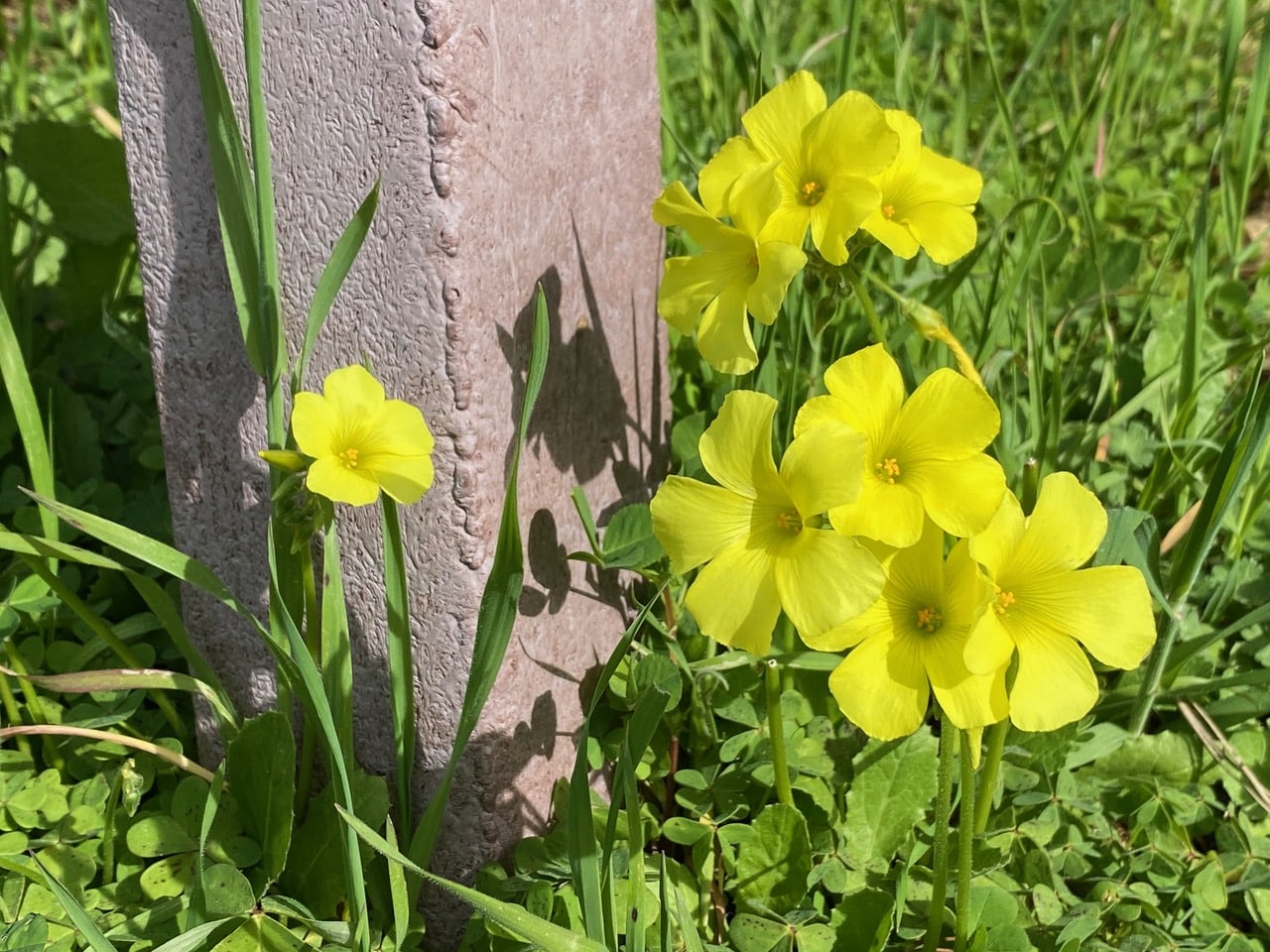
Bright yellow flowers of Bermuda Buttercup, Oxalis pes-caprae greet visitors under a sign post. Does the plant, long considered a pernicious weed, support insect life at all?
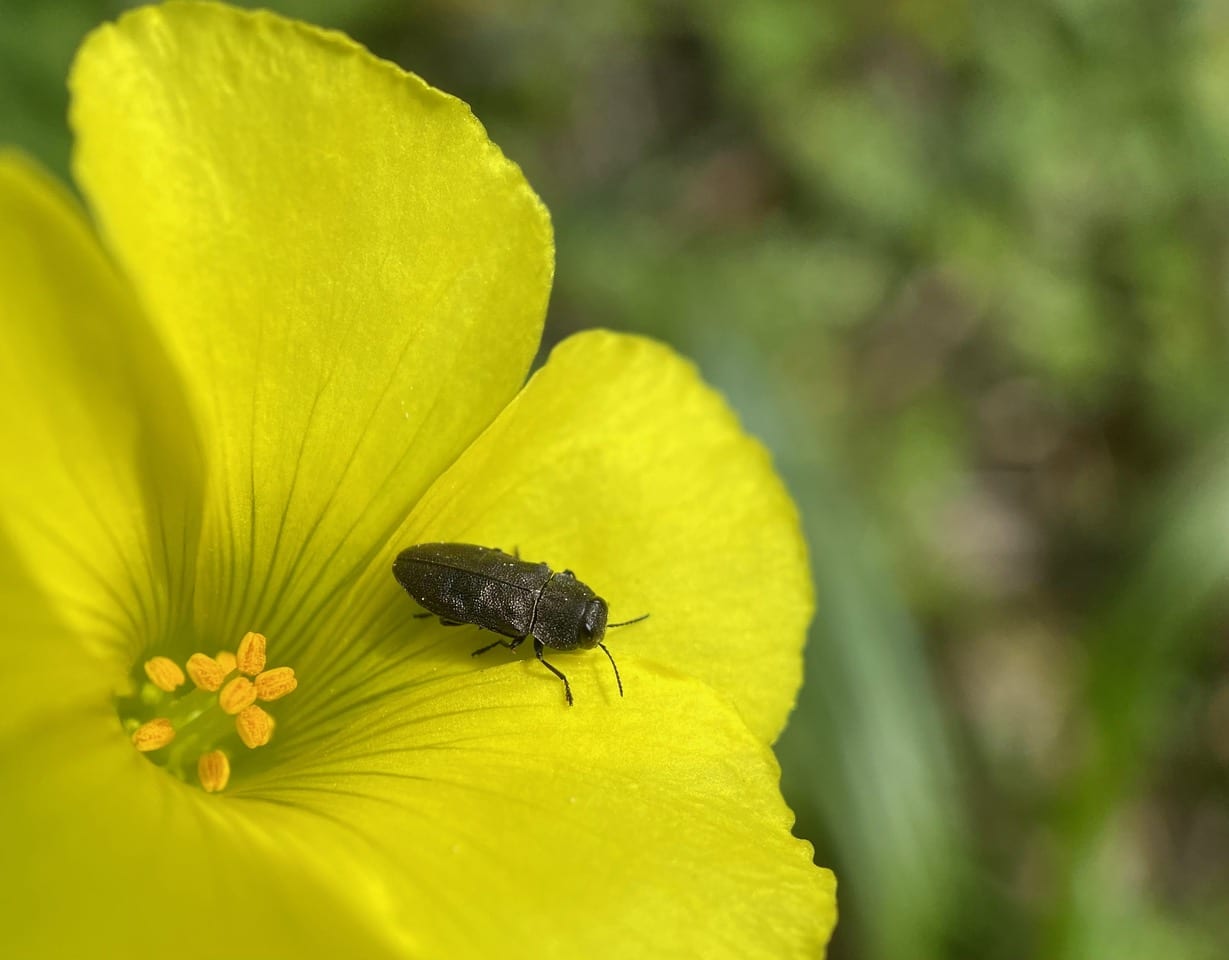
A Jewel Beetle in the subgenus Melantaxia (family Buprestidae) is resting on a Bermuda Buttercup flower.
Buprestids are sometimes also called Jewel Beetles because of their glossy, iridescent colors. The larger and more spectacularly colored ones are highly prized by insect collectors. Their elytra have been traditionally used in beetlewing jewelry in some Asian countries. The iridescence common to these beetles is not due to pigments in the exoskeleton, but instead is caused by structural coloration, in which microscopic texture in their cuticle selectively reflects specific frequencies of light in particular directions. Buprestid larvae are known as flathead borers. They bore through roots, logs, stems, and leaves of various types of plants, ranging from trees to grasses. Adult jewel beetles mainly feed on plant foliage or nectar, although some species feed on pollen and can be observed visiting flowers.
Members of the subgenus Melantaxia have an affinity for yellow flowers, such as buttercups and dandelions. I have seen them gather in large numbers to feed and mate on dandelion flowers.
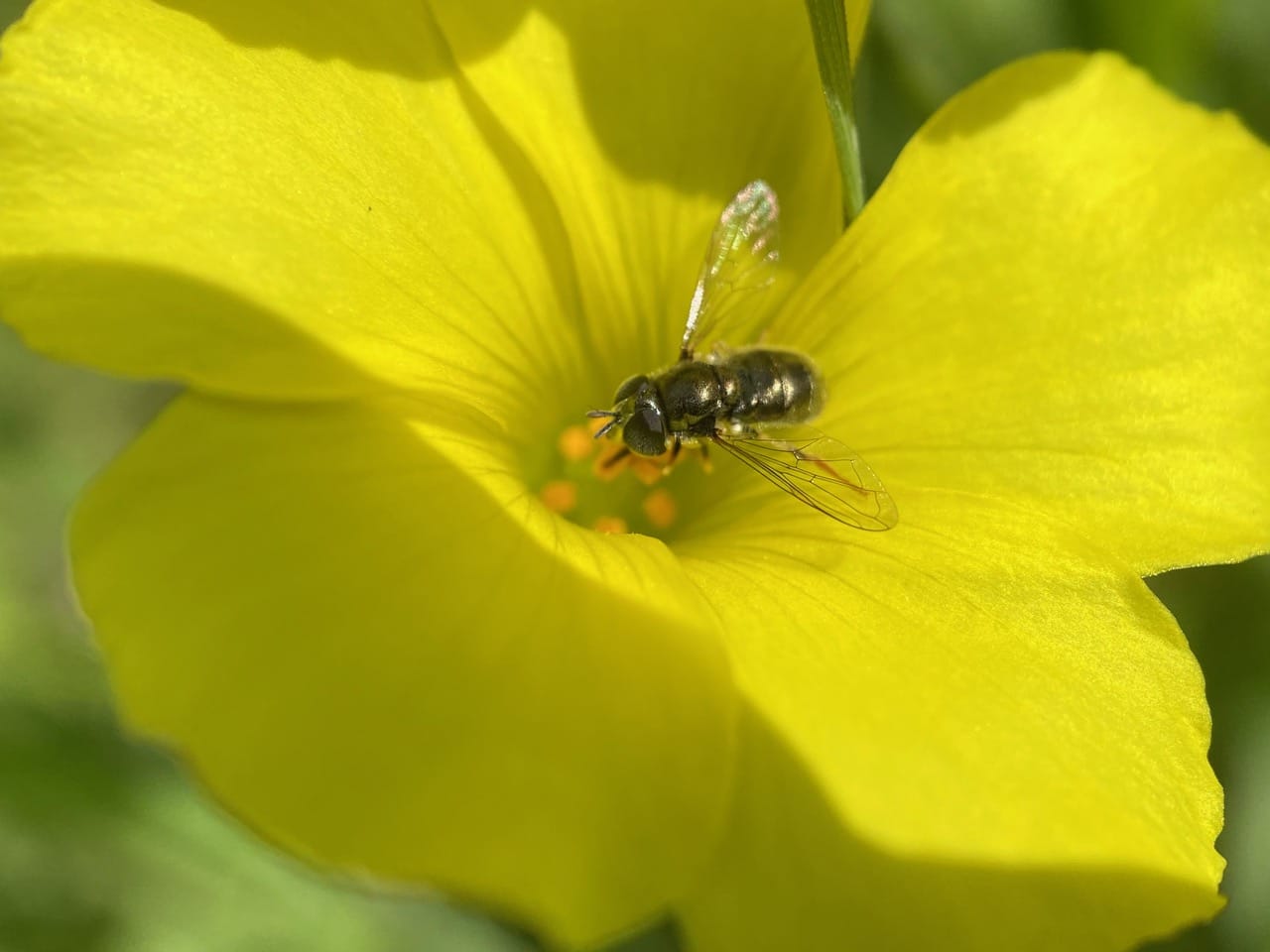
Its tongue extended, a tiny hover fly is perched on the anthers of a Bermuda Buttercup flower, feeding on pollen. From the diminutive size and the general appearance, I recognize it as the Common Grass Skimmer, Paragus haemorrhous (family Syrphidae). This individual, however, lacks the red coloration on the abdomen usually seen in the species. And instead of black, its body has a bronze sheen. Note that the fly holds its wings out at an angle, fighter-jet style, typical of hover flies.

The Common Grass Skimmer, Paragus haemorrhous (family Syrphidae) is easily the smallest hover fly I know, measuring only about 4 mm in length. The species has a world-wide distribution, found in unimproved grassland, dune grass, open areas and pathsides in forest, and meadows. Adults visit flowers for nectar and pollen. Larvae feed on aphids on low herbaceous plants.
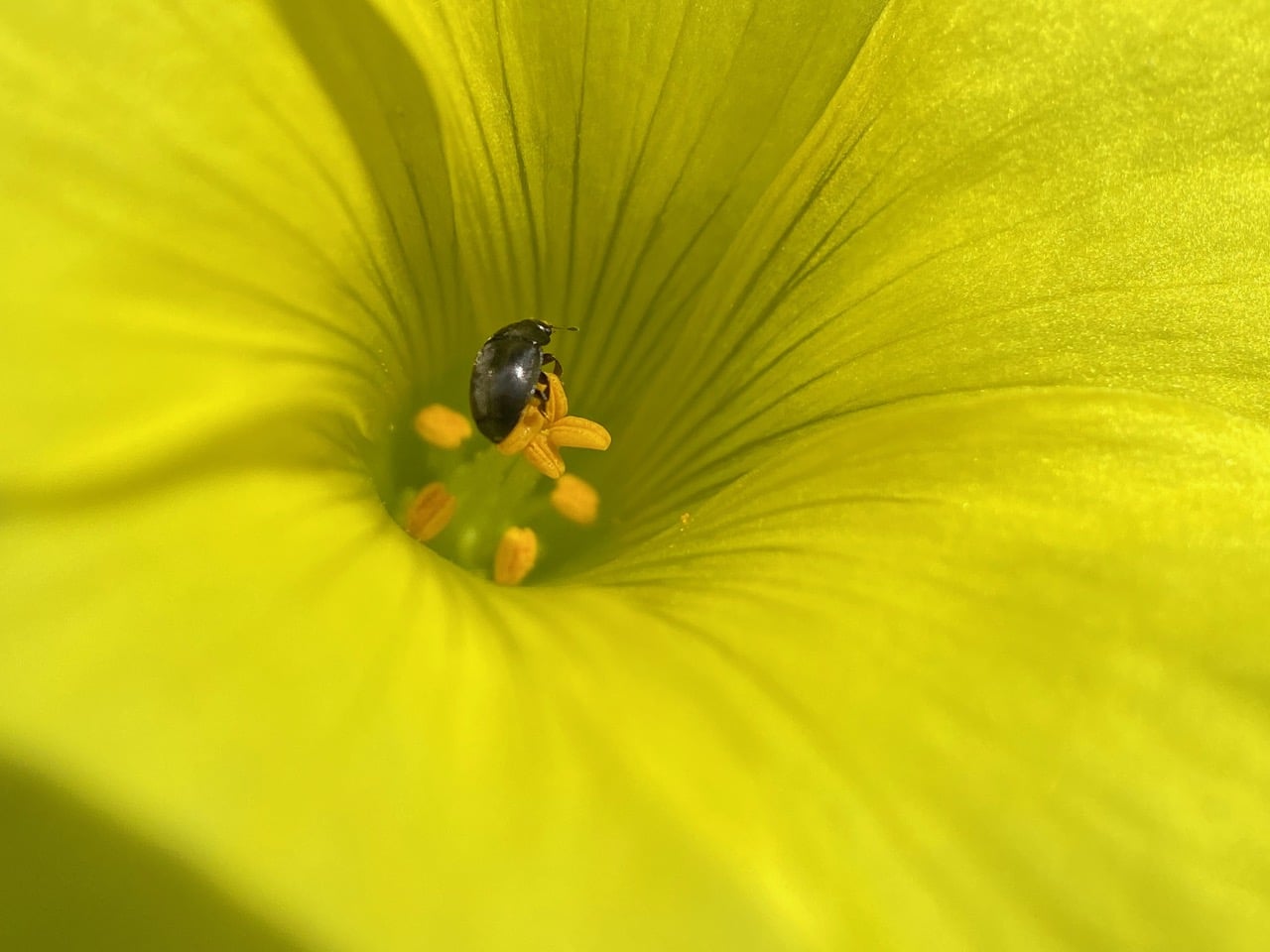
A tiny Common Pollen Beetle, Brassicogethes aeneus (family Nitidulidae) is perched on the anthers of a Bermuda Buttercup flower.
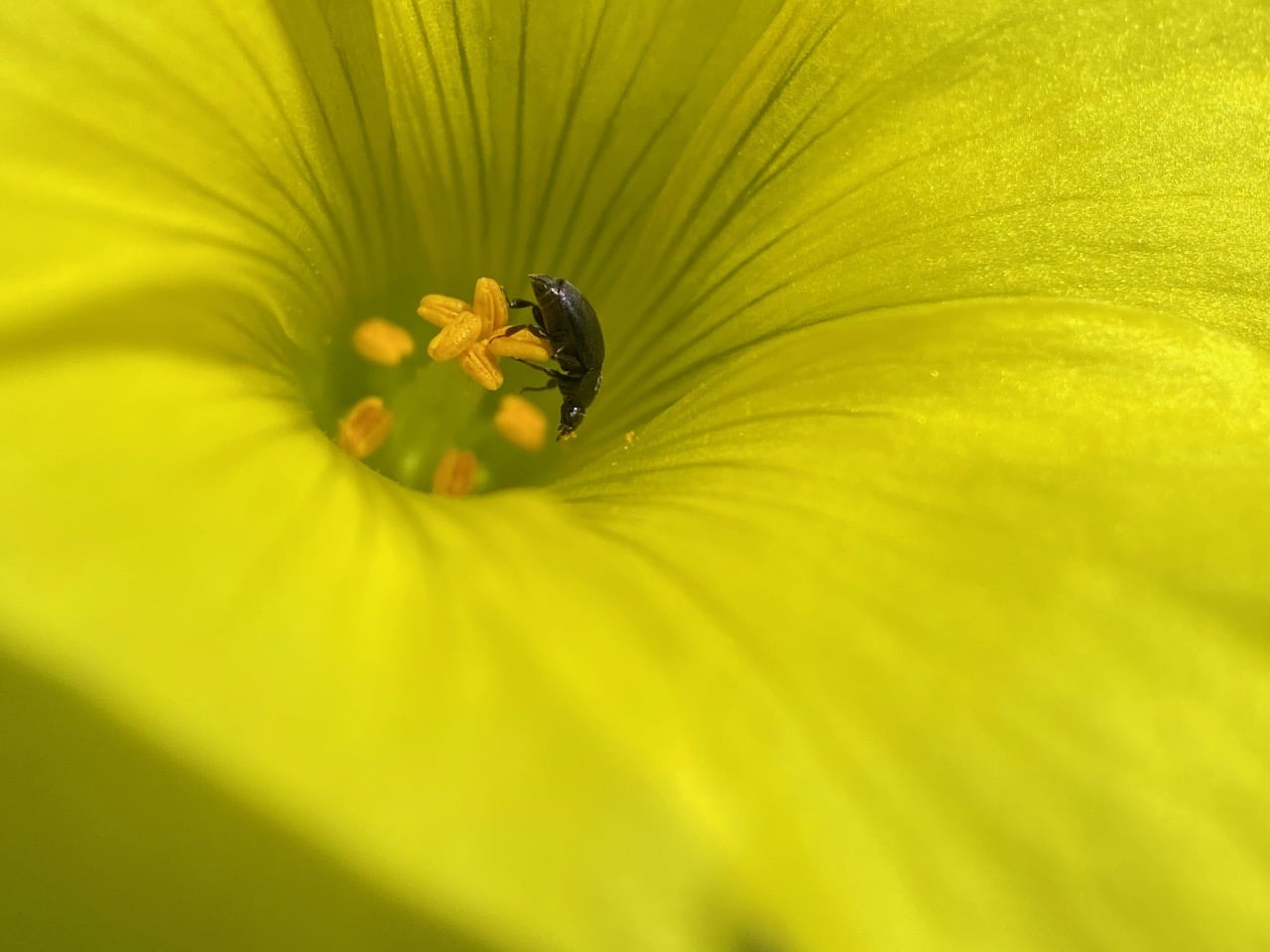
The Common Pollen Beetle, Brassicogethes aeneus, is a species of pollen beetle in the family Nitidulidae. The beetle is found in Europe, northern Asia and North America.
Adults are about 2-3 mm long, 1-2 mm wide and black with a hint of metallic green. The species is an important pest of oilseed rape. The female lays its eggs in the flower buds of the host-pant and the larvae develop within the flowers. Oviposition and feeding damage the buds of oilseed rape and similar Brassicas and may cause the flowers to drop. Both adult and larvae feed on the pollen and nectar in the flowers.

I peek into a Bermuda Buttercup flower and see a Hybotid Dance Fly, Anthalia sp. (family Hybotidae) scavenging pollen that has been shed by the ripe anthers.

Profile of the Hybotid Dance Fly, Anthalia sp. (family Hybotidae) as it crawls out of the Bermuda Buttercup flower. The insect feeds on pollen from a wide variety of wild flowers.