

Pollinator Post 2/27/24 (2)

The Osoberry, Oemleria cerasiformis is in bloom! The species is dioecious – male and female flowers are borne on separate plants.
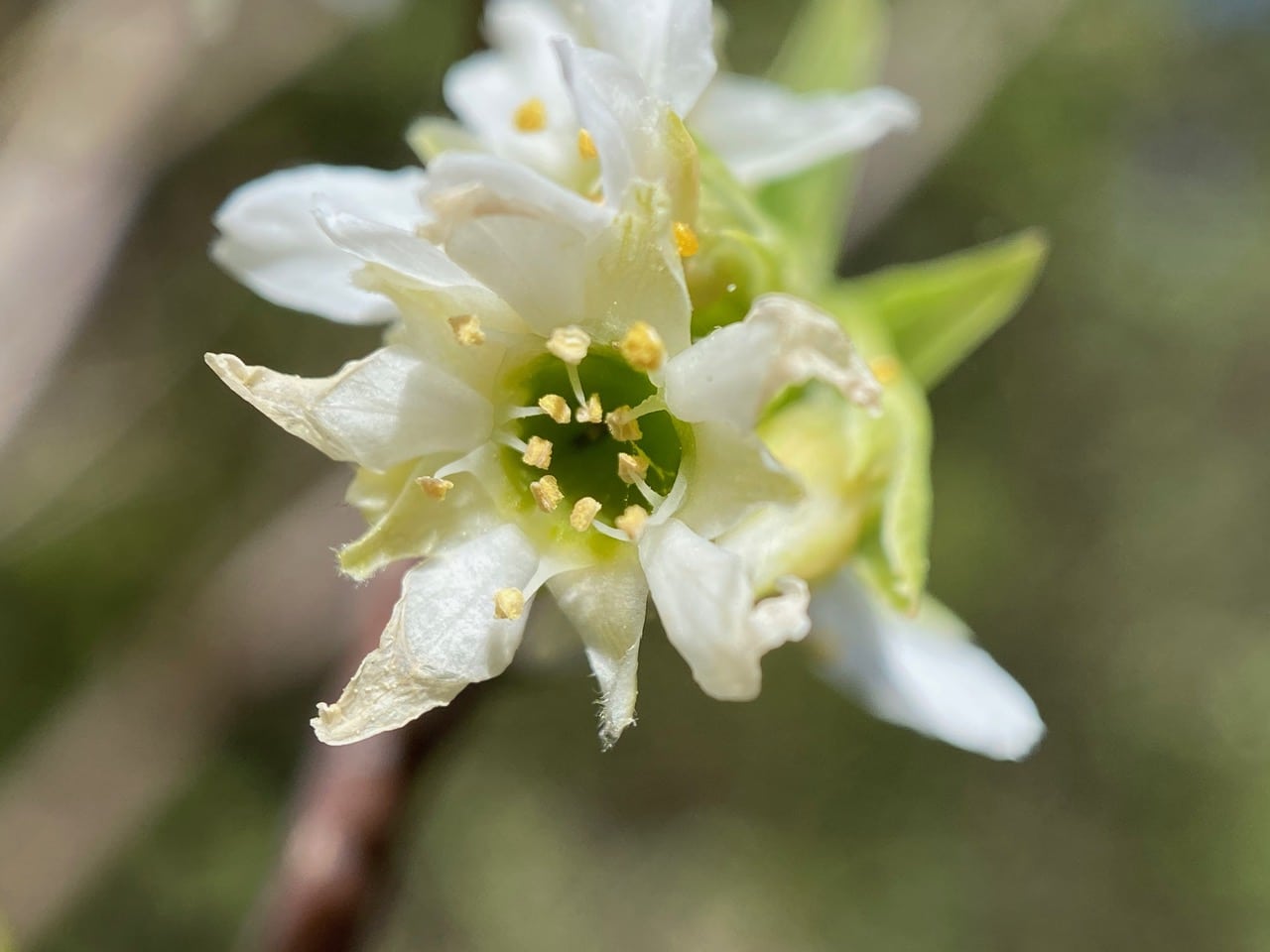

A quick check on the flowers show me that this is a male plant. See the stamens with yellow anthers lining the floral tube? Interestingly, in the wild, male Osoberry plants far outnumber the females, so one rarely gets to see the fruits.
There are 5 petals and 5 sepals. Note the numerous stamens (15, to be exact), in 3 series in the tubular portion of the calyx. Osoberry flowers are supposed to have an unusual scent.
I am ready to put my nose to the flowers when I spot tiny black beetles rummaging among them. Some of the beetles are already coated with the yellow pollen.
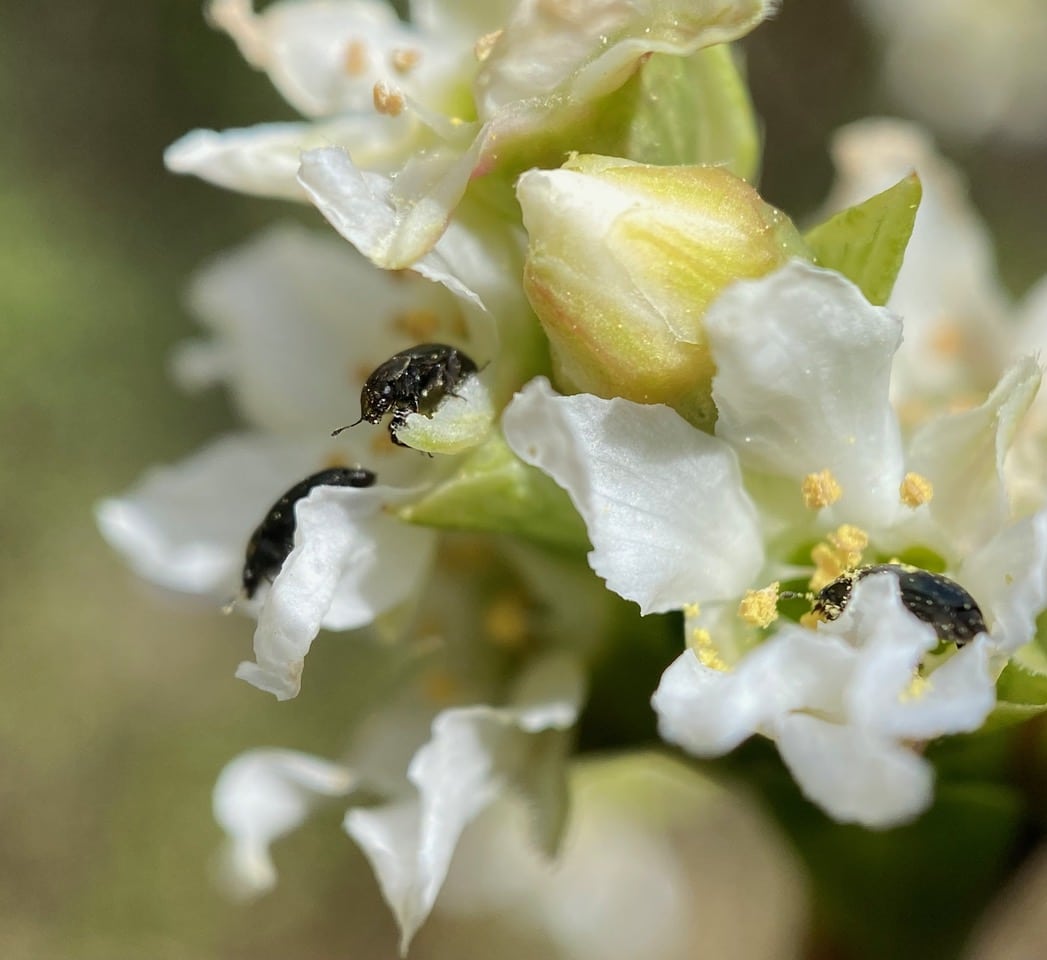
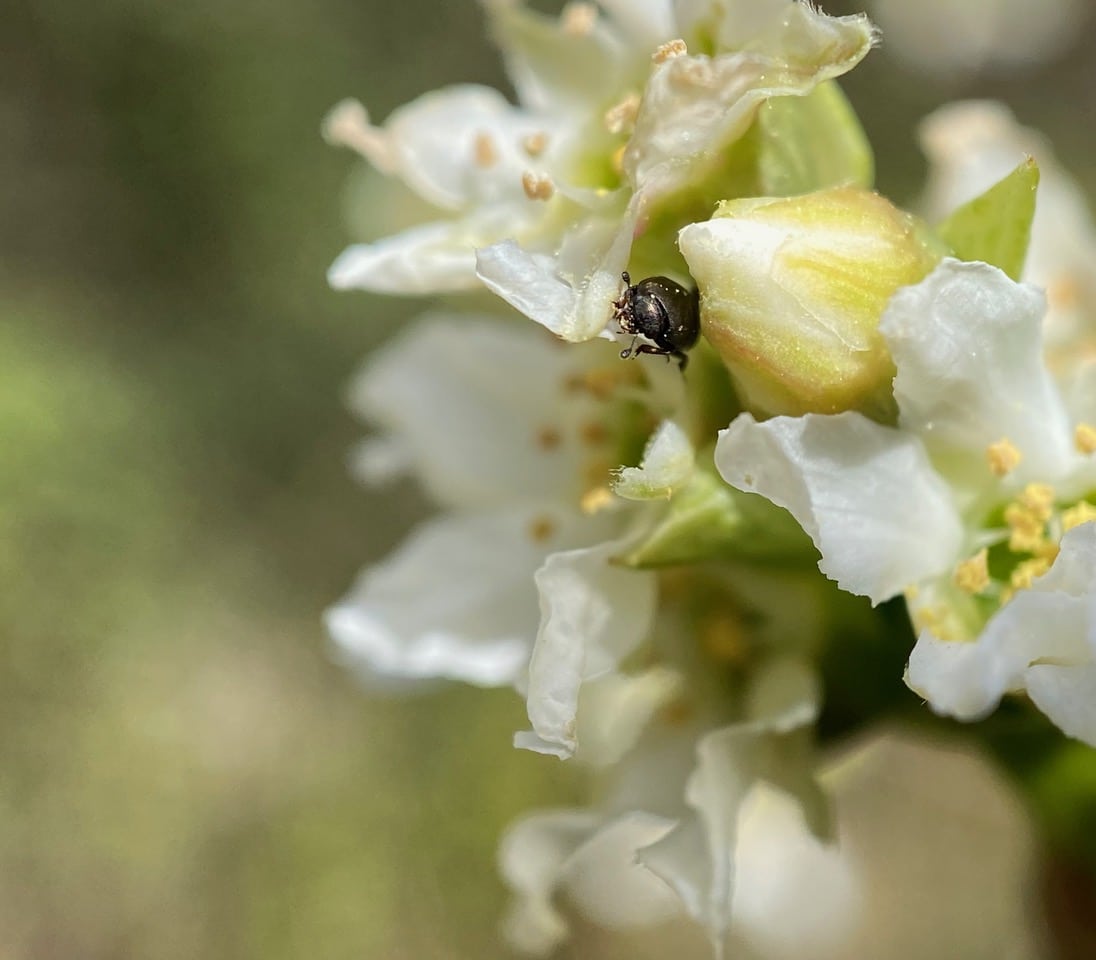



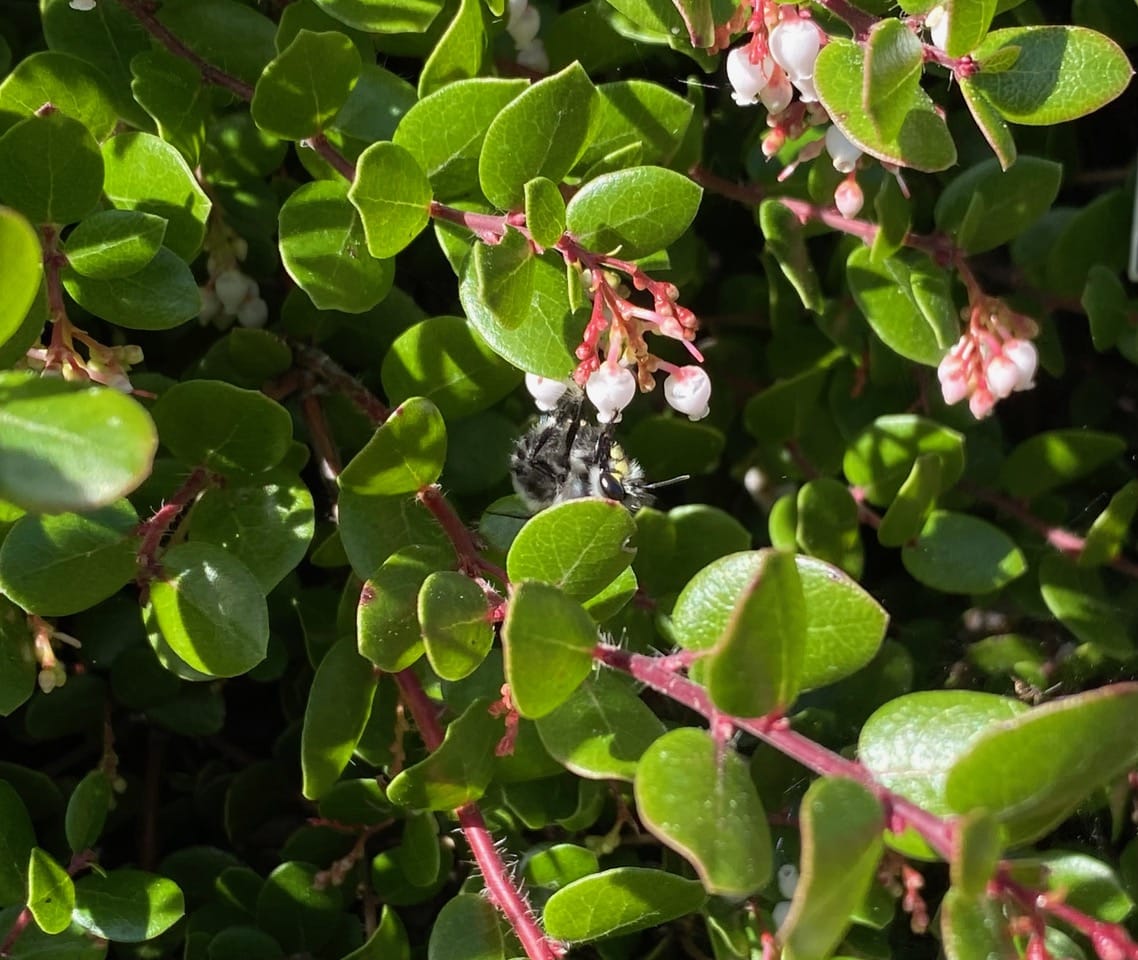

A pair of beetles on the top there are mating!
Beetles are among the first insects to visit flowers and they remain essential pollinators today. They are especially important pollinators of ancient species such as magnolias and spicebush. The beetles eat their way through petals and other floral parts. They often mate and defecate within flowers, generally making a mess. This behavior has earned them the nickname of “mess and soil” pollinators.
The flowers that are visited by beetles are typically:
– Bowl-shaped with reproductive parts exposed
– White, or dull white or green
– Strongly fruity
– Open during the day
– Moderate nectar producers
– May be large solitary flowers
– May be clusters of small flower.
The “mess and soil” behavior is typical of many small beetles that feed on pollen, collectively called the “pollen beetles”. I try to take as many pictures as possible to ensure proper identification.
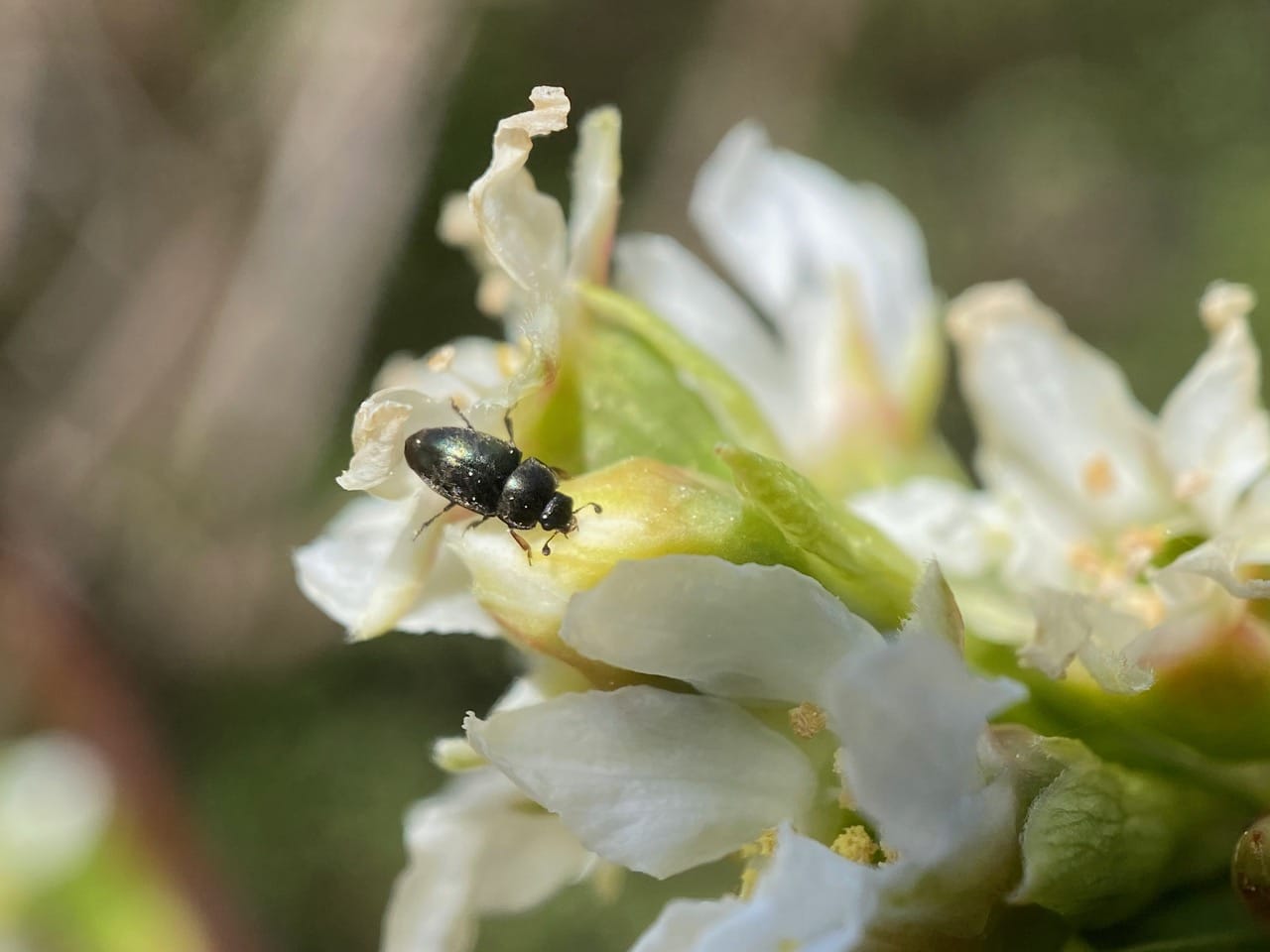
Ah, finally a clear view of the whole beetle! It appears to be the Common Pollen Beetle, Brassicogethes aeneus (family Nitidulidae).
The species is found in Europe, Northern Asia and North America. Adults are 2-3 mm long, black with a hint of metallic green, and have knobbed antennae. It is a known pest of oilseed rape. It is unclear whether the beetles contribute to the pollination of the crop. The female beetle lays its eggs in the flower buds of the host-plant and the larvae develop within the flowers. Both adults and larvae feed on the pollen and nectar in the flowers.
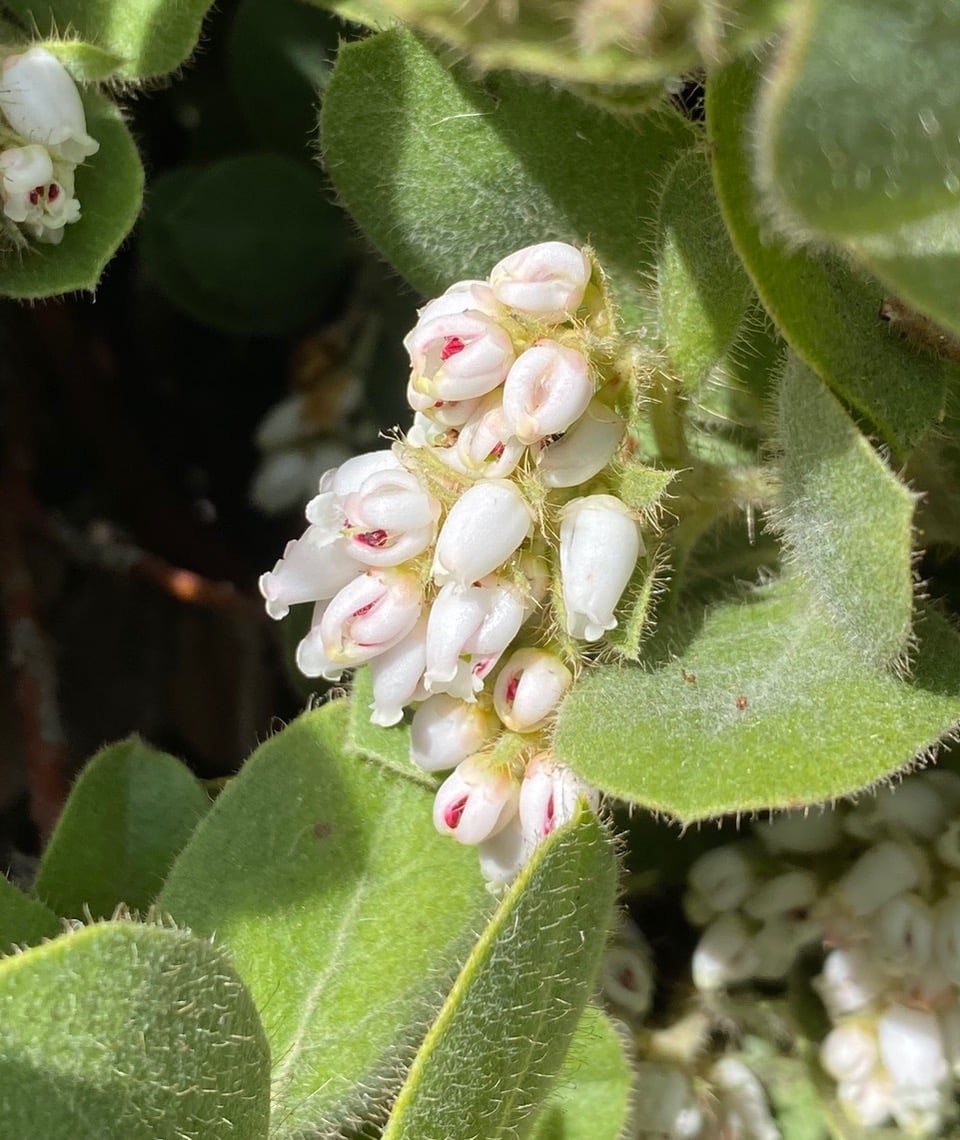
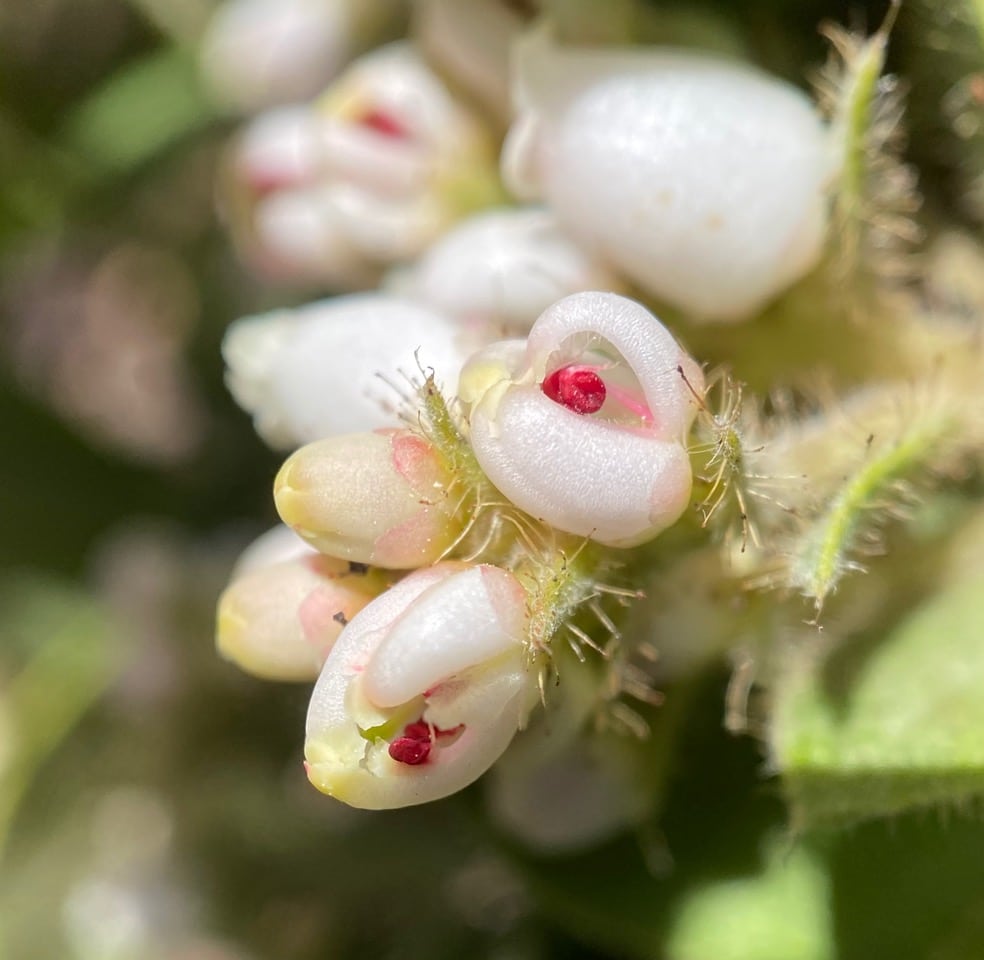
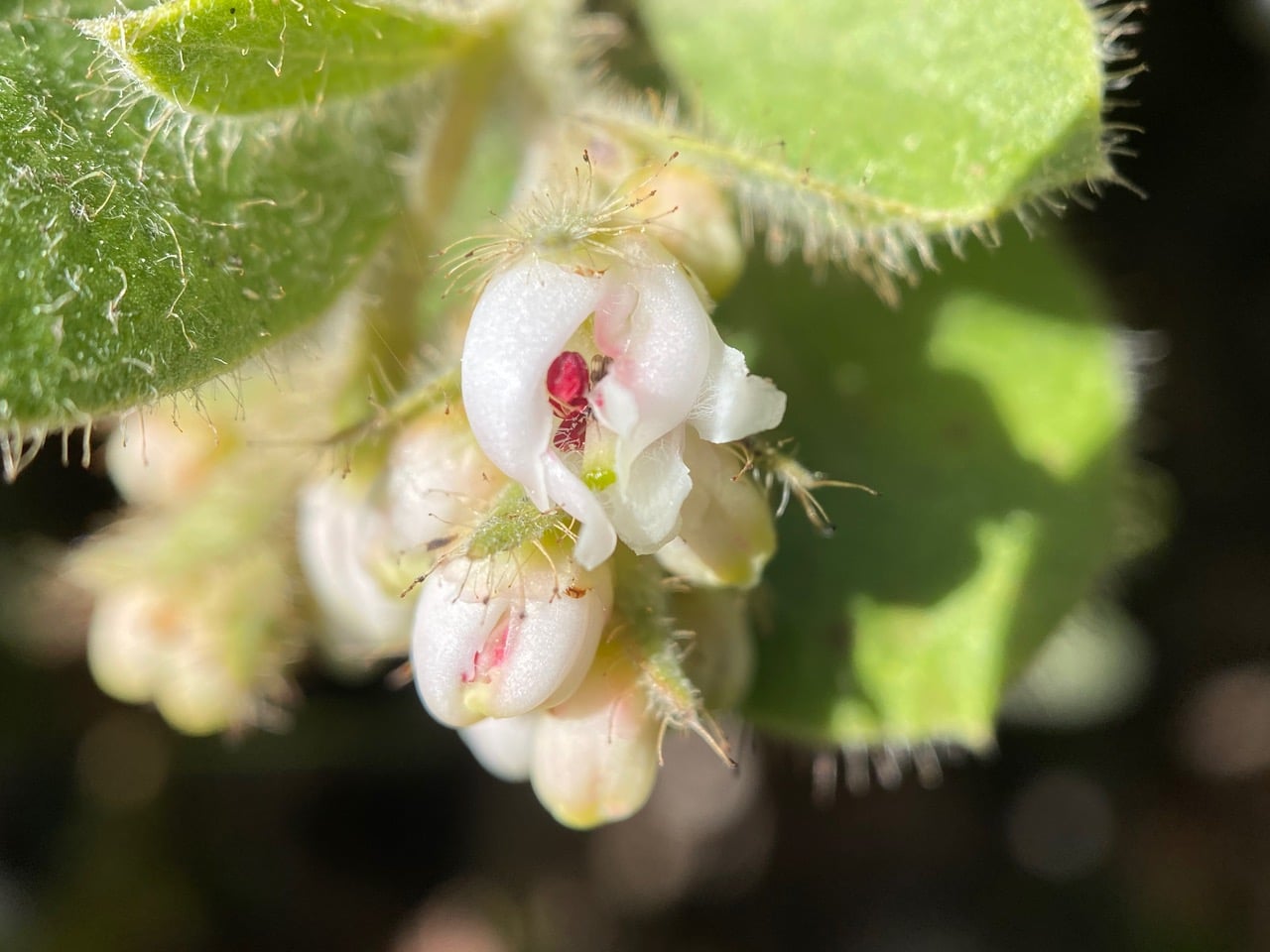
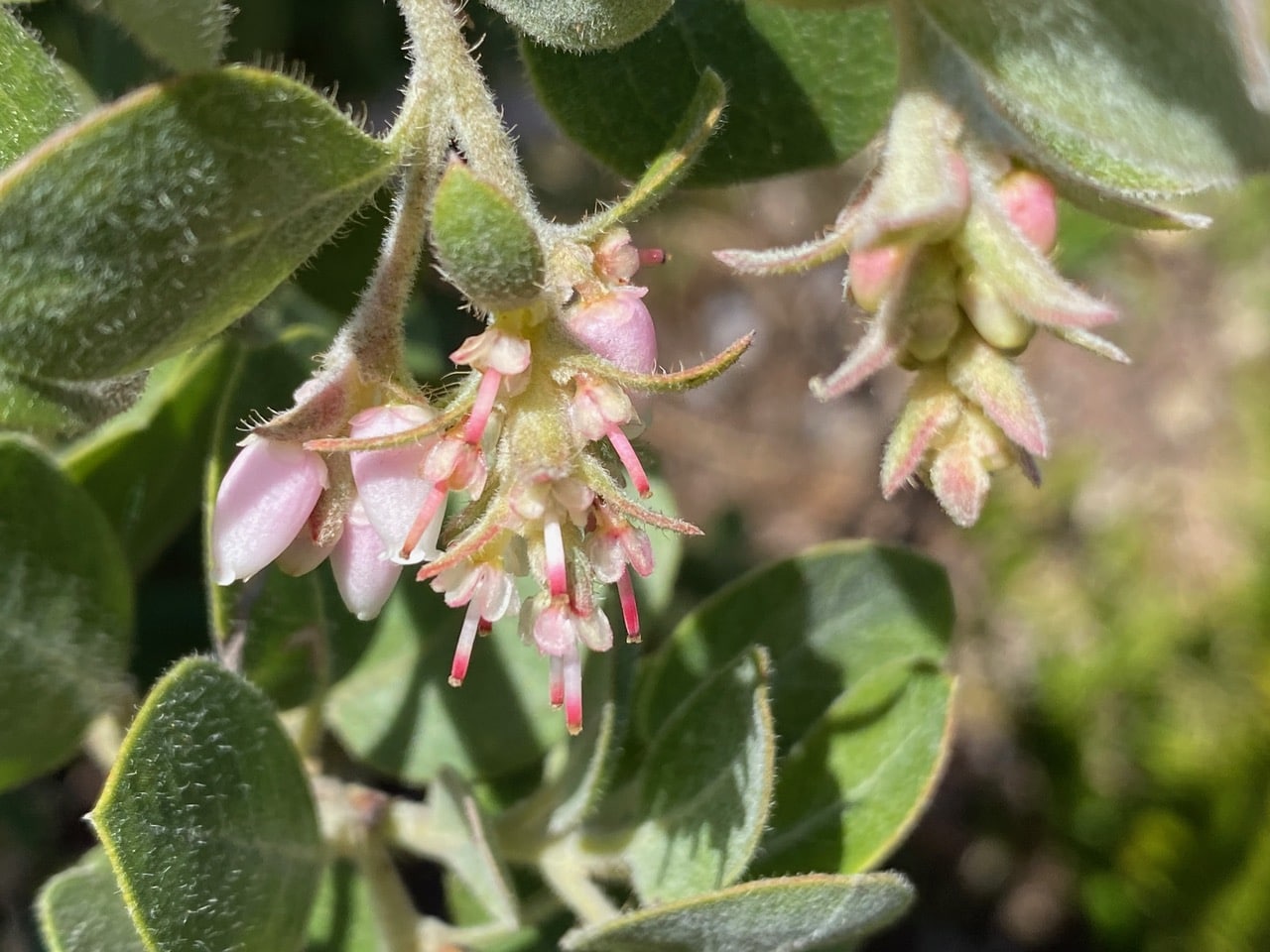
There’s a manzanita in the garden with these curious split corollas. I can’t find the label for this big bushy plant. It might be a mutant, but an instructive one. Because of their small size it is hard for me to dissect a manzanita flower in the field without crushing it. The mutant flowers give us rare glimpses into the mysterious interior of the flower.
The flowers appear split and misshapen, probably because the petals did not fuse properly to form the enclosed corolla. The red things within are actually the unique poricidal anthers of the manzanita.
Here’s a great article about the pollination of manzanita, with excellent images of a dissected manzanita flower and its stamens:
You can actually see the pistil with the green stigma through this split flower.
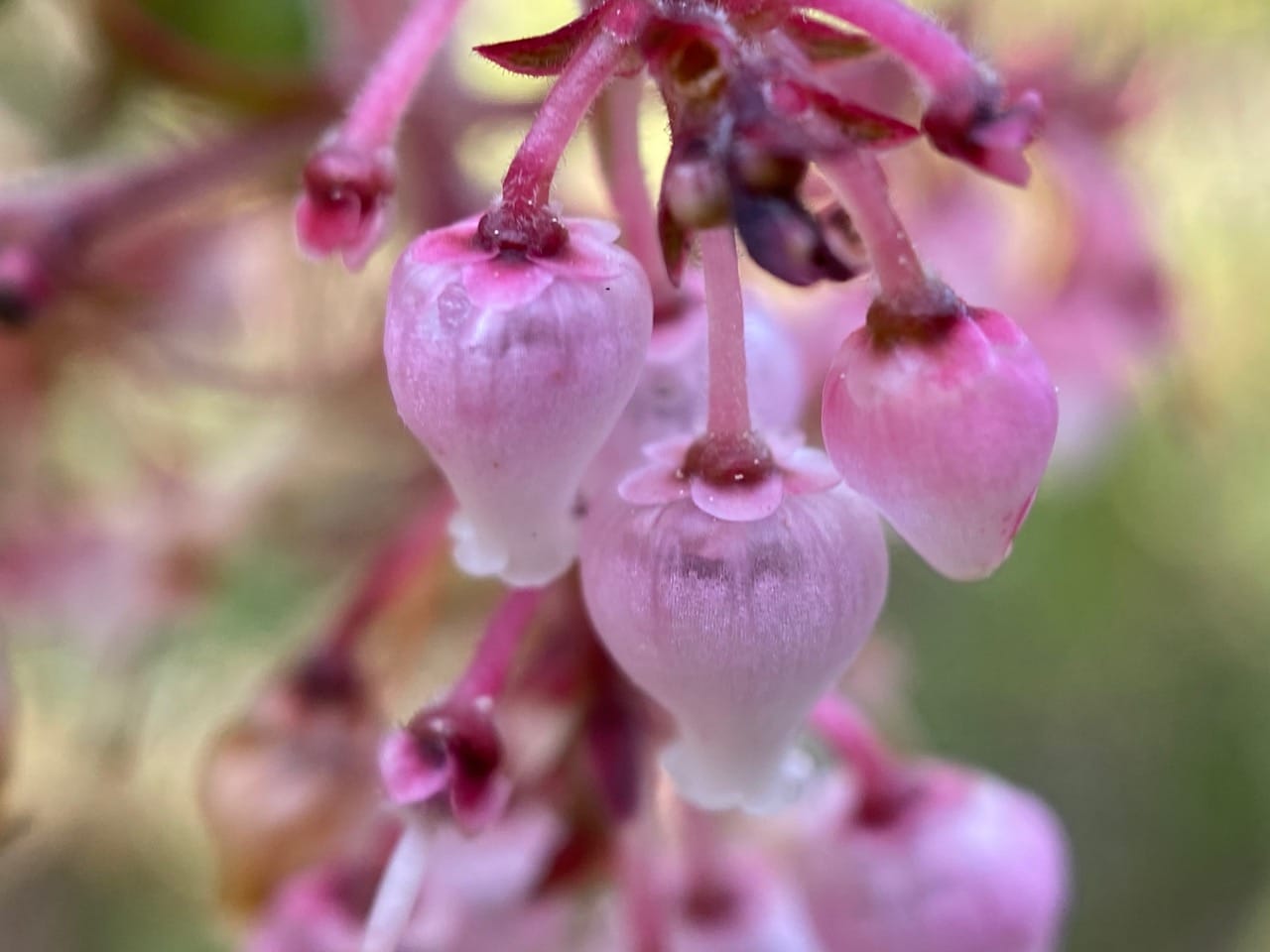
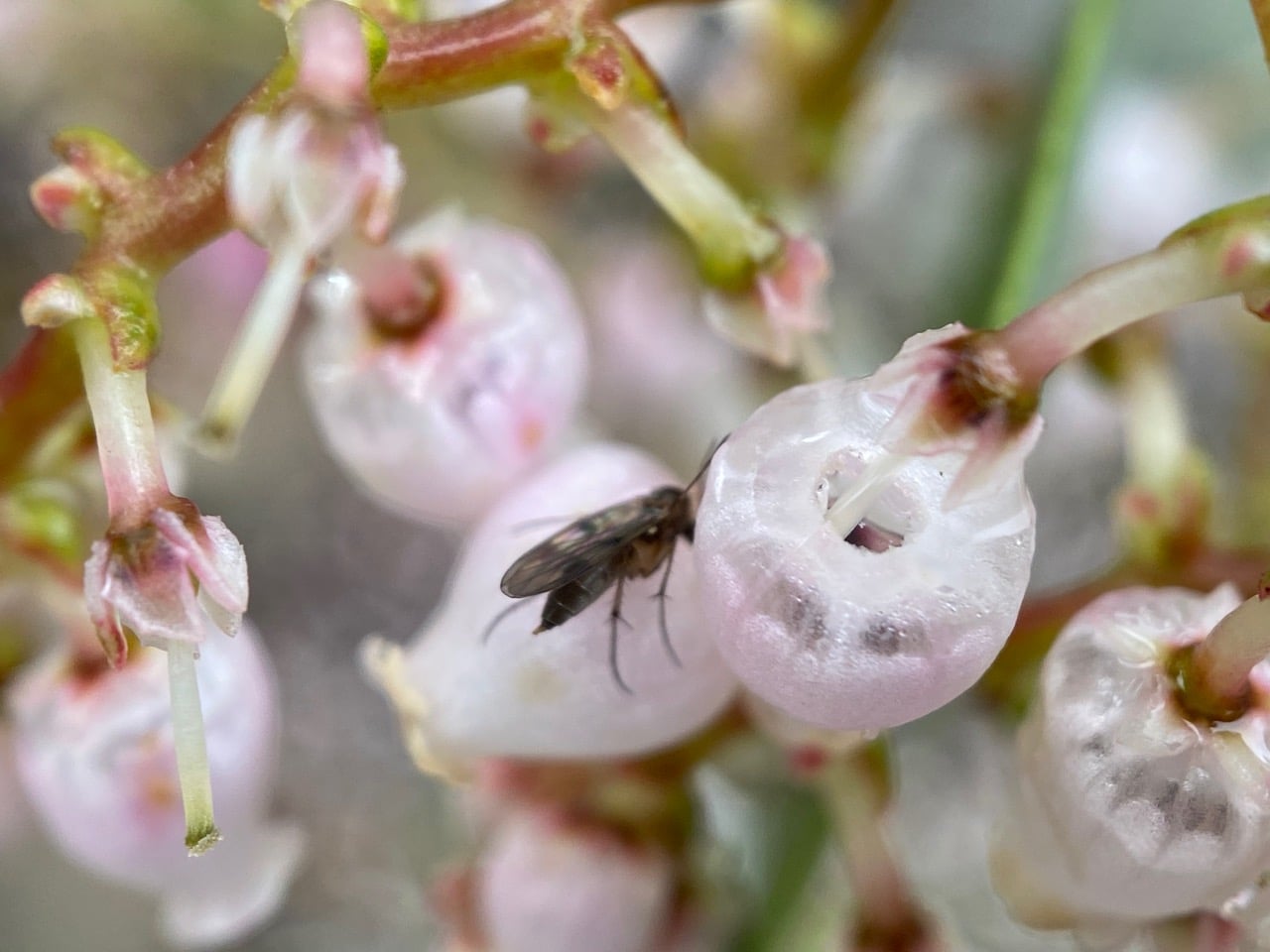
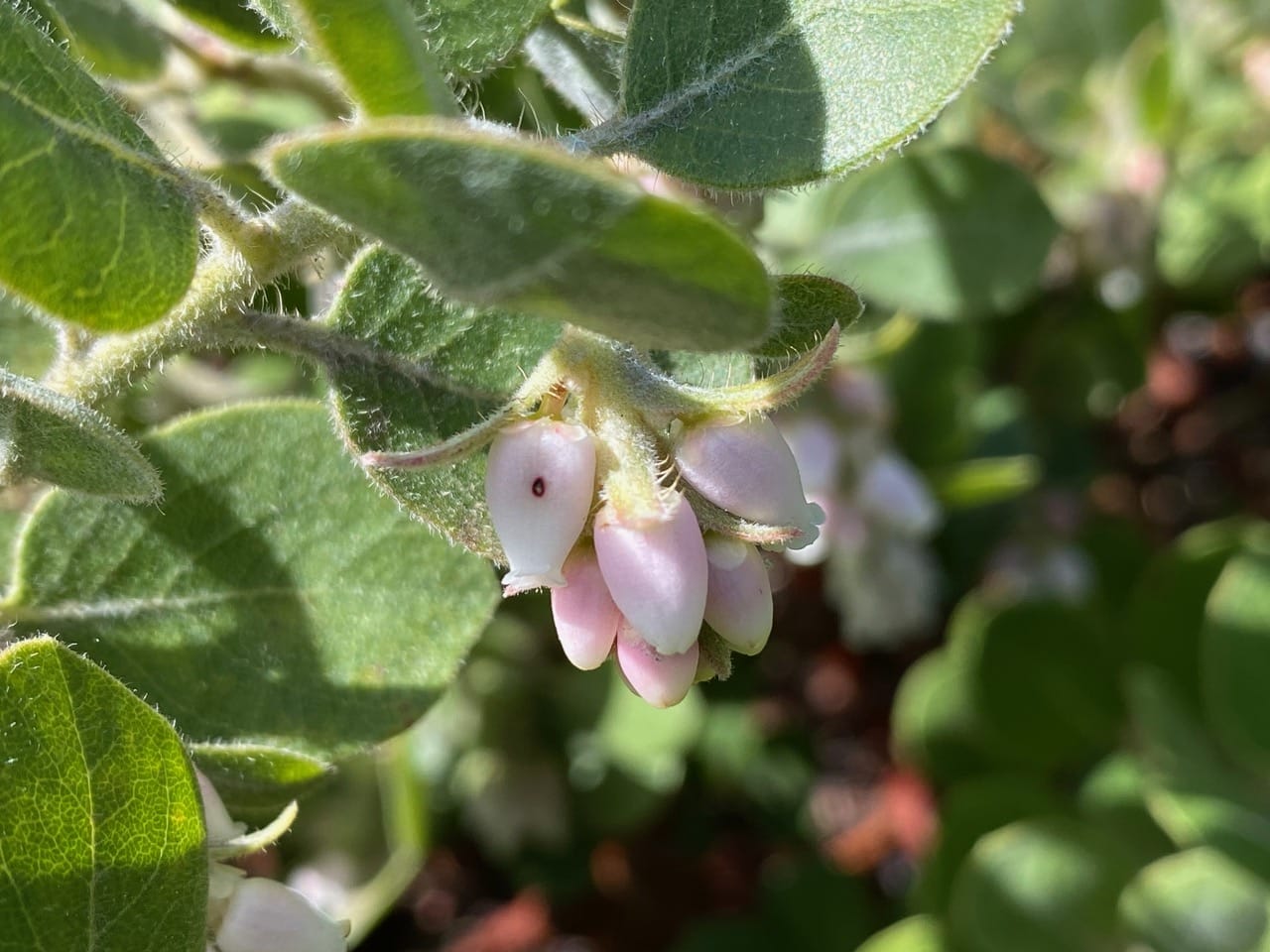
Many species of manzanita have flowers that exhibit translucent tissues at the base of the corolla where it is attached to the pedicel. Sometime the translucent parts are raised in bubble-like bumps, like little skylights. I have often wondered what the function of these “skylights” might be. To allow more light in? Why? Do they benefit the tiny insects that can crawl in (such as thrips), to direct them to the sex organs of the flower? None of the descriptions of manzanita flowers I have read even mention this feature.
Close-up of the “skylights” at the base of the manzanita flowers.
This is an old picture taken on 2/20/24 in the garden.
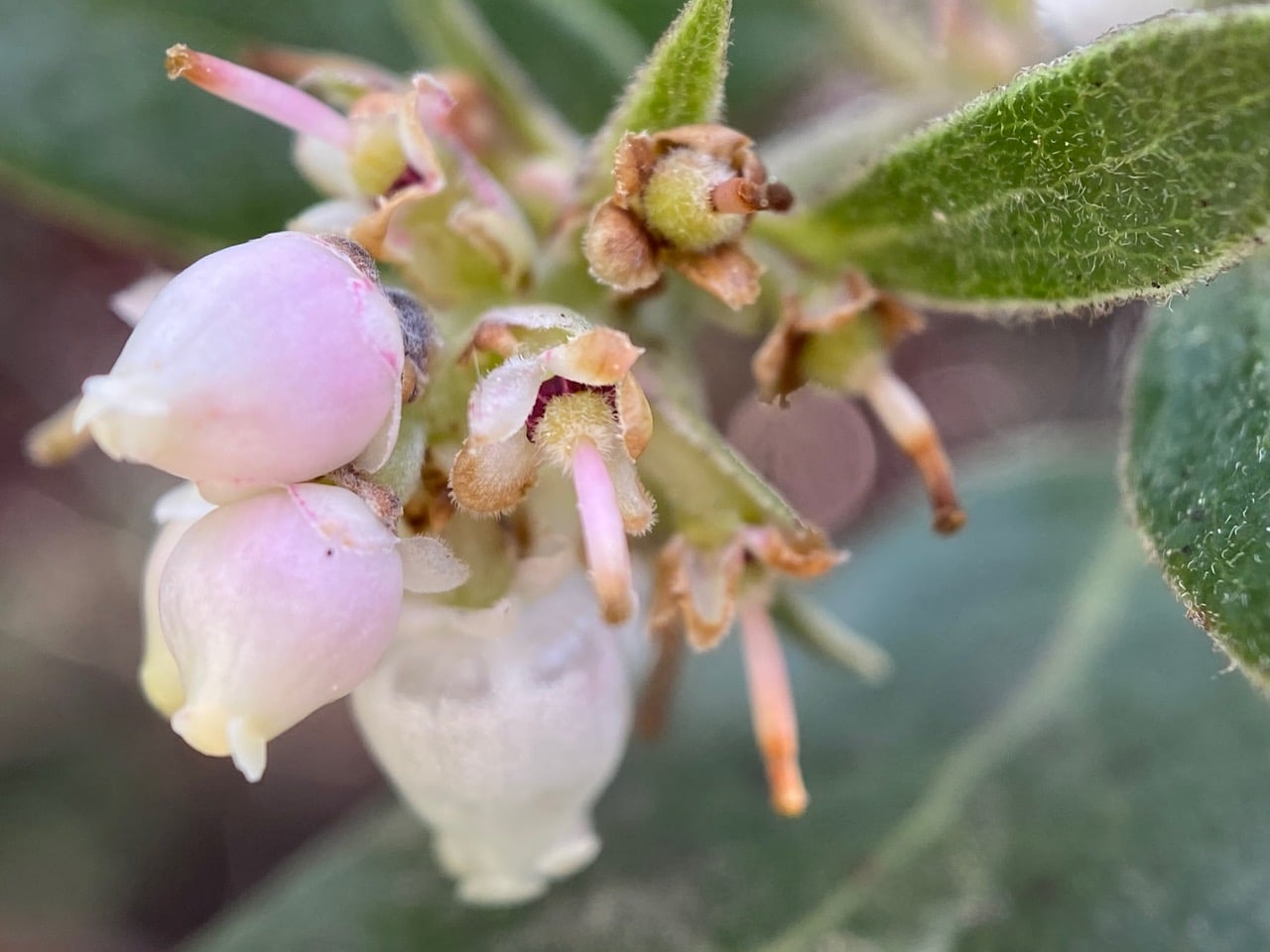
As the manzanita flower senesces, the corolla drops off the pedicel, leaving the exposed pistil.
This species of manzanita has pink-tipped styles!
If the flower has been pollinated, the ovaries begin swell into the familiar manzanita berries, the “little apples”.
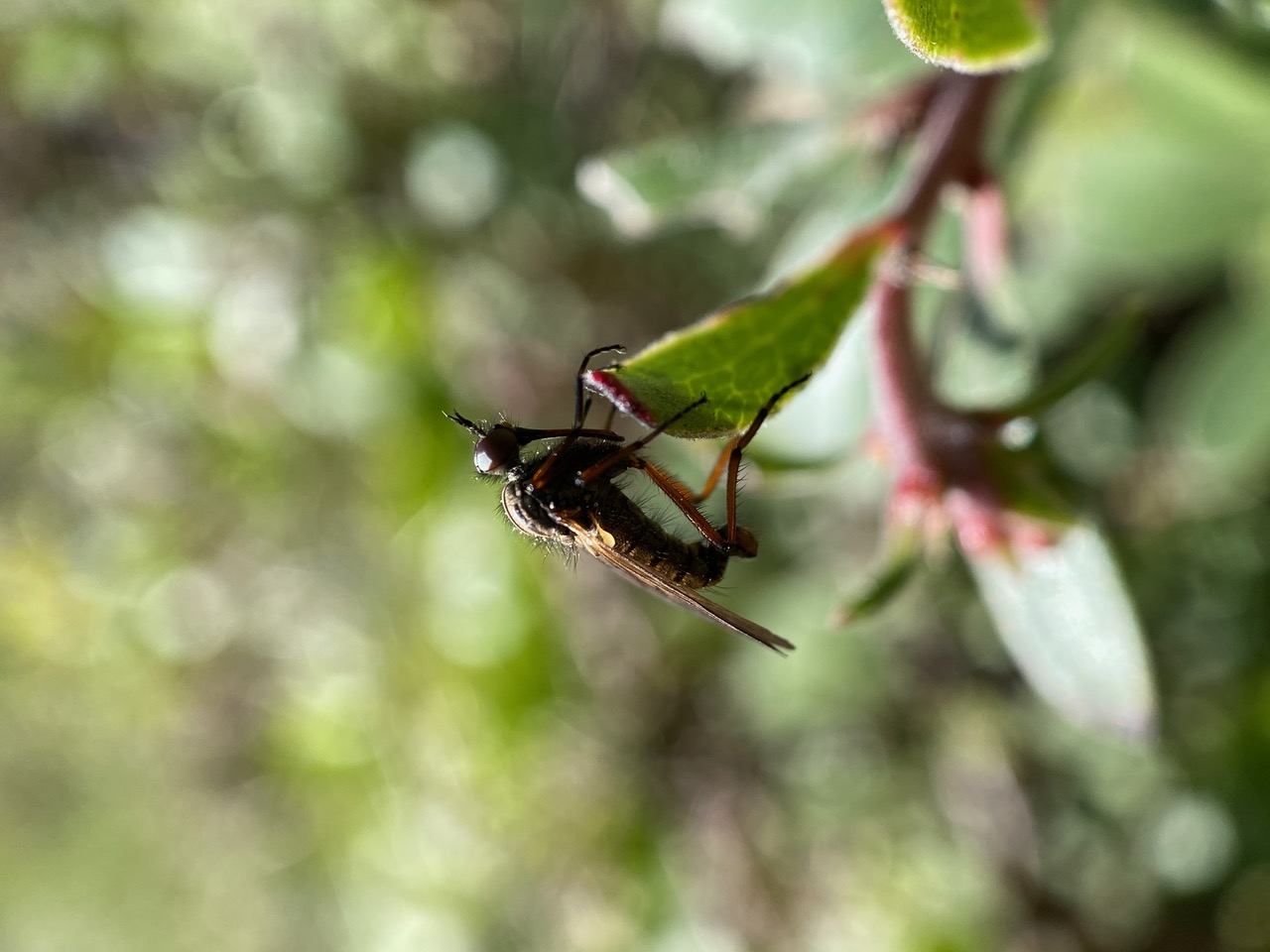
Hello, who’s that dusky insect standing stock-still on a manzanita leaf? It has a long, curved proboscis, and looks a lot like the Dance Fly, Empis sp. (family Empididae) I saw at Roy’s Redwood a week ago. Is its proboscis long enough to reach into the manzanita flowers to access the nectar?
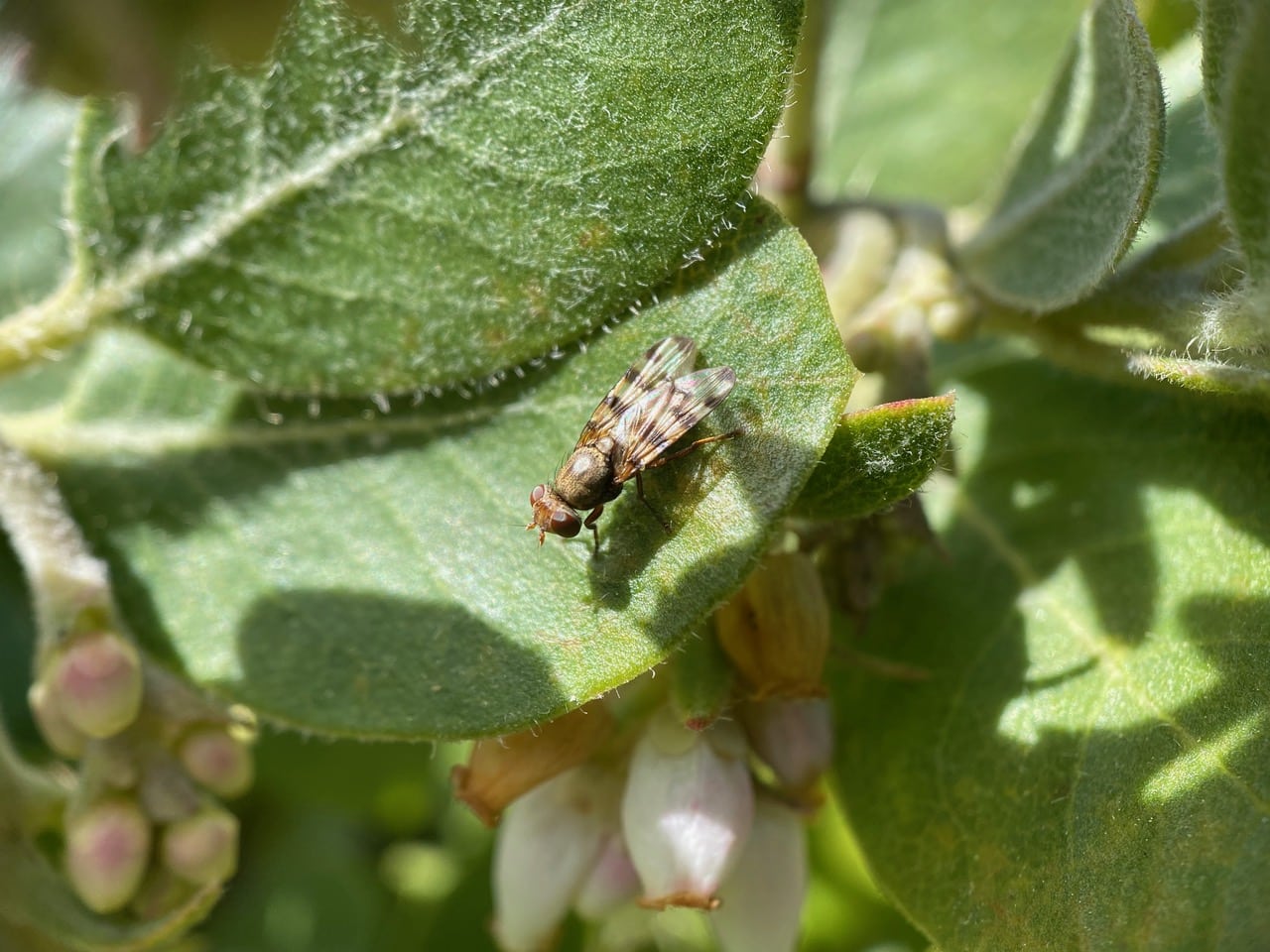
A Narrow-banded Picture-winged Fly, Ceroxys latiusculus (family Ulidiidae) seems to be enjoying the sun on a manzanita leaf.
Picture-winged flies belong to the family Ulidiidae. They are among the more common, ornate, and entertaining of all Diptera, thanks to their lovely wing patterns and adorable courtship behaviors. Most have some kind of pattern of spots, bars, or lines on the wings, and at least a few have metallic bodies. Many can often be found on certain plants, dung, logs, wooden fences, or the trunks of trees. These locations serve as food sources, basking sites, or display sites for courtship. Most species of Picture-winged flies are herbivorous or detritivorous.
Ceroxys latiusculus is common throughout western North America. Larvae develop in the seed heads of Senicio, and other composite flowers. The adult flies are known to invade homes and other buildings in the fall, seeking winter shelter.
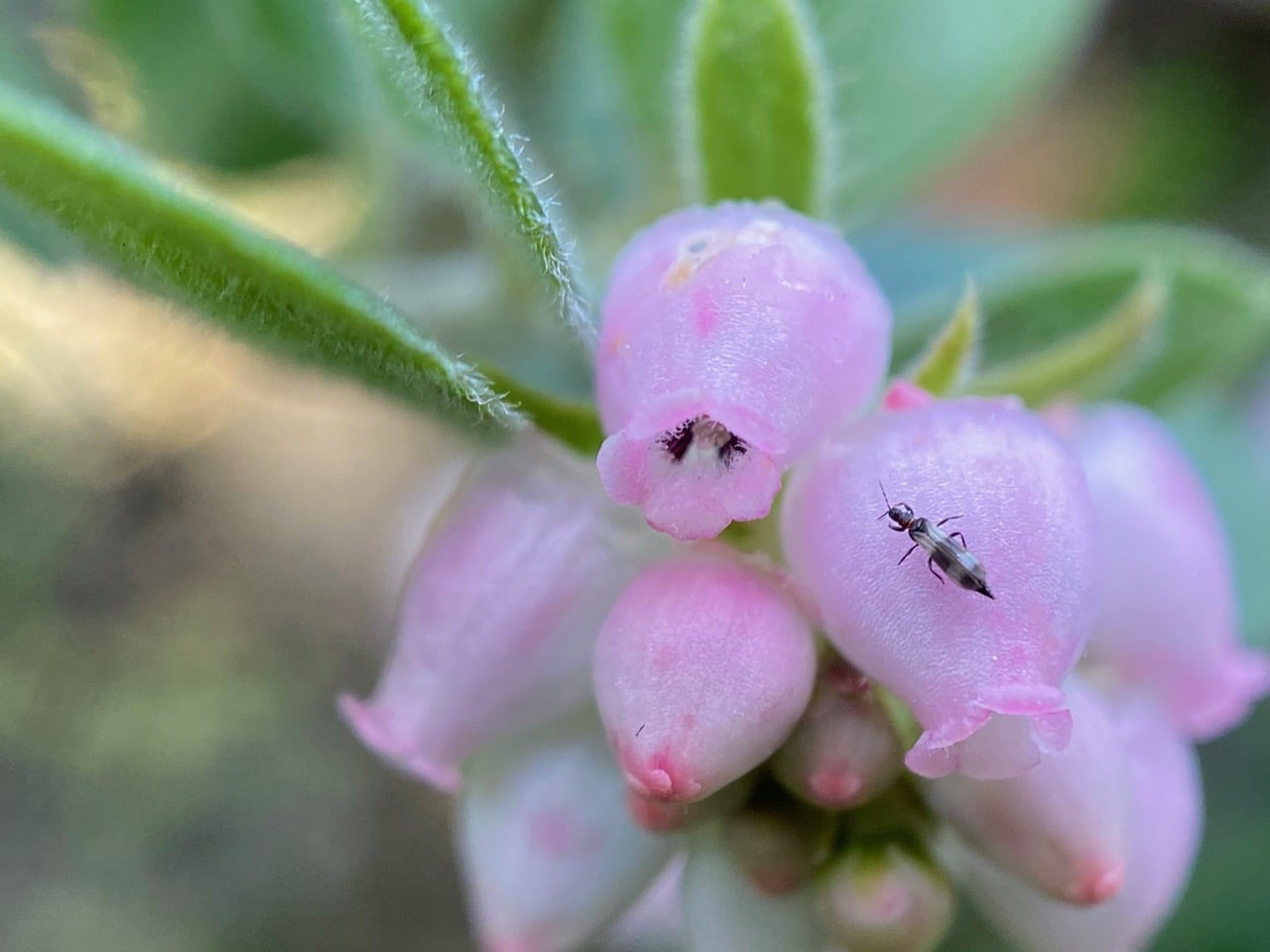
Earlier this morning when I was going through the shady part of the garden, I spot this Thrips moving around on a manzanita flower. It has been identified as an Aeolothrips Predatory Thrips.
Thrips (order Thysanoptera) are minute (mostly 1 mm long or less), slender insects with fringed wings and unique asymmetrical mouthparts. They feed mostly on plants by puncturing and sucking up the contents, although a few are predators. Some flower-feeding thrips pollinate the flowers they are feeding on, and some scientists believe that they may have been among the first insects to evolve a pollinating relationship with their host plants. A genus is notable for being the specialist pollinator of cycads. Thrips are likewise the primary pollinators of heathers in the family Ericaceae, and play a significant role in the pollination of pointleaf manzanita. Electron microscopy has shown thrips carrying pollen grains adhering to their backs, and their fringed wings are perfectly capable of allowing them to fly from plant to plant.
Predatory thrips are generally larger than the herbivorous thrips, about 1.5-2.5 mm long. Aeolothrips can be found whenever their prey occur. They are thought to be predaceous on small arthropods, such as plant-feeding thrips and spider mites. At least some species also feed on pollen and other arthropods, such as aphids and whiteflies.
BTW, there’s no such thing as a “thrip”. It’s always “thrips”, singular or plural!
Who made that hole on the side of the manzanita flower? It appears to be evidence of a nectar robbery. Insects that are too large to enter a flower the proper way sometimes use their mandibles to cut a hole to access the nectar directly. Carpenter Bees (Xylocopa sp.) and Bumble Bees (Bombus sp.) are notorious nectar robbers. Often the holes attract other, weaker insects, the secondary nectar robbers who take advantage of the ready made holes.
Wow, this is serious breach of the manzanita flower! It requires chewing mouthparts. I wonder who did this? Note the red anthers and the green-tipped style within.
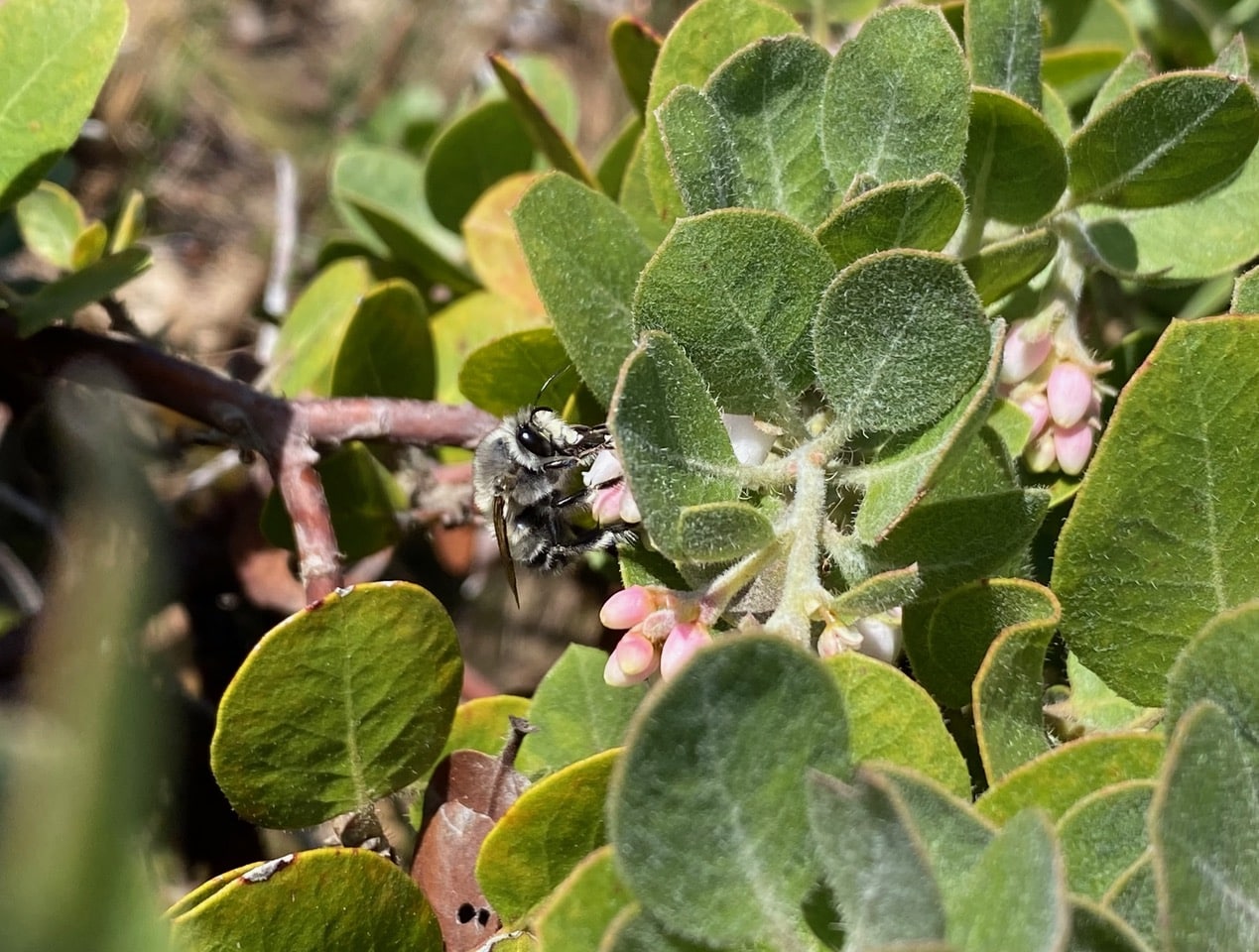
It’s almost noon – fun time for watching the feisty Digger Bees, Anthophora sp. A male has come to take nectar from the manzanita flowers. Males have the yellow-white markings on their faces. They also have these fancy tassels of hair on their legs for use during mating.
The Digger Bees (Anthophora sp.) that visit the manzanita flowers are predominantly males. But I am thrilled to see a female today. She is carrying a good load of yellow pollen in the scopae on her hind legs. If you see a bee with a pollen load, you can be sure that it is a female. Male bees do not collect pollen, neither do they have the equipment for the job.
A scopa (plural scopae; Latin for “broom”) is a modification on the bee’s body that forms a pollen-carrying apparatus. Most often scopae appear on the hind legs of female bees, consisting of extra long hairs to which pollen grains adhere by electro-static forces. In the Leafcutter bees, the scopae are on the ventral abdomen. The location of scopae on bees can be a useful feature for identification.
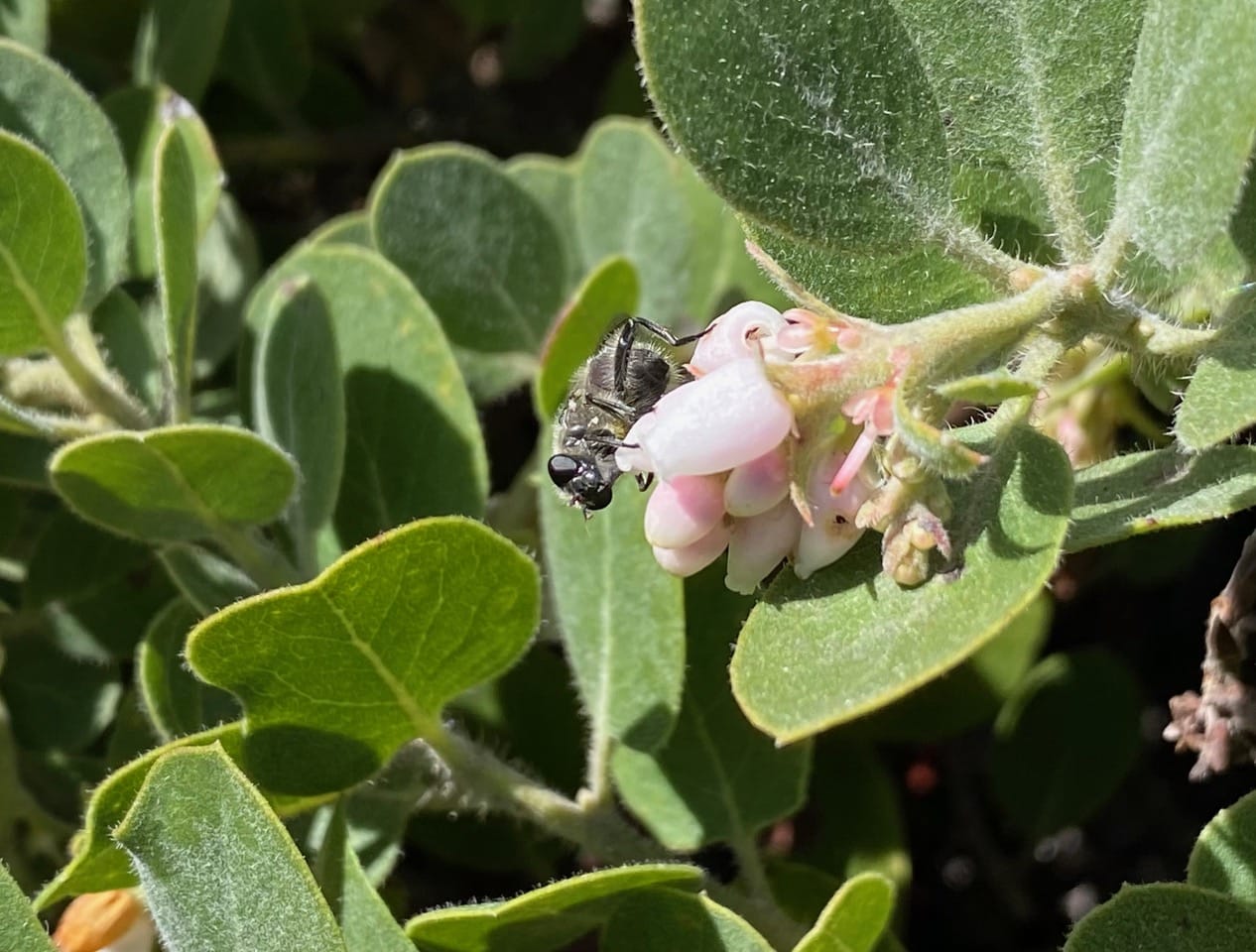
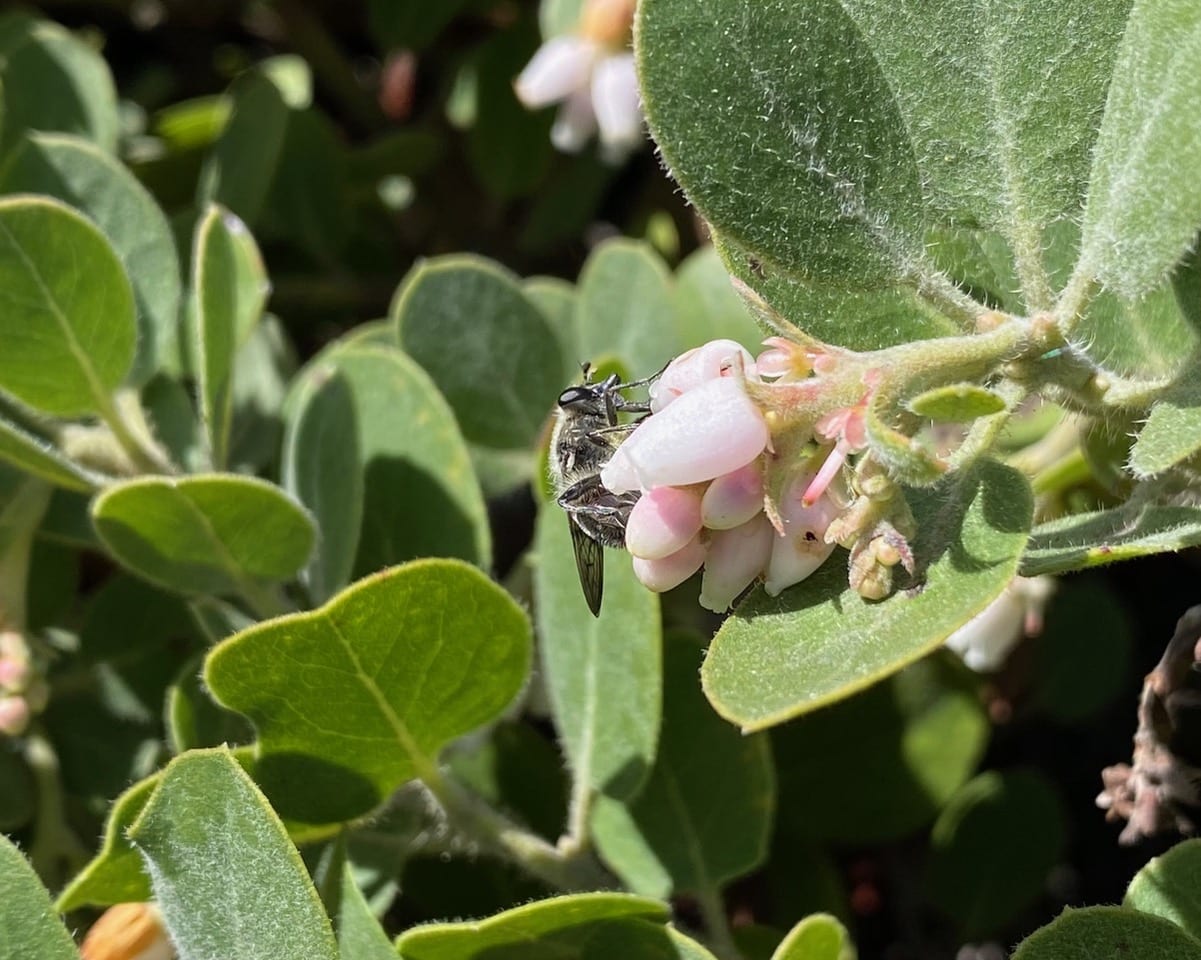
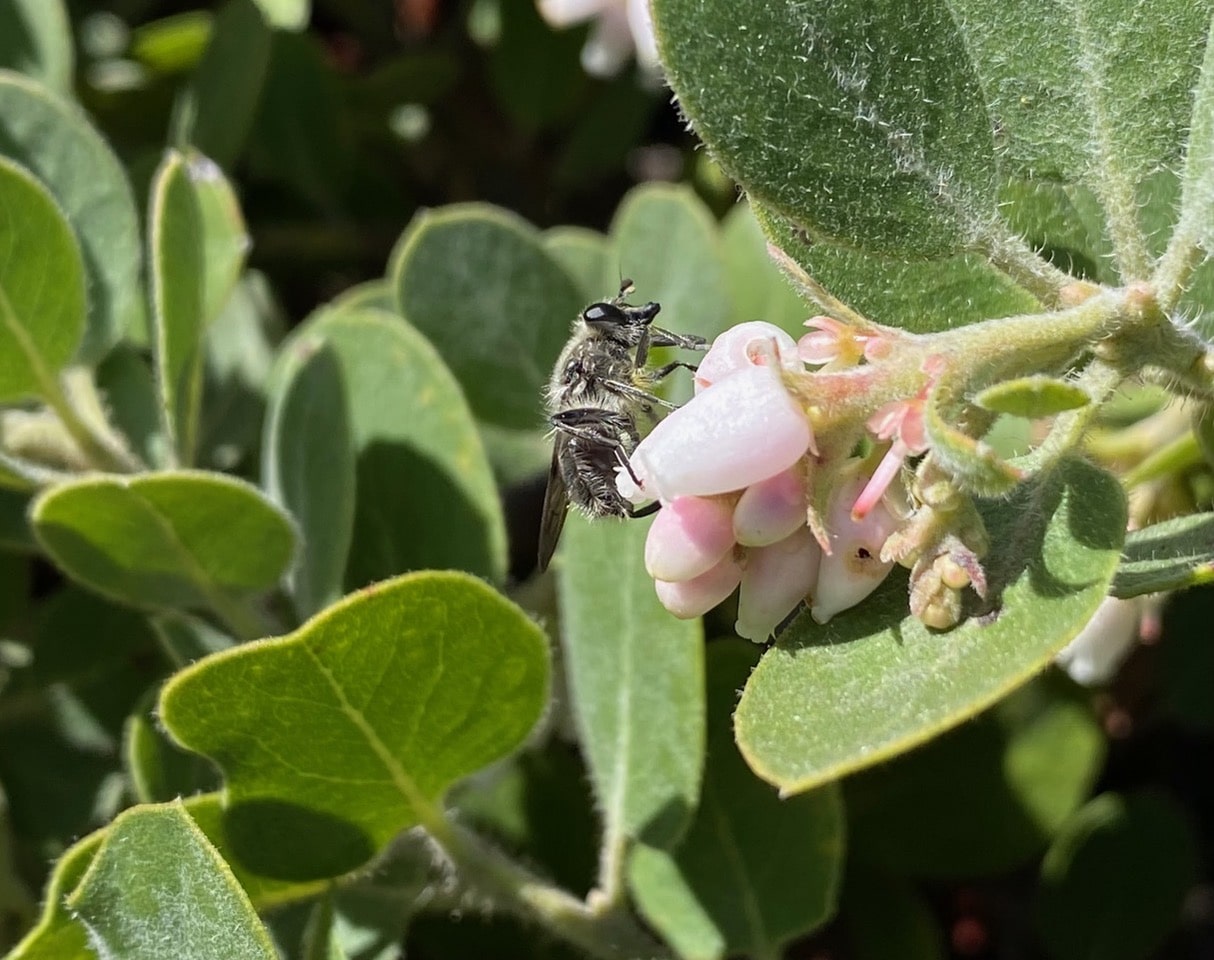
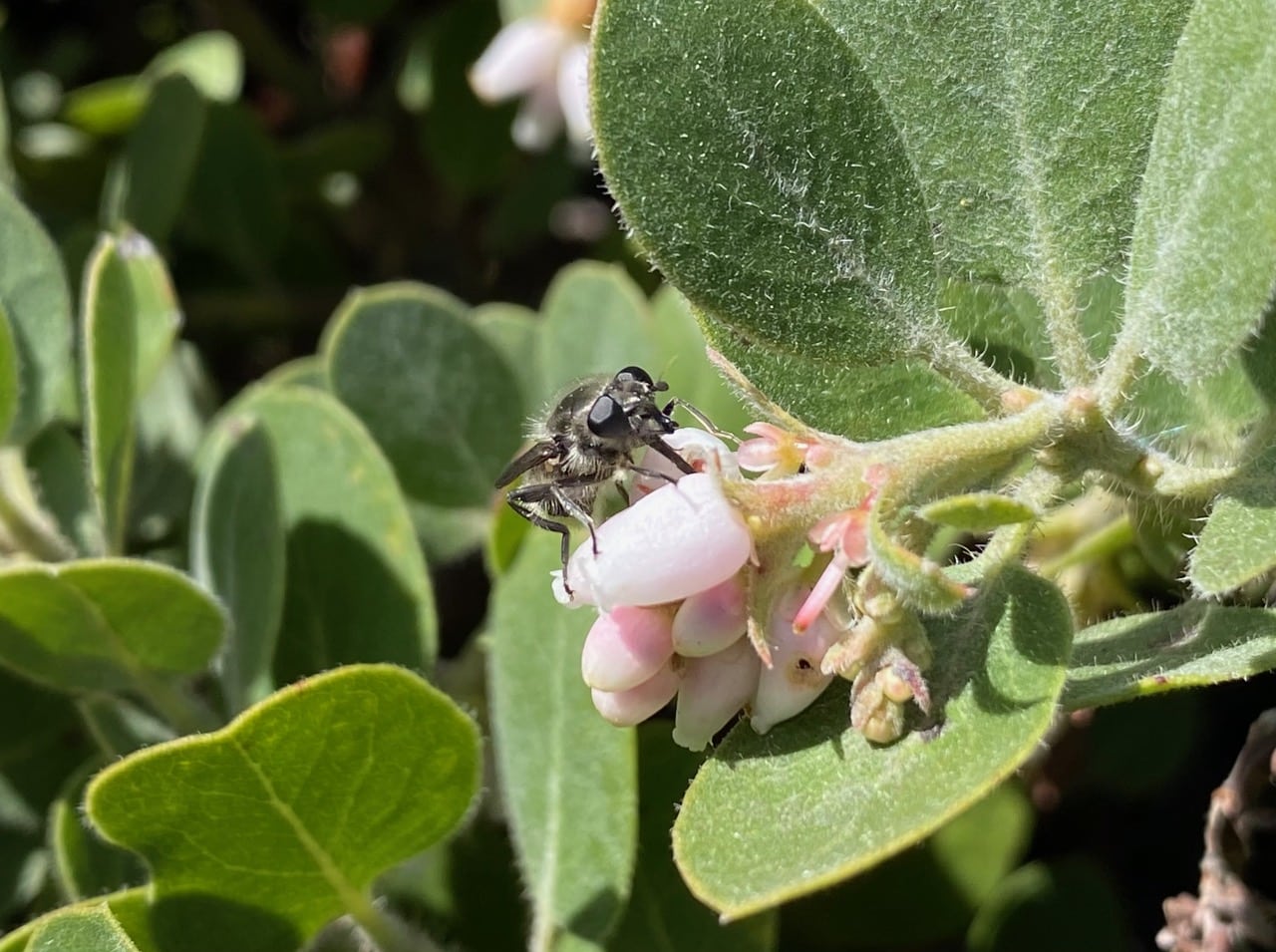
Hey, I don’t think I have seen this insect before! Is it taking nectar from the opening of the manzanita flower?
Ooh, look at the aristate antennae! It’s a fly (order Diptera) for sure!
The fly has a pointy “snout” and a long proboscis like the hover flies in the genus Copestylum. My best guess is that it is a Syrphid Fly.
The fly looks scruffy. An older individual that has lost a lot of hairs?
Is the fly robbing nectar? Or is it probing through the hole at the base of the flower where it has separated from the pedicel? Is the fly’s proboscis strong enough to make a hole in the flower? Note that there’s a hole in the lower flower in the cluster.
When I first submitted the pictures to iNaturalist, their Computer Vision actually suggested a Digger Bee! The AI needs some basic training on how to distinguish a bee from a fly! Fortunately, a hover fly expert on iNaturalist was able to identify the insect as a Longnose Catkin Fly (family Syrphidae). Thank you, Trina!
The Longnose Catkin Fly, Brachypalpus cyanelia (family Syrphidae) is a rare species of hover fly, found mainly in the southern and central parts of California. The larvae are of the rat-tailed type feeding on decaying sap under tree bark. Little else is known about the biology of this fly. The few pictures of the species I can find online show the insect on manzanita flowers! Wow!
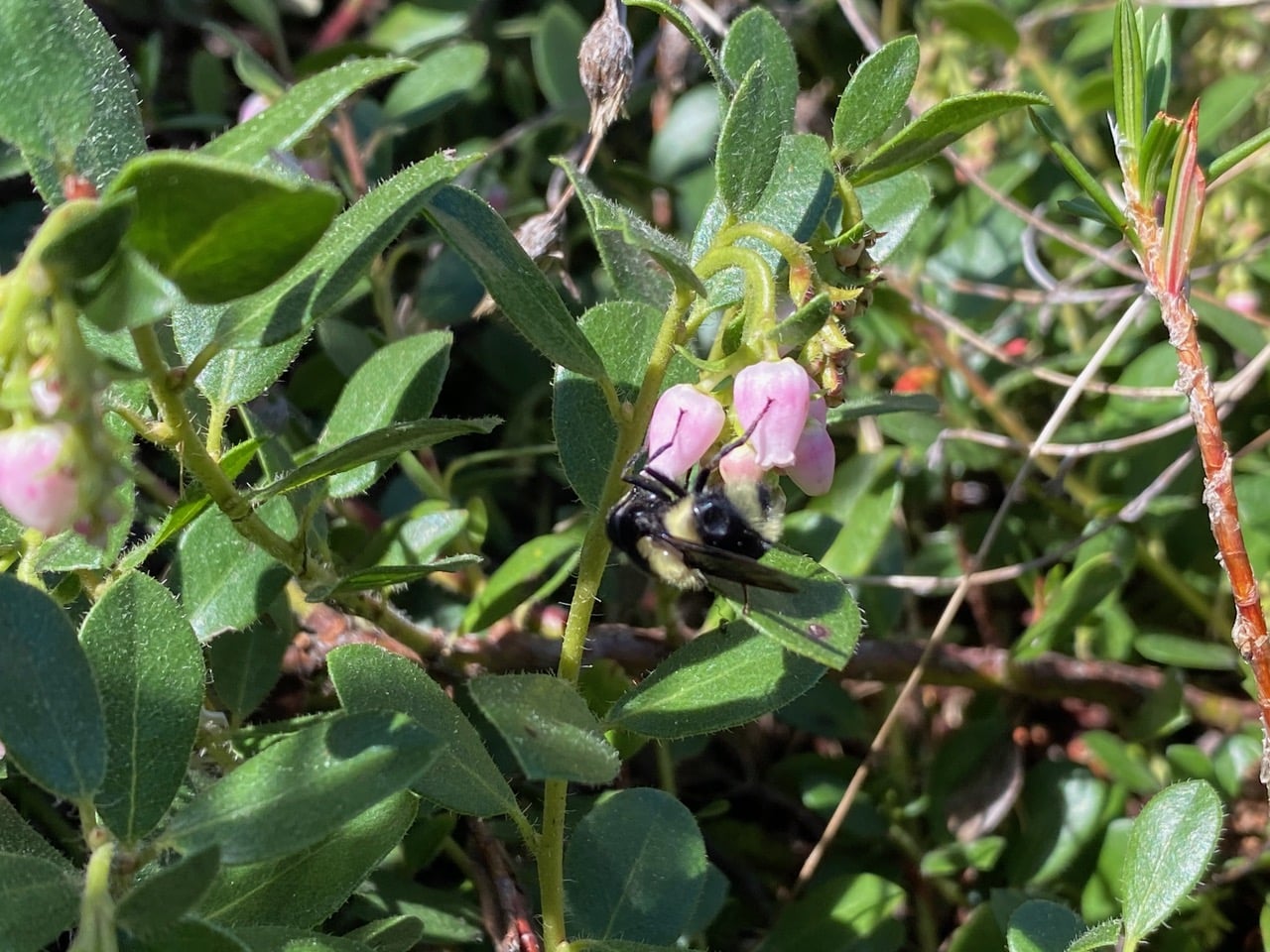
A large insect that looks like a queen Black-tailed Bumble Bee lands on a cluster of manzanita flowers. Something about the insect does not sit right with me. I can only watch from a distance, then decide to take a video of it. As the insect turns around, it is immediately obvious that it is a fly, not a bee. It is a Bumblebee Hoverfly, Volucella bombylans (family Syrphidae).
The Volucella bombylans complex comprises numerous hover flies that are bumble bee mimics, also known as Bumble Bee Hoverflies. These flies look like a bumble bee with a furry black and yellow body, but they are given away by their heads, plumed antennae, large eyes and a single pair of wings. Fast fliers, the adults feed on nectar and pollen, with a preference for blue and yellow flowers. The females lay eggs in the nests of bumble bees and social wasps. The larvae live as scavengers on the bottom of the host’s nest, feeding on waste and dead host larvae.
This provides a glimpse into a different larval niche from what most folks know about Syrphid Flies. We are familiar with the many Syrphid species that have larvae that feed on soft-bodied insects such as aphids. Quite a few other species have larvae that are aquatic filter-feeders that live in decomposing organic matter. Overall, the Syrphid larvae display a degree of habitat diversity that is unusually broad for a single family of Diptera.