

Pollinator Post 2/24/26

Taking advantage of the break in the rains, Fred and I head for Bay Farm Island for our walk. It is cloudy and I wonder if I would see any insect at all.
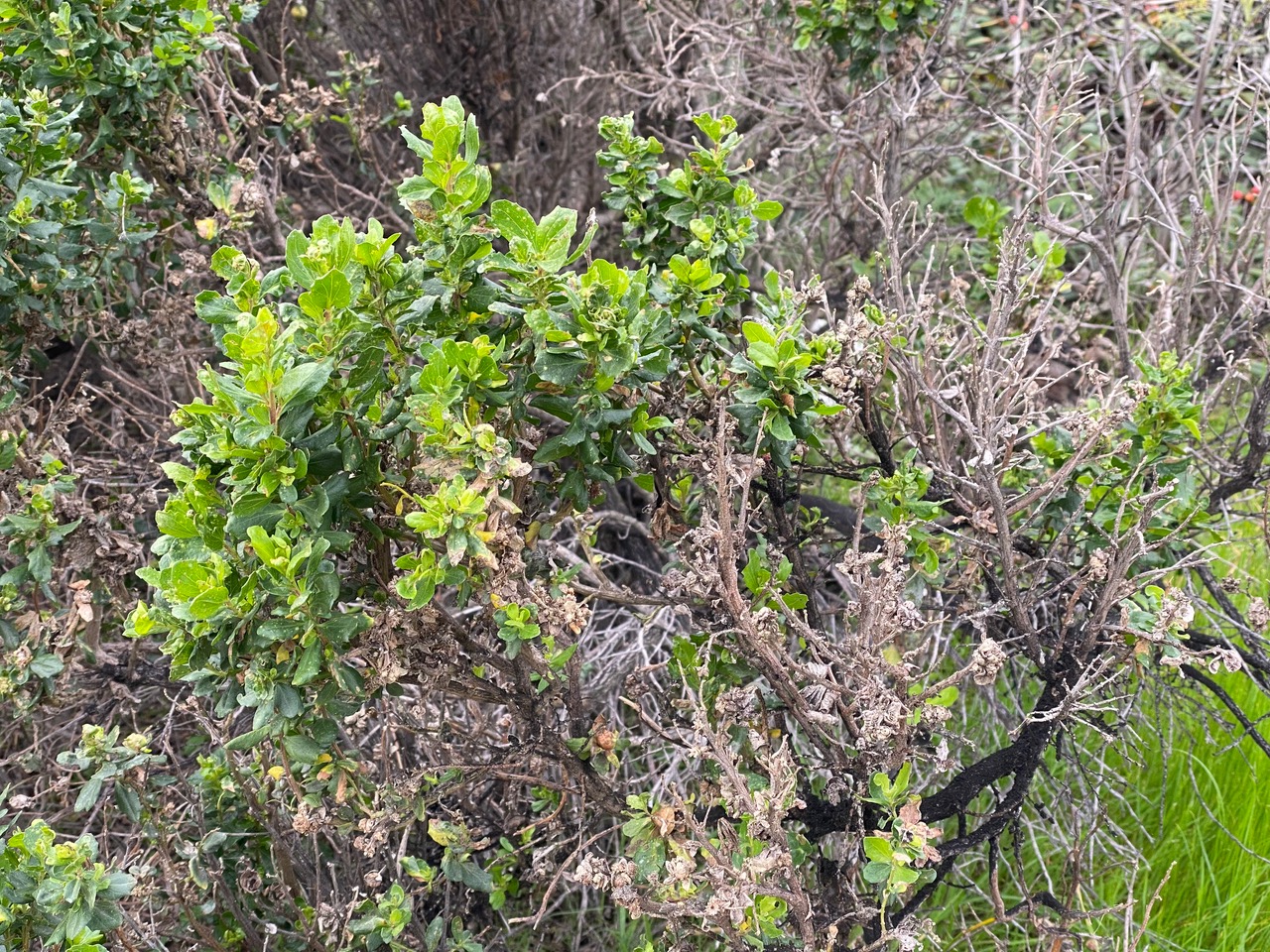
It’s past noon when I get to the big Coyote Brush, Baccharis pilularis that was devastated by a severe caterpillar infestation last year. Many of its branches have died, but some fresh new growths have sprouted on others. I am amazed by the resilience of the plant!

However, closer inspection of the shrub reveals that the new growths are not exactly healthy. The leaves are riddled with pimple-like bumps – galls induced by the Baccharis Leaf Blister Mite, Aceria baccharipha (family Eriophyidae).
Eriophyid Mites are microscopic mites that often go undetected. Unlike most adult mites that have four pairs of legs, eriophyid mites have only two pairs. They are slow-moving, usually white or yellow in color, and have a distinctive “carrot” shape. They are very host-specific. Most eriophyid mites make their home on the surface of leaves where their feeding can cause bronzing or reddening but some are also responsible for creating galls on leaves or witches’-broom on stems and flower buds. Adult females overwinter in cracks and crevices of twigs and bud scales. Females lay eggs in the spring. The young mites that hatch out resemble the adults. Numerous generations are produced each year. They are primarily spread by wind.
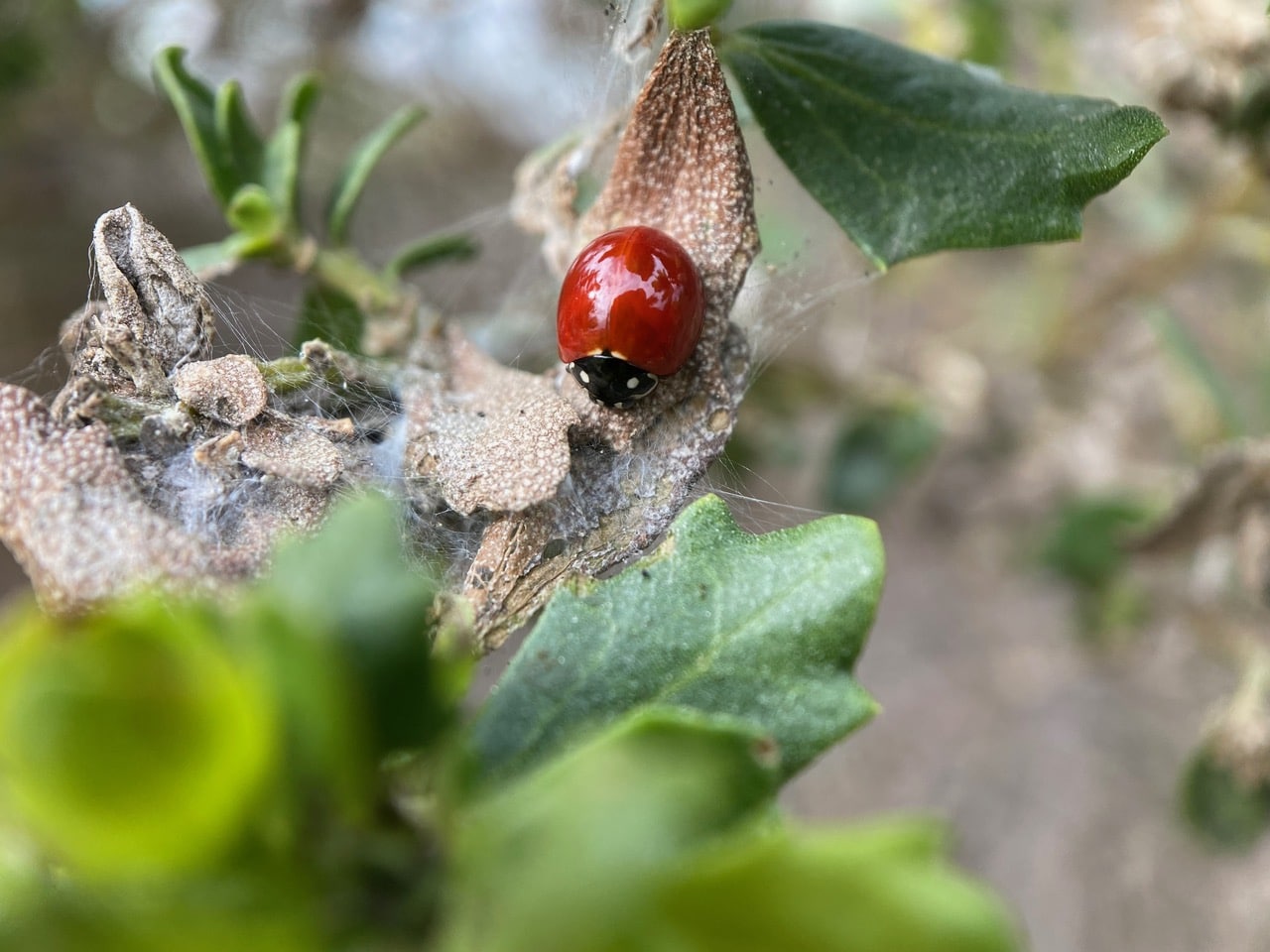
A Spotless Lady Beetle is resting on some dried foliage of the Coyote Brush.
The Spotless Lady Beetle, Cycloneda sanguinea (family Coccinellidae) is a widespread species of lady beetle in the Americas. It is is a large lady beetle with red, unspotted elytra (wing covers) ranging from 4-6.5 mm long. The black and white marks on the head and pronotum are very distinctive, and they are also gender-specific. Both adult and larvae of Spotless Lady Beetles are voracious predators of aphids. They are very often found feeding on aphids on milkweeds, but also occur on a number of other plants. Adults live longer when nectar and pollen are available for nourishment when prey is scarce.
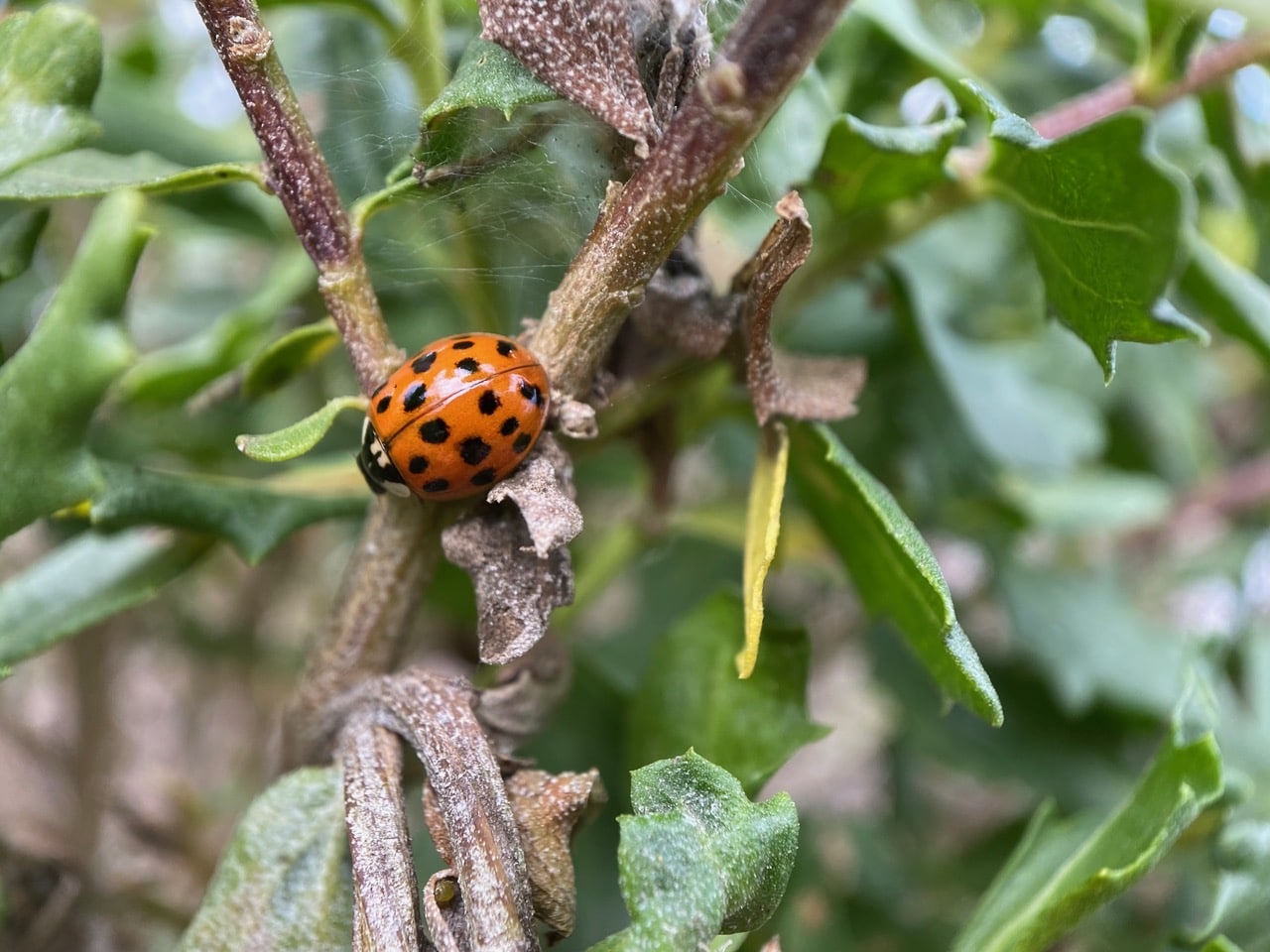
Not far away, a larger lady beetle with multiple spots is resting on a branch. It is an Asian Lady Beetle, Harmonia axyridis (family Coccinellidae).
The beetle is a voracious predator of arthropod pests such as aphids, mites, thrips, scale and Lepidoptera eggs. Introduced from Asia for biological control of arthropod pests during the twentieth century, it has since become established all over the US. The adult beetles are highly variable in appearance, varying in color as well as the number and size of spots. It is believed that the Asian Lady Beetles are aggressive competitors of native ladybeetles. This supposition remains to be proven scientifically. Adult beetles aggregate in high numbers to overwinter, favoring human dwellings. When threatened the beetle produces a yellow viscous, foul-smelling defensive compound, making themselves unwelcome house guests.
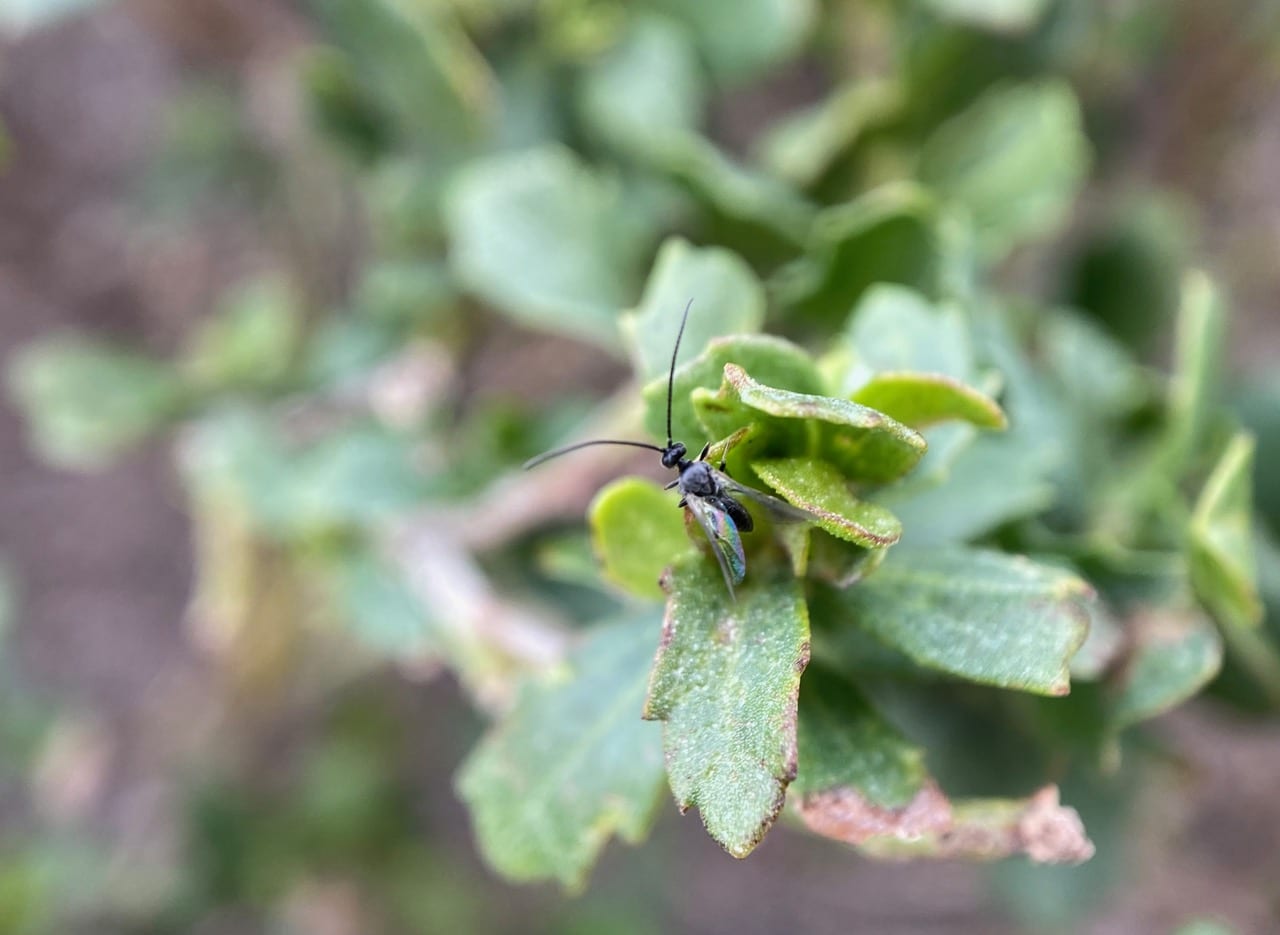
Several tiny insects are dancing over the Coyote Brush. When one finally lands, I realize that it is not a midge, but a wasp with very long antennae. Braconid or Ichneumonid wasp? iNaturalist has helped identify it as a Braconid Wasp, Chelonus sp. (family Braconidae).
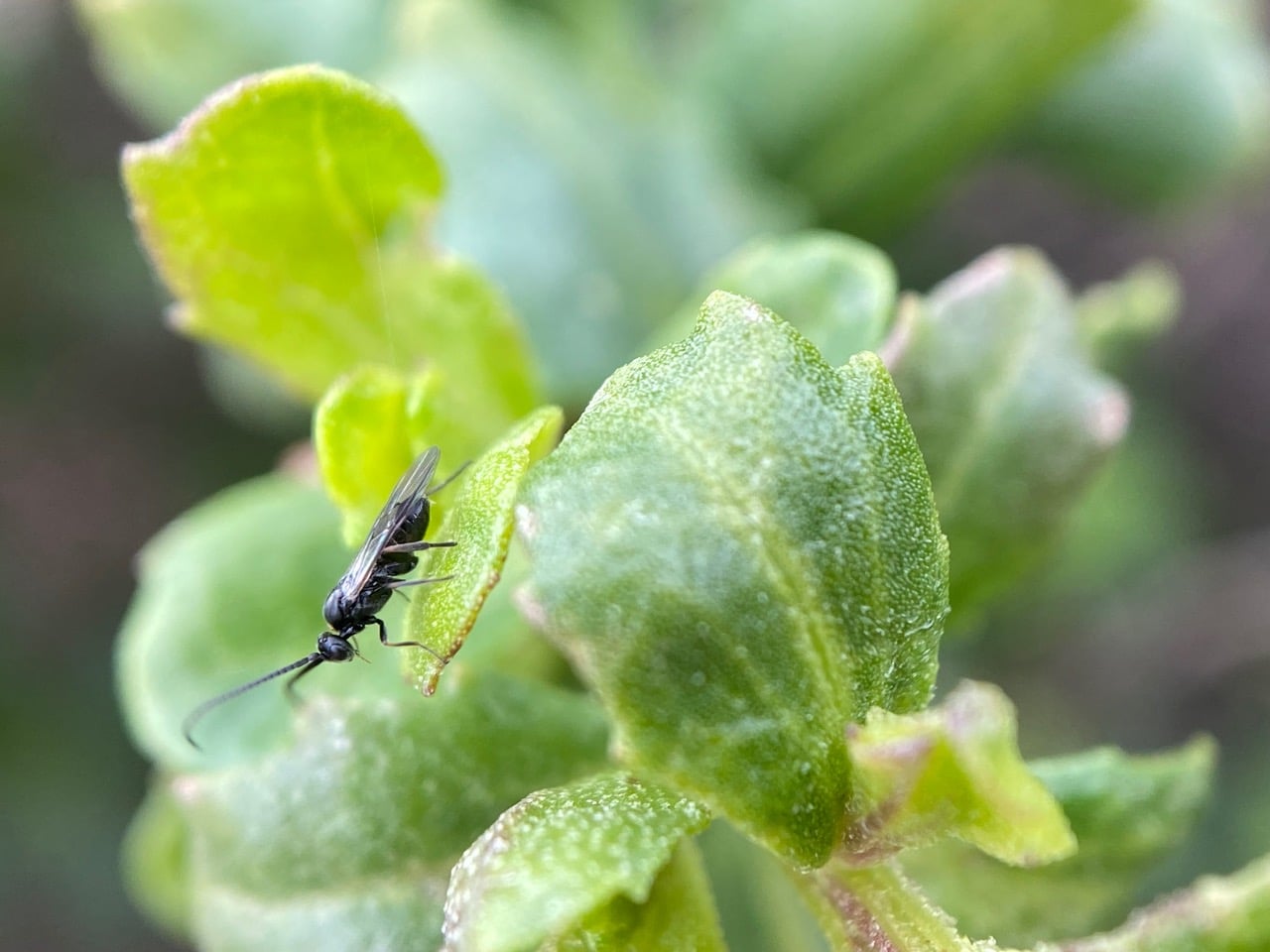
The wasp probes every nook and cranny of the Coyote Brush foliage with its long antennae.
The Braconidae are a family of parasitoid wasps. After the closely related Ichneumonidae, braconids make up the second-largest family in the order Hymenoptera, with about 17,000 recognized species. Females often have long ovipositors to lay eggs on or in their hosts. The larvae of most braconids are internal primary parasitoids of other insects, especially the larval stages of Coleoptera, Diptera, and Lepidoptera. Generally, the braconid life cycle begins when the female wasp deposits her eggs in the host insect, and the braconid larvae develop in the host body, eating it from the inside out. When the wasp larvae are ready to pupate, they may do so in or on the host insect. The new generation of adult braconid wasps emerges from their cocoons and begins the life cycle again.
Braconid wasps use a remarkable weapon to disable the defenses of their host insects – a virus. These parasitic wasps coevolved with polydnaviruses (read poly-DNA-virus), which they carry and inject into the host insects along with their eggs. The virus attacks the host’s immune system and renders it unable to encapsulate the wasp egg; it also halts the host’s development, so it can’t pupate and transform into an adult. Amazingly, the “bracovirus” also changes the host’s metabolism so that it can survive longer without food or water – thus ensuring a nurturing environment for all the young wasps to come.
Chelonus is a wasp genus in the family Braconidae. Their larvae feed chiefly on larvae of moths in superfamilies Tortricoidea and Pyraloidea.

Hey, that’s a different, larger wasp. iNaturalist has helped identify it as an Ichneumonid Wasp in the tribe Exenterini (family Ichneumonidae).
The Ichneumonidae, also known as the Ichneumon Wasps, or Ichneumonids, are a family of parasitoid wasps. They are one of the most diverse groups within the Hymenoptera (the order that includes the ants, wasps and bees) with about 25,000 species and counting. Ichneumon Wasps attack the immature stages of insects and spiders, eventually killing their hosts. They play an important role in the ecosystem as regulators of insect populations.
The Ichneumon Wasps have longer antennae than typical wasps, with 16 segments or more as opposed to 13 or fewer. Ichneumonid females have an unmodified ovipositor for laying eggs. They generally inject eggs either directly into their host’s body or onto its surface, and the process may require penetration of wood. After hatching, the Ichneumonid larva consumes its still living host. The most common hosts are larvae or pupae of Lepidoptera (butterflies and moths), Coleoptera (beetles) and Hymenoptera. Adult Ichneumonids feed on plant sap and nectar. Females spend much of their active time searching for hosts while the males are constantly on the look out for females. Many Ichneumonids are associated with specific prey, and Ichneumonids are considered effective biological controls of some pest species.
Exenterini is a tribe of parasitic wasps within the Ichneumonidae family (subfamily Tryphoninae), specifically acting as parasitoids of Diprionidae sawflies. These slender, specialized parasitoids are found in North America and Eurasia. These wasps do not construct nests, with females laying eggs directly on sawfly larvae on which the wasp larvae feed. They are considered beneficial insects for controlling sawfly populations.
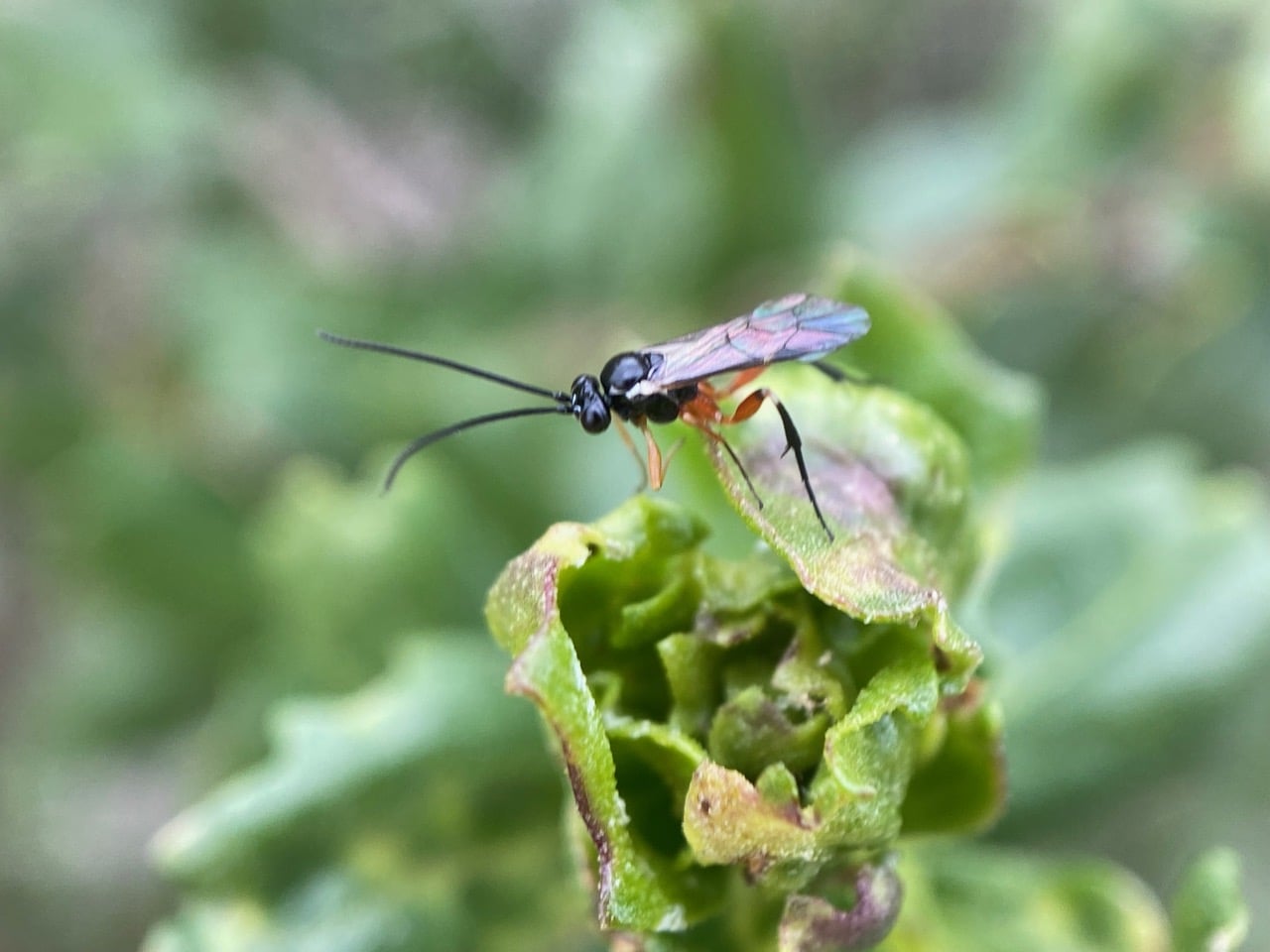
Ooh, here’s another parasitic wasp lurking on the terminal leaves of Coyote Brush. From the color pattern of its hind legs, I recognize it as the Common Hover Fly Parasitoid Wasp, Diplazon laetatorius (family Ichneumonidae) – yet another Ichneumonid wasp!
Diplazon laetatorius is a member of the Ichneumonid wasp family and is 4-7 mm long. The body is mostly black; front two pairs of legs are orange, while the hind legs are highly distinctive and key for identification, featuring a tricolored pattern of black, white and orange. The species has a wide geographic range, from the Canadian Arctic to Argentina, Norway to South Africa, and Japan to New Zealand. Human agriculture is thought to have spread it along with aphids and syrphid flies. Adults feed on floral nectar, with a preference for flowers in the Apiaceae family. Females lay their eggs on or near the eggs and larvae of hover flies (family Syrphidae). The developing parasitoid larvae consume the host from within, eventually completing development and emerging as adult wasps.
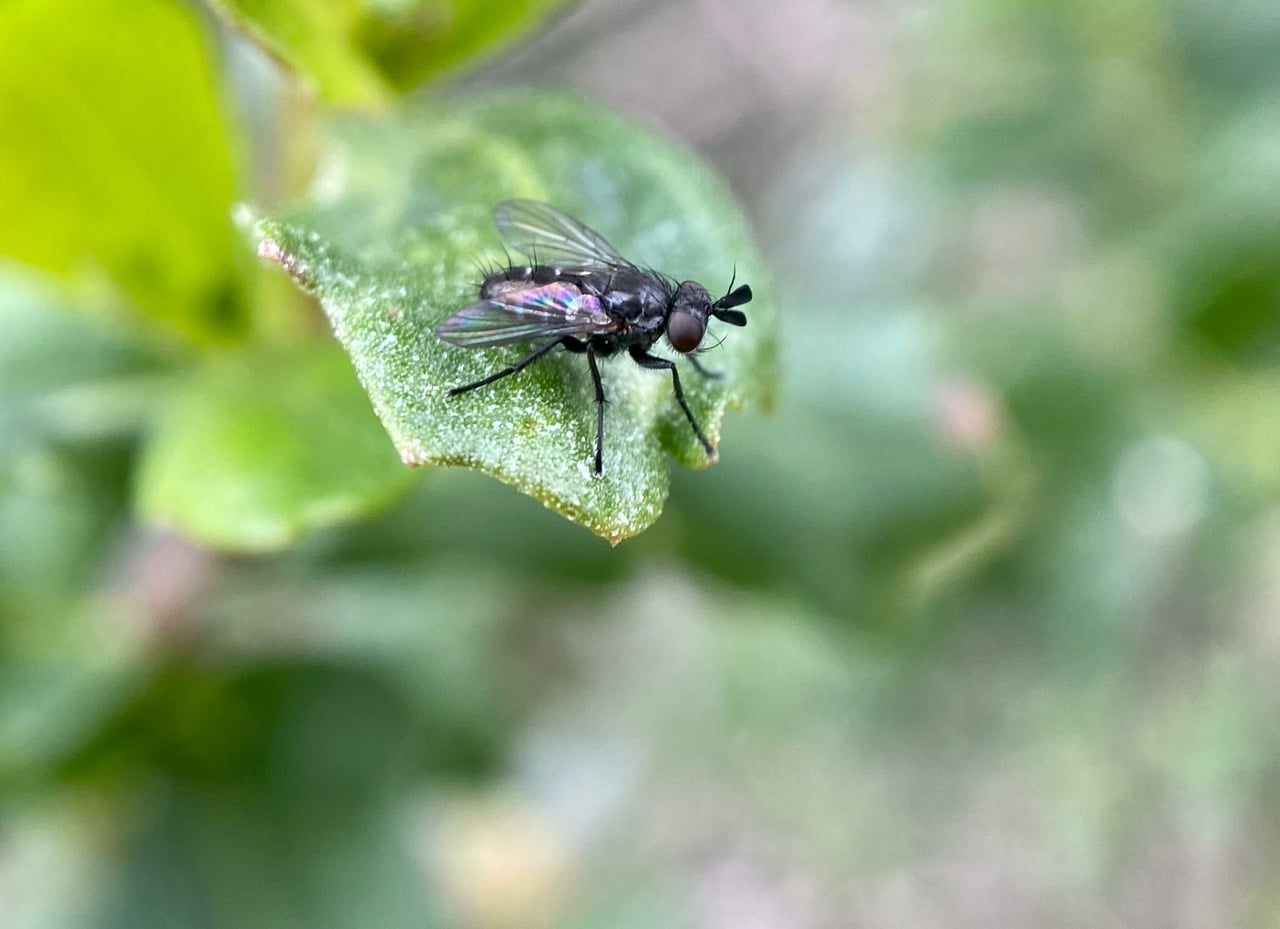
A tiny fly with prominent antennae has landed on a leaf of Coyote Brush. iNaturalist has identified it as a Bristle Fly, Triarthria setipennis (family Tachinidae).
The family Tachinidae is by far the largest and most important group of parasitoid flies. All species are parasitic in the larval stage. Most adults have distinct abdominal bristles, hence the common name. Adults feed on liquids such as nectar and honeydew. They can be found resting on foliage, feeding at flowers or searching for hosts.
Most tachinids attack caterpillars, adult and larval beetles, true bugs, grasshoppers, and other insects. Females lay eggs in or on the host. Tachinid larvae live as internal parasites, consuming their hosts’ less essential tissues first and not finishing off the vital organs until they are ready to pupate. The larvae leave the host and pupate on the ground. Tachinids are very important in natural control of many pests, and many have been used in biological control programs.
Triarthria setipennis is a specialized tachinid fly (family Tachinidae) used as a biological control agent against the European earwig, Forficula auricularia. Originally from Europe, it is established in parts of western North America. It is ovoviviparous, with females laying eggs near host earwigs. (Ovoviviparous describes a reproductive strategy where animals produce eggs that hatch inside the mother’s body, resulting in the birth of live young without placental attachment.) The larvae eventually burrow into the host. The fly is characterized by having long basal arista segments (antennae structure), and small hairs on the parafacial area near the eye. The fly is often found in areas with host populations, such as woodland areas. The species overwinters as a puparium, often after the larva leaves the host to pupate.
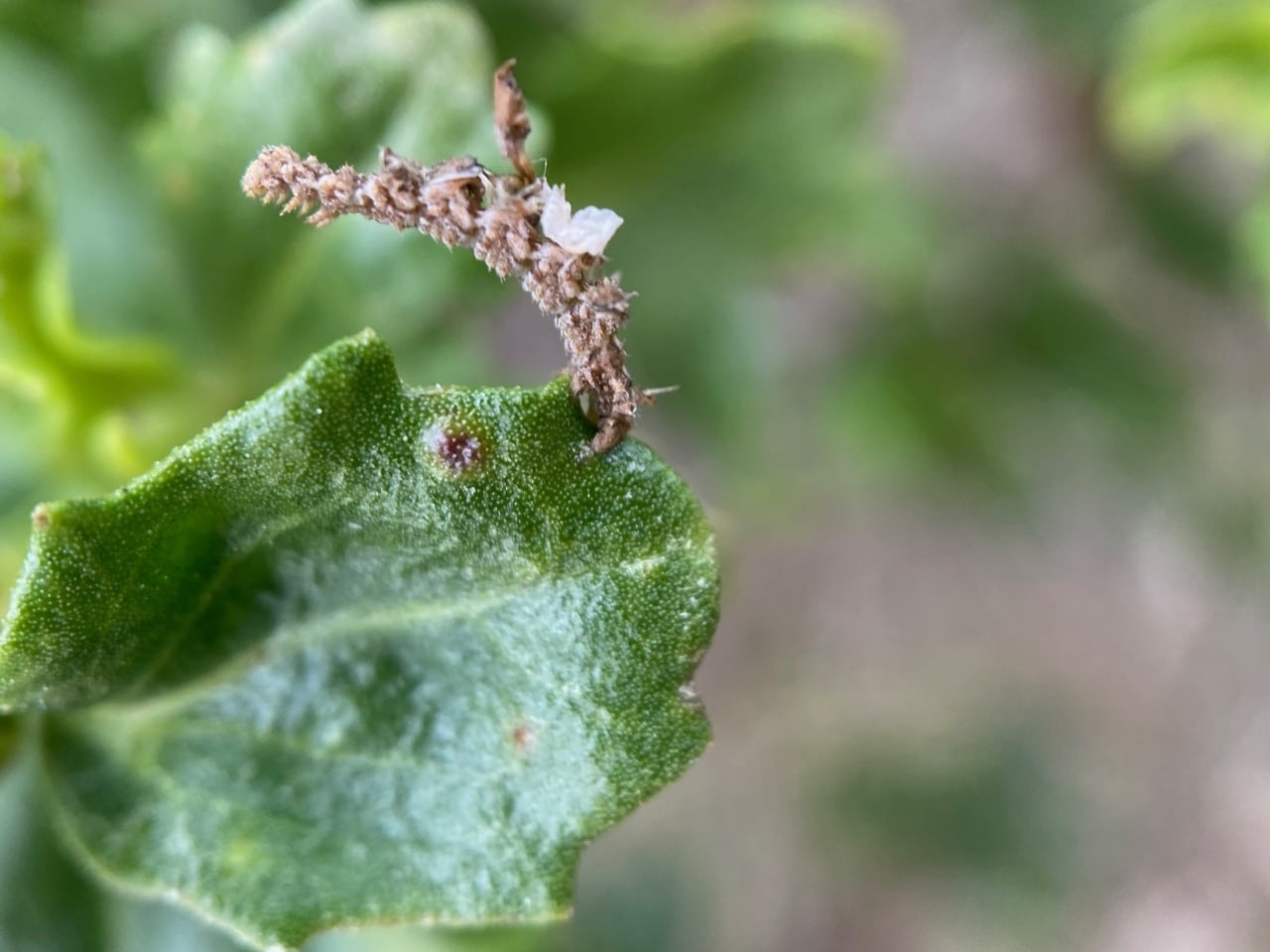
A tiny movement alerts me to the presence of an Inchworm on a leaf of Coyote Brush. It is so well camouflaged I would’ve mistaken it for plant debris had it not suddenly reared up from the leaf. iNaturalist has helped identify the caterpillar as a member of Emerald Moths, Nemoria sp. (family Geometridae).
Inchworms are also called loopers and measuring worms. The majority of the inchworms are the larvae of moths in the family Geometridae. The name comes from the Greek “geo” for earth and “metro” from measure, because the caterpillars seem to be measuring the surface on which they are walking.
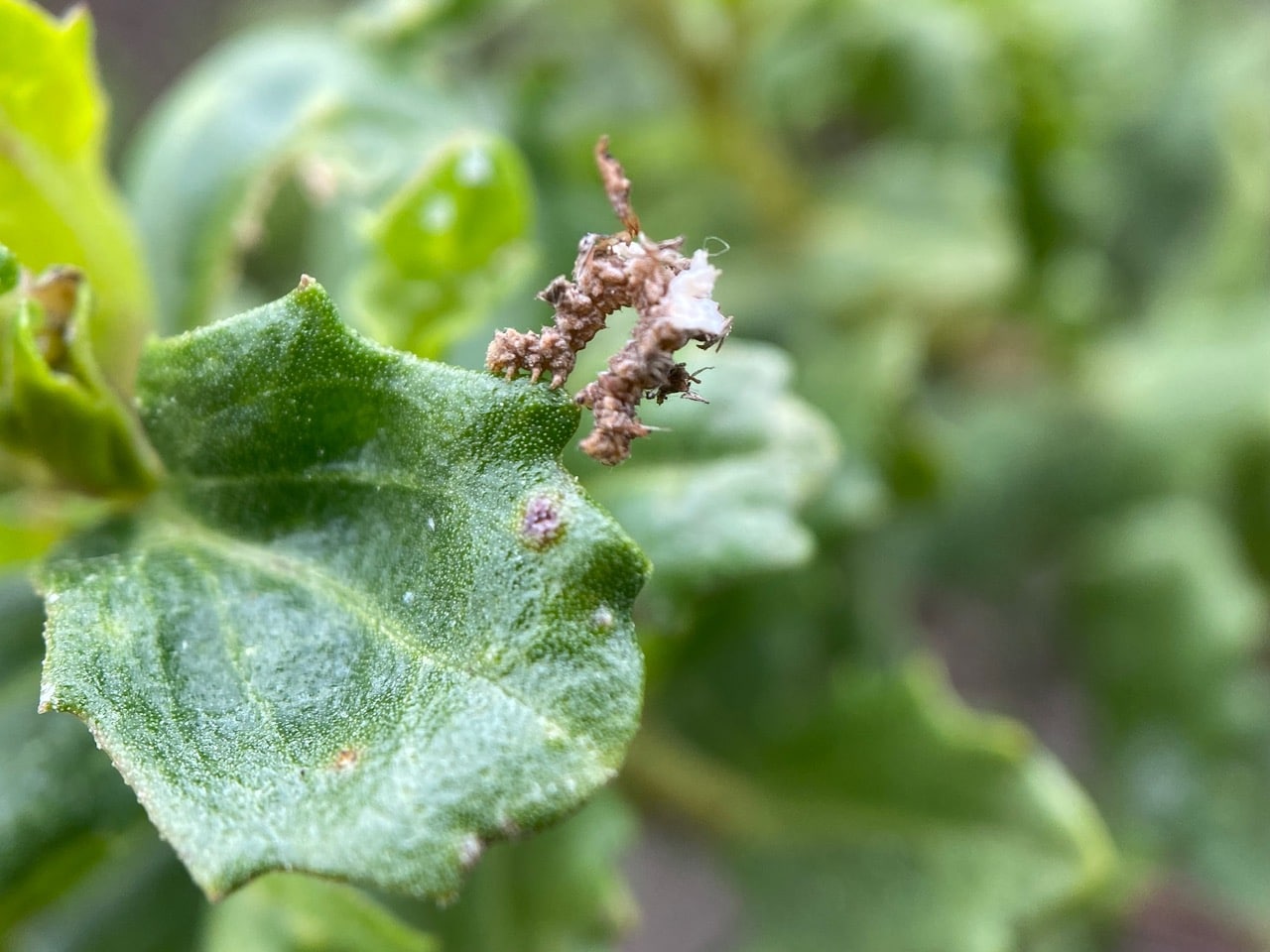
Mesmerized, I watch the caterpillar “inch” its way through the foliage for 15 minutes. I have seen similar decorated inchworms before, but they were mostly found on flowers and had bits of flower parts attached to their back. There are no flowers on the plant at the moment, and the caterpillar has disguised itself with bits of plant debris.
Nemoria caterpillars, commonly known as “camouflaged loopers” attach bits of petals, leaves, and other plant debris to their backs to disguise themselves from predators. The caterpillar uses its mouth to clip pieces of flowers or leaves and uses specialized silk from its spinnerets to attach them, effectively hiding in plain sight. If the caterpillar moves to a different plant or if its current disguise wilts, it will replace the debris with fresh, matching material. This behavior, often seen from spring to early fall, helps them avoid predators like spiders and birds. These caterpillars are common in North America and can be found on a variety of plants, including, but not limited to Asteraceae family.
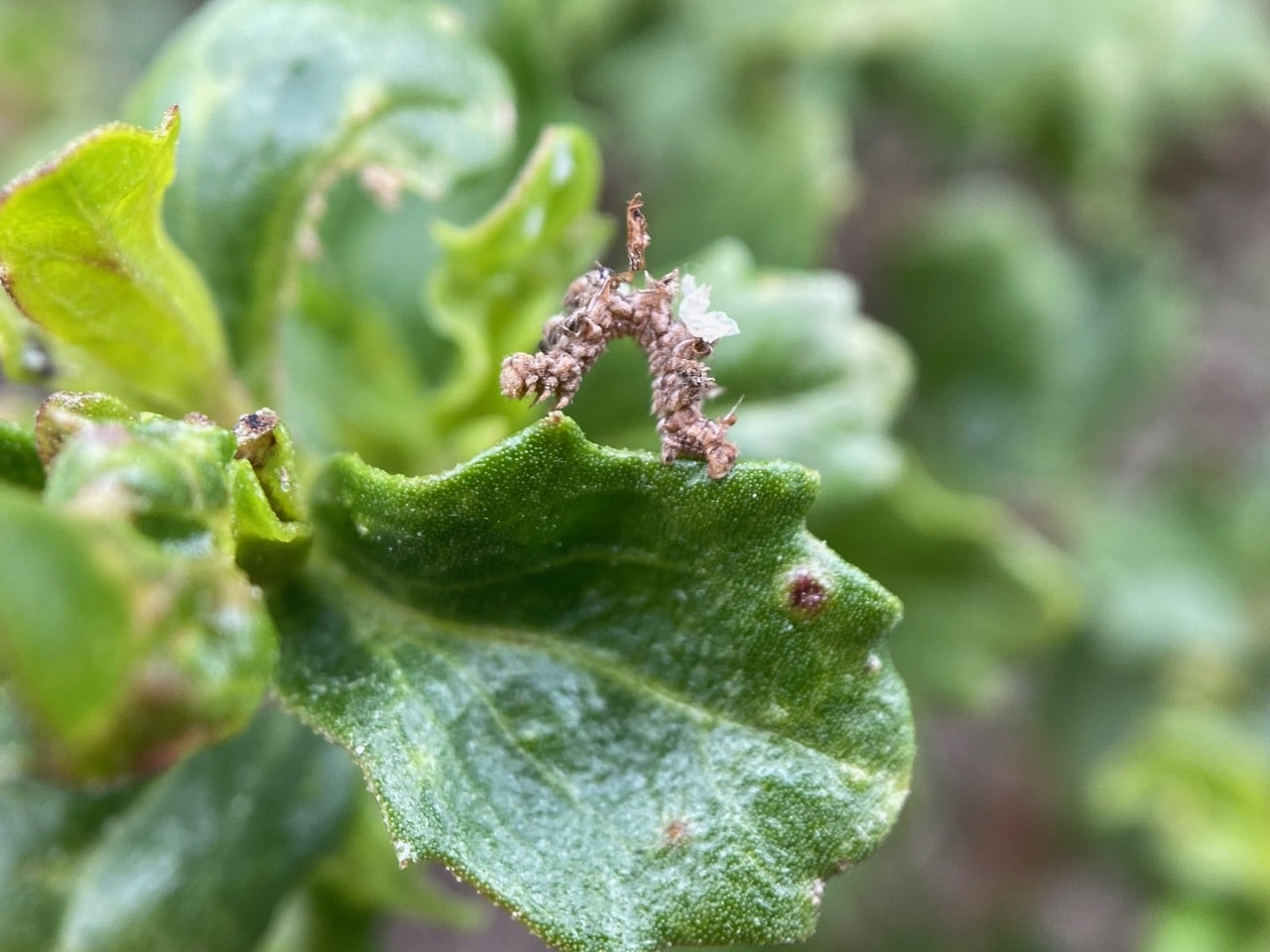
The three pairs of true legs can be seen here lifting off the surface of the leaf. Note that there are no prolegs between the true legs and the anal prolegs in the rear, resulting in the looping locomotion of the inchworm.
All caterpillars have three pairs of jointed legs behind their heads. These legs are called true legs because they will become the six legs of the adult butterfly or moth. There are additional appendages, called prolegs, along their bodies. Prolegs are not true legs, they are just outgrowths of the body wall and will be lost at metamorphosis. They have little hooks on their soles to help the caterpillar walk and grip onto things.
Most caterpillars have five sets of prolegs, four in the middle of the body and one pair at the hind end. Inchworms have the normal six true legs but only two or three pairs of prolegs, all located at the tail end of the body, with none in the middle. When an inchworm walks, it moves its tail-end prolegs up behind its true legs, causing the center of its body to loop upward. Then it stretches its front end forward to take another step.
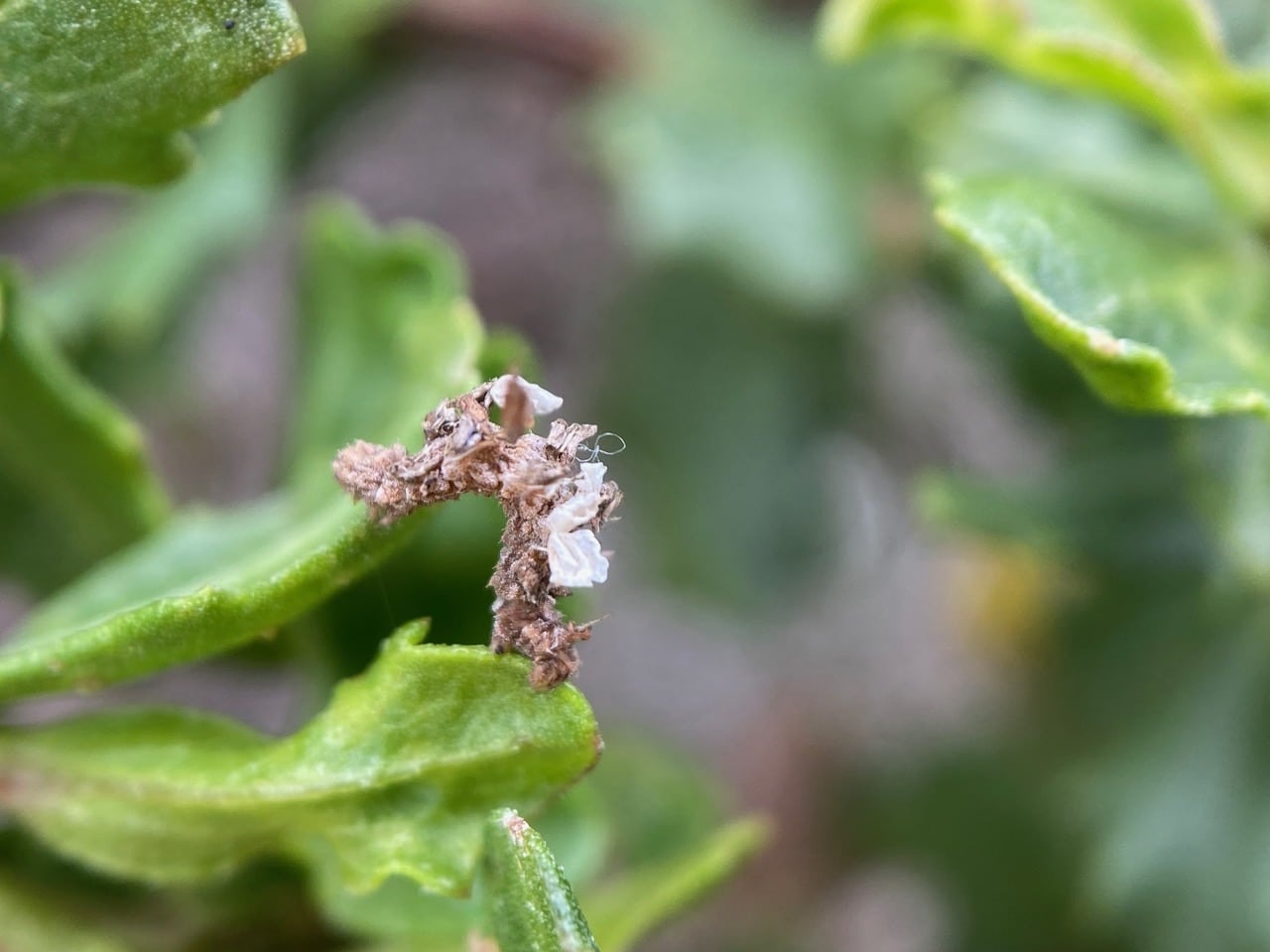
Even under the highest magnification I can muster, It is hard to figure out what exactly the inchworm has dressed itself in. Mostly brown plant debris that matches its body, and some white petals (from the flowers of Perez’s Sea Lavender so common along the shore here)?
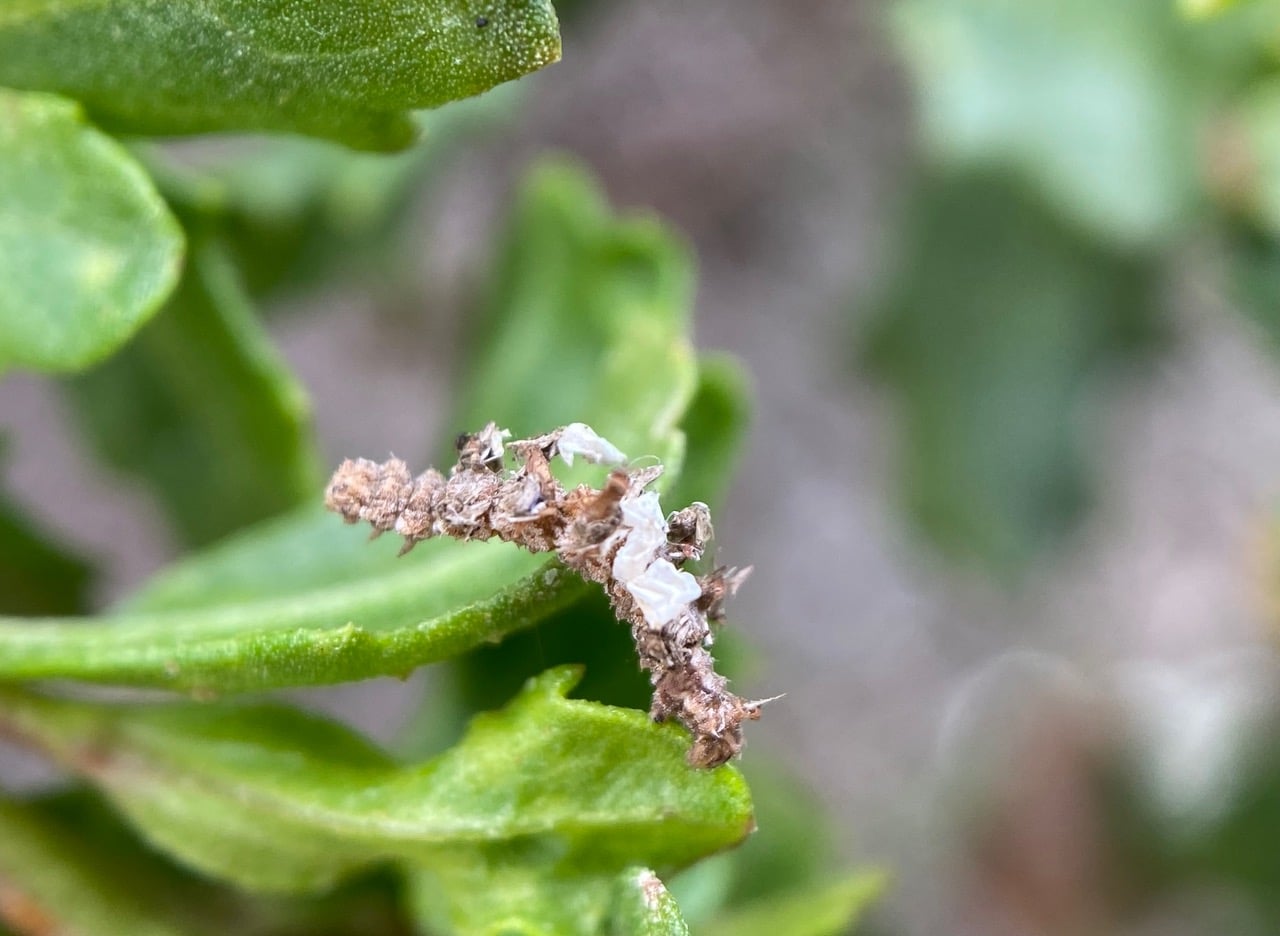
The inchworm climbs from one leaf to the next, spanning gaps with amazing ease and agility.
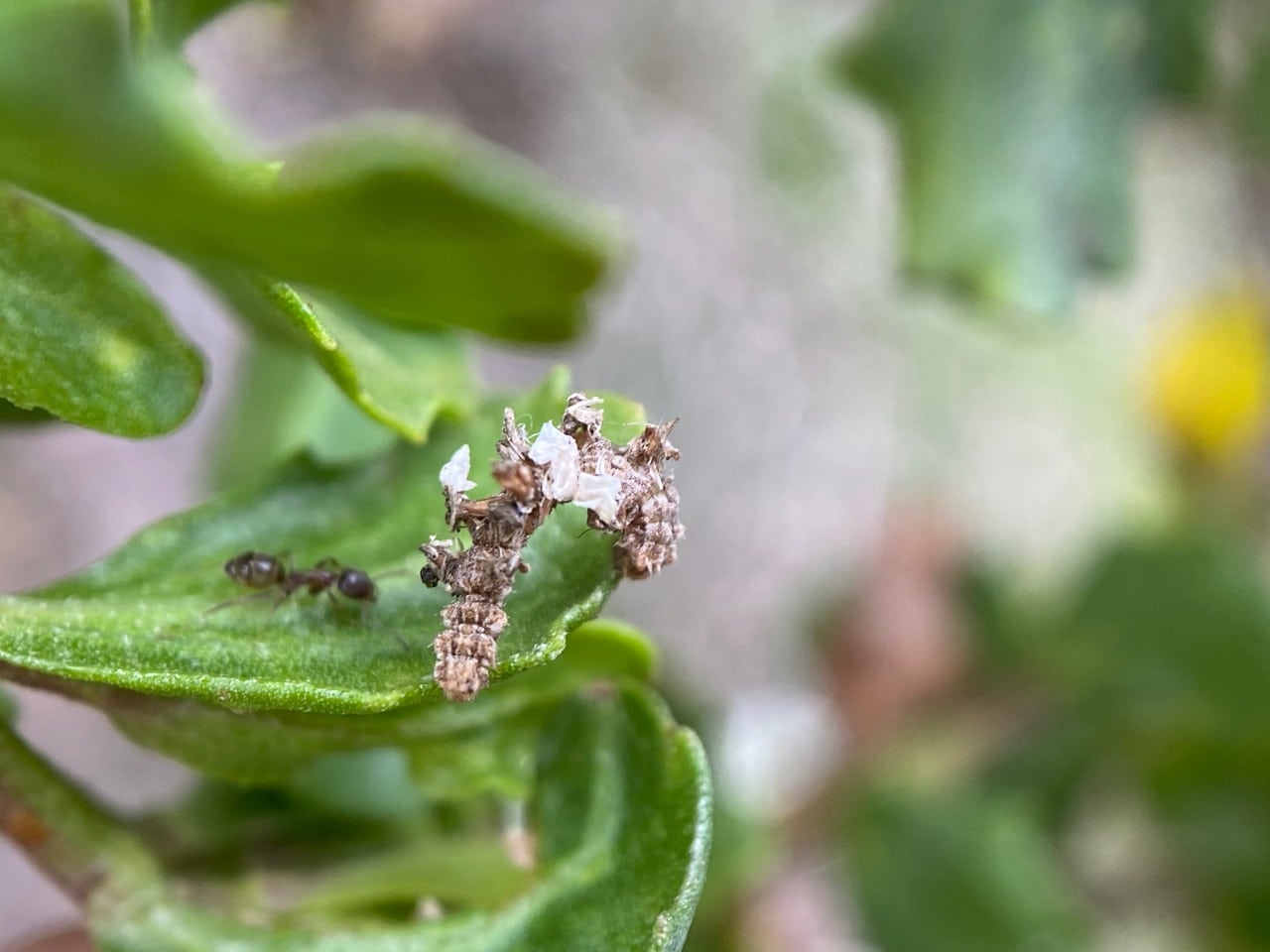
Uh oh, an Argentine Ant is approaching our inchworm. Will it attack the caterpillar? Will it even recognize the caterpillar as something alive? I watch with bated breath.

The inchworm holds perfectly still. After a while, the ant walks away, disinterested. The camouflage worked!

When the inchworm starts to move around again, I spot the young Brown Soft Scales on the stem of the Coyote Brush. Maybe that’s what attracted the ants – they are here to feed on the honeydew excreted by the scales?
The Brown Soft Scale, Coccus hesperidum (family Coccidae) has a cosmopolitan distribution and feeds on many different host plants – crops, ornamental and greenhouse plants. Like other “true bugs” in the order Hemiptera, they have piercing-sucking mouthparts which they use to suck sap from plants. The adults are sedentary, and stay attached to the host plants for life. In order to obtain all the nutrients they need, the scale insects ingest large quantities of sap. They then excrete the excess sugary fluid as honeydew. This is attractive to ants which often tend the scale insects, driving away predators.

It’s low tide at 1 pm as I walk back. The edge of the path by the bay is covered with the yellow flowers of Bermuda Buttercup, Oxalis pes-caprae.
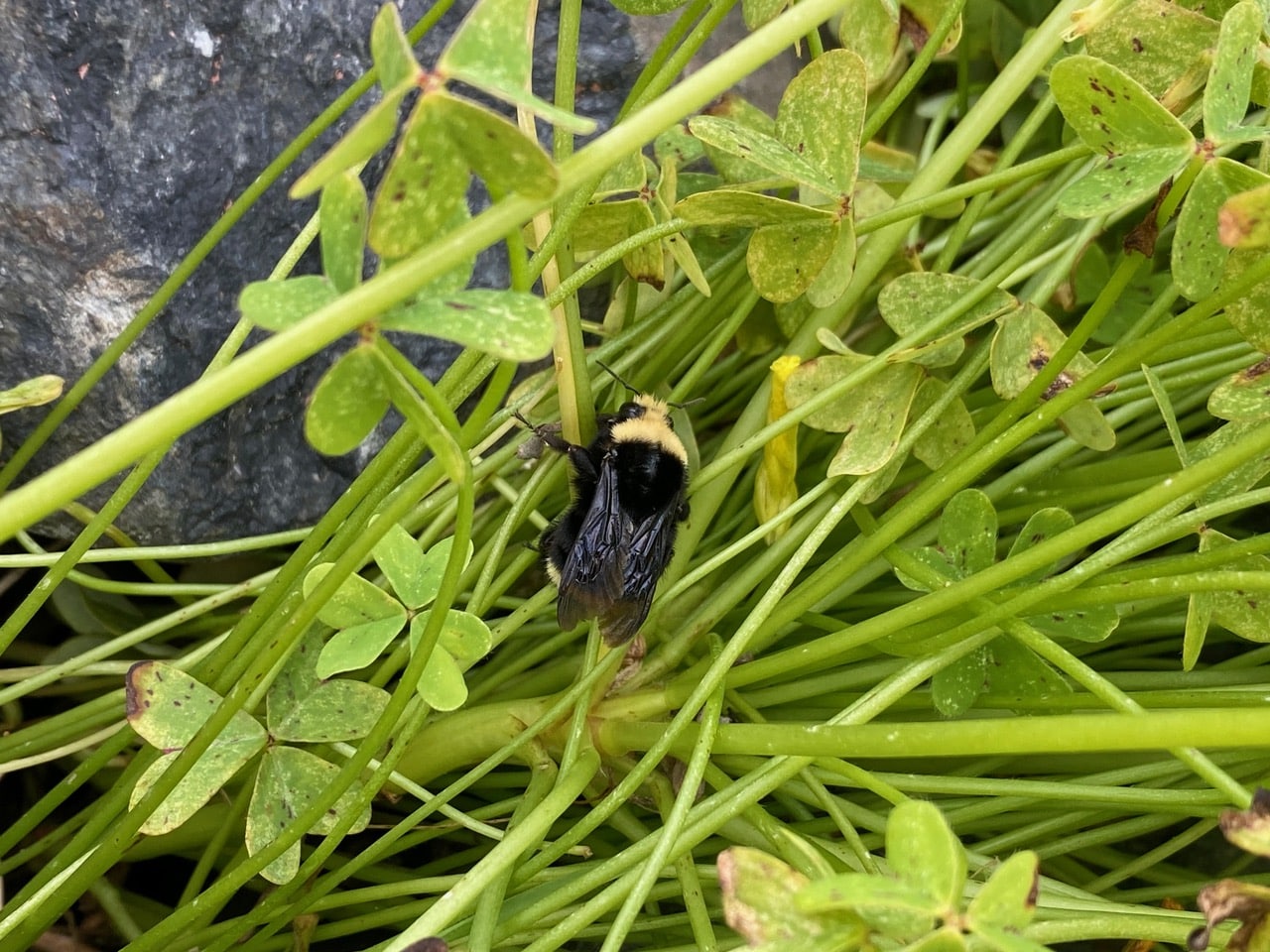
A large queen Yellow-faced Bumble Bee, subgenus Pyrobombus (genus Bombus, family Apidae) is flying low over the low vegetation, seeming to be searching for a nesting site. She is one of only three I see today on the walk. The queen finally lands among the Bermuda Buttercup to take a break. Life must have been especially hard for these queens over the past week, with rain and cloudy skies on most days. These queens, fresh out of hibernation must have been hard pressed to find food and shelter, in addition to having to search for a nesting site. Once the queen has started a brood, she has to forage for floral resources to feed the young as well. It’s a tall order for the single mom at a time when few plants are in bloom.
Bumble bees are social and live in colonial hives. Many of the large individuals seen early in the season are queens. They are the only members of their colony to survive the winter, hibernating until the days begin to warm and their host plants are in bloom. These queens have mated before they went into hibernation. Now their first order of business is to each find a nesting site (usually an abandoned rodent burrow), lay eggs, brood and nurture the first batch of workers. Thereafter, the queens stay behind in the hive to concentrate on laying eggs while the workers take on hive duties and foraging. At the end of the season, usually in late summer, the colony produces gynes and drones (males). These mate with others from neighboring colonies. The mated queens go off to find a safe place to hibernate through the winter, while the rest of the colony, including the old queen dies. And so the cycle is repeated.
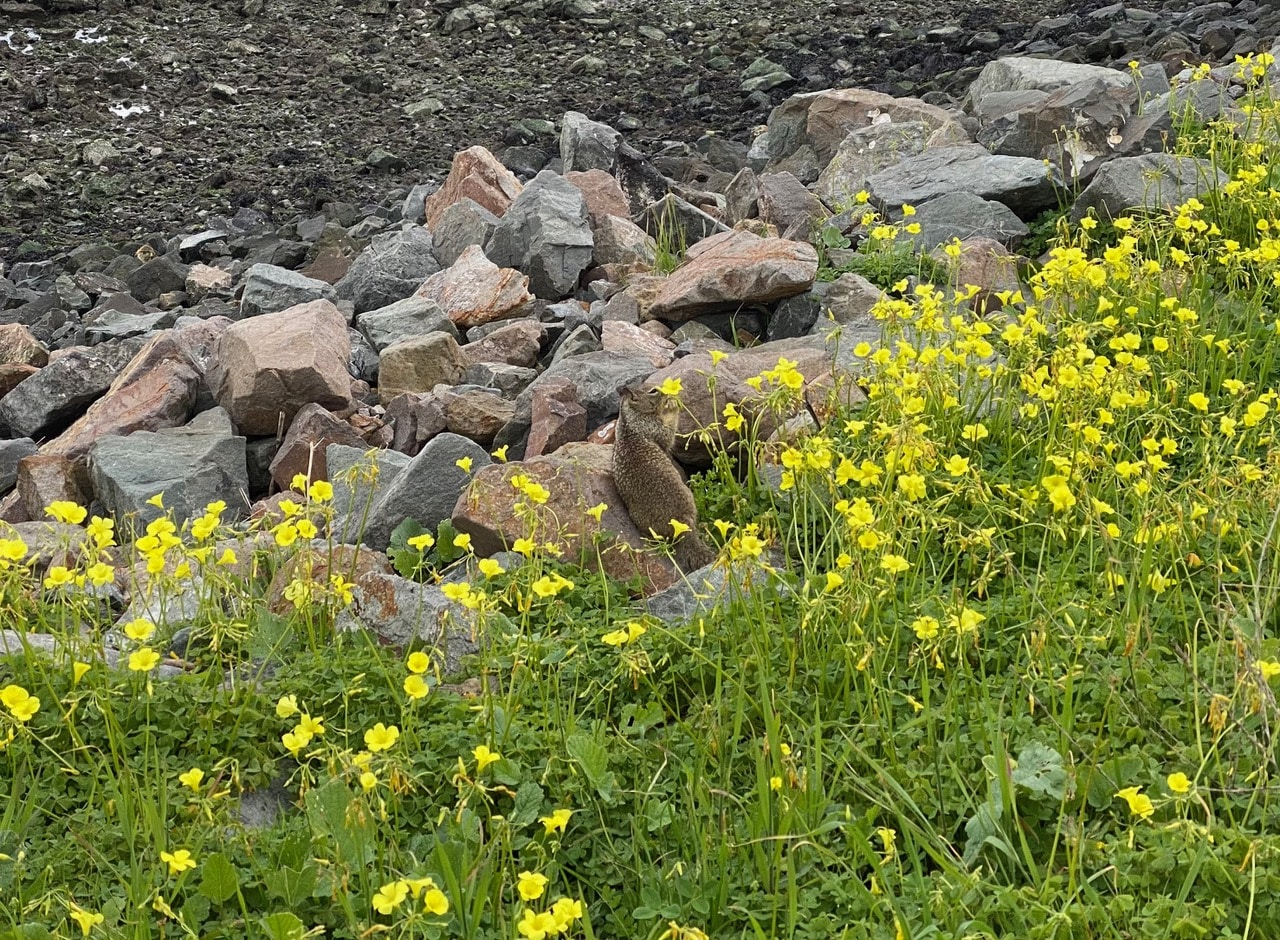
I stop to watch a California Ground Squirrel, Otospermophilus beecheyi feast on the flowers of Bermuda Buttercup. On a fine day, I usually encounter dozens of these adorable rodents feeding on the low vegetation along the paths. They have a mottled gray-brown coat, and shorter, sparser, flatter tails compared to tree squirrels. Ground squirrels have short legs and a more stocky, cylinder-shaped body to navigate underground. Ground squirrels have cheek pouches to carry food back to their burrow. They are considered to be mostly herbivorous, with seeds, grains, nuts, fruits, and sometimes roots constituting most of their diet. When threatened by approaching dogs or bicycles, they have a habit of escaping into underground burrows. They live in colonies, unlike the solitary tree squirrels.

The ground under the Monterey Pines is littered with broken and partially eaten cones and loose scales. The scales have been stripped of their attached seeds. This is the handiwork of another species of squirrels – the Eastern Fox Squirrels, Sciurus niger. These tree dwellers are one of two species of squirrels that live on Bay Farm Island.
Rather similar in appearance to the California Ground Squirrels, the Eastern Fox Squirrels are slightly larger in size, and tend to hold up their long, thick bushy tails in a more upright posture while feeding. When threatened, they run up the trees where they build globular nests, known as dreys, in tree branches. Compared to ground squirrels, tree squirrels are more agile and slender, with longer hind legs for climbing.
Red squirrels harvest pine cones using their sharp, chisel-like incisors to cut down ripe or green cones, allowing them to fall to the ground, to be dismantled ‘corn-on-the-cob’ style. They frequently sit on a specific log or spot at the base of a tree, creating piles of debris known as middens as they feed. They hold the cone, using their teeth to gnaw off the woody scales, working from the base upward in a spiral pattern to access the two seeds hidden under each scale, leaving behind a naked, stripped cone core. Red squirrels are active all winter long, but they still like to stockpile food to make it through inclement weather.