

Pollinator Post 2/23/24 (2)
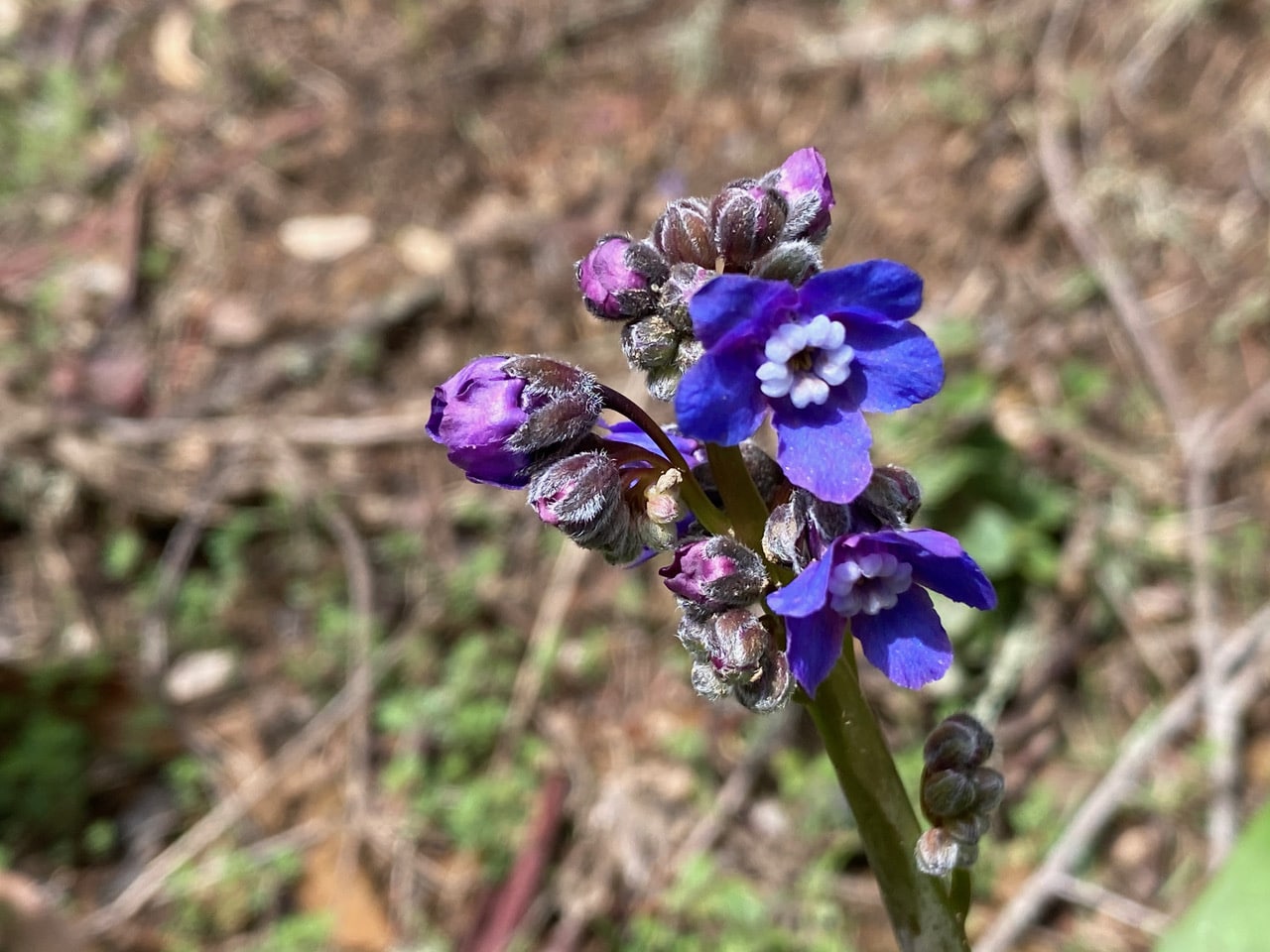
The Western Hound’s Tongue, Adelinia grandis (family Boraginaceae) is blooming in profusion in the woodlands at Roy’s Redwood Preserve.


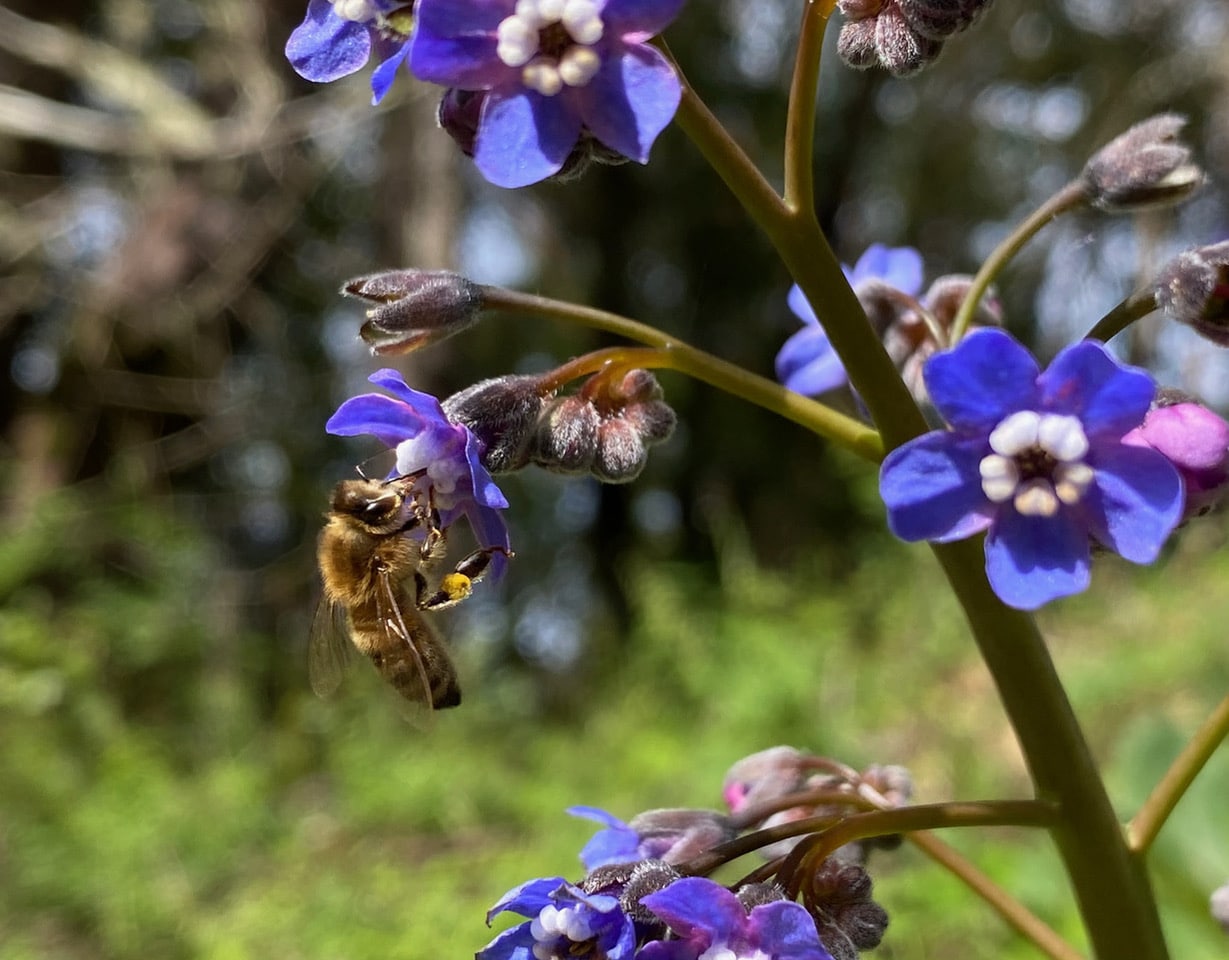
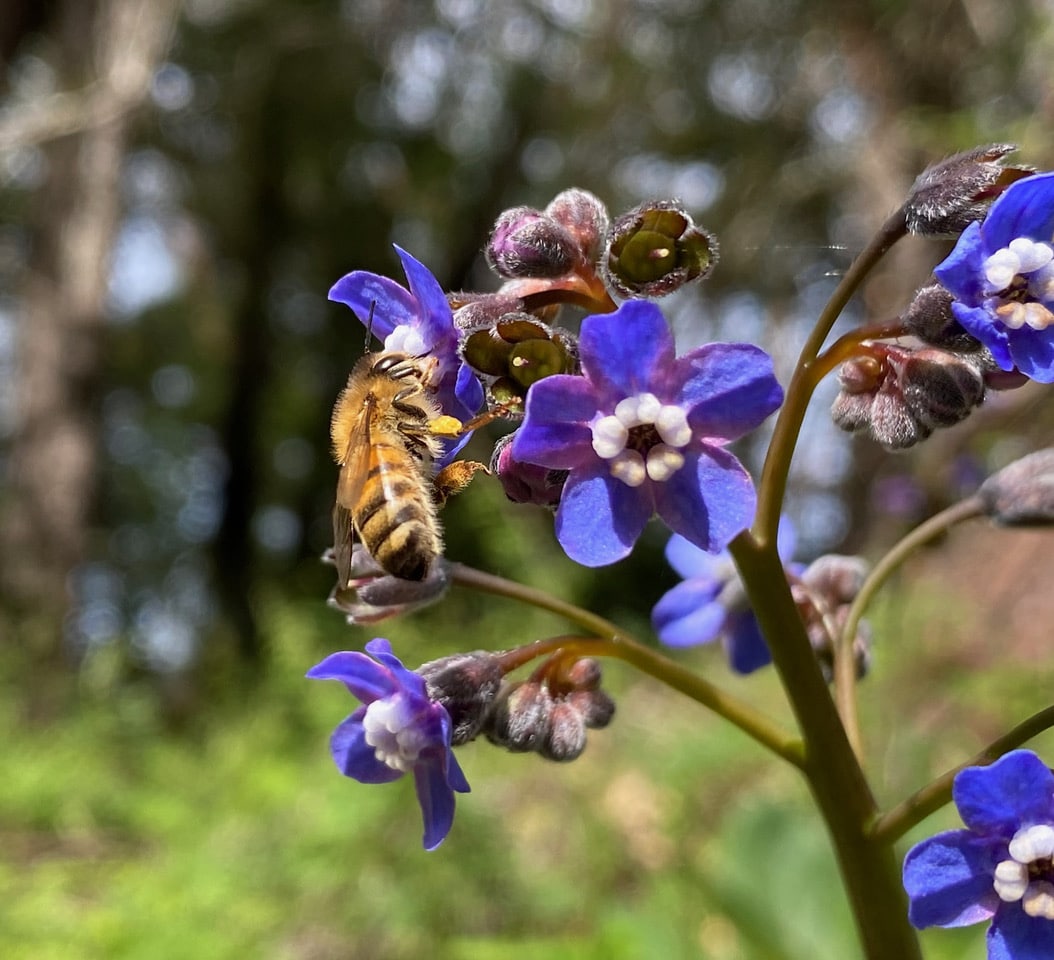
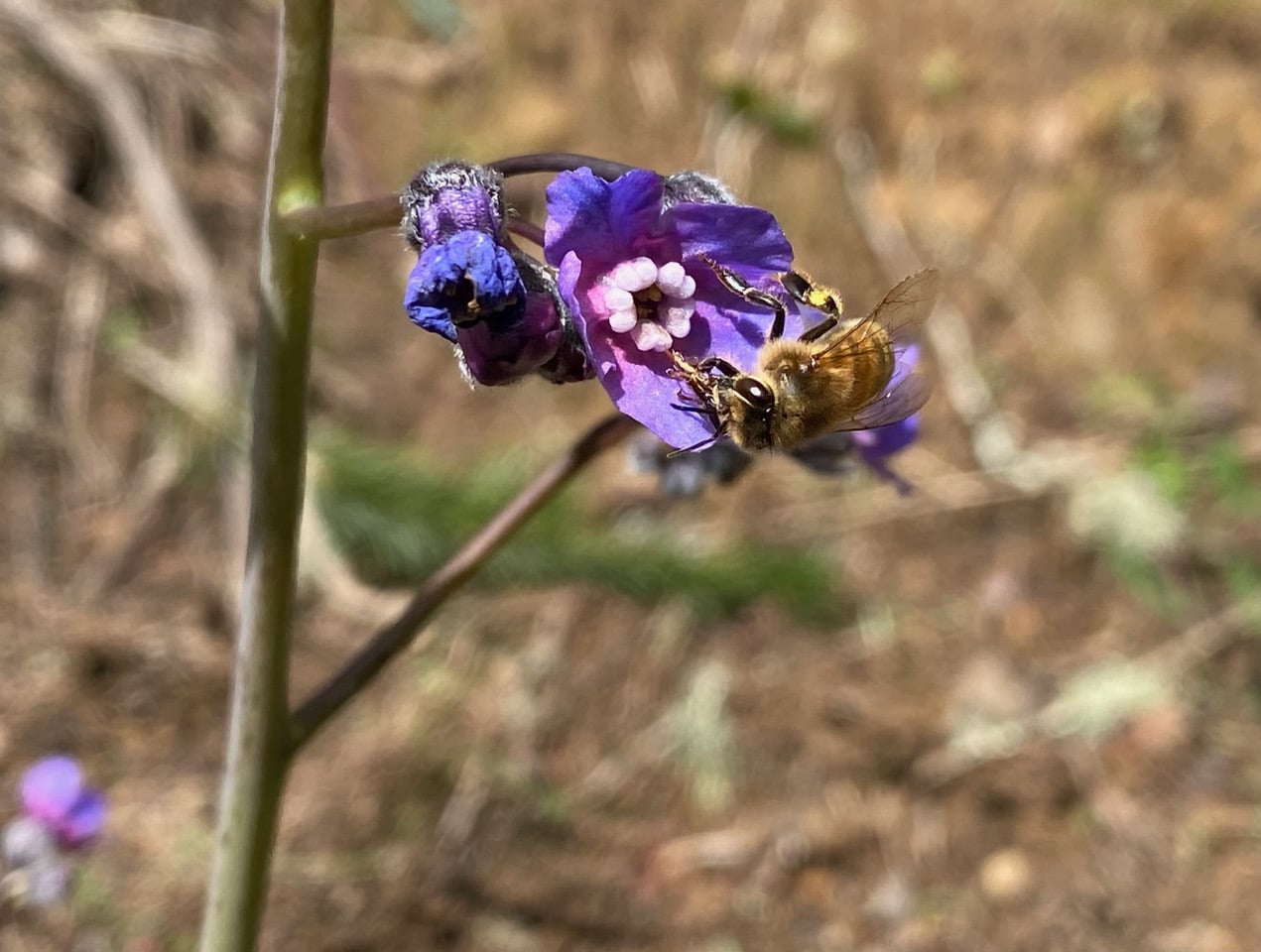 It’s the tongue that gathers the pollen. Here, a Honey Bee is lifting its head from a flower, its tongue covered with yellow pollen. The bee skillfully wipes the pollen off and packs it into the pollen baskets on its hind legs while flying to another flower. Gathering pollen from Hound’s Tongue is slow and laborious work, one tongueful at a time!





Through various stages of maturity, the Western Hound’s Tongue flowers exhibit a wide variation in color, ranging from pink to blue and everything in between. The color change is believed to be a way that the plant communicates to its pollinators, guiding them to visit flowers with maximum rewards of nectar and pollen. Color signaling occurs in the flowers of more than 70 plant families to direct pollinators. Examples include Forget-me-nots, and Heliotrope, also in the Borage family. Bees see blue colors well, but not reds. Hound’s Tongue flowers contain anthocyanin, a pigment that changes color with pH. Immature pink flowers may signal to bees, “Not ready; move on.”, the mature blue flowers, “Ready for pollination.”; and the fading blue-purple of the aging flowers, “I’m done; don’t bother.” What’s more, bees perceive ultraviolet colors of the nectar appendages, which appear white to us. There’s so much more than meets our eyes!
At the edge of the forest where sunlight abounds, a patch of blooming Hound’s Tongue is garnering intense interest among the insects. Most visible are the Honey Bees, Apis mellifera (family Apidae).
The workers are actually collecting pollen while sticking their tongue into the corolla for nectar.
The reproductive structures of the Hound’s Tongue flower are well hidden, surrounded by the puffy white nectar appendages. While probing for nectar, the body of the insect does not make contact with the pollen.
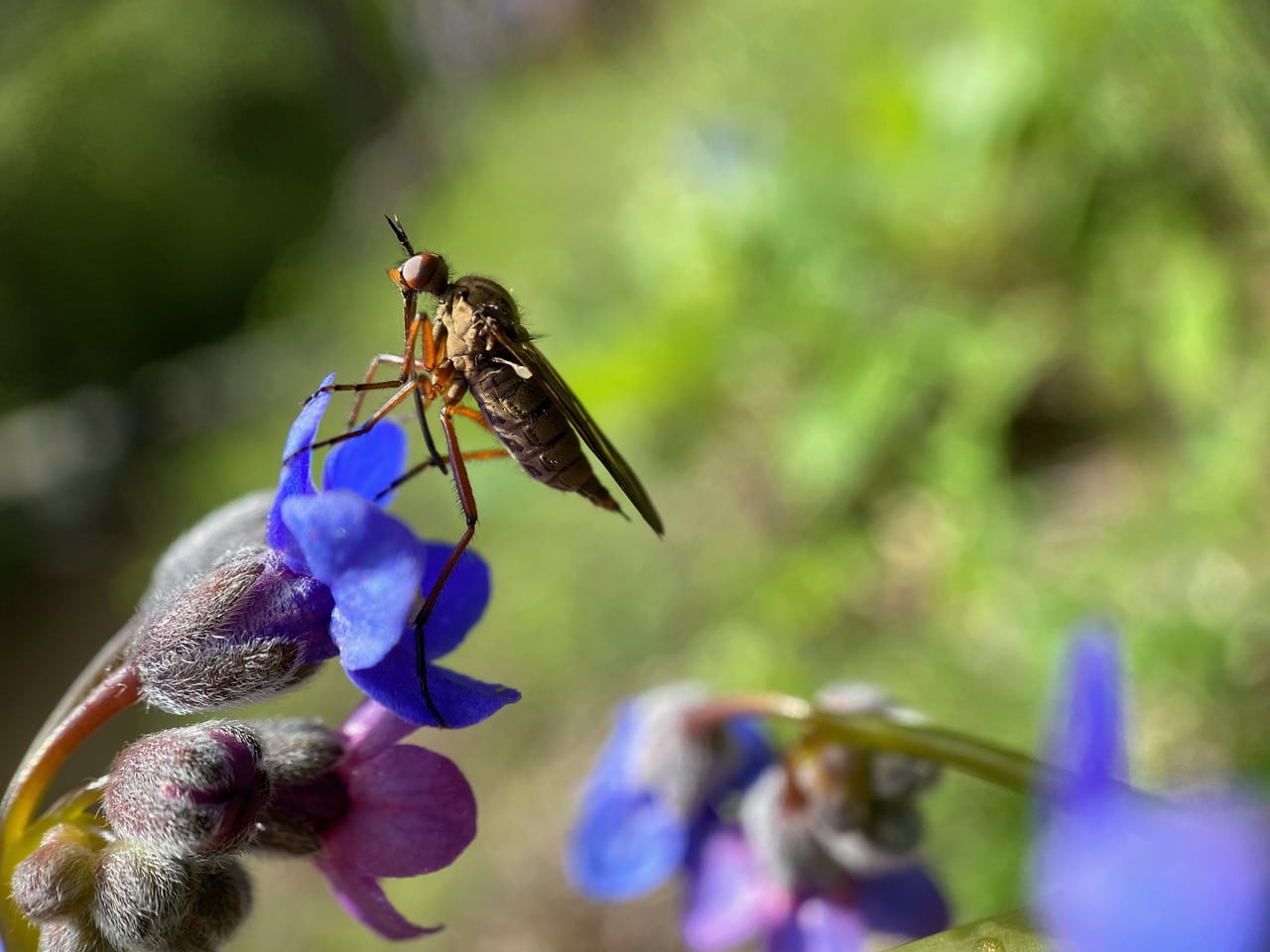
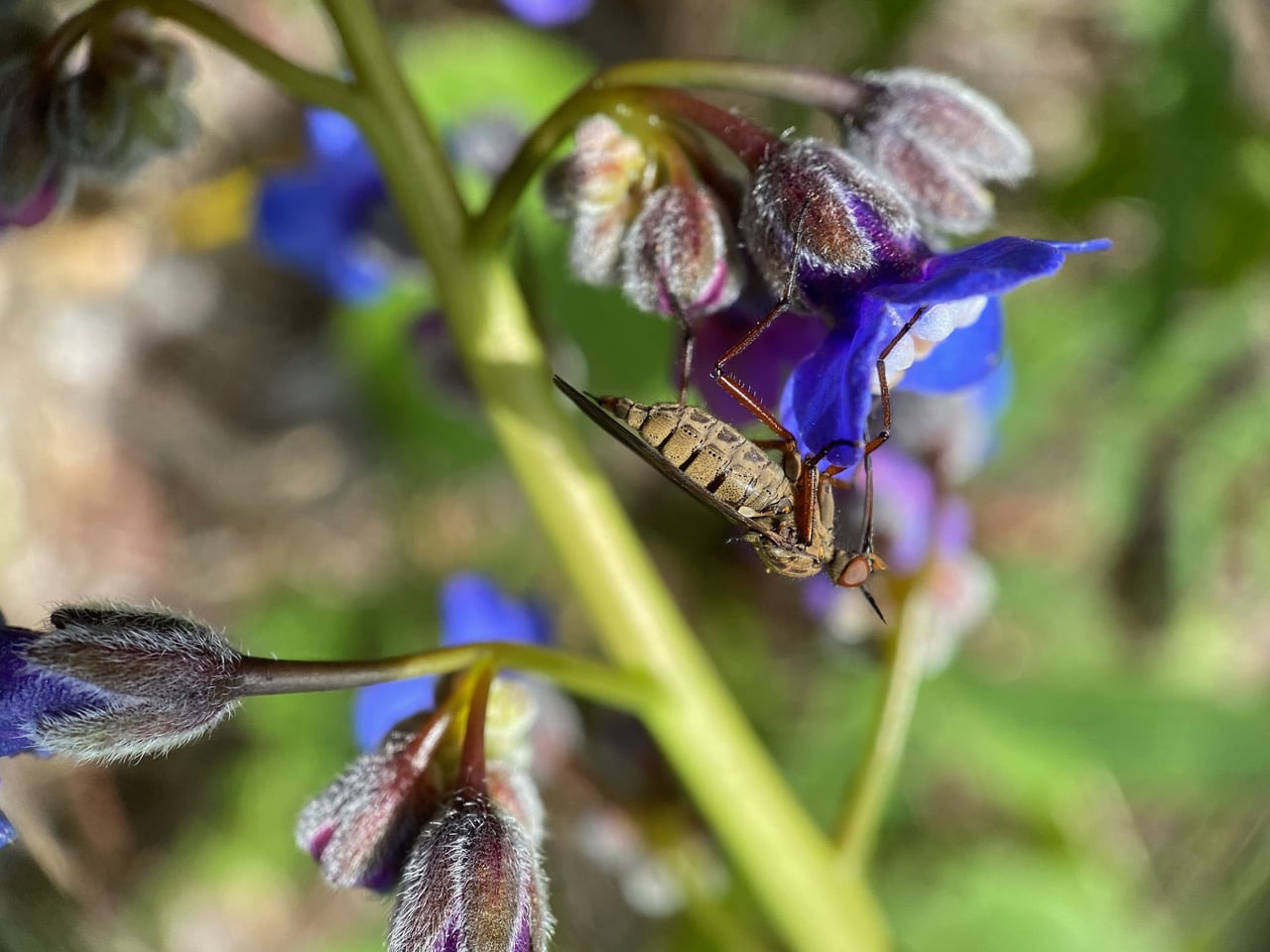
It’s the tongue that gathers the pollen. Here, a Honey Bee is lifting its head from a flower, its tongue covered with yellow pollen. The bee skillfully wipes the pollen off and packs it into the pollen baskets on its hind legs while flying to another flower. Gathering pollen from Hound’s Tongue is slow and laborious work, one tongueful at a time! Whoa, who’s that insect with the incredibly long proboscis, standing over a Hound’s Tongue flower? It appears to be a fly. A Dance Fly?
Flies come in a mind-boggling variety of species, sizes and shapes. Despite the diversity, these carnivores/herbivores/scavengers have been issued only two types of mouthparts – sponging or piercing-sucking. The latter is much less common, occurring mostly in Dance Flies (family Empididae) and Bee Flies (family Bombyliidae).
The fly’s movements from flower to flower are slow and methodical. This view gives me an appreciation of its proboscis.
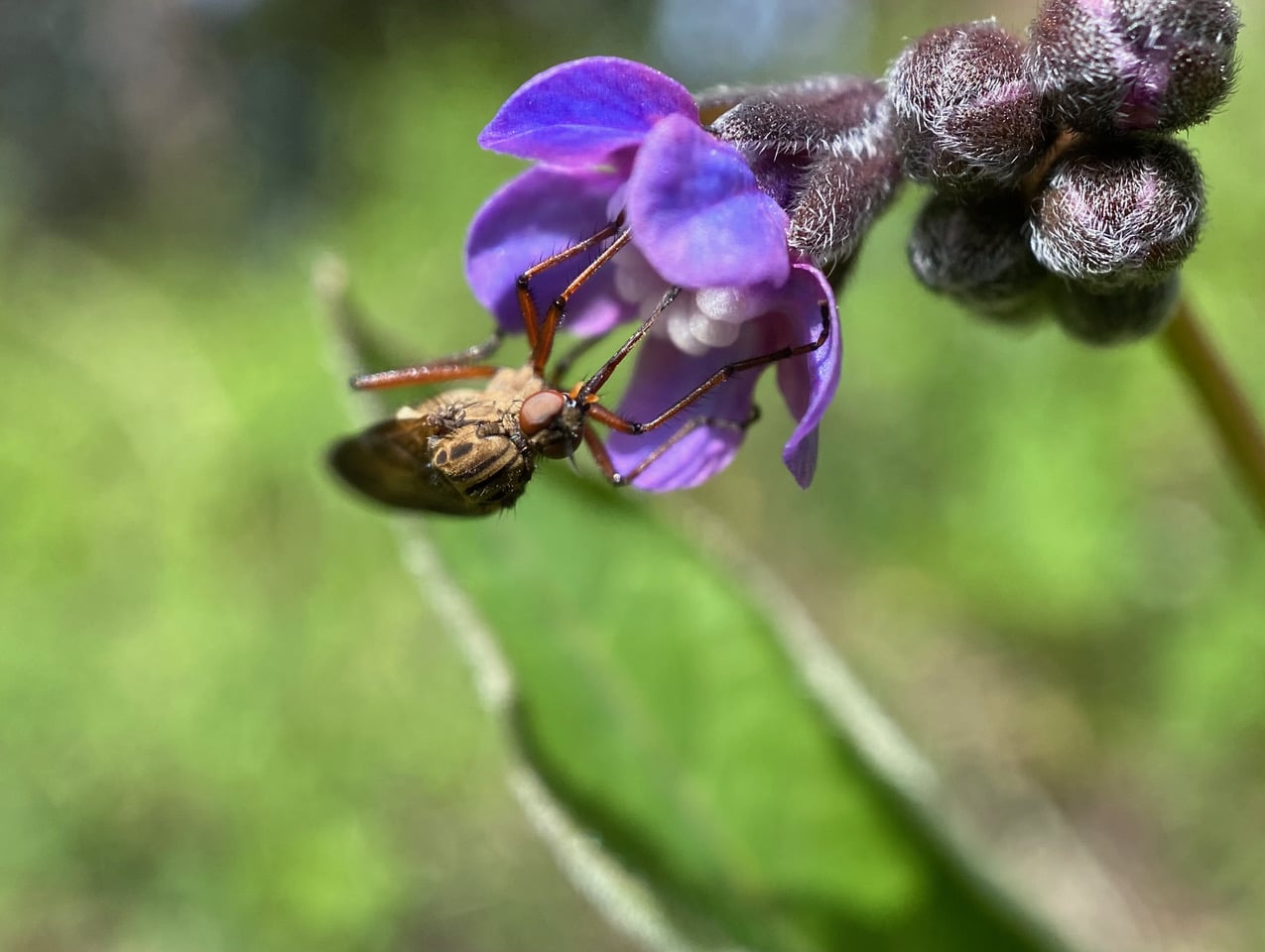
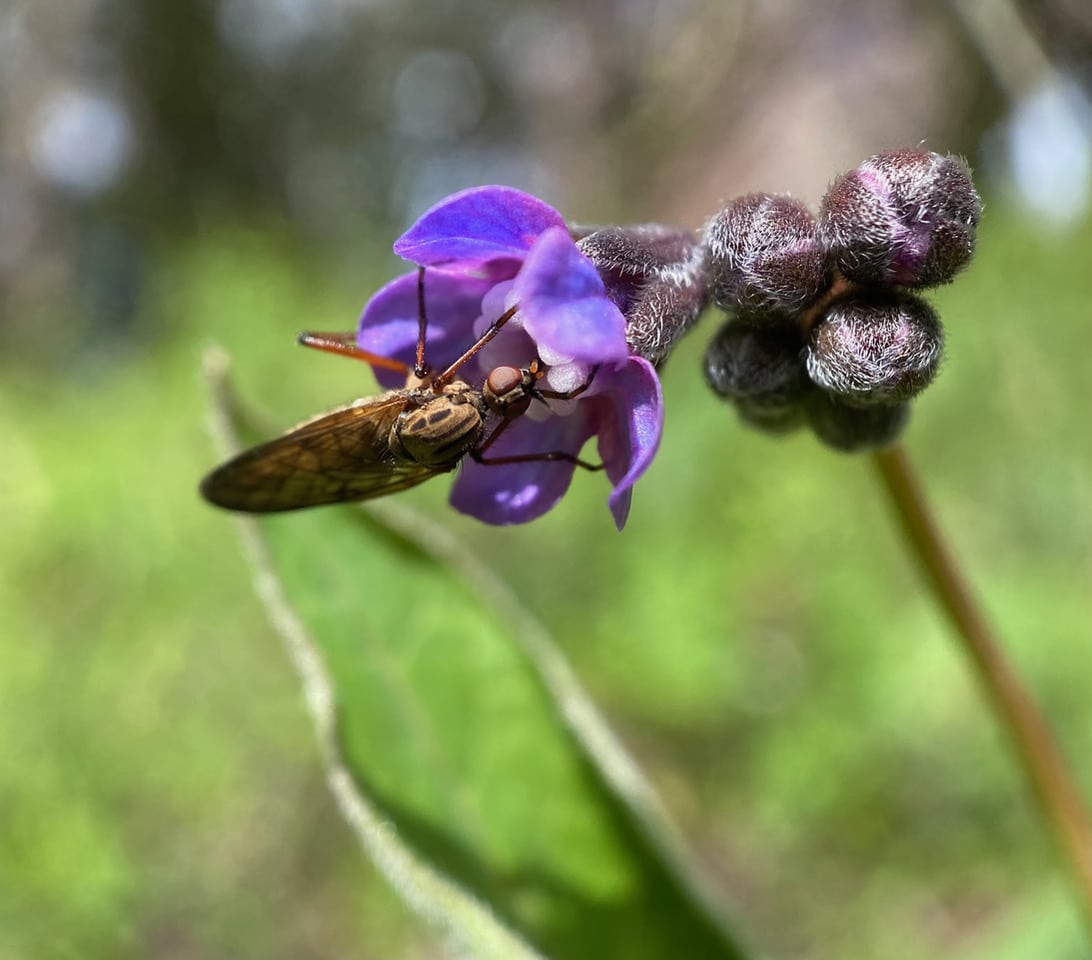
Here the fly is probing the middle of a Hound’s Tongue flower with its proboscis…
The fly repeatedly lowers and raises its head, like a pumpjack working an oil well. I am mesmerized.
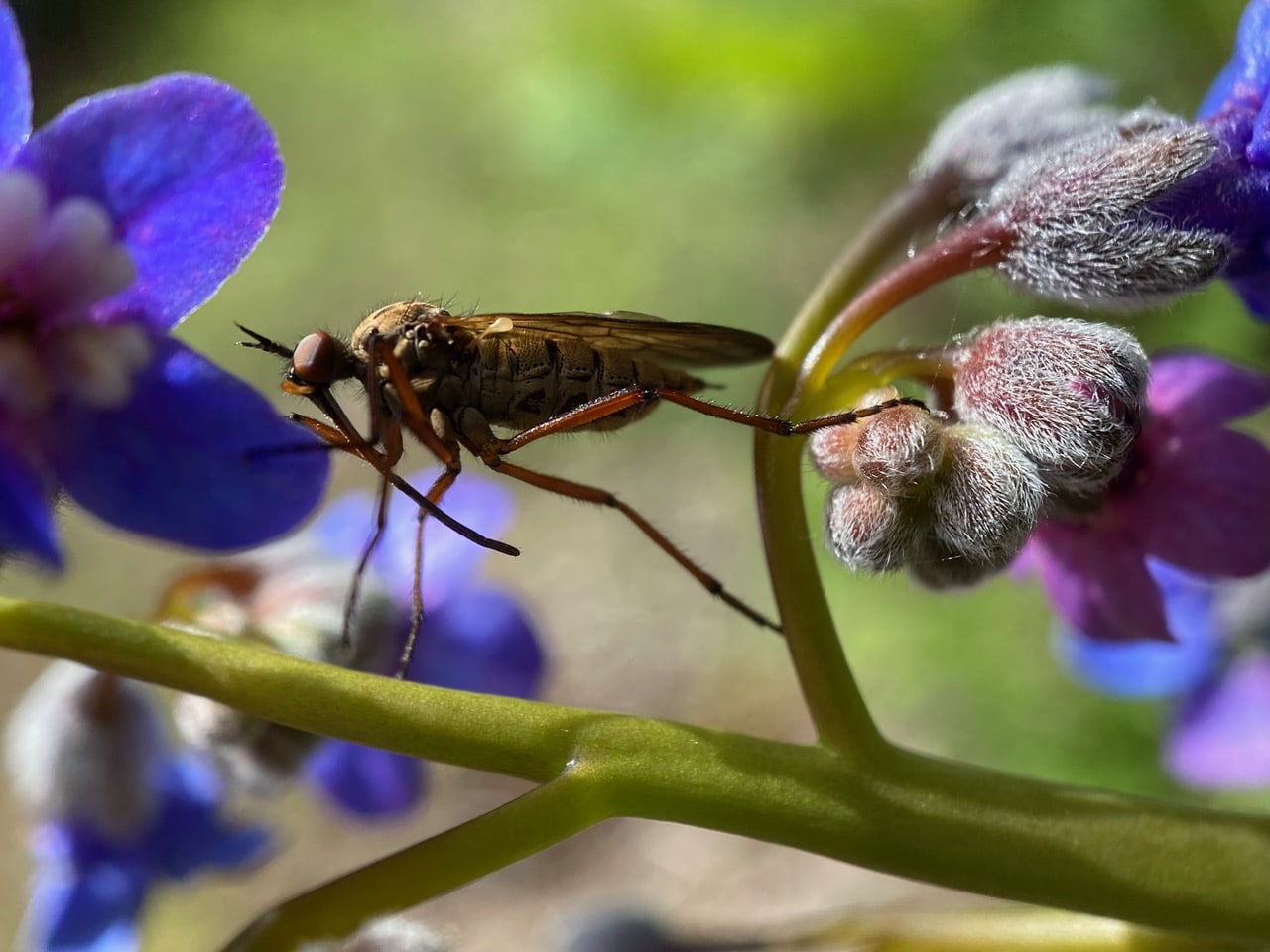
Here’s a clear view of the side of the fly. Its abdomen is huge – a gravid female? Or just bloated with nectar?
iNaturalist has confirmed that the insect is indeed a Dance Fly (family Empididae). It has further narrowed down the ID to the genus Empis.
Dance Flies, in the family Empididae, get their name from the habit of males of some species to gather in large groups and dance up and down in the air in the hopes of attracting females. They are predominantly predatory and they are often found hunting for small insects on and under vegetation in shady areas. Both genders may also drink nectar. Male dance flies give their sweeties a nuptial gift to eat while they mate. The gift is thought to enable her to complete the development of her eggs. Males may wrap their gifts in balloons of silk or spit, hence the other common name of Balloon Flies.
Interestingly, a Greater Bee Fly, Bombylius major (family Bombyliidae) is hovering around the flowers, and sticking its long proboscis into the corolla without even landing. The fly is super wary and zips around so fast I fail to get a picture of it.
While I balance precariously on the steep trail bank to photograph the insects, a Western Skink dashes in and out of a couple of holes in the bank, obviously agitated by my presence. Eventually it calms down and stays outside to bask.
The Western Skink, Plestiodon skiltonianus is a species of small, smooth-scaled lizard with relatively small limbs. It is widespread in northern California but primarily restricted to the coast in central and southern California. Found in a variety of habitats, this lizard is most common in early successional stages or open areas of late successional stages. The diurnal reptile is active during the warm seasons. The lizards spend much of their day basking in the sun. Their diet ranges widely, including spiders and beetles. The species is secretive and very agile, foraging actively through leaf litter and dense vegetation. It is a good burrower and sometimes constructs burrows several times its own body length. Females take great care of their eggs, guarding the nest until the young leave the nest. Young Western Skinks have a bright blue tail with color that fades with age. Skinks can perform autotomy; if seized by a predator its tail is deliberately cast and wriggles violently to attract attention while the lizard may escape. Skinks reach sexual maturity at around 3 years, and live up to 9 years.
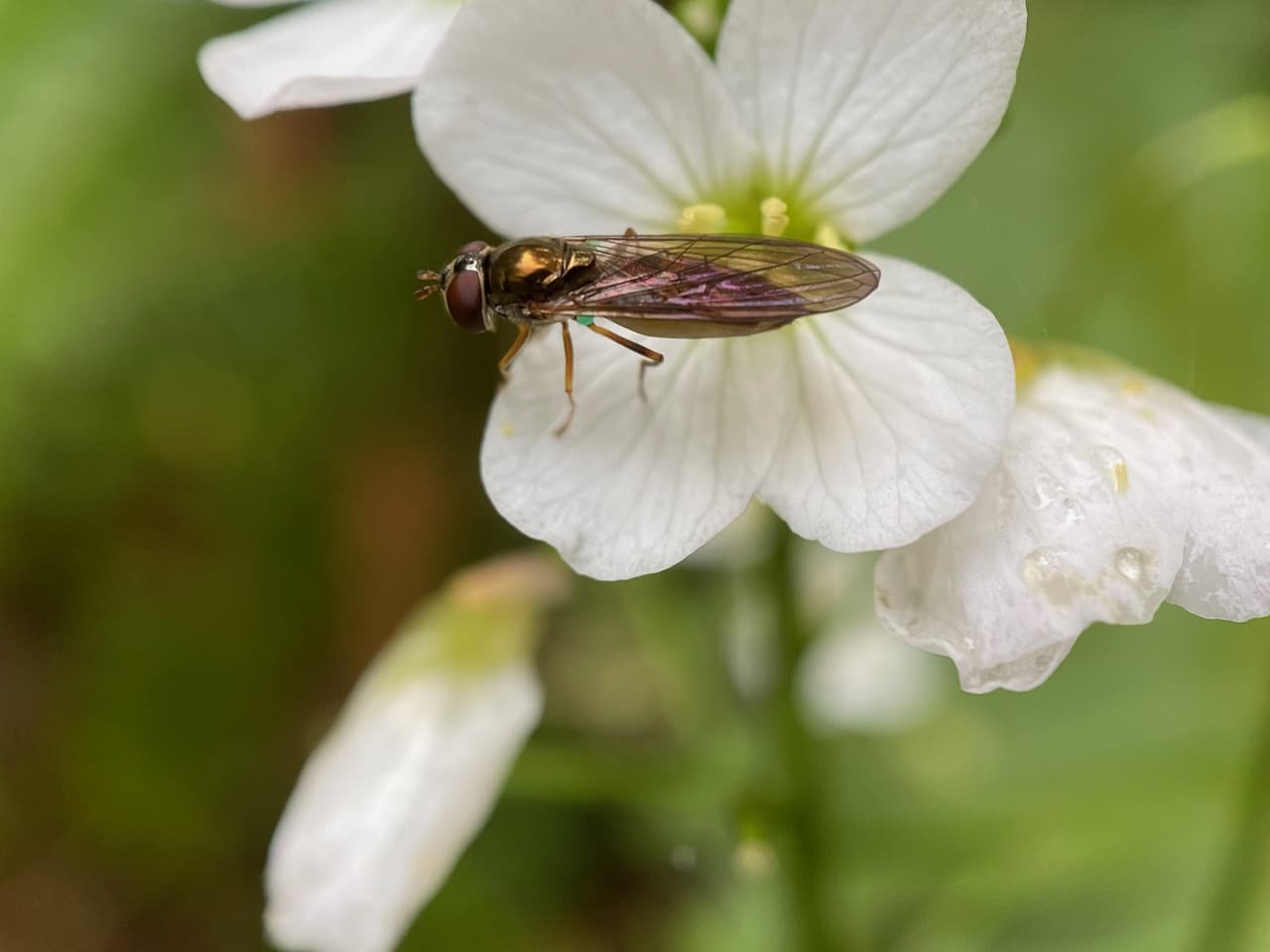
A dusky fly with a metallic sheen lands on a flower of Milk Maid, Cadamine californica. It is probably either a Sedgesitter (Platycheirus sp.) or a Variable Duskyface Fly (Melanostoma sp.) – the two hover flies are very similar in general appearance.
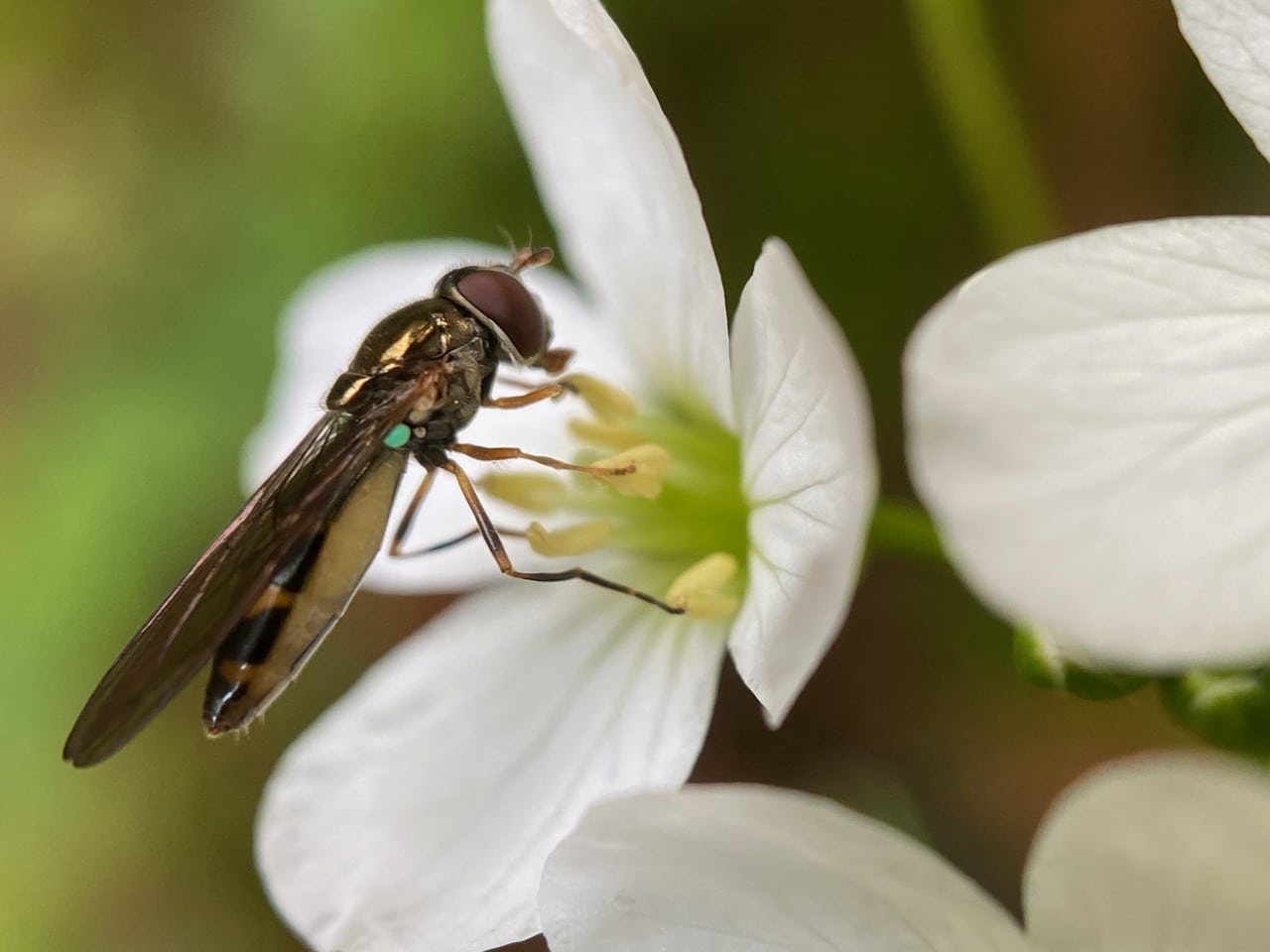
I zoom in on the hover fly and discover that it is a gravid female with blue-green halteres. The feature is a nice confirmation that the fly is a Variable Duskyface Fly, Melanostoma mellinum (family Syrphidae).
Halteres are the modified hind wings in Diptera (flies). They are shaped like ‘drum sticks’ with a slender shaft connected to the thorax. Halteres are highly sophisticated balance organs and they oscillate during flight.
Melanostoma mellinum is a very common species of hover fly found in many parts of Europe including the Mediterranean basin and North Africa, the East Palearctic, and North America. A small species, their wingspan between 4.7 and 7.0 mm. Very similar to Platycheirus, but can be distinguished by fine details. In M. mellinum, the normally pale halteres turn bright blueish-green in females about to lay eggs.
The species’ preferred habitat include grasslands and moorlands, including those in hilly and mountainous regions. Adults can be found feeding on pollen of grasses and other wind-pollinated plants. Little is known of their biology, but the larvae are suspected to be a general predator of small insects in the leaf litter.
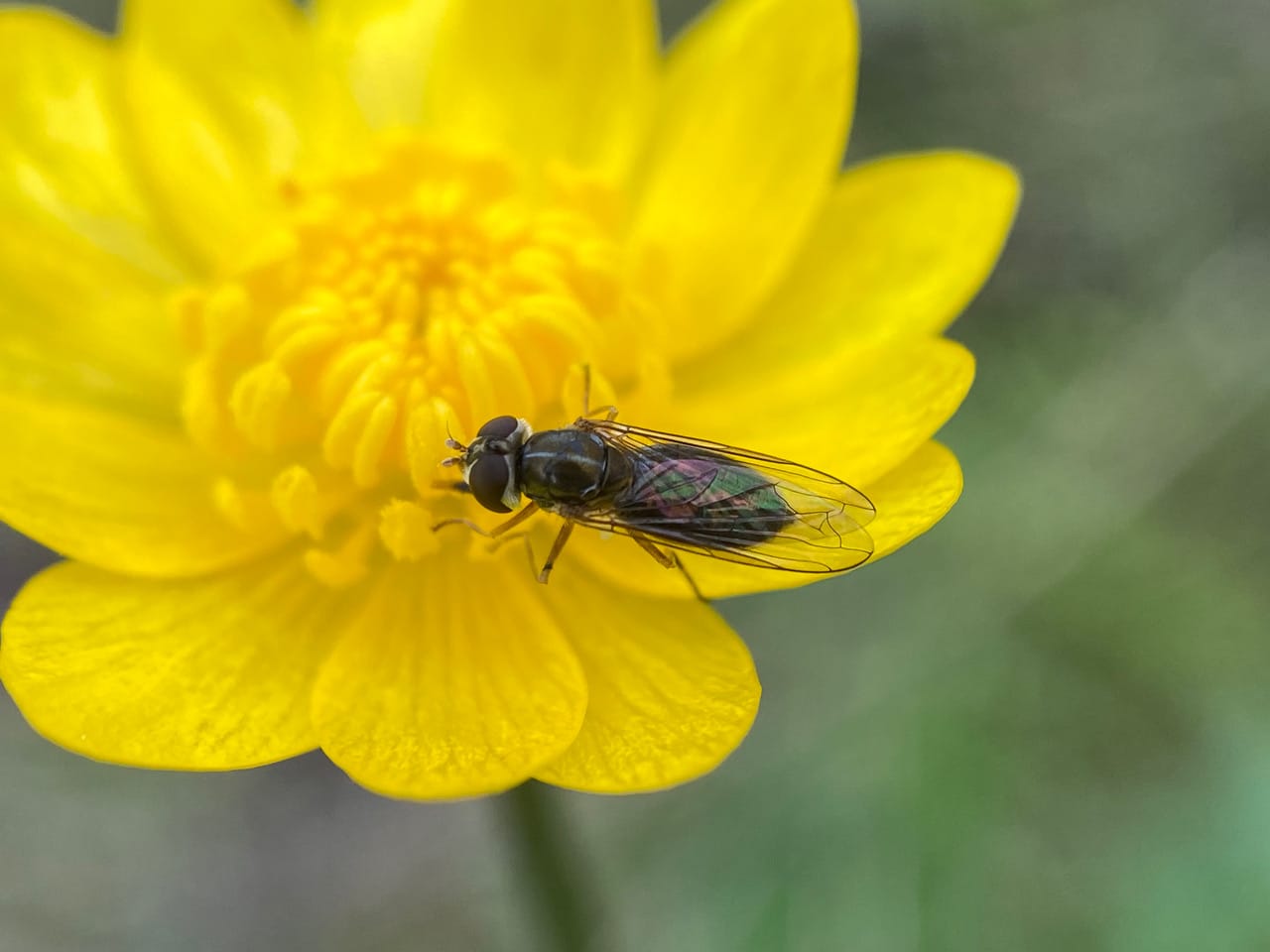
In an open grassy field, some California Buttercup, Ranunculus californicus are blooming. A couple of small flies are foraging on a flower. They appear to be hover flies. But what species?
It is frustrating when the hover flies stubbornly hold their wings closed.
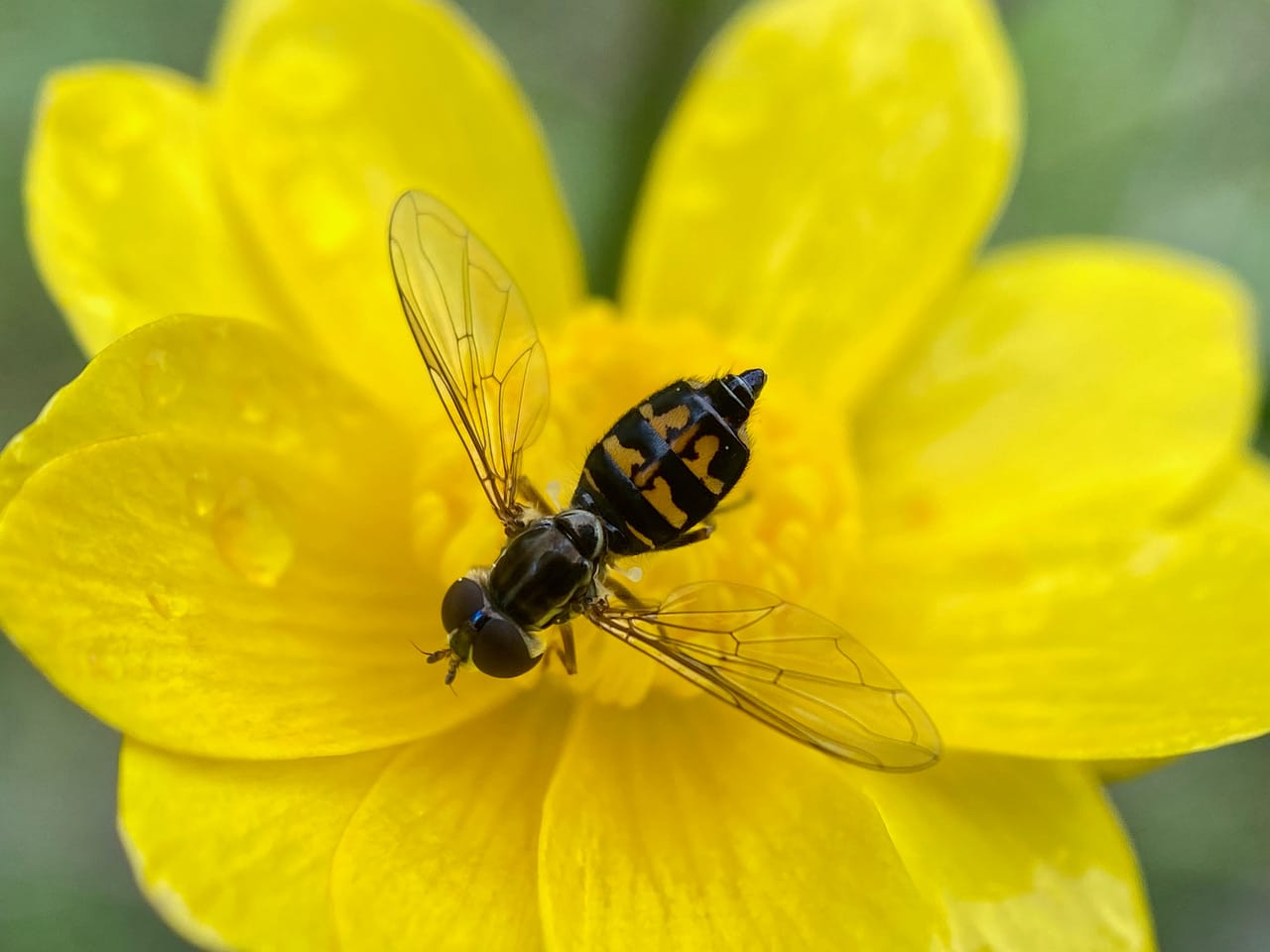
When the fly suddenly opens its wings, it can be instantly identified by its distinctive abdominal markings. It is a female Western Calligrapher, Toxomerus occidentalis (family Syrphidae). The males of the species have a narrower abdomen.
Toxomerus is a very large genus of Hover Flies. They are found in North and South America. The majority of species are only 6-9 mm in length. They are notable for their mimicry of stinging Hymenoptera to avoid predators. Their unique abdominal patterns are diagnostic at the species level within the genus. Most larvae feed on soft bodied insects, such as aphids; a few feed on pollen. Adults feed on the pollen of a wide range of flowers. A female can lay up to hundreds of eggs at a time and will place them where prey or pollen food sources are readily available. They can be found in a wide variety of habitats, often in dense ground cover.
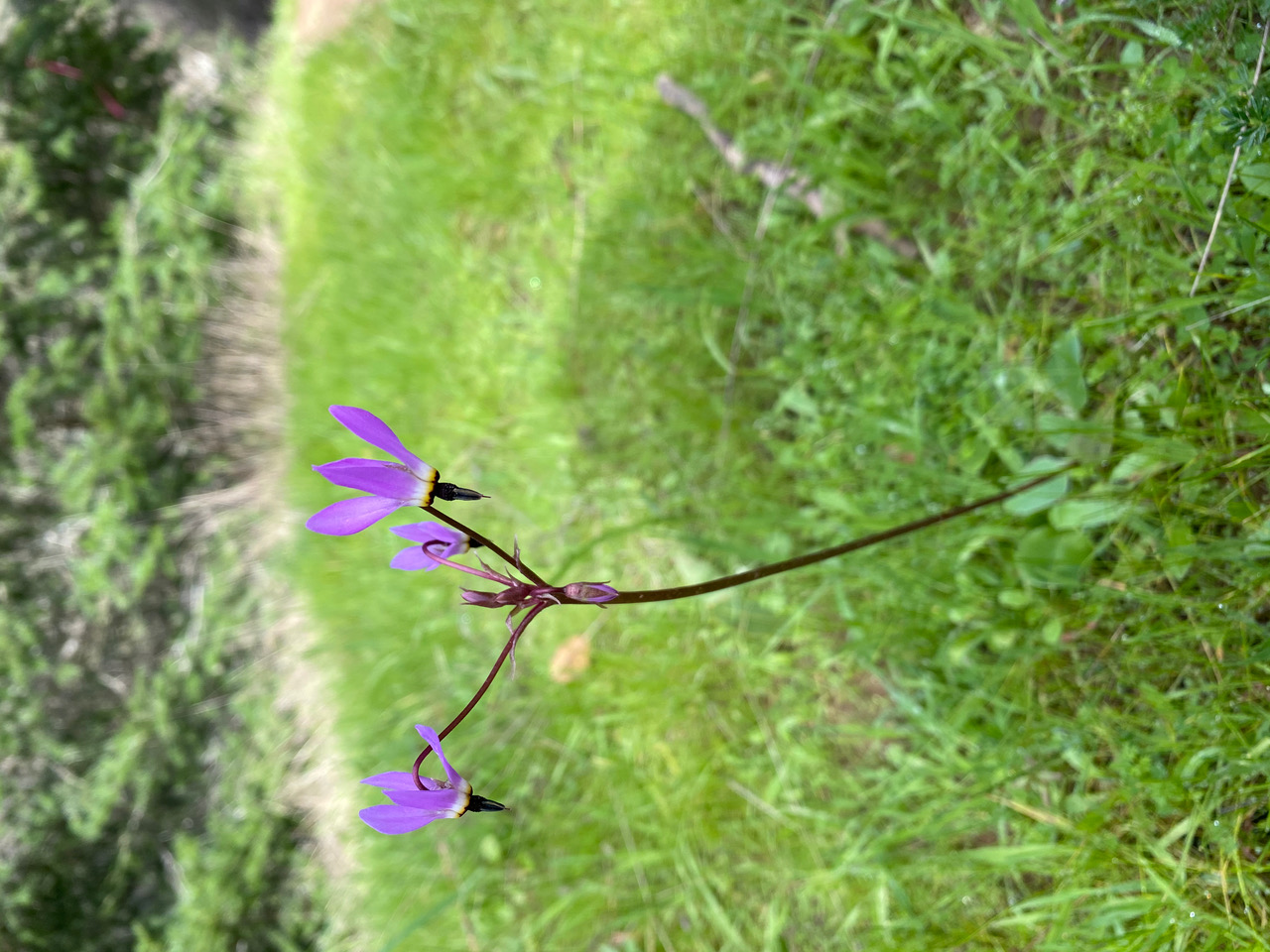
In the lower elevations where the ground holds extra moisture, Shooting Stars, Primula sp. are blooming. I pause to watch for pollinators, but none came.
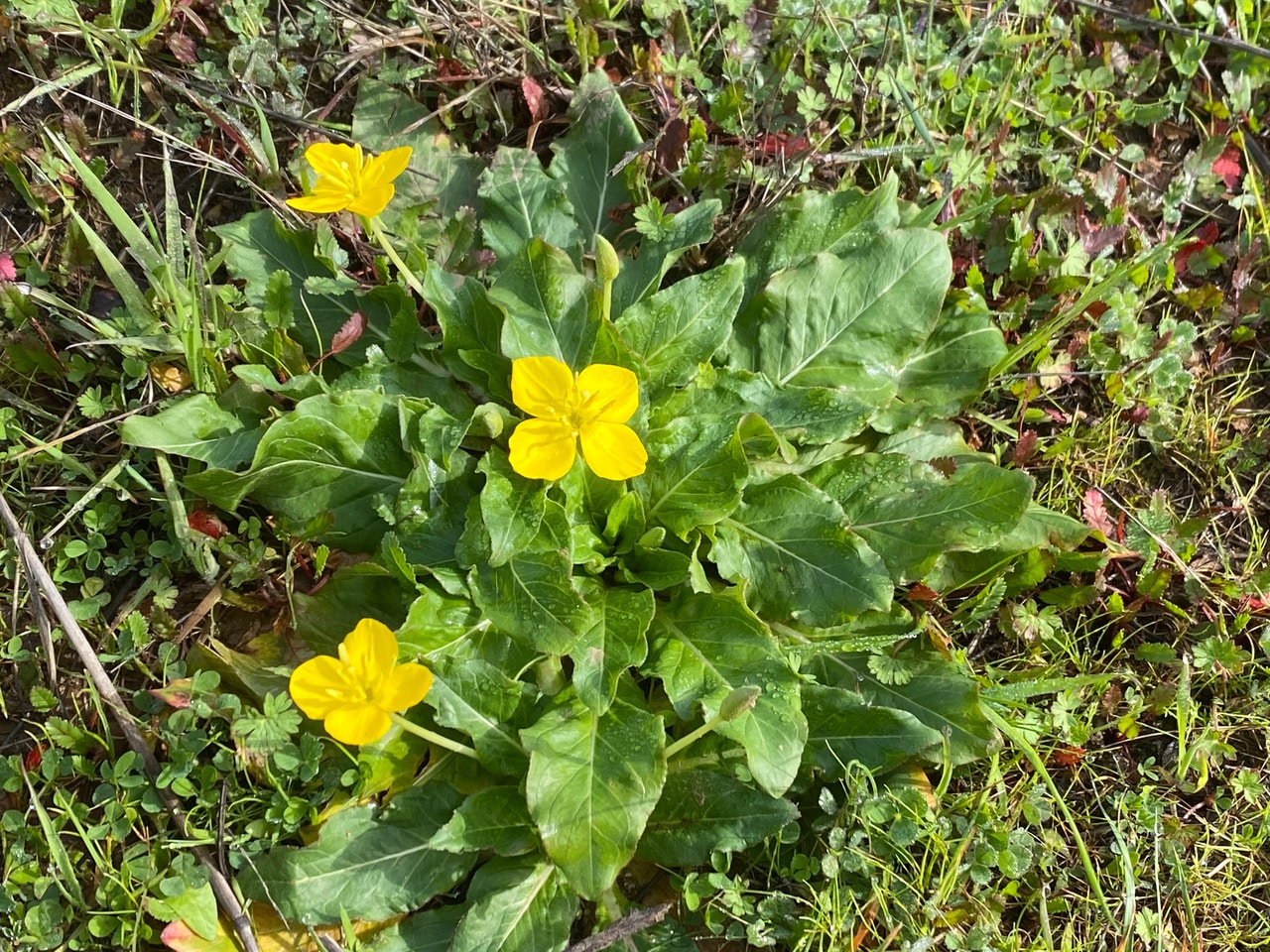
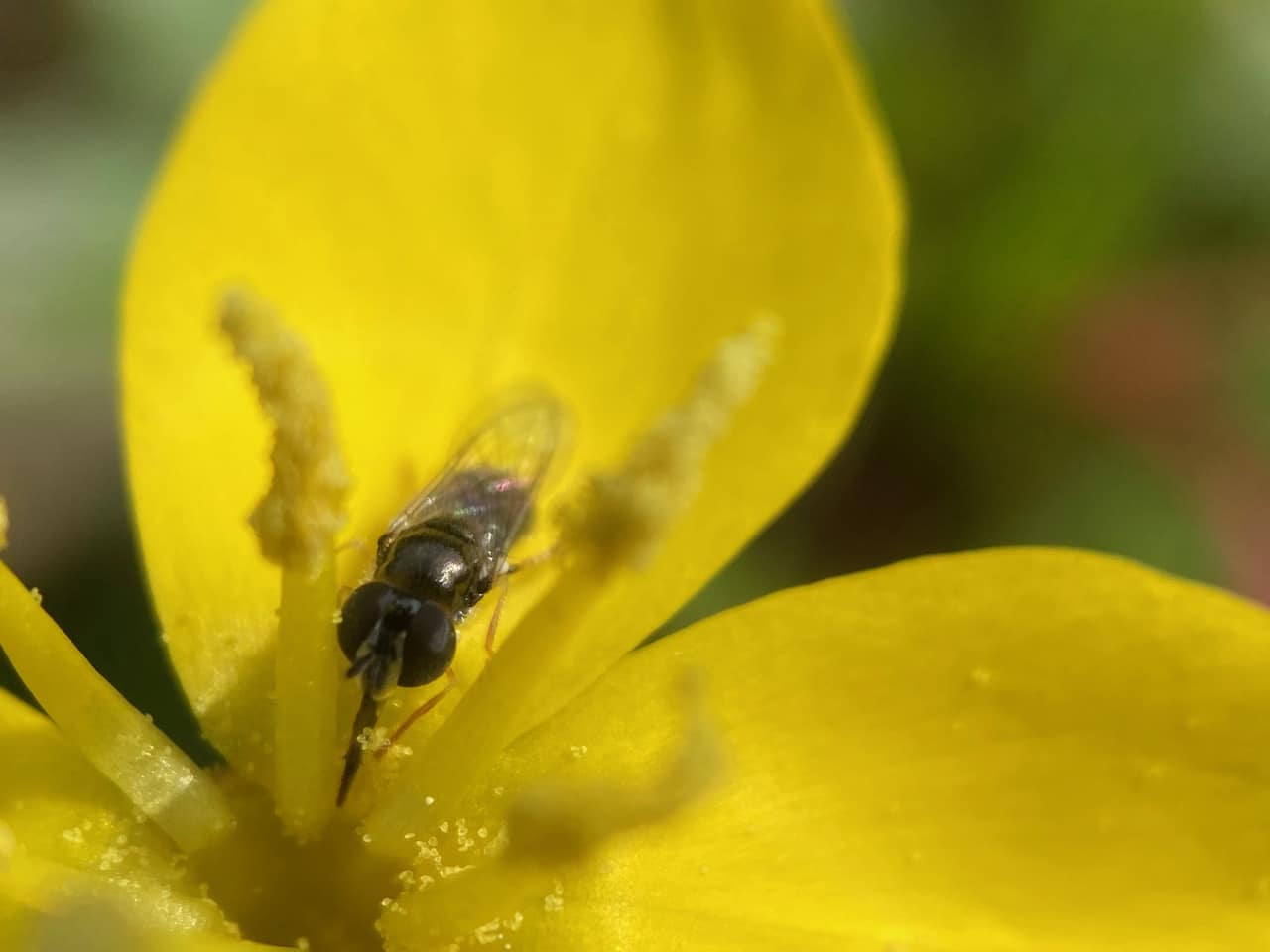
On the way back to the parking lot, I pass some Sun Cups, Taraxia ovata on the edge of the trail. Low to the ground, their 4-petaled, bright lemon-yellow flowers beckon invitingly.
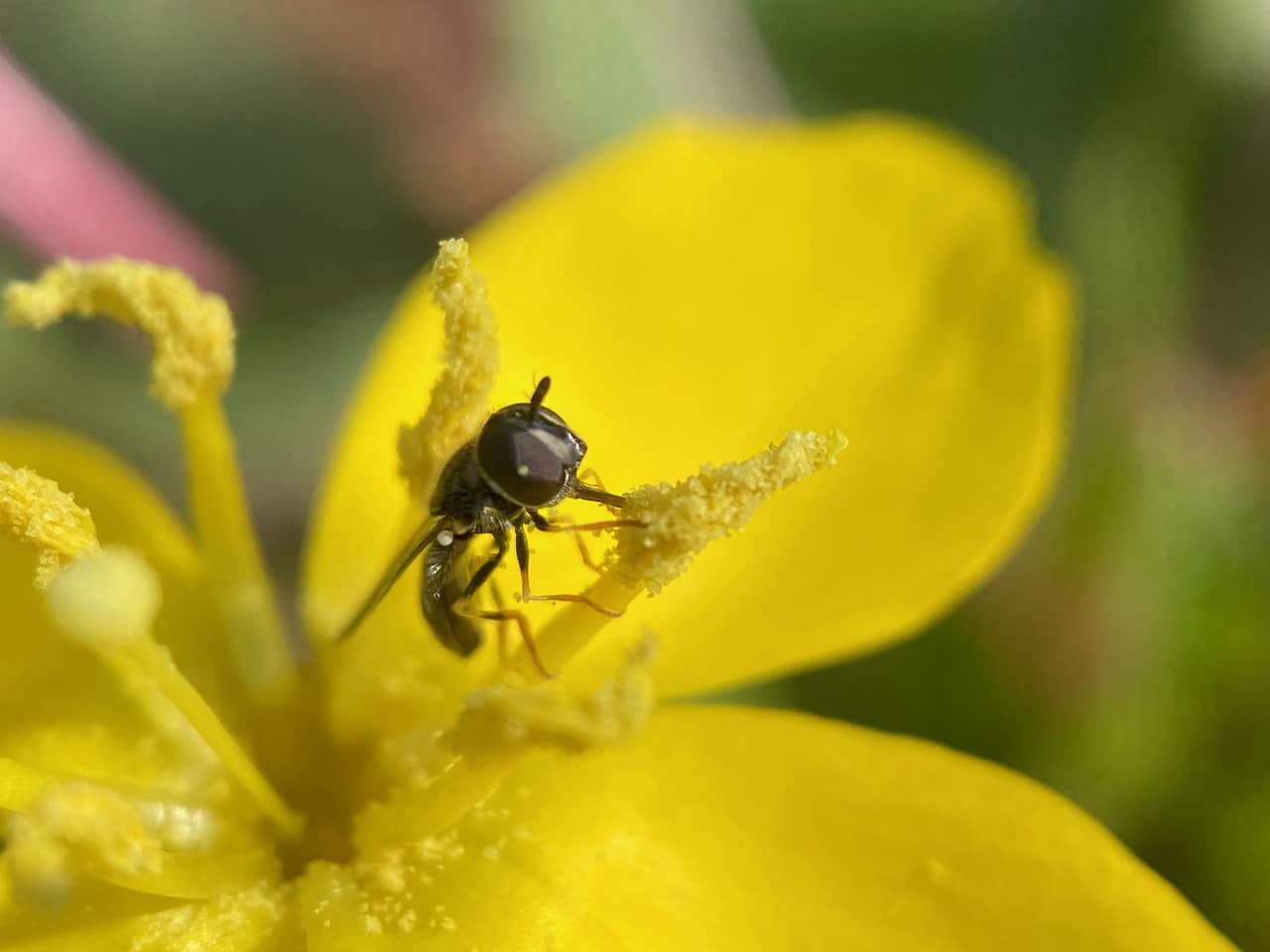
A tiny fly is on one of the stamens, working the pollen with its front legs and tongue. From its diminutive size, oversized head and hunched posture, I recognize it as a Black-backed Grass Skimmer, Paragus haemorrhous (family Syrphidae).
The fly is dark all over, lacking the red in the rear section of the abdomen typical of most members of the species.
The Black-backed Grass Skimmer, Paragus haemorrhous is easily the smallest hover fly I know, measuring only about 4 mm in length. The species has a world-wide distribution, found in unimproved grassland, dune grass, open areas and pathsides in forest, and meadows. Adults visit flowers for nectar and pollen. Larvae feed on aphids on low herbaceous plants.
As the fly approaches the base of the flower, it extends its tongue in anticipation of a nectar treat.
The fly remains in this position for a while, apparently enjoying the flower’s sweet reward.
The little hover fly climbs up another stamen to feed on pollen from the anther.
The alternating bingeing on nectar and pollen continues for a while. Such joy and exuberance! The little fly does not have to go far – this Sun Cup is its universe for now.