

Pollinator Post 2/220/24 (1)

The sky is heavily overcast, but rain is not expected until the afternoon. I make a quick visit to the EB Regional Botanic Gardens, hoping to find more plants in bloom.
Near the gate, a Hoaryleaf Ceanothus, Ceanothus crassifolius is in bloom. Despite the cold and damp, some insects are visiting its rain-battered blossoms. Here a Honey Bee is taking nectar from a fresh flower. She already has a small load of yellow pollen in her pollen baskets.
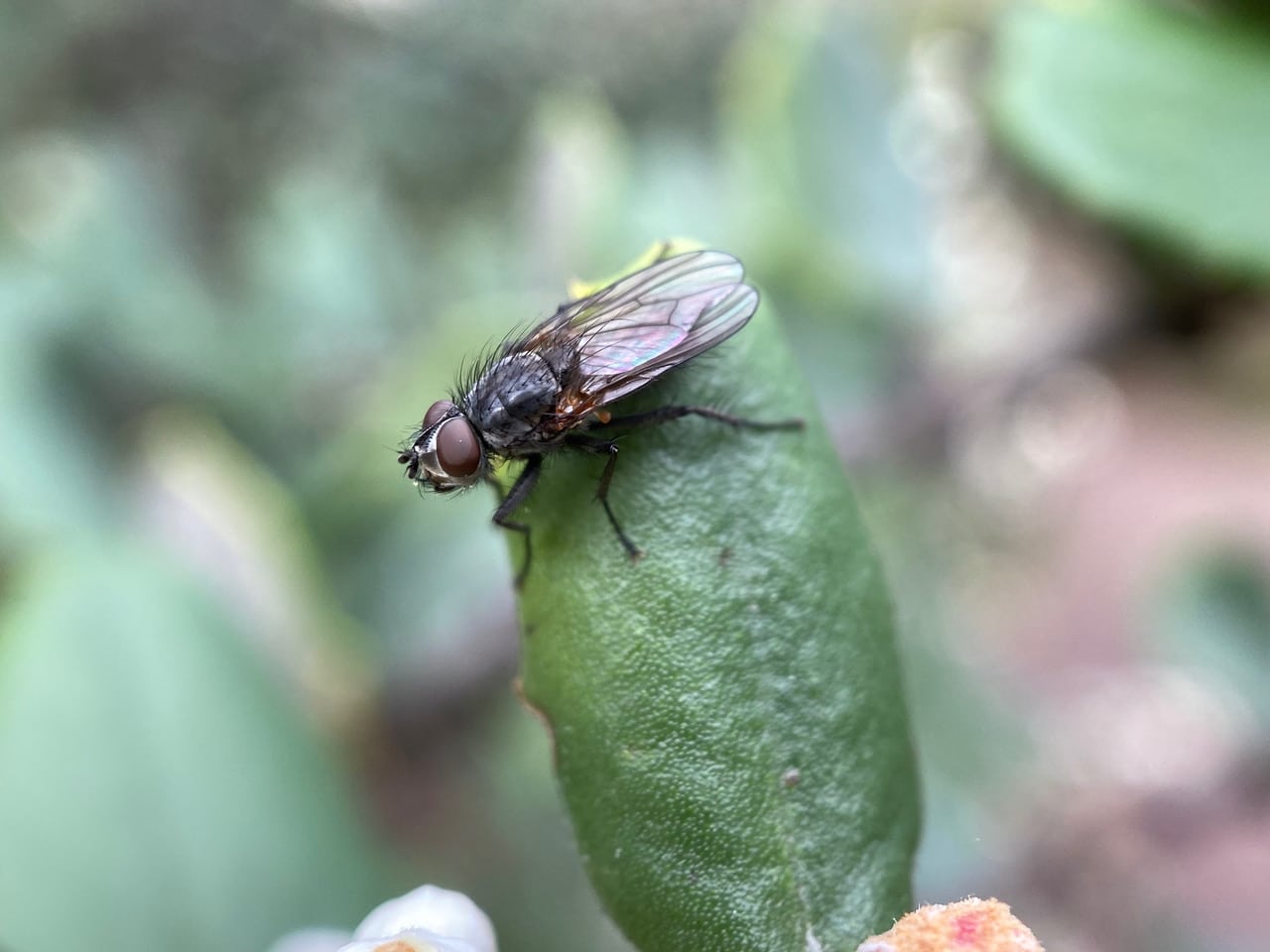







A fly is perched on a Ceanothus leaf. It has been identified by iNaturalist as a Blow Fly in the family Caliphoridae. I am not sure if I could trust the AI on this one.
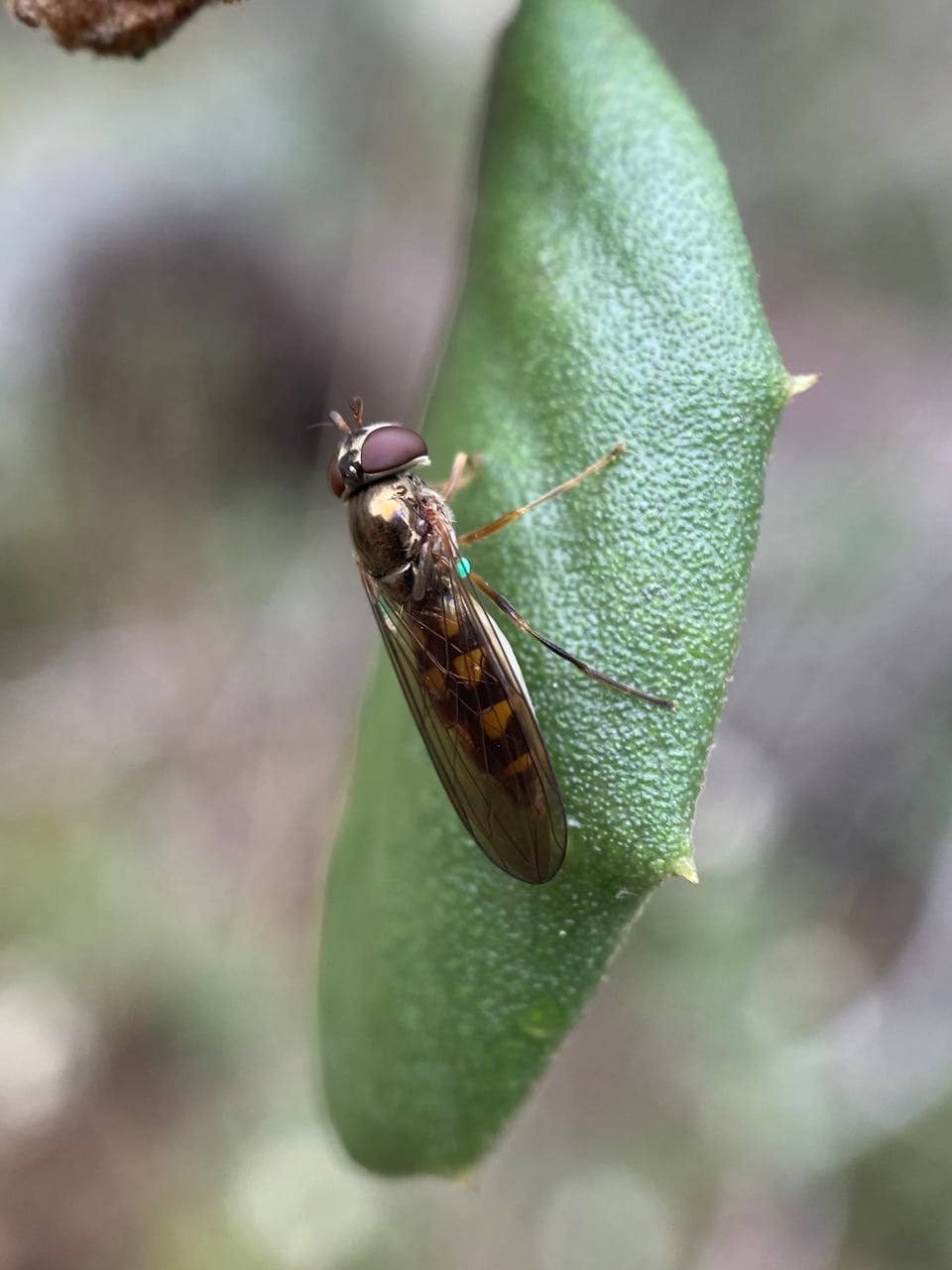
A female Variable Duskyface Fly, Melanostoma mellinum (family Syrphidae) is posing on a Ceanothus leaf. It is easy to determine the sex of the hover fly because her eyes do not meet on top of the head. On top of that, it is apparently a gravid female – check out that neon green haltere under her right wing! Halteres are the modified hind wings in Diptera (flies). They are shaped like ‘drum sticks’ with a slender shaft connected to the thorax. Halteres are highly sophisticated balance organs and they oscillate during flight.
Melanostoma mellinum is a very common species of hover fly found in many parts of Europe including the Mediterranean basin and North Africa, the East Palearctic, and North America. A small species, their wingspan between 4.7 and 7.0 mm. Very similar to Platycheirus, but can be distinguished by fine details. In M. mellinum, the normally pale halteres turn bright blueish-green in females about to lay eggs.
The species’ preferred habitat include grasslands and moorlands, including those in hilly and mountainous regions. Adults can be found feeding on pollen of grasses and other wind-pollinated plants. Little is known of their biology, but the larvae are suspected to be a general predator of small insects in the leaf litter.
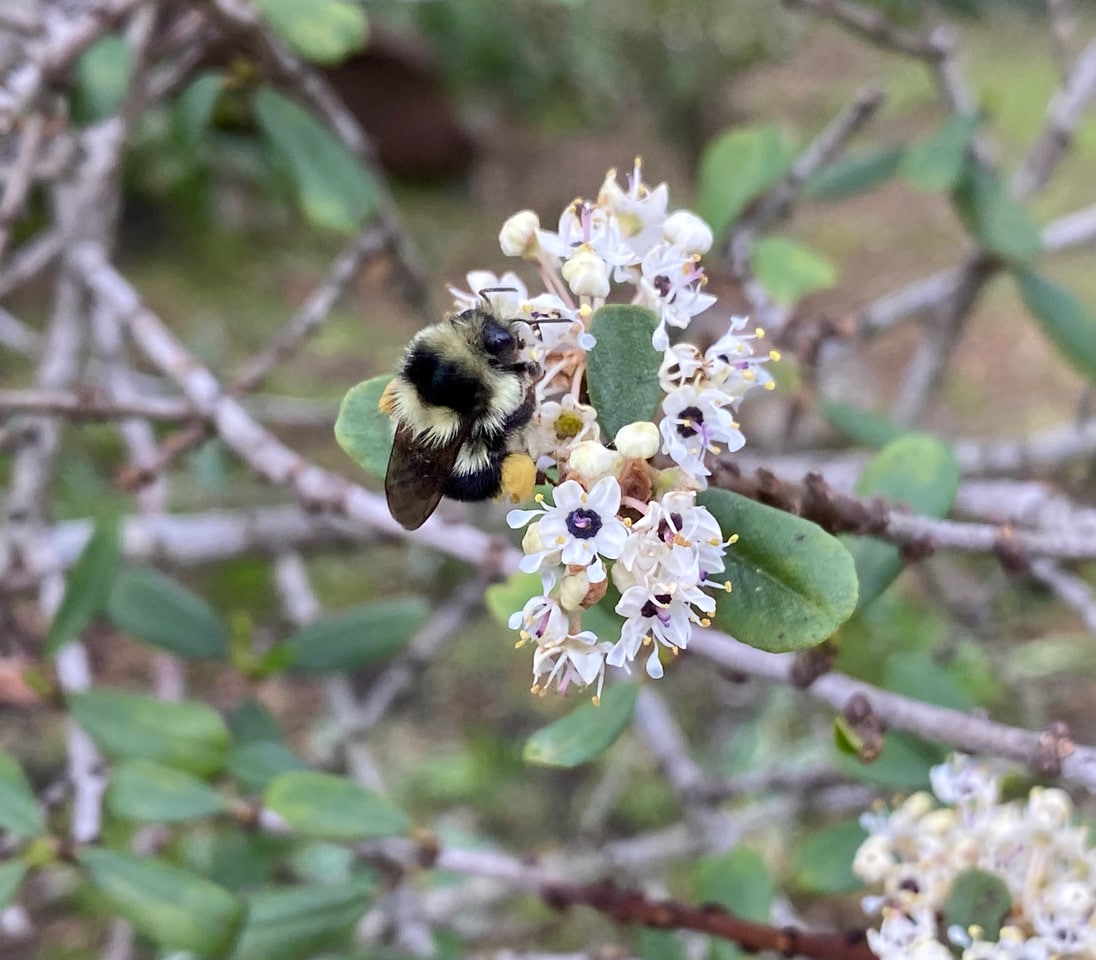
Many small worker Black-tailed Bumble Bees, Bombus melanopygus (family Apidae) are foraging on another Ceanothus across the path. The species is our earliest emerging bumble bee, so it’s not surprising that colonies with workers are already established.
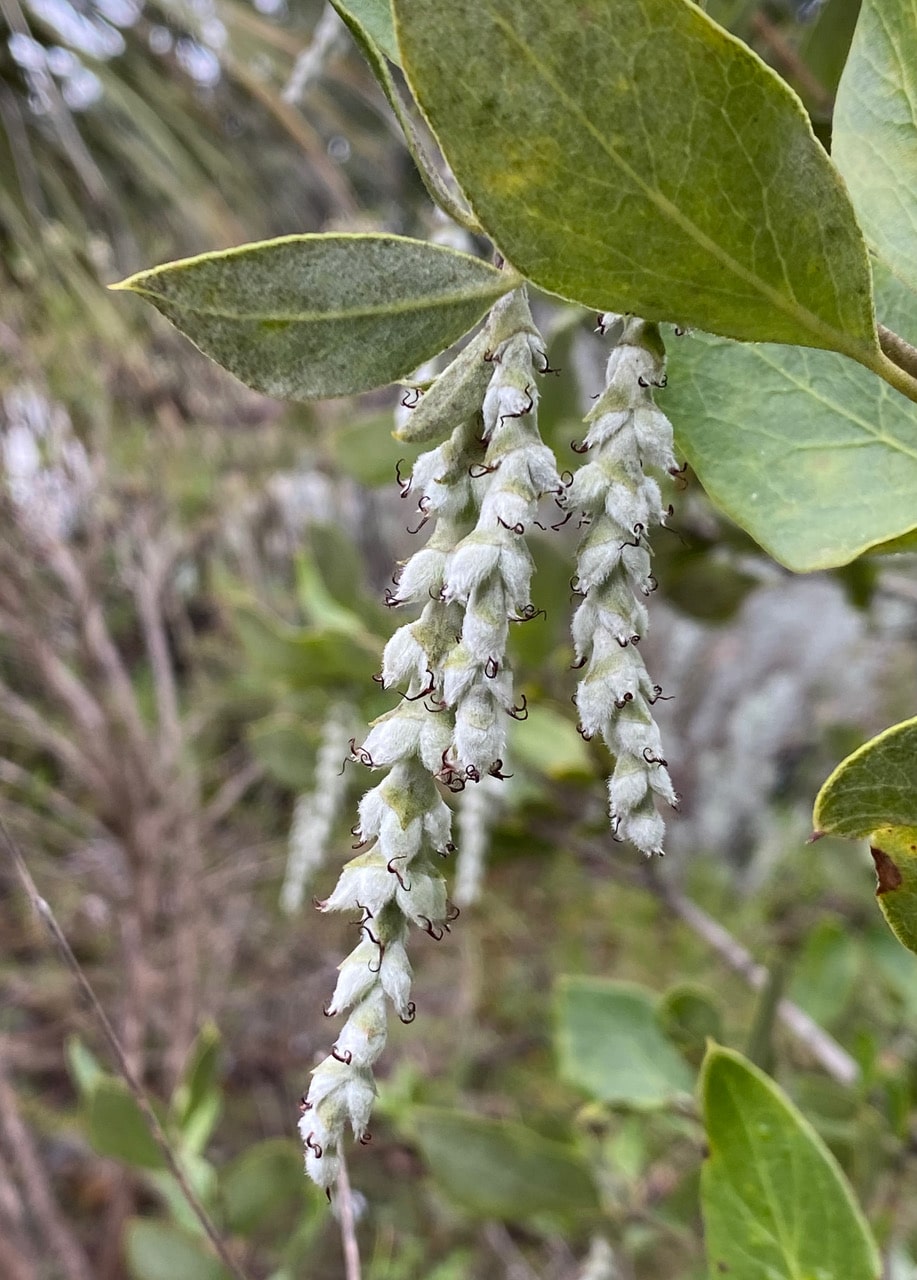
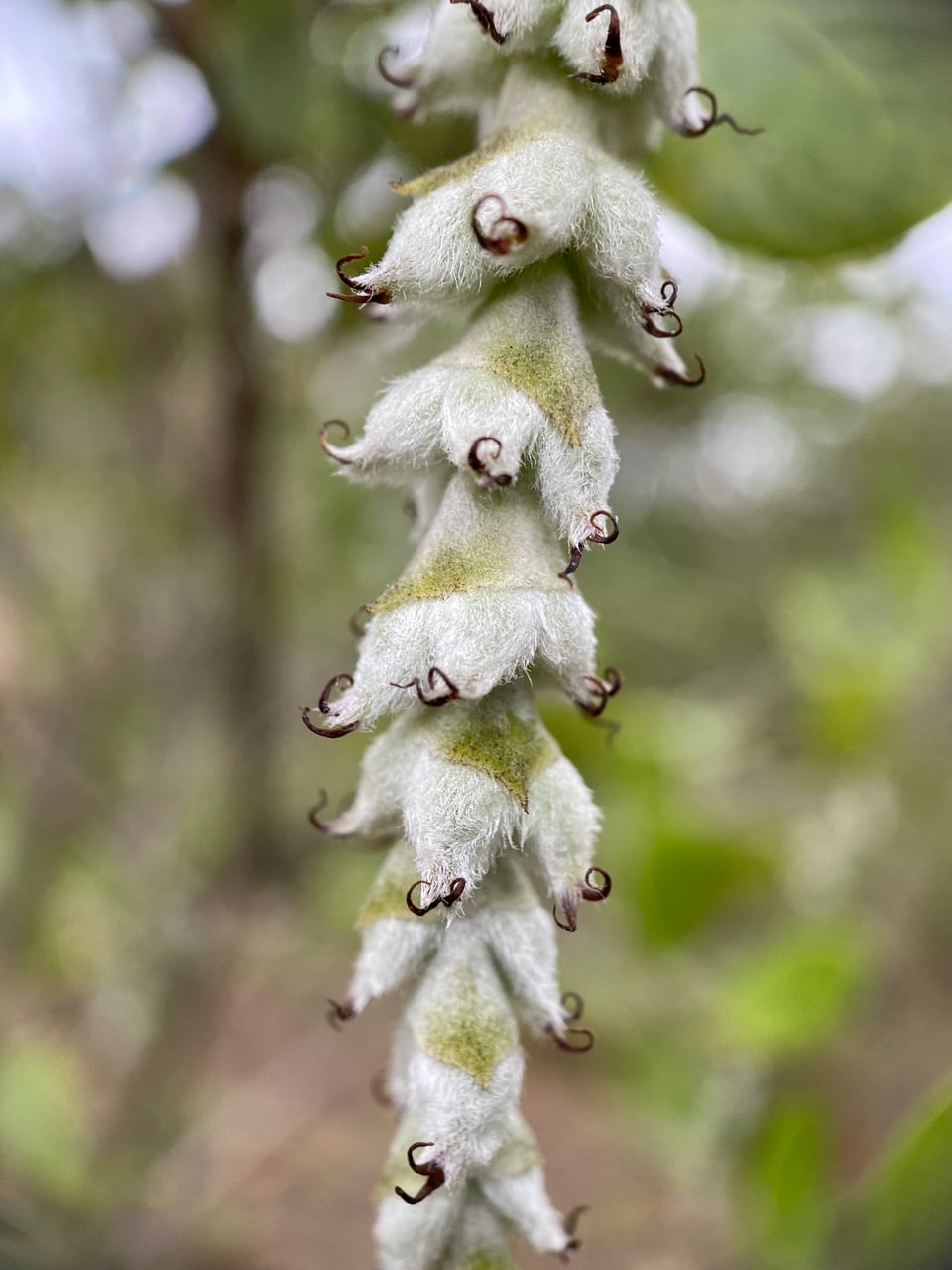
The catkins of a female Silk Tassel dangle from a small shrub.
The Coast Silk Tassel, Garrya elliptica (family Garryaceae) is an evergreen shrub or small tree. It is dioecious, meaning male and female flowers are borne on separate plants. Flowers appear in winter, male catkin-like clusters are yellowish to greenish then gray, up to 12″ long (“silk tassels”), female catkins are shorter, about 3-4″ long. Flowers are clustered and subtended by two bracts that are fused and form a cup or bell-shaped structure. Both male and female flowers are highly reduced, lacking petals. They are wind-pollinated.
The brown curly structures at the tips of each flower are withered stigmas. With luck, pollen from some nearby male Silk Tassels have been blown onto the stigmas when they were fresh and receptive. When pollinated, the female flowers produce fleshy fruits (containing usually two seeds) in tight clusters. These berries are initially hairy, green, and fleshy, becoming smooth, purplish, and brittle with age.
Coast Silk Tassel is an example of plants that are wind pollinated. About 12% of flowering plants and most conifers are wind pollinated. These plants do not waste energy on flower features that attract animal pollinators; instead, their flowers generally have these characteristics:
– Small, petalless, and unscented, with muted colors.
– No nectar
– Stamen (male flower part) and stigma (female pollen-receiving part) are exposed to air currents.
– Male flowers produce a great deal of pollen, which is very small, dry, and easily airborne.
The Goldback Fern, Pentagramma triangularis (family Pteridaceae) at the base of the boulders has revived beautifully in the rain. The old leaves have unrolled, and the tender young leaves are unfurling. Like all ferns, Goldback Fern does not produce flowers or seeds, but reproduces by spores. When you turn over the leaf, you’d find a layer of gold “dust” on the underside. Those are not spores, but a waxy material believed to help protect the plant from desiccation. The leaves curl up in response to dry period, but unroll with the return of the rain.
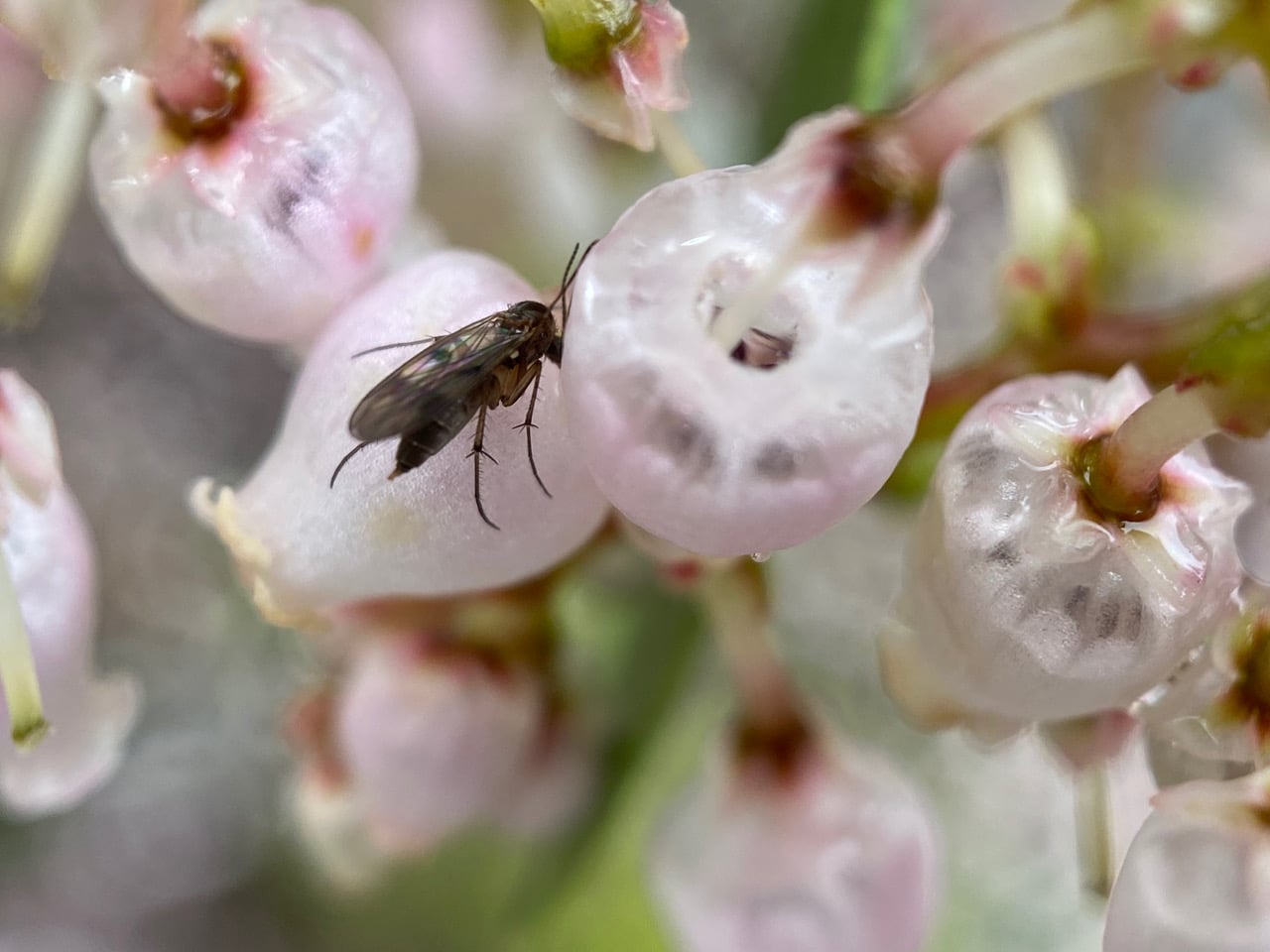
A dark insect is hunkered behind some rain-soaked Manzanita flowers. It is a Fungus Gnat, genus Mycetophila (family Mycetophilidae).
The Mycetophilidae are a family of small flies, often known by their common name of Fungus Gnats. They are generally found in the damp habitats favored by their host fungi and sometimes form dense swarms. The delicate-looking flies are similar in appearance to mosquitoes. Adults have slender legs with segmented antennae that are longer than their head. Adult fungus gnats do not damage plants or bite people. Larvae, however, when present in larger numbers, can damage roots and stunt plant growth. Females lay tiny eggs in soil or moist organic debris. Most of the fungus gnat’s life is spent as a larva and pupa in organic matter or soil. There may be many overlapping generations each year. They are most common during winter and spring in California when water is more available and cooler temperatures prevail.
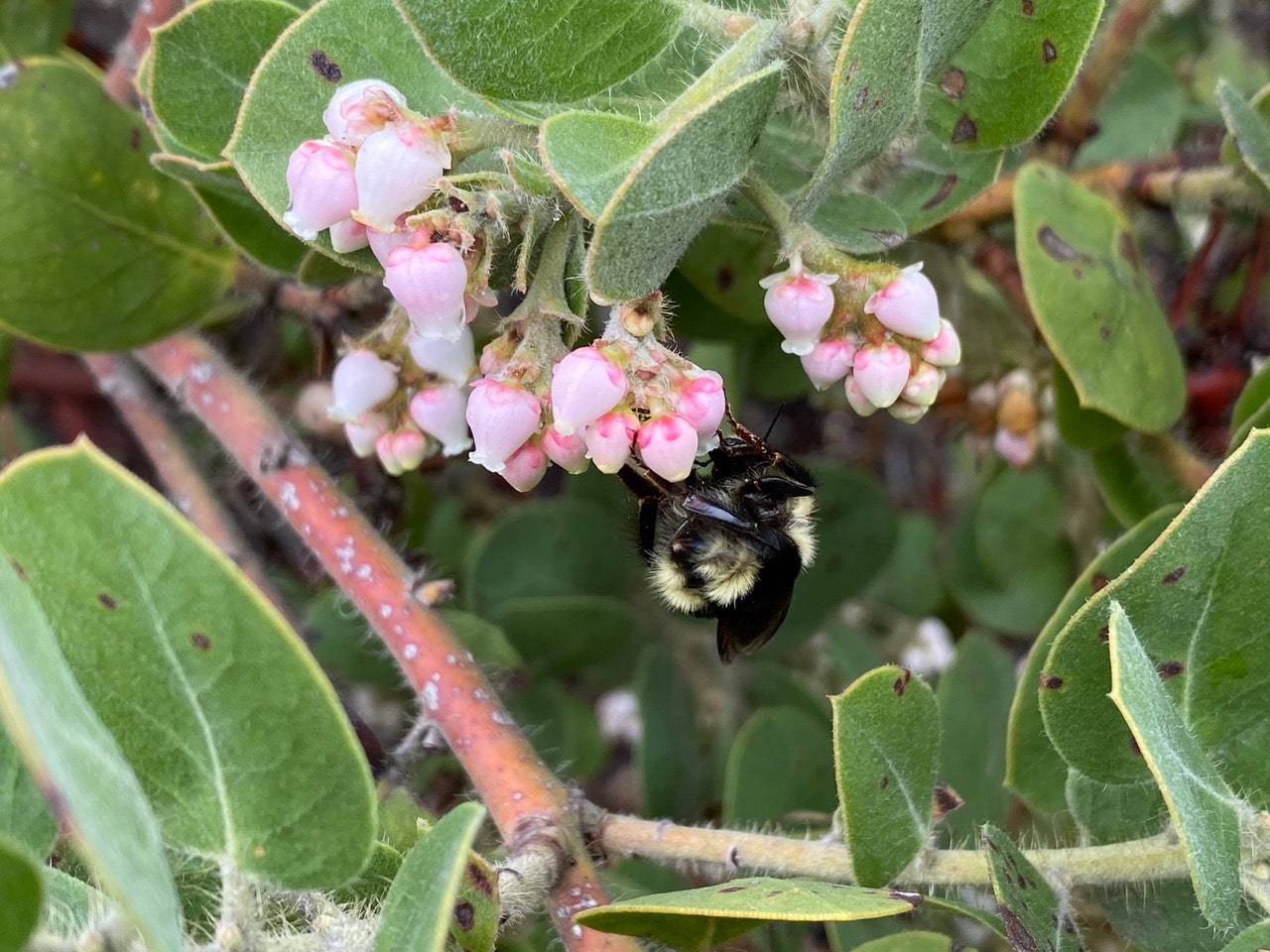
A large Black-tailed Bumble Bee, Bombus melanopygus (family Apidae) is foraging on a cluster of Manzanita flowers.
When the queen bee lifts off, you can see how robustly she’s built! The queens are really built for laying eggs; they are not at all agile at foraging.
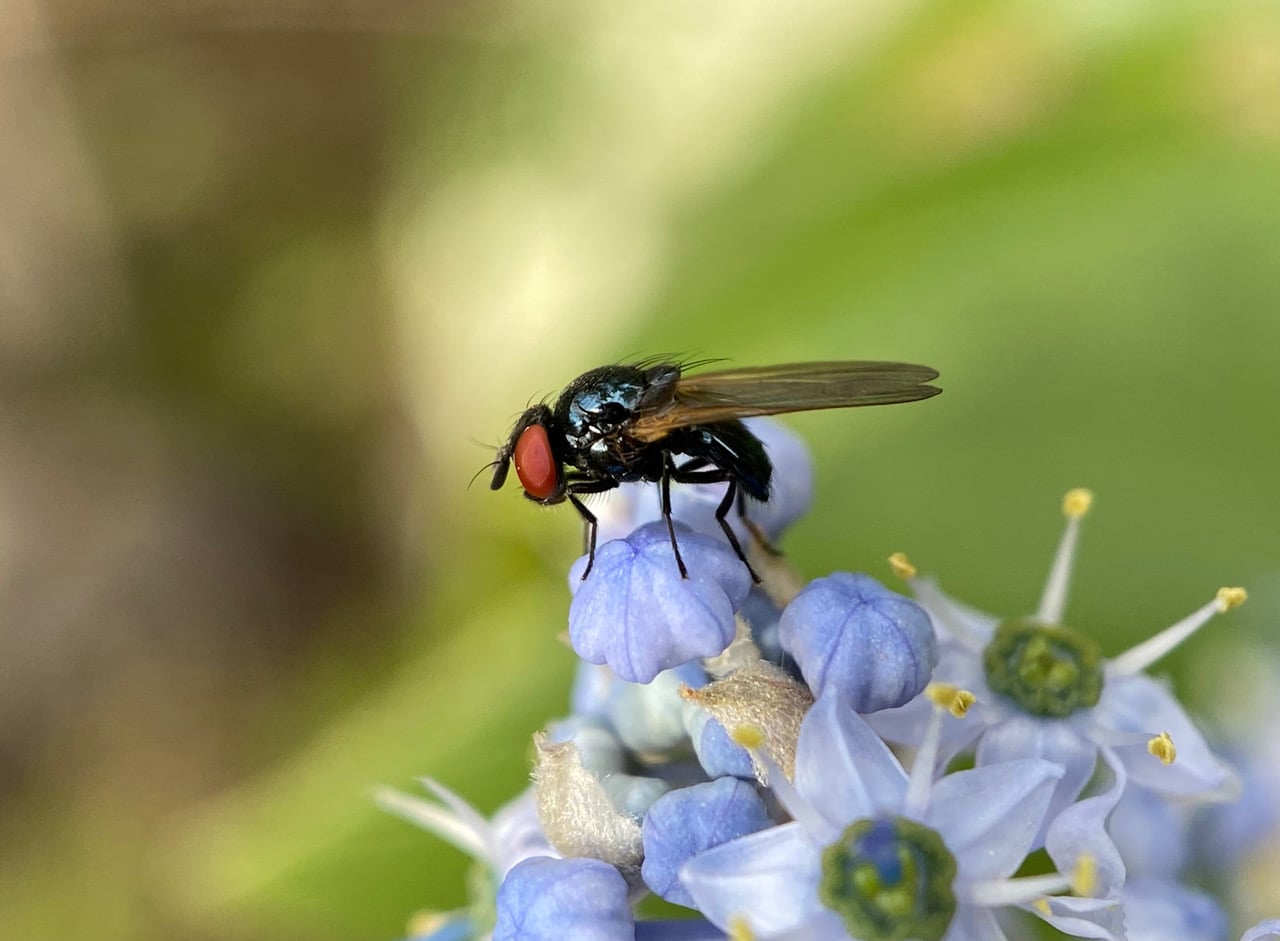
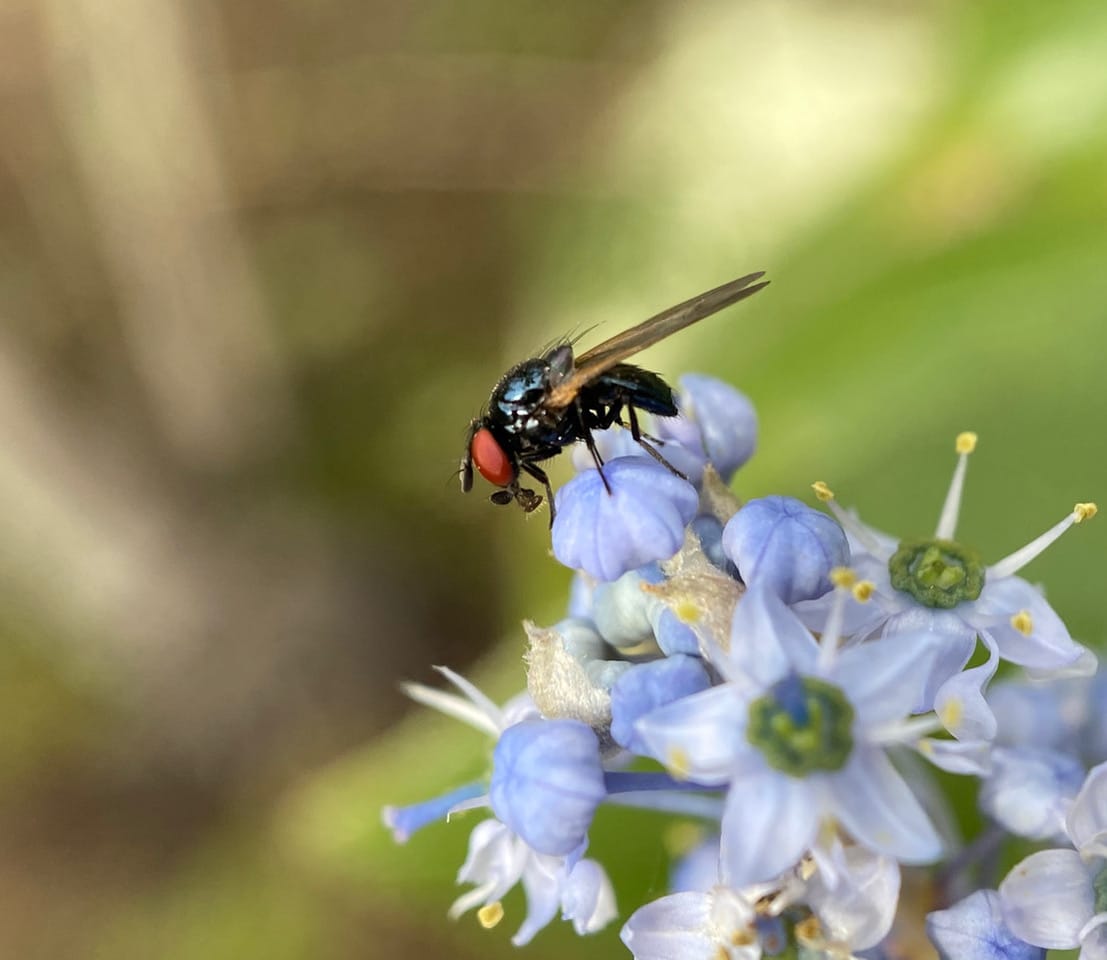
A tiny insect, just a few millimeters long is perched on a cluster of young Ceanothus flowers. I zoom in and find a fly with metallic blue body and large red eyes.
Whoa, check out those impressive sponging mouthparts! The fly is a Lance Fly, Silba fumosa (family Lonchaeidae).
The Lonchaeidae are a family of acalyptrate flies commonly known as Lance Flies. They are generally small but robustly built flies with glossy blue-black or metallic bodies. They are found mainly in wooded areas, throughout the world. The larvae are mostly phytophagous, feeding on already damaged plant tissues, although coprophagous, mycophagous, saprophagous, and predatory species are known. Larvae may be found under bark, in tunnels of bark beetles, in decomposing wood and other decomposing plant residue, and in dung. Some species are agricultural pests. Silba fumosa is native to western Europe, North Africa and the Middle East; it was introduced to western North America. Larvae feed in leaf litter and compost; adults feed on nectar.
We often see tiny insects hovering and milling around in the air. The behavior is common in several families of flies (midges, black flies, dance flies, etc.), but Lonchaeids are one of the few groups of “higher flies” that do it.
When I arrive at the raised bulb bed, I am delighted to see many Shooting Stars (Primula sp.) in bloom, and there are insects zipping around, visiting the flowers. Most are the fast flying Digger Bees (either Anthophora sp. or Habropoda sp.), a few are queen Yellow-faced Bumble Bees, Bombus vosnesenskii (family Apidae). They are so fast I have to resort to video recording to document their activity. Interestingly, I do not hear the high-pitch buzz typical of buzz-pollination as the bees hang upside-down from the nodding flowers.
The Shooting Star flower droops downward with petals reflexed, or bent back. Most of the petals are a lovely pink, but toward the base a fringe of white blends into yellow – colors most attractive to a bee’s eyes. A squiggly line of burgundy marks the spot where the petal bends. A conical purple column hangs below the petals. This is the anther cone, a fusion of the anthers where pollen is produced. Surrounded by the cone, and extending beyond is a thin, needle-like style with a stigma at the tip – the female portion of the flower.
Shooting star flowers do not produce nectar, but pollination is most often accomplished by bumble bees foraging for pollen, and using a specialized method called “buzz pollination”. A bumble bee arrives at the flower, grasps the anther cone with its feet and mandibles and hangs upside-down. It disengages its flight muscles from the wings, then vibrates the muscles at a specific frequency, causing the anthers to vibrate, showering pollen onto the bee’s belly. When the bee next visits another shooting star, the pollen on its belly may be rubbed off on the flower’s stigma. Pollination accomplished!
Honey bees do not have this special skill. Only native bees such as Bumble Bees, Digger Bees and a few others are able to buzz pollinate. Blueberries, cranberries, and plants in the Nightshade family such as tomatoes, eggplants and peppers also require buzz pollination.
Some of the Shooting Stars have been pollinated. The petioles have started to straighten out angling the flowers upwards to face the sky. Pretty soon, cylindrical seed capsules will develop above the spent petals. They eventually split open and their seeds are shaken out by the wind.
In the same bulb bed, the rare and endangered Fragrant Fritillary, Fritillaria liliaceae is blooming gloriously, but I don’t see any insect come close to the large flowers. The Shooting Stars seem to get all the attention today!
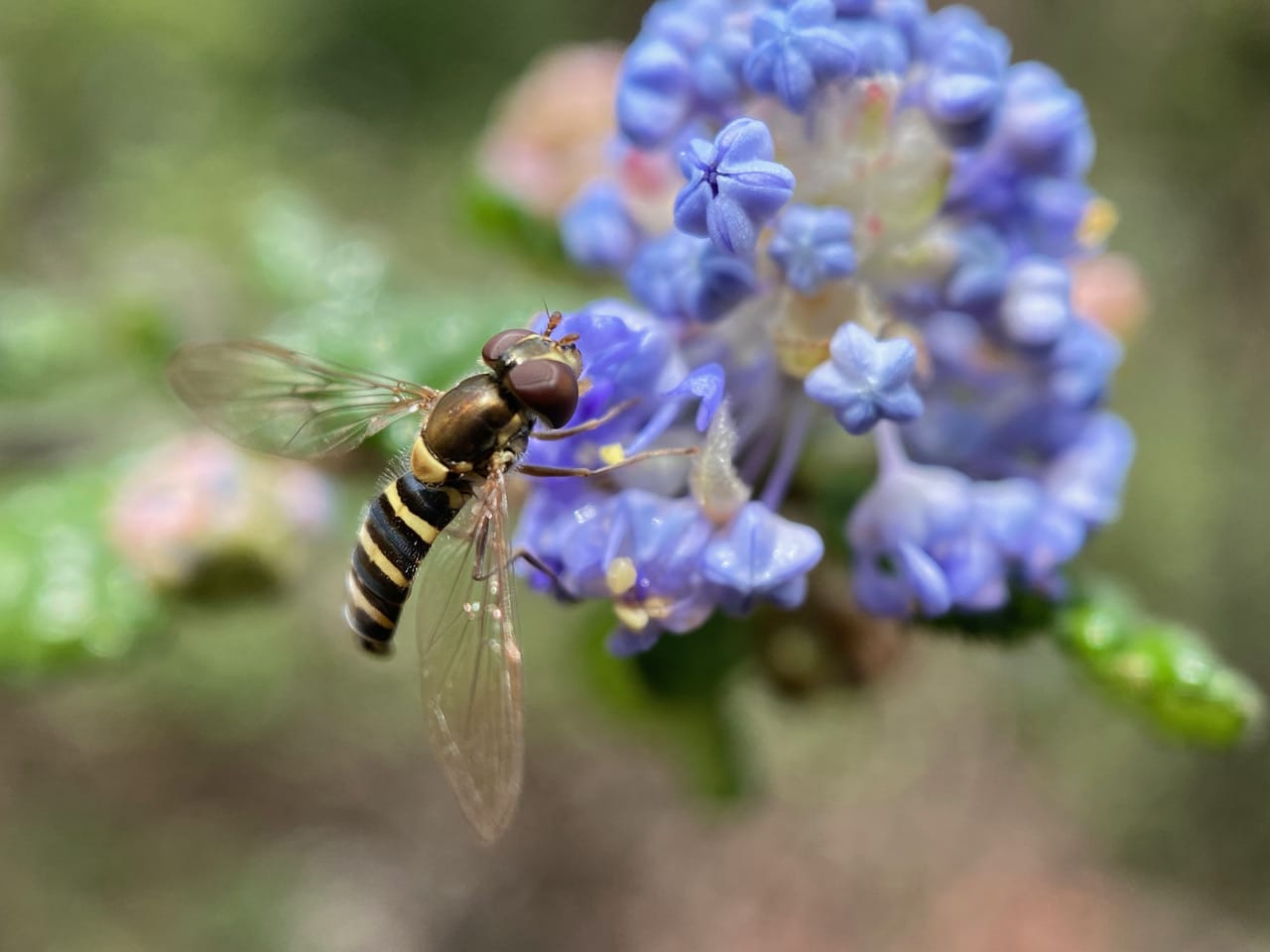
A small hover fly stops by a cluster of immature Ceanothus flowers.
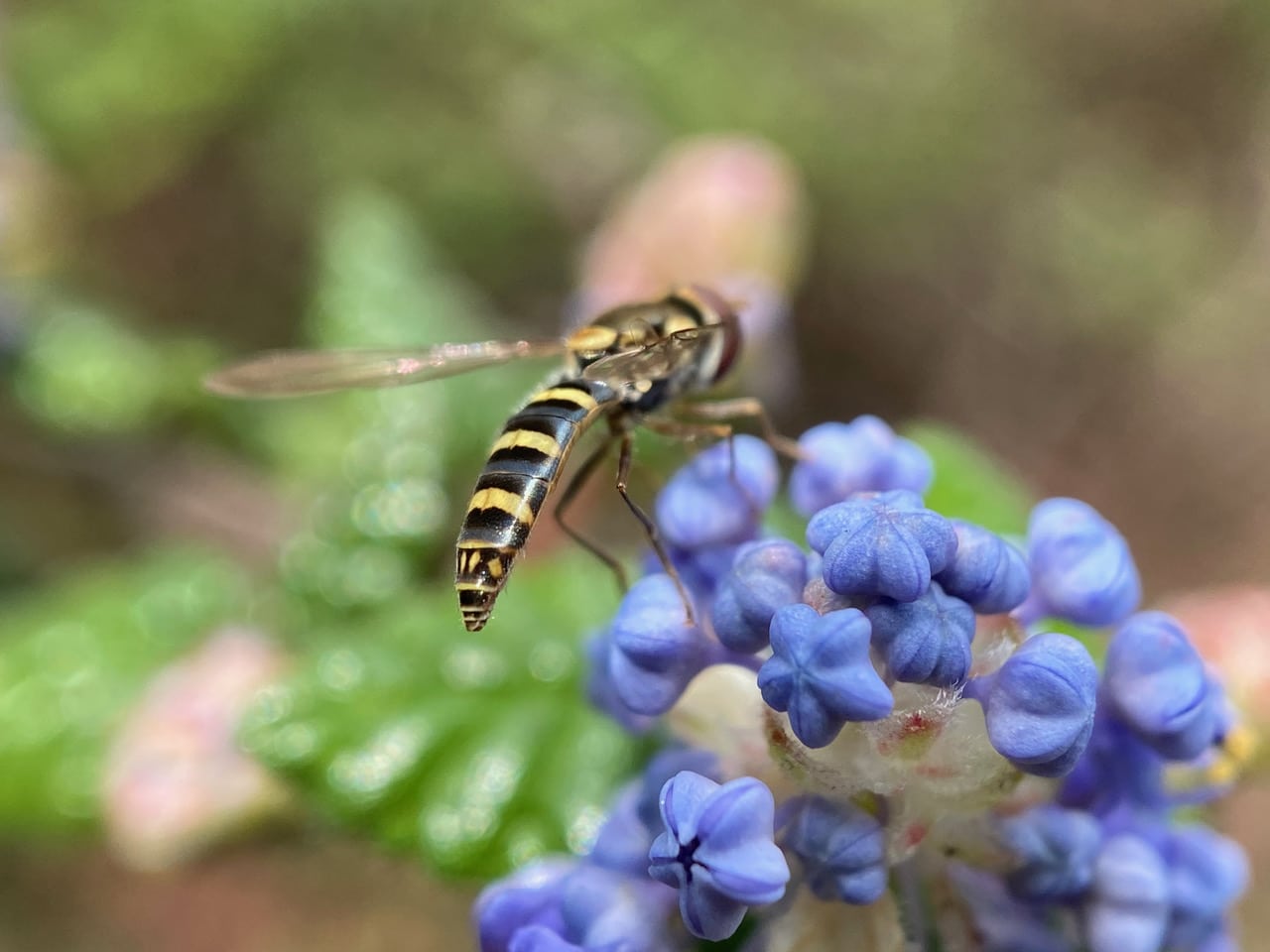
Hmm… its abdomen is stubbornly curled under. I need to see the markings on the tip of the abdomen to identify the critter!
Aah, it’s the Diamond Spottail hoverfly, Fazia micrura (family Syrphidae). There are four diamond-shaped yellow markings near the tip of the abdomen.
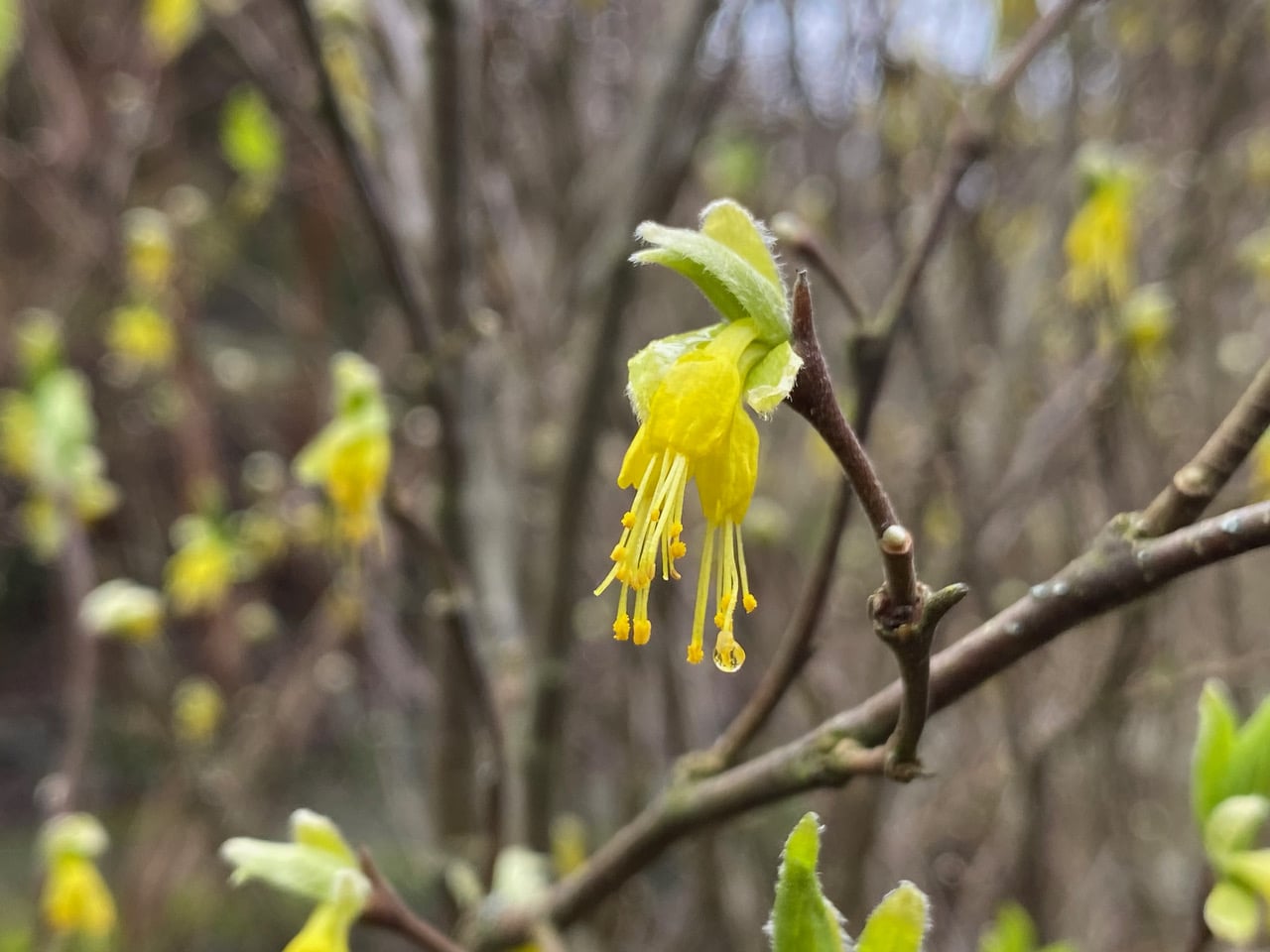
The Western Leatherwood, Dirca occidentalis is blooming gloriously! I wait by the large shrub for a while, but alas, do not to see any pollinator visit the flowers.
Each inflorescence consists of 1-4 nodding flowers arising from the same leaf axil. The apparent petals are actually bright yellow sepals. Long stamens and pistil extend beyond the calyx, giving the appearance of tassels. From what I read, Anna’s hummingbirds and non-native honey bees frequent the flowers. The common name Leatherwood refers to the plant’s pliable twigs and tough, leathery bark. The branches were historically used by Native Americans for basket making.
The Western Leatherwood, Dirca occidentalis belongs in a rather unfamiliar family Thymelaeaceae. The plant is not only endemic to California, but to the SF Bay Area specifically. There are quite a few of these plants growing in the moist and shaded slopes on the north end of the Skyline Gardens. The flowers emerge prior to leafing in late winter.
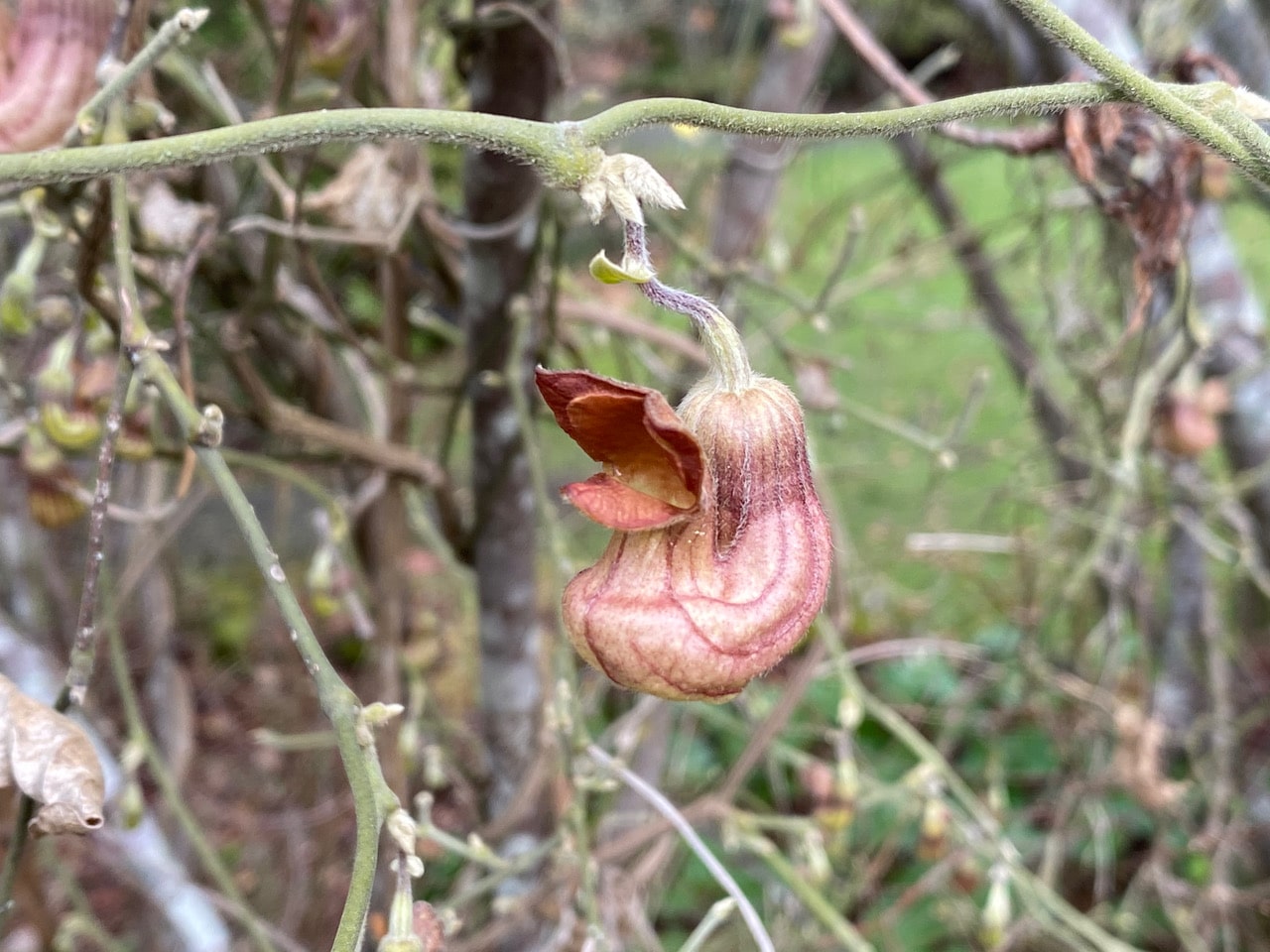
There are many more mature flowers on the California Pipevine, Aristolochia californica today, compared to 2/8 when I last visited this patch.
The California Pipevine flower resembles a calabash pipe and begins to bloom in late winter or early spring. The flowers are actually fused sepals, shaped to protect the reproductive parts within. Many flowers emerge before the bare stems of the deciduous vine begin to leaf out. The flower not only protects its own reproductive parts, it also offers shelter to small insects from the rain and cold. As the flower opens, it emits a foul odor that attracts tiny fungus gnats, a type of flies (family Mycetophilidae). Sometimes when you cut open a flower, some of these gnats would fly out. They look like miniature mosquitoes. They are the primary pollinators for the California Pipevine.
Finding a flower with a wide gape, I can’t resist taking a peek inside. There are small insects jostling around inside – probably Fungus Gnats (family Mycetophilidae)! Quickly, I switch my camera to video mode:
Enticed by the foul odor emitted by the flower, the fungus gnats enter through the maroon three-lipped opening. Insects in general are attracted to light. In the darkness inside the flower, sunlight streaming through the skylight (less pigmented interior tissues) directs the gnat to the top of the flower where the nectar and the reproductive parts are located. While taking nectar, the gnat may bump into the reproductive parts of the flower, getting dusted with the pollen from the anthers.
The California Pipevine is strongly protogynous, the female parts maturing before the male parts. As the flower matures, the stigmatic lobes close up, exposing the stamens beneath them. The stamens begin to peel away from the base of the stigma, and the anthers start to release pollen. Before the gnat leaves the flower, it is dusted with pollen to be ferried into the next flower it visits. If the subsequent flower happens to be in the famale phase, the pollen on the gnat might be deposited on the receptive stigma, effectively pollinating the flower. Separation of the female and male phases ensures that the flower will not pollinate itself; only cross-pollination happens. The gnats are likely to stay in the flower for days while the going is good. They may even find mates while gathered in the enclosure. Once the feast and fun is over, they make their way out through the opening, only to be lured by the next flower.