

Pollinator Post 2/21/25 (3)

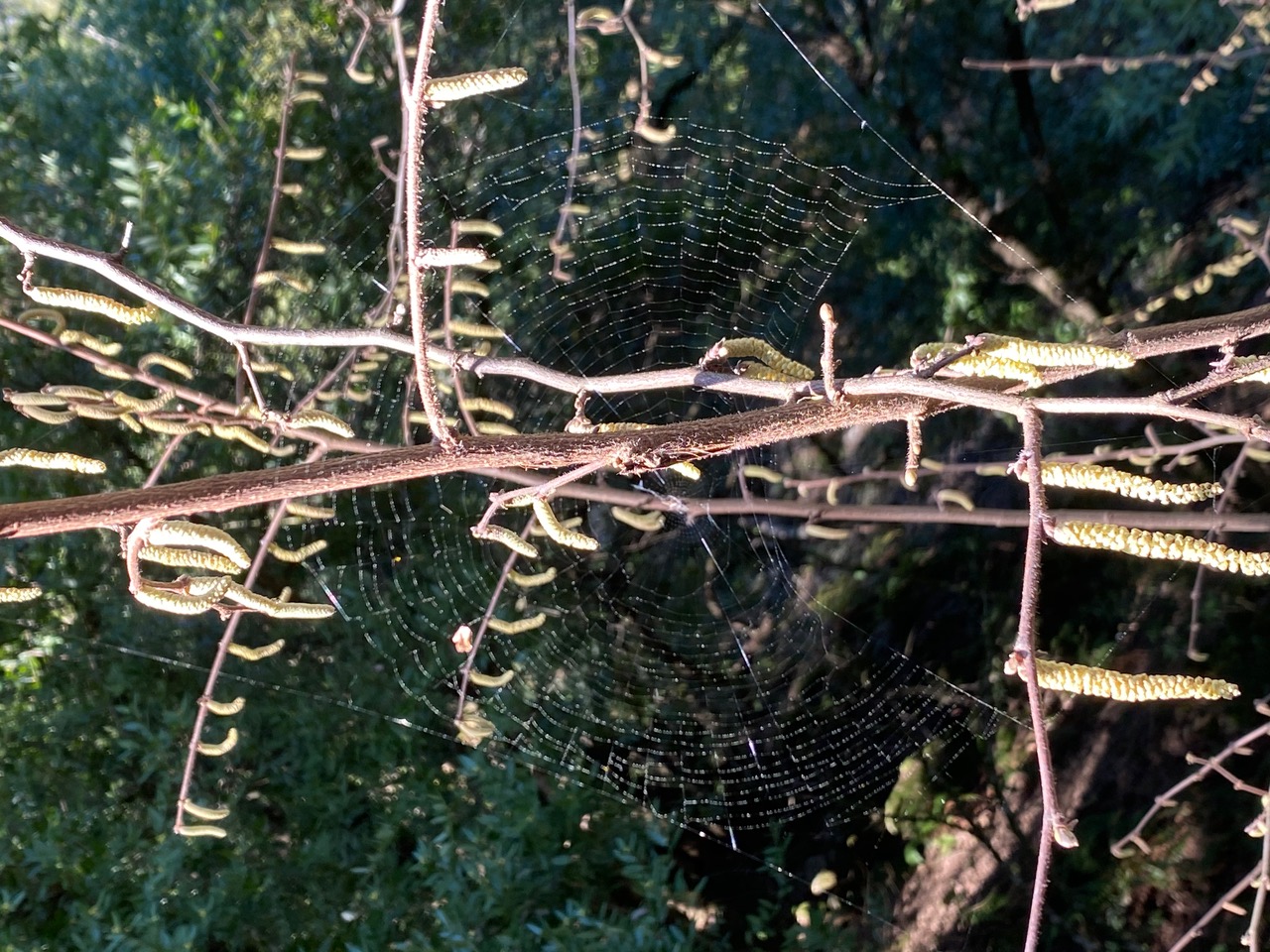
Although not immediately obvious, this tree is in glorious bloom! Prodigious male catkins are hanging from the bare branches of a California Hazelnut or Beaked Hazelnut, Corylus cornuta against the dark background of a Bay Tree.
Beaked Hazelnut Photos Page 1

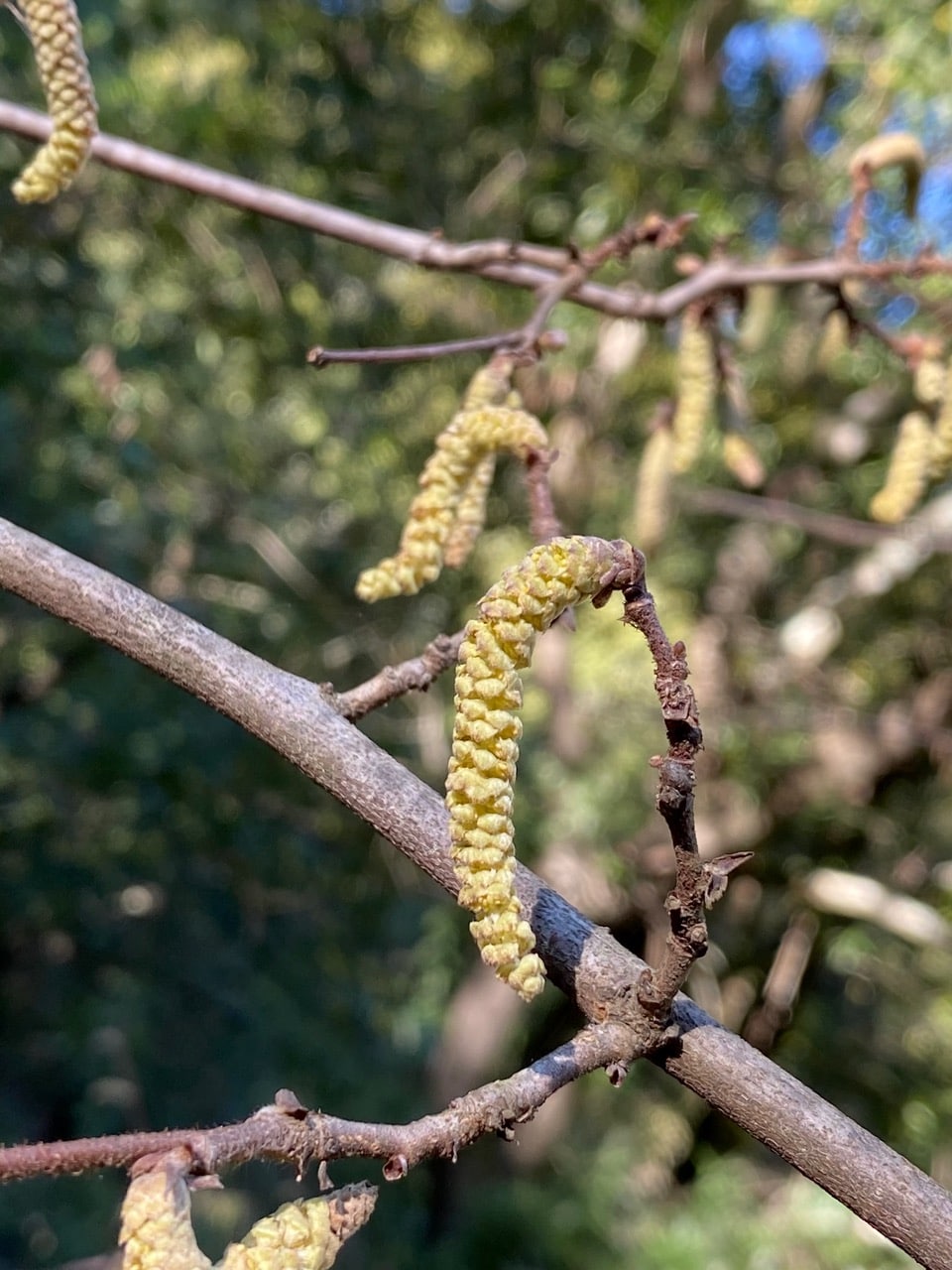




The Hazelnut is monoecious, with separate male and female flowers borne on the same plant. The tree/shrub also exhibits dichogamy, with temporal separation of the male and female phases. Being protandrous, the male flowers of Hazelnut show up before the female flowers. The female flowers have yet to appear on this plant.
The California Hazelnut, Corylus cornuta is a deciduous shrub. Male flowers are borne on long, pendulous catkins in clusters near branch tips, appearing in the fall but opening the following spring before the appearance of leaves. Female flowers, several in a scaly bud, are tiny and inconspicuous with only bright red stigma and styles protruding from the otherwise gray-brown buds, almost completely enclosed by bracts. The flowers are wind-pollinated. The male catkins tend to mature before the female flowers appear on the same plant, ensuring that the flowers do not self-pollinate.
Hazelnut flowers bloom before the leaves emerge, increasing the odds that the wind will successfully transport the pollen grains from the male flowers to a compatible female flower without leaf surfaces disrupting air movements and pollen delivery.
While reaching over to take this picture, I accidentally brush against another branch, sending clouds of yellow pollen billowing out from the male catkins.
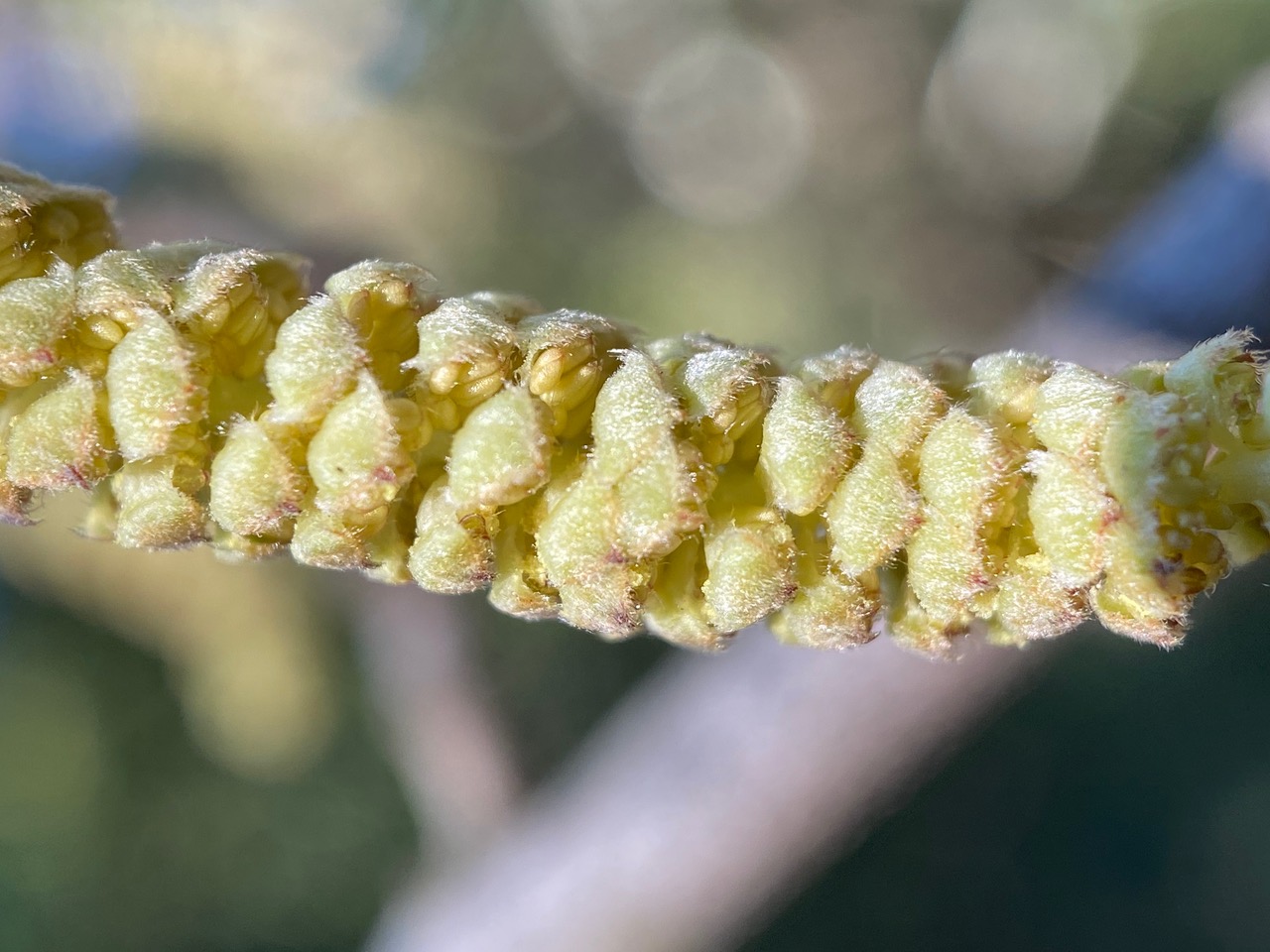
Close-up of a young male catkin. Behind the protective shield of overlapping scales are intact anthers. Both the male and female Hazelnut flowers lack petals.
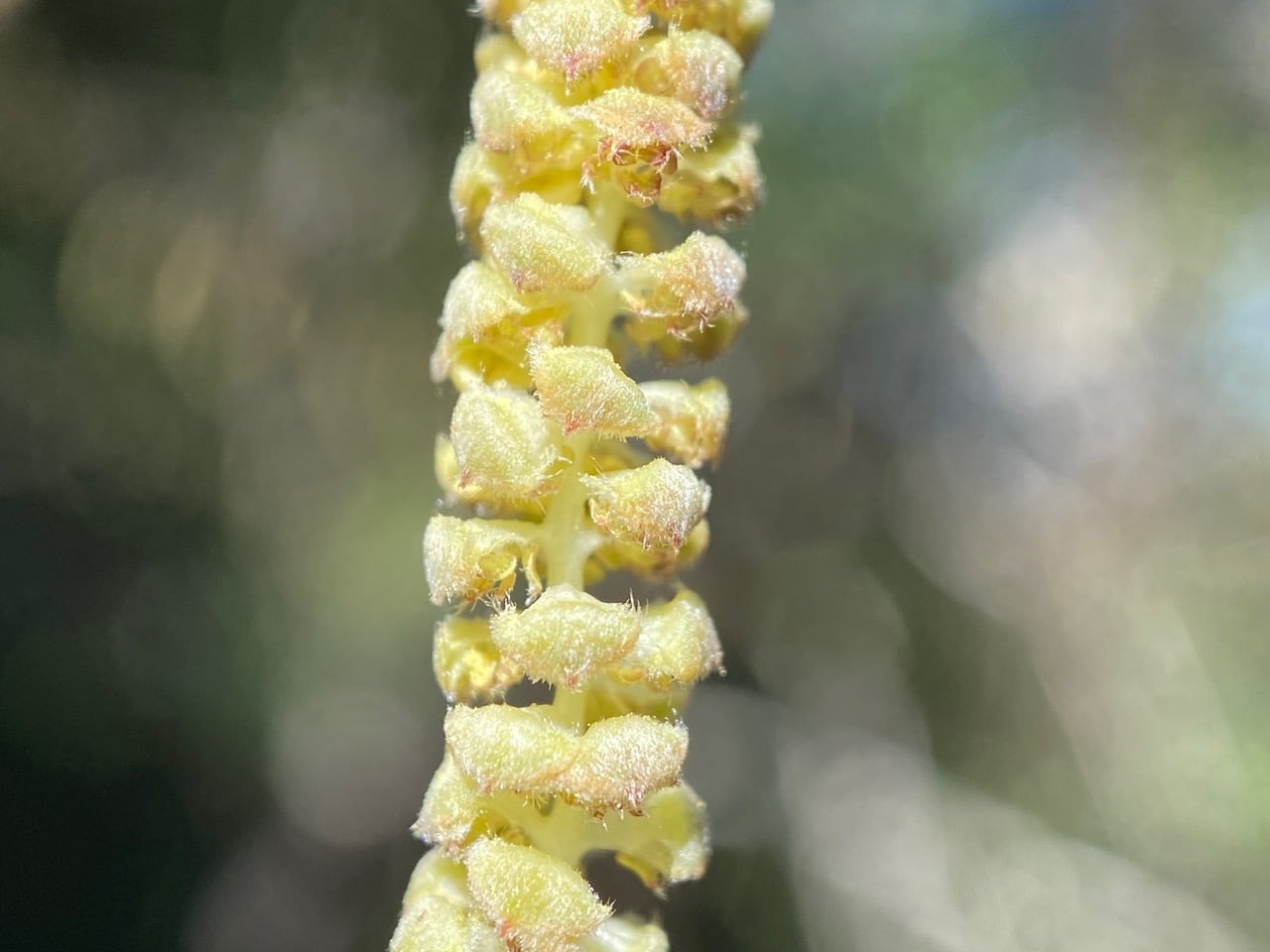
The scales have gaped further apart on this male catkin, showing anthers at the stage of pollen release.
Close-up of an old male catkin showing spent anthers emptied of pollen. Looking up close at these male catkins of Hazelnut (Corylus sp., family Betulaceae), I am blown away (pun intended) by their resemblance to the male catkins of the Silk Tassels (Garrya sp, family Garryaceae) that I have examined recently. Although the two plants belong to different families, they are both dependent on wind pollination. This is a great example of convergent evolution, attesting to the effectiveness of the dangling flower structures for pollen dispersal by wind.
About 12% of flowering plants and most conifers are wind pollinated. These plants do not waste energy on flower features that attract animal pollinators; instead, their flowers generally have these characteristics:
– Small, petalless, and unscented, with muted colors.
– No nectar
– Stamen (male flower part) and stigma (female pollen-receiving part) are exposed to air currents.
– Male flowers produce a great deal of pollen, which is very small, dry, and easily airborne.
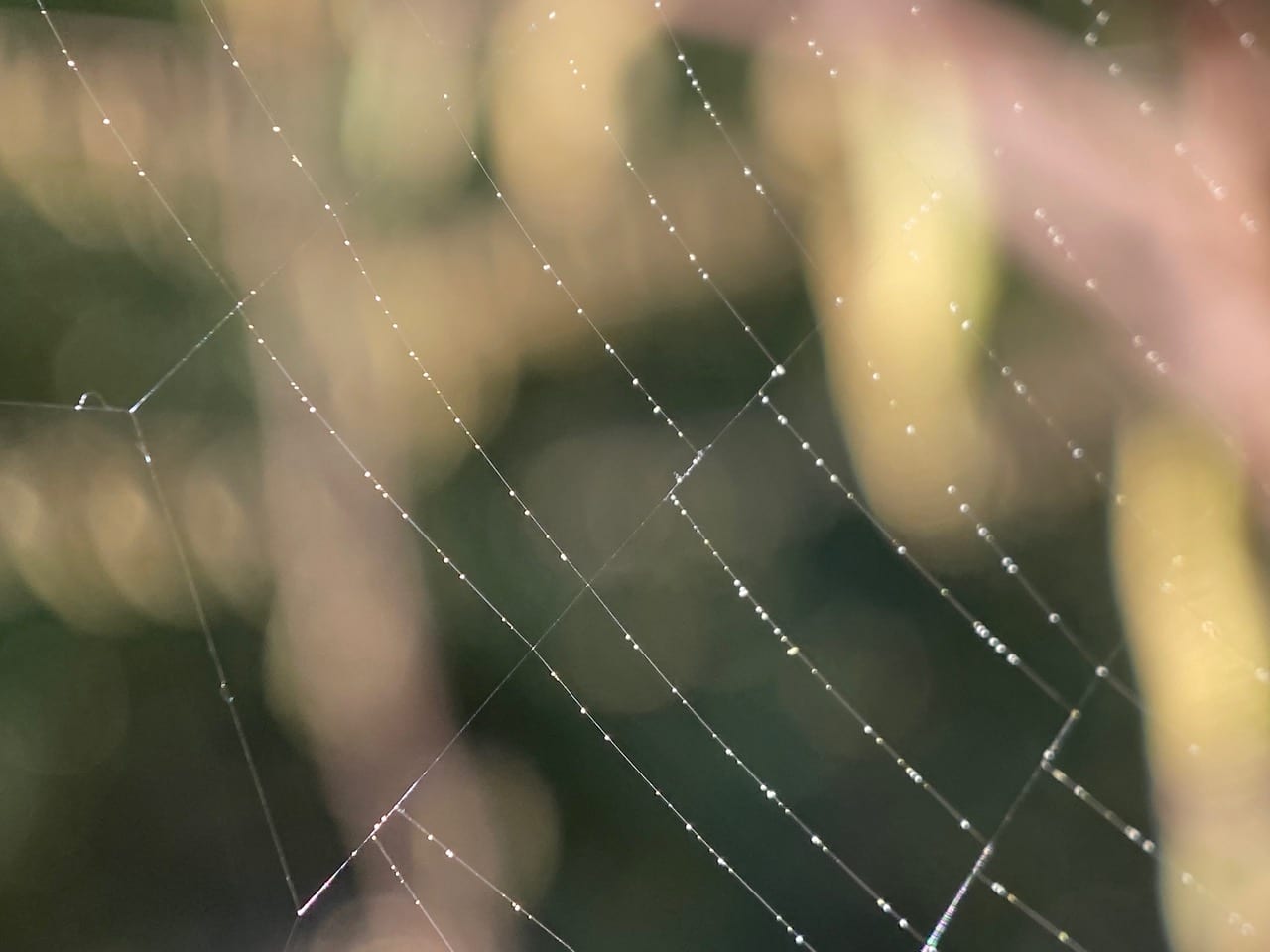
Hey, see that spider web among the male catkins? It has been made visible by the wind-blown Hazelnut pollen that has been trapped on the sticky silk.
Close-up of the Hazelnut pollen grains trapped on the spider silk.
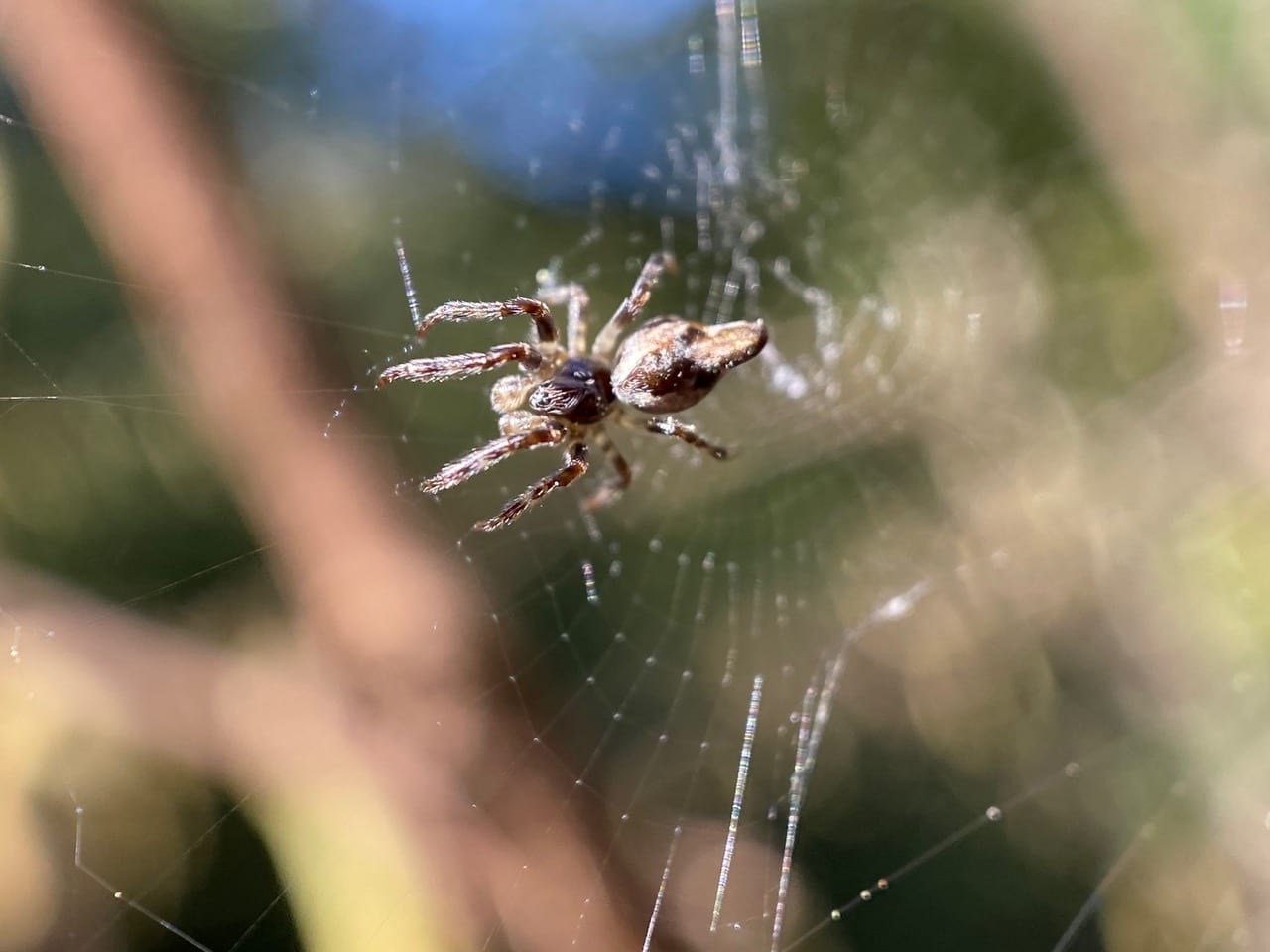
I am surprised to see a Conical Trashline Orb Weaver, Cyclosa conica (family Araneidae) resting head-down in the center of the web. This web is the largest of its kind I have ever seen. The “trashline” is missing as the lower part of the web has been damaged.
Cyclosa, also called Trashline Orbweavers, is a genus of orb-weaver spiders (family Araneidae). The tiny spider (5-7.5 mm) is easily recognized by its web decoration; the spider strings together the dead bodies of insect prey and other debris and hangs them in a vertical line through the middle of its web. The decoration, which sometimes includes egg cases as well, probably serves to camouflage the spider. Cyclosa creates its webs mostly during times of complete darkness. The females occupy the web hub (center) to sit-and-wait for prey. The spider can ensnare prey at nearly any time of day, and it only leaves its spot to replace the web prior to sunrise.
Alerted to my presence, the spider rushes towards the camera. Hey, it’s a male, given its large pedipalps! That’s even more surprising – male Cyclosa are hardly ever seen on a web.
Once the males reach maturity in the spring, they travel away from their home in search of a mate.
Note the prominent pair of appendages that he holds like boxing gloves in front of his face. These are pedipalps. The pedipalps of spiders serve many functions. They are large, paired mouthparts used variously to manipulate food, as supplementary walking legs, communication devices, sensory structures and sex organs.
Once male spiders reach adulthood, they “charge” their two pedipalps with sperm. They will spin a small “sperm web” on which they deposit their sperm from the genital opening on their belly, then take up the sperm into specialized storage structures of the palps, called palpal bulbs that resemble boxing gloves (a handy rule of thumb for distinguishing males and females). These are then used to inject sperm into the female’s reproductive tract during mating.
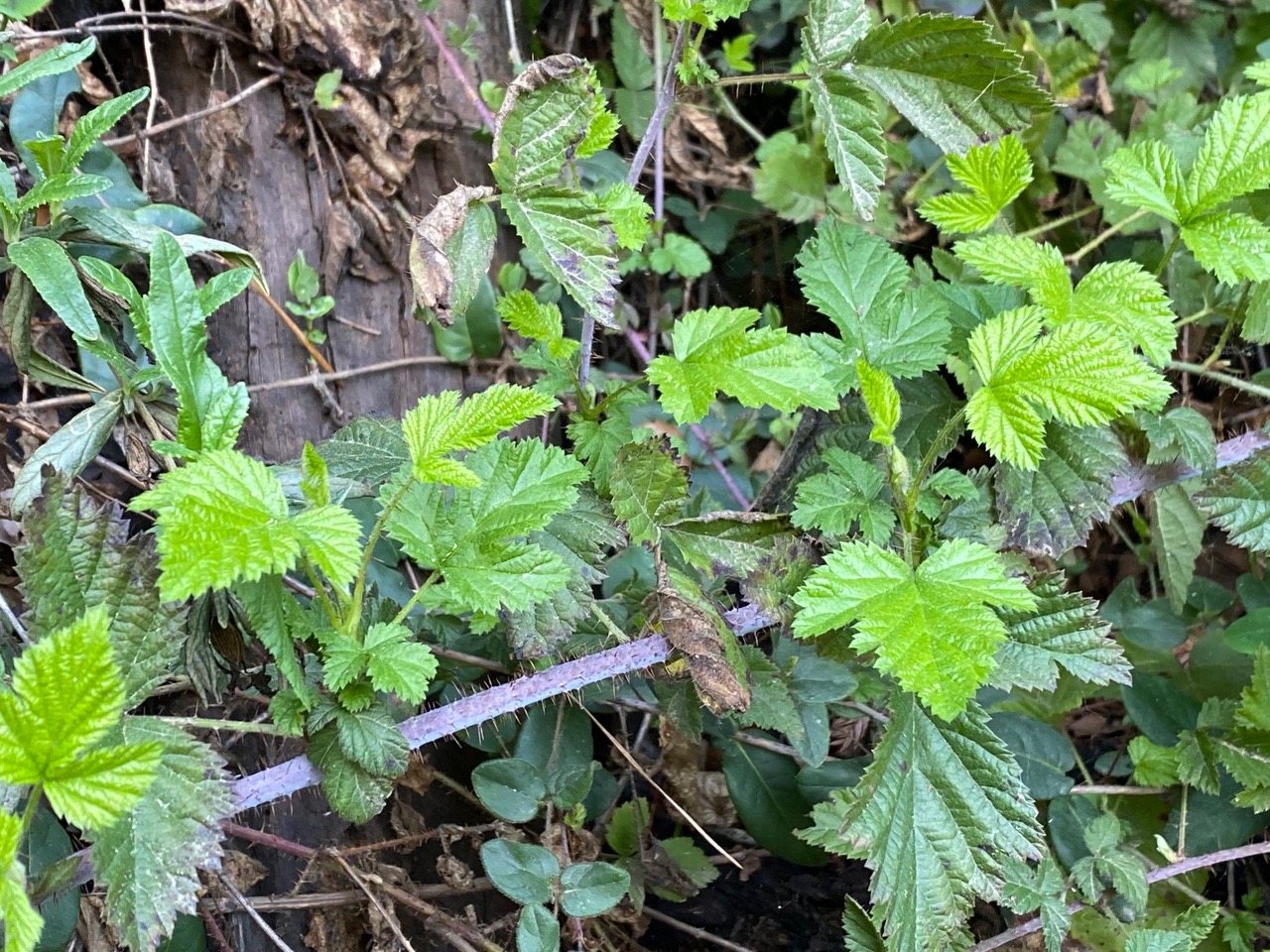
The California Blackberry, Rubus ursinus has sent out bright green shoots to replace the old foliage on the vines.
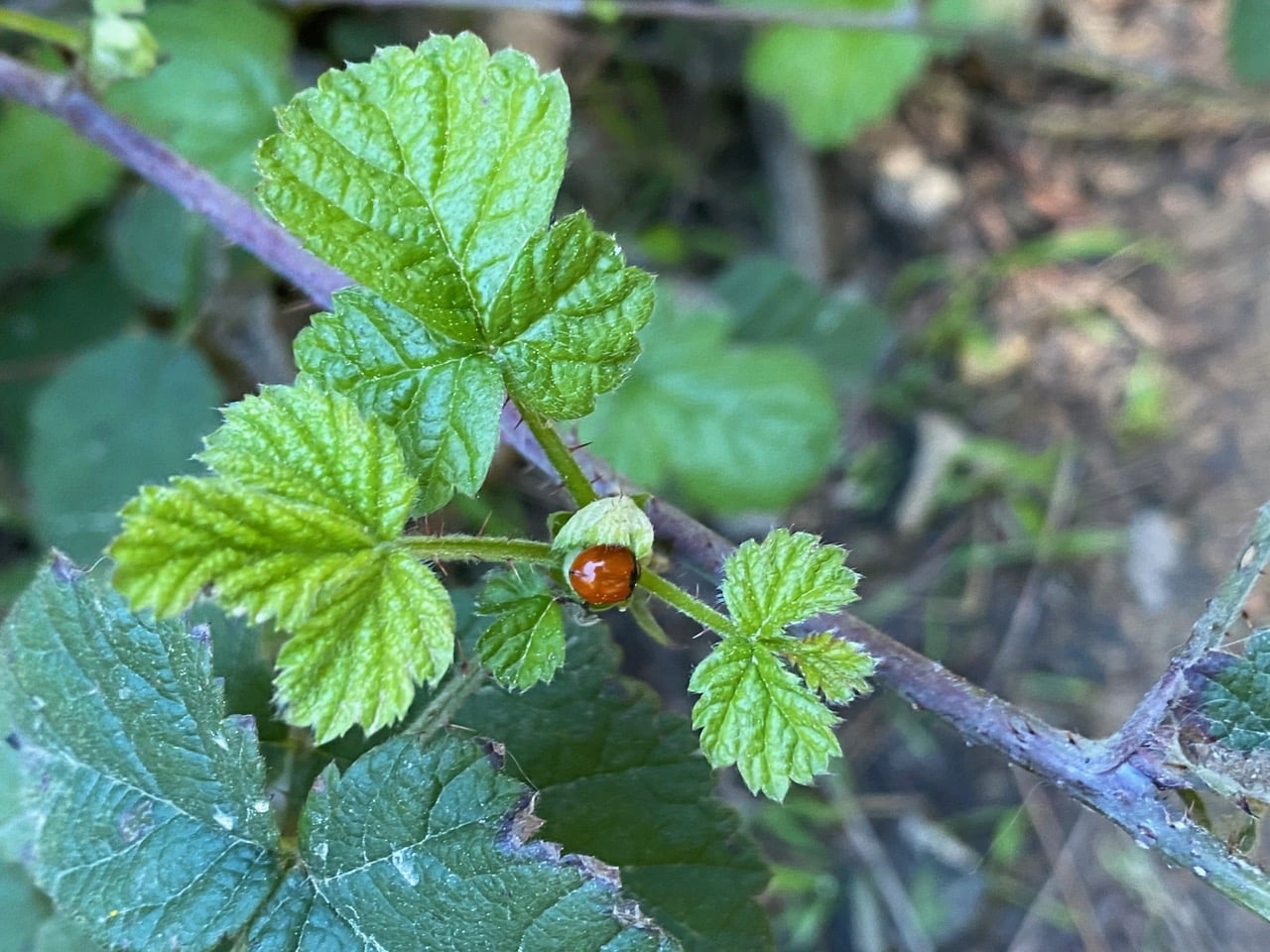
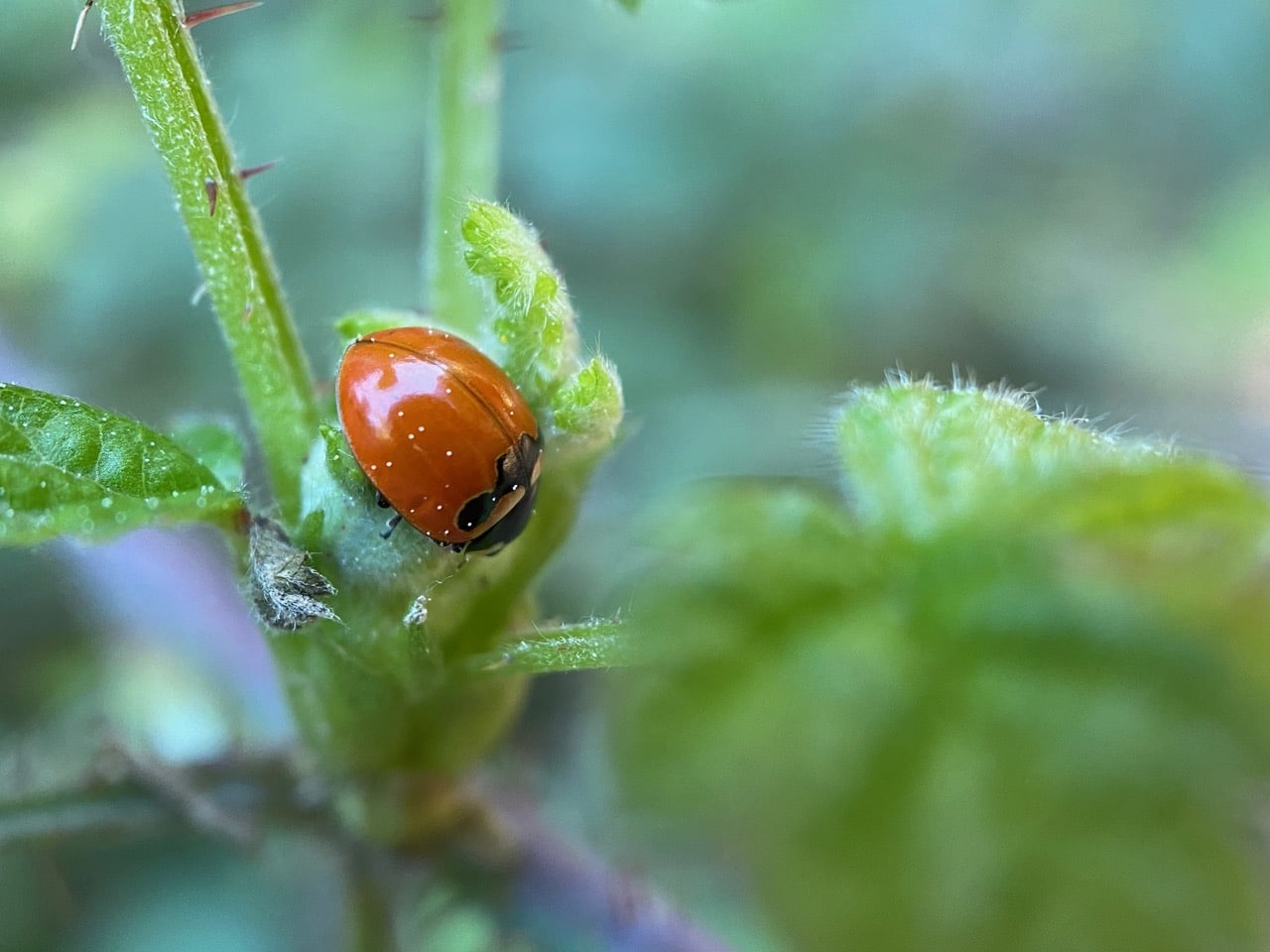
Looks like a Lady Beetle on that new shoot.
Closer examination shows that it is a Three-banded Lady Beetle, Coccinella trifasciata (family Coccinellidae). There are pollen grains scattered over its elytra. Hazelnut pollen carried by the wind?
“Three-banded” Lady Beetle? The species is rather variable depending on its range. The ones found east of the Rockies are indeed three-banded. Species Coccinella trifasciata – Three-banded Lady Beetle – BugGuide.Net Here in California, we have the subspecies Coccinella trifasciata subversa, also known as the Pacific Three-banded Ladybeetle. Photos of Pacific Three-banded Lady Beetle (Subspecies Coccinella trifasciata subversa) · iNaturalist These beetles are active from spring through summer months and on warm days of fall; diapausing (insect version of hibernation) through the colder winter months.