

Pollinator Post 2/21/25 (2)
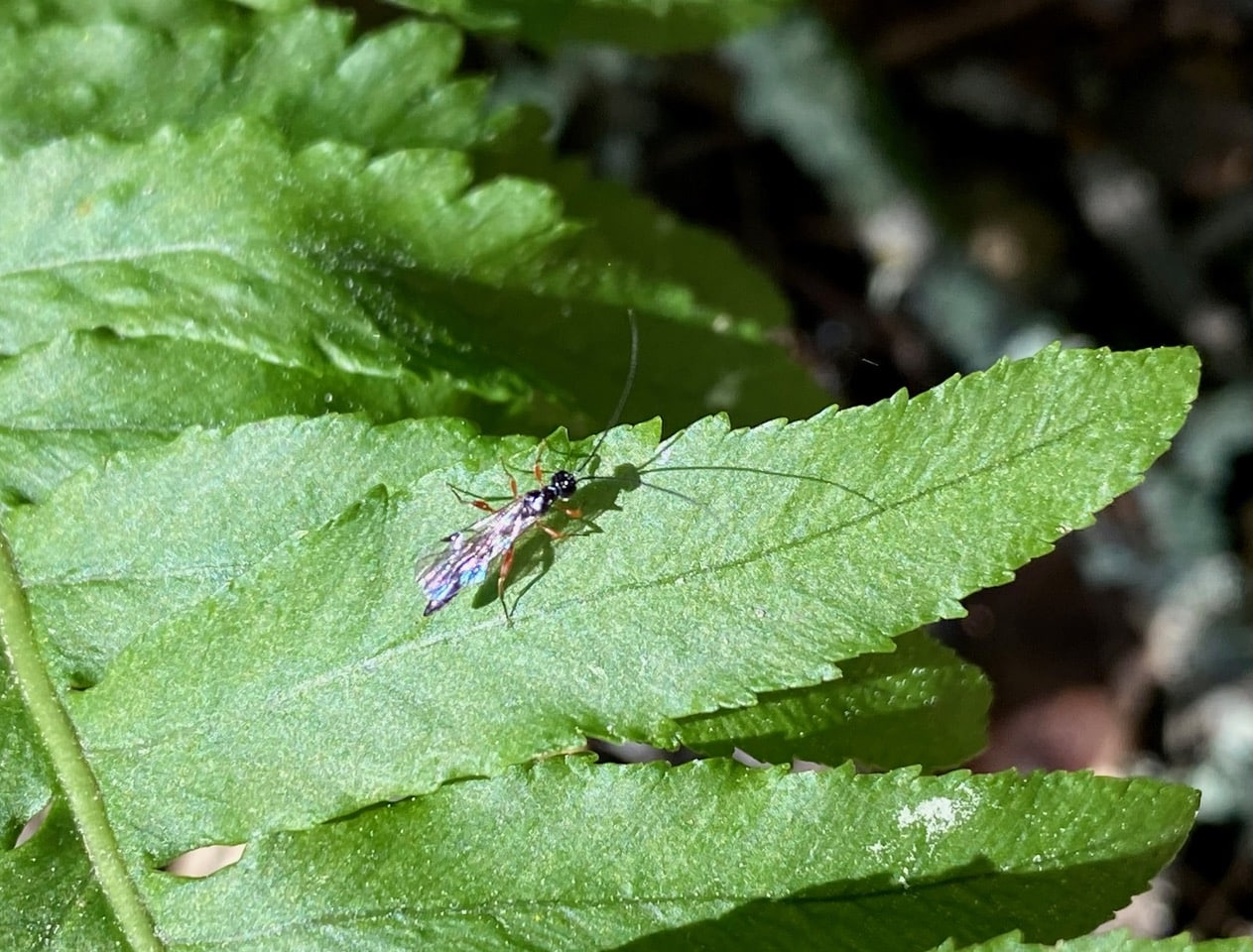
A small wasp with very long antennae has landed on the sunlit leaflet of a fern frond. A parasitoid wasp in the superfamily Ichneumonoidea? iNaturalist has suggested the genus Odontocolon (family Ichneumonidae).
The Ichneumonidae, also known as the Ichneumon Wasps, or Ichneumonids, are a family of parasitoid wasps. They are one of the most diverse groups within the Hymenoptera (the order that includes the ants, wasps and bees) with about 25,000 species and counting. Ichneumon Wasps attack the immature stages of insects and spiders, eventually killing their hosts. They play an important role in the ecosystem as regulators of insect populations.
The Ichneumon wasps have longer antennae than typical wasps, with 16 segments or more as opposed to 13 or fewer. Ichneumonid females have an unmodified ovipositor for laying eggs. They generally inject eggs either directly into their host’s body or onto its surface, and the process may require penetration of wood. After hatching, the Ichneumonid larva consumes its still living host. The most common hosts are larvae or pupae of Lepidoptera (butterflies and moths), Coleoptera (beetles) and Hymenoptera. Adult Ichneumonids feed on plant sap and nectar. Females spend much of their active time searching for hosts while the males are constantly on the look out for females. Many Ichneumonids are associated with specific prey, and Ichneumonids are considered effective biological controls of some pest species.
Ichneumon wasps drill into wood using their ovipositor, which is a long, needle-like structure that consists of three filaments, with two acting as a protective sheath around a central drilling filament. This central filament can move back and forth in a reciprocating motion, essentially “sawing” through the wood while secreting enzymes that help soften the wood fibers, making penetration easier. The wasp can precisely locate the host larva within the wood using its antennae and other sensory abilities.
Members of the genus Odontocolon are parasites of wood-boring beetles and/or Hymenoptera. Females have long ovipositors, while males do not. Those ovipositors are used to drill into wood to reach the target host. An egg is laid on the living beetle grub, and the female then withdraws her ovipositor to go looking for another host. The wasp larva that hatches from the egg lives as external parasite on its host, taking its time as the host itself matures. Sometimes a female wasp will ovipositor on the pupa of the host, rather than the grub. The result is the same: her larval offspring will consume the host and emerge from the host’s pupa.
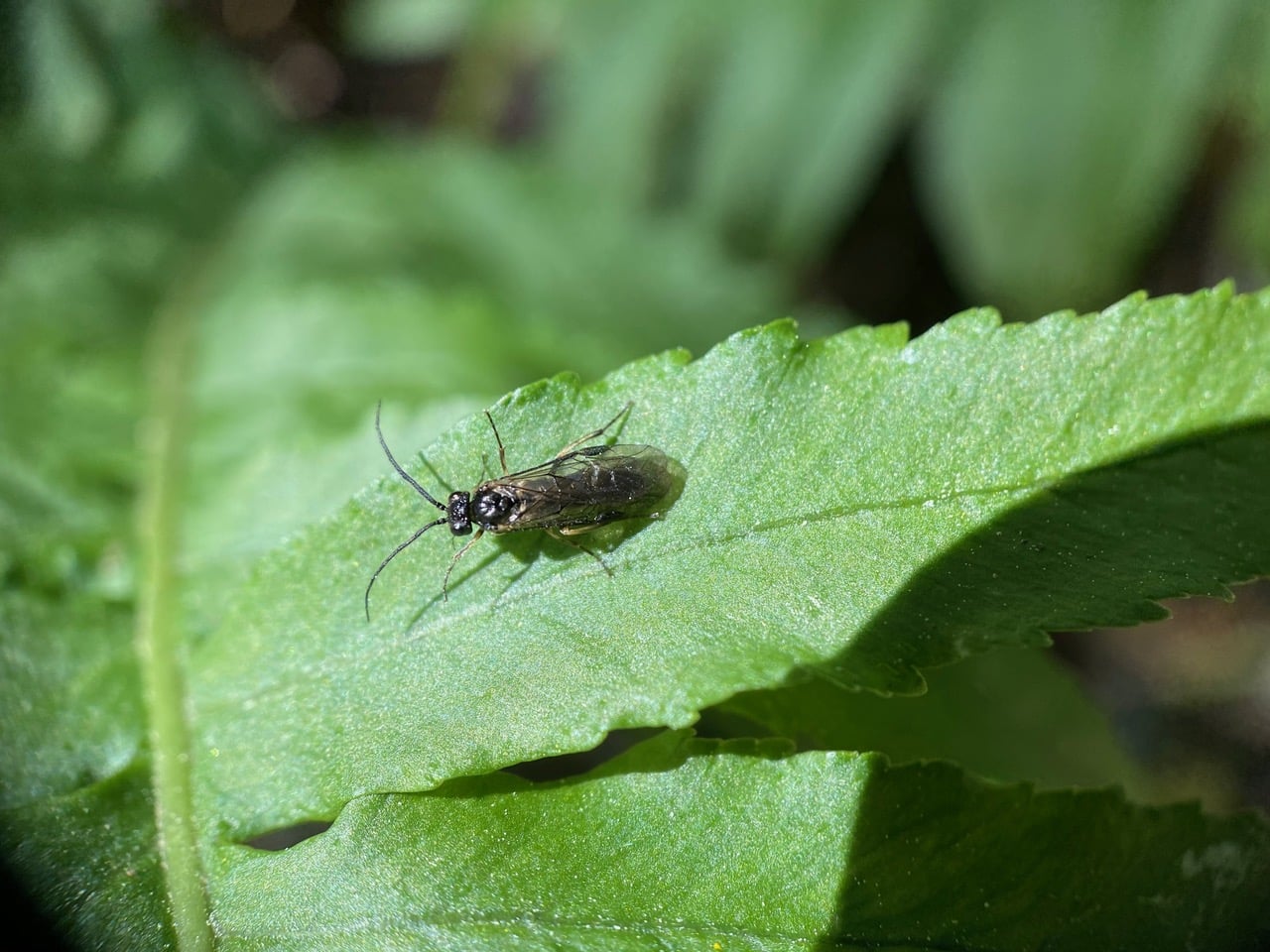
Several black, stocky wasps are flying over the undergrowth next to the trail, occasionally landing solo on the vegetation. Some alight to check out others, occasionally bumping each other off its perch. The wasps look like Typical Sawflies (superfamily Tenthredinoidea), and their behavior is highly suggestive of courtship.
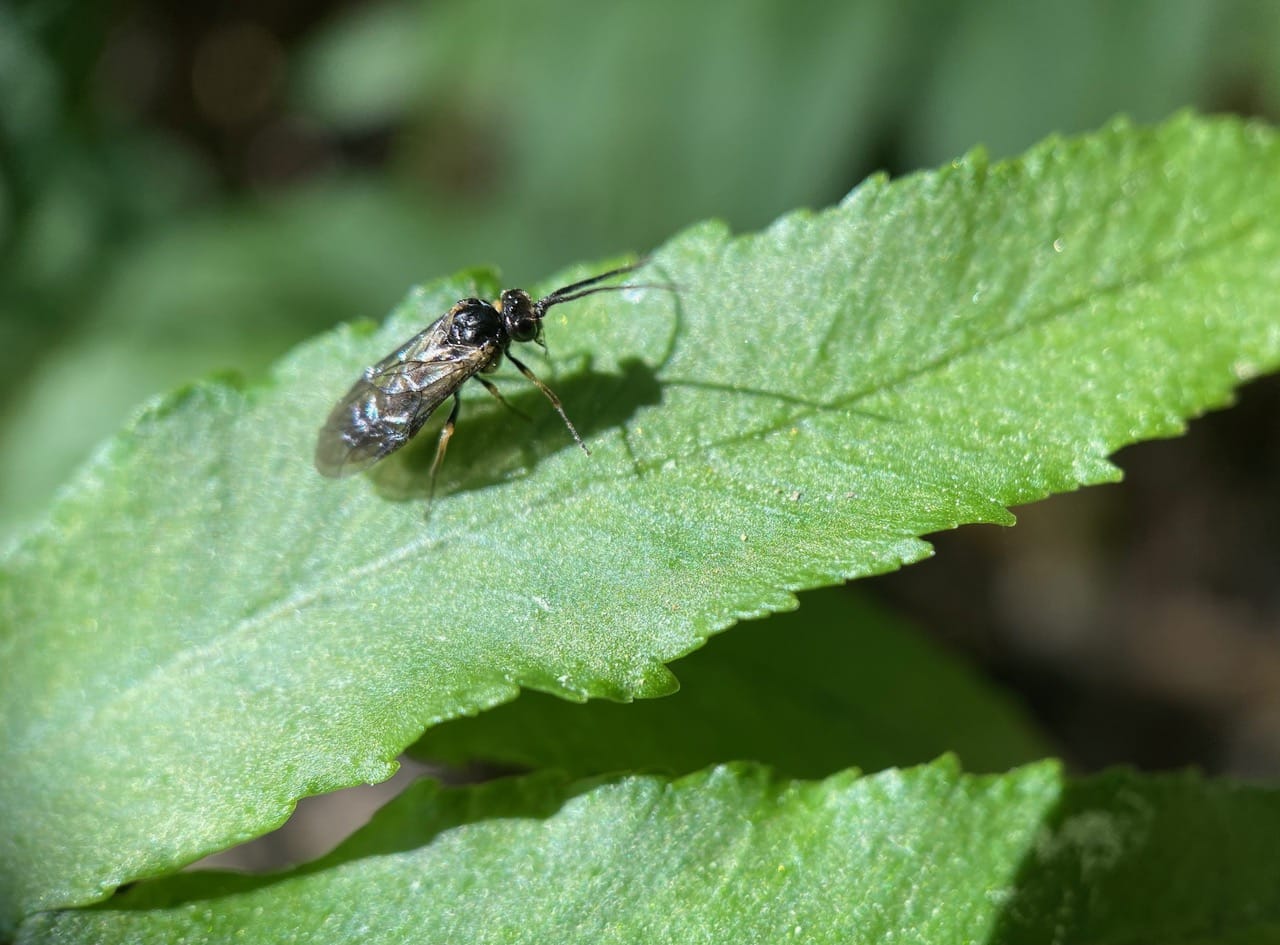
Sawflies are part of the insect order, Hymenoptera, together with bees, wasps and ants. They are considered to be the most primitive group and form the sub-order Symphyta. They differ from the bees, wasps and ants in not having a narrow ‘waist’ and in their wing venation. The common name comes from the saw-like ovipositor that the females use to cut into plant tissues to lay their eggs. Larvae are caterpillar-like and can be distinguished from lepidopteran caterpillars in that all body segments following the three bearing true legs have a pair of fleshy prolegs. Like the lepidopteran caterpillars, sawfly larvae walk about and eat foliage. In many species, the larvae feed in groups.
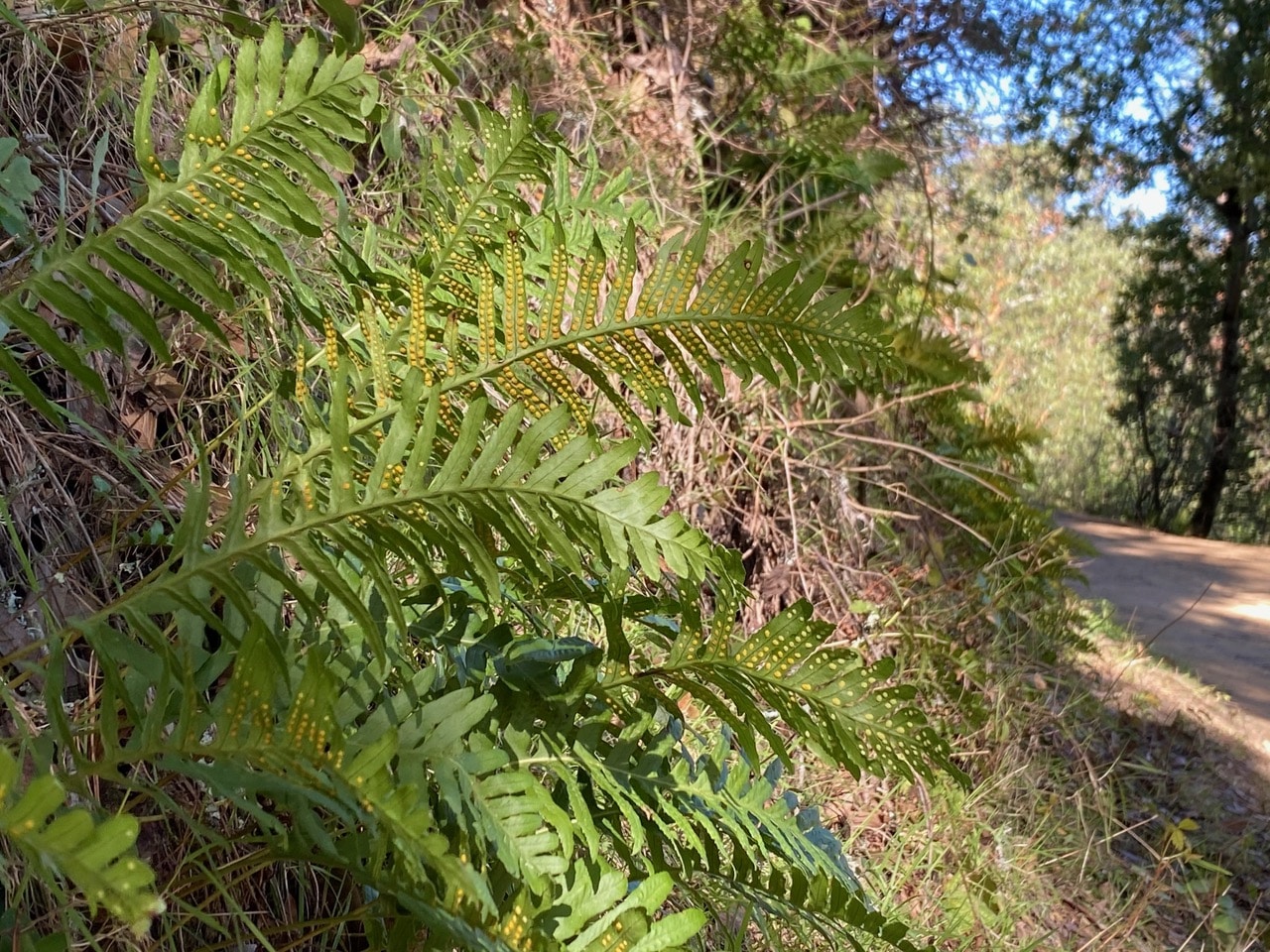
A brisk wind stirs up the fronds of a California Polypody Fern, Polypodium californicum growing on the trail bank, exposing the reproductive structures on the underside of the fronds.
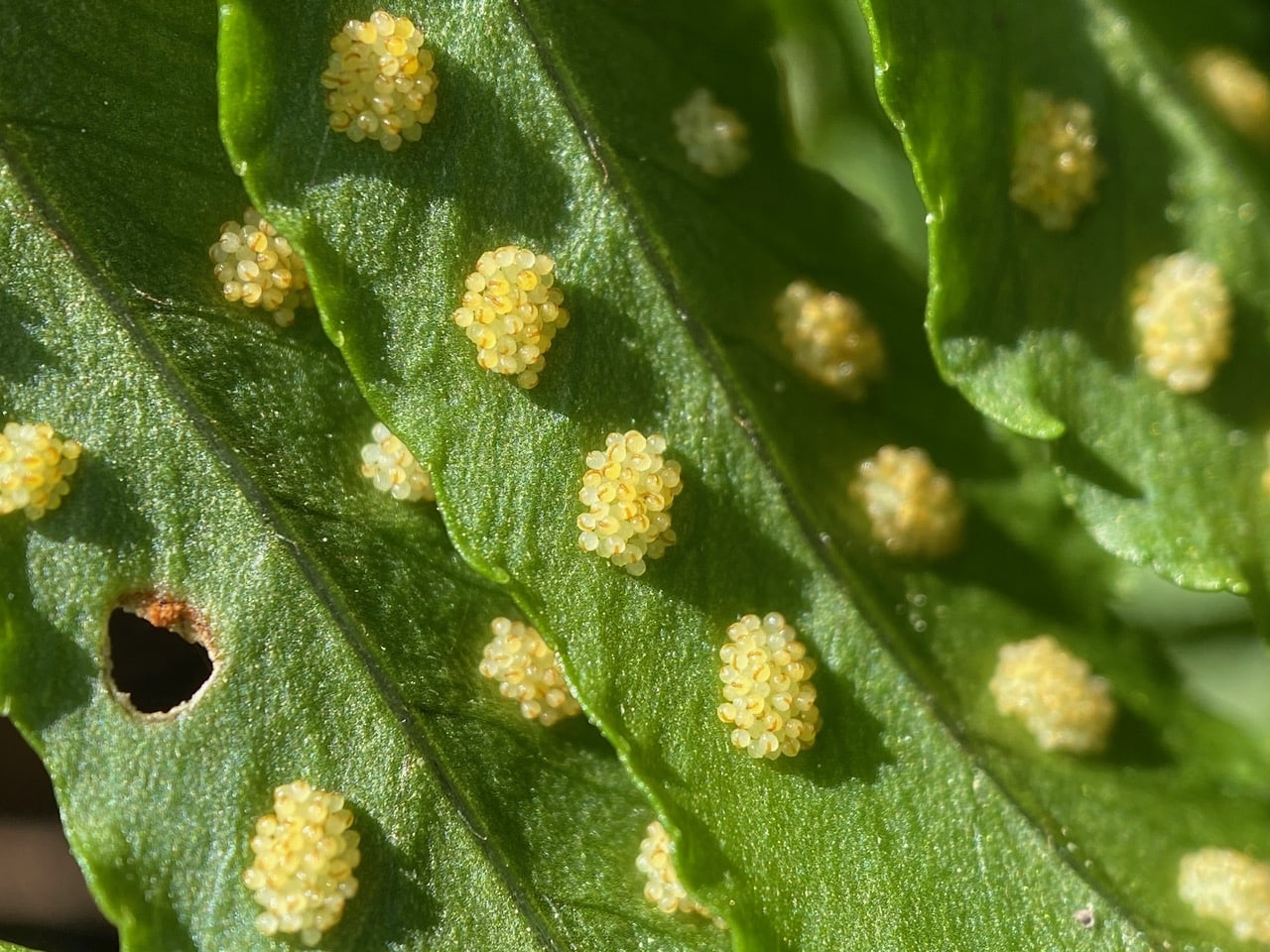
I take my macro lens to the back of a Polypody Fern frond and find these neat clumps of minute marbles evenly spaced along each leaflet. Each of those translucent marbles is a sporangium where spore is produced. Each pile of sporangia is called a sorus (sori in plural). To the left of the picture, a whole sorus has been ripped out. Yums!
Ferns exhibit a distinct life cycle with two stages: the spore-producing sporophyte and the gamete-producing gametophyte, requiring moisture for sperm to swim to the egg for fertilization on the gametophyte. The fern plant we usually see is the sporophyte. On the underside of the sporophyte leaf, spores are produced and released. These grow into a tiny, heart-shaped plant called a gametophyte where fertilization occurs, eventually developing into a mature fern sporophyte. The tiny fern gametophytes usually grow on damp bare soil, but are easily overlooked.
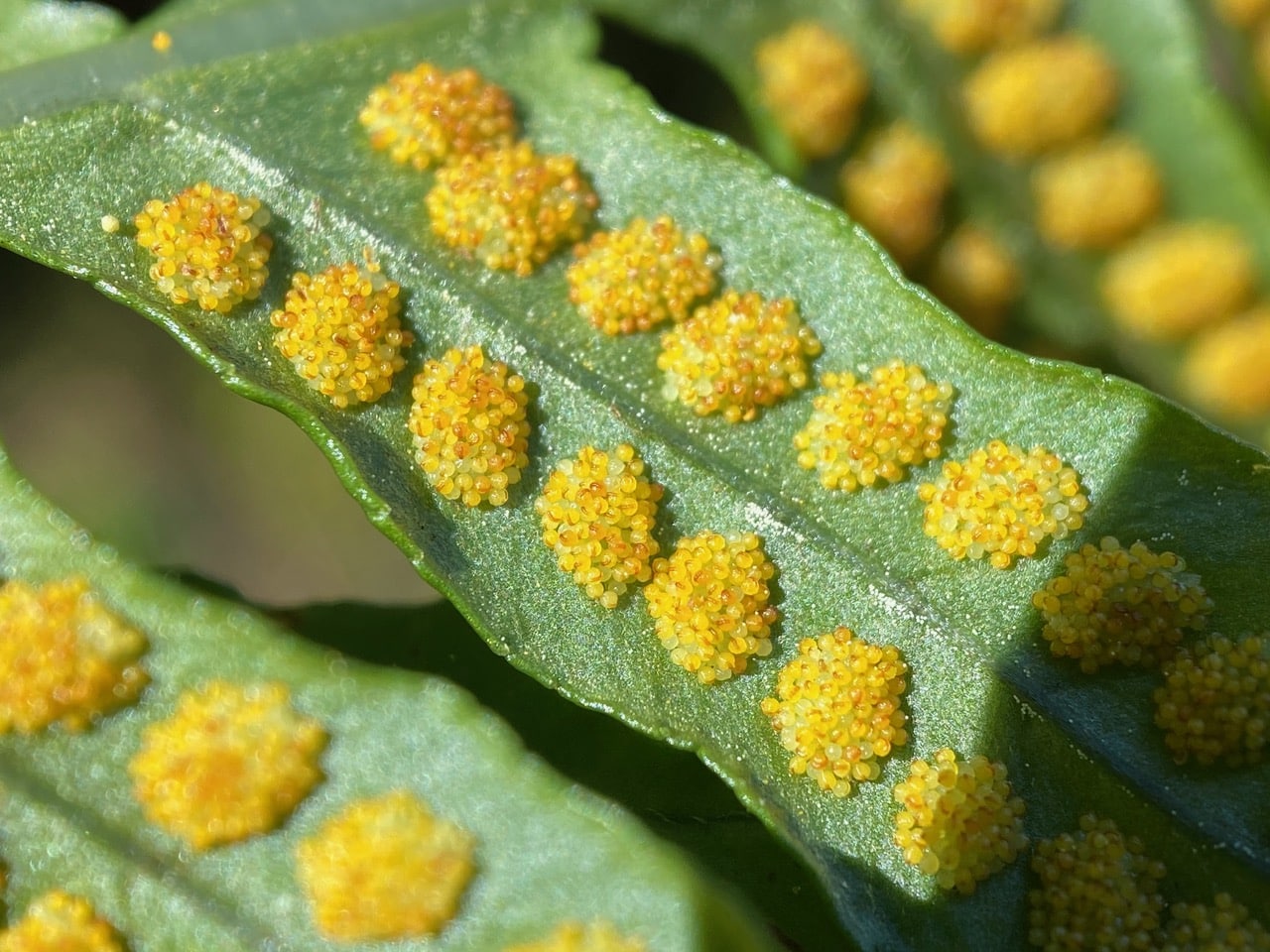
As the fern frond matures, so do its sporangia. The little “marbles” start to darken, turning orange, then brown. At full maturity and given enough heat, spores are forcefully flung from the individual sporangium using a spring-loaded mechanism called cavitation catapulting. Watching this process under the microscope is one of the most memorable moments in my botanical studies.

A healthy stand of Coastal Wood Fern, Dryopteris arguta, is growing by a large log. Wood ferns are easily recognized as their toothed leaflets are louvered, lying at an angle from the plane of the leaf, giving the plant a ruffled or lacy look.
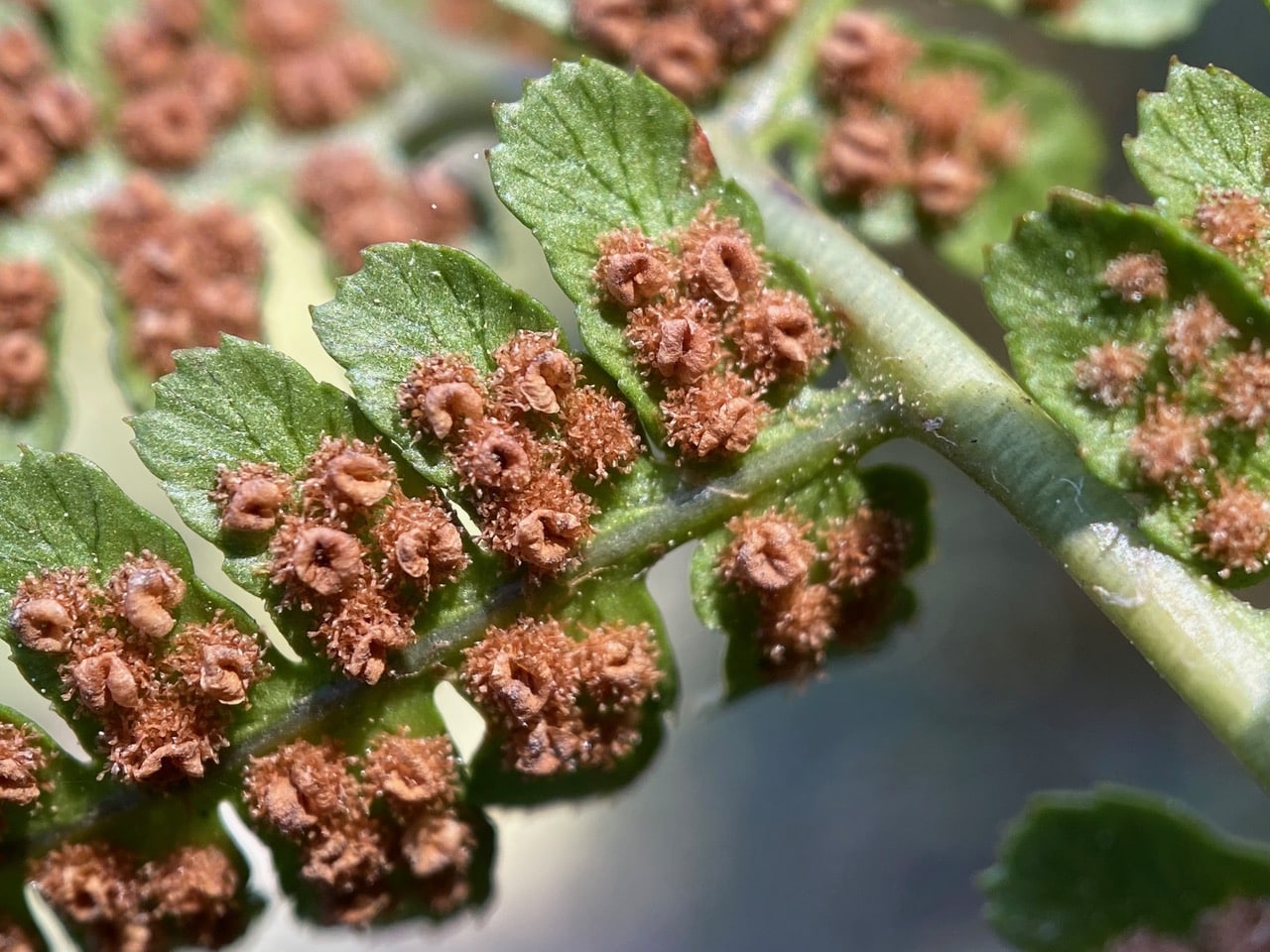
I turn over a frond of the Coastal Wood Fern, and find that all the spores have been released from the sporangia. Note that each sorus is accompanied by a C-shpaed tissue, a covering that has been pulled back. These are the indusiums, present in some ferns, and they can vary considerably in shape, arrangement, location, and covering depending on the species of fern. An indusium is a flap of tissue that protects the sorus. Indusiums shrivel, bend backwards, or tear irregularly when spores are ready to be released.
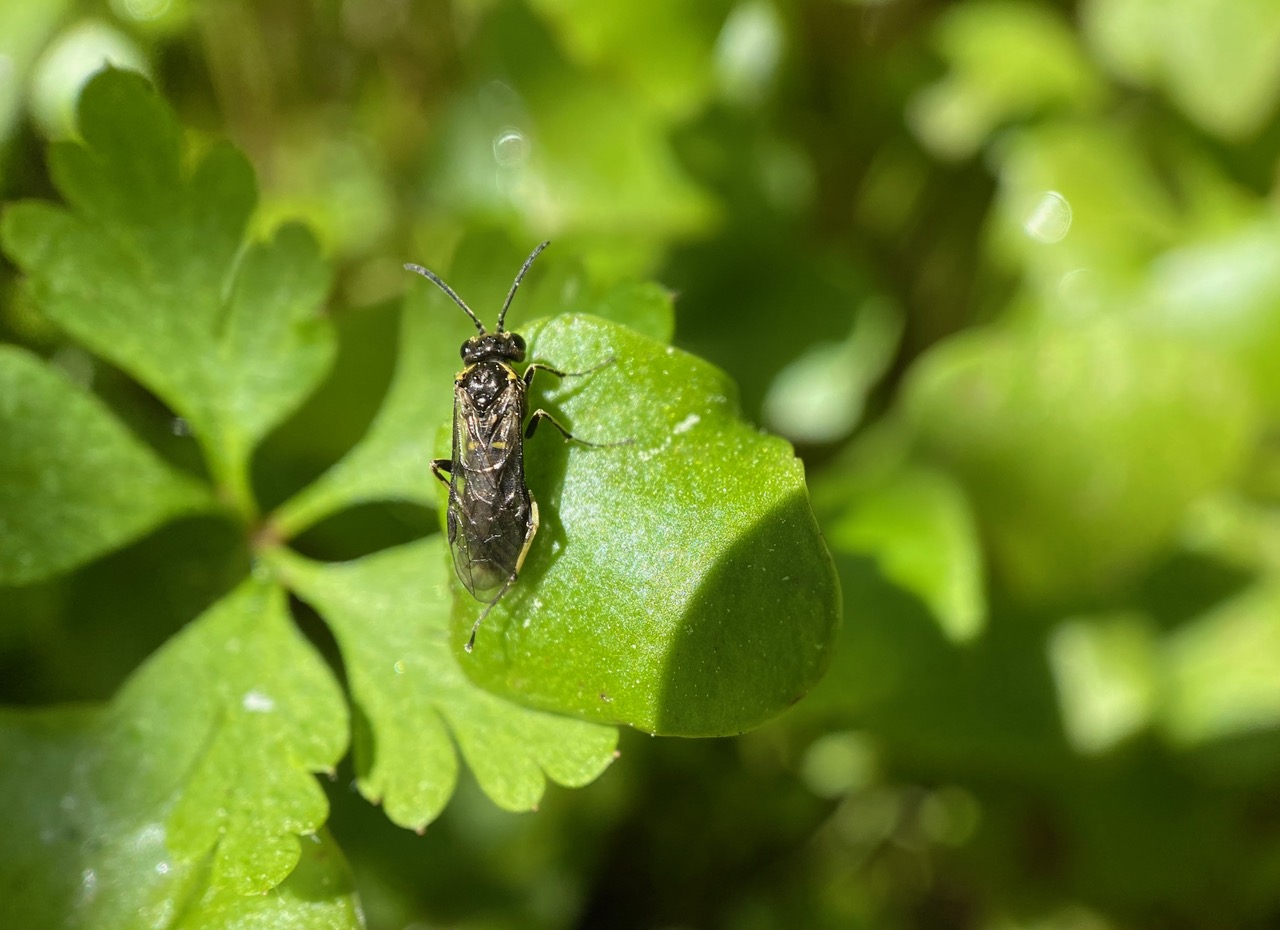
Passing a patch of Miner’s Lettuce, I notice the same kind of Sawflies I met earlier. They are exhibiting the same behavior here – touch down, contact, mating attempts, etc. With these slightly better pictures, iNaturalist is able to further identify the sawflies to the genus Filacus (family Tenthredinidae).
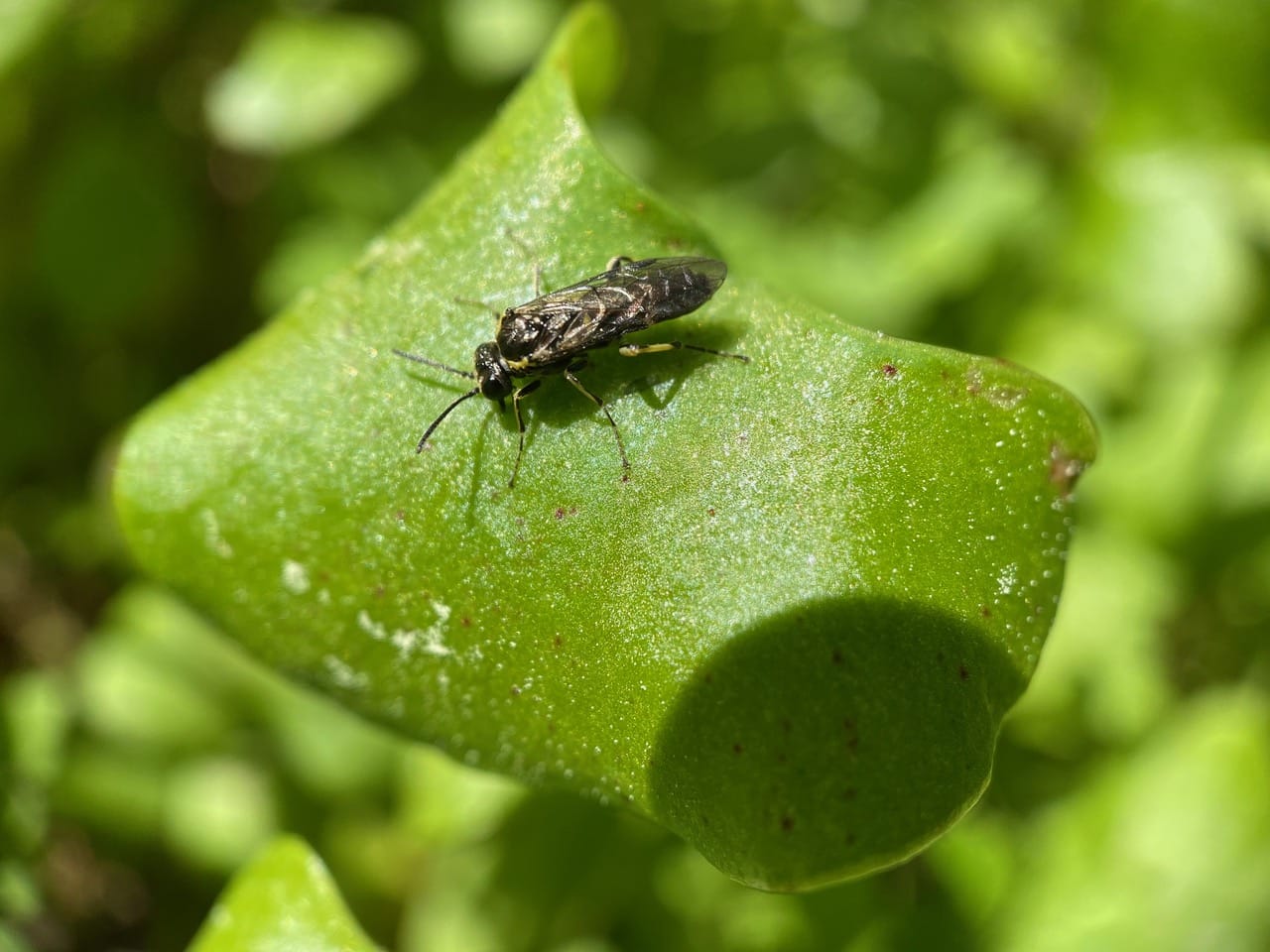
Filacus are sawflies that are small, stout, black and yellow in color. They are native to western North America. Filacus larvae feed on plants of several families. Confirmed hosts include Phacelia, Amsinckia (fiddle necks), and Ranunculus (buttercups). Adult Filacus have been observed visiting a variety of flowers from several plant families and carrying pollen on their bodies, making them a potential pollinator. It is not known if the adults feed on the nectar, pollen, or other flower parts.

Finally, an insect large enough to see from a distance! I watch in utter delight as a pair of California Tortoiseshell butterflies flirts in the air in a bobbing, twirling courtship dance. They eventually land on the grass on the side of the trail. One flies away almost right away, while the other remains on the ground.
The California Tortoiseshell, Nymphalis californica (family Nymphalidae) is found in western North America south of British Columbia. The butterflies frequent chaparral, woodland, brush areas, forest clearings and edges. Males perch in the late afternoon to look for females. Eggs are laid in bunches on the host plant. Caterpillars eat leaves of various species of Ceanothus. Adults overwinter.
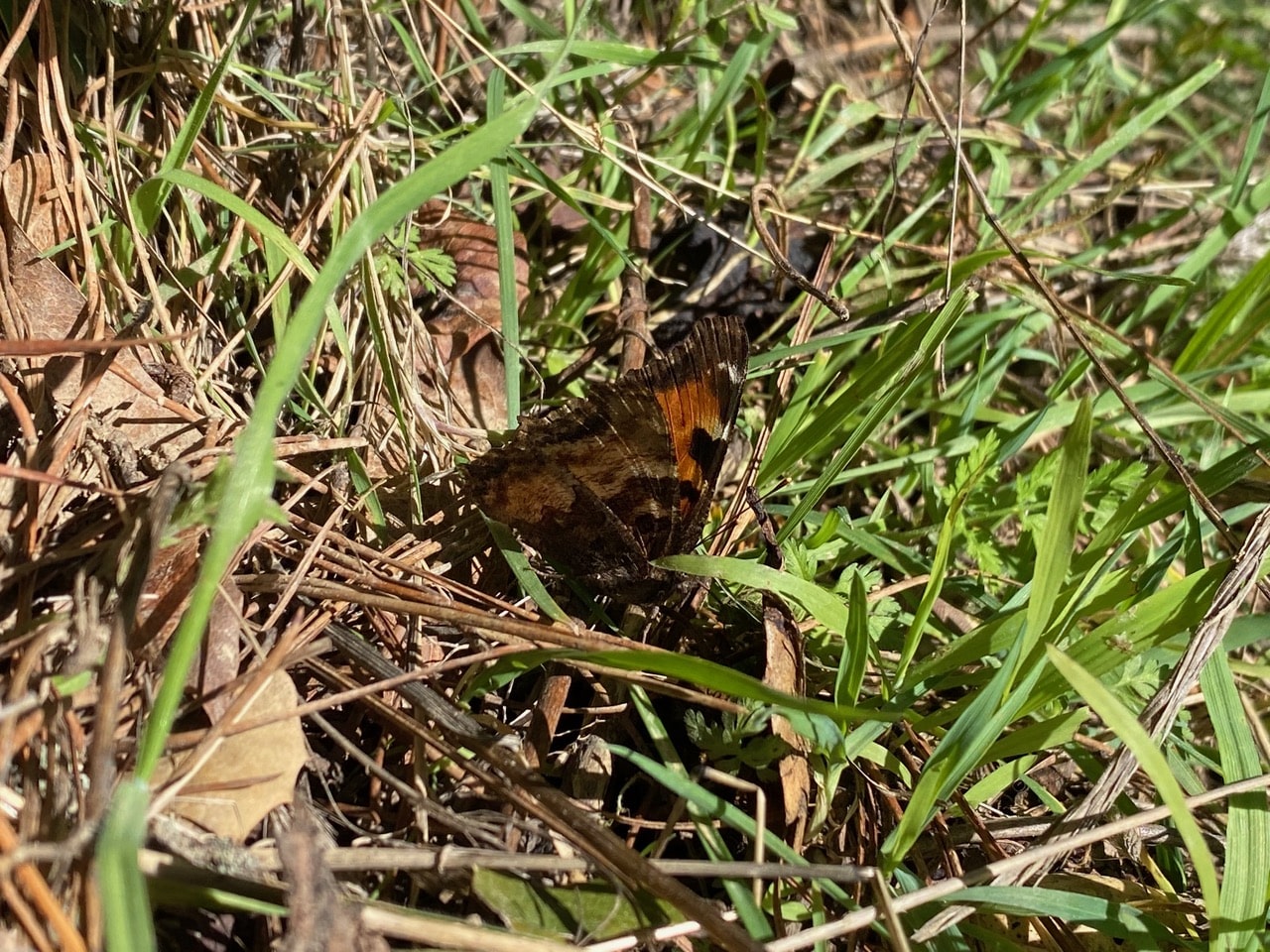
The one on the ground flaps its wings very slowly at regular intervals. It seems oblivious to my approach with the camera.
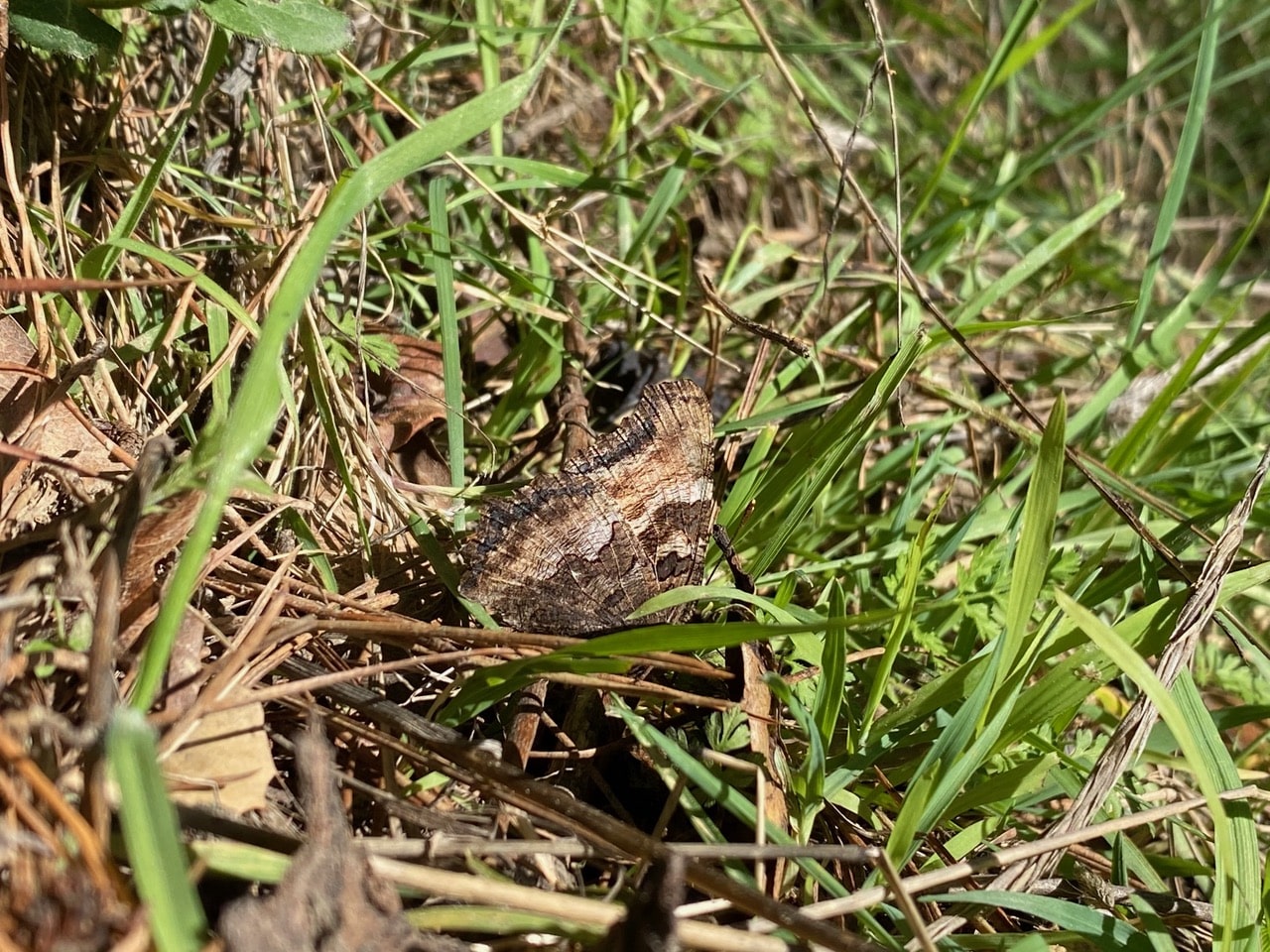
When the wings are fully closed, the brown markings on the underside render the butterfly almost invisible against the leaf litter! The slow wing flapping goes on for a while. I wonder if the butterfly is signaling to someone? Is it wafting pheromones into the air?

A different California Tortoiseshell lands on the leaf litter close by. Is it the same one that left earlier? As it opens its wings fully, I noticed that they are somewhat tattered and missing scales on the edges. These wings have probably seen a lot of mileage, as the species is known to migrate long distances up and down the mountains as part of their life cycle.
The adult California Tortoiseshell butterfly lives for 9 or 10 months. It can be seen in our area from January to June, and then again in September and October. Locally, numbers peak in January-February. It breeds in March/April (with adults emerging May/June). In June, it migrates to summer estivating grounds in high country (generally above tree-line in the Sierra), and then returns in September. (Estivation is a state of dormancy akin to hibernation, except that it takes place in summer rather than winter.) The butterfly overwinters as a hibernating adult in October, emerging in January.
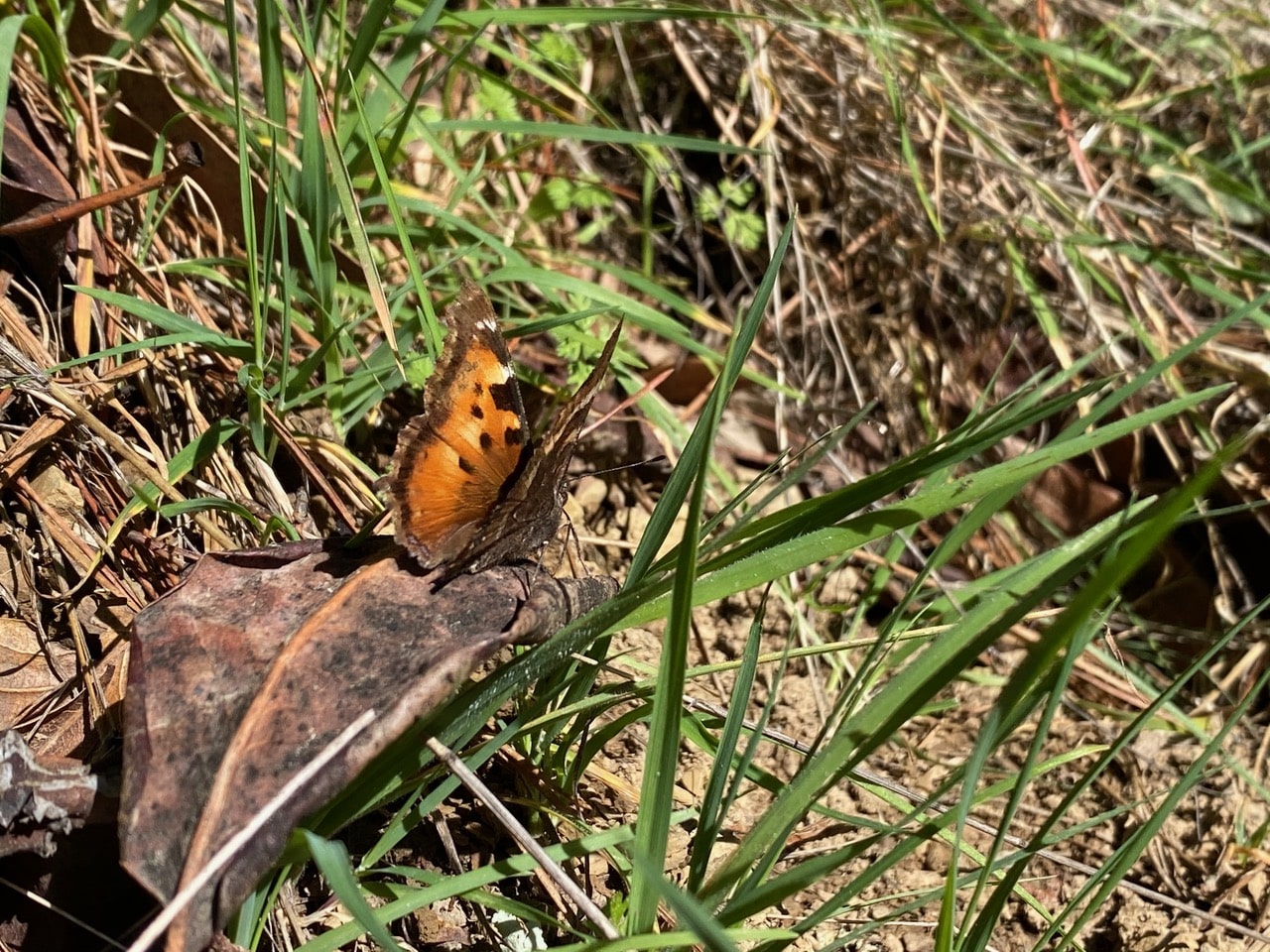
The newcomer makes its way slowly but purposefully to the other butterfly, making brief landings on the low vegetation and flapping its wings intermittently.
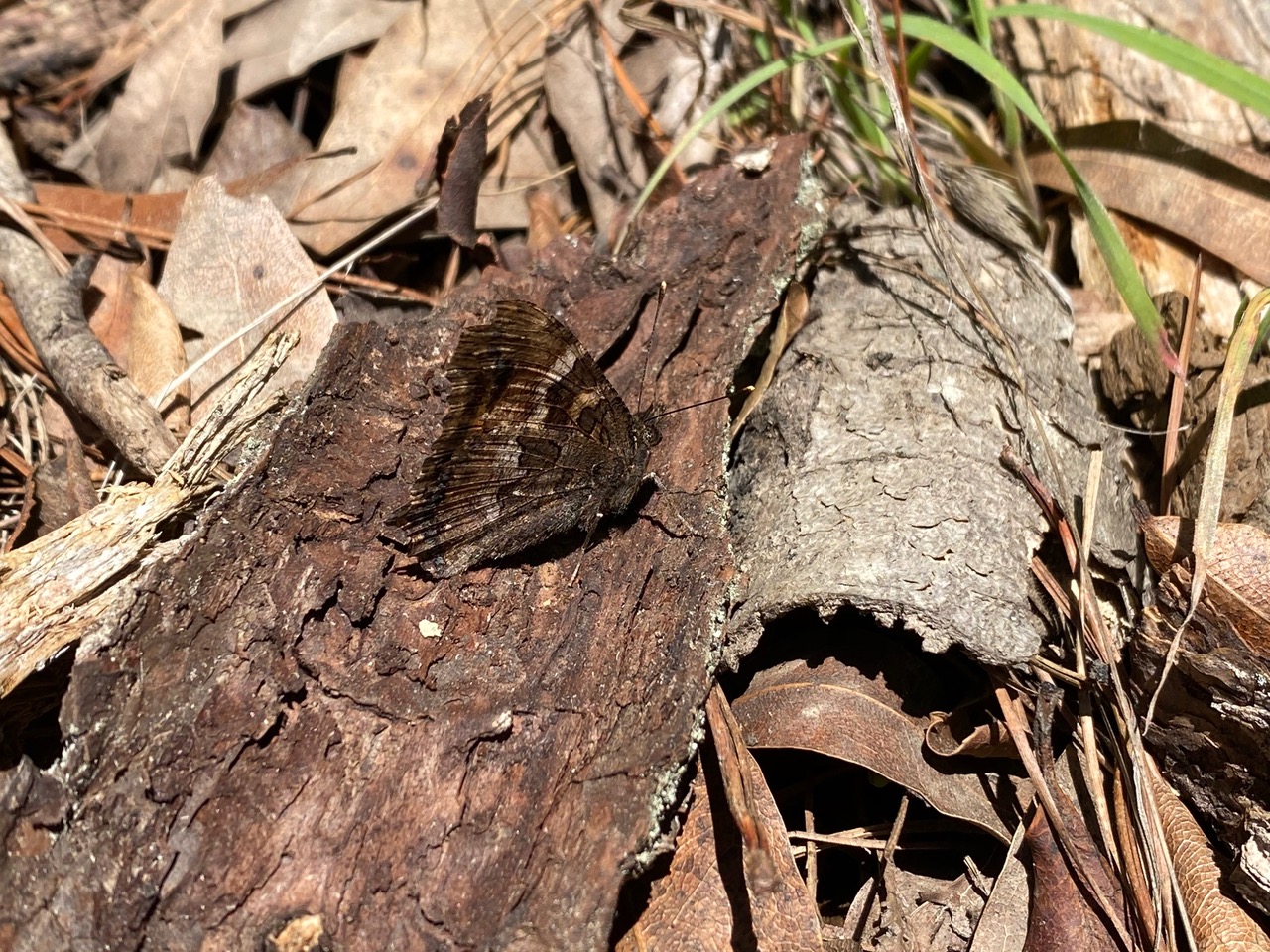
Wow, the butterfly is so well-camouflaged against the bark when its wings are closed! The air is filled with excitement as the newcomer closely approaches the butterfly on the grass. I quickly switch my camera to video mode:
It soon becomes clear to me that the butterfly on the grass is a female, while the one pursuing her is a male. The male makes his intent clear, by approaching her swiftly on foot, and while facing her flaps his wings excitedly. Alas, the female seems to have lost interest. She keeps her wings closed and leans to one side. He mounts her wing, but failing to elicit any response, decides to fly away.
Puzzled by these observations, I turn to a friend who is a butterfly expert for his insights. This is what Sarab has to share:
“Courtship behavior varies widely across species. It is fairly common for females to flutter their wings fast to encourage the male. I’m not sure if slow wing-flapping can be an encouraging sign in some species. The closest thing to a universal rule in butterfly courtship is that disinterested females will angle their abdomen sharply upward. But there are some species where that is specifically an encouraging sign! And males are seen to often persist long after receiving a negative signal.” Aah, it’s not possible to decipher the mystery of a butterfly’s heart….