

Pollinator Post 2/20/25 (1)
It’s a beautiful, sunny morning at the Regional Parks Botanic Garden, Berkeley.
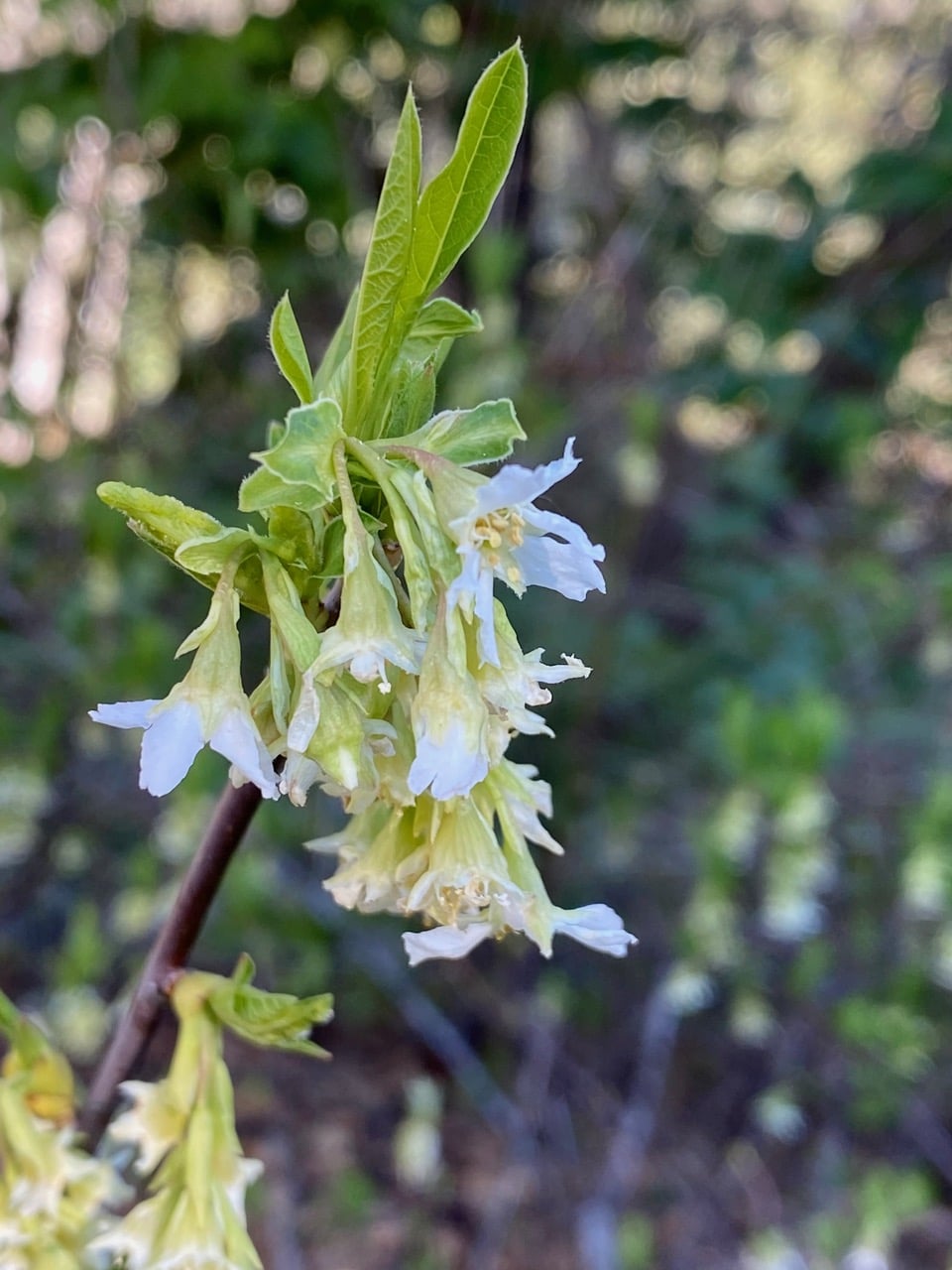
The Osoberry, Oemleria cerasiformis is blooming profusely, with clusters of white flowers hanging on every tip and node of the branches.
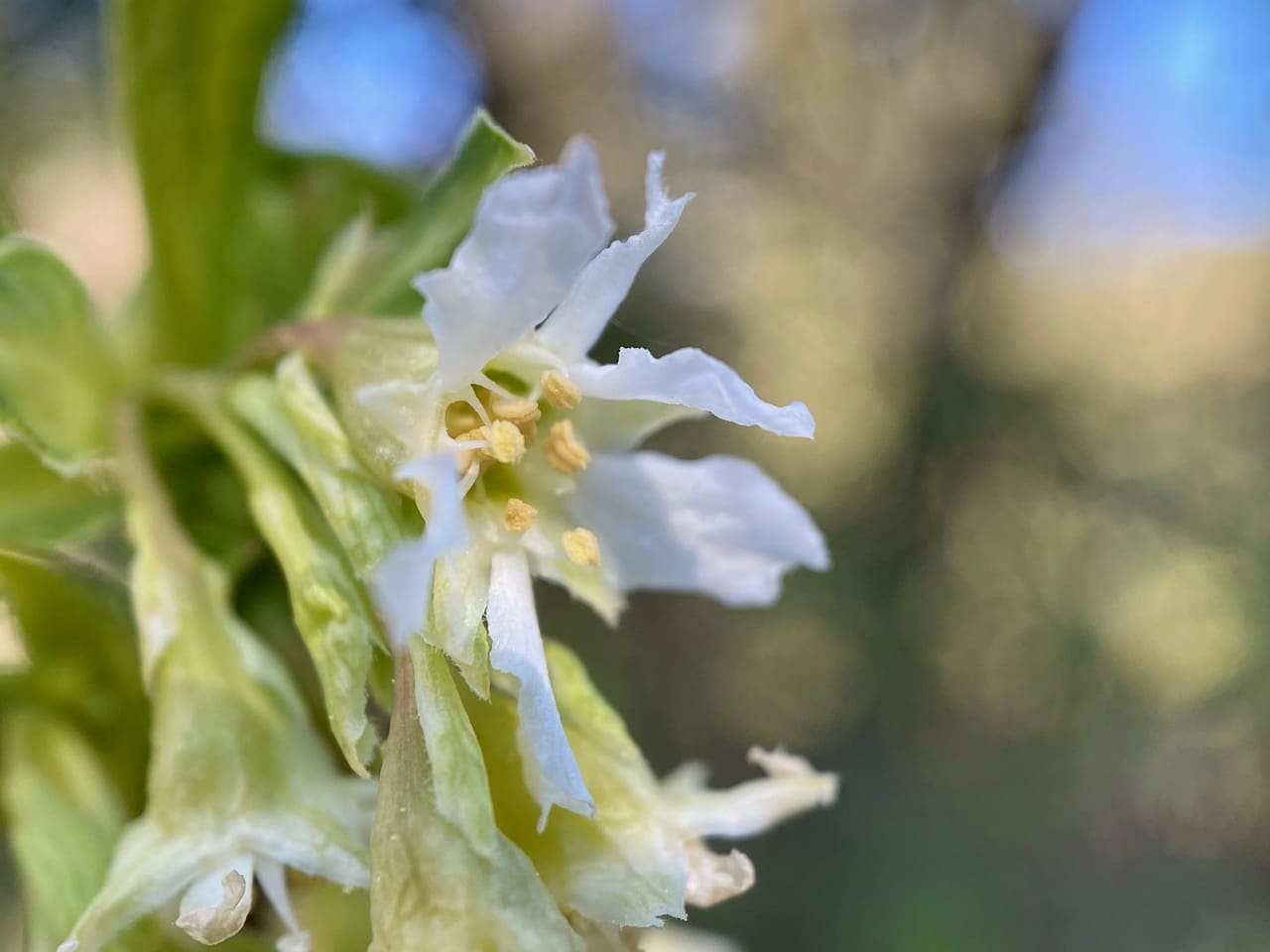



This male flower is crowded with large anthers dispensing pollen. But where are the pollinators?
The Osoberry, Oemleria cerasiformis is dioecious – male and female flowers are borne on separate plants. There are 5 petals and 5 sepals. There are numerous stamens (15, to be exact), in 3 series in the tubular portion of the calyx. Male flowers have prominent stamens that produce prodigious pollen. Female flowers have shriveled, pollen-less stamens and prominent carpels consisting of five styles and five separate ovaries. When fertilized, the ovaries develop into drupes (stone fruits), the so-called “Indian Plums”, up to five per flower.
Osoberry is pollinated by bees, moths, butterflies, hummingbirds, and more. The nectar in the flowers of osoberry is an important source of food for these pollinators in the early spring. Osoberry seeds are dispersed by birds and small mammals in their droppings.
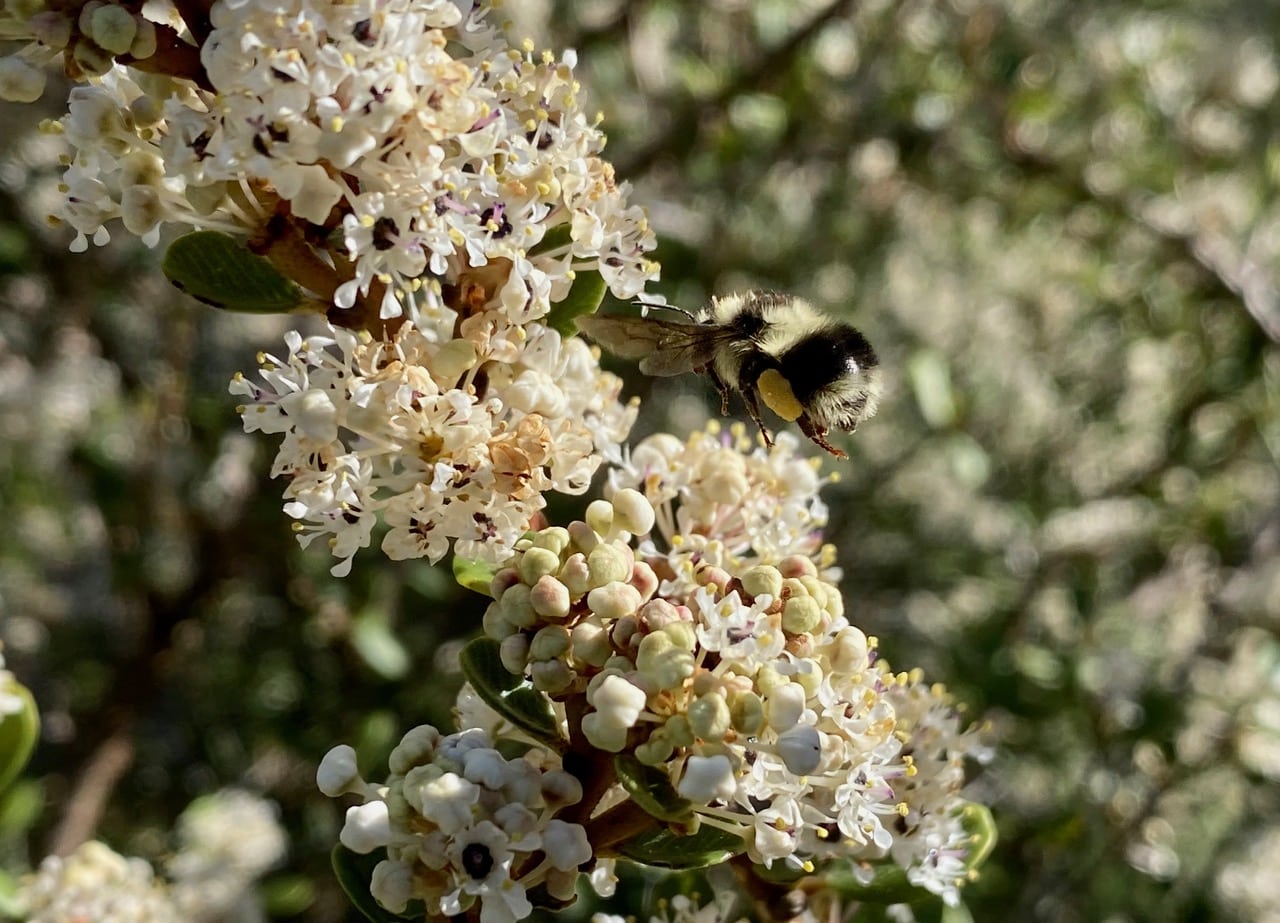
A new species of Ceanothus has come into bloom in the garden – the Buckbrush, Ceanothus cuneatus. The scent from its white flowers are intoxicating, and small worker Black-tailed Bumble bees, Bombus melanopygus (family Apidae) swarm over the blossoms with gusto.
The Black-tailed Bumble Bee, Bombus melanopygus (family Apidae) is native to western North America, widely distributed from the Pacific to the Rocky Mountains, and from Alaska to Baja California. The species is found in various habitats, including agricultural and urban areas. The bees feed on many types of plants, including manzanitas, Ceanothus, golden bushes, wild buckwheats, lupines, penstemons, rhododendrons, willows, sages, and clovers. They nest underground or aboveground in structures.
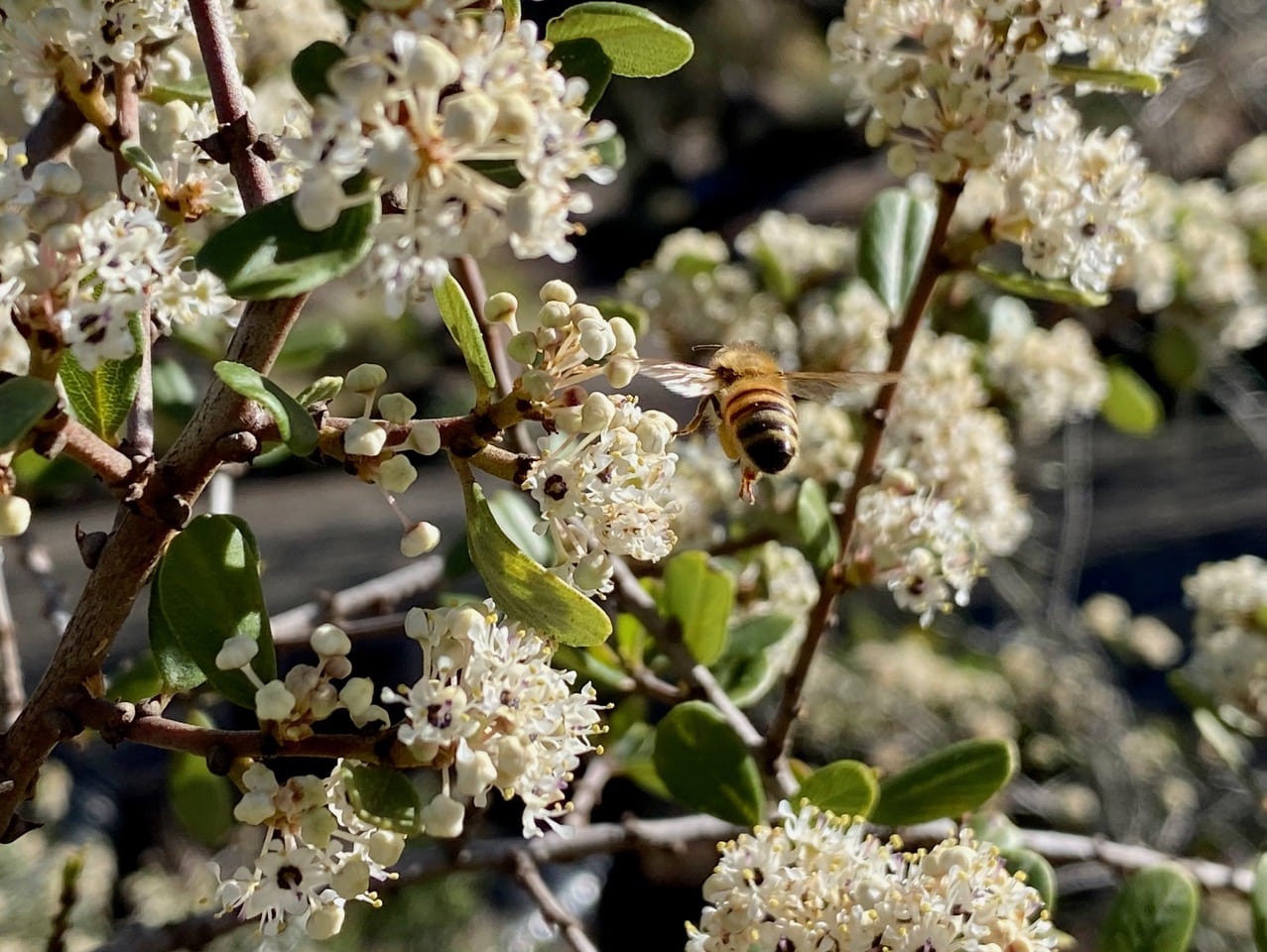
Not far behind in numbers are the Honey Bees, Apis mellifera (family Apidae). A good source of both nectar and pollen, Ceanothus is a fovorite among bees. The nectar is easily accessible in shallow flowers, and pollen is abundantly available on fully exerted stamens. The tightly clustered flowers mean that all the bee has to do is to walk over them to gather what they need.
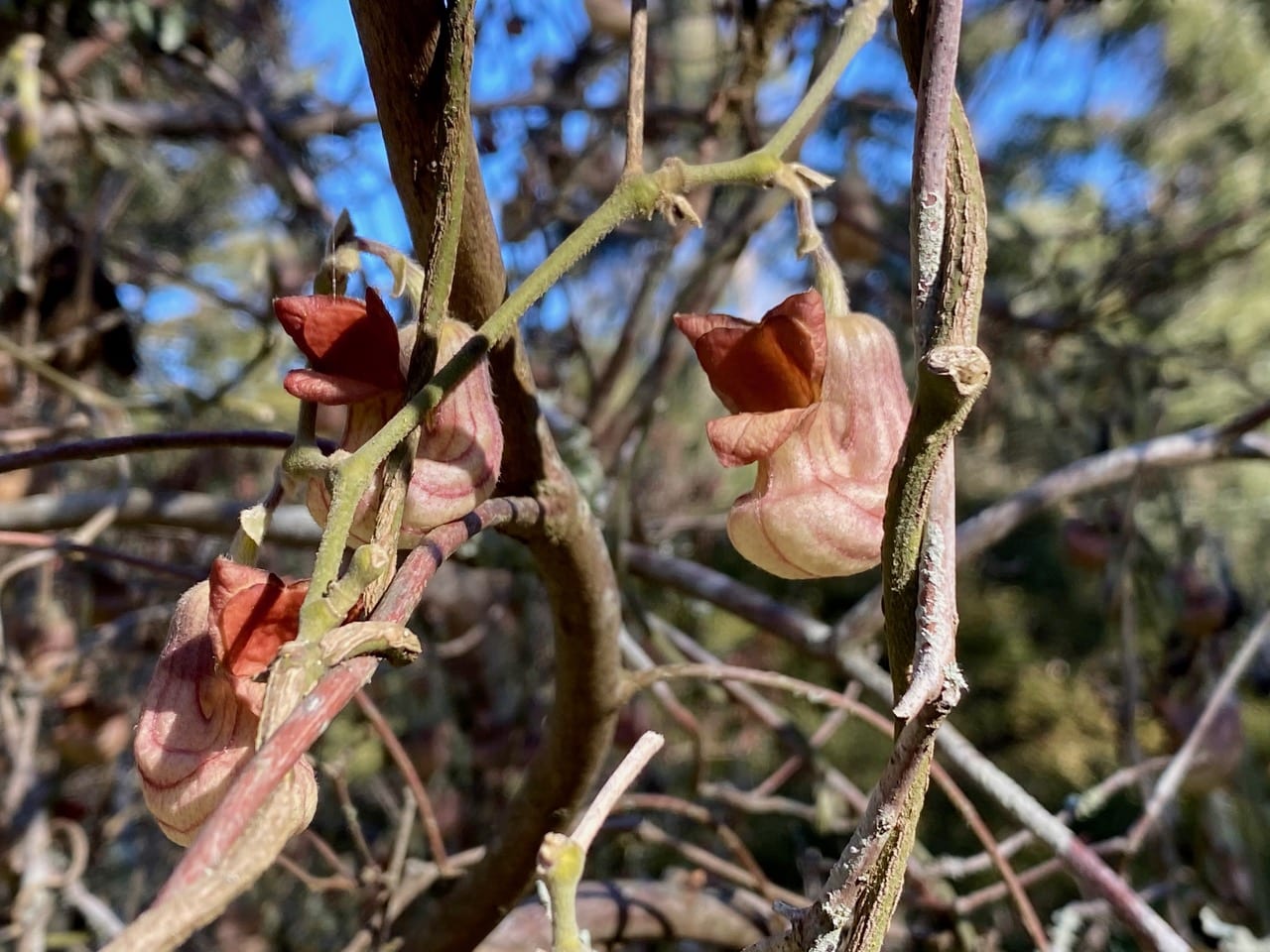
Over by the dormant Western Azalea, the California Pipevine, Aristolochia californica is in peak bloom, with numerous fully opened flowers hanging on the bare branches. With the sun out, a breeze brings a whiff of the flower’s odd odor. Often described as musty or mushroom-like, the scent reminds me of fresh, bloody meat.
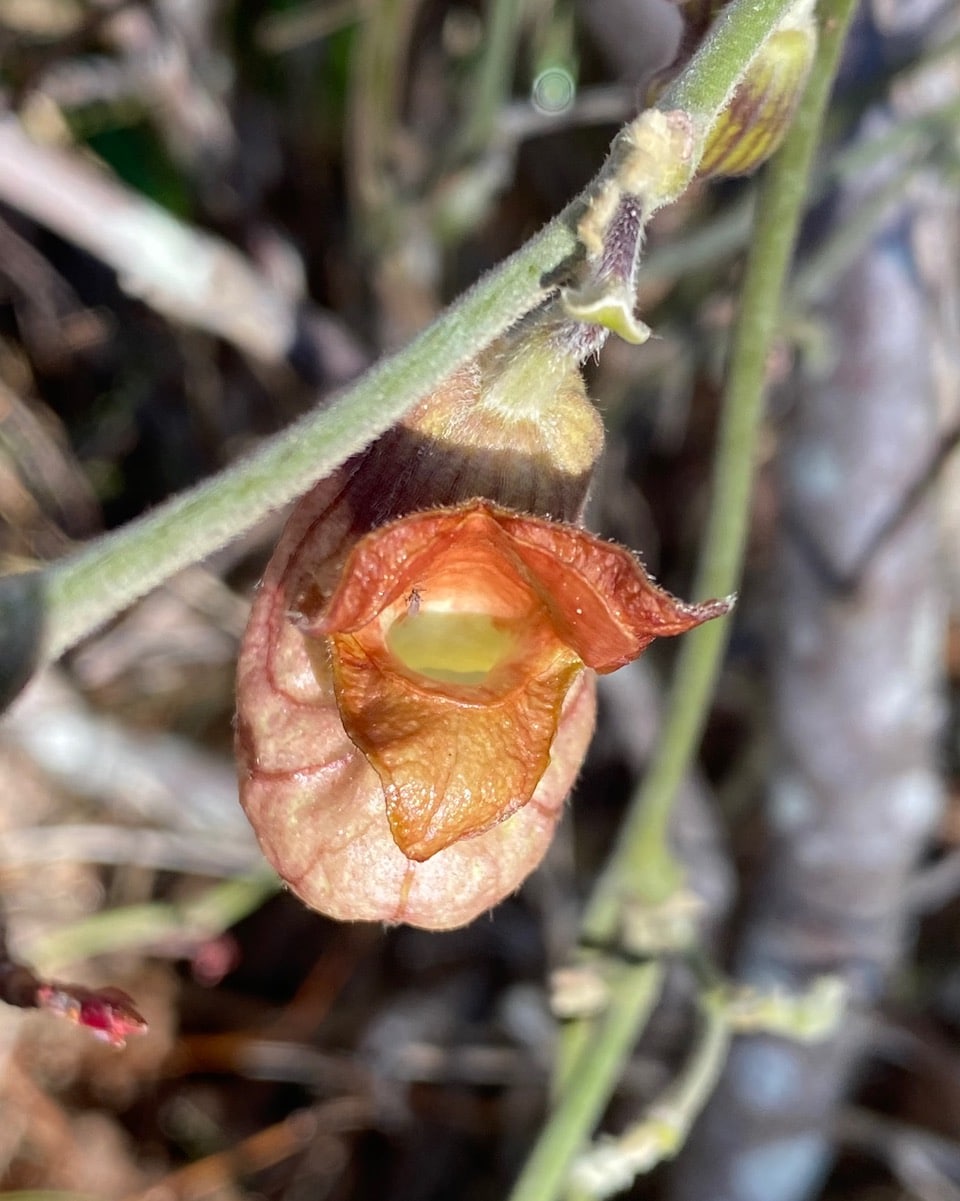
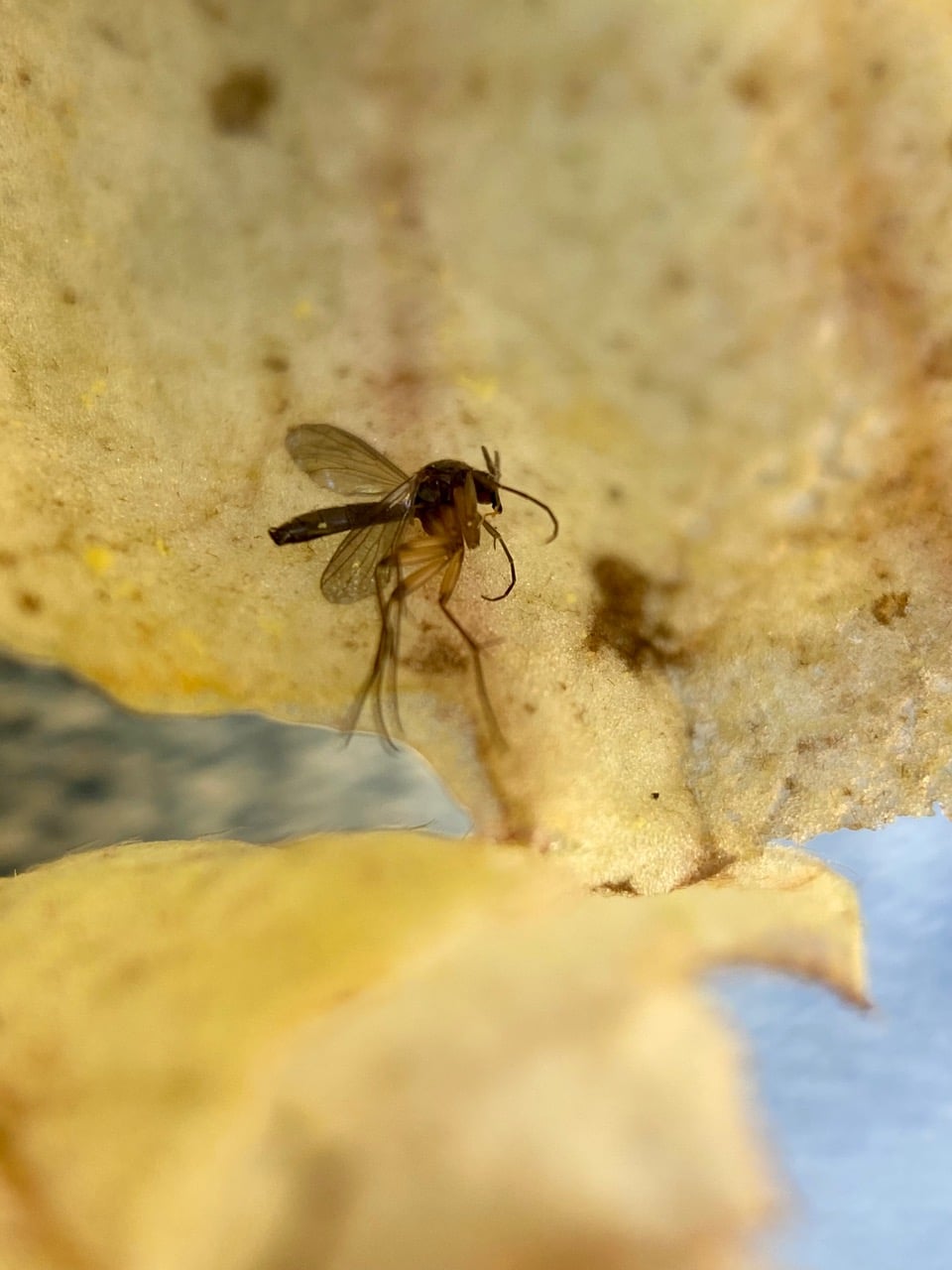
I peek into several flowers to check for insect activity. All seems to be quiet. Wait, isn’t that a tiny insect perched just behind the reddish lips of this flower?
I take a closer look. A Fungus Gnat (fame Mycetophilidae) summoned by the odor?
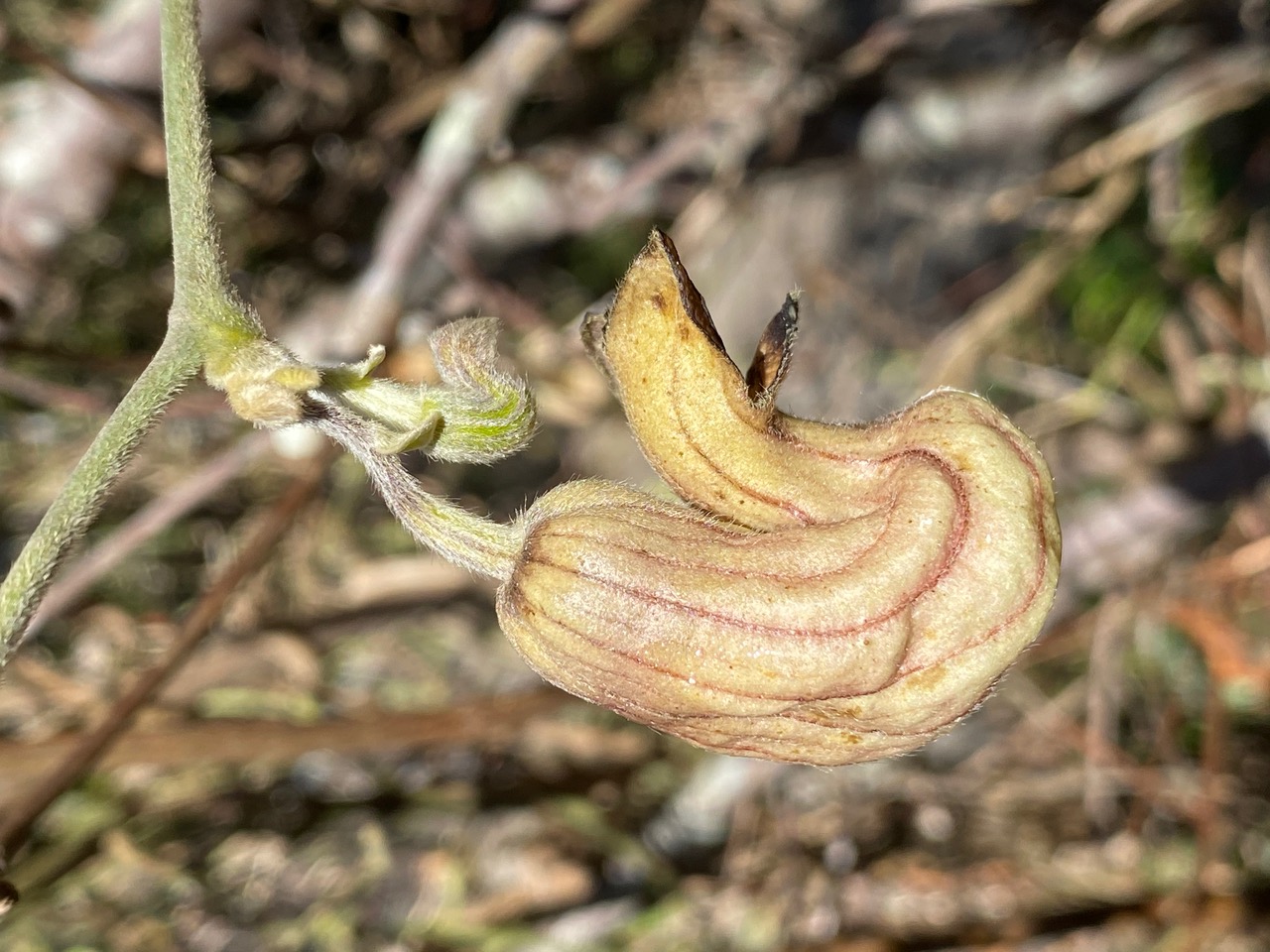
Here’s an old, faded flower.
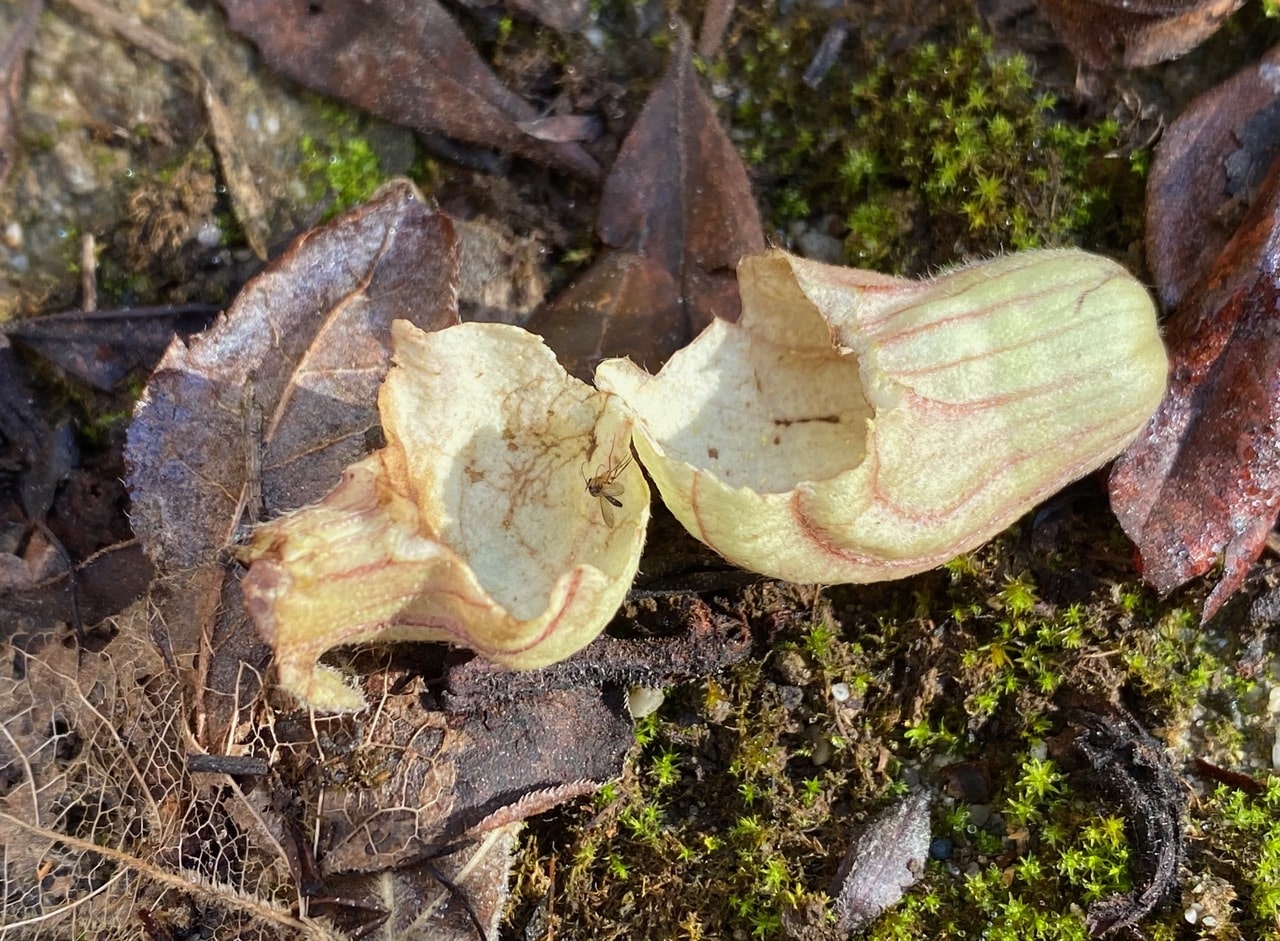
I pick the flower and tear it open. No insects fly out, but there is a dead mosquito-like insect lying at the bottom of the “bowl”.
Close-up of the dead insect. iNaturalist has identified it as a Fungus Gnat, Leia sp. (family Mycetophilidae).
Members of the family Mycetophilidae can usually be distinguished from other small flies by the strongly humped thorax, well-developed coxae (“thighs”), and often spinose legs. The gnats are cosmopolitan, well-represented in wet forests worldwide. The larvae usually feed on fungi, especially the fruiting bodies, but also spores and hyphae, but some species are found in mosses and liverworts. The flowers in the Aristolochiaceae family (e.g. California Pipevine, Wild Ginger) lure and trap adult gnats with their fungus smell and accomplish pollination by these means.
Tearing away the bowl-shaped part of the flower, I look at the base where the reproductive structures are located. As expected at this late stage of anthesis, the flower is in its male phase. The large 3-lobed stigma in the center has closed up, exposing the stamens surrounding it. The anthers are still dispensing copious pollen.
Let’s backtrack to gather the whole progression of anthesis in this unique flower…
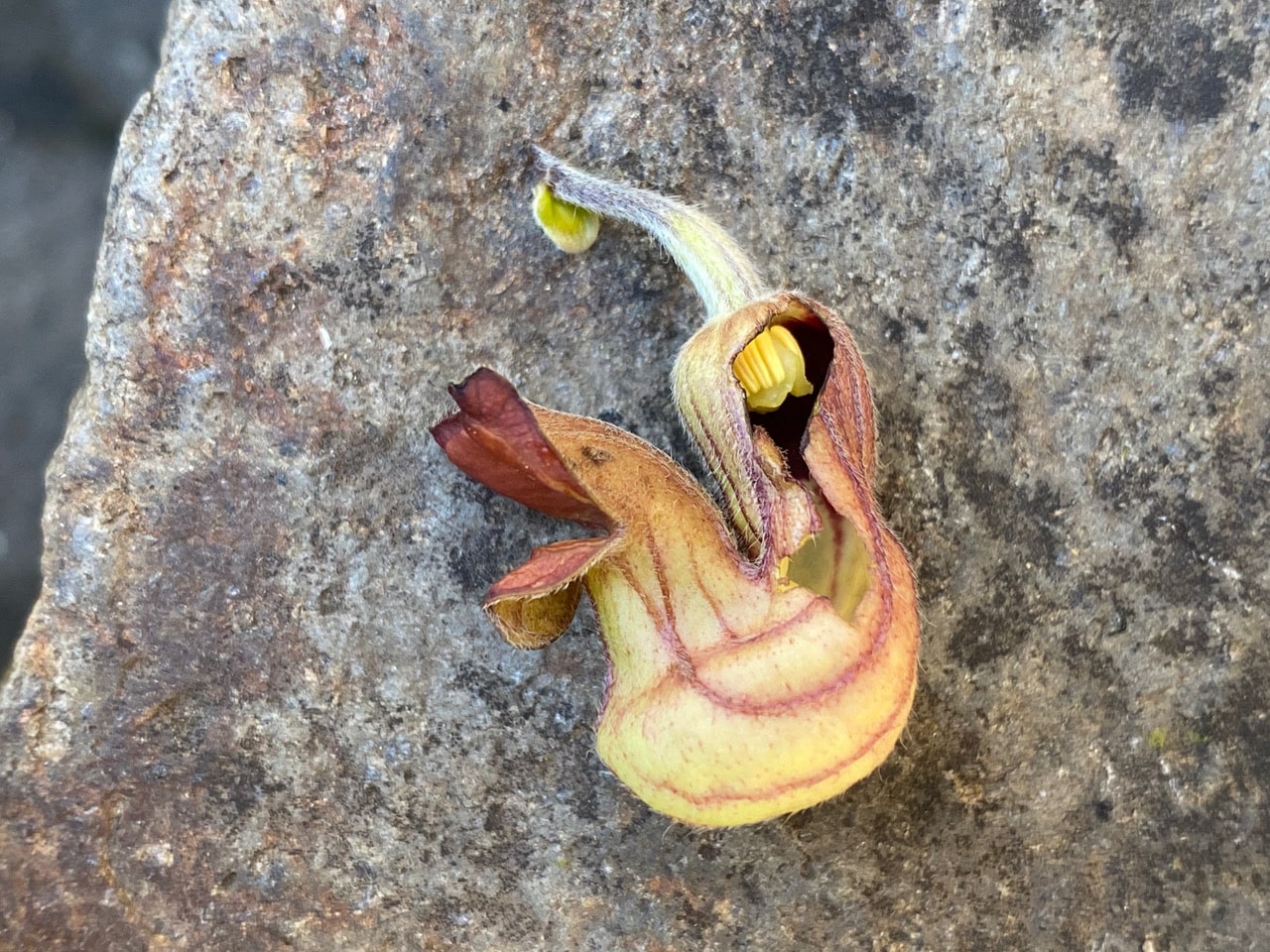
Instead of picking a fresh flower, I am re-posting these two pictures taken on 2/8/24. The flower was already damaged on the vine, with a big tear on the side showing the reproductive structures within. Note the yellow structure at the base of the flower (which is on the top end of the pipe-shaped flower as seen here). That consists of anthers embracing a large stigma in the center. The inner wall of the flower surrounding the reproductive structures is a deep maroon color, distinct from the rest of the interior. This colored tissue usually looks wet and grainy; it is where nectar is produced. Whoever (insect? bird?) broke into the flower was probably going after this sweet tissue!
Photo and text previously posted on 2/8/24.
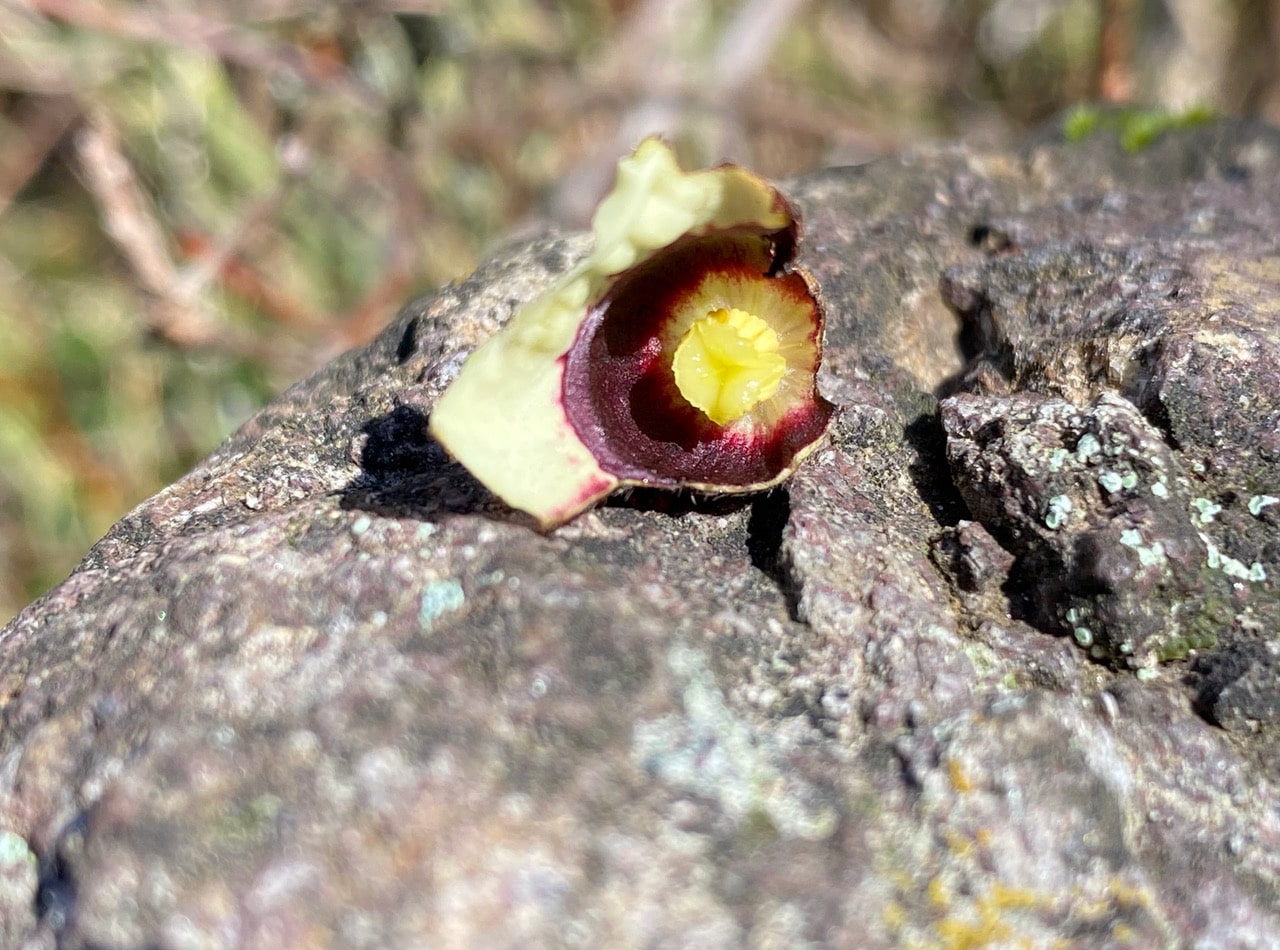
I tear away the flower leaving only the parts relevant to pollination. We are now looking straight into the base of the flower where the reproductive parts are. See the moist yellow, three-lobed stigma in the center, surrounded by yellow anthers? The surrounding interior of the flower that is colored a deep maroon, the nectar secreting tissue? Note that immediately around the reproductive parts there is a little pale area with no pigments. This window presumably can let in sunlight, a “skylight”, so to speak.
Enticed by the foul odor emitted by the flower, the fungus gnat enters through the maroon three-lipped opening. Insects in general are attracted to light. In the darkness inside the flower, sunlight streaming through the skylight directs the gnat to the top of the flower where the nectar and the reproductive parts are located. While taking nectar, the gnat may bump into the reproductive parts of the flower, getting dusted with the pollen from the anthers.
The California Pipevine is strongly protogynous, the female parts maturing before the male parts. As the flower matures, the stigmatic lobes close up, exposing the stamens beneath them. The stamens begin to peel away from the base of the stigma, and the anthers start to release pollen. Before the gnat leaves the flower, it is dusted with pollen to be ferried into the next flower it visits. If the subsequent flower happens to be in the famale phase, the pollen on the gnat might be deposited on the receptive stigma, effectively pollinating the flower. Separation of the female and male phases ensures that the flower will not pollinate itself; only cross-pollination happens. The gnats are likely to stay in the flower for days while the going is good. They may even find mates while gathered in the enclosure. Once the fun and feast is over, and if they are lucky, they make their way out through the opening, to be lured by the next flower.
The Pipevine Caterpillar Thrives in a Toxic Love Triangle | Deep Look – YouTube
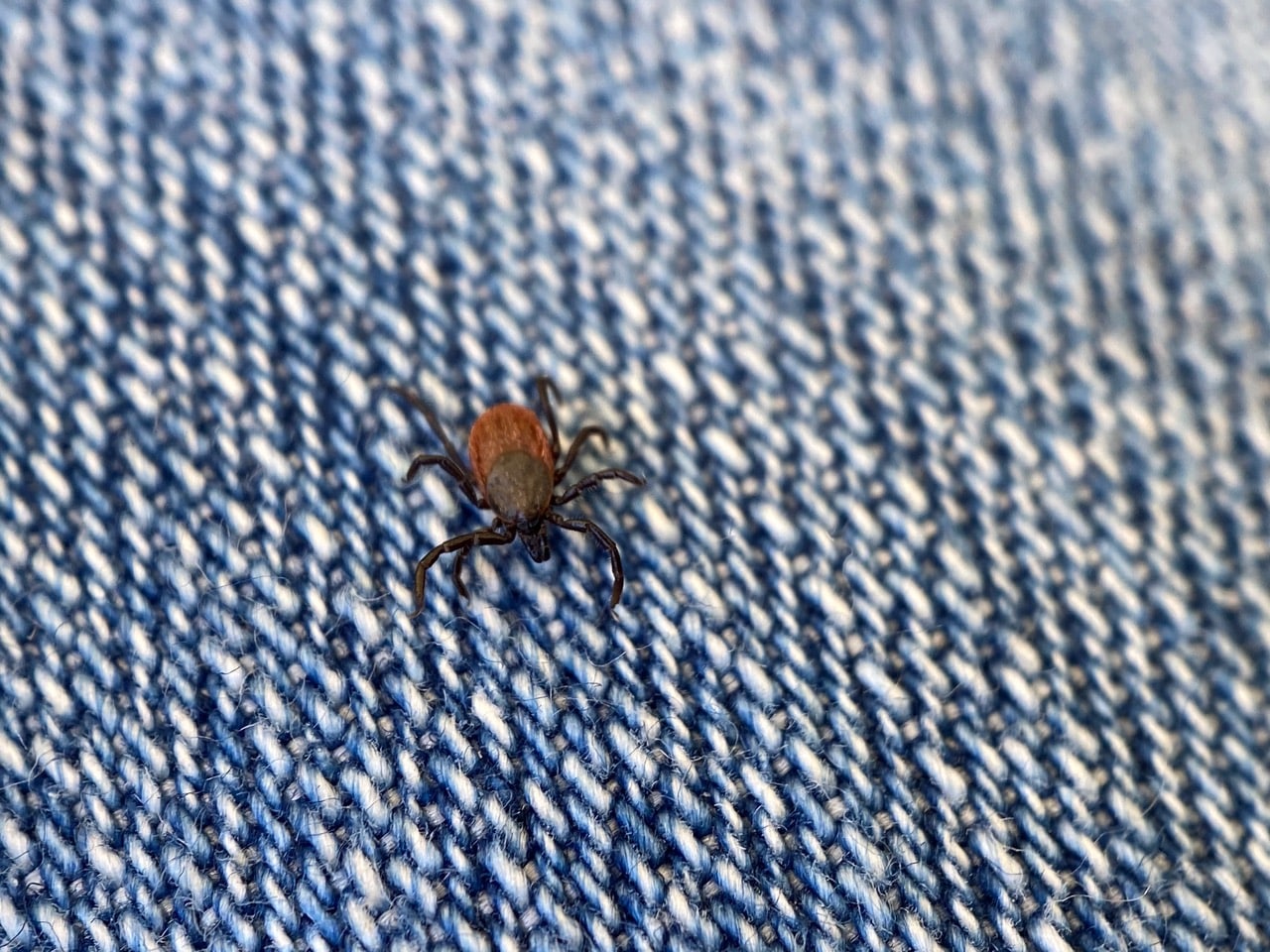
Uh-oh, an adult female Western Black-legged Tick is crawling on my jeans!
The Western Black-legged Tick, Ixodes pacificus (family Ixodidae) is commonly found in the western United States and British Columbia. It is a vector for several diseases, including Lyme disease, anaplasmosis, and babesiosis. The ticks are typically found in moist, wooded areas, such as forests, brush, and grasslands. They are most active during the spring and summer months. The tick has a four-stage life cycle: egg, larva, nymph, and adult. Each stage beyond the egg requires a blood meal from a host, such as a small mammal, bird, or lizard. The life cycle can take up to three years.
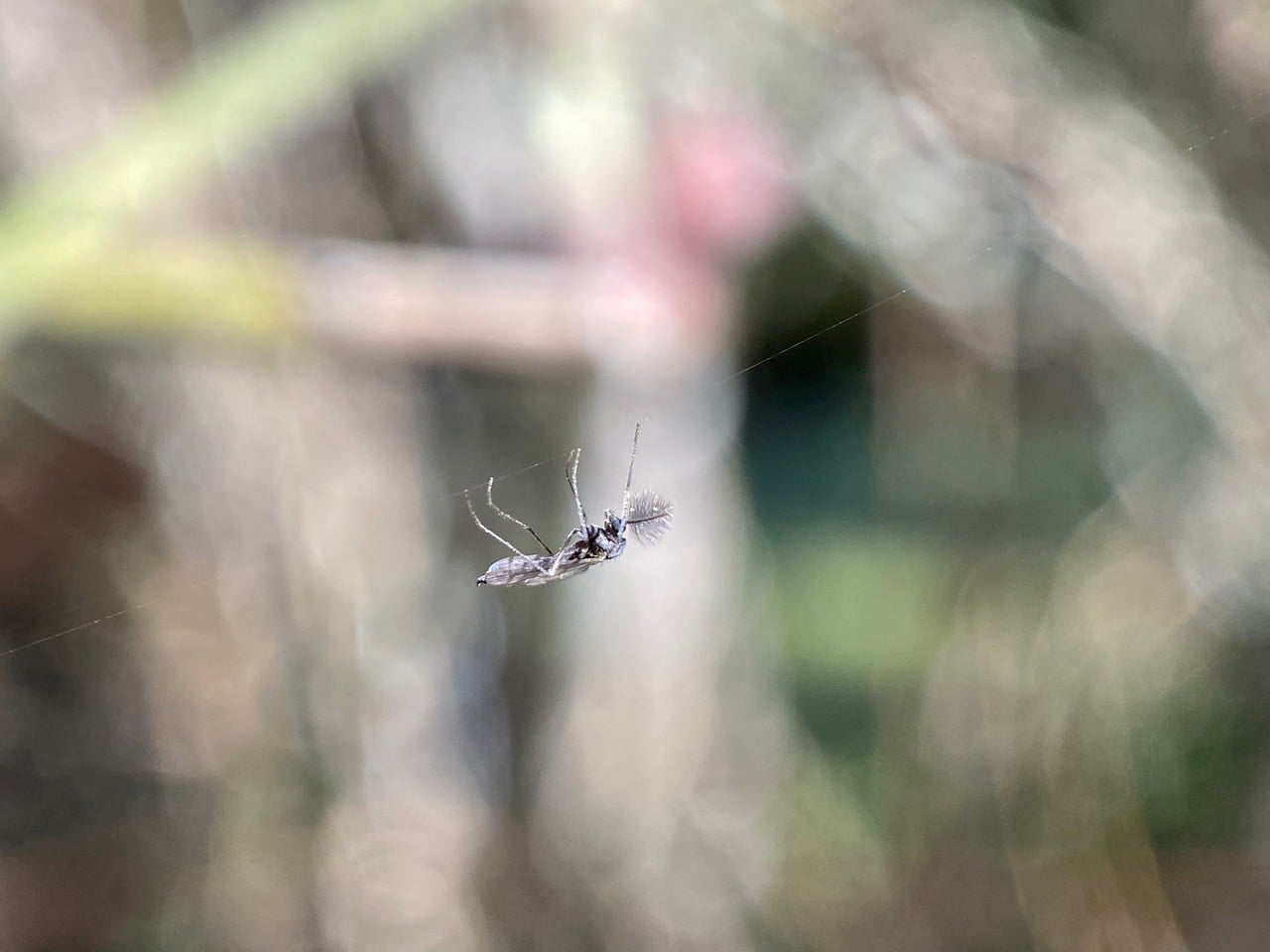
Something small is struggling on a strand of spider silk. Aided by my macro lens, I see that it is a male Non-biting Midge (family Chironomidae). These midges seem to be the most common insect around lately.
The Chironomidae is a large and diverse family of flies, with over 20,000 species known world-wide. Adult midges are small, most measuring 1-10 mm long, with narrow bodies and long legs. They resemble mosquitos, but do not bite. Males have long, feathery (plumose) antennae. Adults are short-lived. They feed on fly droppings, nectar, pollen, honeydew, and various sugar-rich materials. Larvae are mostly aquatic or semi-aquatic; most occur in freshwater habitats, a few occur in decaying matter, under bark, in moist ground, or tree holes. Larvae are mostly scavengers/detritivores. Collectively, they play a vital role in freshwater ecosystems as primary consumers. They harvest an enormous amount of energy from detritus and are important food items for fish, amphibians, birds, and predatory insects such as dragonflies and dance flies. Adult Chironomids can be pests when they emerge in large numbers, forming mating swarms over water or road surfaces.
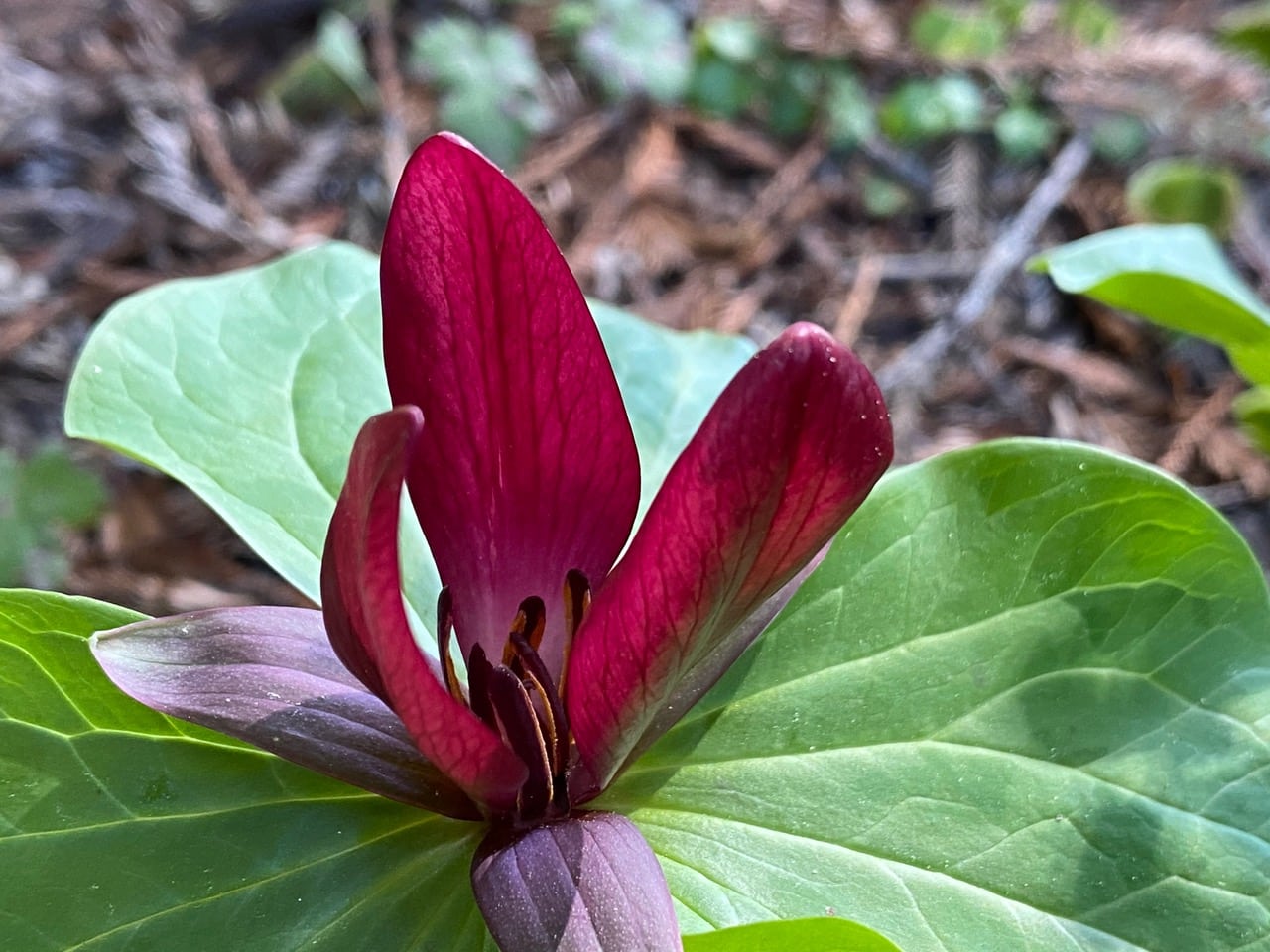
The Giant Trillium (or Wake Robin), Trillium chloropetalum is blooming under the redwoods.
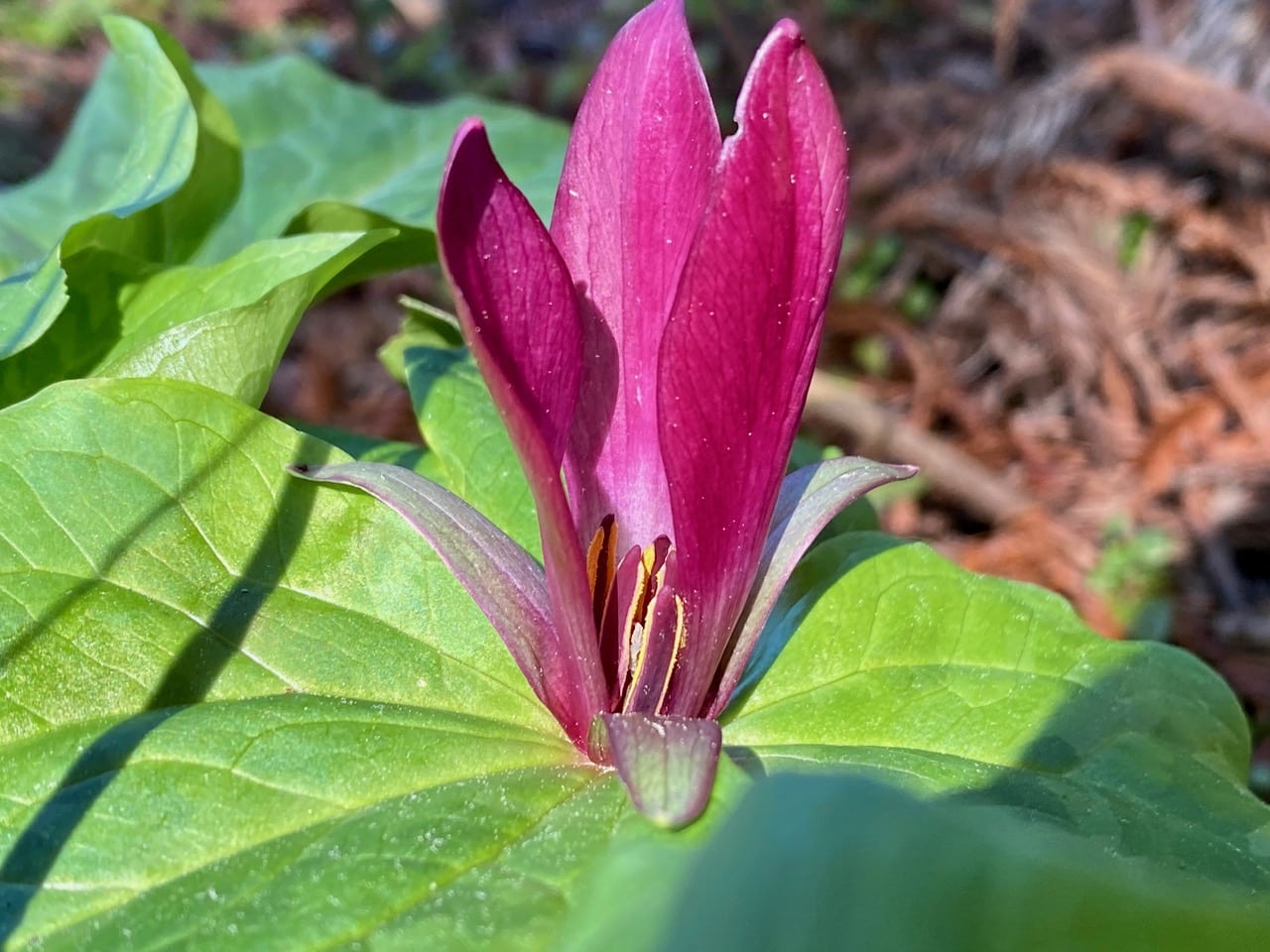
The name “trillium” incorporates the Latin word for three (“tri”), which refers to the three-part symmetry around which the plant parts are organized – in a single blossom there are three petals, three sepals, and likewise, the leaves (technically, bracts) also come three to a plant. Trilliums are divided into two groups, sessile or pedicellate. In the Giant Trillium, the flowers are sessile, meaning they are not subtended by a stalk or pedicel, but sit upright directly on the leaves. The floral structure is intriguing – large, erect, fleshy stamens surround a shorter, purplish, wrinkled pistil in the center. How are these flowers pollinated? From the literature, I gather that various species of trilliums are pollinated in different ways. Red trilliums that do not produce nectar are apparently pollinated by flies (Diptera) and beetles (Coleoptera). Their petals exude an odor that attract carrion flies and beetles which pollinate the flowers. Another source claims that white and drooping trilliums are pollinated by bumble bees and related insects. I have yet to evaluate these claims by my own observations. Since I started looking a few years ago, I have not found an insect on the trillium flowers at all.
This flower is lit by the sun, revealing the sturdy, erect anthers within. Yellow pollen is released on two strips that run along either side of the six flat, maroon anthers. I have yet to see an insect on these dramatic flowers.