

Pollinator Post 2/2/26 (1)

Another fresh new day at an East Bay Regional Park in the Oakland hills. I enter through the Waterloo staging area on Skyline Blvd.
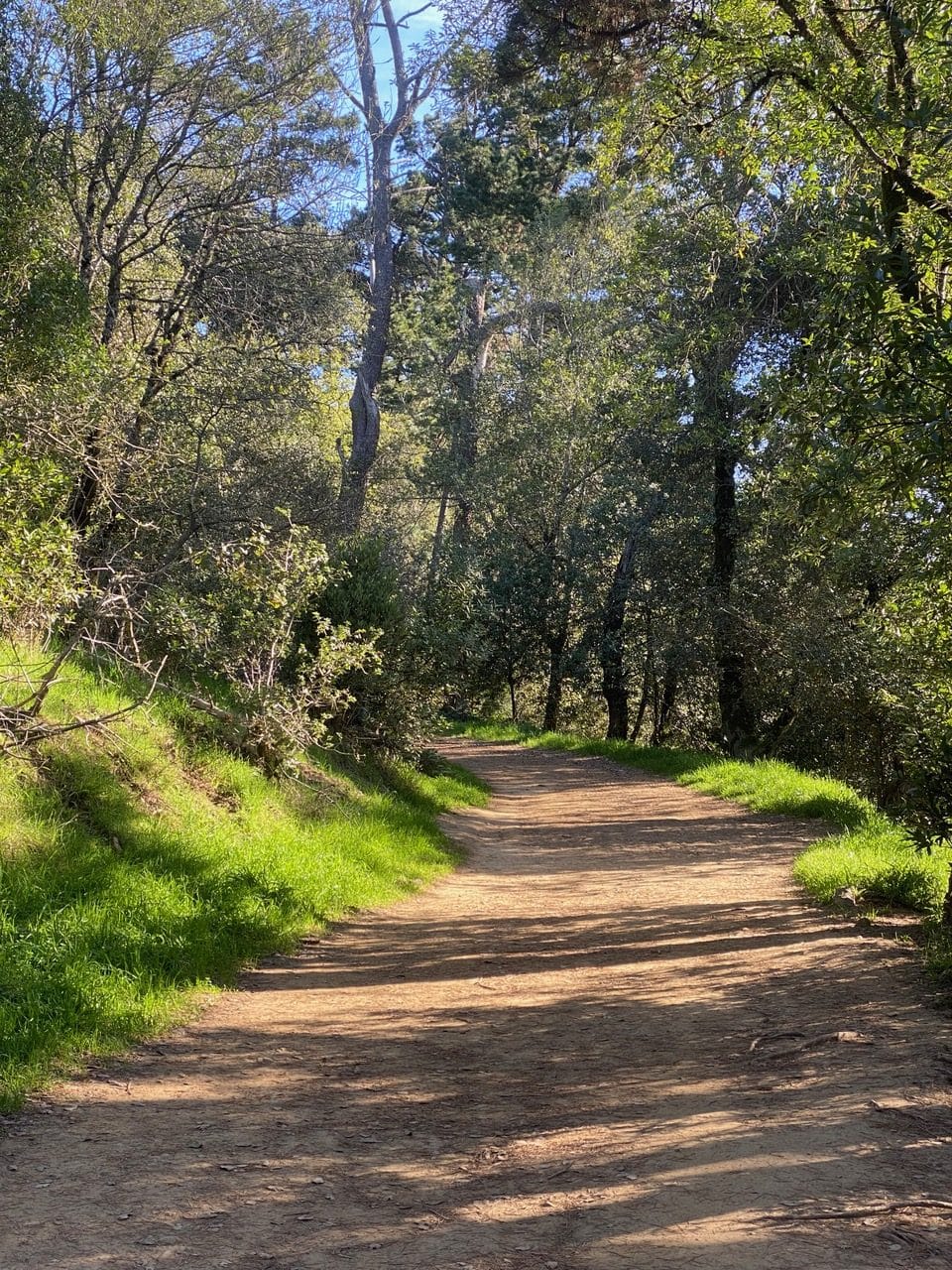
Neon green grasses lit up the sides of West Ridge Trail.
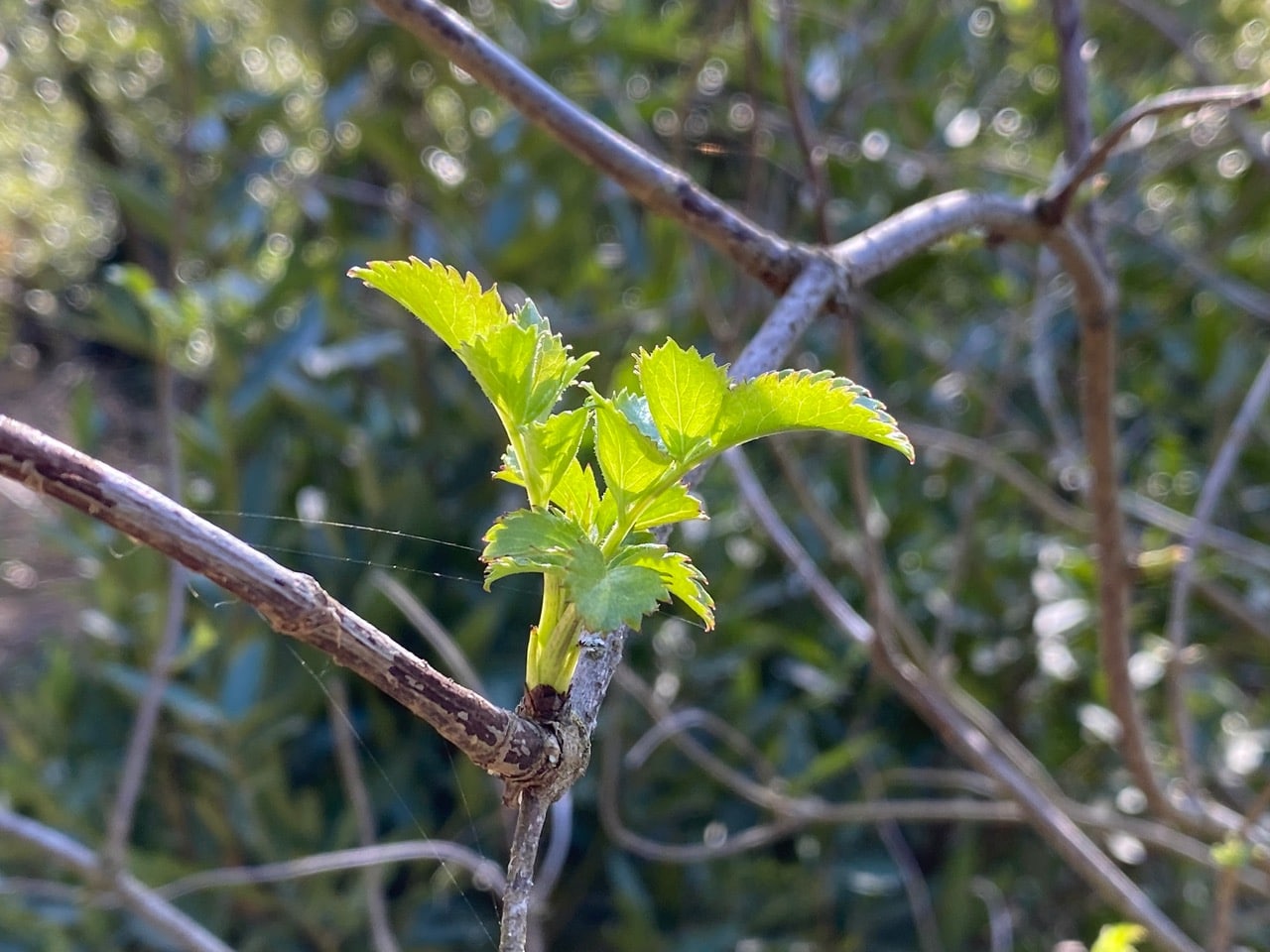
A young shoot on a bare branch of a Blue Elderberry, Sambucas mexicana is backlit by the morning sun. The dormant shrub is waking up!
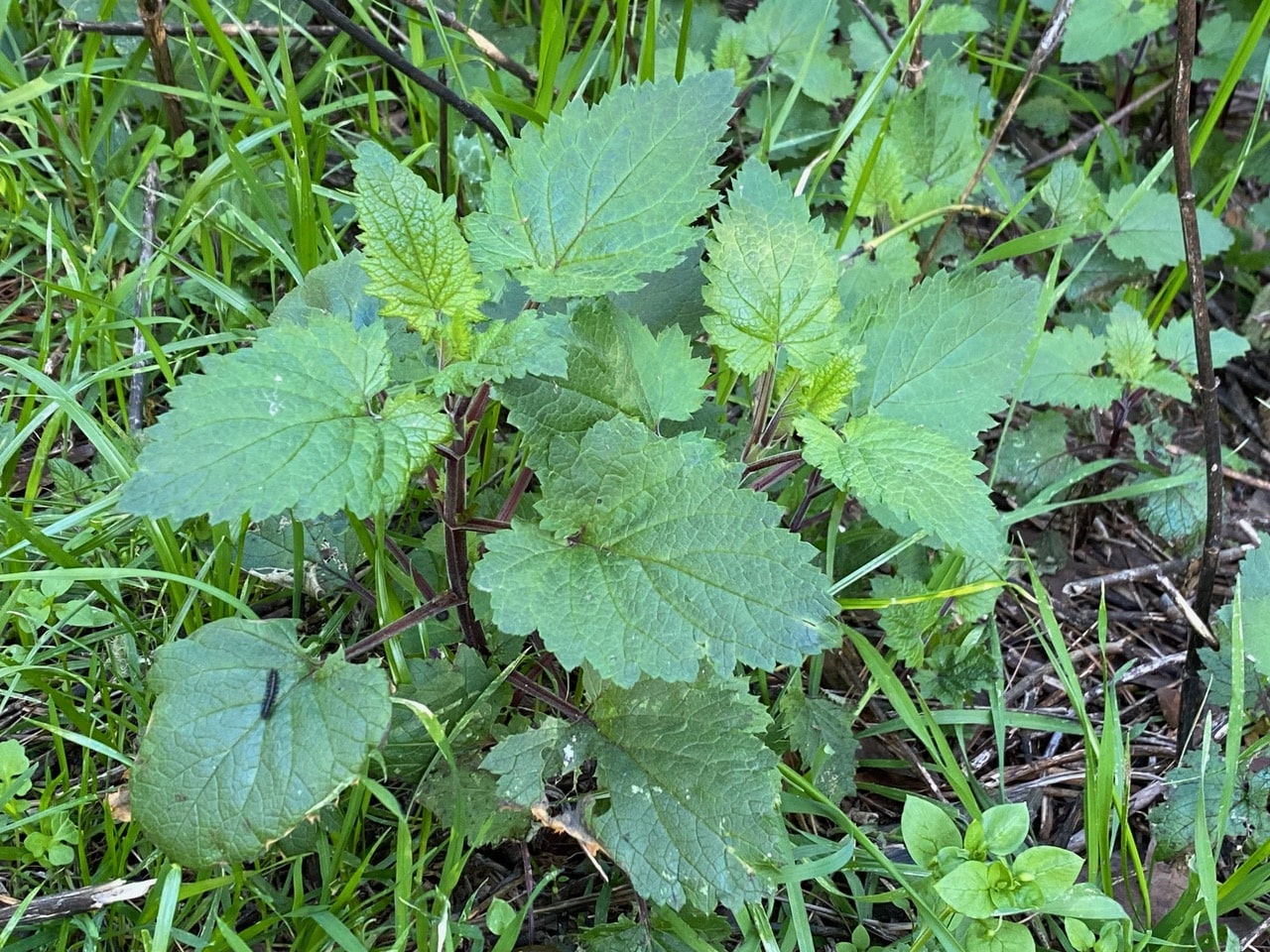
Ooh, do you see that small black caterpillar on the leaf of the Bee Plant, Scrophularia californica?
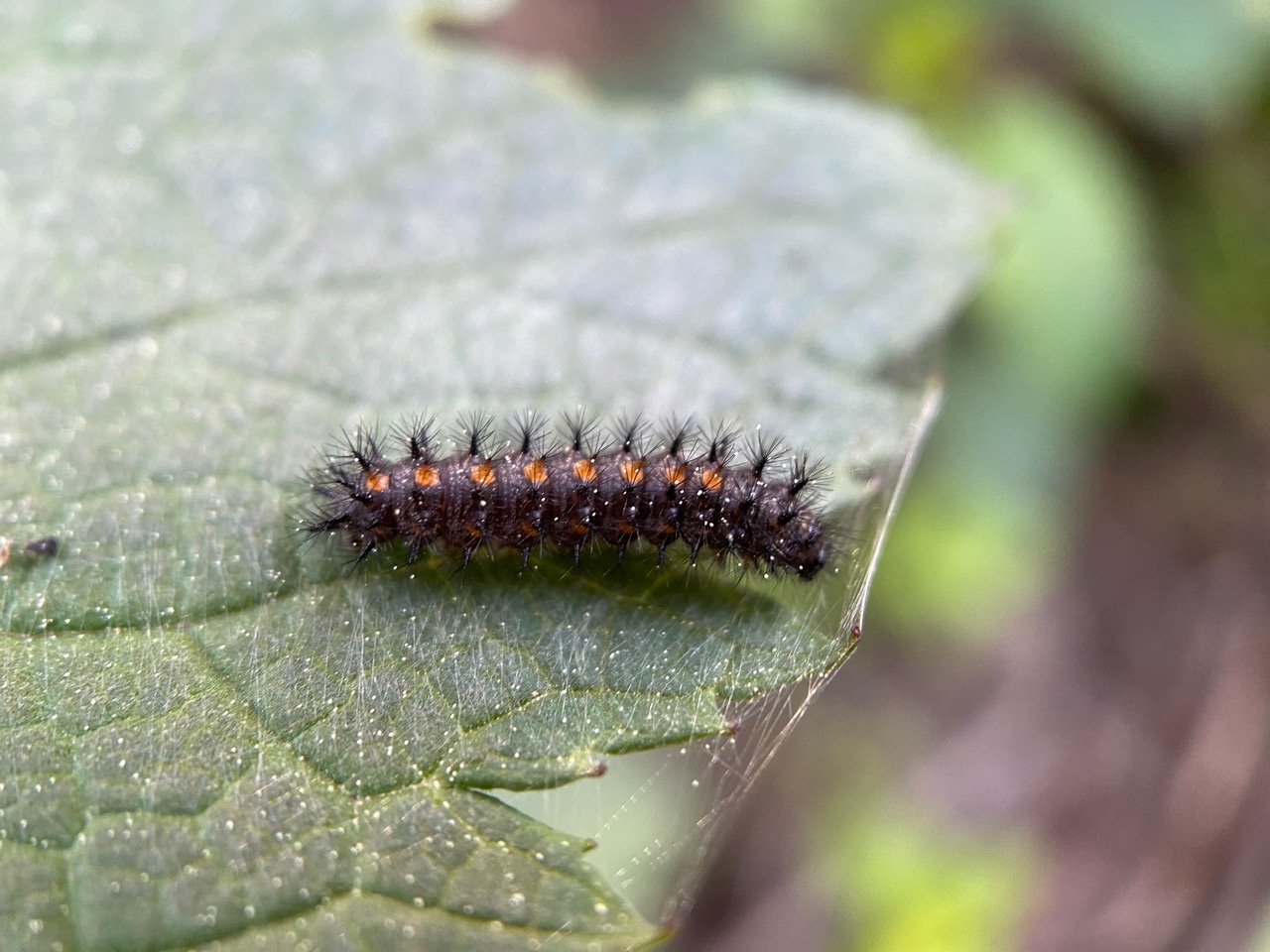
Cose up, the leaf and the Variable Checkerspot caterpillar are sprinkled with what look like grains of pollen. Not surprising, as it is pollen season. The pollen could have been wafted from a number of wind-pollinated plants such as the conifers and the Hazelnut (Corylus) that occur in abundance nearby. All together, I find about a dozen of these young caterpillars, each about 1/4” in length, on this small patch of Bee Plant. We can look forward to seeing the adult butterflies in the spring!
The Variable Checkerspot, Euphydryas chalcedona (family Nymphalidae) is found across western North America. The butterfly occupies a wide range of habitats, including sagebrush flats, desert hills, prairies, open forests and alpine tundra. Males perch or patrol around larval host plants to encounter females. Eggs are laid in large groups on underside of leaves of host plants. Host plants include California Bee Plant, Scrophularia californica, and Sticky Monkeyflower, Diplacus aurantiacus. These plants provide the caterpillars with iridoid glycoside, a chemical that imparts unpalatable taste to birds, protecting the caterpillars from predators. Larvae feed in large, loose groups on the host plants. Individuals overwinter (enter diapause or hibernation) as third or fourth instar larvae in sheltered sites under bark or dead branches, in hollow stems and in rock crevices. Pupation begins in early to mid April and the adult flight season begins between mid-April and May and continues into June. The adults feed exclusively on nectar, and have a life span of about 15 days.

Signs of new life is everywhere. Tender young shoots have sprouted on every node of this vine of California Blackberry, Rubus ursinus.
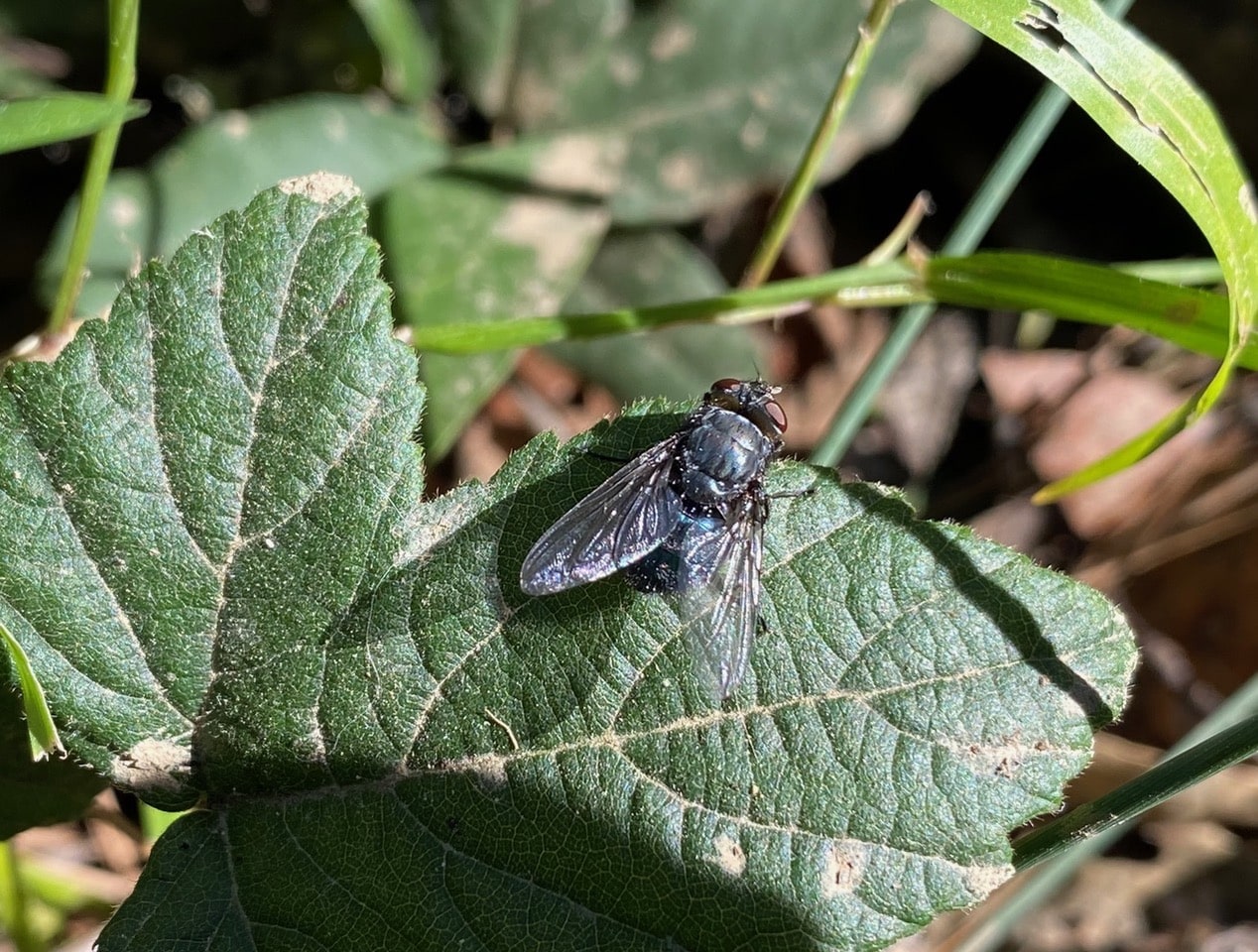
A Blue Blowfly, Calliphora vicina has landed on an old Blackberry leaf.
The Calliphoridae are variously known as blow flies, carrion flies, greenbottles, and bluebottles. Adults are usually brilliant with metallic sheen, often with blue, green, or black thoraces and abdomens. There are three cross-grooves on the thorax; calypters are well developed. Females visit carrion both for proteins and egg laying. The larvae that hatch feed on dead or necrotic tissue, passing through three instars before pupation. After the third instar, the larva leaves the corpse and burrows into the ground to pupate. Adult blow flies are occasional pollinators, being attracted to flowers with strong odors resembling rotting meat. The flies use nectar as a source of carbohydrates to fuel flight.
The Blue Blowfly, Calliphora vicina is important in the field of forensic entomology; its life cycle has been extensively studied and the flies are used to estimate the time of a person’s death in criminal cases. The species is found throughout the U.S. in urban areas and are most abundant in early spring and fall.
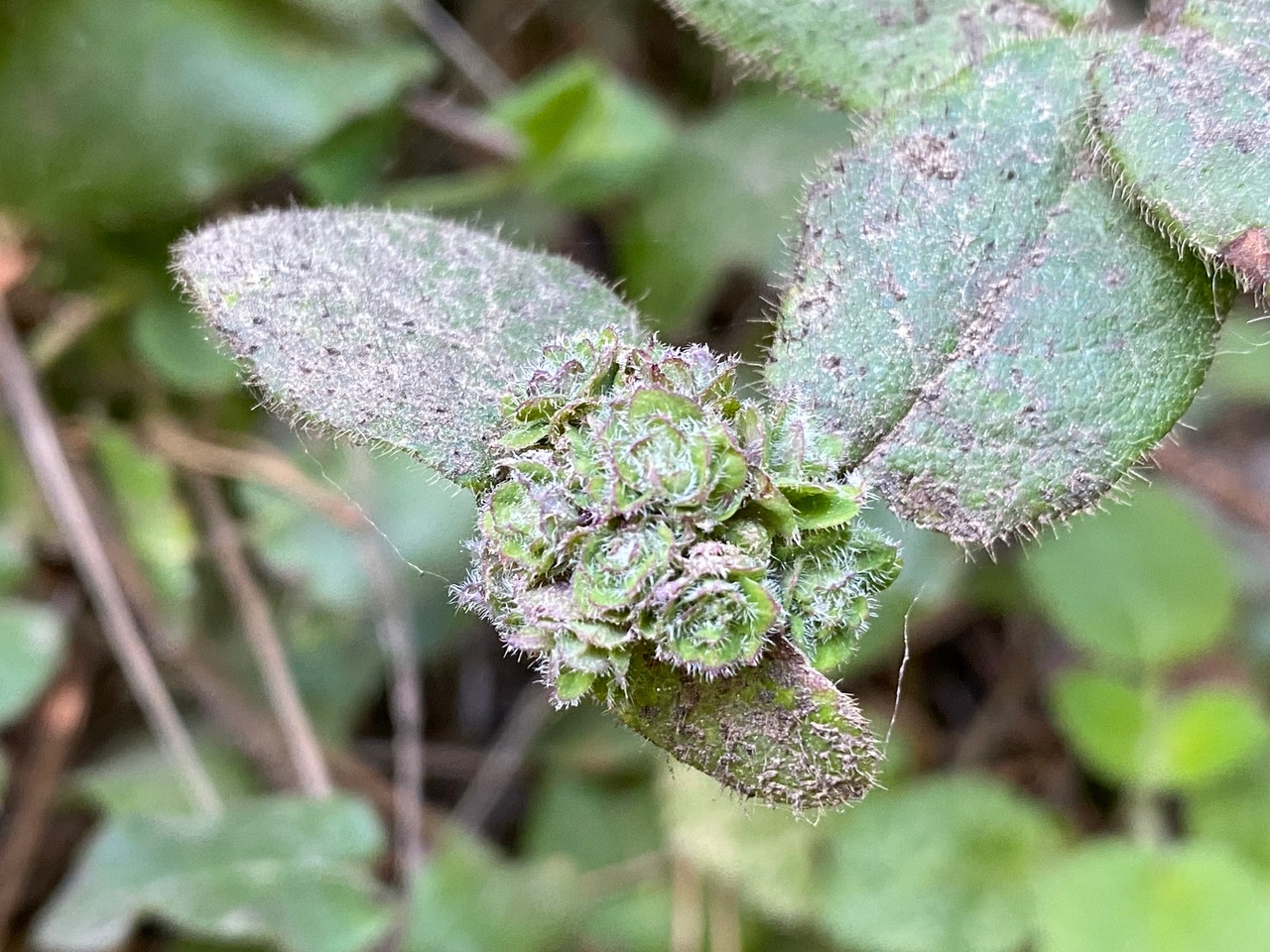
Low to the ground, the mud-covered terminal leaves of a Pink Honeysuckle is holding a hairy rosette of Cabbage-bud-galls.
These galls bring back fond memories of helping Ron Russo rear the gall-makers from them. The Cabbage Bud Gall has since been named after Ron – Lonicerae russoi (family Cecidomyiidae). Ron is the author of the Field Guide to Plant Galls of California and Other Western States.
The Cabbage-bud-gall Midge, Lonicerae russoi (family Cecidomyiidae) induces conical, leafy bud galls on the honeysuckle. While these rosette galls can occur singly, they usually appear in congested clusters that can reach 3 cm across. Each gall has a dense arrangement of white hairs filling its center, marking the entrance to the larval chamber. The galls exposed to direct sun often turn wine red. The larvae feed and eventually pupate within the galls. Adults emerge in late February and March by pushing through the hairs.
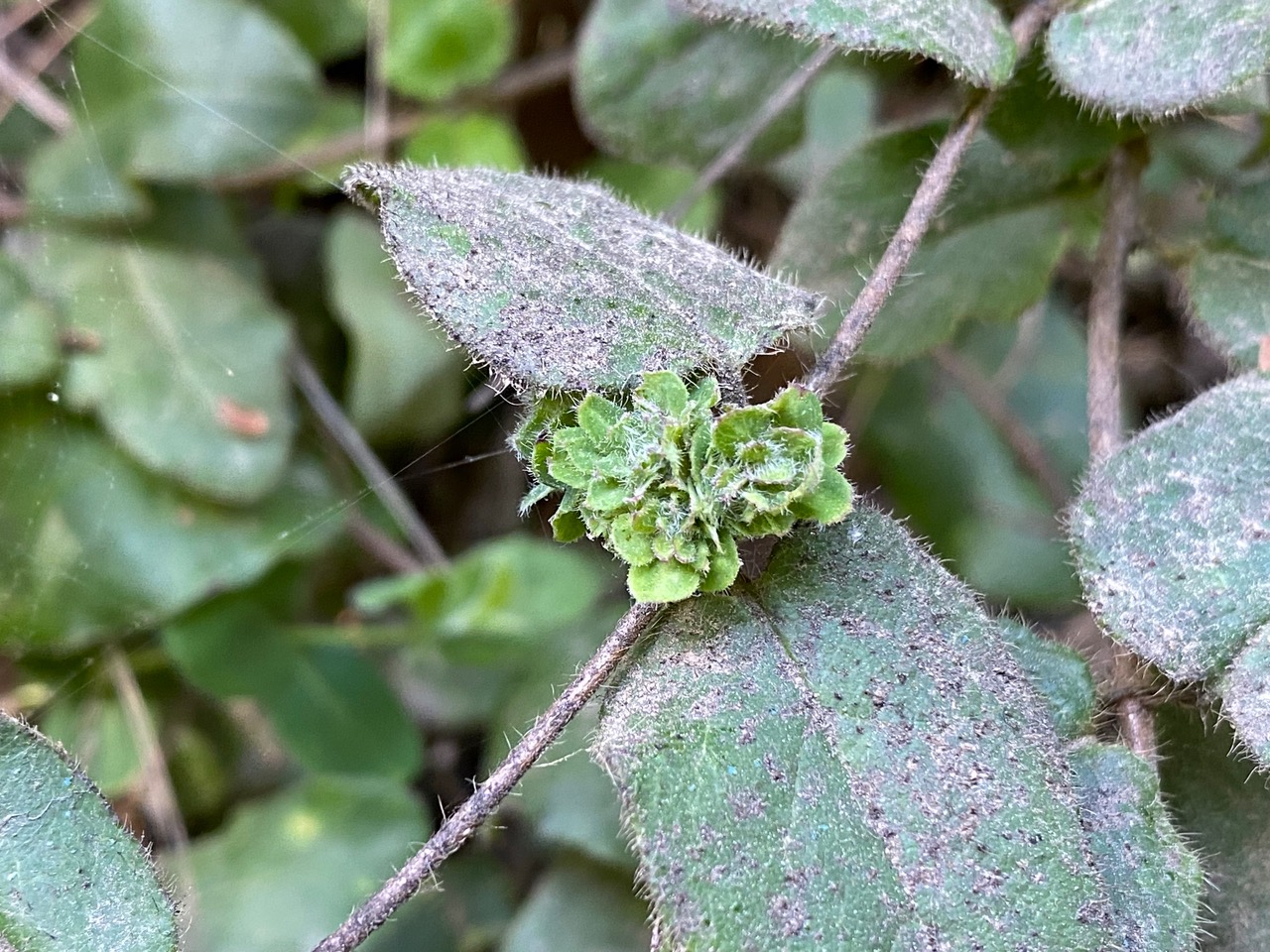
Here’s another of the same gall on a leaf axil of the Honeysuckle. Over the years, I have always been able to find several of these galls on this individual Honeysuckle, while the rest of the plants along this trail are gall-free. Obviously mama midge is very selective about which plant she lays her eggs on. Perhaps she prefers plants of a certain age? that produce less defensive chemicals? or which grow in ideal microclimate?
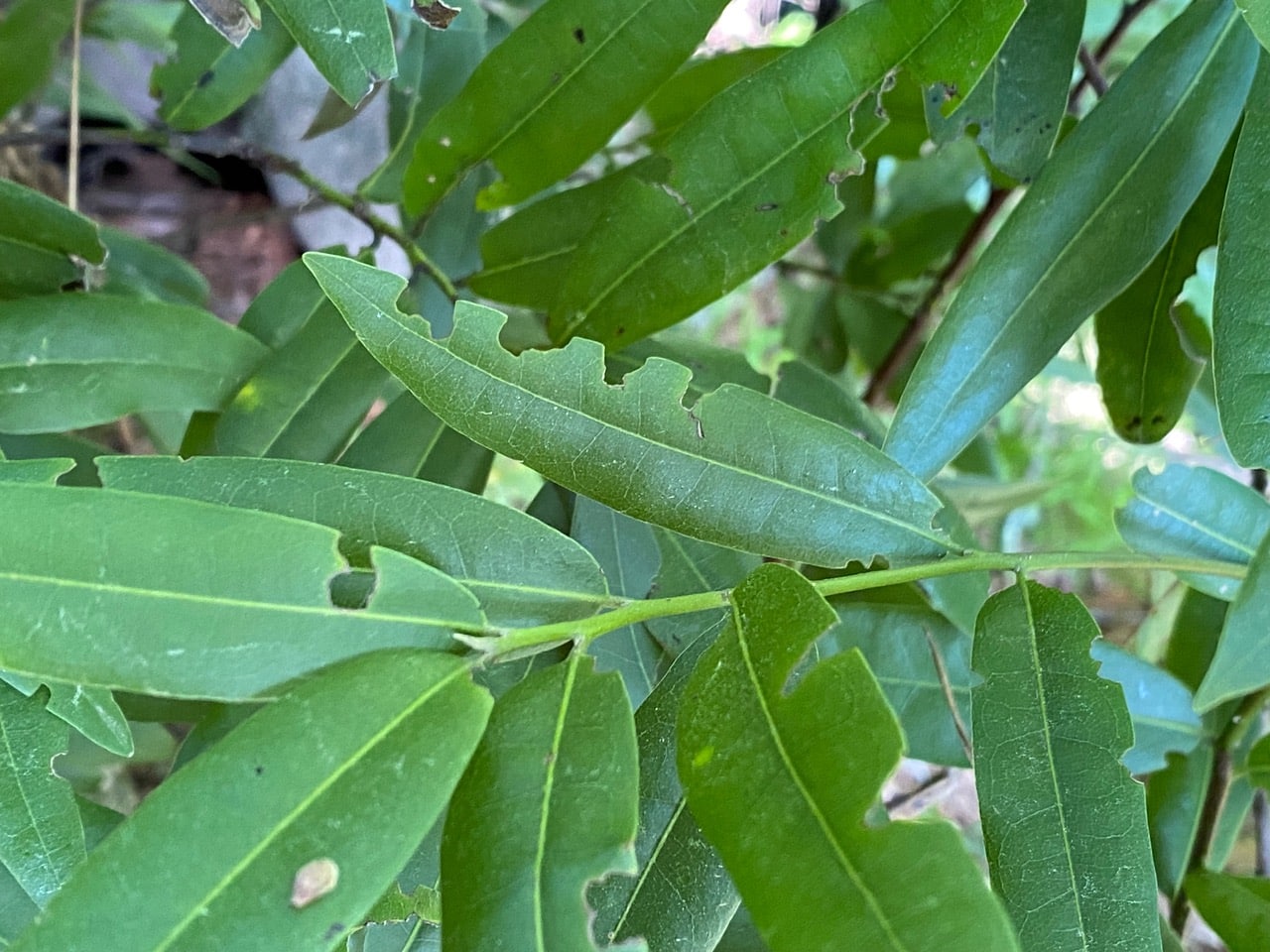
I have always been intrigued by these angular bite marks on the leaf margins of our California Bay, Umbellularia californica. Who is able to feed on the plant that is packed with herbivore-repelling spicy chemicals? I have never found any insect feeding on the Bay leaves. Maybe the offending insects are nocturnal?

A vibrant patch of California Polypody fern covers a steep bank along the trail.
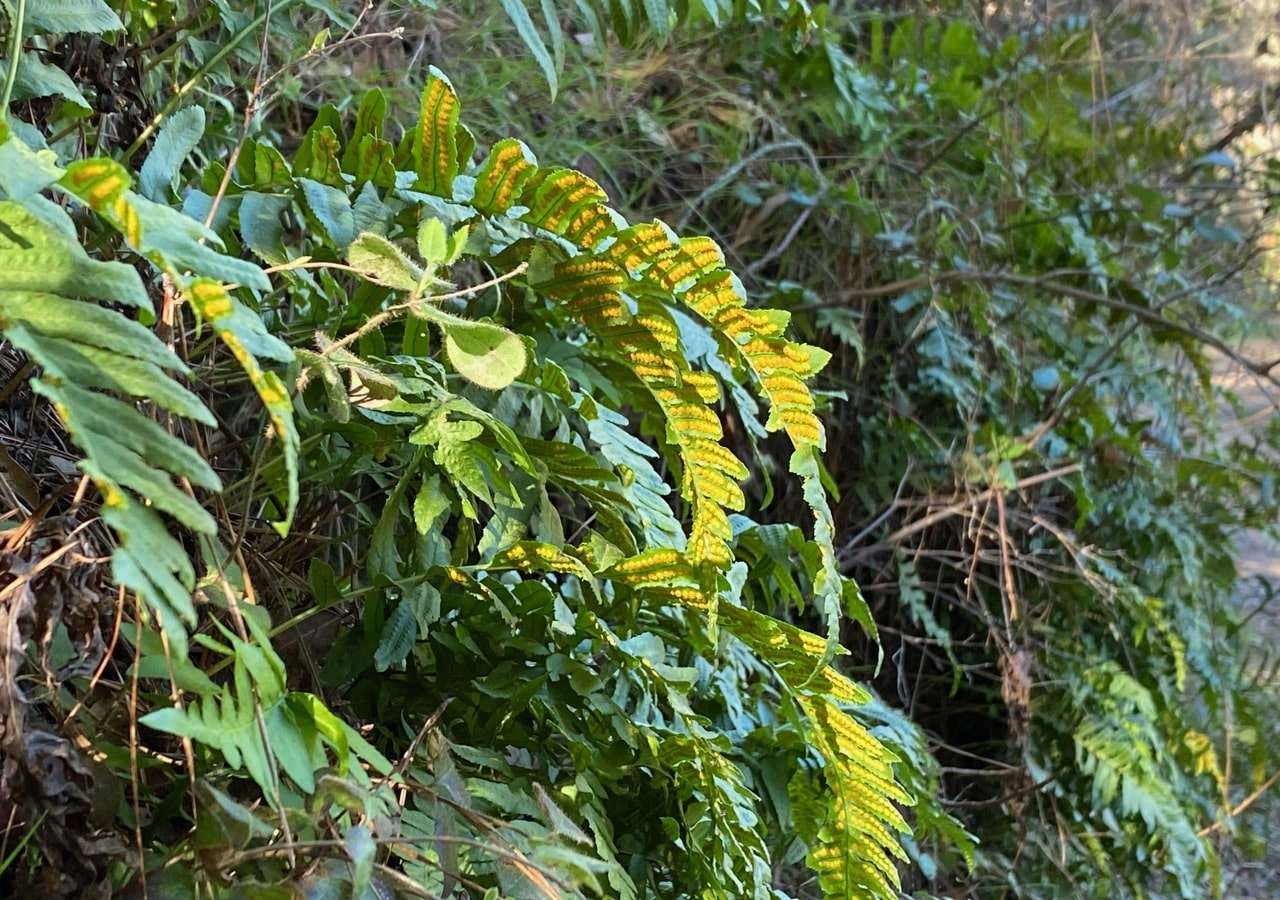
The morning sun has lit up the backside of some of the Polypody ferns, revealing neat rows of golden spore.
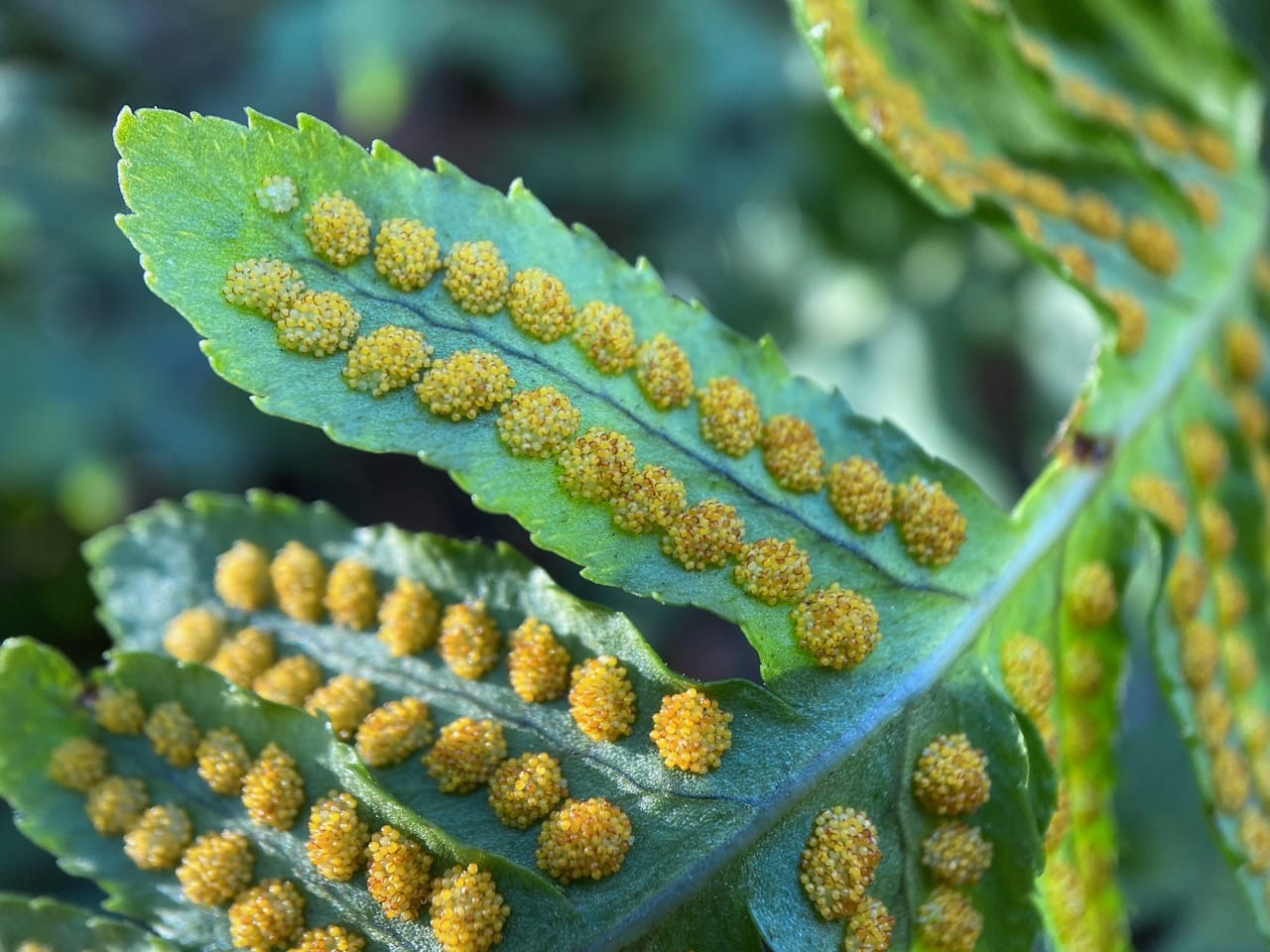
I look at the back of the Polypody Fern through my macro lens and find neat clumps of minute marbles evenly spaced along each leaflet. Each of those translucent marbles is a sporangium where spore is produced. Each pile of sporangia is called a sorus (sori in plural).
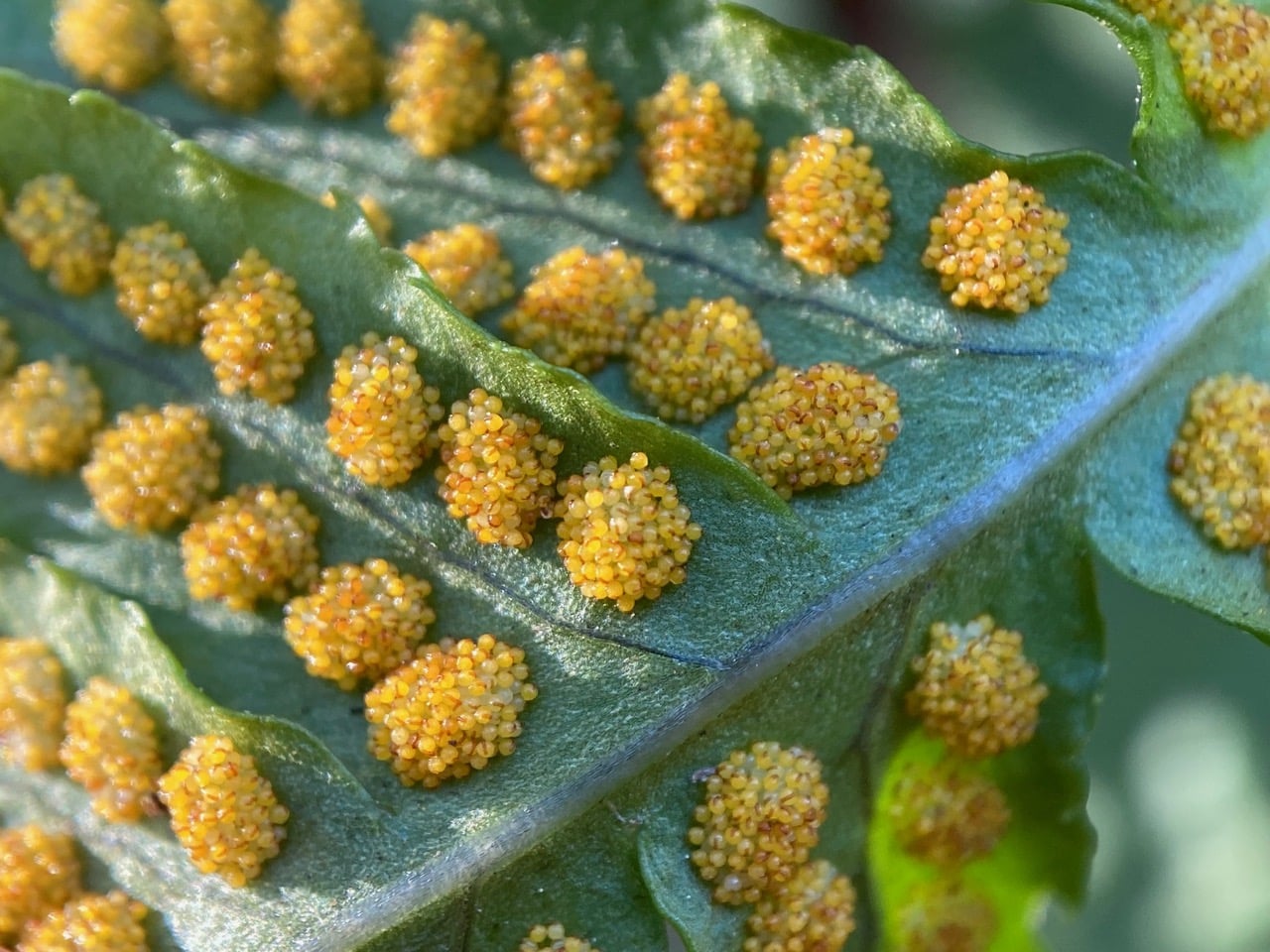
The sori of Polypody Fern under even higher magnification.
Ferns exhibit a distinct life cycle with two stages: the spore-producing sporophyte and the gamete-producing gametophyte, requiring moisture for sperm to swim to the egg for fertilization on the gametophyte. The fern plant we usually see is the sporophyte. On the underside of the sporophyte leaf, spores are produced and released. These grow into a tiny, heart-shaped plant called a gametophyte where fertilization occurs, eventually developing into a mature fern sporophyte. The tiny fern gametophytes usually grow on damp bare soil, but are easily overlooked.
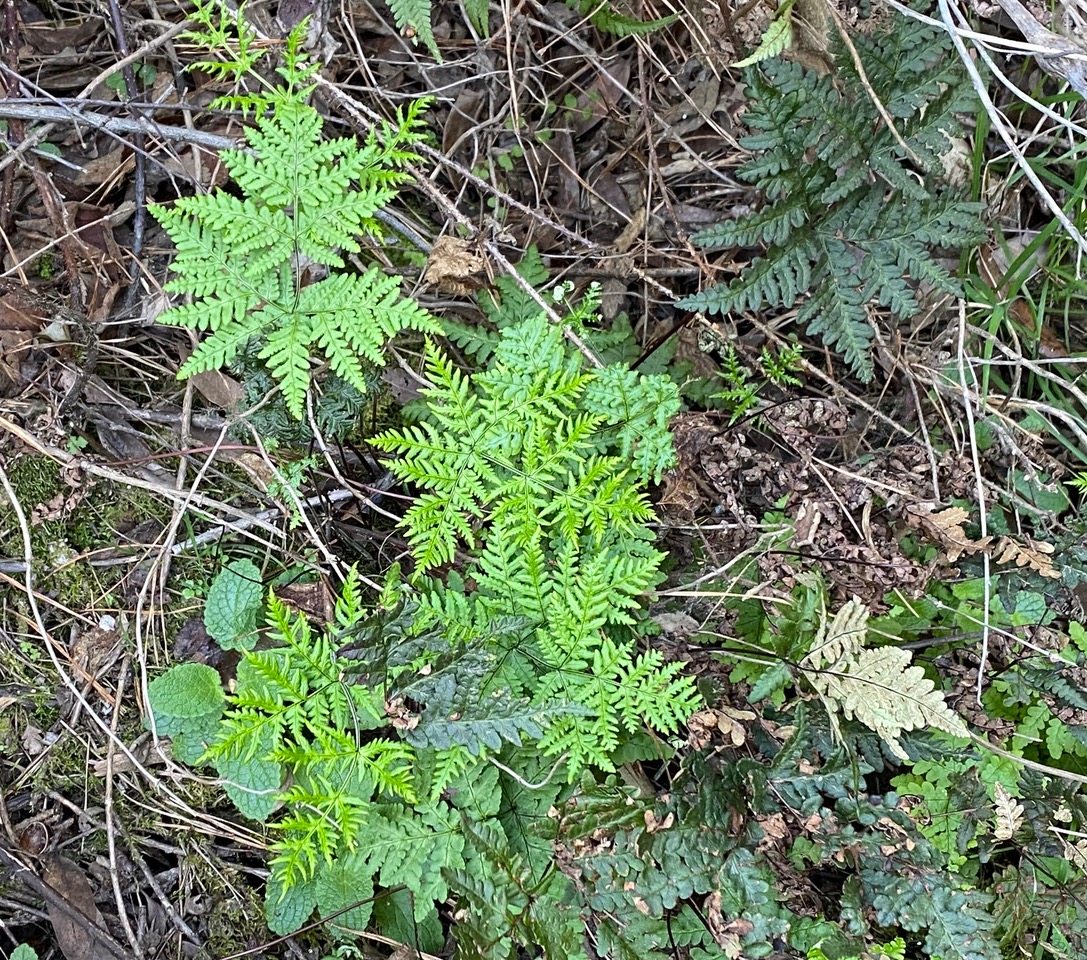
Fresh new fronds of a smaller fern have unfurled in a shady spot in the undergrowth. The small, triangular-shaped fronds are easily recognizable as the Goldback Fern, Pentagramma triangularis.
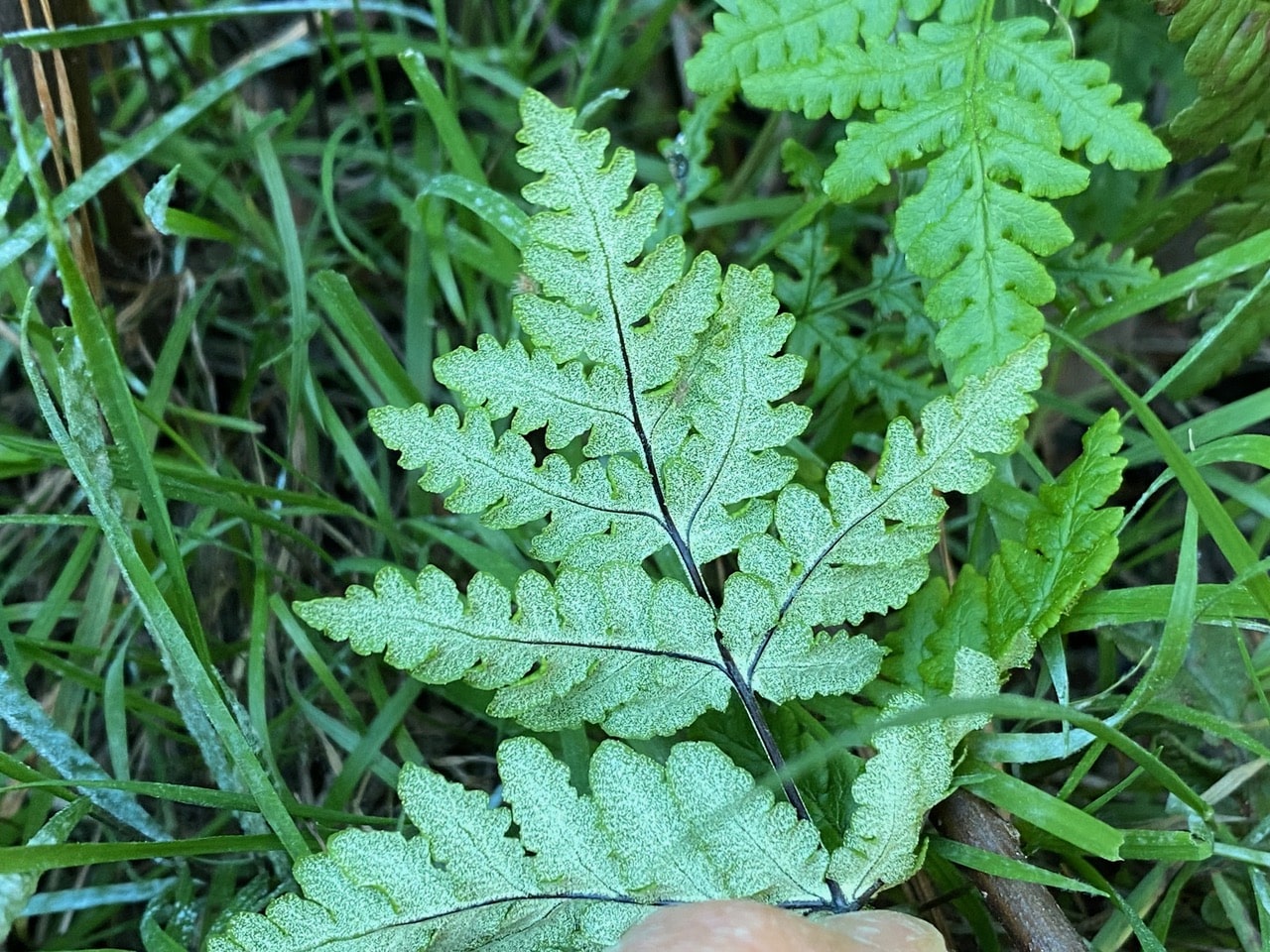
I turn over a leaf to reveal the whitish-gold dust on the underside of the frond.
Like all ferns, Goldback Fern does not produce flowers or seeds, but reproduces by spores. When you turn over the leaf, you’d find a layer of gold “dust” on the underside. Those are not spores, but a waxy material believed to help protect the plant from desiccation. The powdery substance is secreted by the plant and covers the actual spore-producing structures (sori), creating a “gold-painted” appearance of the frond. The leaves curl up in response to dry period, but unroll with the return of the rain.