

Pollinator Post 2/18/25 (1)
At Skyline Garden this morning, I walk the Skyline Trail from Siesta Gate heading south. Surely there must be some early blooms now?
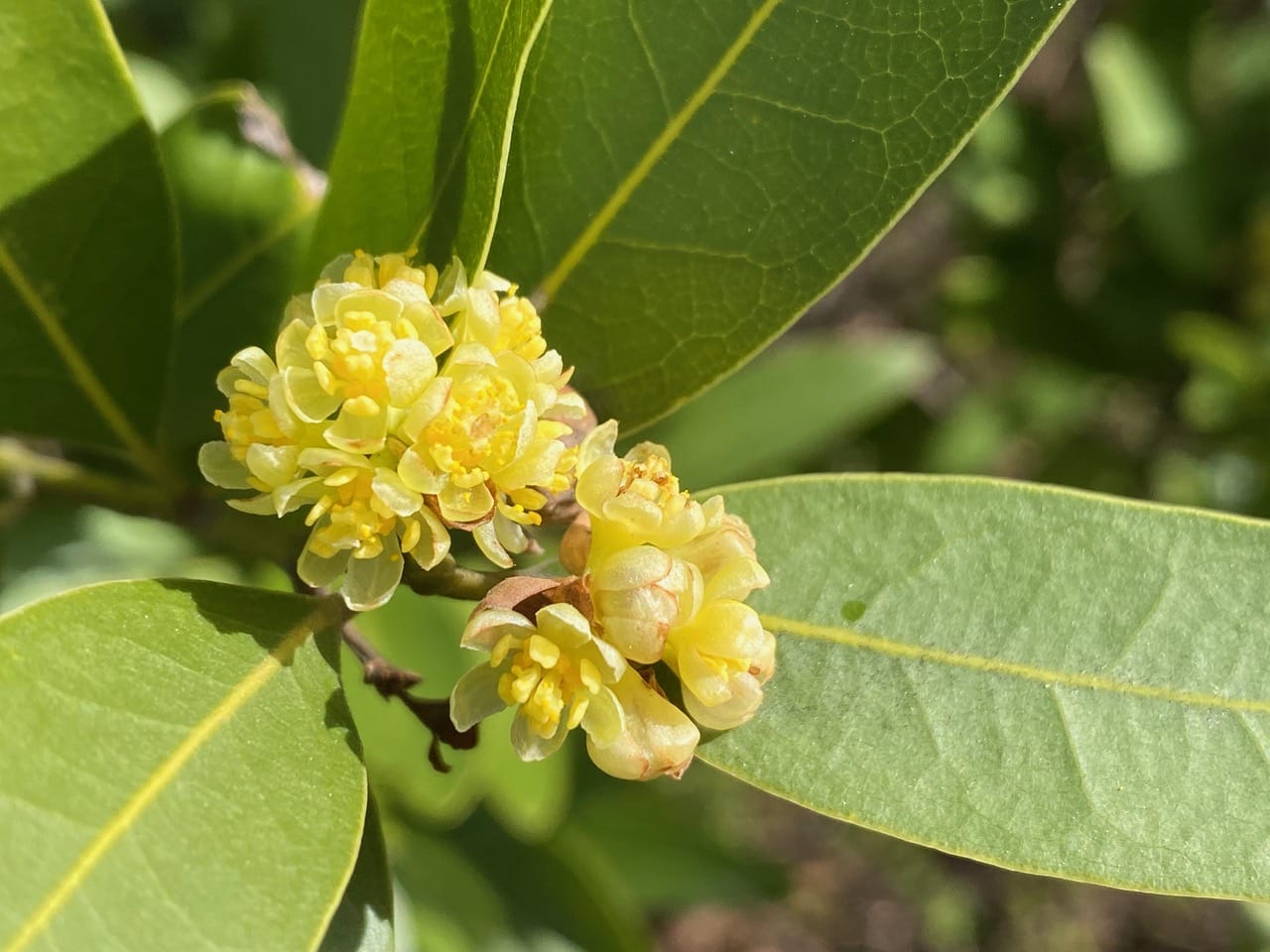
Though past its floral prime, the California Bay, Umbellularia californica is still blooming gloriously. I slow down to scan the inflorescences for any insect visitors. Who pollinates these flowers that bloom in winter?





The California Bay flower has a complex structure, and at maturity offers scattered clumps of pollen distributed evenly over the flower. It has every sign of an insect-pollinated flower; yet again, I don’t see any insects visiting the flowers.
California Bay is an odd ball in our native flora – it belongs to the Lauraceae family that occurs mainly in warm temperate and tropical regions. No surprise that the Bay flower structure is unlike any other we are familiar with. The flowers do not have petals but they do have 6 creamy-white sepals. Stamens are found in two rows – the outer row has six and the inner row three. For the inner row, there are two large yellow glands associated with each stamen. The stamens have four anther sacs – they give the stamen a paw-like appearance. The ovary is superior and includes a stigma that is mostly white. As the flower matures, the four anther sacs (covered with pollen) “pop out” of discrete sockets on the paw-like stamen, appearing like yellow “claws” at the tips of the paw.
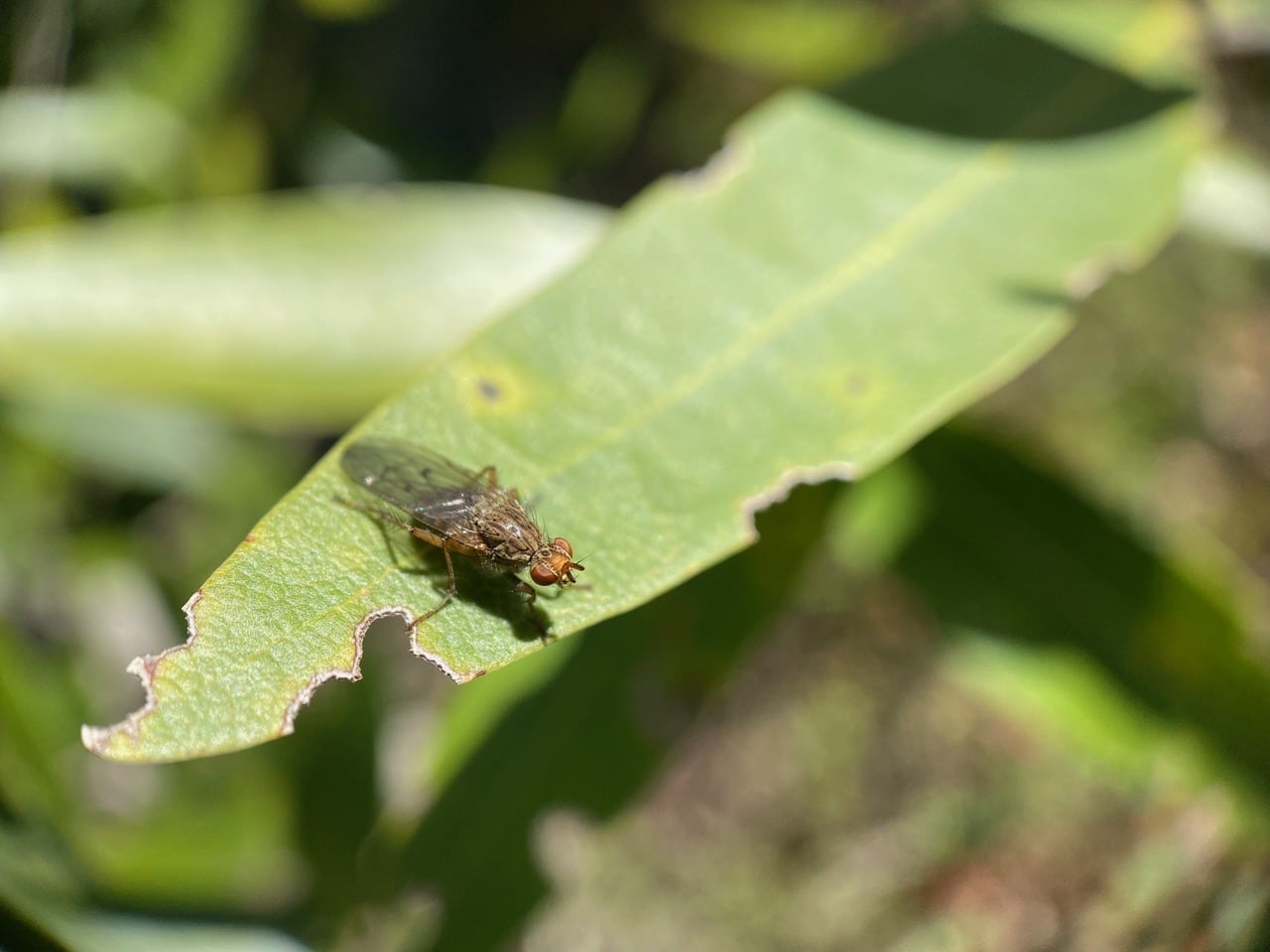
Hey, here’s a fly perched on a bay leaf! It is a Furcate Dung Fly, Scathophaga furcata (family Scathophagidae).
The genus Scathophaga are small to medium sized predatory flies that for the most part, have larvae that develop in animal dung or decaying plant matter. The adults are predators on other small insects, and while they are commonly seen on flowers, they are hunting prey there, rather than acting as pollinators. They are, in fact, one of the better predators of blow flies; thus, they are beneficial agents of biological control. The larvae feed on other insect larvae within animal dung or decaying plant matter. The Furcate Dung Fly prefers more shaded and humid locations than their better-known relative, the Golden Dung Fly, S. stercoraria.
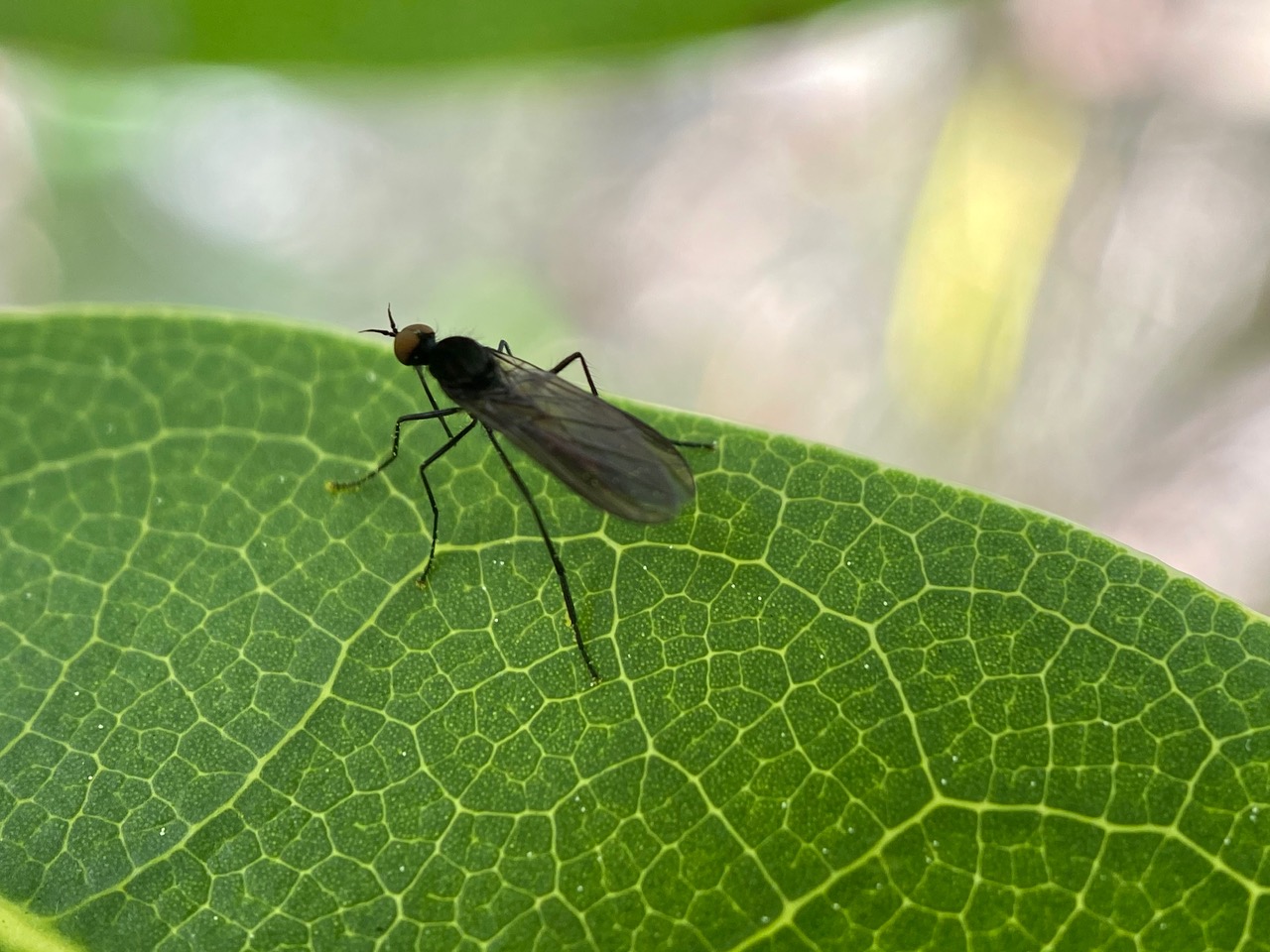
In the shade, a Hybotid Dance Fly (family Hybotidae) is resting on a California Bay leaf. Note its long, thin proboscis.
The Hybotid Dance Flies belong to the superfamily Empidoidea and were formerly included in the Empididae as a subfamily. Empididae generally have a thick beak pointing down, while Hybotidae have a thinner beak, or a thick beak pointing forwards or diagonally. Some crucial wing venation further distinguishes the two families. Precious little is known about the life cycle and biology of Hybotids because they are not considered of economic consequence. Since their forelegs are generally not raptorial, I doubt if they’re predaceous like the Empidids. Some Hybotids are known to eat pollen. I have seen Hybotids visit flowers for nectar and pollen, notably on Soap Plant, Miner’s Lettuce, California Saxifrage, Wild Geranium, Hound’s Tongue and Buttercups, and I believe they may contribute to the pollination of these small wildflowers.
Why the name “dance fly”? This is derived from the mating swarms of males of many species. They gather in clouds over prominent objects, each individual seeming to bounce or “dance” in mid-air. Many other flies do this, notably midges, but the Empidids and the Hybotids got the moniker.
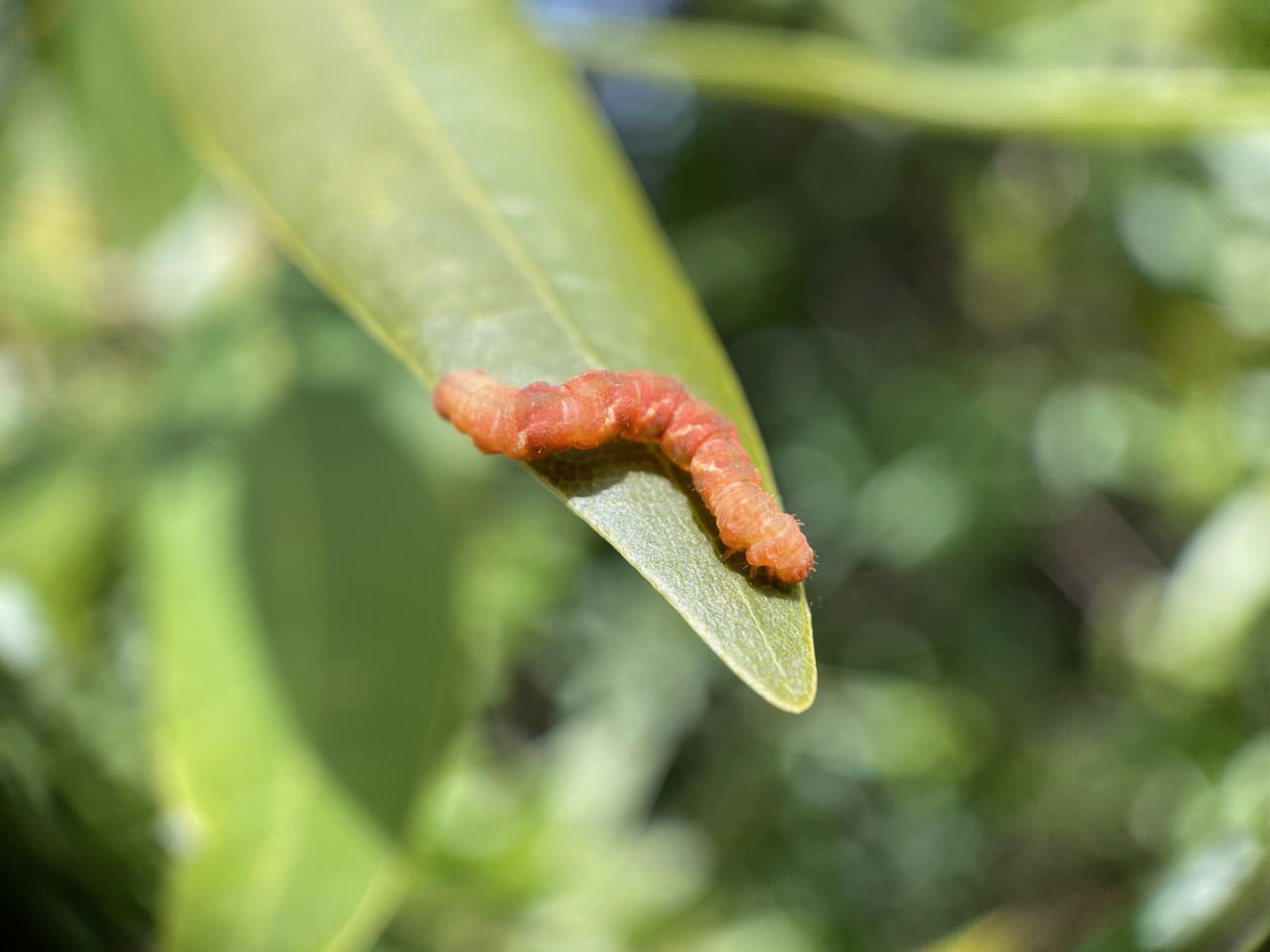
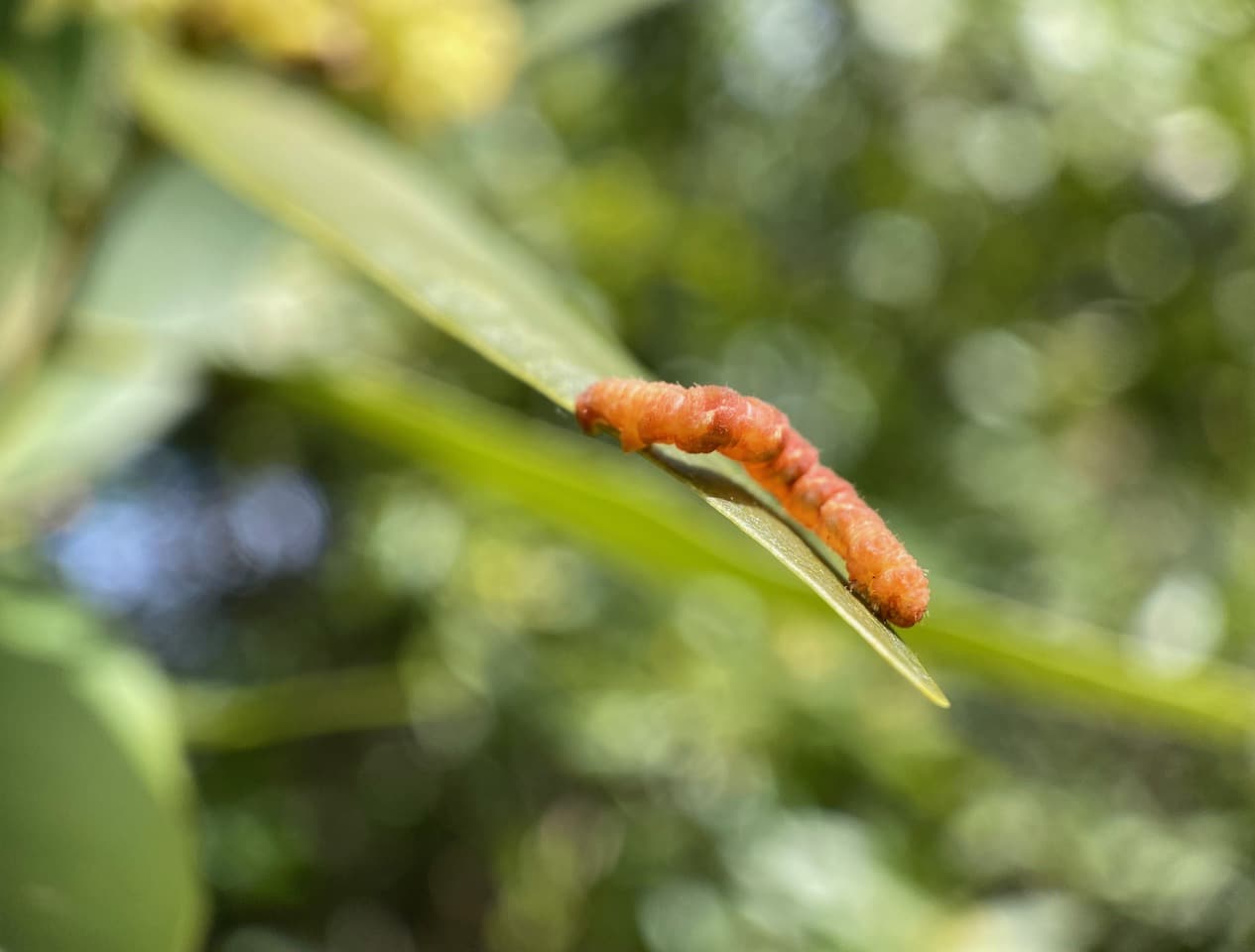
An orange caterpillar stands out on a California Bay leaf. Does it actually eat the obnoxiously spicy leaf?
A side view of the caterpillar shows that it has no prolegs in the mid sections of its body. An inchworm in the family Geometridae?
Inchworms are also called loopers and measuring worms. They majority of the inchworms are the larvae of moths in the family Geometridae. The name comes from the Greek “geo” for earth and “metro” from measure, because the caterpillars seem to be measuring the surface on which they are walking.
All caterpillars have three pairs of jointed legs behind their heads. These legs are called true legs because they will become the six legs of the adult butterfly or moth. There are additional appendages, called prolegs, along their bodies. Prolegs are not true legs, they are just outgrowths of the body wall and will be lost at metamorphosis. They have little hooks on their soles to help the caterpillar walk and grip onto things.
Most caterpillars have five sets of prolegs, four in the middle of the body and one pair at the hind end. Inchworms have the normal six true legs but only two or three pairs of prolegs, all located at the tail end of the body, with none in the middle. When an inchworm walks, it moves its tail-end prolegs up behind its true legs, causing the center of its body to loop upward. Then it stretches its front end forward to take another step.
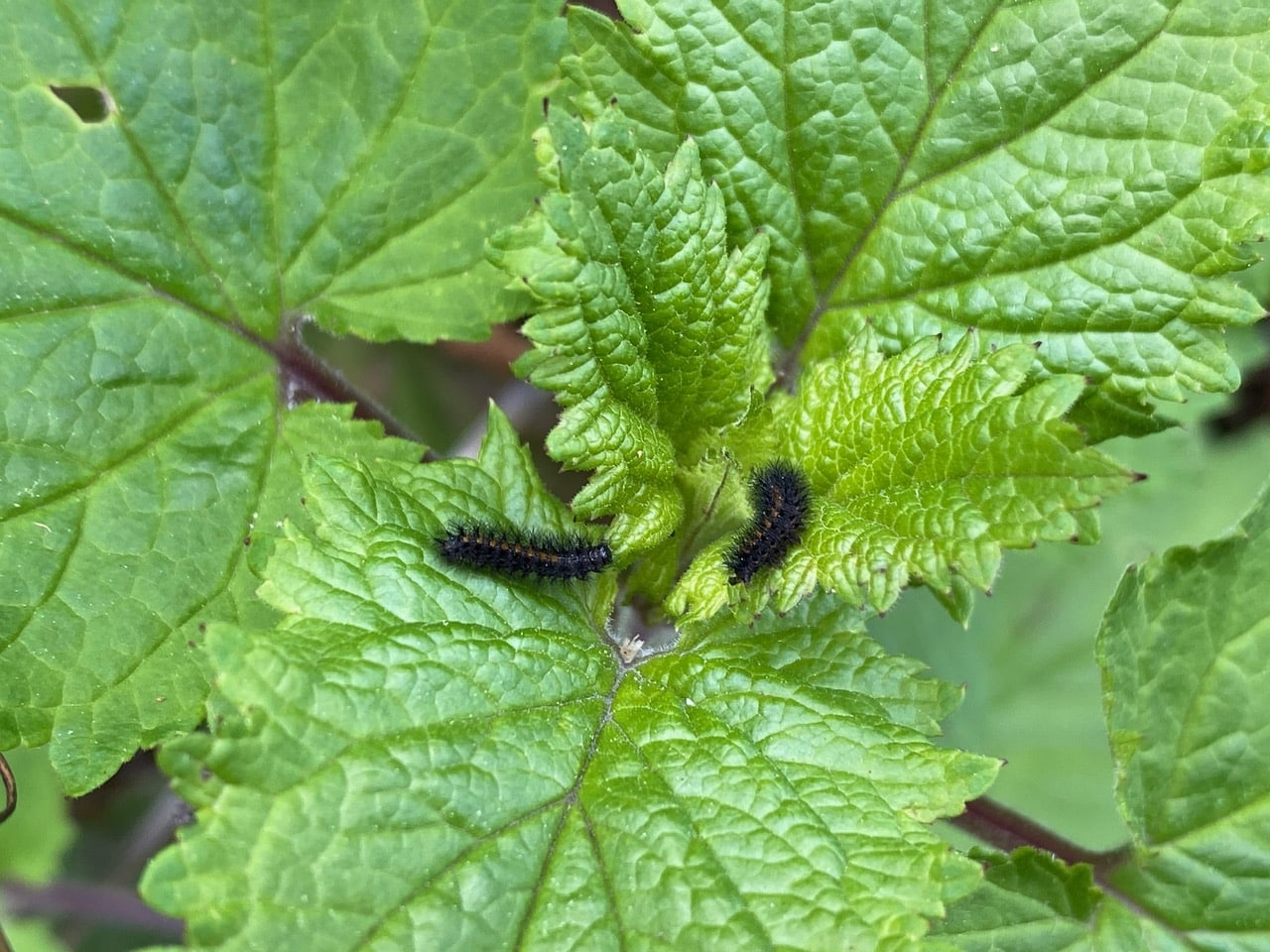
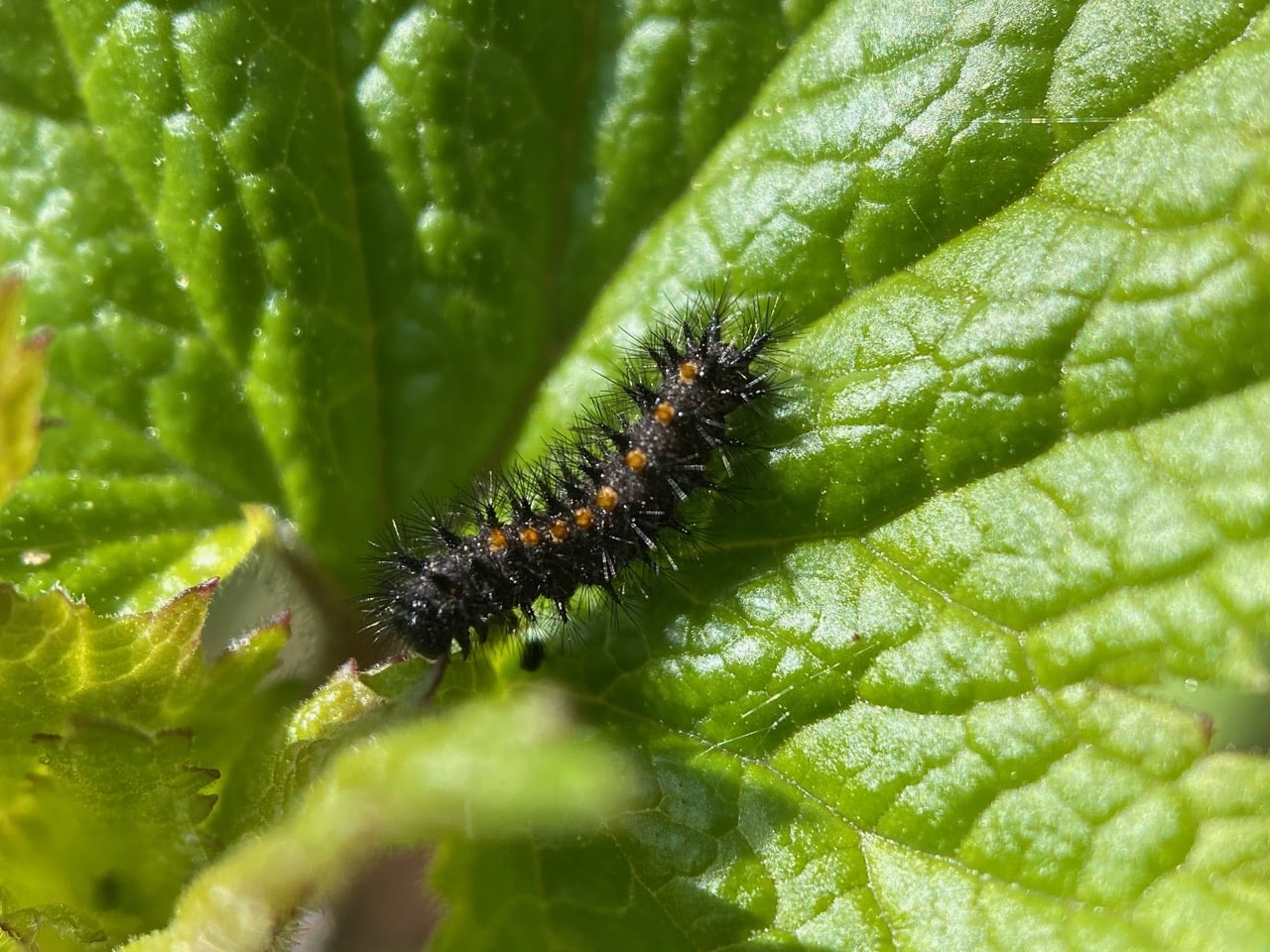
The California Bee Plants, Scrophularia californica on the steep bank by the trail have grown tall. I stop to look for the caterpillars of the Variable Checkerspot, and am not disappointed. Three young caterpillars, barely 1/4 inch long, are feeding on the edge of a leaf. These babies have emerged from their winter diapause or hibernation to continue to feed and grow.
Close-up of the trio.
The Variable Checkerspot, Euphydryas chalcedona (family Nymphalidae) is found across western North America. The butterfly occupies a wide range of habitats, including sagebrush flats, desert hills, prairies, open forests and alpine tundra. Males perch or patrol around larval host plants to encounter females. Eggs are laid in large groups on underside of leaves of host plants. Host plants include California Bee Plant, Scrophularia californica, and Sticky Monkeyflower, Diplacus aurantiacus. These plants provide the caterpillars with iridoid glycoside, a chemical that imparts unpalatable taste to birds, protecting the caterpillars from predators. Larvae feed in large, loose groups on the host plants. Individuals overwinter (enter diapause or hibernation) as third or fourth instar larvae in sheltered sites under bark or dead branches, in hollow stems and in rock crevices. Pupation begins in early to mid April and the adult flight season begins between mid-April and May and continues into June. The adults feed exclusively on nectar, and have a life span of about 15 days.
These two young ones have reached the terminal leaves of another Bee Plant. Yums!
Several young Variable Checkerspot caterpillars are gathered at the tip of an old, broken Bee Plant stem, as if in a traffic pile-up. Perhaps when they emerge from diapause, the caterpillars instinctively climb any stem in search of tender leaves to eat. They don’t have the behavioral flexibility to turn around and climb back down when faced with an abrupt dead end?
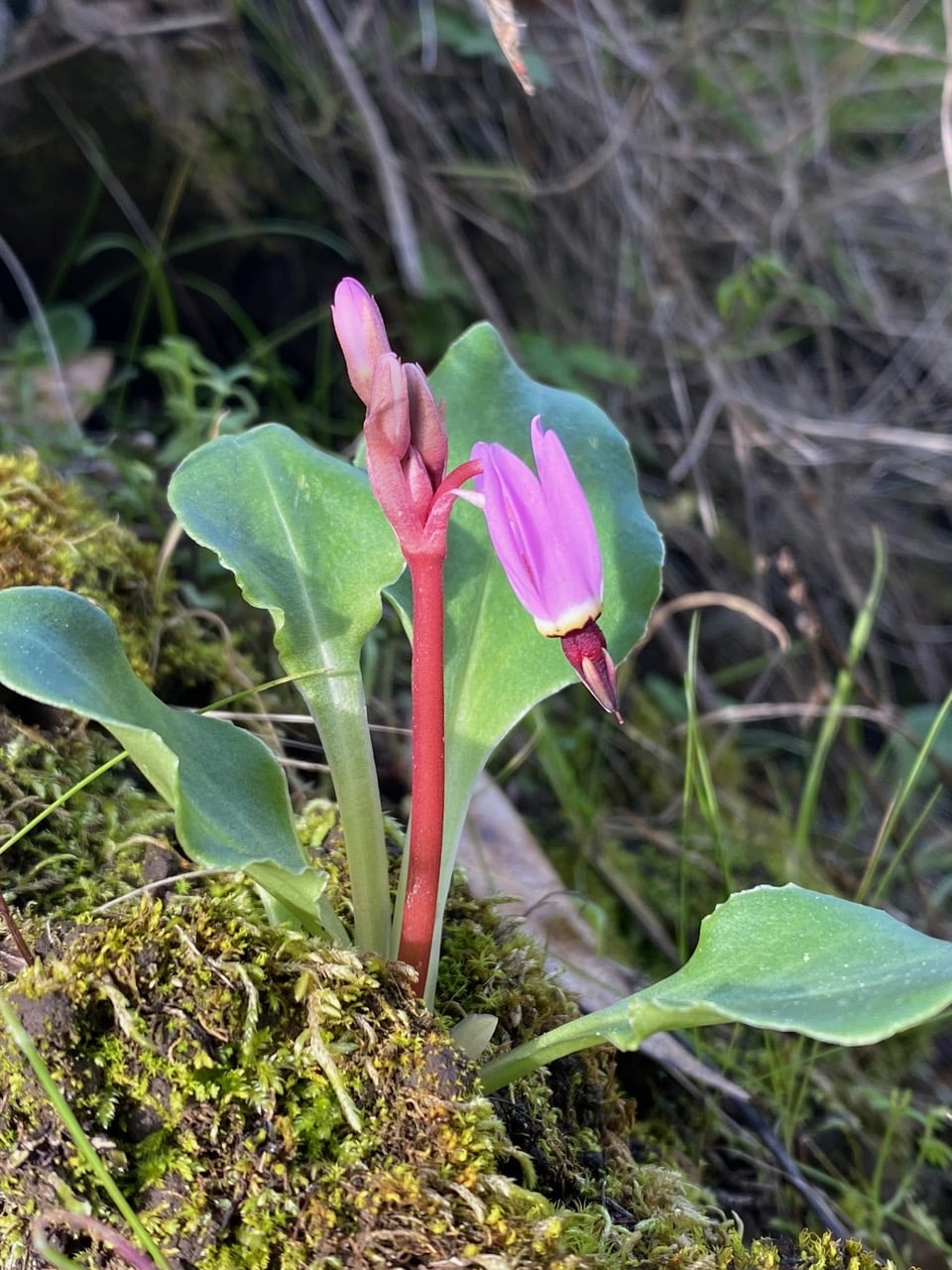
On the wet, mossy bank, a Henderson’s Shooting Star, Primula hendersonii has sent out a single flower on a peduncle only 4 in. tall.
The Shooting Star flower droops downward with petals reflexed, or bent back. Most of the petals are a lovely pink, but toward the base a fringe of white blends into yellow – colors most attractive to a bee’s eyes. A squiggly line of burgundy marks the spot where the petal bends. A conical purple column hangs below the petals. This is the anther cone, a fusion of the anthers where pollen is produced. Surrounded by the cone, and extending beyond is a thin, needle-like style with a stigma at the tip – the female portion of the flower.
Shooting star flowers do not produce nectar, but pollination is most often accomplished by bumble bees foraging for pollen, and using a specialized method called “buzz pollination”. A bumble bee arrives at the flower, grasps the anther cone with its feet and mandibles and hangs upside-down. It disengages its flight muscles from the wings, then vibrates the muscles at a specific frequency, causing the anthers to vibrate, showering pollen onto the bee’s belly. When the bee next visits another shooting star, the pollen on its belly may be rubbed off on the flower’s stigma. Pollination accomplished!
Honey bees do not have this special skill. Only native bees such as Bumble Bees, Digger Bees and a few others are able to buzz pollinate. Blueberries, cranberries, and plants in the Nightshade family such as tomatoes, eggplants and peppers also require buzz pollination.
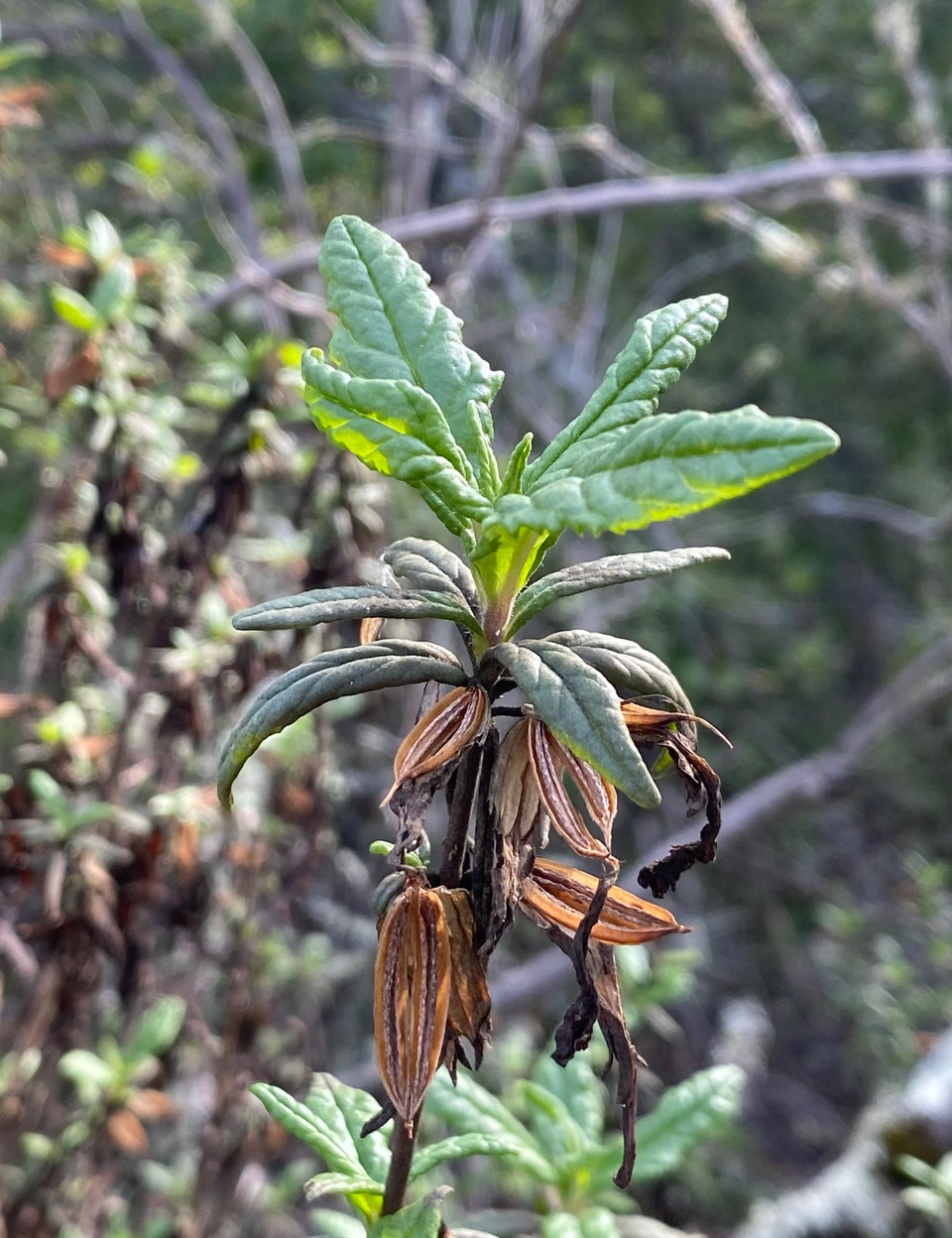
The Sticky Monkeyflowers, Diplacus aurantiacus are getting bushy again. Tender green leaves have emerged at the tips above the old darkened leaves and spent seed capsules. Spring is just around the corner!
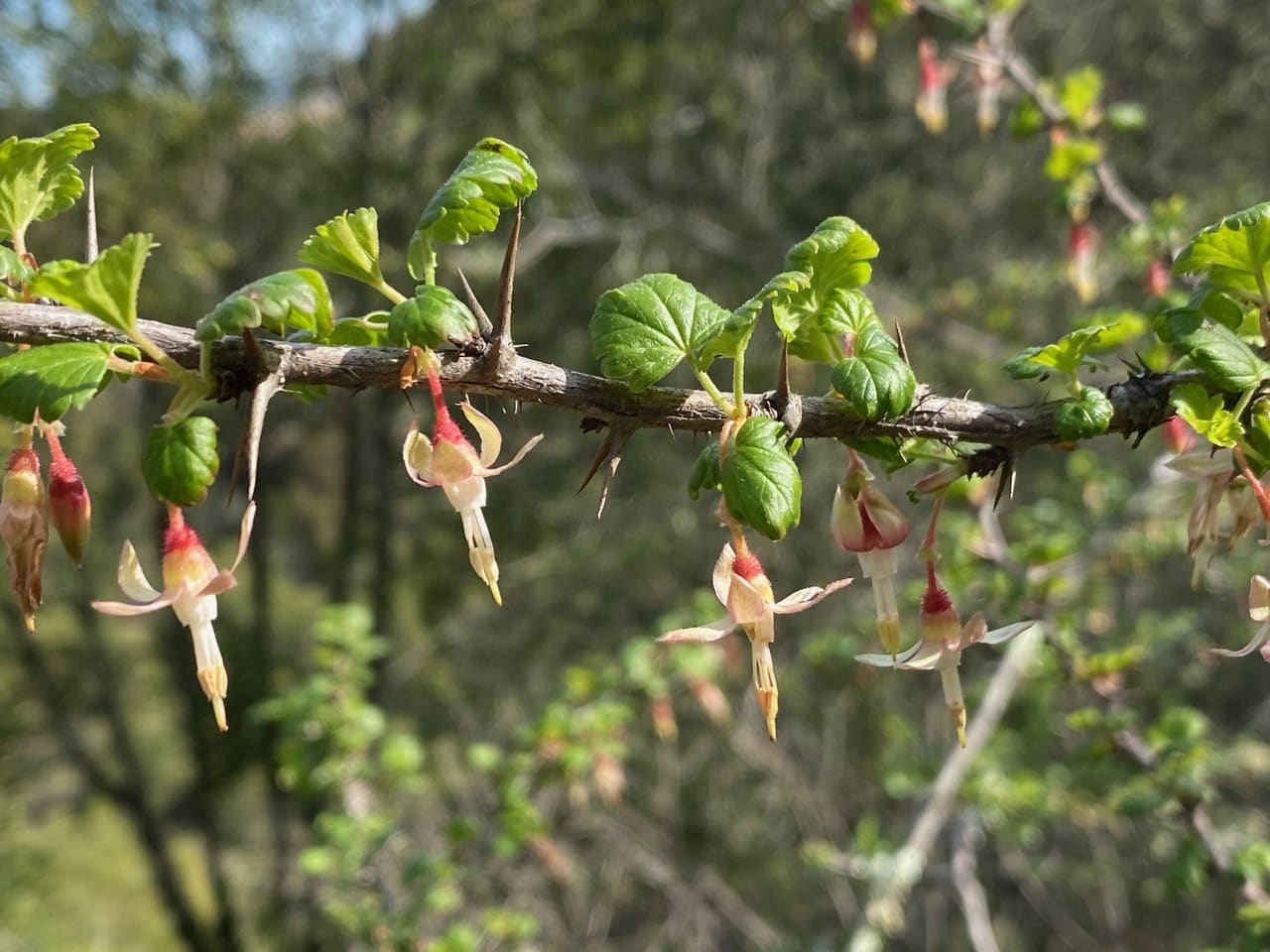
The thorny branches of the big bushy Gooseberry on the steep slope are festooned with delicate, downward-pointing flowers. I sit by the trail to watch for insect action. Occasionally a noisy Pacific Digger Bee, Anthophora pacifica (family Apidae) stops to visit the flowers. I also noticed a small, slender dark bee that hangs on the pendant stamens to methodically collect pollen from the anthers. A Miner Bee in the family Andrenidae?
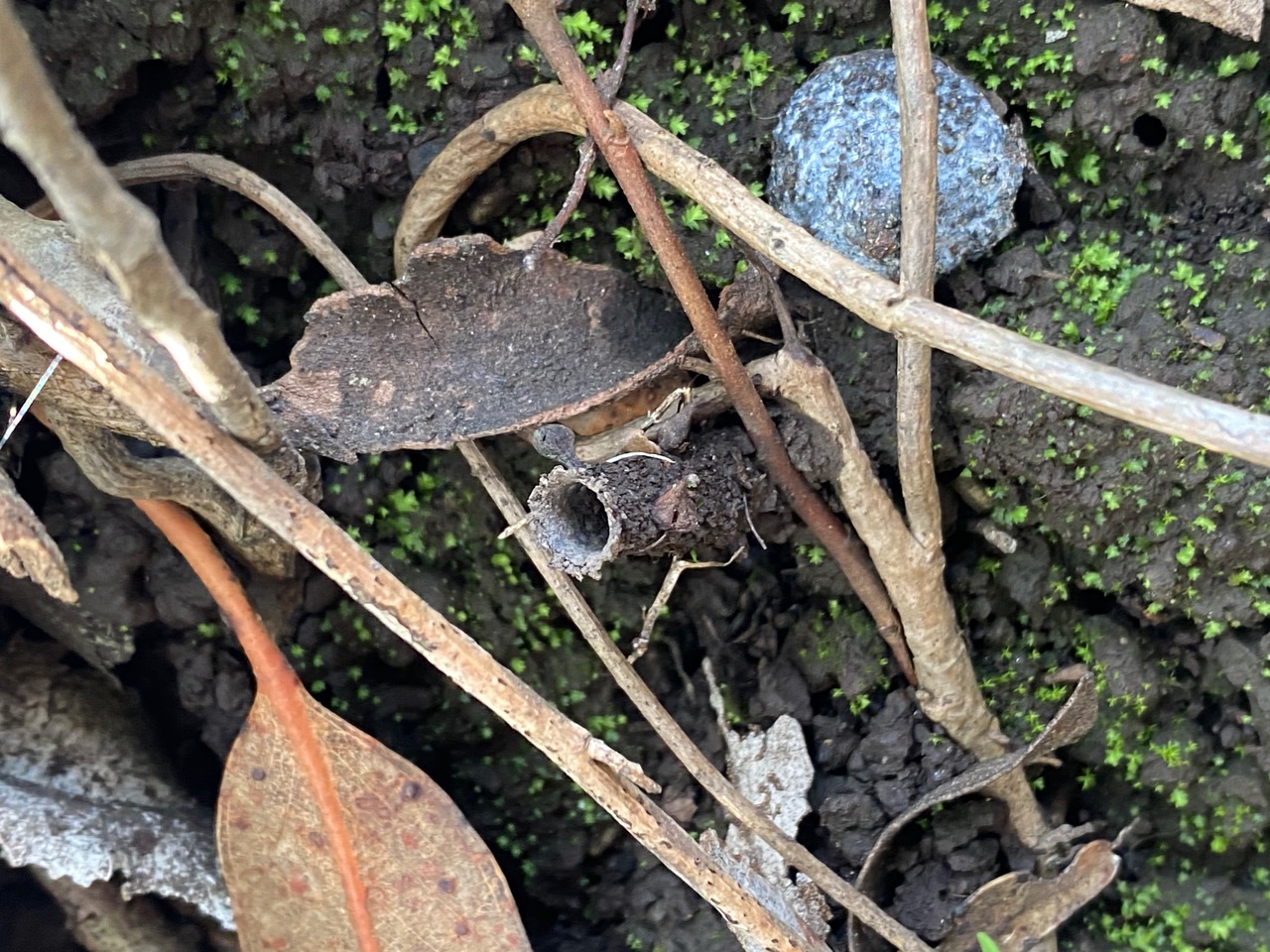
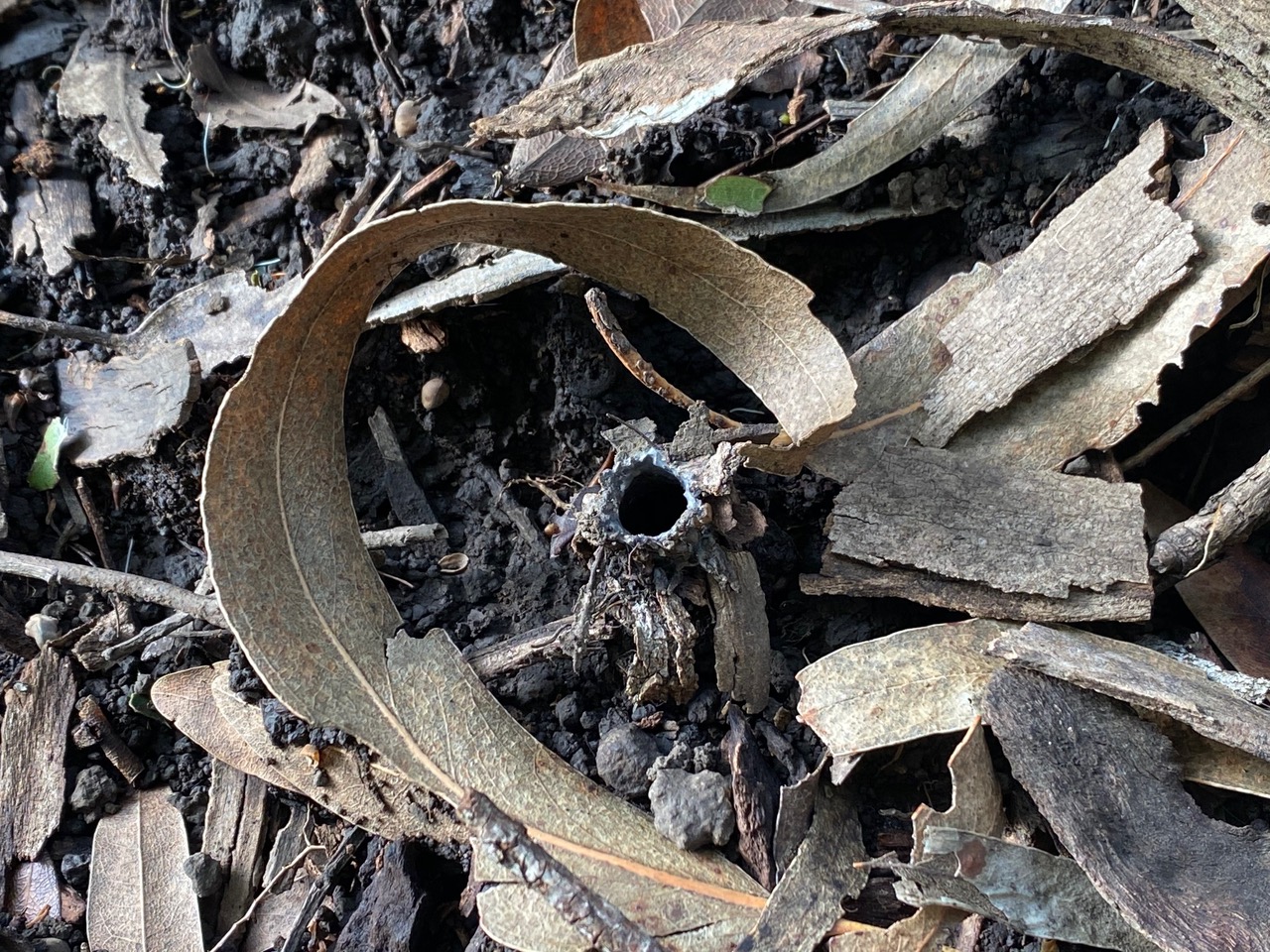
Walking through the dank, dark Eucalypus grove, I keep my eyes peeled for signs of the California Turret Spider. Brush clearing work upslope has caused considerable erosion of the banks along the trail, and avalanches of mud and plant debris have obliterated many of the large turrets that used to be here. I am glad to see some small ones have survived. See that chimney-like structure that is covered in soil and plant debris?
The California Turret Spiders, Atypoides riversi are found only in California, in the Coast Range and Sierra foothills, limited to moist woodlands, often on north-facing slopes, and near shady streams and thickets. They belong to an ancient lineage of spiders, the mygalomorphs, which includes the tarantulas and trapdoor spiders. Mygalomorph fangs swing straight down like pickaxes, instead of from side-to-side like pincers. Turret spiders are ambush predators. At dusk, the spider comes up for food, poised just inside the turret, ready to grab any passing prey.
Here’s another small turret lit by a beam of sunlight. The debris that is attached to the silken turret not only serves to camouflage the spider’s lair, it also serves as an extension of the spider’s sensory reach. A bumbling prey that touches the attachments will alert the spider of its location.
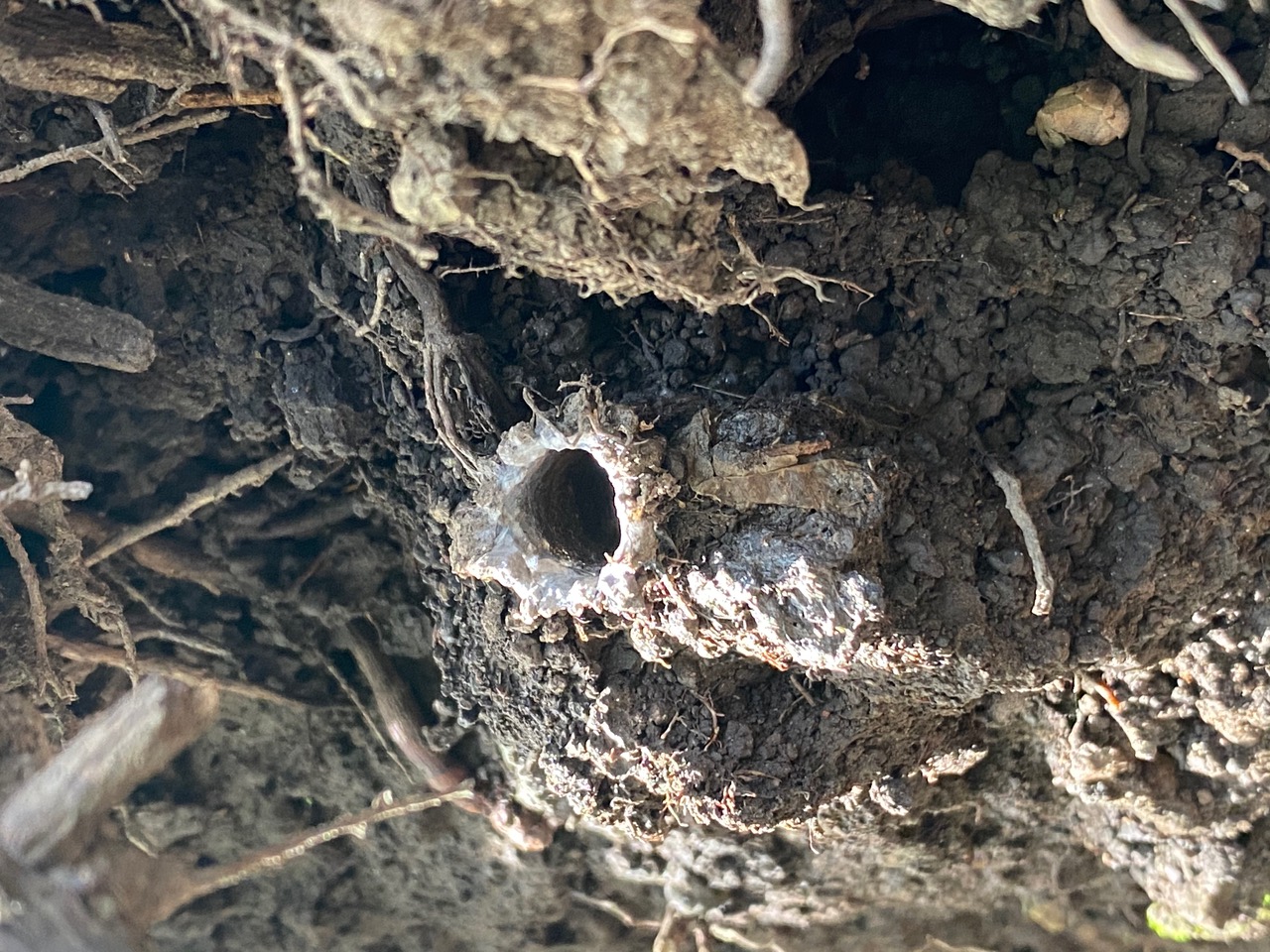
Wow, this large turret has narrowly survived the soil erosion around it, barely hanging on the steep bank. Is its owner able to hunt in such a devastated neighborhood?
Another small turret is nestled among the Eucalypus debris by the trail. For the most part, these remarkable spiders live their quiet lives outside of our conscious awareness. How often we trample on their habitat without knowing that they even exist!