

Pollinator Post 2/18/24 (1)
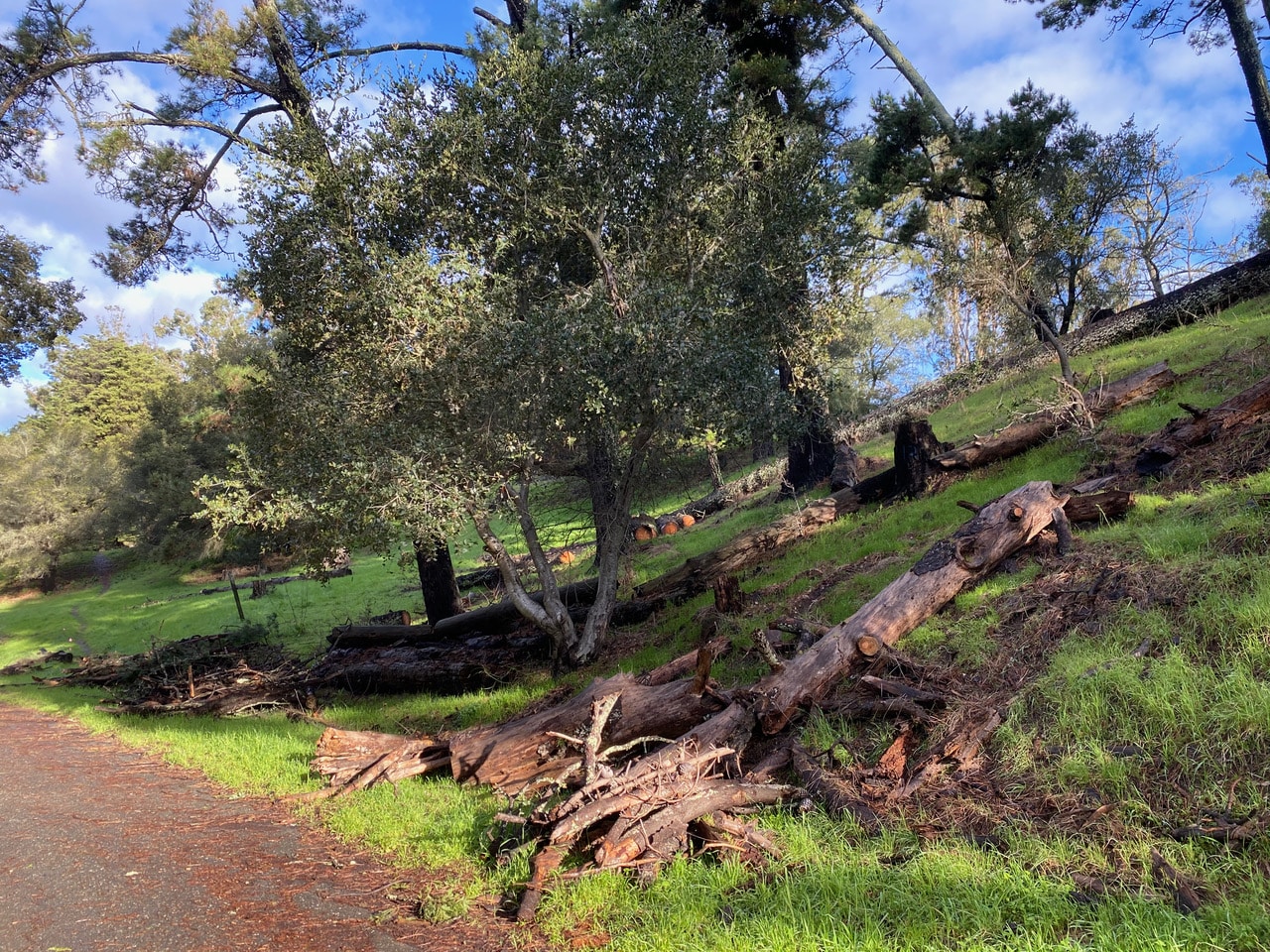
With only a few hours of sun before the next rain sets in, I make a run for Joaquin Miller Park this morning. Apparently no trees have fallen during the last storm. The old dead and dying Monterey Pines have been proactively cut down, littering the ground with large wood debris.
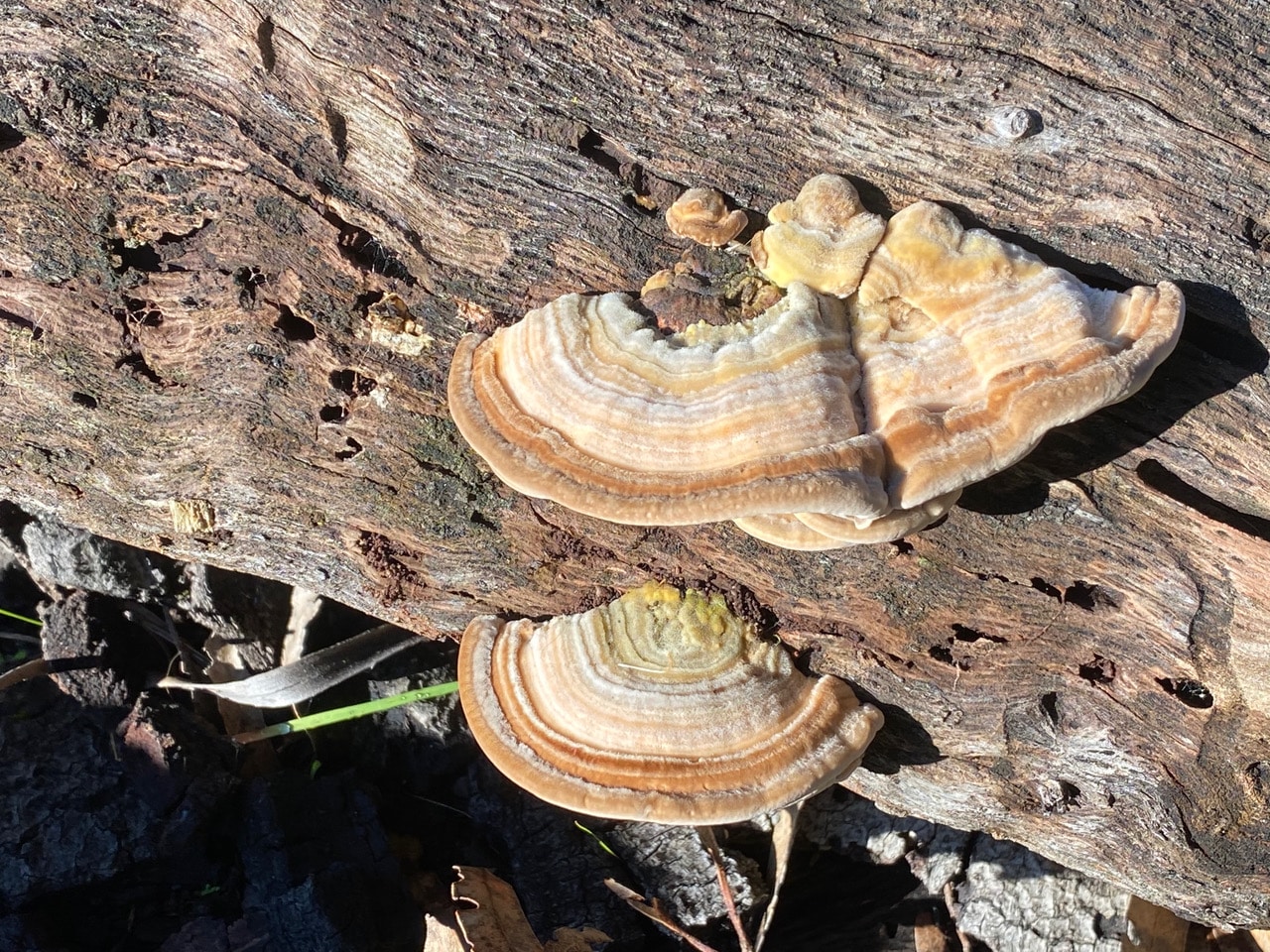 The rotting tree trunks have taken on life of their own. These thick fuzzy fungi have sprouted from a log on the ground.



 Then slowly it stretches its whole body out on the rock to take in the sun, ignoring my presence. Note its smooth scales and tiny limbs – rather snake-like overall. Too bad I don’t get to see its tail, so can’t tell if it’s an adult or juvenile.
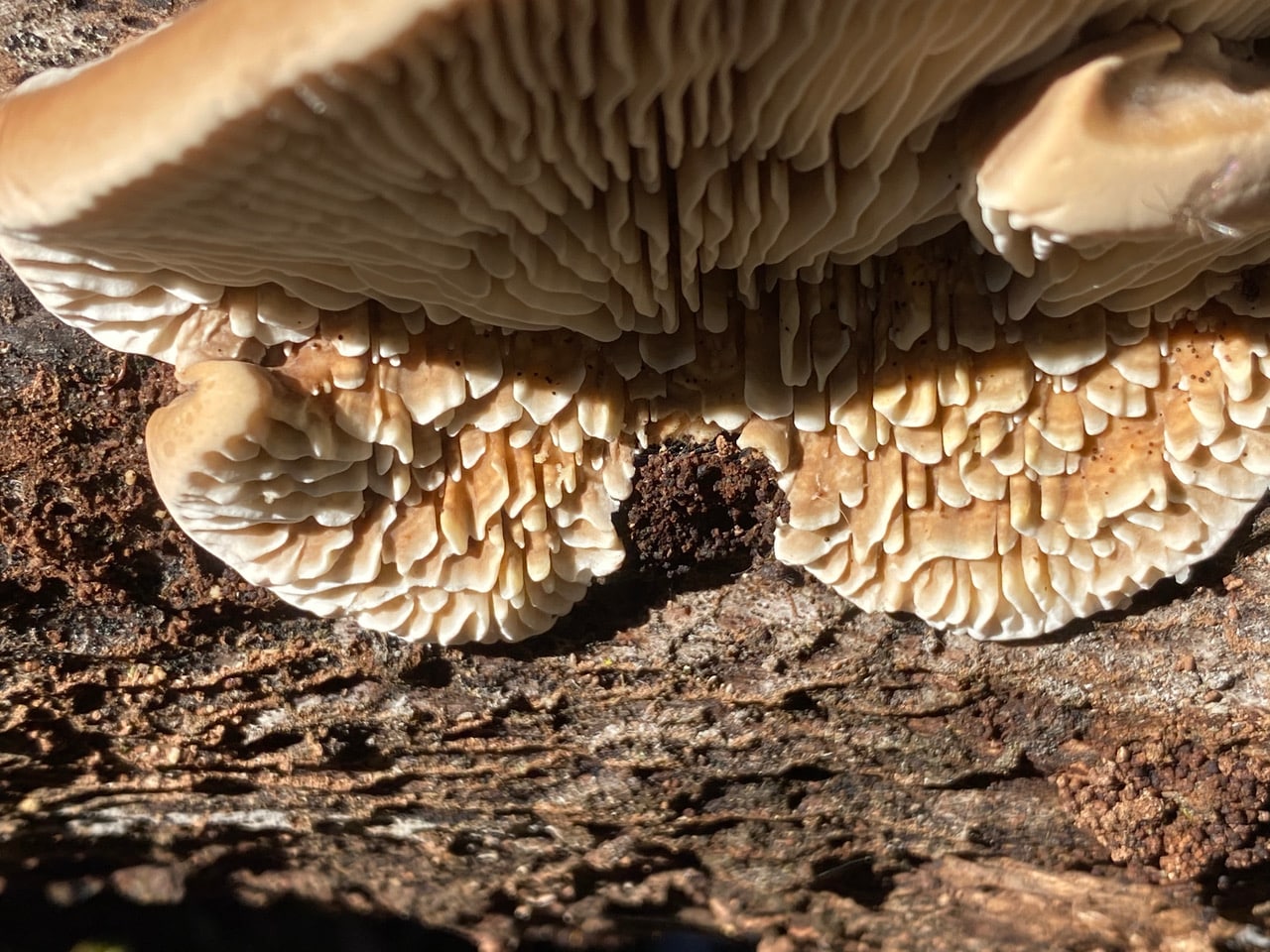
The rotting tree trunks have taken on life of their own. These thick fuzzy fungi have sprouted from a log on the ground. I peek under the caps to check for gills or pores. What sturdy gills these are! iNaturalist has helped identify the fungus as Gilled Polypore, Trametes betulina. What an oxymoron of a name – gilled polypore!
Although it is a member of the Polyporales order, its fruiting bodies have gills instead of pores, which distinguishes it from the superficially similar Turkey Tail, Trametes versicolor. The fungus is widely distributed in North America. It is saprobic on the deadwood or hardwoods, and occasionally conifers, growing alone or in overlapping clusters on logs and stumps. Research has shown that the fungus has several medicinal properties, including antioxidant, antimicrobial, antitumor, and immunosuppressive activities.
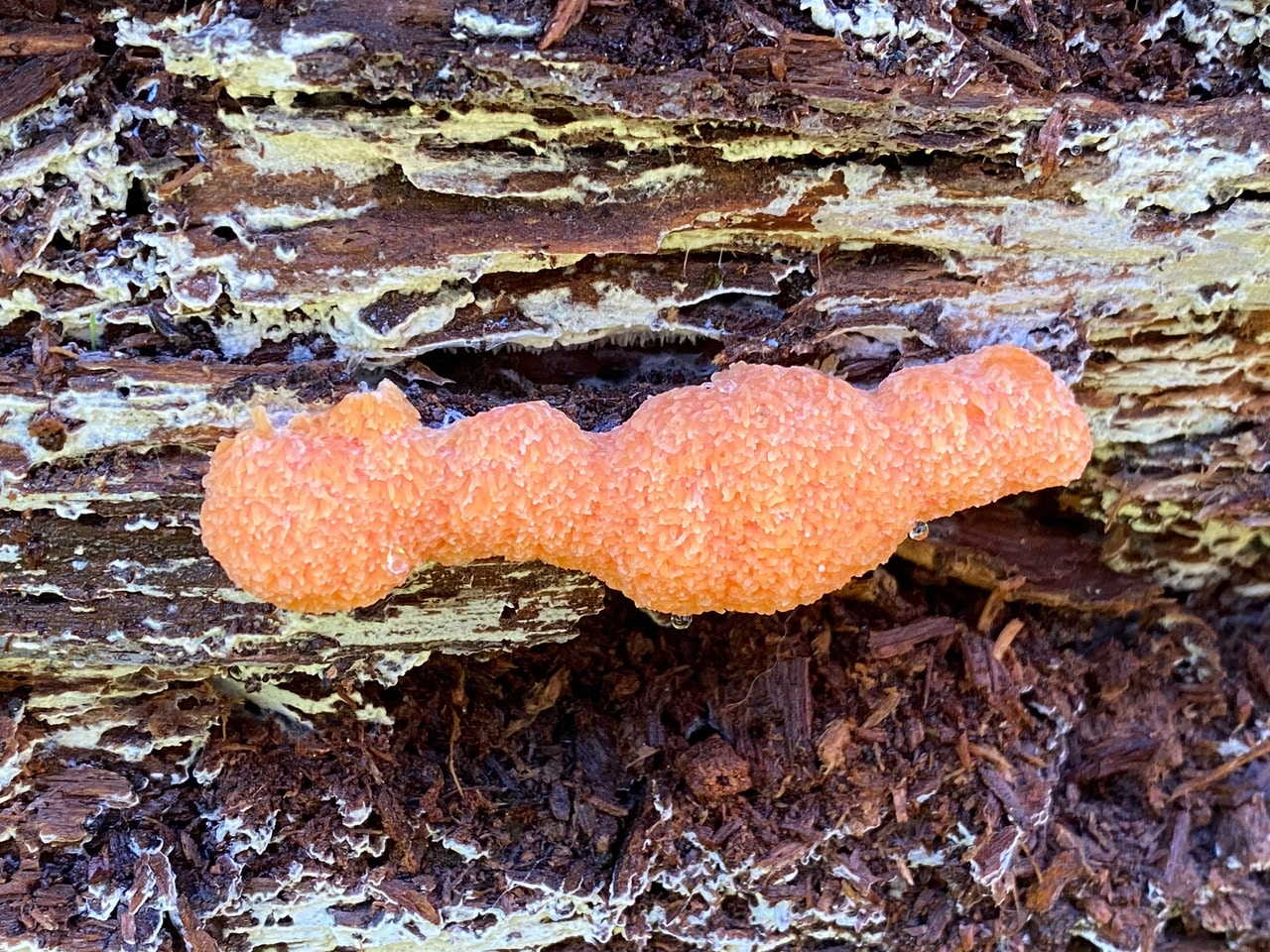
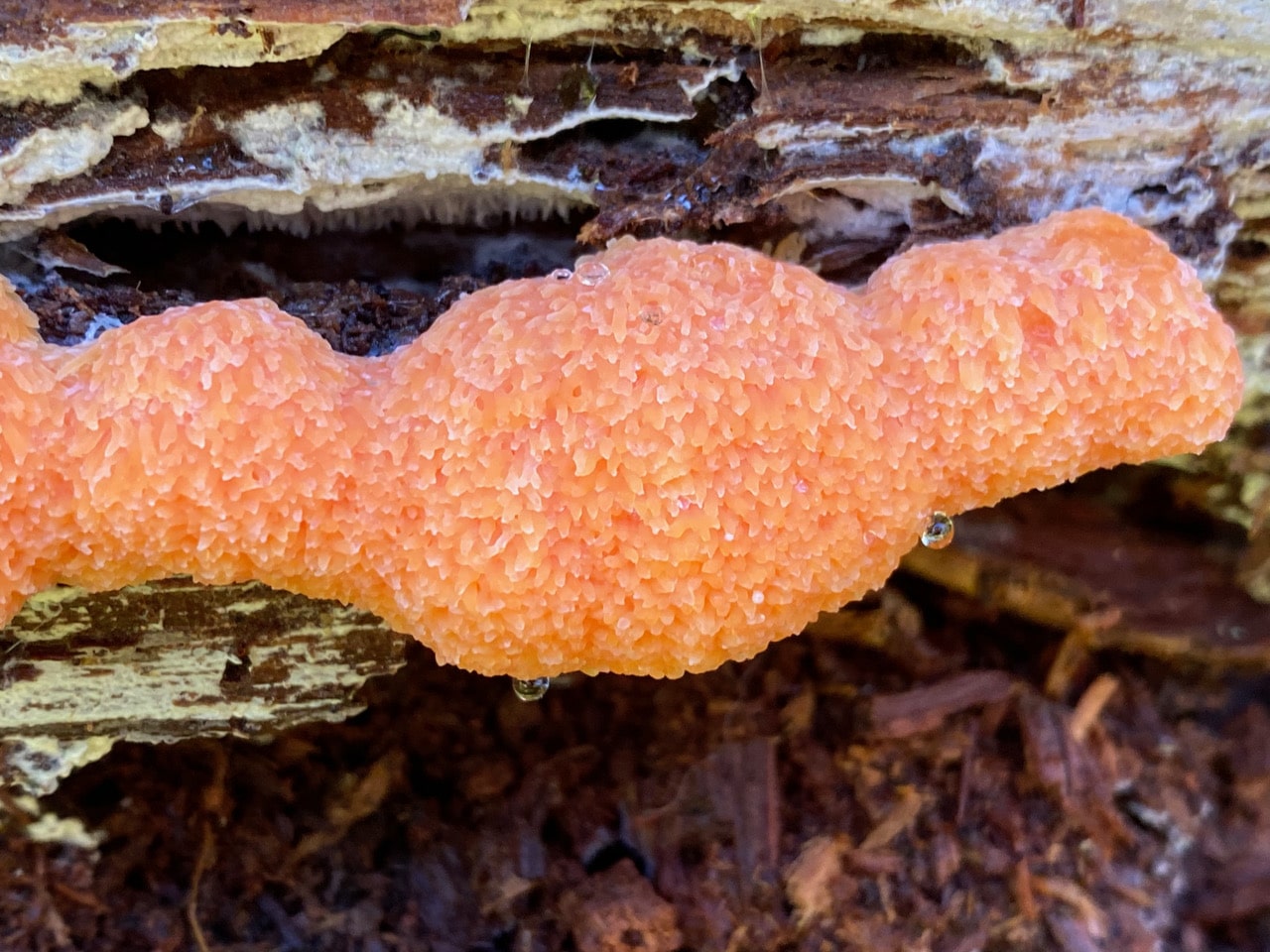
There’s something unfamiliar on another disintegrating log. I think it is a slime mold, not a fungus. iNaturalist has identified it as the Red Raspberry Slime Mold, Tubifera ferruginosa.
Our slime mold appears to be an immature sporangium (or fruiting body) of the Red Raspberry Slime Mold. If I come back tomorrow, the thing would look quite different, probably unrecognizable. These fast developing organisms turn color and change shapes rapidly, eventually releasing countless spores into the air.
Slime Molds are fungus-like organisms that have previously been classified as fungi, but are now placed in Myxomycetes, in the kingdom Protista. The life cycle of slime molds consists of two distinct stages. During the amoeboflagellate stage, slime molds exist as typical single celled organisms. These amoeboid cells feed on bacteria, grow and multiply by fission. This stage eventually progresses to the plasmodium stage, usually by fusion of compatible amoeboflagellates. Morphologically the plasmodium is a veiny network with a viscous, slimy consistency. The plasmodium is multinucleate and can occupy an area larger than one square meter. However, it is technically still a single cell, as it undergoes many nuclear divisions without cellular divisions. The plasmodium feeds on bacteria, fungi, and other microorganisms, ingesting them through phagocytosis.
When conditions are right, the plasmodium will begin to produce fruiting bodies, or sporangia. Slime mold sporangia exhibit a wide variety of colors, shapes and sizes and are often quite beautiful. The primary function of sporangia is to produce and disperse the spores by which slime molds are propagated. The spores of Myxomycetes are microscopic and lightweight, and can be carried by wind for considerable distances. Under the right conditions, the spores germinate into the single-celled amoeboflagellates, and the cycle is repeated.
Mostly associated with cool and moist habitats, slime molds are commonly found in forests, often developing on the bark of living trees, on decaying logs, stumps, dead leaves and other organic litter.
I check on the large stand of Ceanothus in the park. They are not yet blooming – I am about a week early. As there’s nothing else going on, I decide to head home after a walk. Passing the Cascade section of the park in my car, I spot the blooming Manzanita from a distance and decide to make a short stop. I am not disappointed. The Pink-flowering Currant, Ribes sanguineum in the front flower bed are putting up a show.
An occasional Bumble Bee or Digger Bee buzzes around the pendulous inflorescences, but does not stop to forage on them.
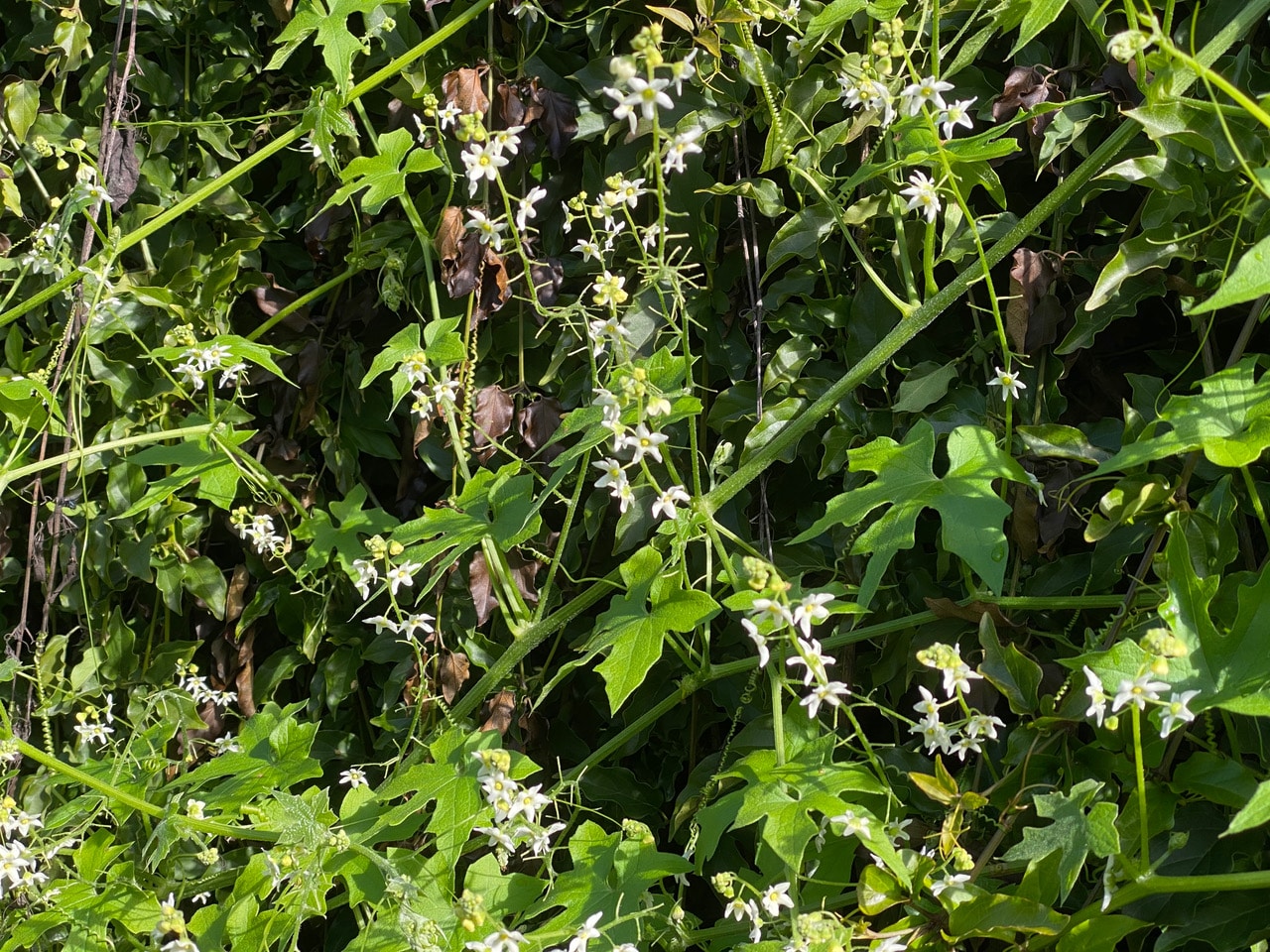
The Oregon Manroot (Marah oregana) sprawling on the rock wall is blooming profusely.
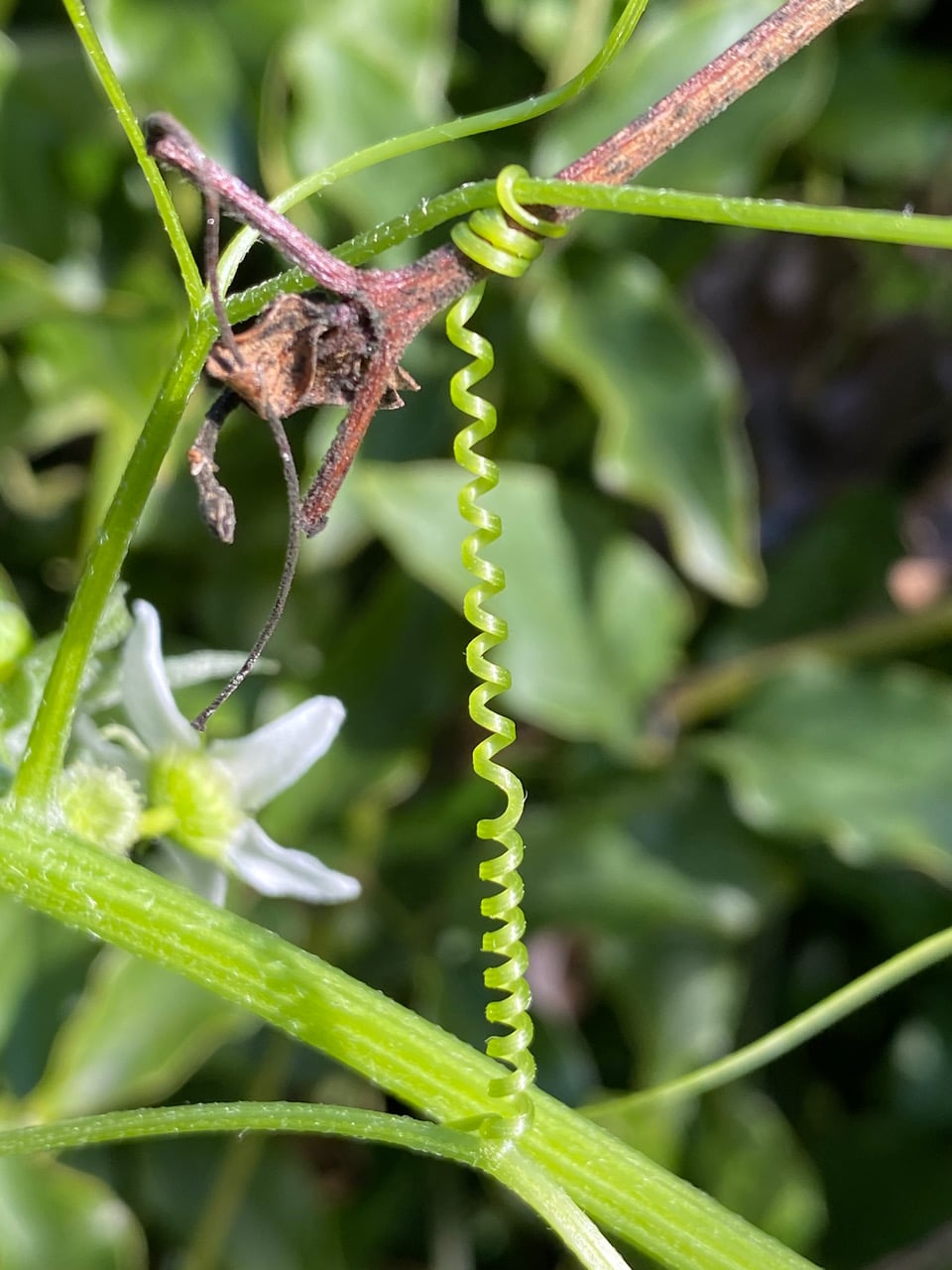
Hey, look at that perfect spring-like tendril on the Oregon Marah. It has successfully latched on to an old vine. See the middle section where the coiling is reversed?
Long tendrils enable Marah to climb/trail over neighboring vegetation. You can invariably find a straight section along a tendril coil where the coiling direction is reversed. Charles Darwin had noticed this behavior and coined it “perversion”. Scientists have actually studied the cucumber tendrils seriously and found some fascinating properties. Once a tendril curls around a support, it forms a counter-clockwise helix and clockwise helix with a straight section between the two. If the tendril is pulled, more turns are added to both helices to better grasp the support.
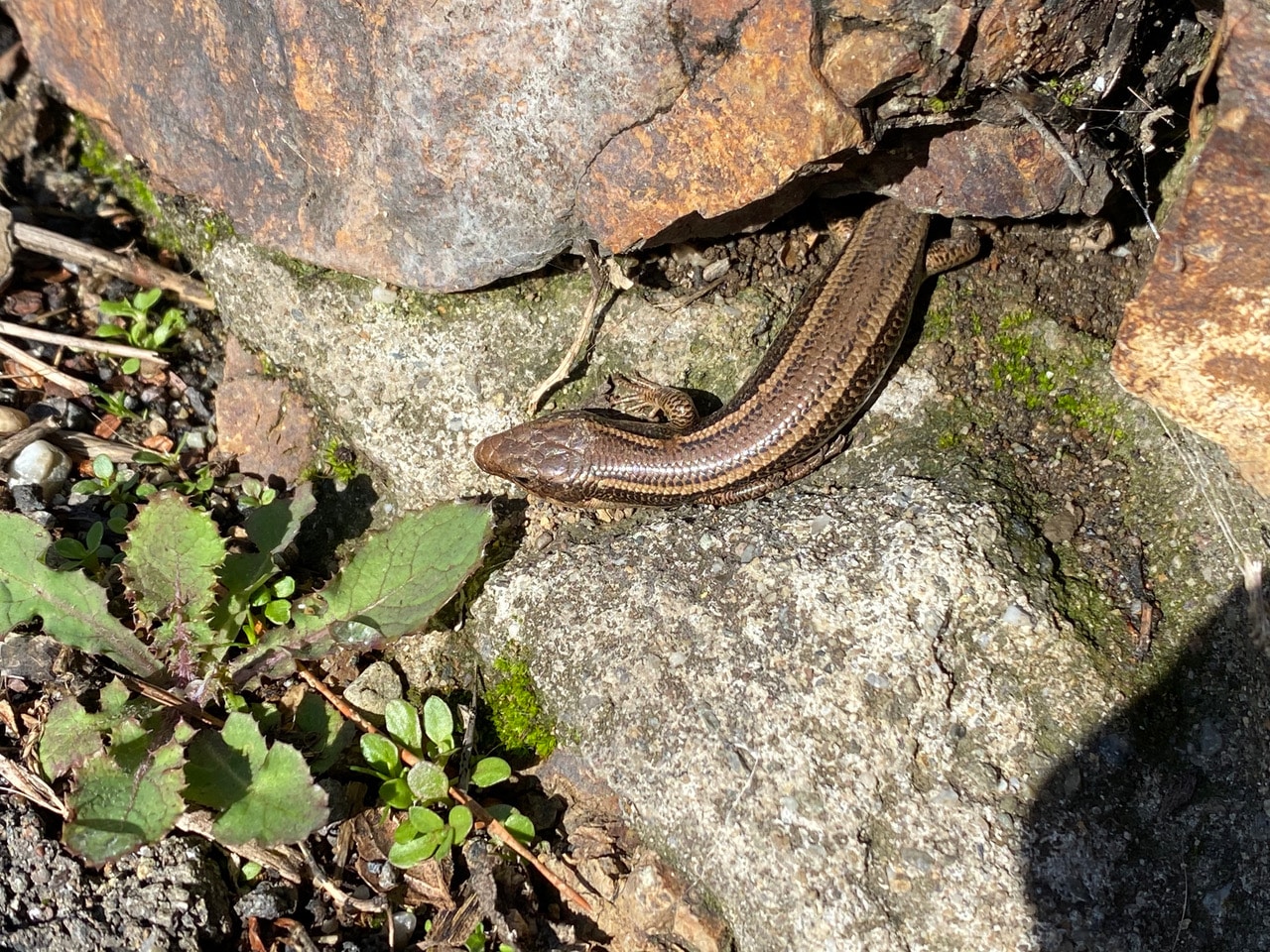
As I walk along the stone wall around the pool, I notice a movement in a crevice at the bottom of the wall. Was that a Lizard I saw that just went into hiding? I decide to sit and wait for the critter to reappear. Sure enough, the sun is too much of a lure. The Western Skink pokes it head out cautiously after a minute.
Then slowly it stretches its whole body out on the rock to take in the sun, ignoring my presence. Note its smooth scales and tiny limbs – rather snake-like overall. Too bad I don’t get to see its tail, so can’t tell if it’s an adult or juvenile. The Western Skink, Plestiodon skiltonianus is a species of small, smooth-scaled lizard with relatively small limbs. It is widespread in northern California but primarily restricted to the coast in central and southern California. Found in a variety of habitats, this lizard is most common in early successional stages or open areas of late successional stages. The diurnal reptile is active during the warm seasons. The lizards spend much of their day basking in the sun. Their diet ranges widely, including spiders and beetles. The species is secretive and very agile, foraging actively through leaf litter and dense vegetation. It is a good burrower and sometimes constructs burrows several times its own body length. Females take great care of their eggs, guarding the nest until the young leave the nest. Young Western Skinks have a bright blue tail with color that fades with age. Skinks can perform autotomy; if seized by a predator its tail is deliberately cast and wriggles violently to attract attention while the lizard may escape. Skinks reach sexual maturity at around 3 years, and live up to 9 years.
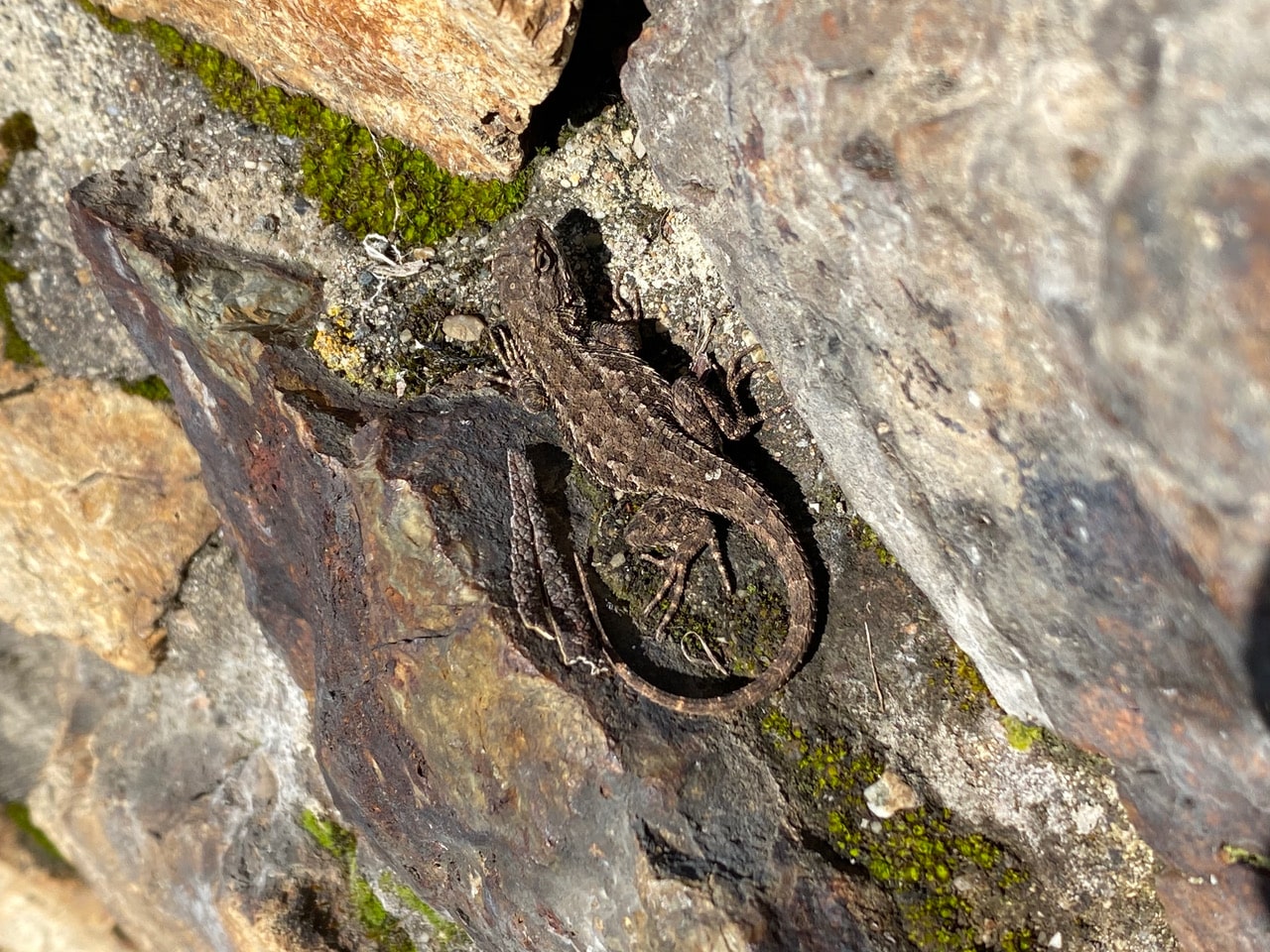
Just a few steps further, I find a young Western Fence Lizard basking on a narrow ledge of the stone wall. Is it out of brumation (reptile version of hibernation) already?
California is the heart of the range of the Western Fence Lizard (Sceloporus occidentalis), although the lizard is found throughout most of the western states. The species is found in a wide range of habitats: grassland, chaparral, sagebrush, woodland, coniferous forestland farmland. The scales of fence lizards are sharply keeled, and never look shiny. As the ventral abdomen of an adult is characteristically blue, it is also known as the Blue-belly. These lizards are diurnal, and are commonly seen basking on paths, rocks, and fence posts, and other suitable sunny spots. To thermoregulate, the lizard can change color from light grey or tan to nearly jet black. The species goes through a period of brumation during the winter. The Western Fence Lizard primarily feeds on small invertebrates, but may consume any appropriate sized prey item.