

Pollinator Post 2/15/25
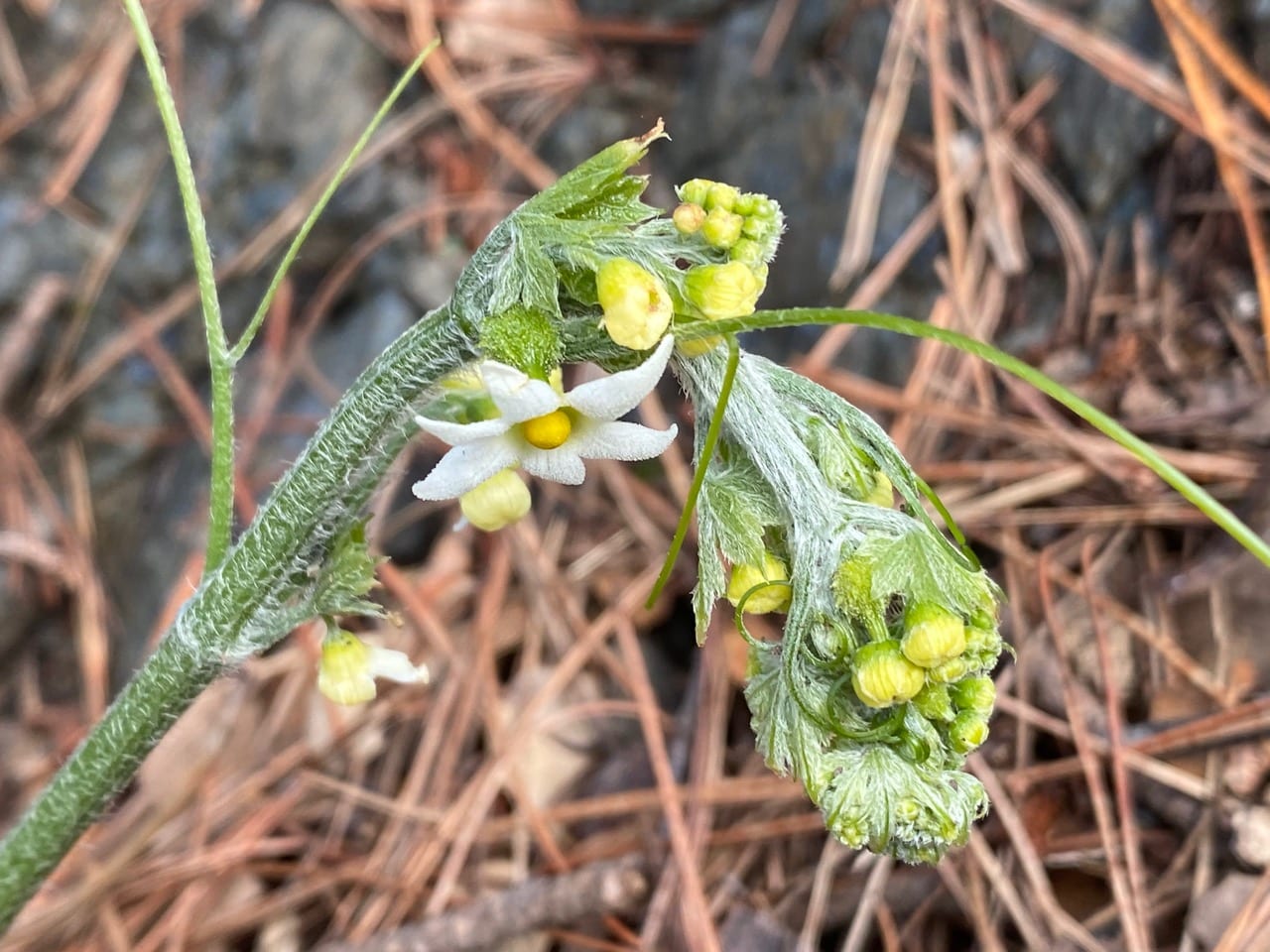
I feel the urge to check on the Wild Cucumbers, Marah species at Joaquin Miller Park in the Oakland hills.
I easily locate the robust Coast Manroot, Marah oregana under the Monterey Pines by Sanborn Drive. Much to my delight, it has started to bloom! The first to open up are the solitary female flowers at the leaf axil below the inflorescence bearing the male flowers. See the fuzzy green ovary under the corolla of the female flower?
The Wild Cucumber is monoecious, with separate male and female flowers borne on the same plant. Male flowers far outnumber the female flowers. The staminate (male) flowers are borne on vertical panicles arising from a leaf axil. In both sexes, the five or six white petals are fused at the base to form a cup at the base of the flower.
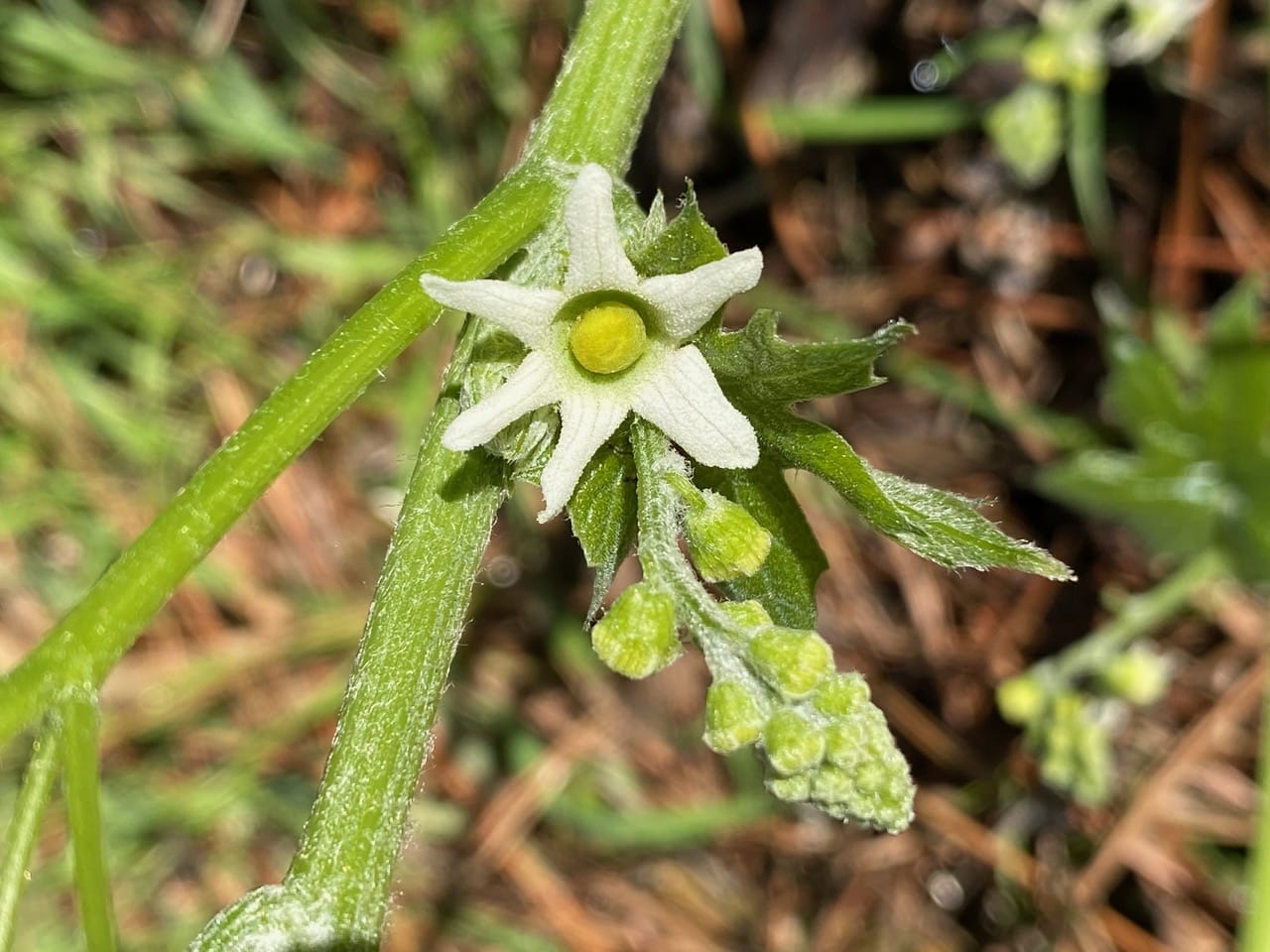
Here’s another female flower at a leaf axil. The adjacent male flowers are still in tight buds. Is this a way Marah prevents self-pollination?
The female Marah flower contains a single large, globular stigma whose surface is moist, ready to receive incoming pollen.
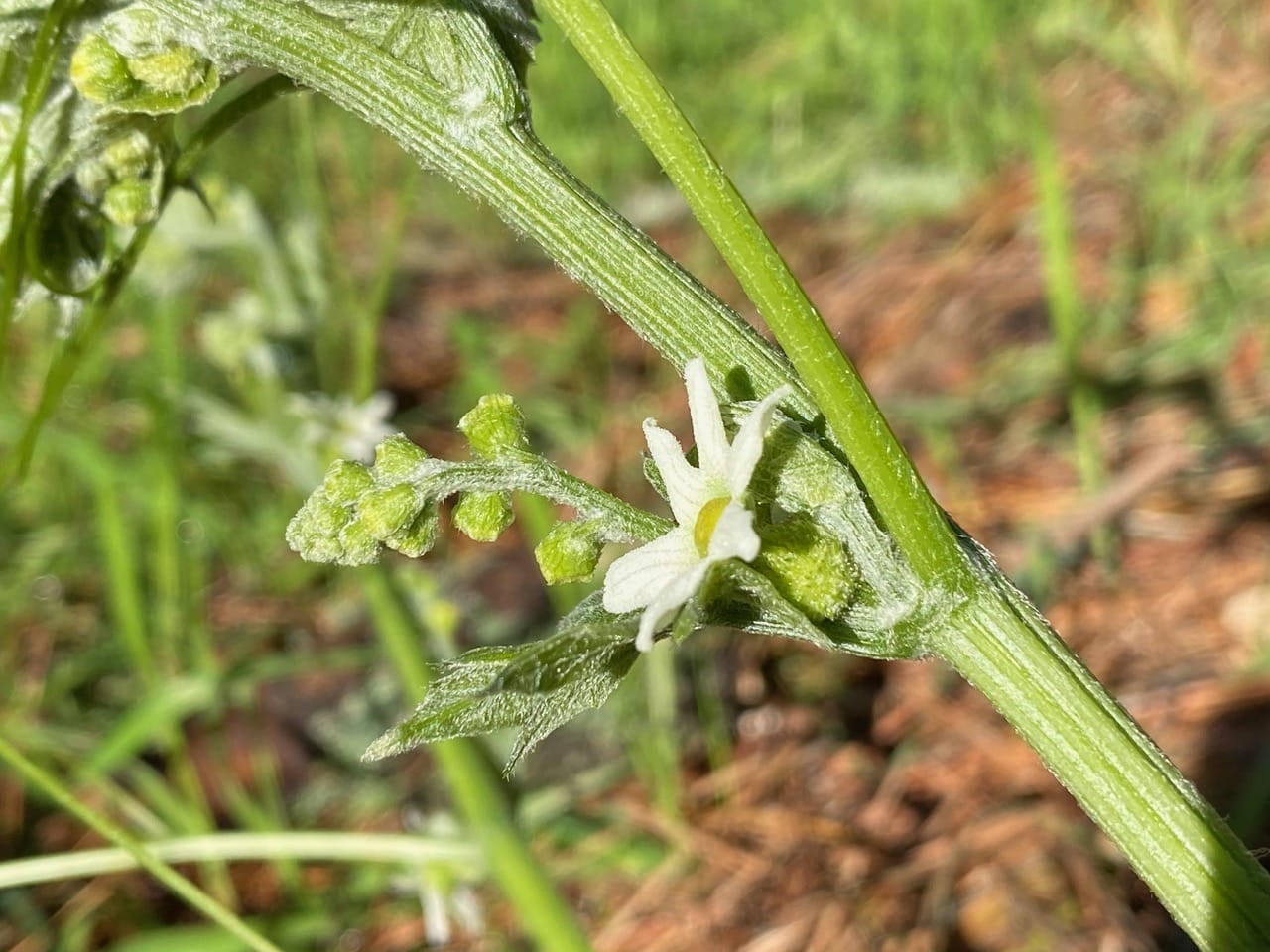
Again, lady first! The temporal separation of the genders, even on monoecious plants is termed dichogamy. In Marah’s case, it’s protogyny – female stigma becomes receptive even before the male flowers open to release pollen. Marah has inferior ovaries. Note the immature ovary – the fuzzy green swelling under the corolla. After pollination, the ovaries develop into the spiky fruits that we are familiar with.
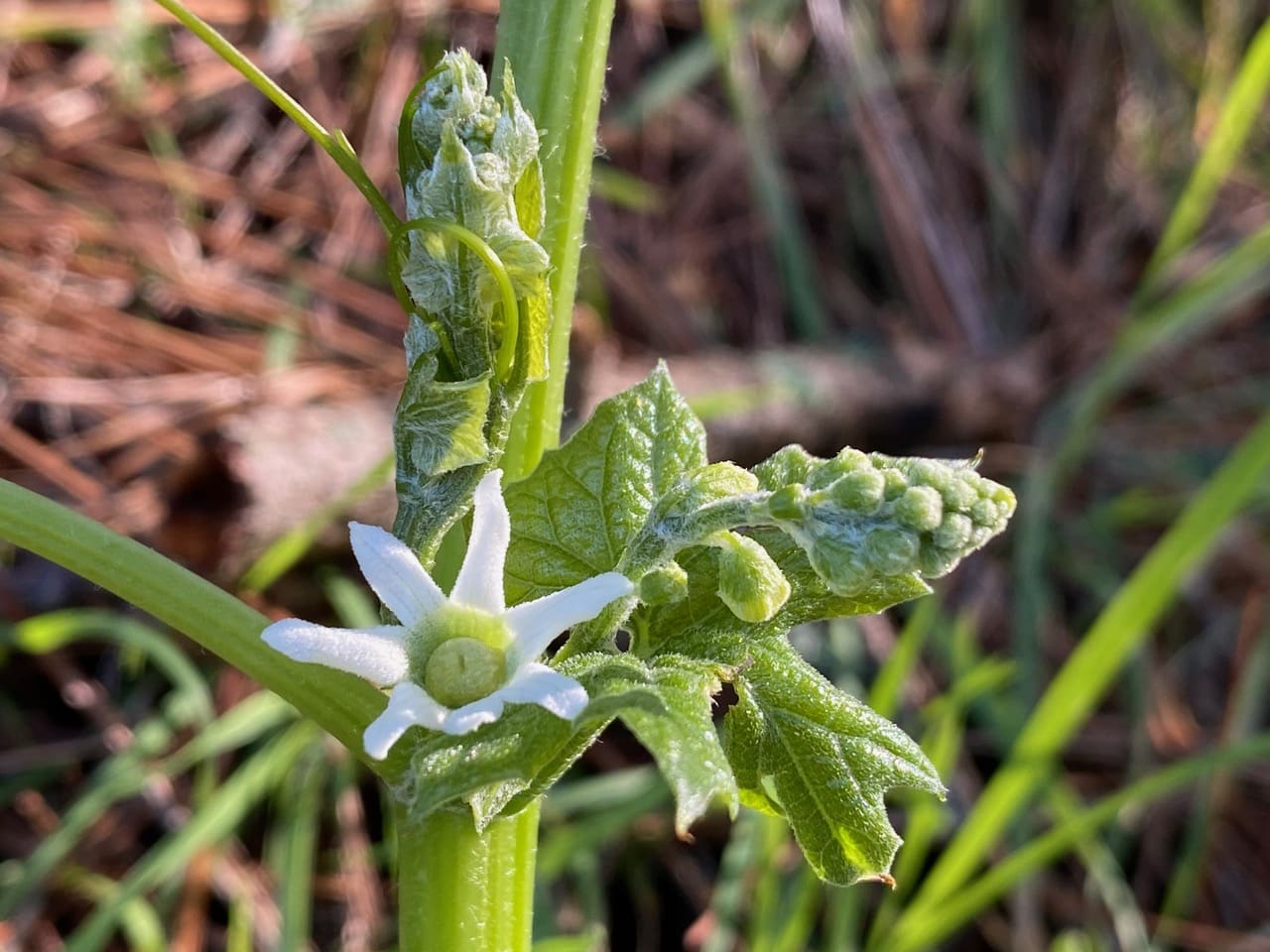
Another evidence of protogyny in the Marah. By separating the timing of male and female functions, dichogamy increases the likelihood of cross-pollination, which can lead to greater genetic diversity and improved plant fitness.
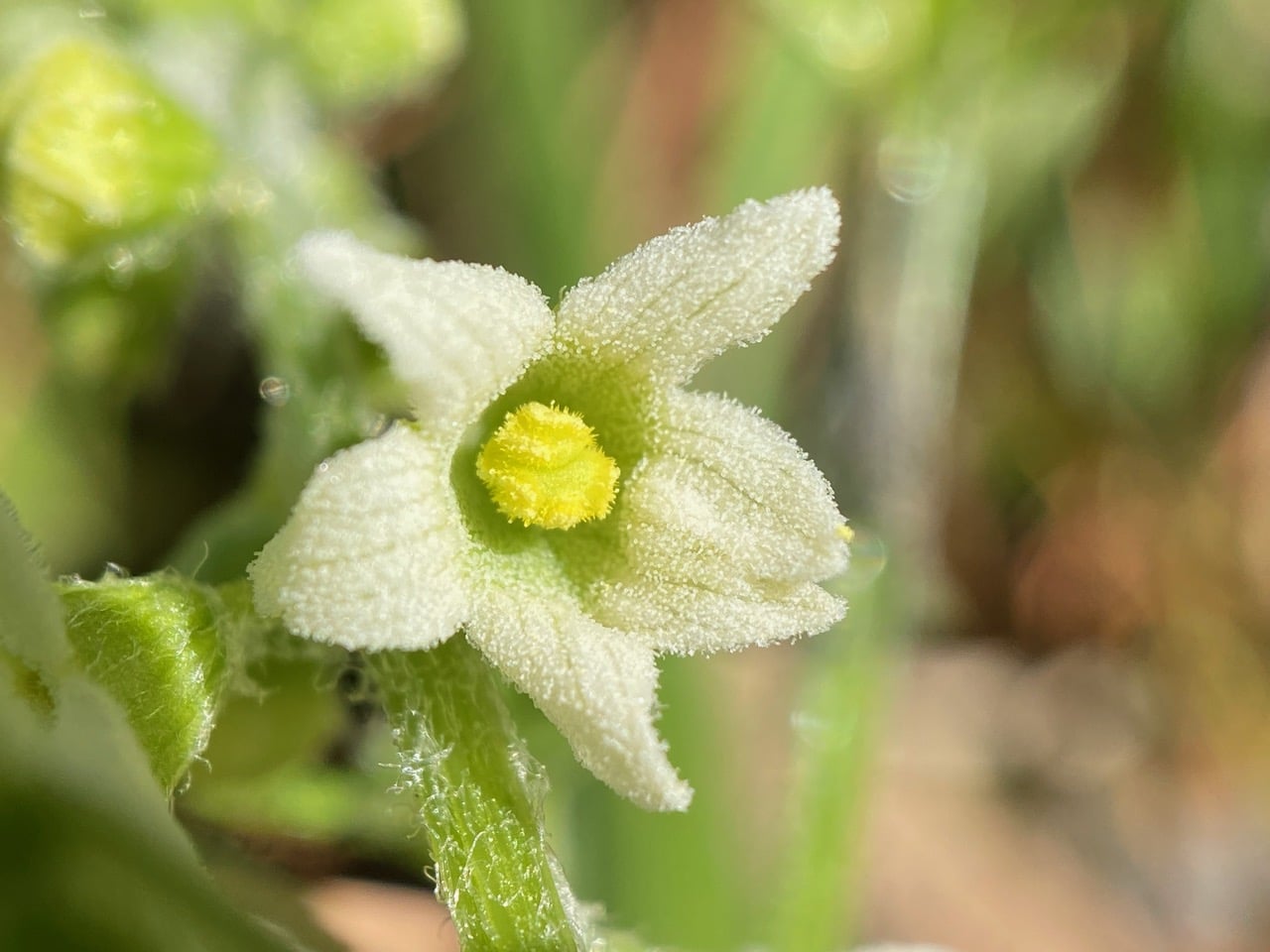
Here’s a mature male flower of Marah oregana. The anthers are fused and twisted together in a mass to form a yellow center. The anthers are in the process of releasing pollen.
The corolla is densely covered with short glandular hairs.
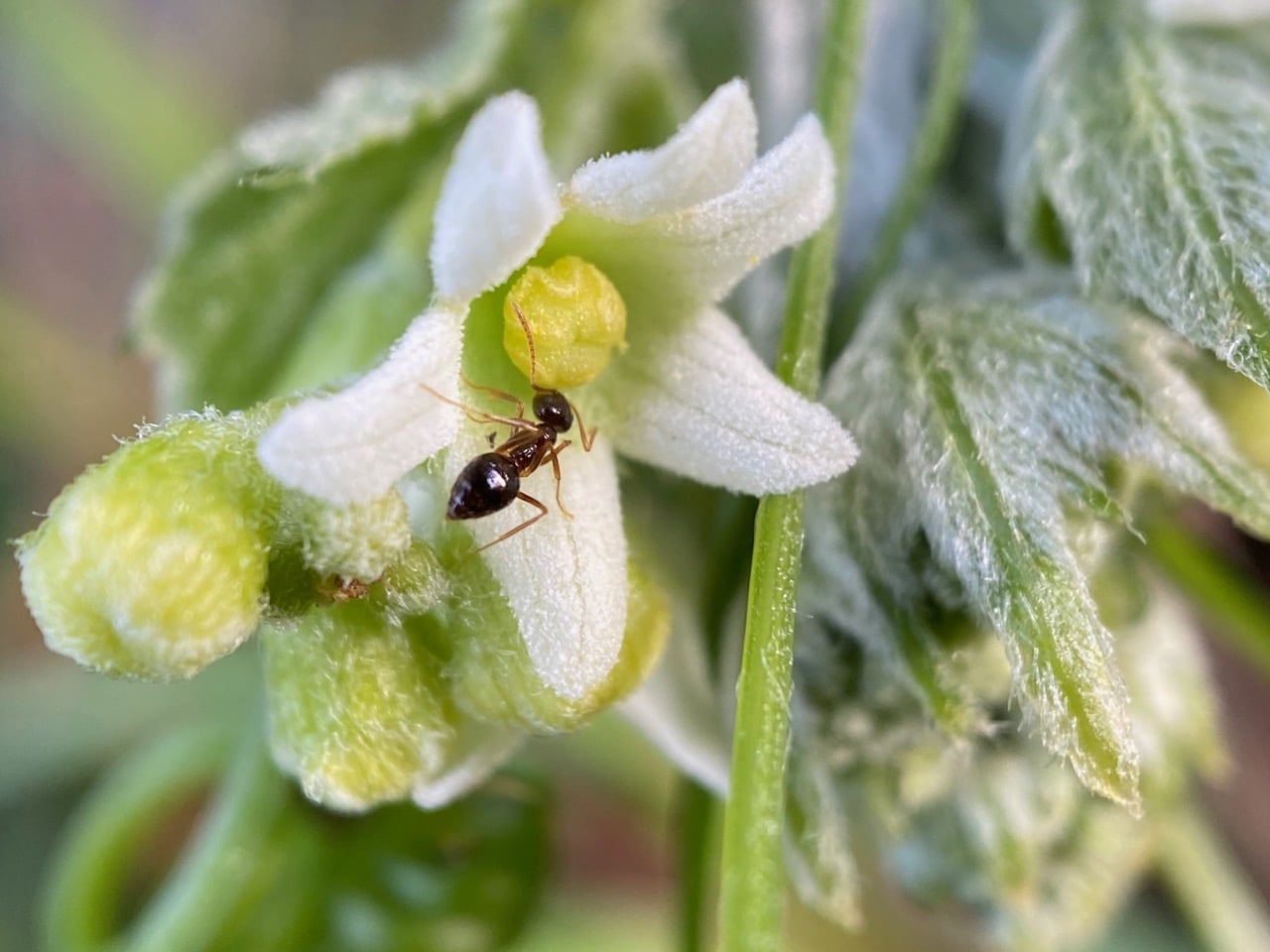
This American Winter Ant is checking out a freshly opened male Marah flower that has yet to release its pollen.
The American Ant, Prenolepis imparis is a widespread North American ant. A dominant woodland species, it is most active during cool weather, when most other ant species are less likely to forage. This species is one of a few native ants capable of tolerating competition with the invasive Argentine Ant, Linepithema humile. They are also aggressive toward other ants and produce abdominal secretions that are lethal to Argentine Ants. Prenolepis imparis is a generalist omnivore. Foragers are known for tending to aphids or scale insects from which they consume excreted honeydew, aggregating on rotting fruit, and exploiting protein-rich sources such as dead worms. The colony enters estivation (a hibernation-like state) and becomes inactive above ground for the warmer months, during which time eggs are laid and brood are reared. Reproductives overwinter and emerge on the first warm day of spring for their nuptial flight.
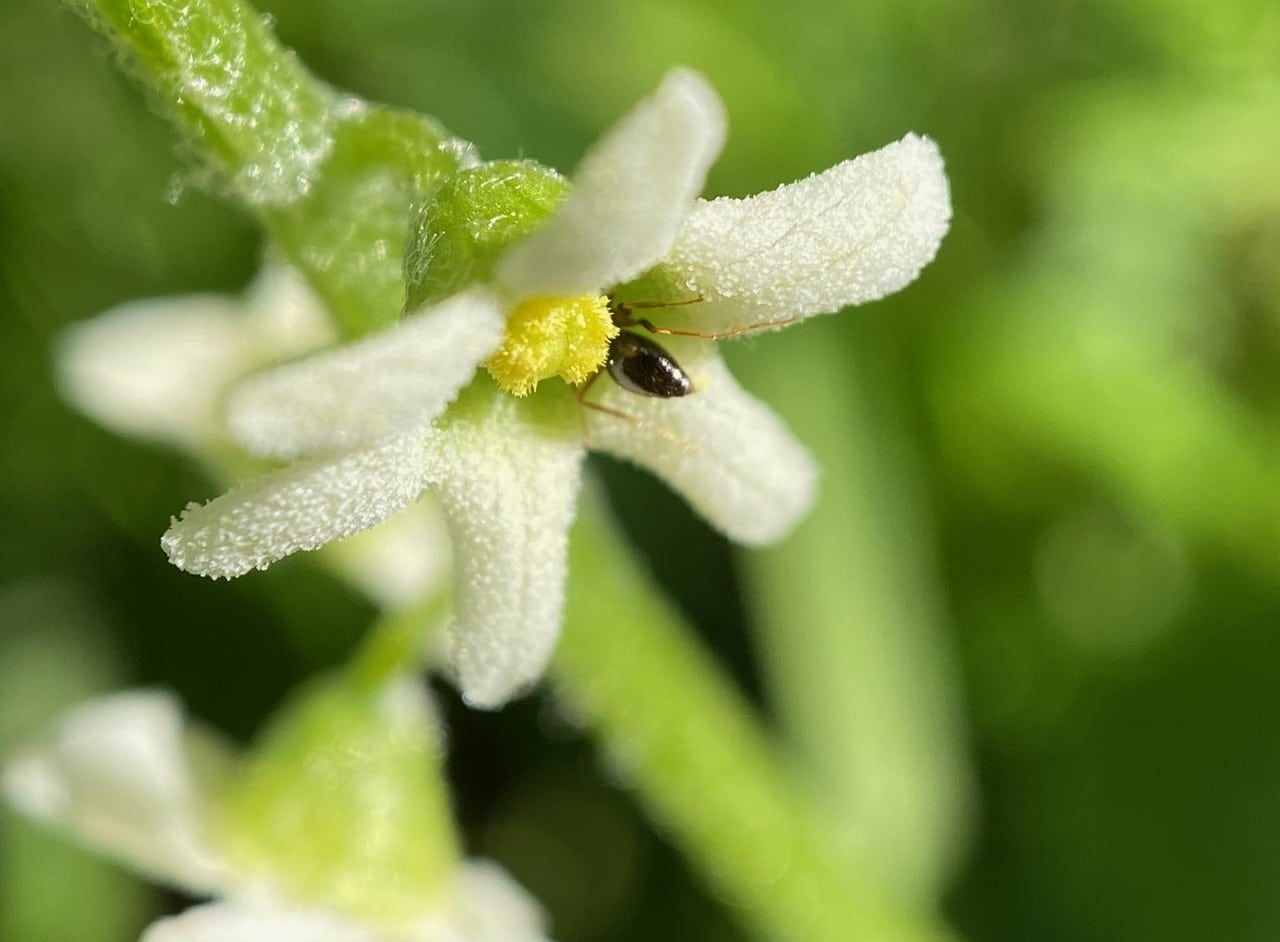
Another American Winter Ant has entered the cup-shaped corolla base of another male flower to access nectar. In doing so, its body is likely to come into contact with the pollen from the anthers.

There is busy traffic of the American Winter Ants on this male Marah inflorescence. Many ants emerge from the flowers with their bodies, especially the heads, covered with pollen.
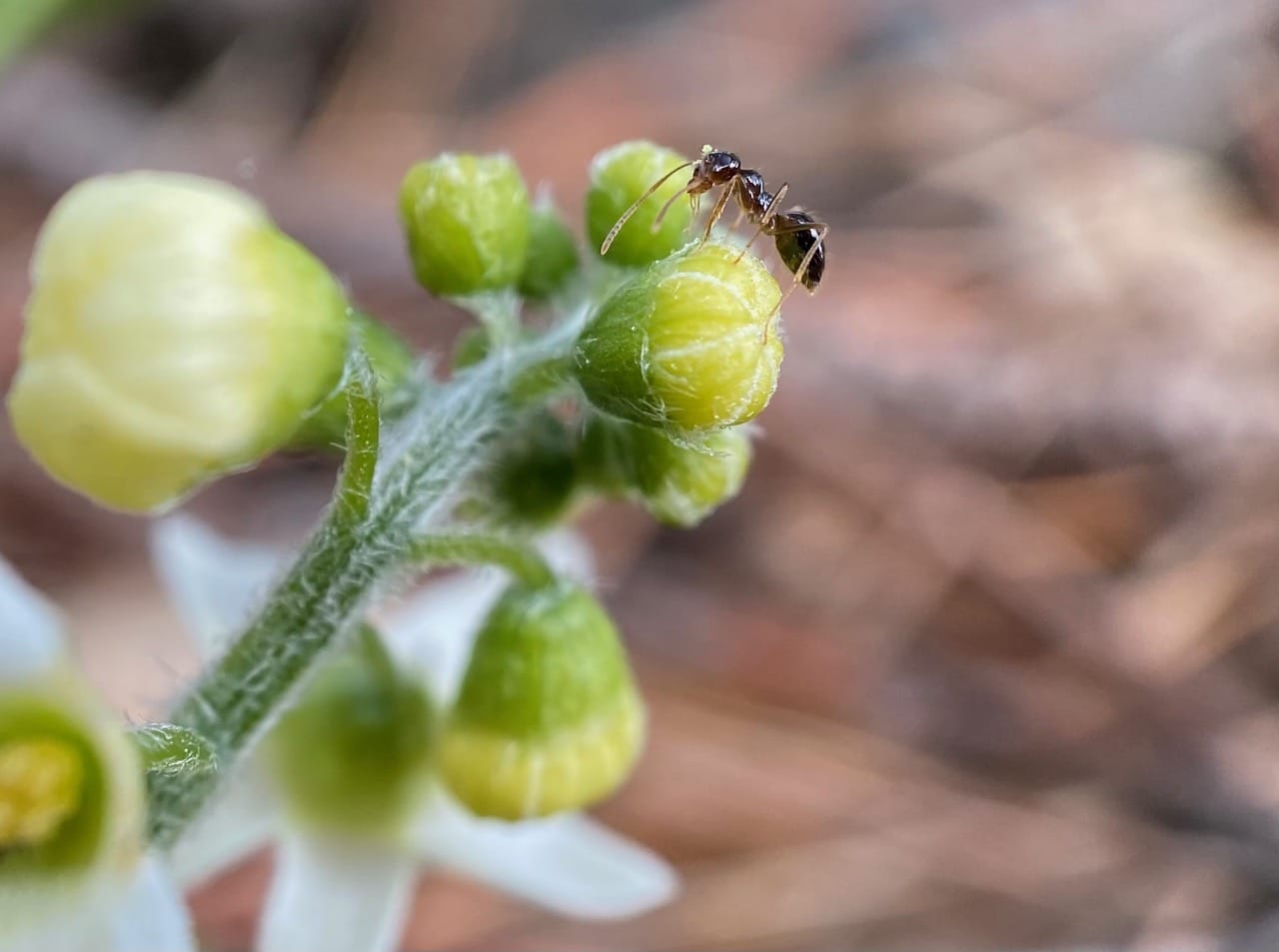
Perched on a flower bud, this ant is trying to groom the pollen off its head.

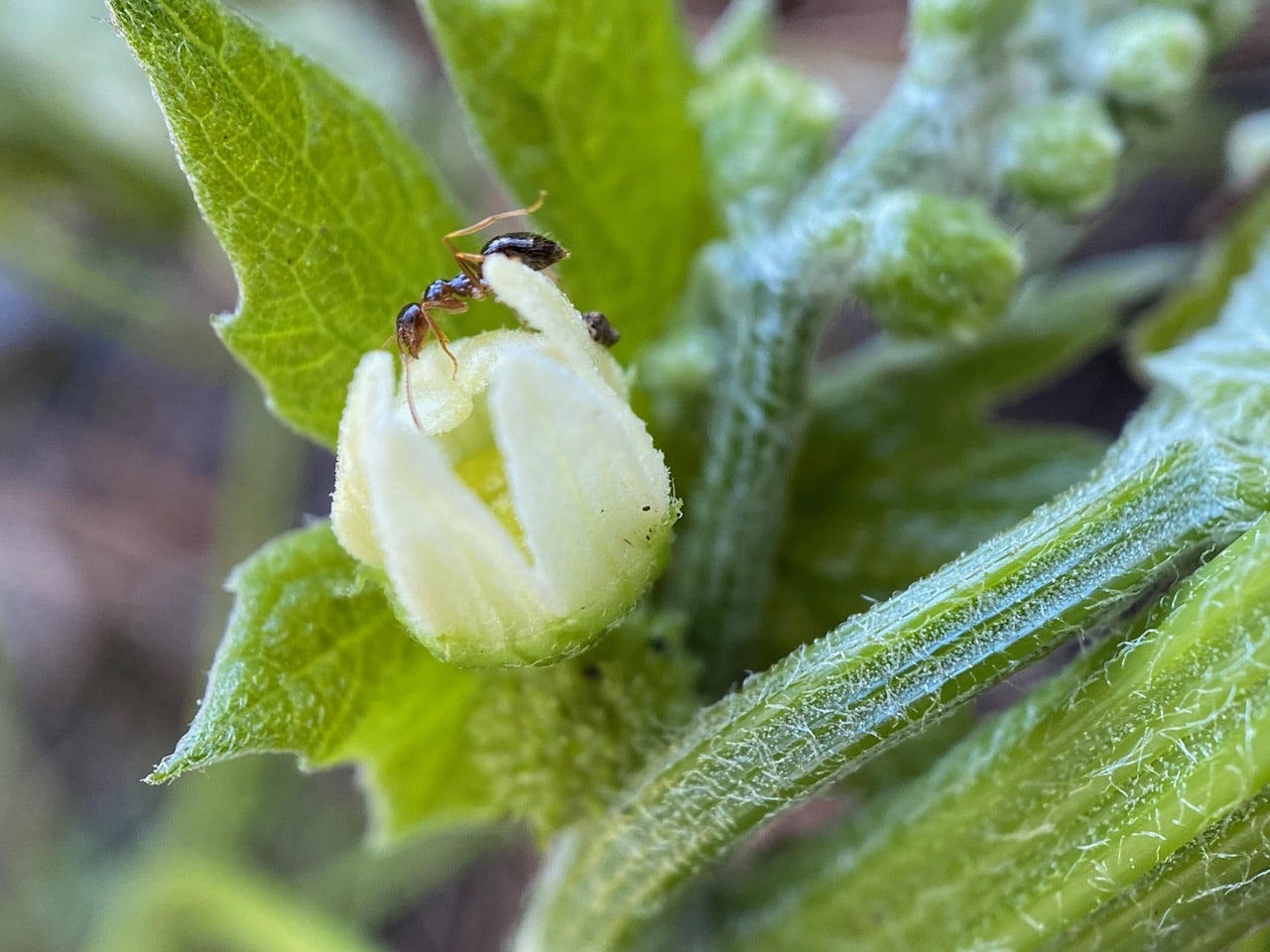



Then off it goes, into another flower in search of nectar.
An American Winter Ants is exploring the outside of a female Marah flower yet to open fully.
The ant spends quite some time investigating the base of the flower where nectar is produced.
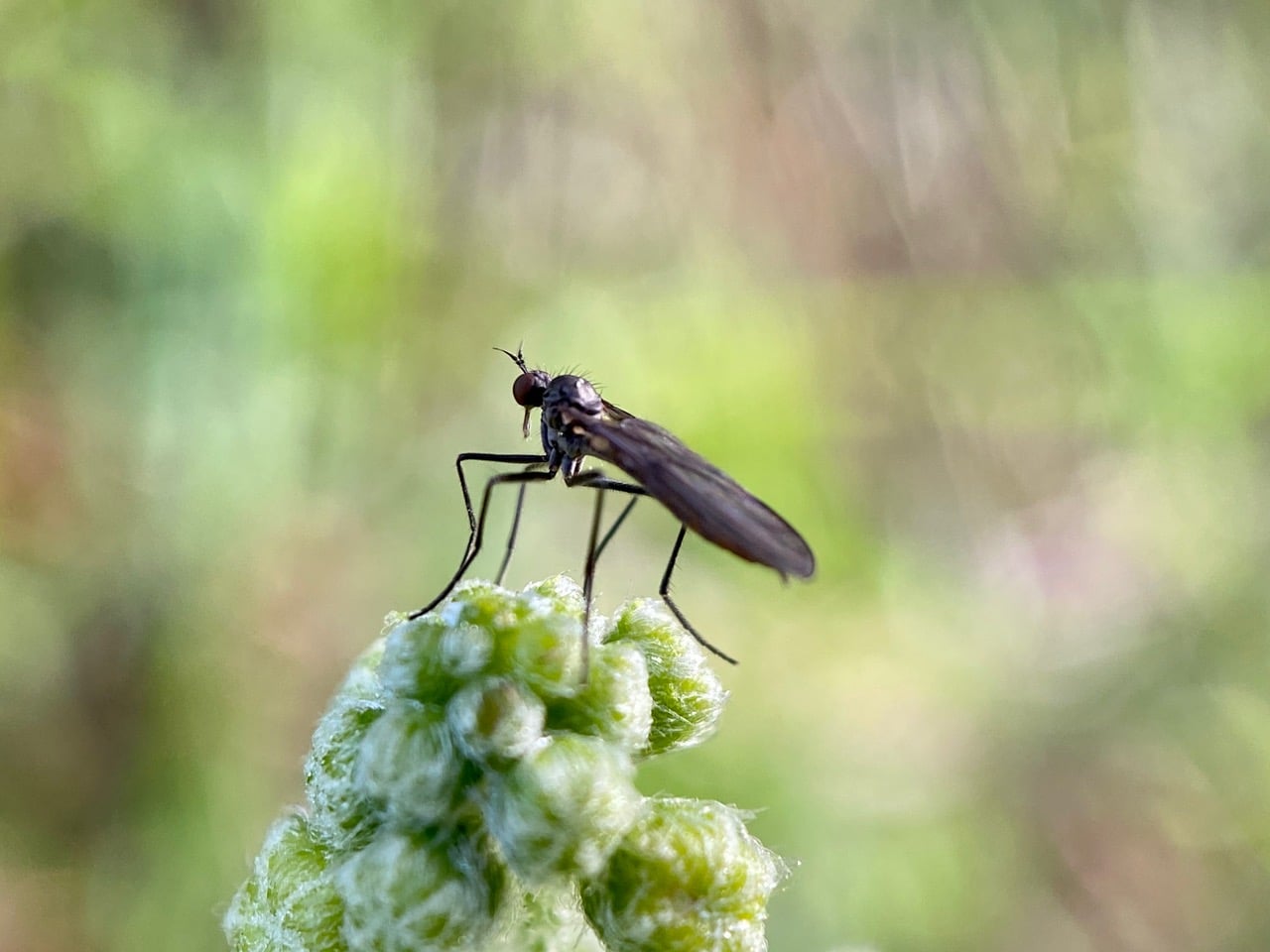


A Dance Fly is perched on a cluster of Marah flower buds. It has a short, stout proboscis. Probably a predatory Dance Fly in the family Empididae.
Dance Flies, in the family Empididae, get their name from the habit of males of some species to gather in large groups and dance up and down in the air in the hopes of attracting females. They are predominantly predatory and they are often found hunting for small insects on and under vegetation in shady areas. Both genders may also drink nectar. Male dance flies give their sweeties a nuptial gift to eat while they mate. The gift is thought to enable her to complete the development of her eggs. Males may wrap their gifts in balloons of silk or spit, hence the other common name of Balloon Flies.
On a Marah leaf, a Dance Fly (family Empididae) is hunched over a prey, a tiny winged insect.
Empidids feed on insects, nectar, and pollen. The predators pierce their prey with a sharp proboscis and suck out their body fluids. They can capture insects live or scavenge them from spider webs or the water’s surface. Some adult Empididae visit flowers to obtain nectar. Others obtain all their protein needs by feeding on pollen.
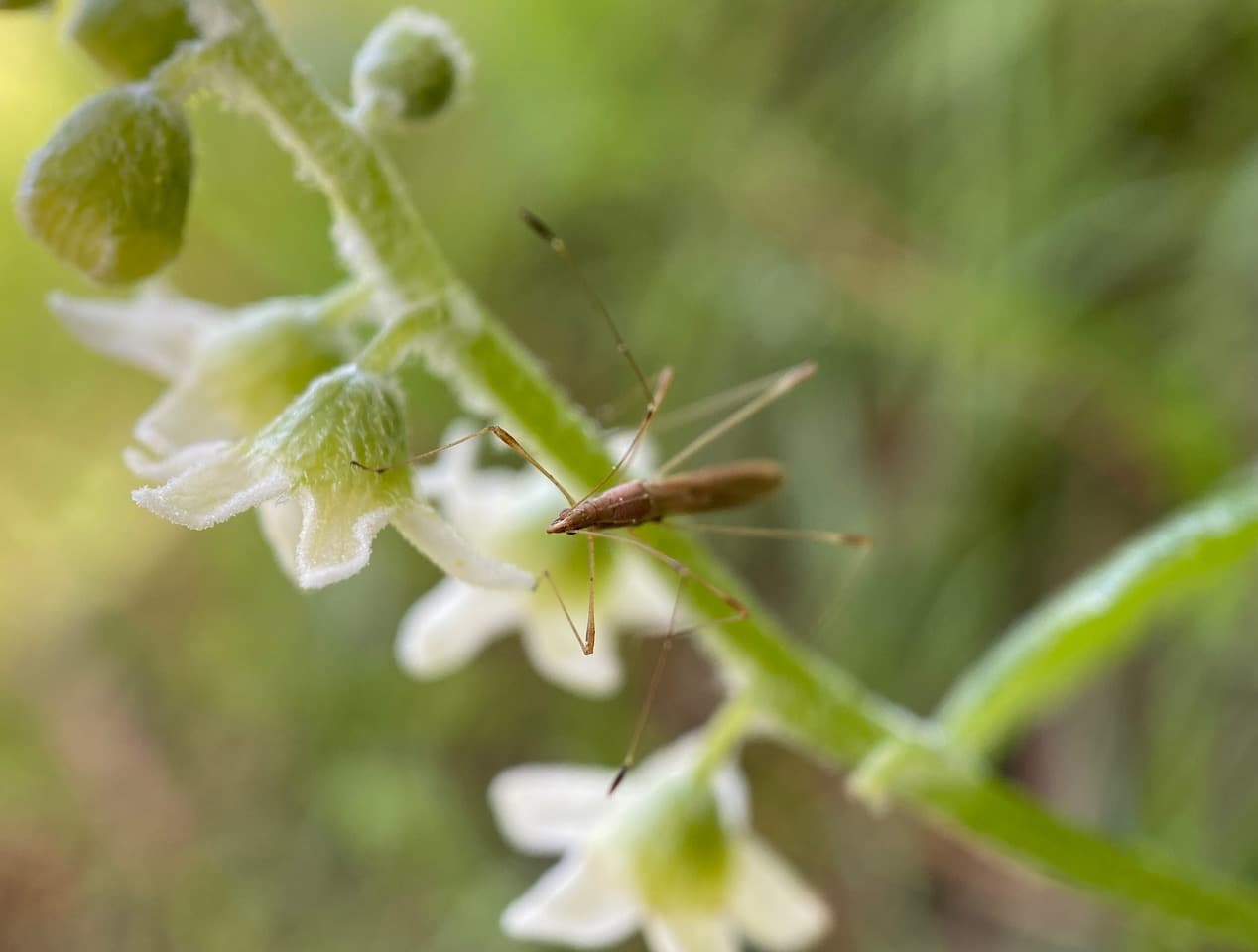
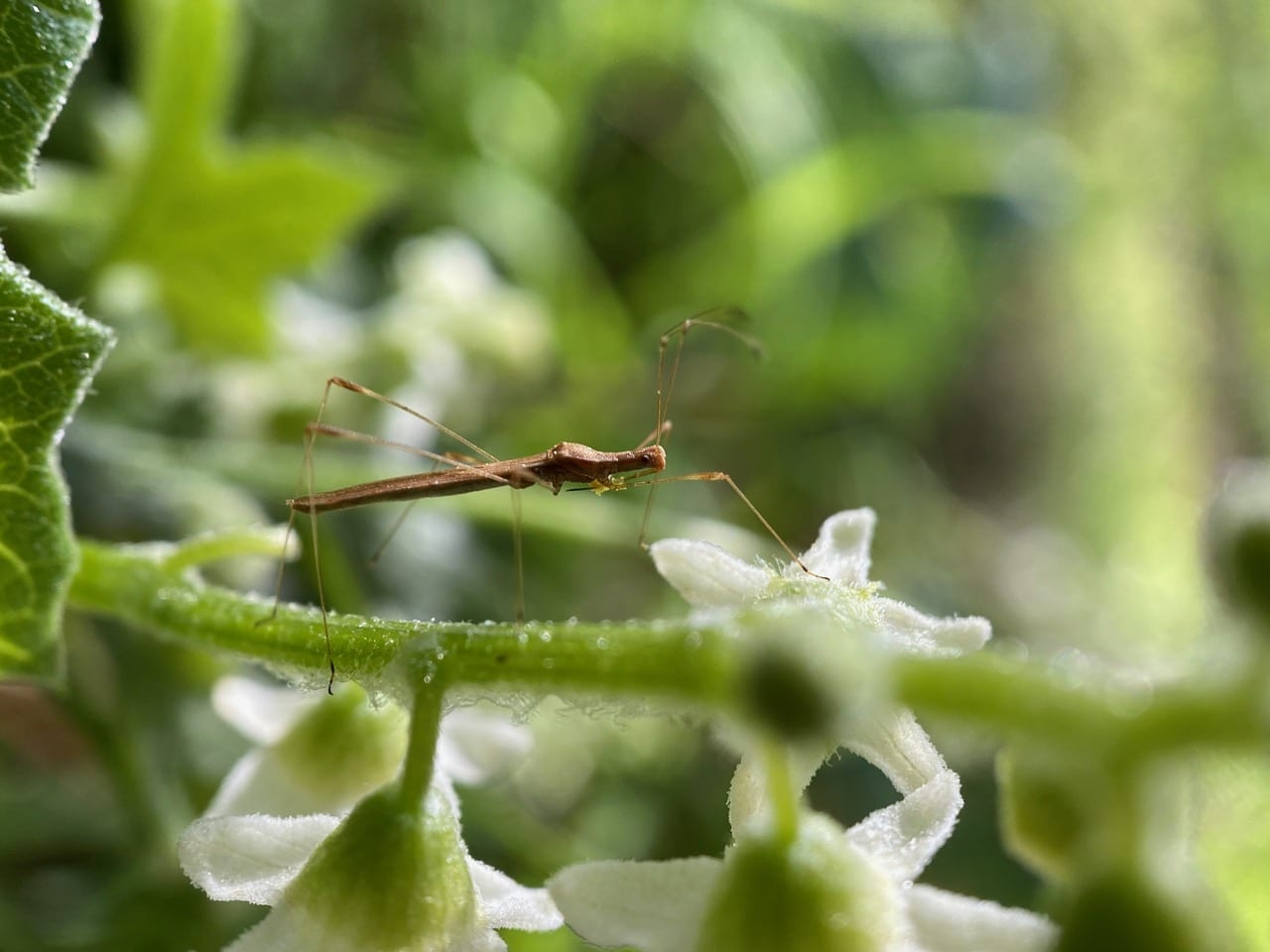
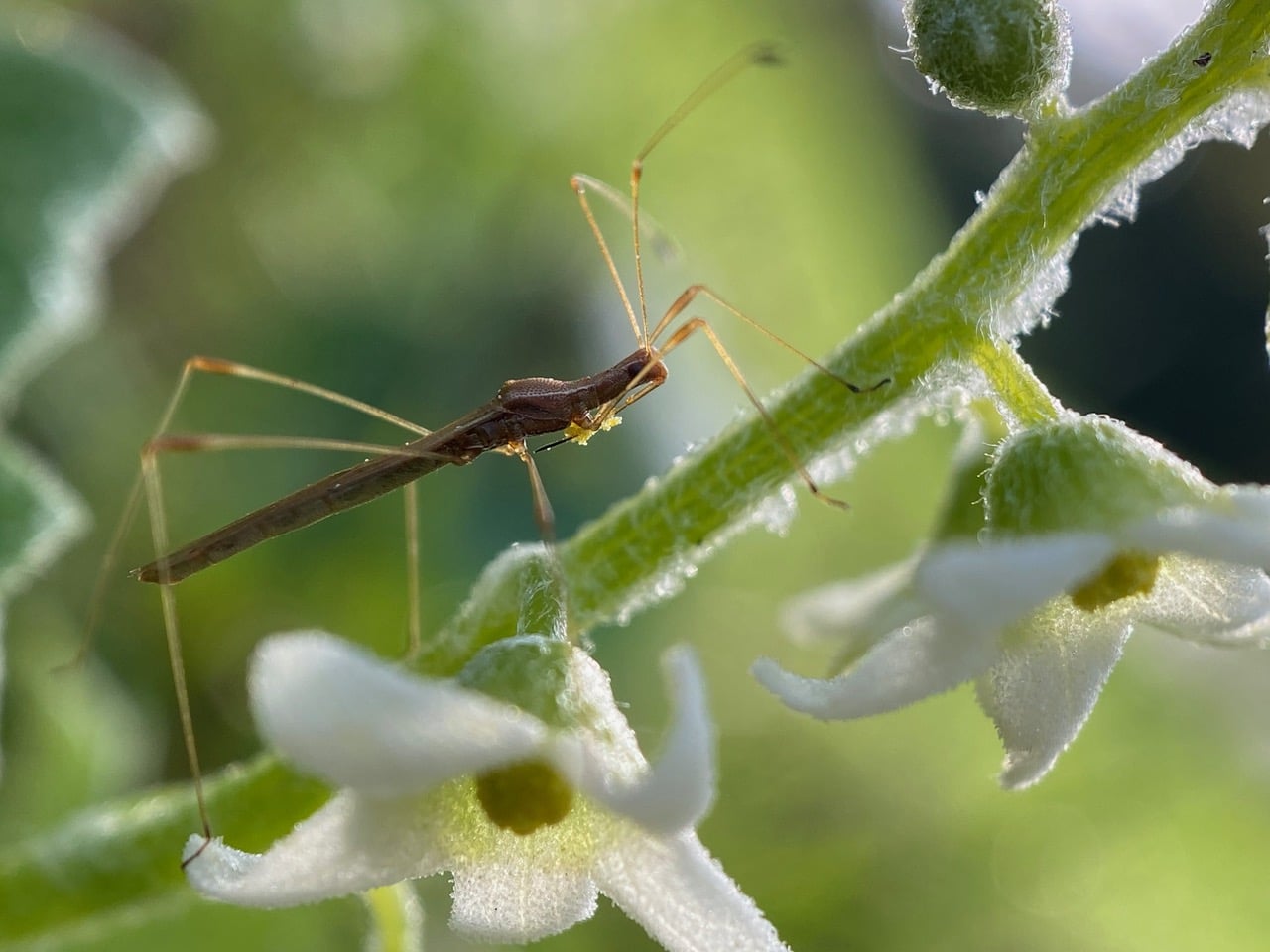
On long, thread-like legs, a Stilt Bug (family Berytidae) is ambling slowly along a flower-covered vine of Coastal Manroot, Marah oregana.
iNaturalist has helped identify the Stilt Bug to the genus Neoneides. There is only one described species in the genus, Neoneides muticus.
The Berytidae are extremely gracile insects with legs so long and slender as to suggest common names such as “thread bugs” and “stilt bugs”. They resemble some Assassin Bugs, but lack the raptorial forelegs of the predators. Antennae have 4 segments, the fourth enlarged, appearing as a swelling at the tip.
Stilt Bugs occur worldwide and throughout North America. Most are phytophagous (plant-feeders); many may be host-specific, often associated with plants with glandular hairs in Geraniaceae, Onagraceae, Scrophulariaceae, and Solanaceae. Some are occasionally omnivorous, feeding opportunistically on insects entrapped in plant exudates or on lepidopteran eggs or aphids.
Neoneides muticus (family Berytidae) is a small delicate, stilt bug, adults measuring 8-9.5 mm. It occurs in the United States and southern Canada in the east and in the west, but is mostly absent from the Great Plains. The mouthparts are optimized for piercing and sucking and formed into a long, slender beak (rostrum) with four segments. The rostrum is folded under the body when not in use. The antennae are very long, thread-like, and elbowed. They have four segments, with the fourth thickened at the tip.
In this close-up, clumps of pollen grains can be seen adhering to the Stilt Bug’s folded rostrum. The insect must have been feeding on the nectar/pollen of Marah. Might these insects serve as pollinators for Marah?
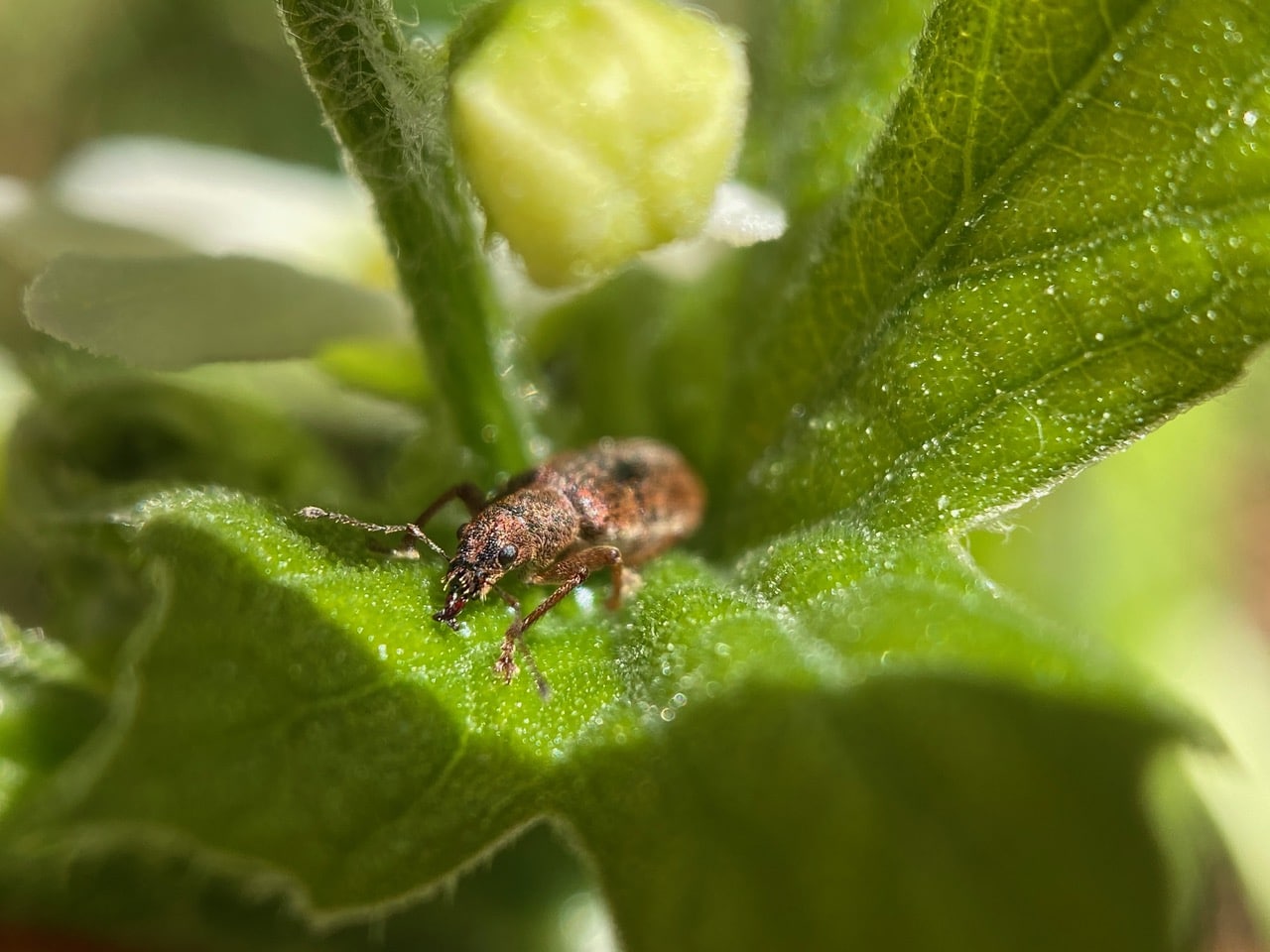
An orange-brown insect is lurking underneath the cucumber flowers. A Weevil (family Curculionidae)?
Weevils, family Curculionidae, are also called snout beetles. Curculionidae is one of the largest beetle families (about 40,000 species). Most weevils have long, distinctly elbowed antennae that may fold into special grooves on the snout. The snout is used not only for penetration and feeding but also for boring holes in which to lay eggs. The mouthparts are quite small and located at the end of the rostrum (snout), designed for chewing. Many weevils have no wings, while others are excellent fliers. Most are less than 6 mm in length. The majority of weevils feed exclusively on plants. The fleshy, legless larvae of most species feed only on a certain part of a plant – i.e., the flower head, seeds, fleshy fruits, stems, or roots. Many larvae feed either on a single plant species or on closely related ones. Adult weevils tend to be less specialized in their feeding habits. The family includes some very destructive agricultural pests.
Ooh, what interesting mouthparts! The insect is a Broad-nosed Weevil (family Curculionidae, subfamily Entiminae).
The Entiminae are a large subfamily in the weevil family Curculionidae, containing most of the short-nosed weevils. Unlike the other weevils, these have broad and short rostrum.
The integument of entiminae can be black, reddish, orange and even metallic in coloration. Many species are covered by scales arranged in a broad variety of patterns. These scales bear three dimensional photonic crystals within their lumen, which makes the scales iridescent. Many species are flightless.
In general, Entiminae are polyphagous herbivores, feeding on a broad range of plants. For the most part, the larvae feed externally on roots in the soil and adults feed on foliage. Entimines lay eggs loosely in the soil, or in clusters glued onto vegetation, but never into plant tissues, and do not use their rostrum to prepare their oviposition site. Many species are known to be parthenogenetic, reproducing without males.
I lower the Marah leaf to get the rest of the weevil into view. A weevil expert on iNaturalist has narrowed down the ID of the weevil further to the Pine Needle Weevil, Pachyrhinus cinereus. Wow, all this makes good sense – the Marah is growing under a grove of Monterey Pines, Pinus radiata. The weevil might have recently emerged from the soil.
The Pine Needle Weevils in the genus Pachyrhinus are native to western North America. The adult beetles are bout 1/4 in. long. The thorax is narrower than the elytra covering the abdomen. The snout is very short and blunt with long, thin, elbowed antennae arising at its base in front of the eyes. Their colors range from light brown to gray to r reddish-orange color. Overall they are covered with short hairs. The larvae feed on the roots of the plants while the adults feed on the needles, often on the tender growing tips, resulting in stunted growth and even distorted growing areas that become bushy. Adult beetles overwinter in leaf litter below the trees, emerge in the spring, and females deposit eggs by gluing several needles together and depositing the eggs in rows within these needles. When the eggs hatch the larvae drop to the ground to feed on the roots. The life cycle normally takes 2 years in northern regions. Generally the feeding of these beetles will not harm the overall health of the trees, and control ins not needed.
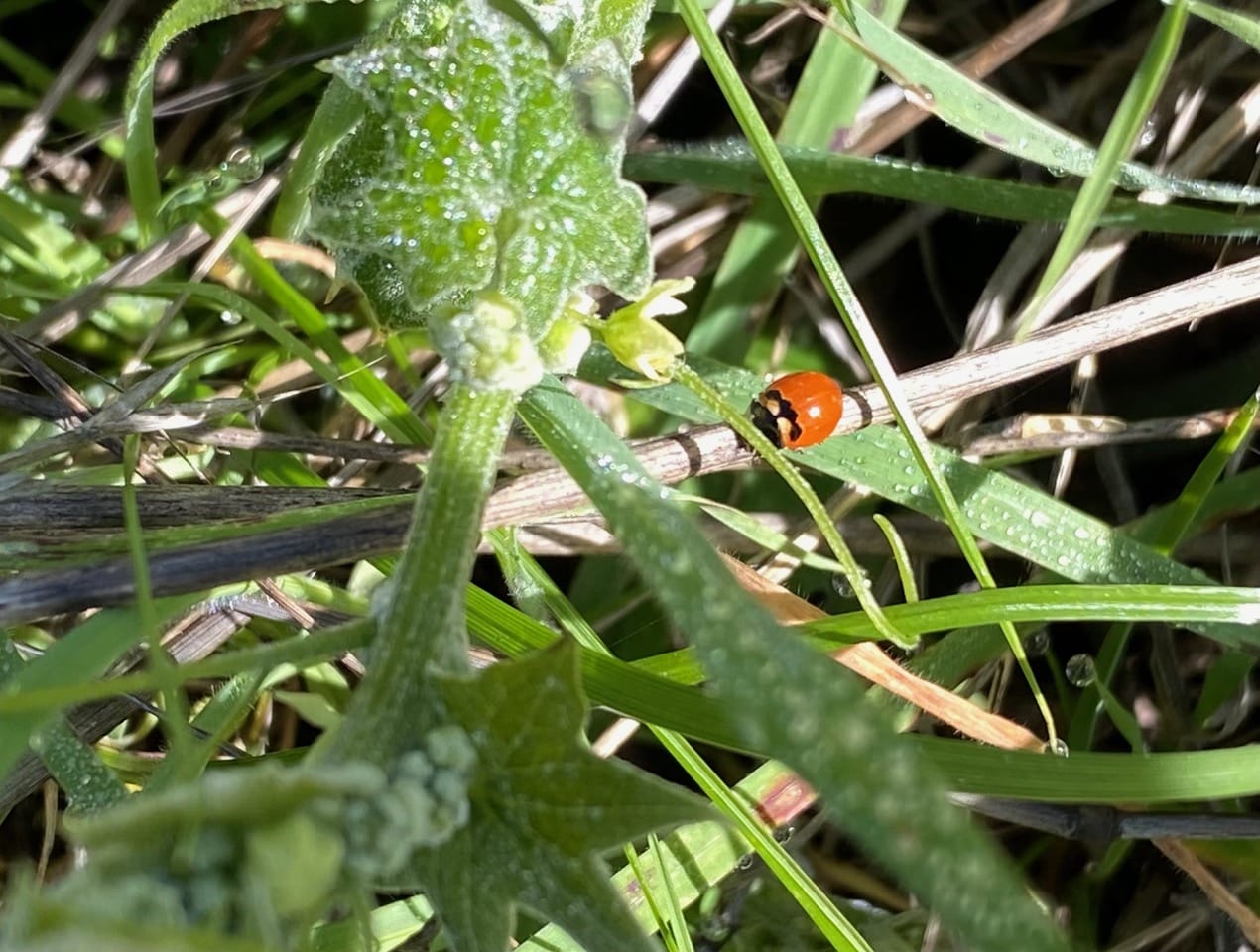
Ooh, an unusual Lady Beetle is crawling on the tangle of vegetation under the Marah vine! Instead of spots, this ladybeetle has rather unusual markings on its elytra! It’s the Three-banded Ladybeetle, Coccinella trifasciata (family Coccinellidae), native to North America.
“Three-banded”? The species is rather variable depending on its range. The ones found east of the Rockies are indeed three-banded. Species Coccinella trifasciata – Three-banded Lady Beetle – BugGuide.Net Here in California, we have the subspecies Coccinella trifasciata subversa, also known as the Pacific Three-banded Ladybeetle. Photos of Pacific Three-banded Lady Beetle (Subspecies Coccinella trifasciata subversa) · iNaturalist These beetles are active from spring through summer months and on warm days of fall; diapausing (insect version of hibernation) through the colder winter months.