

Pollinator Post 2/15/23
I walk the Bypass Trail to the Swale this sunny, calm afternoon.
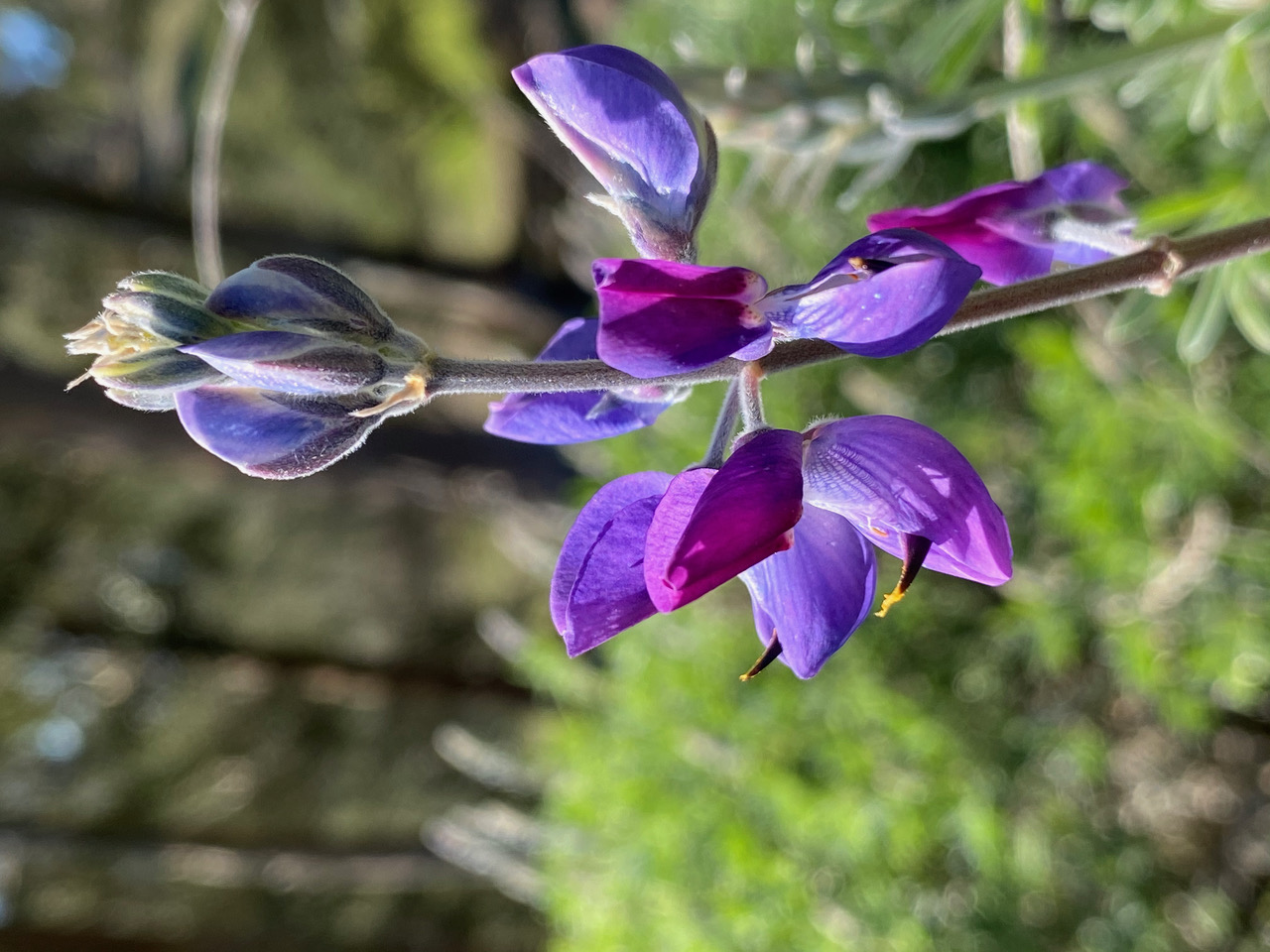
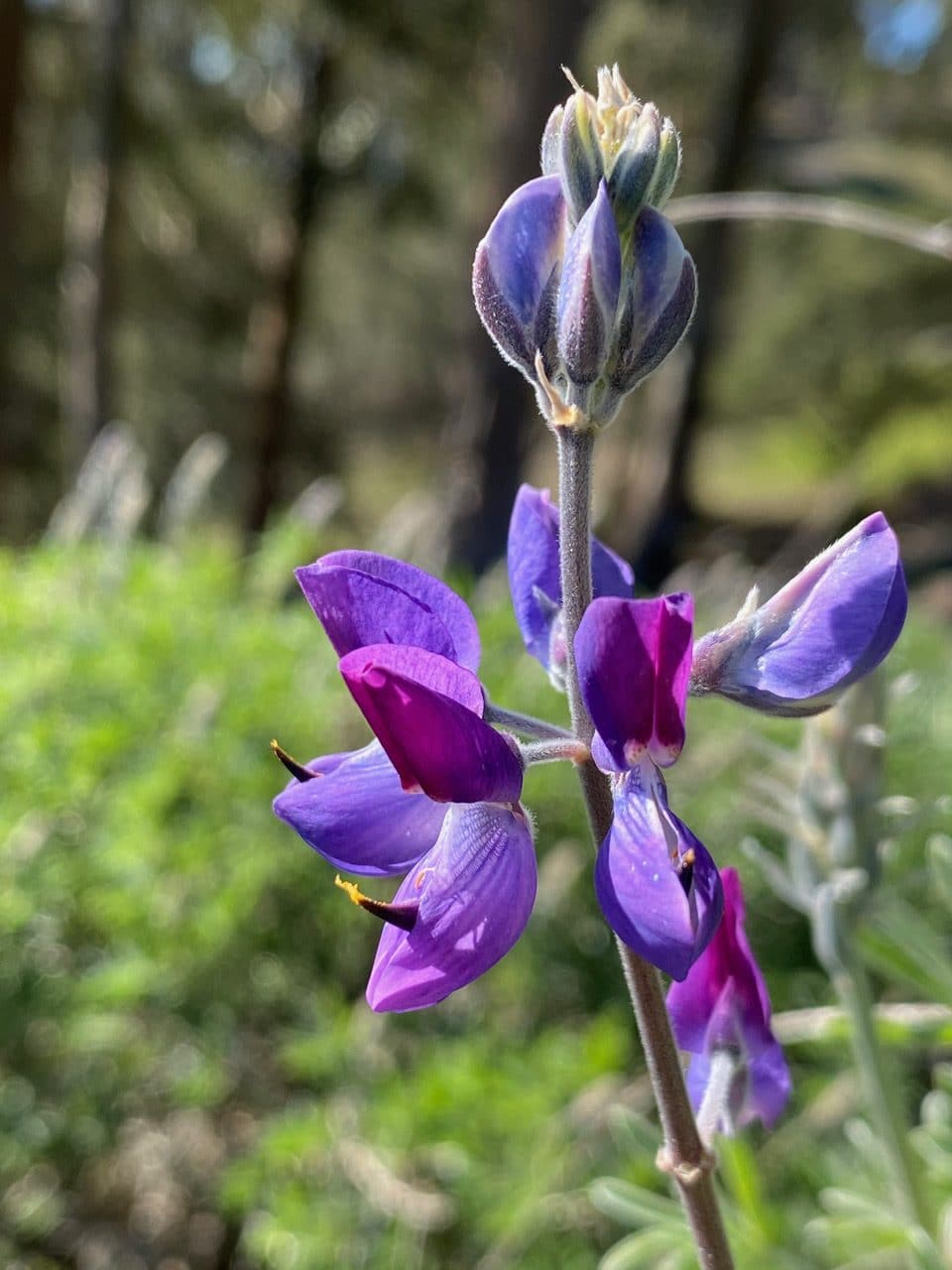
Some of the Silverleaf Lupine, Lupinus albifrons along the trail are already blooming. This is a relatively fresh inflorescence. Why are the flowers’ banners (the upper, erect petals) colored a reddish-purple?
When
the flowers of Silverleaf Lupine first
open, they have white banners. After the flowers are pollinated, the banners turn
reddish-purple (as seen in the older flowers in the lower part of the
inflorescence) when the levels of the anthocyanin pigment rises 3-5 time. The color change is a response to ethylene (a
gaseous plant hormone) produced by the pistil (female part of the flower) after
it has been pollinated and is no longer receptive. Bumble Bees, who are
the lupine’s principal pollinators use the color change to guide them to the
fresh flowers with the biggest rewards. This arrangement benefits both
the plant and pollinator, maximizing pollination efficiency.
the flowers of Silverleaf Lupine first
open, they have white banners. After the flowers are pollinated, the banners turn
reddish-purple (as seen in the older flowers in the lower part of the
inflorescence) when the levels of the anthocyanin pigment rises 3-5 time. The color change is a response to ethylene (a
gaseous plant hormone) produced by the pistil (female part of the flower) after
it has been pollinated and is no longer receptive. Bumble Bees, who are
the lupine’s principal pollinators use the color change to guide them to the
fresh flowers with the biggest rewards. This arrangement benefits both
the plant and pollinator, maximizing pollination efficiency.
There’s another way that the lupine flowers talk to the bees. See those dark purple veins on the top of the wing petals (lower pair of petals)? The lines converge toward the base of the petals where the nectar is produced. Much like the lights on airport runways that guide airplanes, the lines on the flowers guide the pollinators to the nectar rewards. These are sometimes referred to as “nectar guides”; they inform the bees on where to land and where to stick their tongues. Yet another ingenious arrangement that benefits both the pollination partners.
Lupines and Bees…It’s Complicated – YouTube

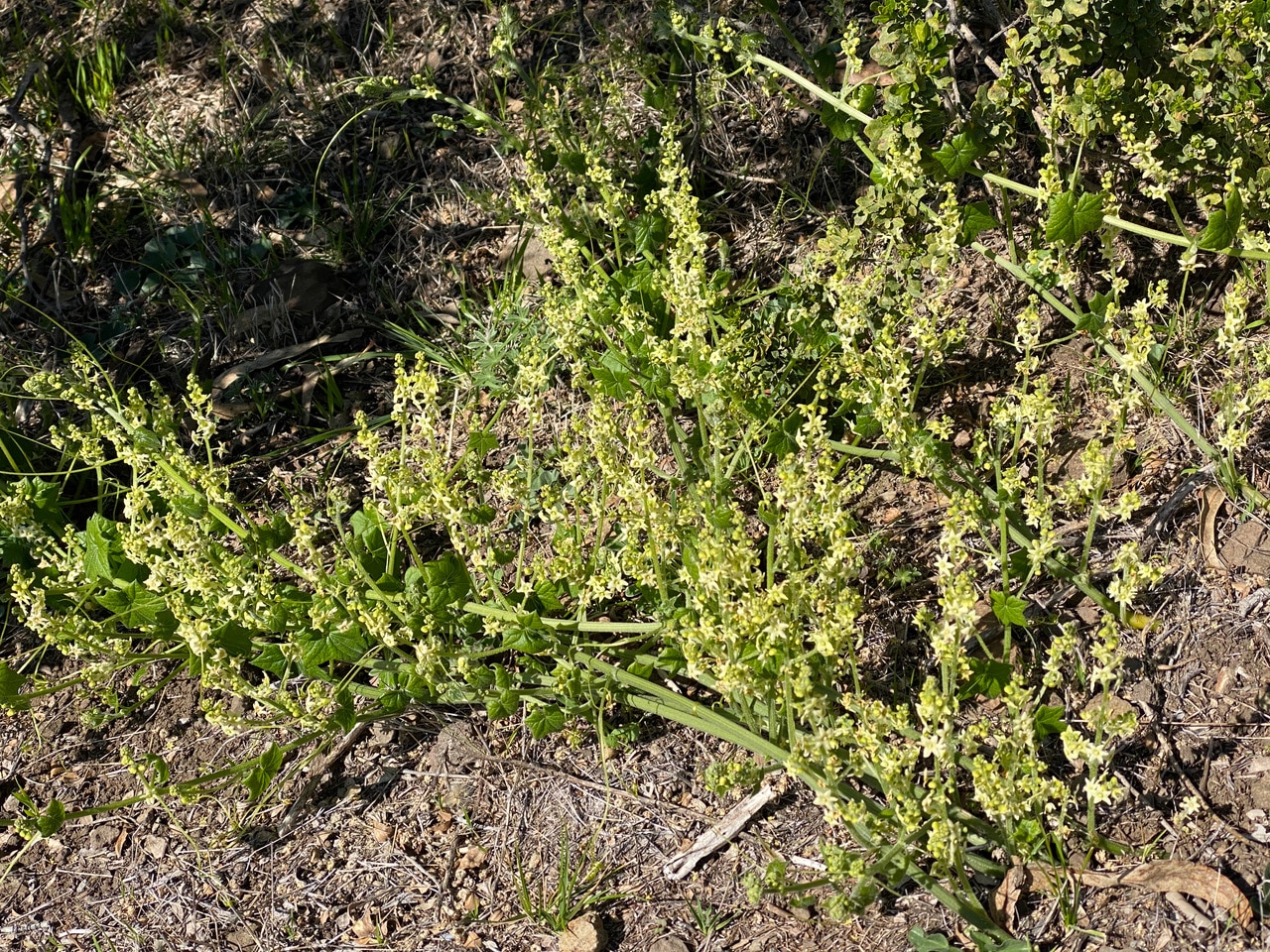
 While the leaves are barely unfurling, both male and female flowers can be seen on the vines. Note the solitary female flower on the lower left of the picture.


Thanks to the work of the bumble bee, an Argentine Ant, Linepithema humile has free access to the pollen on the stamens that have been extruded from this lupine flower.
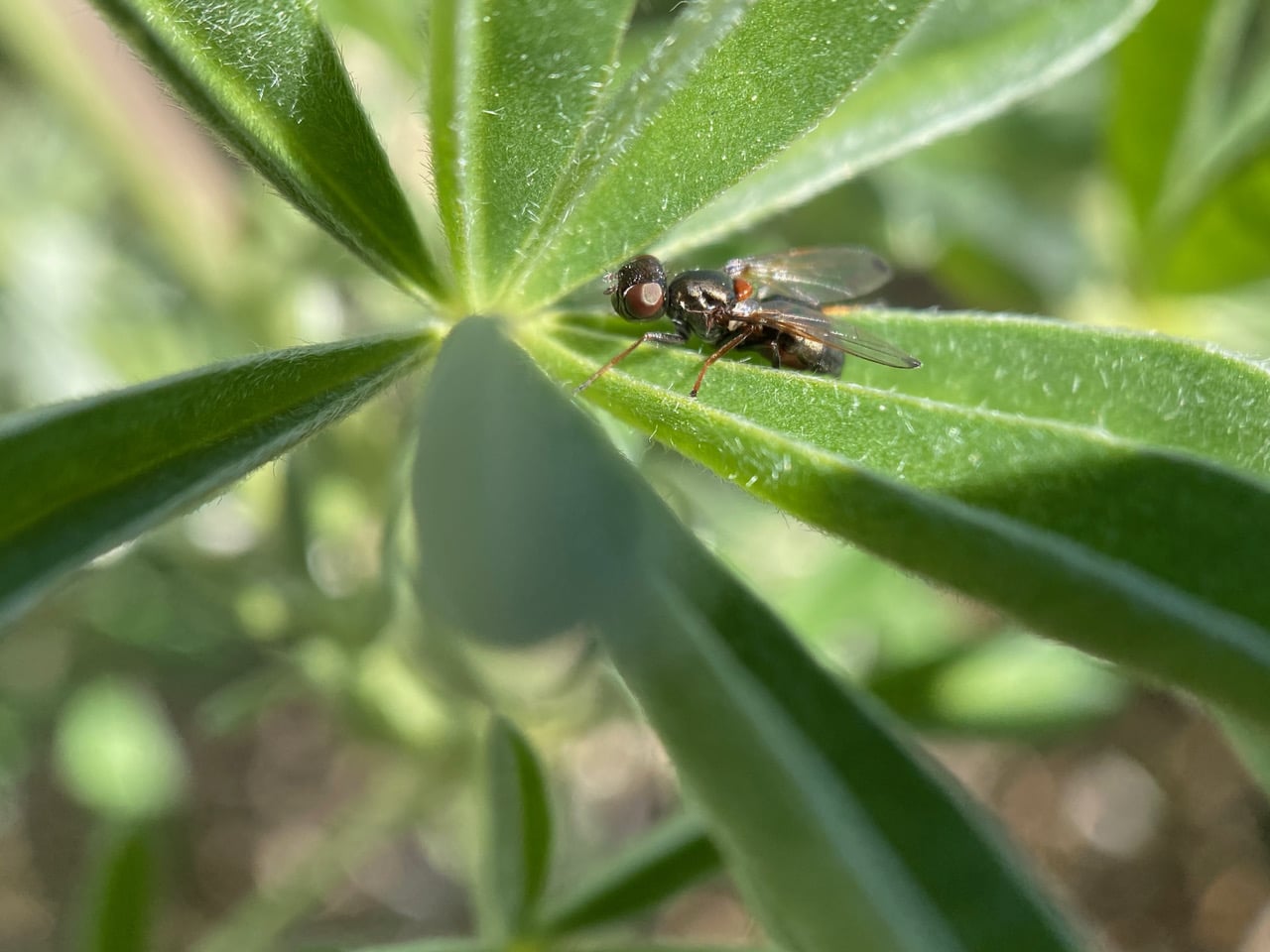
A small, shiny black fly is walking slowly on a lupine leaf. Its wings are outstretched horizontally a full 90 degrees from its body, and it is waving them as if signaling or displaying. A fly expert on iNaturalist has helped identify it as a member of the genus Curranops, in the family of Picture-winged Flies, Ulidiidae.
The Picture-winged Flies are among the more common, ornate, and entertaining of all Diptera, thanks to their lovely wing patterns and cute courtship behaviors. Most have some kind of pattern of spots, bars, or lines on the wings, and many have metallic bodies. Photos of Wing-waving Flies (Family Ulidiidae) · iNaturalist United Kingdom By comparison, our little fly seems atypical of the family, lacking bold markings on the wings.
Many Picture-winged Flies are often found on certain plants, dung, logs, wooden fences, or tree trunks. These locations serve as food sources, basking sites, or display sites for courtship. Many species actively wing-wave as they walk over foliage or tree trunks and dead wood. Unlike their close relatives the Fruit Flies (family Tephritidae) which are mostly phytophagous (feeding on living plants), the Ulidiids are mostly saprophagous, with larvae that develop in decaying vegetation/fruit, dung, decaying wood or organically-rich wet mud. Hence the Ulidiids are essentially decomposers/recyclers of organic matter, almost never pests.
Interestingly, the only other entries for the genus Curranops on iNaturalist are from the Bay Area, and most of the flies were photographed on Silverleaf Lupine in early spring. Photos of Curranops apicalis · iNaturalist The naturalists who submitted the pictures have wondered if there were any specific association between the fly and the plant. According to Spencer Pote, the fly expert who identified our fly, Curranops is very poorly known both taxonomically and biologically. Nothing is known of the life cycle of Curranops at all, and there are only two rare species in the genus, known from a smattering of specimens. Spencer added that some related species are associated with the roots of various plants.
Perhaps the larvae of our Curranops feed on the roots of Silverleaf Lupine, and the adults emerge from the soil in early spring to court and mate on their host plant? I will continue to keep an eye out for them….
I clamber up a slope to check out a large Wild Cucumber or California Manroot, Marah fabacea that is sprawled on the ground next to a Coyote Brush, blooming profusely.
Why the curious name “manroot”?
Marahs are perennial plants, growing from a large tuberous root. The common names “manroot” and “old man in the ground” derive from the swollen lobes and limb-like extensions of the unearthed tuber. On old plants, the tuber can be several meters long and weigh in excess of 200 lbs. Because of this huge energy reserve, the vines can swiftly emerge from the ground following the first winter rains.
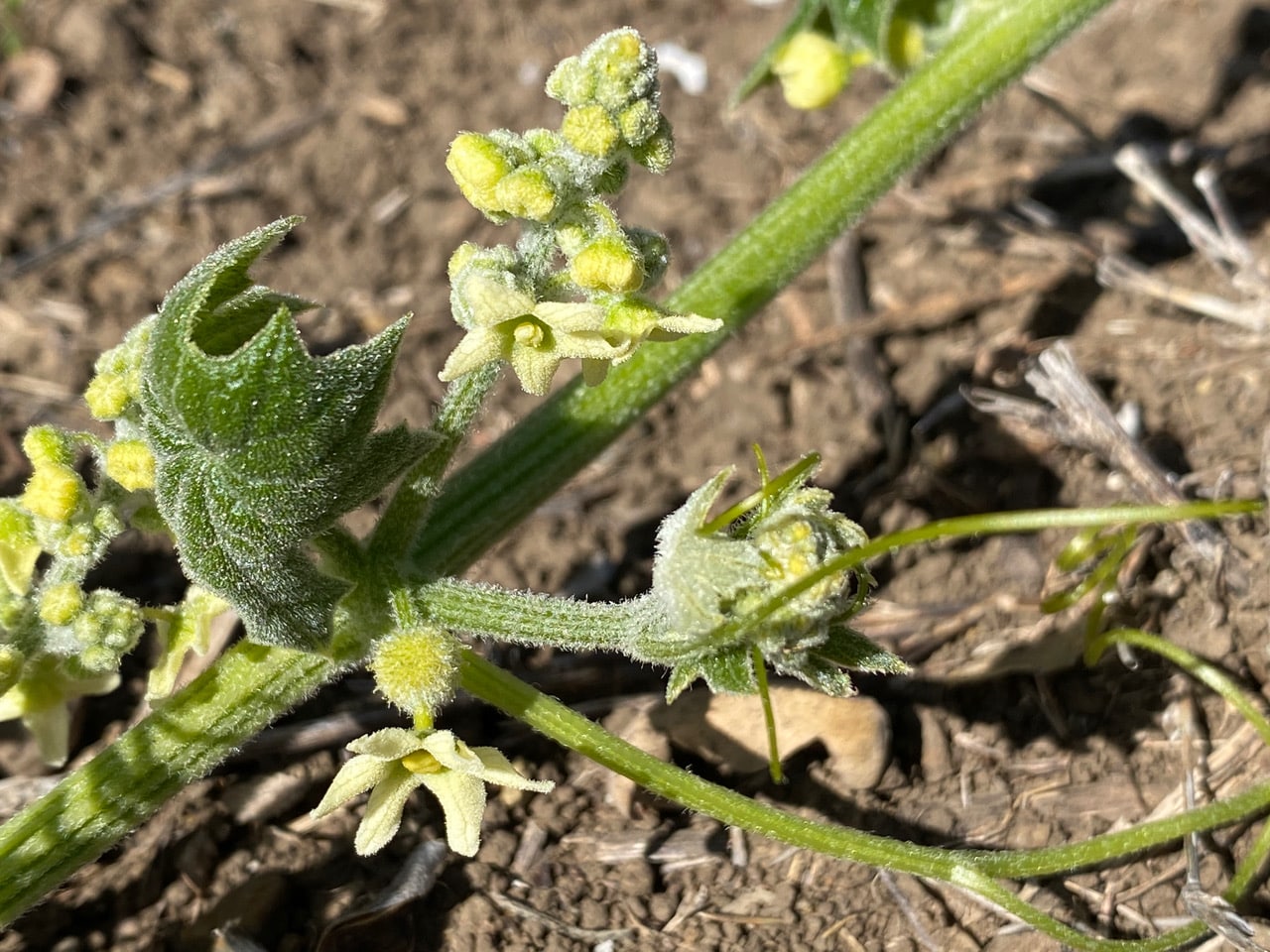
While the leaves are barely unfurling, both male and female flowers can be seen on the vines. Note the solitary female flower on the lower left of the picture. Wild Cucumber flowers are monoecious: separate male and female flowers are found on the same plant. Male flowers appear in open spikes while solitary female flowers appear at the leaf axil, often beneath the male flowers. A small hairy inferior ovary is already evident when the female flower is very young. This will eventually develop into a spiky fruit.
The wild cucumber is pollinated by insects, but the plant is self-fertile, meaning that pollen from the male flowers can fertilize the female flowers on the same plant.
An Argentine Ant is checking out the stamens of a male flower of Marah fabacea. Are ants responsible for pollinating Marah ?
Close-up of a female flower with two ants crawling on it. The swollen ovary will develop into a large spiky fruit bearing large seeds.
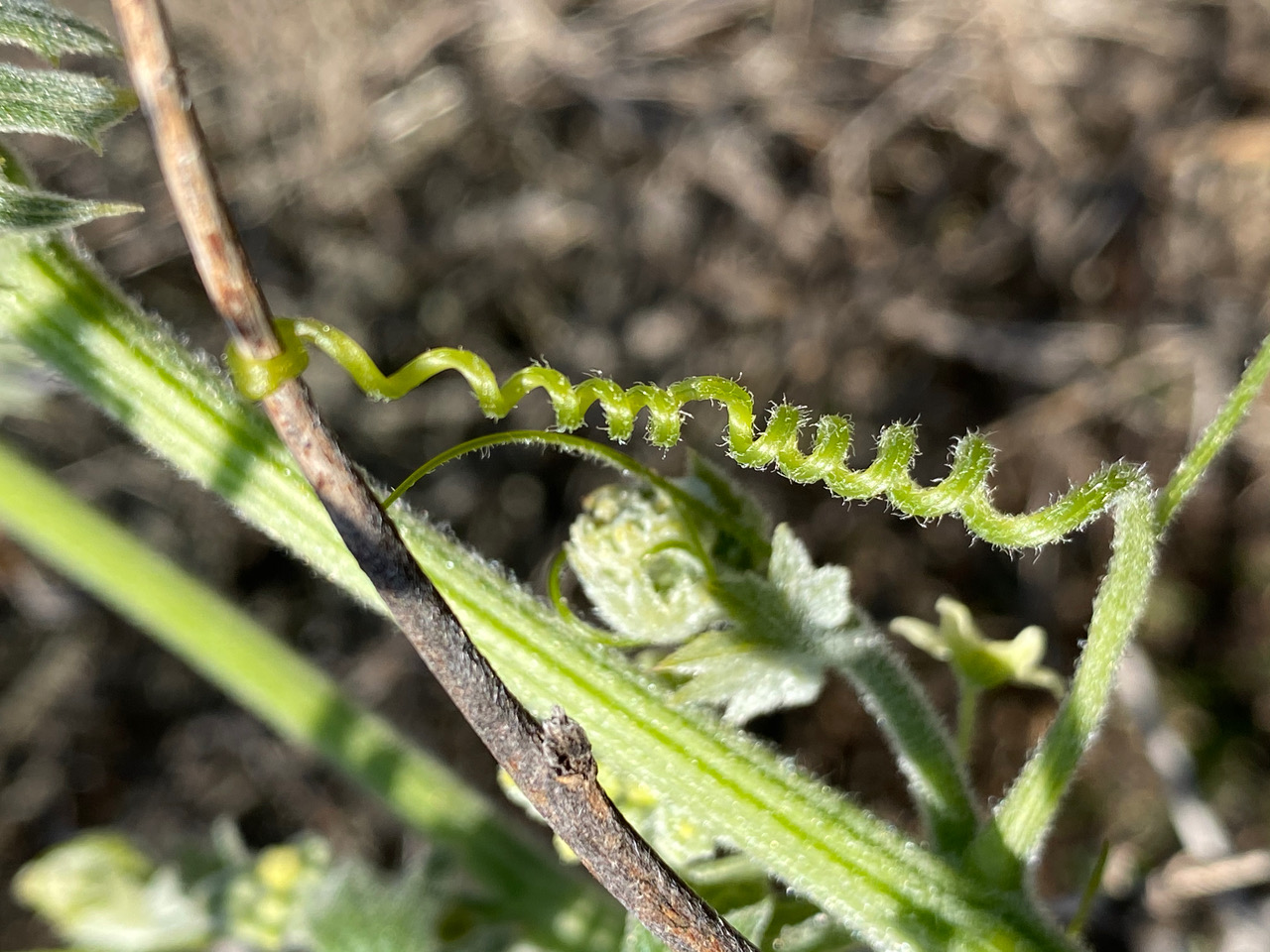
Marah’s whimsical tendrils amuse me endlessly.
Long tendrils enable Marah to climb/trail over neighboring vegetation. You can invariably find a straight section along a tendril coil where the coiling direction is reversed. Darwin had noticed this behavior and coined it “perversion”. Scientists have actually studied the cucumber tendrils seriously and found some fascinating properties. Once a tendril curls around a support, it forms a counter-clockwise helix and clockwise helix with a straight section between the two. If the tendril is pulled, more turns are added to both helices to better grasp the support.