

Pollinator Post 2/11/24 (1)

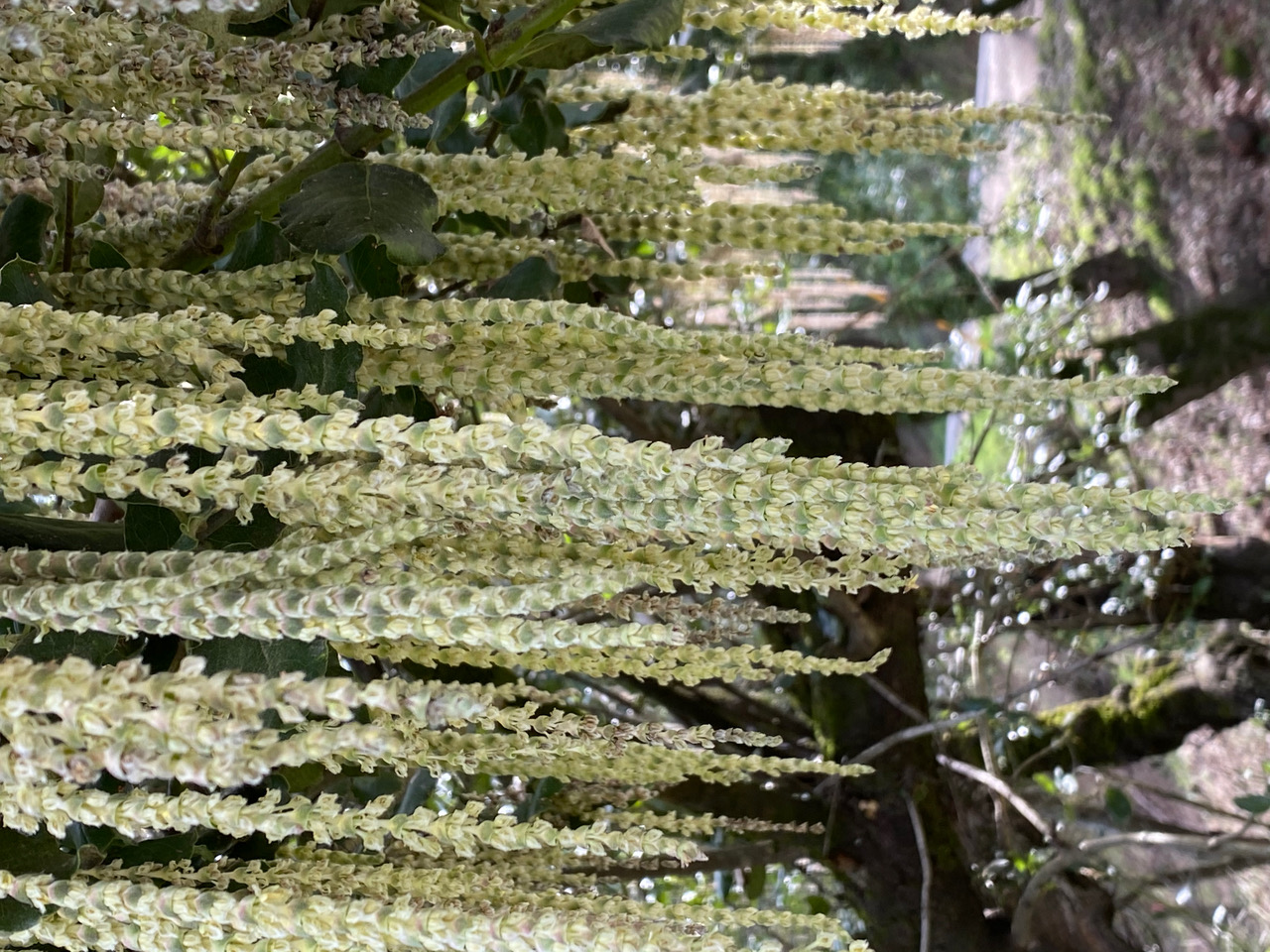
I am at the Sibley Volcanic Regional Preserve for a morning walk. At the parking lot my attention is drawn to the spectacular Coast Silk Tassel plant heavily draped with long dangling male catkins.
The Coast Silk Tassel, Garrya elliptica (family Garryaceae) is an evergreen shrub or small tree. It is dioecious, meaning male and female flowers are borne on separate plants. Flowers appear in winter, male catkin-like clusters are yellowish to greenish then gray, 8-20 cm long (“silk tassels”), female flower clusters are shorter, 5-9 cm long.
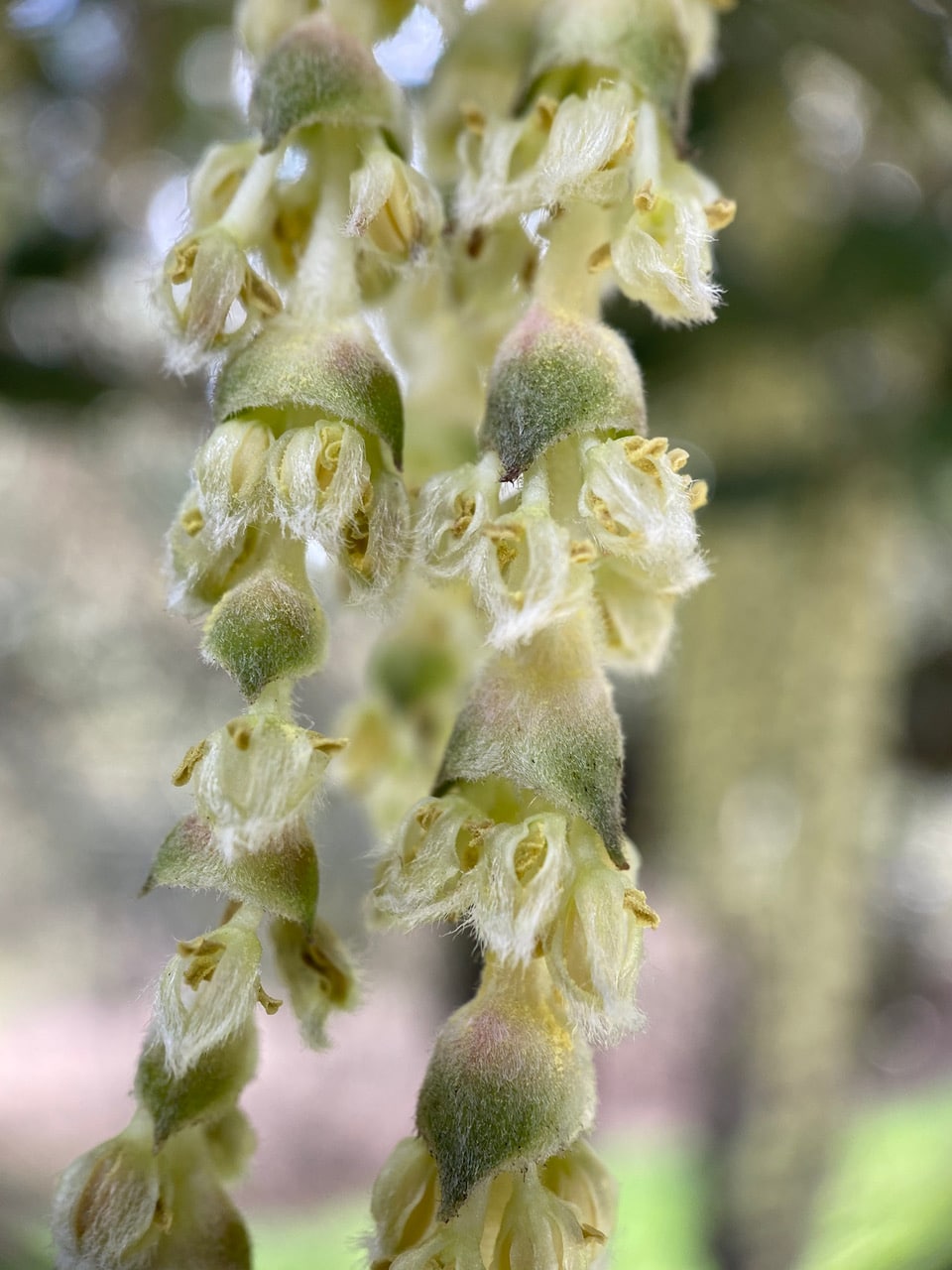
Close-up of the silky male catkins of the Coast Silk Tassel. Within each catkin, tiny male (staminate) flowers are clustered and subtended by two bracts that are fused and form a cup or bell-shaped structure. The flowers are highly reduced, lacking petals. These flowers are wind-pollinated. As the wind blows, pollen is shaken out of the exposed stamens. What a clever design, and so beautiful!
Coast Silk Tassel is an example of plants that are wind pollinated. About 12% of flowering plants and most conifers are wind pollinated. These plants do not waste energy on flower features that attract animal pollinators; instead, their flowers generally have these characteristics:
– Small, petalless, and unscented, with muted colors.
– No nectar
– Stamen (male flower part) and stigma (female pollen-receiving part) are exposed to air currents.
– Male flowers produce a great deal of pollen, which is very small, dry, and easily airborne.
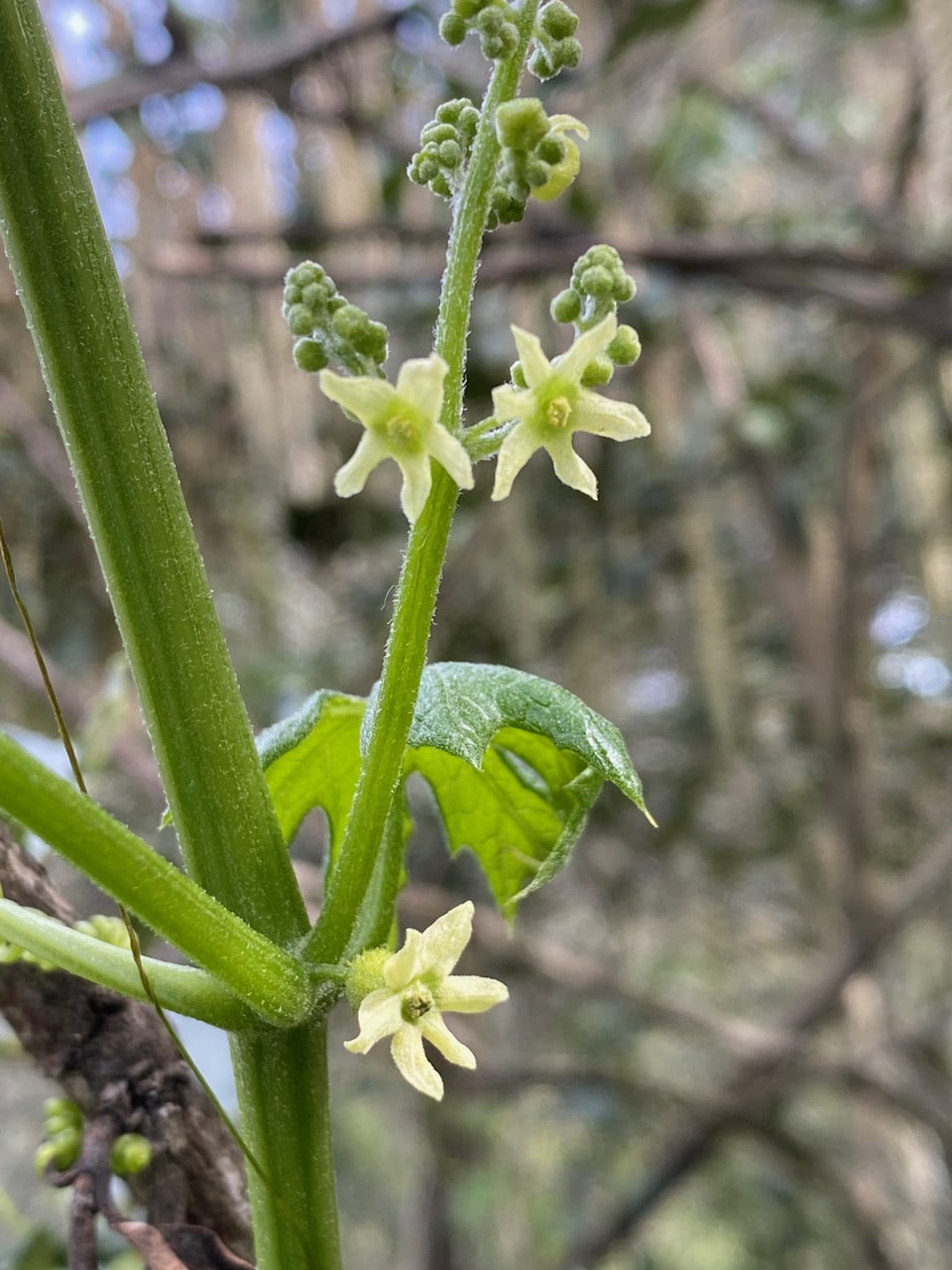
Under the Silk Tassel tree, a California Manroot or Wild Cucumber, Marah fabacea has started to bloom. In fact, under the solitary female flower at the bottom is already a developing fruit. Above her are the male flowers.
Wild Cucumber flowers are monoecious: separate male and female flowers are found on the same plant. Male flowers appear in open spikes while solitary female flowers appear at the leaf axil, often beneath the male flowers. A small spiky inferior ovary is already evident when the female flower is very young. This will eventually develop into a spiky fruit.
The wild cucumber is pollinated by insects, but the plant is self-fertile, meaning that pollen from the male flowers can fertilize the female flowers on the same plant.
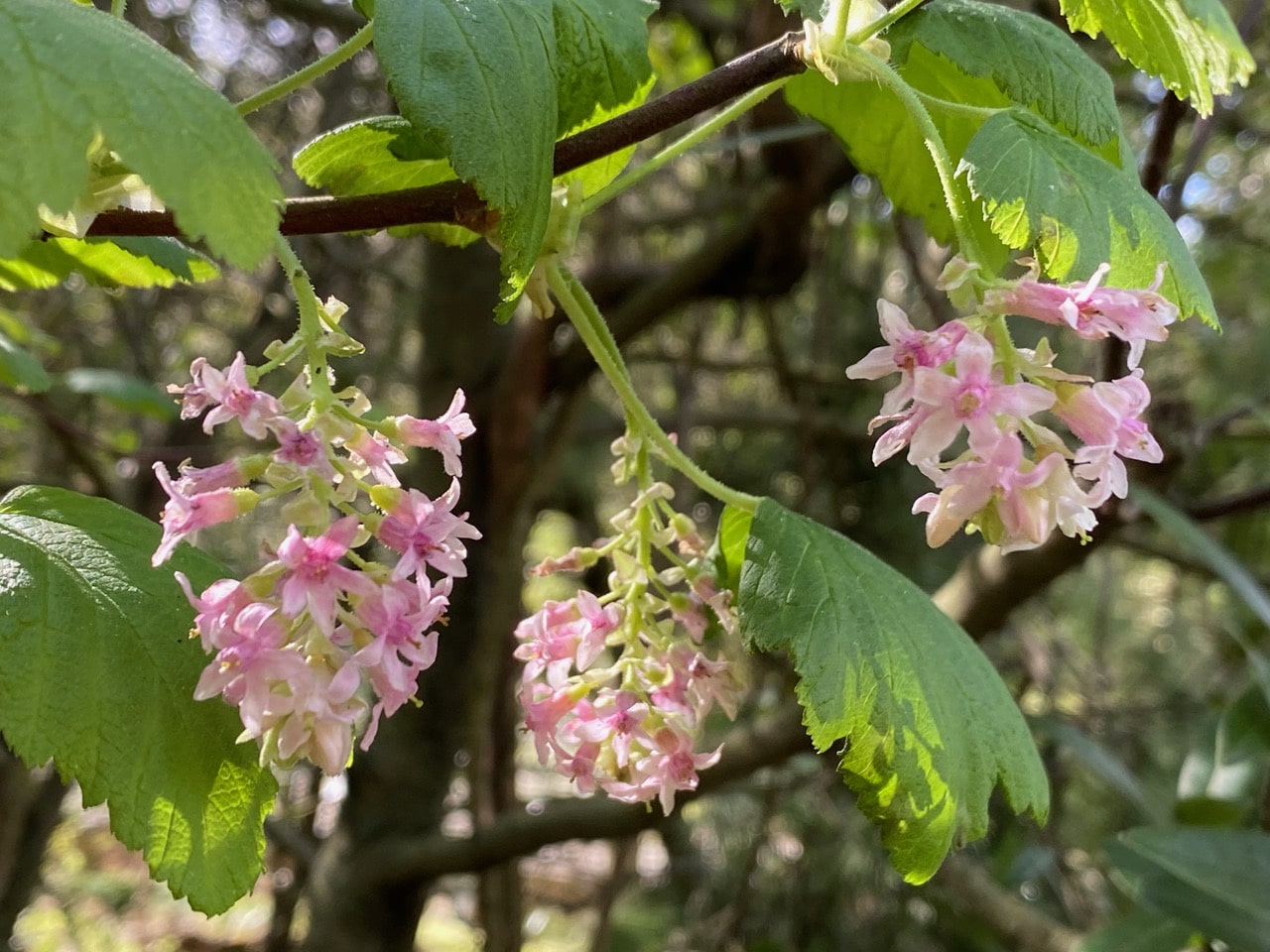
In the dappled shade along a path through the woodland, a Pink-flowering Currant, Ribes sanguineum is in bloom. Clusters of pink flowers hang from slender branches.
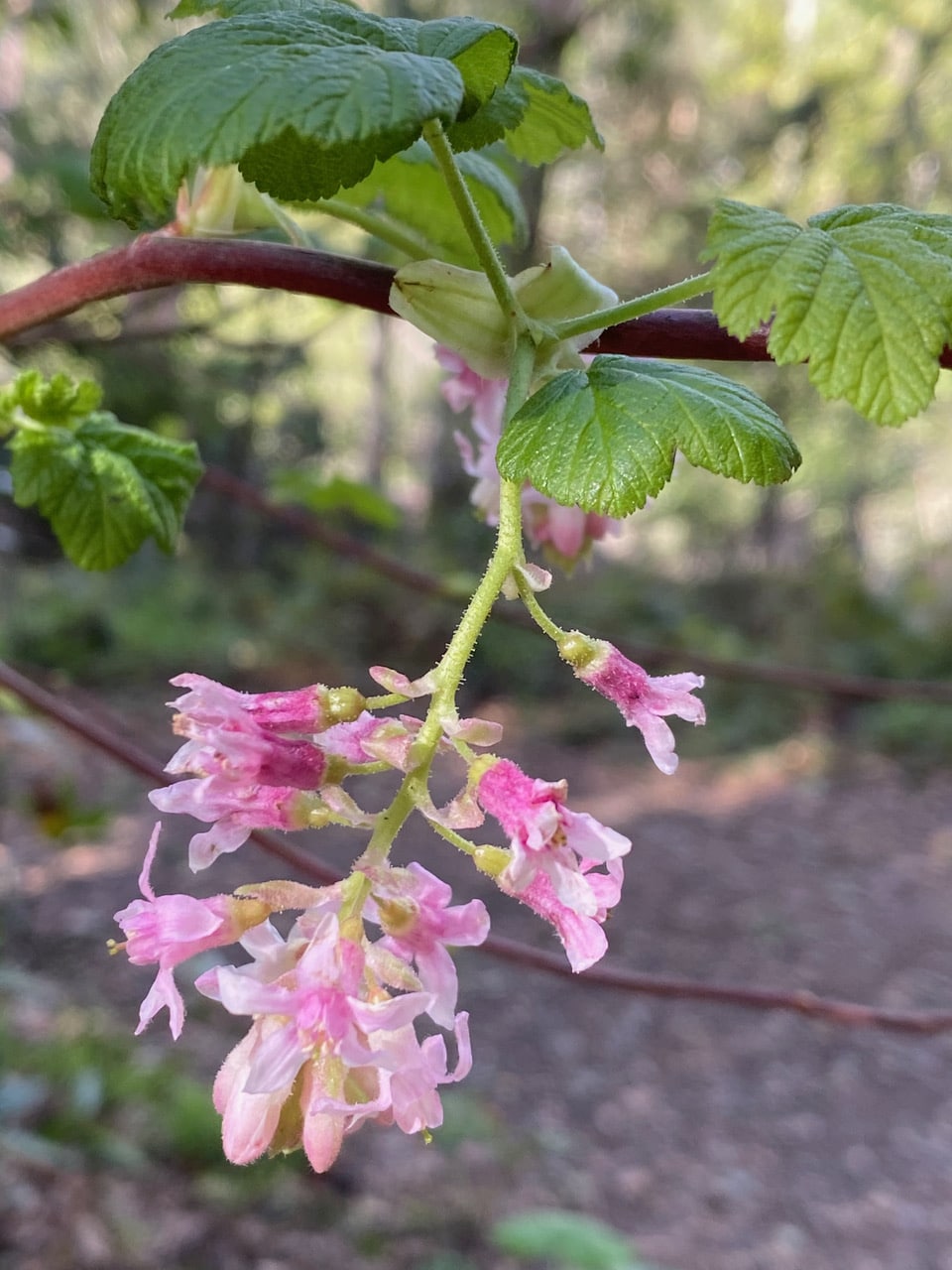
The inflorescences look somewhat battered from the recent rain storms.
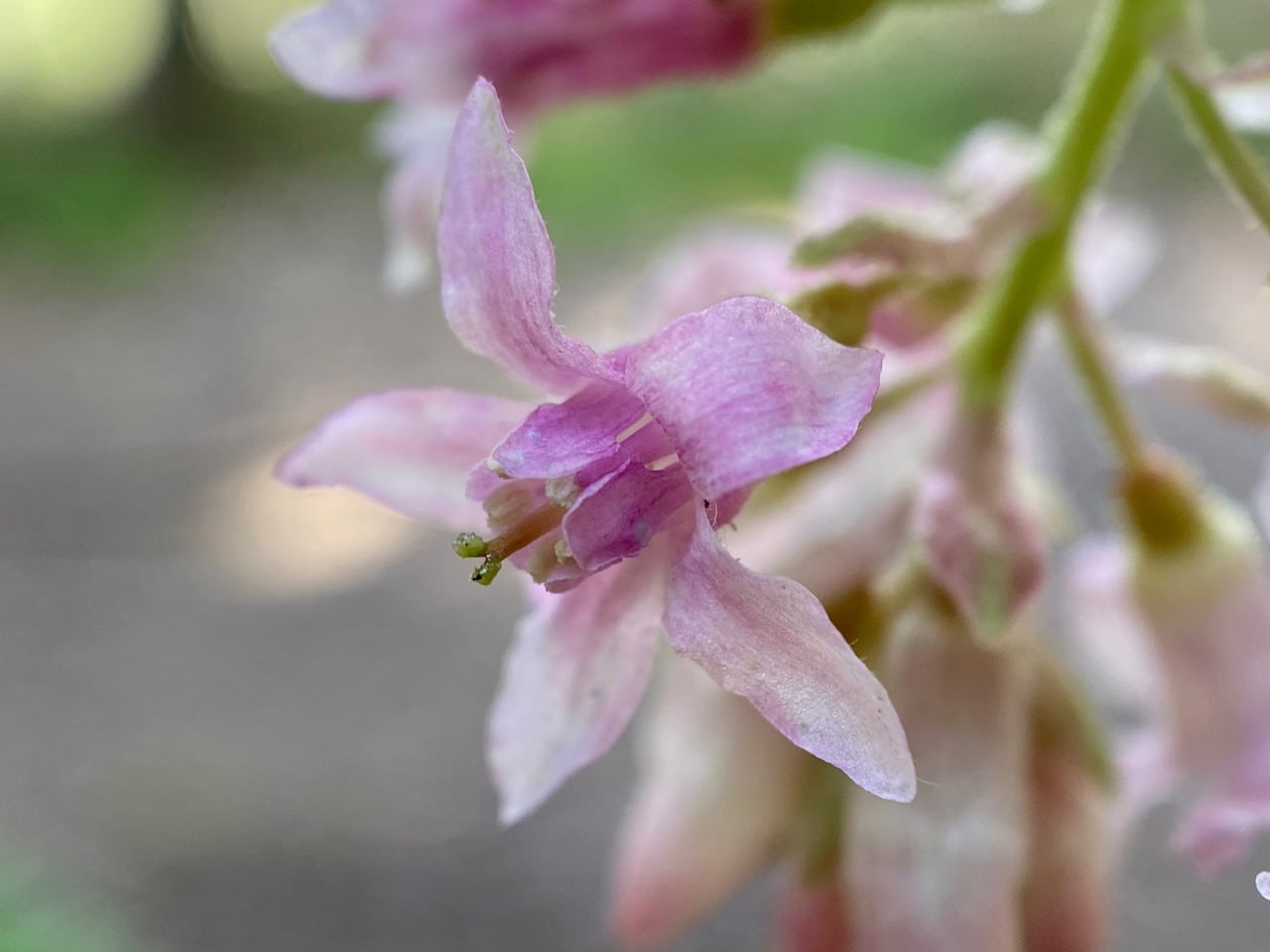 In the Pink-flowering Currant, the largest and most conspicuous flower parts are not the petals, but the 5 flaring sepals. The small petals stand erect in the middle, forming something of a cup around the reproductive structures. There are five stamens (male parts). The two-lobed style (female) protrudes prominently from the center of the flower.




In the Pink-flowering Currant, the largest and most conspicuous flower parts are not the petals, but the 5 flaring sepals. The small petals stand erect in the middle, forming something of a cup around the reproductive structures. There are five stamens (male parts). The two-lobed style (female) protrudes prominently from the center of the flower. Even though the flowers last only a week, they attract pollinators like bees, butterflies, hover flies and hummingbirds. The flowers produce small amounts of nectar, but research shows that the sugar content in the flowering currant is high. The plant is a blessing especially for the bumble bees. The flowers bloom in late winter through early spring just when the queen bumble bees start to emerge from hibernation and need a good supply of nectar to sustain their activity. Bumble bees do not make honey, but they do store the nectar in waxy honey pots in their nests. This nectar store is a vital rainy day food source when the queen is not able to forage, and it also sustains her while she broods her eggs.
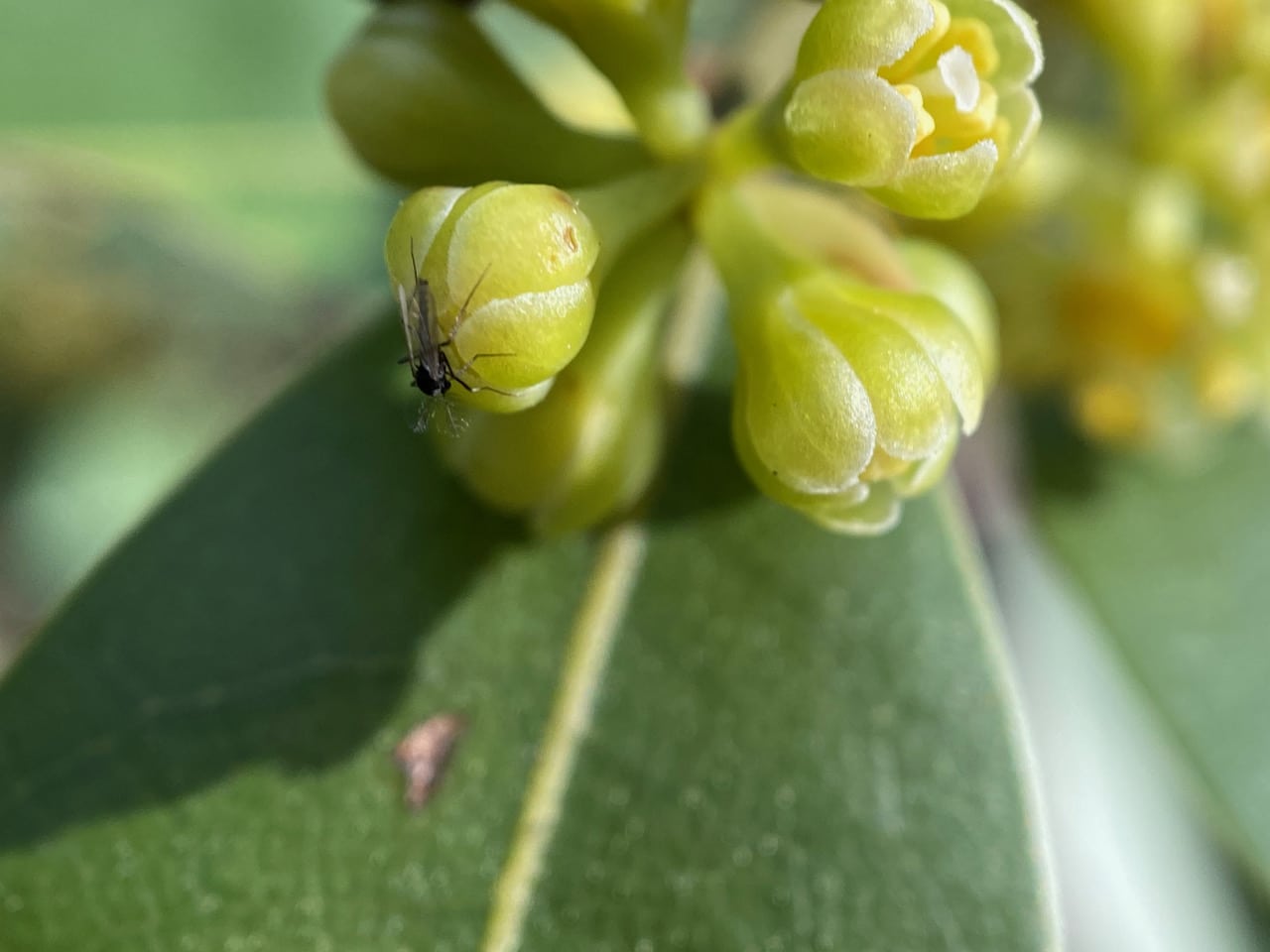
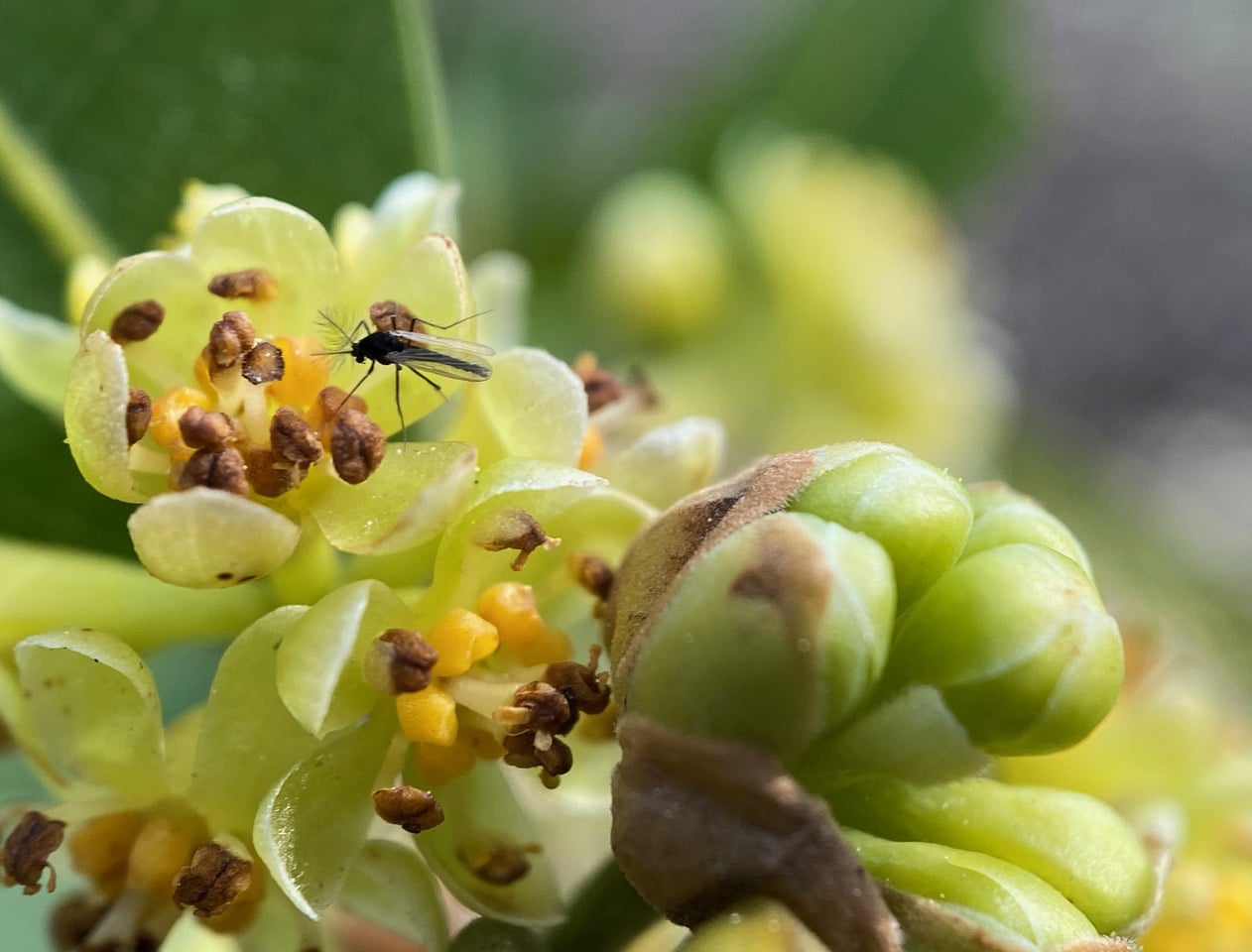
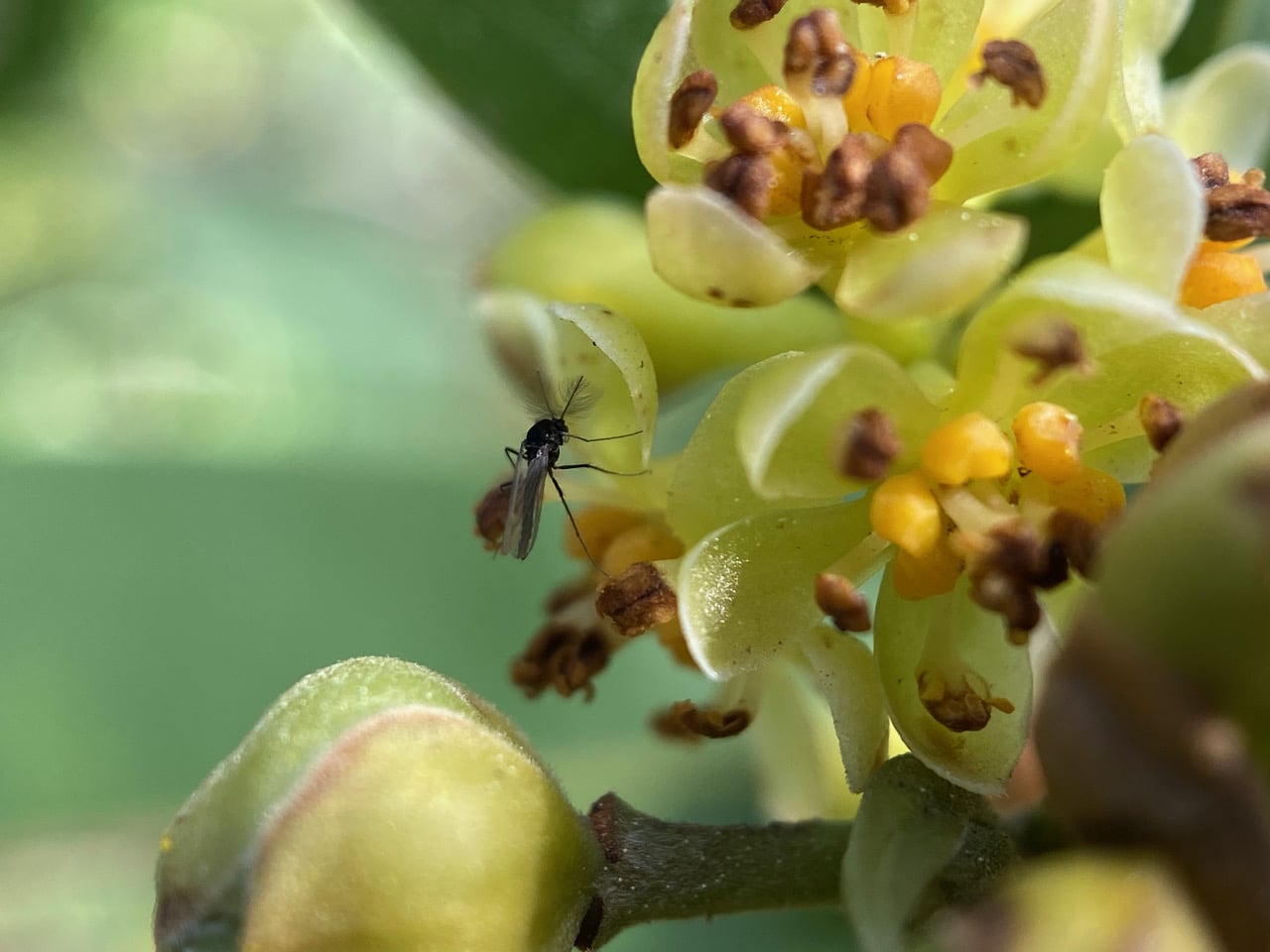
I stop to check on a tiny insect hunched over a flower bud of California Bay. It appears to have feathery antennae.
Yes, indeed, very prominent plumose antennae! This must be a male Non-biting Midge in the family Chironomidae.
The Chironomidae is a large and diverse family of flies, with over 20,000 species known world-wide. Adult midges are small, most measuring 1-10 mm long, with narrow bodies and long legs. They resemble mosquitos, but do not bite. Males have long, feathery (plumose) antennae. Adults are short-lived. They feed on fly droppings, nectar, pollen, honeydew, and various sugar-rich materials. Larvae are mostly aquatic or semi-aquatic; most occur in freshwater habitats, a few occur in decaying matter, under bark, in moist ground, or tree holes. Larvae are mostly scavengers/detritivores. Collectively, they play a vital role in freshwater ecosystems as primary consumers. They harvest an enormous amount of energy from detritus and are important food items for fish, amphibians, birds, and predatory insects such as dragonflies and dance flies. Adult Chironomids can be pests when they emerge in large numbers, forming mating swarms over water or road surfaces.

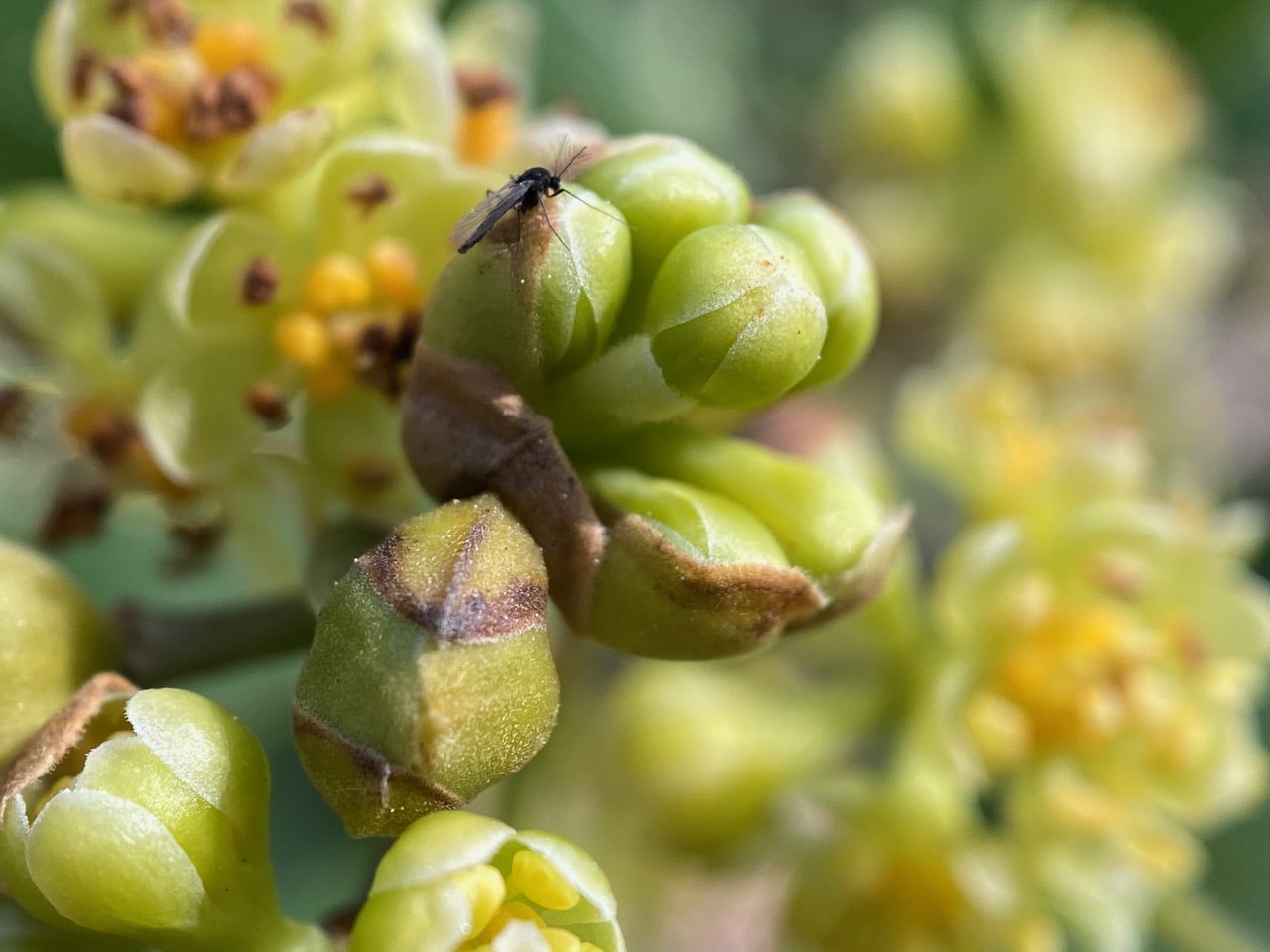
The midge moves slowly from one flower bud to the next, as if in search of something. Nectar? Pollen? I am excited as I have been trying to figure out who pollinates the Bay flowers.
The midge checks out the old flowers on the next inflorescence. The anthers on these flowers have turned brown and are no longer producing pollen. Maybe the nectar at the base of the flowers has dried up as well?
I follow the movements of the midge on the inflorescence for quite a while, but do not see any feeding activity. Finally it flies away, probably disappointed. It’s unfortunate that the flowers are either immature or too old to provide nectar or pollen. I still think that the Chironomids are a good candidate pollinator for California Bay, as the insects are active during the bloom period of the tree. They are often seen swarming over the bay trees in winter.
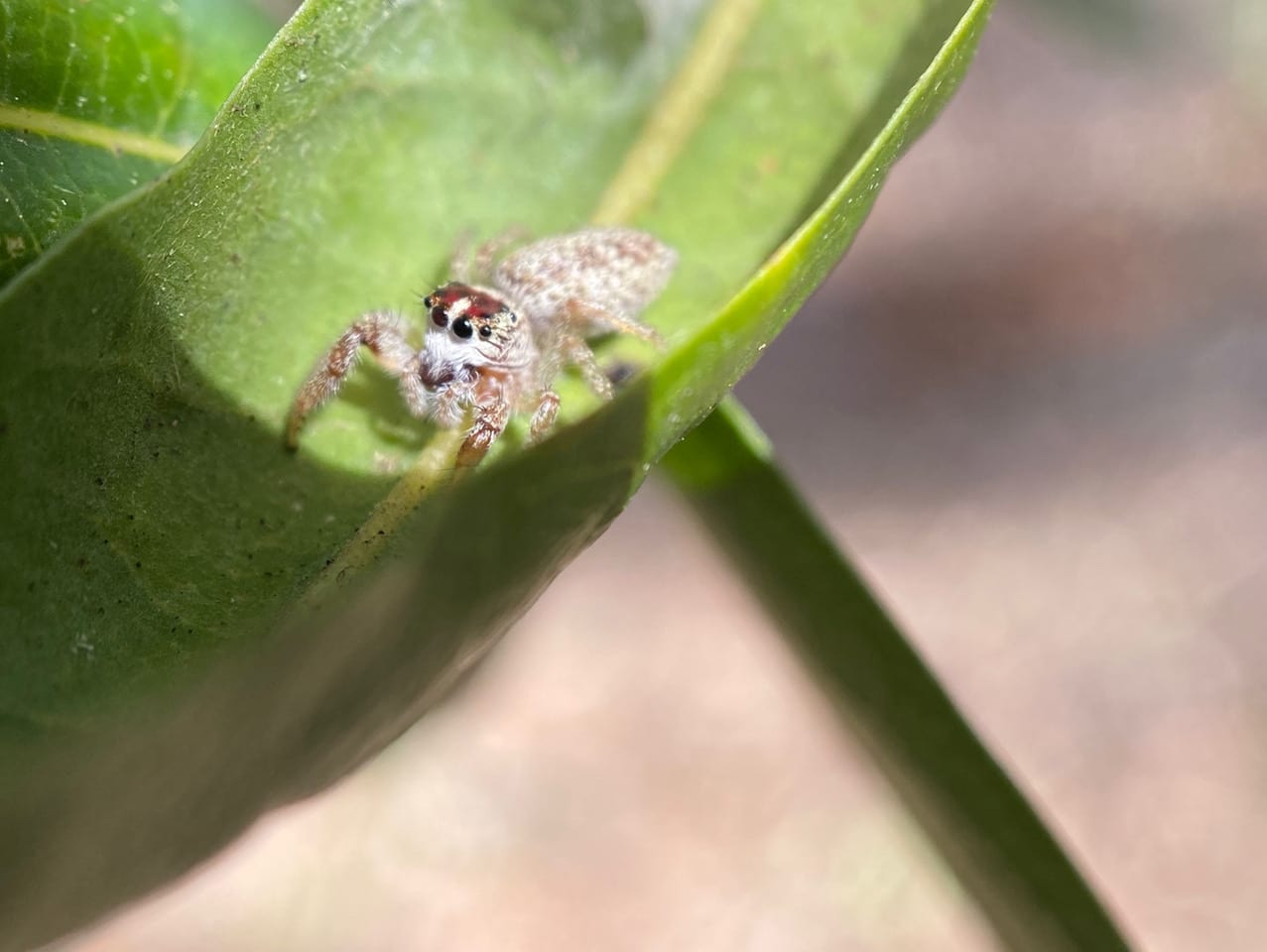
I spot a small Jumping Spider basking on a California Bay leaf. As I approach with the camera, the spider slips under the leaf. I wait for a while, then decide to turn the leaf over to see if the spider is still there. It’s still there, peering out from its tubular silken retreat that has an opening at both ends.
The poor thing looks absolutely panicked, but would not leave its retreat. It must be terrifying for the spider to have its secret hideout discovered so rudely.
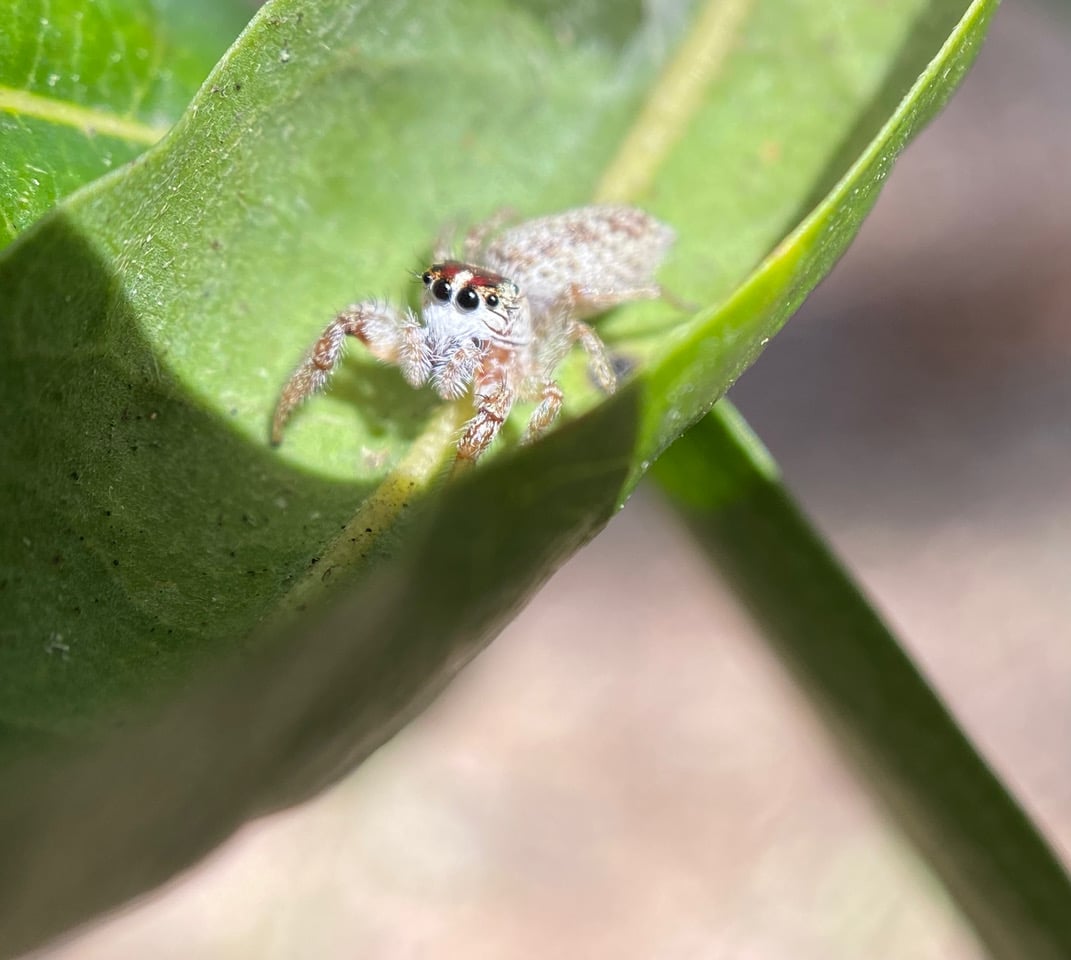
I quickly tilt the leaf into the light to get a better look at the spider’s colors, then beat a fast retreat.
iNaturalist has helped to identify the spider. Its name is Phanias harfordi (family Salticidae). Yay, a new jumper for me! Apparently it is a female. The males of the species are more colorful. Phanias are found in western North America, from Washington south to California. These small jumping spiders (5-7 mm) are foliage dwellers, usually found on the leaves of various trees and shrubs. Like other Salticids in general, Phanias females tend to place the eggs in a cocoon, and build a silk cave around it where they stay and guard the eggs. The species is found from mid spring into early winter. (Wow, no wonder our little female is unwilling to leave the retreat. She is probably guarding her eggs! And sadly, she is close to the end of her life.)
Salticids are free-roaming hunting spiders. They do not weave a web to catch prey. They stalk, then pounce on their prey. Just before jumping, the spider fastens a safety line to the substrate. It can leap 10-20 times their body length to capture prey. Their movement is achieved by rapid changes in hydraulic pressure of the blood. Muscular contractions force fluids into the hind legs, which cause them to extend extremely quickly. Jumping spiders are visual hunters. Their excellent vision has among the highest acuities in invertebrates. Since all their 8 eyes are fixed in place and cannot pivot independently from the body like human eyes can, jumping spiders must turn to face whatever they want to see well. This includes moving their cephalothorax up and down, an endearing behavior.
Here’s another view of the devoted mother. She could’ve easily jumped off the leaf, but didn’t. Now I know why. Sorry to have traumatized you, Mama Spider!
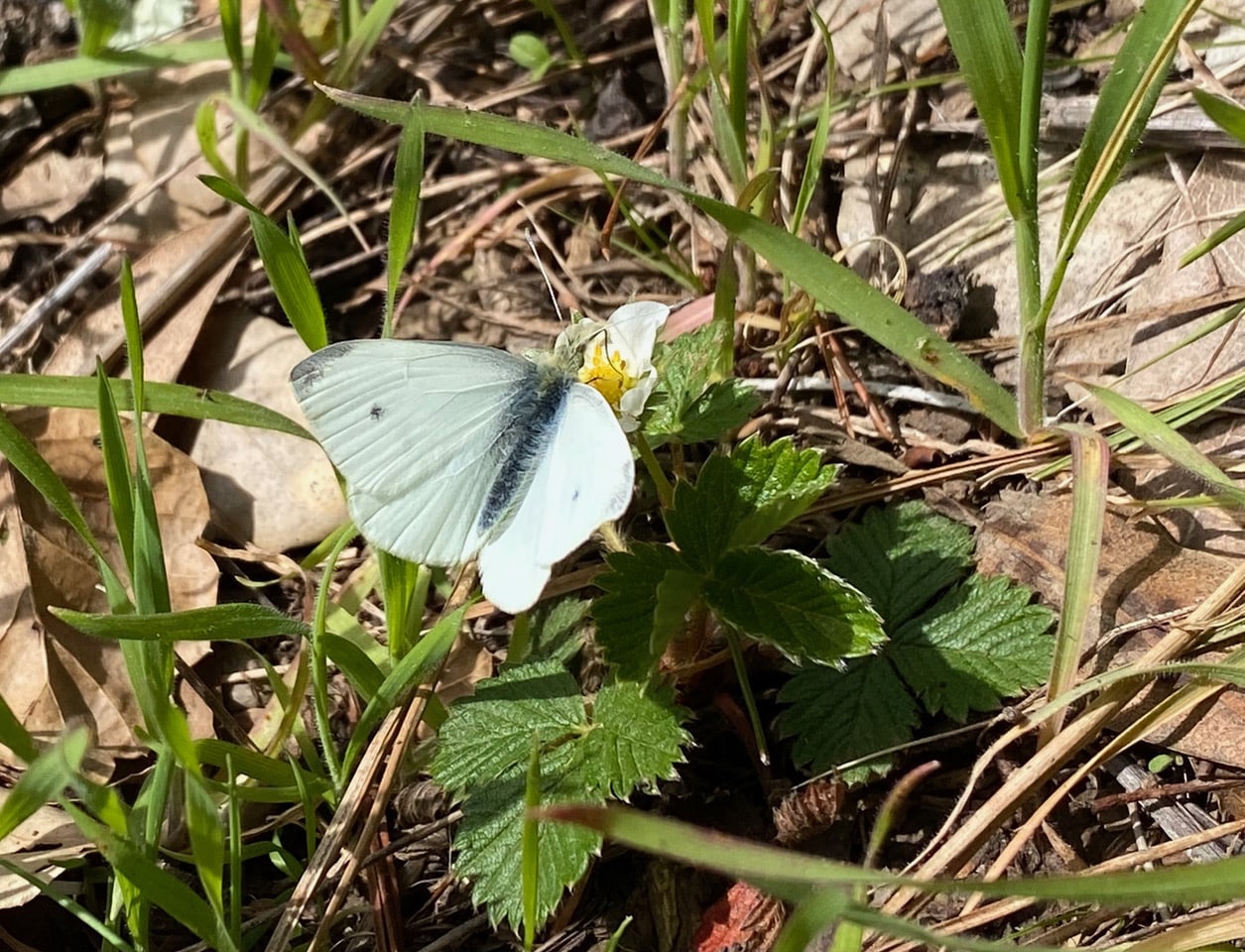
On the open grassy slope at forest edge, a male Cabbage White butterfly is taking nectar from a flower of Woodland Strawberry, Fragaria vesca.
The cabbage white, Pieris rapae (family Pieridae) was introduced to the US along with European cabbage imports in the 1860’5. The caterpillars feed on plants in the mustard or Brassicaceae family, and occasionally some in the caper family. The butterflies have a darkened, yellowish underside of the hind wings, which enables them to heat up quickly in the sun. The butterfly’s white wings reflect ultraviolet light, which we can’t see but the butterflies can. To our eyes the butterflies seem plain and drab, but to each other, females are a gentle lavender and males shine with a deep royal purple. Brighter males are more attractive to females and the color’s strength reflects the amount of protein the males consumed as caterpillars. During mating, male butterflies transfer nutrients to the females in the form of infertile sperm, a nuptial gift which will enhance the female’s life expectancy and fertility. A male with a higher quality diet can afford to be brighter and to produce bigger and more nutritious nuptial gifts.