

Pollinator Post 12/4/25

It’s a cold, crisp morning at the East Bay Regional Parks Botanic Garden. Temperatures hover below 50 degrees F when I arrive around 10 am. I wish I have worn my gloves!
Most of the deciduous trees and shrubs have lost their leaves, but the irrigated garden still looks lush. However there’s hardly any insect in flight.

There are many signs of leaf mining activity on the foliage of the Greenbark Ceanothus, Ceanothus spinosus.
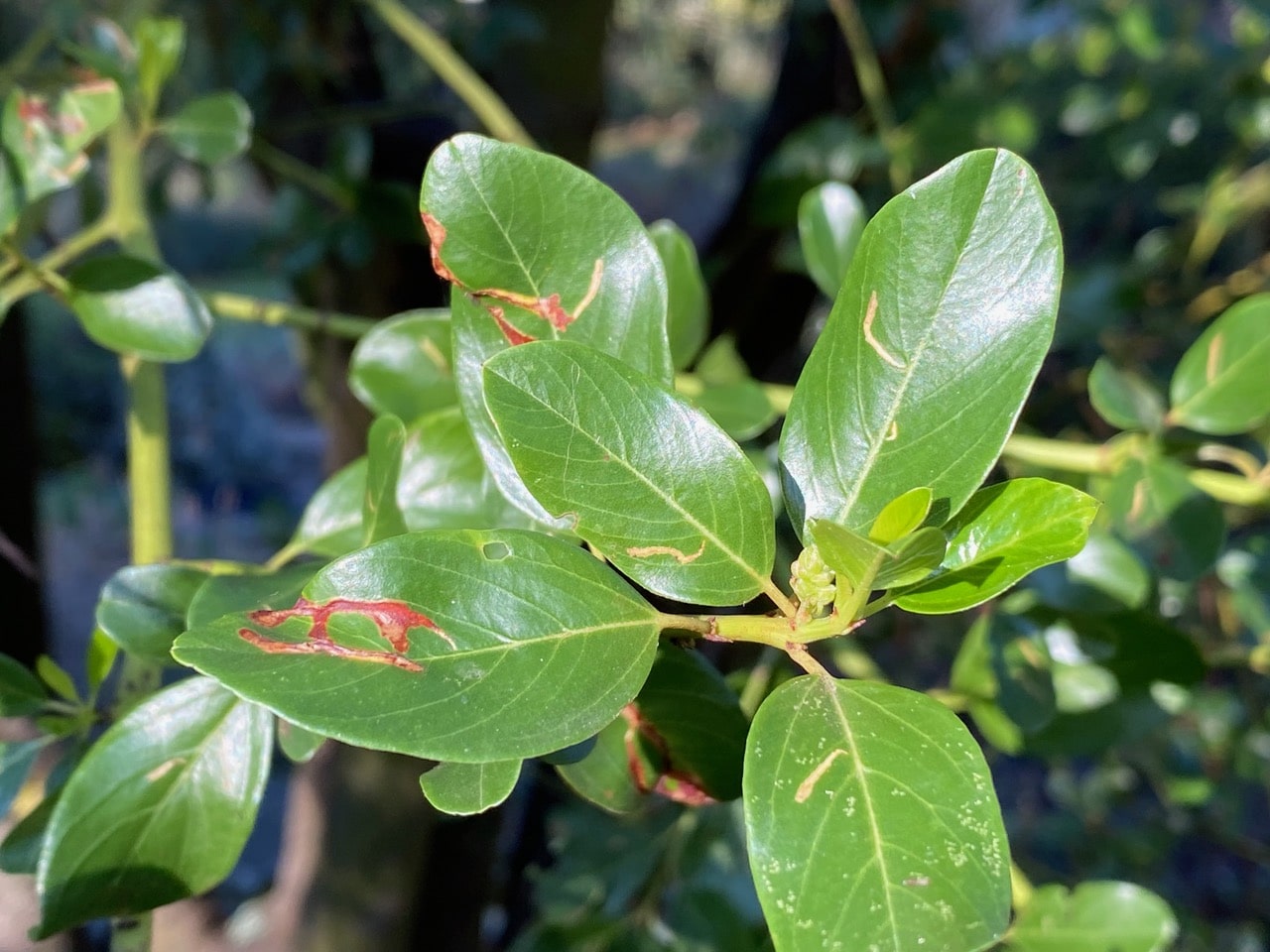
Some of the leaf mines are reddish. iNaturalist has helped identify them as the work of the Leaf-miner Flies, Phytomyza sp. (family Agromyzidae).
The Agromyzidae are a family commonly referred to as the Leaf-miner Flies, for the feeding habits of their larvae, most of which are leaf miners on various plants. They are small flies, most species in the range of 2-3 mm. Agromyzidae larvae are phytophagous, feeding as leaf miners, less frequently as stem miners or stem borers. A few live on developing seeds, or produce galls. There is a high degree of host specificity. A number of species attack plants of agricultural or ornamental value, so are considered pests. The shape of the mine is often characteristic of the species and therefore useful for identification. Adults occur in a variety of habitats, depending on the larval host plants.
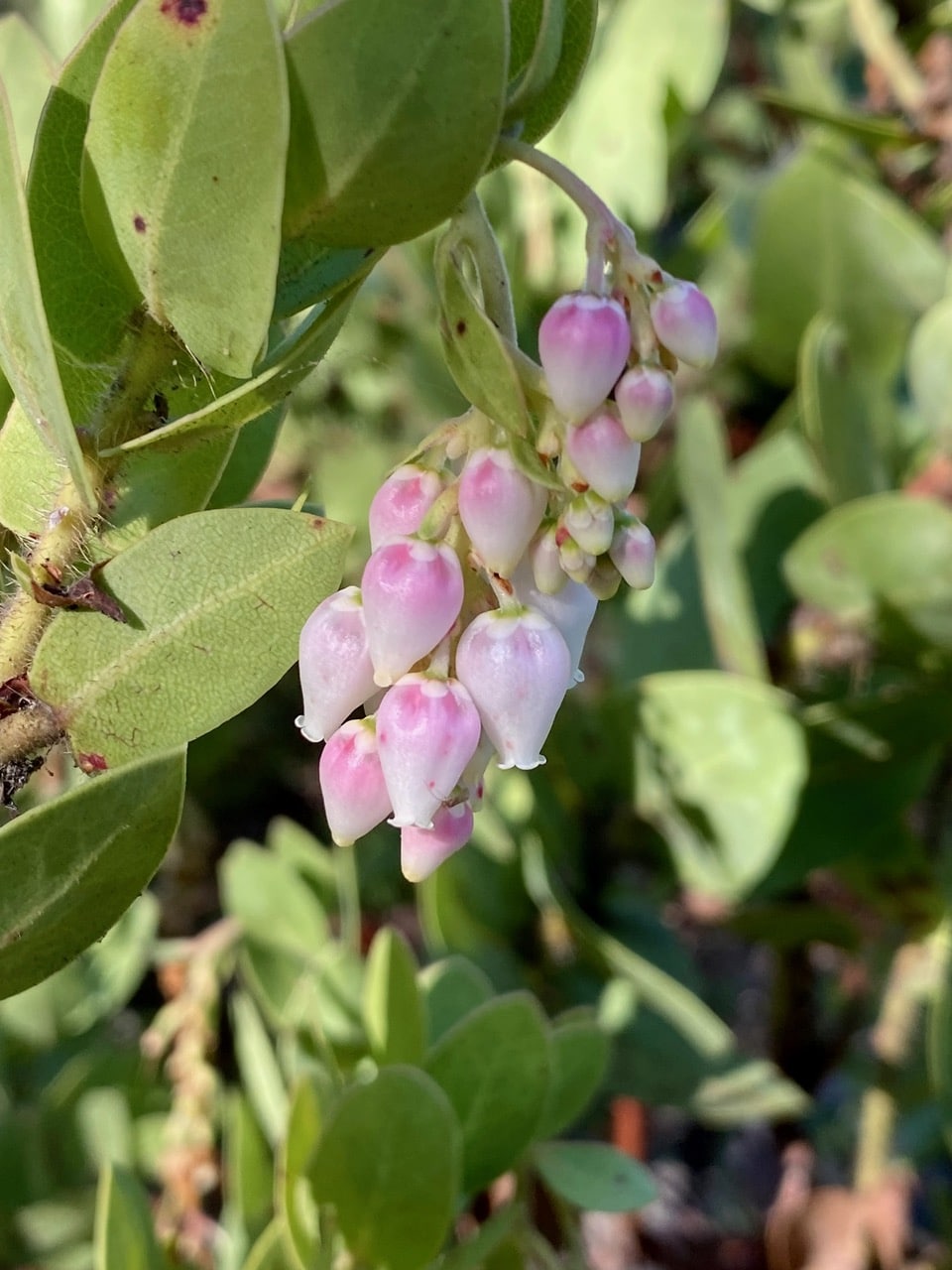
Many species of Manzanita, Arctostaphylos in the garden are already in full bloom. How are these super-early bloomers pollinated? I did see a queen Black-tailed Bumble Bee, Bombus melanopygus buzz pollinate the manzanita flowers, but it flew away before I could get my camera ready.
Manzanita flowers are perfectly adapted for our rainy winter season, using their urn-shaped, downward-facing blooms and waxy coating to shield pollen from rain, while also providing vital food for early-emerging bumblebees and other pollinators during a dormant period for many other plants.

Someone (probably a nectar robber) has chewed a big hole on the side of a Manzanita flower, giving me a convenient view of the interior. Note the maroon-colored anthers that have horn-like appendages attached. When the flower was fresh, the appendages actually made contact with the corolla, so that any movement or vibration on the corolla will be efficiently transmitted to the anthers, shaking pollen out of their large terminal pores. This is how Bumble Bees and a few other large bees are known to “buzz pollinate” manzanita flowers. The bee will hang upside down on the nodding flower, disengage its wings from the flight muscles; then the muscles are vibrated at a specific high frequency (Middle C, around 260-280 Hz) to cause the pollen to shake loose and fall down onto the bee’s belly. The bee gathers the pollen into the pollen baskets on her hind legs before returning to her hive.
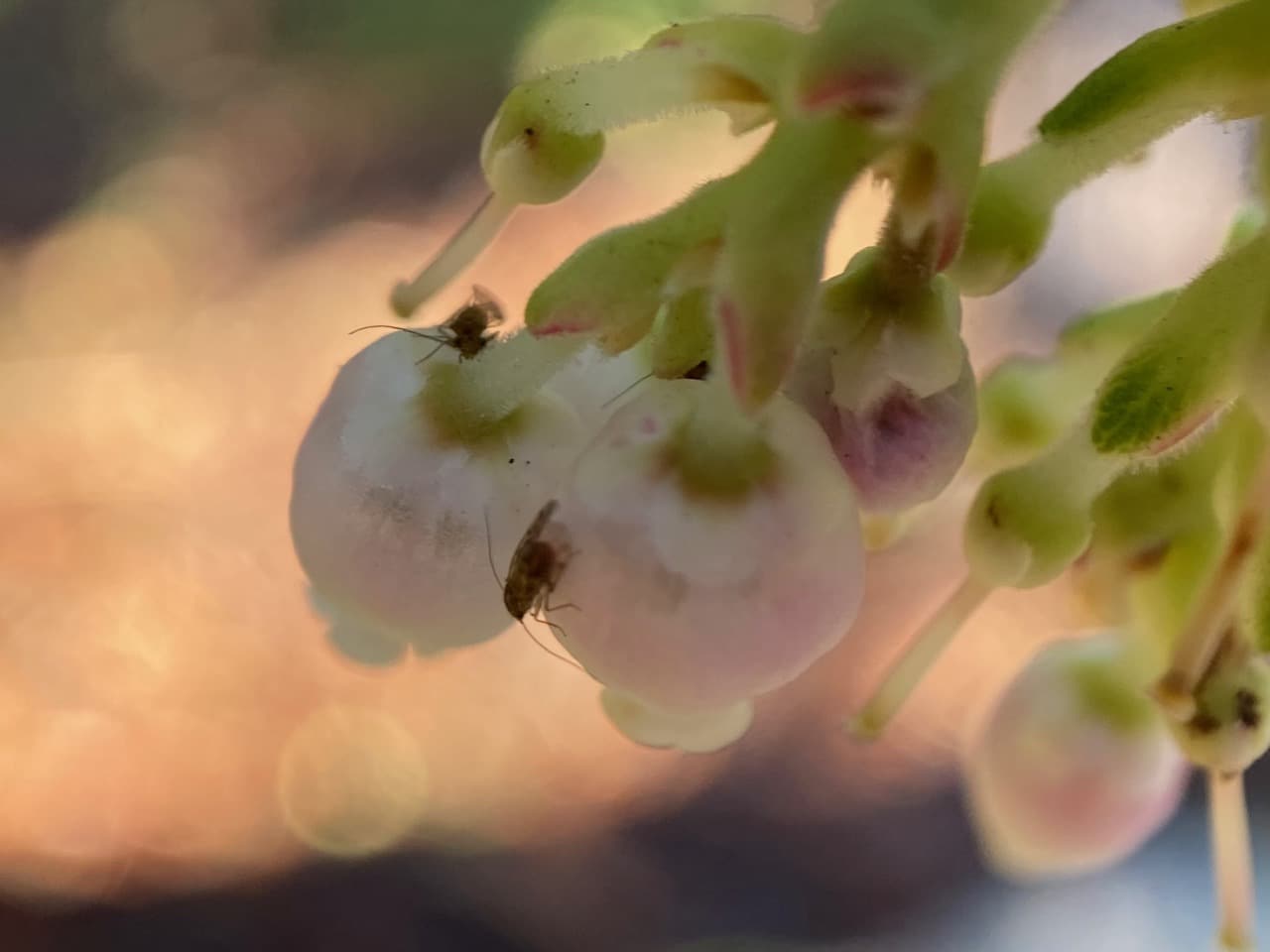
Out of the corner of my eye, I spot some tiny insects on a cluster of manzanita flowers in the shade.
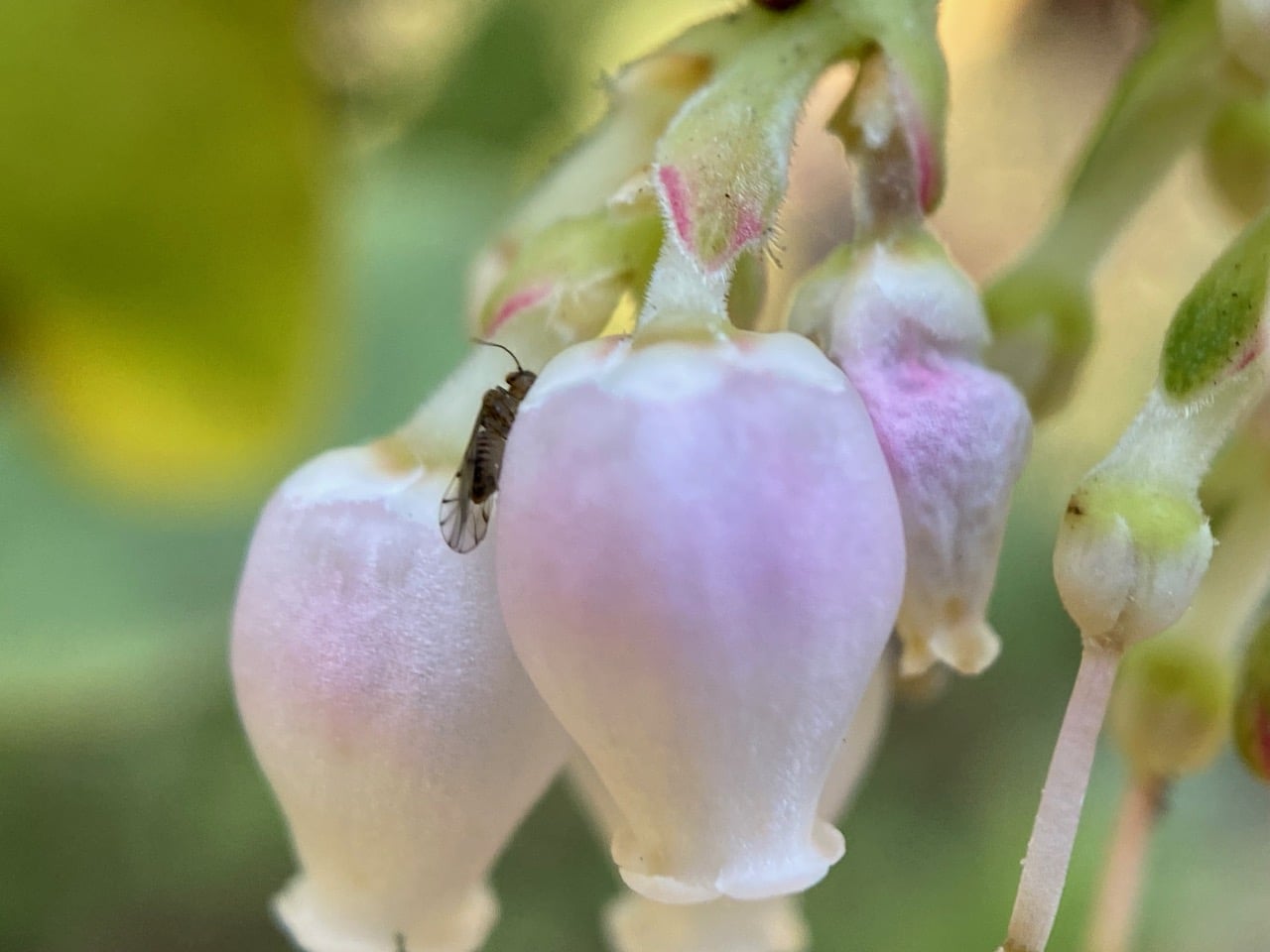
Turning the branch into the light, I finally get a better look at the insects that are weaving in and out between the flowers. They appear to be Barklice (order Psocoptera).
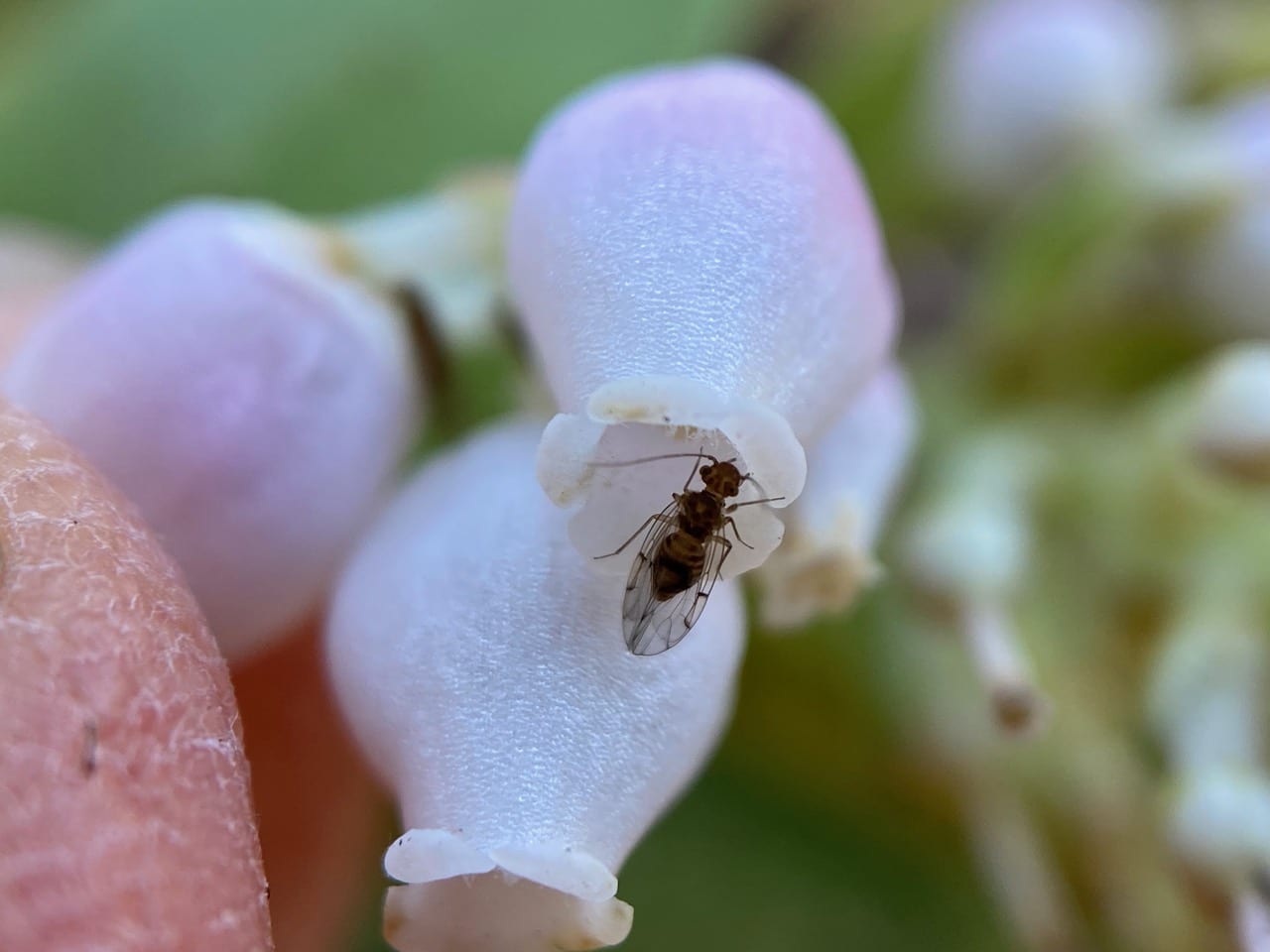
iNaturalist has helped identify the insects as Outer Barklice, Ectopsocus sp. (family Ectopsocidae). This one even ventures into a manzanita flower. Note how easily these tiny insects can slip through the narrow opening of the urn-shaped flowers. I have seen Thrips (order Thysanoptera) do this, and they are known to pollinate manzanitas. Do these Barklice pollinate the manzanita flowers? The urn-shaped, downward-facing manzanita flowers are great shelters for these minute insects during the rainy season.
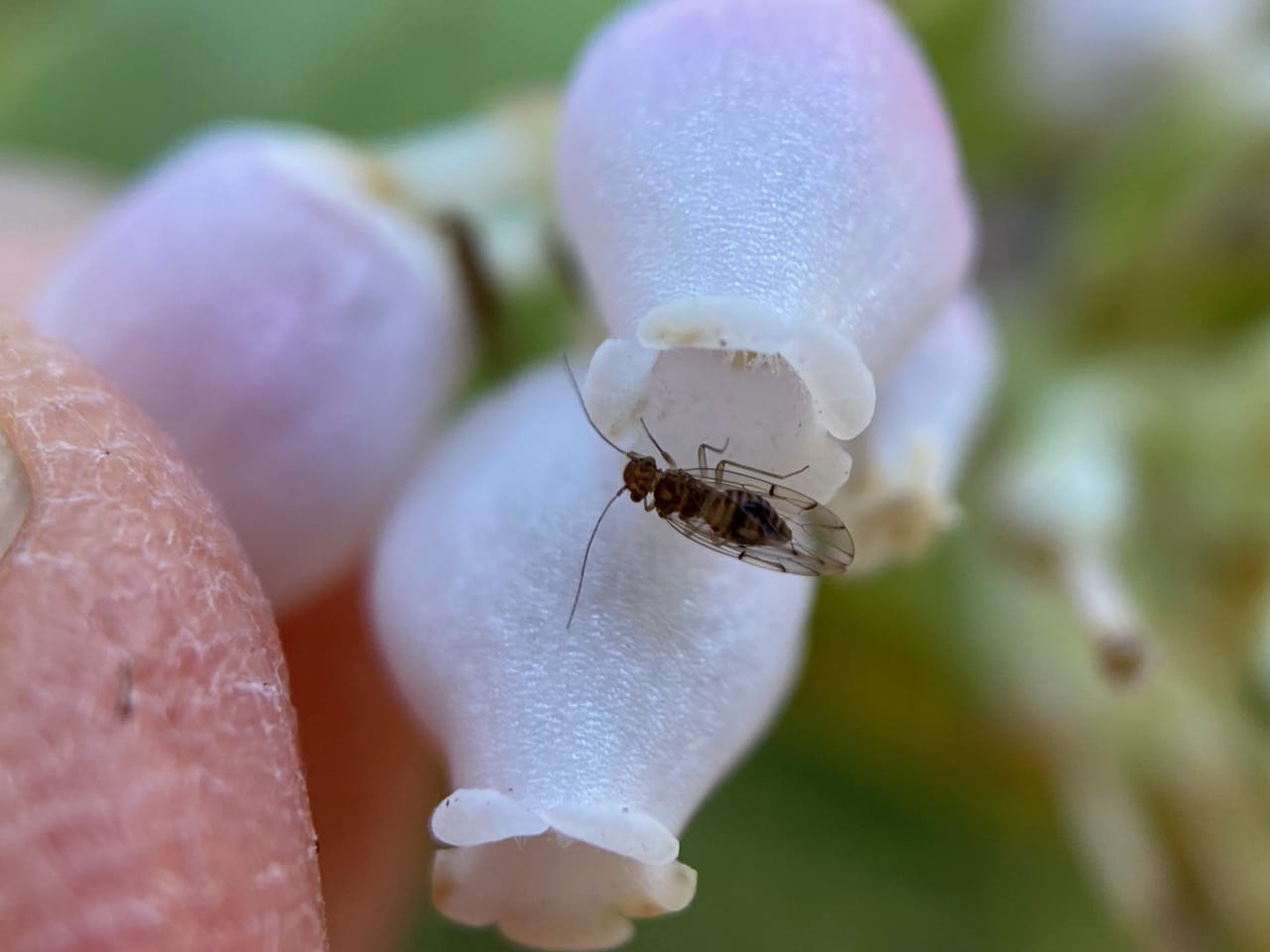
Barklice or Booklice (order Psocoptera) or Psocids are small, scavenging insects that feed on fungi, algae, lichen, and organic detritus on the bark and foliage of trees and shrubs, but are also known to feed on starch-based household items like grains, wallpaper glue and book bindings. They have chewing mandibles, and the central lobe of the maxilla is modified into a slender rod. This rod is used to brace the insect while it scrapes up detritus with its mandibles. The insects are often found in association with sap-sucking insects. Honeydew from the sap-suckers forms the substrate for the growth of sooty mold, which may be a source of food for the barklice.
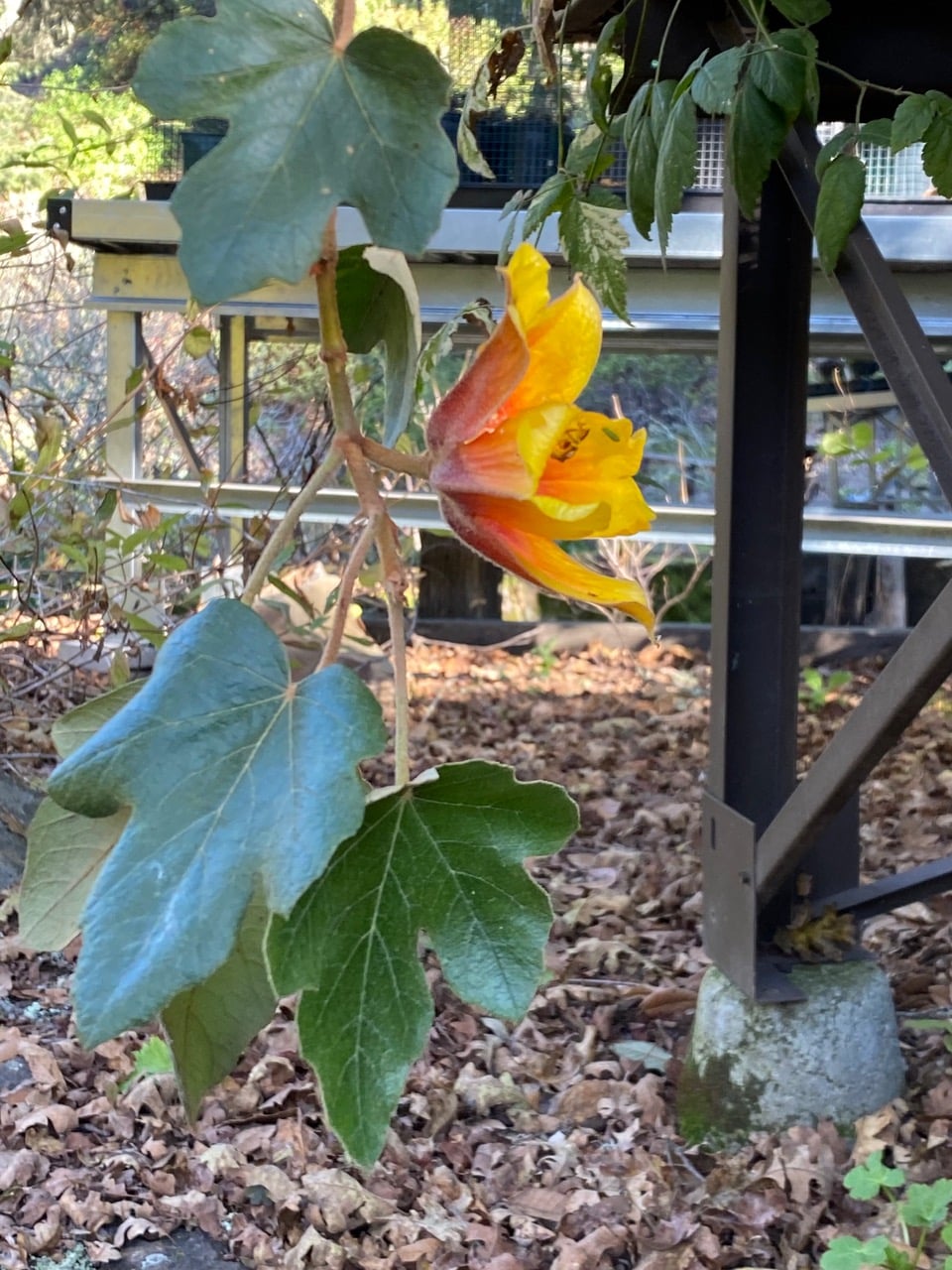
Outside the greenhouse, a large flower is dangling from a potted Flannel Bush, Fremontodendron californicum. There appears to be an insect on the flower.
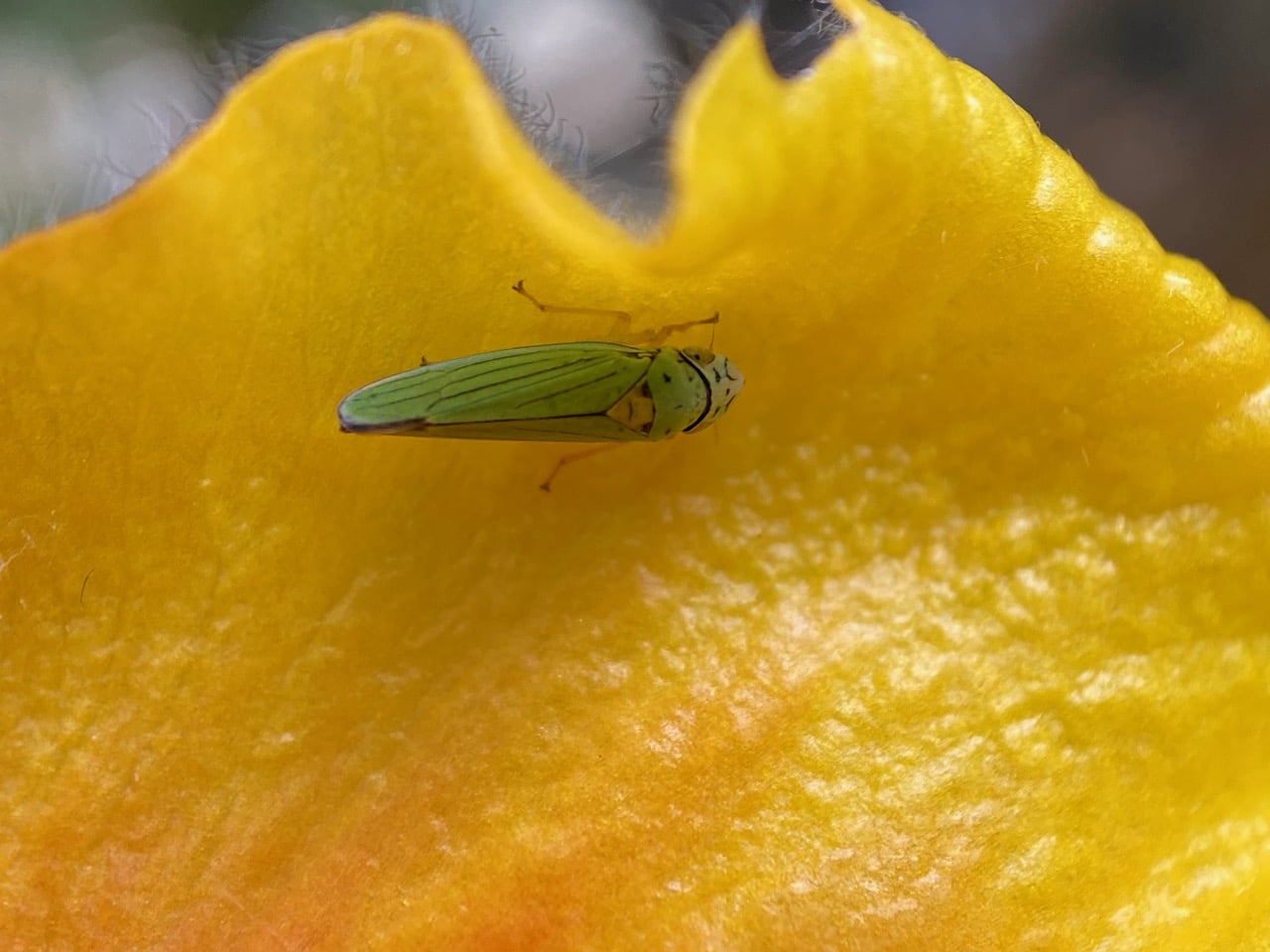
Ah, it’s a Leafhopper called the Blue-green Sharpshooter, Graphocephala atropunctata (family Cicadellidae).
The Blue-green Sharpshooter, Graphocephalus atropunctata (family Cicadellidae) is a hemipteran bug endemic to California. It is about 0.4 in long with blue or bluish-green color on the upper surface while the head, prothorax, legs and underside are lighter and yellow-green. The leafhopper feeds on plant sap, specifically the xylem, using its piercing-sucking mouthparts. Adult blue-green sharpshooters are long-lived. Both nymphs and adults share the peculiar habit of running sideways. There is usually only a single generation per year. The females mature during their first winter and lay eggs the following spring. The bugs can be found in the vegetation alongside streams and rivers, in locations with abundant soil moisture and some shade. They can be found on the leaves of native as well as cultivated ornamental plants and crops. More than 150 plants have been recorded as hosts.
The Blue-green Sharpshooter is known to be a carrier of Pierce’s Disease, a disease infecting grape vine, among other crops of economic importance. As the bugs feed, they inject plants with a bacteria that causes the disease, blocking the flow of water and nutrients through the xylem.
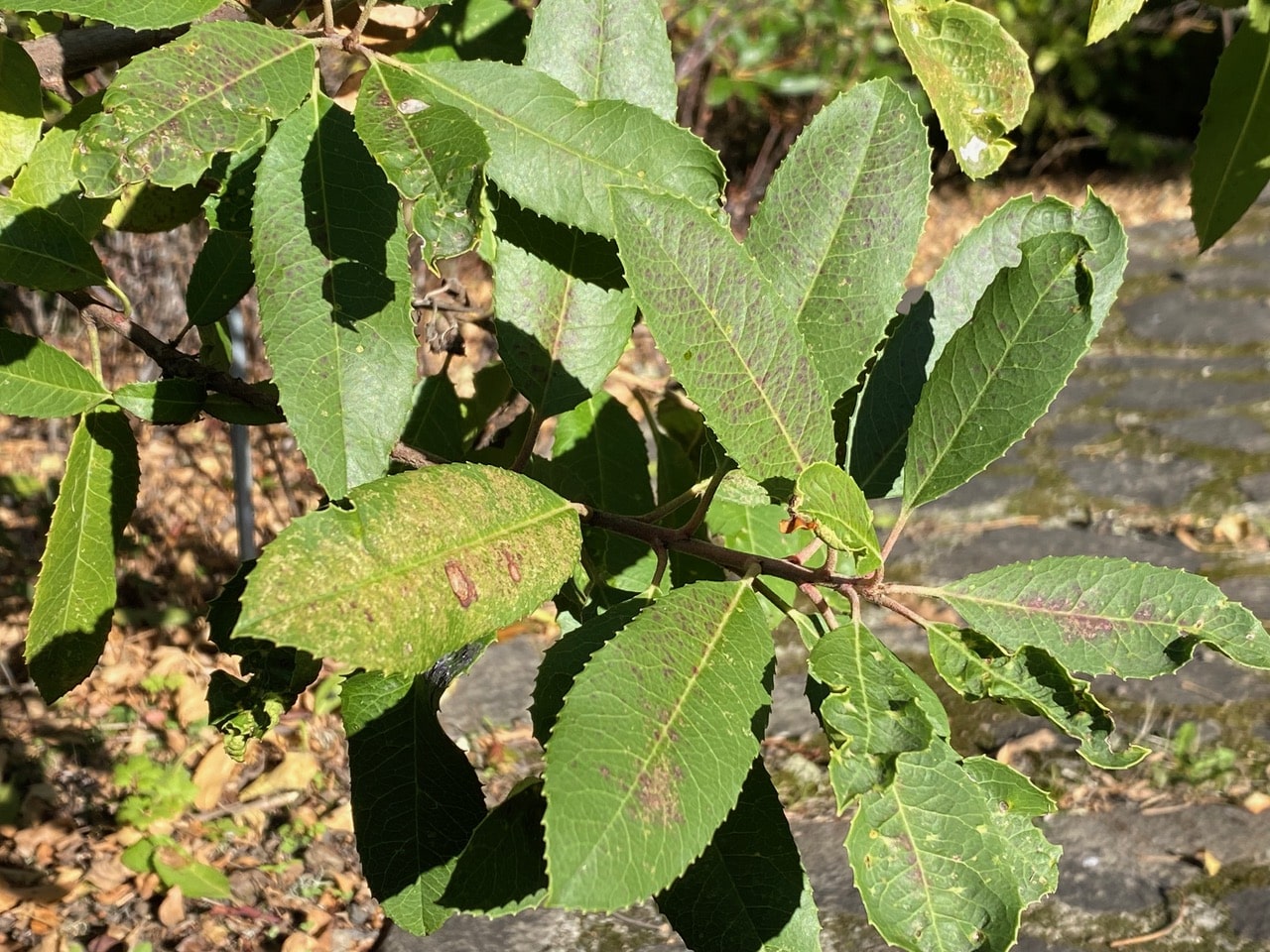
The lower leaves of this large Toyon, Heteromeles arbutifolia look sick. Many are stippled and turning yellow. Some are crinkled.

Turning over several leaves, I finally find the culprits – Toyon Lace Bugs, Corythucha incurvata (family Tingidae).
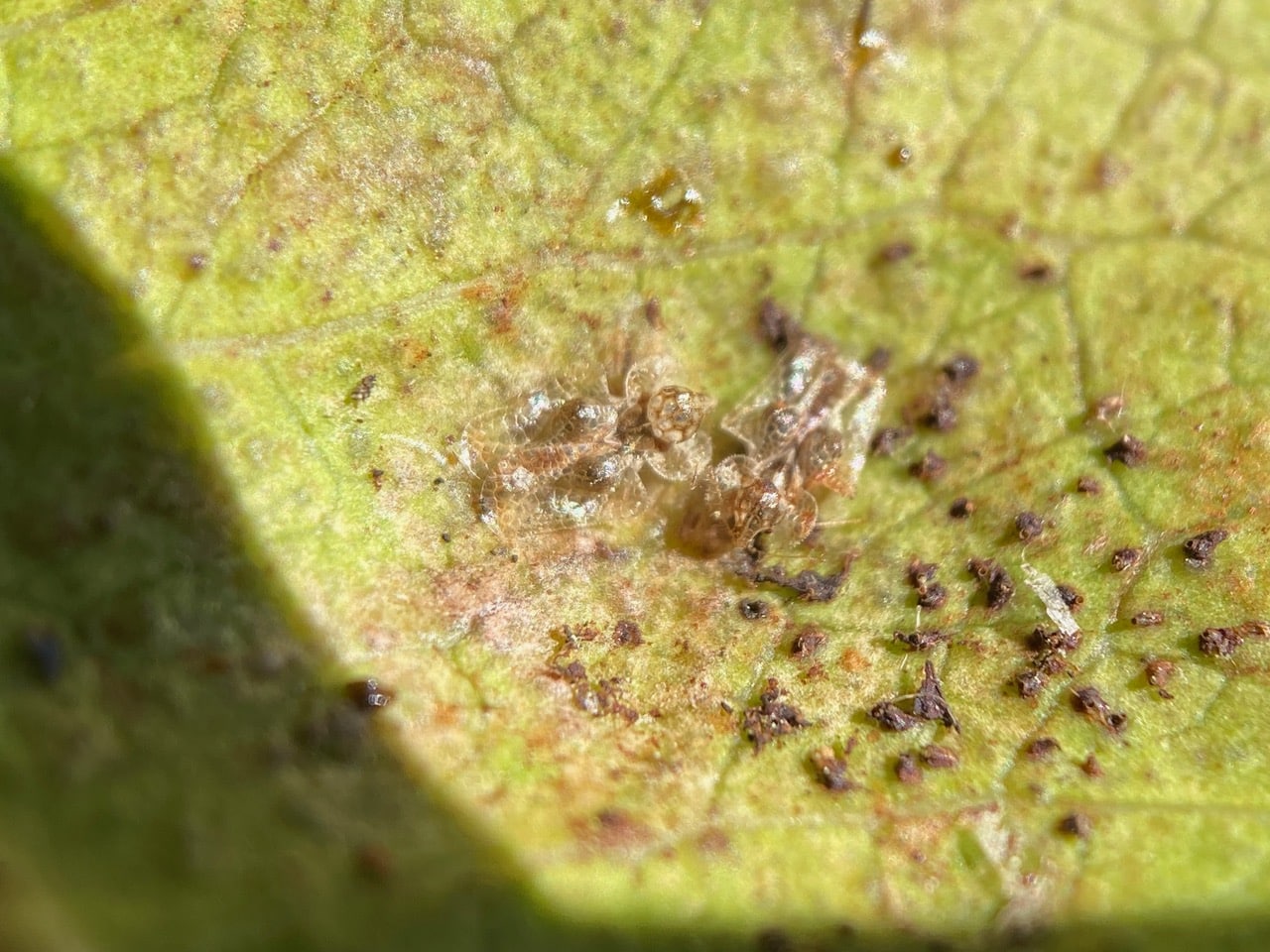
The Tingidae are a family of very small (2-10 mm) insects in the order Hemiptera that are commonly referred to as lace bugs. They are called lace bugs because the pronotum and fore wings of the adult have a delicate and intricate network of divided areas that resemble lace. Their body is flattened dorsoventrally, and the head is often concealed under the hood-like pronotum. Lace Bugs feed by sucking sap from plants, extracting the protein they need and excreting liquid waste as honeydew. The most common symptom of feeding is the stippled and mottled yellowish foliage. In heavy infestations, black sooty mold may develop on the honeydew, impairing photosynthesis by the plant. This may result in some dieback of twigs and branches and a reduction in flowering the following year. Tingids are usually host-specific and can be very destructive to plants. Each individual usually completes its entire lifecycle on the same plant, if not the same part of the plant.
The genus Corythucha is primarily distributed in the northern hemisphere, including Europe, North America and eastern Asia.

Here are some Lace Bug nymphs or their shed exoskeletons. Unlike the adults, they are dark, wingless and spiny.
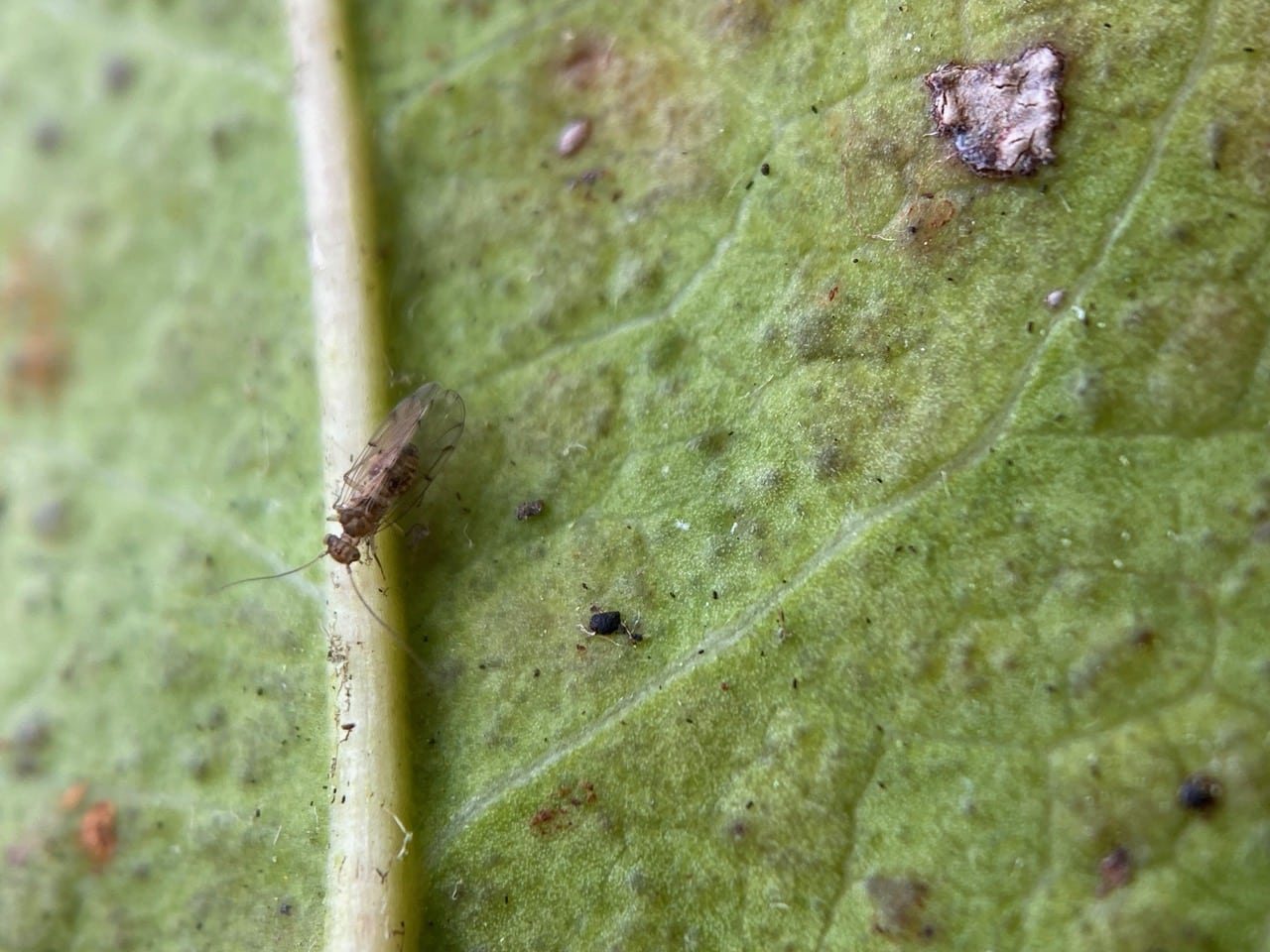
A tiny winged insect is running around on the underside of another Toyon leaf. It is a Barklouse. iNaturalist has helped narrow the ID to the species Ectopsocus californicus (family Ectopsocidae).
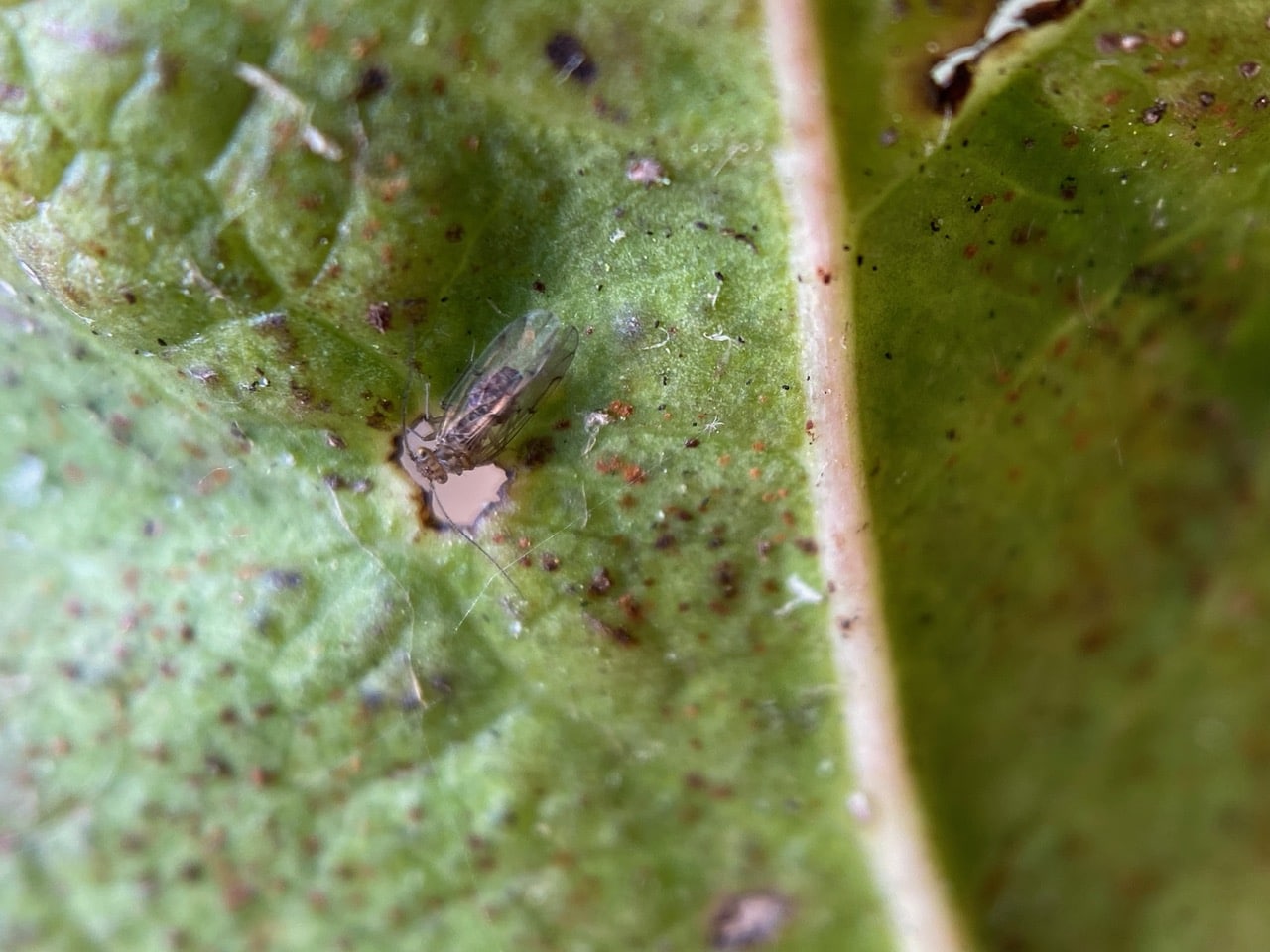
The Barklouse pauses at a hole in the leaf. The insect is probably here to feed on the molds that grow on the honeydew excreted by the Lace Bugs.
Ectopsocus californicus is a species of Outer Bark Louse found in Australia, Central America, and North America. Ectopsocidae is a family of insects in the order Psocodea (book lice or bark lice). Found worldwide, the family includes fewer than 200 species, most of them in the genus Ectopsocus. The Ectopsocids are tiny (2 mm long) insects with a bulbous head that is wider than the pronotum and both fore- and hindwing with distinct dashes along the margins. Forewings are short, broad, and held in horizontal position. Barklice are found on living or dead foliage of a wide variety of trees, including both deciduous trees and conifers. They are harmless grazers of algae, mold, lichens, and decaying organic material, effectively cleaning the tree. For this reason, they are considered a beneficial insect. Members of genus Ectopsocus are only found on trees. Eggs are laid in webbed groups on leaf surfaces. Due to their presence in the feathers of birds it has been speculated that many species of Ectopsocids disperse by phoresy, hitchhiking rides on migrant birds. Many species of barklice use silk strands to form protective, communal webs on tree trunks. These webs are harmless to the tree and serve multiple purposes for the bark louse colony. The silk webbing shields the soft-bodied bark lice and their eggs from natural enemies such as birds and predatory insects. The webs also protect bark lice from wind and rain. The silken sheets create a protective, defined space for the nymphs and adults to move around the tree trunk as they forage for food.

The rare and endangered Palmer’s Goldenbush, Ericameria palmeri var. palmeri is at the end of its blooming, its branches loaded with fluffy seed heads.

An unidentified fly is taking nectar from a Palmer’s Goldenbush flowerhead. It’s amazing that these small insects can fly in temperatures below 50 F.

A Sedgesitter, Platycheirus sp. (family Syrphidae) is also attracted to the Palmer’s Goldenbush, one of the few plants in the garden still in bloom. Its dusky metallic luster distinguishes this common hover fly from most others.
The Sedgesitter, Platycheirus sp. (family Syrphidae) is found in grass and herb vegetation. Adults of many species feed on pollen of wind-pollinated plants, such as Salix, Plantago, Poaceae, Cyperaceae, but they also visit other flowers. Many stay active during cold and rainy weather. Larvae feed on aphids.
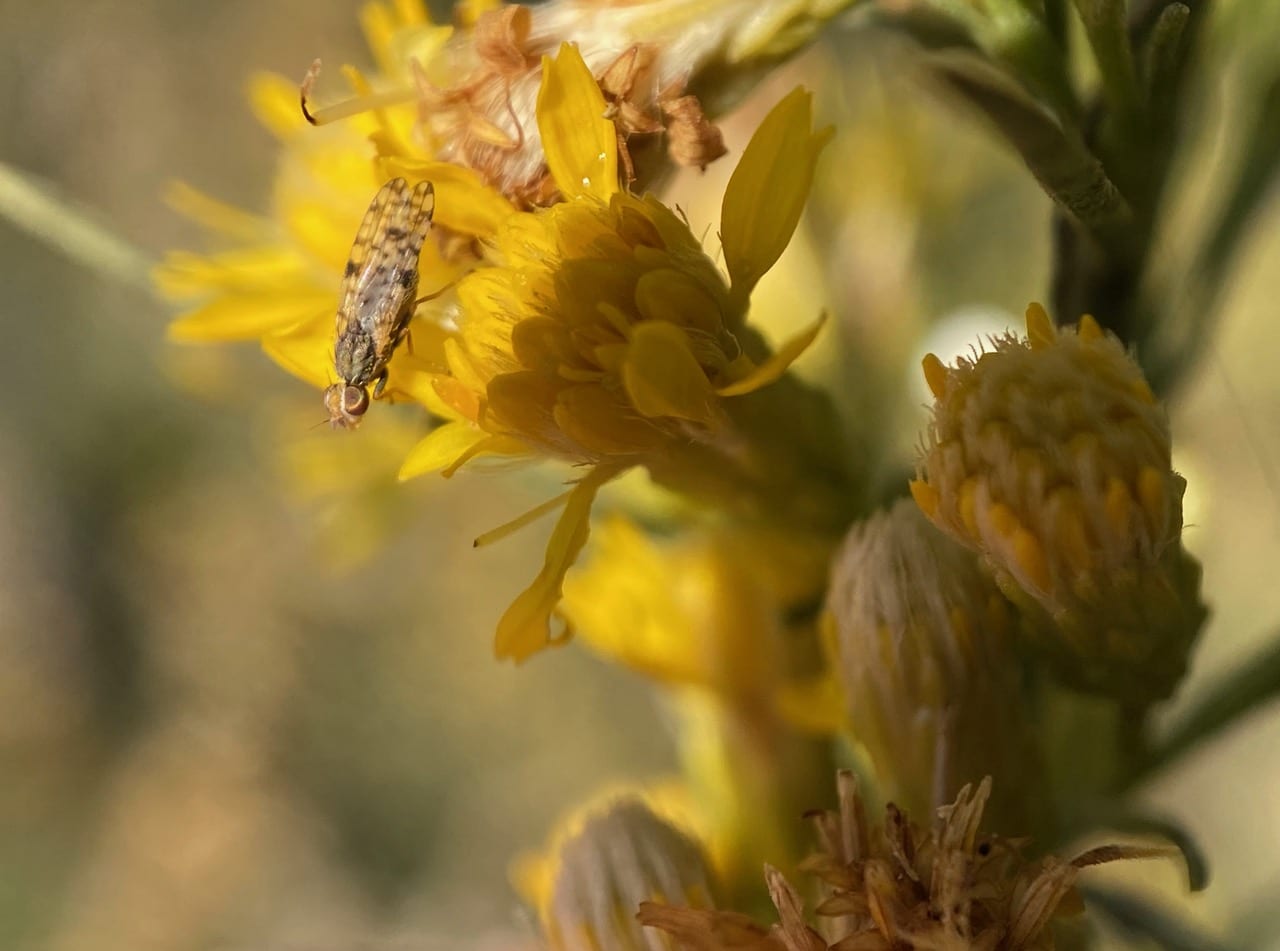
A small fly with picture wings is lurking on a flowerhead of Palmer’s Goldenbush. I recognize it right away as a Fruit Fly (family Tephritidae). iNaturalist has narrowed the ID to the genus Campiglossa.
Tephritids are small to medium-sized flies that are often colorful, and usually with picture wings. The larvae of almost all Tephritidae are phytophagous. Females deposit eggs in living, healthy plant tissues using their telescopic ovipositors. Here the larvae find their food upon emerging. The larvae develop in leaves, stems, flowers, seeds, fruits, and roots of the host plant, depending on the species. Adults are often found on the host plant and feeding on pollen, nectar, rotting plant debris, or honeydew. Tephritid flies are of major economic importance as they can cause damage to fruit and other plant crops. On the other hand, some Tephritids are used as agents of biological control of noxious weeds.
The genus Campiglossa has a worldwide distribution. Adult females oviposit in flowerheads of Asteraceae. The short, stout larvae live in the ovaries, feeding on the developing seeds. Many species are reported to be monophagous, some oligophagous. In entomology, a monophagous insect is one that feeds on only a single species of plant; oligophagous insects feed on a few closely related species.

The Fruit Fly is female, as evidenced by her oviscape.
Female Fruits Flies are easily distinguished by the presence of an oviscape – the pointy structure at the tip of their abdomen. The oviscape is the basal part of the ovipositor, the non-retractile sheath that protects the telescopic ovipositor. It remains exposed when the ovipositor is withdrawn and not in action.