

Pollinator Post 11/4/25

It’s extreme high tide at Crab Cove at 10:45 am. The boat ramp is flooded.

This is the highest tide I have seen here. It suddenly dawns on me that it’s full moon tomorrow, and that we are experiencing spring tides.
Spring tides are characterized by higher high tides and lower low tides, and they occur when the sun, moon, and Earth align during a new moon or full moon. This alignment results in the gravitational forces of the sun and the moon combining, creating a greater tidal range. A specific type, the perigean spring tide, can produce exceptional high tides when this alignment occurs while the moon is closest to the Earth. We will reach perigee (closest point) tomorrow, Nov. 5. In fact, tomorrow’s full moon will be the Beaver Supermoon, which will be the largest and brightest of the year.

I walk the narrow spit lined with Oregon Gumweed, Grindelia stricta on the edges.

The Pickleweed growing on the edges are inundated.
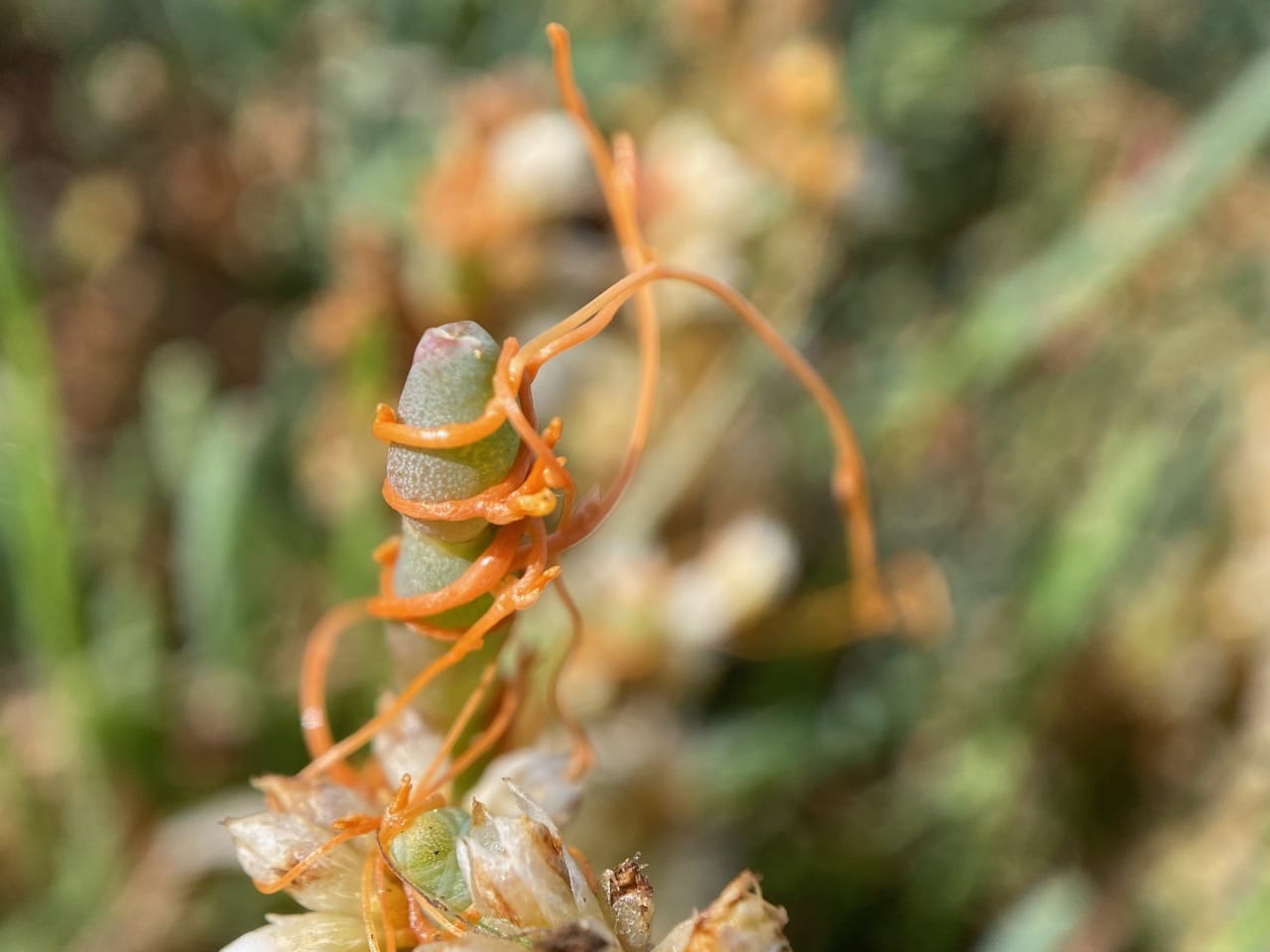
On higher ground, a small patch of Pickleweed, Salicornia pacifica (family Amaranthaceae, formerly Chenopodiaceae) is laden with tangled masses of string-like stems of the parasitic Dodder.
Dodder is an annual parasitic vine in a single genus, Cuscuta in the family Cuscutaceae. Dodders are obligate parasites, meaning they can’t make a living without their plant hosts. The thin, thread-like, yellow or orange stems grow rapidly entwining and covering their host plants.
Dodder seeds germinate in the soil and can live on their own for 5-10 days. Dodder seedlings are capable of detecting plant volatiles released by prospective host plants. If they have not found a suitable host in time the seedlings will die. Seedlings that find a suitable host twine around the plant and insert haustoria (modified adventitious roots) into the tender stem. The haustoria penetrate and tap the host plant’s vascular system for water, minerals and nutrients. Dodder is weakly photosynthetic, but most produce very little food on their own. As the vine successfully taps the host plant, its connection to the soil is severed. Small, white, bell-shaped flowers form in late summer and early fall and can produce copious amounts of seeds.
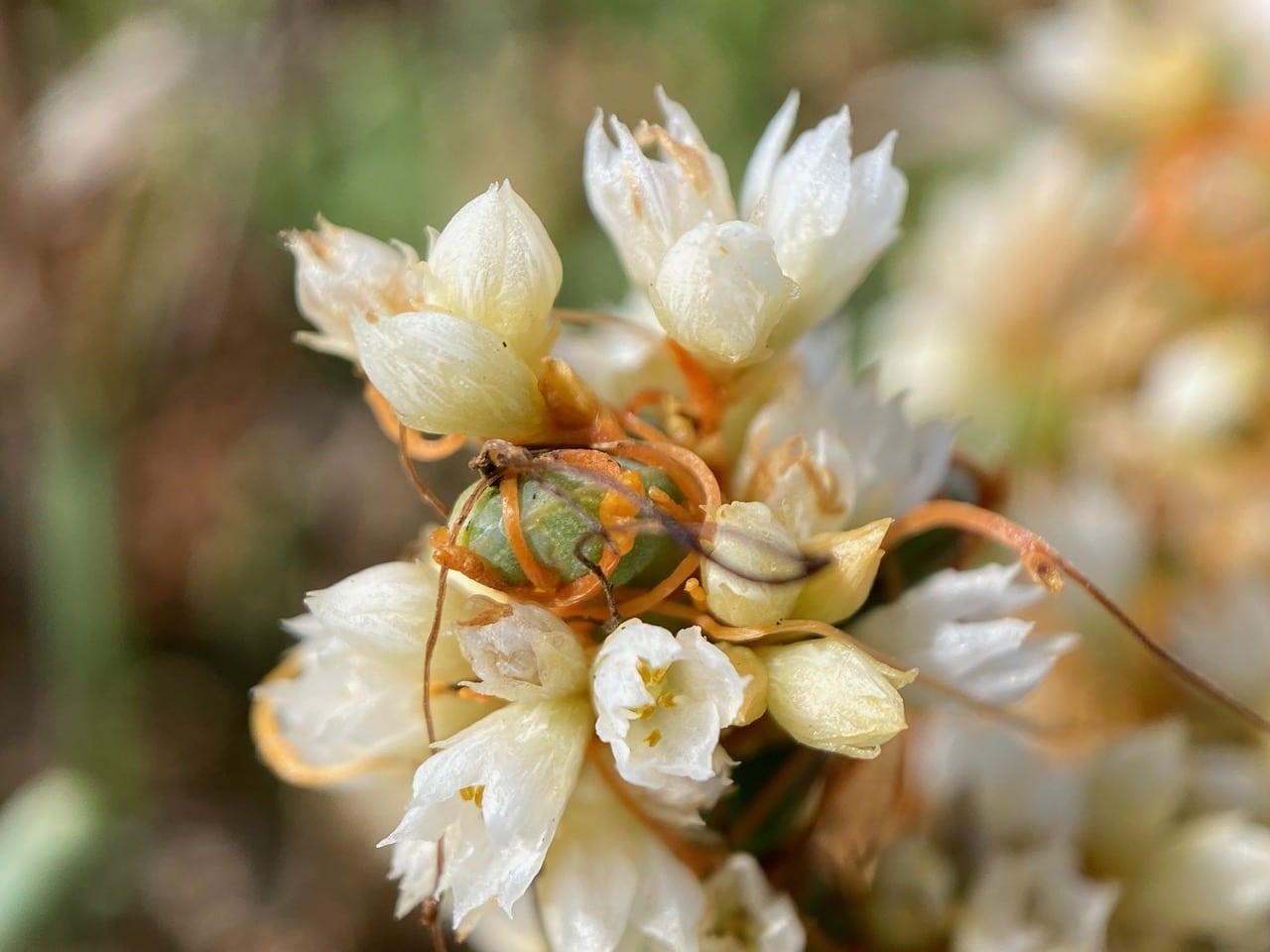
Close-up of Dodder flowers blooming on the Pickleweed.
The small inconspicuous Dodder flowers are primarily pollinated by wasps, particularly small, native wasp species that are attracted to the host plant’s flowers. Dodder uses its host plant’s flowering signals to synchronize its own flowering. The host plant’s leaves sense environmental cues and produce a flowering signal that travels through the plant’s vascular system. Dodder “eavesdrops” on it to produce its own flowers. Dodder flowers generally don’t produce much nectar, and lack their own strong floral scent. It relies on the proximity to its host plant’s flowers to attract pollinators.
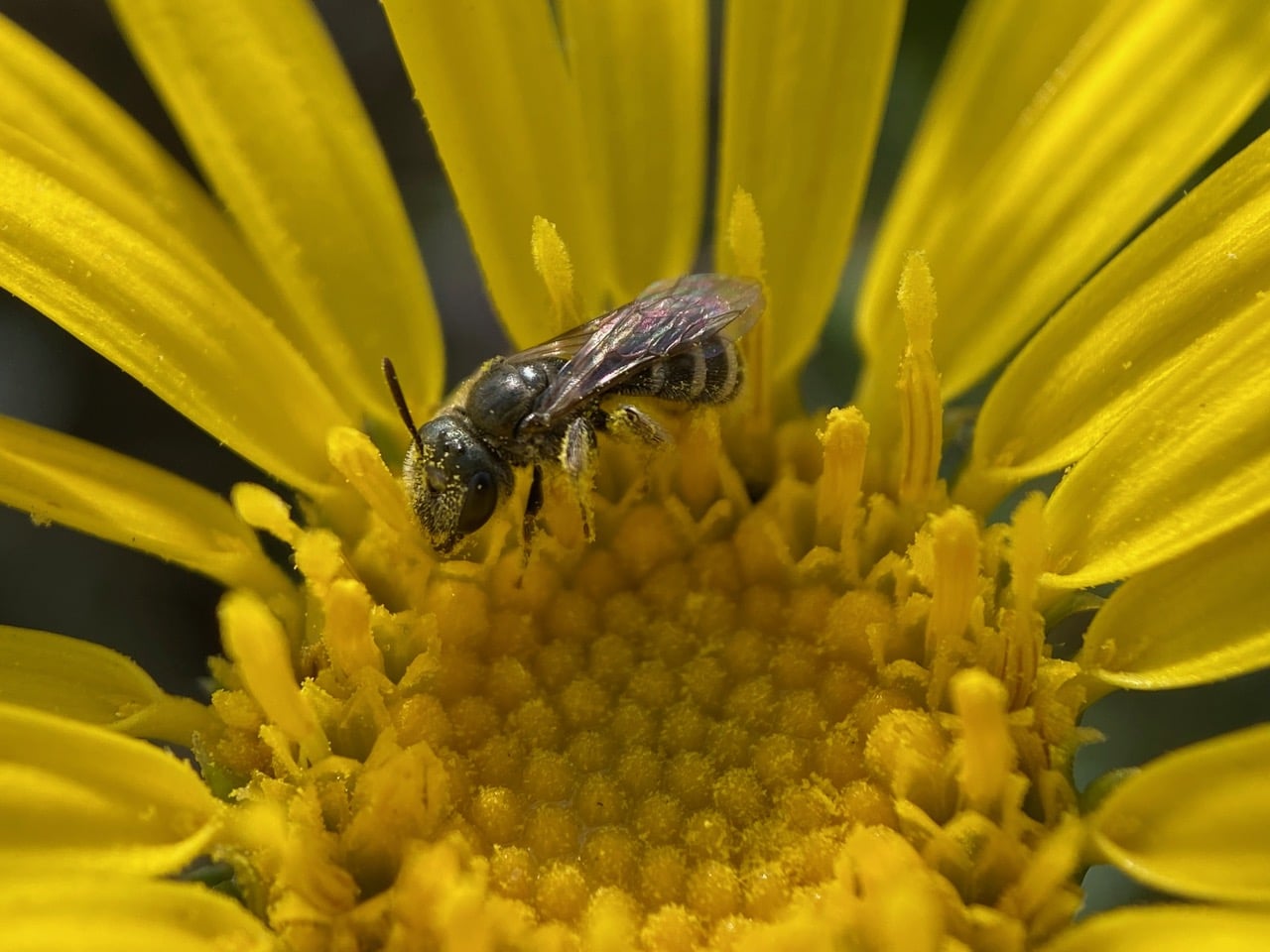
Dusted with pollen, a Tripartite Sweat Bee, Halictus tripartitus (family Halictidae) is foraging on a Grindelia flowerhead.
Halictus is found worldwide; they are most common in the Northern Hemisphere. All are generalists, foraging from a wide variety of flowering plants. Many species are social and produce several generations per year. This is not surprising as most blooming plants are season-specific; a bee that requires pollen and nectar across multiple seasons would not thrive as a specialist. All Halictus in North America nest in the ground, often in aggregations; and they may nest in the same area for decades.

A female Fine Striped Sweat Bee, Agapostemon subtilior (family Halictidae) is moving away after taking nectar from the Grindelia flowers. The scopa on her hind legs are empty – she has not been collecting pollen.
Agapostemon are brightly colored metallic green or blue bees measuring 7 to 14.5 mm long. Most species have a metallic green head and thorax, and black-and-yellow striped abdomen; some females are entirely bright green or blue. Females carry pollen on scopal hairs located on their hind legs. Agapostemon are generalists. Like other members of the family Halictidae, they are short-tongued and thus have difficulty extracting nectar from deep flowers. Males are often seen flying slowly around flowers looking for females. The bees favor flowers with high densities. Females excavate nests in the ground. These are summer to fall bees.
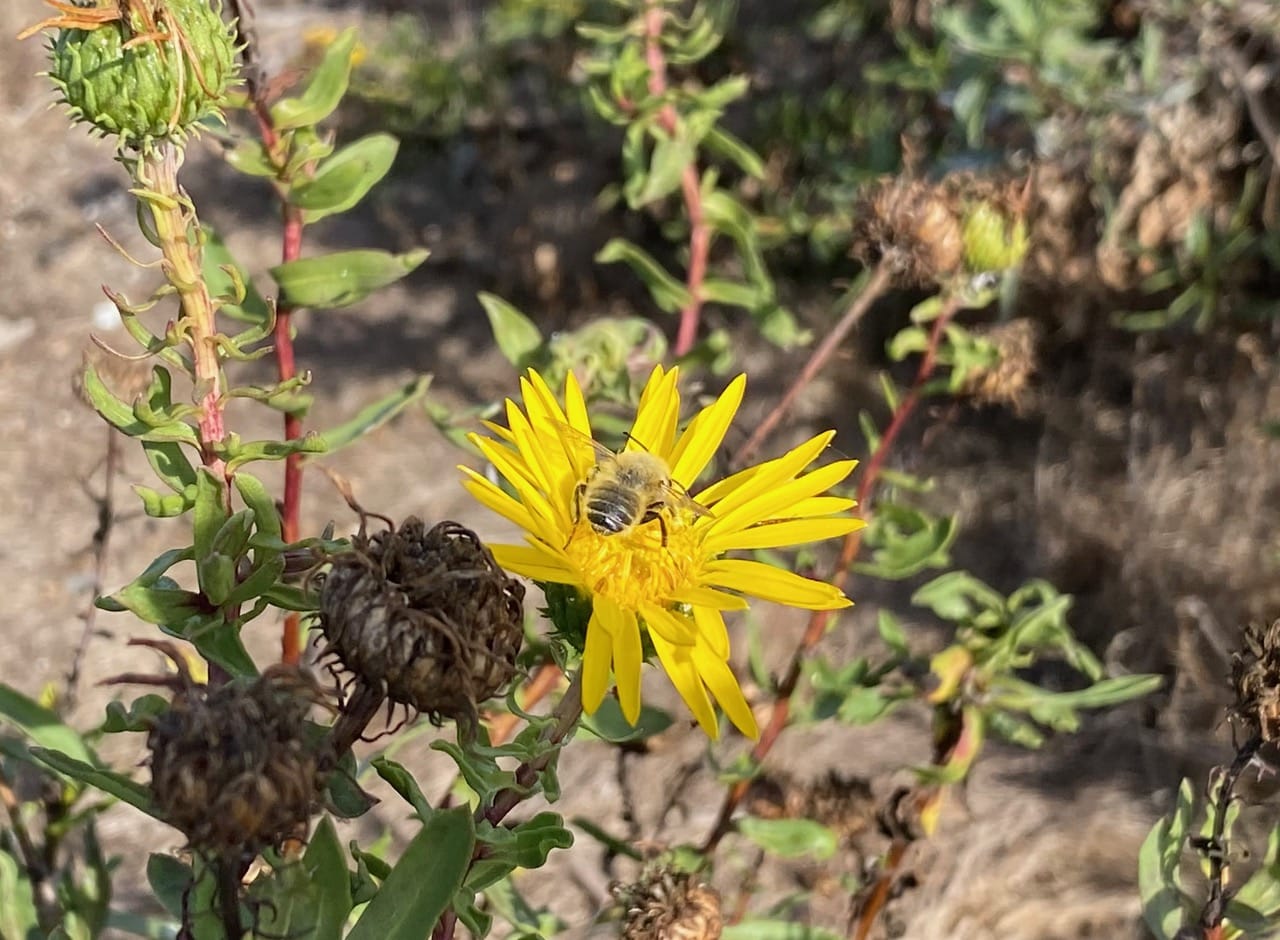
A male Western Leafcutter Bee, Megachile perihirta (family Megachilidae) has landed on a Grindelia flowerhead.

Leaf-cutter Bees, Megachile sp. (family Megachilidae) are stout-bodied, usually with pale hair on the thorax and stripes of white hairs on the abdomen. Females usually have a triangular abdomen with a pointed tip, and males’ faces are covered with dense, pale hair. Flight season is from May into September, with peak activity from June to August. Solitary females construct nests in tubular cavities, including hollow stems, tree holes, and abandoned beetle burrows in wood. Many use holes drilled into wood, straws, or other manufactured tunnels. Females cut pieces from leaves or flower petals for use in the construction of brood cells. Most Megachile females are generalist foragers, but prefer flowers in the family Asteraceae. Pollen is transported in dense scopae (special pollen collecting hairs) on the underside of the abdomen.

A small coppery brown butterfly the size of my thumbnail has landed on a Pickleweed. Just from its size, I recognize it as the Western Pygmy Blue. It is the first one I see this year; I’m so glad I haven’t missed its season.
The Western Pygmy Blue, Brephidium exilis (family Lycaenidae) is one of the smallest butterflies in the world and the smallest in North America. The butterfly is found in alkaline areas such as deserts and salt marshes. The caterpillars feed on plants in the Goosefoot family Amaranthacea, commonly found in salty habitats. Although the species has no set breeding season, mating activity is at its peak during late summer and early fall.
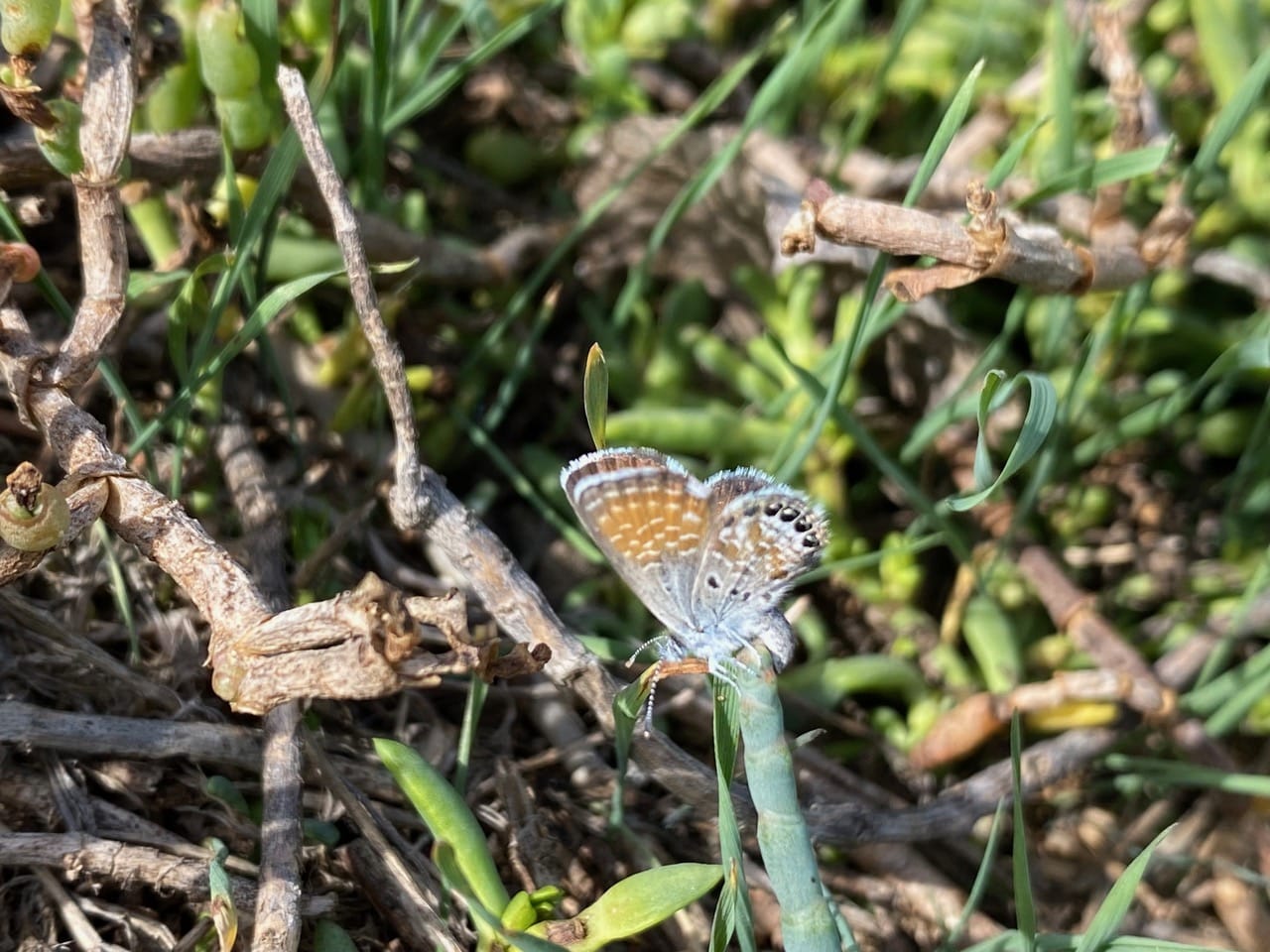
Much to my delight, the butterfly curls her abdomen forward to lay eggs on the Pickleweed stem. Pickleweed, Salicorna pacifica belongs to the goosefoot family Amaranthaceae (formerly Chenopodiaceae) and is one of the butterfly’s host plants.
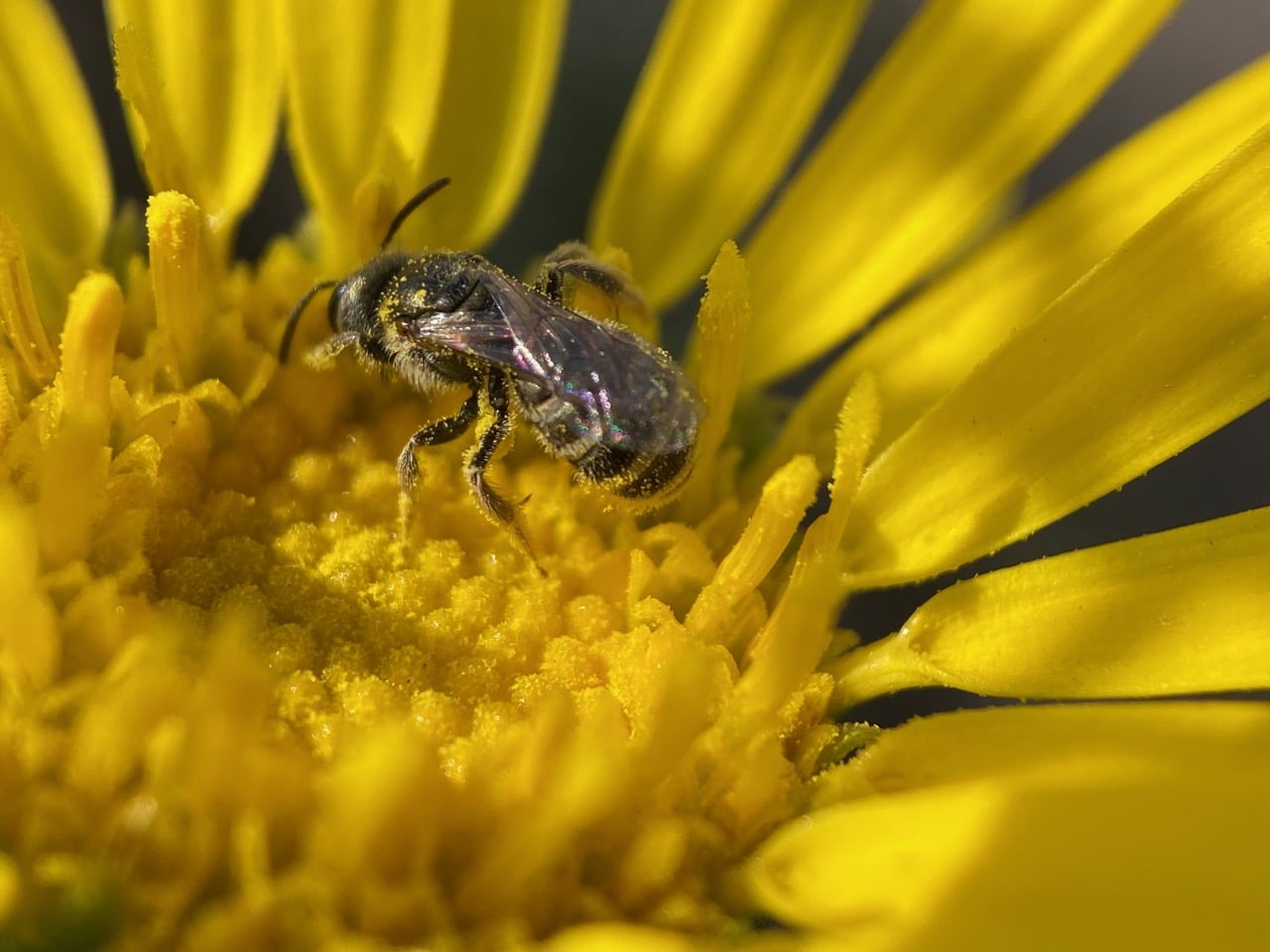
Another Tripartite Sweat Bee, Halictus tripartitus (family Halictidae) on a Grindelia flowerhead. Because the species is somewhat social, their colonies can persist a long time through the seasons.
Tripartite Sweat Bees, Halictus tripartitus are social, forming annual colonies in the soil where a queen lays eggs and daughter bees act as workers. They are considered a “primitively social” species, meaning they have a social organization with a queen and workers, but with simpler colonies compared to more complex eusocial insects such as honey bees. While Tripartite Sweat Bees are social, other sweat bee species can be solitary, communal, or semi-social, and the social behavior of a single species can sometimes vary depending on environmental factors such as geographic location, or altitude.

At the butterfly garden, one of the Sneeze Weed, Helenium puberulum is still in bloom.
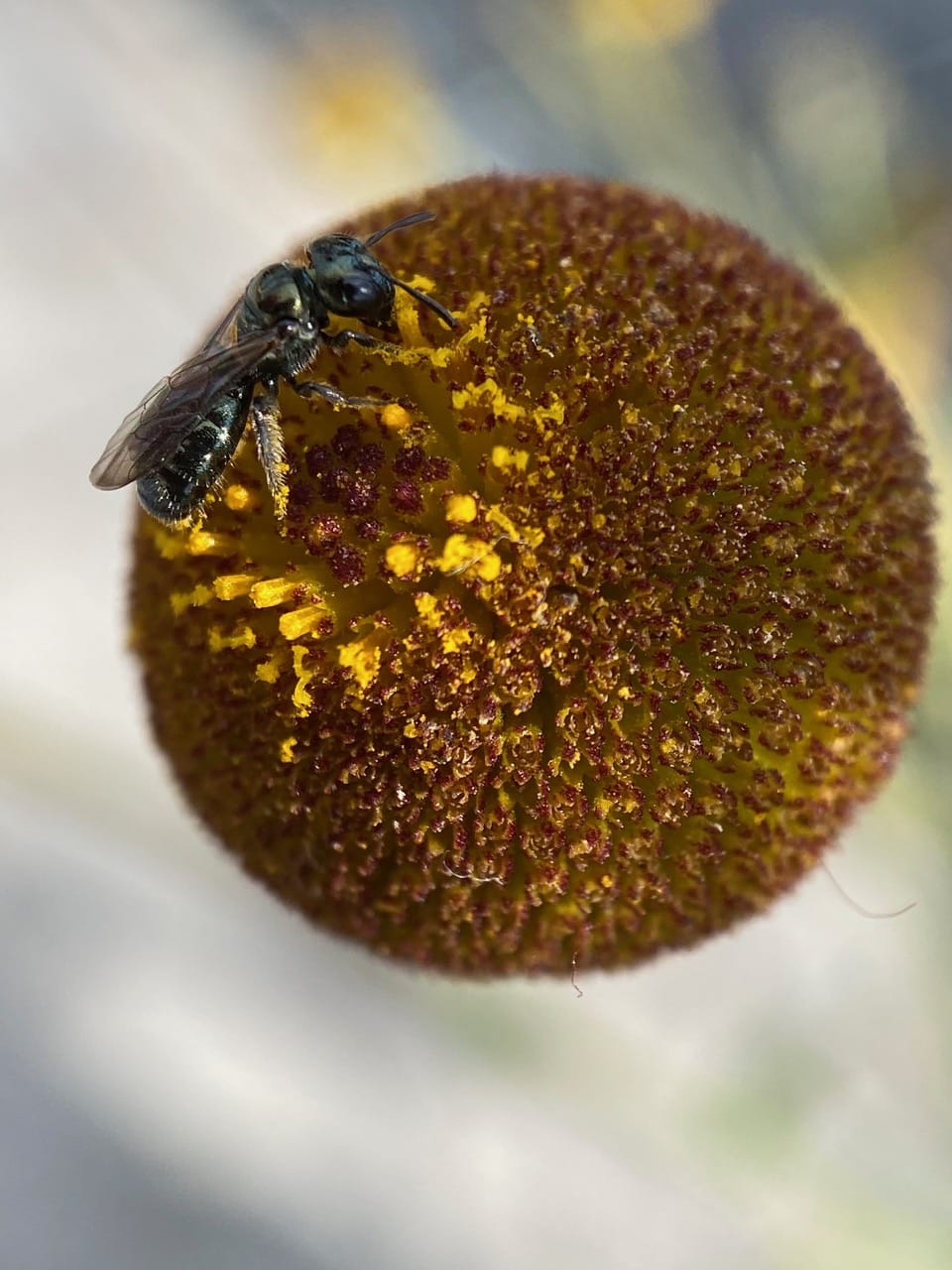
A Small Carpenter Bee, Ceratina acantha (family Apidae) is foraging on the freshly opened florets on a Sneeze Weed flowerhead.

The Small Carpenter Bee genus Ceratina is closely related to the more familiar, and much larger Carpenter Bees (genus Xylocopa). Ceratina are typically dark, shiny, even metallic bees, with fairly sparse body hairs and a weak scopa on the hind leg. The shield-shaped abdomen comes to a point at the tip. Some species have yellow markings, often on the face.
Females excavate nests with their mandibles in the pith of broken or burned plant twigs and stems. While many species are solitary, a number are subsocial. Both male and female carpenter bees overwinter as adults within their old nest tunnels, emerging in the spring to mate. In the spring, this resting place (hibernaculum) is modified into a brood nest by further excavation. The female collects pollen and nectar, places this mixture (called bee bread) inside the cavity, lays an egg on the provision, and then caps off the cell with chewed plant material. Several cells are constructed end to end in each plant stem.


A tiny dark insect is moving slowly over the surface of a Sneeze Weed flowerhead. Having first met one just a week ago, I recognize it right away as the Western Plant Bug, Rhinacloa forticornis (family Miridae).
Mirid bugs are also referred to as plant bugs or leaf bugs. Miridae is one of the largest family of true bugs in the order Hemiptera. Like other Hemipterans, Mirids have piercing, sucking mouthparts to extract plant sap. Some species are predatory. Others are opportunistic omnivores. One useful feature in identifying members of the family is the presence of a cuneus; it is the triangular tip of the corium, the firm, horny part of the forewing, the hemielytron. The cuneus is visible in nearly all Miridae.

The Western Plant Bug, Rhinacloa forticornis is found in North America, Central America, South America, the Caribbean, and Oceania. In the US, it is found mostly in the southwest (CA to TX). Measuring 1.4-1.8 mm, the bug is recognized by its small size, generally dark coloration, including the basal antennal segments. The specific epithet forticornis means ‘with sturdy antennae’. There’s precious little information out there on the species other than that it is polyphagous, feeding on a variety of plants.
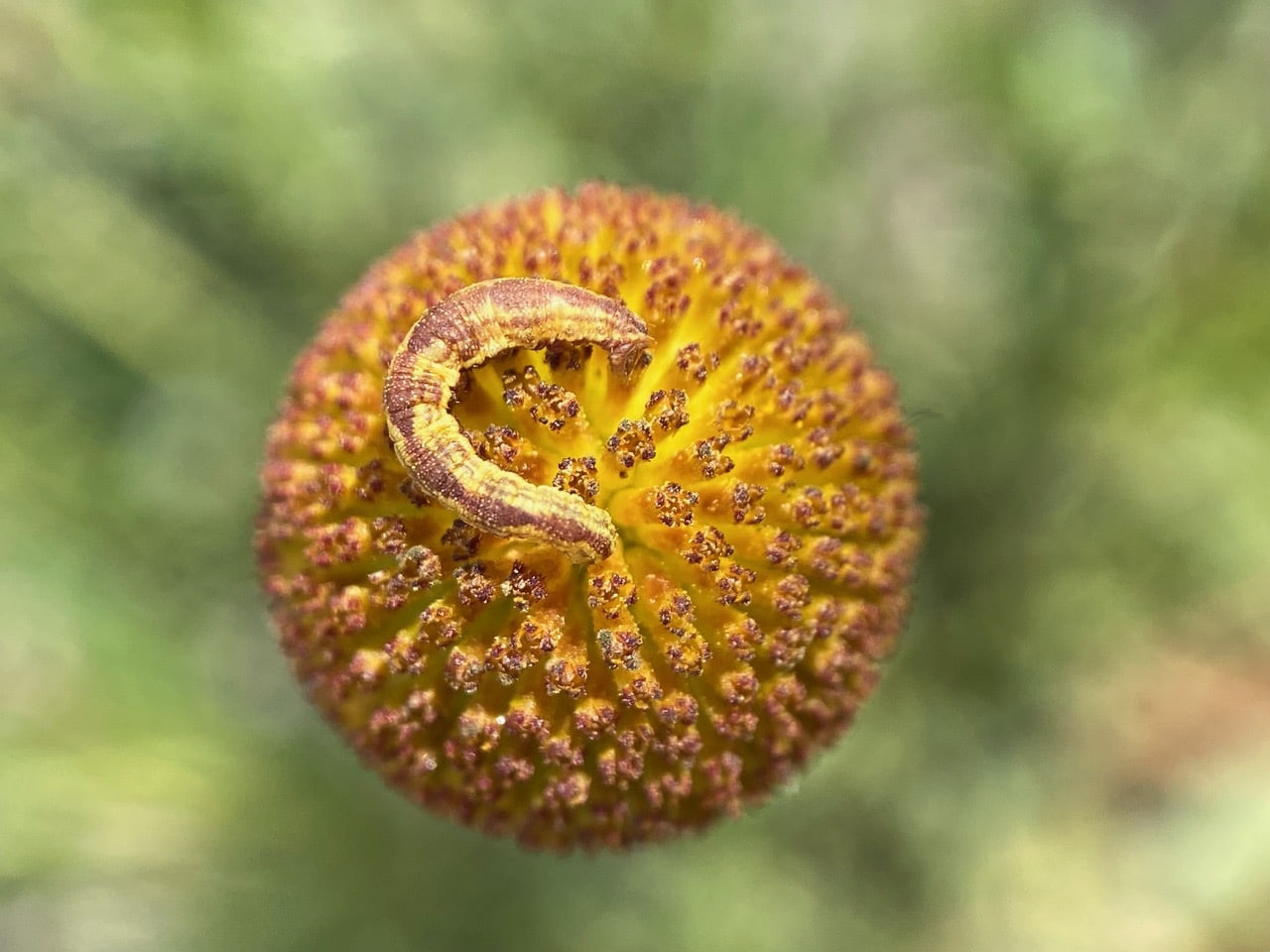
A chubby Inchworm, a Pug Moth caterpillar, Eupithecia sp. (family Geometridae) is resting on a Sneeze Weed flowerhead. It will probably go into pupation soon.
Eupithelia is the largest genus of moths of the family Geometridae. Occurring worldwide except for Australasia, species in the genus are commonly known as pugs. The caterpillars move in a looping manner and are commonly called inchworms. Adults are typically small, 12 – 35 mm, with muted colors. Most species rest with forewings held flat at right angles to the body, while the hindwing are largely covered by the forewings. They are generally nocturnal. Larvae mostly feed from the flowers and seeds of their food plants rather than the foliage. Many species have a very specific food plant.

Here’s a much younger Eupithecia caterpillar. It is feeding on the flower parts on a Sneeze Weed flowerhead.

A small, whitish critter is crawling over a Sneeze Weed flowerhead. My handy macro lens reveals it to be a Long-tailed Mealybug, Pseudococcus longispinus (family Pseudococcidae).
Mealybugs are soft-bodied insects that belong to the order Hemiptera, specifically within the superfamily Coccoidea (scale insects), and are classified in the family Pseudococcidae. As Hemipterans, they have piercing-sucking mouthparts for extracting sap from plants. They are usually elongate and segmented, and may have wax filaments radiating from the body, especially at the rear. Females, about 3/16 inch long, are typically wingless and covered with a waxy coating, while males are smaller, gnat-like, and winged. Females remain wingless and feed on plants, continuing to produce wax and exude honeydew. They eventually die after laying eggs. After the second instar, males develop into small, winged adults that are short-lived and do not feed. Their sole purpose is to fertilize the females.
The mealybug life cycle begins with eggs, which hatch into tiny, mobile “crawlers” (nymphs). These nymphs go through several stages to become adults, a process that takes anywhere from six weeks to two months depending on the species, and environment. While most female mealybugs lay hundreds of eggs in a waxy sac, certain species like the long-tailed mealybugs give birth to live young instead. Mealybugs tend to congregate in large numbers, forming white, cottony masses on plants. They feed on stems and leaves of fruit trees and ornamentals. High populations slow plant growth and cause premature leaf or fruit drop and twig dieback.
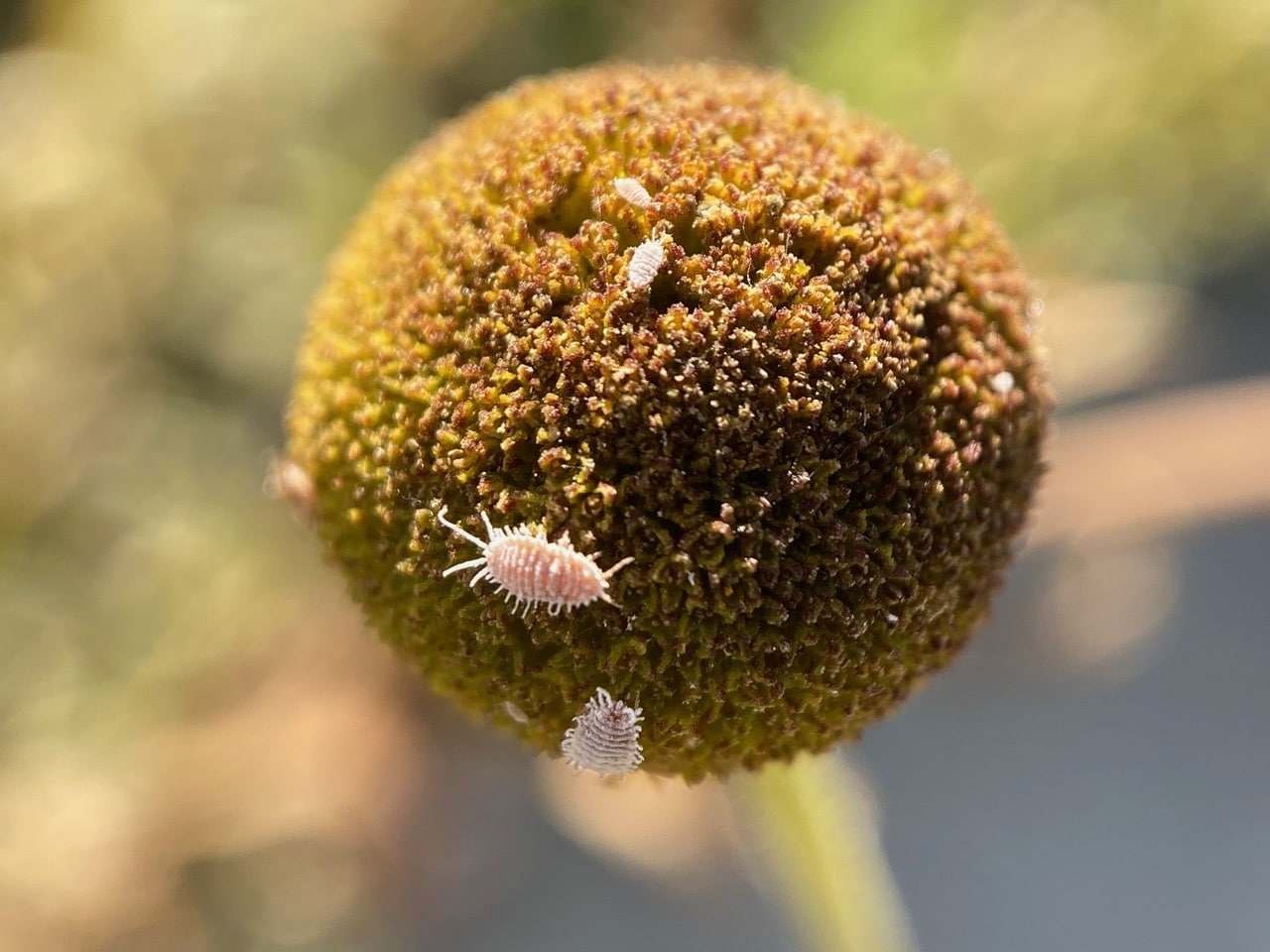
There seems to be a colony of different sized Long-tailed Mealybugs on this other Sneeze Weed flowerhead.
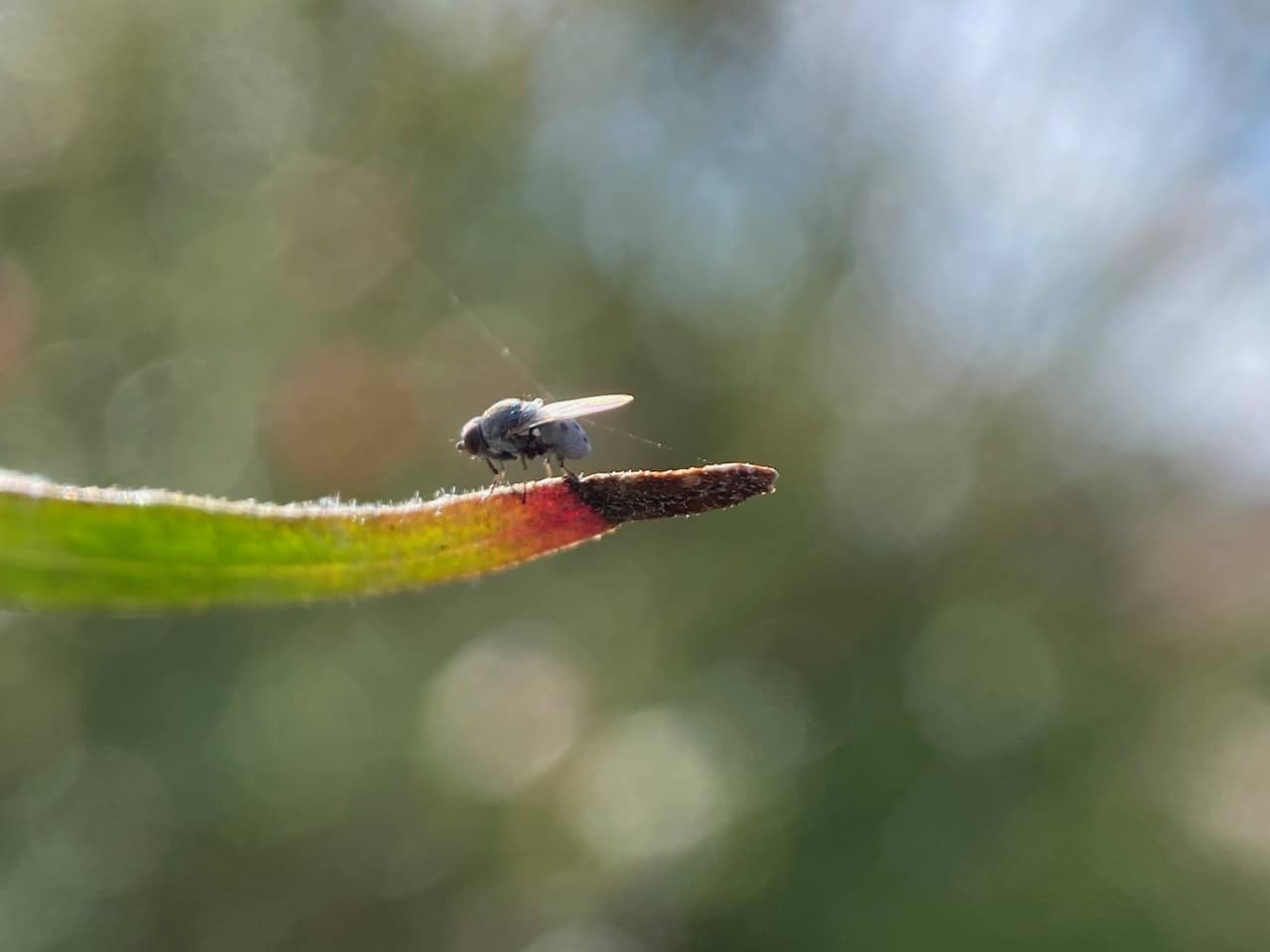
A tiny fly is perched on the tip of a senescing Sneeze Weed leaf.
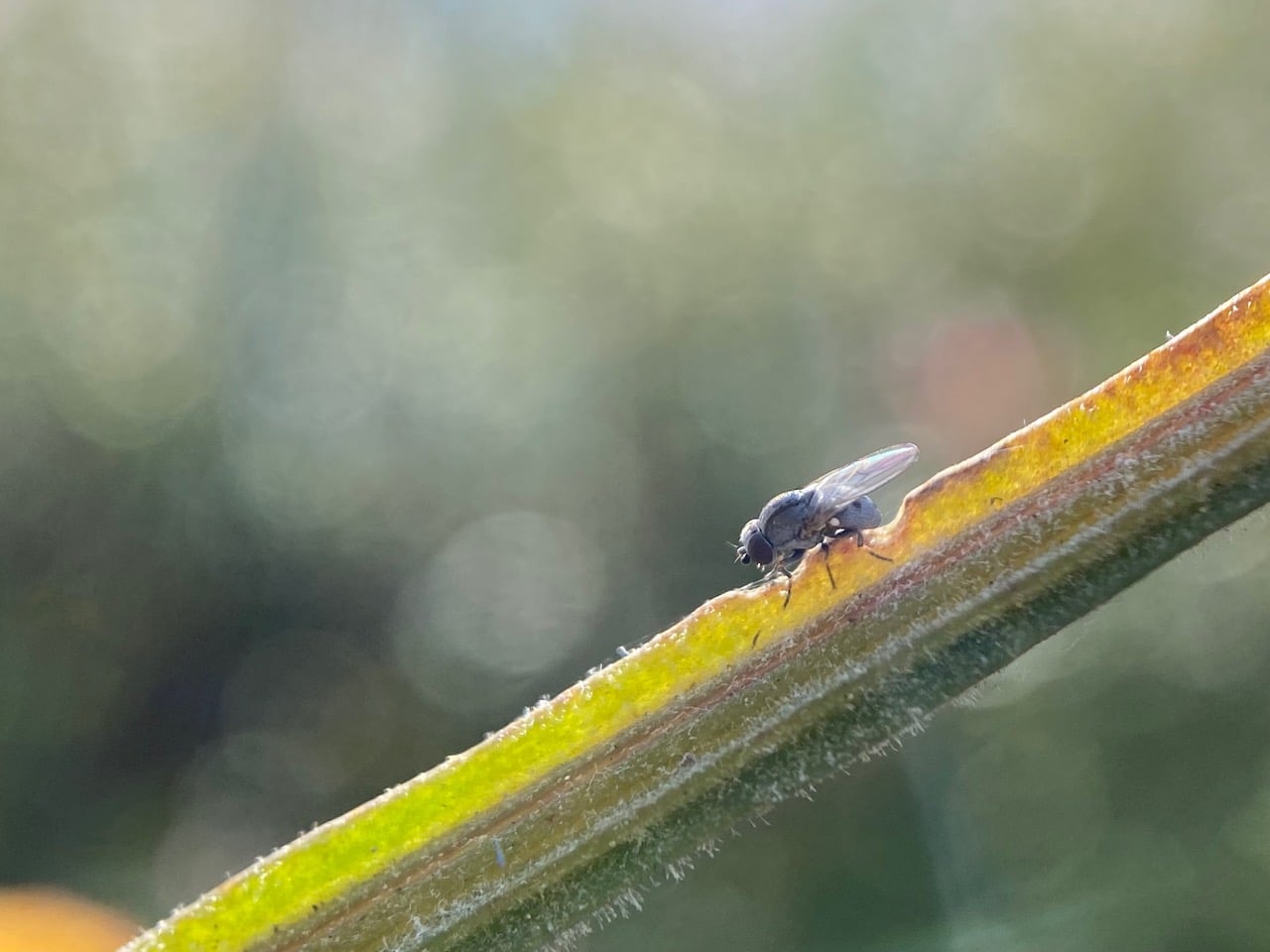
The fly slowly moves down the Sneeze Weed stem. iNaturalits has helped identify it as an Aphid Fly, Leucopis sp. (family Chamaemyiidae). Ah, the fly is here because of the Mealybugs!
The Chamaemyiidae are a small family of acalyptrate flies with less than 200 species described worldwide. The flies are usually silvery gray with black spots, but some are tiny, shiny black flies. The larvae of these small flies are active and predatory and are often used for biological control of aphids, scale insect, mealybugs, and similar pests.
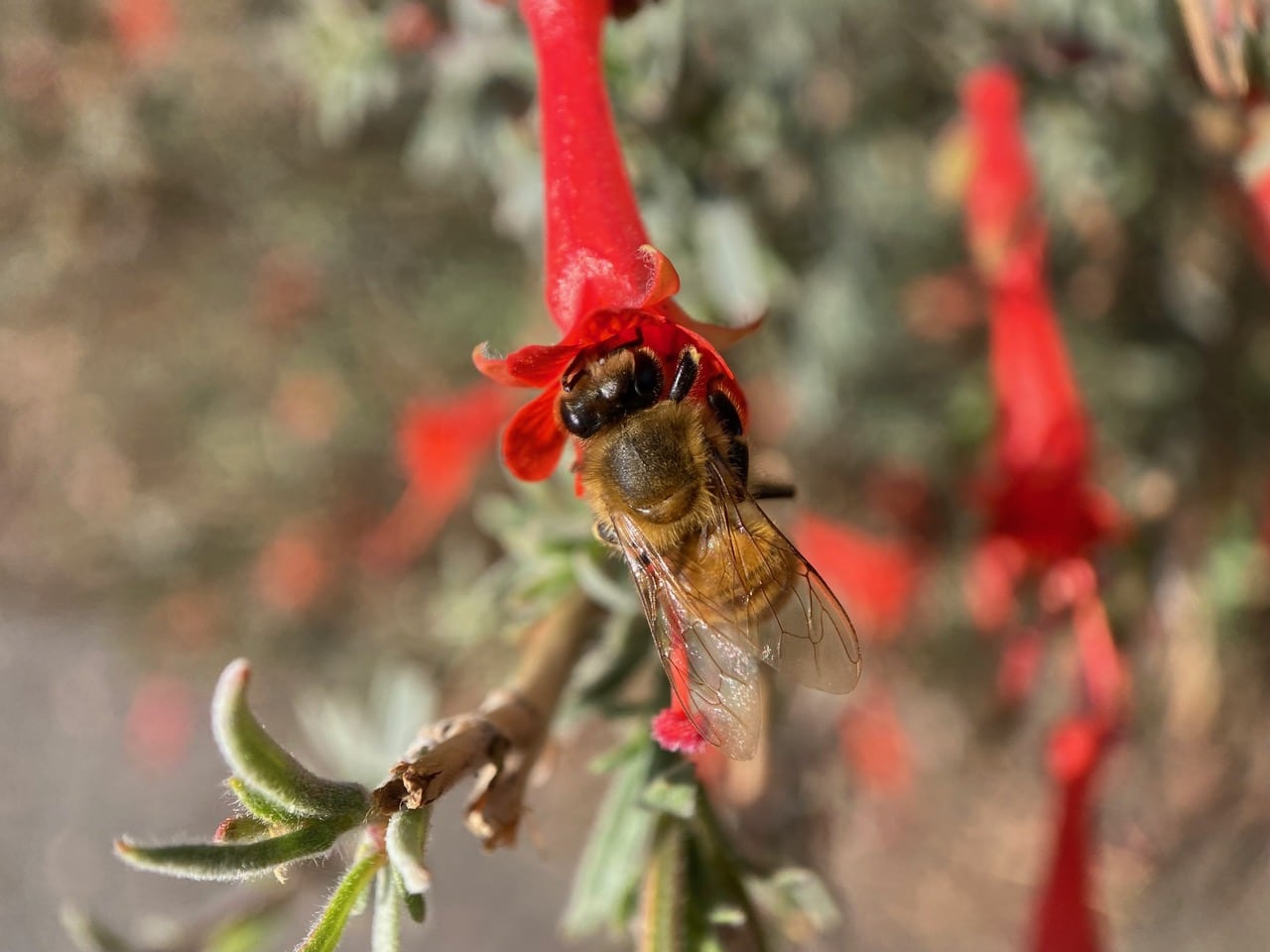
A Honey Bee, Apis mellifera (family Apidae) goes from one California Fuchsia flower, Epilobium canum to another, desperately seeking nectar. I doubt if its attempts are successful, as the bee’s tongue is probably not long enough to reach the nectar at the base of the long, tubular flower. One seldom sees an insect on these red flowers. They are usually pollinated by hummingbirds which are attracted to the red color, and whose long tongue can easily access the nectar.