

Pollinator Post 11/14/25
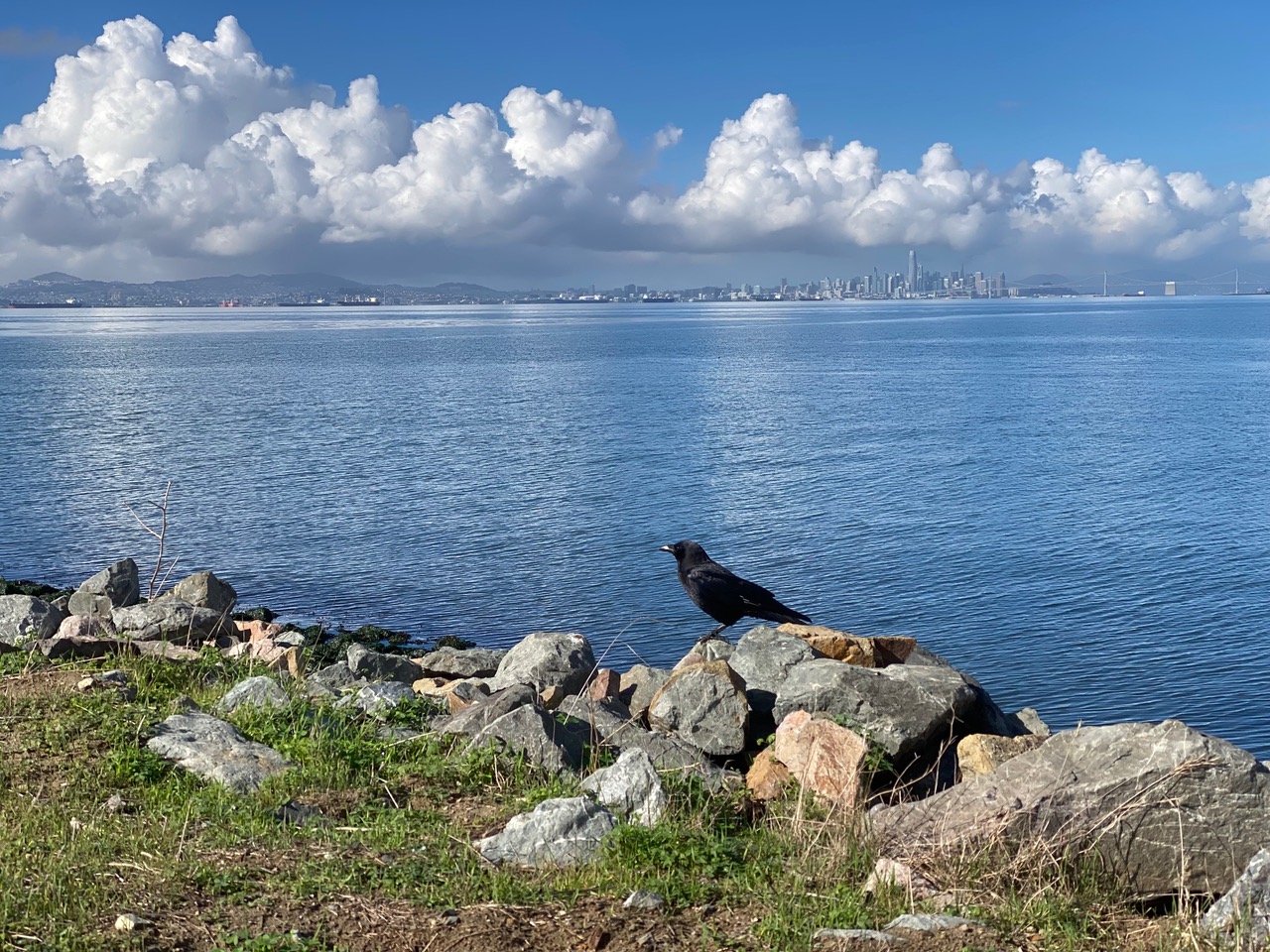
After a whole day of drenching rain yesterday I am happy to be back walking along the shoreline of Bay Farm Island this morning. The air is sparkling clean.












Cumulus clouds loom over the San Francisco cityscape, promising more precipitation from the atmospheric river in the sky.
There’s hardly anything in bloom now. I stop by a fading Telegraph Weed, Heterotheca grandiflora. The hardy native still has some fresh flowerheads.
What first appeared to be a caterpillar on one of the Telegraph Weed flowerheads turns out to be a hover fly larva on closer inspection. The translucent green slug-like creature has a tapered head with no eyes, and no visible legs. Is it hunting aphids?
Many species of hover flies (family Syrphidae) have larvae that feed on aphids and other soft-bodied insects. The females seek out aphid colonies on plants to lay their eggs, to ensure that their offspring will have plenty to eat. Syrphid larvae have no eyes and no legs. They swing their tapered head from side to side in search of prey. When they make contact with a prey, they grab hold of it with their mouthpart, then suck out the victim’s body contents. Depending on species, a Syrphid larva can feed on 100 to 400 aphids before it pupates.
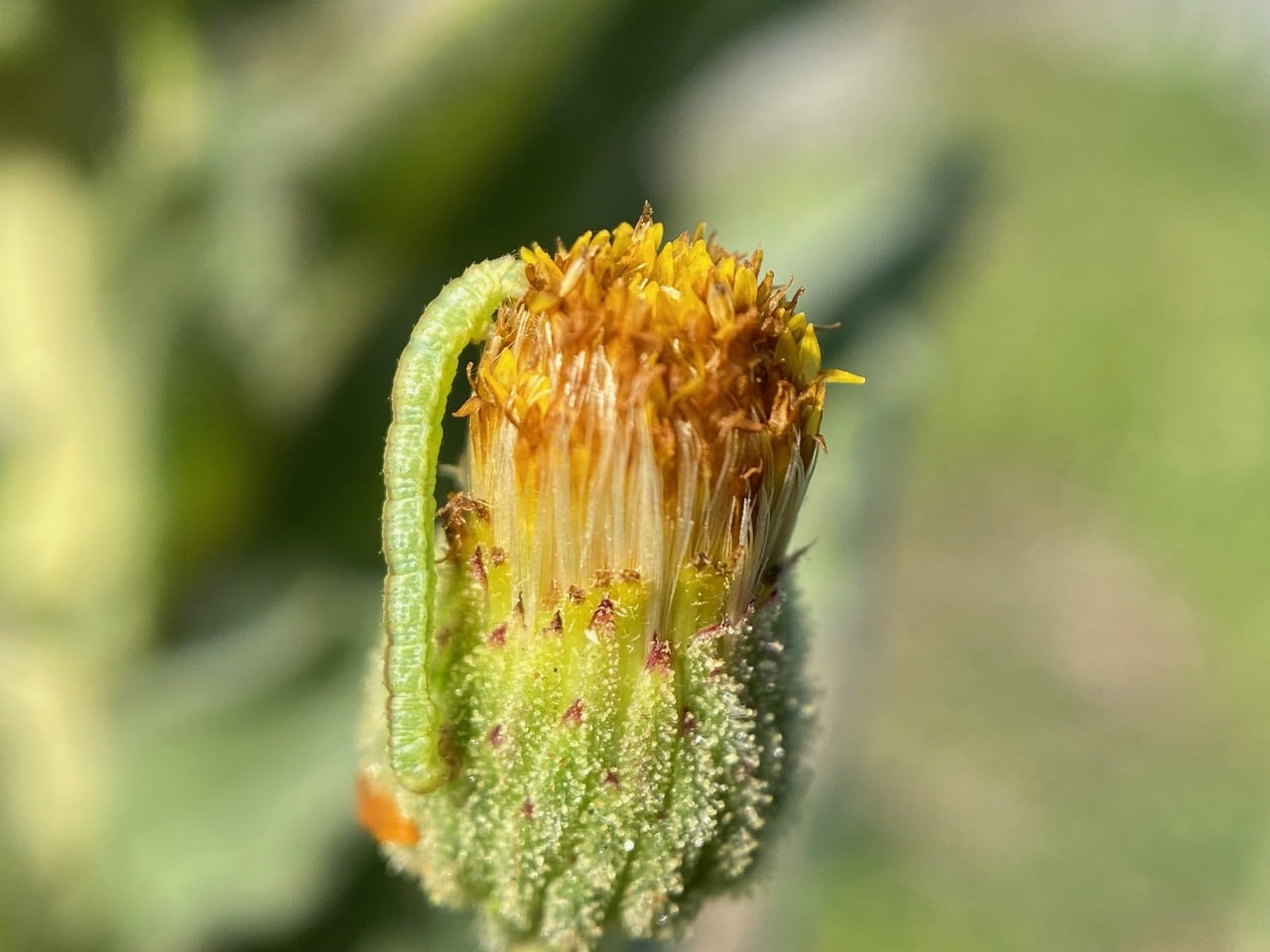
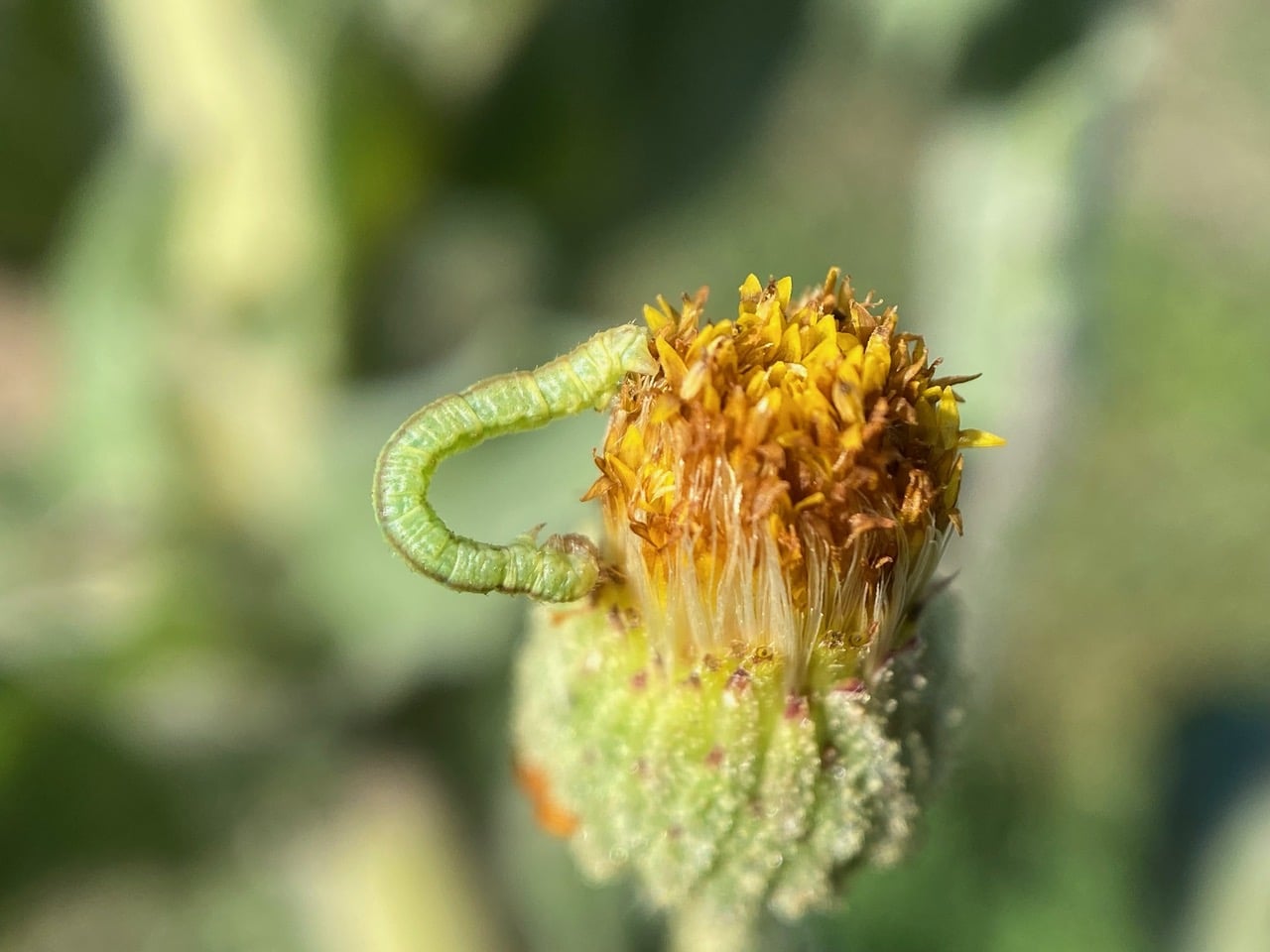
Look, here’s a caterpillar on a spent Telegraph Weed flowerhead! It is an Inchworm, larva of a Pug Moth in the genus Eupithecia (family Geometridae).
Eupithelia is the largest genus of moths of the family Geometridae. Occurring worldwide except for Australasia, species in the genus are commonly known as pugs. The caterpillars move in a looping manner and are commonly called inchworms. Adults are typically small, 12 – 35 mm, with muted colors. Most species rest with forewings held flat at right angles to the body, while the hindwing are largely covered by the forewings. They are generally nocturnal. Larvae mostly feed from the flowers and seeds of their food plants rather than the foliage. Many species have a very specific food plant.
When the caterpillar lets loose of its grip of the involucre, and assumes an inverted U-shape, we can see its true legs behind its head. The caterpillar is holding onto the flower parts with its anal prolegs in the rear. Note the absence of prolegs between the true legs and the anal prolegs as in other caterpillars. This anatomy forces the inchworm to adopt a looping locomotion.
Inchworms are also called loopers and measuring worms. The majority of the inchworms are the larvae of moths in the family Geometridae. The name comes from the Greek “geo” for earth and “metro” from measure, because the caterpillars seem to be measuring the surface on which they are walking.
All caterpillars have three pairs of jointed legs behind their heads. These legs are called true legs because they will become the six legs of the adult butterfly or moth. There are additional appendages, called prolegs, along their bodies. Prolegs are not true legs, they are just outgrowths of the body wall and will be lost at metamorphosis. They have little hooks on their soles to help the caterpillar walk and grip onto things.
Most caterpillars have five sets of prolegs, four in the middle of the body and one pair at the hind end. Inchworms have the normal six true legs but only two or three pairs of prolegs, all located at the tail end of the body, with none in the middle. When an inchworm walks, it moves its tail-end prolegs up behind its true legs, causing the center of its body to loop upward. Then it stretches its front end forward to take another step.
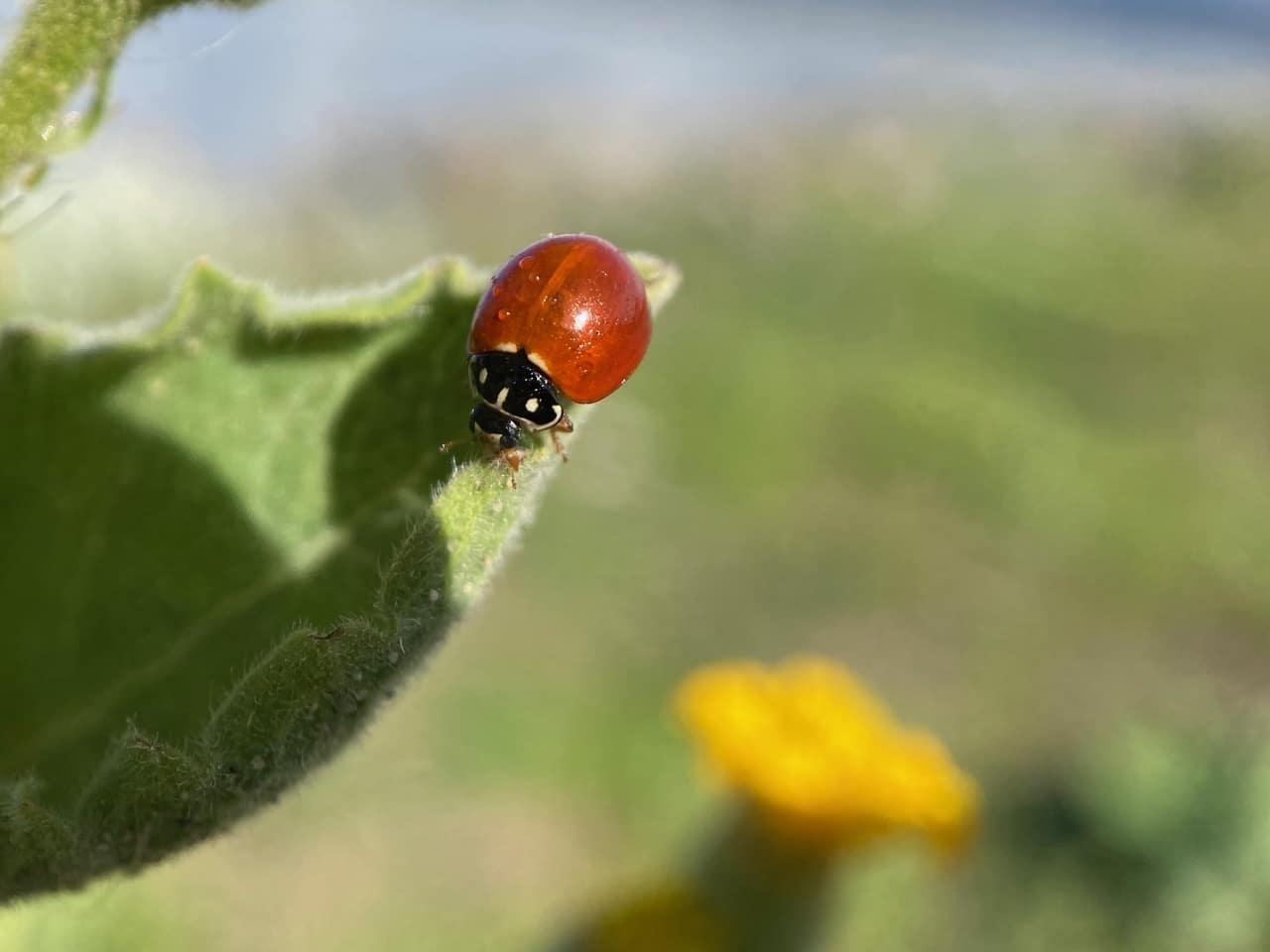
A Spotless Lady Beetle, Cycloneda sanguinea (family Coccinellidae) is resting on a leaf of Telegraph Weed, droplets of moisture clinging to its elytra. Those don’t look like rain drops. Maybe accumulations of aphid honeydew?
The Spotless Lady Beetle, Cycloneda sanguinea (family Coccinellidae) is a widespread species of lady beetle in the Americas. It is is a large lady beetle with red, unspotted elytra (wing covers) ranging from 4-6.5 mm long. The black and white marks on the head and pronotum are very distinctive, and they are also gender-specific. Both adult and larvae of Spotless Lady Beetles are voracious predators of aphids. They are very often found feeding on aphids on milkweeds, but also occur on a number of other plants. Adults live longer when nectar and pollen are available for nourishment when prey is scarce.
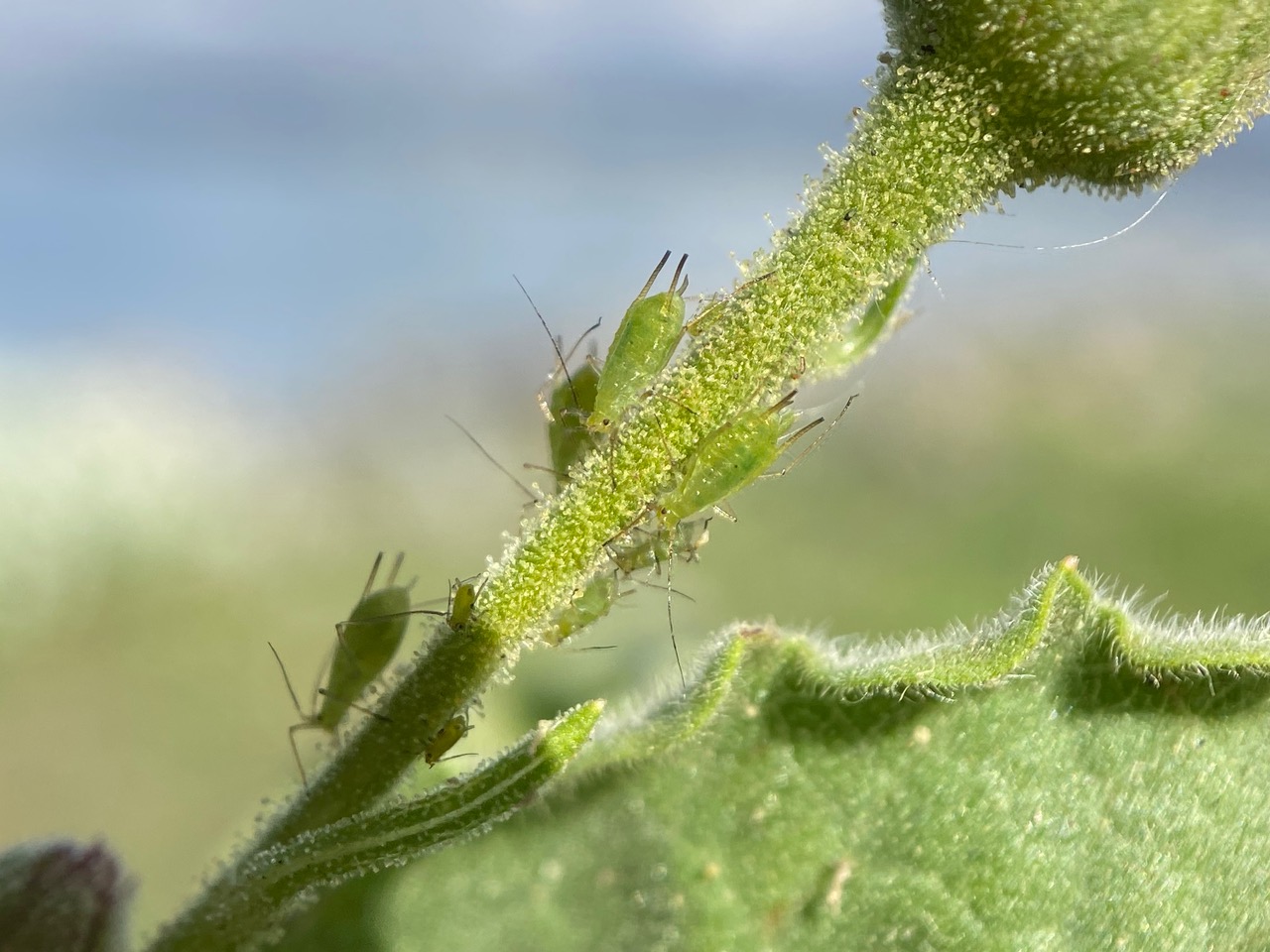
The presence of both the hover fly larva and the lady beetle are suggestive of the presence of aphids on the plant. It didn’t take long for me to find them. iNaturalist has helped identify them as members of the genus Macrosiphum (family Aphididae).
Aphids (family Aphididae) are small sap-sucking insects in the order Hemiptera. Aphids usually feed passively on phloem of plants. Once the phloem vessel is punctured, the sap, which is under pressure, is forced into the aphid’s food canal. Aphids produce large amounts of a sugary liquid waste called “honeydew”. A fungus called sooty mold can grow on honeydew deposits that accumulate on leaves and branches, turning them black.
A typical life cycle involves flightless females giving live birth to female nymphs, – who may also be already pregnant, an adaptation called telescoping generations – without the involvement of males. Maturing rapidly, females breed profusely so that the population multiplies quickly. Winged females may develop later in the season, allowing the insects to colonize new plants. In temperate regions, a phase of sexual reproduction occurs in the autumn, with the insects often overwintering as eggs. The life cycle of some species involves an alternation between two species of host plants. Some species feed on only one type of plant, while others are generalists, colonizing many plant groups. Some ants have a mutualistic relationship with aphids, tending them for their honeydew and protecting them from predators.
Macrosiphum is a genus of aphid. During the summer populations are made of parthenogenetic females, meaning reproduction occurs without males. In the fall, males and females are produced; they mate and females lay eggs that overwinter. There are many tightly host-specific species in the genus.
Hey, there’s a black, bloated aphid “mummy” next to a normal aphid on this flowerhead.
Parasitic wasps from the Aphelinidae family cause aphids to turn black. When a female wasp lays an egg inside an aphid, the larva develops inside the host, eventually killing it. The dead aphid’s body turns into a black, puffy “mummy”, and the wasp larva pupates inside before emerging as an adult. Other parasitic wasps, like those in the Aphidiidae family, cause the mummies to turn brown, gold, or tan instead.
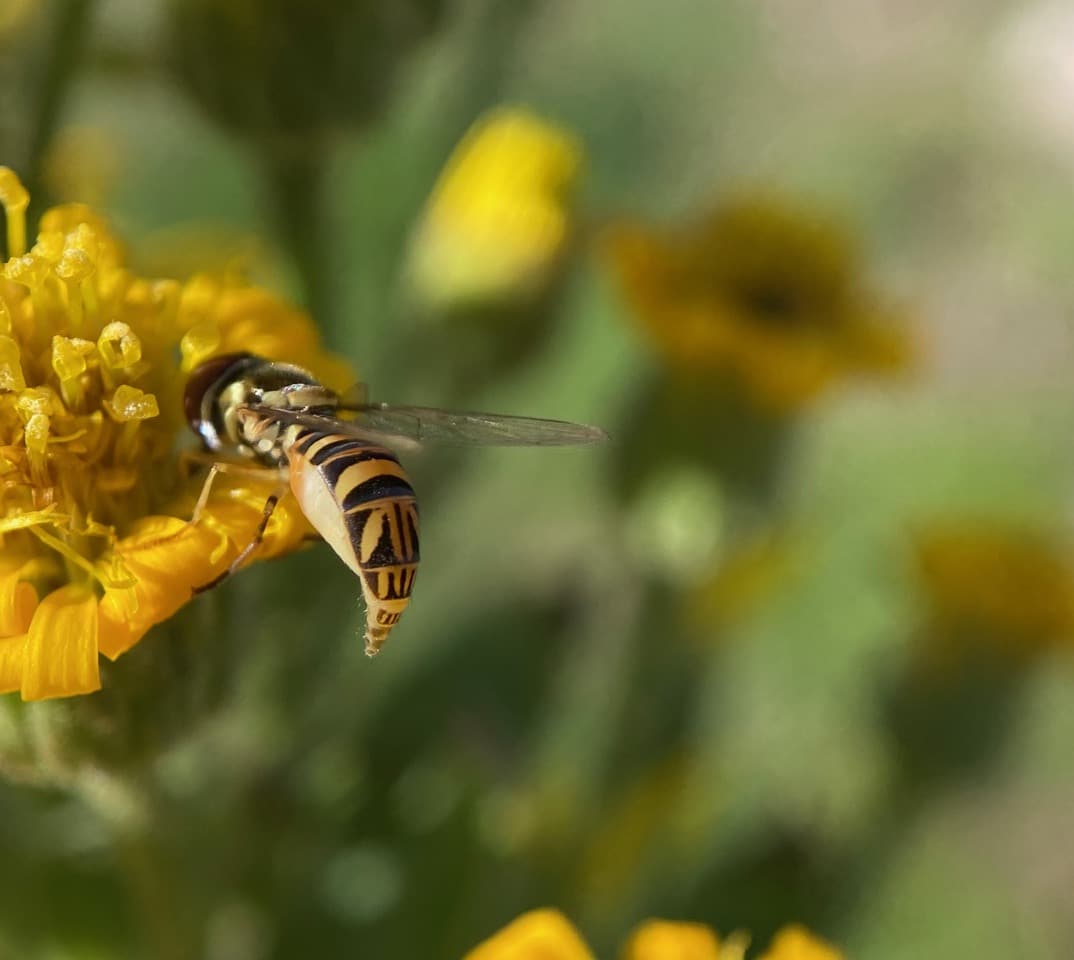
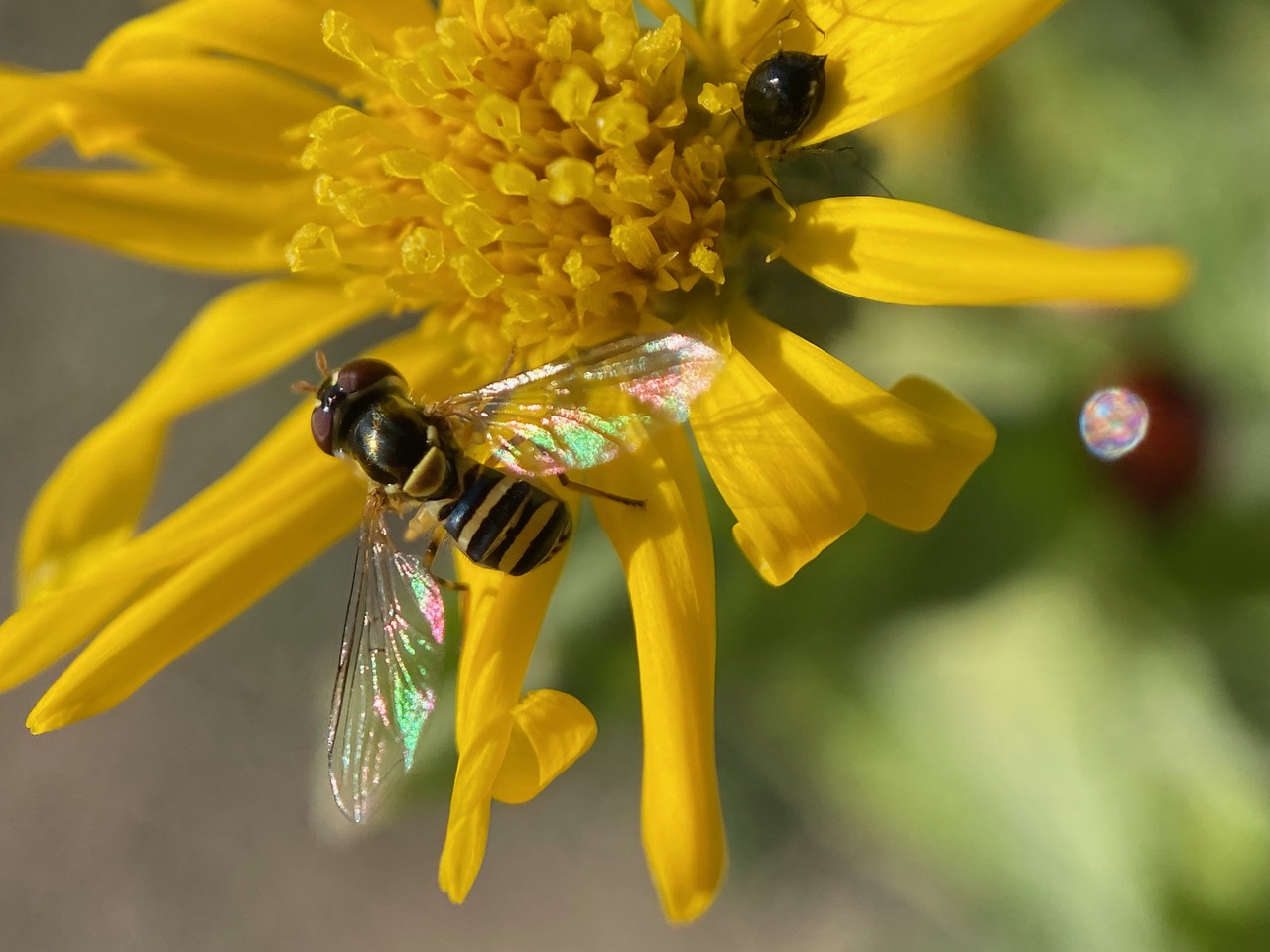
A female Oblique Streaktail, Allograpta obliqua (family Syrphidae) has landed on a fading Telegraph Weed flowerhead. The gravid hover fly has the pointed tip of her abdomen fully extended as if she’s in egg laying mode.
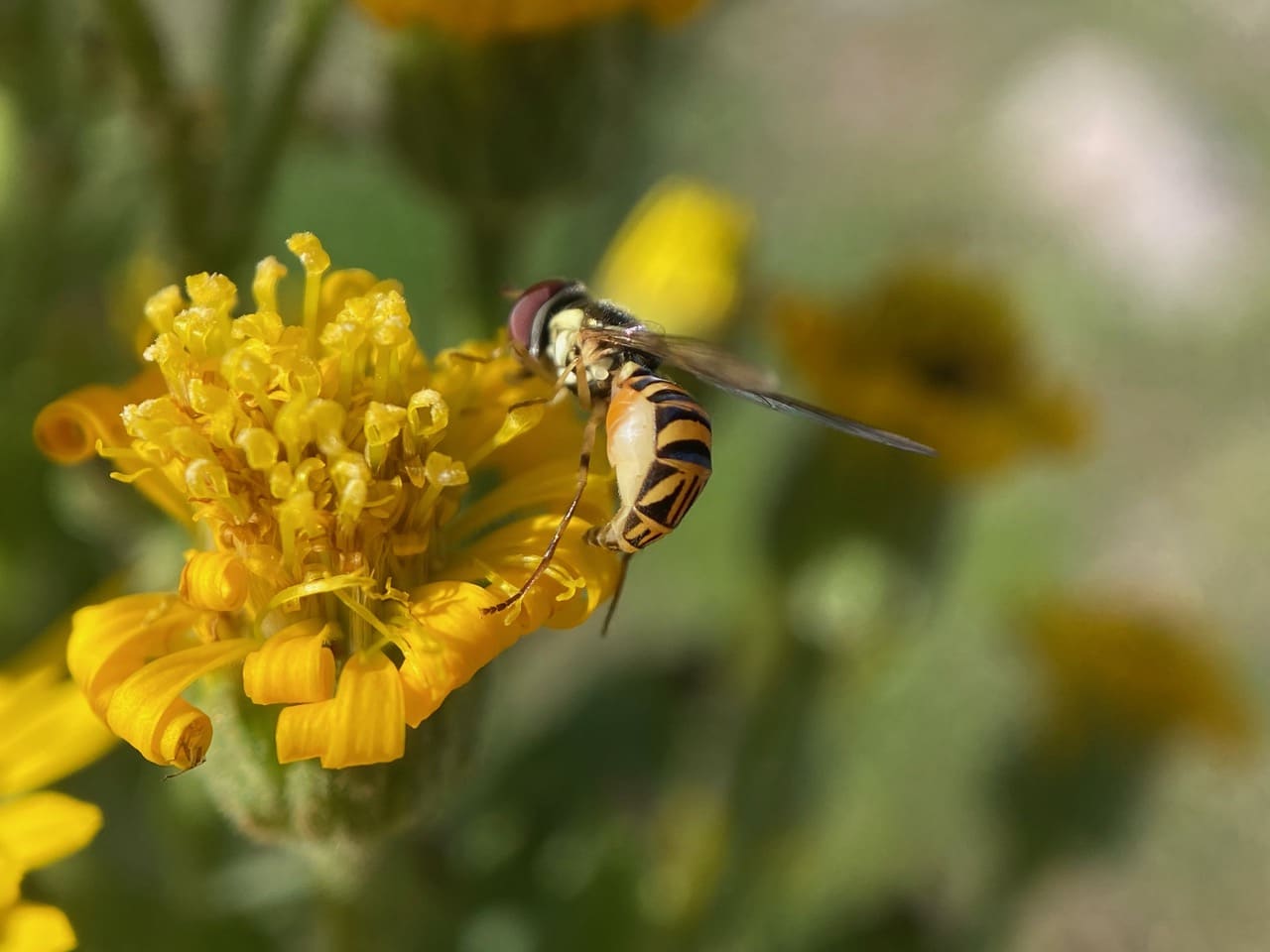
Although small in size (6-7 mm long), the Oblique Streaktail is easily recognizable for the unique pattern on its black-and-yellow abdomen. It is a common North American species of hover fly. Adults visit flowers for nectar and pollen, and are pollinators. Females lay eggs on plant surfaces near aphids. Larvae feed on the aphids.
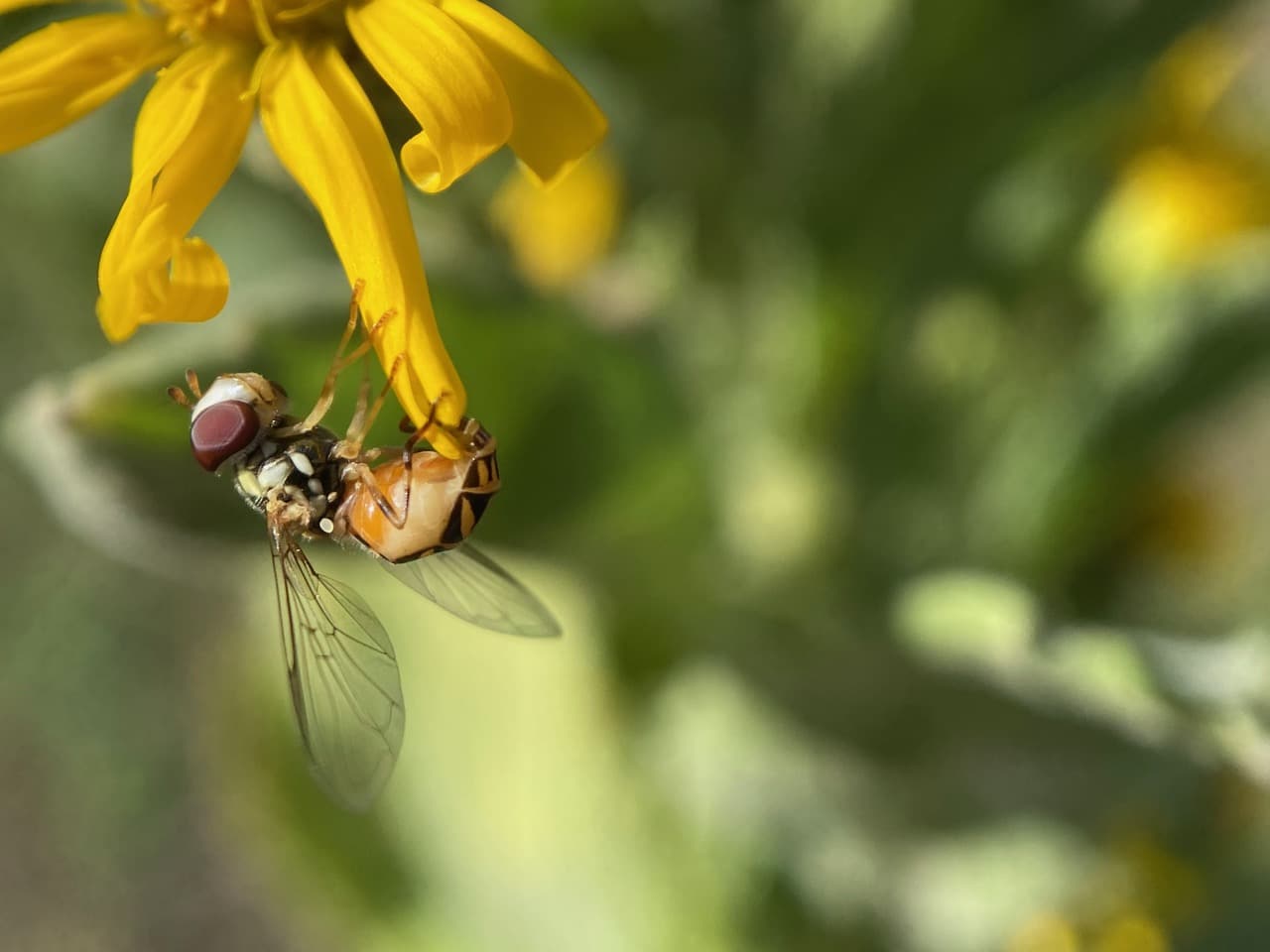
The female Oblique Streaktail curls her abdomen forward to lay an egg on a ray petal of the flowerhead. She must have detected the presence of aphids close by. Female hover flies lay eggs singly near aphids, to ensure that their offspring will not be competing with each other for food.
There, she just dropped another egg.
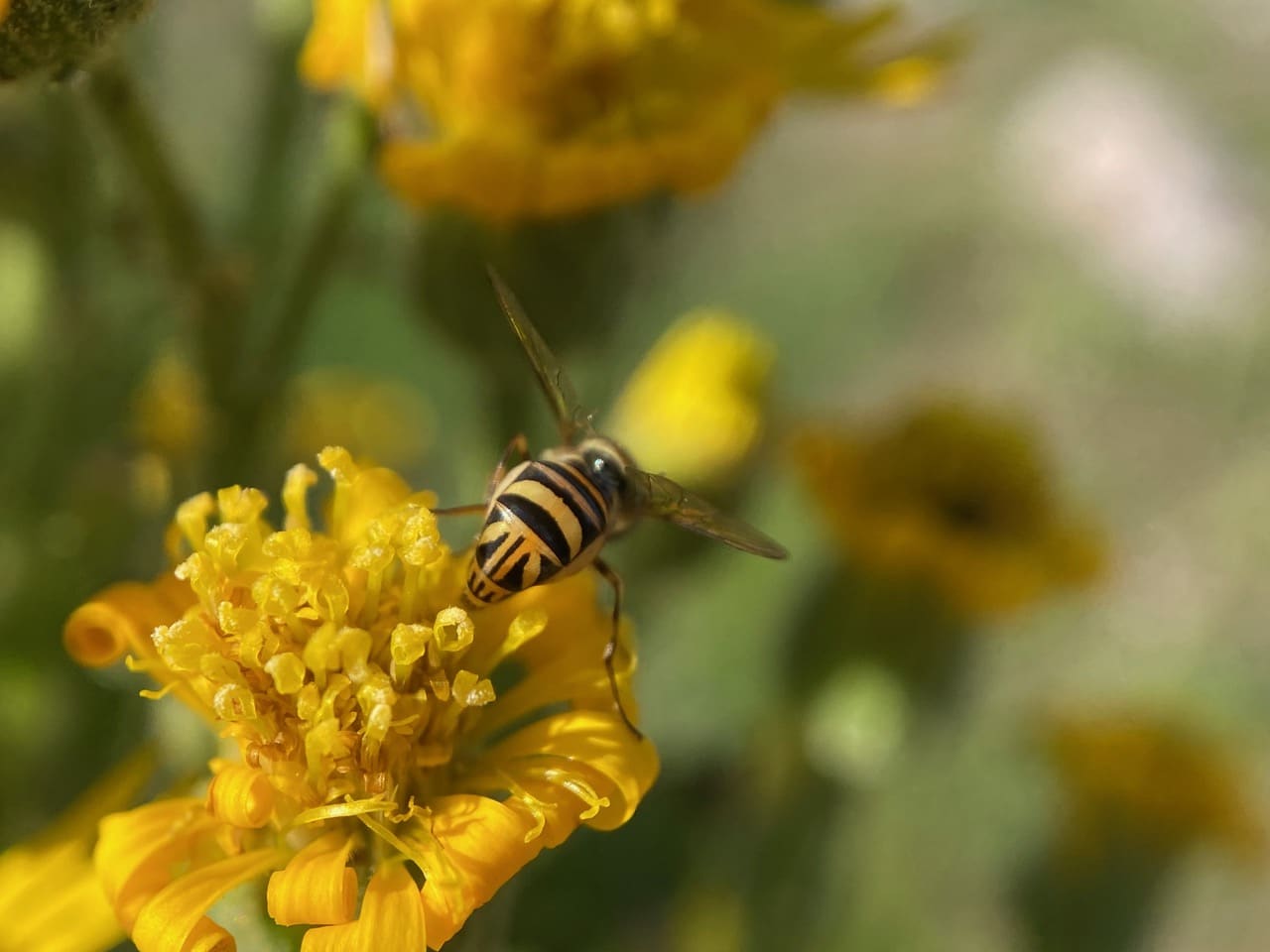
The female Oblique Streaktail flies to another flowerhead, the one where I have just photographed the aphid and aphid “mummy”. Here she proceeds to lay more eggs.
What is she doing now, hanging onto the edge of a ray petal?
She curls her abdomen forward to lay another egg! What a blast – I have never had such good views of a hover fly laying eggs!
The female clambers onto a leaf to continue her task. The busy mama certainly has a lot of eggs to deposit.
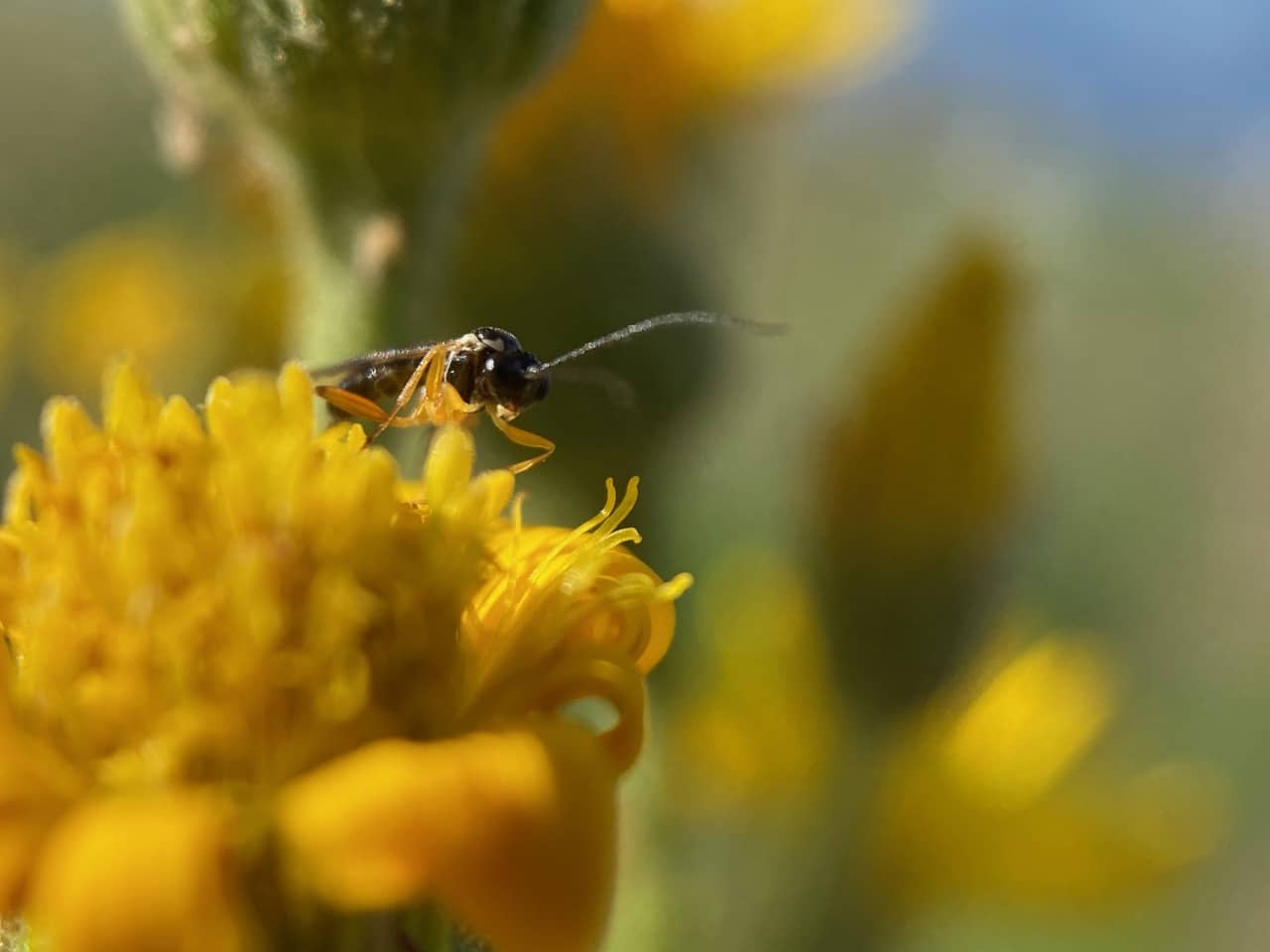
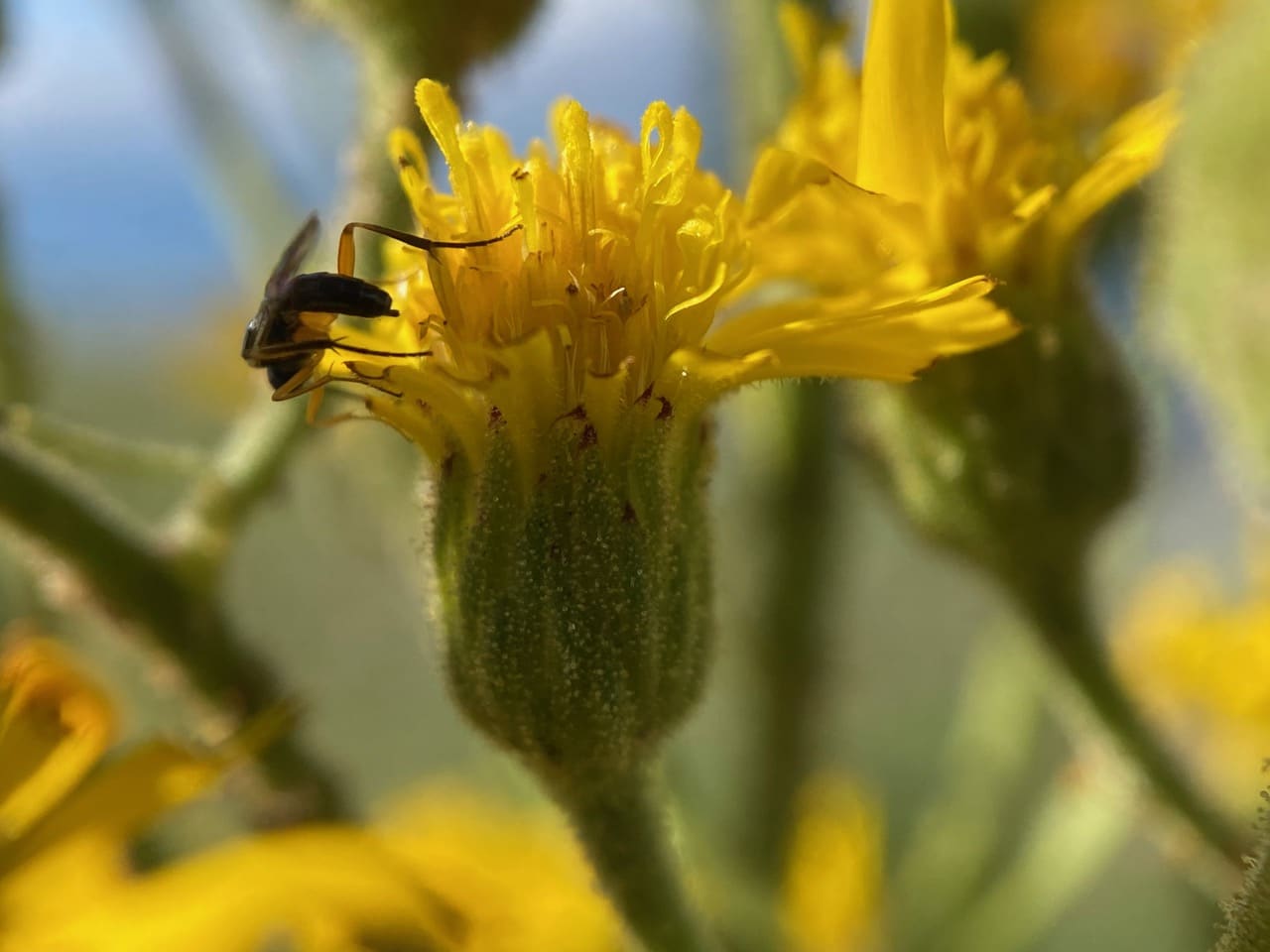
A small wasp with very long antennae appears on a fading Telegraph Weed flowerhead. A parasitic wasp in the superfamily Ichneumonoidea?
The superfamily Ichneumonoidea comprises the two largest families within Hymenoptera: Ichneumonidae and Braconidae, both with a cosmopolitan distribution. Members of the two families are distinguished by wing venation. Ichneumonoids are solitary wasps, and the vast majority are parasitoids; the larvae feed on or in another insect, eventually killing it. In general, ichneumonoids are host specific, and only attack one or few closely related host species. Many species use polydnaviruses to suppress the immune systems of their host insects. Various Ichneumonoids are used as biological control agents in controlling horticultural or forest pests.
The wasp appears to be searching for something, its antennae probing every nook and cranny.
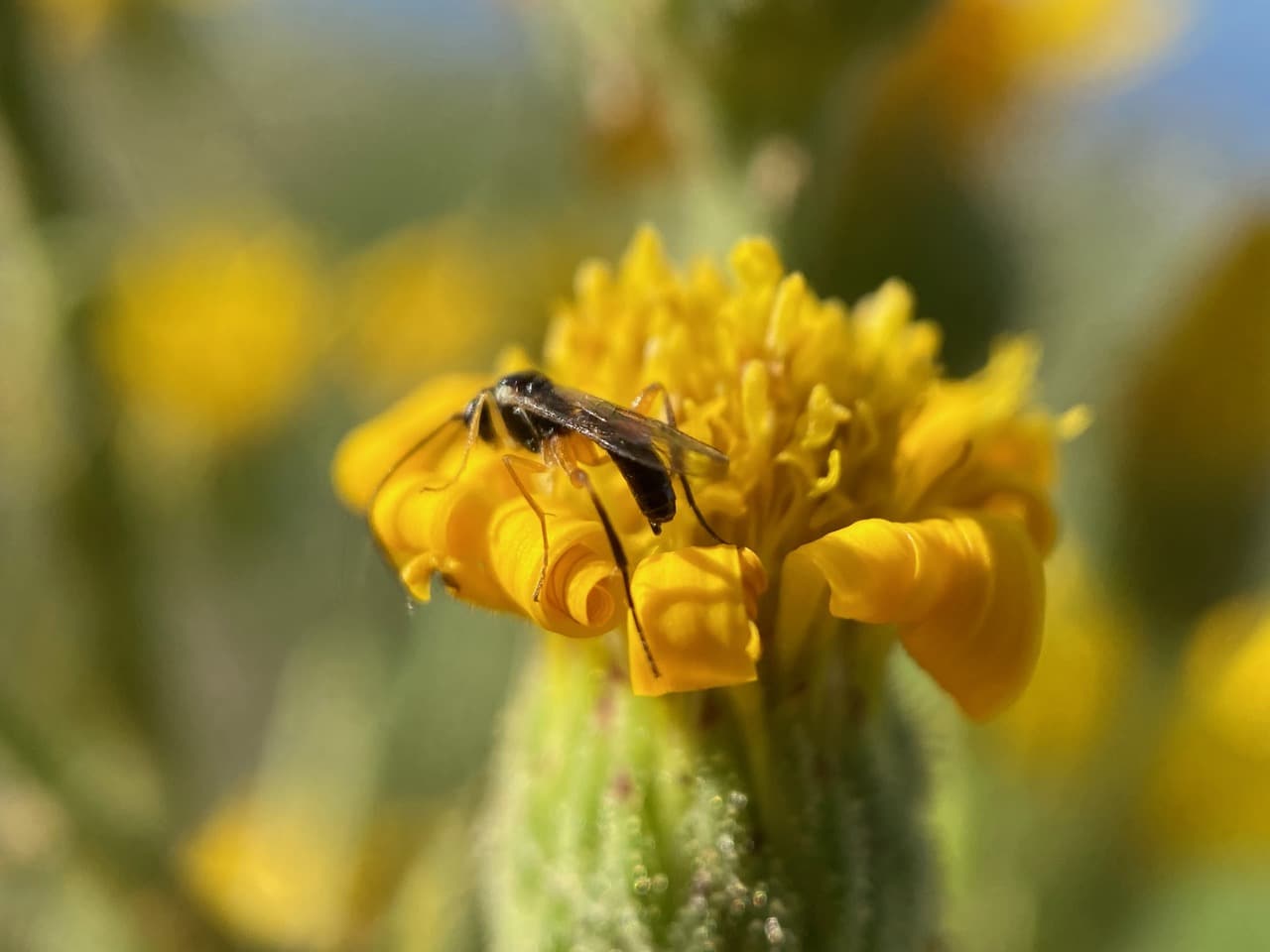
I finally get a glimpse of the wasp’s hind leg which has a white band. The color pattern is characteristic of the Common Hover Fly Parasitoid Wasp, Diplazon laetatorius (family Ichneumonidae).
Diplazon laetatorius is a member of the Ichneumonid wasp family and is 4-7 mm long. The body is mostly black; front two pairs of legs are orange, while the hind legs are banded red, white, and black. The species has a wide geographic range, from the Canadian Arctic to Argentina, Norway to South Africa, and Japan to New Zealand. Human agriculture is thought to have spread it along with aphids and syrphid flies. Adults feed on floral nectar, with a preference for flowers in the Apiaceae family. Females lay their eggs on or near the eggs and larvae of hover flies (family Syrphidae). The developing parasitoid larvae consume the host from within, eventually completing development and emerging as adult wasps.
The wasp has found her host and has curled her abdomen forward to lay her egg. Has she found the eggs left by the egg-laying hover fly we saw earlier?
Wow, in less than 30 minutes, I have unraveled a mini ecosystem centered around the aphids on a single Telegraph Weed. The lady beetle is here to feed on the aphids. Some of the aphids have been parasitized by wasps that turned them into “mummies”. The female hover fly is here to lay her eggs close to the aphids. The hover fly larva is an aphid predator. The parasitoid wasp is here to lay her eggs in the eggs or larvae of the hover fly. Who would’ve thought so much is going on right under our noses! Aphids tend to generate this kind of complex interactions among their friends and foes, visible to any curious gardener who cares to look through a magnifying glass.
A curious California Ground Squirrel watches me from a respectful distance while I take pictures of the insects.
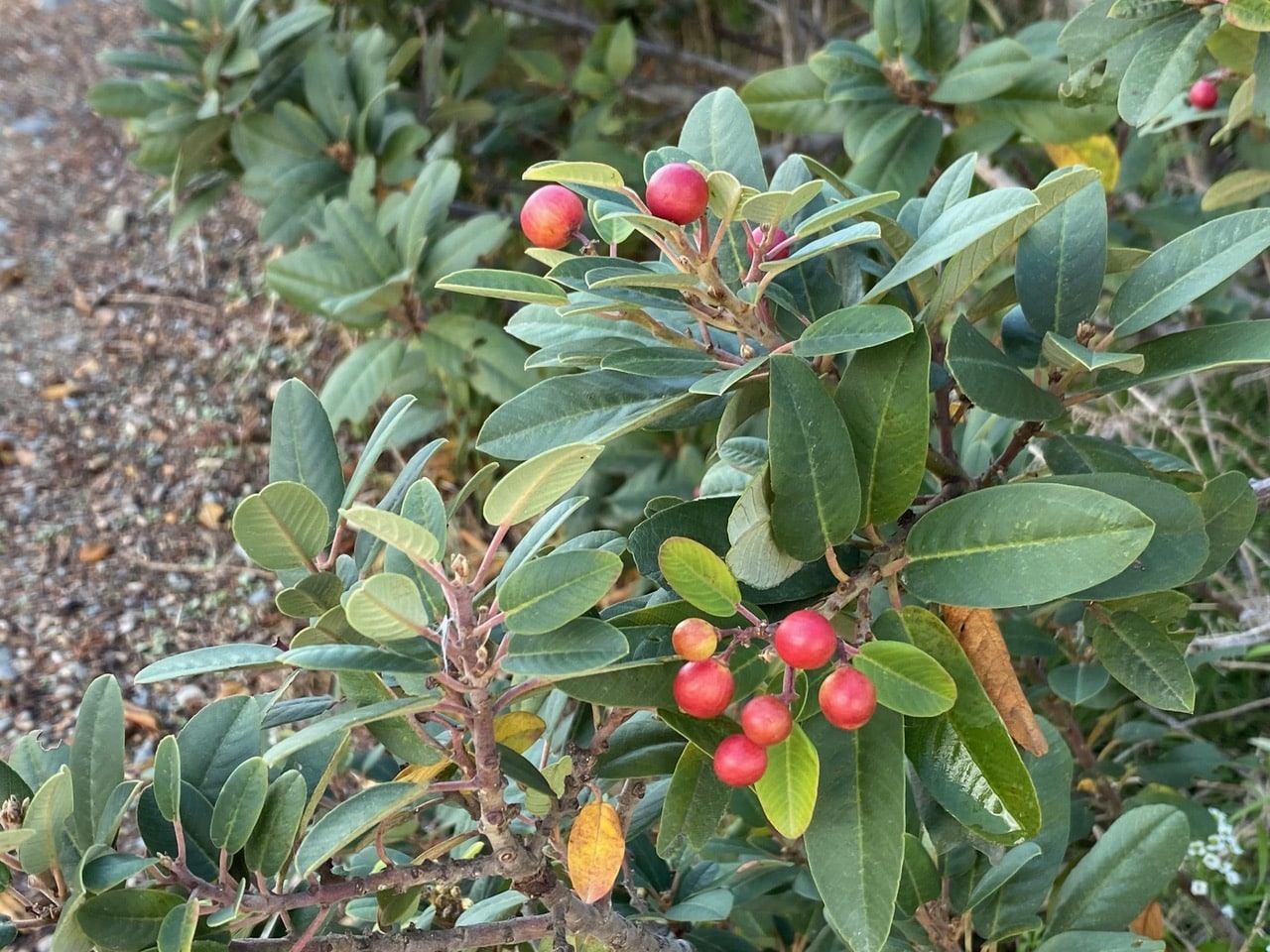
On top of the rocky piling by the water, fruits are ripening on the large wind-pruned Coffeeberry, Frangula californica.
A stout fly is resting on a Coffeeberry leaf. iNaturalist has helped identify it as the Common Tiger Fly, also known as the Hunter Fly or Killer Fly, Coenosia Tigrina. It is a species of fly in the same family as the common house fly, Muscidae. It is a small fly, 6-7 mm long. Their common name reflects the fact that they are predatory as both maggots and adults. Like other members of the genus, adults are predators that hunt flying insects, while larvae feed on earthworms.
The Common Tiger Flies attack from behind, and after catching their prey in midair with their front legs, immediately drop to the ground, and insert their mouthparts to feed. Their prey are mostly equal or smaller size flies. The Tiger Flies are triggered by motion, ignoring immobile prey species that are located nearby. Cannibalism is not uncommon. Because of their effectiveness and voraciousness as predators they are being investigated as a biocontrol for pest control in greenhouses. Adult females lay eggs in the soil, and larvae follow slime trails and earthworm tunnels to find their host.
Fliege Coenosia tigrina – YouTube
Curiously, the Coffeeberry is blooming and producing fruits this time of year.
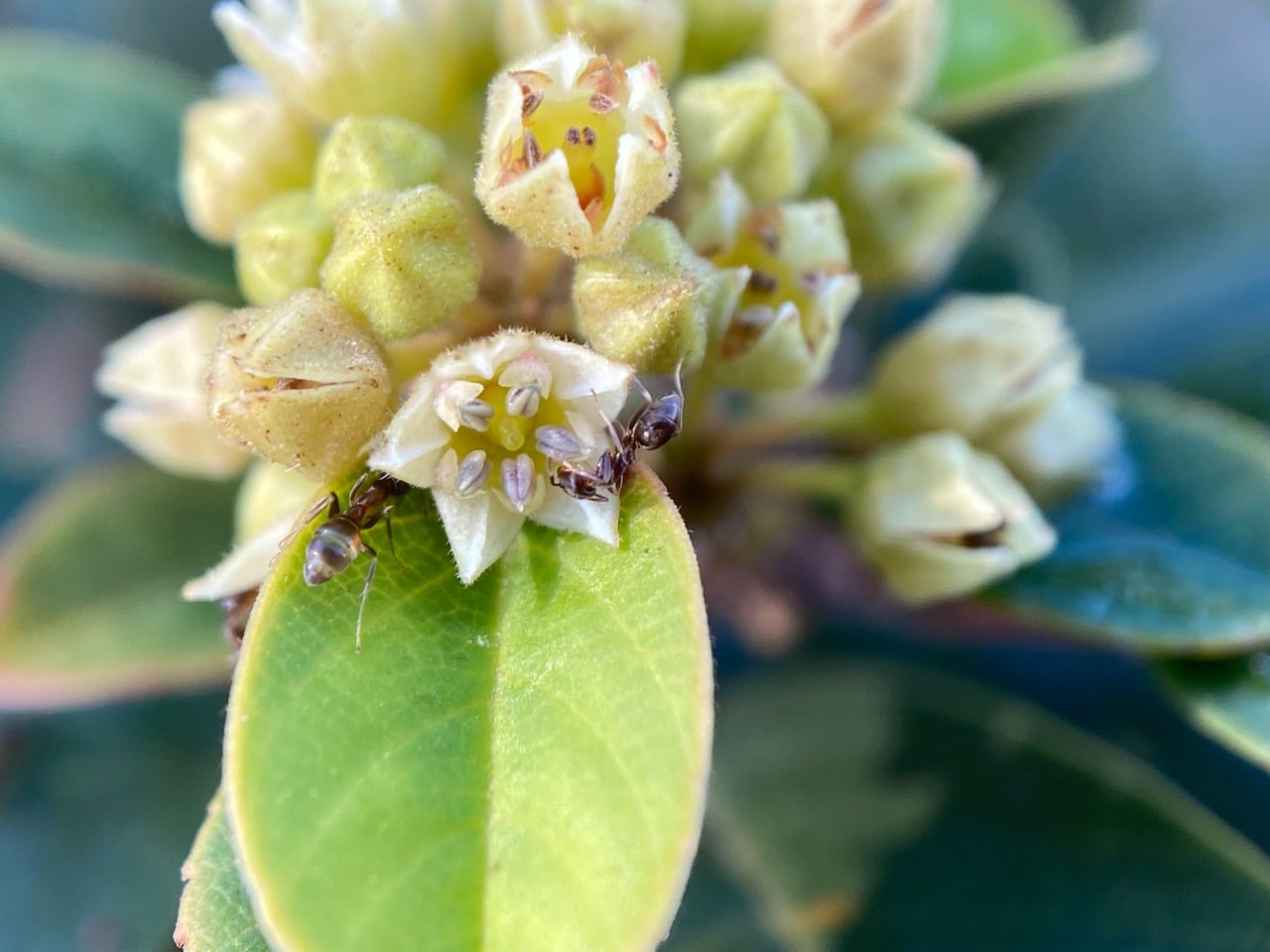
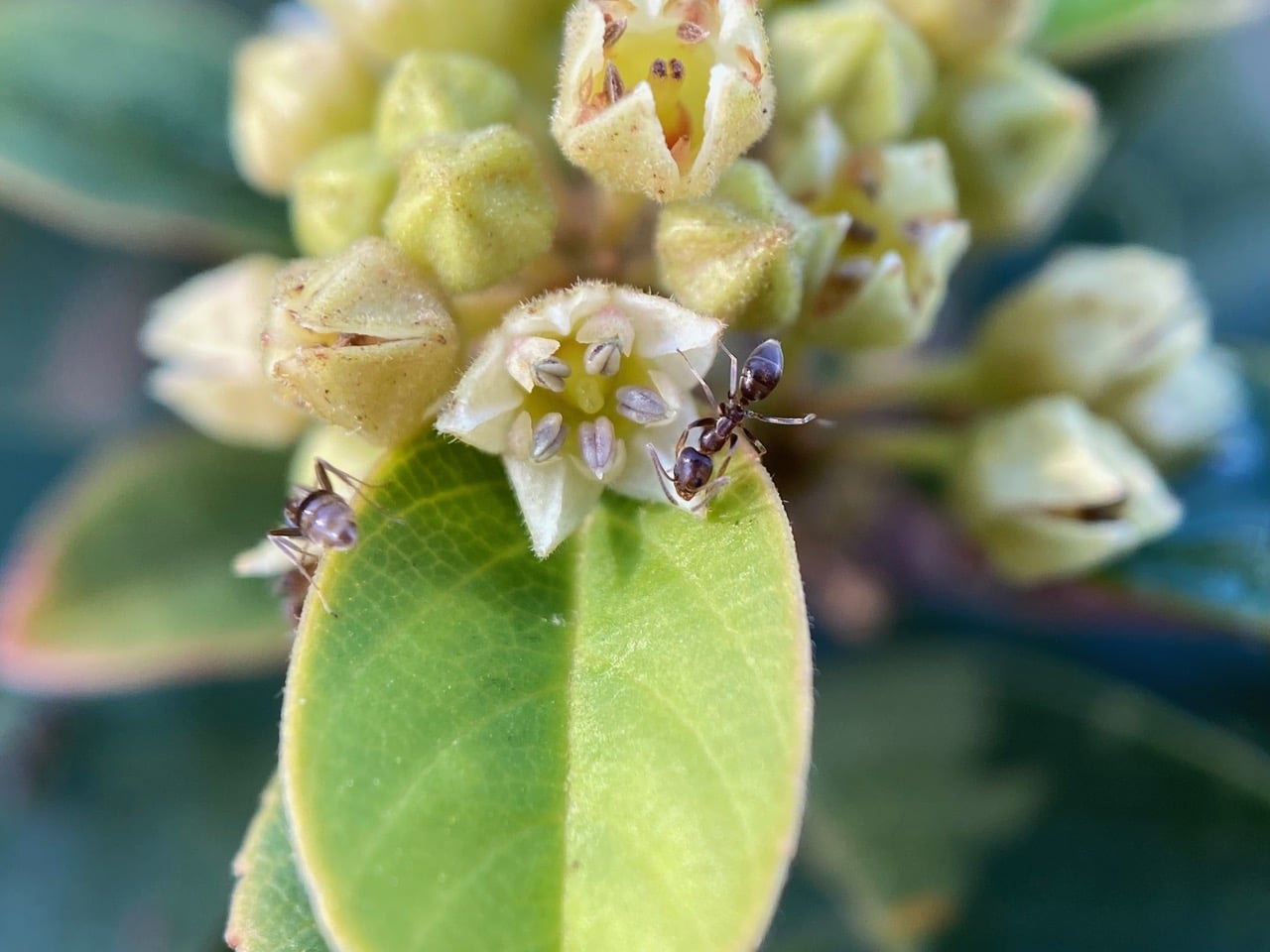
Argentine Ants are swarming over the Coffeeberry flowers, seeking nectar.
The Argentine Ant, Linepithema humile (family Formicidae) is native to Northern Argentina, but it has been inadvertently introduced by humans to many countries, and is now an established invasive species in many Mediterranean climate areas worldwide. The success of the species can be attributed to their lack of aggression between the colonies. There is no apparent antagonism between separate colonies of its own kind, resulting in “super-colonies” that extend across hundreds or thousands of kilometers in different parts of the their range. Genetic, behavioral, and chemical analyses show that introduced Argentine Ants on separate continents actually represent a single global supercolony.
The Argentine Ants are ranked among the world’s worst invasive animal species. In its introduced range, the Argentine ant often displaces most or all native ants and can threaten native invertebrates and even small vertebrates that are not accustomed to defending against the aggressive ants. This can, in turn, imperil other species in the ecosystem, such as native plants that depend on native ants for seed dispersal, or lizards that depend on native ants for food.
A new study published in the Journal of Insect Science documents a serious dilemma that Bumble Bees face when Argentine Ants compete with them over nectar. Bees tend to avoid flowers already occupied by aggressive ants, which will bite to keep them away, but when they both get tangled in a fight, bees sometimes bite back. These skirmishes are a lose-lose scenario in most cases, leaving ants dead and bees with wasted energy that could’ve been spent foraging and feeding their colonies.
Some of the Fennel, Foeniculum vulgare along the shore are still in bloom.
A California Lady Beetle, Coccinella californica (family Coccinellidae) is resting on a dried Fennel leaf.
The California Lady Beetle, Coccinella californica has a red elytra that is usually spotless. Pronotum is black with a white patch on each side. Head is black with two small white spots between the eyes. There is a black suture (where the wings meet, down the middle of the back). The species’ range is the coastal counties north of the Transverse Ranges. Both adults and larvae are voracious predators of aphids and other soft-bodied insects.
That looks like a large aphid mummy on an umbel of Fennel flower buds. Surely, this plant is infested with aphids?
It took me a long time to find the aphids. They are tiny and they mostly aggregate on the developing seed capsules.