

Pollinator Post 10/9/25 (2)
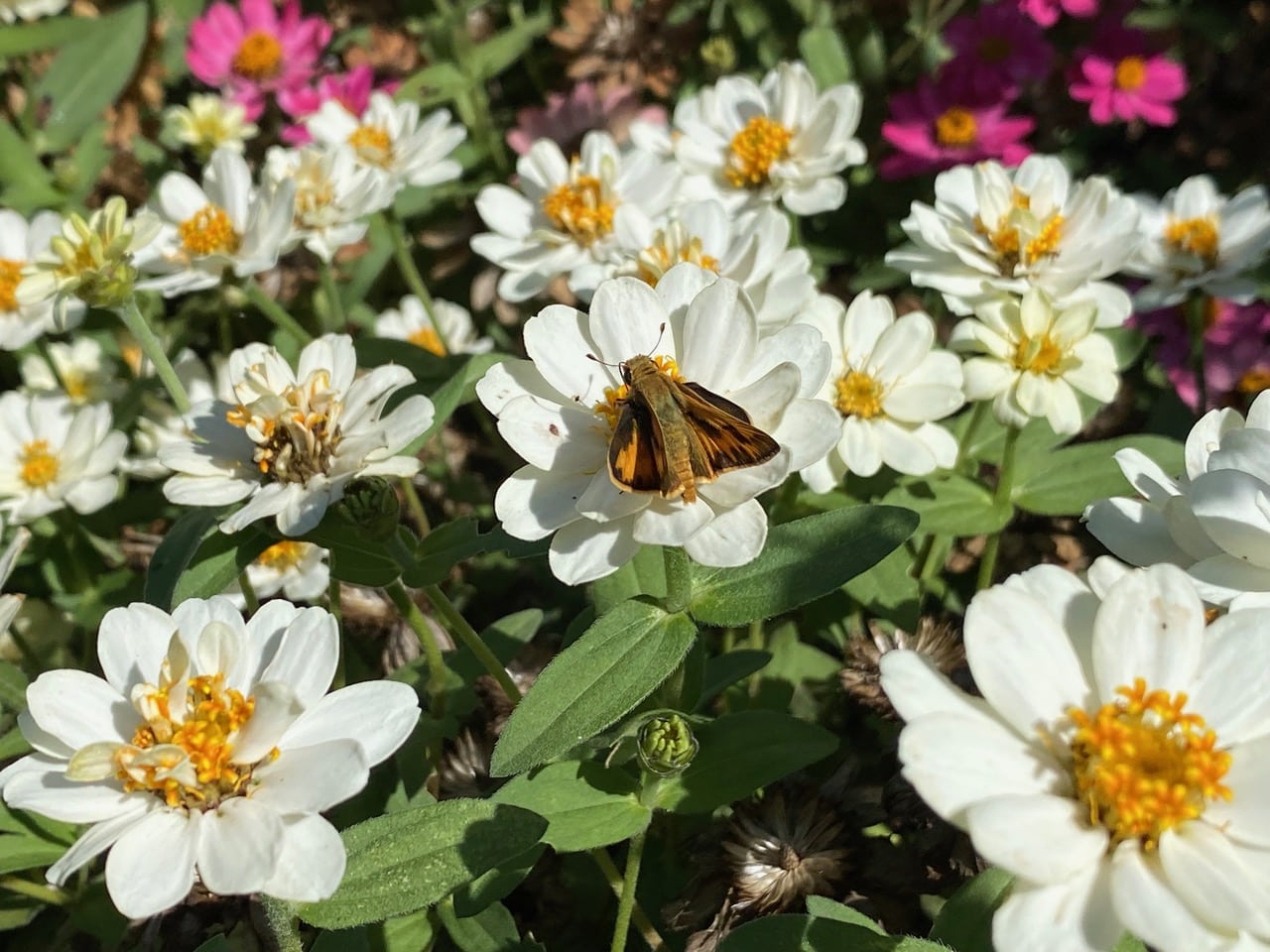
A Fiery Skipper, Hylephila phyleus (family Hesperiidae) is taking nectar on a Zinnia flowerhead.
Skippers are a family, the Hesperiidae, of the order Lepidoptera (butterflies and moths). They are named for their quick, darting flight habits. Most have the antenna clubs hooked backwards like a crochet hook. They also have generally stockier bodies and larger compound eyes than the other butterflies. Their wings are usually small in proportion to their bodies. When at rest, skippers keep their wings usually angled upwards or spread out, and only rarely fold them up completely. Californian species are mostly brown or tan, with black, orange, or yellow markings.
Skipper caterpillars are usually green or brown, sometimes yellowish, never brightly colored. They have a distinctive “collar”, a narrow ring around the body right behind the head. Caterpillars are camouflaged and often hide during the day. Many species make nests of leaves and silk for additional protection. Most North American species feed on grasses, but some common species eat shrubs and trees, especially in the bean family. Most species are limited to a single group of food plants. Adult skippers are only active during the day, but Skipper caterpillars feed mainly when it is dark or partly light.
Fiery Skippers, Hylephila phyleus (family Hesperiidae) is a small butterfly, with a wingspan of 1.25 to 1.5 in. It can be seen from March to November. Host plants include various species of grasses.
Fiery Skipper is the most abundant grass skipper in California, mostly due to its dominance in urban areas, thanks to the ubiquity of the Great American Lawn. Originally found only in North and South America, it has been introduced into Hawaii and Bali
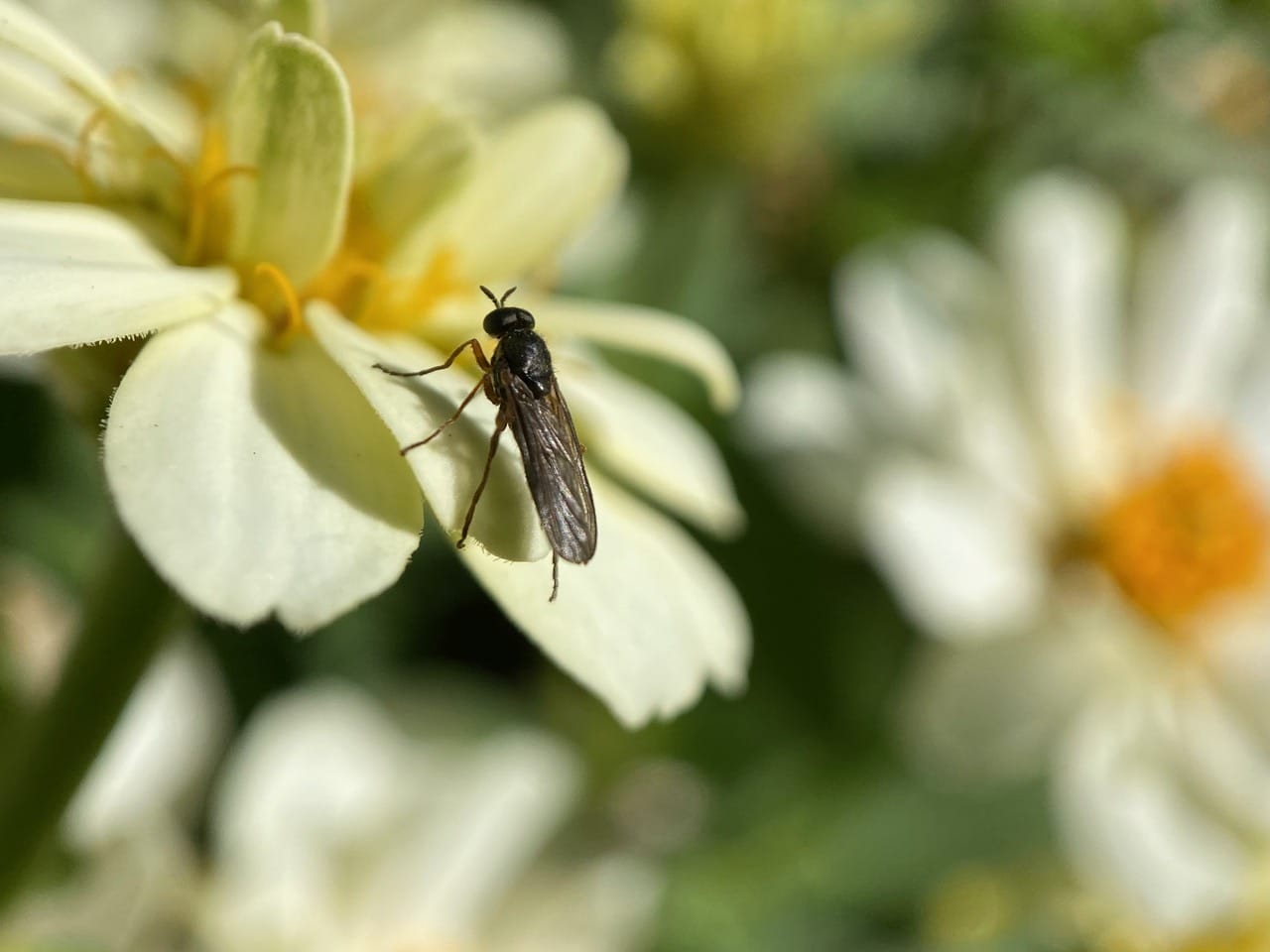
A male Sugarcane Soldier Fly, Inopus rubriceps (family Stratiomyidae) has landed on a ray petal of a Zinnia flowerhead.
The Sugarcane Soldier Fly, Inopus rubriceps (family Stratiomyidae) is native to eastern Australia where it infests such crops as corn, pastures, and sugarcane. The fly was accidentally introduced into California over 50 years ago. It is now infesting lawns in San Francisco and other Bay Area counties. Damage to turf and other members of the grass family results from withdrawal of sap from roots of host plants by the larvae and possibly, injection of a toxin into the plant.
In California adults occur in large numbers from late September to early November each year. Eggs are deposited in crevices in the soil. The adults are sexually dimorphic. Females have tiny red heads with eyes set far apart. The smaller males have large eyes that occupy the whole surface of the head.
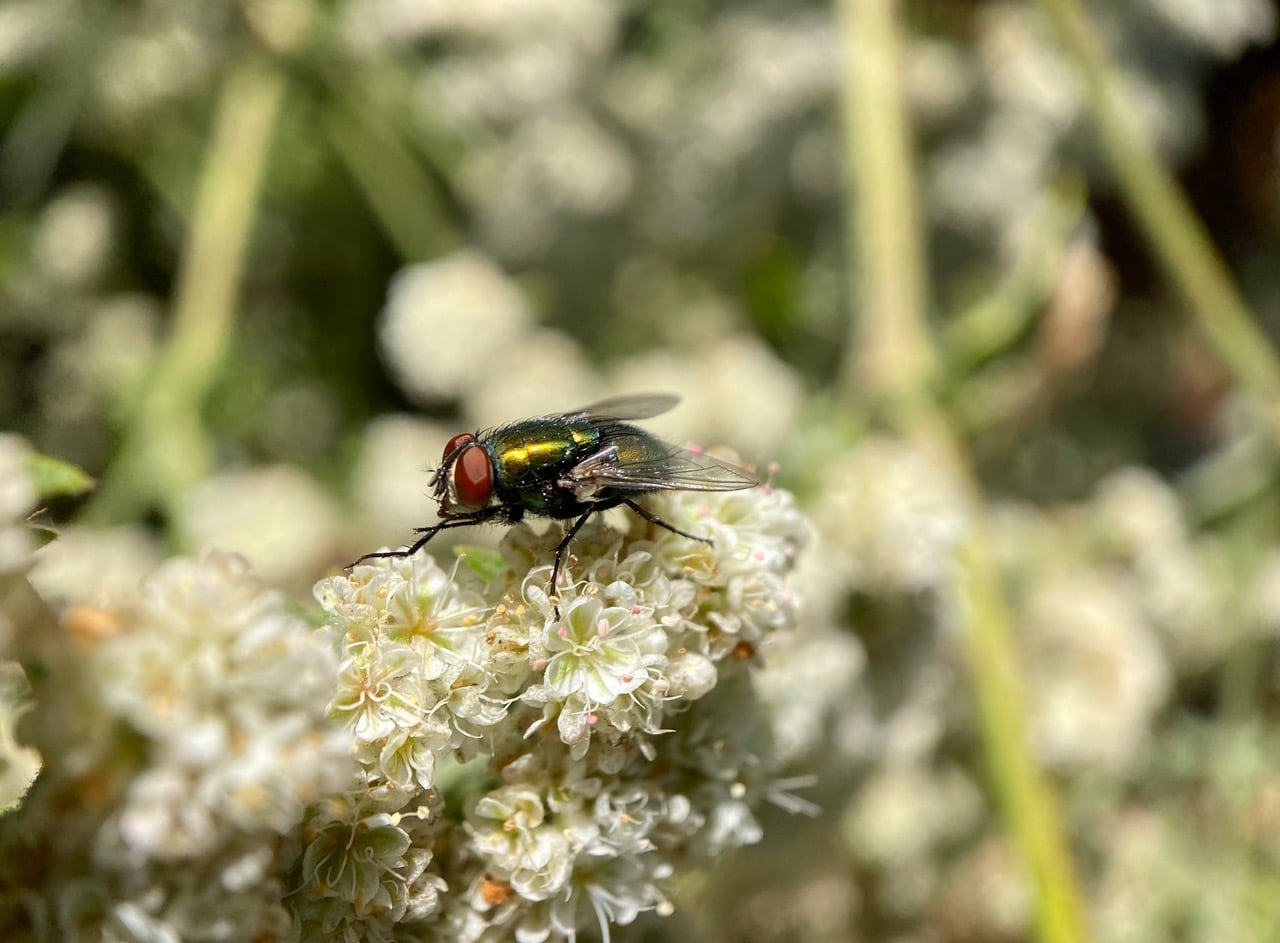
A Common European Greenbottle Fly, Lucilia sericata (family Calliphoridae) is grooming itself on an inflorescence of St. Catherine’s Lace, Eriogonum giganteum.

The Common European Greenbottle Fly, Lucilia sericata (family Calliphoridae) is a Blowfly found in most areas of the world and is the most well-known of the numerous green bottle fly species. Slightly larger than a house fly, it has brilliant, metallic, blue-green or golden coloration with black markings. The lifecycle of Lucilia sericata is typical of blowflies. Females lay masses of eggs in fresh carrion. The flies are extremely prolific – a single female may produce 2,000 to 3,000 eggs in her lifetime. The larvae feed on dead or necrotic tissue, passing through 3 larval instars. Third-instar larvae drop off the host to pupate in the soil. The adults feed opportunistically on nectar, pollen, feces, or carrion; they are important pollinators as well as important agents of decomposition. Pollen is used as an alternative protein source, especially for gravid females who need large amounts of protein and cannot reliably find carrion.
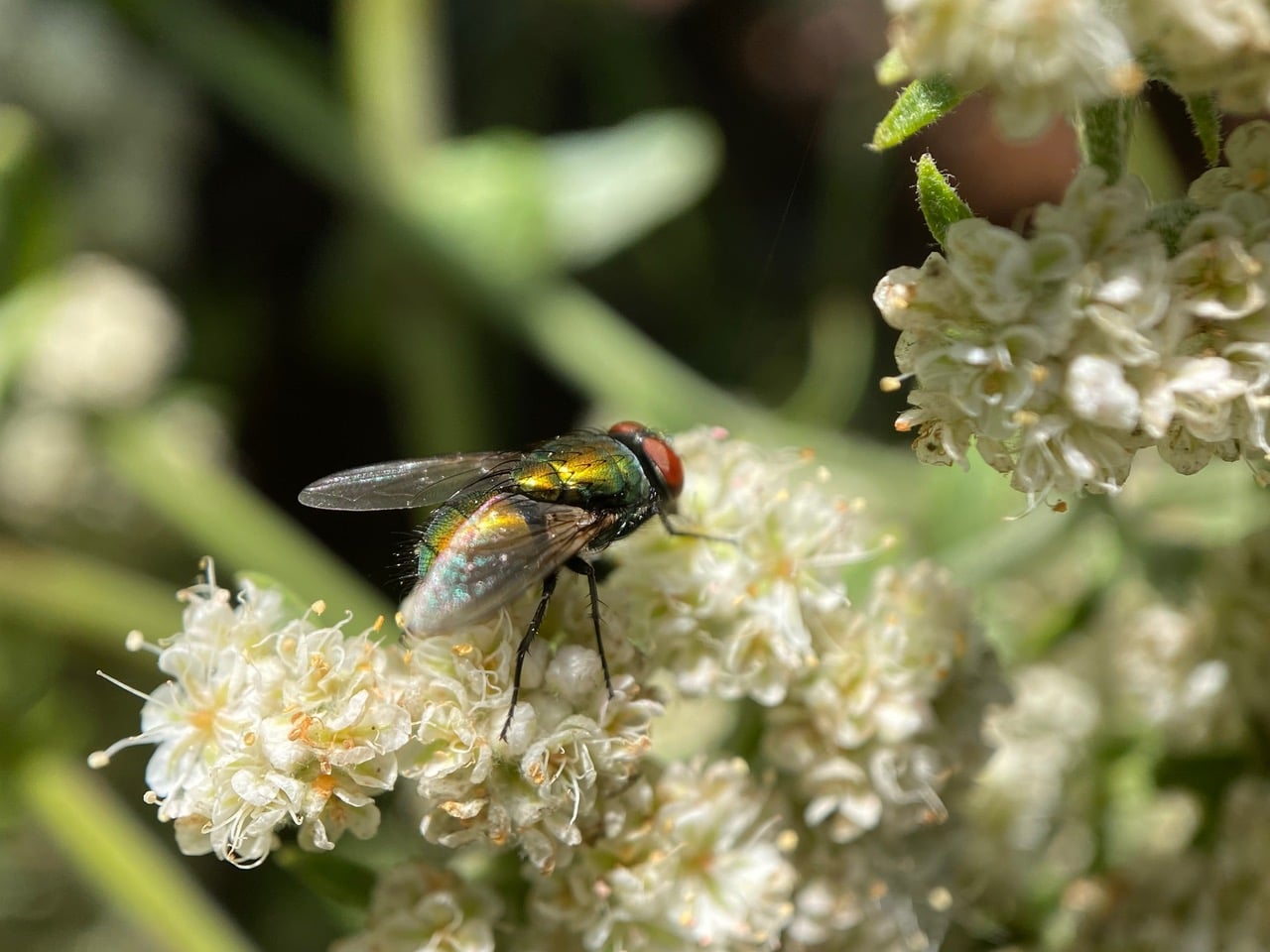
While we may find the blowflies disgusting for their association with filth and carrion, they are important decomposers/ recyclers in the ecosystem. Besides, their larvae are used in maggot therapy to clean wounds by consuming only dead and infected tissue, helping to promote faster healing and prevent infection.

Perched on an inflorescence of St. Catherine’s Lace, Eriogonum giganteum, a Thick-legged Hover Fly, Syritta pipiens (family Syrphidae) is feeding on pollen from a flower.
Syritta pipiens originates from Europe and is currently distributed across Eurasia and North America. They are fast and nimble fliers. The fly is about 6.5 – 9 mm long. The species flies at a very low height, rarely more than 1 m above the ground. Adults visit flowers – males primarily to feed on nectar, and females to feed on protein-rich pollen to produce eggs. The species is found wherever there are flowers. It is also anthropophilic, occurring in farmland, suburban gardens, and urban parks. Larvae are found in wetlands that are close to bodies of freshwater such as lakes, ponds, rivers, ditches. Larvae feed on decaying organic matter such as garden compost and manure. Males often track females in flight, ending with a sharp dart towards them after they have settled, aiming to attempt forced copulation.
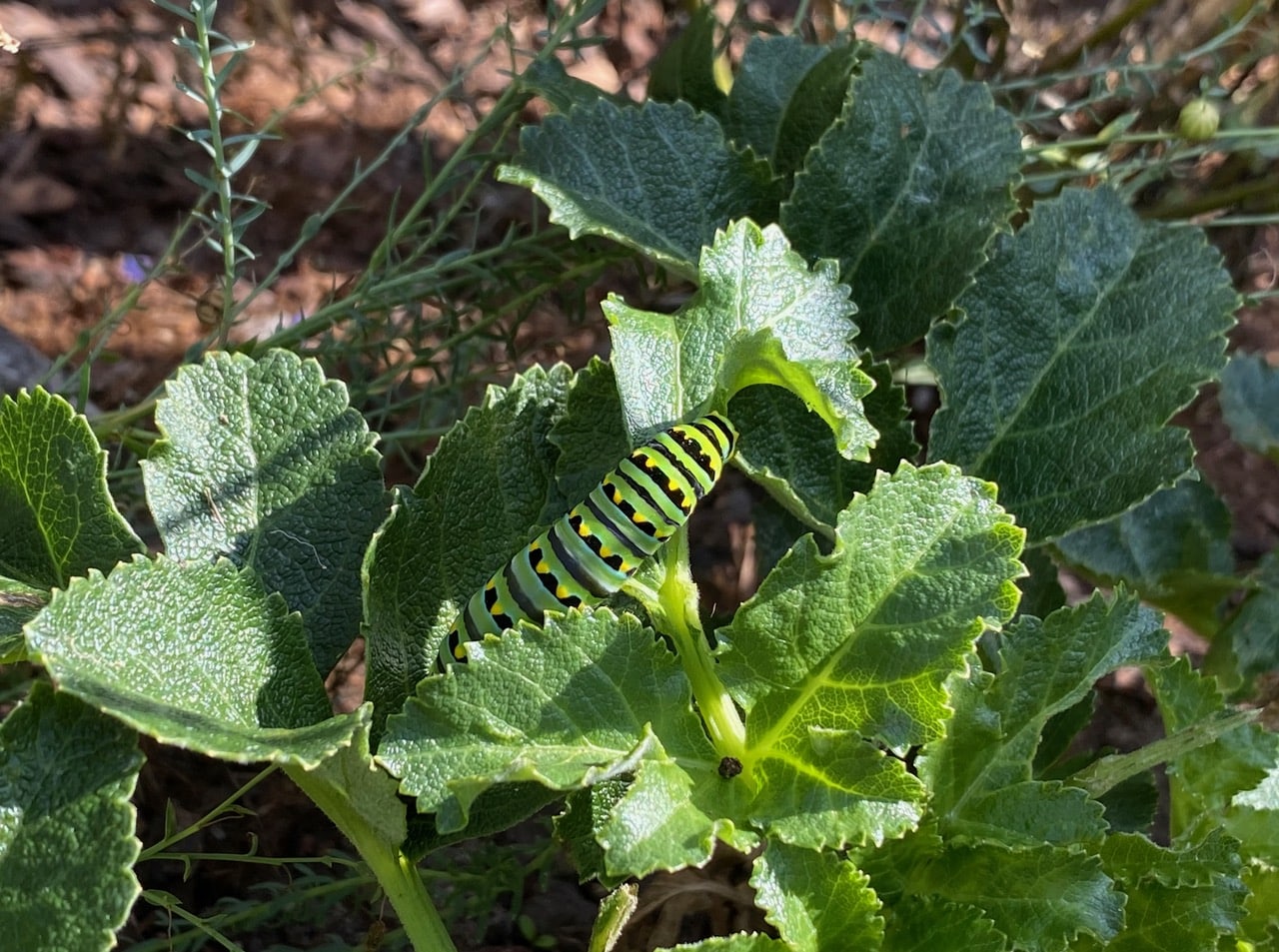
Whoa, there’s a large 5th instar Anise Swallowtail caterpillar on that young Coast Angelica, Angelica hendersonii!
The Anise Swallowtail, Papilio zelicaon (family Papilionidae), is a common swallowtail butterfly of western North America. It is found in fairly open country, most likely seen on bare hills or mountains, in fields oar at the roadside. Adult females lay eggs singly on the underside of host plant leaves. In the first two instars, the caterpillar is a bird poop mimic – dark brown, almost black, with an irregular white band at its middle. After that it becomes more green at each successive molt until, in the fifth (last) instar, it is predominantly green, with markings in black, orange, and light blue. Its major food plants are members of the carrot family, Apiaceae (including Angelica), and also some members of the citrus family, Rutaceae.
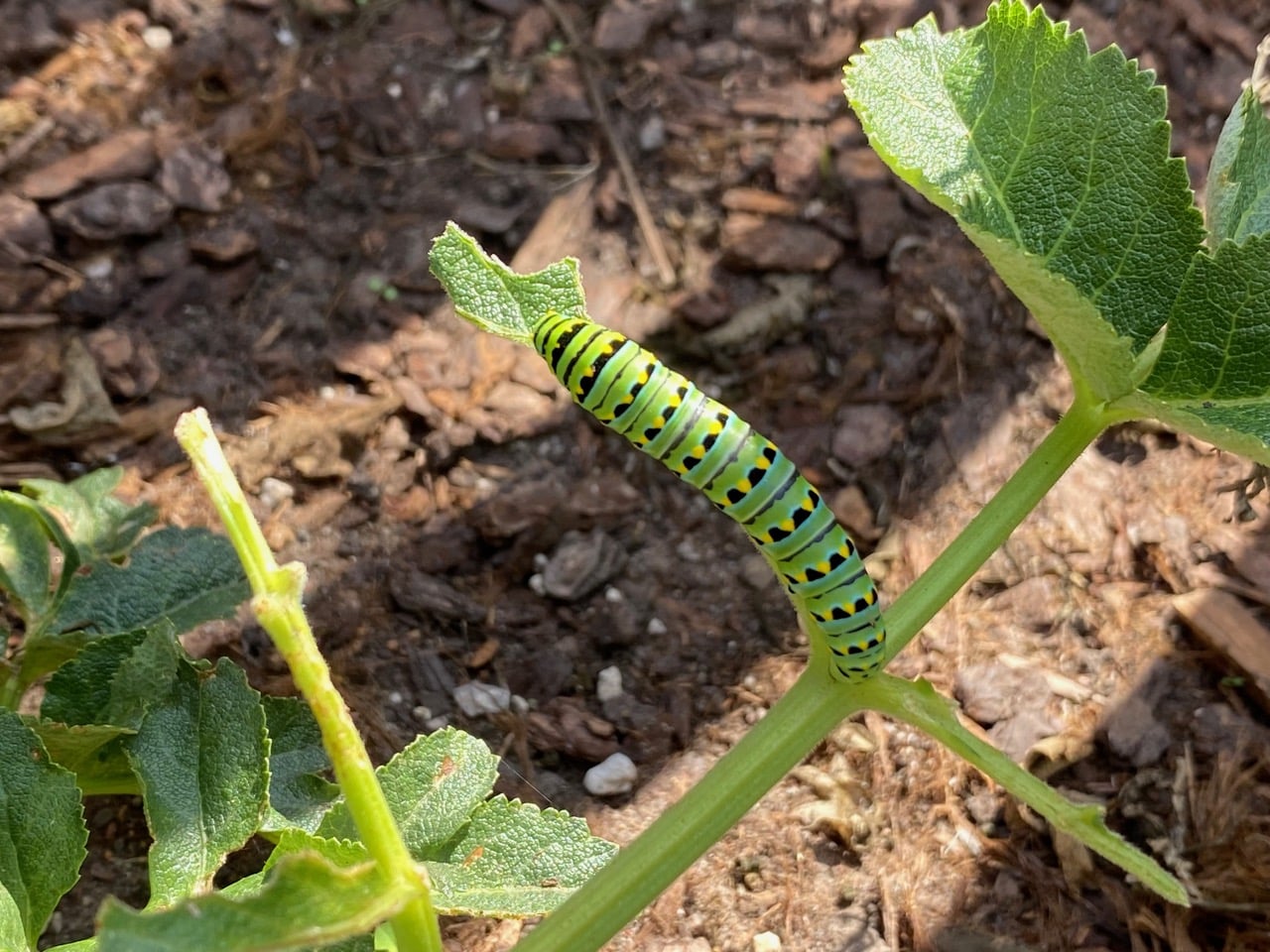
This Anise Swallowtail caterpillar is feeding on another leaf of the same plant. Note that several of the leaflets have been demolished. Both caterpillars look like they are close to pupation. There’s actually a third caterpillar hidden in the foliage of the same plant.
Anise Swallowtail caterpillars feed on plants in the Apiaceae family, including fennel, parsley, carrots, and dil, as well as poison hemlock. They also use native plants like Angelica, Cow Parsnip, and Yampah. Sweet orange (Citrus sinensis) is the only known non-Apiaceae host plant, likely because it contains similar chemical compounds.

To show Craig the fascinating defense behavior of the Swallowtail, I gentle tap on the head of one of the caterpillars. Immediately a yellowish-orange horn-like structure, the osmeterium, is extruded from behind its head. It is almost immediately retracted. (The two forks of the osmeterium are of the same length, but look unequal from this perspective because of foreshortening effect.)
The osmeterium is a defensive organ found in Swallowtail butterfly caterpillars (family Papilionidae). It is a fleshy, forked structure that can be everted from the caterpillar right behind its head when it feels threatened. When extended, the osmeterium releases a foul-smelling secretion, often containing terpenes (essential oils) extracted from the caterpillar’s host plants.

In the front garden, a female Sugarcane Soldier Fly, Inopus rubriceps (family Stratiomyidae) is perched on a spent Seaside Daisy seed head! We saw a male earlier in the backyard. The sexual dimorphism is very distinct in this species.
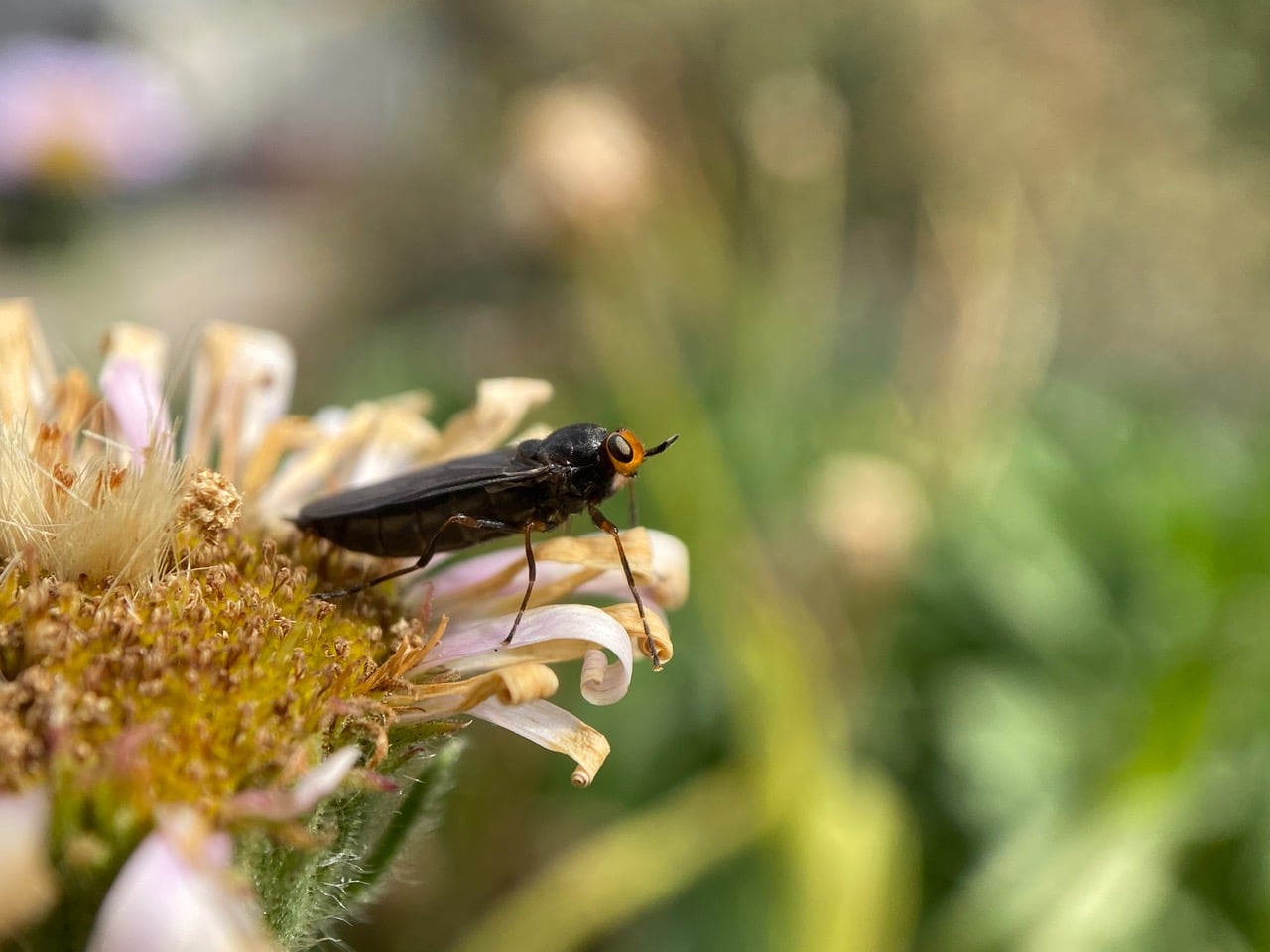
Female Sugarcane Soldier Flies, Inopus rubriceps (family Stratiomyidae) have tiny red heads with eyes set far apart. The males are smaller and have large eyes that occupy the whole surface of the head.

A Sandhill Skipper, Polites sabuleti (family Hesperiidae) lands on a flowerhead of Seaside Daisy, Erigeron glaucus. The butterfly appears to be having some trouble with its proboscis, shaking it in an agitated way. Wait a minute, the yellow stuff attached to its proboscis appears not to be loose pollen grains, but a pair of milkweed pollinia!

A close-up of the butterfly’s head shows that, indeed, a pair of pollinia has been attached to the butterfly’s proboscis just below the angled bend. It is conceivable that while previously probing for nectar from a milkweed flower, the butterfly’s proboscis has accidentally slipped into a stigmatic slit, subsequently pulling out a pair of pollinia. More often it’s the legs of the insect that are trapped. I am rather surprised to see this, as all the milkweeds in Craig and Jenny’s garden are done blooming. Perhaps some neighber’s garden still has milkweed in bloom? In fact the pollinia are large, likely from a flower of Showy Milkweed, Asclepias speciosa. How long has the pollinia been on the butterfly’s proboscis? Does having the pollinia clamped onto the proboscis restrict the flow of nectar? Or the coiling of the proboscis when not in use?
The pollination of the milkweed flower, Asclepias sp. is a complicated and treacherous affair, relying on unusual floral structures and arrangement to trick insects into carrying its pollen. The pollen of milkweed, much like those of orchids, are packed into neat packets called pollinia, that usually come in pairs. Milkweed flowers are a rich source of nectar that attract many pollinators. While probing for nectar, the insect’s leg or other appendages may accidentally slip into the stigmatic slit of the flower where a pair of pollinia lies hidden. In pulling its leg free, the insect may pull out an attached pollinia. This may be deposited in another milkweed flower that the insect subsequently visits, effectively pollinating the flower. Repeated visits to the milkweed flowers may result in a chain of pollinia attached to a pollinator, sometime impeding its flight and movement. The smaller, weaker insects that are unable to extricate their legs from the trap may end up losing their life and/or limb on the flower.
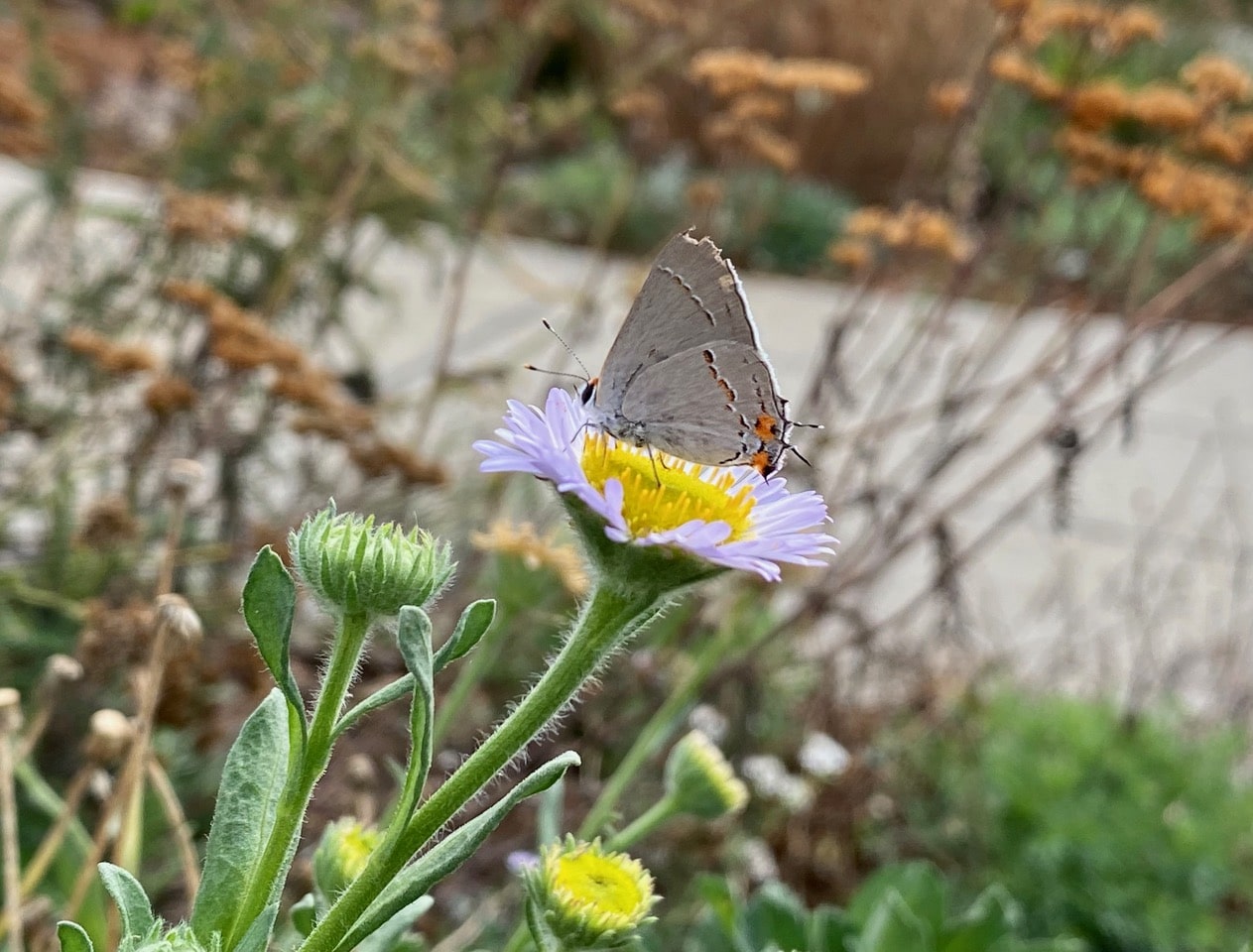
A rather ragged looking Gray Hairstreak, Strymon melinus (family Lycaenidae) lands on a Seaside Daisy flowerhead. While the butterfly probes for nectar, it constantly rubs its hind wings together.
Why the name “hairstreak”? These small butterflies have a slim, hair-like tail on the lower corner of each hindwing. Gray Hairstreak also has colorful false eyespots near the base of each tail. The eyespots and antenna-like tails are believed to fool predators into mistaking its tail for its head. Hairstreaks even add a behavioral component – a nectaring hairstreak often rubs its wings up and down, simulating the movement of twitchy antennae. This may fool birds, lizards, and spiders into attacking the wrong end, sparing the life of the butterfly.
Female Gray Hairstreaks lay eggs singly on the flowers, flower buds, young fruits and nearby leaves of a host plant. Host plants include a wide variety of plants, notably from the pea (Fabaceae) and mallow (Malvaceae) families. The caterpillars are greenish at the start, but older individuals range in color from gray to pink. As in many species of Lycaenidae, Gray Hairstreak larvae are myrmecophiles (ant-lovers) – often tended by ants. Ants harvest a sweet liquid from the caterpillar’s dorsal nectary organ (“honey gland”) and in exchange may protect them from predators. Larvae of many Lycaenidae species also communicate with ants via ant-like sounds (clicks and hums) or by sending vibrations through the substrate.

What is that pair of tiny, erect, antenna-like structures on the Gray Hairstreak’s head? I am not able to find an answer anywhere.

A female Western Leafcutter bee, Megachile perihirta (family Megachilidae) is collecting pollen on a Seaside Daisy flowerhead. The scopa on the underside of her abdomen is already covered with yellow pollen.
The motion of Megachilidae, (including leafcutter bees and mason bees) in pollen gathering is energetic and swimming-like; this agitation releases large amounts of pollen from the flower’s reproductive structures. Pollen grains are loosely held on the scopal hairs by electrostatic attraction, and come off easily on the next flowerhead the bee visits. For this reason, these bees are consider pollinators extraordinaire.
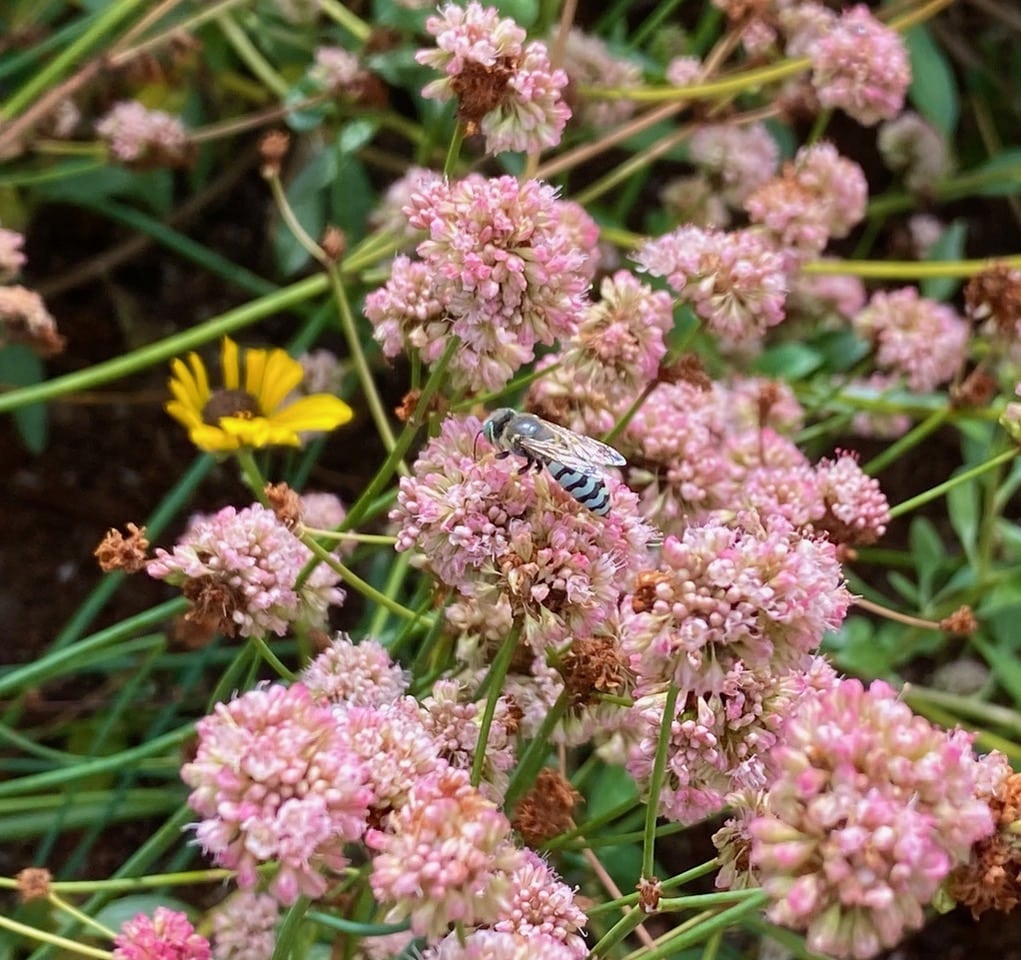
An American Sand Wasp, Bembix americana (family Crabronidae) is foraging on a cluster of pink-flowered Buckwheat, Eriogonum sp.
Sand wasps in the genus Bembix are familiar and common throughout North America, digging their burrows in dunes, on beaches, and other habitats with loose, deep sand. The female rapidly kicks out large quantities of sand using a “tarsal rake” of spines on each front leg. The burrow is excavated before the wasp goes hunting. Bembix are generalist, opportunistic hunters. True flies in the order Diptera are the usual prey. A victim is paralyzed or killed by the wasp’s sting, and is then flown back to the nest. Most species will lay an egg on the first victim, while some species lay an egg in the empty cell before starting to hunt. Once the egg hatches, mama wasp brings flies to her larva as needed. This “progressive provisioning” is rare in the insect world. When the larva reaches maturity, mama wasp closes the cell. Inside, the larva spins an oblong cocoon, weaving sand grains into the structure and resulting in a hardened capsule. Overwintering takes place as a prepupa inside this cocoon, but there are usually two generations a year.
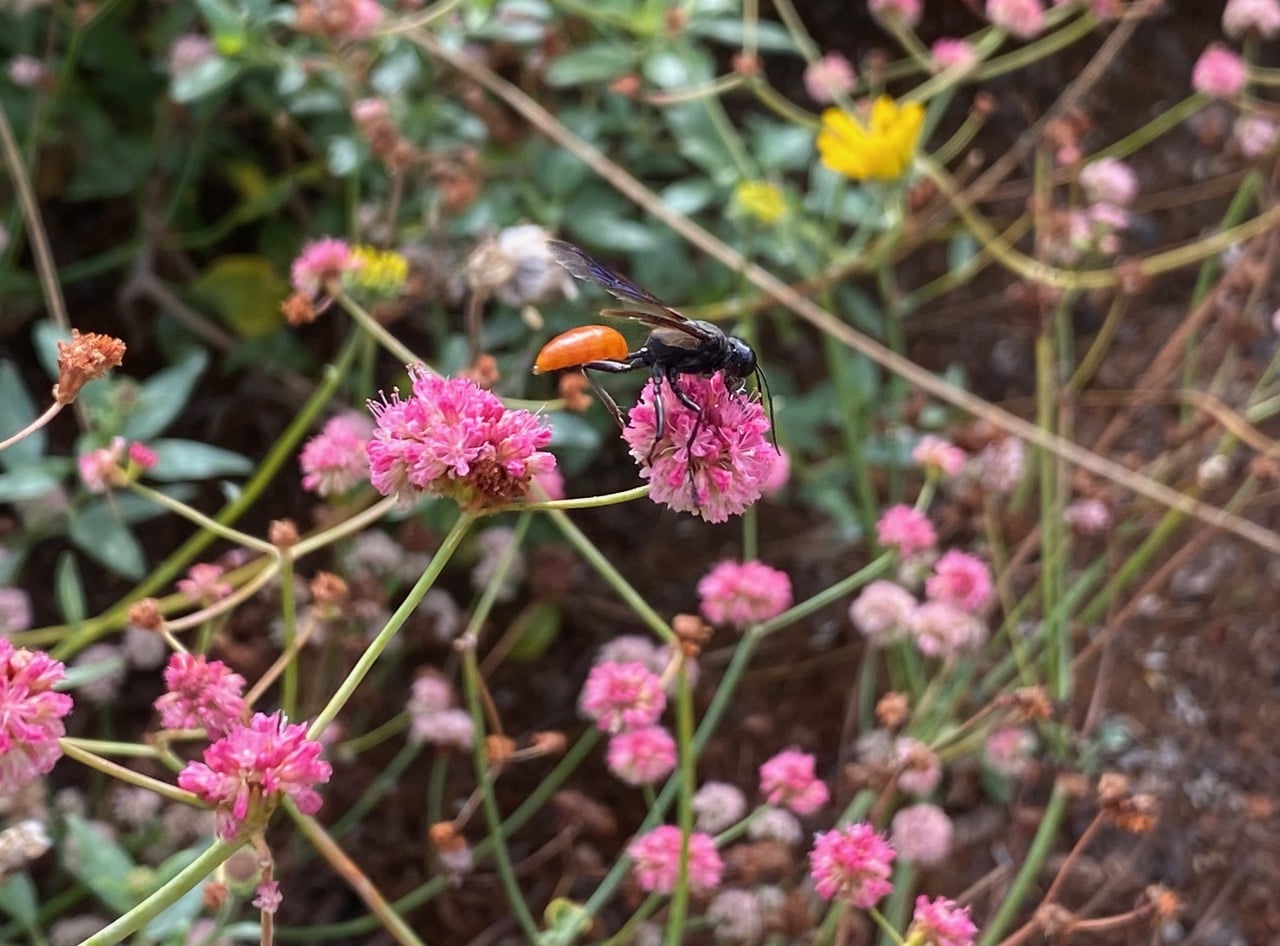
A large black wasp with orange-red abdomen is busy flitting around the flowers of Red-flowered Buckwheat, Eriogonum grande ssp. rubescens seeking nectar. It is easily recognizable as a female Thread-waisted Burrowing Wasp, Sphex lucae (family Sphecidae).

The Sphecidae are solitary wasps with elongated and narrow first abdominal segment, giving rise to the common name Thread-waisted Wasps. Sphex lucae is a widespread western species, ranging from WA in the north, south to CA, and east to TX. The species exhibits sexual dimorphism – females are black with a red abdomen, while the males are all black. Adults visit many types of flowers for nectar. Females hunt katydids and grasshoppers as food for their young. The wasp excavates a single-celled burrow in the soil in advance of hunting activities. She drags her paralyzed prey back to the burrow, laying a single egg on the victim. The nest entrance is then sealed and the process is repeated. Males of this species spend nights in sleeping aggregations in sheltered places such as beneath a rock overhang.
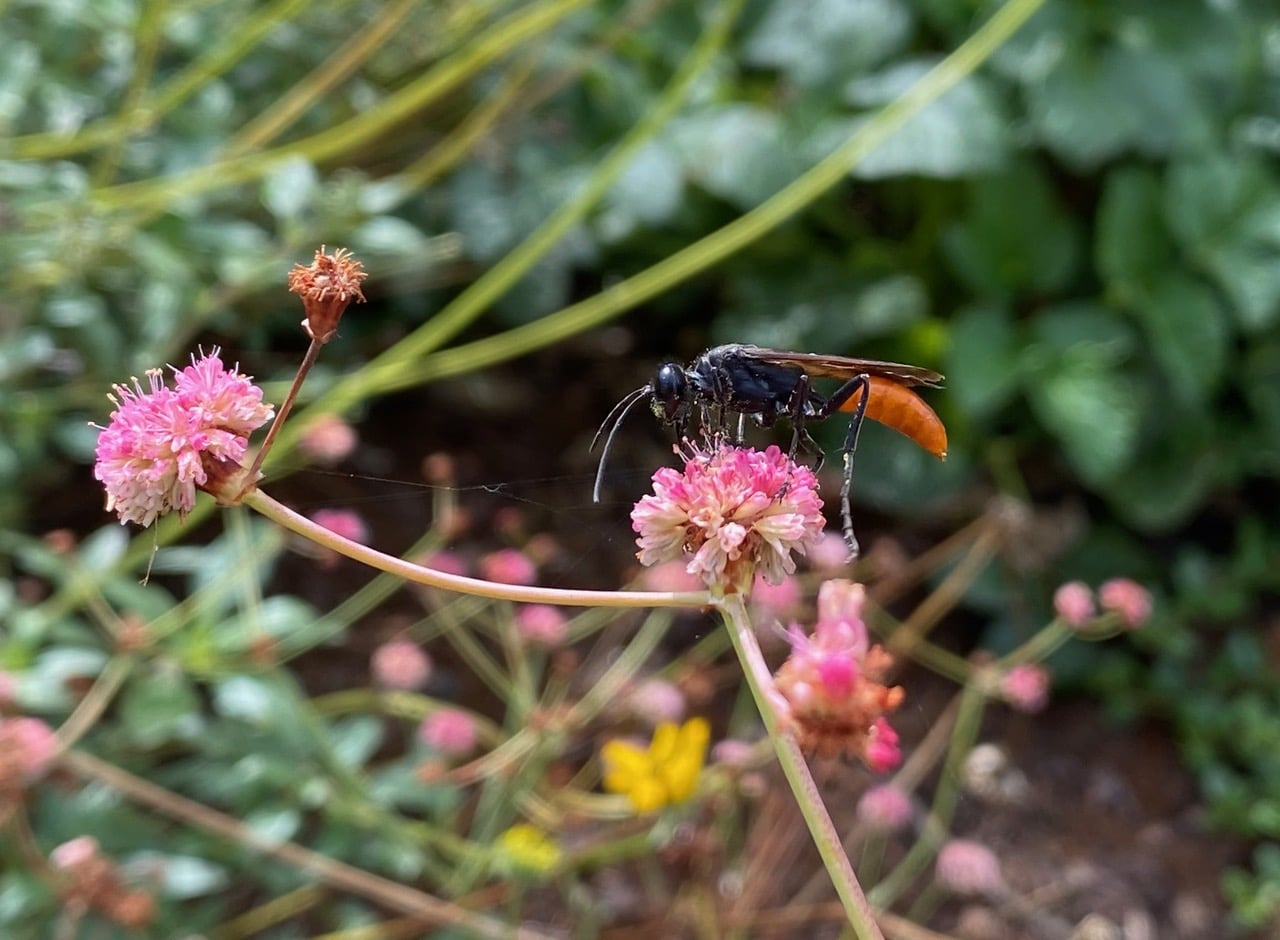
Sphex lucae is most commonly seen in Bay Area gardens foraging on Buckwheat flowers.