

Pollinator Post 10/9/25 (1)

A bright, clear morning in Alameda. I approach Craig and Jenny’s house with excitement. Their well-irrigated garden is probably one of the last places I’ll find significant insect activity this year.
Sure enough, just as before, a few Western Leafcutter Bees, Megachile perihirta (family Megachilidae) are foraging on the patch of Pacific Aster, Symphyotrichum chilense by the curb. Note the yellow pollen on the underside of this female’s abdomen.
Leaf-cutter Bees, Megachile sp. (family Megachilidae) are stout-bodied, usually with pale hair on the thorax and stripes of white hairs on the abdomen. Females usually have a triangular abdomen with a pointed tip, and males’ faces are covered with dense, pale hair. Flight season is from May into September, with peak activity from June to August. Solitary females construct nests in tubular cavities, including hollow stems, tree holes, and abandoned beetle burrows in wood. Many use holes drilled into wood, straws, or other manufactured tunnels. Females cut pieces from leaves or flower petals for use in the construction of brood cells. Most Megachile females are generalist foragers, but prefer flowers in the family Asteraceae. Pollen is transported in dense scopae (special pollen collecting hairs) on the underside of the abdomen.
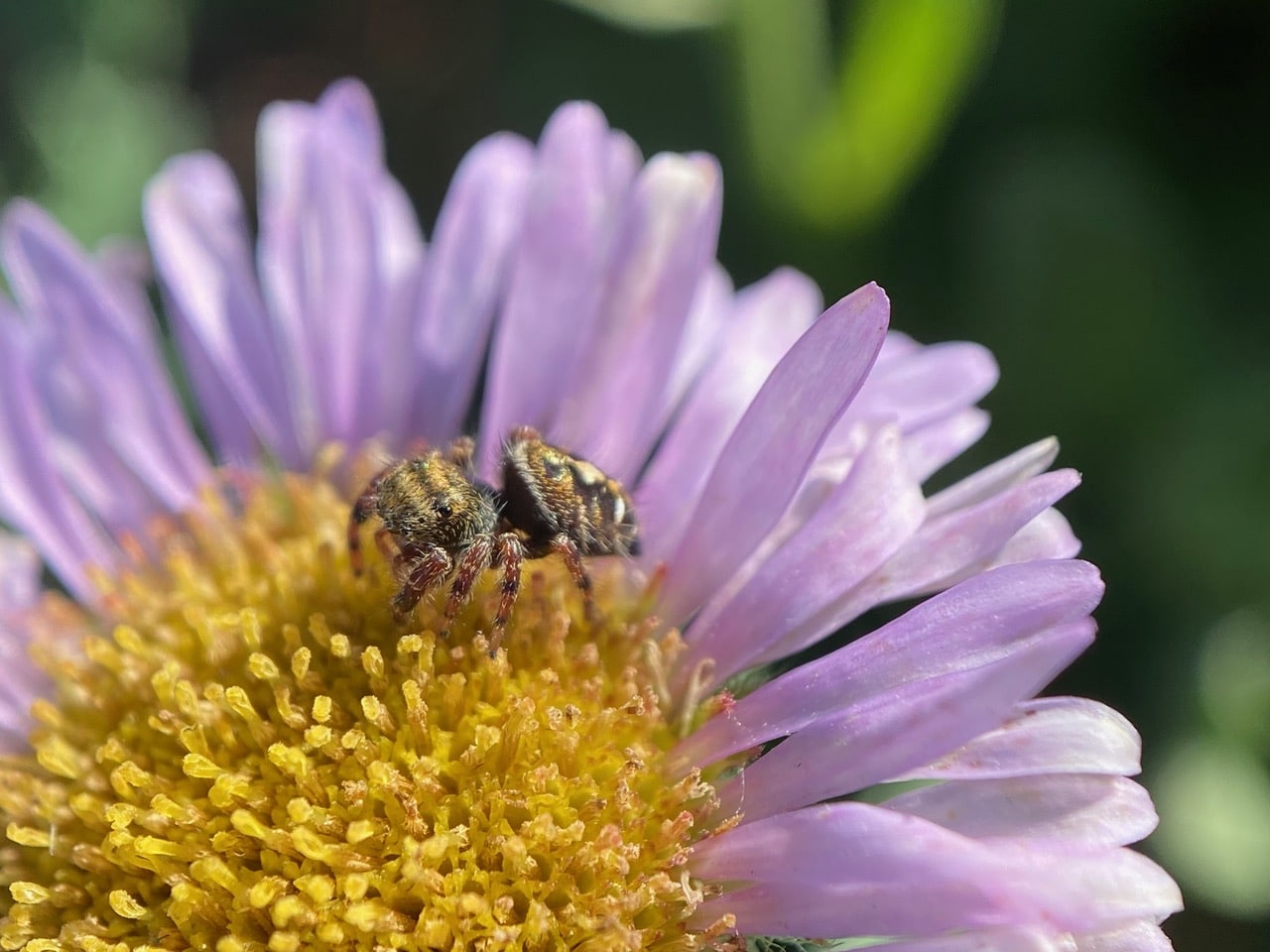
A small Jumping Spider (family Salticidae) is hunting on a flowerhead of Seaside Daisy, Erigeron glaucus.
Jumping Spiders or Salticids are free-roaming hunters. They do not weave a web to catch prey. They stalk, then pounce on their prey. Just before jumping, the spider fastens a safety line to the substrate. It can leap 10-20 times their body length to capture prey. Their movement is achieved by rapid changes in hydraulic pressure of the blood. Muscular contractions force fluids into the hind legs, which cause them to extend extremely quickly.

The little spider suddenly pivots to face me with her frontal eyes, her pedipalps shaking excitedly under her face.
The pedipalps are jointed appendages, much like small legs. They are used by the spider to sense objects, shape their webs, and to aid in prey capture and feeding. In male spiders, the pedipalps are also used to deliver sperm during mating.
Jumping spiders have excellent vision, with among the highest acuities in invertebrates. The 8 eyes are grouped four on the face (the two big Anterior Median Eyes in the middle, and two smaller Anterior Lateral eyes to the side), and four on top of the carapace. The anterior median eyes provide high acuity but small field of view, while the other six eyes act like our peripheral vision, with lower resolution but broad field of view. Since all eight eyes are fixed in place and can’t pivot independently from the body like human eyes can, jumping spiders must turn to face whatever they want to see well. This includes moving their cephalothorax up and down, an endearing behavior.

The spider leaps onto a leaf. Do you see the faint safety line trailing from her abdomen?
The spider’s abdomen is reddish and patterned, indicating that it is an immature female Johnson’s Jumping Spider, Phidippus johnsoni (family Salticidae). Also known as the Red-backed Jumping Spider, the species is one of the largest and most commonly encountered jumping spiders in western North America. Adult males have an all-red abdomen.
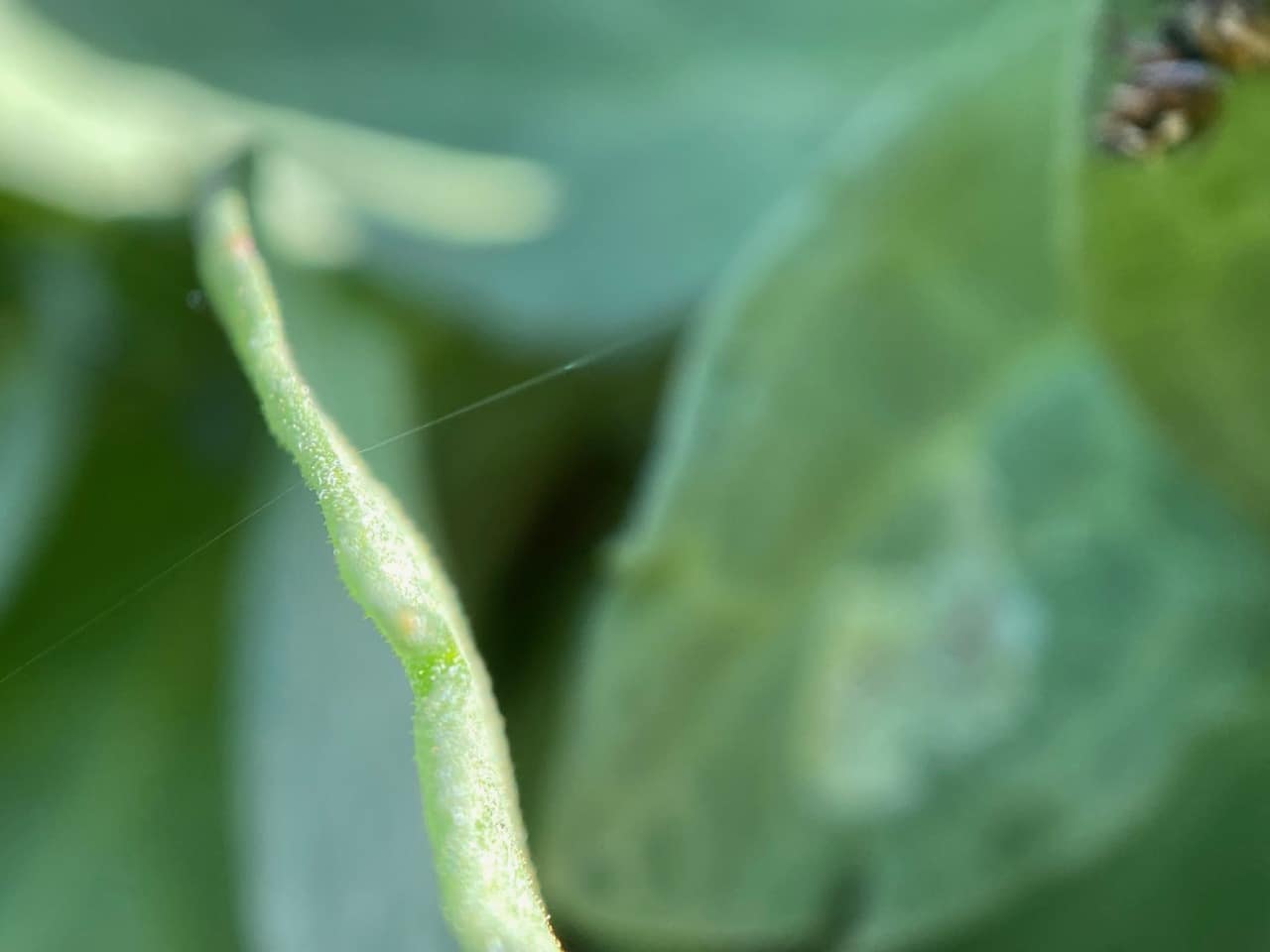
After a brief pause, the spider proceeds to jump to another leaf. Note that she has attached another safety line before the leap.
Jumping Spiders attach a silk dragline to the substrate before they jump. This behavior serves two crucial functions for the spider: acting as a safety line and stabilizing its body during the jump. If the spider misses its target or gets knocked off course, the dragline catches it and prevents a dangerous fall. After a miscalculated jump, the spider can climb back up the dragline to its starting point. The dragline can also serve as an escape mechanism: If the spider needs to make a quick escape from a predator, it can leap and hang from the safety line until the threat has passed. What’s more, by adjusting the tension on the silk line, the spider can actively control its orientation in mid-air. Studies using high-speed cameras have shown that jumping spiders with a dragline land cleanly on their feet and are ready to pounce on prey almost instantly. Interestingly, jumping spiders can produce this high-performance silk extremely quickly – at over 100 body lengths per second- while jumping. This rapid production is necessary for the dragline to keep pace with the spider’s fast, agile movements.

A Spotted Cucumber Beetle, Diabrotica undecimpunctata (family Chrysomelidae) is roaming a flowerhead of Bush Sunflower, Encelia californica.
Members of the family Chrysomelidae are commonly known as Leaf Beetles. Adults and larvae feed on all sorts of plant tissues, and all species are fully herbivorous. Many are serious pests of cultivated plants, including food crops. Others are beneficial due to their use in biocontrol of invasive weeds. Chrysomelids are popular among insect collectors, as many are conspicuously colored, typically in glossy yellow to red or metallic blue-green hues, and some have spectacularly bizarre shapes.
Native to North America, the Spotted Cucumber Beetle can be a major agricultural pest, causing damage to crops in the larval as well as adult stages of their life cycle. Larvae, sometimes known as rootworms feed on the roots of emerging plants. In the adult stage the beetles cause damage by eating the flowers, leaves, stems and fruits of the plant.

A female Western Leafcutter Bee, Megachile perihirta (family Megachilidae) is gathering pollen on a Encelia flowerhead.
North America is home to many leafcutter bees, but the Western Leafcutter, Megachile perihirta is one of the largest. The species ranges on the west coast from British Columbia south to northern Mexico. From a distance, the female can be mistaken for a honey bee. She is about the same size as a worker honey bee and enjoys many of the same flowers, but her head is disproportionately large because it houses the bulky muscles that operate her large mandibles. While most leafcutter bees nest above ground in tubes and tunnels, the Western Leafcutter nests underground. Often a small group of females live in a community and burrow into soil, gravel, or sand. Although they are generalist foragers, the Western Leafcutters, Megachile perihirta prefer flowers in the Asteracea family for nectar and pollen; the composite flowerheads offer a flat surface on which numerous florets are clustered. The bees are frequently seen foraging on Seaside Daisy, Grindelia, Asters, Sunflowers, Cosmos, and Dahlia.
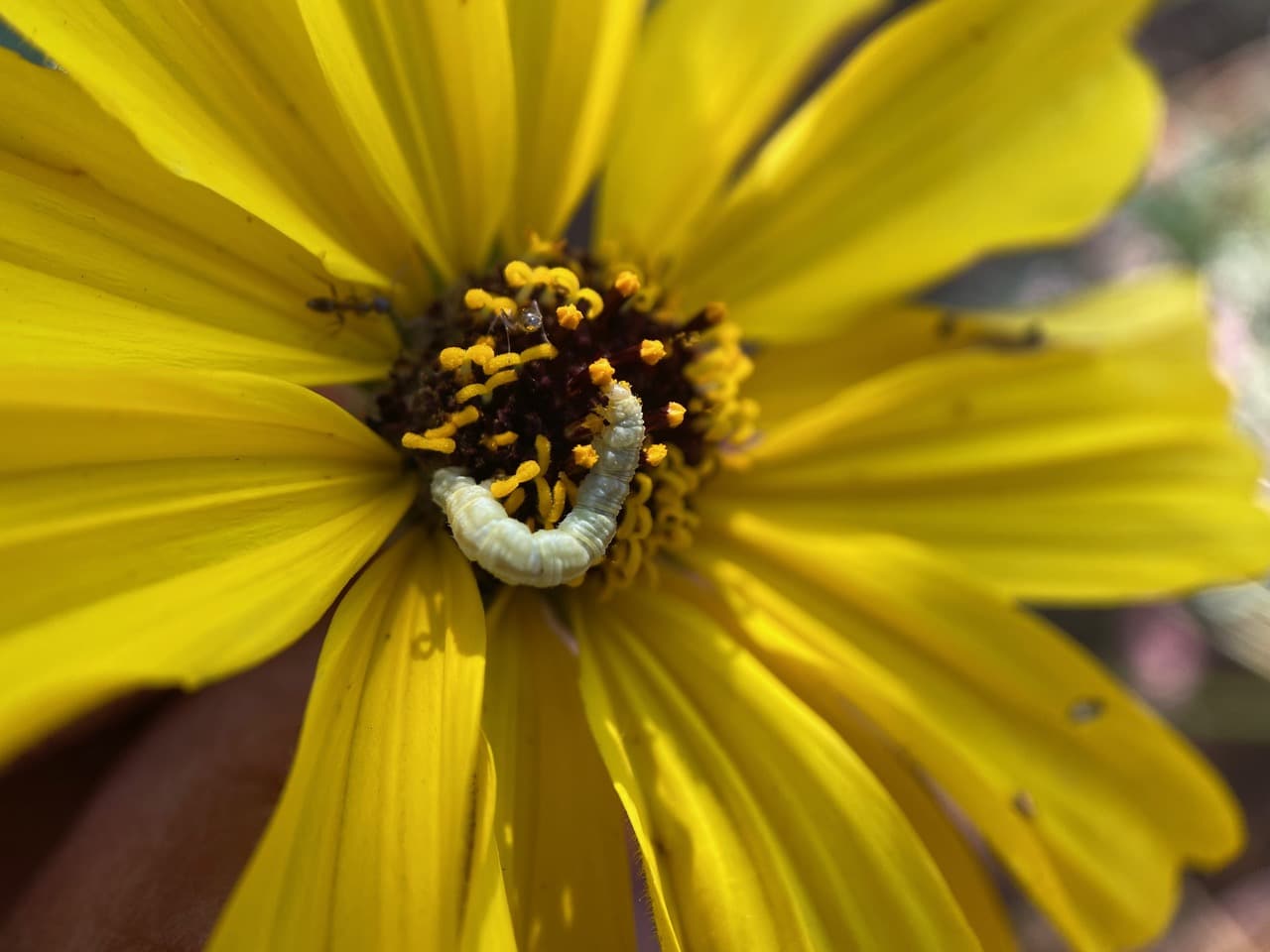
An Inchworm (family Geometridae) is feeding on the florets of Bush Sunflower.
Inchworms are also called loopers and measuring worms. The majority of the inchworms are the larvae of moths in the family Geometridae. The name comes from the Greek “geo” for earth and “metro” from measure, because the caterpillars seem to be measuring the surface on which they are walking.
All caterpillars have three pairs of jointed legs behind their heads. These legs are called true legs because they will become the six legs of the adult butterfly or moth. There are additional appendages, called prolegs, along their bodies. Prolegs are not true legs, they are just outgrowths of the body wall and will be lost at metamorphosis. They have little hooks on their soles to help the caterpillar walk and grip onto things.
Most caterpillars have five sets of prolegs, four in the middle of the body and one pair at the hind end. Inchworms have the normal six true legs but only two or three pairs of prolegs, all located at the tail end of the body, with none in the middle. When an inchworm walks, it moves its tail-end prolegs up behind its true legs, causing the center of its body to loop upward. Then it stretches its front end forward to take another step.

A Eurasian Drone Fly, Eristalis arbustorum (family Syrphidae) lands on a cluster of flowers of the Red-flowered Buckwheat, Eriogonum grande ssp. rubescens.
The Eurasian Drone Fly, Eristalis arbustorum is an abundant species of hover fly that occurs throughout the northern hemisphere, including Europe, North Africa and North India. It was introduced to North America in the mid 1800’s and is now ubiquitous throughout much of the United States and Canada. The common name “drone fly” refers to its resemblance to the drone of the honeybee. Hoverflies get their names from the ability to remain nearly motionless while in flight. The adults are also known as flower flies as they are commonly found on and around flowers feeding on nectar and pollen. The Eurasian Drone Fly is found in a diversity of habitats, including wetland, forests, montane tundra, as well as farmland, urban parks and gardens. It visits the flowers of a wide range of low-growing plants and shrubs. The larvae are aquatic, occurring in shallow, nutrient rich standing water and in cow manure and compost heaps. Also known as “rat-tailed maggots”, the larvae have a siphon on their rear end that acts like a snorkel, helping them breathe under water. The siphon can be several times the length of the larva’s body. The larvae are saprophagous, feeding on bacteria in stagnant water rich in decomposing organic matter.
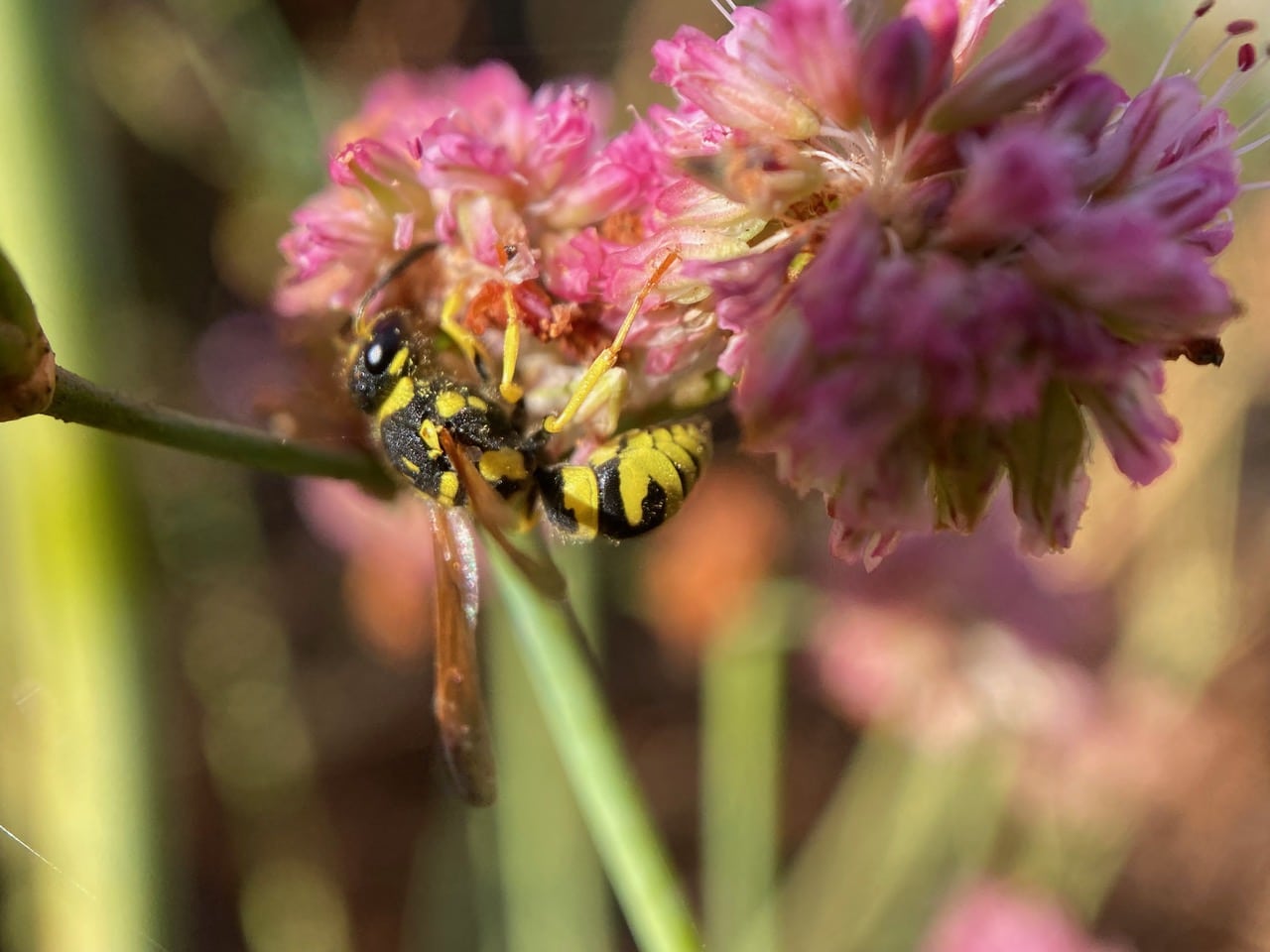
A Mason Wasp, Ancistrocerus bustamente (family Vespidae, subfamily Eumeninae) is foraging on an inflorescence of Red-flowered Buckwheat.
Potter wasps (or mason wasps), the Eumeninae, are a cosmopolitan wasp group presently treated as a subfamily of Vespidae. Most eumenine species are black or brown, and commonly marked with strikingly contrasting patterns of yellow, white, orange, or red. Their wings are folded longitudinally at rest. Eumenine wasps are diverse in nest building. The Mason Wasps are species that generally nest in pre-existing cavities in wood, rock, or other substrate. Potter Wasps are the species that build free-standing nests out of mud, often with a spherical mud envelope. The most widely used building material is mud made of a mixture of soil and regurgitated water.
All known Eumenine species are predators, most of them solitary mass provisioners. When a cell is completed, the adult wasp typically collects beetle larvae, spiders, or caterpillars and, paralyzing them, places them in the cell to serve as food for a single wasp larva. As a normal rule, the adult wasp lays a single egg in the empty cell before provisioning it. The complete life cycle may last from a few weeks to more than a year from the egg until the adult emerges. Adult mason wasps feed on floral nectar.
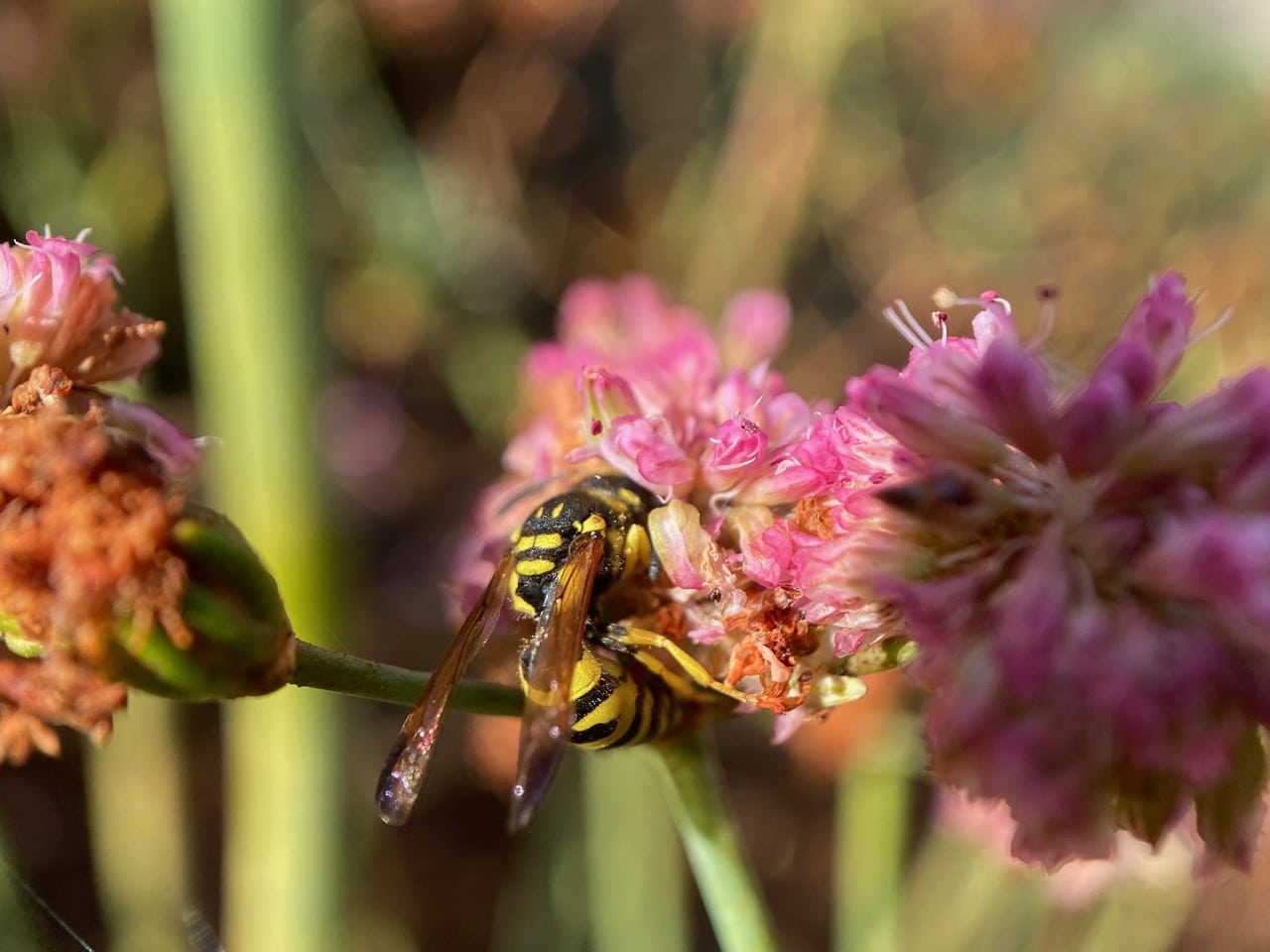
The wasp is spending a lot of time probing deep into the inflorescence. I wonder if it is after a caterpillar or other prey insect to provision her nest?

The Mason Wasp, Ancistrocerus bustamente (family Vespidae, subfamily Eumeninae) is found in western North America and Mexico. The species frequents arid areas, and nests in pre-existing cavities (e.g. old borings in wood, hollow stems, rock crevices) and use mud for partitions between brood cells. The wasps have been known to nest in Sambucus (Elderberry) stems. The name of the genus means “hooked horn” for the back-curved last segments of the antennae characteristic of the males.
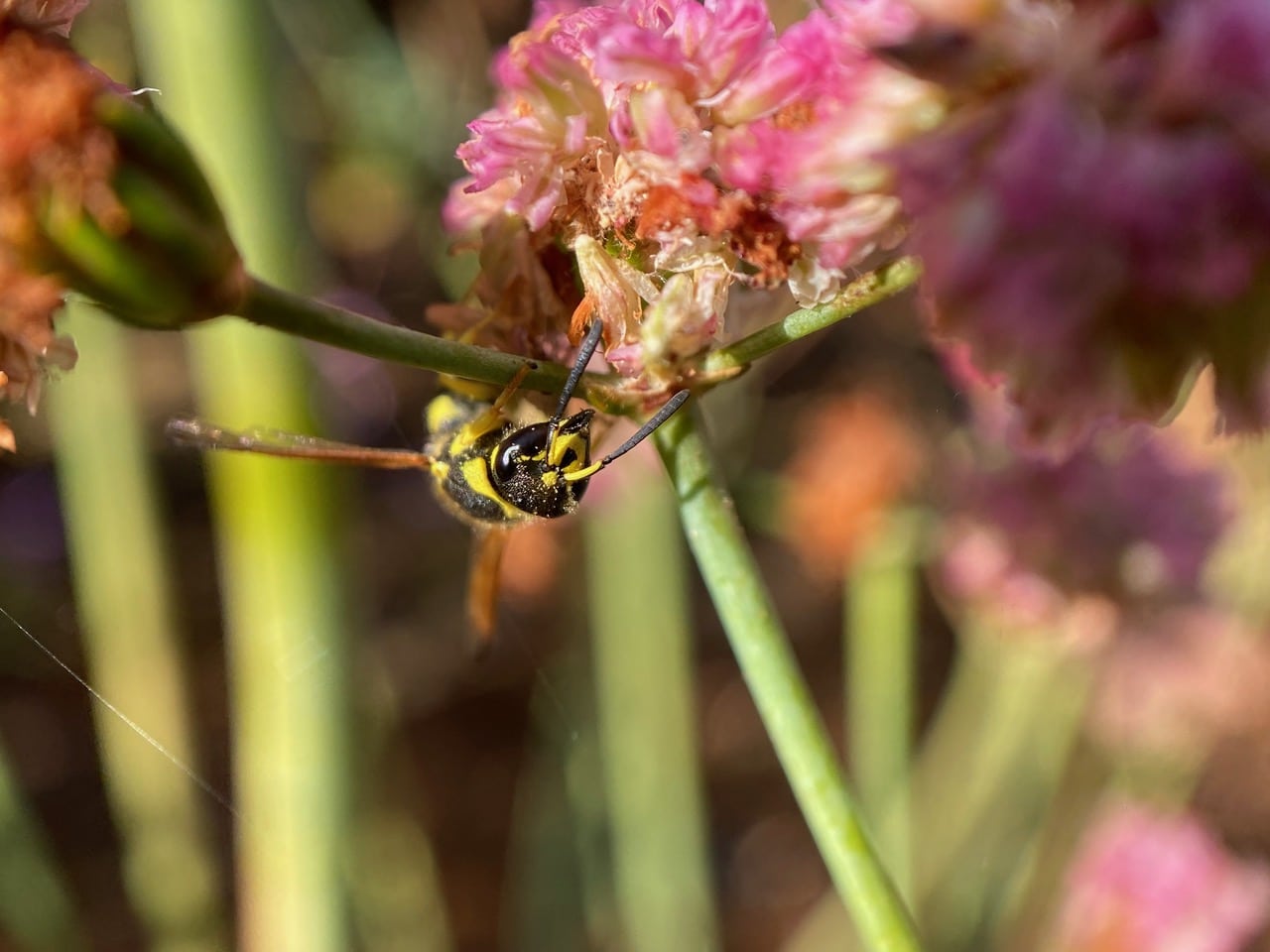
The wasp has straight antennae – it is female.

A Pug Moth caterpillar, Eupithecia sp. (family Geometridae) is partially hidden behind the ray petals of a Cosmos flowerhead.
Eupithelia is the largest genus of moths of the family Geometridae. Occurring worldwide except for Australasia, species in the genus are commonly known as pugs. Adults are typically small, 12 – 35 mm, with muted colors. Most species rest with forewings held flat at right angles to the body, while the hindwing are largely covered by the forewings. They are generally nocturnal. Larvae mostly feed from the flowers and seeds of their food plants rather than the foliage. Many species have a very specific food plant.
As I survey the insects in the front yard, I realize that they are pretty much the same cast of characters that I have encountered on previous visits. Such creatures of habit – each insect obviously has its preferred flower. The most obvious absence today is that of the Summer Longhorn Bees, Melissodes sp. (family Apidae). I guess their season is over, although many of their favorite plants (the Asteraceae) are still in bloom here. I miss the charismatic bees already!

In the backyard I pause to observe the busy insect life on the large Narrowleaf Milkweed, Asclepias fascicularis by the fence. A Large Milkweed Bug, Oncopeltus fasciatus (family Lygaeidae) is foraging among the silky seed plumes freshly exposed by an opened seed pod.
Milkweed Bugs are Seed Bugs (family Lygaeidae) in the insect order of “true bugs”, Hemiptera. The bold red-and-black coloration of the bug serves as aposematic warning to potential predators of its distastefulness and toxicity. Like the Monarch butterflies, Oncopeltus sequesters the toxic compounds of milkweeds, giving the insect its toxicity. The bugs undergo incomplete metamorphosis, with five instars before reaching adulthood. The nymphs and adults all feed on milkweed using their piercing-sucking mouthparts. Adults are capable of penetrating the seed pod with their proboscis and injecting digestive juices. All stages of development can be found on the plants in mid to late summer. Adults live for about one month. The insect overwinters as an adult.
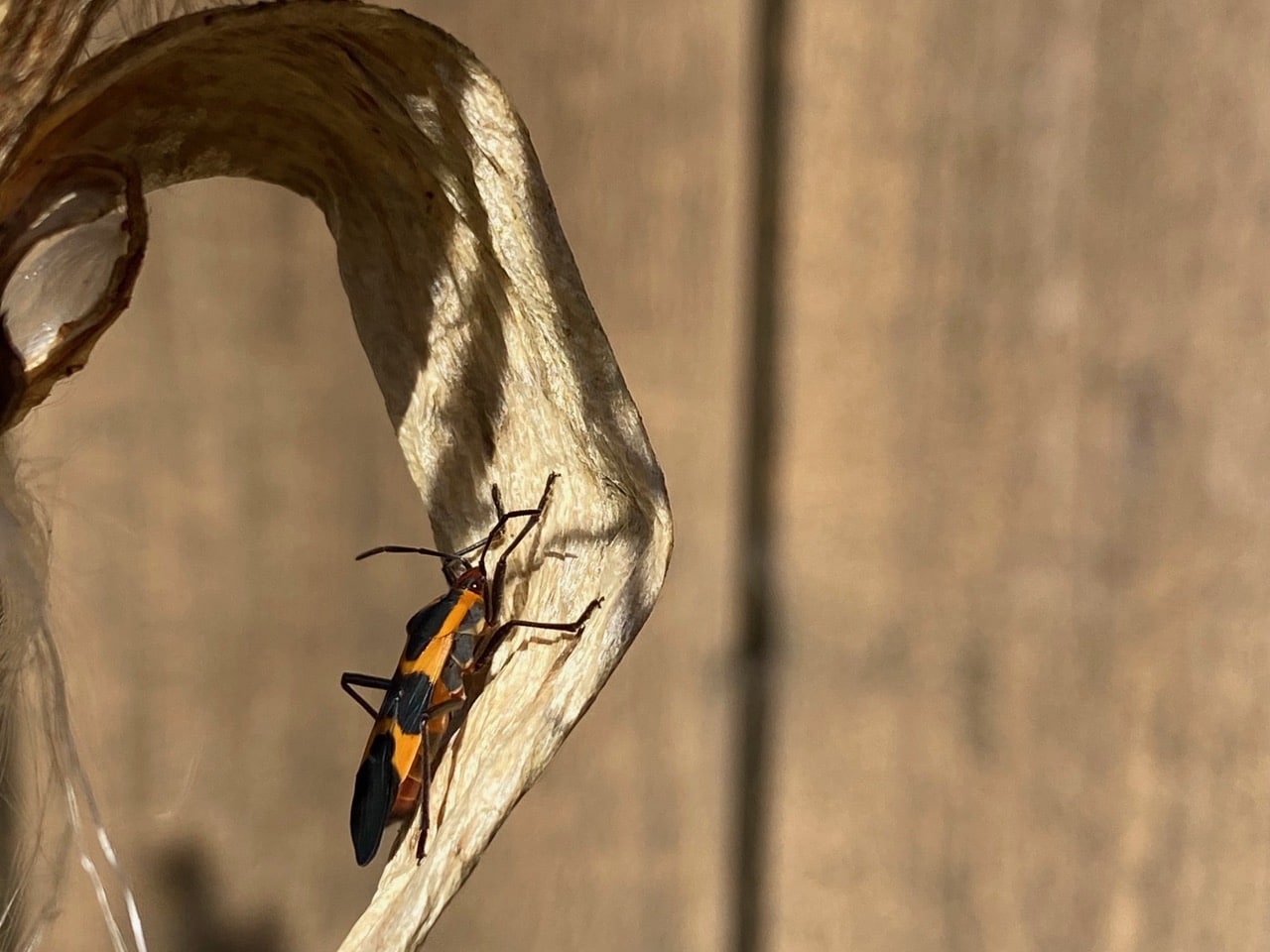
A Large Milkweed Bug is resting on the split skin of a milkweed seed pod, apparently satiated from the bonanza of seeds.
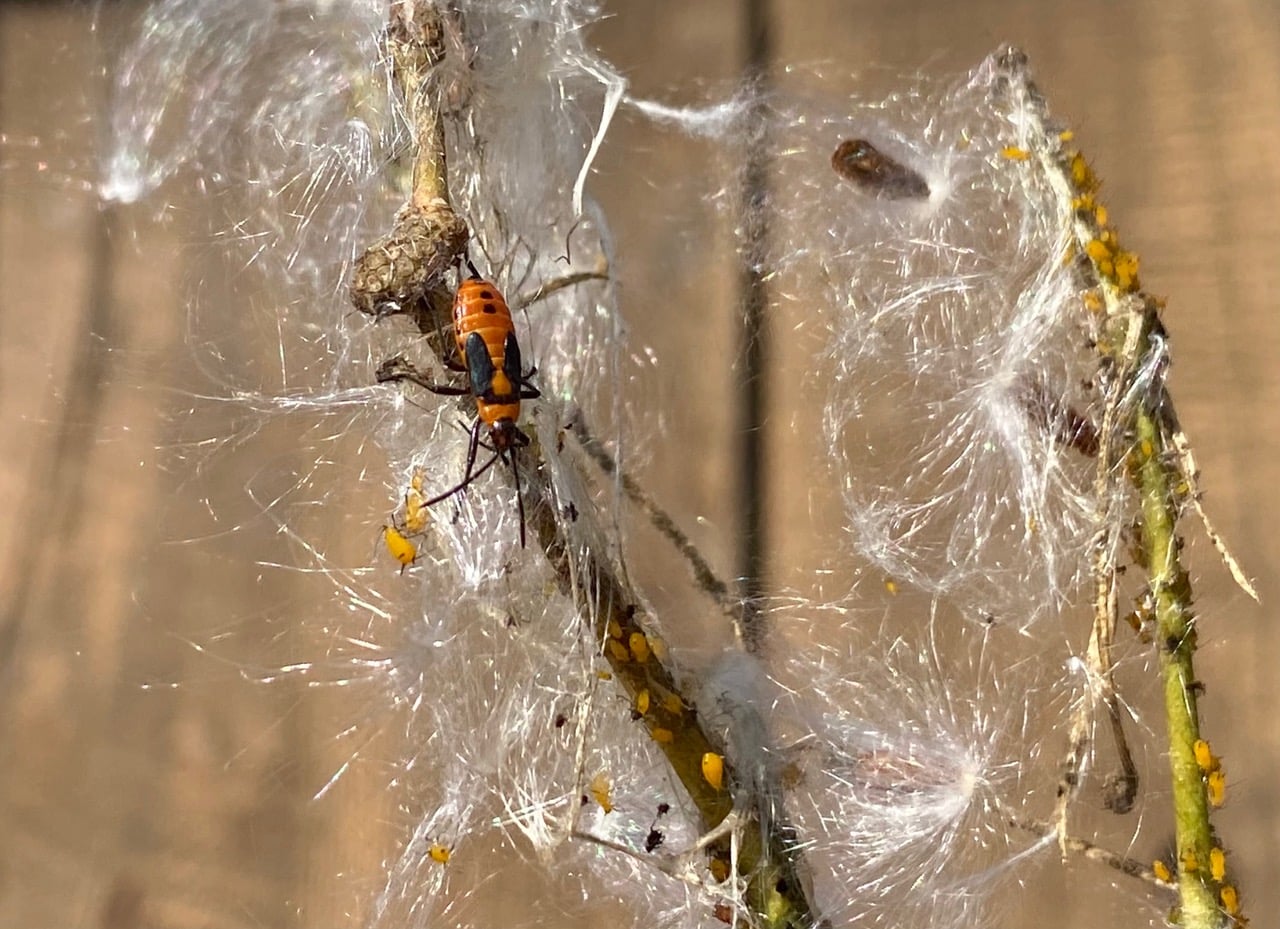
There are still a few nymphs of the Large Milkweed Bug on the plant, most having transformed into adults since my last visit. The nymph pictured here is a late instar sporting large wing pads. On its final molt into an adult, it will acquire functional wings and reproductive organs.
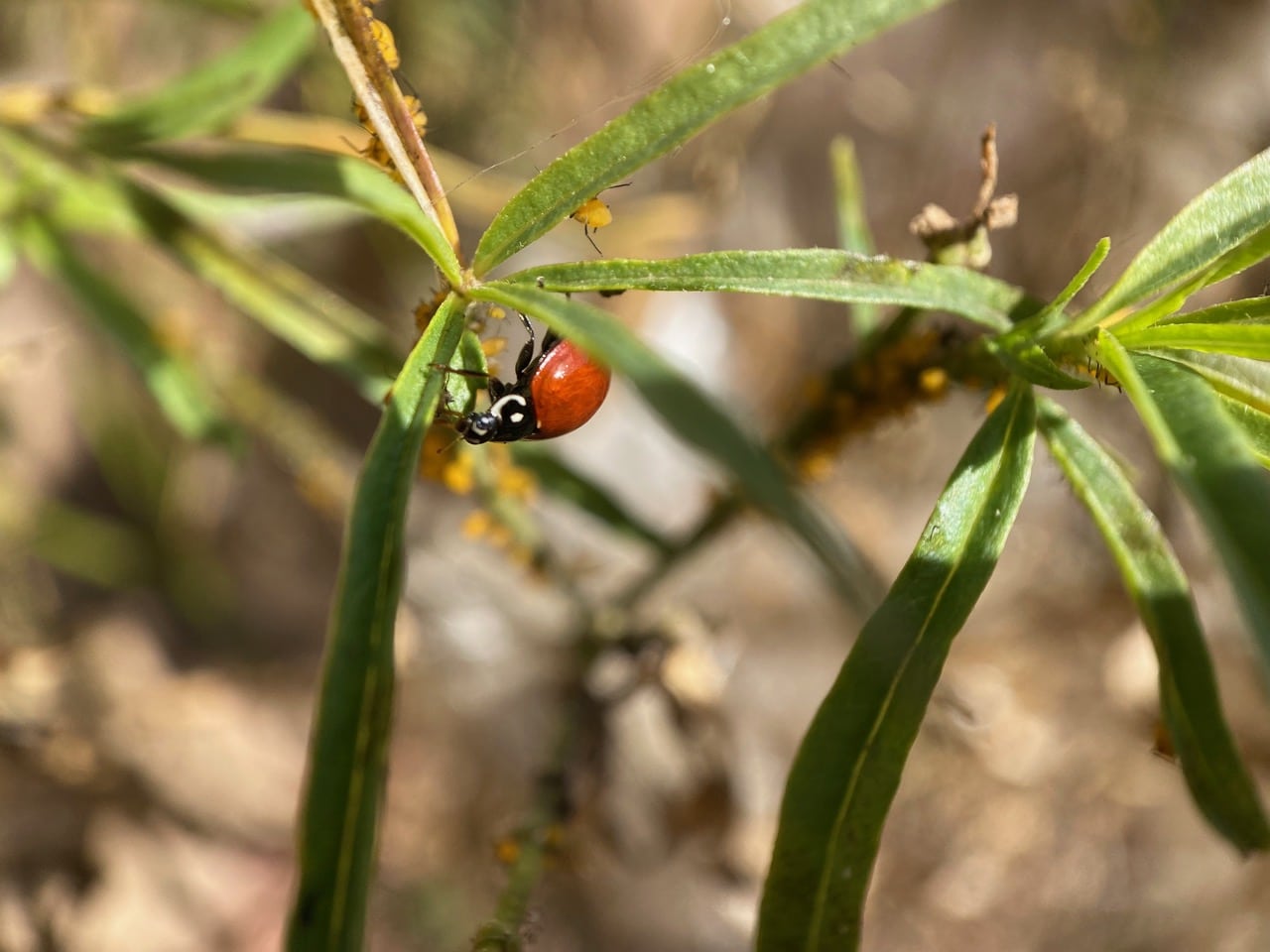
A Spotless Lady Beetle, Cycloneda sanguinea (family Coccinellidae) is actively hunting aphids on the milkweed leaves.
The Spotless Lady Beetle, Cycloneda sanguinea (family Coccinellidae) is a widespread species of lady beetle in the Americas. It is is a large lady beetle with red, unspotted elytra (wing covers) ranging from 4-6.5 mm long. The black and white marks on the head and pronotum are very distinctive, and they are also gender-specific. Both adult and larvae of Spotless Lady Beetles are voracious predators of aphids. They are very often found feeding on aphids on milkweeds, but also occur on a number of other plants. Adults live longer when nectar and pollen are available for nourishment when prey is scarce.
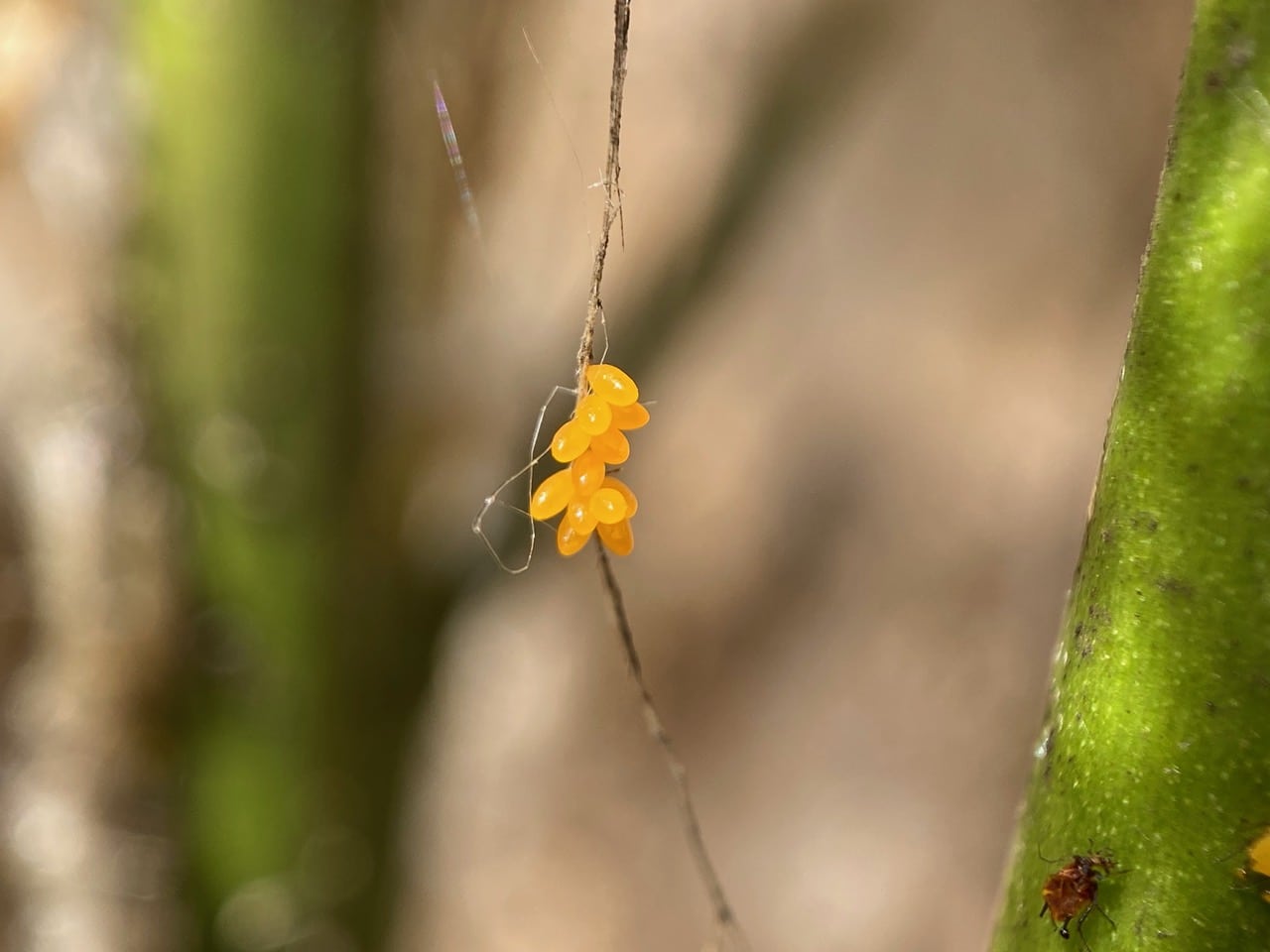
Hey, here’s a dozen fresh Lady Beelte eggs attached on the seed pod fibers! What an odd place to be leaving your eggs! As precarious as they appear, at least the eggs won’t be dislodged or damaged by the busy traffic occurring on the stems and leaves.
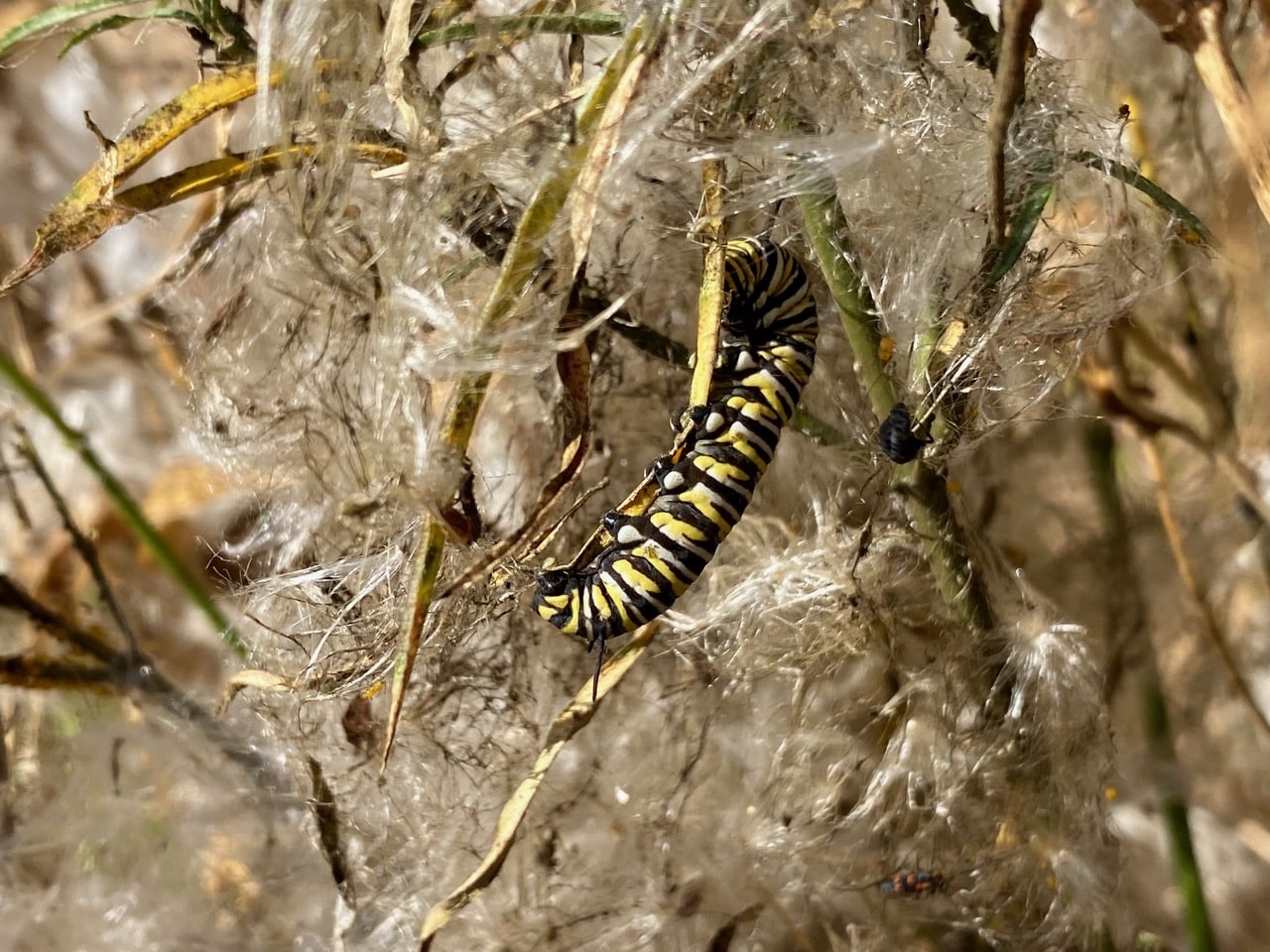
I spot a mature Monarch caterpillar on a senescing milkweed leaf amidst seed fluffs tainted with honeydew and sooty mold. It is probably close to pupation – and just in time. There’s little foliage left to sustain a growing caterpillar much longer.
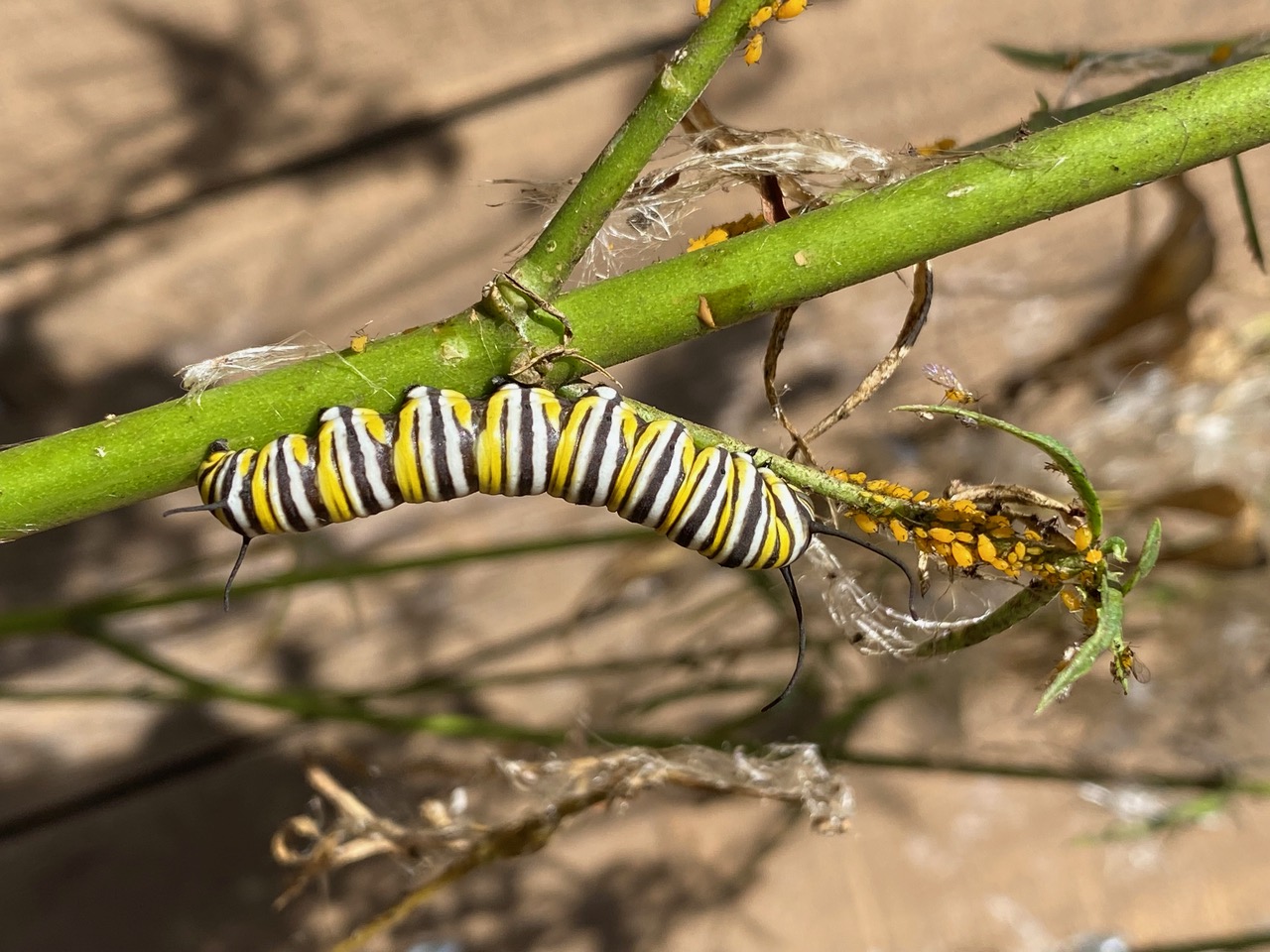
Craig spots another mature Monarch caterpillar on a milkweed stem. It has to put up with all those aphids to get to its food. Craig and I look around the plant, especially on the wooden fence for any Monarch chrysalids. Craig bemoans the fact that none has been found so far this year.
Monarch caterpillars feed exclusively on plants from the genus Asclepias, commonly known as milkweed. The plant is not only their only food source but also provides them with the cardiac poisons, or cardiac glycosides which make the caterpillars and the adult butterflies toxic to predators.
A Monarch caterpillar is approximately 2 inches when it is ready to pupate, having completed its fifth and final instar of growth. After reaching this length and size, it will leave its food source, find a suitable protected spot, and hang in a “J” shape before shedding its exoskeleton one last time to form a chrysalis. Monarch caterpillars pupate, or form a chrysalis, in a protected, secure spot away from their milkweed host plants to avoid predators. They may travel up to 10-30 feet or more to find a suitable location, which can include neighboring plants, fences, buildings, garden structures, patio furniture, or other nearby surfaces.

The brilliant orange of the Gulf Fritillary competes with the bright pinks of the Zinnia for our attention.
The Gulf Fritillary or Passion Butterfly, Dione vanillae (family Nymphalidae) is a bright orange butterfly in the subfamily Heliconiinae. Members of this subfamily are “longwing butterflies” which have long, narrow wings compared to other butterflies.
Gulf Fritillaries are most commonly found in the southern areas of the United States, from Florida and Georgia to Texas and California. Its range also extends to parts of Mexico, Central and South America. The butterflies are found in open habitats, in moderately sunny areas near open grasslands, woodlands, parks and gardens. The Gulf Fritillary is a medium-sized butterfly with extended forewings and a wingspan of 6.5 to 9.5 cm. The females are typically distinctly larger and darker than males. The host plants for the caterpillars of the Gulf Fritillary are members of the genus Passiflora, commonly known as passion vines. Most of the passionflower plant that the caterpillar feeds on, including the leaves and stems, contains toxins that are sequestered in the bodies of the larva as well as the adult butterfly. When threatened, the Gulf Fritillary releases chemicals from its abdominal glands, producing an unpleasant odor. The butterfly’s bright orange coloration serves as a warning to predators that it should be avoided.
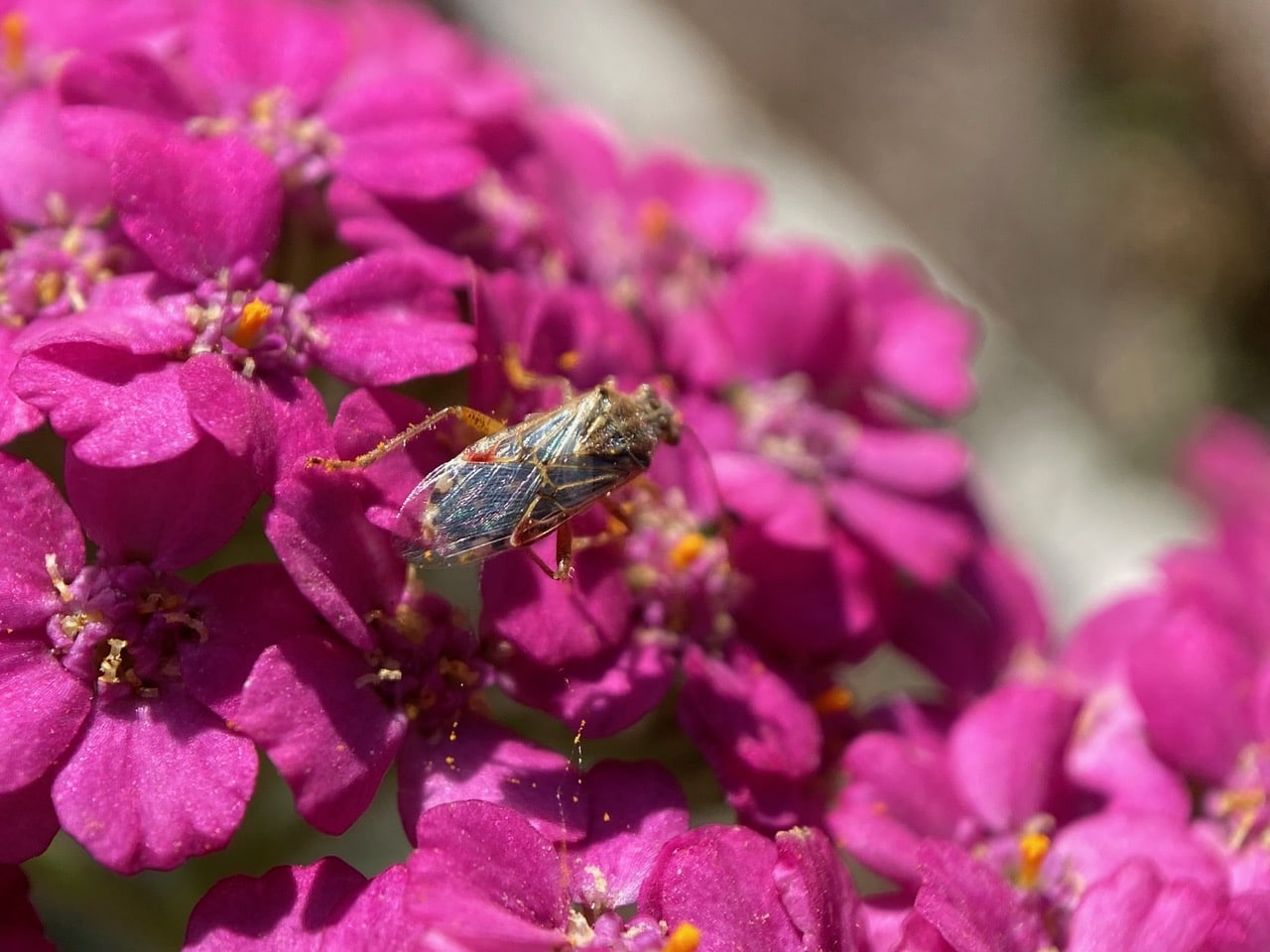
A small bug is lurking on an inflorescence of red-flowered Yarrow, Achillea millefolium. It is a Hyaline Grass Bug, Liorhyssus hyalinus (family Rhopalidae).
The family Rhopalidae are called Scentless Plant Bugs, referring to the reduced scent gland opening. The wing membranes are characterized by many veins. These bugs occur throughout much of the world. They feed on the seeds of herbaceous plants.
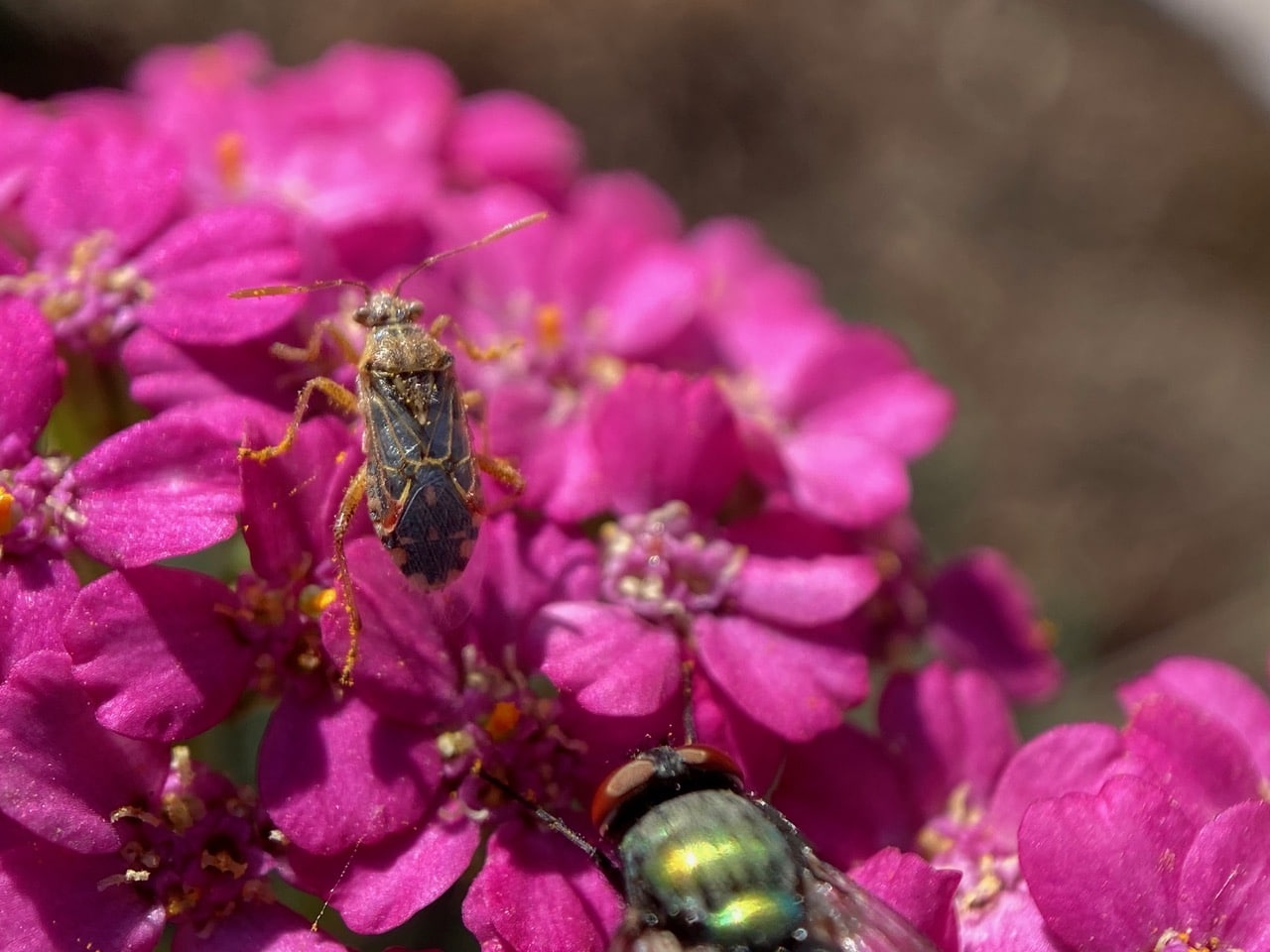
The Hyaline Grass Bug, Liorhyssus hyalinus is a species of Scentless Plant Bugs belonging to the family Rhopalidae. The species is widely distributed across North America, most commonly in southwestern United States. It is considered a “cryptogenic” species (species of uncertain origin) in North America. The bug is 5.5-7.5 mm in length. The species is characterized by hyaline (clear or translucent) wing membrane extending beyond the dark upper side of the abdomen. Extremely polyphagous, the bug feeds on a wide variety of plants, but shows a preference for Asteraceae. They are commonly found in hemp fields, where they feed on flowers, developing seeds, and foliage. These bugs are known to migrate from various weed hosts into hemp fields, especially when seeds are developing. They use piercing-sucking mouthparts to extract plant tissues. They are able to feed on seeds by injecting digestive juices into the seeds and sucking up the digested contents as a liquid. The mouthparts, collectively called a rostrum, is folded under the body when not in use.