

Pollinator Post 10/9/24
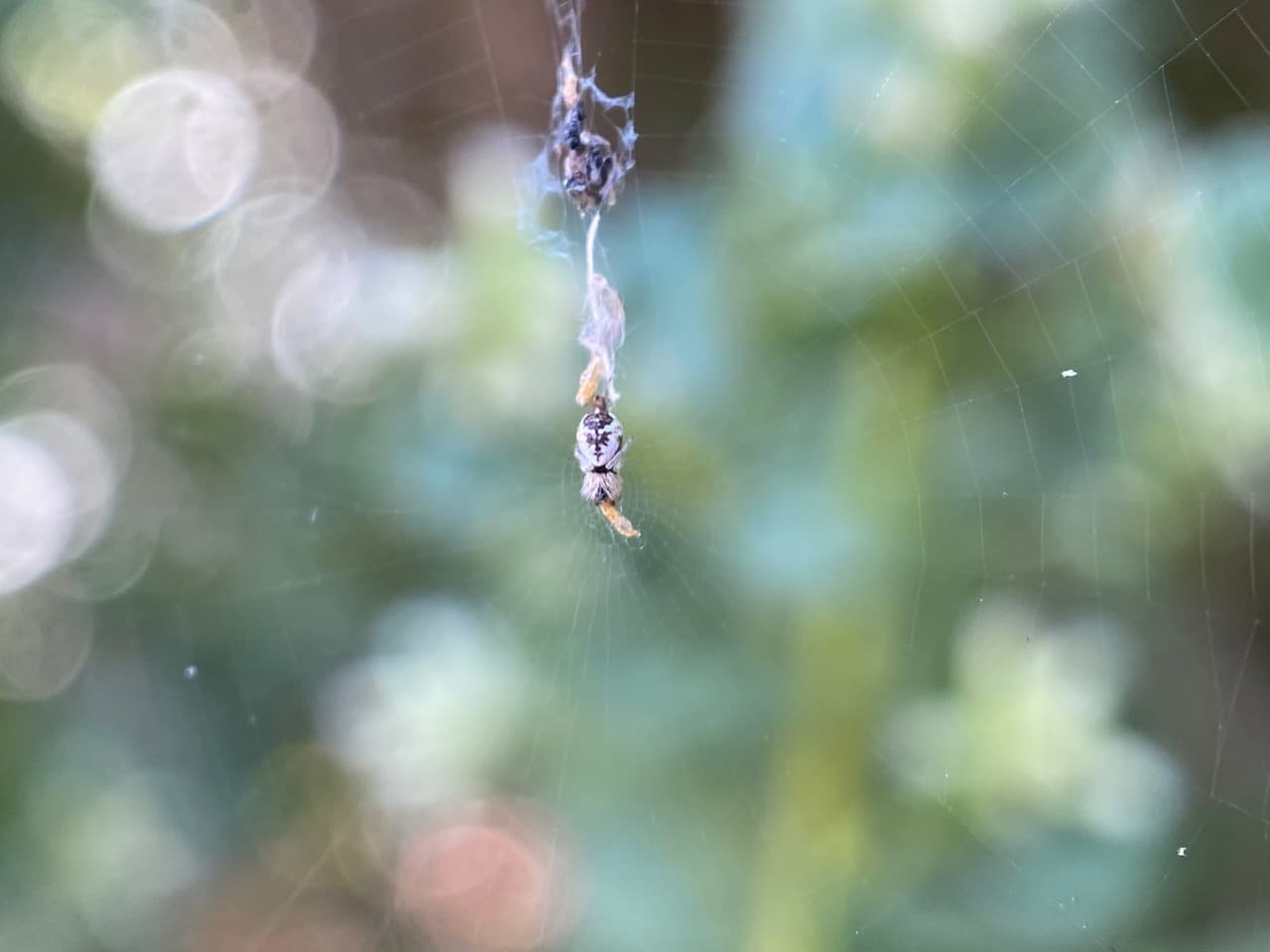
I visit Skyline Gardens this afternoon, walking the stretch of Skyline Trail between the Steam Train entrance and Siesta Gate. There is little in bloom now, but I am curious about the insect life on Coyote Brush, Baccharis pilularis prevalent along this stretch. While many of the plants are already going to seed, some are still in bloom. I am surprised by how eerily quiet everything is. In past years, this was the hub of insect activity in the fall.
No more than an inch across, a tiny decorated orb web of the Trashline Spider, Cyclosa sp. (family Araneidae) hangs among a Coyote Brush foliage, Baccharis pilularis. I zoom in with my macro lens and find the spider – it is the bottom lump in the vertical line of debris. Resting head-down in the center of her web, she is feeding on something minute – a thrips? The spider is the smallest I have ever seen of this species, probably an immature.
Trashline spiders are so-called for their web decoration. Cyclosa create orb-shaped webs using both the sticky and non-sticky threads, mostly during times of complete darkness. Across its spiral wheel-shaped web, Cyclosa fashions a vertical “trashline” made of various components such as prey’s carcasses, detritus, and at times, egg cases. The trashline helps the spider to camouflage exceptionally well from predators. The spider sits in the web hub to conduct its sit-and-wait hunting, ensnaring prey at nearly any time of day; it only leaves its spot to replace the web prior to sunrise.
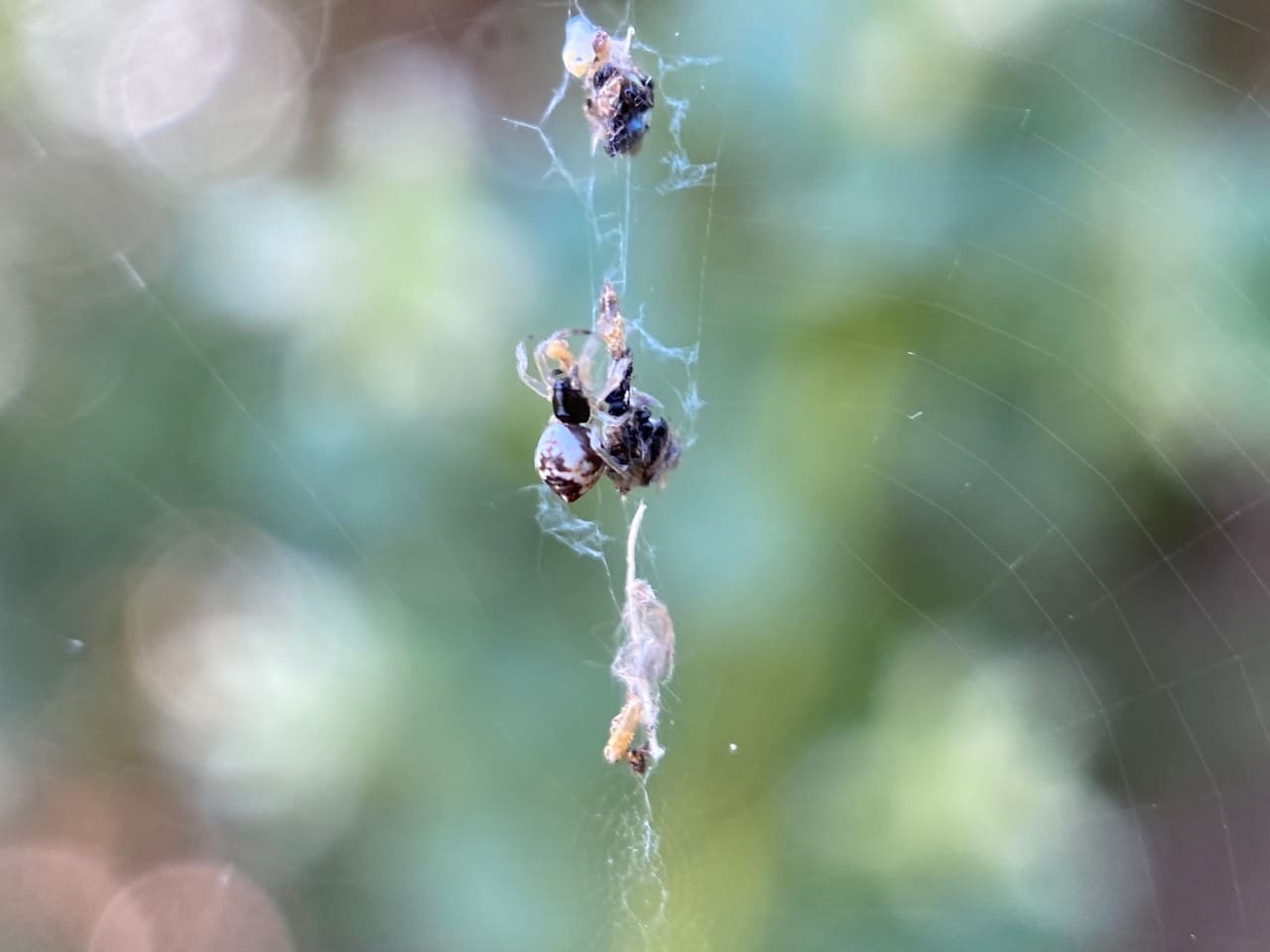
A minute later, I see movements on the web. The spider is crawling up the vertical line of debris, holding the yellow prey in her jaws. The spider has a black cephalothorax. I am amazed at how well she has fashioned the debris to look like herself. As she passes the first lump, it looks like a mirror reflection of herself!
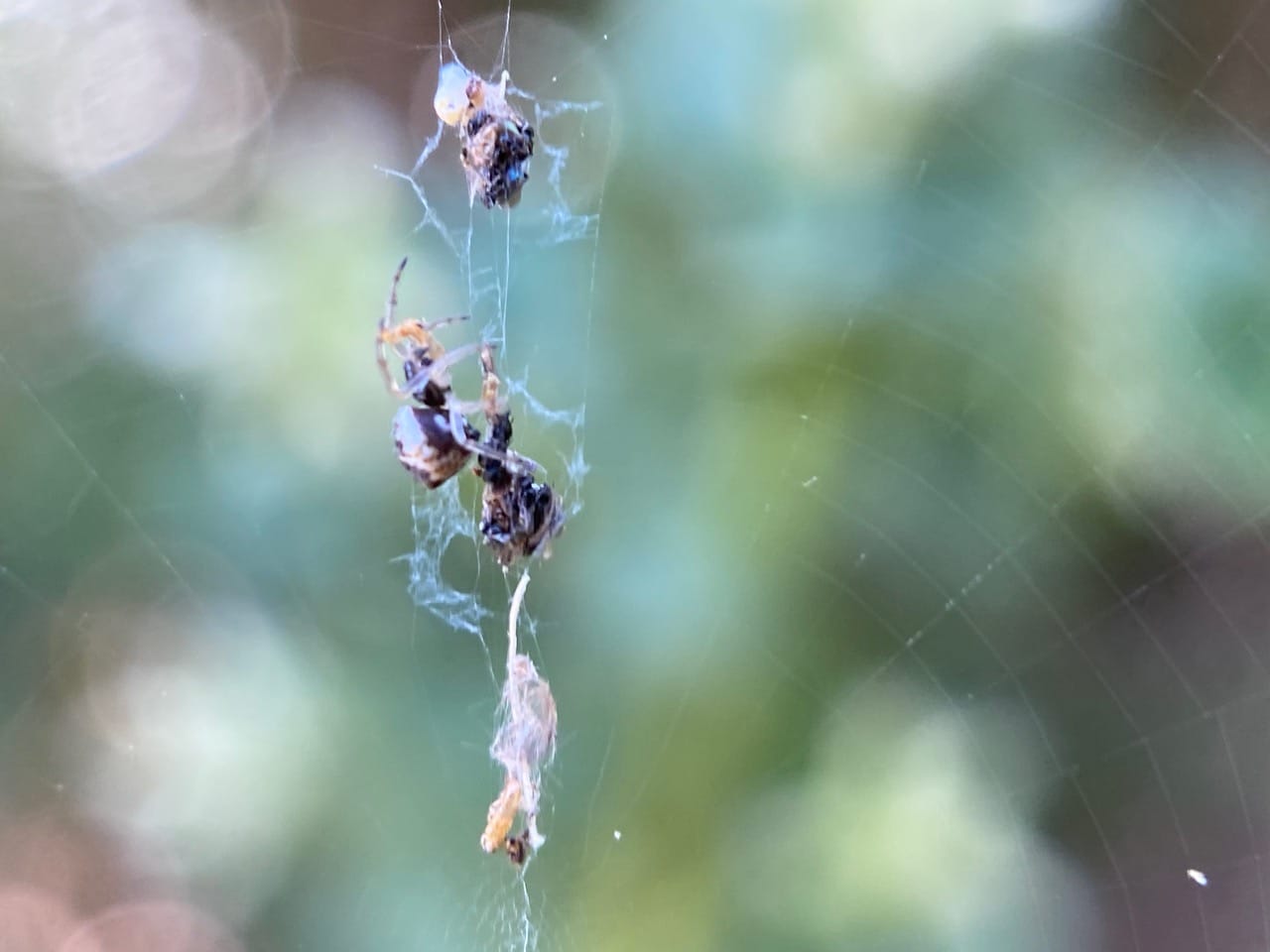

The spider continues up the trash line, dead prey still in her jaws.
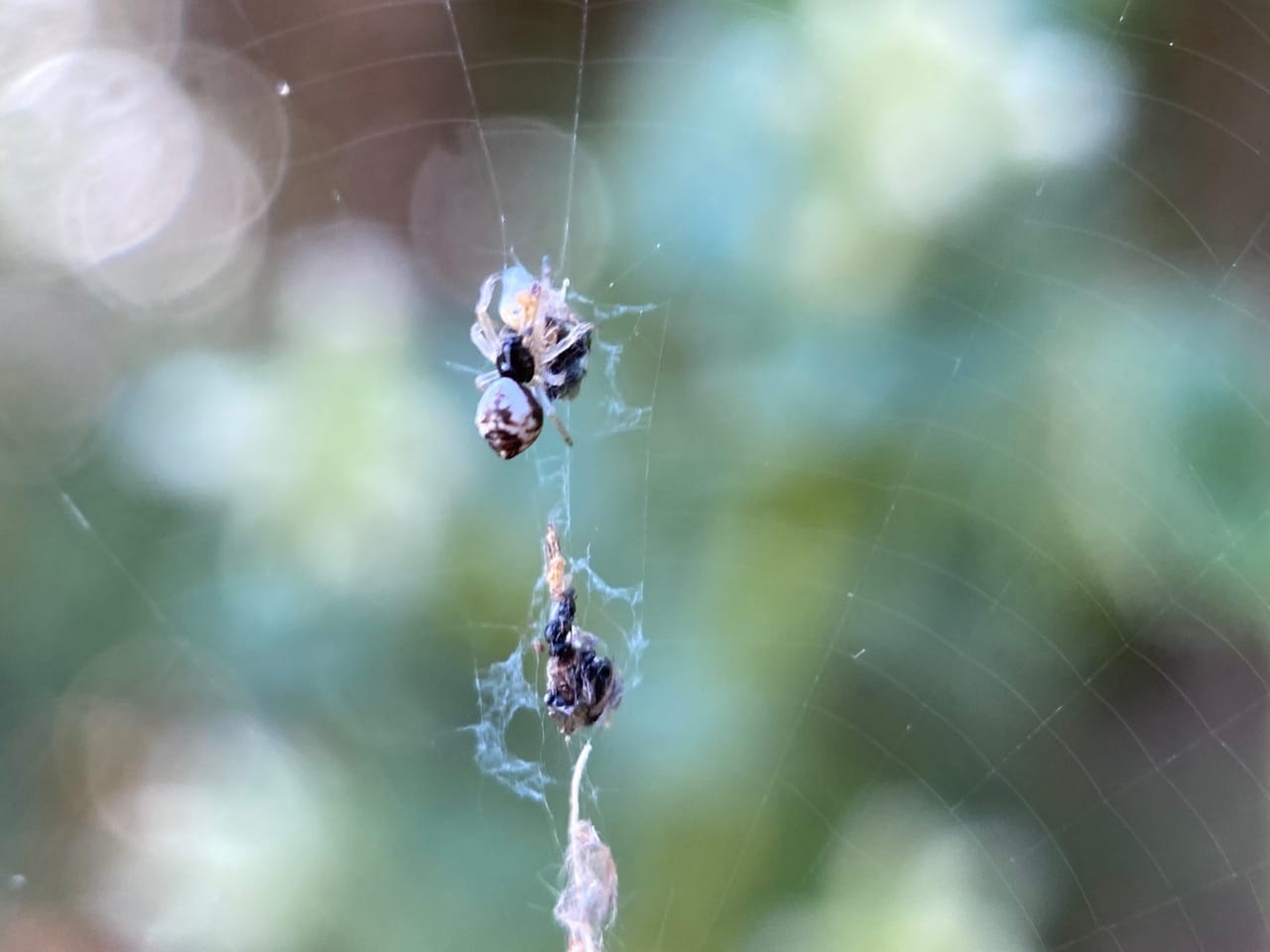
The spider adds the dead prey to the top lump in the trash line. As the spider grows with more food, so does the lumps on her trashline. Are spiders conscious of their own appearance? How do they pull off such uncanny camouflage?
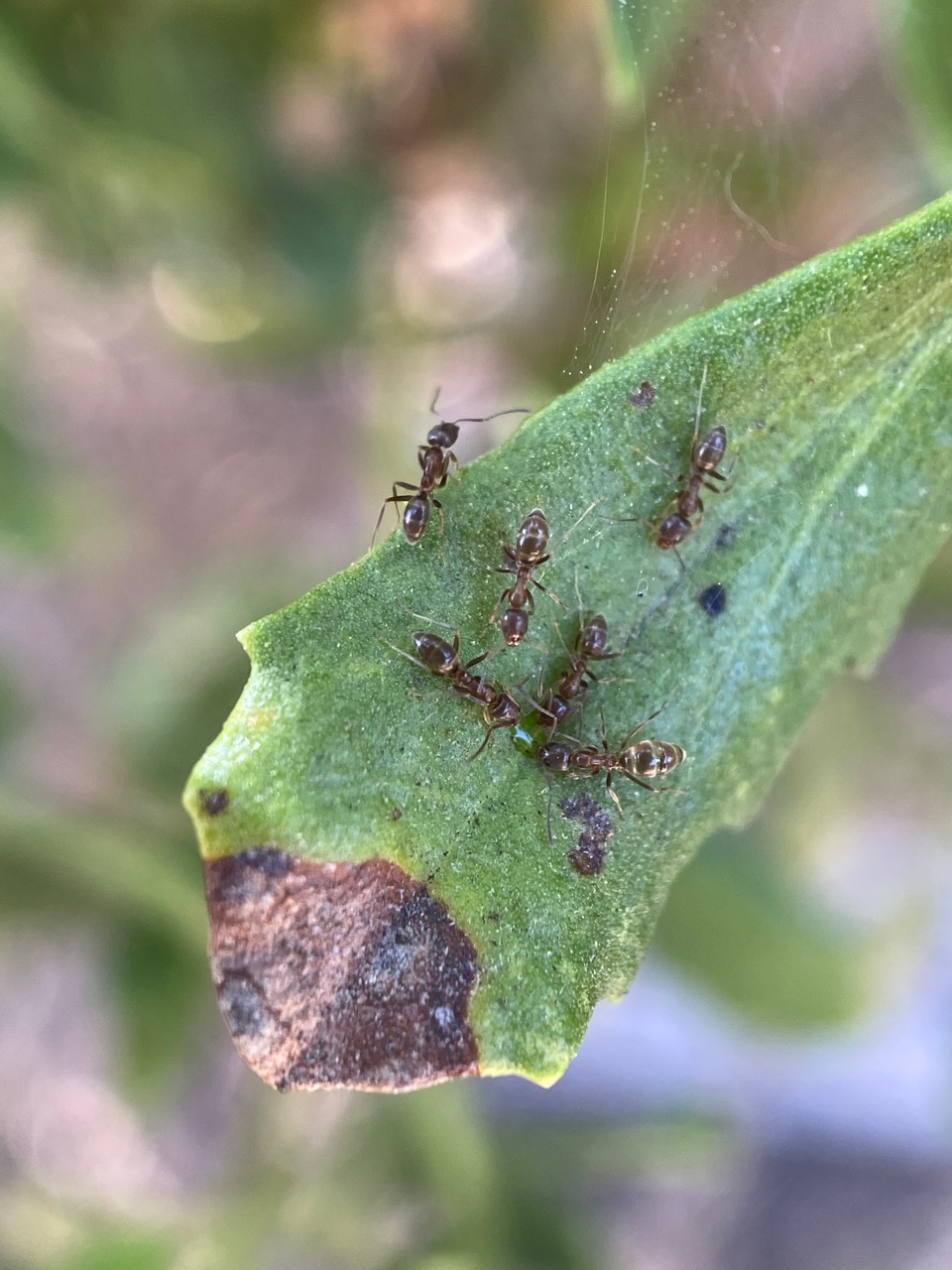
Some of the Coyote Brush along the trail are still in bloom, but there’s little insect activity on them, except for some ants. An excited group of Argentine Ants have gathered around a tiny droplet of liquid on a Baccharis leaf – honeydew excreted by a sucking insect? Manna from heaven on a parched day.
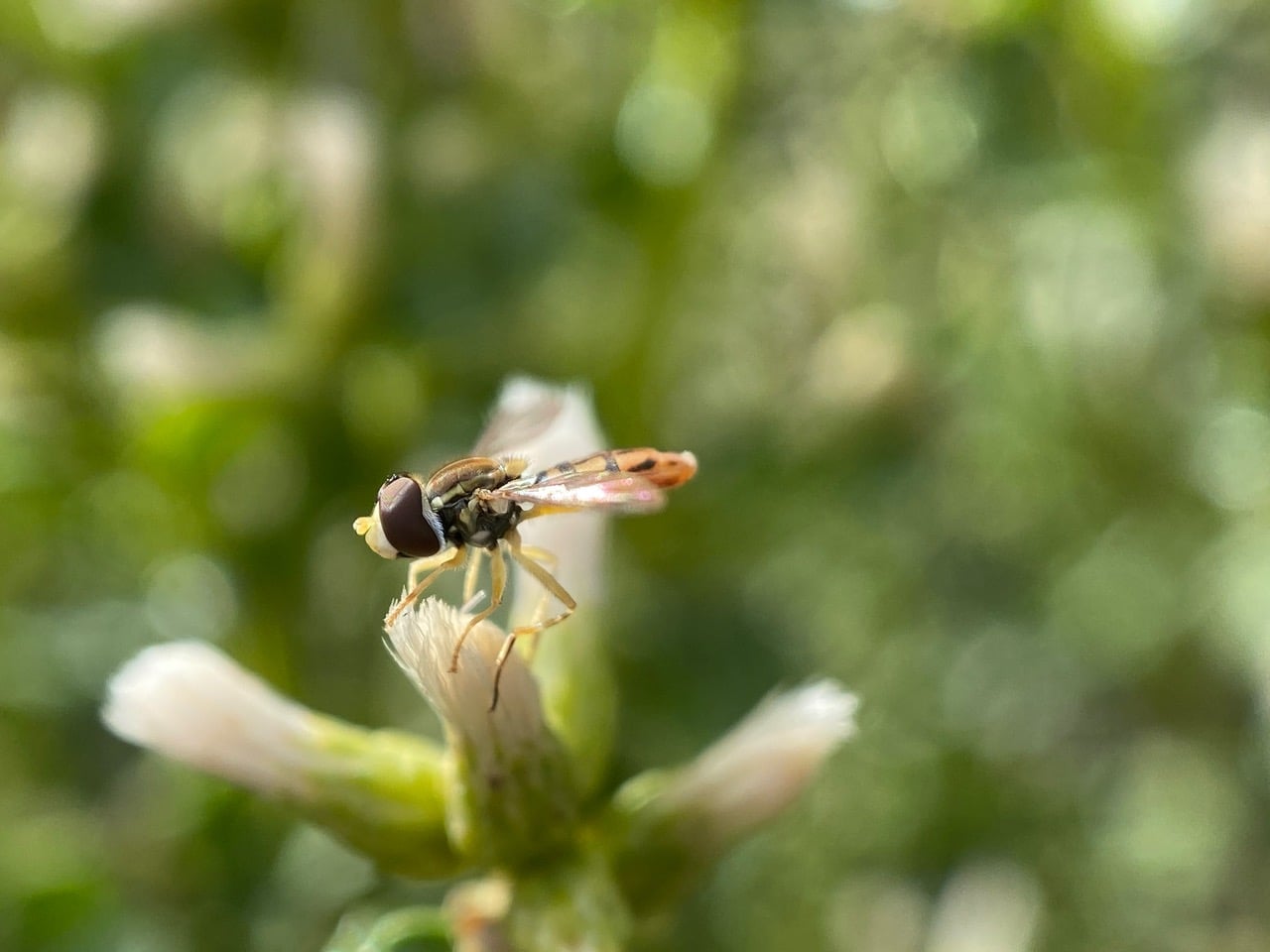
A Western Calligrapher, Toxomerus occidentalis (family Syrphidae) has landed on a female flowerhead of Coyote Brush.
Toxomerus is a very large genus of Hover Flies. They are found in North and South America. The majority of species are only 6-9 mm in length. They are notable for their mimicry of stinging Hymenoptera to avoid predators. Their unique abdominal patterns are diagnostic at the species level within the genus. Most larvae feed on soft bodied insects, such as aphids; a few feed on pollen. Adults feed on the pollen of a wide range of flowers. A female can lay up to hundreds of eggs at a time and will place them where prey or pollen food sources are readily available. They can be found in a wide variety of habitats, often in dense ground cover.
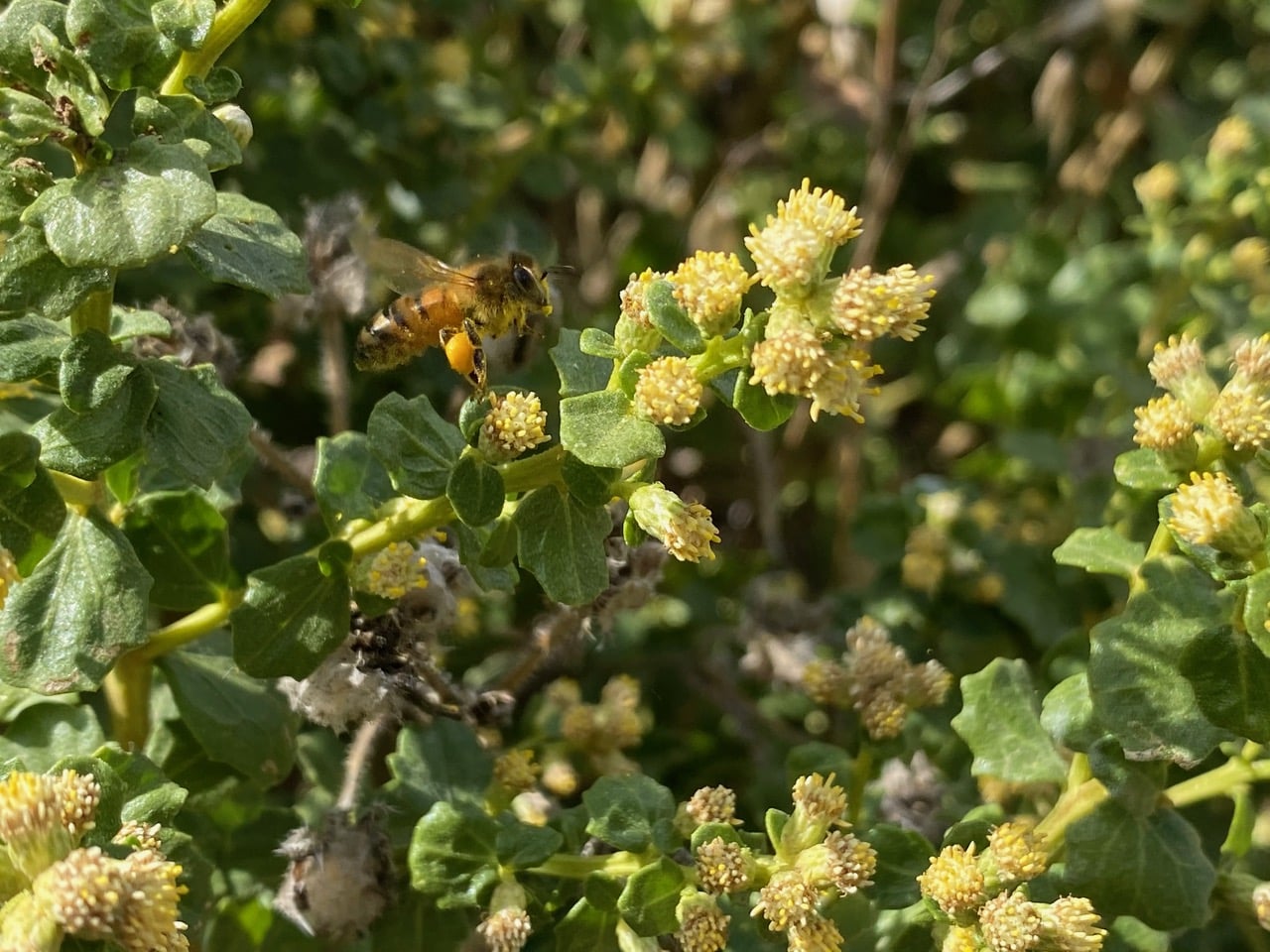
An occasional Honey Bee, Apis mellifera (family Apidae) forages on the male Coyote Brush still in bloom. This worker has a good sized load in her pollen baskets.
Watching honey bees forage, I am often reminded of a fellow docent at the Oakland Museum Natural Sciences Gallery many years ago. Bud taught me that every honey bee worker out foraging should be treated with respect – they are all little old ladies. Bud was absolutely correct. All Honey Bee foragers are female, and they are the oldest of their hive mates. How do honey bees get their job assignments within their social organization?
A bee’s job is, first of all, determined by its sex. Male bees, or drones, don’t do any work. Making up roughly 10% of the colony’s population, they spend their whole lives eating honey and waiting for the opportunity to mate with the queen. The queen mates with up to 20 drones and will store their sperm in her spermatheca for the rest of her life. That’s where male duties end. Female bees, known as worker bees, make up the vast majority of a hive’s population, and they do all the work to keep it functioning. Females are responsible for the construction, maintenance, and proliferation of the nest and the colony. When a worker bee emerges as an adult, she immediately starts cleaning the cell from which she hatched. Her first 3 days are spent cleaning cells to prepare them for the queen’s next round of eggs. Then her hormones kick in to initiate the next phase of work: nursing the young. The worker bee spends about a week nursing the brood, feeding larvae with royal jelly. Next, the worker bee enters the third phase, as a sort of utility worker, moving farther away from the nest’s center. Here she builds cells and stores food in the edge of the nest for about a week. A worker’s hormone shifts into the final phase of work at around 41st day: foraging. This work is the most dangerous and arguably the most important. It’s only done by older bees who are closer to death. As the worker bee approaches her fourth week of nonstop work, she senses her end of days, and removes herself from the hive, so as not the become a burden to the colony. If she dies in the hive, her hive mates would have to remove her corpse. Thus is the life of a female honey bee during the active seasons of spring and summer, compulsively working from the day she’s born until the day she expires.
So, don’t forget to tip your hat to the “little old ladies” you see in the garden!
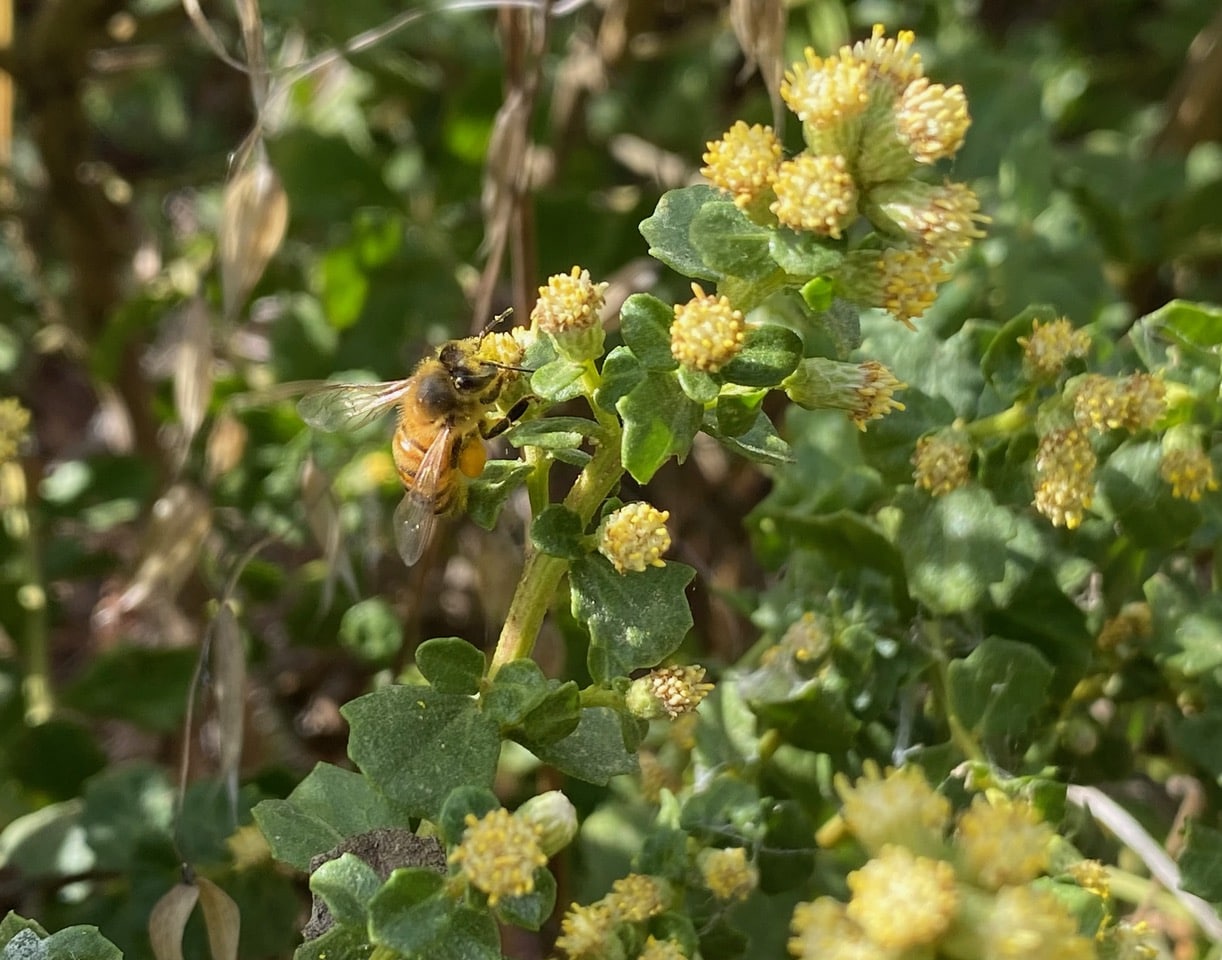
It is interesting that the eusocial bees are still collecting pollen this late in the season when few floral resources are available.
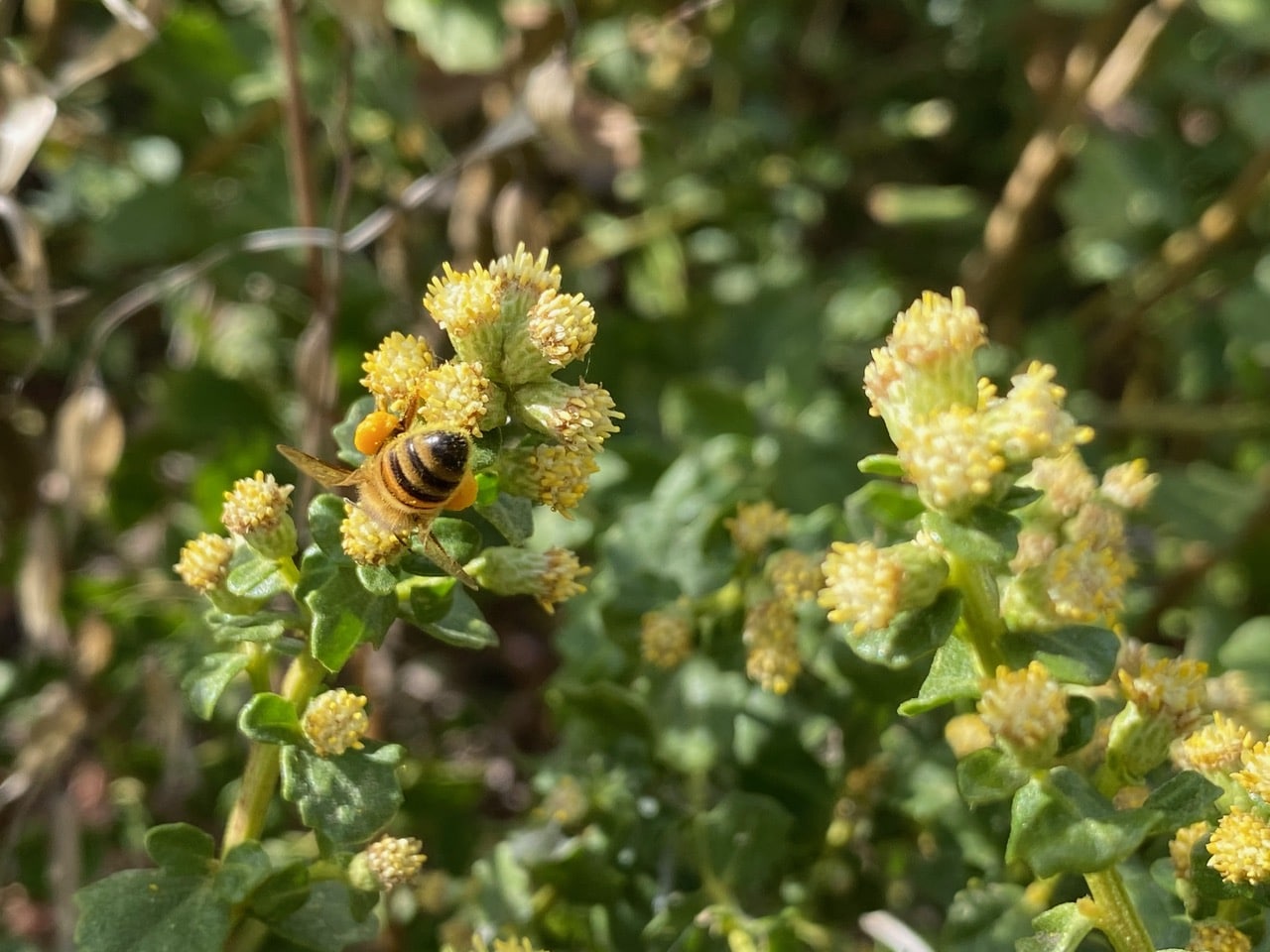
The pollen collecting apparatus in Apidae bees, which include honey bees and bumble bees, is commonly called a “pollen basket” or corbicula. This region is located on the tibia of the hind legs and consists of hairs surrounding a concave region. After the bee visits a flower, she begins to groom herself and brushes the pollen down toward her hind legs and packs the pollen into her pollen basket. A little nectar mixed with the pollen keeps it all together like putty, and the stiff hairs surrounding the pollen basket hold it in place. Remarkably bees are able to fly while carrying up to a third of their body weight in pollen.
.jpg)
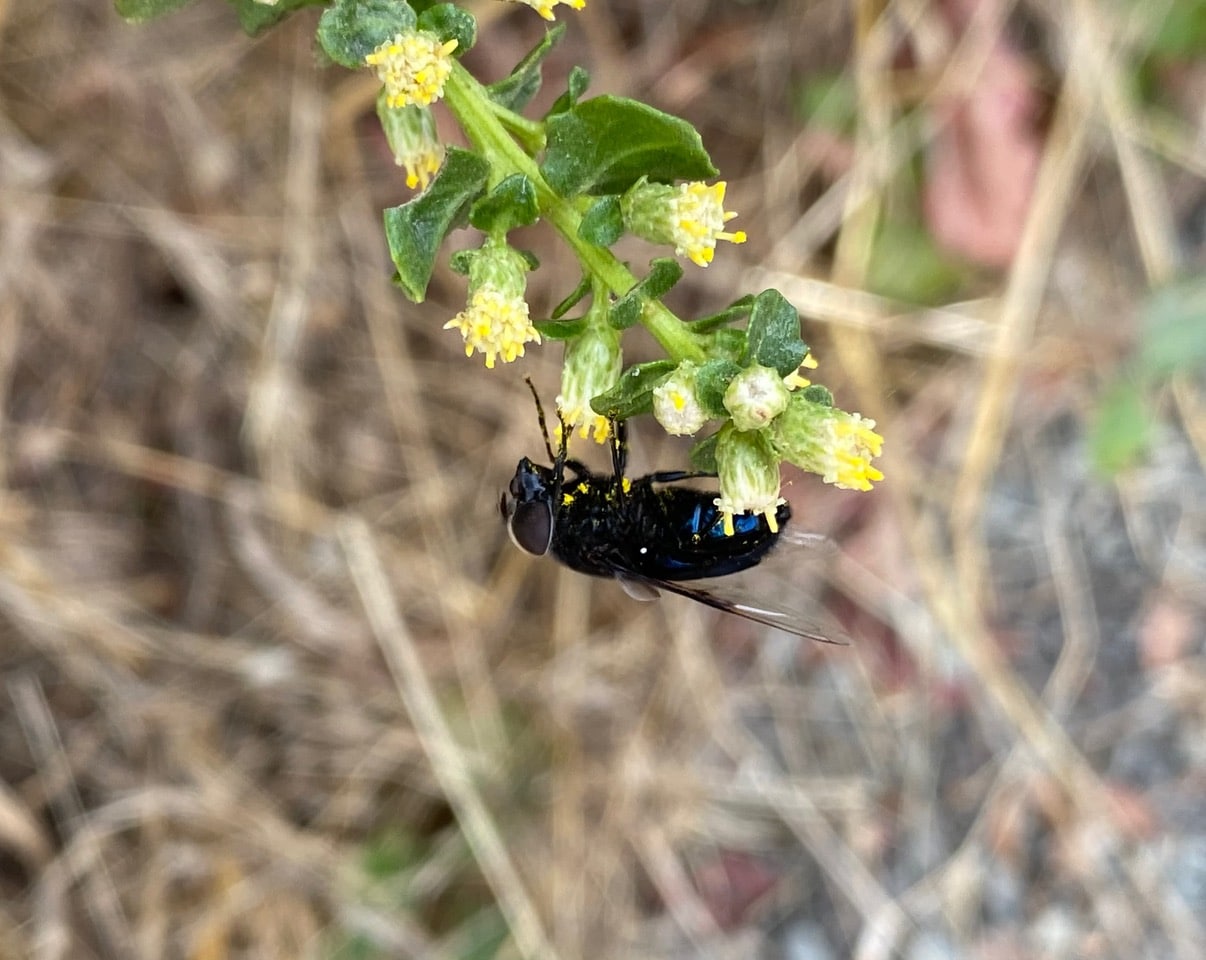
A large glossy black hover fly hangs upside down on a branch of Coyote Brush to feed on the male flowers. The Purple Bromeliad Fly, Copestylum violaceum (family Syrphidae) can easily be mistaken for a Carpenter Bee while in flight. They are the same size and color and makes similar buzzing noises. C. violaceum is the largest hover fly in our area.
The adult Purple Bromeliad Fly, Copestylum violaceum visits a wide range of flowers for nectar and pollen. The larvae develop in semi-aquatic habitats, e.g. tree holes, where they feed on bacteria on decomposing plant matter. The larvae have a long, snorkel-like appendage on their rear end that helps them breathe underwater; hence they are called rat-tailed maggots. Both play important roles in the ecosystem – adults as pollinators, and larvae as recyclers/decomposers.

Minutes later, our smallest hover fly, the Common Grass Skimmer, Paragus haemorrhous (family Syrphidae) lands on a flowerhead of the same plant.
The Common Grass Skimmer, Paragus haemorrhous (family Syrphidae) is easily the smallest hover fly I know, measuring only about 4 mm in length. The species has a world-wide distribution, found in unimproved grassland, dune grass, open areas and pathsides in forest, and meadows. Adults visit flowers for nectar and pollen. Larvae feed on aphids on low herbaceous plants.
Common Grass Skimmer (Paragus haemorrhous) · iNaturalist

Here’s a rear view of the diminutive hover fly, the Common Grass Skimmer, Paragus haemorrhous (family Syrphidae).
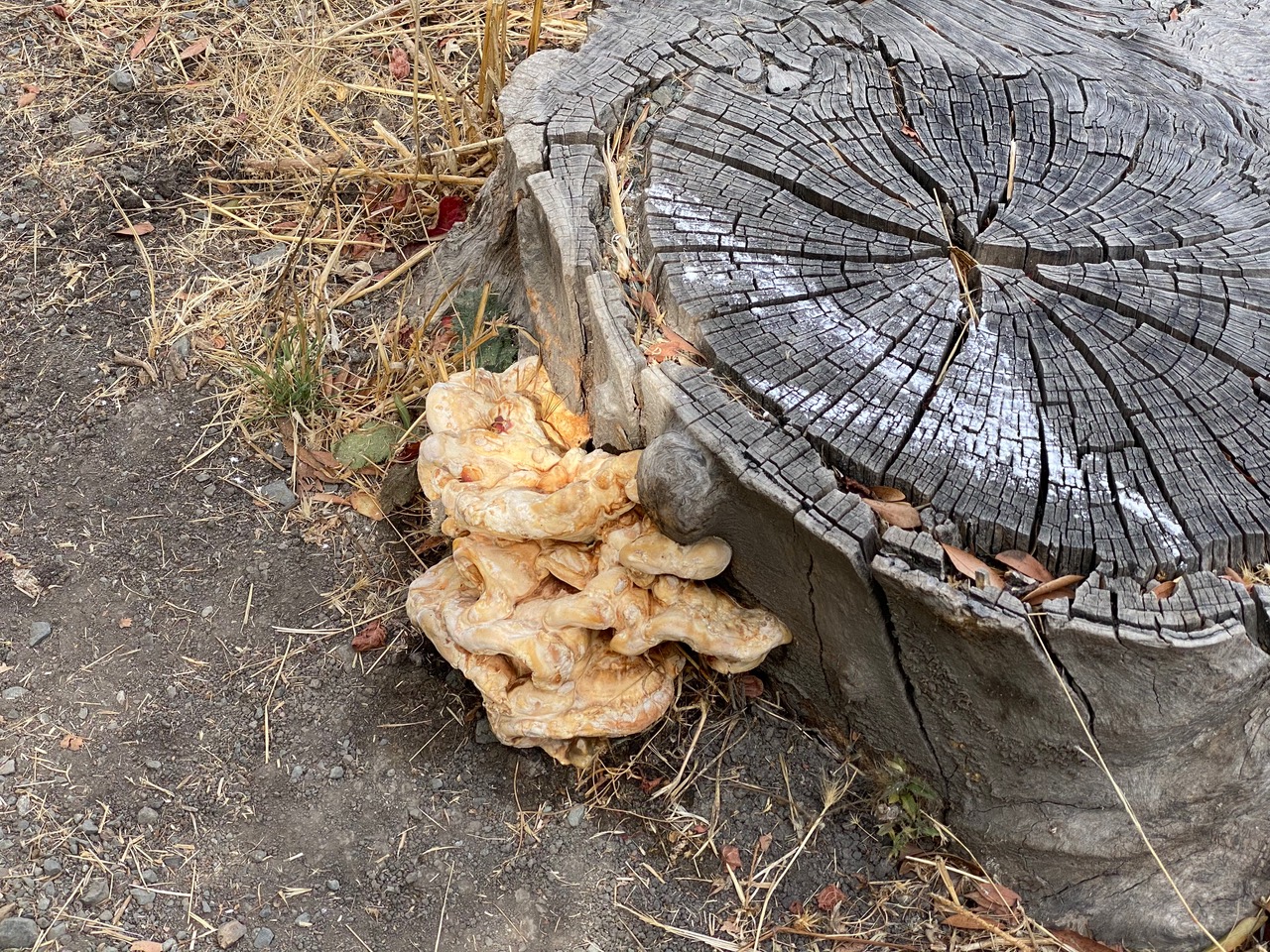
A huge, multi-layered fungus has sprouted on the massive old tree stump near the Steam Train gate. Although its colors have somewhat faded, the fungus is still recognizable as the Western Sulphur Shelf or Chicken of the Woods, Laetiporus gilbertsonii.
The brilliant yellow-orange, fleshy shelves of Western Sulphur Shelf are unlikely to be mistaken for any other fungus. The fungus is unusual in that it fruits well before the start of Bay Area rainy season, often in very dry weather. The lower surface does not bear gills, but fine pores from which spores are expelled. It is particularly common on species of Eucalyptus and other hardwoods. In age, fruiting body become dry, white and crumbly. Fruitings repeat year after year from the same stump or log.
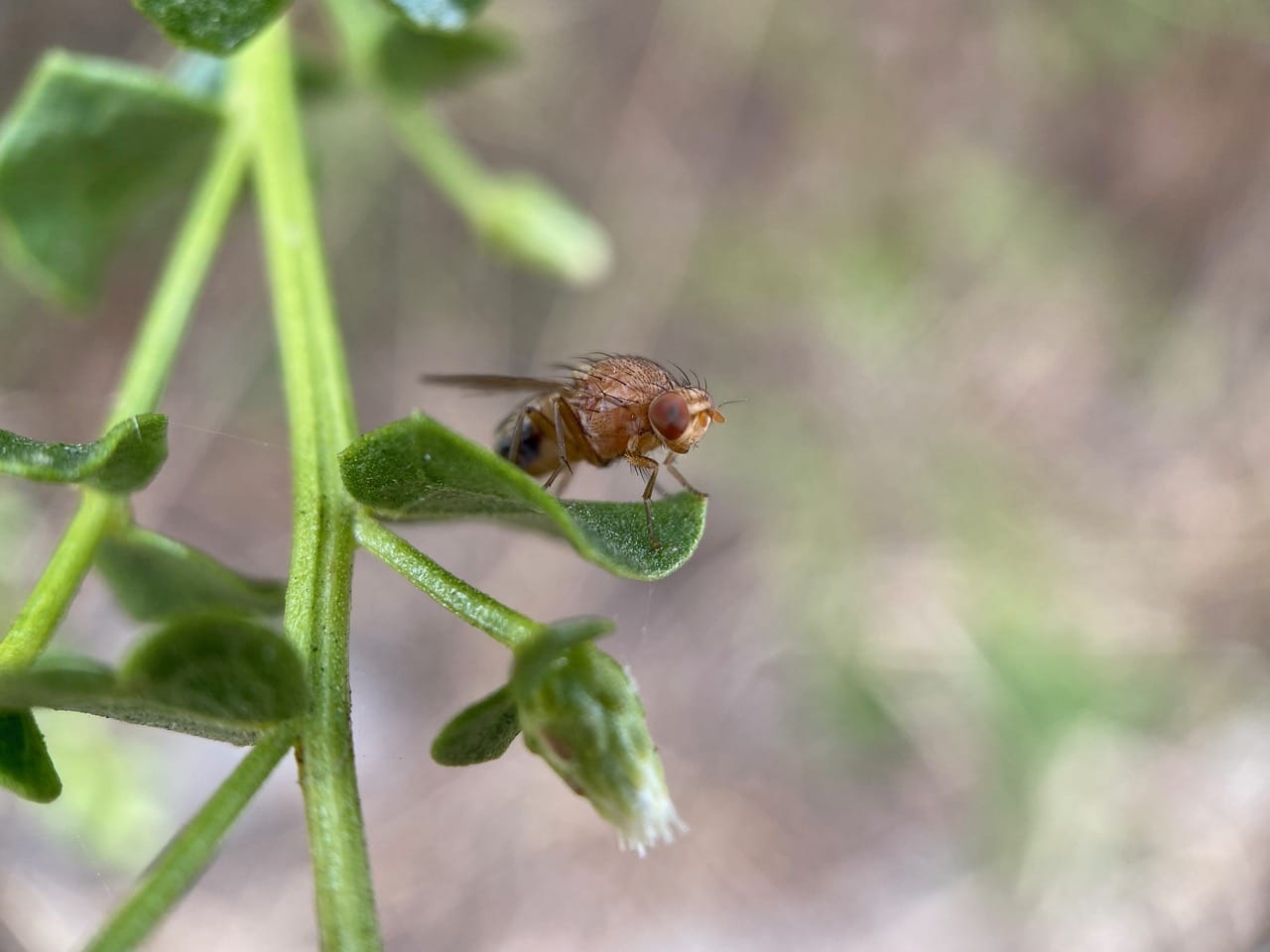
A small yellowish fly is resting on a leaf of Coyote Brush. It is a member of the genus Minettia, family Lauxaniidae.
Lauxaniidae are small flies (2-7 mm in length). They are often rather plump and dull, the body color varying from yellow-brown to black, or with a combination of these colors. They are characterized by strong, backward pointing bristles on the front (top of the head right above the eyes). The larvae are mostly saprophages, feeding in leaf litter, soil, bird nests, etc. Larvae of some mine fallen leaves, others live in rotten wood.

A Bee Fly lands on the trail in front of me. Everything about it is dark chocolate brown, almost black, including its wings. It is the Sinuous Bee Fly, Hemipenthes sinuosa (family Bombyliidae). The name sinuosa refers to the sinuous, undulating border of the dark area on the wings of the fly.
The Bee Flies belong to the family Bombyliidae. Adults generally visit flowers for nectar and pollen, some being important pollinators. Larvae generally are parasitoids of other insects. When at rest, many species of bee flies hold their wings at a characteristic “swept back” angle. The adult females usually deposit eggs in the vicinity of possible hosts, quite often in the burrows of beetles or ground-nesting bees/wasps. Bombyliidae parasitism is not host-specific, but rather opportunistic, using a variety of hosts.
The Sinuous Bee Fly is a common species throughout most of North America. Members of this genus are parasitoids and hyperparasitoids. Their larvae are parasitic on other insects, while the adults visit flowers for nectar. The term hyperparasitoid refers to the fact that the larvae of Hemipenthes sinuosa hatch within the larvae of Tachinid Flies, Ichneumonid wasps and other insects, which themselves are parasitic in other species. In other words, larvae of Hemipenthes are parasites of parasites.