

Pollinator Post 10/8/24 (1)
After a crazy week of brutal heat, Fred and I are happy to resume our daily walk at Shoreline Park on Bay Farm Island this morning.

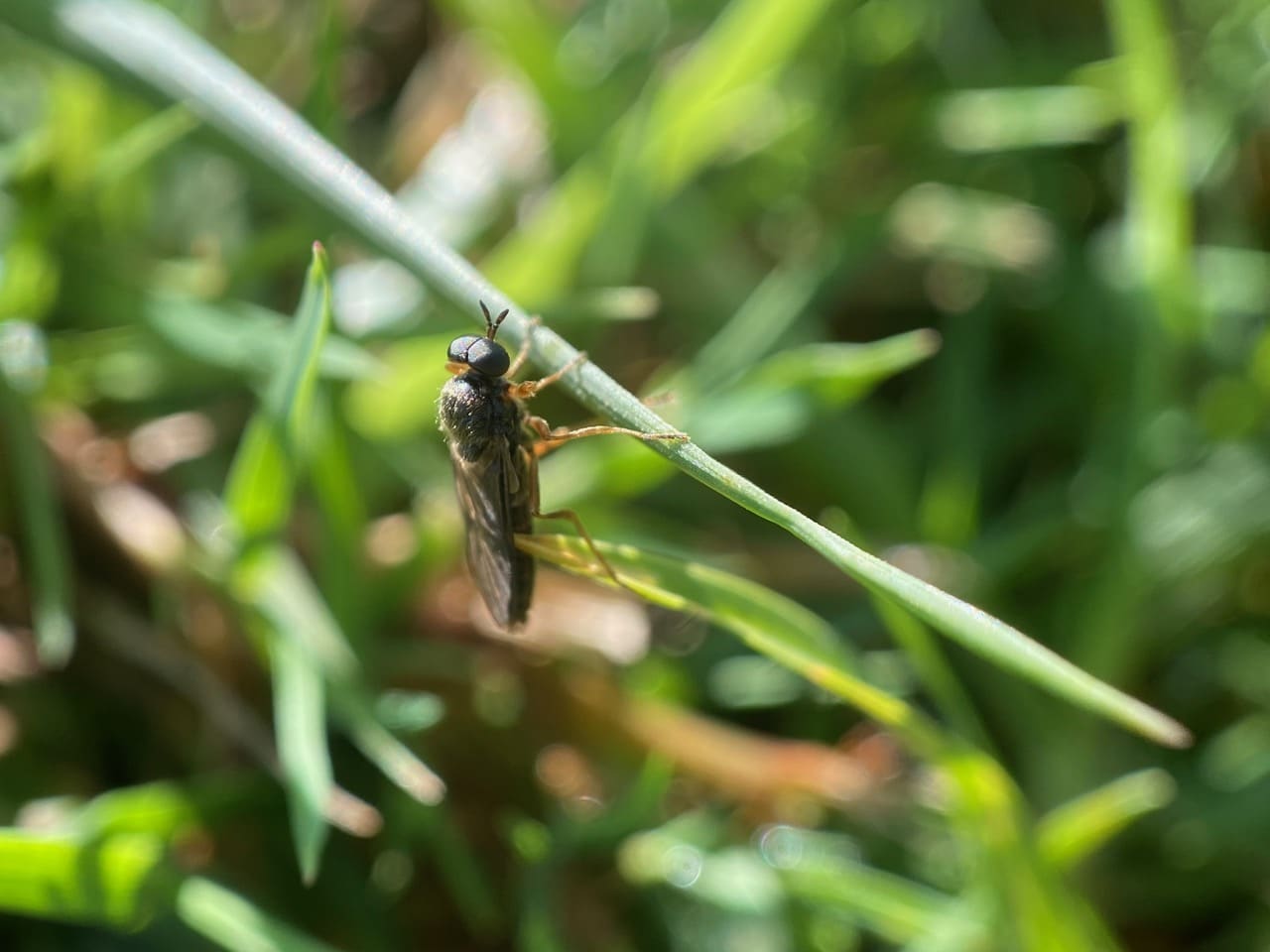






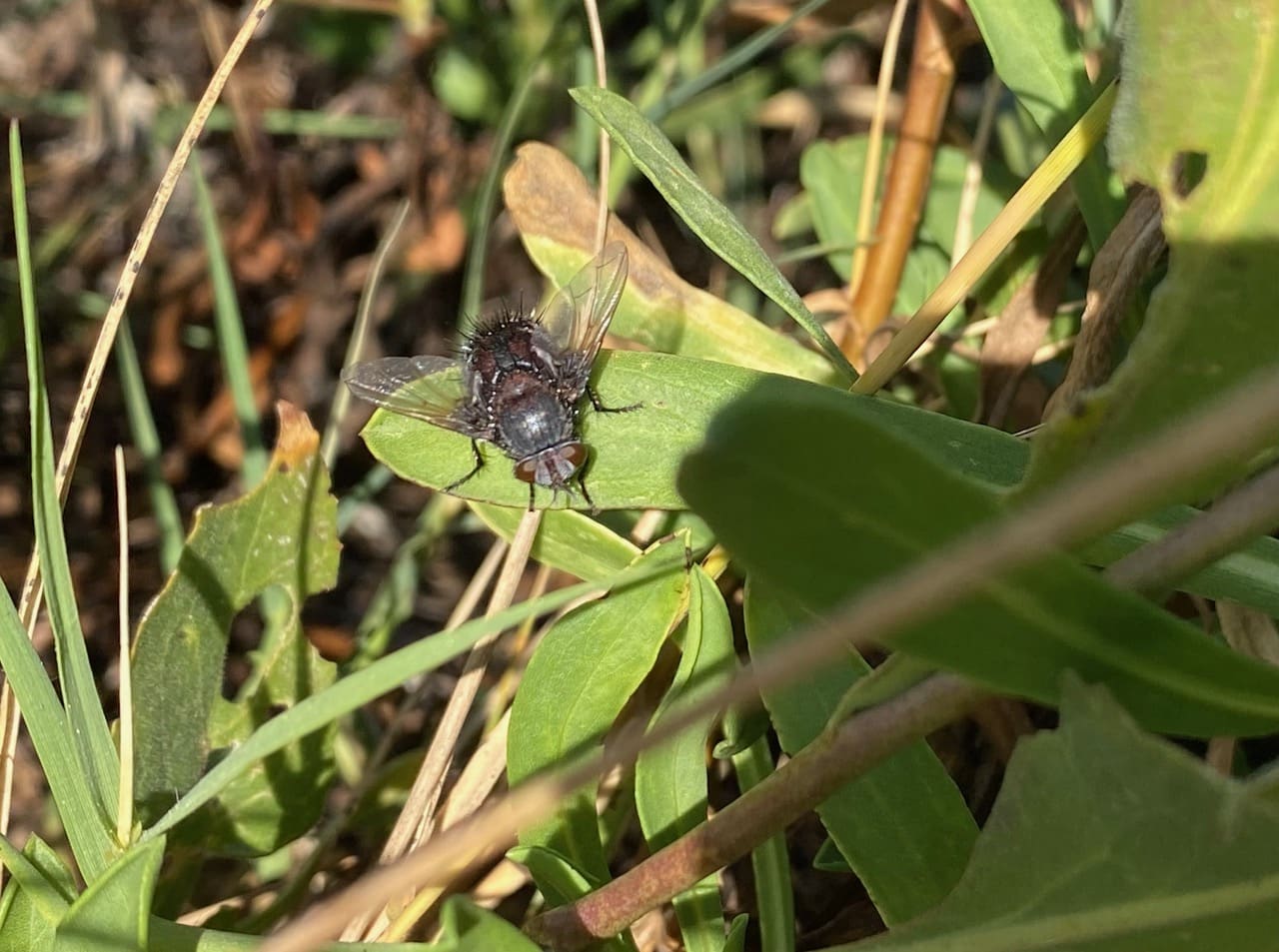
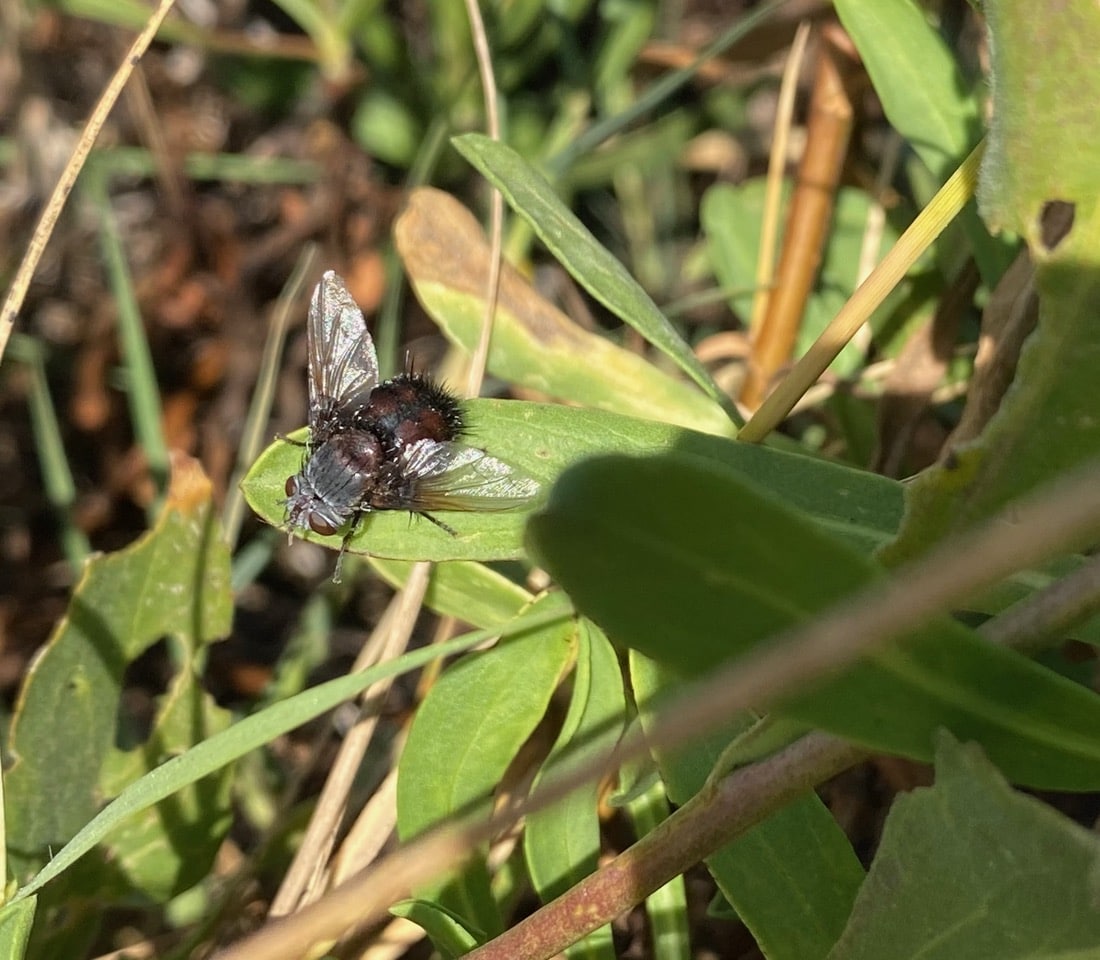

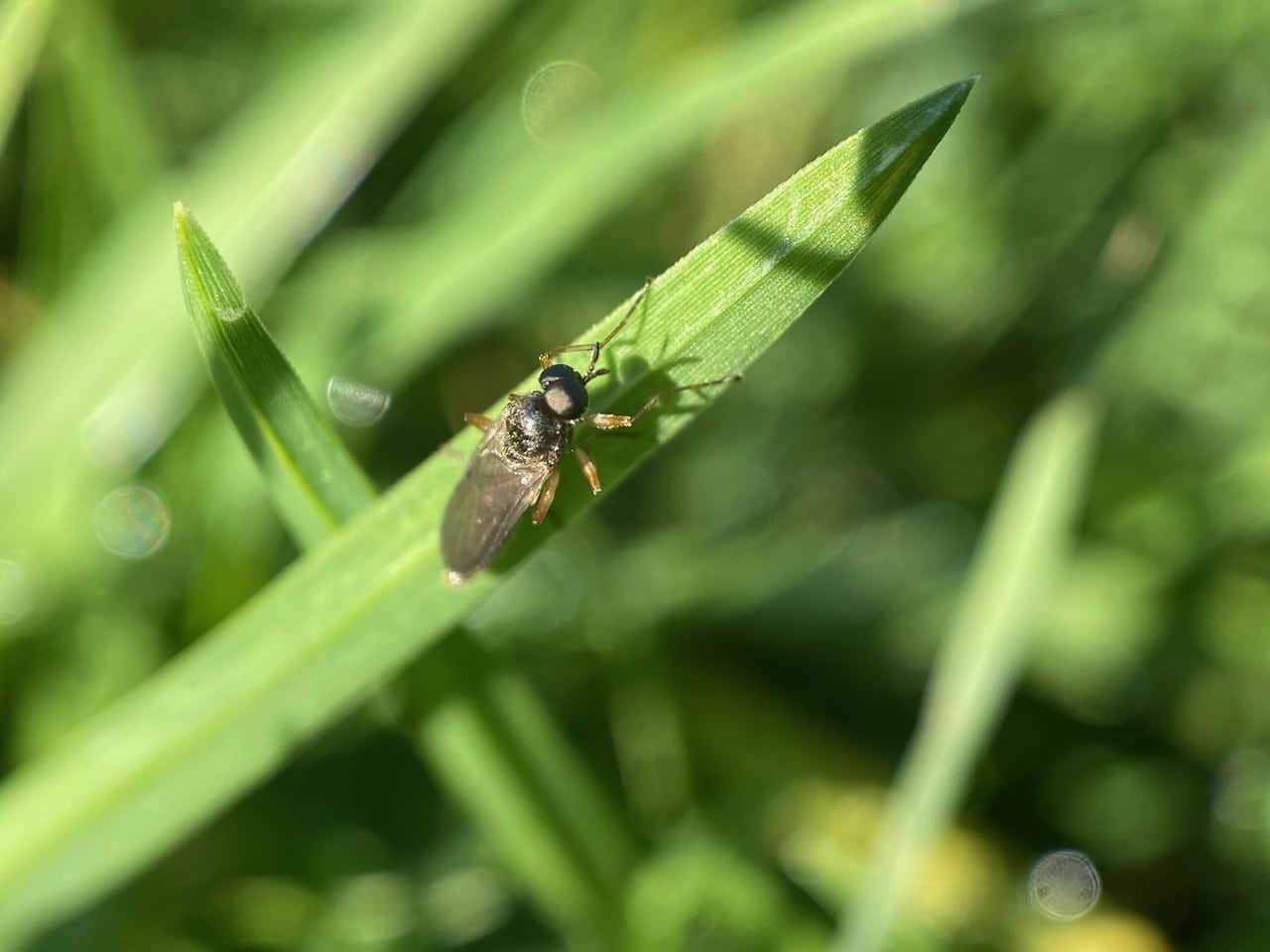
Numerous small insects are dancing low over the green, well-watered lawn. They are skittish and difficult to photograph. Finally one perches on a blade of grass to groom itself. Wow, it is all eyes! iNaturalist has helped identify it as the Sugarcane Soldier Fly, Inopus rubriceps (family Stratiomyidae). I have actually seen the females at this location – they didn’t look like this at all. What we have here is obviously a male.
The Sugarcane Soldier Fly, Inopus rubriceps (family Stratiomyidae) is native to eastern Australia where it infests such crops as corn, pastures, and sugarcane. The fly was accidentally introduced into California over 50 years ago. It is now infesting lawns in San Francisco and other Bay Area counties. Damage to turf and other members of the grass family results from withdrawal of sap from roots of host plants by the larvae and possibly, injection of a toxin into the plant.
In California adults occur in large numbers from late September to early November each year. Eggs are deposited in crevices in the soil. The adults are sexually dimorphic. Females have tiny red heads with eyes set far apart. The smaller males have large eyes that occupy the whole surface of the head.
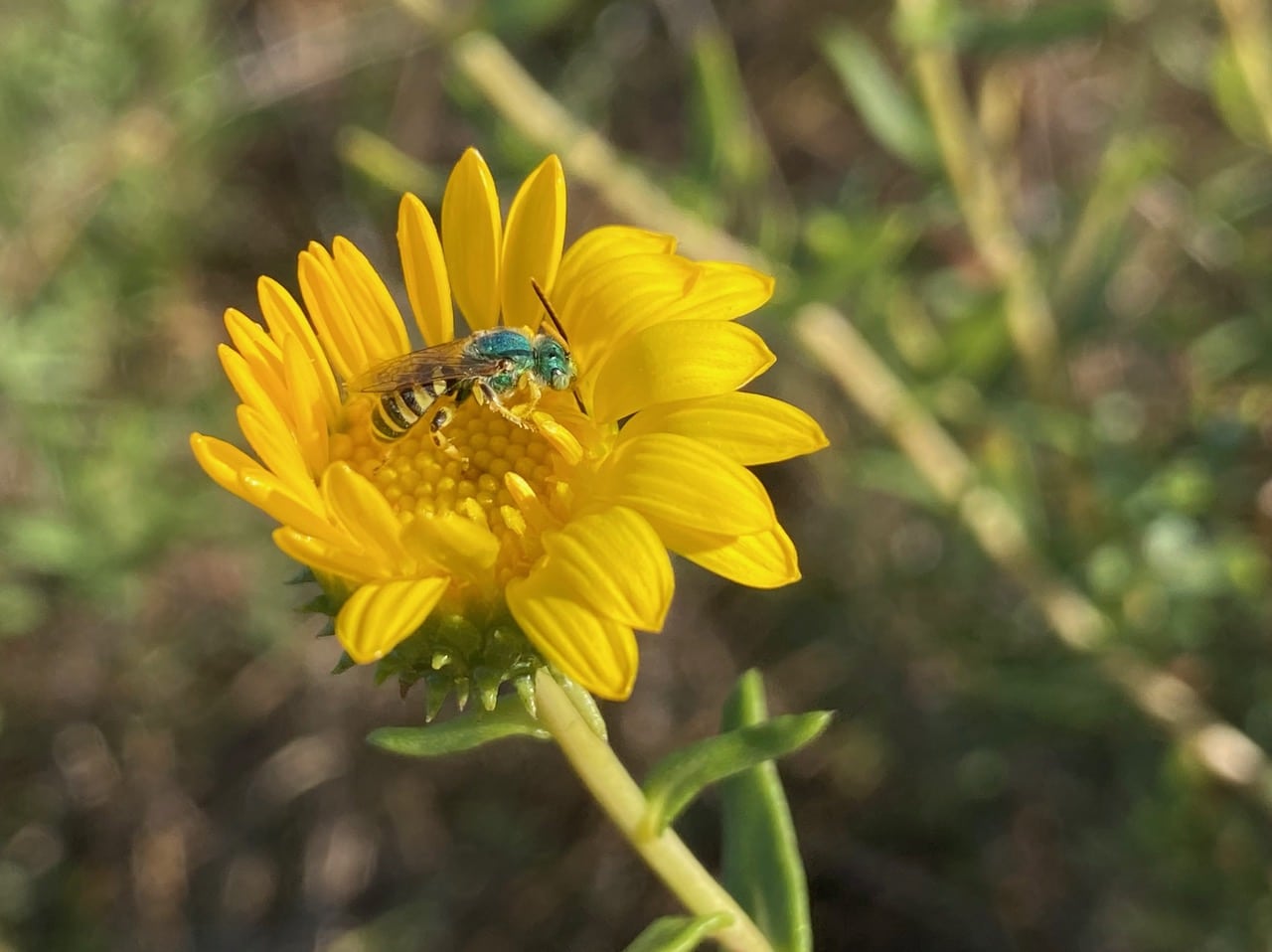
A female Texas Striped Sweat Bee, Agapostemon texanus (family Halictidae) is foraging on a flowerhead of Bristly Oxtongue, Helminthotheca echioides.
The genus Agapostemon is widespread and abundant throughout North America. These ground-nesters are most diverse and abundant in temperate regions and southwestern U.S. deserts. Agapostemon are commonly called “sweat bees” because they are closely related to, and resemble bees in the Halictus and Lasioglossum genera. Unlike those bees however, Agapostemon are not attracted to human sweat.
Agapostemon are brightly colored metallic green or blue bees measuring 7 to 14.5 mm long. Most species have a metallic green head and thorax, and black-and-yellow striped abdomen; some females are entirely bright green or blue. Females carry pollen on scopal hairs located on their hind legs. Agapostemon are generalists. Like other members of the family Halictidae, they are short-tongued and thus have difficulty extracting nectar from deep flowers. Males are often seen flying slowly around flowers looking for females. The bees favor flowers with high densities. The bees are active summer to fall.
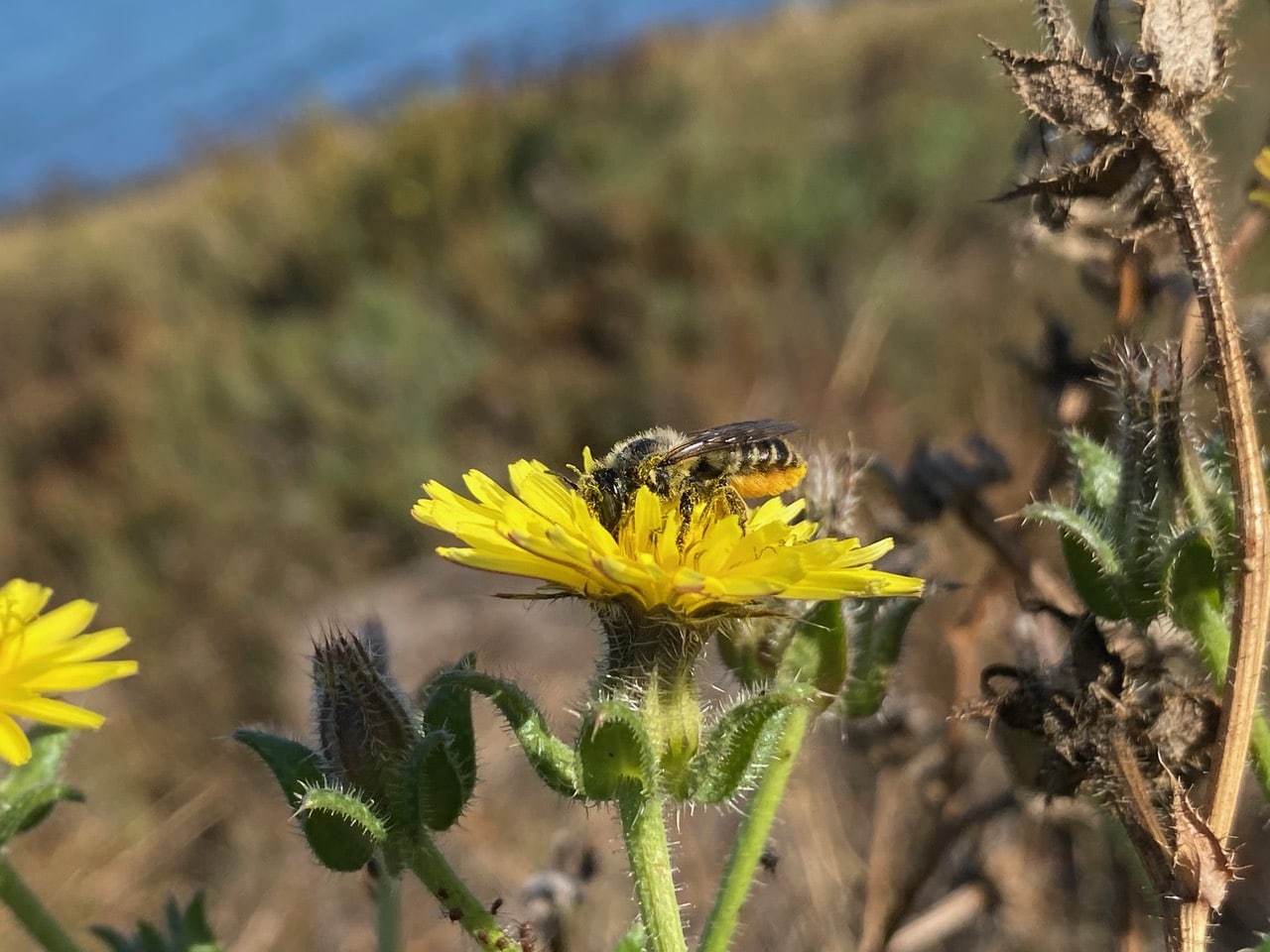
A female Western Leafcutter Bee, Megachile perihirta (family Megachilidae) is foraging on a flowerhead of Bristly Oxtongue.
Leaf-cutter Bees, Megachile sp. (family Megachilidae) are stout-bodied, usually with pale hair on the thorax and stripes of white hairs on the abdomen. Females usually have a triangular abdomen with a pointed tip, and males’ faces are covered with dense, pale hair. Flight season is from May into September, with peak activity from June to August.
Solitary females construct nests in tubular cavities, including hollow stems, tree holes, and abandoned beetle burrows in wood. Many use holes drilled into wood, straws, or other manufactured tunnels. Females cut pieces from leaves or flower petals for use in the construction of brood cells. Most Megachile females are generalists when foraging for pollen. Pollen is transported in dense scopae on the underside of the abdomen.
Photos of Western Leafcutter Bee (Megachile perihirta) · iNaturalist
As the bee lifts her head I glimpse her enormous mandibles. The family name Megachilidae means “big jaws”, referring to their large mandibles. Females have especially large and powerful mandibles that they use to cut leaves and petals to line their nest cells.
Did last week’s extreme heat cause the Grindelia flowerheads to wither prematurely, or is this the natural progression of the season? This is my first year observing this Grindelia population, so I can’t tell. But I am shocked by the sudden reduction in the number of fresh flowerheads.
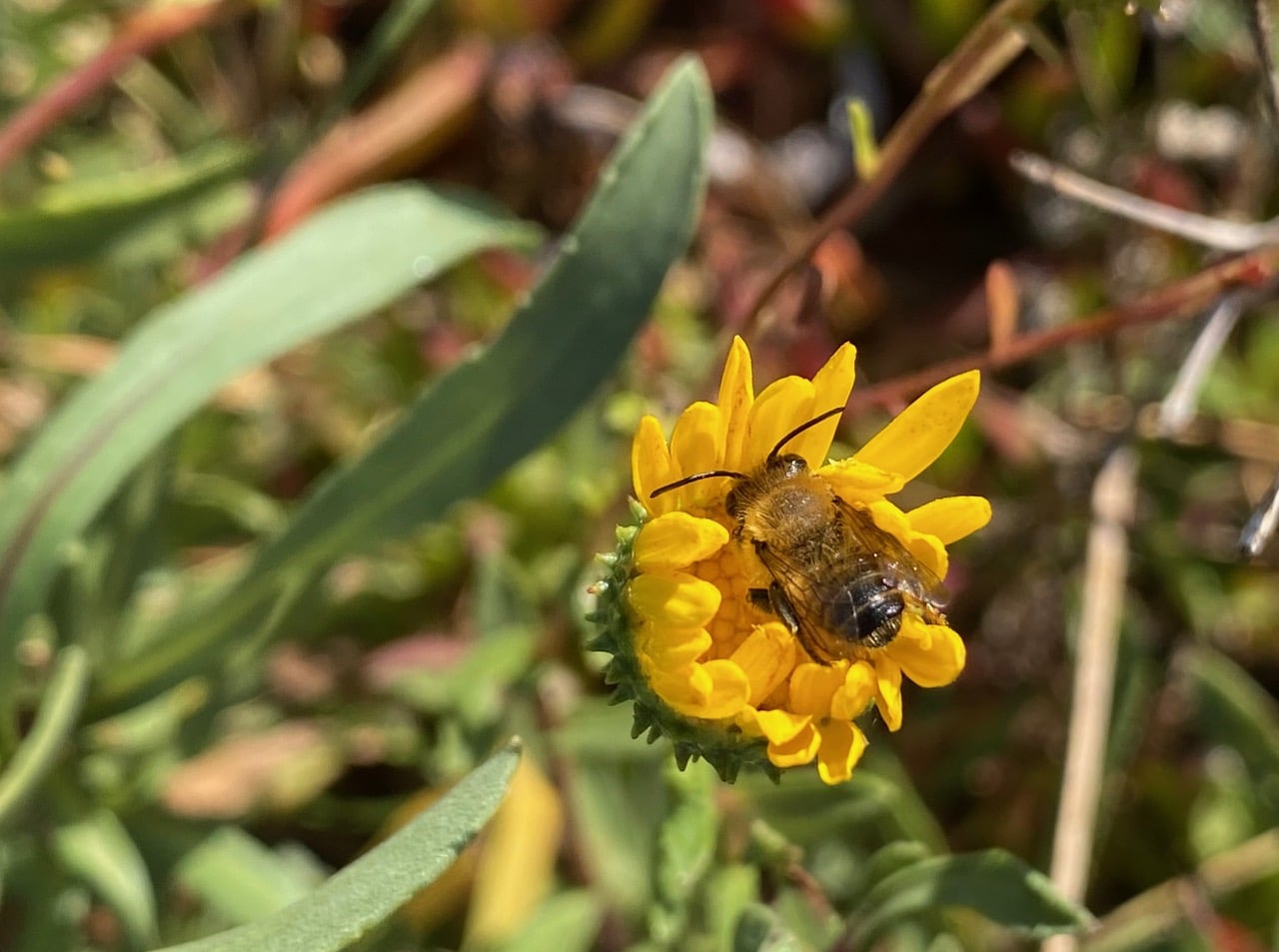
A male Western Leafcutter Bee, Megachile perihirta (family Megachilidae) is perched motionless on a freshly opened Grindelia flowerhead. Is it asleep or is it dead? It looks like a healthy bee. I mark the plant so I can return to check on the bee later on. When I pass this way about half an hour later, the bee is no longer there. It was merely taking a nap.
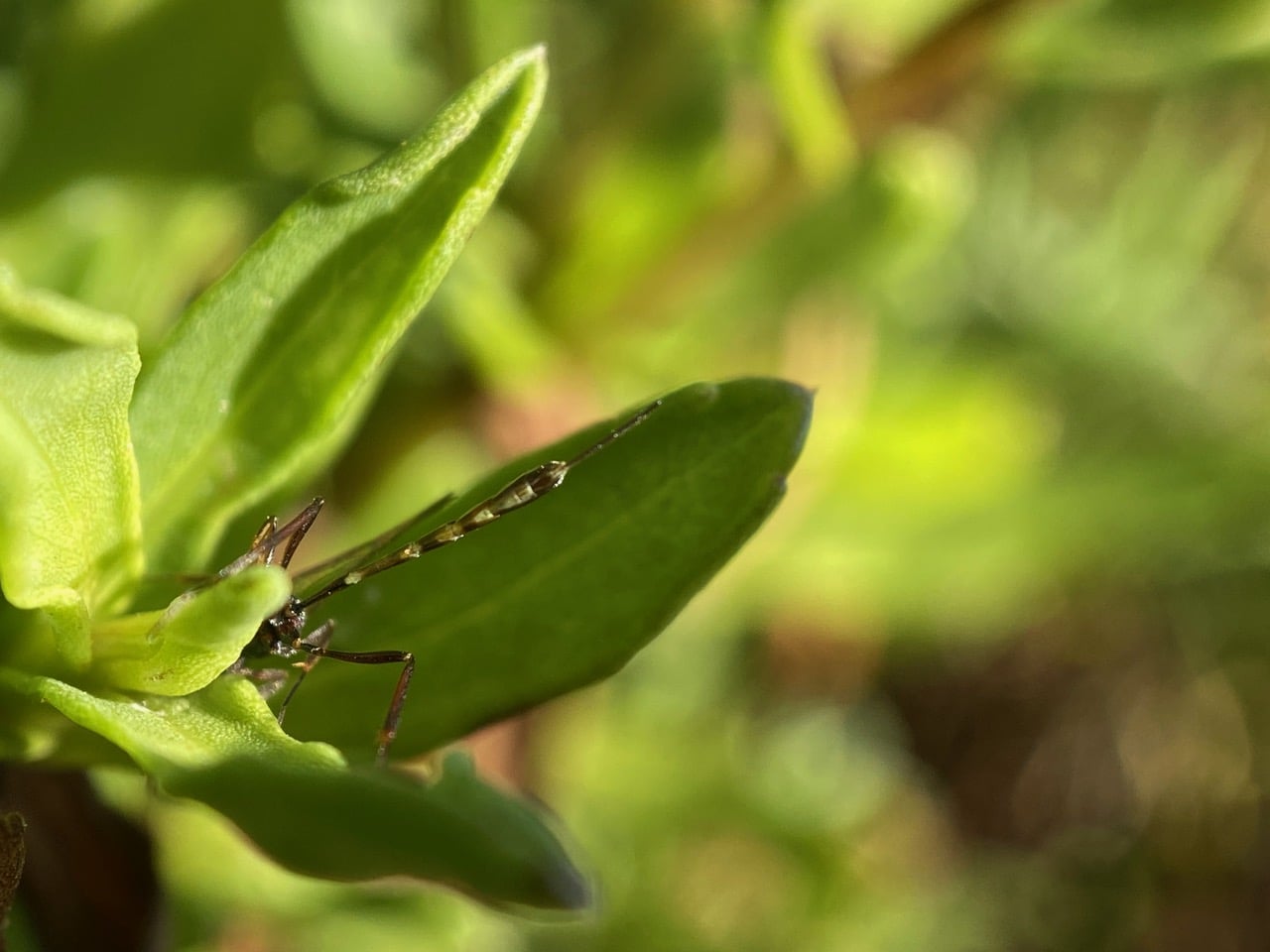
A tiny wasp with a long skinny abdomen lands on a Grindelia, and promptly disappears into the foliage. There is an ovipositor at the tip of its abdomen – the wasp is a female parasitoid, Anomalon sp. (family Ichneumonidae) probably here in search of host insects on which to lay her eggs.
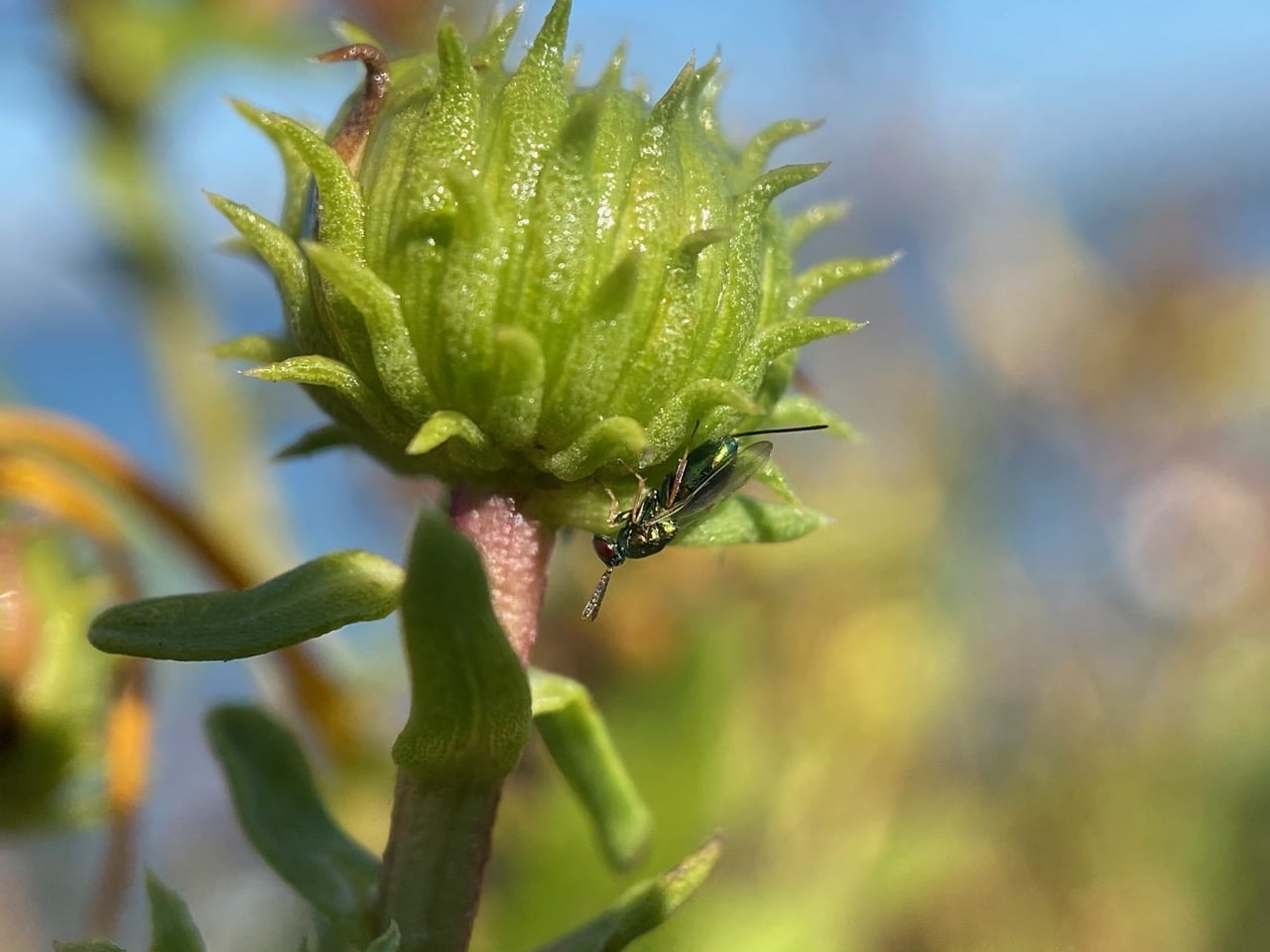
A tiny, iridescent green wasp with a long ovipositor is perched motionless at the base of an immature Grindelia flowerhead. A deja vu moment for me – haven’t I seen this recently? The parasitoid wasp is probably injecting her eggs into a host insect within the flowerhead. The long “ovipositor” we see is only the sheath that protects the actual ovipositor. During egg laying, the ovipositor is unsheathed and pushed downward into the substrate into which the egg is injected.
Her job done, the wasp turns around, climbs up the involucre and flies away. iNaturalist has identified it as a chalcid wasp, Torymus sp. (family Torymidae).
Torymidae is a family of wasps in the superfamily Chalcidoidea. Most species in this family are small with attractive metallic coloration, and females generally have long ovipositors. Many are parasitoids on gall-forming insects, and some are phytophagous (plant-eating) species, sometimes using the galls formed by other insects. Over 960 species in about 70 genera are found worldwide. They are best recognized in that they are one of the few groups of chalcidoidea in which the cerci are visible. Most members of the genus Torymus are ectoparasitoids of gall forming insects, usually gall wasps and gall midges.
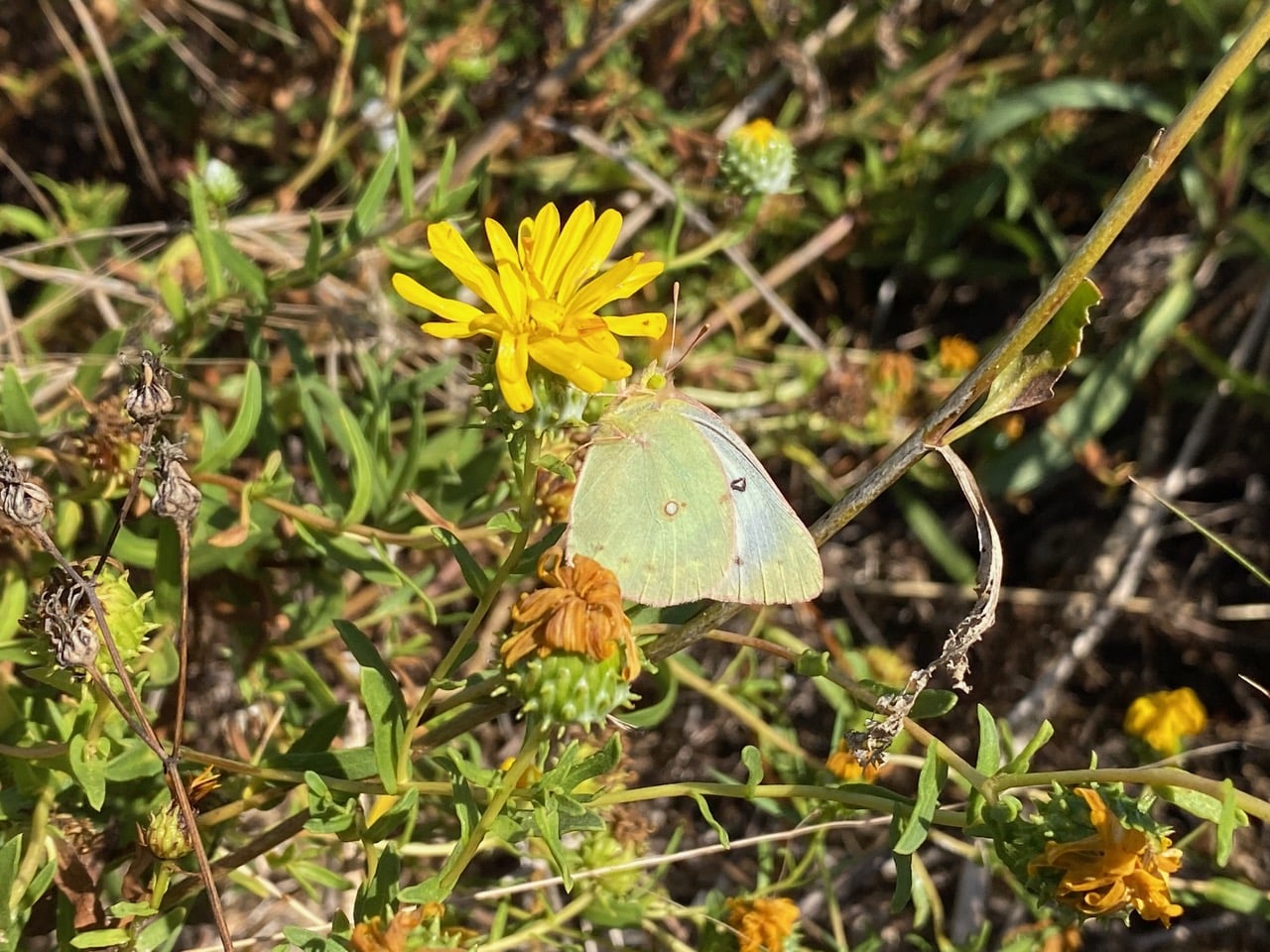
An Orange Sulphur butterfly is clinging motionless to the side of a Grindelia flowerhead, but does not seem to be taking nectar.
The Orange Sulphur, Colias eurytheme is a widespread and common North American butterfly, belonging to the Pieridae family, the “Whites and Sulphurs”. It is medium-sized with a wingspan of about 2 in. Though color may vary among individuals, the wings are typically yellowish and orange, although some females are white and may appear greenish. The top wing surface has dark brown to black edging. Adults fuel up on nectar from a variety of flowering plants. The caterpillars (green with a white side streak) tend to concentrate on pea family plants (family Fabaceae), such as alfalfa, vetch and clover. Males patrol for females, looking for the characteristic female ultraviolet light absorbance on the hind wings. In contrast, the males’ hindwings reflect ultraviolet light instead.
A male Texas Striped Sweat Bee, Agapostemon texanus (family Halictidae) visits a Grindelia flowerhead for nectar. These bees seem to be the predominant bees on the Grindelia now that the number of the Summer Longhorn Bees, Melissodes sp. (family Apidae) has declined sharply. I only encounter one or two Melissodes today.
Whoa, that’s a formidable looking fly! Stocky, dark brown with black spiky bristles on its abdomen, it looks like a fly from hell. For many moths, the Bristle Fly, Leschenaultia sp. (family Tachinidae) may indeed be a fly from hell.
The family Tachinidae is by far the largest and most important group of parasitoid flies. All species are parasitic in the larval stage. Most adults have distinct abdominal bristles, hence the common name. Adults feed on liquids such as nectar and honeydew. They can be found resting on foliage, feeding at flowers or searching for hosts.
Most tachinids attack caterpillars, adult and larval beetles, true bugs, grasshoppers, and other insects. Females lay eggs in or on the host. Tachinid larvae live as internal parasites, consuming their hosts’ less essential tissues first and not finishing off the vital organs until they are ready to pupate. The larvae leave the host and pupate on the ground. Tachinids are very important in natural control of many pests, and many have been used in biological control programs.
The Bristle Fly, Leschenaultia sp. (family Tachinidae) is a New World species, found in most of North America, especially diverse in the southwestern United States. Recorded hosts include various moths, including Arctiidae, Lasiocampidae and Saturniidae.
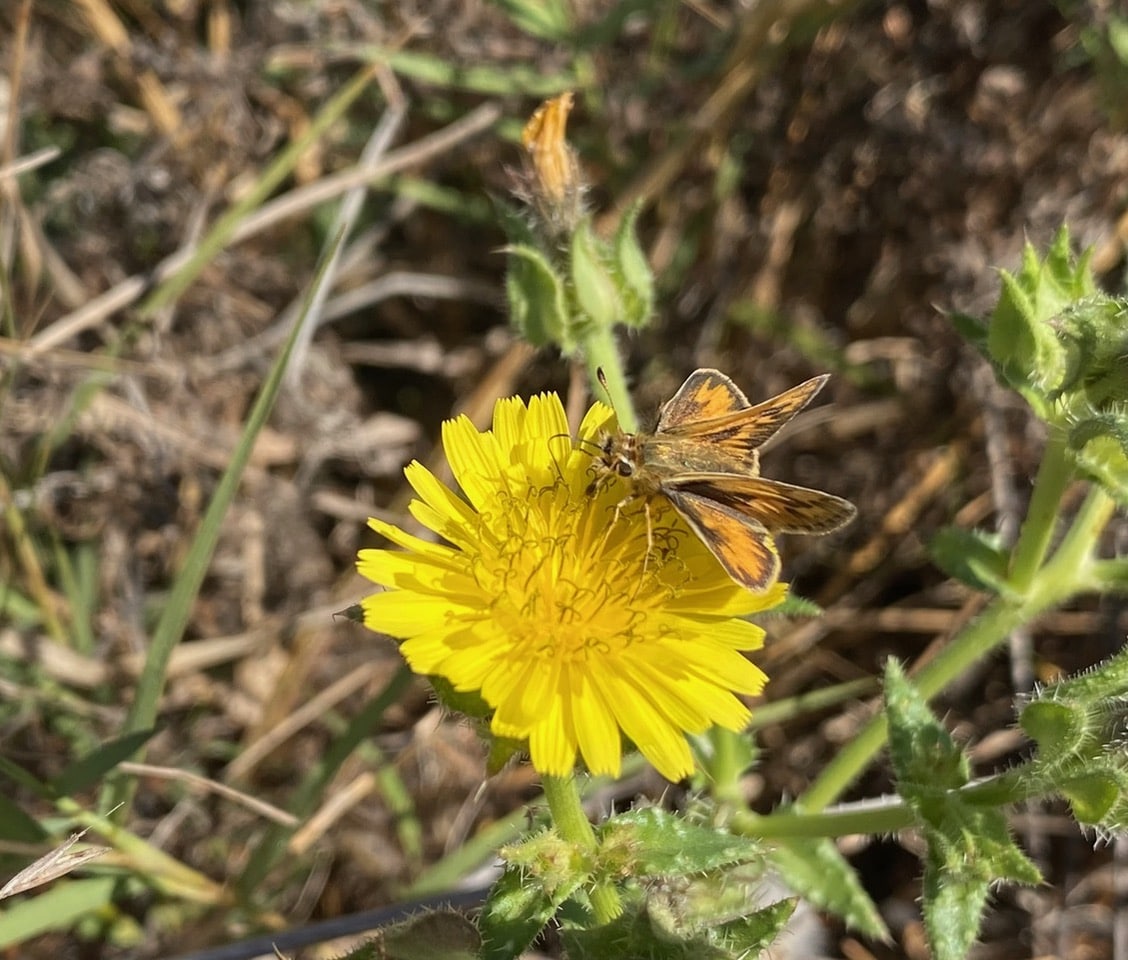
A Sandhill Skipper sits still while probing for nectar from several florets on a Bristly Oxtongue flowerhead.
Skippers are a family, the Hesperiidae, of the order Lepidoptera (butterflies and moths). They are named for their quick, darting flight habits. Most have the antenna clubs hooked backwards like a crochet hook. They also have generally stockier bodies and larger compound eyes than the other butterflies. Their wings are usually small in proportion to their bodies. When at rest, skippers keep their wings usually angled upwards or spread out, and only rarely fold them up completely. Californian species are mostly brown or tan, with black, orange, or yellow markings.
Skipper caterpillars are usually green or brown, sometimes yellowish, never brightly colored. They have a distinctive “collar”, a narrow ring around the body right behind the head. Caterpillars are camouflaged and often hide during the day. Many species make nests of leaves and silk for additional protection. Most North American species feed on grasses, but some common species eat shrubs and trees, especially in the bean family. Most species are limited to a single group of food plants. Adult skippers are only active during the day, but Skipper caterpillars feed mainly when it is dark or partly light.
The Sandhill Skipper, Polites sabuleti (family Hesperiidae) is found in western United States. Their habitats include alkali grasslands, moist meadows, lawns, salt marshes, sand dunes, sagebrush flats, and alpine fell-fields. Adults feed on flower nectar, while caterpillars feed on leaves and take shelter in nests of tied leaves. Larval host plants include various grasses, including the salt grasses. There are several flights from March-October in the southern range and low elevations.
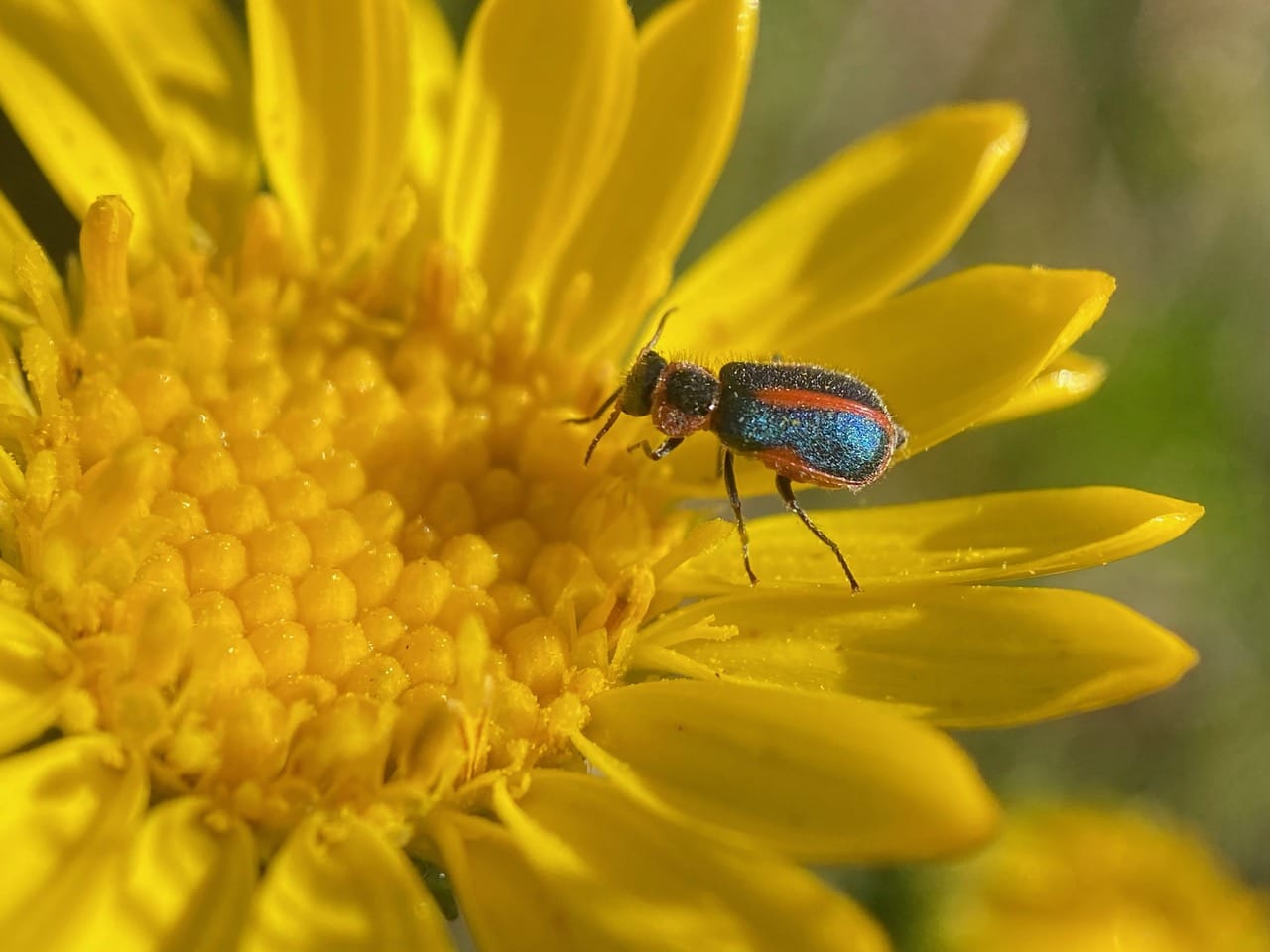
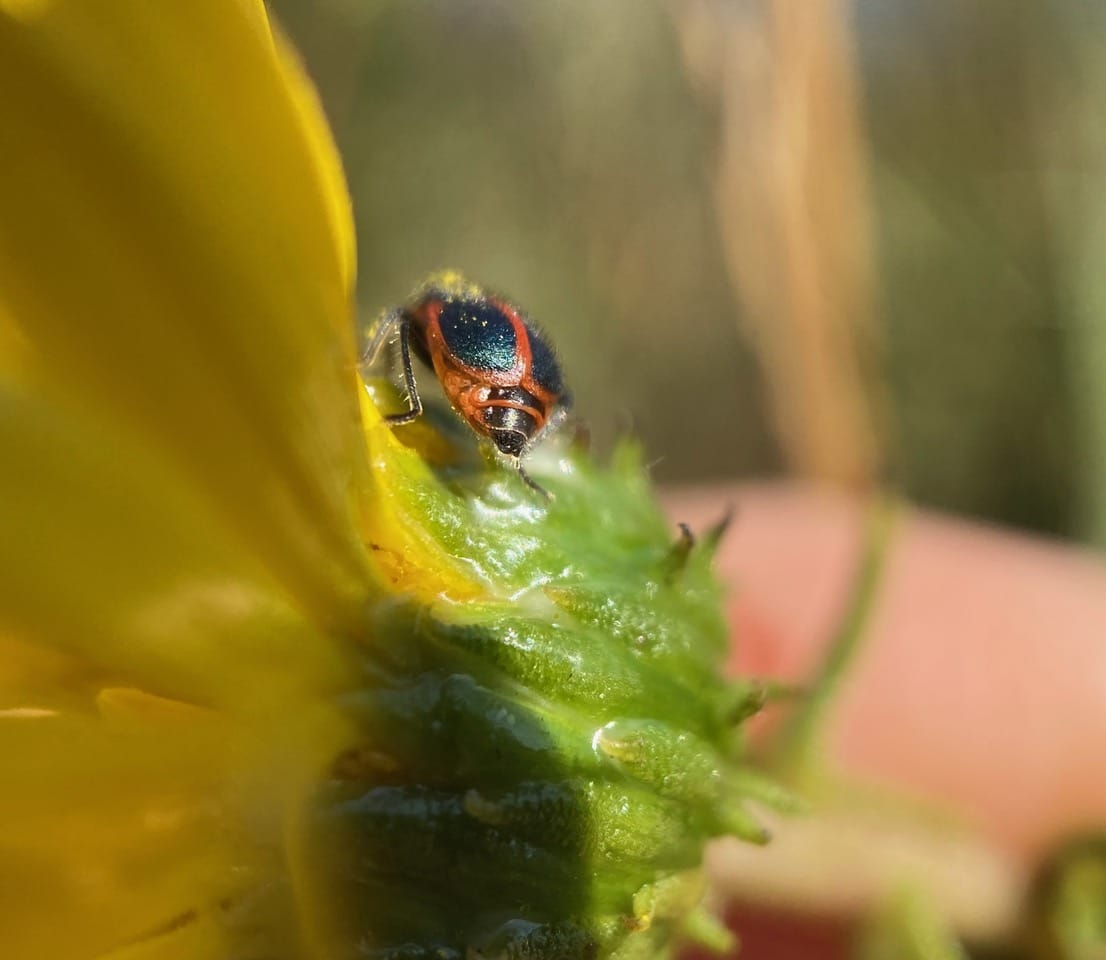
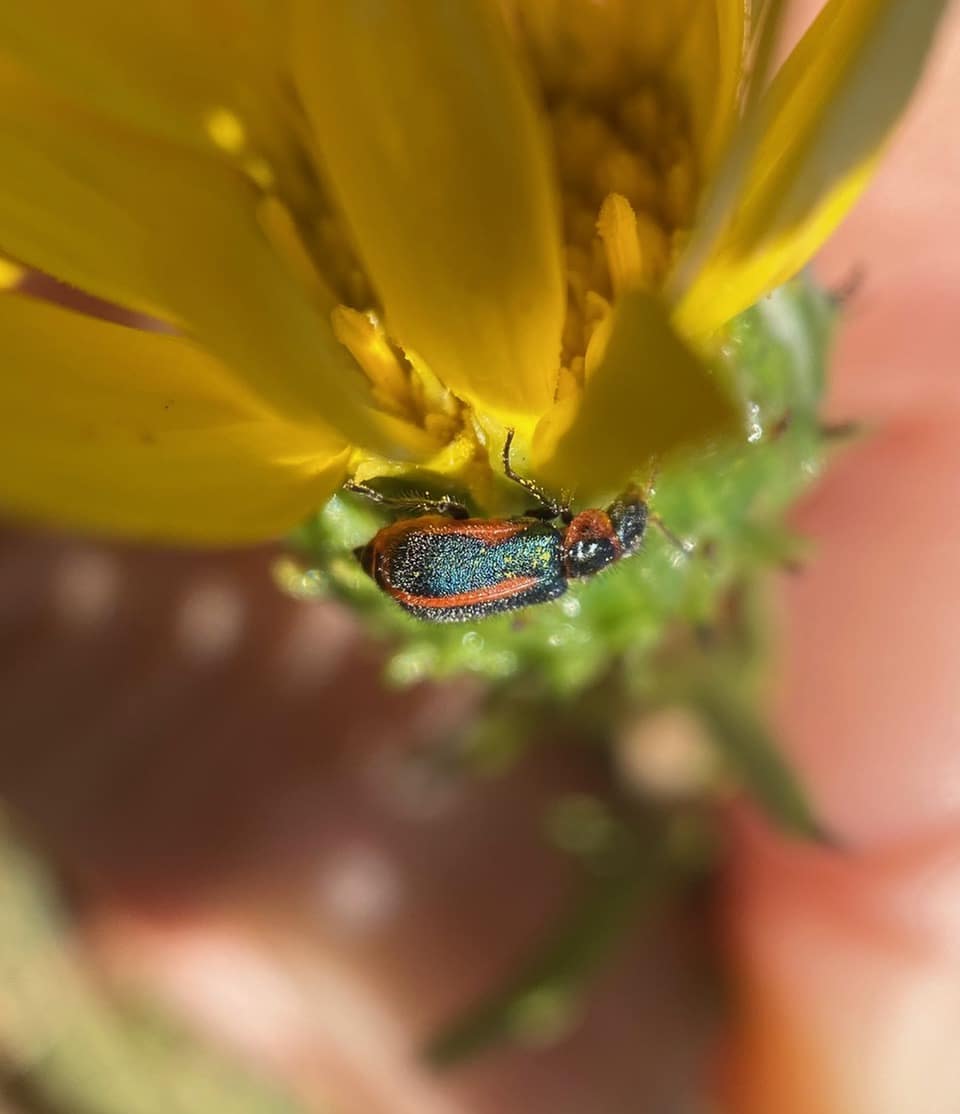
A Soft-winged Flower Beetle, Collops sp. (family Melyridae) provides colorful contrast on a fresh Grindelia flowerhead.
Members of the family Melyridae differ from most other beetles in that their bodies are not hard and shell-like. Collops are small beetles, 4-7 mm. They are important predators with a penchant for soft-bodied insects like whiteflies, small Lygus nymphs, aphids, mites, and lepidopteran eggs and caterpillars. Occasionally they graze on pollen and nectar resources too. Larvae are predaceous in the soil litter, but are rarely seen.
I get a glimpse of the beetle’s rear end as it runs away under the ray petals of the flowerhead.
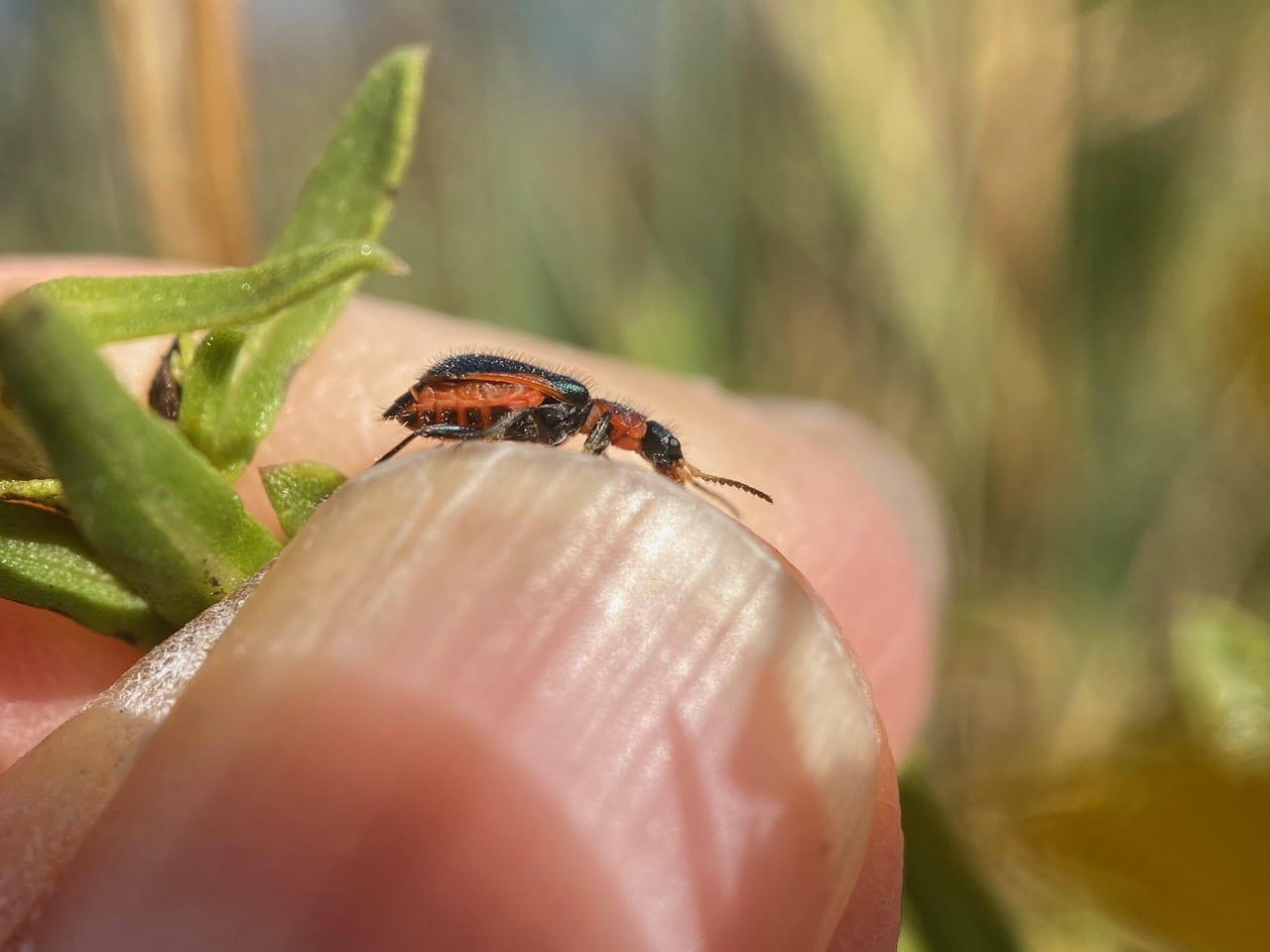
The beetle calmly climbs onto my finger while I grip the stem beneath the flowerhead. It is clearly a female.
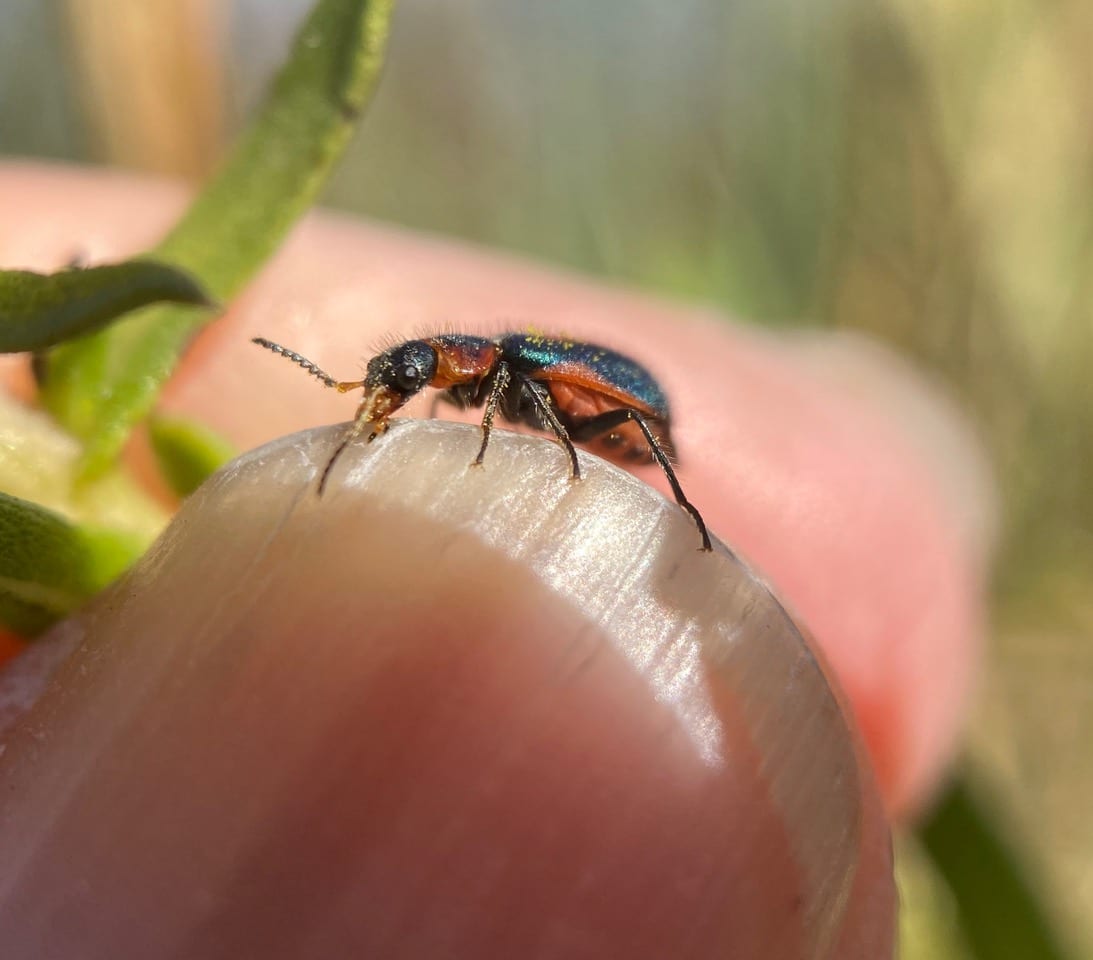
Male and female Collops can be distinguished by clearly visible knobby structures present on the base of the male’s antennae. We obviously have a female here. The function of the enlarged basal antenomeres are not clearly understood. But here’s a description by an observer:
“I have watched a male approach a female and present his vibrating antennae for her inspection, touching them to her antennae and sweeping the knobs across her head and pronotum. It looked as if he was maybe releasing pheromones towards the chemoreceptors on her antennae…. which would make her receptive to his advances.”
Here’s a good view of the female Collops’ antennae. The beetle is on the edge of my thumb nail. She lacks the knobby structure near the base of the antennae that are conspicuous in the males.