

Pollinator Post 10/7/26

At the tail end of a week-long heat wave, the gentle breezes off the water at Bay Farm feel heavenly. The Oregon Gumweed, Grindelia stricta is winding down its bloom season. As there’s much less insect activity these days, I think I can leave my camera in my pocket today.
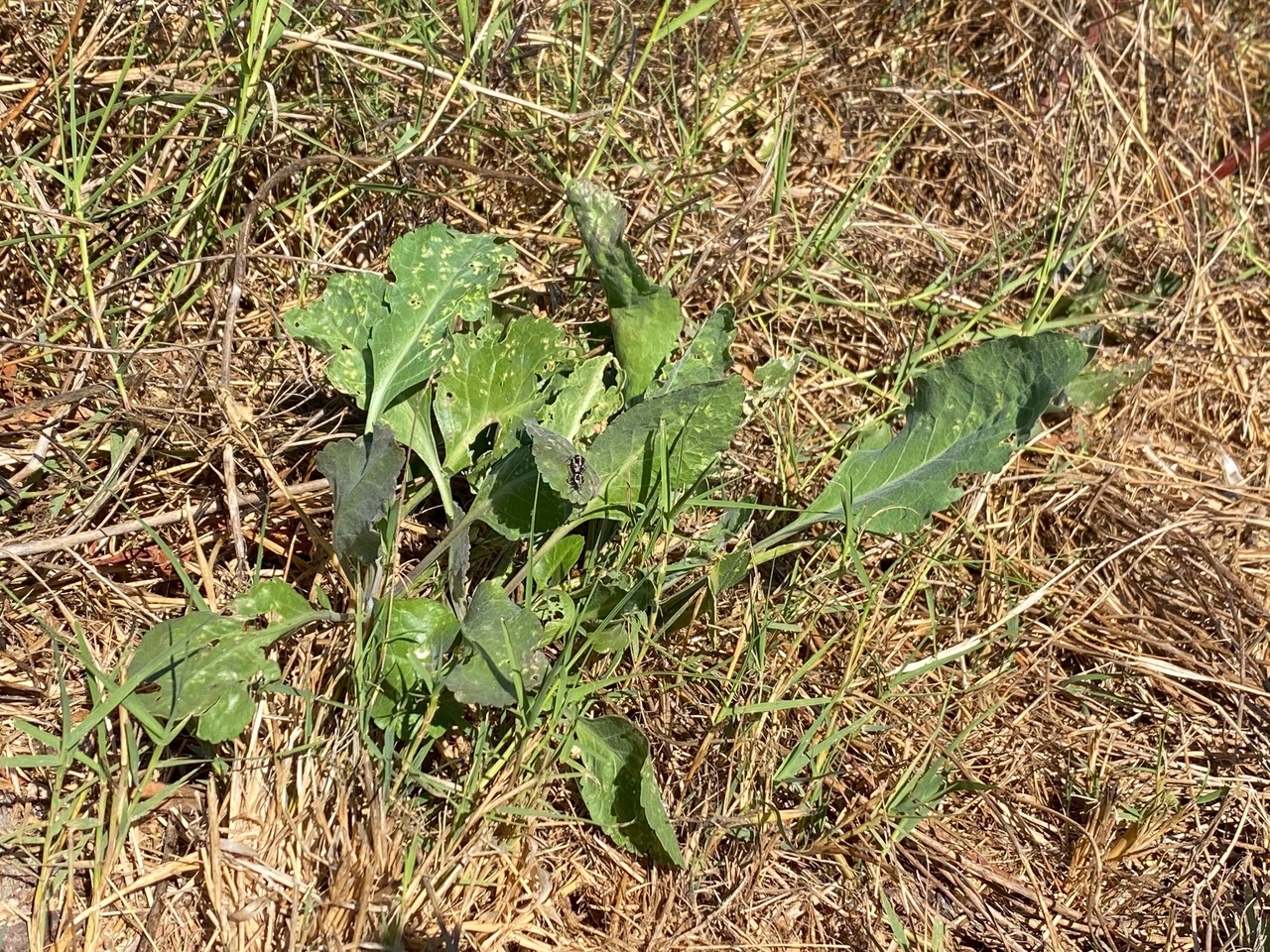
Wait, I see a mating pair of Stink Bugs on a basal leaf of Broadleaf Pepperweed, Lepidium latifolium (family Brassicaceae).

iNaturalist has helped identify the Stink Bugs as Bagrada Bugs, Bagrada hilaris (family Pentatomidae). The larger one in the back is the female.
Pentatomidae is a family of insects belonging to the order Hemiptera or “true bugs”. As hemipterans, the pentatomids have piercing-sucking mouthparts, and most are phytophagous, including several species that are severe pests on agricultural crops. Stink Bugs feed on plant fluids by inserting their needlelike mouthparts into stems, leaves or seed pods. While feeding, they inject materials into the plant to aid in digestion and sap removal. Penetration by the mouthparts can cause physical damage, much like stabbing the plant with a fine needle.
All Pentatomids have 5-segmented antennae (hence their family name, Penta – five and tomos – section.) They generally have a large triangular scutellum in the center of the back. The adult is generally shield-shaped when viewed from above. The common name of Stink Bug refers to their ability to release a pungent defensive spray when threatened, disturbed, or crushed.

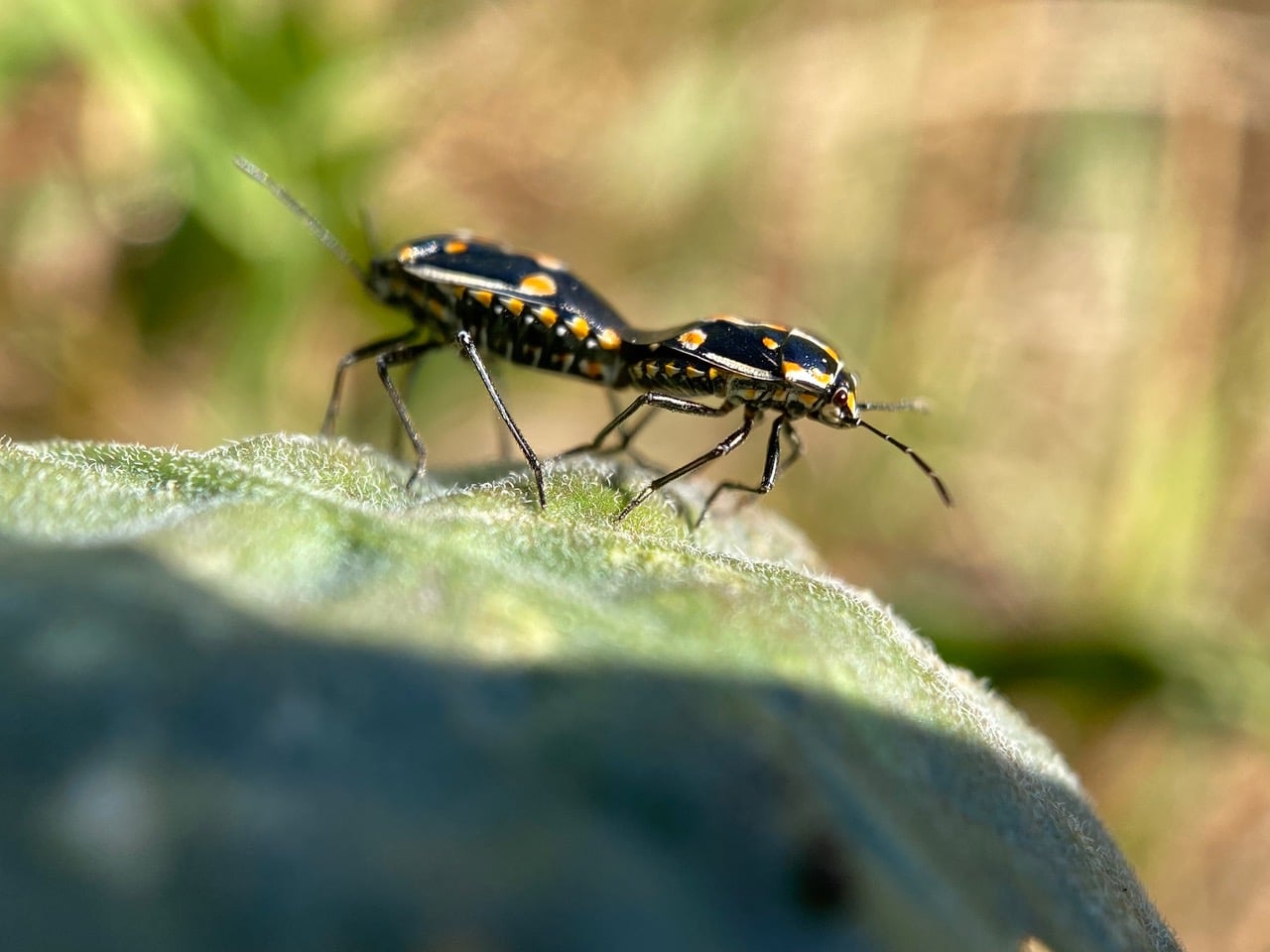
Bagrada hilaris is a species of stink bug known by the common name Bagrada Bug. Native to southeastern Africa, it was first reported in southern California in 2008. The Bagrada Bug’s main hosts are plants in the mustard family, Brassicaceae. It is a major pest insect of Brassica oleracea crops (including cabbage, kale, cauliflower, Brussels sprouts, and broccoli), and related crucifers such as turnips, rape, and mustard. Both adults and nymphs suck sap from the leaves of the plants, causing wilting, yellowing, and stunted growth. When large numbers of the bug congregate on the plants they can cause extensive damage.
The adult bug is 5-7 mm in length, shield-shaped, and black with white and orange markings. The female, which is larger than the male, lays up to 100 oval or barrel-shaped eggs on leaves or in soil beneath plants. The nymphs passes through five instars, transitioning from orange-red to black. In Southern California, there are multiple generations each year and populations generally peak late in summer and fall.
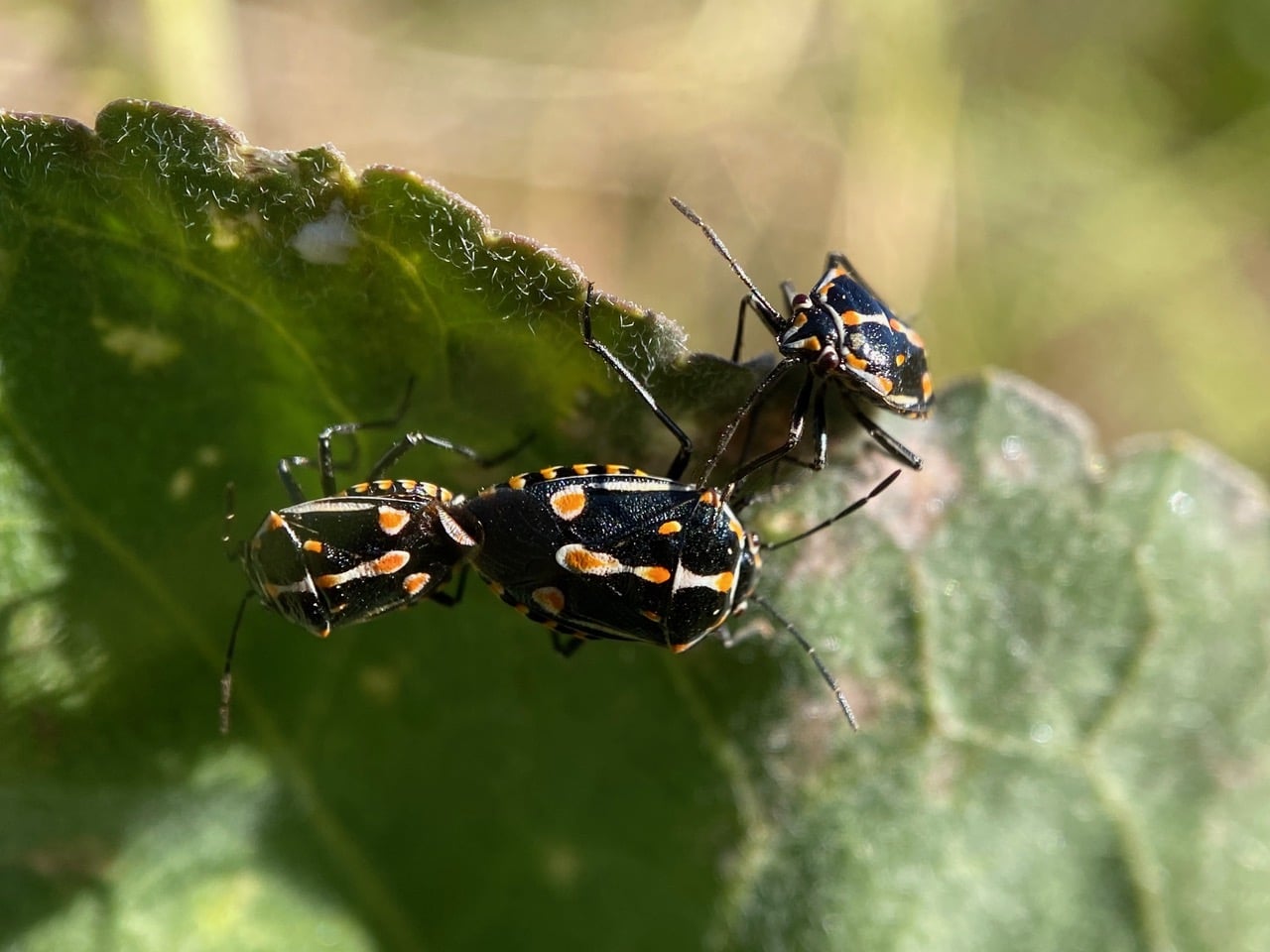
A male Bagrada Bug approaches a mating pair, and touches the female with his antenna.

The interloper mounts the female while her mate hangs on tenaciously. The new comer finally gives up and leaves. Ah, love triangle in the bug world!
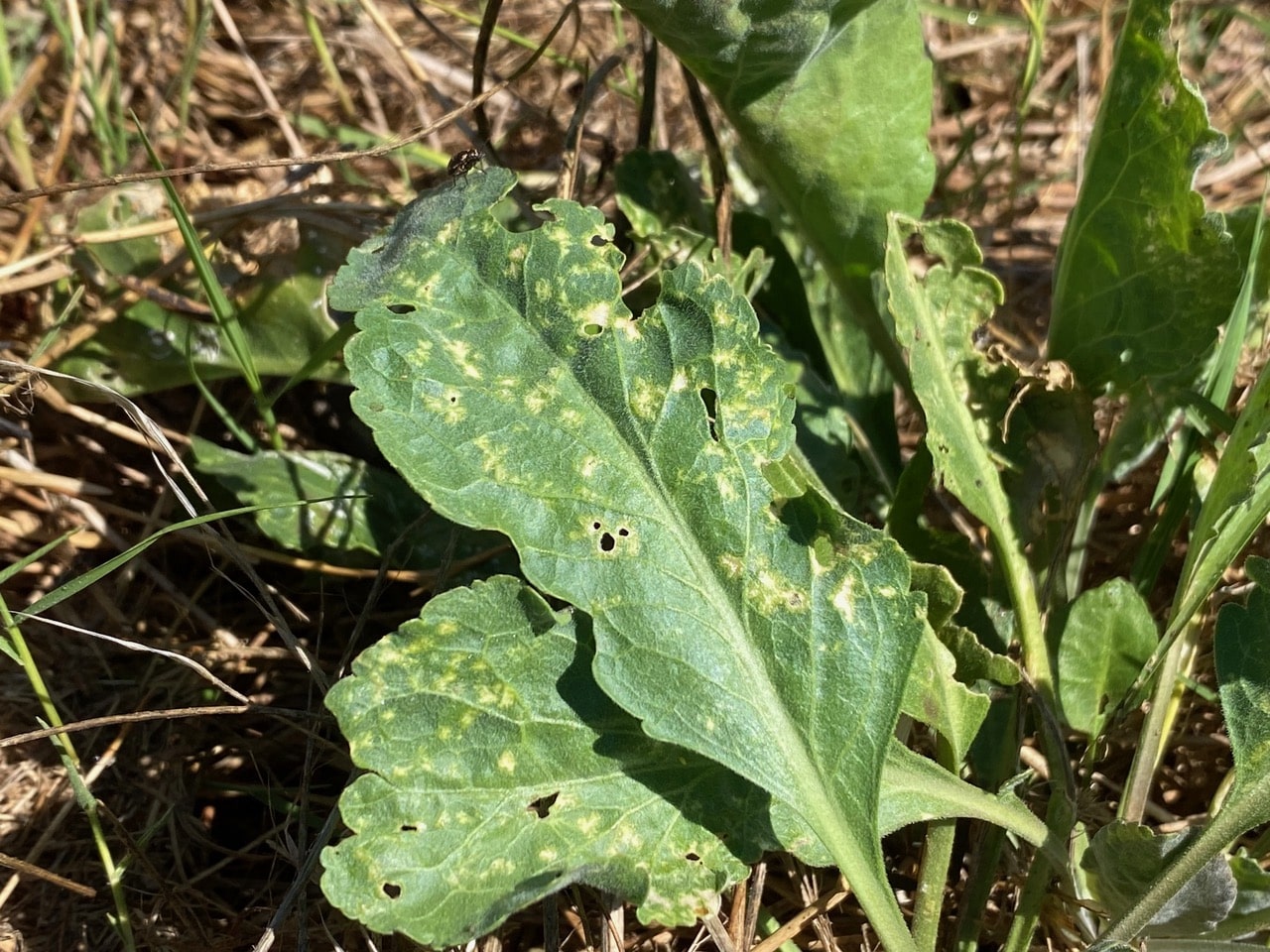
I check the condition of the Broadleaf Pepperweed when all the Bagrada Bugs have disappeared behind the leaves. The foliage is limp, and yellow stipplings are left by the piercing-sucking mouthparts of the stink bugs
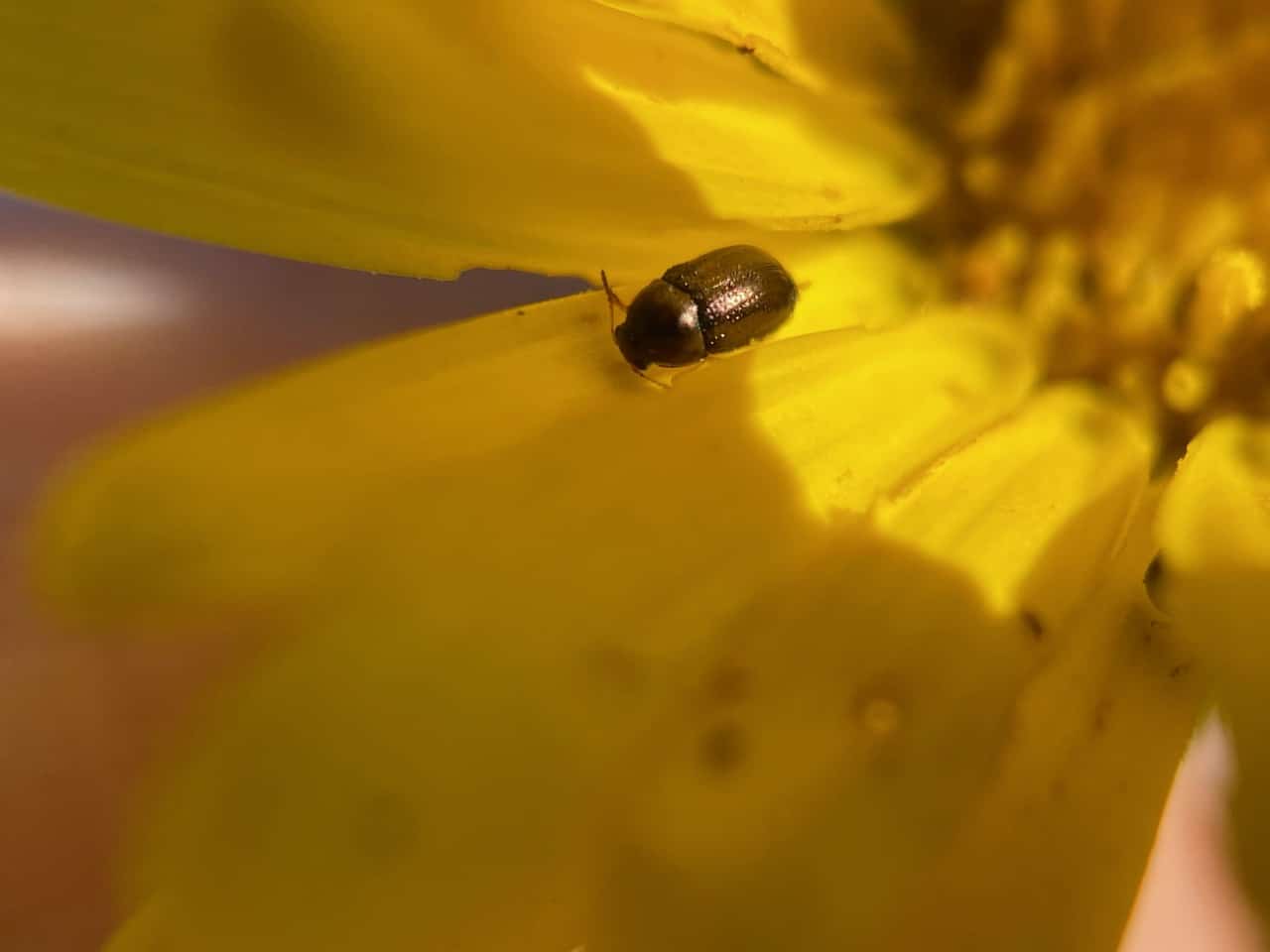
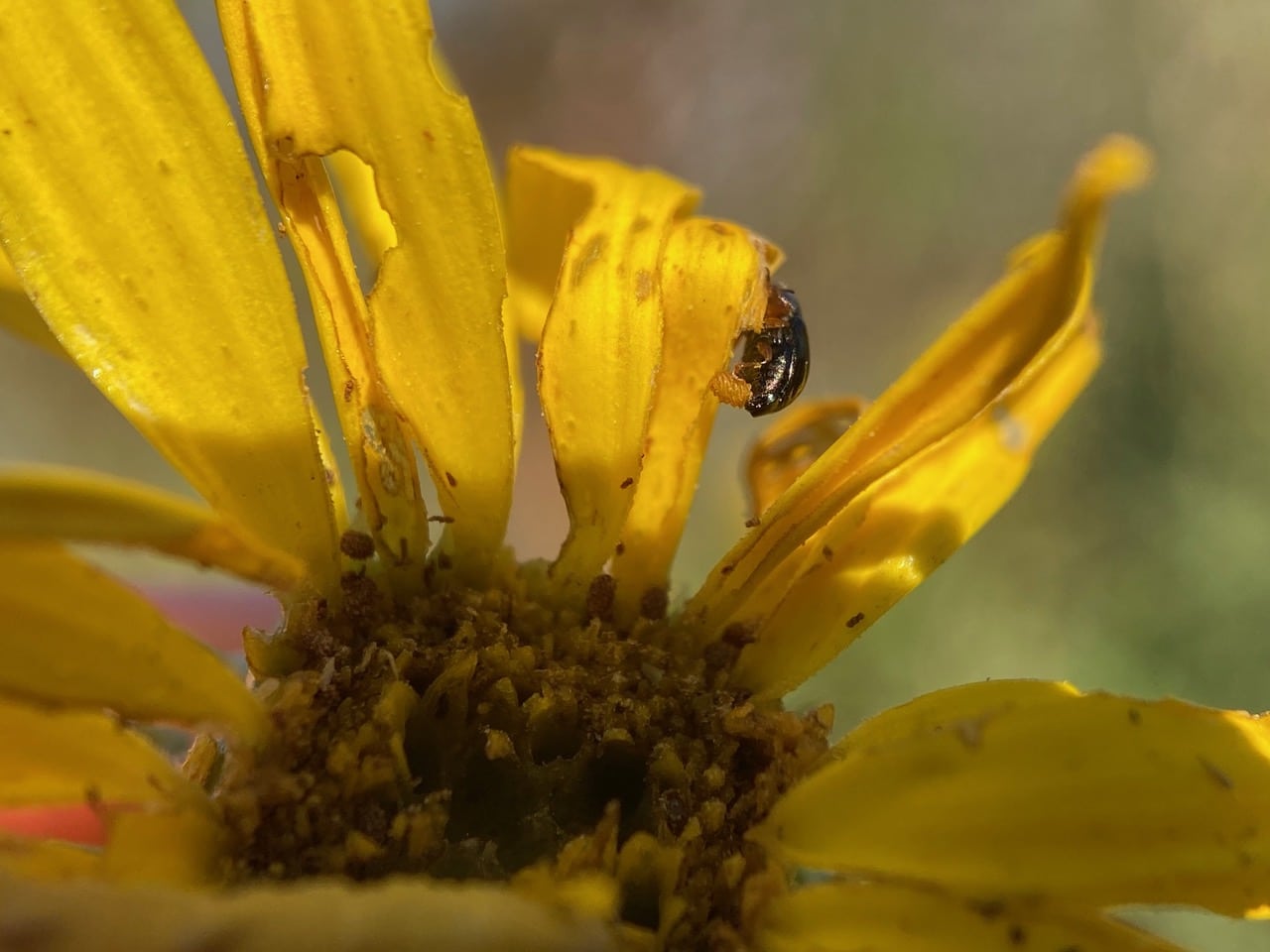
A Bronze Leaf Beetle, Diachus auratus (family Chrysomelidae) is resting on a Grindelia ray petal.
The Bronze Leaf Beetle, Diachus auratus (family Chrysomelidae) is a small, shiny, “bullet-shaped” beetle that feeds on the leaves, flowers, and fruits of plants, particularly berry crops such as strawberries, raspberies, and blackberries. It is a species of case-bearing leaf beetle in the subfamily Cryptocephalina, known for larvae that create cases out of feces and debris. The species is widespread in North America, as well as parts of Central and South America, Australia, and Asia. Adults, 1-2 mm, are found on many unrelated plants, especially plants in bloom. The larvae live underground and feed on the roots of plants, specifically grass and clover. As she lays her eggs, the female covers each one with a layer of excrement. After the larvae hatch, they retain this covering (case) as camouflage and add to it throughout their larval life. When disturbed, the larvae pull in their head and legs; because their color and shape resemble caterpillar droppings they are ignored by predators. Eventually the larva seals the case to pupate inside, before emerging as an adult. Some species are myrmecophiles, living near or even inside ant nests.

Ooh, here’s a Buttonhook Leafbeetle Jumping Spider, Sassacus vitis (family Salticidae).
Jumping spiders (family Salticidae) are free-roaming hunting spiders. They do not weave a web to catch prey. They stalk, then pounce on their prey. Just before jumping, the spider fastens a safety line to the substrate. It can leap 10-20 times their body length to capture prey. Their movement is achieved by rapid changes in hydraulic pressure of the blood. Muscular contractions force fluids into the hind legs, which cause them to extend extremely quickly. Jumping spiders are visual hunters. Their excellent vision has among the highest acuities in invertebrates. Since all their 8 eyes are fixed in place and cannot pivot independently from the body like human eyes can, jumping spiders must turn to face whatever they want to see well. This includes moving their cephalothorax up and down, an endearing behavior.

It is often difficult to tell whether a particular spider is an adult or an immature, judging by size alone. In the jumping spiders in the genus Sassacus, the adults are only about 3-5 mm. The genus name Sassacus was the last chief of the Pequot Indians, a Native American tribe of the Connecticut Valley that was vanquished in a war with English settlers in 1637. The iridescent color and very compact appearance of these spiders leads scientists to suspect that they are mimics of certain leaf beetles in the family Chrysomelidae. Many Chrysomelids don’t taste good, as they feed on poisonous plants and sequester those plant toxins for their own defense. They advertise their distastefulness to predators with bold black and white, yellow, orange, or red color patterns, or with brilliant metallic colors. One of the defining characteristics of the genus is the very short legs. The fourth pair of legs is still the thickest, with one or two pairs of spines, used in tackling prey. Like most jumping spiders, Sassacus engages in visual courtship displays. The twitching abdomen also produces an auditory stimulus as the male waves his front legs to garner the female’s attention.
Sassacus vitis is native to North America, with a range spanning from Canada to Panama. It is a small jumping spider with iridescent gold abdomen and white ring around the anterior surface of abdomen. Body is covered with golden scales. Males are 3.5 mm long, females 4.5 mm. The name vitis is Latin for “grapevine”. The spider is commonly found on shrubs and vines and in fields. Best known as a common resident of vineyards.
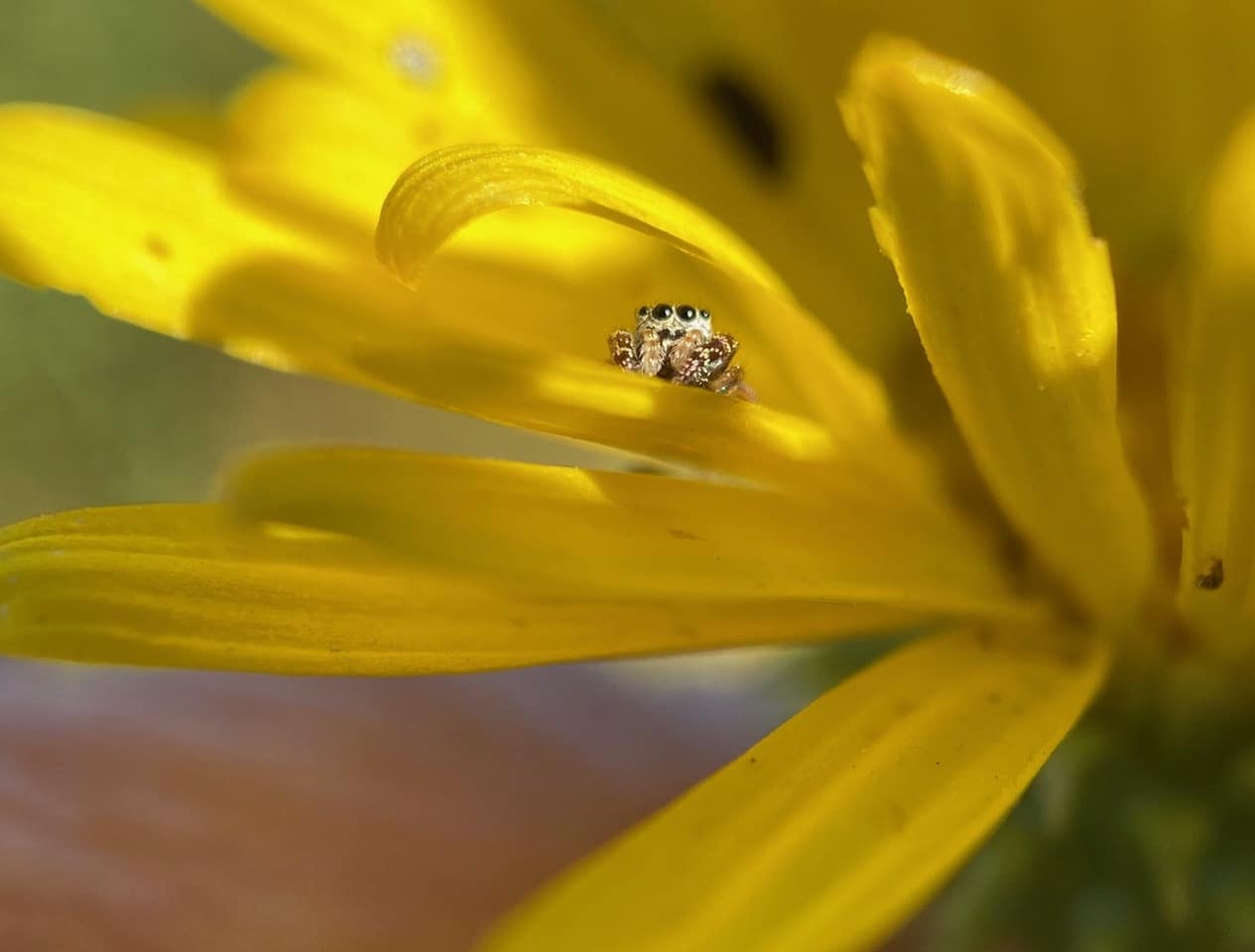
Jumping spiders have excellent vision, with among the highest acuities in invertebrates. The 8 eyes are grouped four on the face (the two big Anterior Median Eyes in the middle, and two smaller Anterior Lateral eyes to the side), and four on top of the carapace. The anterior median eyes provide high acuity but small field of view, while the other six eyes act like our peripheral vision, with lower resolution but broad field of view. Since all eight eyes are fixed in place and can’t pivot independently from the body like human eyes can, jumping spiders must turn to face whatever they want to see well. This includes moving their cephalothorax up and down, an endearing behavior.


Here’s a Buttonhook Leafbeetle Jumping Spider, Sassacus vitis and a Bronze Leaf Beetle, Diachus auratus (family Chrysomelidae) on the same Grindelia flowerhead.
I finally appreciate the strange common name of the spider. There is a fascinating evolutionary connection between the spider and the beetle. The jumping spider has a compact body and a striking, iridescent bronzy-gold sheen. Scientist strongly suspect that Sassacus vitis is a Batesian mimic of leaf beetles (family Chrysomelidae), especially the bronze-colored variants.
Many leaf beetles store toxins from the plants they eat, making them taste terrible to predators like birds. They advertise this defense with metallic or bright warning colors. By mimicking the beetle’s shape and metallic bronze luster, the harmless spider tricks predators into leaving it alone. Both the beetles and Sassacus vitis are commonly found on the exact same vegetation. Sassacus vitis is a diurnal hunter frequently spotted basking on sunny leaves, shrubs, and vines, which is precisely where leaf beetles gather to feed.
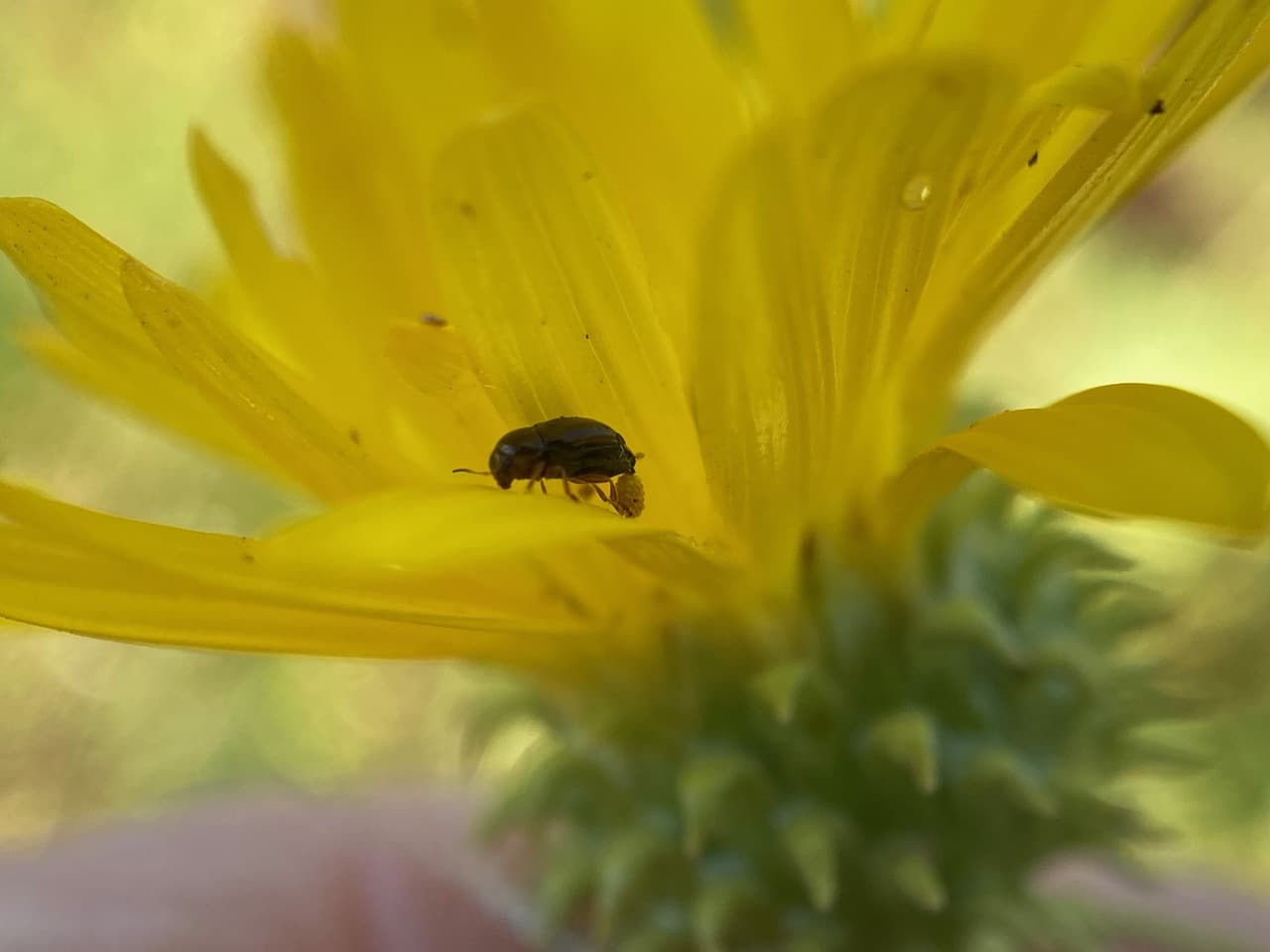
On a Grindelia flowerhead in the shade, a Bronze Leaf Beetle is hunched in this position for a long time, while a large lump hangs from the tip of her abdomen. Wow, is she laying an egg and coating it with her feces? I have known about this behavior for a while, but never in my wildest dream thought I would get to witness the process!

Carefully, I twist the flowerhead toward the sun for a better view of the ovipositing beetle. Focused on her task, she does not flinch.
Female Bronze Leaf Beetles (and related case-bearing leaf beetles) cover their eggs in a layer of waste, or frass, to protect them from predators and pass down essential gut microbes. The hardened fecal casing makes the eggs look like tiny caterpillar droppings or debris, which helps trick and repel hungry predators. The waste coating often contains a “fecal string” that newly hatched larvae eat, allowing the baby beetles to inherit vital gut bacteria from their mother. This is a rather unusual insect parenting strategy. Once the larva hatches, it chews an opening in the case, sticks out its head and legs, and carries the structure on its back as a mobile armored shell, enlarging it with its own waste as it grows.
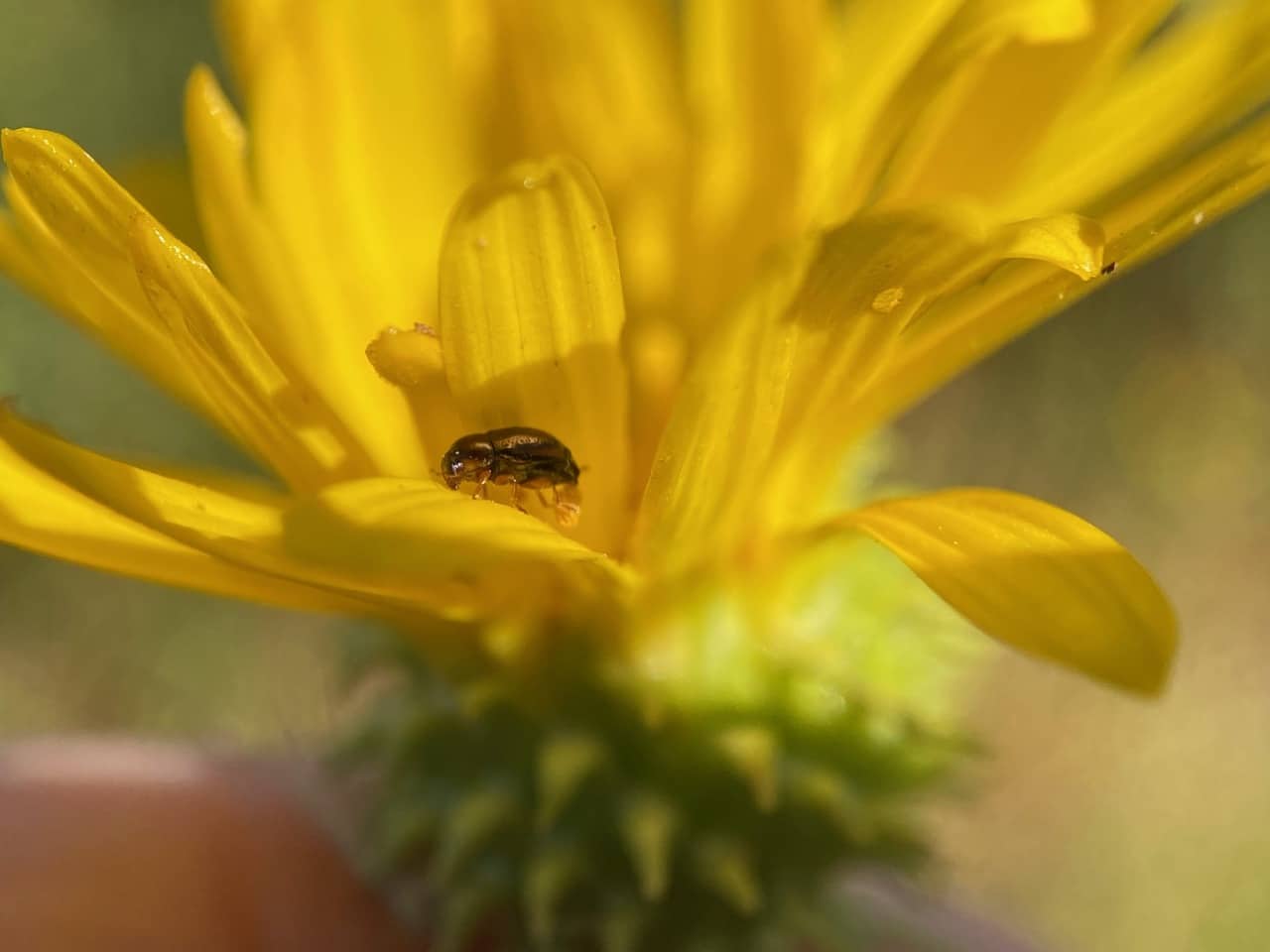
Mama beetle is laying an egg and coating it with frass spirals by rotating it with her hind legs.
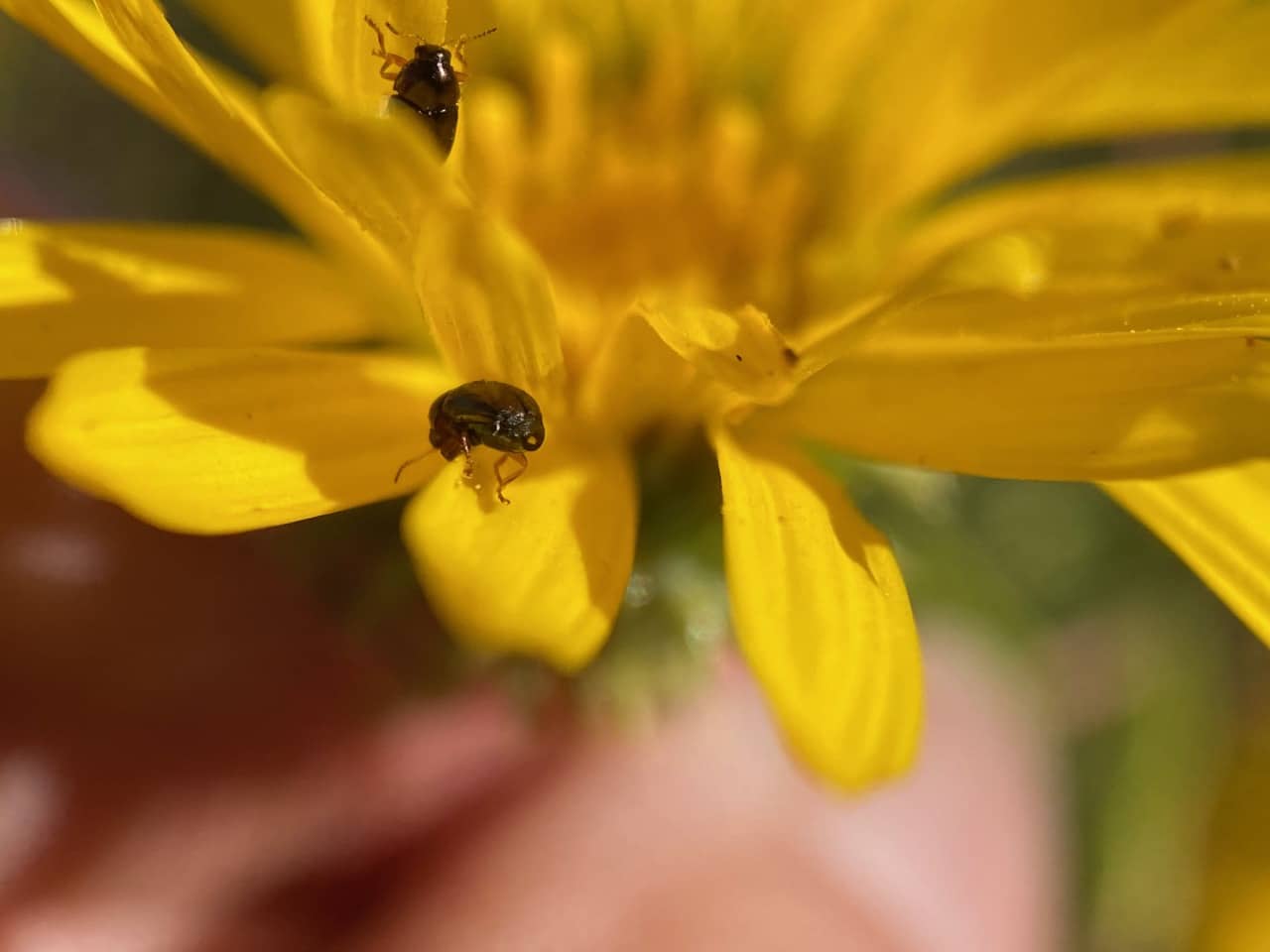
There is another Bronze Leaf Beetle hanging around close to the female on the same flowerhead. I have never seen so many Bronze Leaf Beetles in one day!
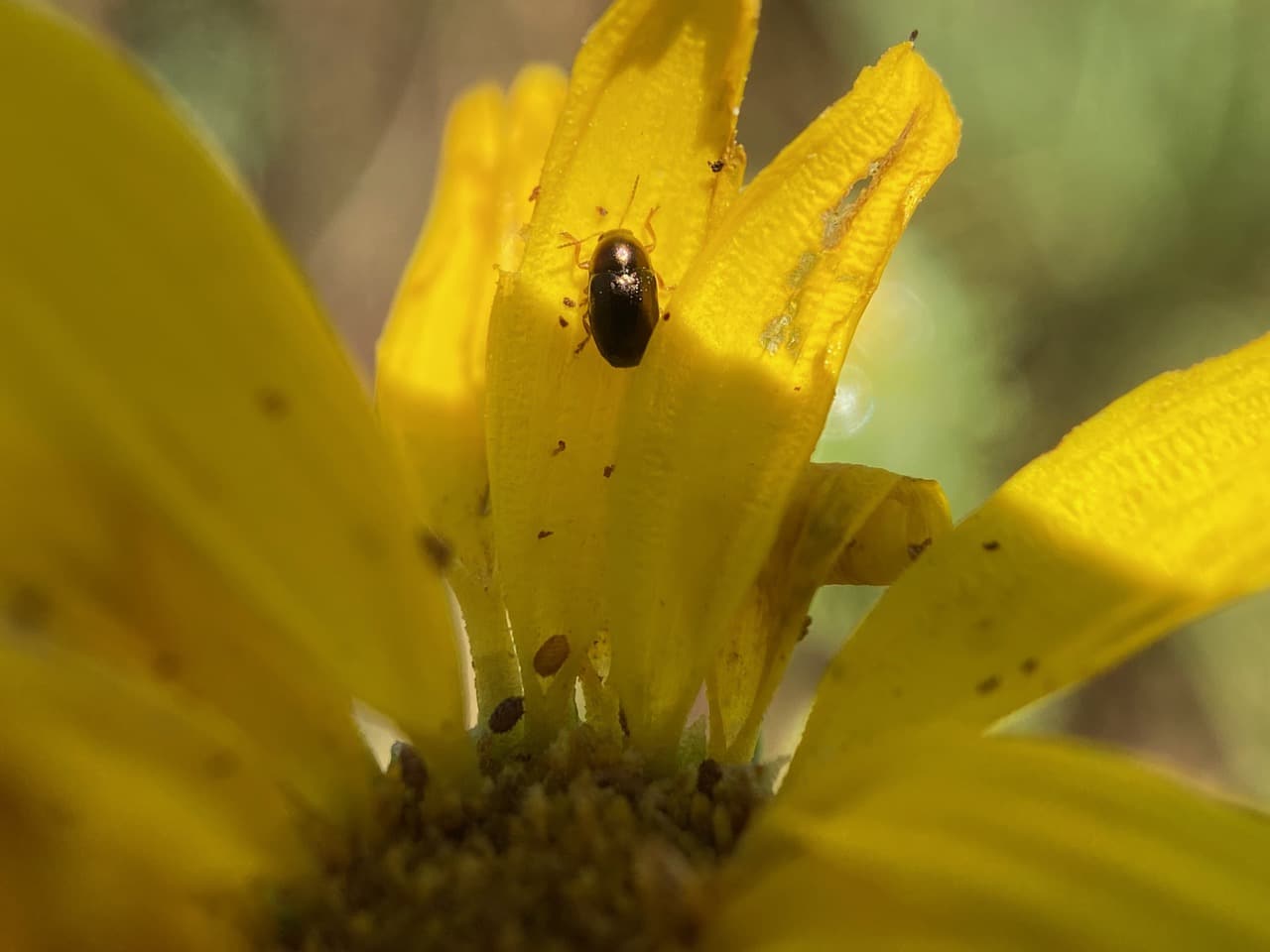
On yet another Grindelia flowerhead, a Bronze Leaf Beetle is perched on a ray petal surrounded by scattered bits of frass. At the base of the ray petals are large cylindrical masses that look like encased beetle eggs.
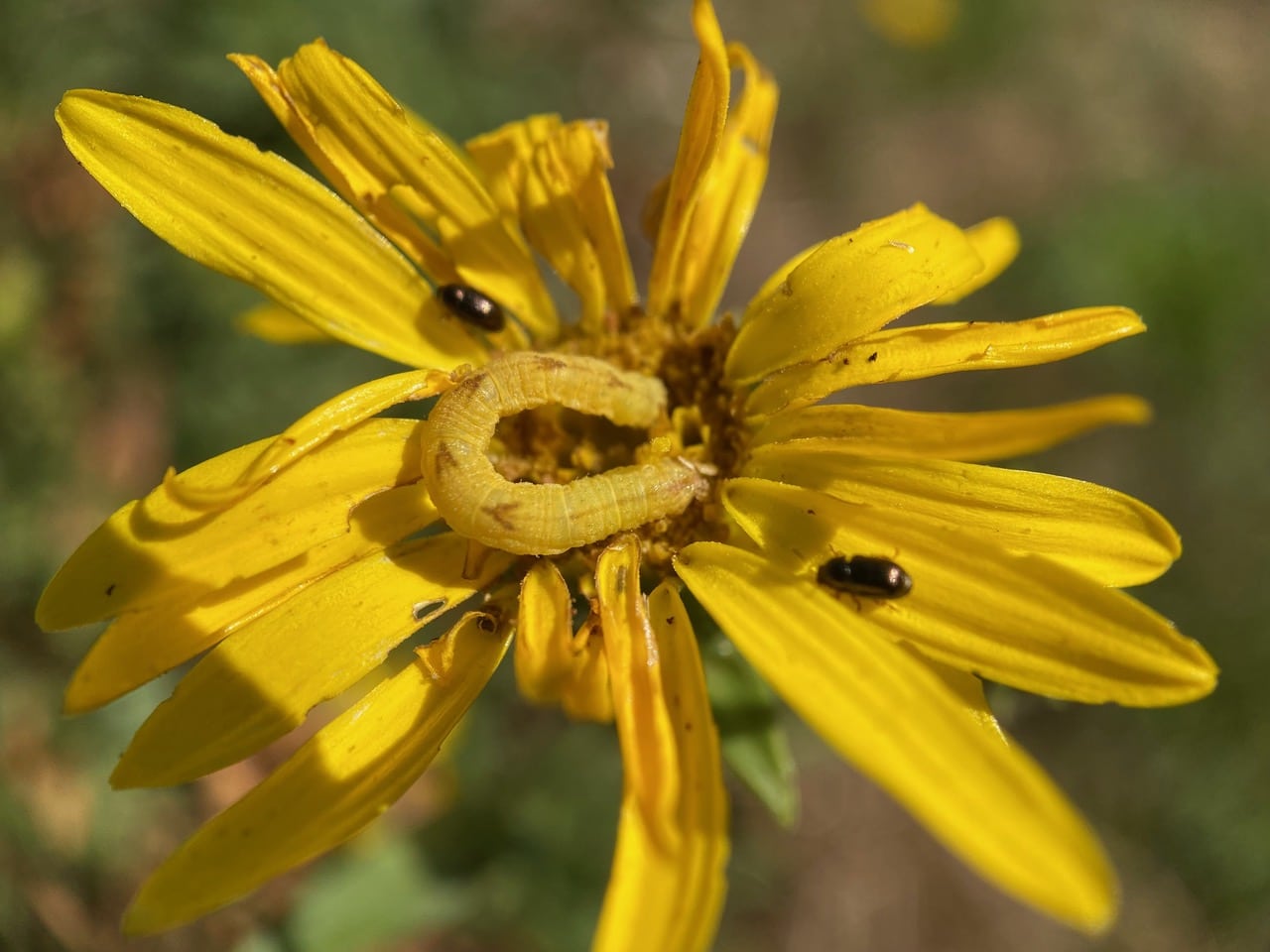
I spot the two Bronze Leaf Beetles on this flowerhead before I see the much larger but well-camouflaged inchworm caterpillar of Pug Moth, Eupithecia sp. (family Geometrididae).
Inchworms are also called loopers and measuring worms. The majority of the inchworms are the larvae of moths in the family Geometridae. The name comes from the Greek “geo” for earth and “metro” from measure, because the caterpillars seem to be measuring the surface on which they are walking. The “looping” locomotion is mandated by the absence of prolegs in the middle section of the caterpillar’s body.
Eupithecia is the largest genus of moths of the family Geometridae. Occurring worldwide except for Australasia, species in the genus are commonly known as pugs. The caterpillars move in a looping manner and are commonly called inchworms. Adults are typically small, 12 – 35 mm, with muted colors. Most species rest with forewings held flat at right angles to the body, while the hindwing are largely covered by the forewings. They are generally nocturnal. Larvae mostly feed from the flowers and seeds of their food plants rather than the foliage. Many species have a very specific food plant. Many are commonly found on Asteraceae flowers.
Many species of Pug Moth caterpillars are specialized flower feeders and will actually absorb the pigments from the flowers and pollen they eat. Because of this dietary habit, their bodies take on the exact hues of their host plants to camouflage themselves from predators.
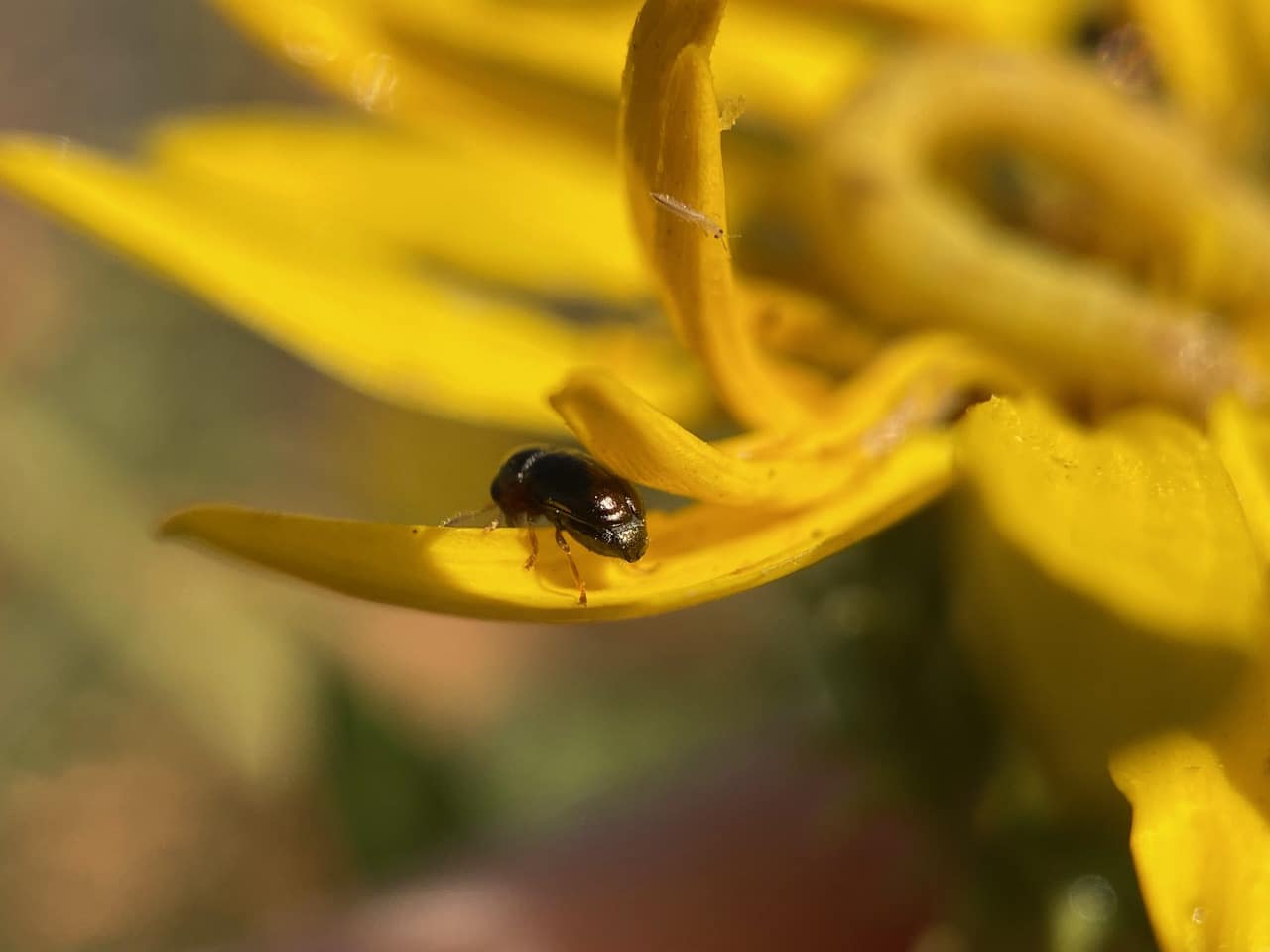
I check every beetle to see if it is laying egg. This one’s not.

Ooh, that one might be laying an egg and coating it with her frass.

A Bronze Leaf Beetle climbs on the head of the Pug Moth caterpillar, causing it to stretch out straight. The frass-coated eggs of the beetle are thought to mimic the caterpillar’s poop. So it makes sense that the two live on the same flowerhead, both feeding on flower parts.
Wow, it suddenly dawns on me that there’s actually a three-fold co-evolutionary tale here – the beetle, the spider and the caterpillar, all co-existing in seamless relationship with one another on the same flowerhead, and each taking advantage of some form of mimicry! The caterpillar camouflages itself with the pigments of the flowers it eats to avoid being detected by predators. The Bronze Leaf Beetles coat their eggs with poop to resemble caterpillar frass. The tiny Buttonhook Leafbeetle Jumping Spider has evolved to resemble the Leaf Beetles in their bronzy sheen, to avoid being eaten by predators that avoid the beetles for their unpleasant taste. Nature in her perfect orchestration!

Are these two Bronze Leaf Beetles mating on the flowerhead next to the Pug Moth caterpillar?

Actually there are three Bronze Leaf Beetles on the Grindelia flowerhead with the Pug Moth caterpillar. A very crowded place indeed! Maybe the beetles have sought out the company of the caterpillar so that the eggs they lay will be mistaken for caterpillar poop and left alone?
Finally, on another flowerhead, I find the light conditions and the orientation of the beetle I have been hoping for! The frass-coated egg is clearly seen at the tip of the beetle’s abdomen. Note similar looking clumps at the base of the ray petals. It is a big day for the Bronze Leaf Beetles!
And I thought I wouldn’t be using my camera today!