

Pollinator Post 10/6/23
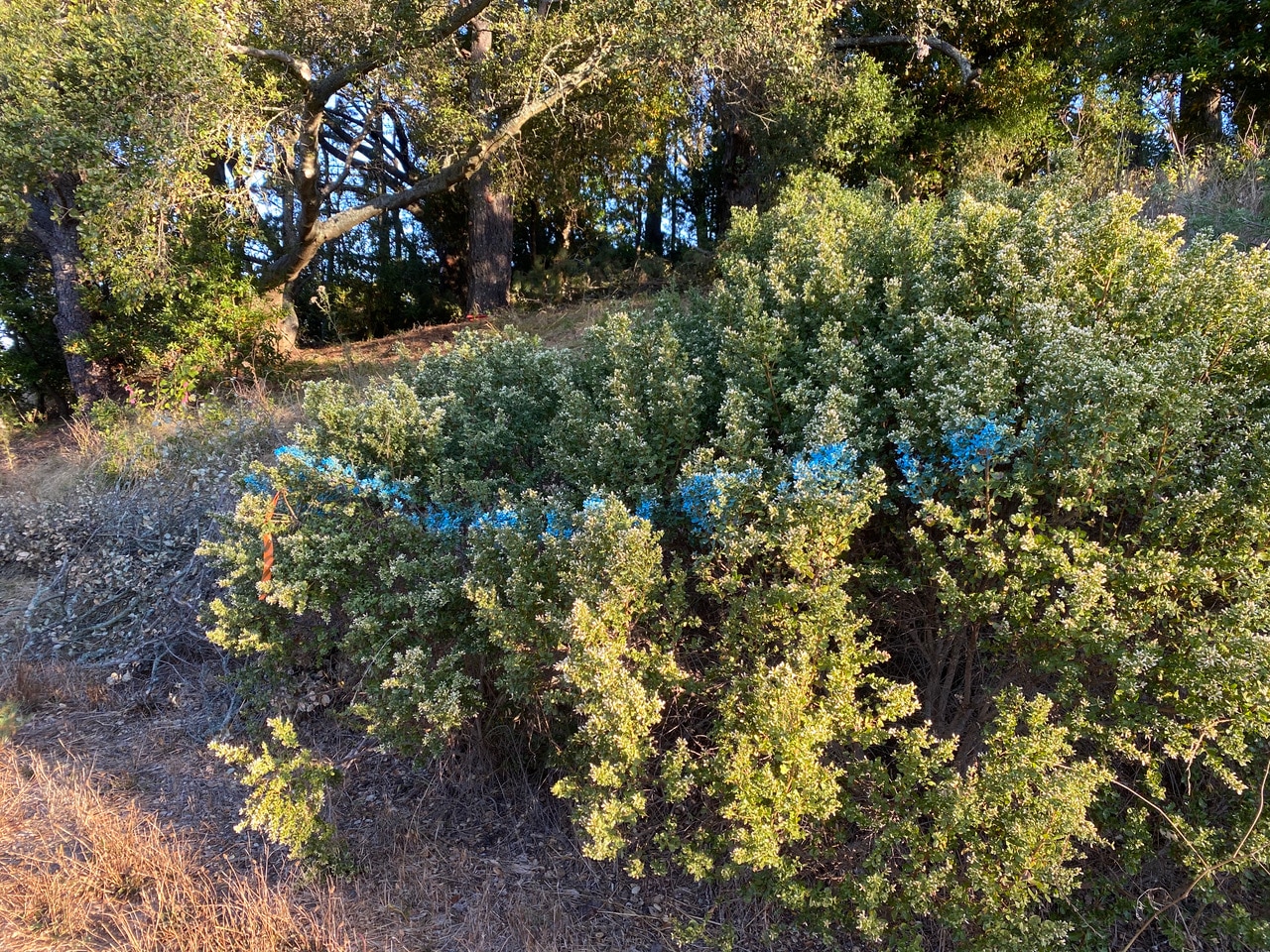
I love the open vistas at Inspiration Point in the Berkeley hills, but invariably my attention is drawn to the human impacts on the landscape. Why has this large Coyote Brush, Baccharis pilularis next to the trail been sprayed with bright blue paint? Has it been marked to be removed or to be spared from brush clearing?


 There’s a nice little patch of lupine on the side of the trail that is still in bloom! It must be Summer Lupine, Lupinus formosus. Wouldn’t this be a great plant for the home garden for supporting pollinators through the summer?

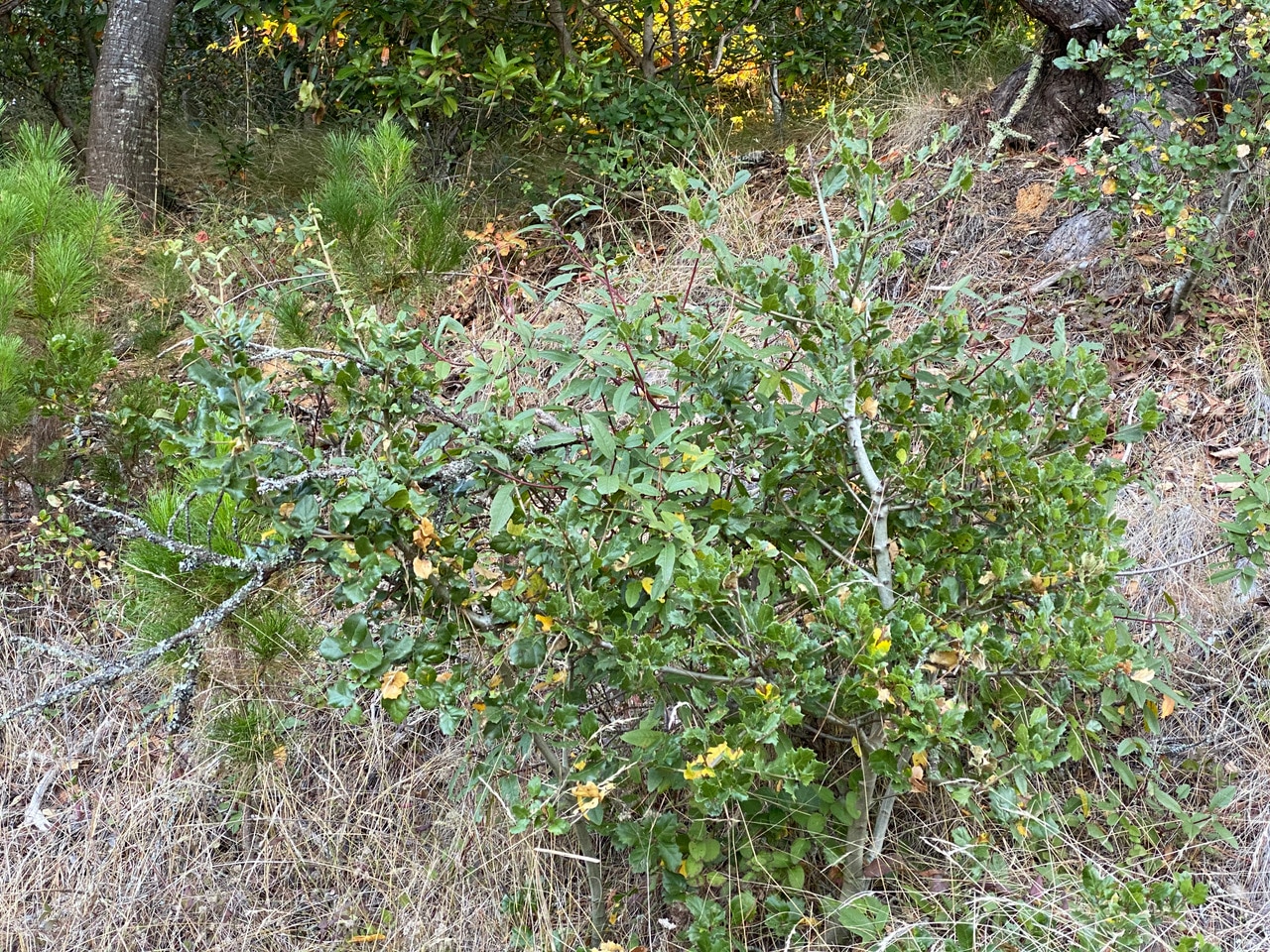
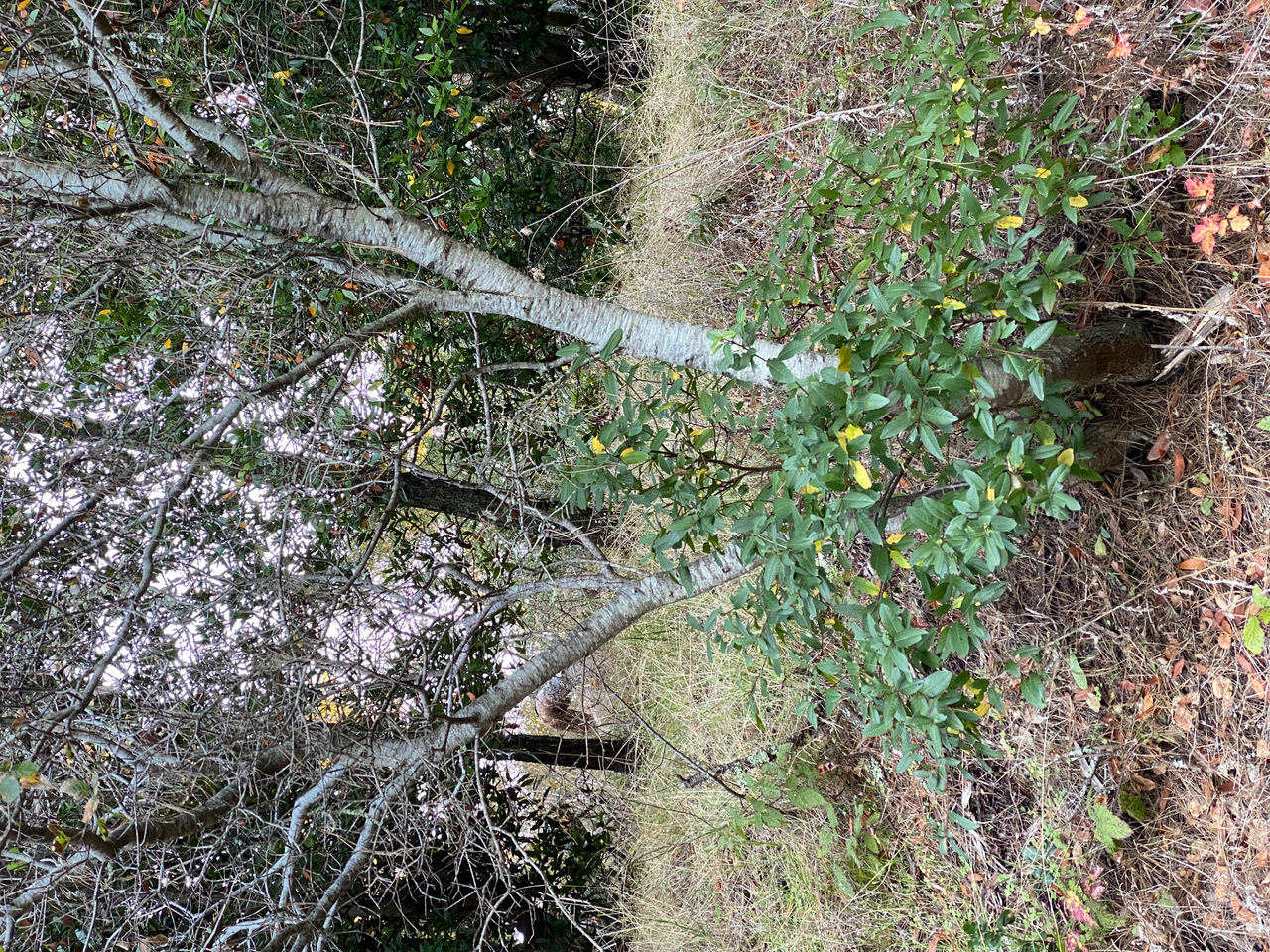
Barely three feet from the edge of the trail, I notice a small Coffeeberry growing in the embrace of a young oak tree. I did not see this the last time I was here.
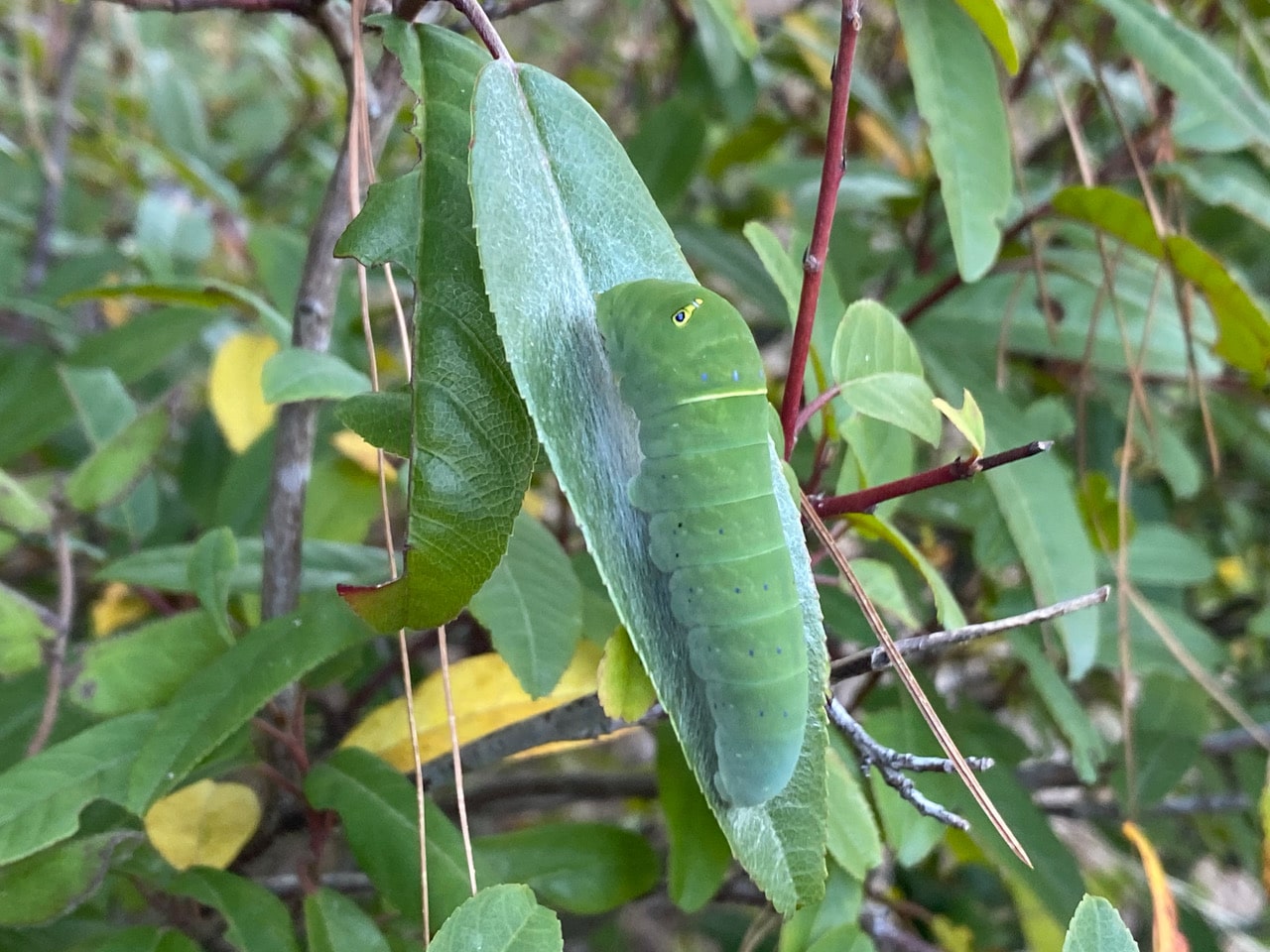
I step off the trail to take a look, and find a mature Pale Swallowtail caterpillar! Wow, this park sure has a healthy population of these butterflies!
Just a little further on, I come across this small Coffeeberry bush under the oak tree that I have photographed three days ago.
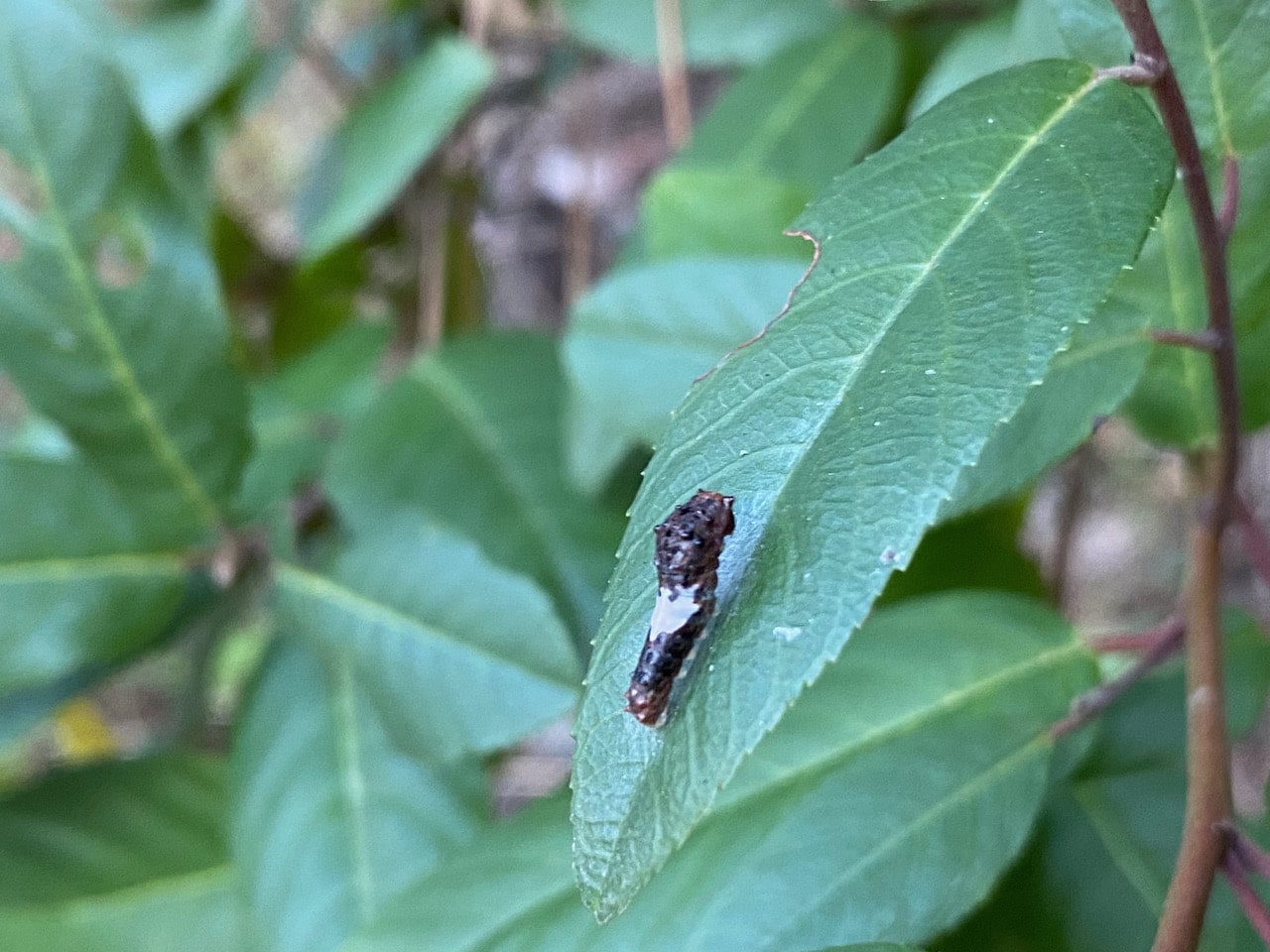
Then I spot something on a leaf that I didn’t see last time – a young Pale Swallowtail caterpillar still in its bird-poop mimicking instar! Wow, will it have enough time to develop before winter sets in? I observed Blue for six weeks from this stage to the time it disappeared to pupate. Assuming that development is fairly uniform across the species, this little caterpillar will need another 6 weeks to complete its larval development. The current warm trend in our weather bodes well for it.
A male Bluet has landed on an immature floral umbel of Fennel. Bluets are Narrow-winged Damselflies in the family Coenagrionidae (suborder Zygoptera, order Odonata).
Damselfly, (suborder Zygoptera) is a group of aerial predatory insects in the order Odonata, together with their cousins, the dragonflies (suborder Anisoptera). Damselflies are found mainly near shallow freshwater habitats and are graceful fliers with slender bodies and long, filmy, net-winged wings. Damselflies can usually be distinguished from dragonflies by their thinner abdomens and by the way they hold their wings when at rest – folded and held together above the body or against the body, rather than horizontally and spread apart. The large eyes of damselflies are always widely separated, rather than close together or touching each other.
The adults hunt in flight, mainly for small insects. Mating pairs usually fly in tandem. The female usually flies low over the water, depositing eggs directly on the surface or into aquatic vegetation. Nymphs are aquatic predators using their extendable jaws to snatch and draw in food. When ready, the nymphs crawl out of the water to a safe place to shed their skin and emerge as winged adults.
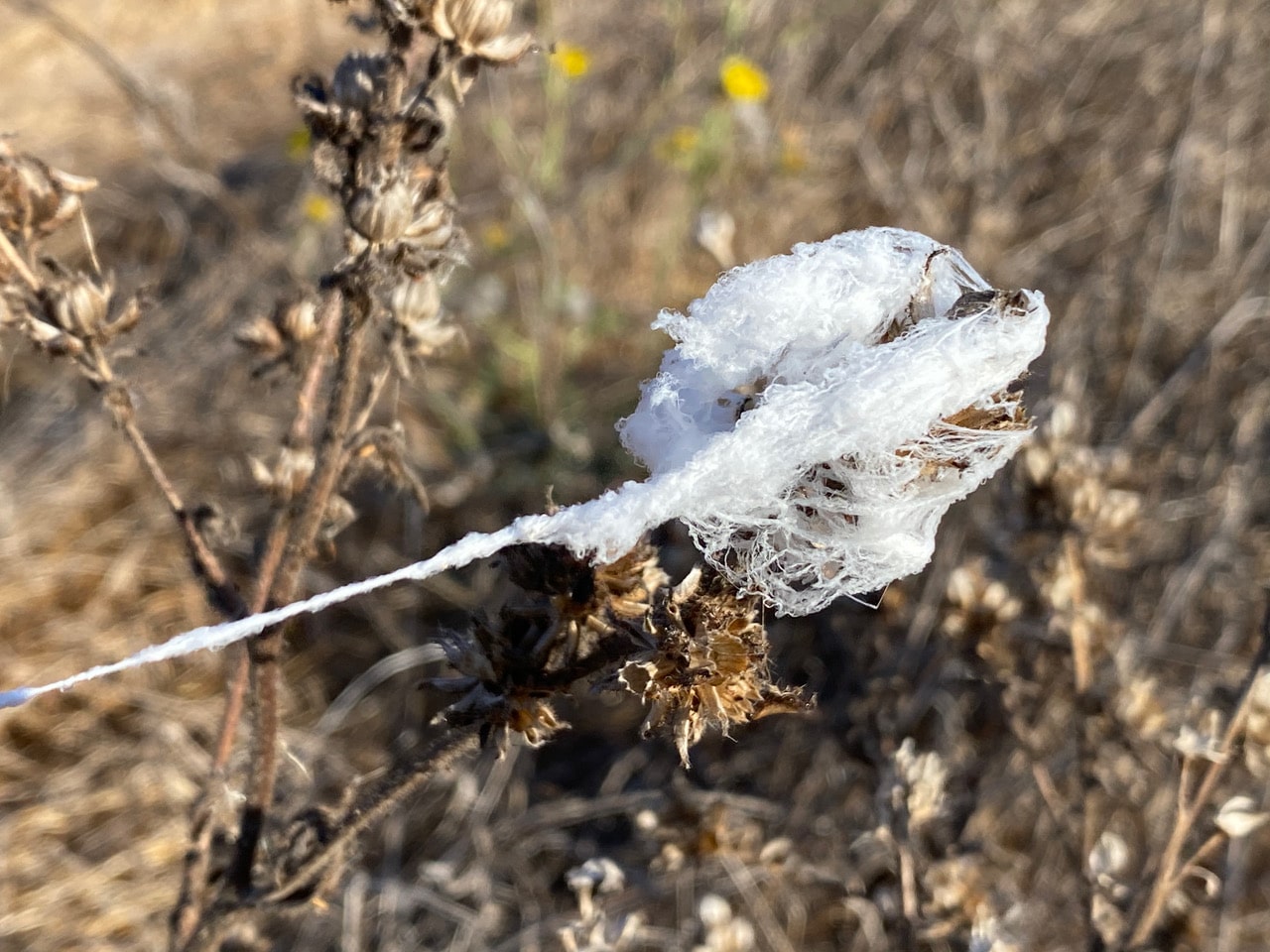
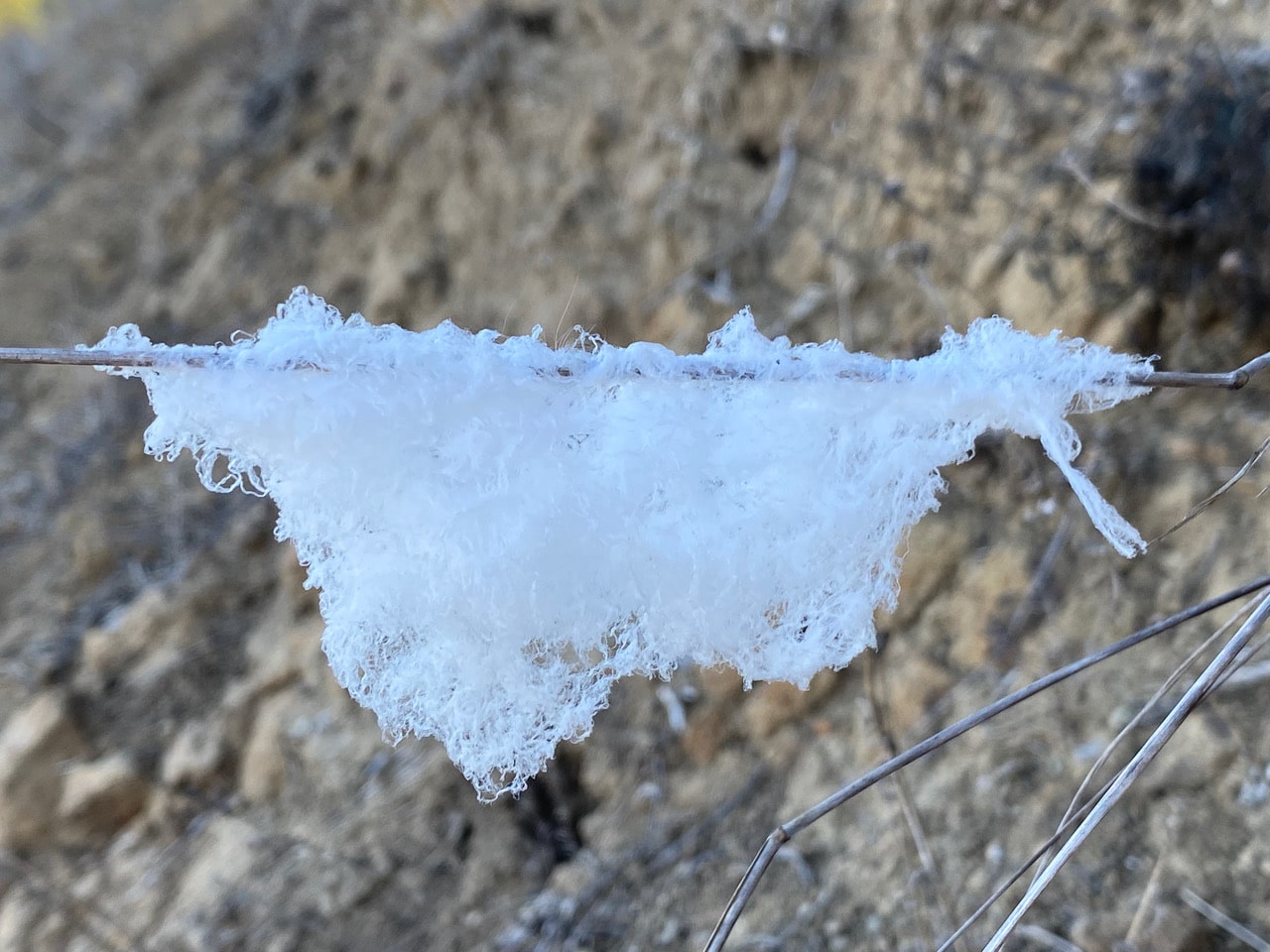
I come across several of these white, fluffy clumps stretched over the dried vegetation in the field.
Closer inspection shows that it is most likely spider silk, but I don’t see spiders on any of the white fluffs.
Recently there have been reports of baby spiders falling from the sky, sprinkling parts of the Bay Area with early Halloween decorations. Gobs of white spider webs have been seen floating and sticking to surfaces in the fields. According to an authority, inside those webs are baby spiders seeking new places to live in the process called “ballooning’ – sailing through the air on silk strands.
Here’s another big clump of spider silk caught on a grass stem.
Spider silk is as strong as steel or in some cases even stronger when it comes to tensile strength, which measures the amount of stress a material is able to withstand before breaking. A strand of spider silk is made up of many smaller strands – thousands to be exact, each 1,000 times thinner than a strand of human hair. These nanostrands are only 20 millionths of a millimeter in diameter. Another key feature of spider silk is its elasticity. Some silk can be stretched up to four times its original length without breaking.
Not all spider silk is the same. Spider silk is a protein fiber spun by spiders. All spiders produce silk, and a single spider can produce up to seven different types of silk for different uses. The most well-known use of spider silk is making intricately designed webs for trapping prey. Spiders also use silk to build nests and cocoons, wrap up their prey, and as anchor lines or drag lines, which they leave trailing behind them as they move around. Some spiders even eat the silk from their old webs to recycle the proteins for making new silk.
A spinneret is a silk-spinning organ of a spider. Spiders have special glands that secrete silk proteins (made up of chains of amino acids). The spider pushes the liquid solution through long ducts, leading to microscopic spigots on the spider’s spinnerets. Spiders typically have two or three spinneret pairs, located at the rear of the abdomen. Most spinnerets are not simple structures with a single orifice producing a single thread, but complex structures of many microscopic spigots, each producing one filament. The spigots allow the spider to combine multiple filaments in different ways to produce many kinds of silk for various purposes. Various species of spiders use silk extruded from spinnerets to build webs, to transfer sperm, to entrap insects, to make egg-cases, to manipulate static electricity in the air, and to fly (ballooning), etc.

Aww, the mature Pale Swallowtail caterpillar I found on this Coffeeberry leaf three days ago is longer there. I am hopeful that it has left in search for a place to pupate. Pale Swallowtail caterpillars typically do not pupate on their host plant. Have a safe and snug time in your chrysalis until spring, little feller!
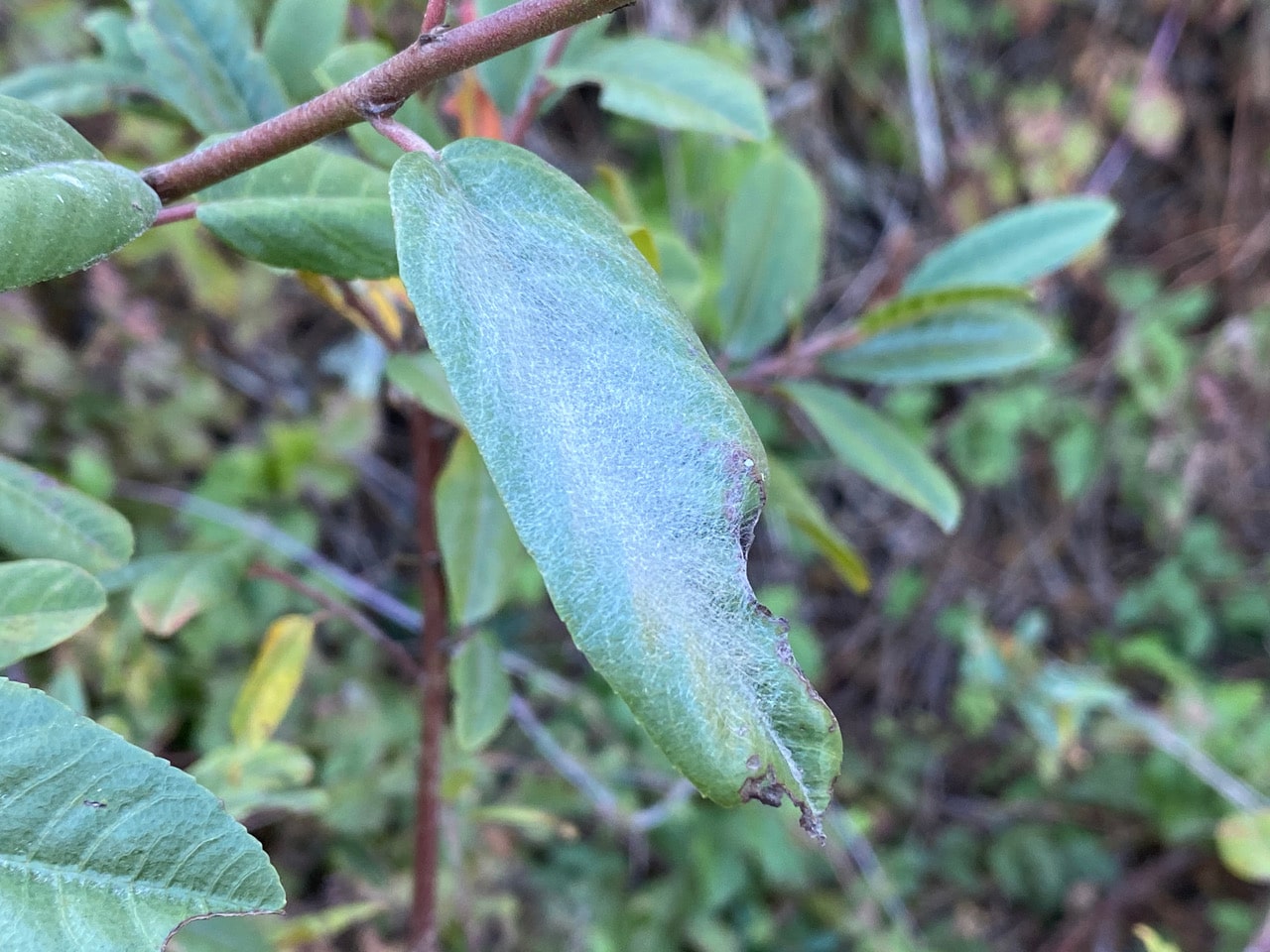
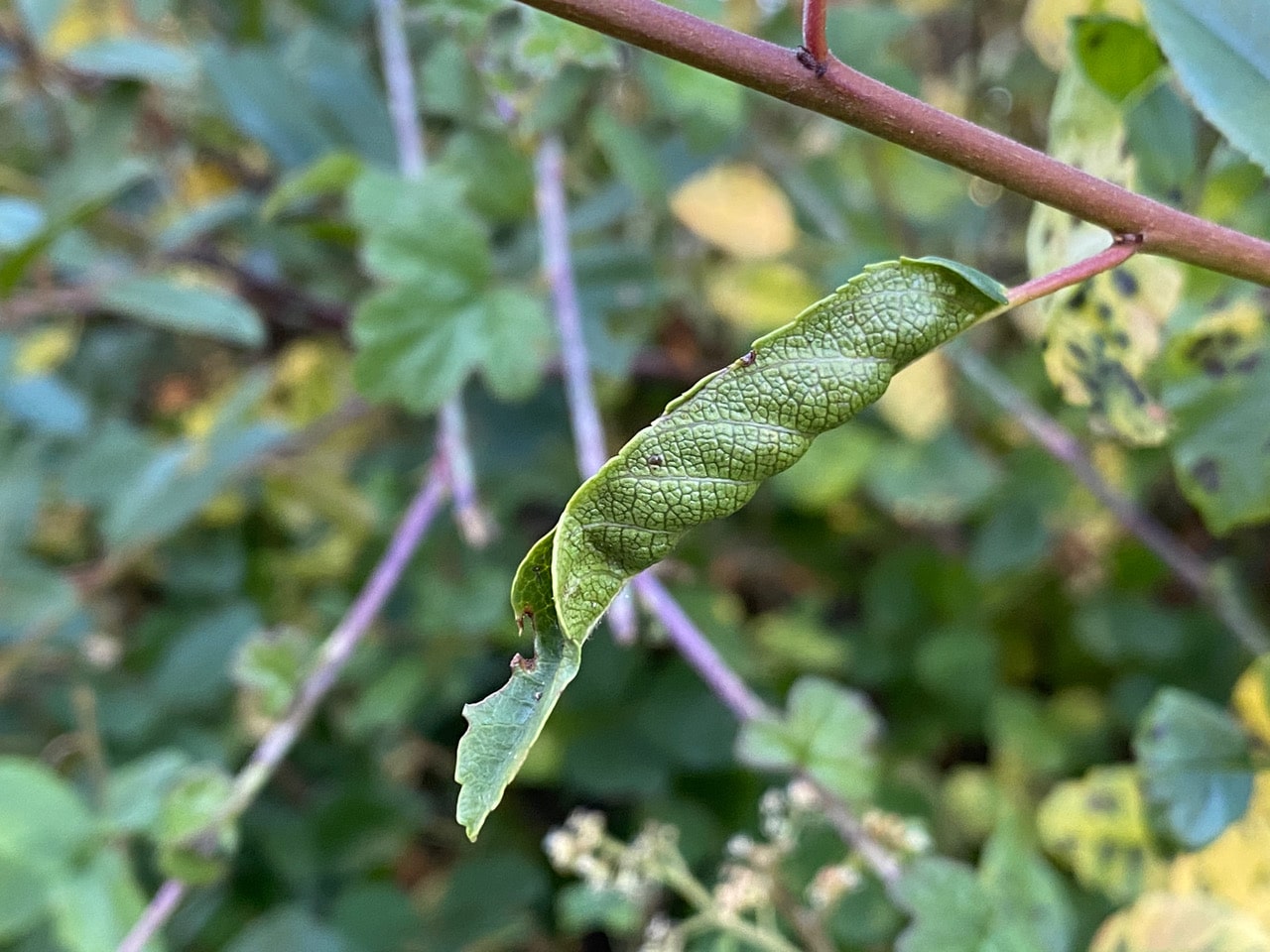
Hey, this is one of the fun things I find every fall! See that Coffeeberry leaf that has been folded along the midrib into an elongate bloated structure? The edges of the leaf has been very neatly bound together with silk. It is a leaf gall induced by the Midrib Gall Moth, Sorhagenia nimbosa (family Cosmopterigidae). The galls are the result of a significant expansion of the tissues in and around the midrib. These rigid, thick-walled galls occupy most to the affected leaf with only the basal and apical portions of the leaf unaffected. The single caterpillar feeding inside is brown with a darker head, and is 6 mm long. Galls appear in mid-May along the California coast. Most of the older galls have an exit hole through which the caterpillar lowers itself to pupate in the ground.
There’s a nice little patch of lupine on the side of the trail that is still in bloom! It must be Summer Lupine, Lupinus formosus. Wouldn’t this be a great plant for the home garden for supporting pollinators through the summer?Native to California, blooming from April to August, the species has been cited as a poisonous plant. Although it is not endangered, it faces eradication in some areas at the hands of cattle farmers as it has been implicated in crooked calf disease. The Summer Lupine is a larval host to several butterflies including the Acmon Blue, Arrowhead Blue, Melissa Blue, Silvery Blue, Sooty Hairstreak, and the endangered Mission Blue Butterfly.
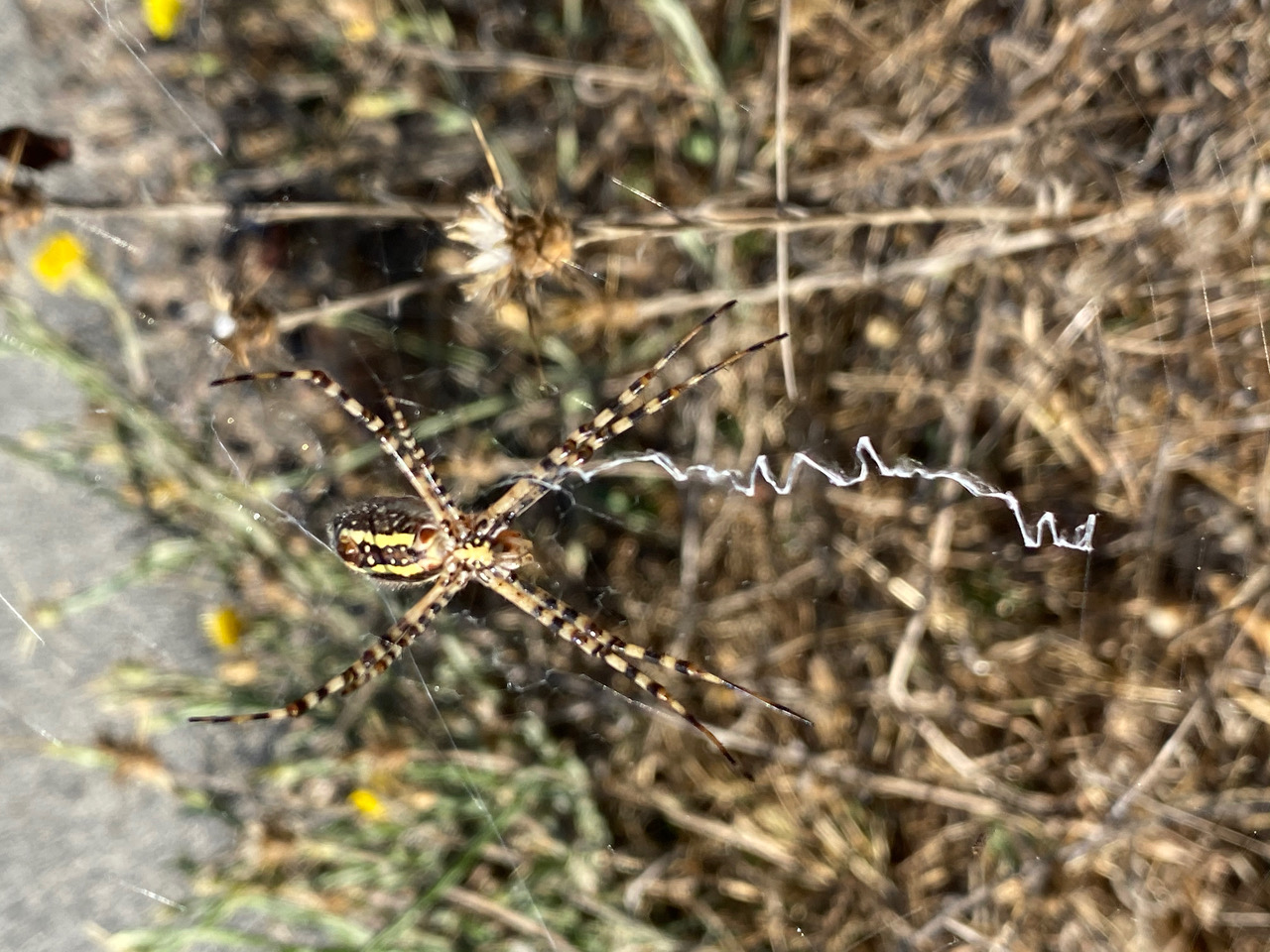
A female Banded Garden Spider, Argiope trifasciata (family Araneidae) is resting head-down in her orb web among dried Yellow Starthistles. We are looking at her underside. Most Argiope webs are built with a slight tilt from the vertical, and the resident spider is always found on the side facing the ground. This arrangement enables the spider to drop from the web quickly without getting entangled. The other, more conspicuous feature of the Argiope web is the stabilimentum, the zig-zag decoration made of thick silk.
A stabilimentum, also known as a web decoration is a conspicuous silk structure included in the webs of some species of orb-weaver spider. Its function is a subject of debate. It is likely that different species use them for different purposes. Originally the decorations were thought to stabilize the web (hence the name), but this hypothesis has been dismissed. Notable is the fact that stabilimentum-building spiders are largely diurnal. It has been suggested that the decoration provides protection to the spider by making the web more visible to animals such as birds/mammals that might fumble into the web. An alternative hypothesis is that web decorations attract prey by reflecting ultraviolet light that is known to be attractive to many species of insects. Yet others think that the purpose of the stabilimentum is to attract the male of the species to the web when the female is ready to reproduce. There’s no end to our fascination with the spiders and their webs.
Here’s a view showing the spider’s back.
The Banded Orbweaver, Argiope trifasciata is a species of spider native to North and South America, but now found around the world. The spiders typically begin to appear during autumn from early September to late October. Their large orb webs can be up to 2 feet in diameter, among stems and bushes. Often there is a prominent silk decoration of a zigzag line on the web – the stabilimentum. The female rests at the center of the web facing downwards, with her legs arranged in pairs, making a cross shape. Males are much smaller and have their own small webs in close proximity to the females’ webs. The species is diurnal, and feeds on the insects that are snared in the web. Large, powerful prey like yellowjackets are swiftly wrapped in silk to immobilize them, before being injected with toxic saliva. Egg sacs are deposited in early fall and consist of several hundred eggs. The spiderlings emerge the following spring.