

Pollinator Post 10/5/23
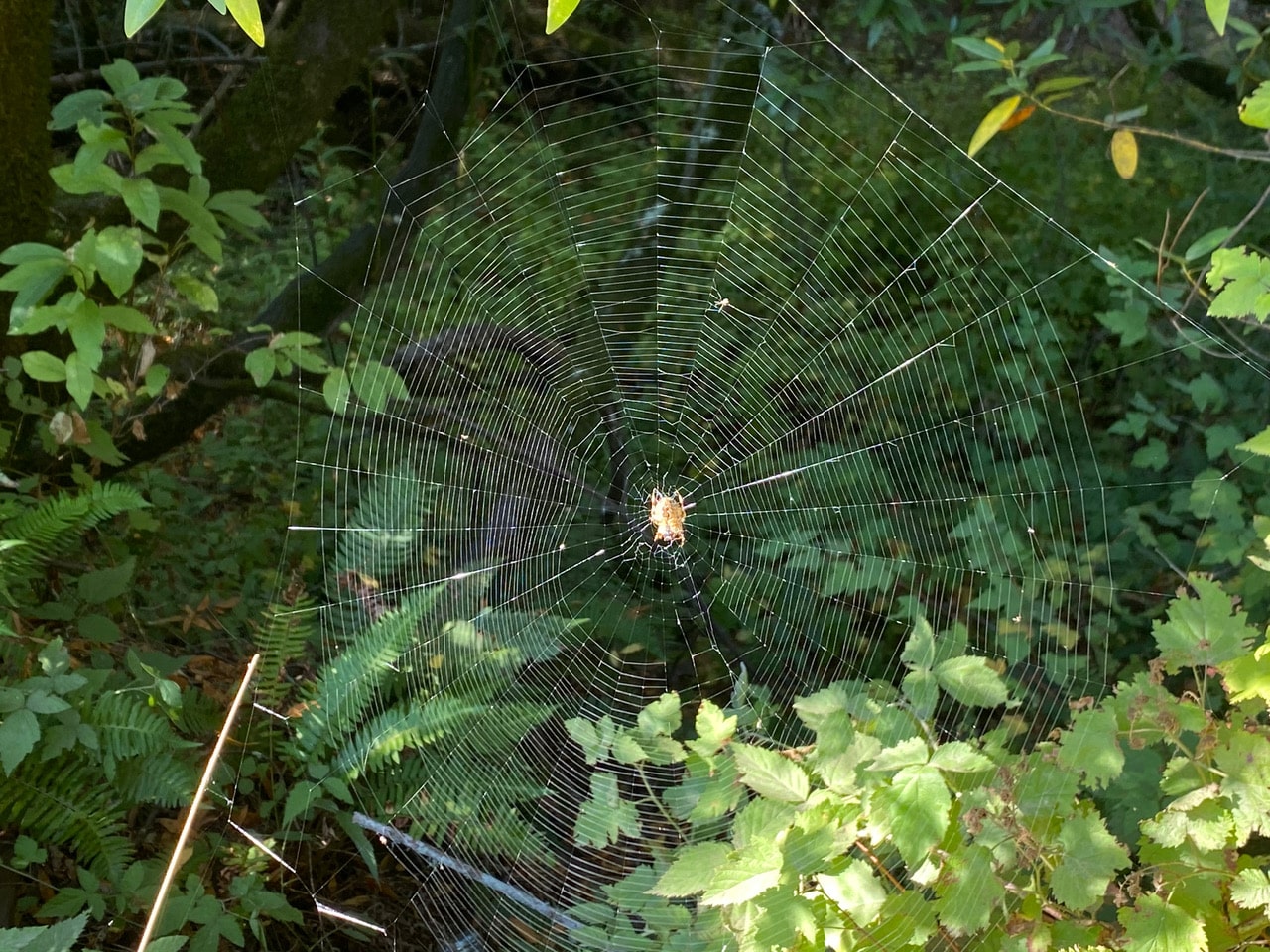
To avoid the heat, I take my walk in the Reinhardt Regional Park in the shade of redwood trees this morning. Near the entrance a perfect orb web over the Nine Bark by the paved trail cheers and worries me at the same time. Why are there so few insects? How are the spiders to survive without insect prey?
The legs of orb-weaver spiders (family Araneidae) are specialized for spinning orb webs. The webs are built by larger females, which hang head down in the center of the web or remain hidden in nearby foliage, with one claw hooked to a signal line connected to the main orb, waiting for a disturbance to signal the arrival of prey. Prey is then quickly wrapped in silk and bitten, and the prey may hang on the web to be stored for later consumption. The initial bite serves to paralyzed the prey and to prevent injury to the spider from struggling prey. The injected enzymes serve to begin liquefaction of the prey’s internal structures.
Orbweaver spiders are well known for sexual cannibalism. Females often kill and consume the males just before, during, or just after mating.
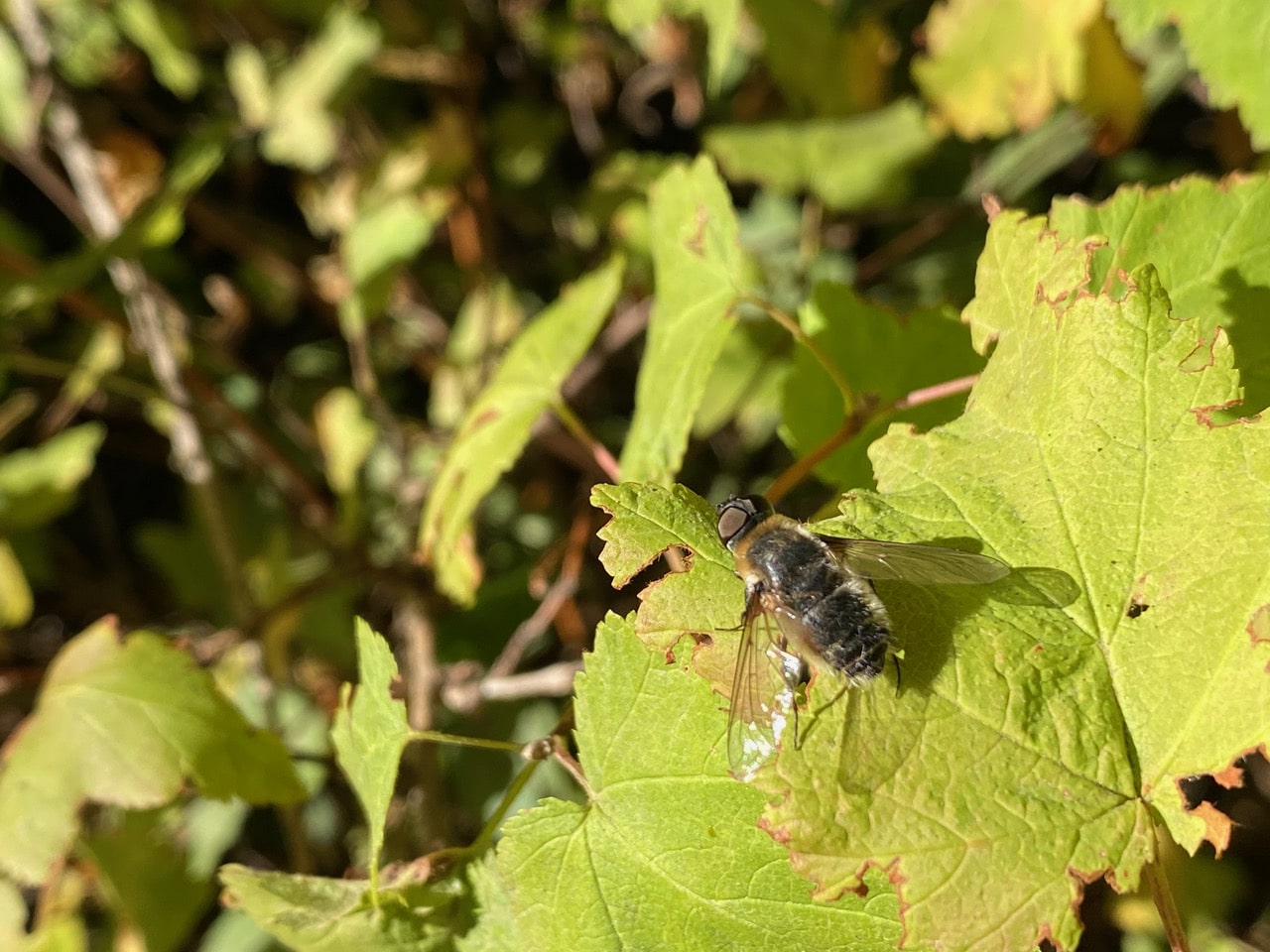
Ooh, that looks like a Bee Fly (family Bombyliidae).
The Bee Flies belong to the family Bombyliidae. Adults generally visit flowers for nectar and pollen, some being important pollinators. Larvae generally are parasitoids of other insects. When at rest, many species of bee flies hold their wings at a characteristic “swept back” angle. The adult females usually deposit eggs in the vicinity of possible hosts, quite often in the burrows of beetles or ground-nesting bees/wasps. Bombyliidae parasitism is not host-specific, but rather opportunistic, using a variety of hosts. Adult females of the genus Villa lay eggs in mid-air and flick them towards the nest entrances of their hosts. They typically have an eversible pouch near the tip of their abdomen known as a sand chamber, which is filled with sand grains gathered before egg laying. These sand grains are used to coat each egg just before their aerial release, presumably to improve the female’s aim by adding weight.
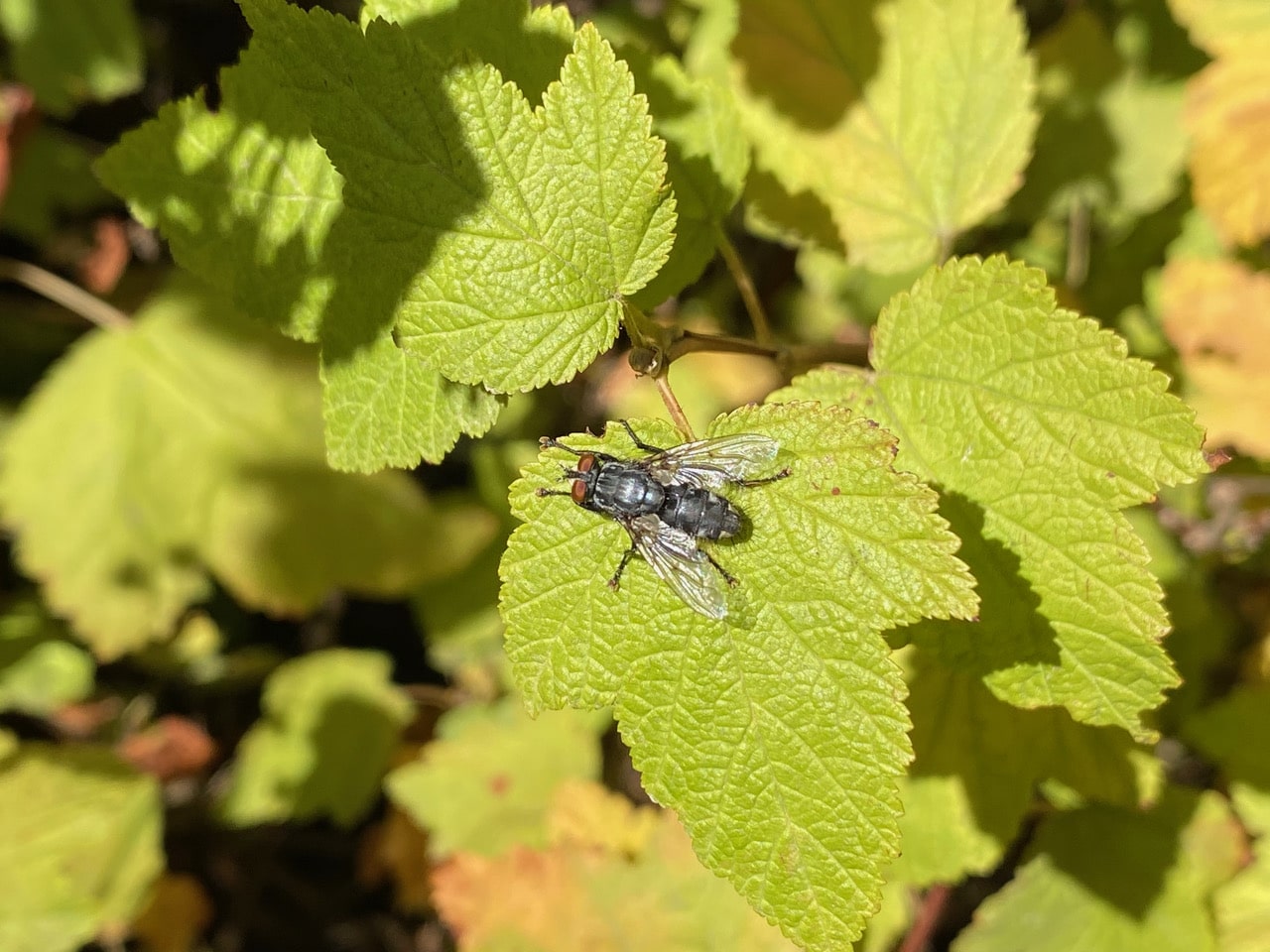 Further along the trail, I begin to see more insects on the Nine Bark foliage. Here’s a Flesh Fly, Wohlfahrtia sp. (family Sarcophagidae).
Many Flesh Flies have black and gray longitudinal stripes on the thorax and checkering on the abdomen, red eyes, and a bristled abdomen sometimes with a red tip. They differ from most flies in that they are ovoviviparous, opportunistically depositing hatched or hatching maggots instead of eggs on carrion, dung, decaying material, open wounds of mammals, hence their common name. The adults mostly feed on fluids from animal bodies, nectar, sweet foods, fluids from animal waste and other organic substances. While we may find their habits revolting, Flesh Flies perform important roles in the ecosystem – the larvae as decomposers/recyclers, and the adults as pollinators.
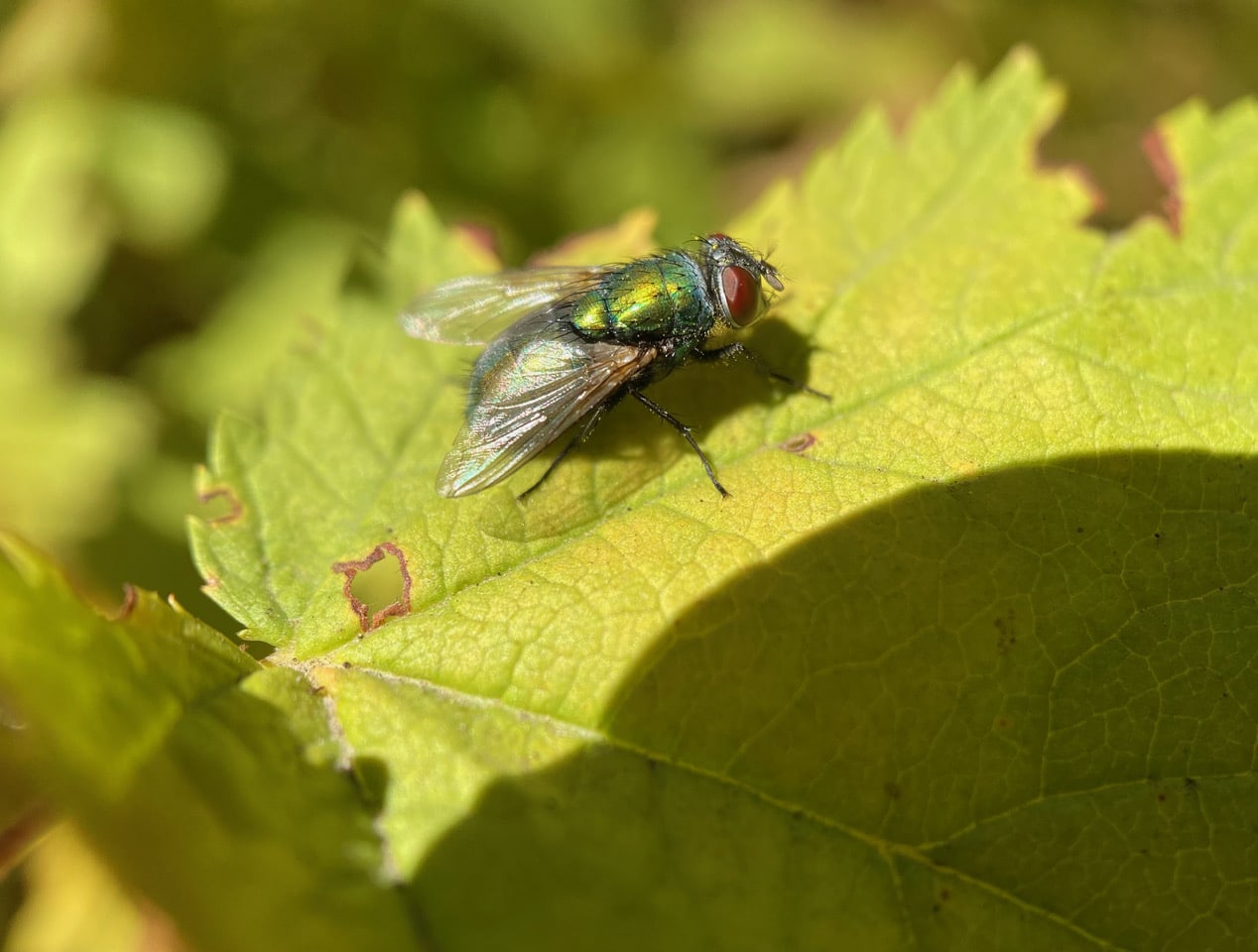
A Common Green Bottle Fly, Lucilia sericata (family Calliphoridae) has landed on a Nine Bark leaf.
The Common Green Bottle Fly is a Blowfly found in most areas of the world and is the most well-known of the numerous green bottle fly species. The lifecycle of Lucilia sericata is typical of blowflies. Females lay masses of eggs in fresh carrion. The flies are extremely prolific – a single female may produce 2,000 to 3,000 eggs in her lifetime. The larvae feed on dead or necrotic tissue, passing through 3 larval instars. Third-instar larvae drop off the host to pupate in the soil. The adults feed opportunistically on nectar, pollen, feces, or carrion; they are important pollinators as well as important agents of decomposition. Pollinator is used as an alternative protein source, especially for gravid females who need large amounts of protein and cannot reliably find carrion.
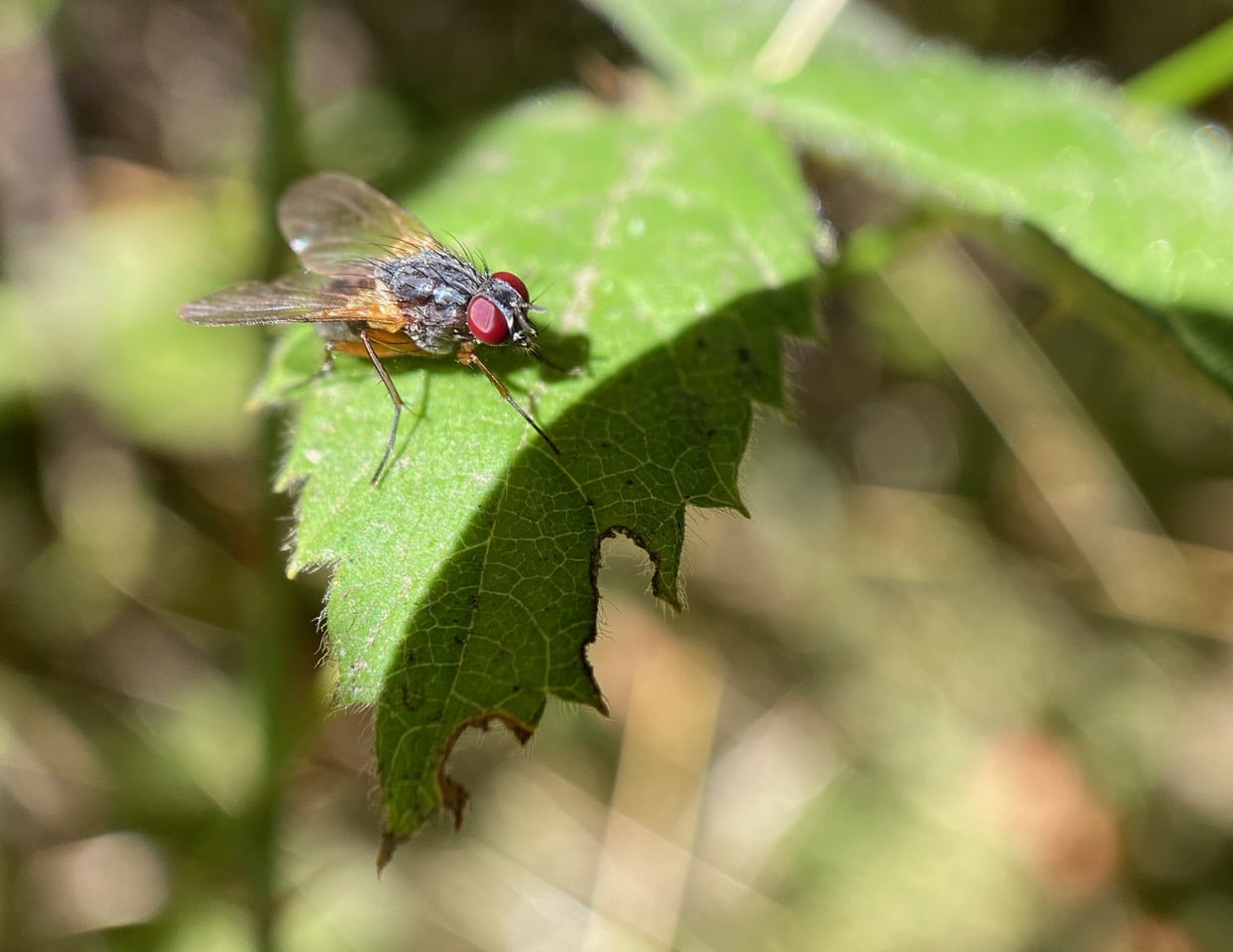
Here’s another decomposer, Phaonia subventa (family Muscidae).
Native to Europe, this is a small fly, 6-8 mm long, with an orange abdomen, and striped grey thorax. The species frequent well wooded areas. Females lay their eggs in a wide variety of decaying matter – rotting vegetation or in carrion, on which their larvae feed.

Just a few steps further, I discover why there are so many decomposers around. They are gathered to partake of a windfall on the paved trail. A Yellowjacket has joined the party, trying to carve out a piece from the meaty pile on the ground. What on earth is that?
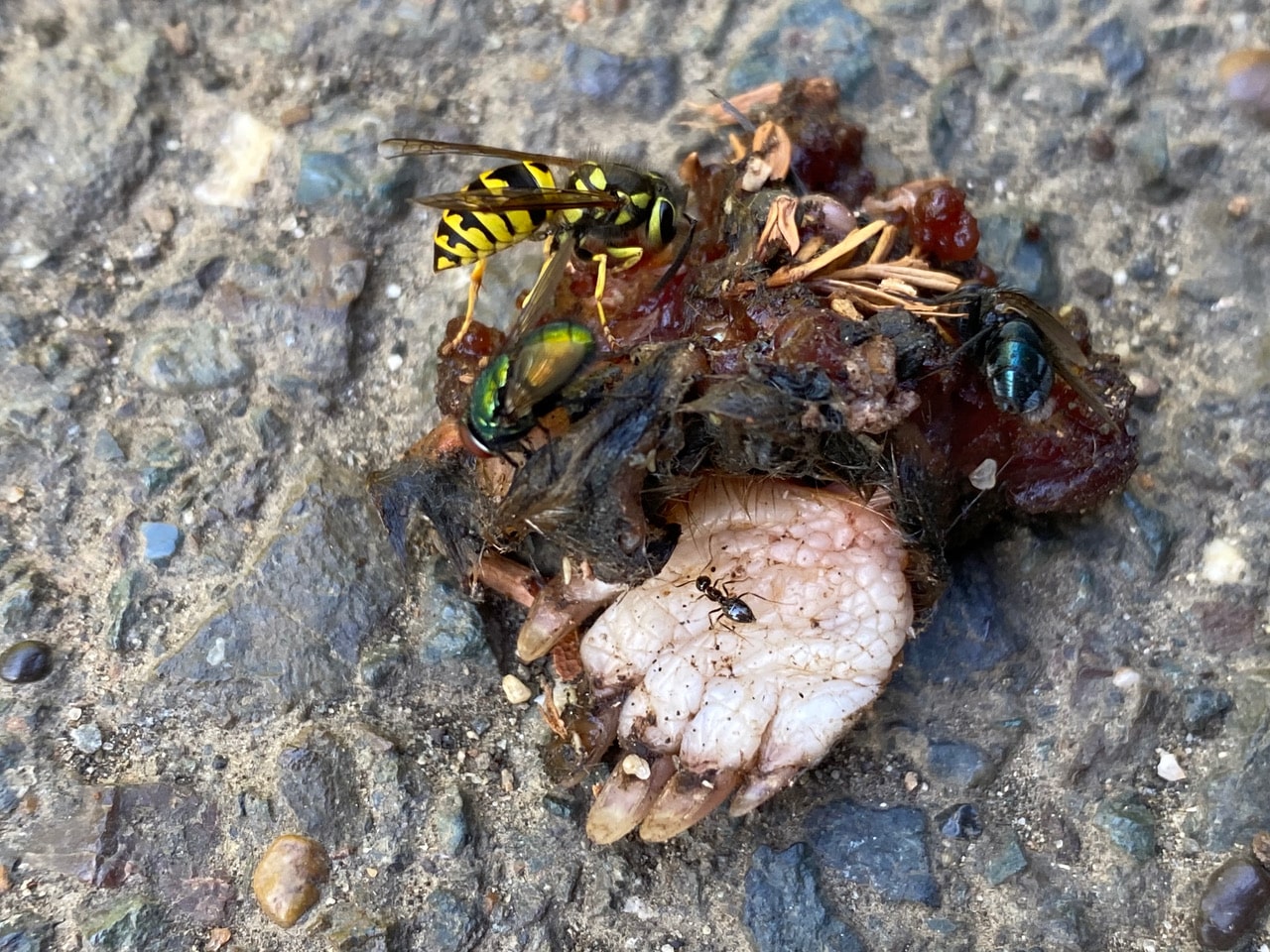
There’s another similar clump a couple of feet away. Now I see what the feast is! It is a dead mole. I am rather surprised to see its front paw (being investigated by an American Winter Ant) is still intact while the rest of its body have been pulverized. Was it attacked by a predator and abandoned before it was consumed? The dismembered carcass is still fresh, and relatively odorless.

Growing in the shade, some leaves of a young American Elm, Ulmus americana are still green, but riddled with shot holes.

The older leaves have been totally skeletonized, and look lace-like.

I find the culprits on the trunk of the American Elm trees. They are the Elm Leaf Beetles, Xanthogaleruca luteola (family Chrysomelidae).
The Elm Leaf Beetle is native to Europe but invasive in other parts of the world. They feed on all species of elm trees. The dark grub-like larvae chew on the underside of leaves but avoid the larger leaf veins, producing “skeletonized” leaves. Damaged leaves look lacy, turn brown and may prematurely drop from the trees. The beetles overwinter in the adult stage. In late summer and early fall they seek out protected sites such as woodpiles, loose mulch, bark fissures to shelter through winter. In spring the beetles become active and move to elm tree when leaves emerge. Eggs are laid on the underside of leaves. Larvae feed on the underside of the leaf, skeletonizing the leaves. When mature, the larvae crawl down the trunk and pupate at the base the tree, sometimes in large groups. Several generations can be produced in a single year.

A Leaf Miner has been eating its way through this willow leaf, creating the sinuous transparent tunnels.
A leaf miner is any one of numerous species of insects in which the larval stage lives in, and eats, the leaf tissue of plants. The vast majority of leaf-mining insects are moths (Lepidoptera), sawflies (Symphyta), and flies (Diptera). Some beetles also exhibit this behavior. Leaf miners are protected from many predators and plant defenses by feeding within the tissues of the leaves, selectively eating only the layers that have the least amount of cellulose, and lowest levels of defensive chemicals.

I am not sure how many leaf miners are responsible for the damage on this willow leaf. Maybe only one?
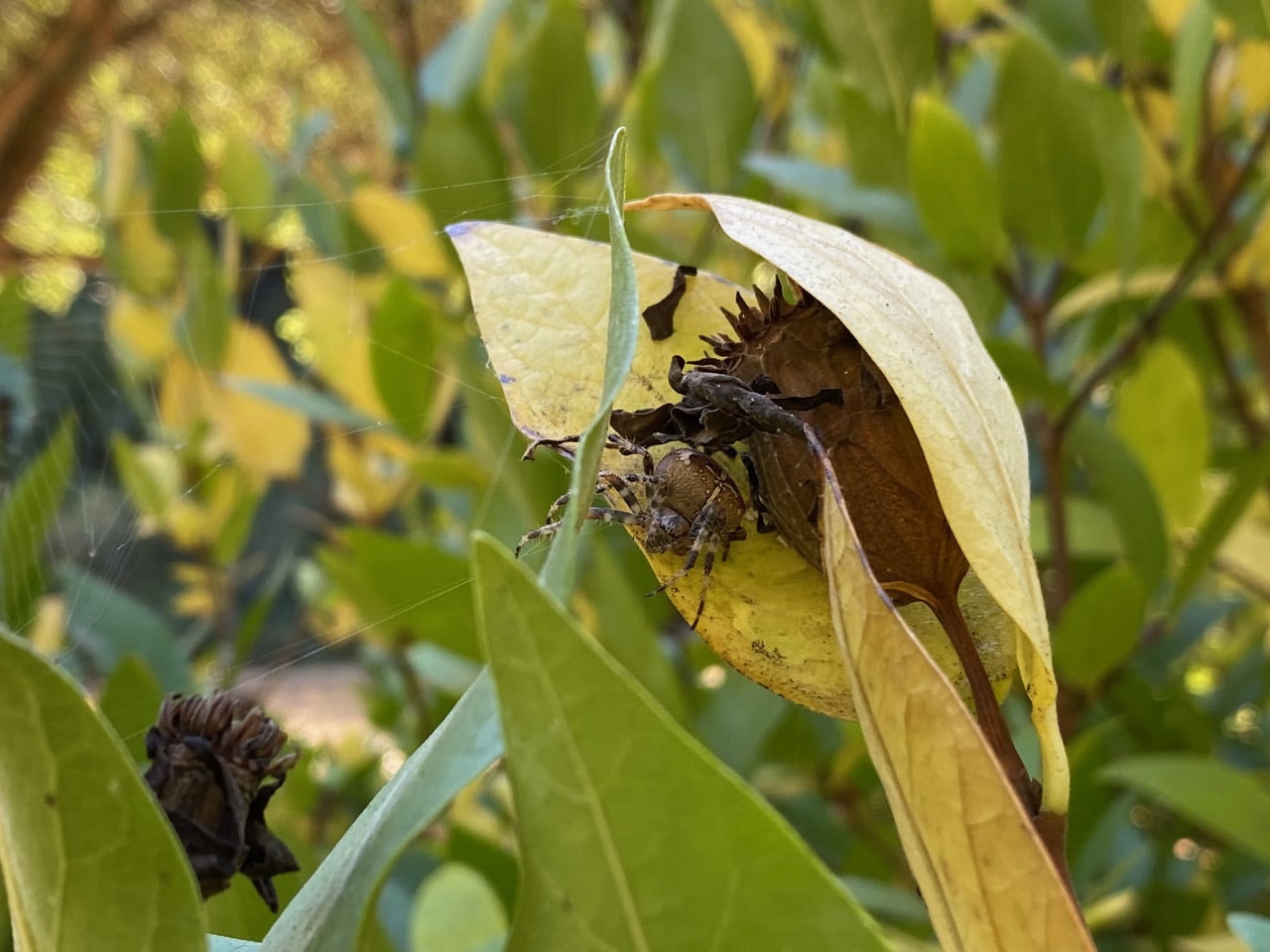
A Orbweaver is hiding among the leaves and seed capsule of a Spice Bush, Calycanthus occidentalis, while holding on to a signal line attached to the center of its orb web.
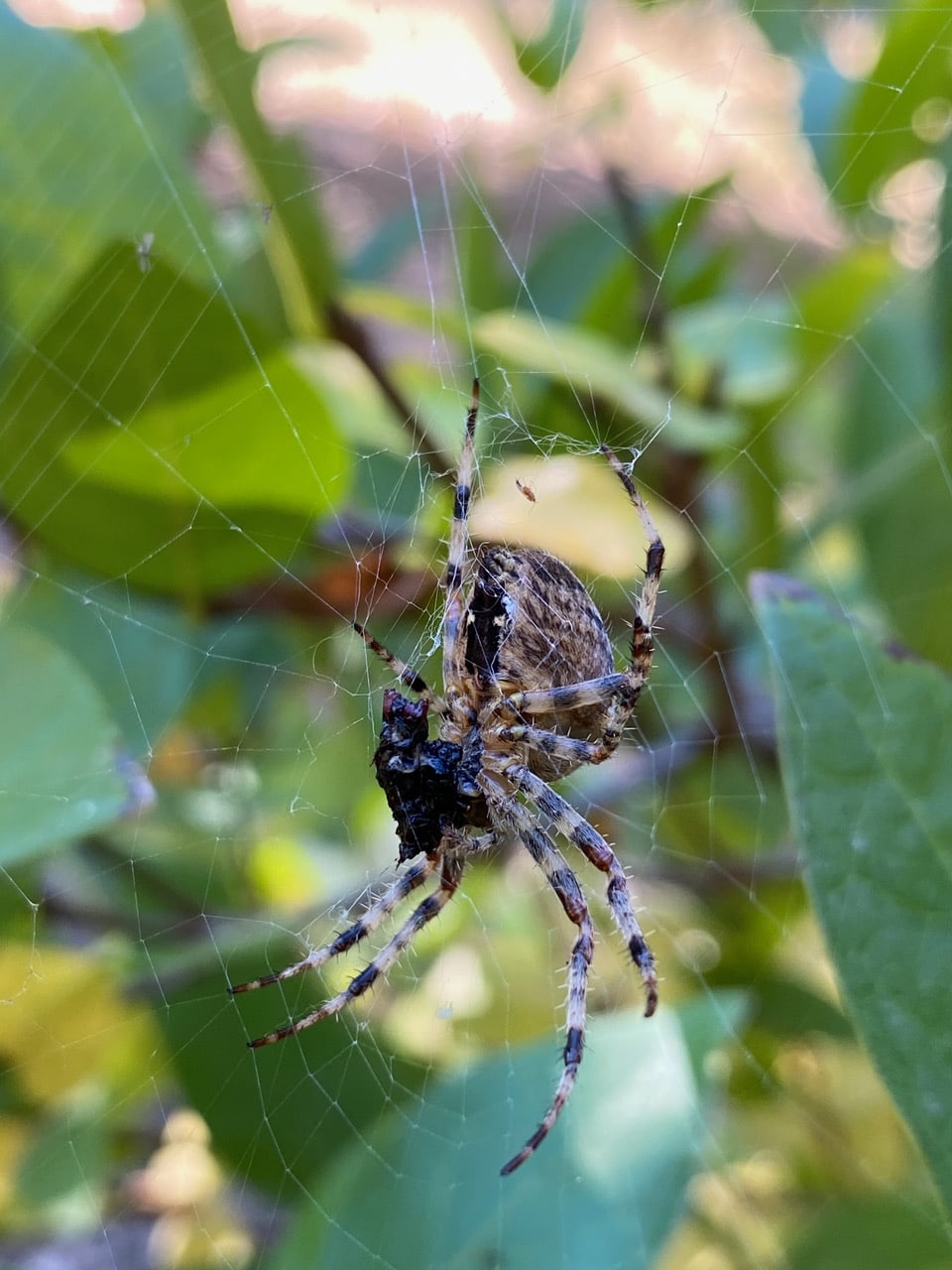
On the same Spice Bush, another large Orb Weaver is feeding on its catch. The prey is no longer recognizable, having been well liquified by digestive enzymes that the spider secretes.
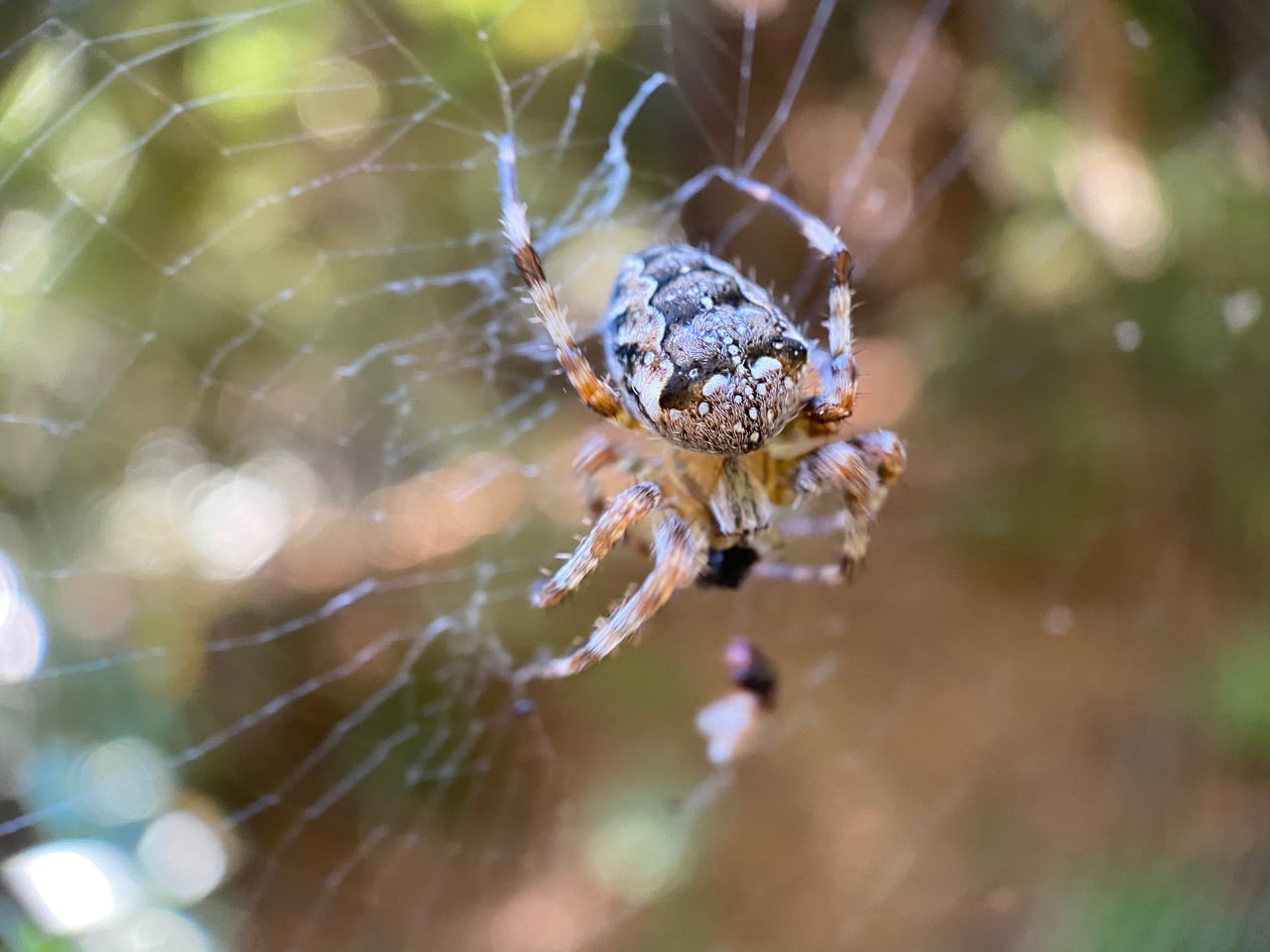
Its orb web strung between Blackberry brambles in the shade of redwoods, a Cross Orbweaver, is feeding on a small, pulverized prey.
Araneus diadematus is commonly called the Cross Orbweaver or the European Garden Spider. It is found in Europe where it is native, and North America, where it was introduced. Individual spiders can vary markedly in coloration, from light yellow to dark grey, but all have mottled white markings across the dorsal abdomen, with four or more segments forming a cross. The markings are formed in cells filled with guanine, which is a byproduct of protein metabolism. Adult females range in length from 1/4 to 3/4 in, while the males range from 1/4 to 1/2 in.