

Pollinator Post 10/4/24 (2)
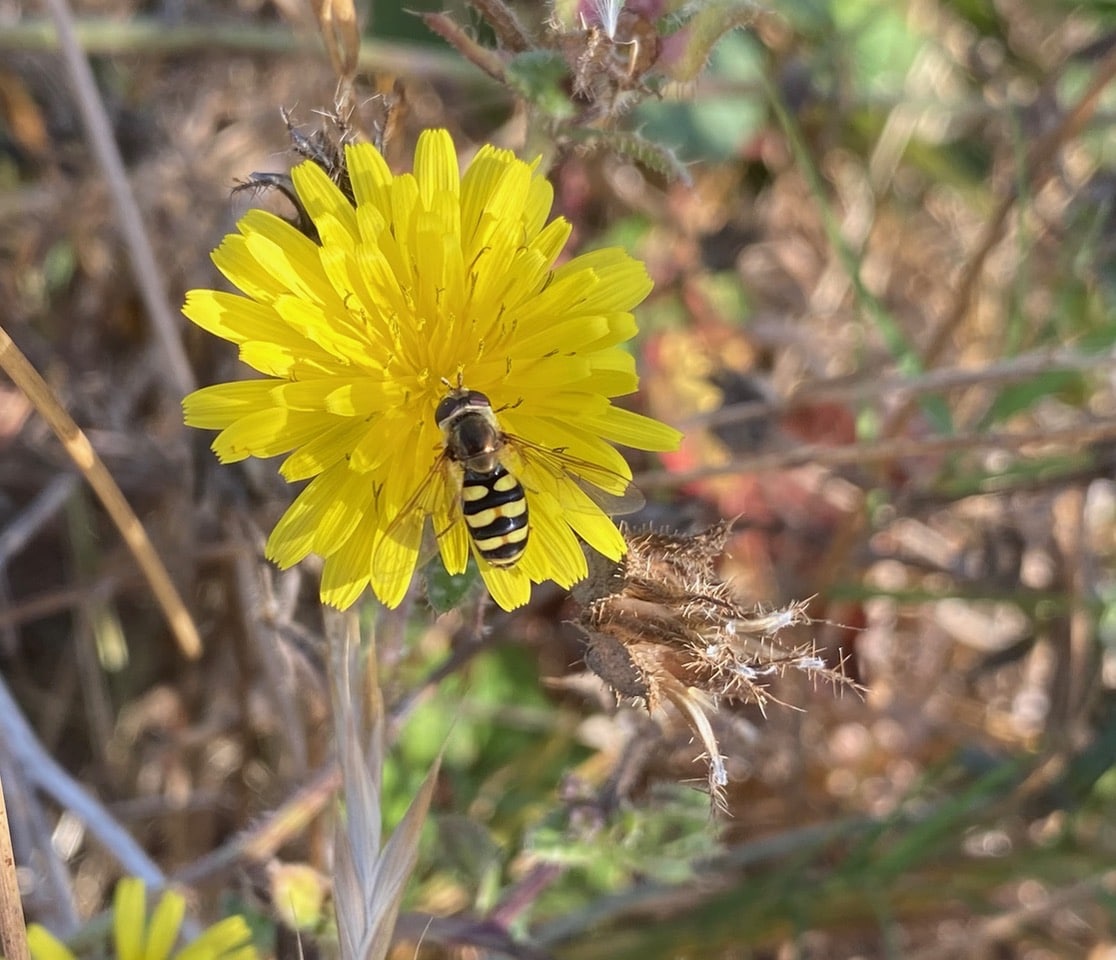
A Western Aphideater, Eupeodes fumipennis (family Syrphidae) has landed on a flowerhead of Bristly Oxtongue, Helminthotheca echioides.
The hoverfly is found in western North America, mostly seen March through October. As the common name implies, larvae prey on aphids and other soft-bodied insects. Adults visit flowers for nectar and pollen. The conspicuous black-and-yellow banding on the abdomen is a perfect example of Bayesian mimicry common among hover flies. The resemblance to stinging insects such as bees/wasp lends a measure of protection to the harmless fly.
Western Aphideater (Eupeodes fumipennis) · iNaturalist
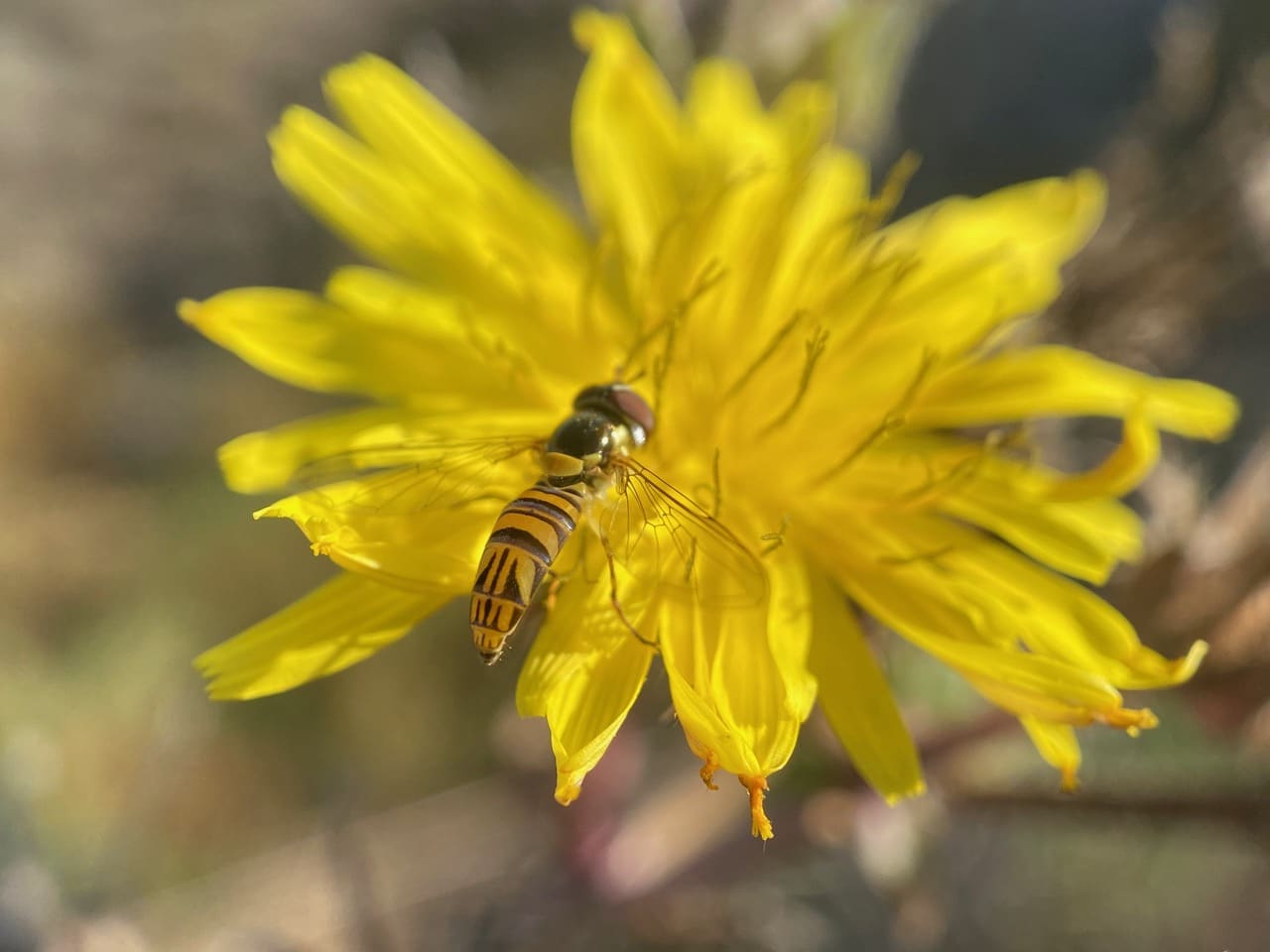


A female Oblique Streaktail, Allograpta obliqua (family Syrphidae) visits a flowerhead of Bristly Oxtongue. This hover fly species seems to be everywhere lately.
The Oblique Streaktail, Allograpta obliqua (family Syrphidae) is a common North American species of hoverfly. Adults are 6-7 mm long. Females have a tapered abdomen that ends in a pointed tip. Eggs are laid on surfaces of leaves or stems near aphids. The larvae are important predators of aphids. Adults visit flowers for nectar and pollen, and are pollinators.
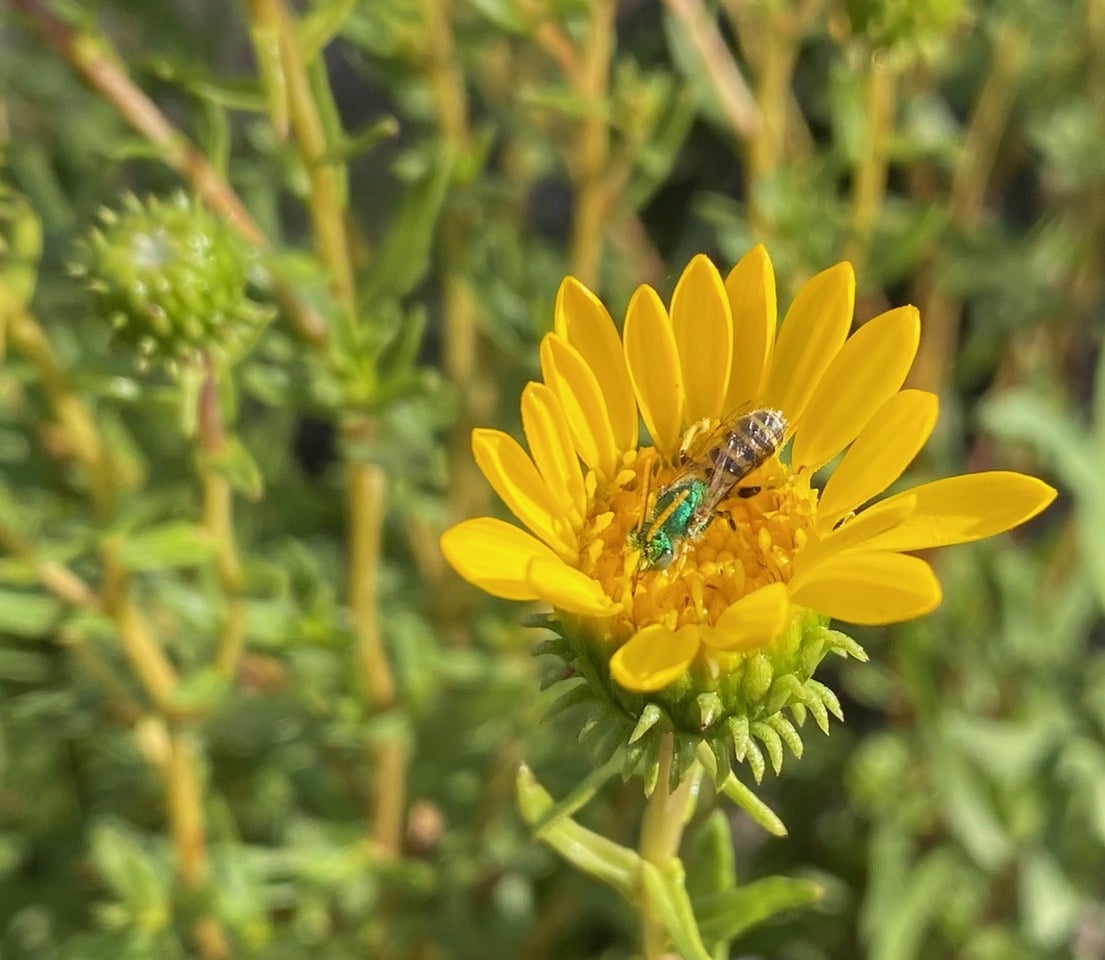
A male Texas Striped Sweat Bee, Agapostemon texanus (family Halictidae) is taking nectar from a Grindelia flowerhead.
The genus Agapostemon is widespread and abundant throughout North America. The ground-nesters are most diverse and abundant in temperate regions and southwestern U.S. deserts. Agapostemon are commonly called “sweat bees” because they are closely related to, and resemble bees in the Halictus and Lasioglossum genera. Unlike those bees however, Agapostemon are not attracted to human sweat.
Agapostemon are brightly colored metallic green or blue bees measuring 7 to 14.5 mm long. Most species have a metallic green head and thorax, and black-and-yellow striped abdomen; some females are entirely bright green or blue. Females carry pollen on scopal hairs located on their hind legs. Agapostemon are generalists. Like other members of the family Halictidae, they are short-tongued and thus have difficulty extracting nectar from deep flowers. Males are often seen flying slowly around flowers looking for females. The bees favor flowers with high densities.
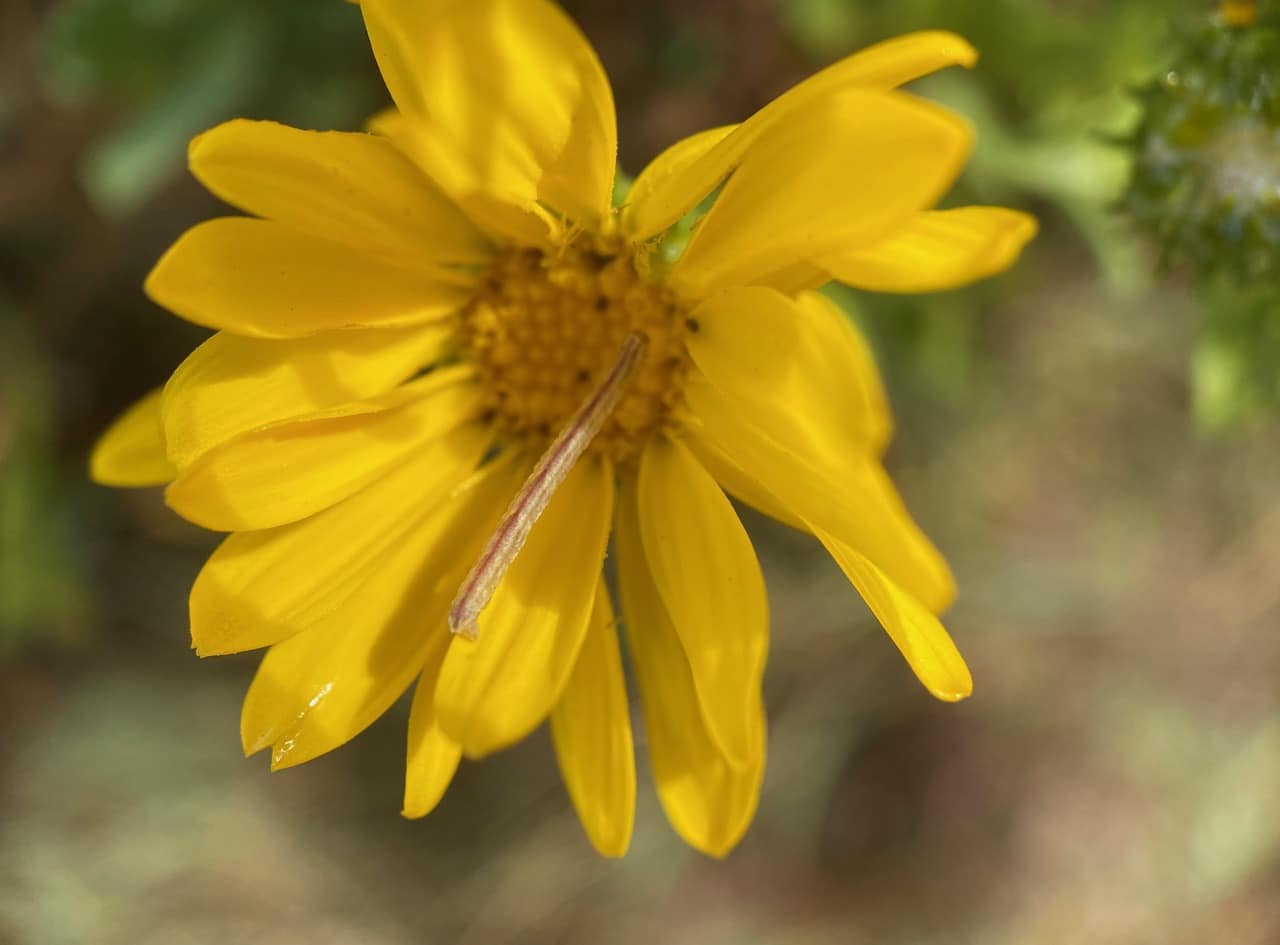
Its rear end anchored on a ray petal, an Inchworm caterpillar of Pug Moth, Eupithecia sp. (family Geometridae) has reached down to feed on the florets in the center of a Grindelia flowerhead.
Inchworms are also called loopers and measuring worms. They majority of the inchworms are the larvae of moths in the family Geometridae. The name comes from the Greek “geo” for earth and “metro” from measure, because the caterpillars seem to be measuring the surface on which they are walking.
All caterpillars have three pairs of jointed legs behind their heads. These legs are called true legs because they will become the six legs of the adult butterfly or moth. There are additional appendages, called prolegs, along their bodies. Prolegs are not true legs, they are just outgrowths of the body wall and will be lost at metamorphosis. They have little hooks on their soles to help the caterpillar walk and grip onto things. Most caterpillars have five sets of prolegs, four in the middle of the body and one pair at the hind end. Inchworms have the normal six true legs but only two or three pairs of prolegs, all located at the tail end of the body, with none in the middle. When an inchworm walks, it moves its tail-end prolegs up behind its true legs, causing the center of its body to loop upward. Then it stretches its front end forward to take another step.
Epithelia is the largest genus of moths of the family Geometridae. Occurring worldwide except for Australasia, species in the genus are commonly known as pugs. Adults are typically small, 12 – 35 mm, with muted colors. Most species rest with forewings held flat at right angles to the body, while the hindwing are largely covered by the forewings. They are generally nocturnal. Larvae mostly feed from the flowers and seeds of their food plants rather than the foliage. Many species have a very specific food plant.
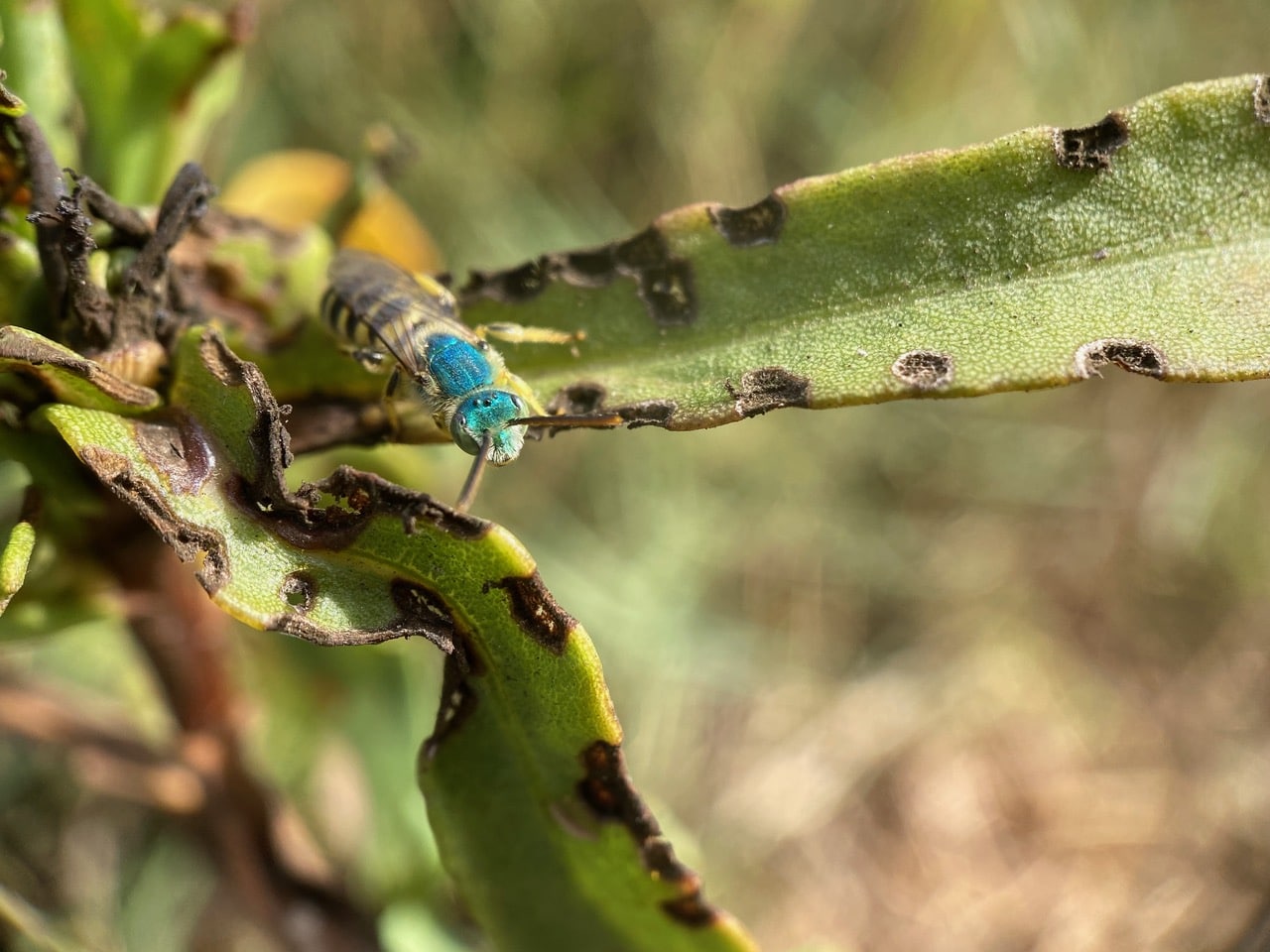
A male Texas Striped Sweat Bee, Agapostemon texanus (family Halictidae) has landed on a badly chewed foliage of Grindelia.
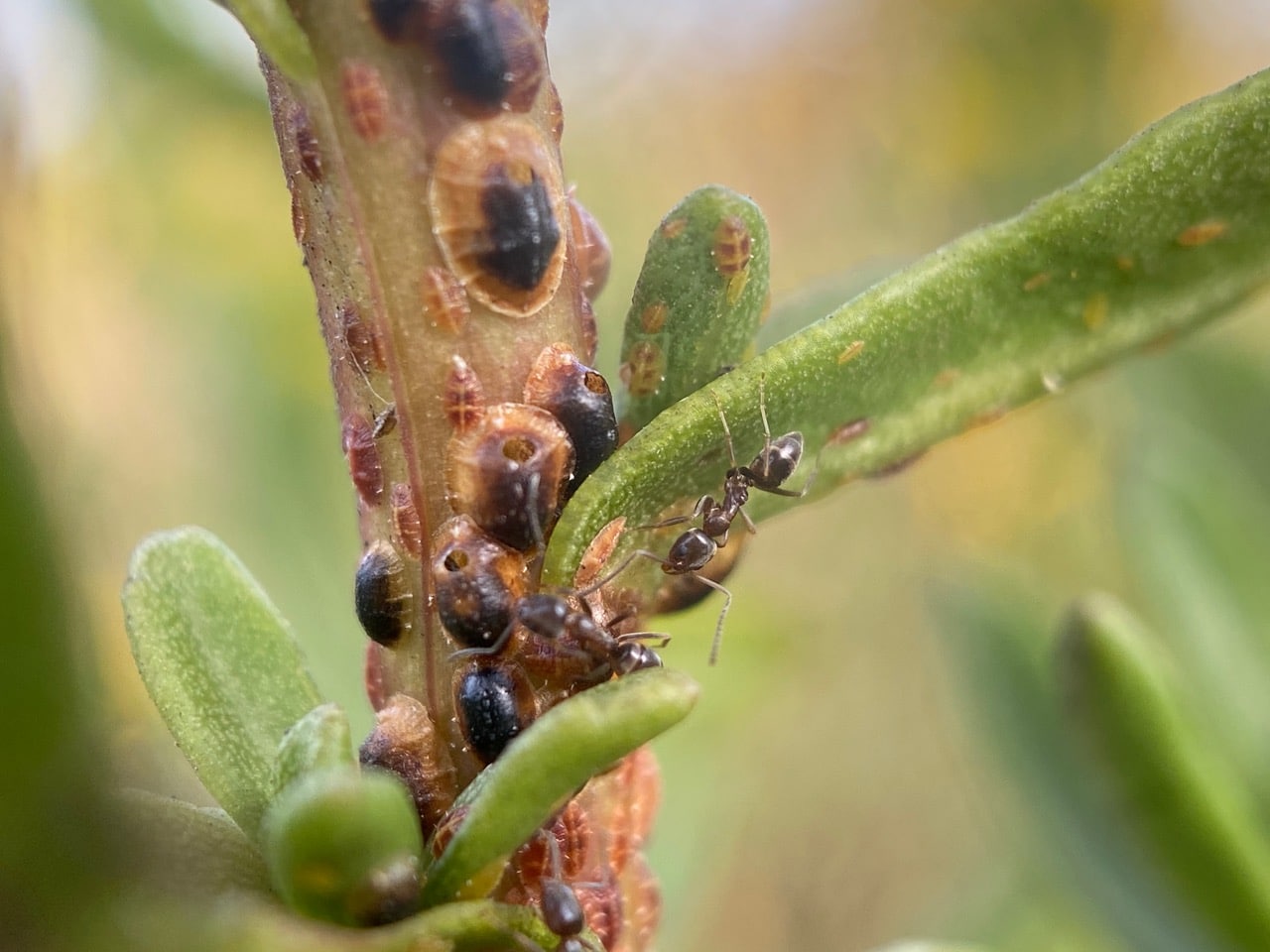
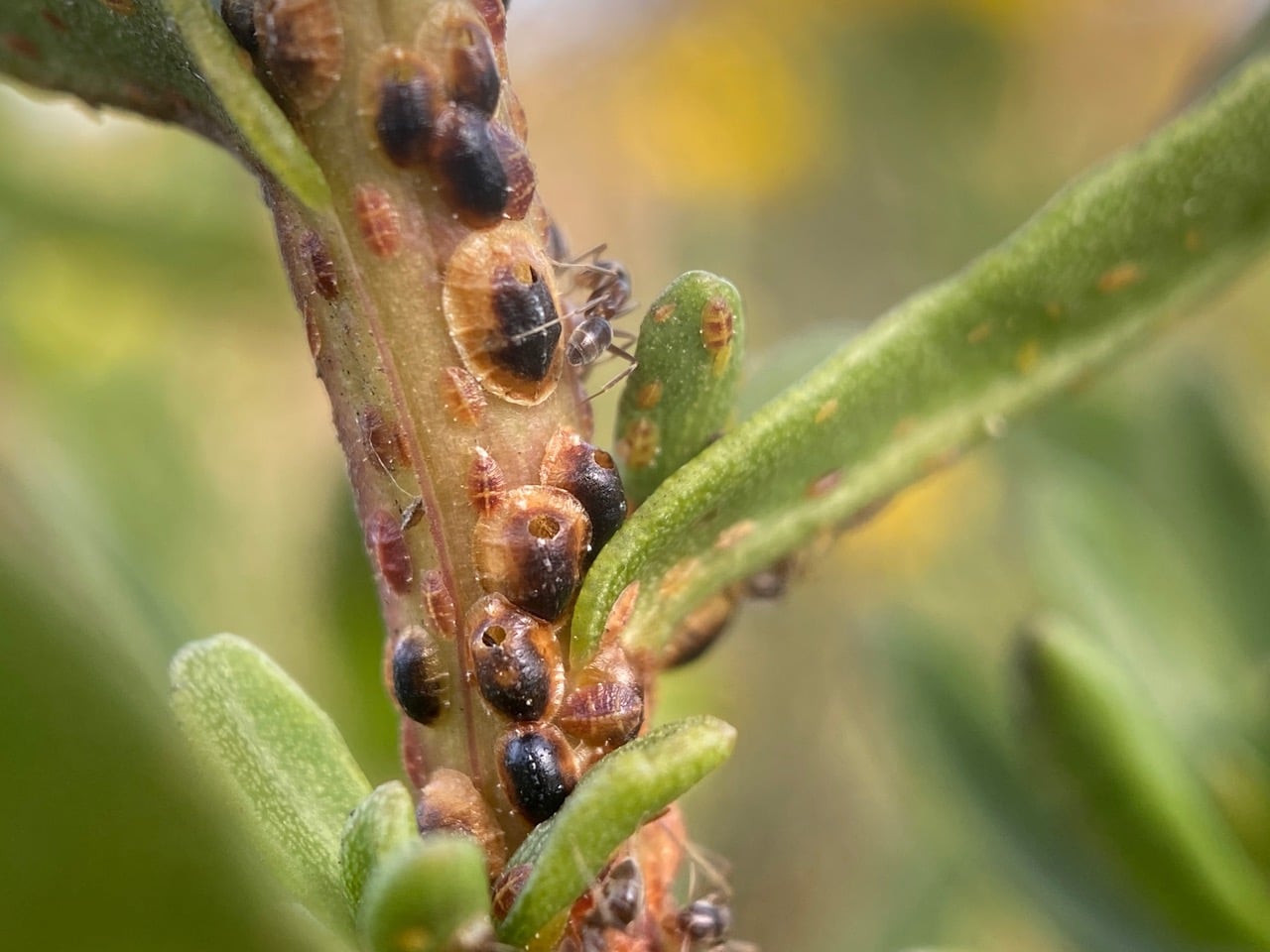
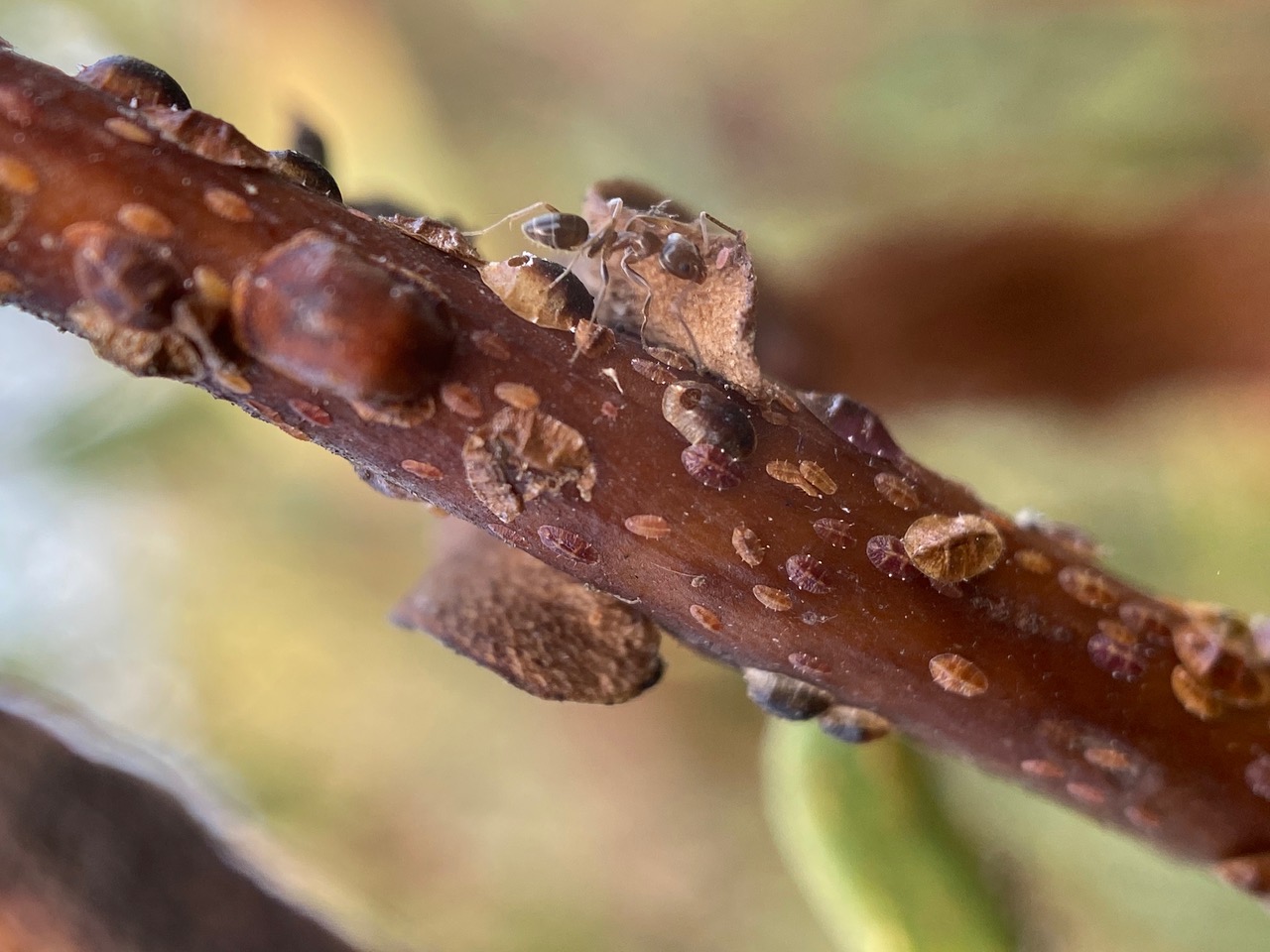
Some Argentine Ants, Linepithema humile (family Formicidae) are tending a colony of Brown Soft Scale, Coccus hesperidum (family Coccidae) on the stem of a Grindelia.
The Brown Soft Scale, Coccus hesperidum (family Coccidae) has a cosmopolitan distribution and feeds on many different host plants – crops, ornamental and greenhouse plants. The adult female scale insect is oval and dome-shaped, about 3-5 mm long. It retains its legs and antennae throughout its life. Males of the species are rarely found. The Brown Soft Scale is ovoviviparous and produces young mostly by parthenogenesis. Over the course of her life, the female may produce up to 250 eggs, a few being laid each day. The eggs are retained inside the insect until they hatch, at which time small nymphs emerge and are brooded for a few hours before dispersing. These first-stage nymphs are known as crawlers and move a short distance from the mother before settling and starting to feed. They have piercing-sucking mouthparts and feed on the host plant’s sap. They are largely sedentary for the rest of their lives and pass through two more nymphal stages before becoming adults. There may be 3-7 generations in a year. Males are occasionally produced and these pass through four nymphal stages before becoming winged adults.
In order to obtain all the nutrients they need, the scale insects ingest large quantities of sap. They then excrete the excess sugary fluid as honeydew. This is attractive to ants which often tend the scale insects, driving away predators.
The Argentine Ant, Linepithema humile (family Formicidae) is native to Northern Argentina, but it has been inadvertently introduced by humans to many countries, and is now an established invasive species in many Mediterranean climate areas worldwide. The success of the species can be attributed to their lack of aggression between the colonies. There is no apparent antagonism between separate colonies of its own kind, resulting in “super-colonies” that extend across hundreds or thousands of kilometers in different parts of the their range. Genetic, behavioral, and chemical analyses show that introduced Argentine Ants on separate continents actually represent a single global supercolony.
The Argentine Ants are ranked among the world’s worst invasive animal species. In its introduced range, the Argentine ant often displaces most or all native ants and can threaten native invertebrates and even small vertebrates that are not accustomed to defending against the aggressive ants. This can, in turn, imperil other species in the ecosystem, such as native plants that depend on native ants for seed dispersal, or lizards that depend on native ants for food.
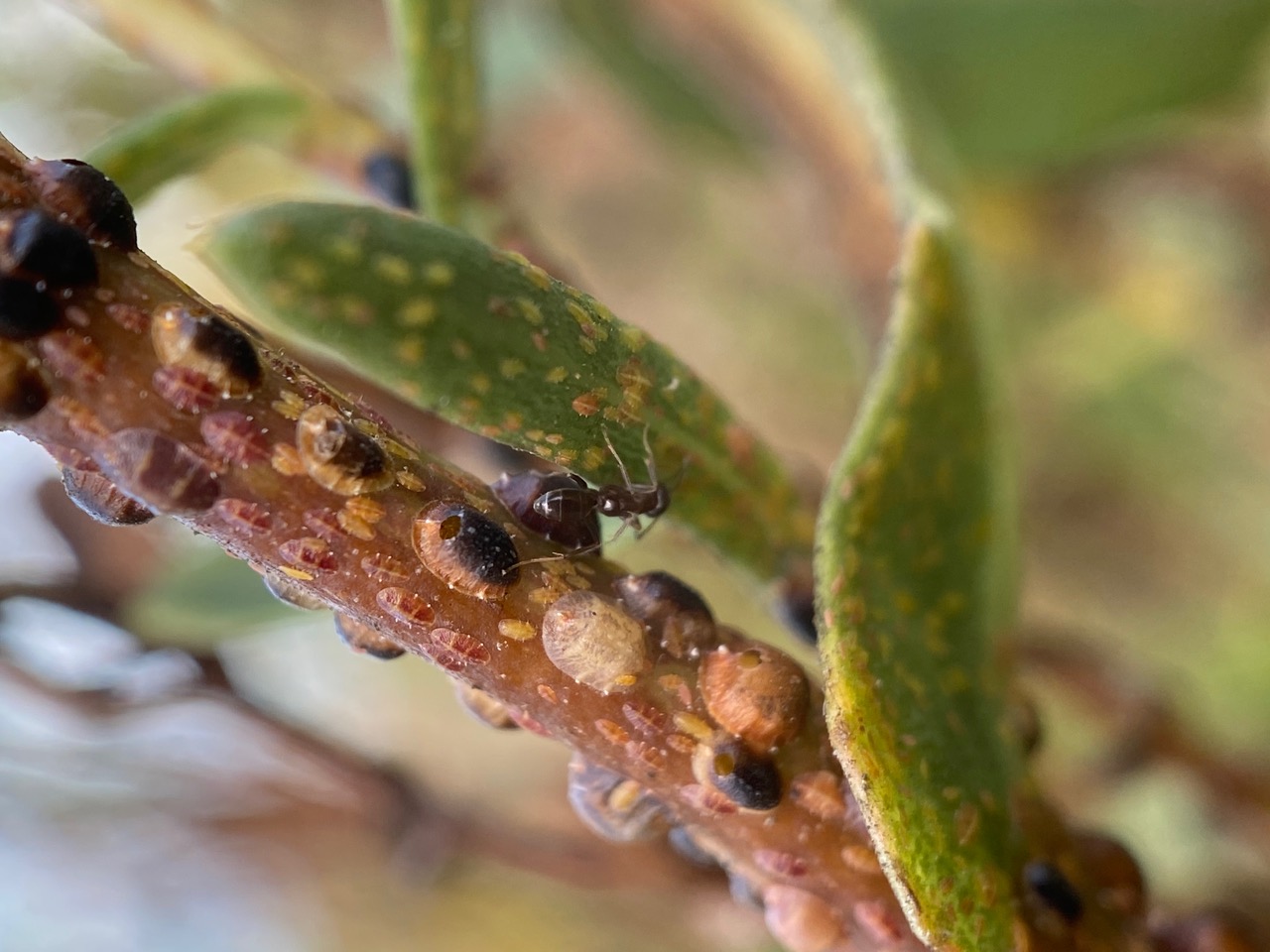
As the ants exit my view, I notice that many of the scale insects have a perfect round hole on their back.
The round openings are probably the exit holes made by a parasitoid wasp, Coccophagus sp.(family Aphelinidae). The most obvious evidence this tiny wasp is present is the blackening of scale nymphs that are normally brown. After the wasp completes its development and emerges as an adult a round hole in the top of the scale remains.
At least 26 Coccophagus species occur in California. Coccophagus lycimnia is the most abundant species, well studied and used as biological control agents against whitefly and scale insect pests in agriculture. The species can occur anywhere plants are infested with its host scales – fruit trees, nut crops, residential fruit and landscape tree, ornamental shrubs, and woody woodland plants. Adult wasps are about 1 mm long. The head and body are black except that adult females have a bright lemon yellow scutellum. Adult females investigate a scale by repeatedly touching it with their antennae. This commonly causes the scale to excrete a honeydew droplet, which the wasp consumes. Consuming honeydew increases adult parasitoid longevity. Eggs are deposited on the dorsal side of the scales at different locations depending on the size of the host. Female Coccophagus lycimnia prefer to oviposit in second instar hosts. Her fertilized eggs produce females and unfertilized eggs produce male wasps. As oviposition takes only a few seconds, the female wasps usually avoid being attacked by the ants tending the scales. The wasp larva feeds on the host from the inside, and pupation takes place inside the scale. The adult wasp emerges by making an exit hole in the scale body. C. lycimnia has multiple generations per year.
I look around the same plant, and find numerous parasitized scale nymphs with round holes on their backs. In fact, a significant percentage of the larger scales have been parasitized.
There are two more parasitized scales near the ant. It is so cool to see that there is natural biological pest control for the wild Grindelia out here!
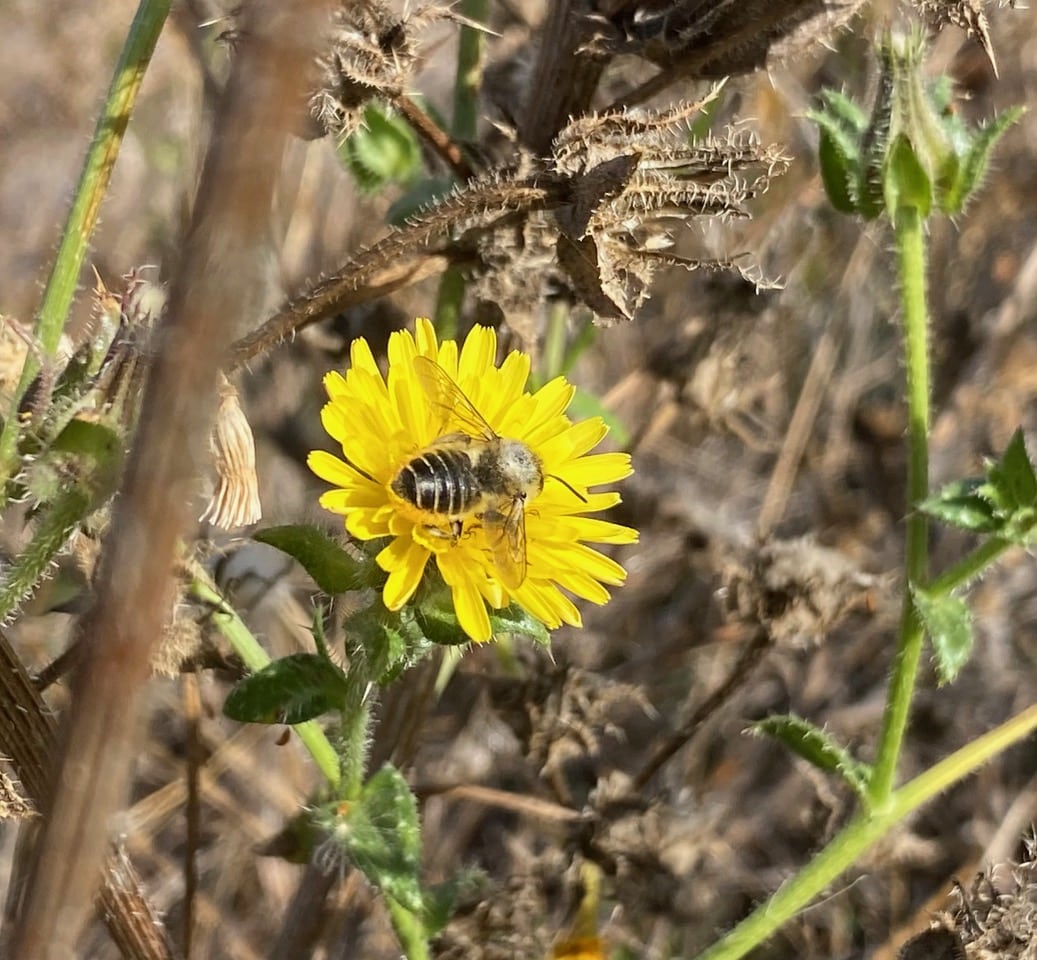
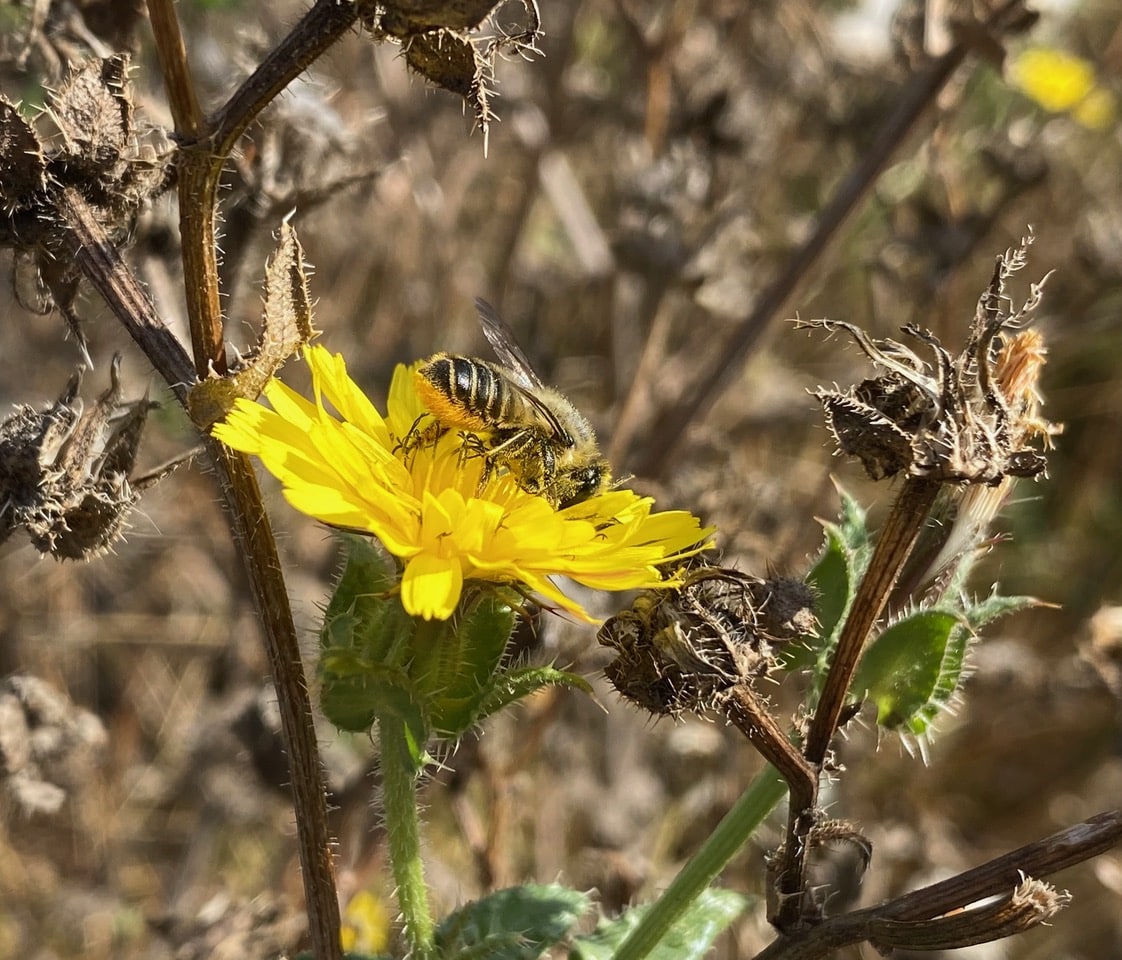
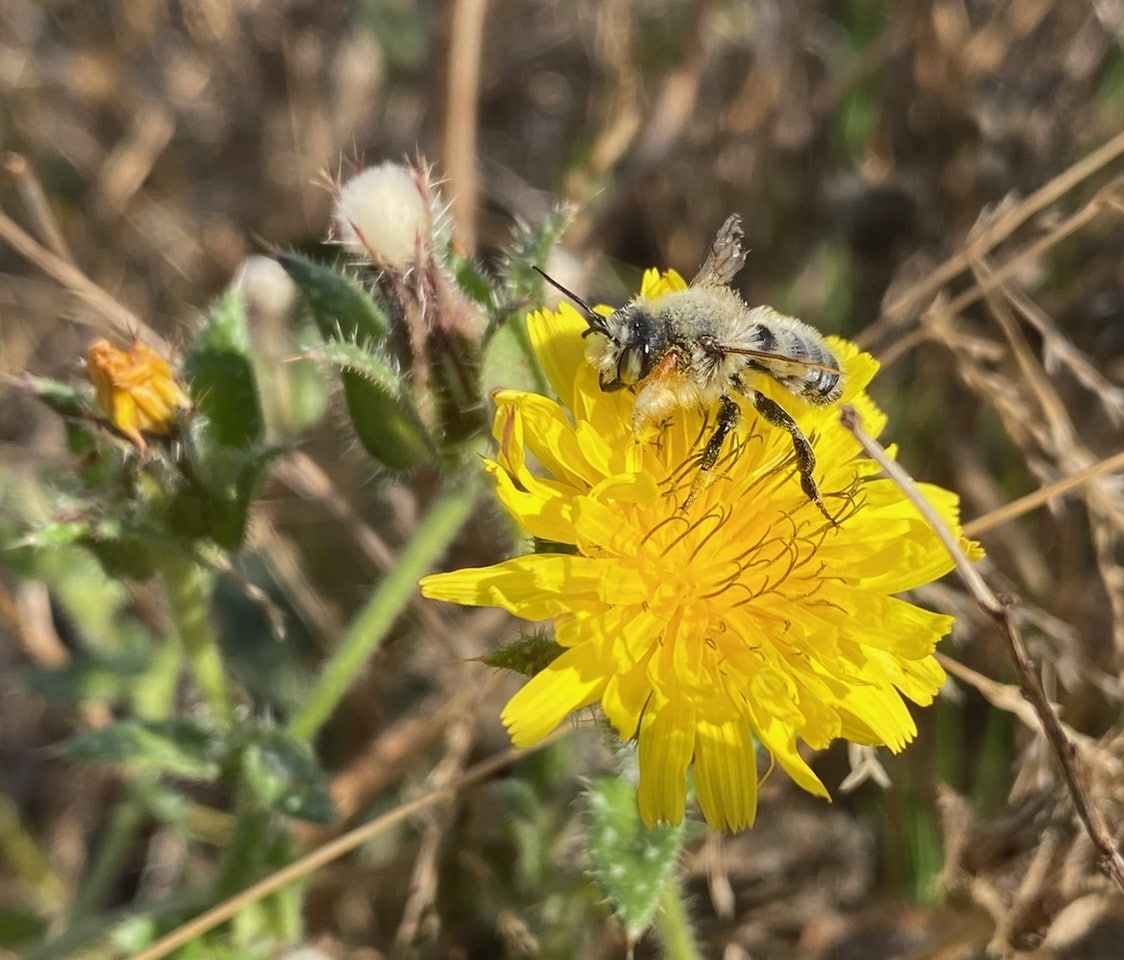
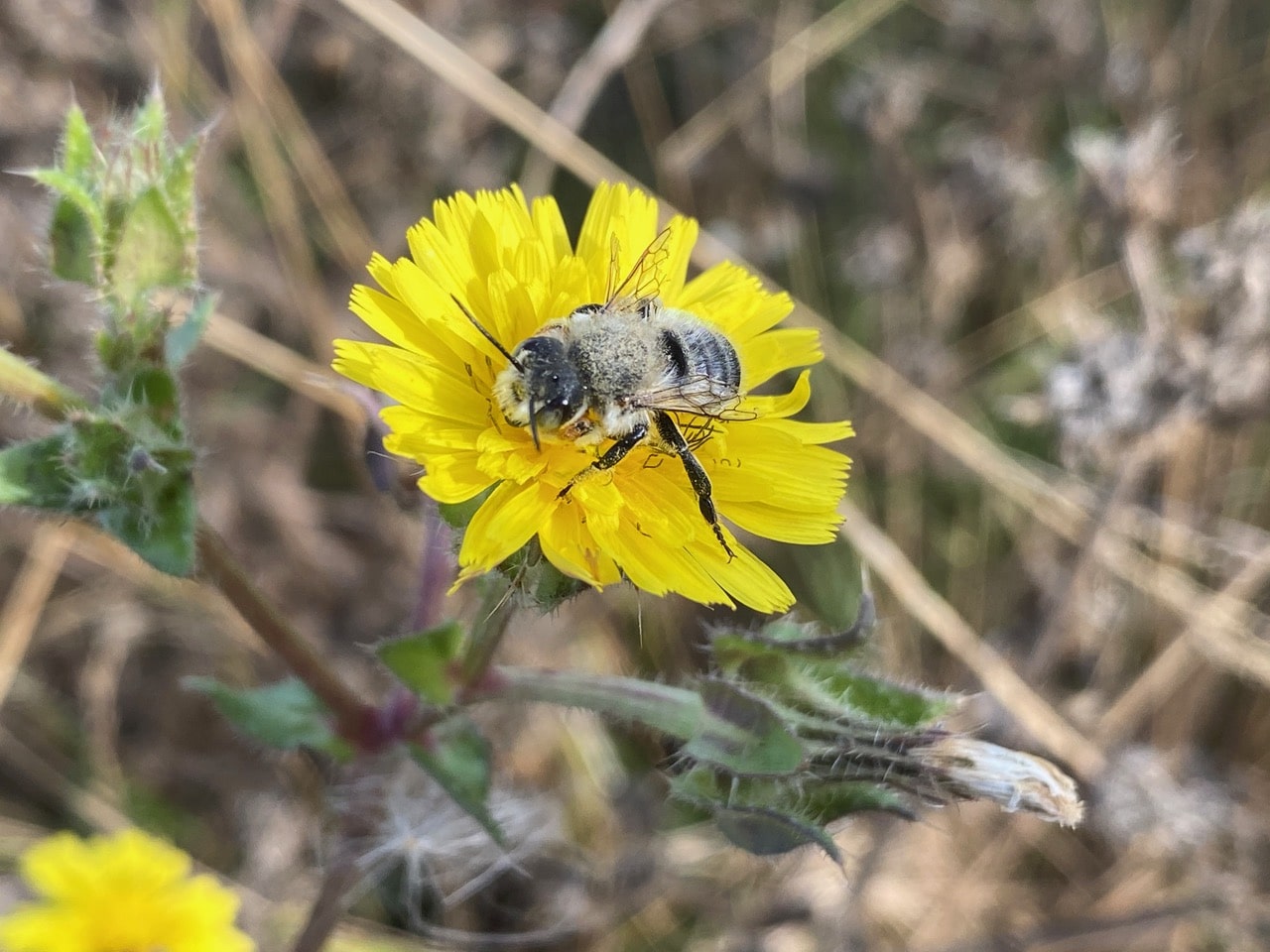
As the morning heats up, more bees begin to appear on the scene. A female Western Leafcutter Bee, Megachile perihirta (family Megachilidae) lands on a flowerhead of Bristly Oxtongue, her abdominal scopa already yellow with pollen.
Leaf-cutter Bees, Megachile sp. (family Megachilidae) are stout-bodied, usually with pale hair on the thorax and stripes of white hairs on the abdomen. Females usually have a triangular abdomen with a pointed tip, and males’ faces are covered with dense, pale hair. Flight season is from May into September, with peak activity from June to August.
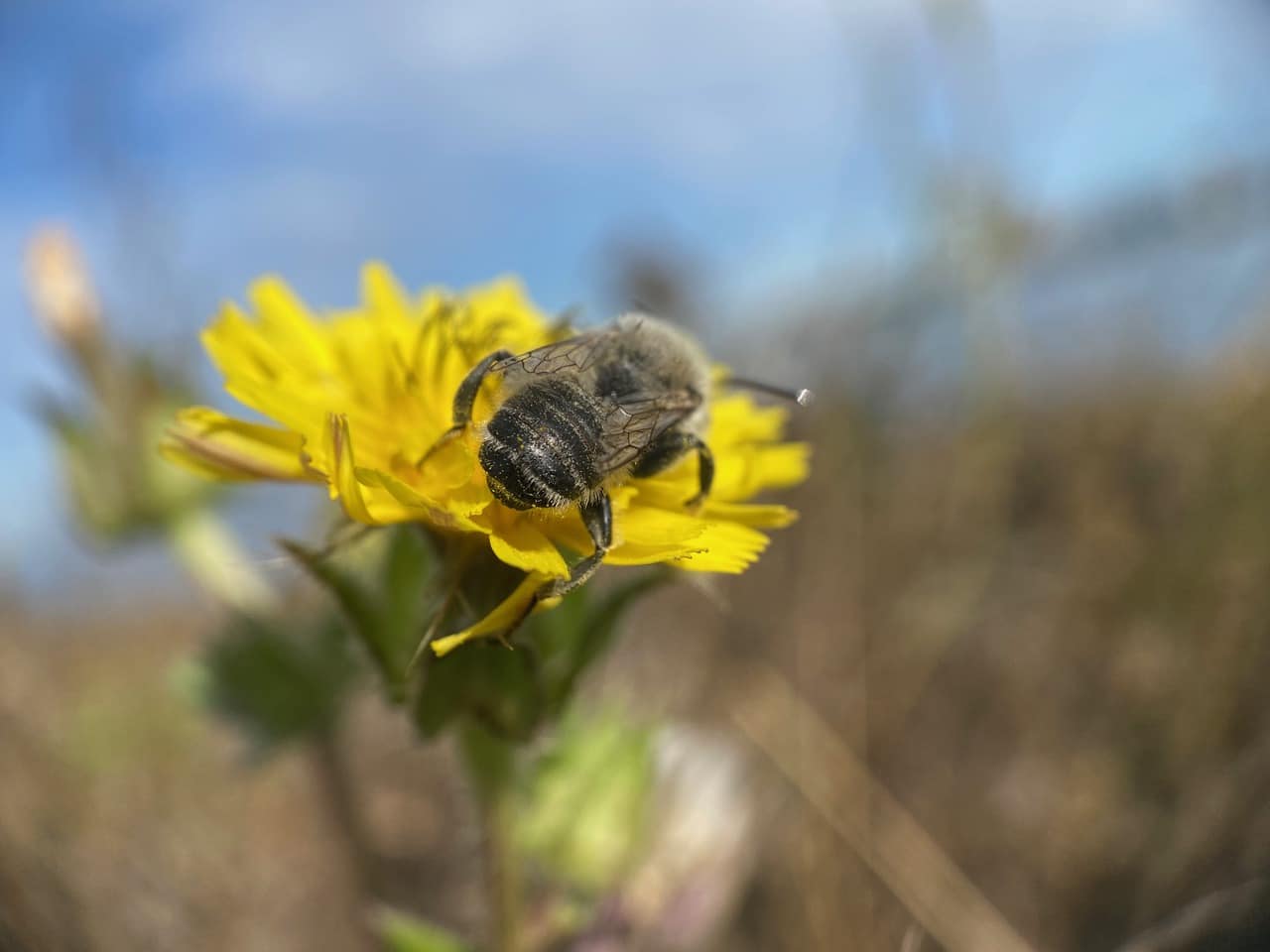
Solitary females construct nests in tubular cavities, including hollow stems, tree holes, and abandoned beetle burrows in wood. Many use holes drilled into wood, straws, or other manufactured tunnels. Females cut pieces from leaves or flower petals for use in the construction of brood cells. Most Megachile females are generalists when foraging for pollen. Pollen is transported in dense scopae on the underside of the abdomen.
Photos of Western Leafcutter Bee (Megachile perihirta) · iNaturalist
The shaggy hairs of the female’s abdominal scopa is visible from this angle.
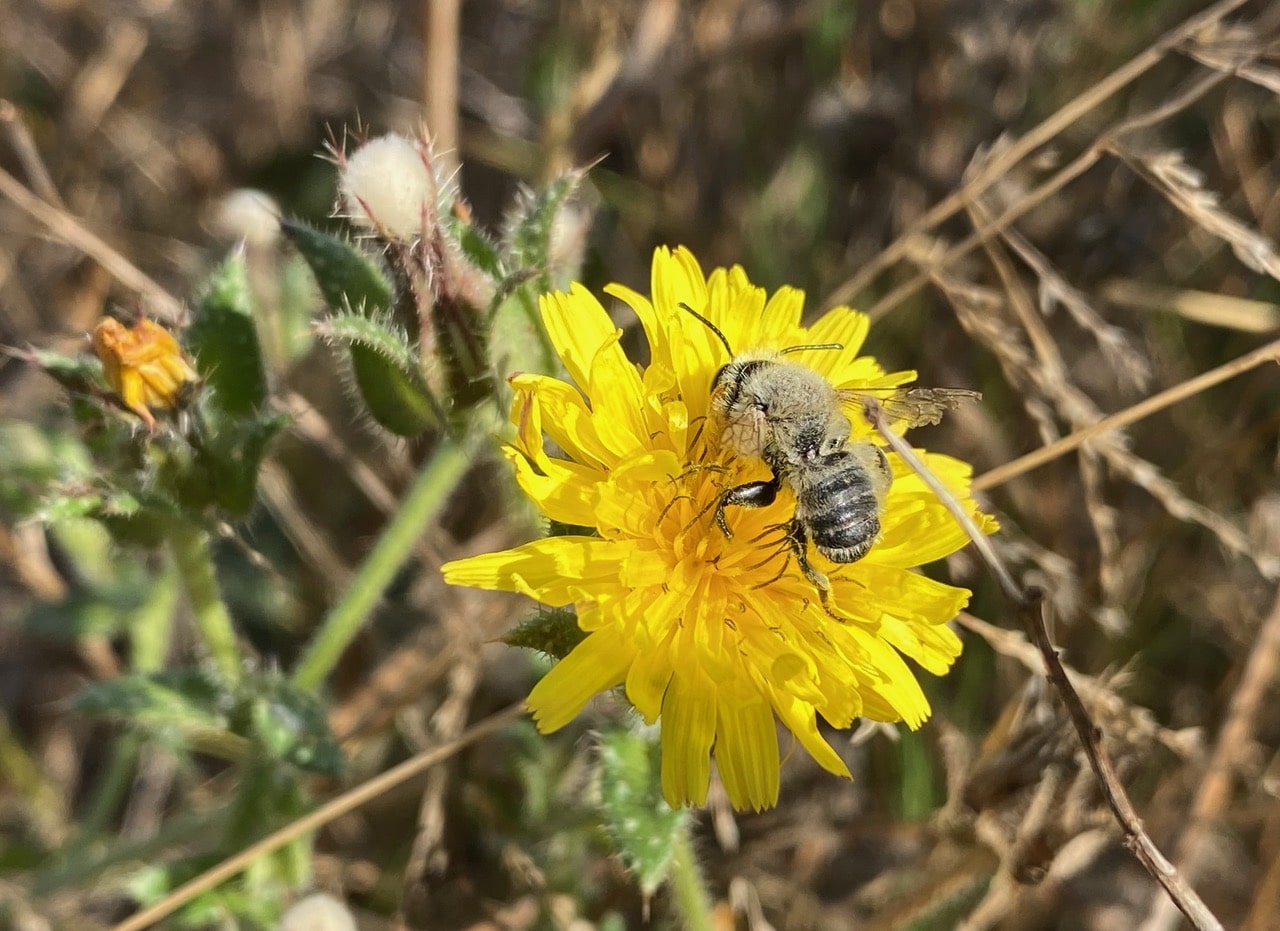
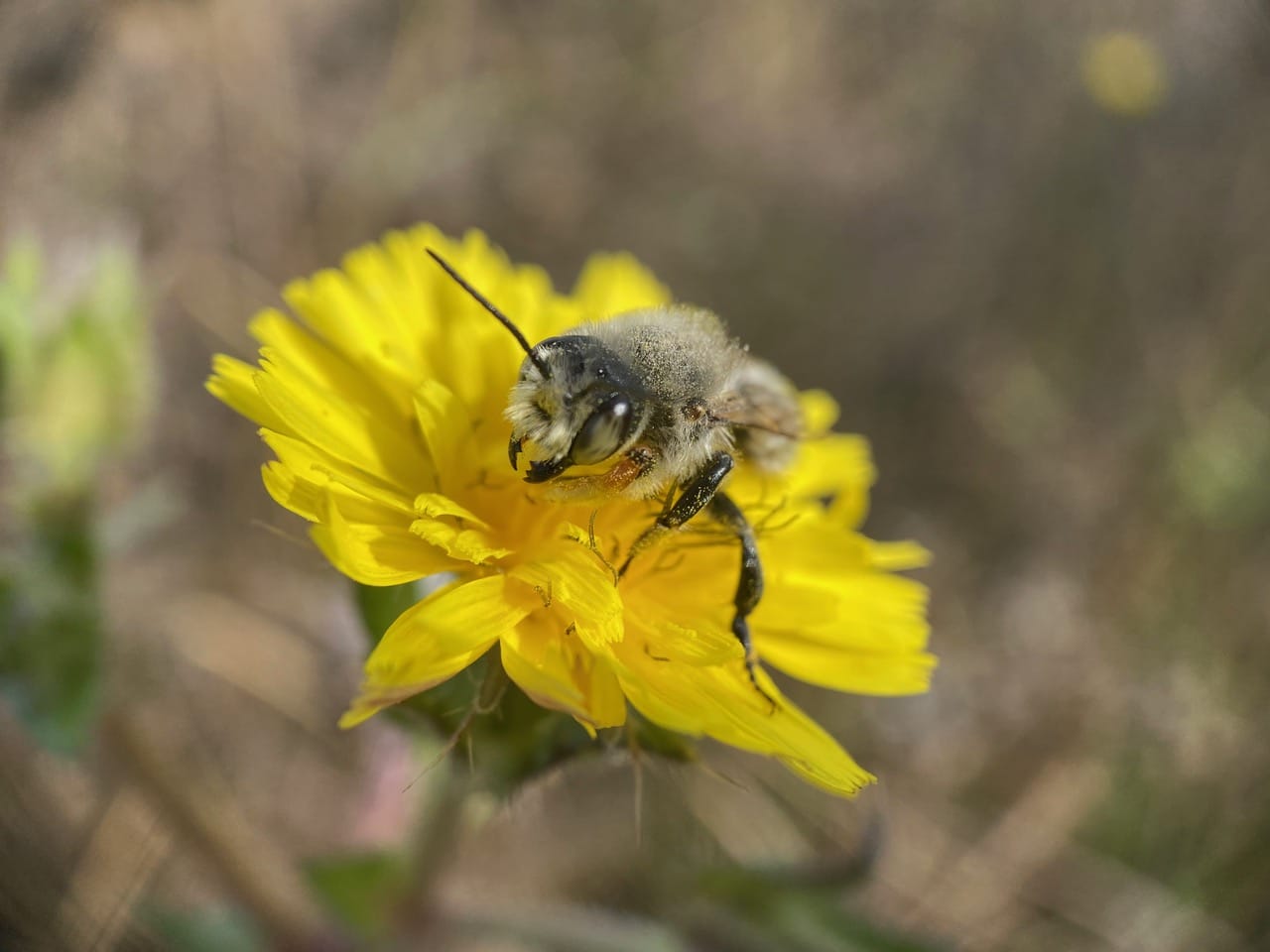
A few steps further, I encounter this scruffy male Western Leafcutter Bee, Megachile perihirta (family Megachilidae) visiting a Bristly Oxtongue flowerhead. He has seen better days – his wings are tattered and his abdomen missing a lot of hair.
Note the unusual front legs of the male Western Leafcutter Bee. It is an orange-brown color and tufts of white hairs come off the fringes.
Males of some species of Megachile (including M. perihirta) have enlarged forelegs with long border hairs. They use these to cover the eyes of females while mating, presumably as blinders to calm them and increase receptivity.


Note the serrated mandibles of the male Western Leafcutter Bee. Females have even larger and more powerful mandibles that they use to cut leaves and petals to line their nest cells. The family name Megachilidae means “big jaws”, referring to their large mandibles.
The male has lost the upper part of his mustache as well.
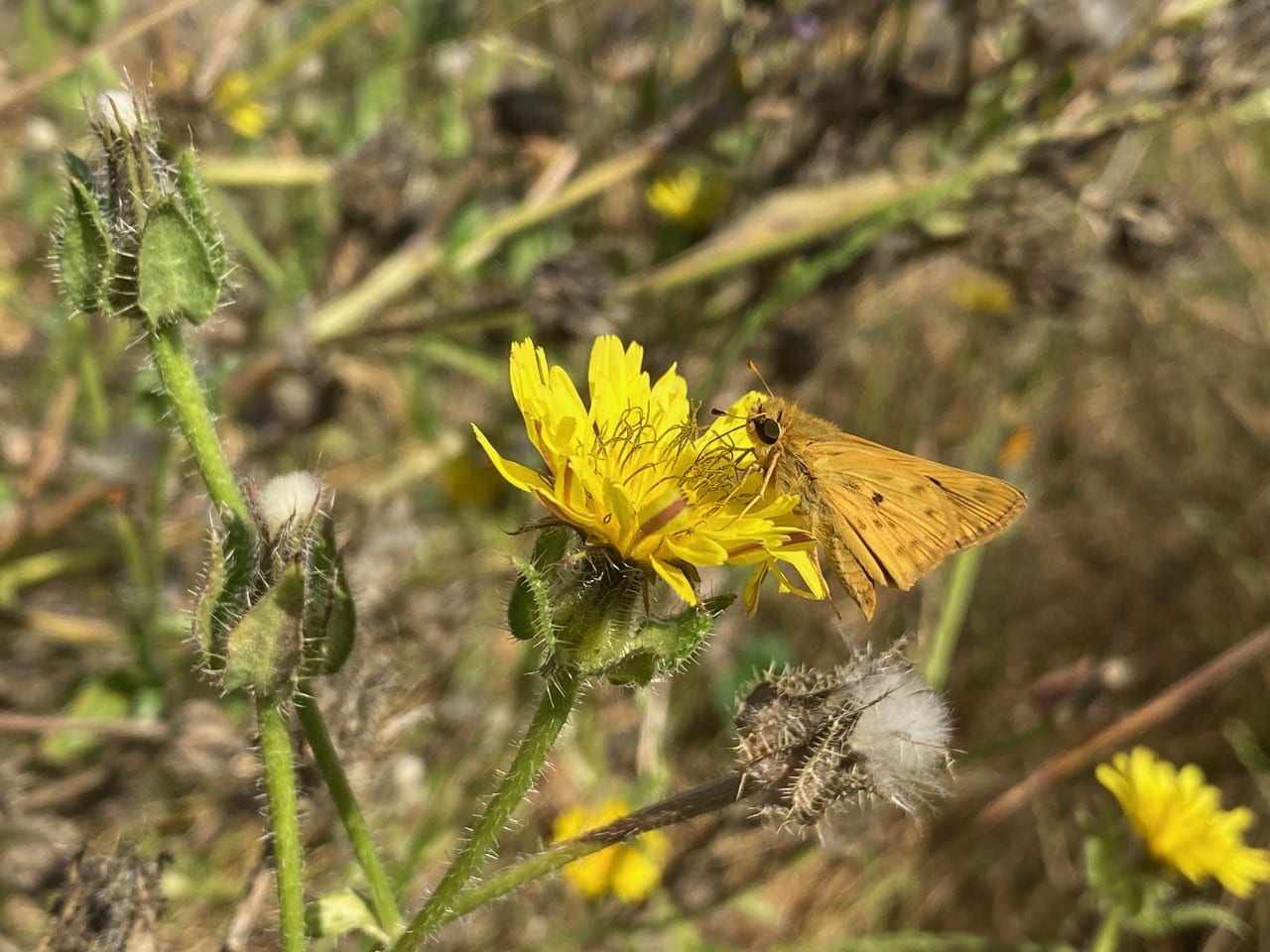
A Fiery Skipper, Hylephila phyleus (family Hesperiidae) is taking nectar from a Bristly Oxtongue flowerhead.
The Fiery Skipper, Hylephila phyleus is a species of butterfly in the family Hesperiidae. The species has a wide range in North and South America. At about 1 inch in length, males are orange or yellow while the females are dark brown. In both sexes, small brown spots are seen on both the hindwings and forewings. Like other skippers, the Fiery Skippers often hold their wings in a “triangle” shape – the forewings held upright, and the hindwing folded flat. This position is thought to better absorb the sun’s rays. The butterfly’s flight is described as rapid and darting. Fiery Skipper larvae are greenish pink-grey with a black head and constricted neck. These caterpillars are often considered pests as they feed on many species of turfgrass.