

Pollinator Post 10/4/24 (1)
Avoiding the extreme heat and poor air quality, I have not visited the Shoreline Park at Bay Farm Island for the past few days. I arrive early today to avoid the heat, curious to see how the extreme weather is affecting the insects here.
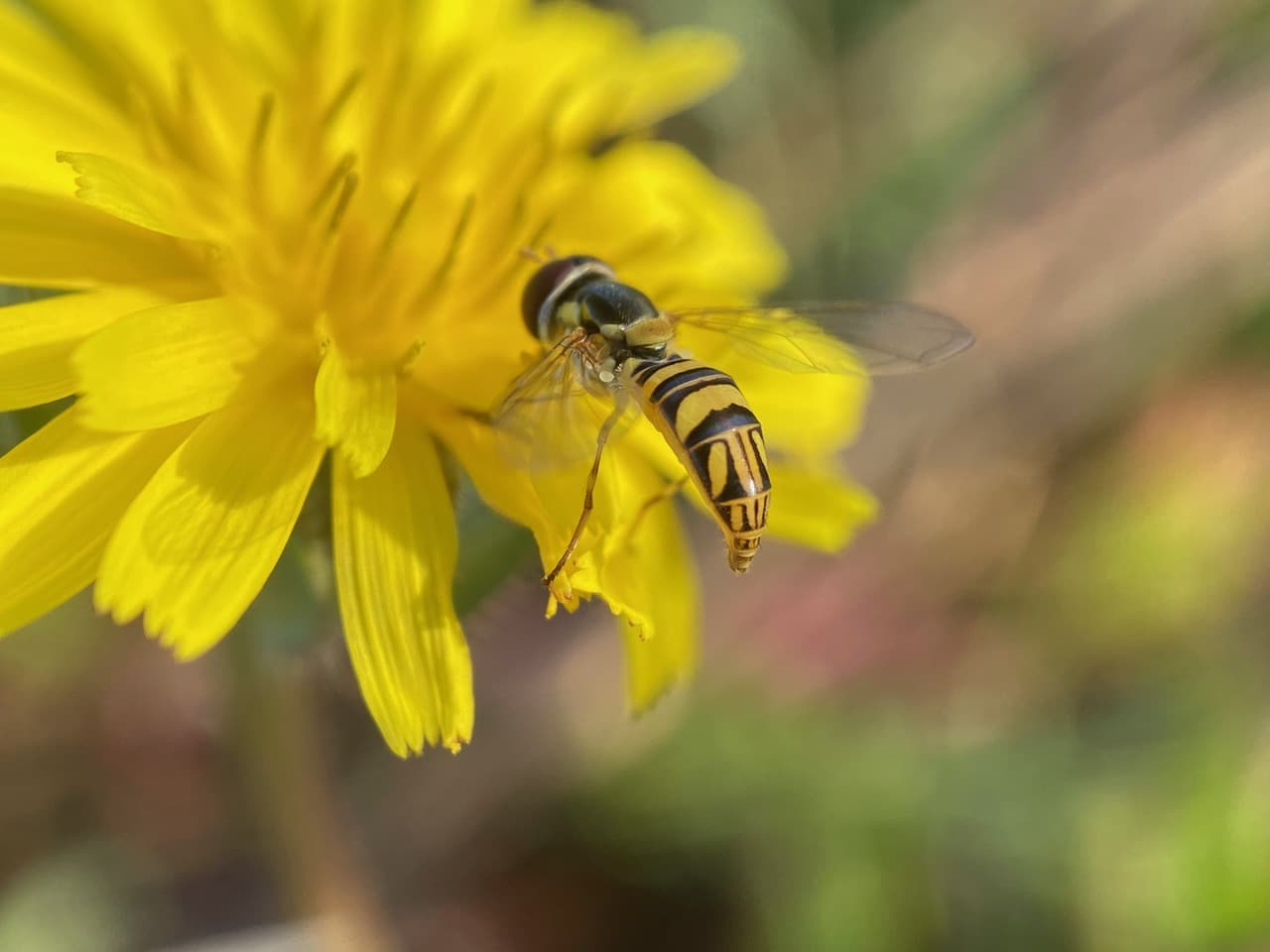
A female Oblique Streaktail, Allograpta obliqua (family Syrphidae) is out early, foraging on the flowerhead of Bristly Oxtongue, Helminthotheca echioides.
The Oblique Streaktail, Allograpta obliqua (family Syrphidae) is a common North American species of hoverfly. Adults are 6-7 mm long. Females have a tapered abdomen that ends in a pointed tip. Eggs are laid on surfaces of leaves or stems near aphids. The larvae are important predators of aphids. Adults visit flowers for nectar and pollen, and are pollinators.

The early morning sun lights up the translucent red abdomen of a Common Grass Skimmer, Paragus haemorrhous (family Syrphidae) perched head-down on a twig.
The Common Grass Skimmer, Paragus haemorrhous (family Syrphidae) is easily the smallest hover fly I know, measuring only about 4 mm in length. The species has a world-wide distribution, found in unimproved grassland, dune grass, open areas and pathsides in forest, and meadows. Adults visit flowers for nectar and pollen. Larvae feed on aphids on low herbaceous plants.

Backlit by the morning sun, an extensive, messy spider web shows up prominently on a dead Oregon Gumweed, Grindelia stricta.
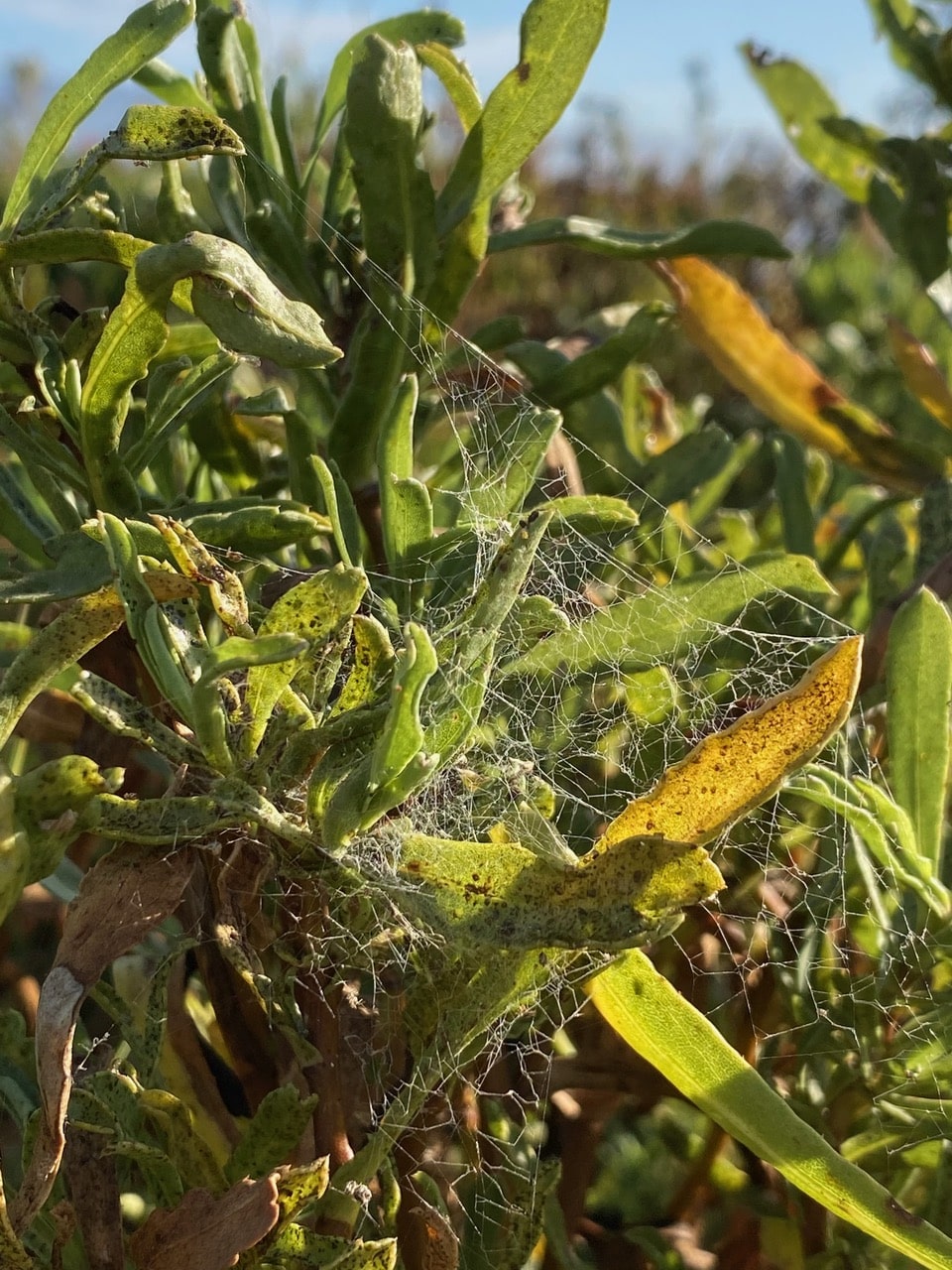
A similar spider web has been constructed on a live but yellowing Grindelia. The web most likely belongs to a Grey House Spider, Badumna longinqua (family Desidae).
Badumna longinqua (family Desidae) is native to eastern Australia, but it has increased its global range to north and south America, South Africa, and Japan. In the United States, B. longinqua is usually found in woodlands, along immediate coastal areas, within agricultural ecosystems, and recently in vineyards. It is usually the spider found in tangles of leaves held together by messy webs on the outermost upper fringes of small shrubs in the suburbs. Although also abundant around homes and buildings, the spiders are not often seen as it feeds at night and will stay hidden in its retreat during the daytime.
The female B. longinqua spider can potentially spend her entire life in one same web, while the mature males tend to roam in search of mates. As a starting point for its web, the spider first finds a satisfactory hiding place, such as a crack or small opening to funnel out its web from, which it then interlines with silk. From this tubular entrance, it builds a multitude of ladder-like webs in a radiating fashion. Badumna spiders use cribellate silk which is produced from numerous tiny silk glands underneath a specialized spinning organ called a cribellum. The cribellum surface is covered by hundreds of thousands of tiny, elongate spigots which each produces an extremely thin single fibril of cribellate silk merely tens of nanometers thick. All spigots act together to produce a single cribellate thread made up of thousands of silk fibrils. The fibers are so small in diameter that they are strongly subject to Van der Waals forces. In addition, the fibers have a surface that absorbs waxes from the epicuticle of insect prey on contact. This creates a powerful adhesion without any liquid glue. Cribellate spiders possess a row of toothed bristles, the calamistrum on the hind legs that they use to comb out the silk, producing a woolly texture.
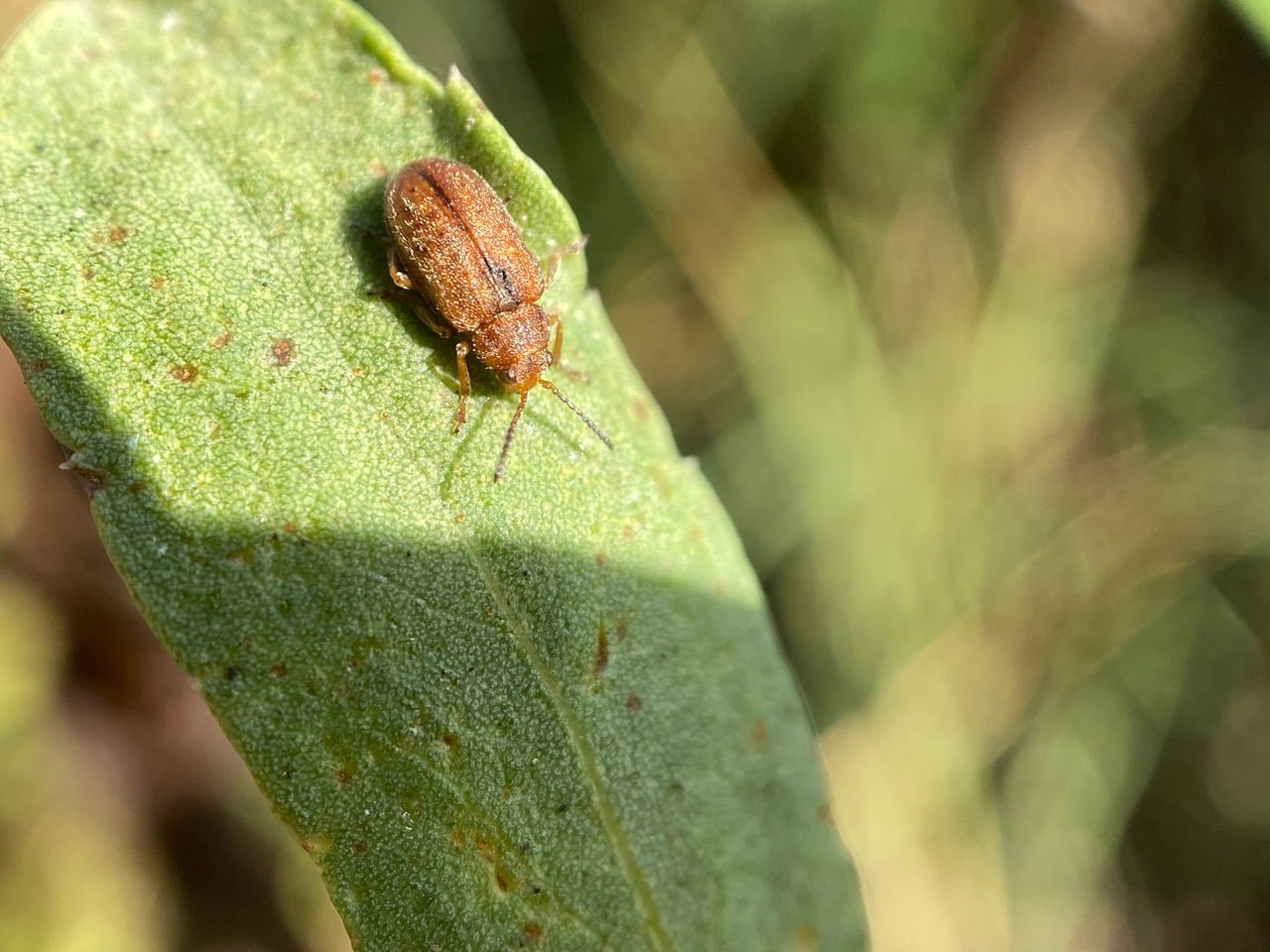
A tiny Leaf Beetle (family Chrysomelidae) is resting on a Grindelia leaf.
Leaf Beetles in the family Chrysomelidae make up one of the largest and most commonly encountered beetles. They are all phytophagous – both adults and larvae feed on all sorts of plant tissues. All species of Chrysolina are phytophagous, feeding on specific food plants, and some of them have been used for biological control of weeds.

The Grindelia that are heavily infested with Lace Bugs (family Tingidae) are turning yellow, their foliage spotted with black Sooty Mold that grows on the honeydew excreted by the bugs. Surprisingly the bugs are difficult to find today. Have they moved on to greener pastures? Or is this the end of their season? How do the bugs overwinter?

Three adult Lace Bugs, Corythucha sp. (family Tingidae) can be seen on the tip of this Grindelia leaf.
The Tingidae are a family of very small (2-10 mm) insects in the order Hemiptera that are commonly referred to as lace bugs. They are called lace bugs because the pronotum and fore wings of the adult have a delicate and intricate network of divided areas that resemble lace. Their body is flattened dorsoventrally, and the head is often concealed under the hood-like pronotum. Lace Bugs feed by sucking sap from plants, extracting the protein they need and excreting liquid waste as honeydew. The most common symptom of feeding is the stippled and mottled yellowish foliage. In heavy infestations, black sooty mold may develop on the honeydew, impairing photosynthesis by the plant. This may result in some dieback of twigs and branches and a reduction in flowering the following year. Tingids are usually host-specific and can be very destructive to plants. Each individual usually completes its entire lifecycle on the same plant, if not the same part of the plant.
The genus Corythucha is primarily distributed in the northern hemisphere, including Europe, North America and eastern Asia.
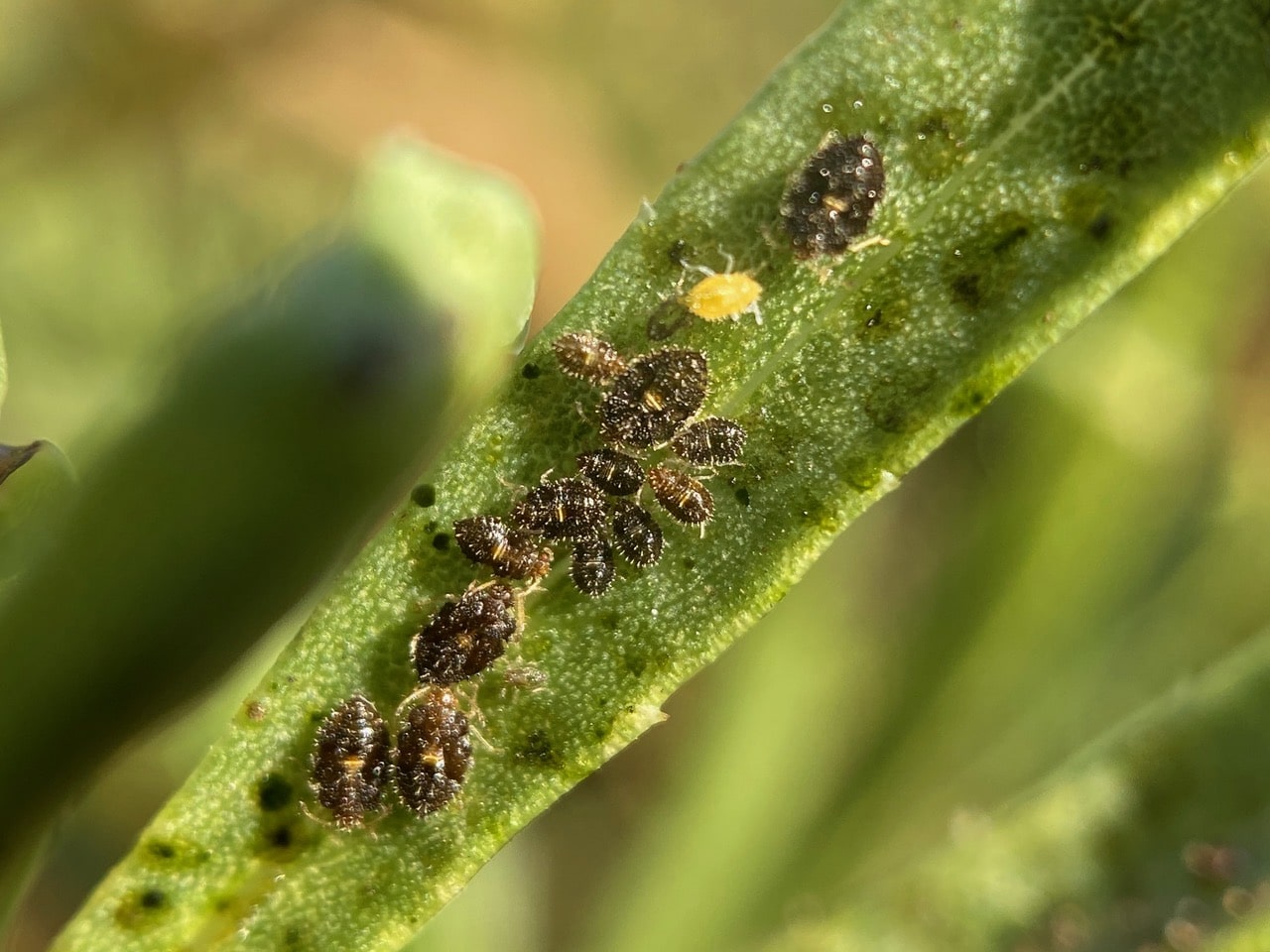
These are the bristly black nymphs of the Lace Bugs, Corythucha sp. (family Tingidae). The yellow one might be a freshly molted nymph.
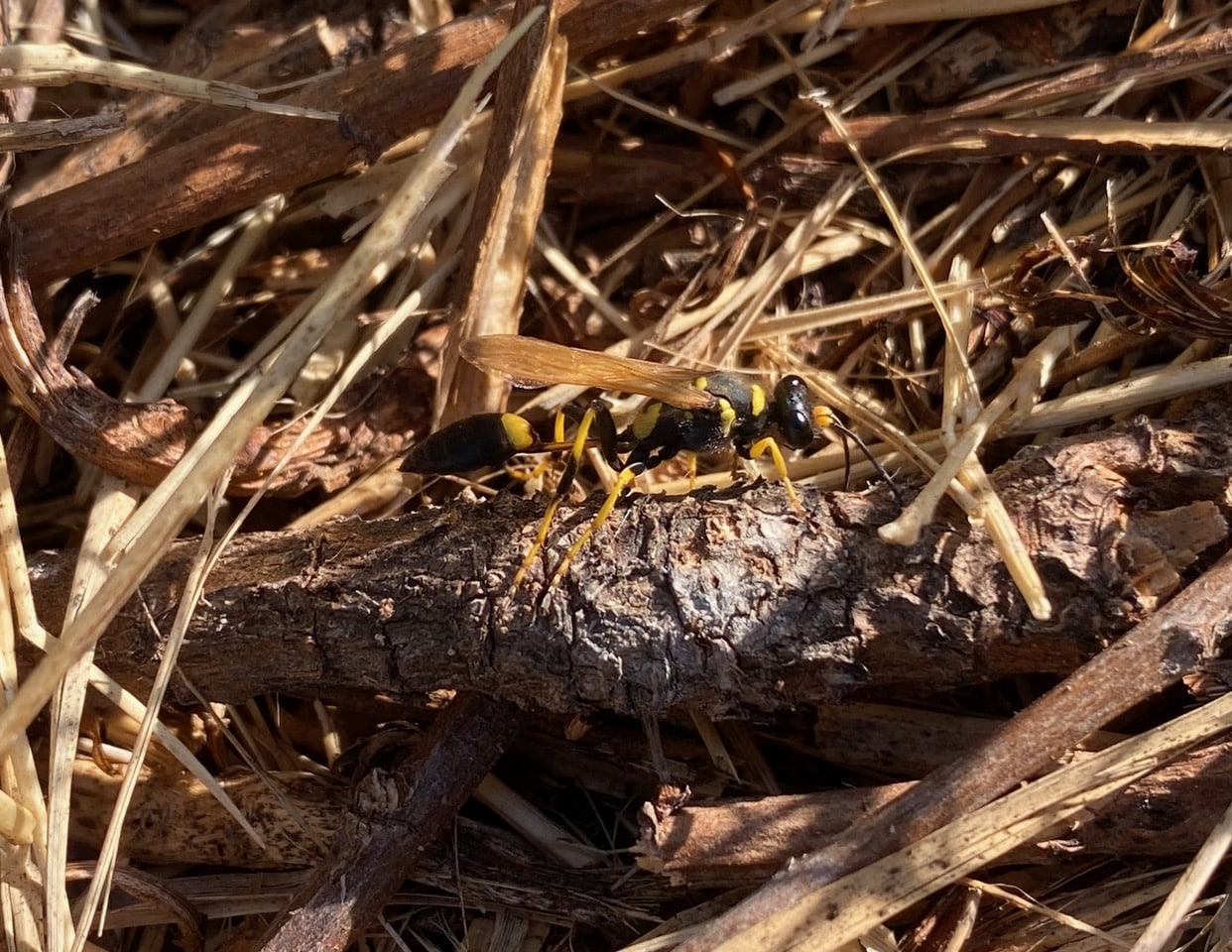
Stepping into the wet section of the trail, I keep a lookout for the Mud Daubers collecting mud for their nest construction. Sure enough, here’s one running around on the leaf litter by the path.
The Yellow-legged Mud-dauber, Sceliphron caementarium (family Sphecidae) is widespread in the Americas. The species is found in a wide variety of habitats, such as rock ledges, man-made structures, puddles and other water edges. The wasp can reach a length of 24-28 mm. They are generally black with yellow markings, with impossibly long and skinny “waist”. They are solitary parasitoid wasps that build nests out of mud. Females collect mud balls at puddles and pool edges for constructing nests. The nests comprise up to 25 vertically arranged, individual cylindrical cells. Eventually the cells are covered over as a cluster by more mud, forming a smooth structure the size of a human fist. Nest constructed, the female wasp goes hunting for spiders. The prey are stung and paralyzed and placed in the cell, usually 6-15 per cell. A single egg is laid on the prey within each cell. The wasp then seals the cell with a thick mud plug. The larva that hatches out feeds on the spiders, pupates in the cell and emerges as an adult, breaking out of its mud nursery. Adult wasps can be seen in mid-summer feeding on nectar at flowers.
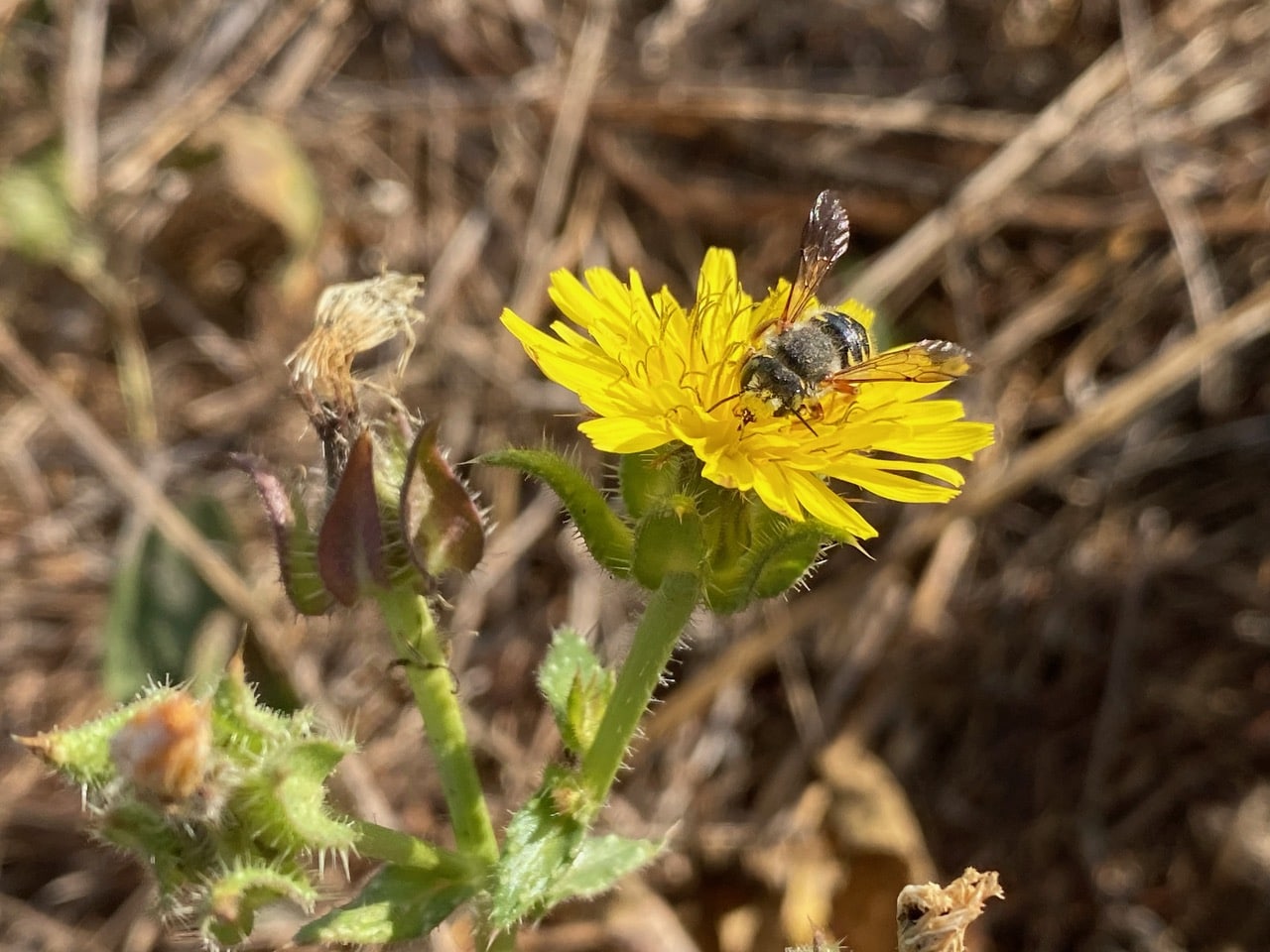
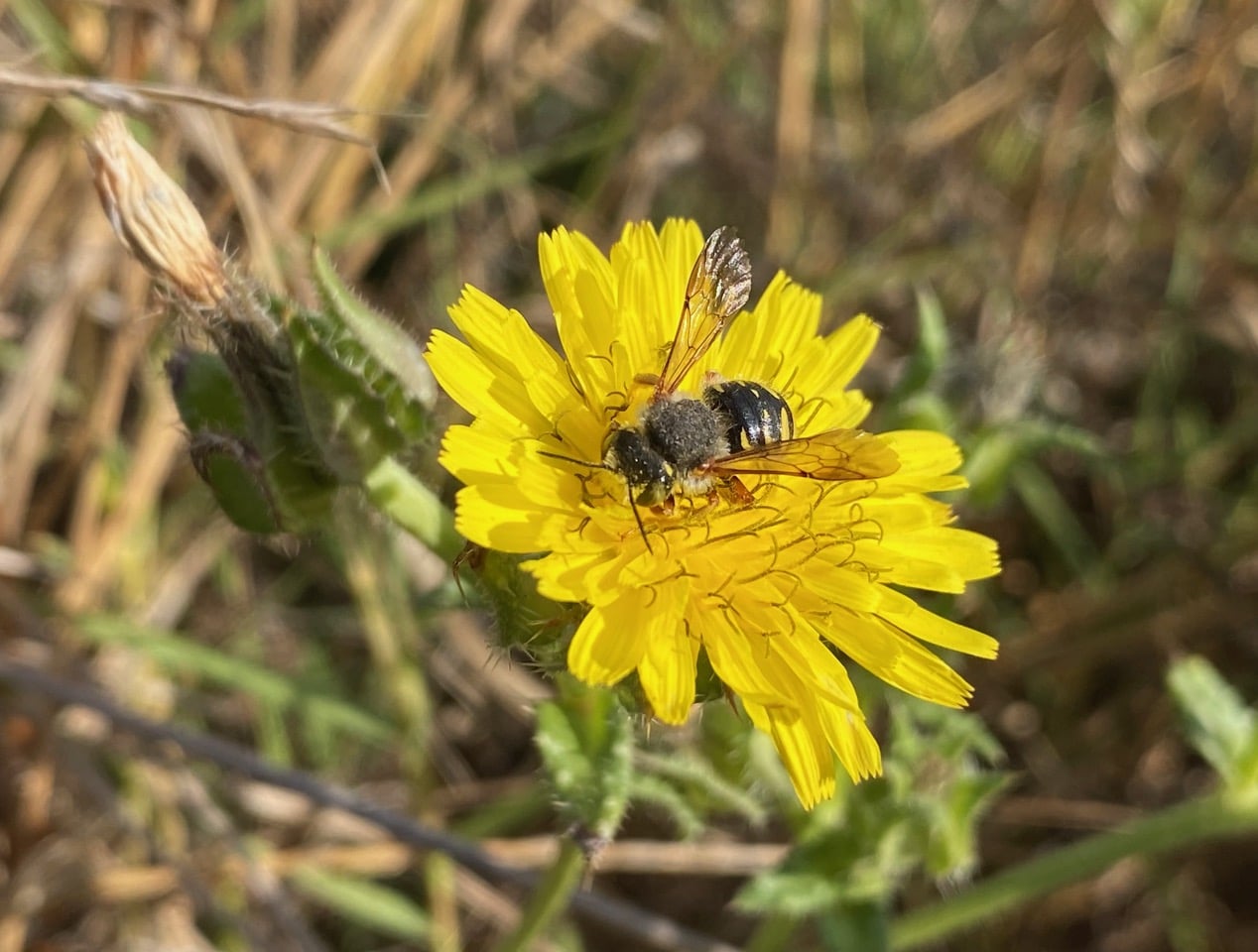
Ooh, a small bee has landed on a flowerhead of Bristly Oxtongue, Helminthotheca echioides. It holds up its orange-tinged wings wasp-like the whole time it is foraging.
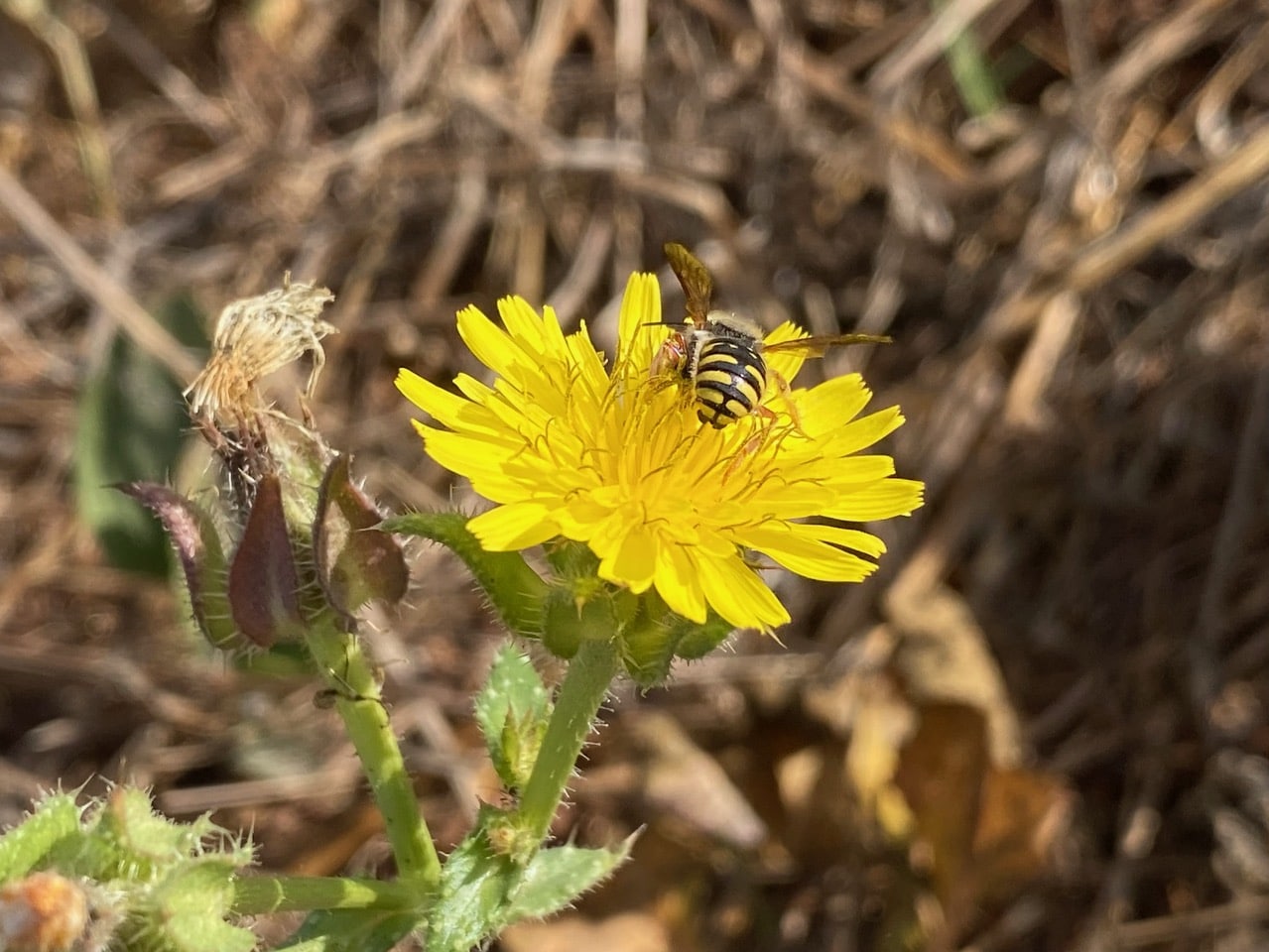
The black-and-yellow pattern on its abdomen tells me that it is probably a Woolcarder Bee, Anthidium sp. (family Megachilidae). The large size, and the prominent prongs at the tip of its abdomen tell me that it is a male. Which species?
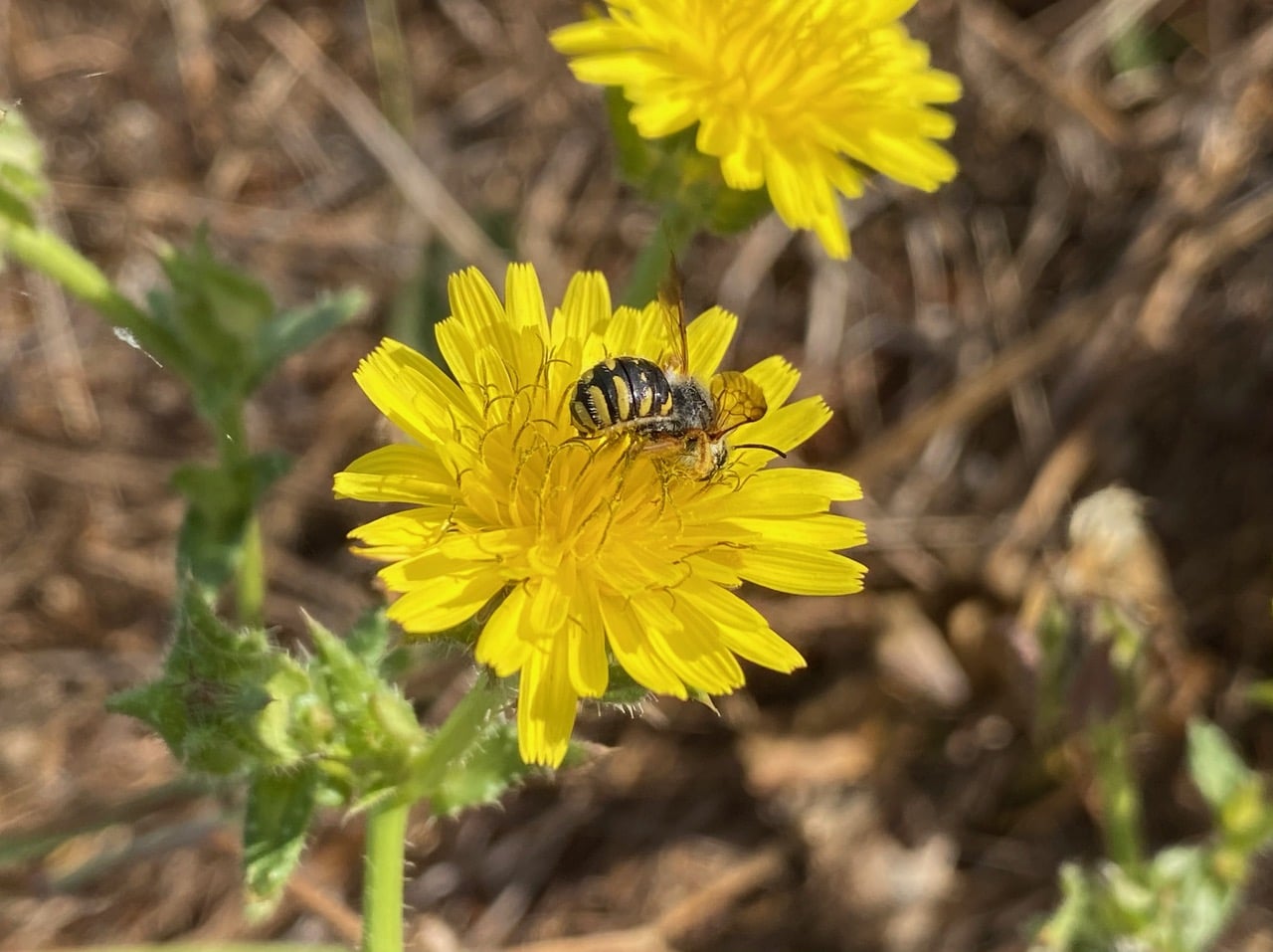
Usually feisty, wary and frenetic, this individual is so intent on drinking nectar that it doesn’t seem to be bothered by my presence.
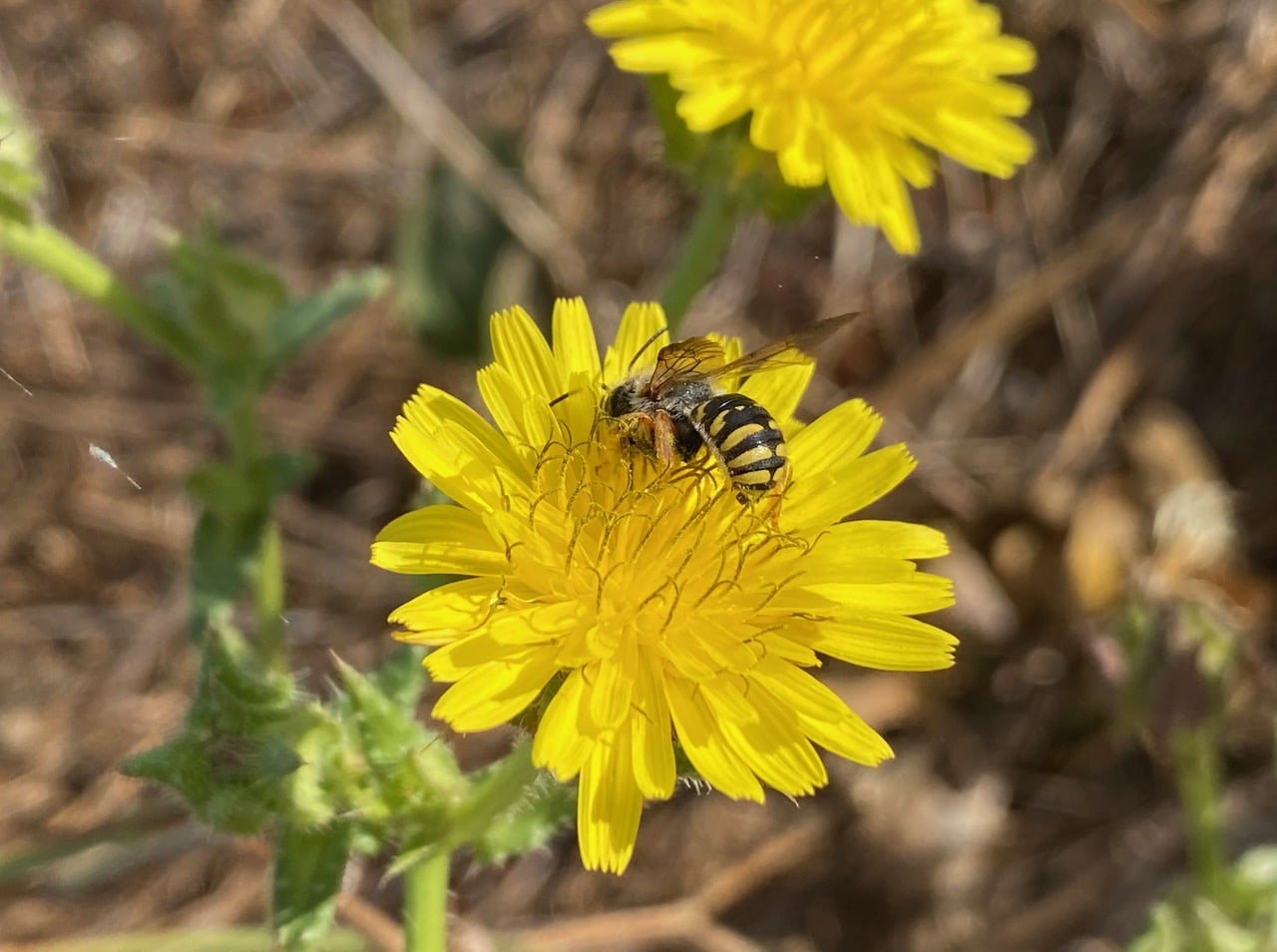
Woolcarder Bees belong in the family Megachilidae, which includes the leaf-cutter bees and mason bees. They get the name “carder” from the behavior of the females scraping hair from leaves and stems of wooly plants. The substantially larger males engage in territorial behavior, aggressively chasing other males and pollinators from their territory. They mate with the females that forage in their territory. The females construct their nests in pre-existing cavities, using the hairs of wooly plants that they collect with their sharply toothed mandibles. They then roll up the fibers into a ball and transport them to the nest to line the nest cell, where they lay an egg and a provisioning mass consisting of nectar and pollen. Females largely use the hairs of plants in the mint family, Lamiaceae, especially those of genus Stachys and Betonica. The European Woolcarder Bees visit a wide range of flowers, with a preference for blue flowers that have long throats. They are considered generalists. Females carry pollen in the scopa on the underside of their abdomen. Both males and females can hover in midair near flowers similar to the hover flies (family Syrphidae).

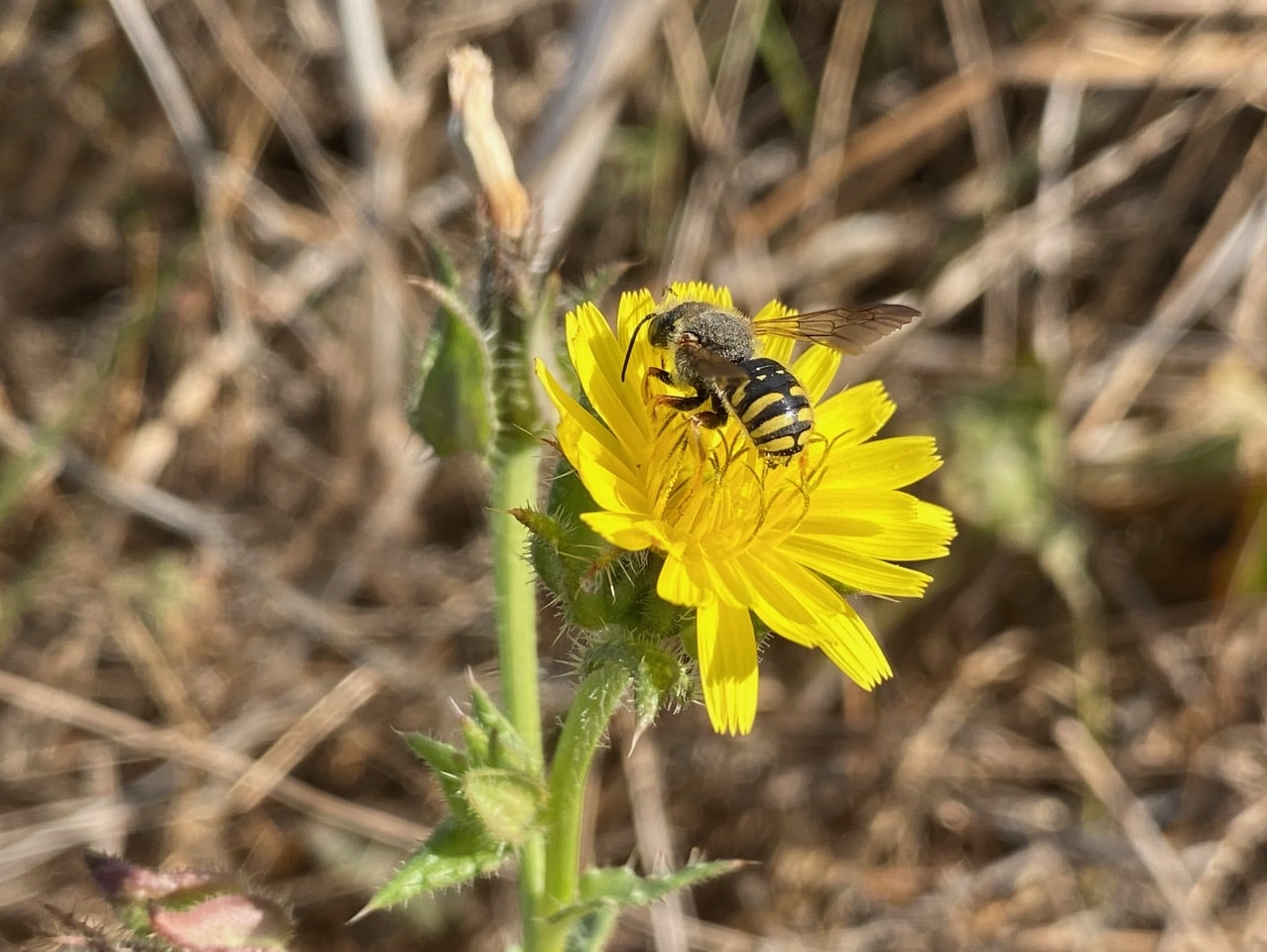
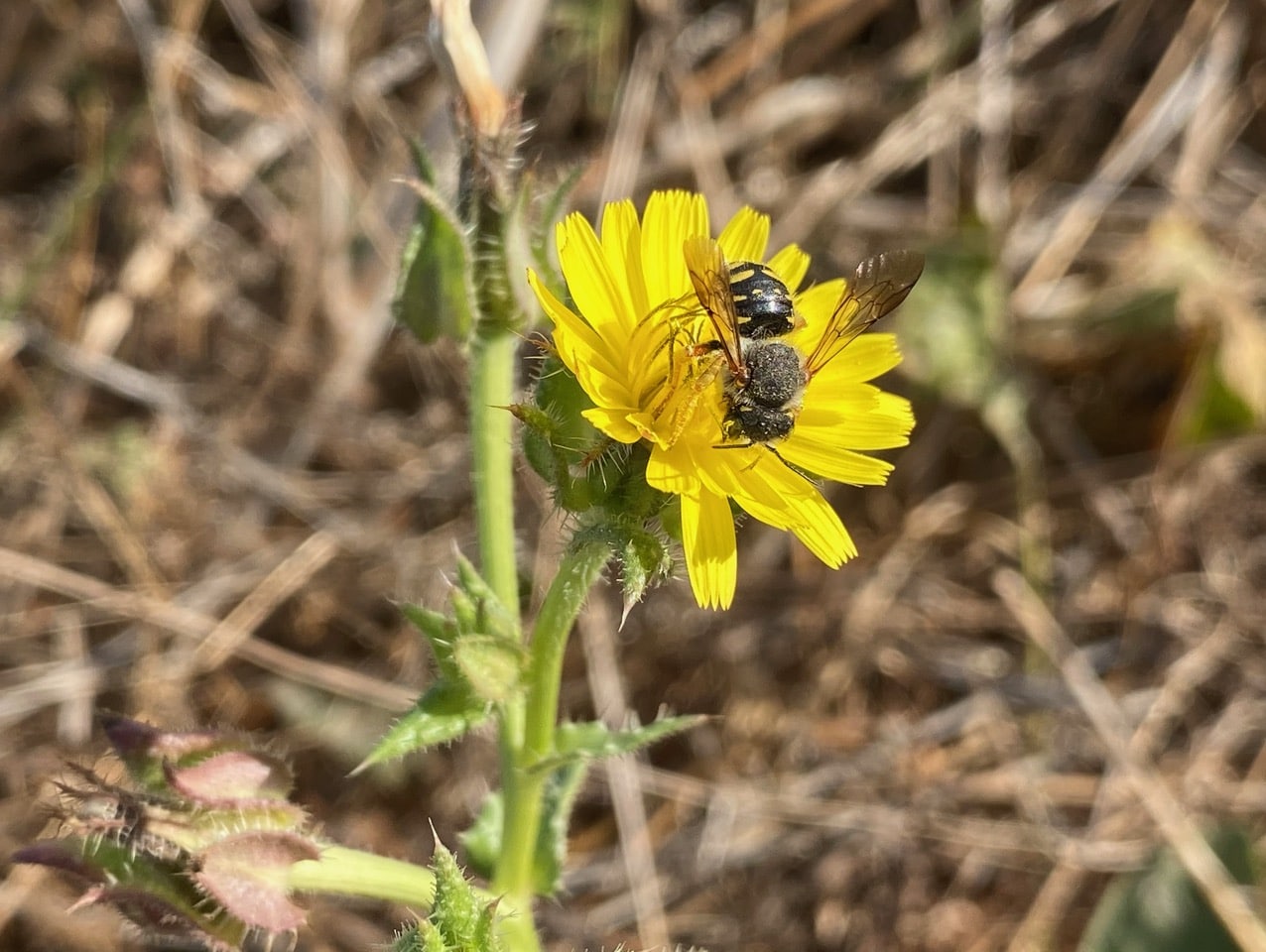
Ah, I finally get a decent view of the bee’s tegulae, the small knob-like structures at the base of the wings. They appear to be orange in color. This feature distinguishes the Oblong Woolcarder Bee, Anthidium oblongatum from the very similar European Woolcarder Bee, Anthidium manicatum.
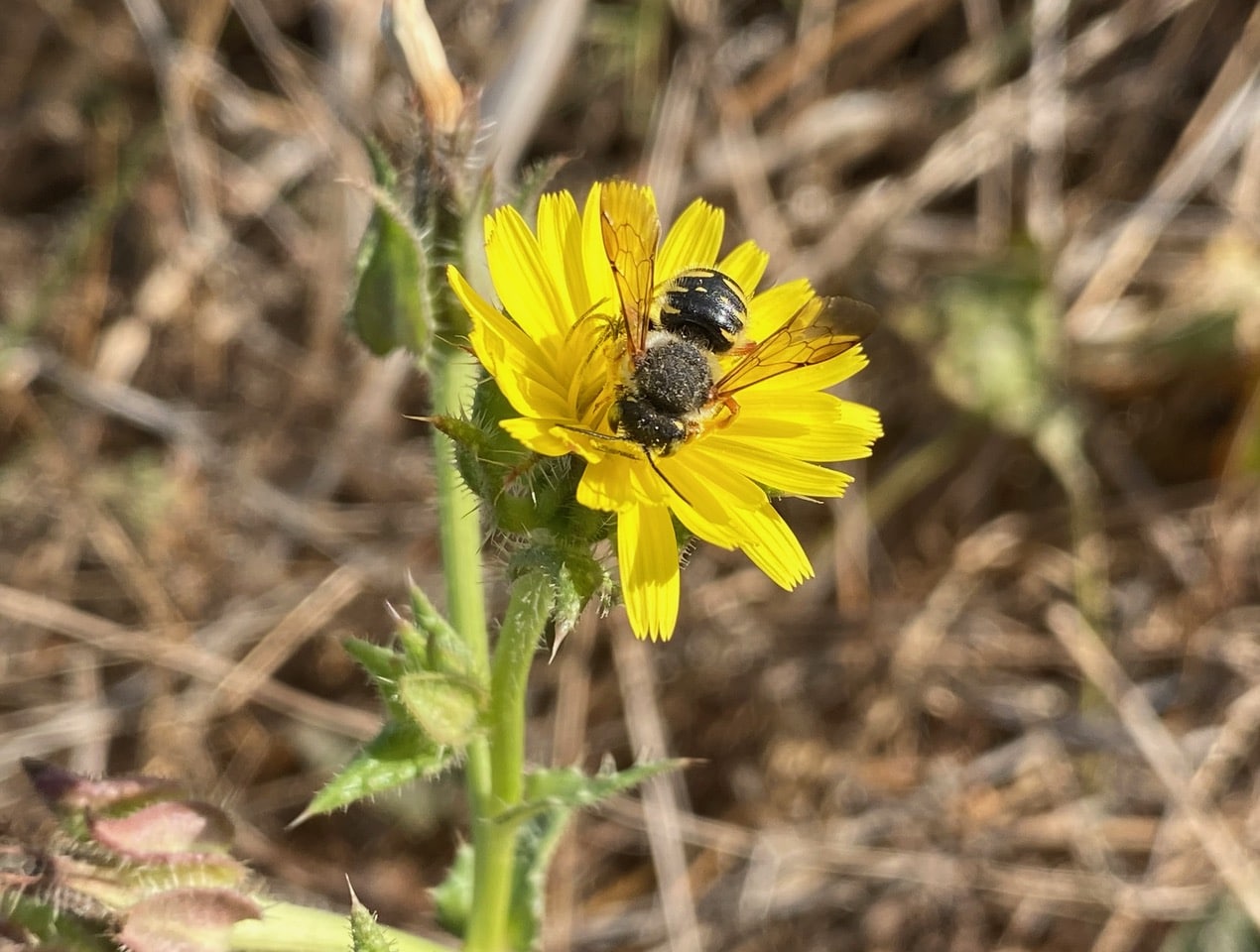
The Oblong Woolcarder Bee, Anthidium oblongatum is a species of bee in the family Megachilidae, along with the leafcutter bees and mason bees. It is native to
Eurasia and north Africa, and has also been introduced to North America. The species prefers warm and dry locations such as flowering grasslands, hedges, and dry stone walls. It can also be found in ruderal sites such as weathering heaps, road embankments, railway embankments, flood dams, rock gardens. The flight period is in one generation from mid-June to early August. A. oblongatum uses pre-existing cavities to create nest, preferring horizontal crevices 5-6 mm wide. The brood cells are made from plant fibers that the female scrapes from hairy plants. The species populates gardens, especially those that have suitable food plants as well as building materials. A. oblongatum dabs the outside of the nest with rust-colored glandular secretions. At Bay Farm, I most often find the bees on Fabaceae, especially on Bird’s foot Trefoil, Lotus tenuis.
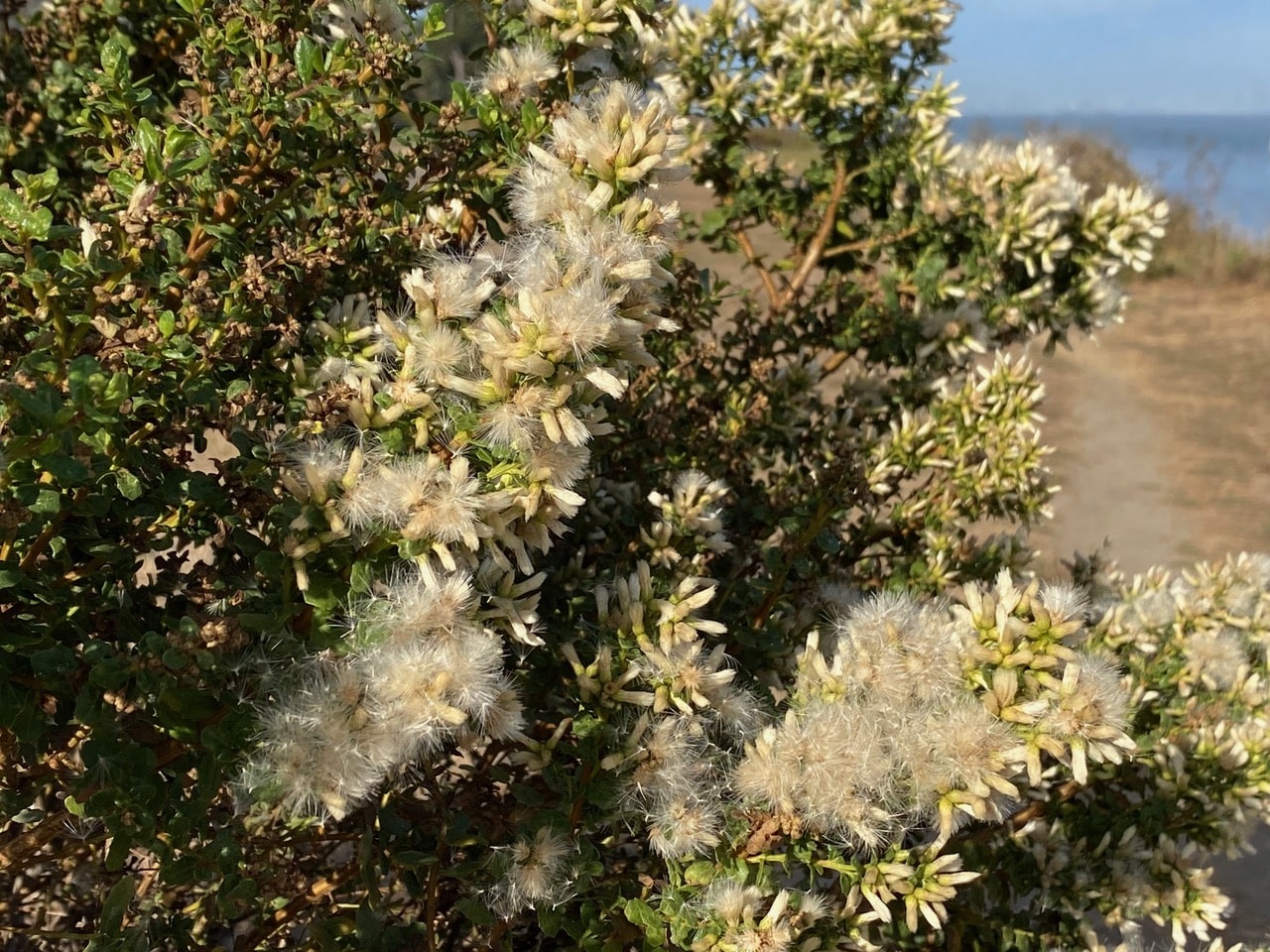
The female Coyote Brush, Baccharis pilularis by the side of the paved path is already releasing its seeds! This is the time of year when the genders of the dioecious plant can be easily distinguished. Female plants are dressed up in billowy white plumes.
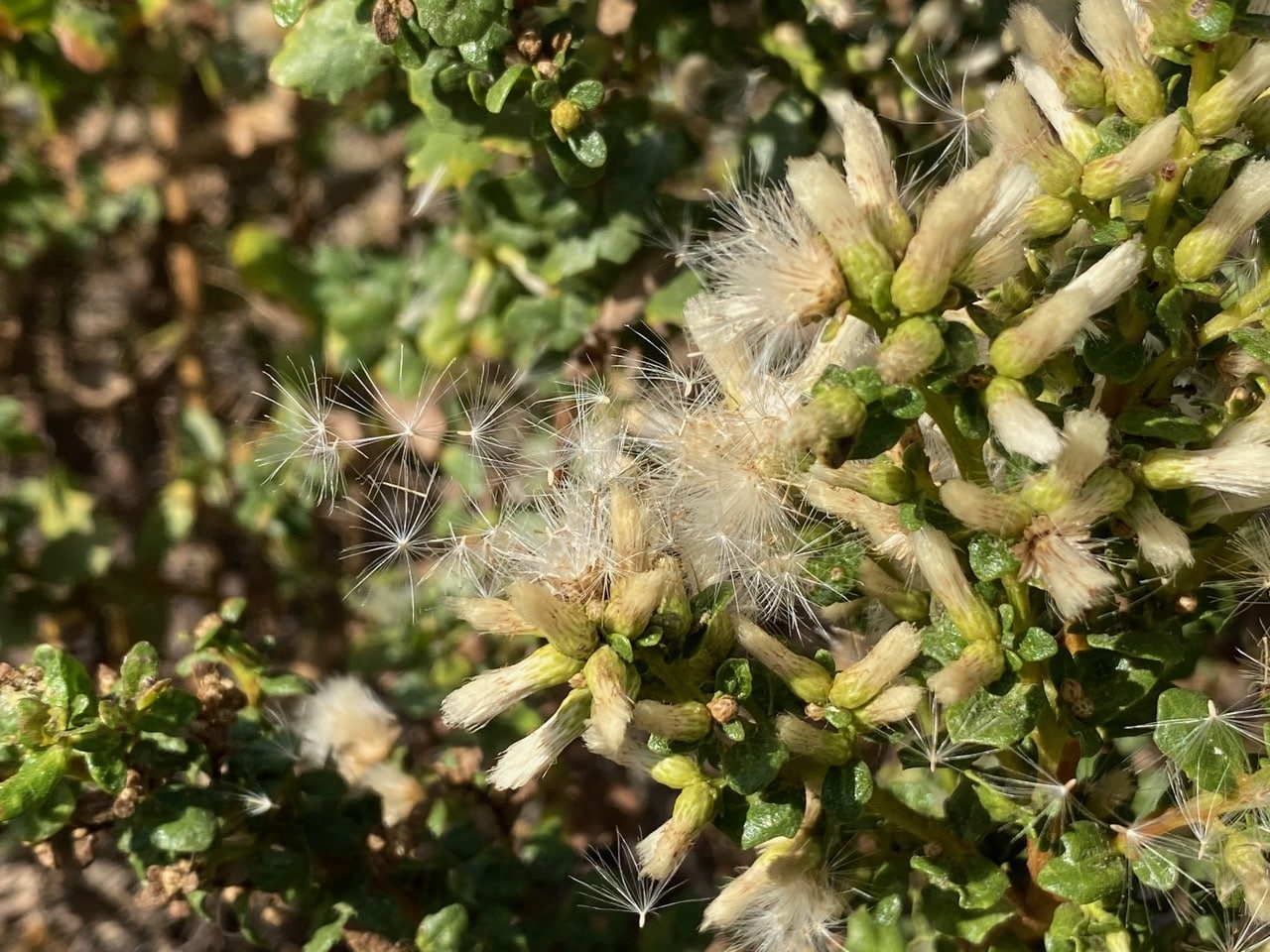
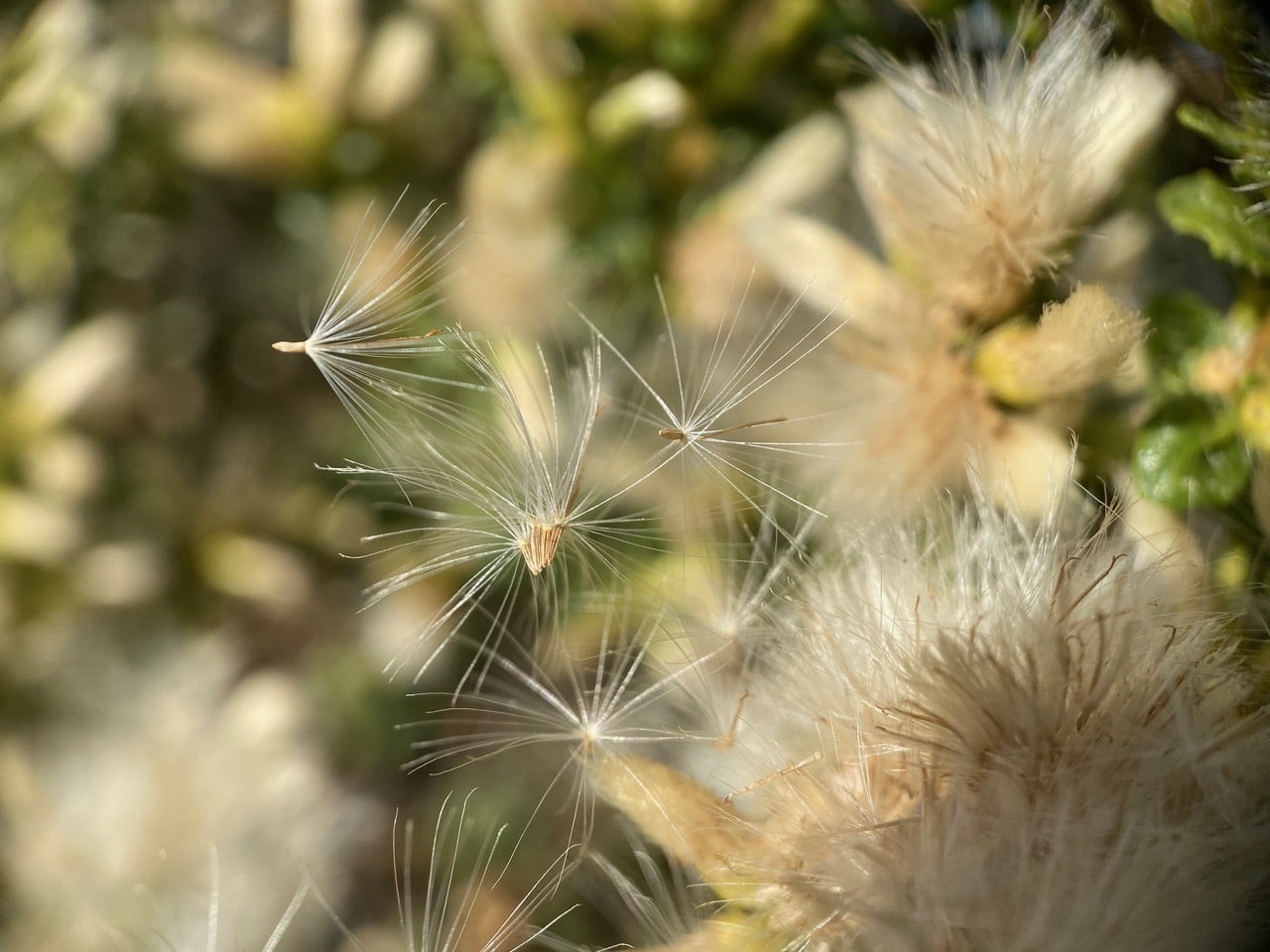
Each tiny seed is contained in an achene attached to a cluster of silvery white fibers or the pappus. In Asteraceae, the pappus is a modified calyx, the part of an individual floret, that surrounds the base of the corolla tube in flower. It functions as a dispersal mechanism for the seeds. By creating a separated vortex ring in its wake, the flight of the pappus is stabilized and more lift and drag are produced. As a result, the achenes are carried a longer distance on the wind before landing. Nature’s genius knows no bounds!