

Pollinator Post 10/31/24
A cool, crisp day after an early morning rain. Everything looks refreshed at Shoreline Park this morning.
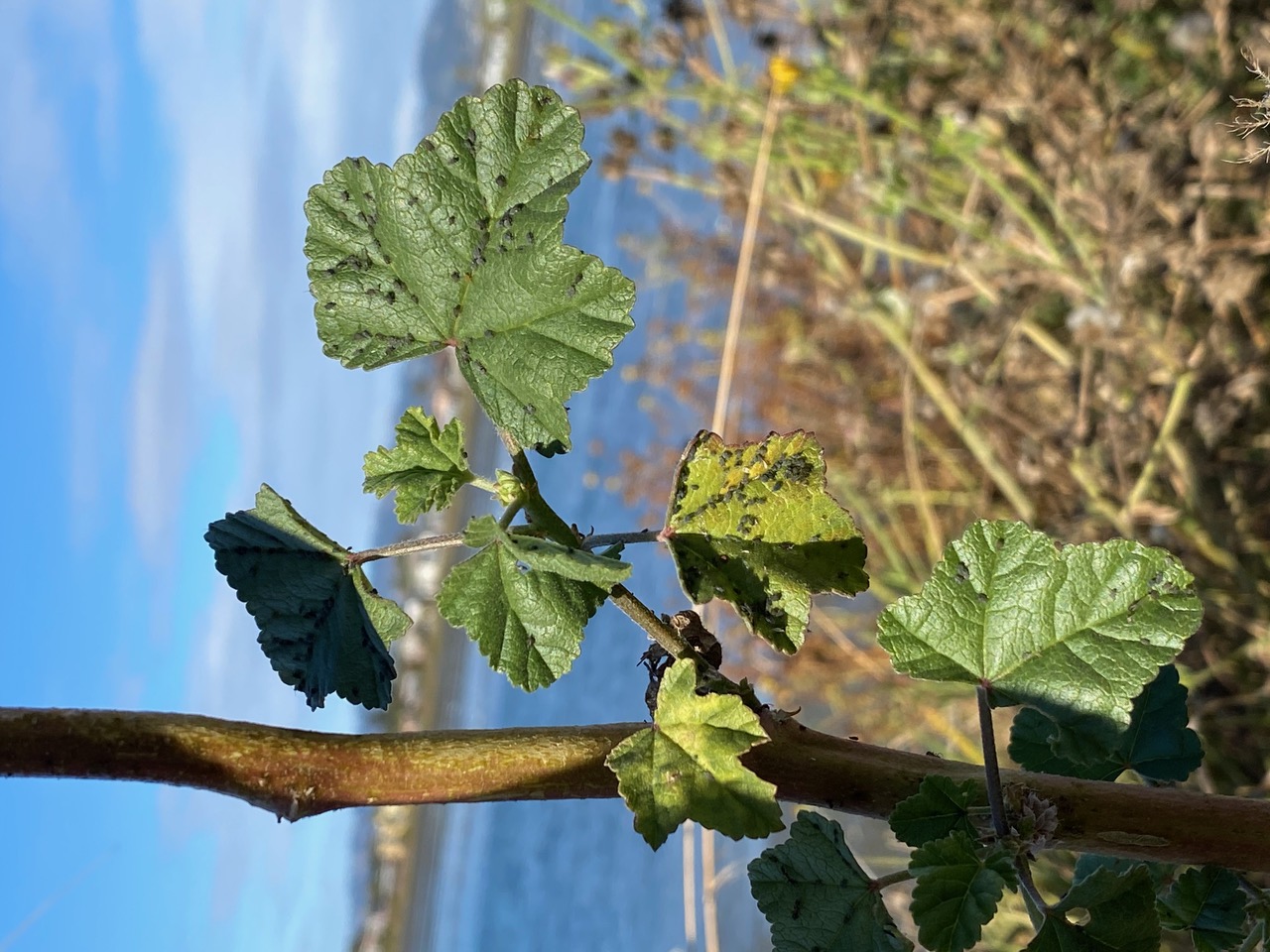
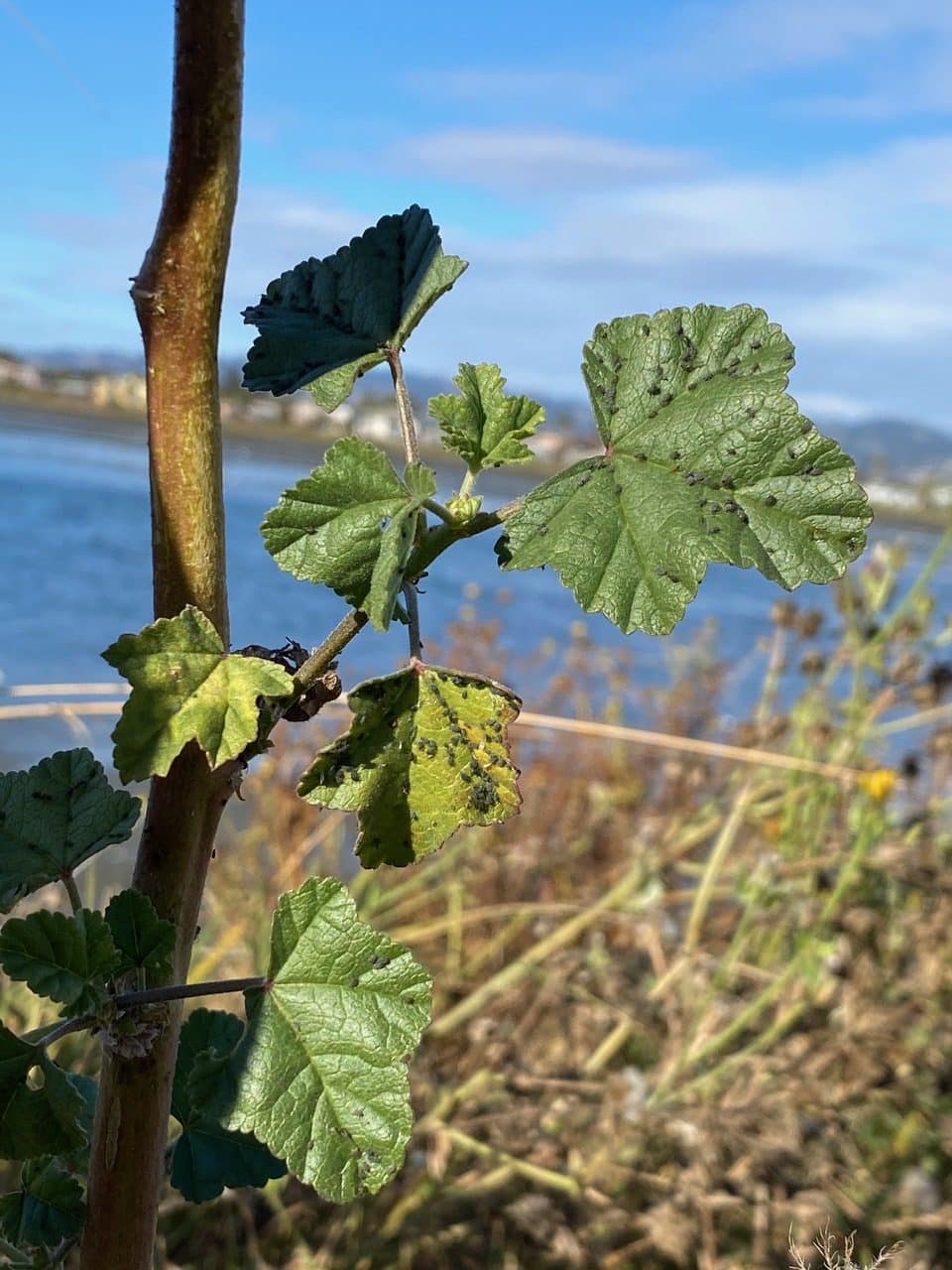
Dark aphids dot the leaves of a weedy Mallow by the trail.

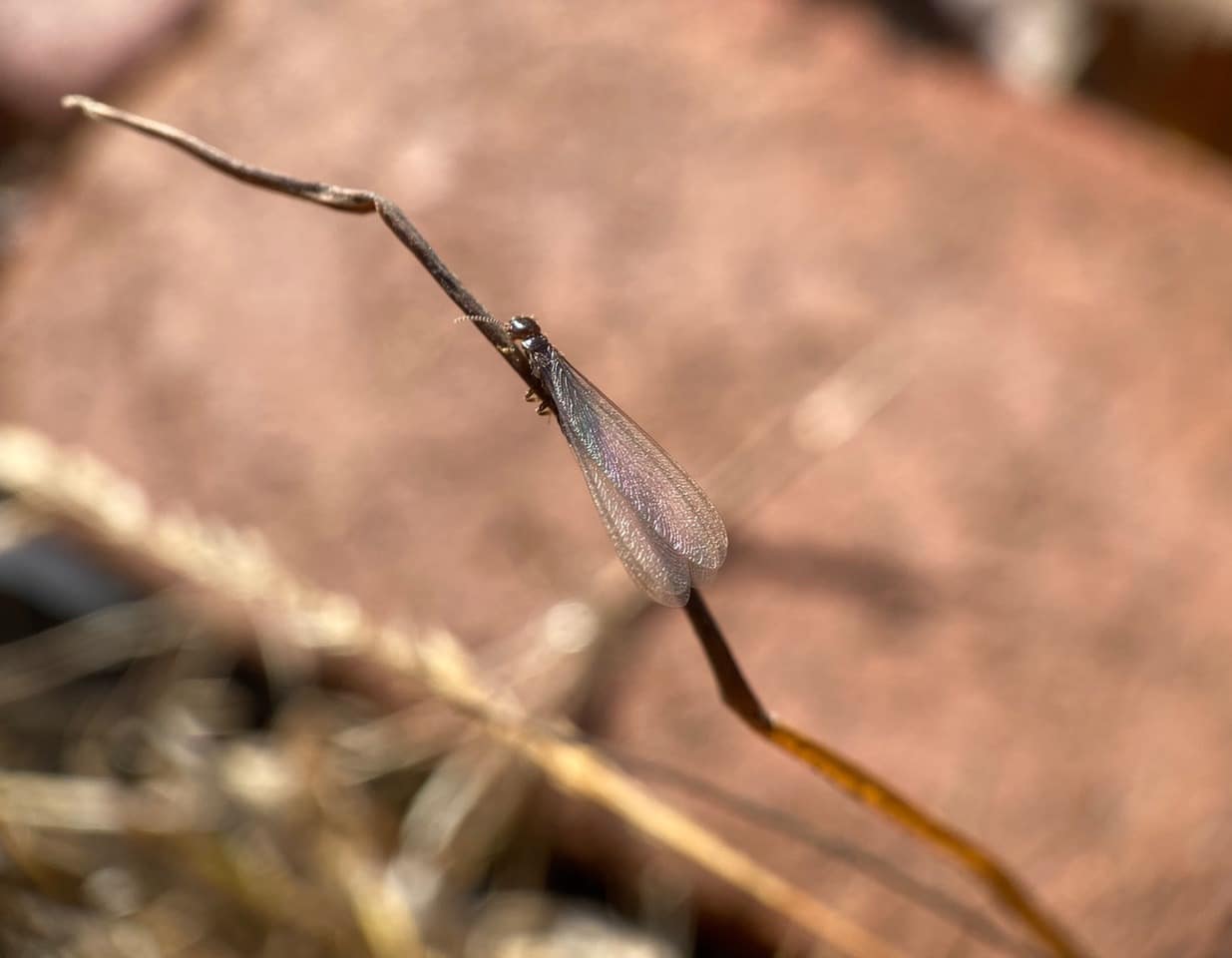
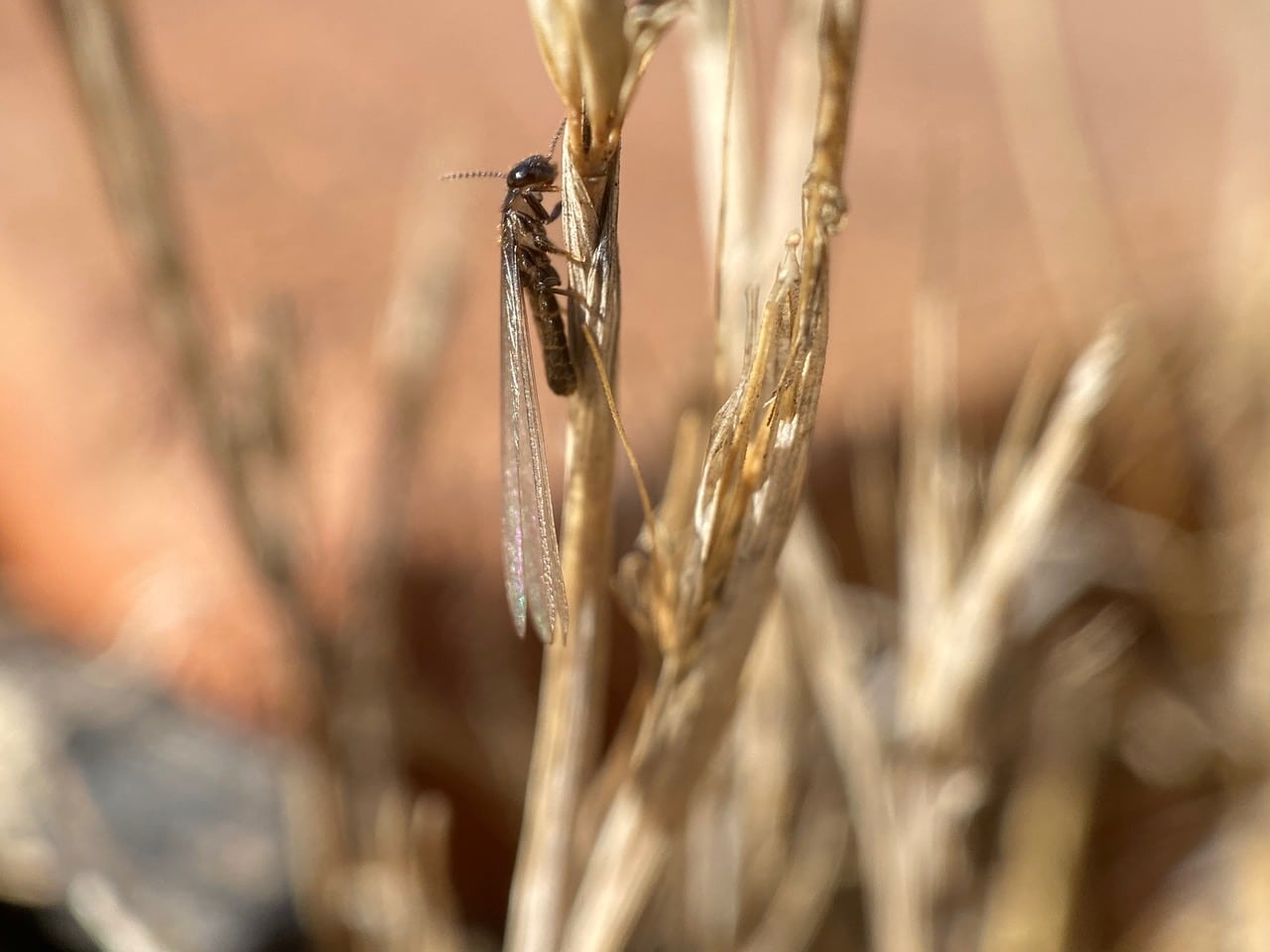
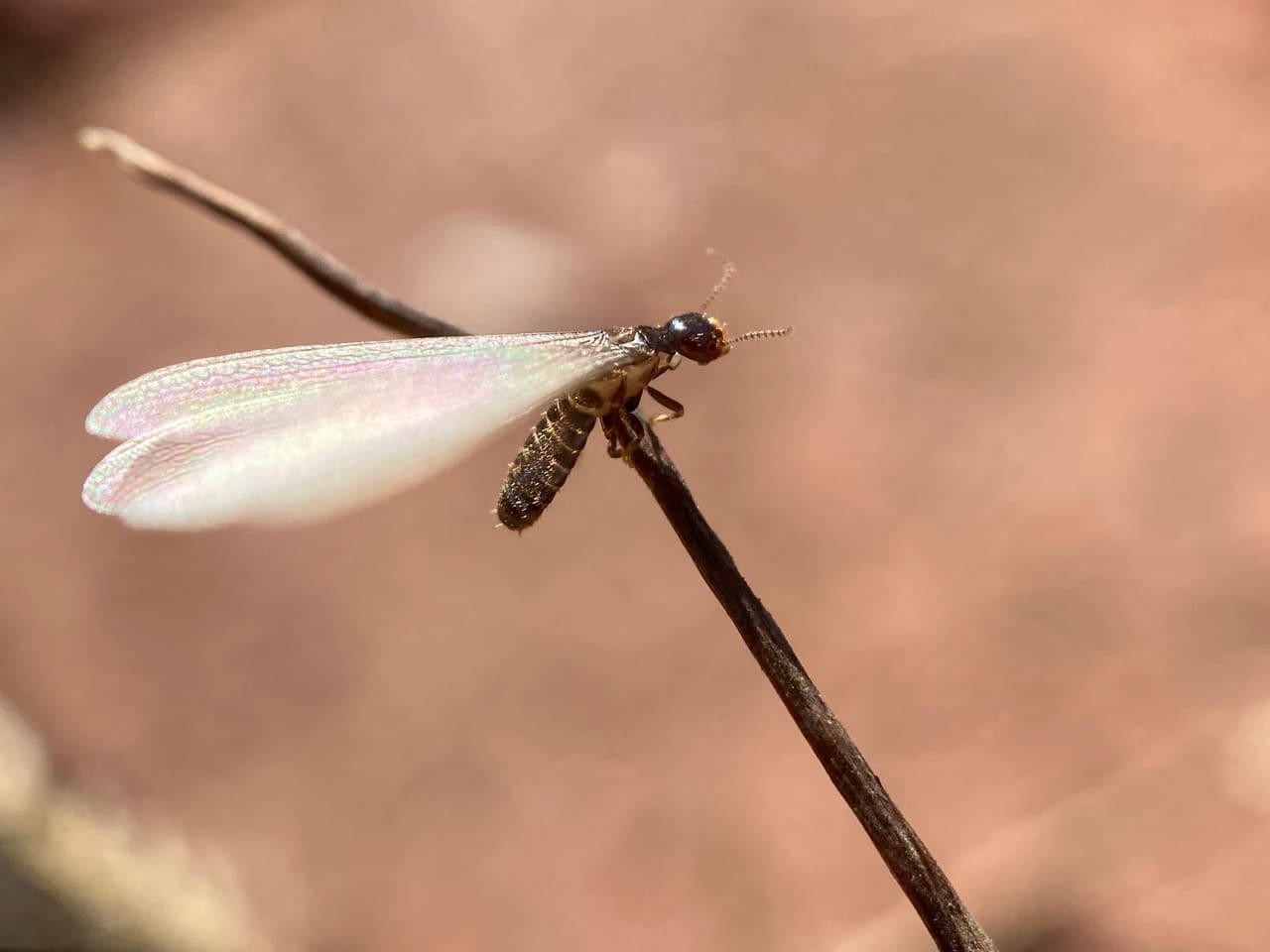
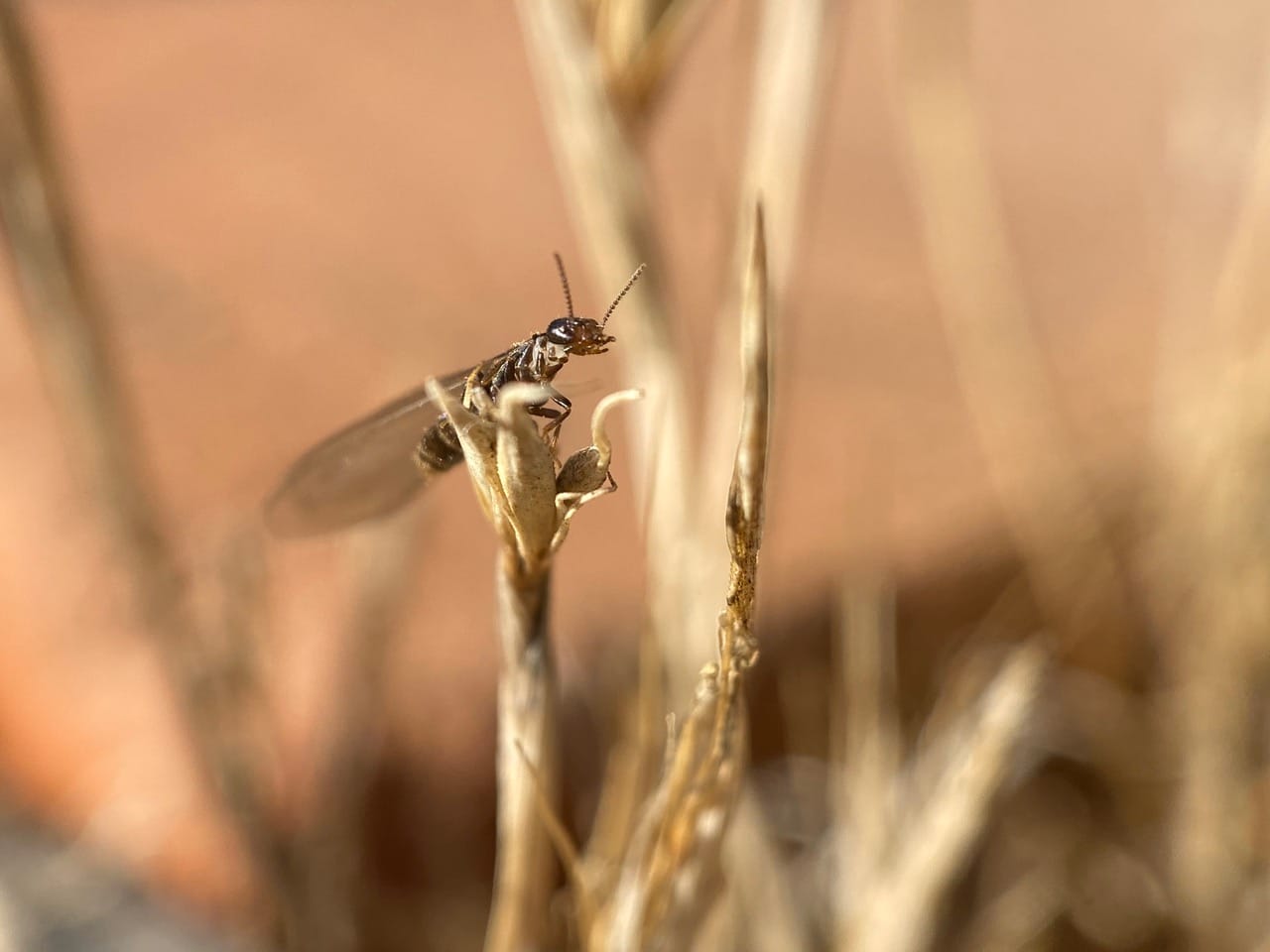
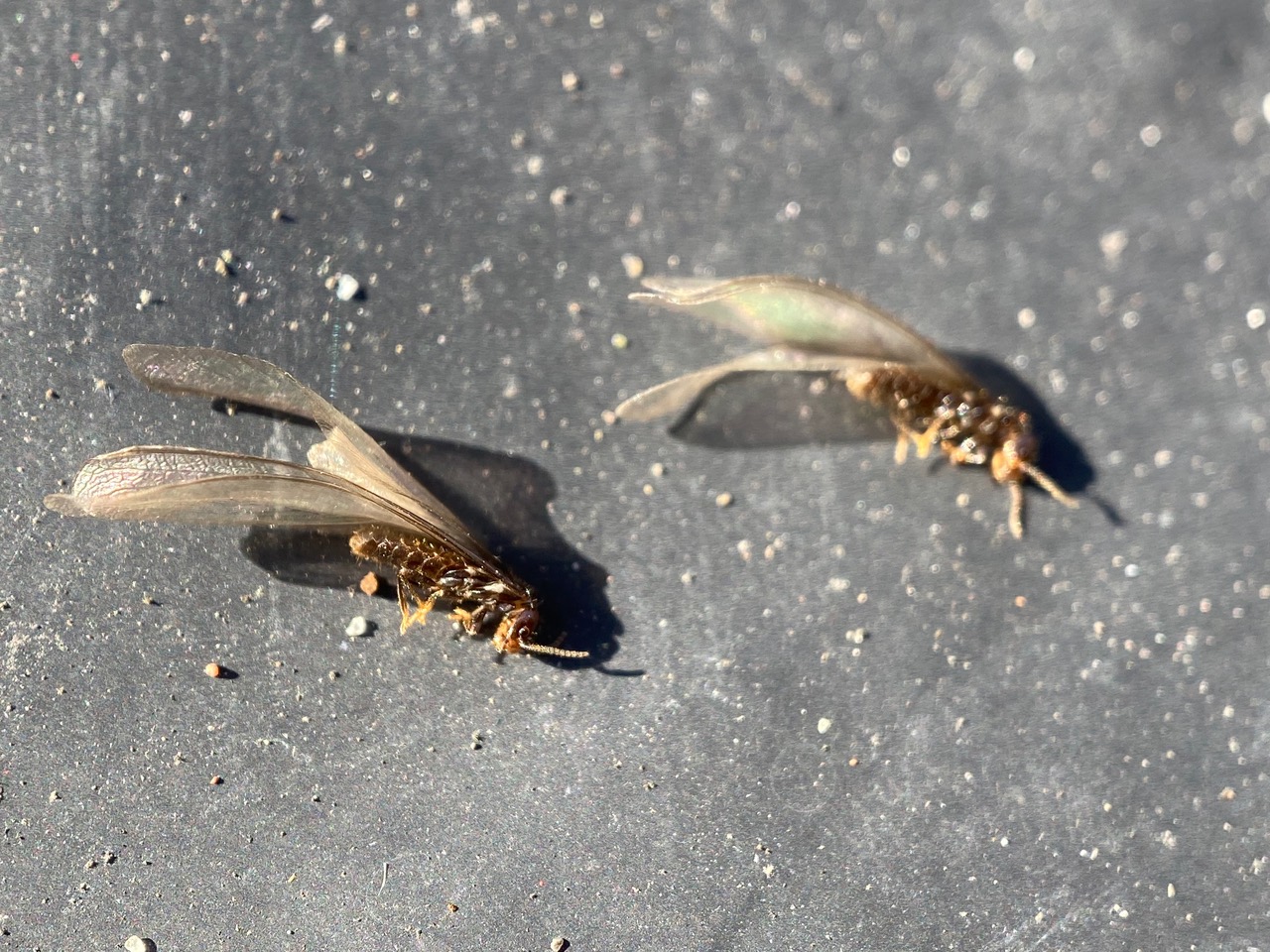 I find quite a few dead termite alates on the black tarp that covers a flowerbed next to the spot where the alates emerge. Wow, how and why did they die?
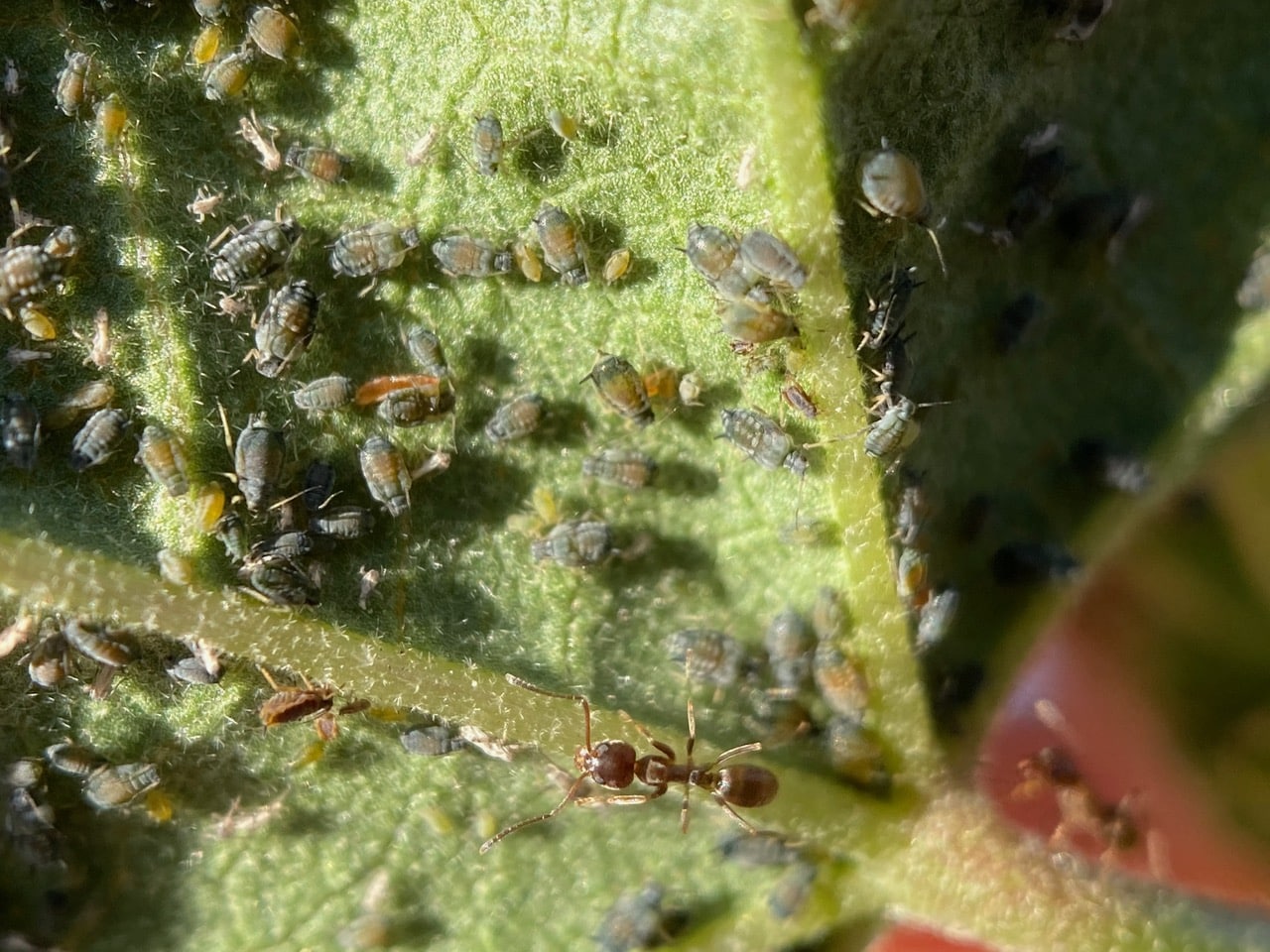
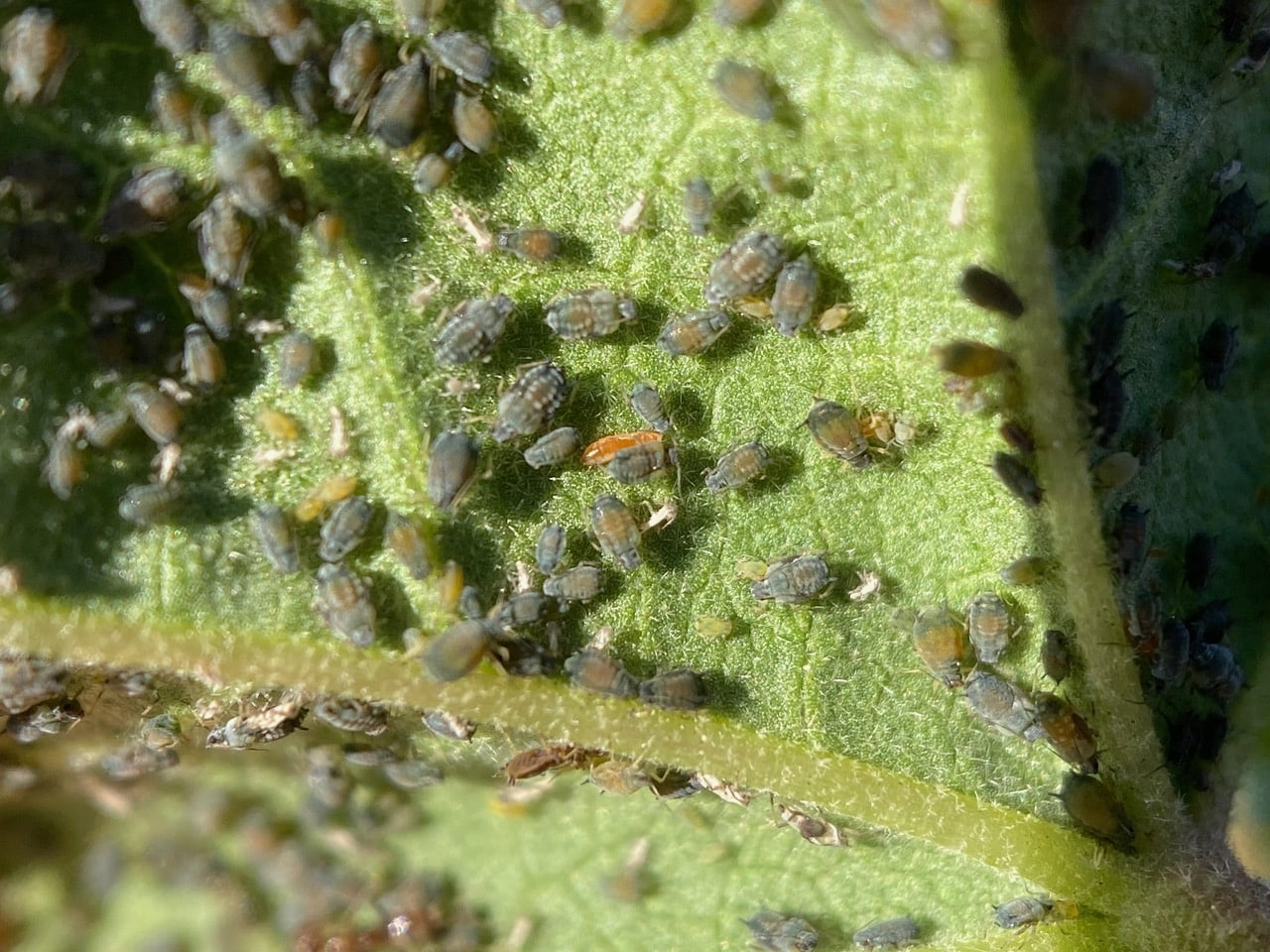
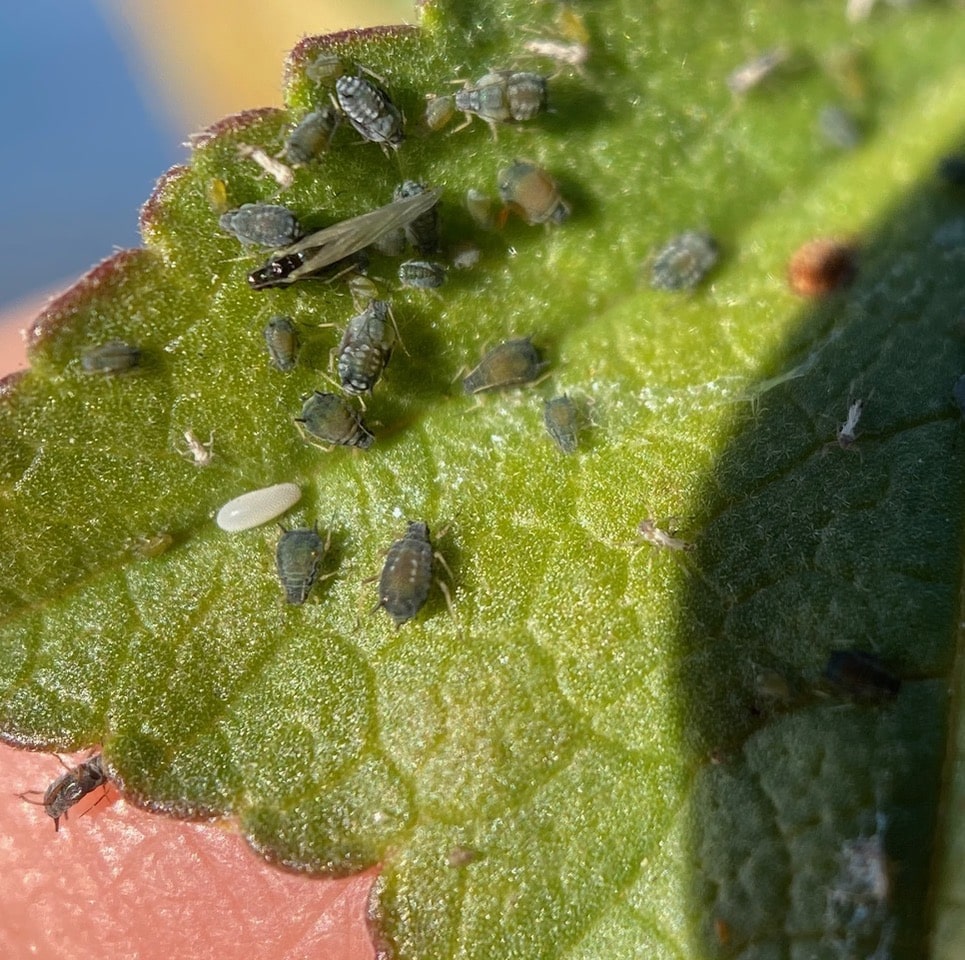
Turning over a leaf I find a bustling metropolis of aphids and their tending Argentine Ants.
Aphids are small sap-sucking insects in the order Hemiptera. A typical life cycle involves flightless females giving live birth to female nymphs, – who may also be already pregnant, an adaptation called telescoping generations – without the involvement of males. Maturing rapidly, females breed profusely so that the population multiplies quickly. Winged females may develop later in the season, allowing the insects to colonize new plants. In temperate regions, a phase of sexual reproduction occurs in the autumn, with the insects often overwintering as eggs.
The life cycle of some species involves an alternation between two species of host plants. Some species feed on only one type of plant, while others are generalists, colonizing many plant groups. Some ants have a mutualistic relationship with aphids, tending them for their honeydew and protecting them from predators.
Aphids usually feed passively on phloem of plants. Once the phloem vessel is punctured, the sap, which is under pressure, is forced into the aphid’s food canal. Aphids produce large amounts of a sugary liquid waste called “honeydew”. A fungus called sooty mold can grow on honeydew deposits that accumulate on leaves and branches, turning them black.
Ants and aphids share a well-known mutualistic relationship. The aphids produce honeydew, a sugary food for the ants; in exchange, the ants care for and protect the aphids from predators and parasites. Some ants will “milk” the aphids to make them excrete the sugary substance. The ants stroke the aphids with their antennae, stimulating them to release the honeydew. Aphid-herding ants make sure the aphids are well-fed and safe. When the host plant is depleted of nutrients, the ants carry their aphids to a new food source. If predatory insects or parasites attempt to harm the aphids, the ants will defend them aggressively. Some species of ants continue to care for aphids during winter. The ants carry the aphids to their nest for the winter months, and transport them to a host plant to feed the following spring.
I try to focus in on the tiny orange slug-like creature among the aphids. Yep, it is an aphid predator, an Aphid Midge, Aphidoletes aphidimyza (family Cecidomyiidae). I love how the name rolls off the tongue and how both genus and specific epithet refer to aphids. These larvae are aphid killing specialists, known to feed on over 70 aphid species. The adults are small (less than 1/8 in. long), black, delicate flies that live for about 10 day, feeding on aphid honeydew. They hide beneath the leaves during the day, and are active at night.
Females deposit 100-250 tiny shiny orange eggs singly or in small groups among aphid colonies. The small, bright orange, slug-like larvae inject a toxin into the aphids’ leg joints to paralyze them and then suck out the aphid body contents through a hole bitten in the thorax. The larvae can consume aphids much larger than themselves and may kill many more than they eat when aphid populations are high. A single larva grows up to 1/8 in. long, and kills up to 65 aphids a day. After 3-7 days of feeding, the larvae drop to the ground and burrow into the soil to pupate. The Aphid Midge is commercially grown by insectaries for use as biological pest control in commercial greenhouse crops.
See that hover fly egg that looks like a grain of rice? A mama hover fly (family Syrphidae) has wisely scouted out this colony of aphids in which to lay her eggs. When her larvae hatch out, they will have plenty of aphids to eat.
Syrphid larvae have no eyes and no legs. They swing their tapered head from side to side in search of prey. When they make contact with a prey, they grab hold of it with their mouthpart, then suck out the victim’s body contents. Depending on species, a Syrphid larva can feed on 100 to 400 aphids before it pupates.
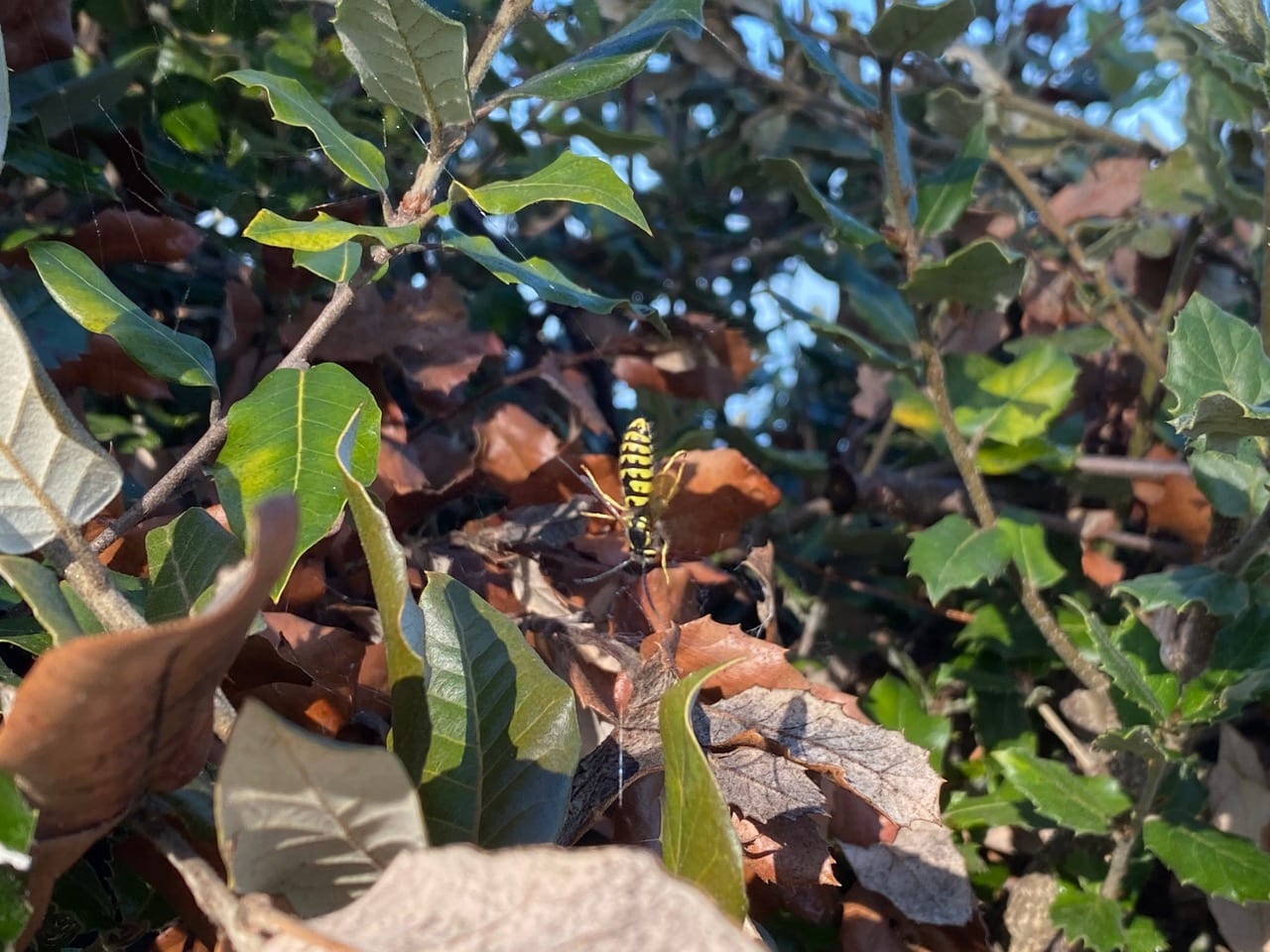
Lately there has been a lot of Yellowjacket activity around the two large bushy Holm Oak, Quercus ilex by the shore. In the cool of the morning, I often find the males basking on leaves facing the sun. Do the males sleep on these trees at night? A male yellowjacket has inadvertently flown into a spider web, and is struggling to free itself.
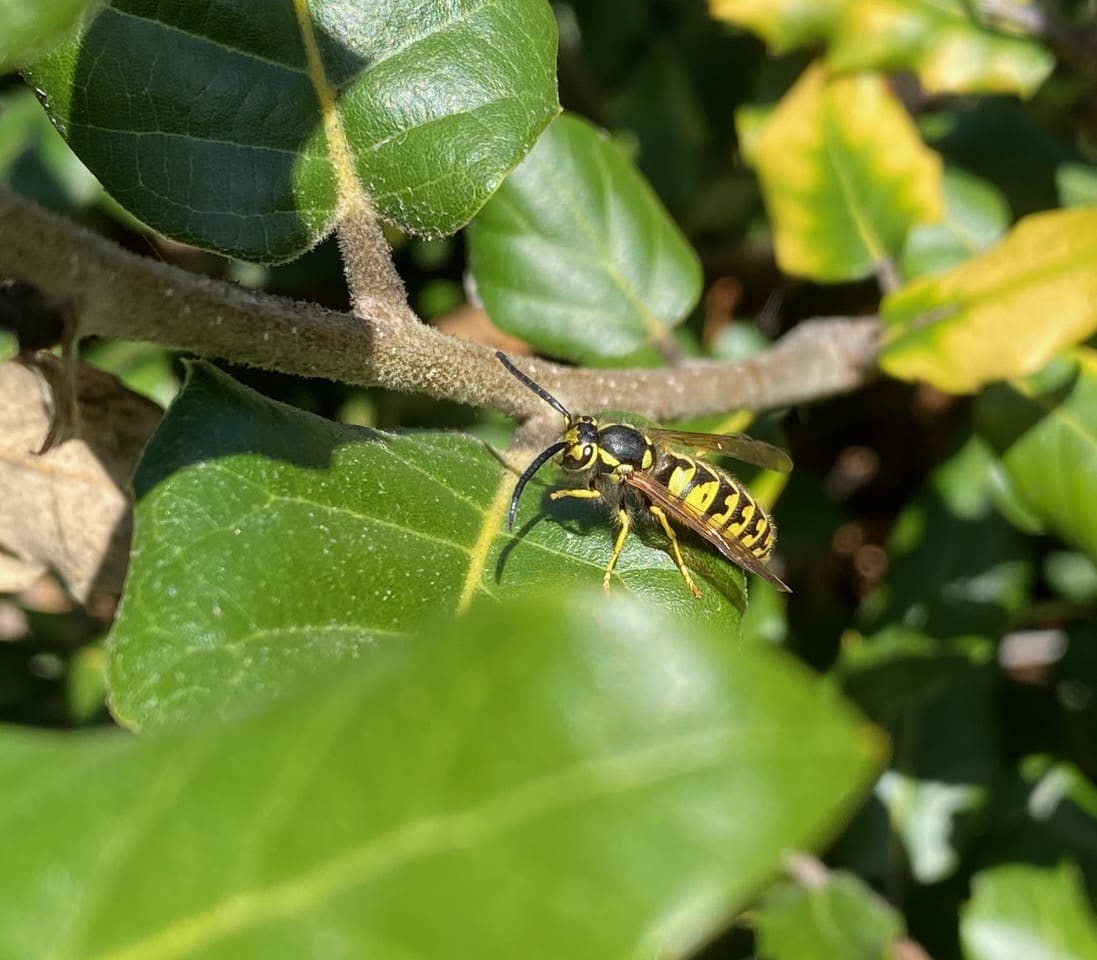
A male Yellowjacket is grooming itself in the morning sun. He spends an inordinate amount of time fussing over his antennae. The antennae of male Hymenopterans (bees, wasps and ants) are often much longer than their female counterparts. Male antennae have an extra segment and the segments themselves are longer. This is because male antennae are specialized to pick up the subtle scent of female pheromones.
When I pass this way again in about an hour (close to noon), the wasps are zipping about over the oaks in break neck speed. Is this a mating swarm? I do not see any mating activity. There is precious little information out there on the swarming of Yellowjackets.
The following information is gleaned from the website of the Illinois College of Aces, Department of Crop Sciences:
“Yellowjackets, like other social insects, have a caste system with division of labor. Each colony has a queen whose purpose is to reproduce. Male yellowjackets fertilize the queen, and sterile female workers forage for food, take care of the queen and the young, and defend the nest.
Single queens begin building nests in the spring. Depending on the species, she will locate a sheltered space underground, often an abandoned rodent burrow, or in a structure and construct a golf ball sized nest of paper that is made by mixing wood fibers with her saliva. She lays eggs and cares for the grub-like larvae in the nest. The first generation of sterile female workers emerge in June and assume the care of the nest. This allows the queen to concentrate on reproduction. Yellowjacket adults feed on nectar, fruit juices, sap and other liquids and provide insects and carrion to the larvae. The population of worker yellowjackets increases during the summer and peaks in early to mid-August.
From late summer into early fall the queen produces queen and male yellowjackets. Each nest can produce thousands of new queens. Queens and males swarm from the nest and mate. The males, workers, and old queens die as winter approaches. Newly mated queens seek overwintering sites in protected places such as logs, under bark or leaf litter, and occasionally in human-made structures. They remain dormant through the winter and begin the cycle once again in the spring.”
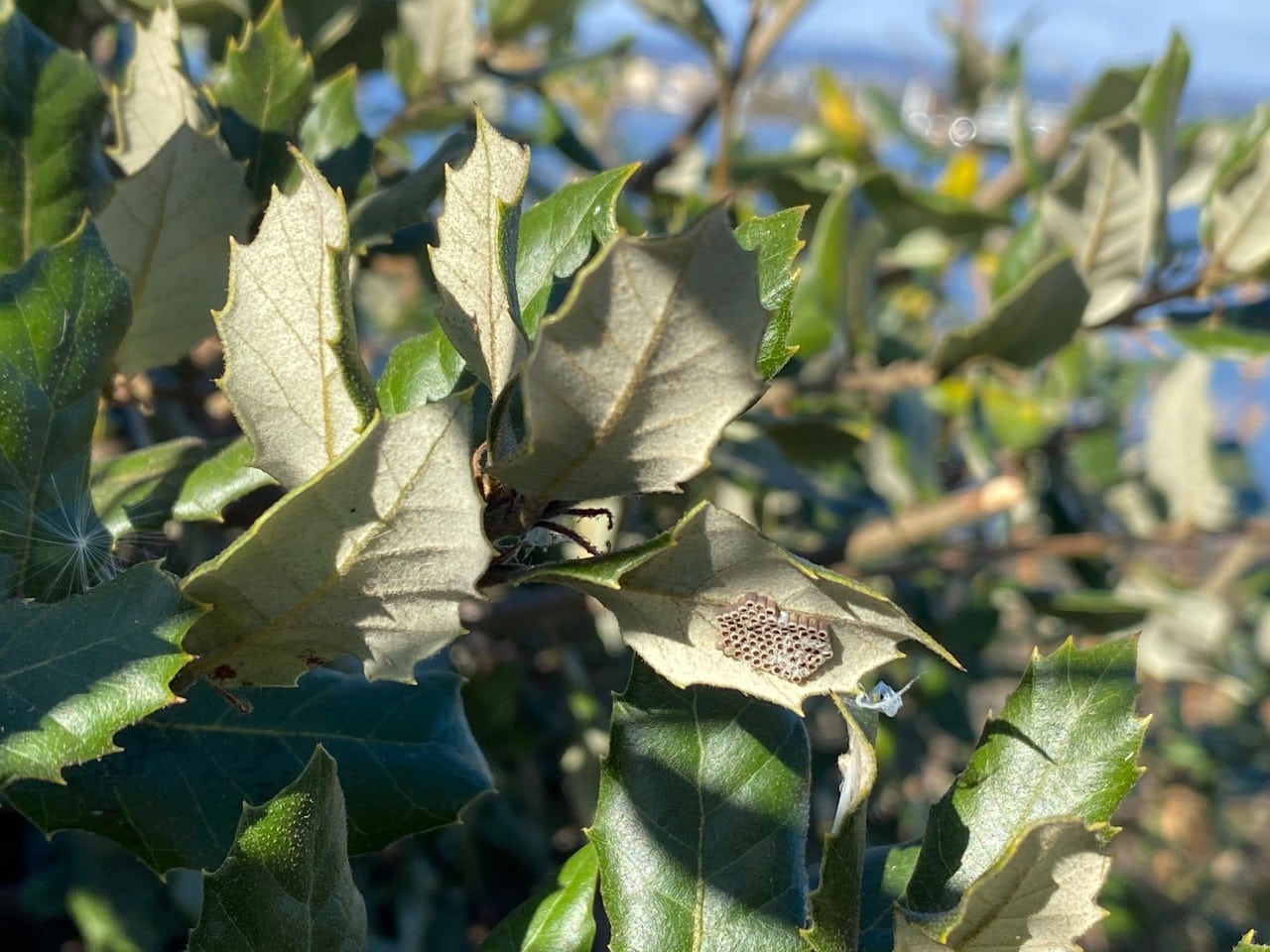
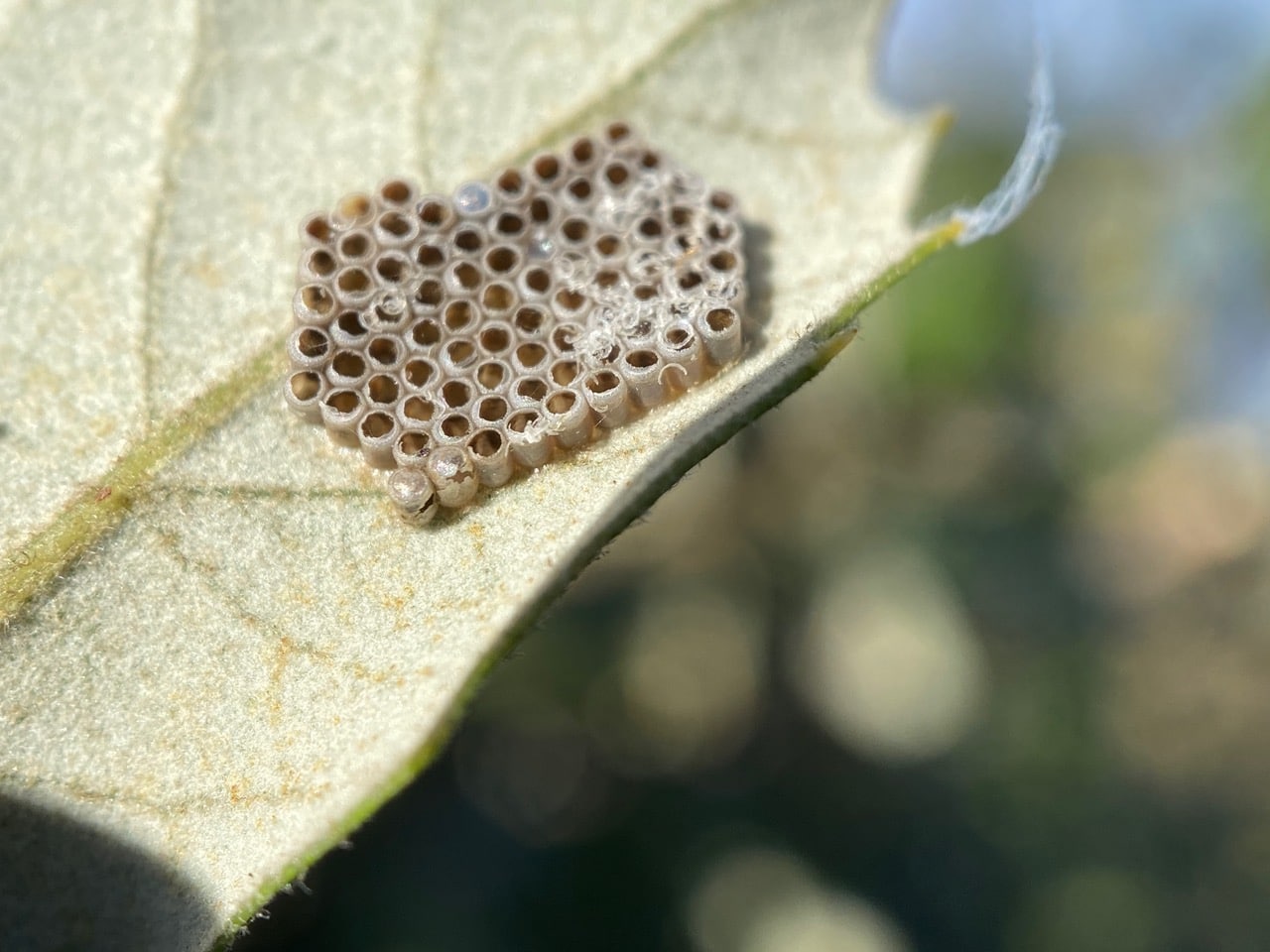
Hey, what’s that on the underside of the oak leaf?
A typical cluster of Stink Bug eggs. Stink Bug eggs are barrel-shaped with a pop-top from which the nymph eventually emerges. Most of the eggs in this cluster have hatched. That must have been quite a show when the hatchlings emerged all at once! The only Stink Bugs I have seen here at Shoreline Park are the nymphs of the Southern Green Stink Bug, Nezara viridula (family Pentatomidae).
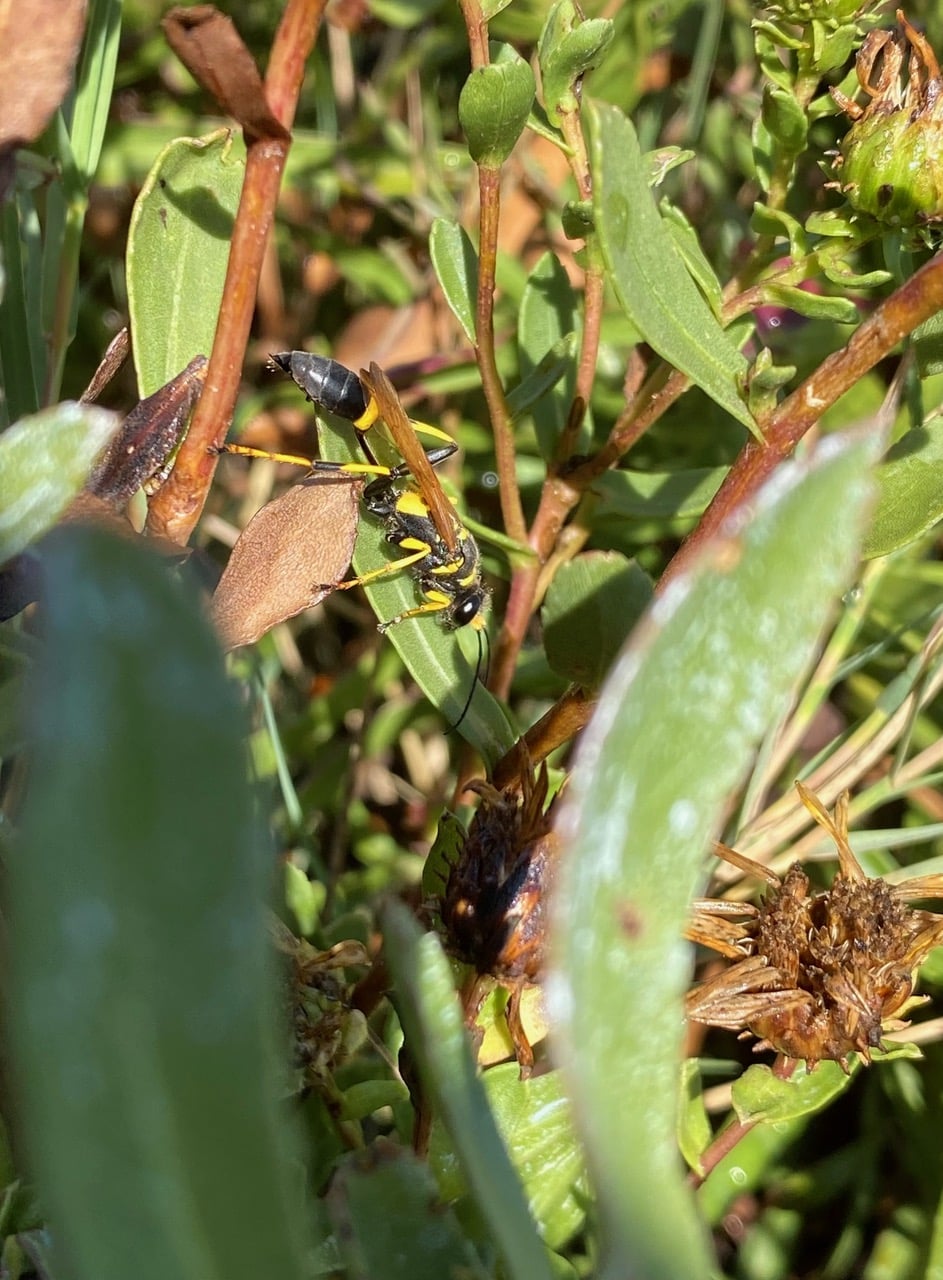
A Yellow-legged Mud-dauber, Sceliphron caementarium (family Sphecidae) is moving around among the Grindelia foliage. It is probably a female hunting for spiders to provision her nest.
The Yellow-legged Mud-dauber, Sceliphron caementarium (family Sphecidae) is widespread in the Americas. The species is found in a wide variety of habitats, such as rock ledges, man-made structures, puddles and other water edges. The wasp can reach a length of 24-28 mm. They are generally black with yellow markings, with impossibly long and skinny “waist”. They are solitary parasitoid wasps that build nests out of mud. Females collect mud balls at puddles and pool edges for constructing nests. The nests comprise up to 25 vertically arranged, individual cylindrical cells. Eventually the cells are covered over as a cluster by more mud, forming a smooth structure the size of a human fist. Nest constructed, the female wasp goes hunting for spiders. The prey are stung and paralyzed and placed in the cell, usually 6-15 per cell. A single egg is laid on the prey within each cell. The wasp then seals the cell with a thick mud plug. The larva that hatches out feeds on the spiders, pupates in the cell and emerges as an adult, breaking out of its mud nursery. Adult wasps can be seen in mid-summer feeding on nectar at flowers.
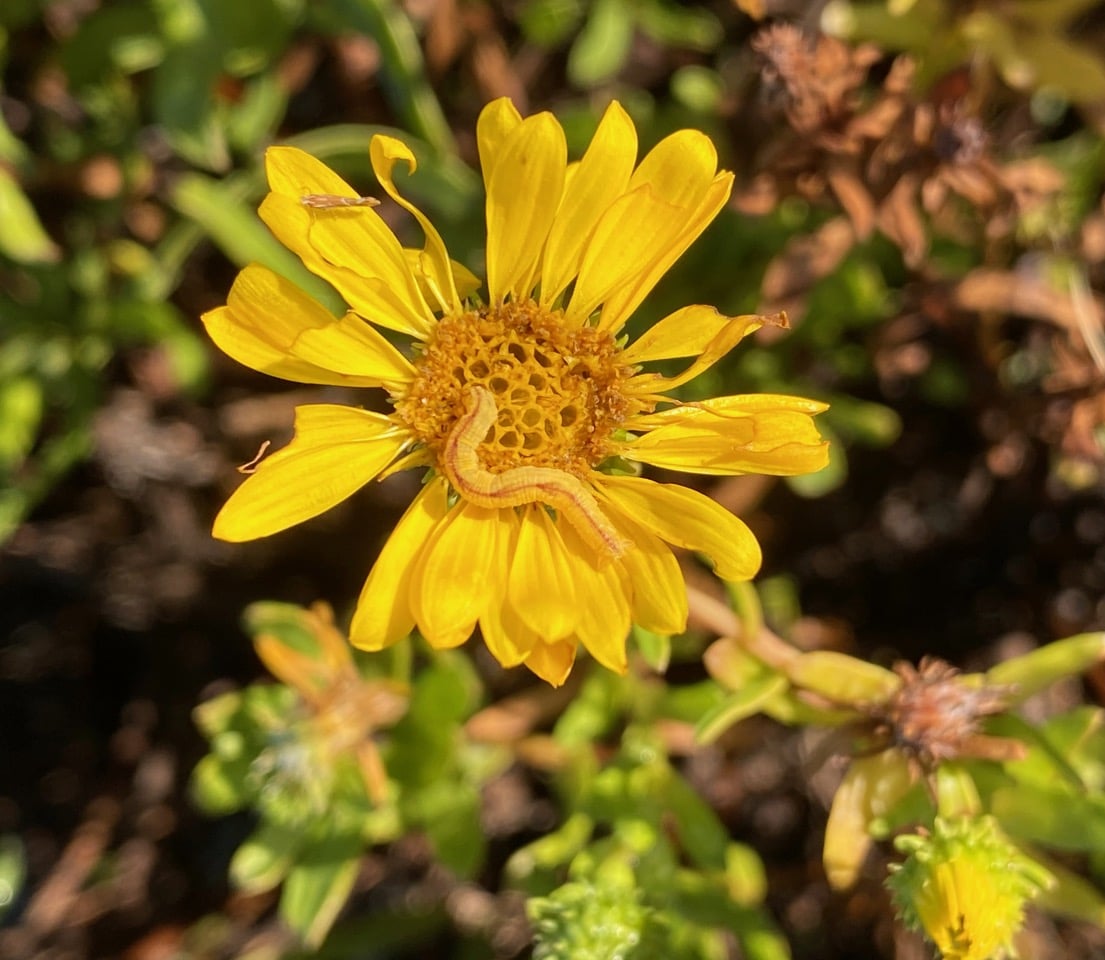
An Inchworm caterpillar of Pug Moth, Epithecia sp. (family Geometridae) is feeding on a Grindelia flowerhead. Note that most of the florets in the middle of the flowerhead have been emptied of their reproductive structures.
Inchworms are also called loopers and measuring worms. The majority of inchworms are the larvae of moths in the family Geometridae. The name comes from the Greek “geo” for earth and “metro” from measure, because the caterpillars seem to be measuring the surface on which they are walking.
All caterpillars have three pairs of jointed legs behind their heads. These legs are called true legs because they will become the six legs of the adult butterfly or moth. There are additional appendages, called prolegs, along their bodies. Prolegs are not true legs, they are just outgrowths of the body wall and will be lost at metamorphosis. They have little hooks on their soles to help the caterpillar walk and grip onto things. Most caterpillars have five sets of prolegs, four in the middle of the body and one pair at the hind end. Inchworms have the normal six true legs but only two or three pairs of prolegs, all located at the tail end of the body, with none in the middle. When an inchworm walks, it moves its tail-end prolegs up behind its true legs, causing the center of its body to loop upward. Then it stretches its front end forward to take another step.
Epithelia is the largest genus of moths of the family Geometridae. Occurring worldwide except for Australasia, species in the genus are commonly known as pugs. Adults are typically small, 12 – 35 mm, with muted colors. Most species rest with forewings held flat at right angles to the body, while the hindwing are largely covered by the forewings. They are generally nocturnal. Larvae mostly feed from the flowers and seeds of their food plants rather than the foliage. Many species have a very specific food plant.
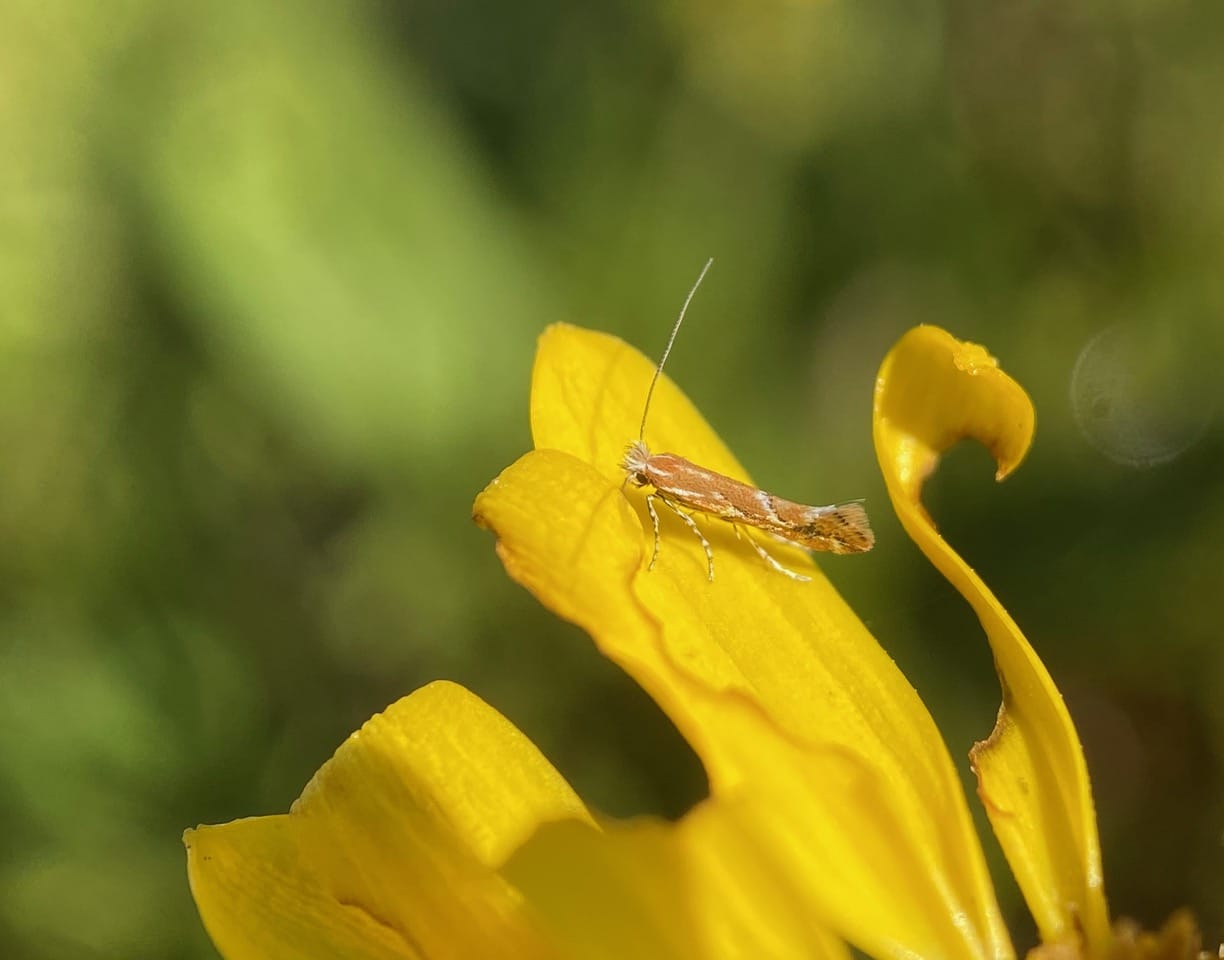
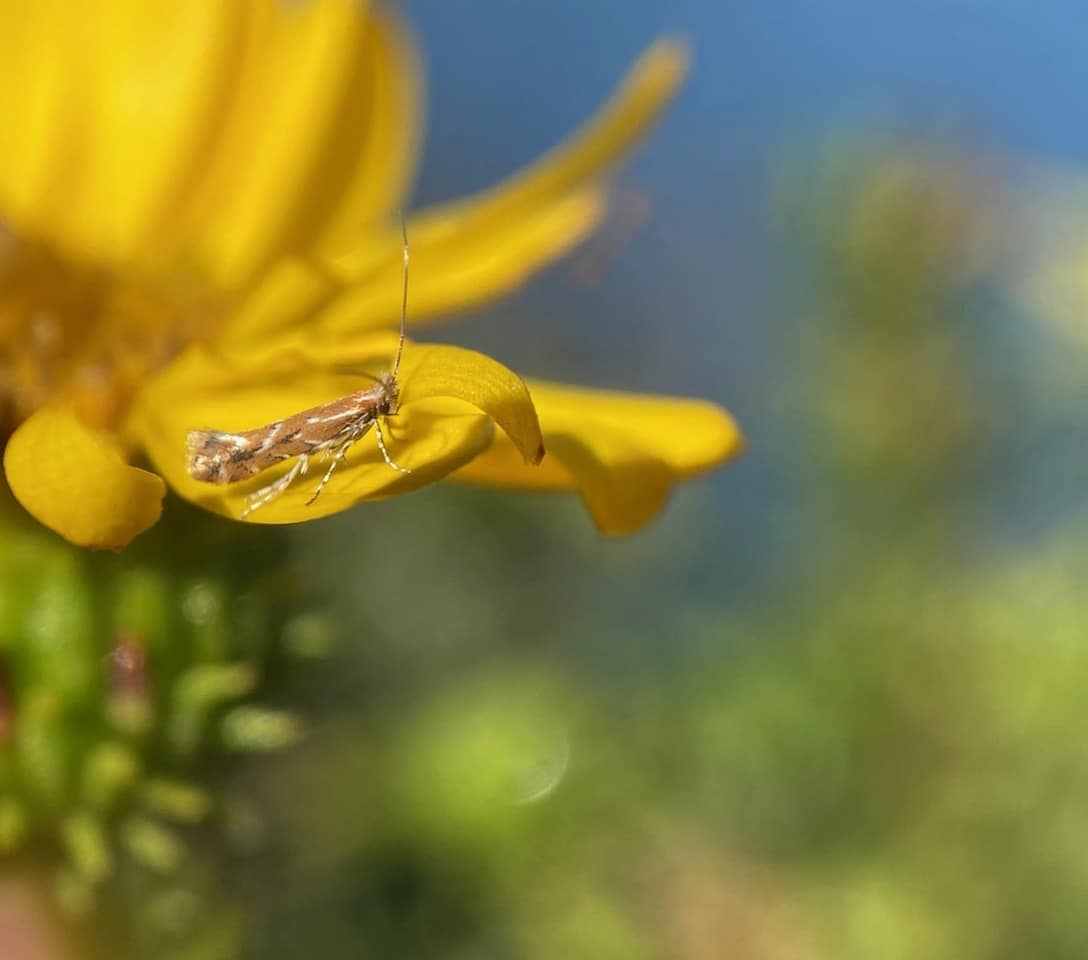
I turn my camera on the tiny, slender creature on a ray petal of the same Grindelia flowerhead. What a beautiful moth! I recognize it immediately as the Oak Blotch Leafminer, Cameraria sp. (family Gracillariidae), because I have reared a couple of them from blotch leaf mines on the Coast Live Oak in my own garden.
Leafminer caterpillars feed on the inside of leaves, creating distinctive tunnels or mines that can be white or brownish in color. Female leaf-mining moths lay their eggs on or in the foliage of suitable host plants. After hatching, the caterpillar tunnels through the internal leaf tissues. They feed between the upper and lower epidermis of leaves. In doing so, they create mines that show up as white or brownish discolored lines or blotches. The pattern of the mine is fairly constant for a particular species of leaf miner. When they have completed their feeding, the caterpillar of some species pupate within the foliage, but in others the larvae exit the mines and pupate elsewhere on the plant or in the soil.
Pygmy Leafminer at Work at The Caterpillar Lab – YouTube
Gracillariidae is an important family of moths, and the principal family of leaf miners that includes several agricultural and horticultural pests. The moths have a worldwide distribution, except Antarctica. These generally small (wingspan 5-20mm) moths are leaf miners as caterpillars. Most have specific host plants.
Most larval Gracillariidae undergo hypermetamorphosis, meaning there is a major change within the larval stage. Early instars have a flattened head and body, modified mandibles, and lack functional spinnerets or legs; these feed on sap. Later instars are cylindrical with round heads, and have chewing mouthparts, legs and functional spinnerets; these feed on plant tissue.
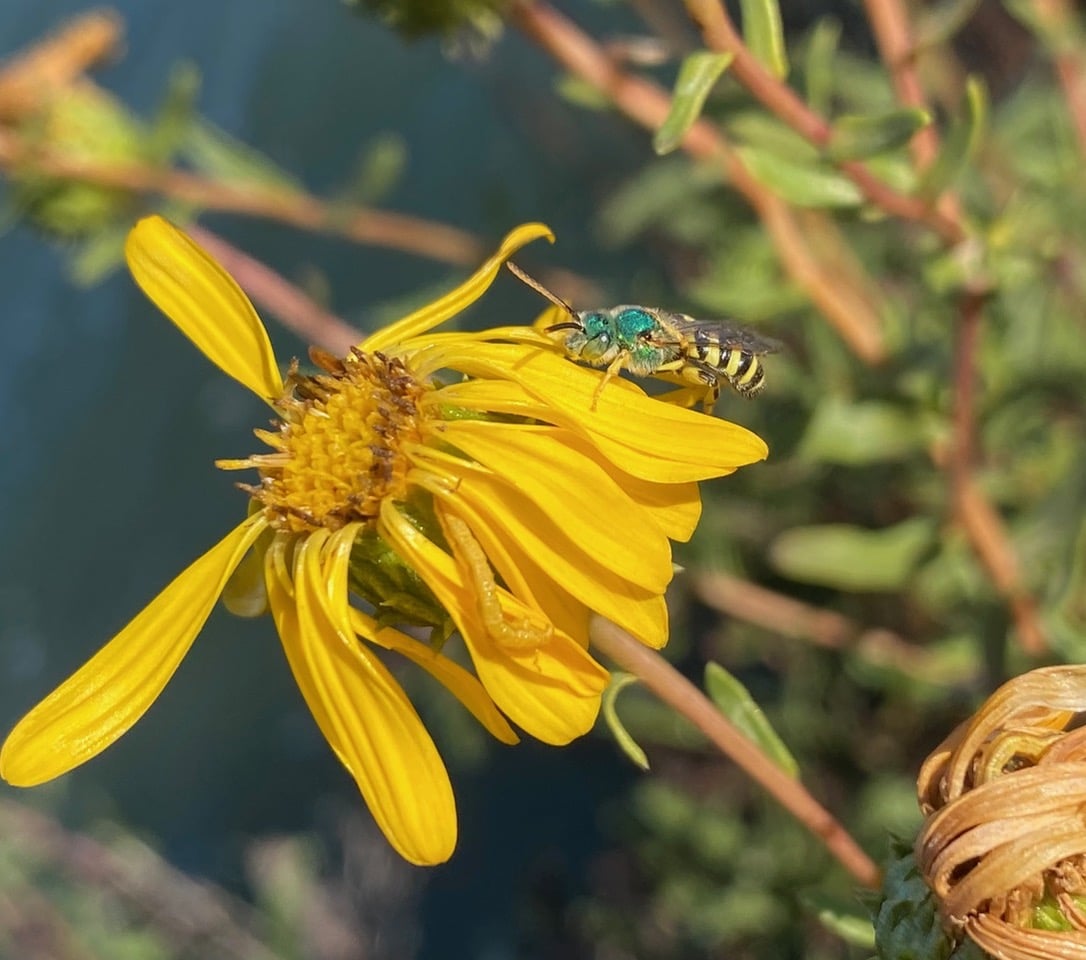
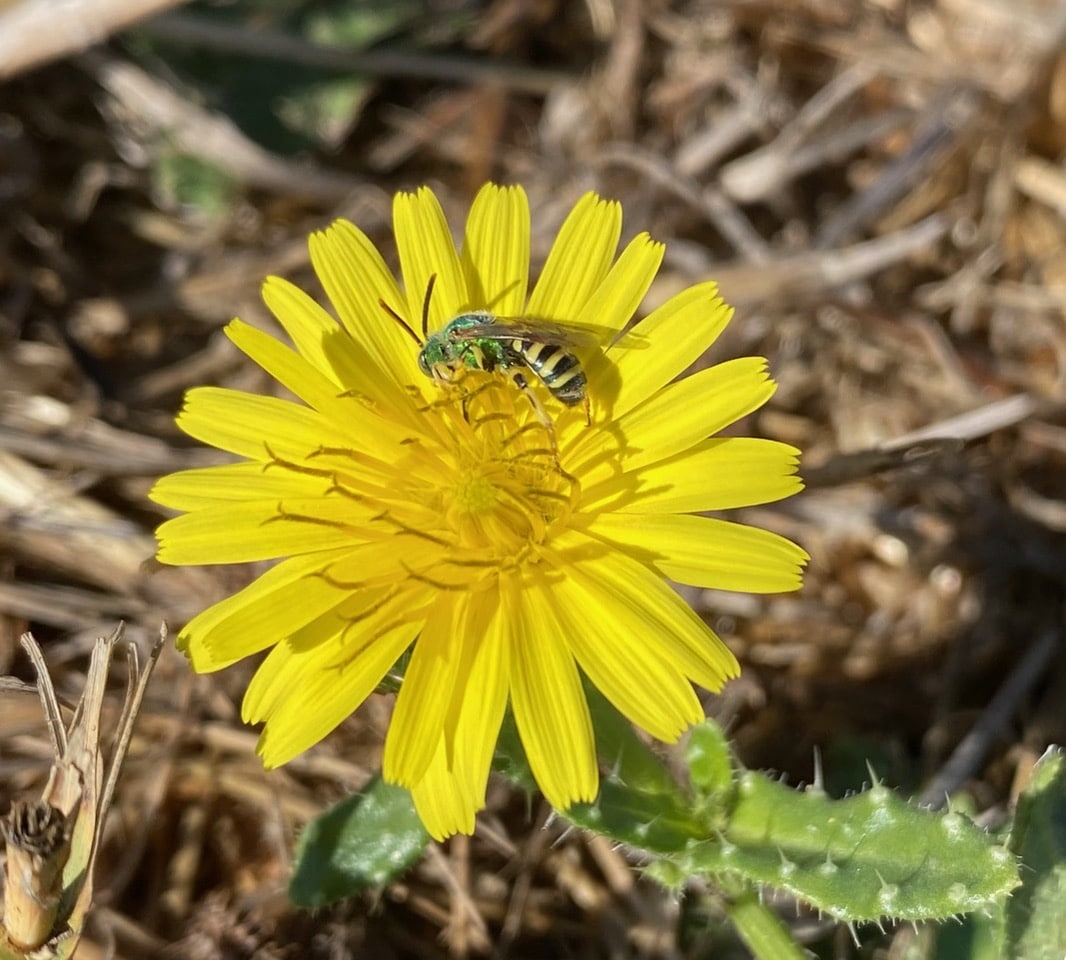
Ooh, do you see the well-camouflaged Inchworm caterpillar of the Pug Moth, Eupithecia sp. (family Geometridae)? I did not see it when I took this picture of the male Striped Sweat Bee, Agapostemon subtilior (family Halictidae) landing on the Grindelia flowerhead.
In Greek, the genus name Agapostemon means “stamen loving”, referring to the bee’s need to forage for pollen. The family Halictidae consists of small, non-aggressive bees with short tongues. They are called sweat bees because they are often attracted to human perspiration from which they obtain salts and water.
The Striped Sweat Bee, Agapostemon subtilior is most commonly found in the west coast of the United States. The species is easily recognized by its metallic green coloration. The females have an entire body that is brilliant blue-green, while the males have an abdomen that is brownish-black with yellow bands. The males (9-10 mm) are smaller than the females (11mm). Due to their short tongues, the Striped Sweat Bees have a limited ability to access nectar from deep flowers. They are generalist foragers, visiting a wide range of flowers.
Female Agapostemon subtilior are active May through October, while males are on wing from July through October. Two generations are produced per year. In the fall fertilized females overwinter in their nests while males typically die. In the spring the fertilized females emerge. They construct their underground nests in bare, loamy soil, lay their eggs in brood chambers and provision them with pollen before dying. In this first generation, the eggs hatch into mostly females as they develop from fertilized eggs. To fix the skewed sex ratio these females lay unfertilized haploid eggs that develop into males. During the summer months the male and female Striped Sweat Bees mate, thus repeating the cycle.
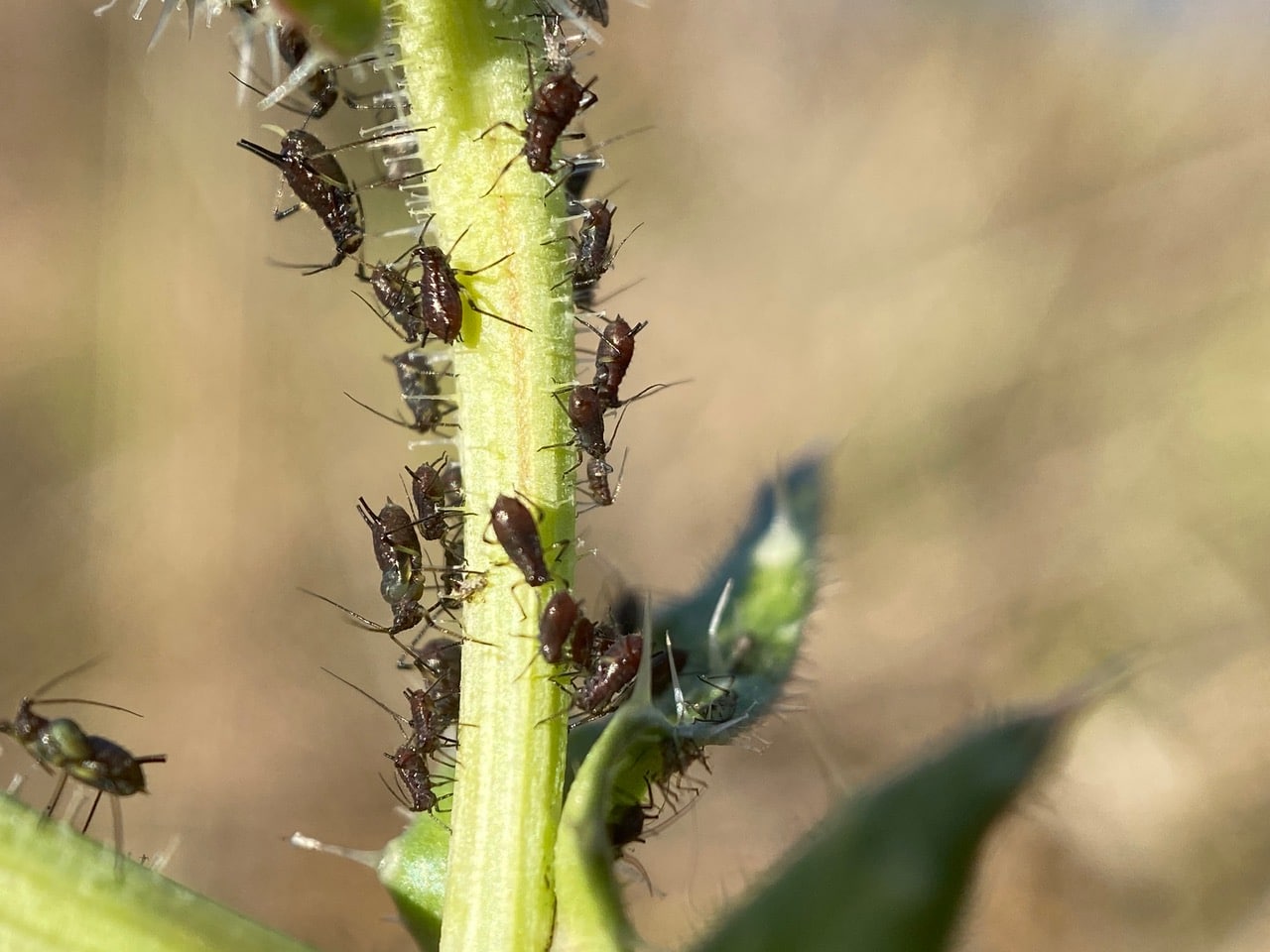
Stopping by an aphid-infested Bristly Oxtongue, Helminthotheca echioides, I notice that some of the larger aphid nymphs have translucent greenish wing buds on their thorax. The colony is preparing for dispersal!
Generally adult aphids are wingless, but most species also occur in winged forms, especially when populations are high or during spring and fall. The ability to produce winged individuals provides the aphids with a way to disperse to other plants when the quality of the food source deteriorates, or when predation pressure is high.
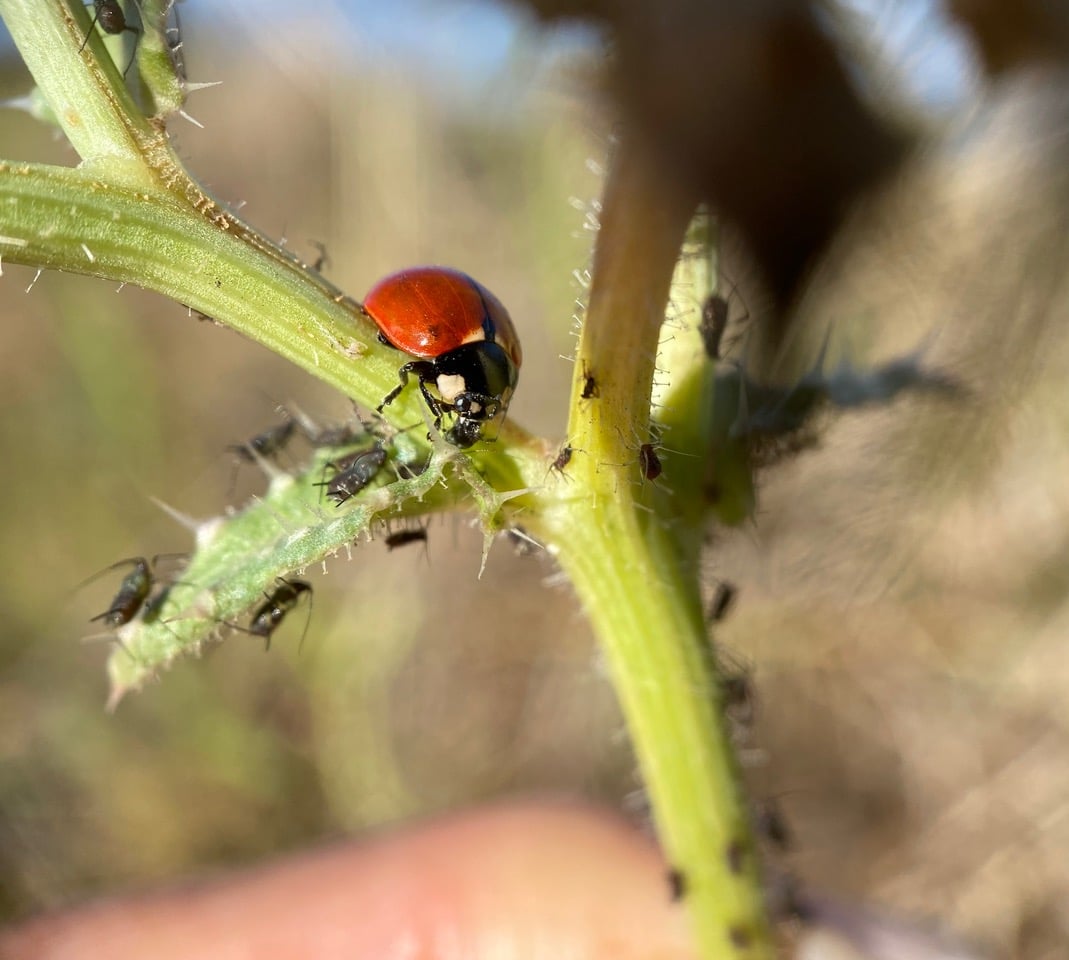
A California Lady Beetle, Coccinella californica (family Coccinellidae) is feeding on an aphid on a Bristly Oxtongue.
The California Lady Beetle, Coccinella californica has a red elytra that is usually spotless. Pronotum is black with a white patch on each side. Head is black with two small white spots between the eyes. There is a black suture (where the wings meet, down the middle of the back). The species’ range is the coastal counties north of the Transverse Ranges.
A male Striped Sweat Bee, Agapostemon subtilior (family Halictidae) is taking nectar on a flowerhead of Bristly Oxtongue.
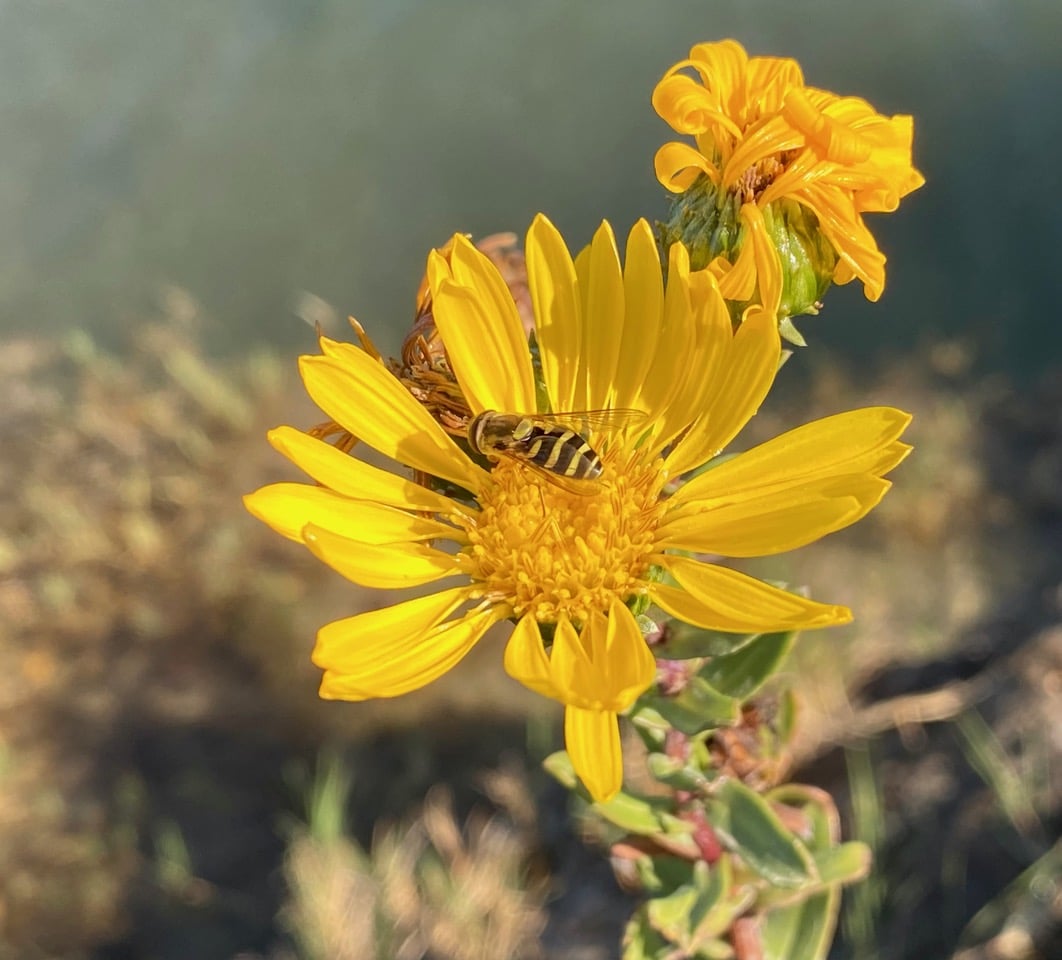
A Western Aphideater, Eupeodes fumipennis (family Syrphidae) forages on a Grindelia flowerhead. The hover fly is a perfect example of Batesian mimicry. It has black-and-yellow stripes on its abdomen, reminiscent of the stinging wasps and bees. The resemblance provides the harmless fly with a measure of protection from potential predators who may want to avoid confrontation with an aggressive insect.
The Western Aphideater, Eupeodes fumipennis (family Syrphidae) is found in western North America, mostly seen March through October. As the common name implies, larvae prey on aphids and other soft-bodied insects. Adults visit flowers for nectar and pollen.
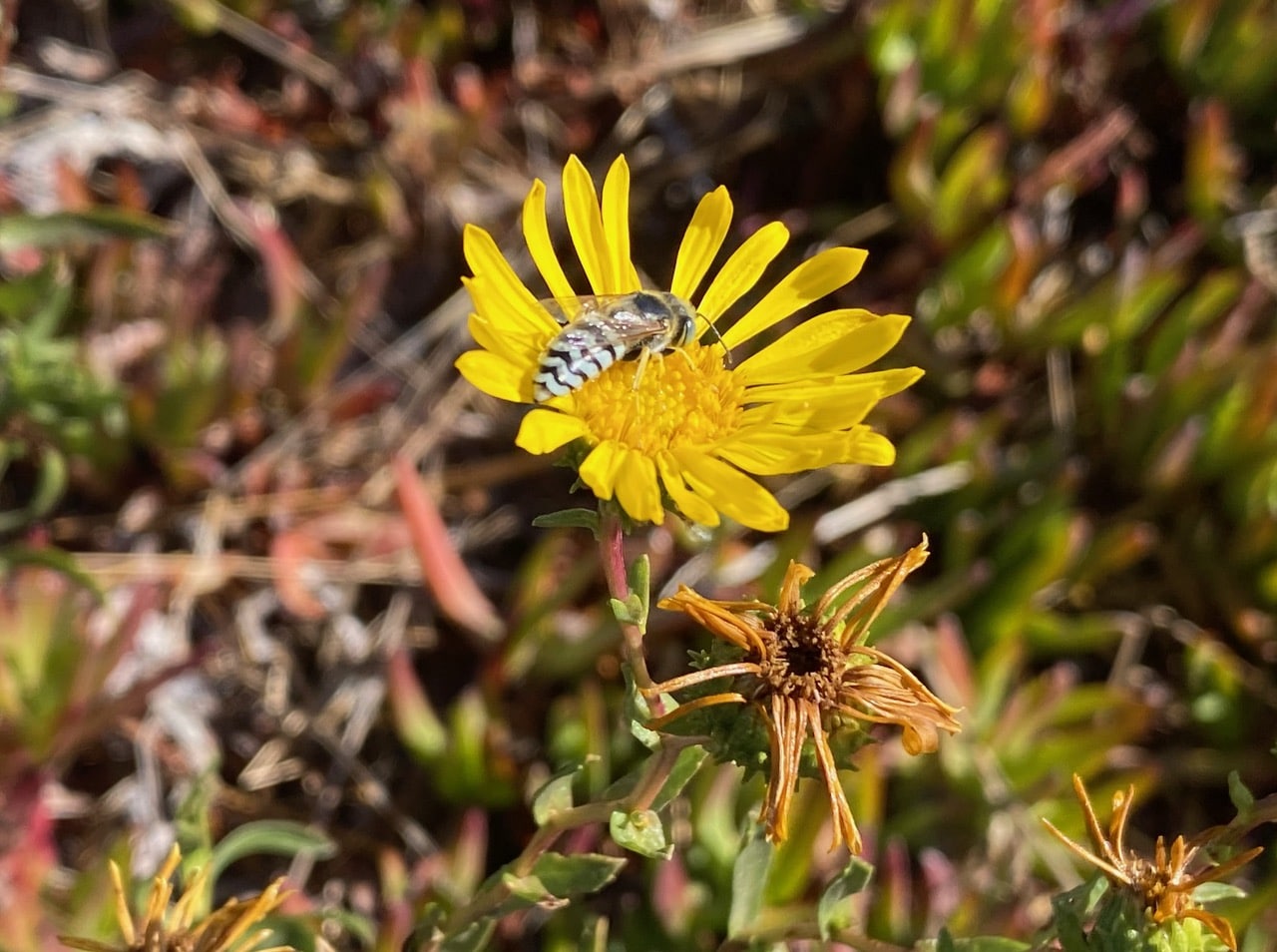
The Sand Wasps are still going strong along the shore here. Although I no longer see them excavate nests on the sandy ground, many of them are still seeking nectar from the remaining flowers.
Sand wasps in the genus Bembix are familiar and common throughout North America, digging their burrows in dunes, on beaches, and other habitats with loose, deep sand. The female rapidly kicks out large quantities of sand using a “tarsal rake” of spines on each front leg. The burrow is excavated before the wasp goes hunting. Bembix are generalist, opportunistic hunters. True flies in the order Diptera are the usual prey. A victim is paralyzed or killed by the wasp’s sting, and is then flown back to the nest. Most species will lay an egg on the first victim, while some species lay an egg in the empty cell before starting to hunt. Once the egg hatches, mama wasp brings flies to her larva as needed. This “progressive provisioning” is rare in the insect world. When the larva reaches maturity, mama wasp closes the cell. Inside, the larva spins an oblong cocoon, weaving sand grains into the structure and resulting in a hardened capsule. Overwintering takes place as a prepupa inside this cocoon, but there are usually two generations a year.
A Western Pygmy Blue, Brephidium exilis (family Lycaenidae) is taking nectar from a Grindelia flowerhead. It is a common butterfly here, as the shores of Bay Farm Island abound in its larval food plants, such as the Fleshy Russian Thistle and the various Salt Bushes.
With a wingspan of 12-20 mm, about the size of a thumbnail, the Western Pygmy Blue, Brephidium exilis (family Lycaenidae) is one of the smallest butterflies in the world and the smallest in North America. The butterfly is found in alkaline areas such as deserts and salt marshes. The caterpillars feed on plants in the Goosefoot family Chenopodiaceae, commonly found in salty habitats. Although the species has no set breeding season, mating activity is at its peak during late summer and early fall.
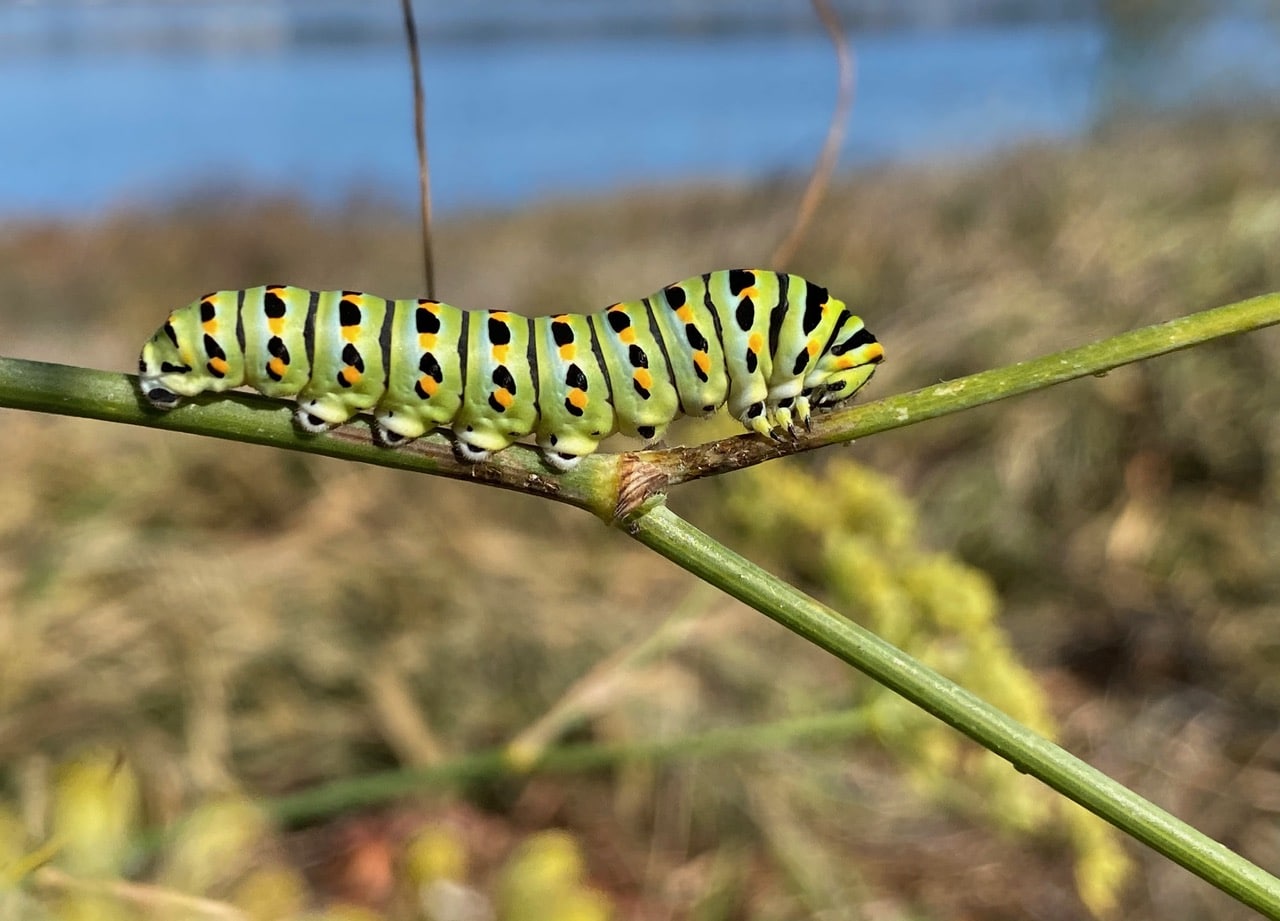
What a delightful surprise! A last instar caterpillar of the Anise Swallowtail is resting on a stem of a Fennel, Foeniculum vulgare that is leaning dangerously low to the ground. I must have passed this plant a hundred times without seeing the caterpillar!
The Anise Swallowtail caterpillar undergoes drastic changes in appearance as it grows, starting from a bird-dropping mimic, eventually acquiring a green camouflage to blend in with its host plant. Instar is the term given to the developmental stage of an insect between molts. For example, after hatching from the egg an insect is said to be in its first instar. When the insect molts it is then a second instar and so on.
I take a closer look at the caterpillar. Each of its stubby, fleshy prolegs under its abdominal segments has a black spot, like a painted toe nail. On the last abdominal segment is another pair of prolegs, called the anal prolegs. Clustered close to its head, under the thoracic segments are three pairs of thoracic legs with claws. These will be retained in the adult butterfly after metamorphosis, while the prolegs will disappear.
_Fausses_pattes.jpg)
A friend reported termite swarming in his neighborhood in Alameda this morning. I drop everything and head for Alameda again in the afternoon. In the back of my mind, I have wondered this morning whether a termite or ant swarming might be imminent following the rain we had early this morning. The termites have mobilized very quickly!
Emil leads me to the spot where he had witnessed a termite swarm earlier, around noon. It is a neighbor’s front yard with a brown lawn and a tarp-covered flowerbed. Only an occasional winged termite can be seen rising from the ground. Alas – the swarming activity has obviously subsided! We discover where the termites are emerging from – on the edge of the lawn next to the flowerbed. I manage to photograph the stragglers making a mad dash up the grass stems to launch themselves into the air.
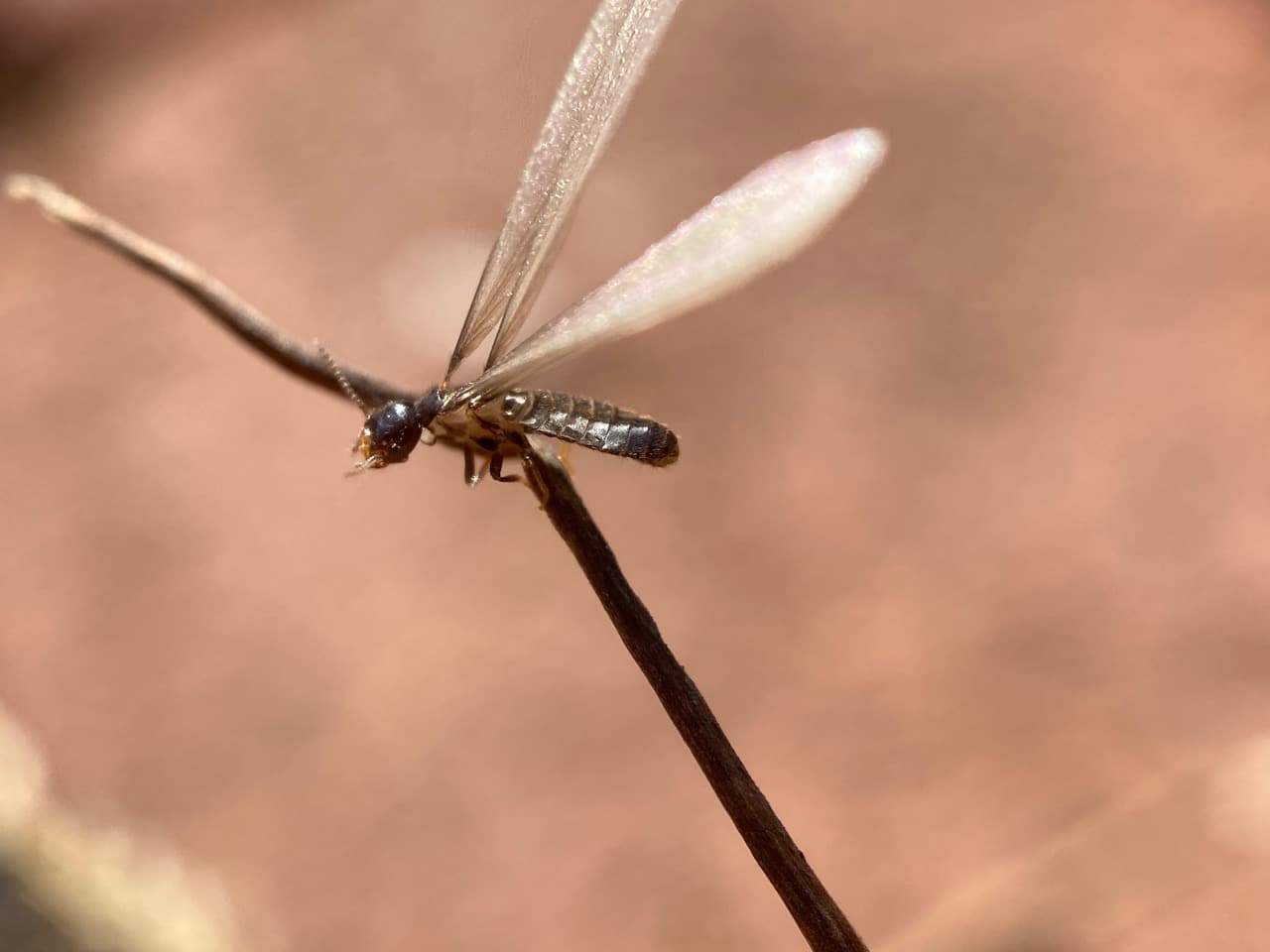
Close up of a termite alate (winged reproductive) waiting to go on its nuptial flight on the next breeze. It is probably a Western Subterranean Termite, Reticuliformes hesperus (family Heterotermitidae, order Blattodea). It is difficult to tell the genders of the alates in the field – male and female alates look similar.
Termites have a caste system in their social organization. Worker termites undertake the most labor within the colony, being responsible for foraging, food storage, and brood and nest maintenance. They are tasked with the digestion of cellulose in food and feeding their nest mates in the process of trophallaxis. The soldier caste is anatomically and behaviorally specialized to defend the colony. They have large heads with modified jaws so enlarged that they cannot feed themselves. Instead, like juveniles, they are fed by workers. The primary reproductive caste of a colony consists of the fertile adult female and male individuals, commonly known as the queen and king. These form lifelong pairs where the king will continuously mate with the queen. The queen is responsible for egg production. Alates, or winged reproductives are produced at certain time of year. With the right environmental conditions (usually warm, windless days after a rain), the alates fly off on nuptial flight in search of mates from other nearby colonies.
Here’s a fun video to introduce you to the Western Subterranean Termites, Reticuliformes hesperus (family Heterotermitidae):
Although termites are dreaded for feeding on our homes and other wooden structures, the insects are an important component of our ecosystem. Termites are “green machines”- they are hands-down nature’s best recyclers. They feed on the cellulose found in dead plants, and their sticky excretions hold the soil together, preventing soil erosion. They burrow tirelessly and aerate the soil, allowing rainwater to seep in and enabling the mixing of nutrients to support new plant growth. Termites are also food for a host of predators such as lizards and birds.
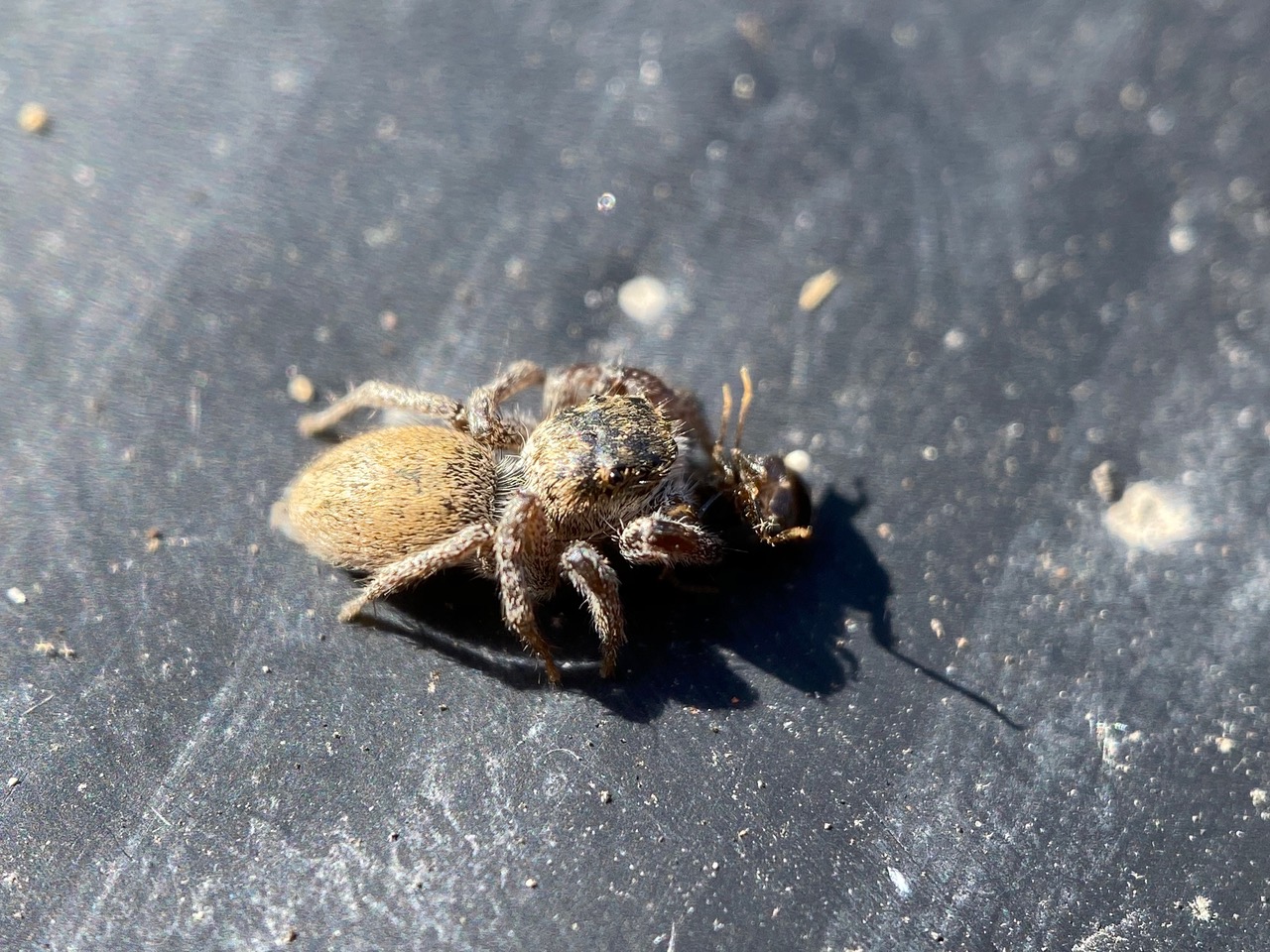
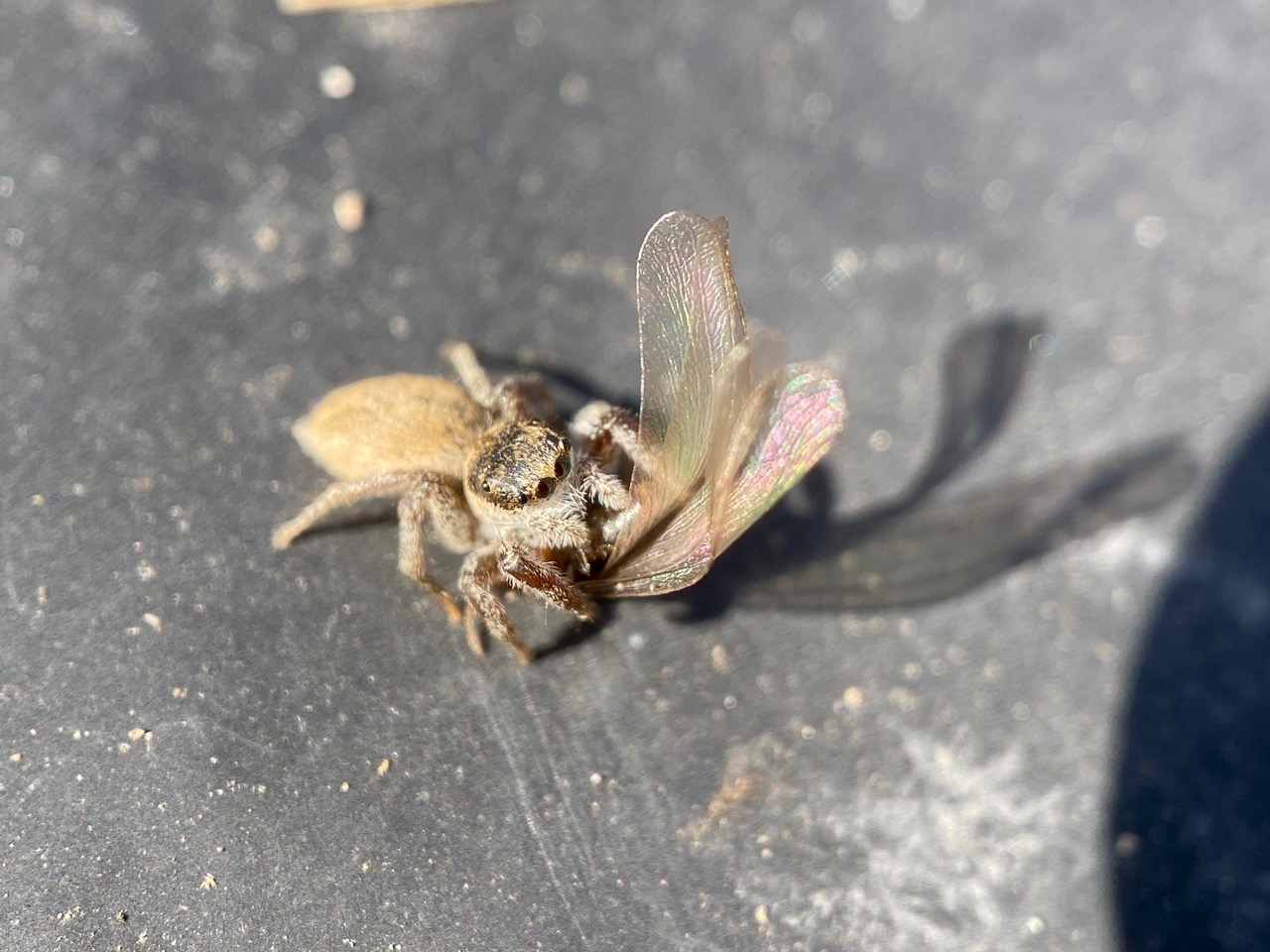
I find quite a few dead termite alates on the black tarp that covers a flowerbed next to the spot where the alates emerge. Wow, how and why did they die?It only takes a minute for the answer to come to me – a Jumping Spider! A female Paradise Jumping Spider, Habronattus sp. (family Salticidae) is trying to subdue a still struggling termite that she has pinned under her. A Paradise Jumping Spider in paradise! What a windfall the termite swarming event must be for this little predator! In the 15 minutes I watch her, the spider successfully tackles 3 alates that land on the tarp.
The genus Habronattus is restricted to the New World, mainly in North and Central America. These small spiders (5-8 mm) are found in a variety of habitats including mountaintops, deserts, and riparian areas. They can be common and abundant in backyards, gardens, and agricultural areas, often seen jumping along the ground, across leaf litter, or through vegetation. Habronattus are commonly referred to as Paradise Jumping Spiders due to their colorful courtship ornaments and complex dances, similar to the birds-of-paradise. Males display intricate coloration, while the larger females are a drab and cryptic gray-brown. The eyes of Habronattus has a unique vision system that provides an enhanced ability to discriminate colors. Specifically, Habronattus has a red filter pigment in their retina, which gives them a broad color discrimination ability ranging from UV to red.
Habronattus species are perhaps best-known for the complex and multimodal courtship behavior of males, which incorporates movement, bright colors, and substrate-borne vibrations into a choreographed species-specific display.
Habronattus jumping spiders are opportunistic and voracious generalist predators. They can be extremely abundant in certain habitats and eat mostly small insects and other arthropods, including many pest species. Their prey capture technique relies on their acute vision, which enables them to tackle and take down prey much larger than themselves.
Dear Friends,
Given the waning floral bounty and the dwindling numbers of insects, it’s time to put our gardens and the Pollinator Post to rest again. The posts will resume next spring when the insects reappear with the first blooms. Meanwhile I look forward to some quiet time to pursue other interests and projects.
May the joy and wonder of discovery be yours through the seasons!
Cheers,
May