

Pollinator Post 10/3/25

Another beautiful afternoon at Bay Farm Island.
The Oregon Gumweed, Grindelia stricta along the shoreline is fading, but I am hopeful that I’ll still find some interesting insects on these plants.

Wow, that’s a huge Thick-headed Fly, Physocephala texana (family Conopidae) on the Grindelia flowerhead – the largest I have ever seen! For that size, the parasitoid fly in its younger days must have been hosted by a queen Bumble Bee (Bombus)or a Carpenter Bee (Xylocopa). The sight of this unusual fly always elicits a mix of wonder and horror in me. It gives me no comfort to think that I have just passed two queen Yellow-faced Bumble Bees flying low over the undergrowth, seemingly searching for a hibernation site for overwintering. They would be prime targets for this female Thick-headed Fly when she’s looking to lay her eggs.
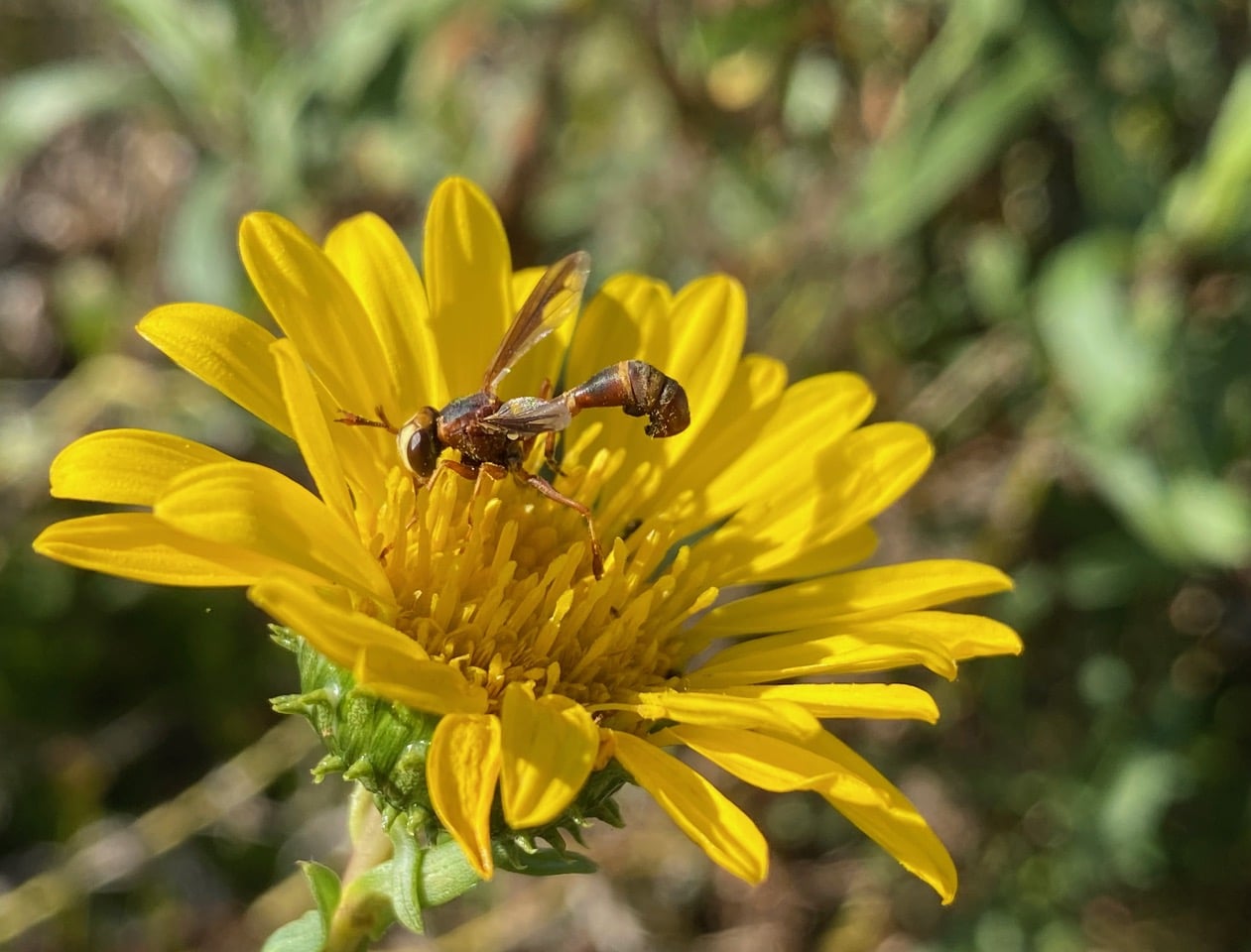
The small and little-known family of Conopidae, commonly called the Thick-headed Flies, are distributed worldwide. Remarkable mimics of wasps and bees, the flies are frequently found at flowers, feeding on nectar with their long probosces. The larvae of all Conopids are internal parasitoids, mostly of aculeate (stinging) Hymenoptera (wasps, bees). Adult females in the genus Physocephala aggressively intercept their hosts in flight to deposit eggs. Vulnerable foraging bees are likely the most susceptible to parasitism by Conopids. The female’s abdomen is modified to form what amounts to a “can opener” to pry open the segments of the host abdomen as the egg is inserted. The fly larva feeds on the host from the inside out. The bee host continues to live, and is able to fly throughout the duration of the larval developmental period. The vast majority of parasitized bumble bees bury themselves by burrowing into the ground right before they die. This behavior does not matter to the bees – they are doomed. But it is critical for the flies – if the host dies underground, the fly is sheltered from the elements, predators and parasites. Pupation occurs in the abdomen of the now deceased bee host. The adult fly typically emerges after overwintering in the abdominal puparium of the bee.
The life spans of parasitized bumble bees are not significantly shortened, though as the parasitoid grows, the bee can’t carry home as much nectar. Bumble bees will chill, literally, to put off the inevitable, seeking cooler spots, even sleeping outside at night to slow the growth within them. If many of the workers in a colony are infested, future queens may be smaller in size and may not have enough energy to get through the winter.
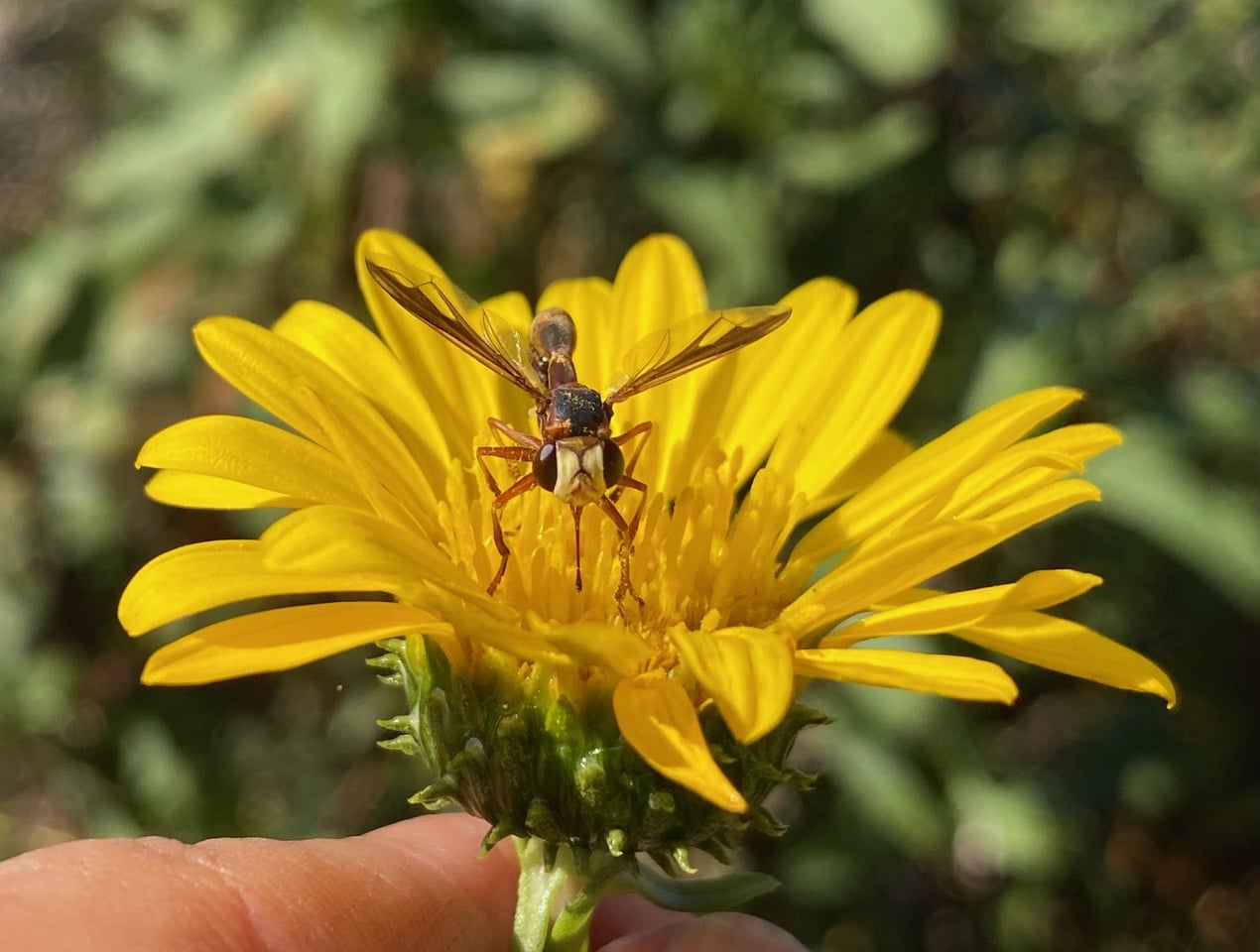
Front view of the Thick-headed Fly, as it lifts its face from the flowers. Note its long, straight proboscis. The leading edge of its wings are brown, resembling the wings of wasps that are partially folded lengthwise when not in flight.
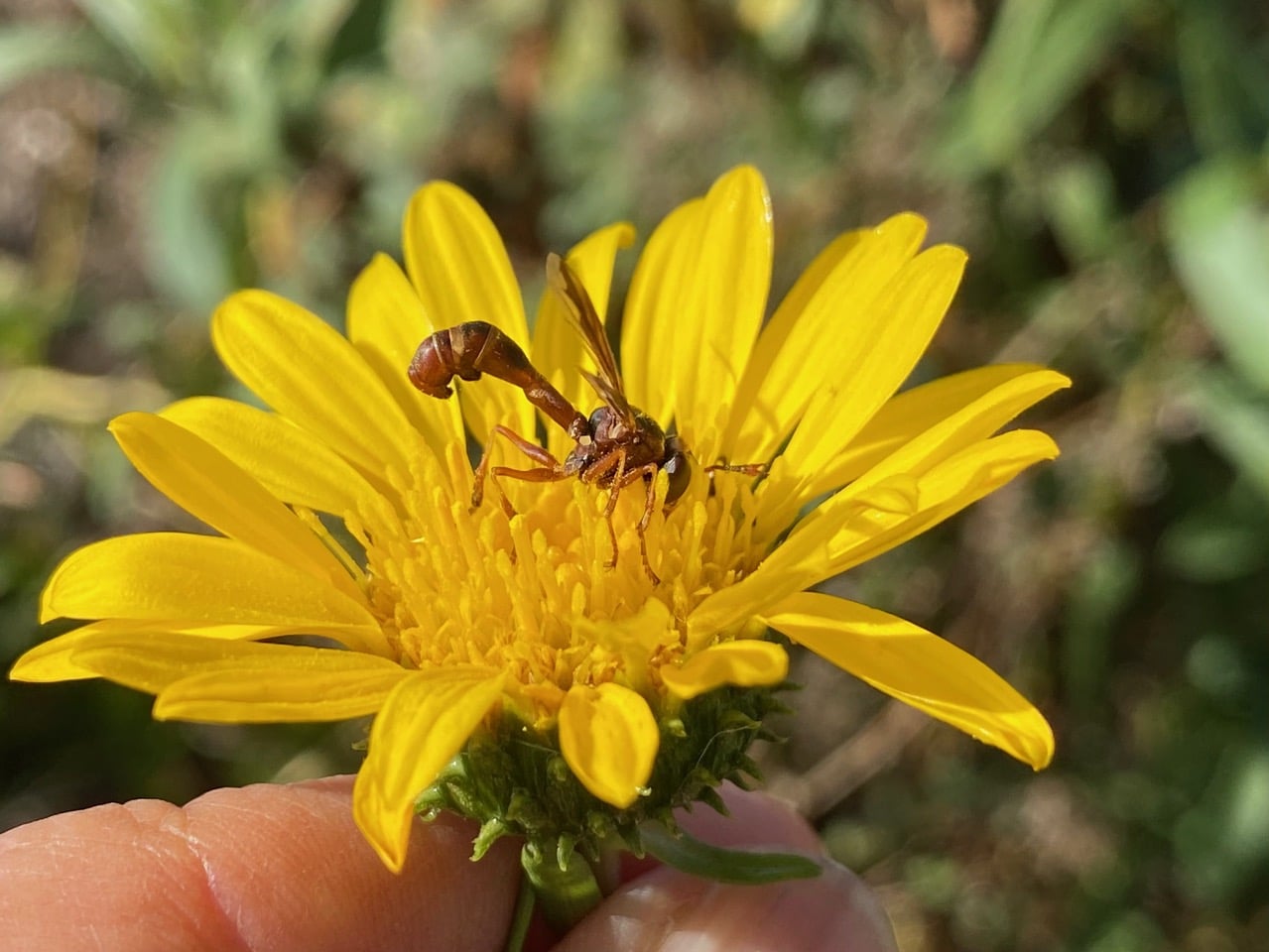
The fly is so intent on taking nectar that it allows me to manipulate the flowerhead anyhow I want to photograph it. Here’s a front-row view of that formidable “can-opener” abdomen of the female.
Adult female Physocephala will pounce on a bee or wasp host while it is visiting flowers or in flight. Oviposition is accomplished by using a rapid opposing-motion of the female’s theca and hook-like terminalia to pry open the host’s abdominal tergites (somewhat like a “can-opener”) to insert an egg in the host.
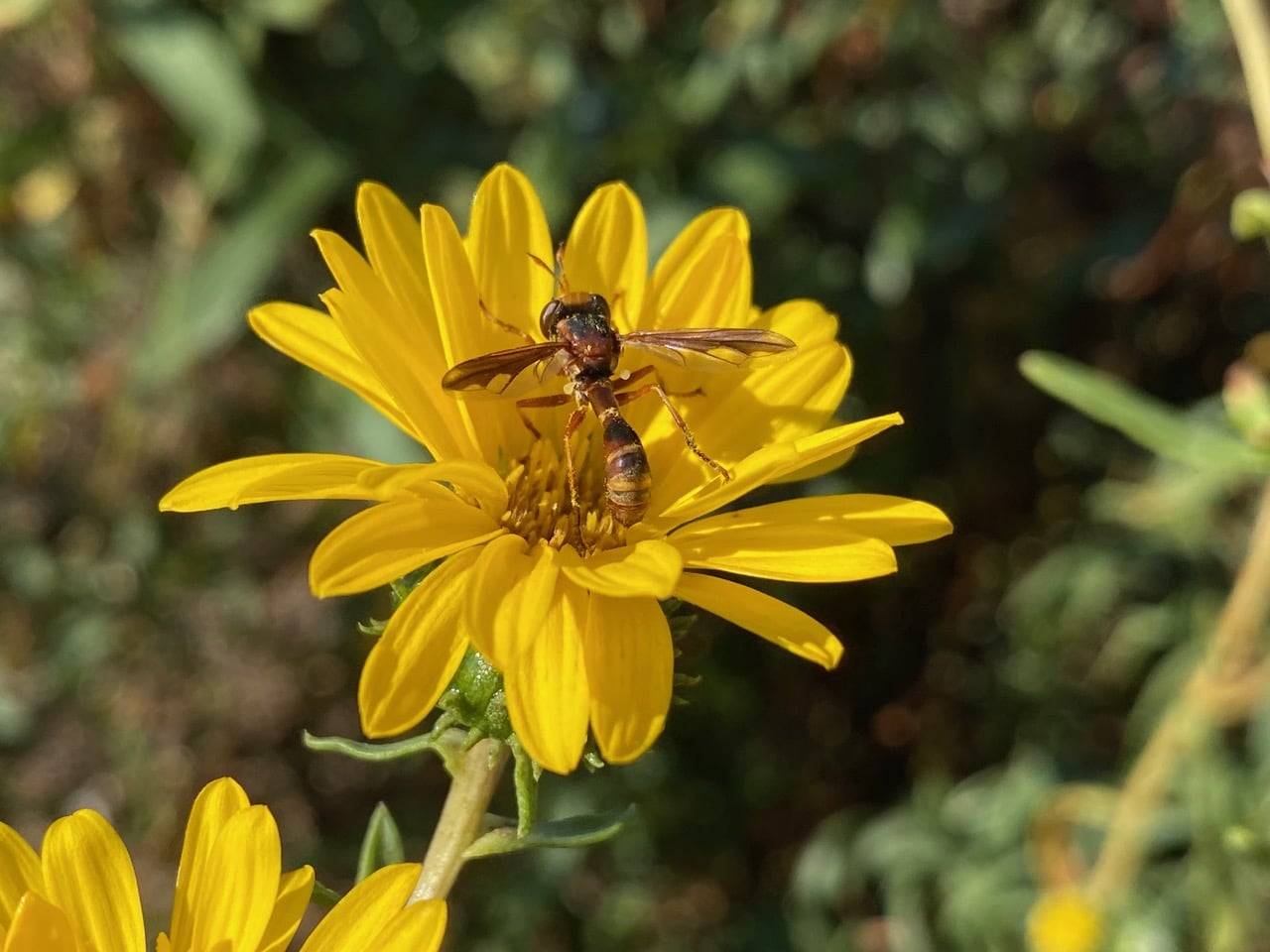
A dorsal view shows the fly’s petiolate abdomen – the long, narrow second segment simulates a wasp’s narrow waist.
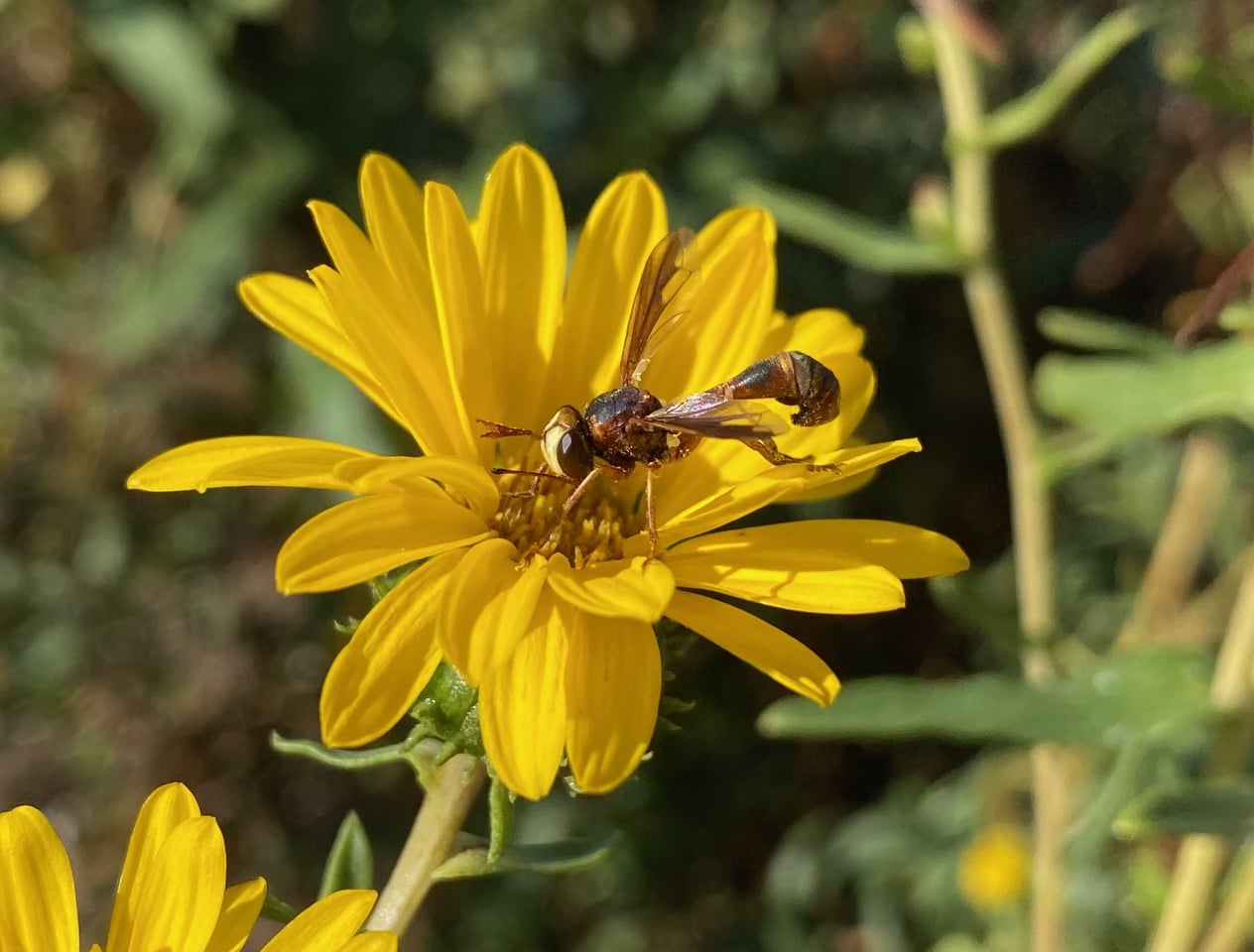
This side view of the fly shows its unusual mouthparts. The proboscis is hinged near the base, beyond which it is long, straight and needle-like, projecting forward well beyond the face. The antennae are also long and straight, positioned close together, and point forwardly-upward.
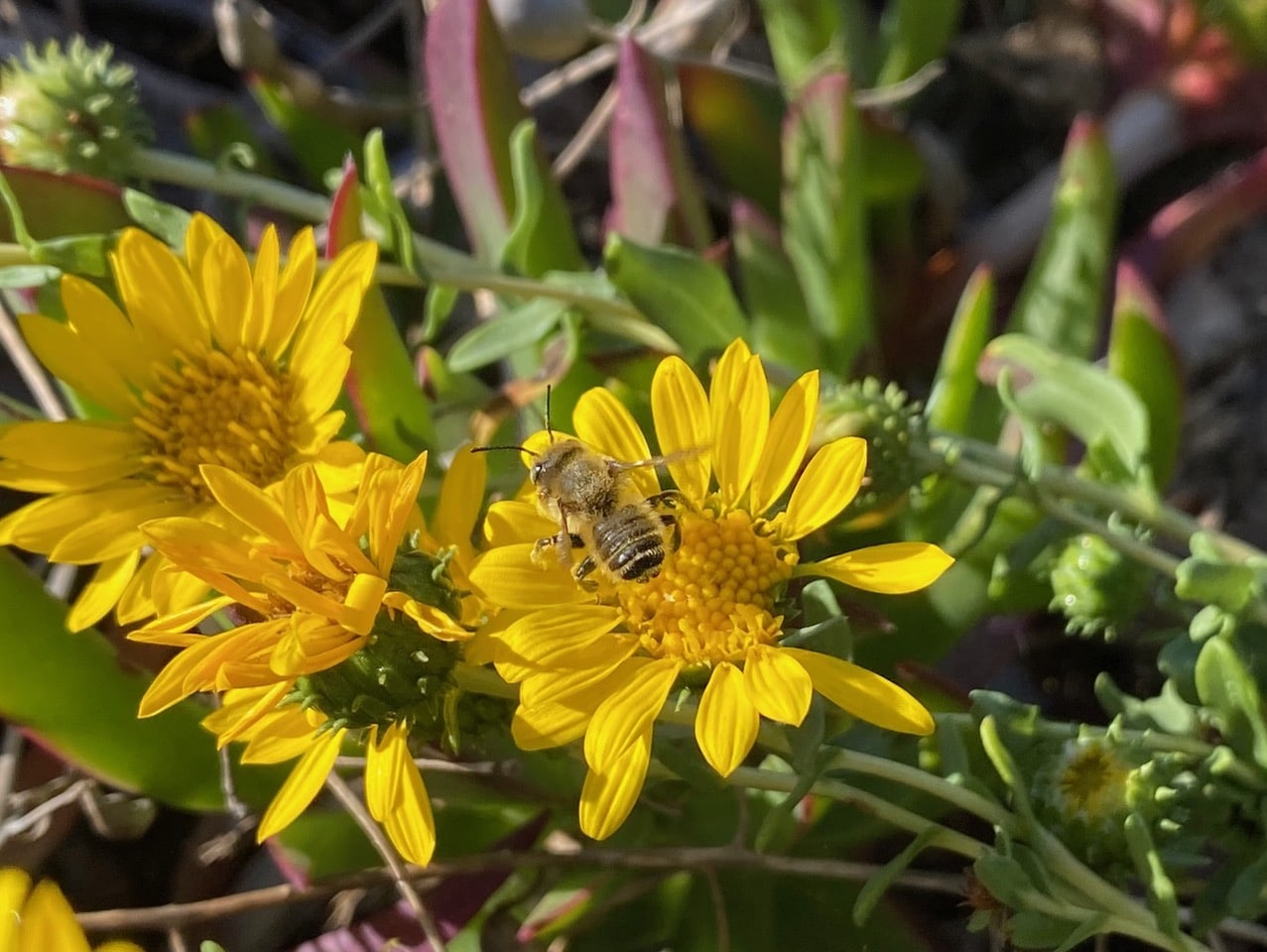
A male Western Leafcutter Bee, Megachile perihirta (family Megachilidae) has landed on a Grindelia flowerhead. Note his general fuzzy appearance and his rounded abdomen.
Leaf-cutter Bees, Megachile sp. (family Megachilidae) are stout-bodied, usually with pale hair on the thorax and stripes of white hairs on the abdomen. Females usually have a triangular abdomen with a pointed tip, and males’ faces are covered with dense, pale hair. Flight season is from May into September, with peak activity from June to August. Solitary females construct nests in tubular cavities, including hollow stems, tree holes, and abandoned beetle burrows in wood. Many use holes drilled into wood, straws, or other manufactured tunnels. Females cut pieces from leaves or flower petals for use in the construction of brood cells. Most Megachile females are generalists when foraging for pollen. Pollen is transported in dense scopae on the underside of the abdomen.
Photos of Western Leafcutter Bee (Megachile perihirta) · iNaturalist
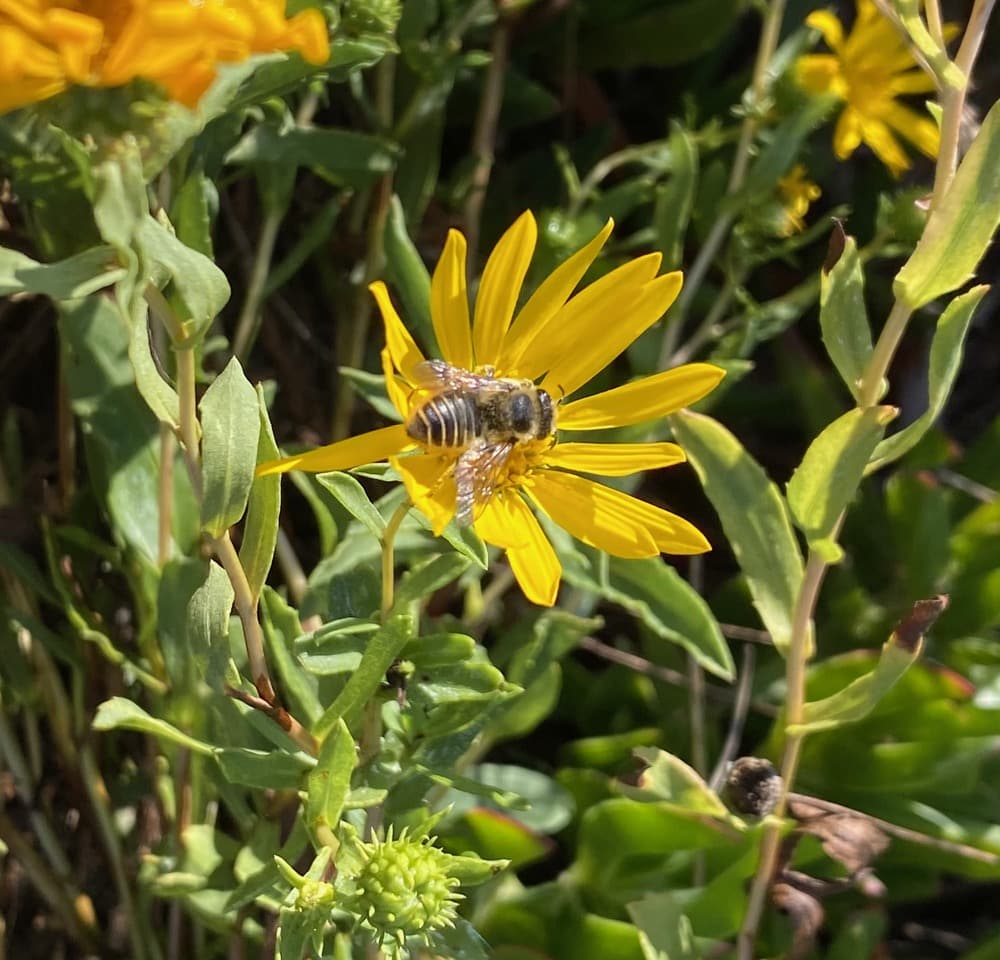
Here’s a female Western Leafcutter Bee, Megachile perihirta (family Megachilidae) collecting pollen on a Grindelia flowerhead in the typical butt-up posture. Note that her abdomen ends with a pointed tip, in contrast to the male’s. Pollen is collected on the scopa (special pollen collecting hairs) on the underside of the female’s abdomen.
North America is home to many leafcutter bees, but the Western Leafcutter, Megachile perihirta is one of the largest. The species ranges on the west coast from British Columbia south to northern Mexico. From a distance, the female can be mistaken for a honey bee. She is about the same size as a worker honey bee and enjoys many of the same flowers, but her head is disproportionately large because it houses the bulky muscles that operate her large mandibles. While most leafcutter bees nest above ground in tubes and tunnels, the Western Leafcutter nests underground. Often a small group of females live in a community and burrow into soil, gravel, or sand. Although they are generalist foragers, the Western Leafcutters, Megachile perihirta prefer flowers in the Asteracea family for nectar and pollen; the composite flowerheads offer a flat surface on which numerous florets are clustered. The bees are frequently seen foraging on Seaside Daisy, Grindelia, Asters, Sunflowers, Cosmos, and Dahlia.
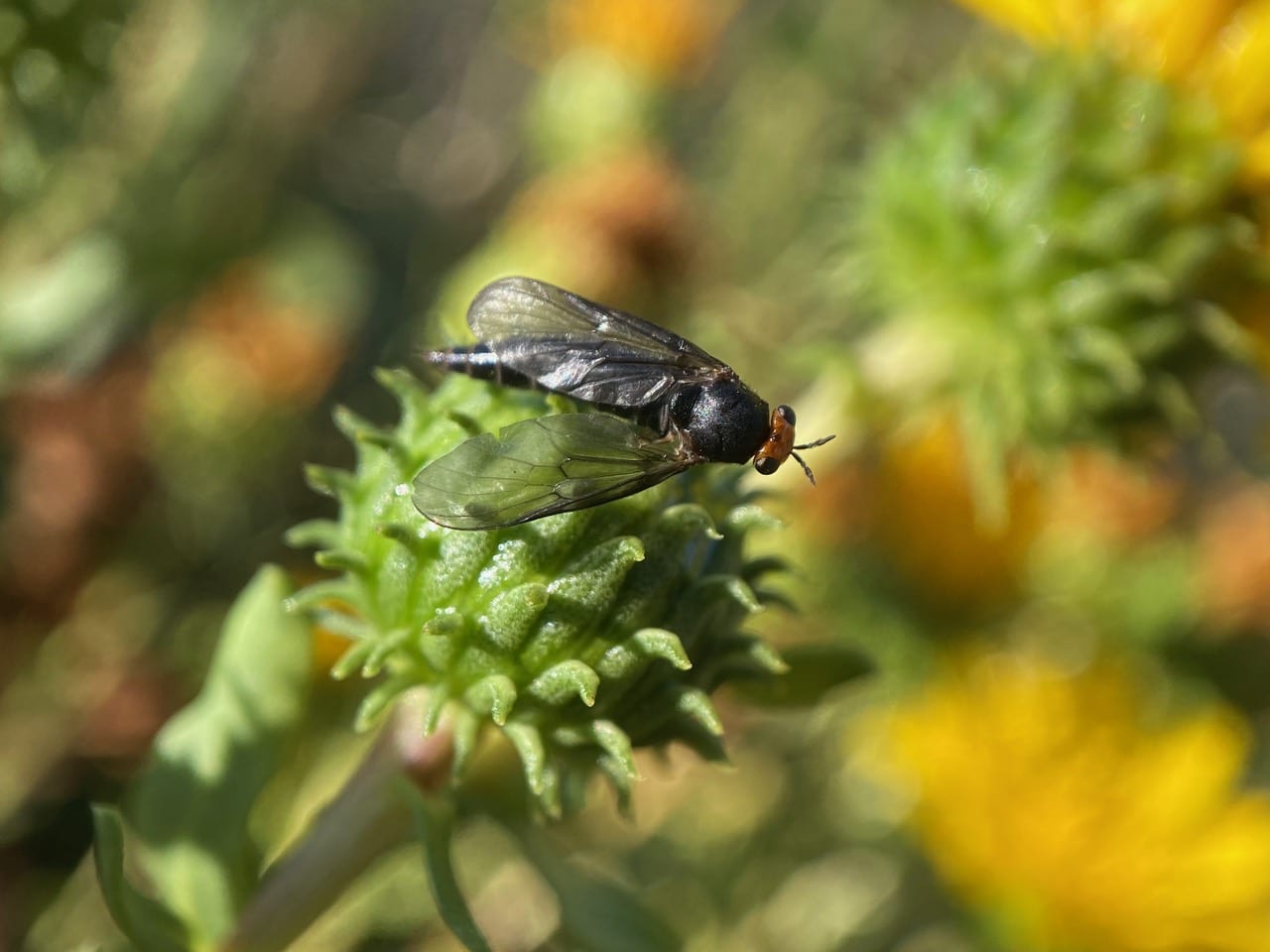
A small black fly is lying on its side atop an immature Grindelia flowerhead. Closing in, I discover that it is a female Sugarcane Soldier Fly, Inopus rubriceps (family Stratiomyidae).
The Sugarcane Soldier Fly, Inopus rubriceps (family Stratiomyidae) is native to eastern Australia where it infests such crops as corn, pastures, and sugarcane. The fly was accidentally introduced into California over 50 years ago. It is now infesting lawns in San Francisco and other Bay Area counties. Damage to turf and other members of the grass family results from withdrawal of sap from roots of host plants by the larvae and possibly, injection of a toxin into the plant.
In California adults occur in large numbers from late September to early November each year. Eggs are deposited in crevices in the soil. The adults are sexually dimorphic. Females have tiny red heads with eyes set far apart. The smaller males have large eyes that occupy the whole surface of the head.
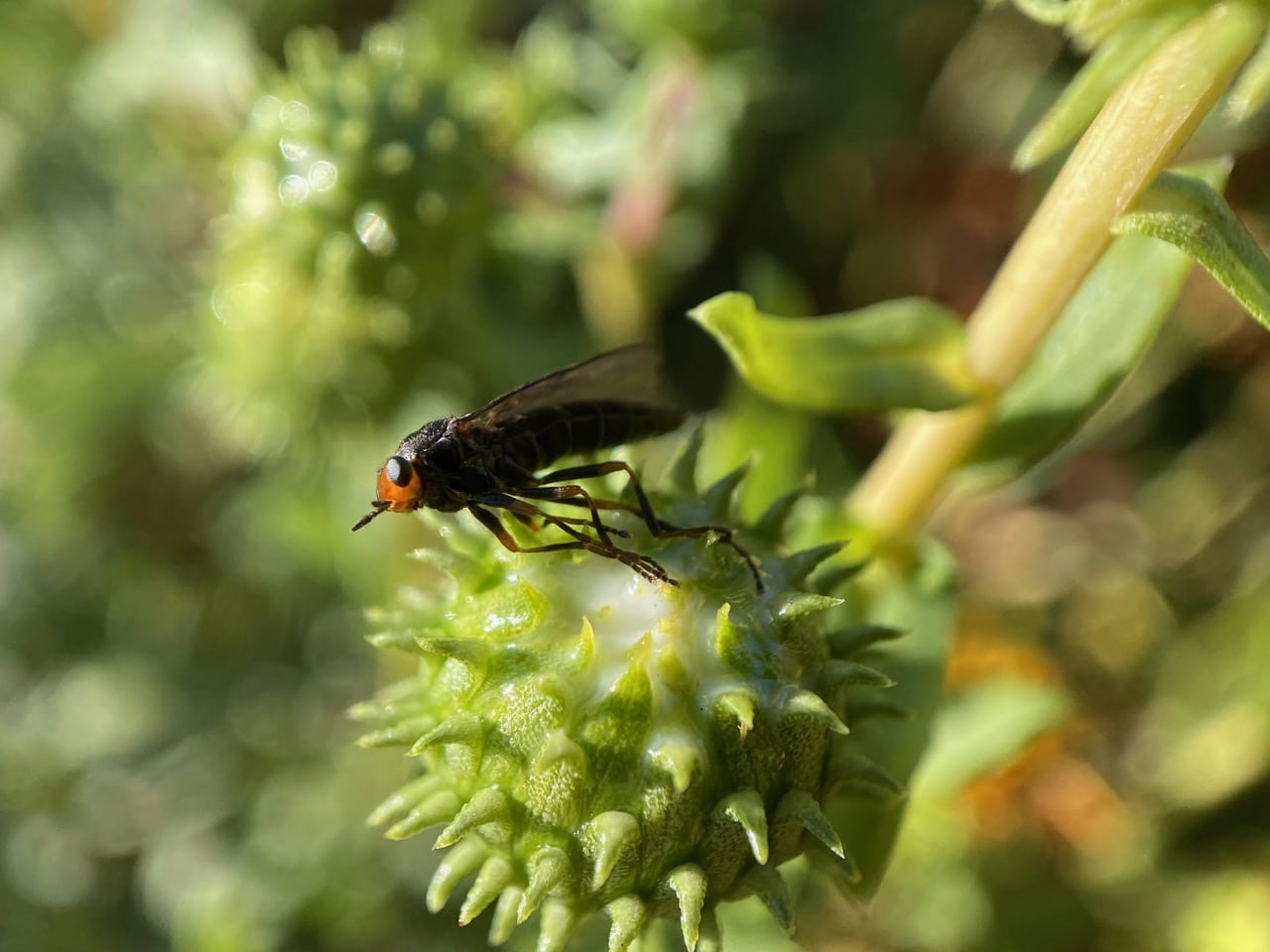
Looking from the front, I realize that the fly is stuck on the glue-like exudate of the immature Grindelia flowerhead. It is still alive, weakly trying to free its legs from the sticky stuff.
The sticky, white exudate on immature Grindelia flowerheads is a protective, antimicrobial resin that helps the plant defend itself from insects, herbivores, and pathogens. It is the source of the plant’s common name, “gumweed”. The resin is produced by special glands, called trichomes, that are most abundant on the flowerheads and leaves. Production is highest on the buds right before they open, appearing first as a clear, viscous liquid. As it dries and dehydrates, it becomes the stickier, white substance for which the plant is known. In addition to repelling larger herbivores, the viscous resin can trap smaller insects that come in contact with the buds. The resin is rich in antimicrobial compounds, such as grindelic acid and other diterpenes, that inhibit the growth of bacteria and fungi.
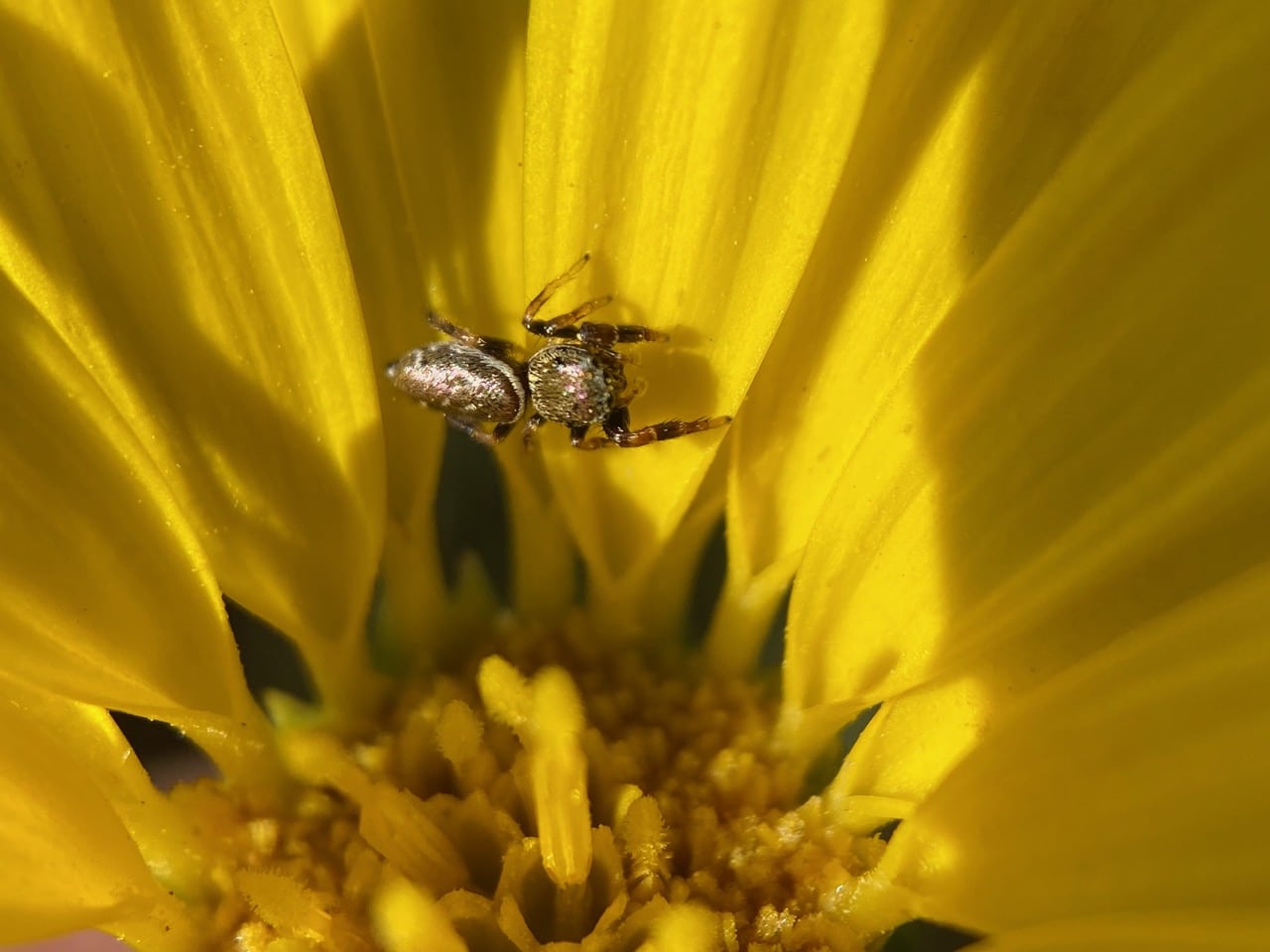
A tiny Jumping Spider on a Grindelia flowerhead is lit up by the afternoon sun. It is a Buttonhook Leafbeetle Jumping Spider, Sassacus vitis (family Salticidae).
Jumping spiders (family Salticidae) are free-roaming hunting spiders. They do not weave a web to catch prey. They stalk, then pounce on their prey. Just before jumping, the spider fastens a safety line to the substrate. It can leap 10-20 times their body length to capture prey. Their movement is achieved by rapid changes in hydraulic pressure of the blood. Muscular contractions force fluids into the hind legs, which cause them to extend extremely quickly. Jumping spiders are visual hunters. Their excellent vision has among the highest acuities in invertebrates. Since all their 8 eyes are fixed in place and cannot pivot independently from the body like human eyes can, jumping spiders must turn to face whatever they want to see well. This includes moving their cephalothorax up and down, an endearing behavior.
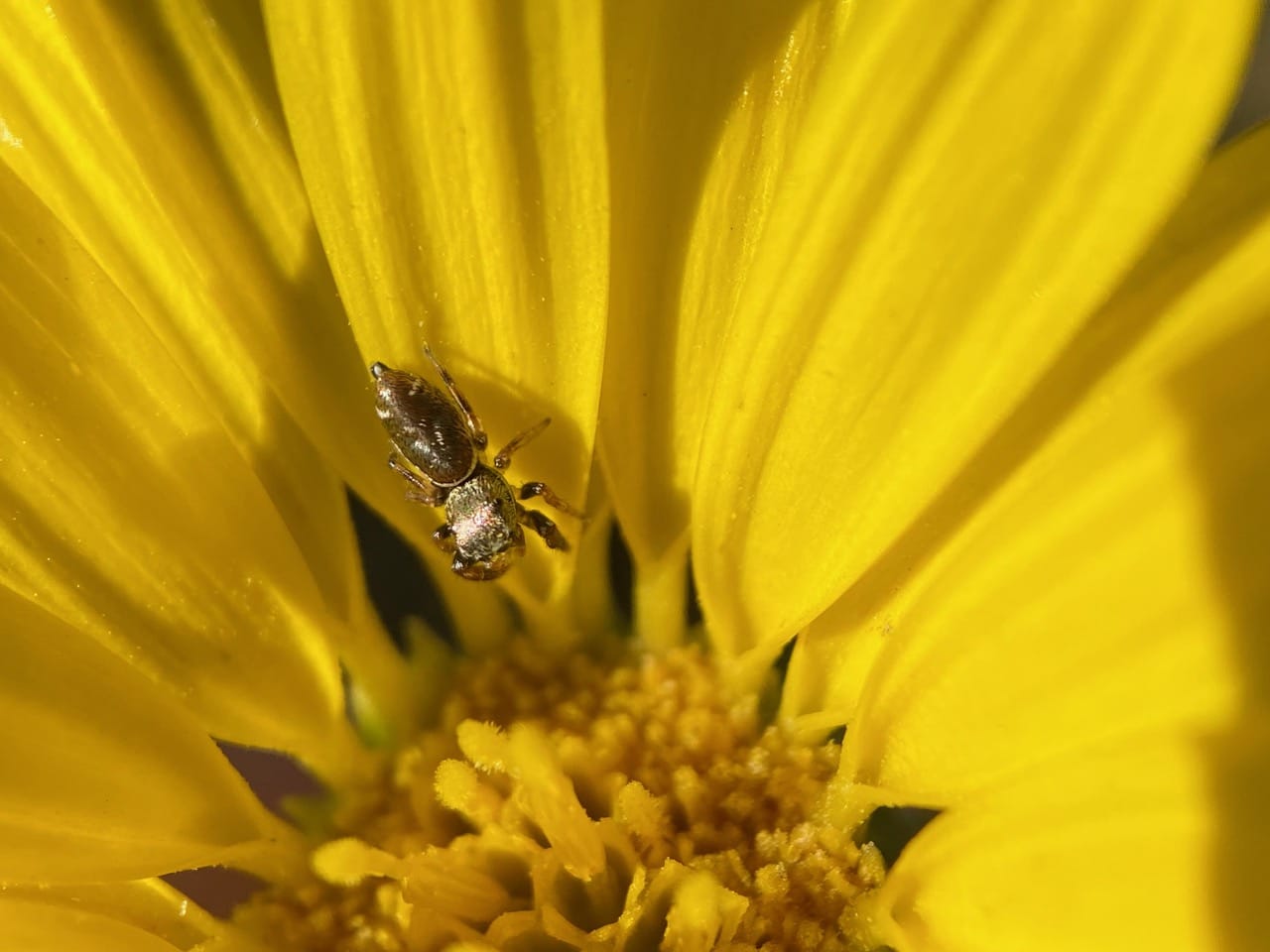
It is often difficult to tell whether a particular spider is an adult or an immature, judging by size alone. In the jumping spiders in the genus Sassacus, the adults are only about 3-5 mm. The genus name Sassacus was the last chief of the Pequot Indians, a Native American tribe of the Connecticut Valley that was vanquished in a war with English settlers in 1637. The iridescent color and very compact appearance of these spiders leads scientists to suspect that they are mimics of certain leaf beetles in the family Chrysomelidae. Many Chrysomelids don’t taste good, as they feed on poisonous plants and sequester those plant toxins for their own defense. They advertise their distastefulness to predators with bold black and white, yellow, orange, or red color patterns, or with brilliant metallic colors. One of the defining characteristics of the genus is the very short legs. The fourth pair of legs is still the thickest, with one or two pairs of spines, used in tackling prey. Like most jumping spiders, Sassacus engages in visual courtship displays. The twitching abdomen also produces an auditory stimulus as the male waves his front legs to garner the female’s attention.
Sassacus vitis is native to North America, with a range spanning from Canada to Panama. It is a small jumping spider with iridescent gold abdomen and white ring around the anterior surface of abdomen. Body is covered with golden scales. Males are 3.5 mm long, females 4.5 mm. The name vitis is Latin for “grapevine”. The spider is commonly found on shrubs and vines and in fields. Best known as a common resident of vineyards.

A tiny, dark fly is perched on a Grindelia ray petal, waving its picture wings and manipulating its mouthparts. I recognize it as a female Fruit Fly, Goedenia formosa (family Tephritidae). Female Fruits Flies are easily distinguished by the presence of an oviscape – the pointy structure at the tip of their abdomen. The oviscape is the basal part of the ovipositor, the non-retractile sheath that protects the ovipositor. It remains exposed when the ovipositor is withdrawn and not in action. I have photographed the females of this species laying eggs in the immature Grindelia flowerheads in mid September last year along this shoreline. These flies can navigate the sticky exudates of immature Grindelia flowerheads with impunity, even laying their eggs right into the white goo!
In communicating with a fruit fly expert on iNaturalist, I learned that Goedenia formosa‘s host plants are varied, but it has indeed been reared from Grindelia. This species, along with Goedenia steyskali, are the only two with confirmed modern records from Grindelia, the larvae feeding on the ovules or immature seeds. Of the two species, G. steyskali has been more thoroughly studied. In Spencer Pote’s own words: “… apparently their larvae actually eat the sap as it comes out of the base of the flower! They even overwinter with the aid of the sap by combining it with feces to build a little cell that the third instar lives in while waiting to pupate.” Amazing insects!

The Fruit Fly runs over the ray petals, all the while waving her wings alternately in semaphore-style, twisting them in figure-8 motion. Is she sending messages with that wing display?

The Fruit Fly lifts off and lands on a Grindelia leaf, still waving her wings.

She next lands on a shriveled flowerhead.
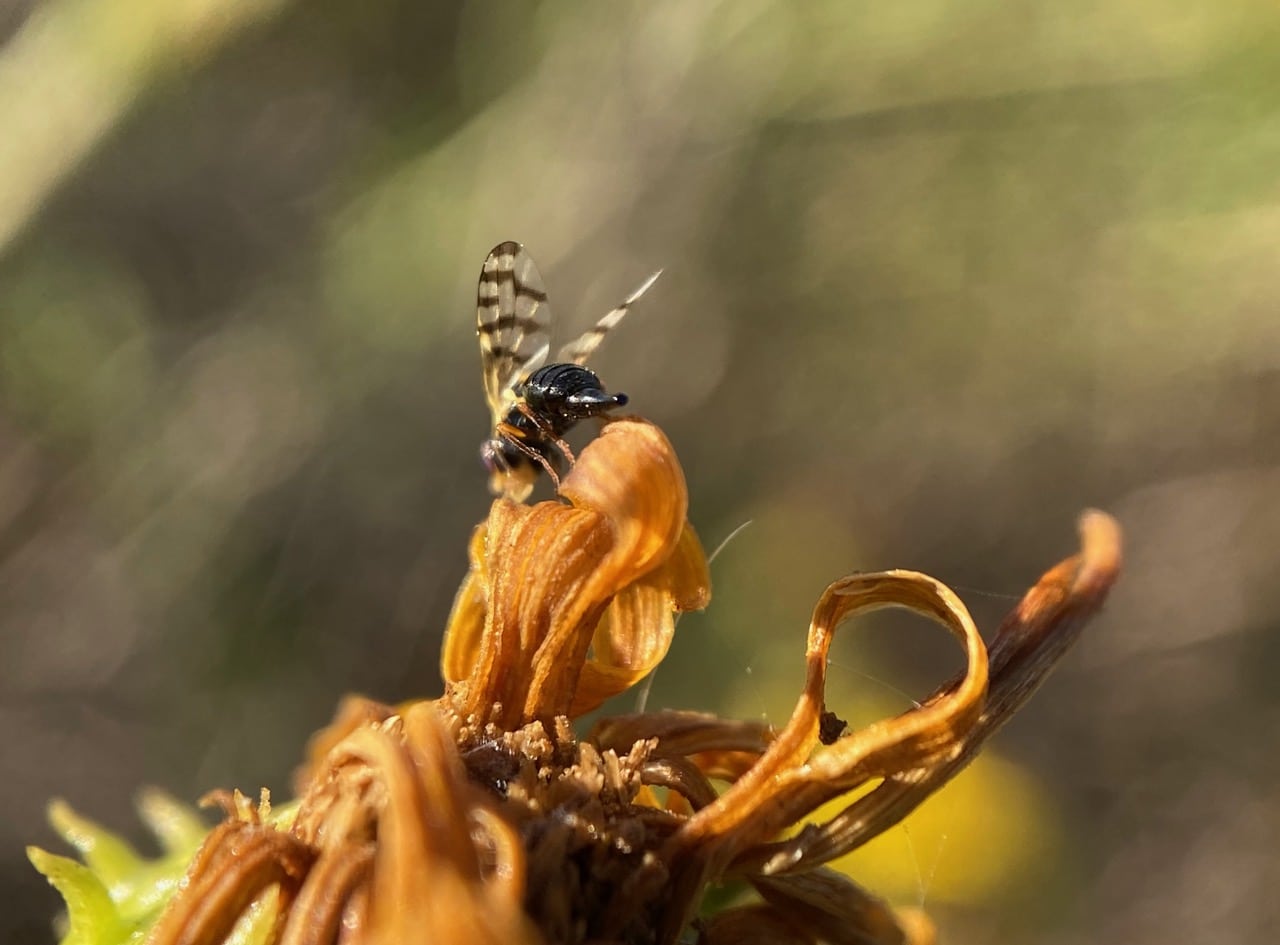
What is she looking for here? We know that she’s not likely to lay her eggs here. The larvae feed on young seeds or ovules. Maybe this is a good perch for wing display to attract a mate?
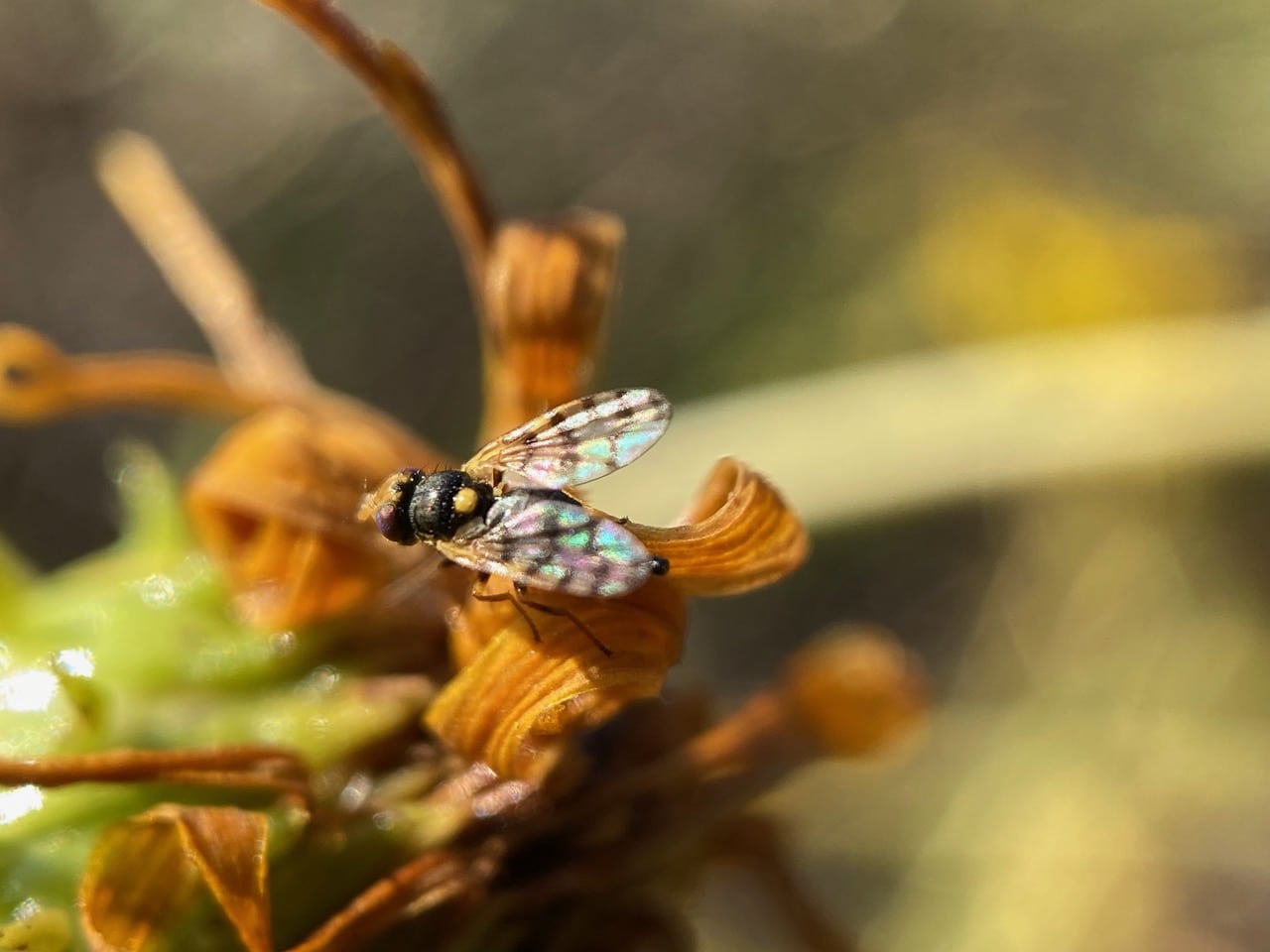
The fly has a prominent yellow scutellum on a black thorax.

Ooh, a shiny Bronze Leaf Beetle, Diachus auratus (family Chrysomelidae) on a Grindelia flowerhead! These beetles are more common than I realize. They are often overlooked because of their minute size.
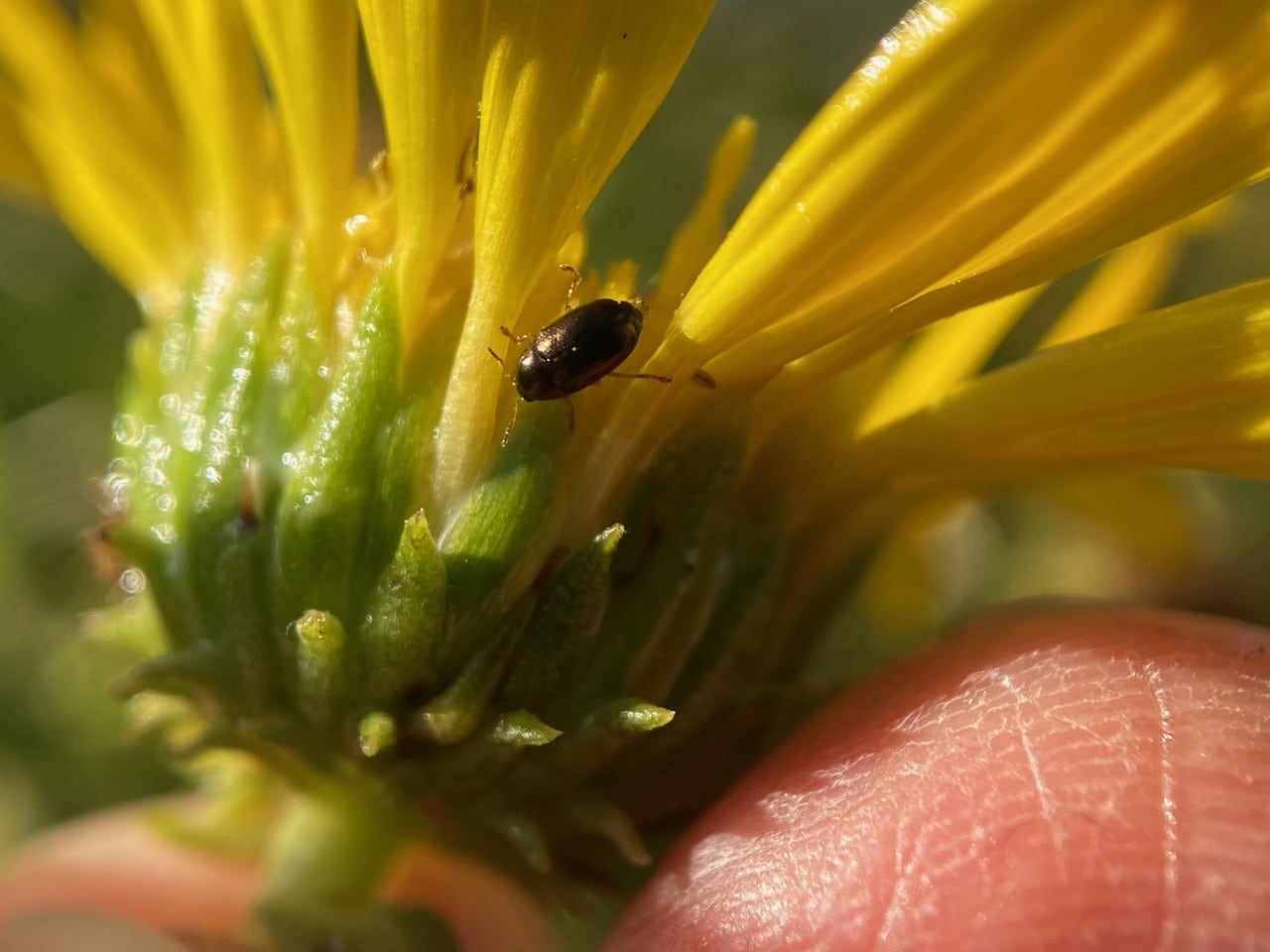
The Bronze Leaf Beetle, Diachus auratus is a species of case-bearing leaf beetle in the family Chrysomelidae, subfamily Cryptocephalina. It is found in Australia, the Caribbean, the Americas, Oceania, and Southern Asia. Adults, 1-2 mm, are found on many unrelated plants, especially plants in bloom. Case-bearing leaf beetles are found in two subfamilies within Chrysomelidae. As she lays her eggs, the female case-bearing leaf beetle covers each one with a layer of excrement. After the larvae hatch, they retain this covering (case) as camouflage and add to it throughout their larval life. When disturbed, the larvae pull in their head and legs; because their color and shape resemble caterpillar droppings they are ignored by predators. Eventually the larva seals the case to pupate inside, before emerging as an adult. Some species are myrmecophiles, living near or even inside ant nests.