Pollinator Post 10/29/24 (3)
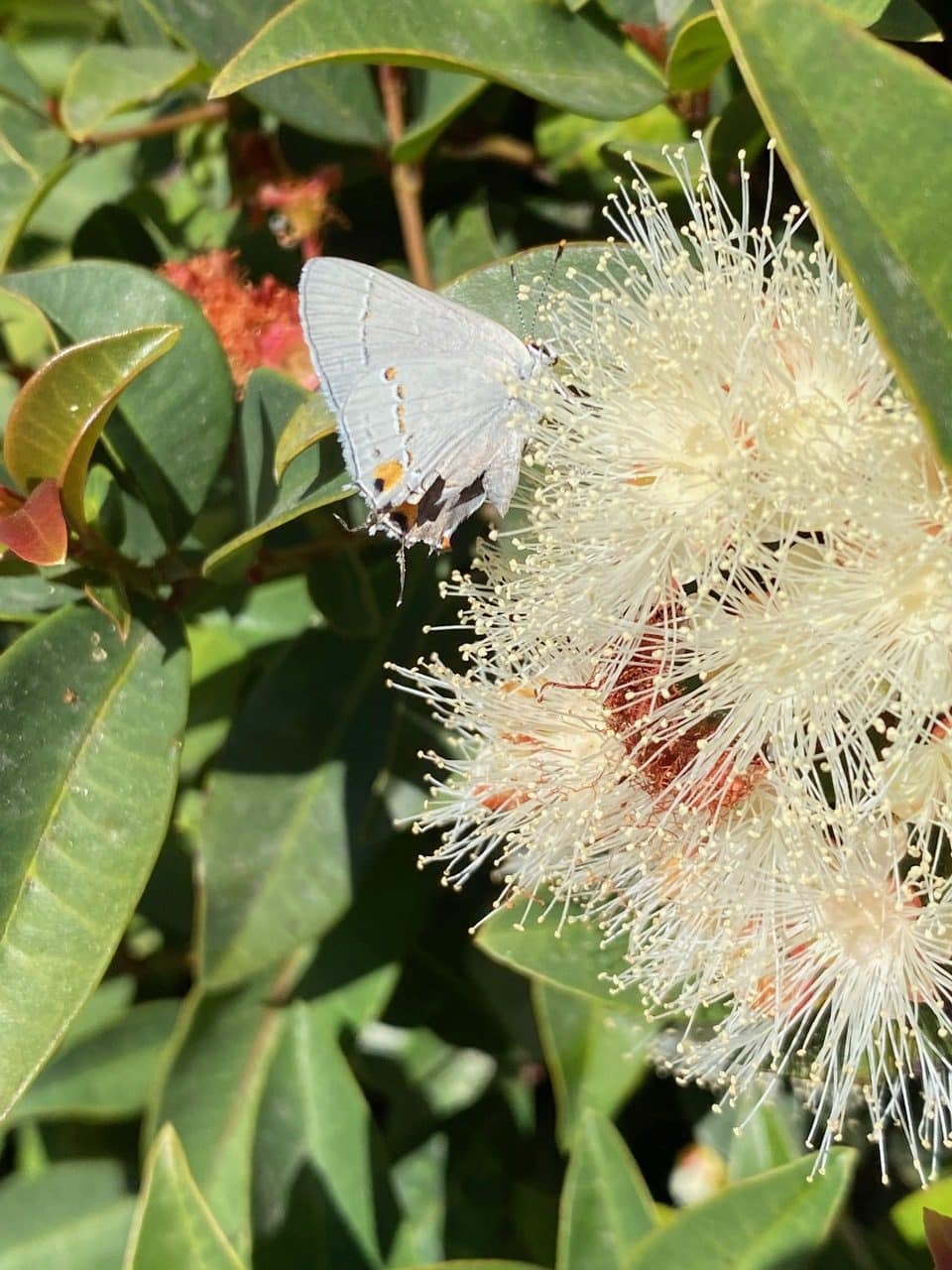

A Gray Hairstreak, Strymon melinus (family Lycaenidae) has landed to take nectar from a cluster of unidentified flowers near the side walk. The lower corner of its right hind wing has sustained some damage, probably from a bird’s beak. But the butterfly has survived to sip nectar for another day. Despite the wing damage it is continuously rubbing its hind wings together, up and down.
Why the name “hairstreak”? These small butterflies have a slim, hair-like tail on the lower corner of each hindwing. Gray Hairstreak also has colorful false eyespots near the base of each tail. The eyespots and antenna-like tails are believed to fool predators into mistaking its tail for its head. Hairstreaks even add a behavioral component – a nectaring hairstreak often rubs its wings up and down, simulating the movement of twitchy antennae. This may fool birds, lizards, and spiders into attacking the wrong end, sparing the life of the butterfly.
Female Gray Hairstreaks lay eggs singly on the flowers, flower buds, young fruits and nearby leaves of a host plant. Host plants include a wide variety of plants, notably from the pea (Fabaceae) and mallow (Malvaceae) families. The caterpillars are greenish at the start, but older individuals range in color from gray to pink. As in many species of Lycaenidae, Gray Hairstreak larvae are myrmecophiles (ant-lovers) – often tended by ants. Ants harvest a sweet liquid from the caterpillar’s dorsal nectary organ (“honey gland”) and in exchange may protect them from predators. Larvae of many Lycaenidae species also communicate with ants via ant-like sounds (clicks and hums) or by sending vibrations through the substrate.
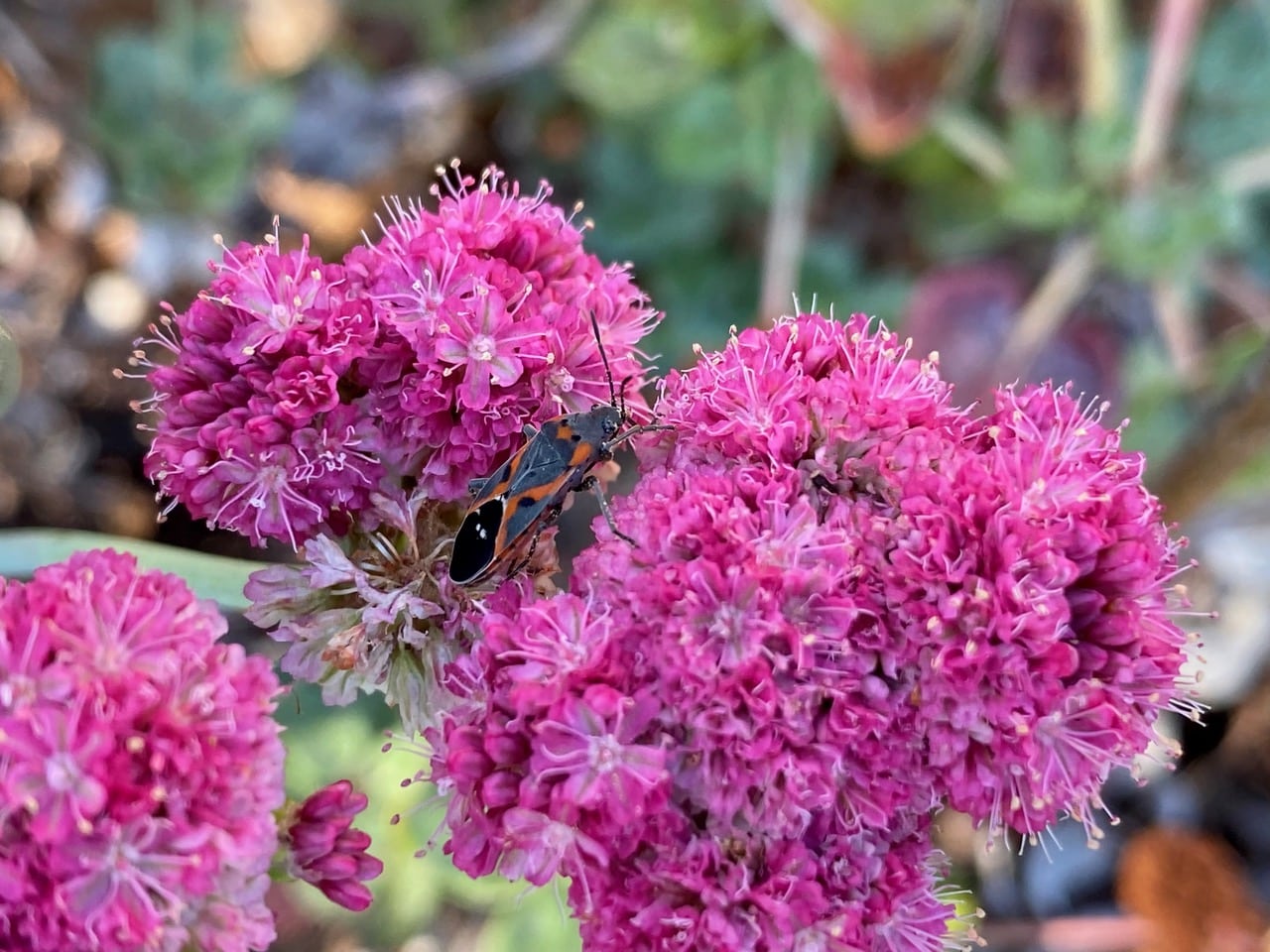
A Small Milkweed Bug is foraging on an inflorescence of Red-flowered Buckwheat, Eriogonum grande var. rubescens.
The Small Milkweed Bug, Lygaeus kalmii belongs to the family Lygaeidae, collectively known as “seed bugs”. Through their piercing-sucking mouthparts, they secrete saliva and digestive enzymes to predigest their food before sucking up the slurry. Milkweed seeds make up the diet of the nymphs, but adults are generalists, feeding on the seeds of various plants and the nectar of flowers. The adults are not even strictly herbivorous; they are opportunistic scavengers on dead insects, and are known to feed on the eggs, larvae or pupae of other insects. The adult bugs overwinter and often emerge from cracks and crevices on warm spring days. They are found at virtually any time of the year in our gardens.
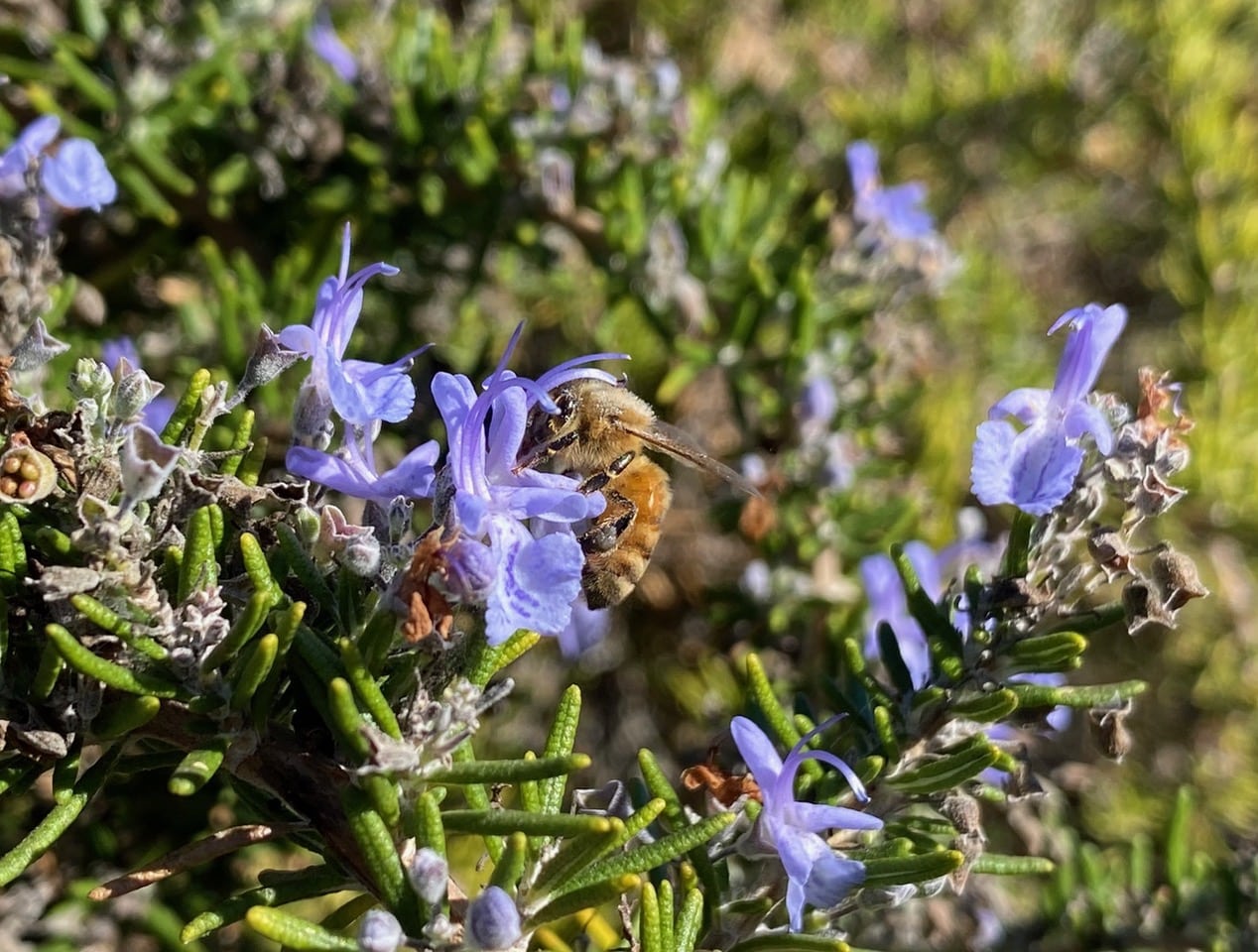
A Honey Bee, Apis mellifera (family Apidae) is probing a Rosemary flower, Salvia rosmarinus (family Lamiaceae) for nectar and getting dabbed with pollen on her back by the pair of arching stamens. The bee is essentially collecting both nectar and pollen simultaneously. The pollen comes as a free bonus.
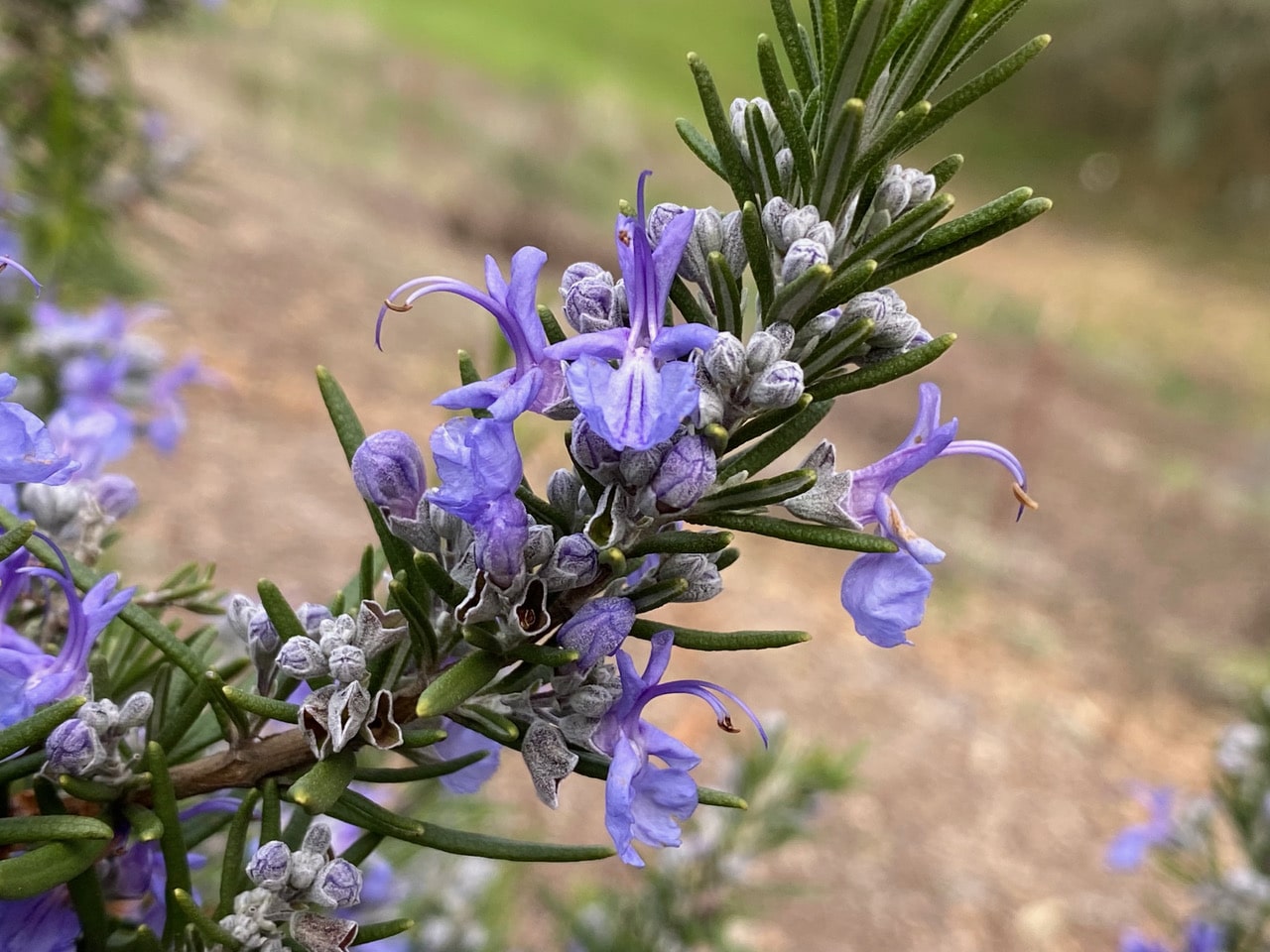
Photo from 2/15/24. Sage flowers (genus Salvia) feature a unique pollination mechanism called a “staminal lever”. The flower is bisexual and protandrous, i.e. the male parts mature earlier than the female parts. When a pollinator probes the back of a male-phase flower in search of nectar, a see-saw contraption tilts the pair of pollen-filled (male) anthers down to deposit their load on the back of the insect. When the insect next visits a female-phase flower, the protruding mature stigma will be the first part of the flower to touch the pollinator and will receive the pollen from the previous flower.
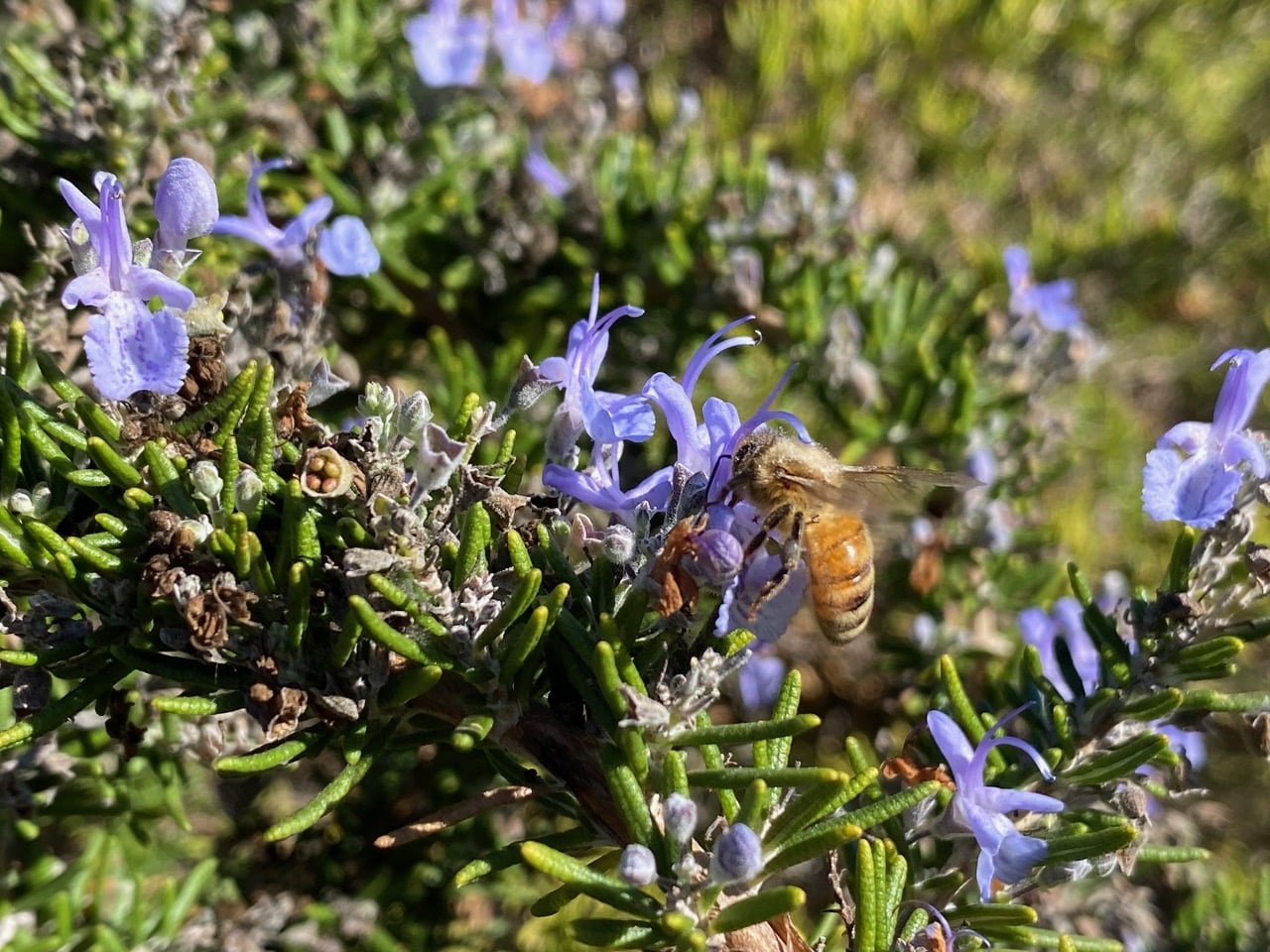
It is fun to watch pollination in progress as the Honey Bee goes from one Rosemary flower to the next – flower and bee working harmoniously in an orchestrated dance. Invariably the bee gets dabbed on her hairy thorax with pollen from the arching stamens. The size of the bee seems a perfect fit for the job. It is hardly surprising, as both flower and bee originate from Europe where they have co-evolved with each other.

It is interesting that the staminal lever mechanism is absent in all our native Salvia. If you find one that works, do let me know. Many of our Salvias have evolved extremely long reproductive parts, better adapted for pollination by the hummingbirds and hawk moths.

Note the cream-colored pollen on the bee’s thorax as she lifts off.
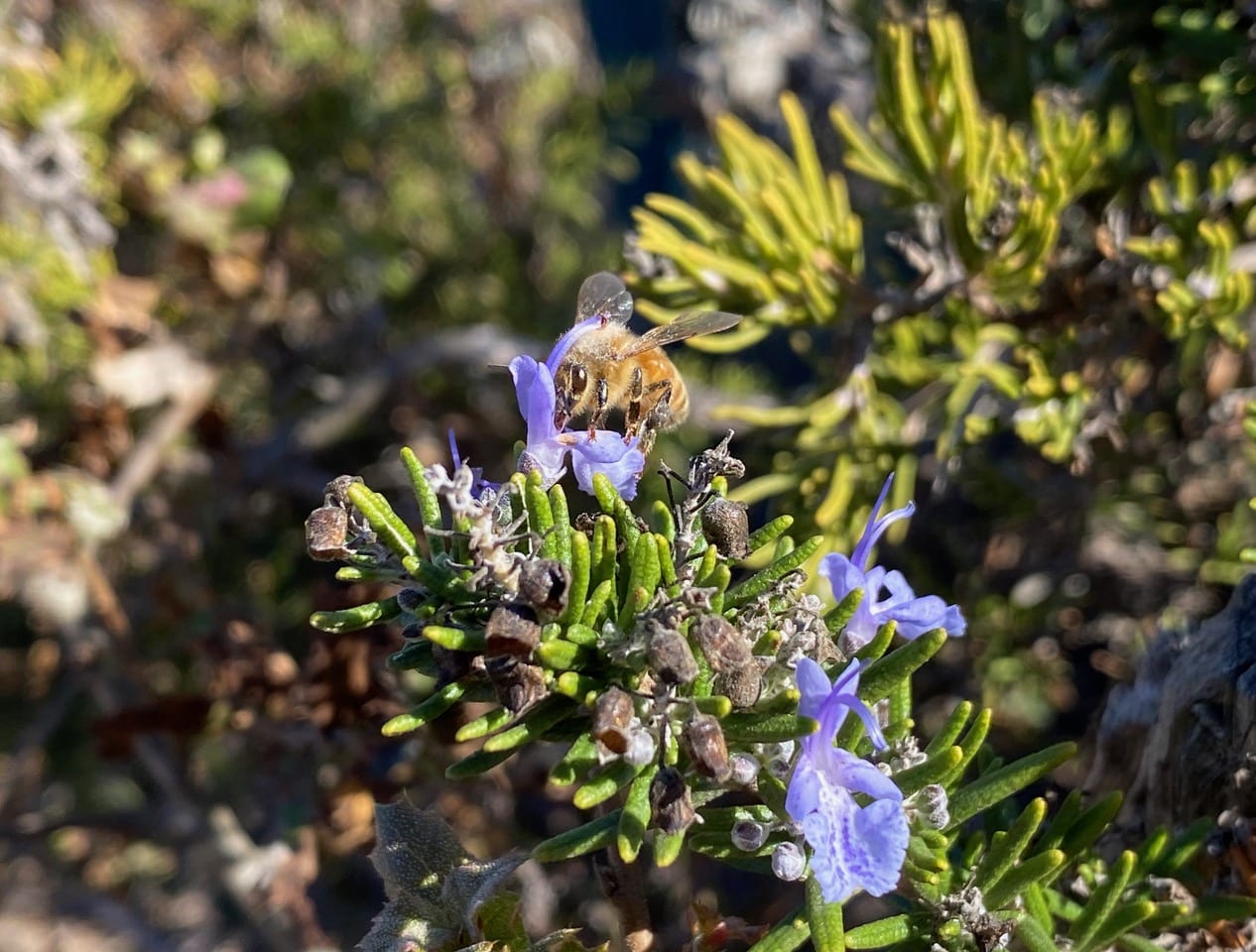
There she goes again on the next flower!
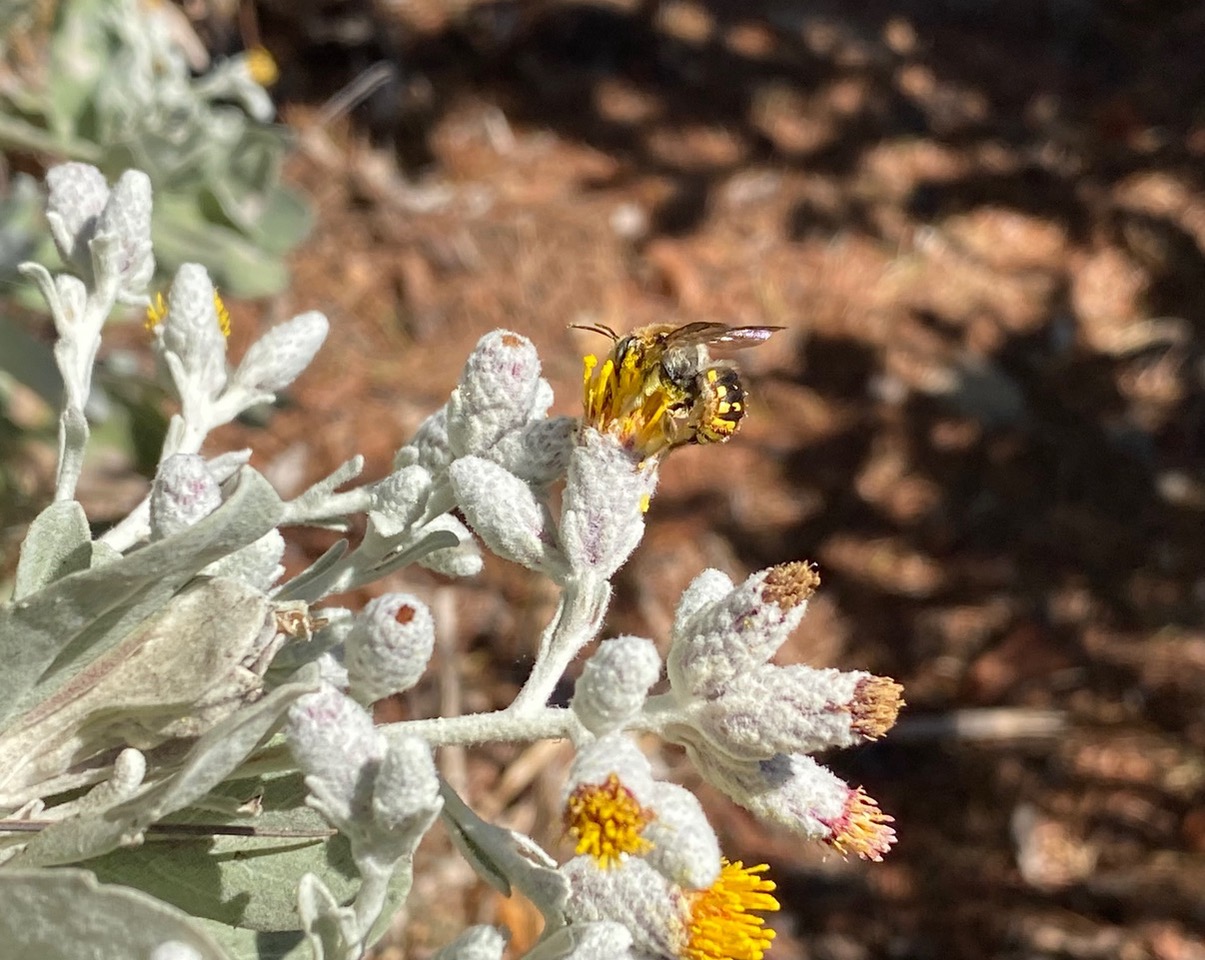
We stop by the garden of another Mendocino Park volunteer, Dave, kitty-corner from Anita’s. The Hazardia in the front garden is still blooming beautifully. A large European Woolcarder Bee, Anthidium manicatum (family Megachilidae) has landed on the a small flowerhead with barely enough standing room for the bee. I am intrigued – most Anthidium are known to visit flowers with bilateral symmetry, such as those of the pea and mint families. I don’t remember seeing one on an Asteraceae flowerhead.
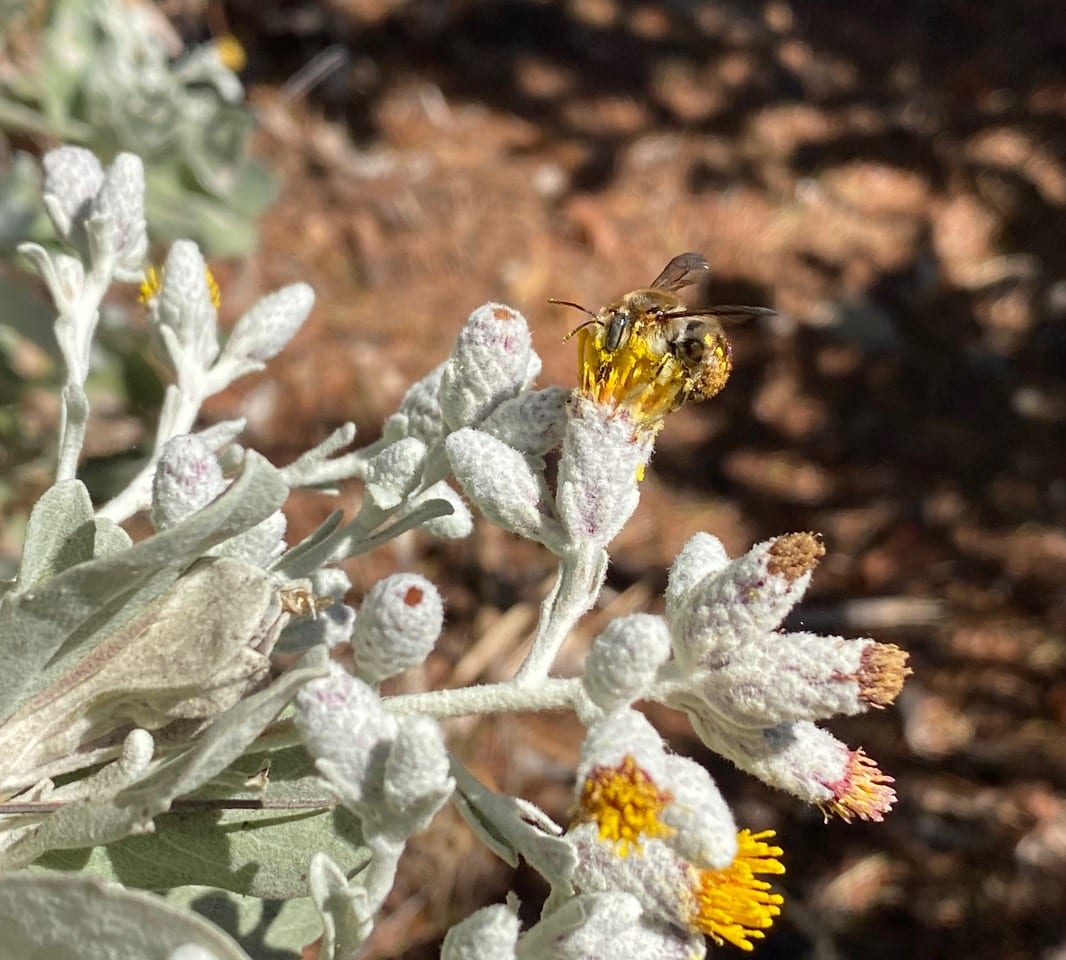
By its large size and robust build, I figure that it is a male Anthidium manicatum. It appears to be collecting pollen, but actually the sticky pollen has automatically stuck to the bee while it is nectaring.
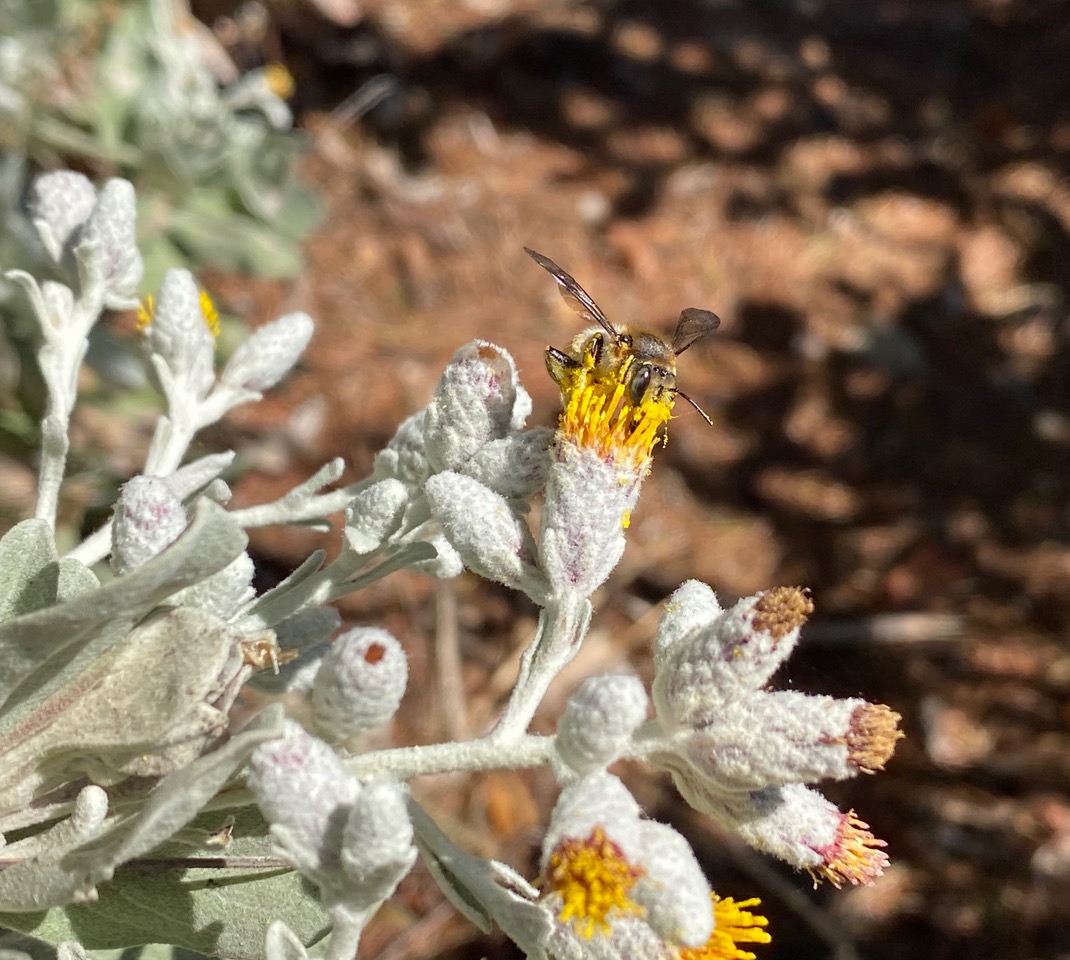
Anthidium manicatum, commonly called the European Woolcarder Bee, is a species in the family Megachilidae, which includes the leaf-cutter bees and mason bees. They get the name “carder” from the behavior of the females scraping hair from leaves and stems of wooly plants. The substantially larger males engage in territorial behavior, aggressively chasing other males and pollinators from their territory. They mate with the females that forage in their territory. The females construct their nests in pre-existing cavities, using the hairs of wooly plants that they collect with their sharply toothed mandibles. They then roll up the fibers into a ball and transport them to the nest to line the nest cell, where they lay an egg and a provisioning mass consisting of nectar and pollen. Females largely use the hairs of plants in the mint family, Lamiaceae, especially those of genus Stachys and Betonica. The European Woolcarder Bees visit a wide range of flowers, with a preference for blue flowers that have long throats. They are considered generalists. Females carry pollen in the scopa on the underside of their abdomen. Both males and females can hover in midair near flowers similar to the hover flies (family Syrphidae).
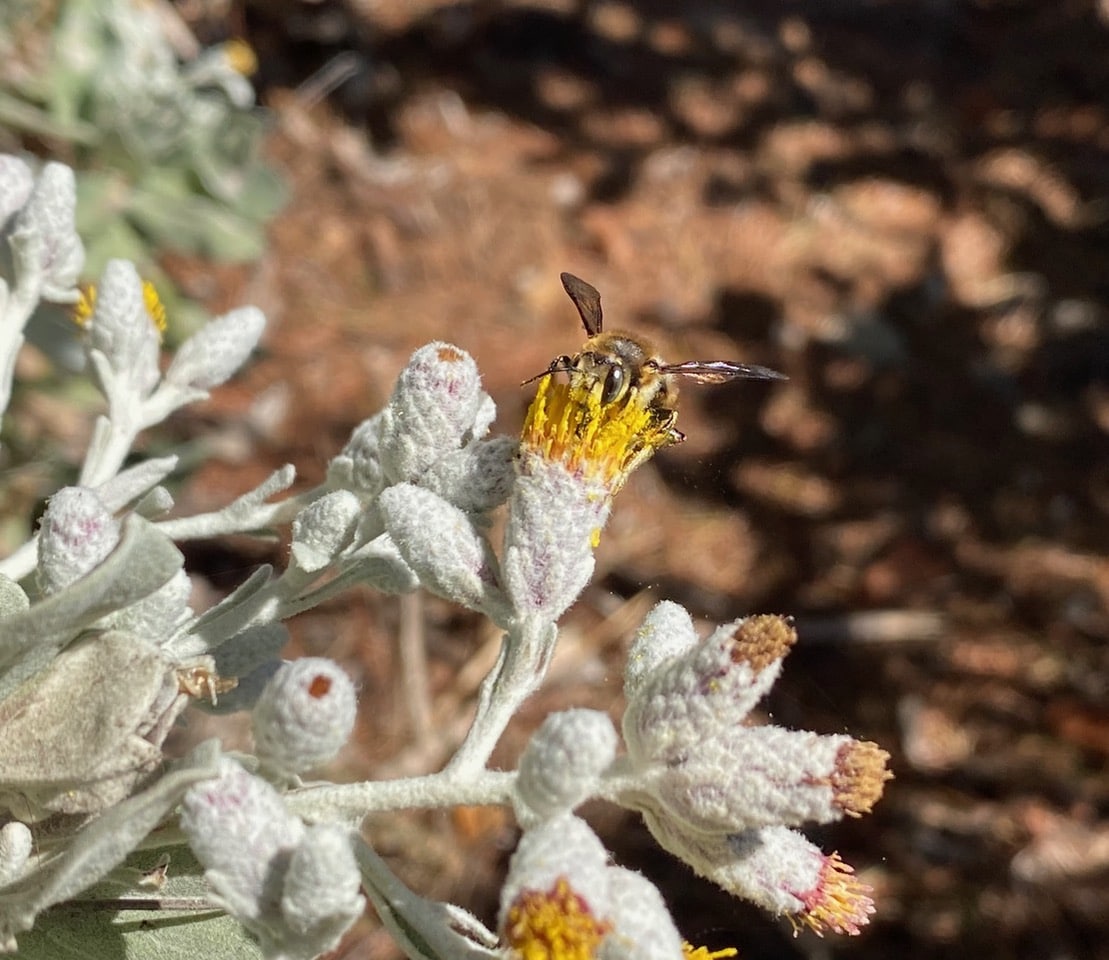
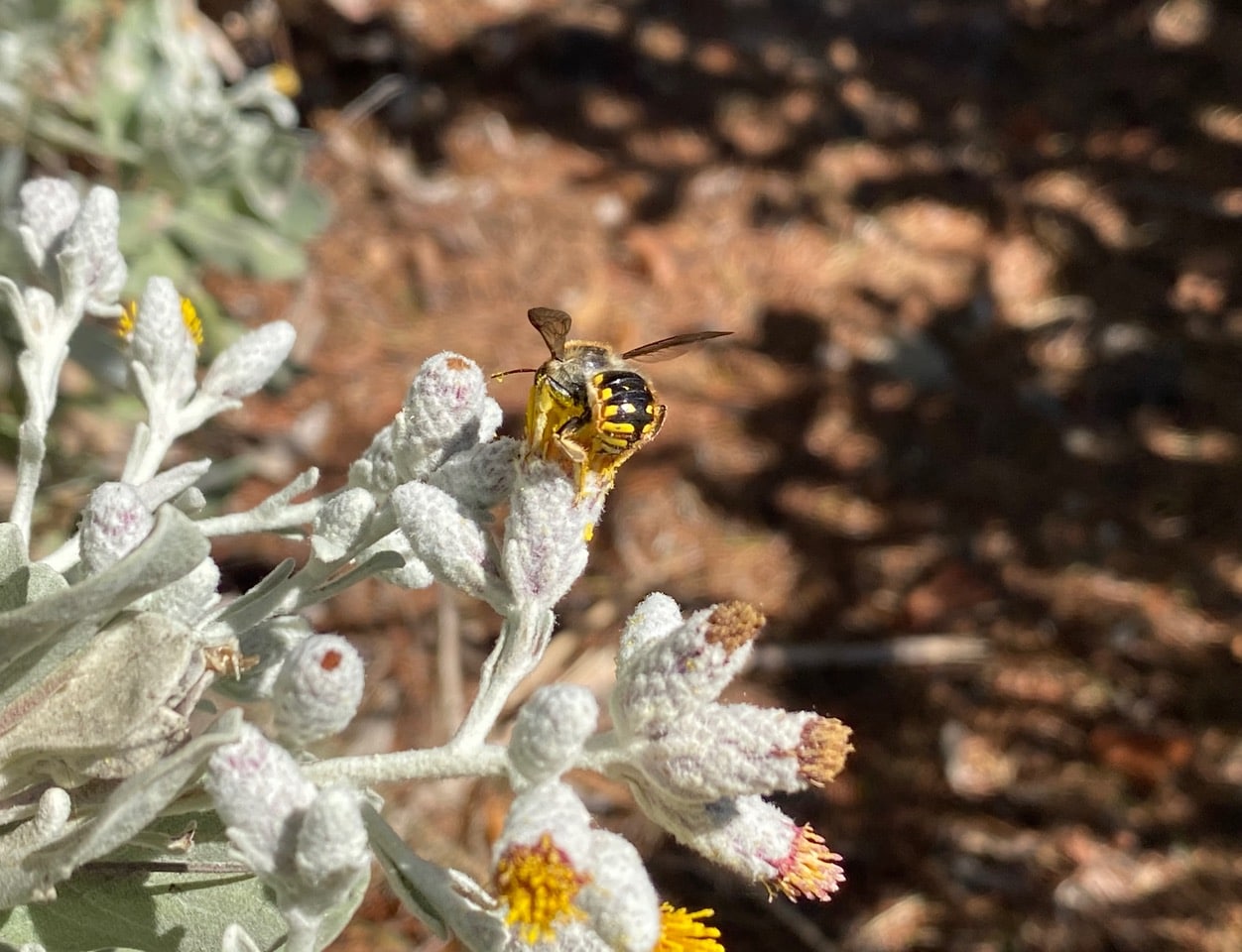
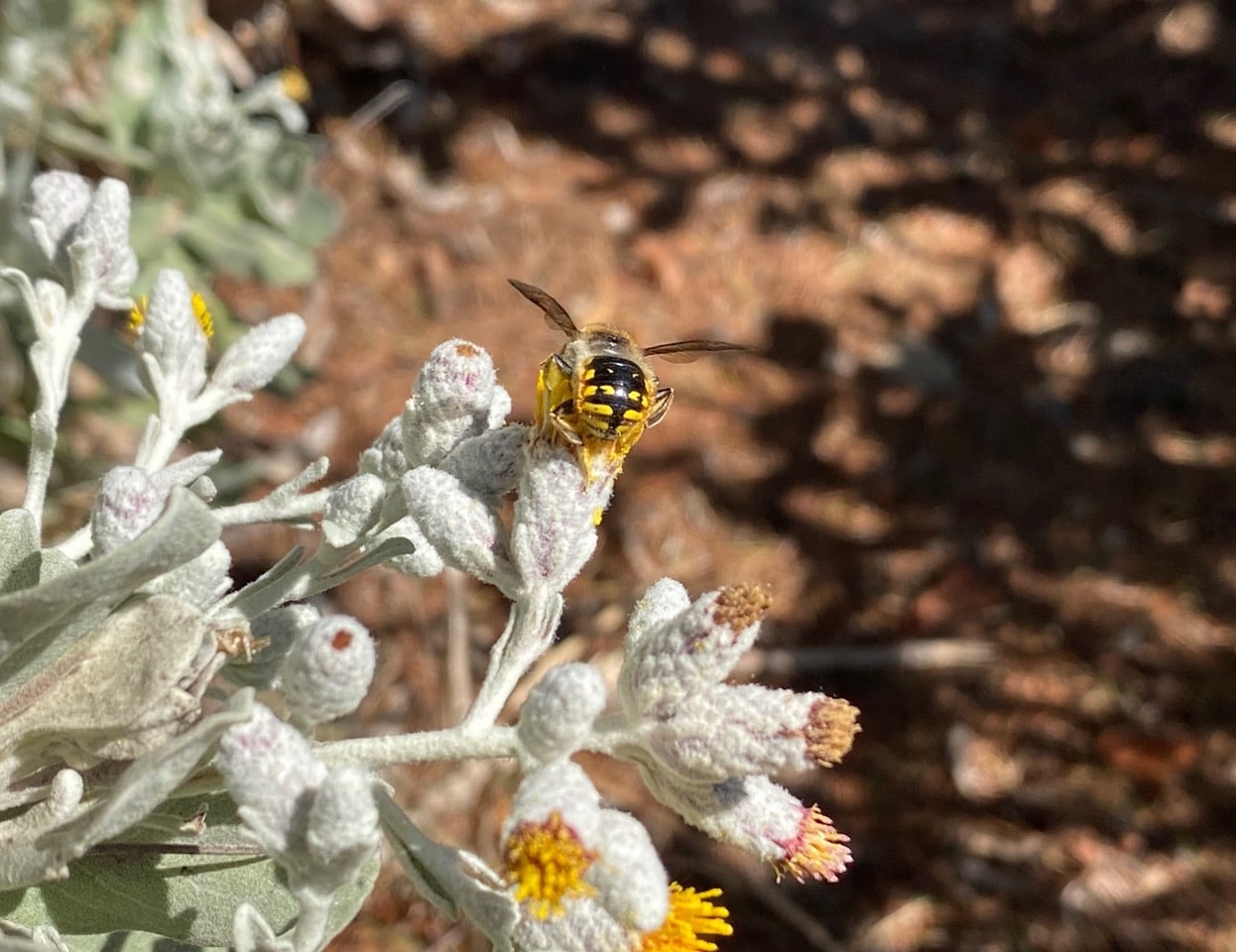
Note the typical black-and-yellow abdominal markings on the European Woolcarder Bee.
 The California Buckwheat, Eriogonum fasciculatum planted on the sidewalk strip by the volunteers is still blooming nicely, but few insects are taking advantage of the flowers today except for an occasional honey bee. A Common Grass Skimmer, Paragus haemorrhous (family Syrphidae) lands on a branch to groom itself. The hover fly is easily recognizable by its small size, oversized head and droopy posture.
 The Common Grass Skimmer, Paragus haemorrhous (family Syrphidae) is easily the smallest hover fly I know, measuring only about 4 mm in length. The species has a world-wide distribution, found in unimproved grassland, dune grass, open areas and pathsides in forest, and meadows. Adults visit flowers for nectar and pollen. Larvae feed on aphids on low herbaceous plants.

A Bristle Fly (family Tachinidae) lands on a rock next to the buckwheat.

It eventually lands on the pavement next to me. Genus Peleteria?
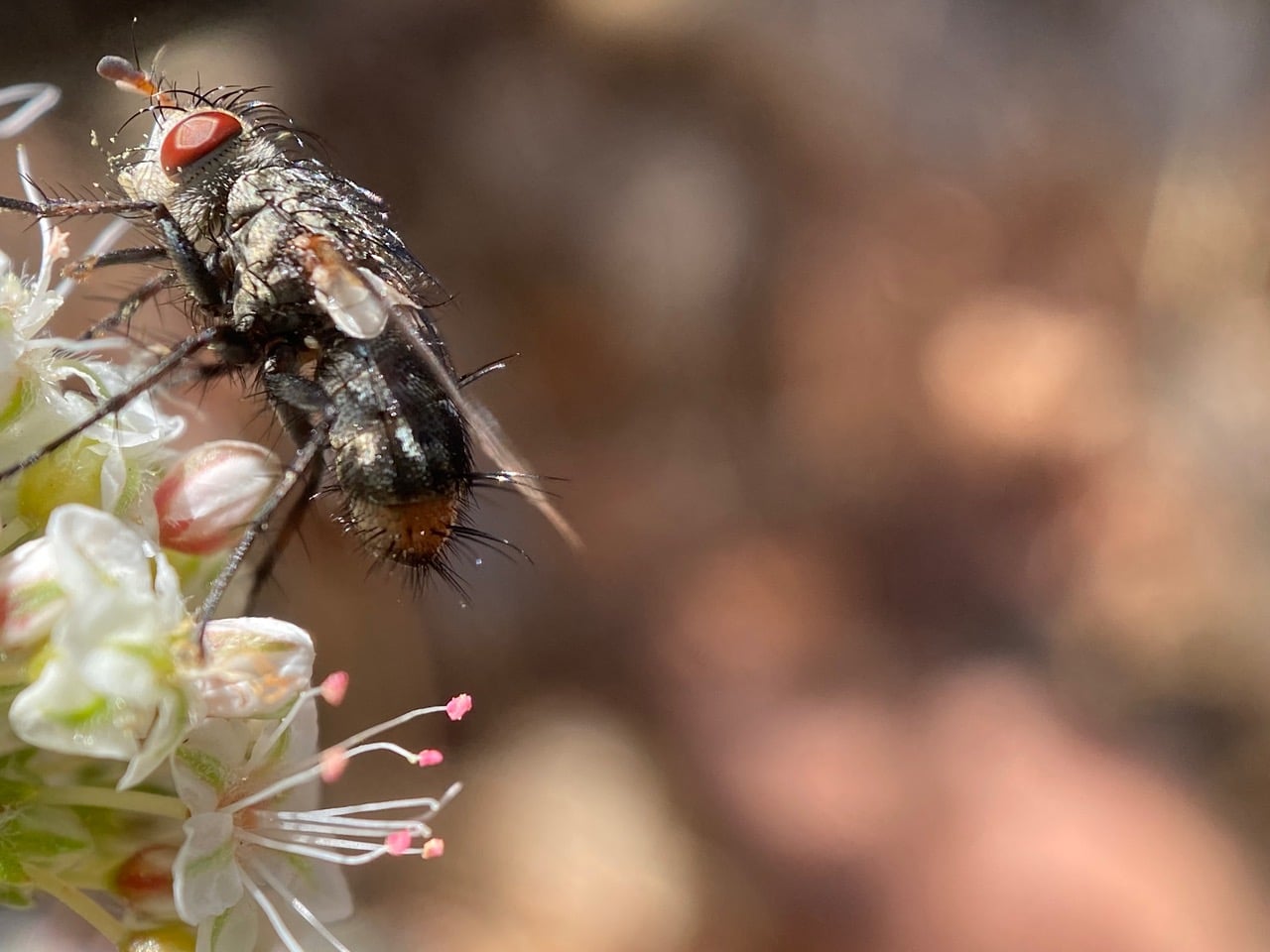
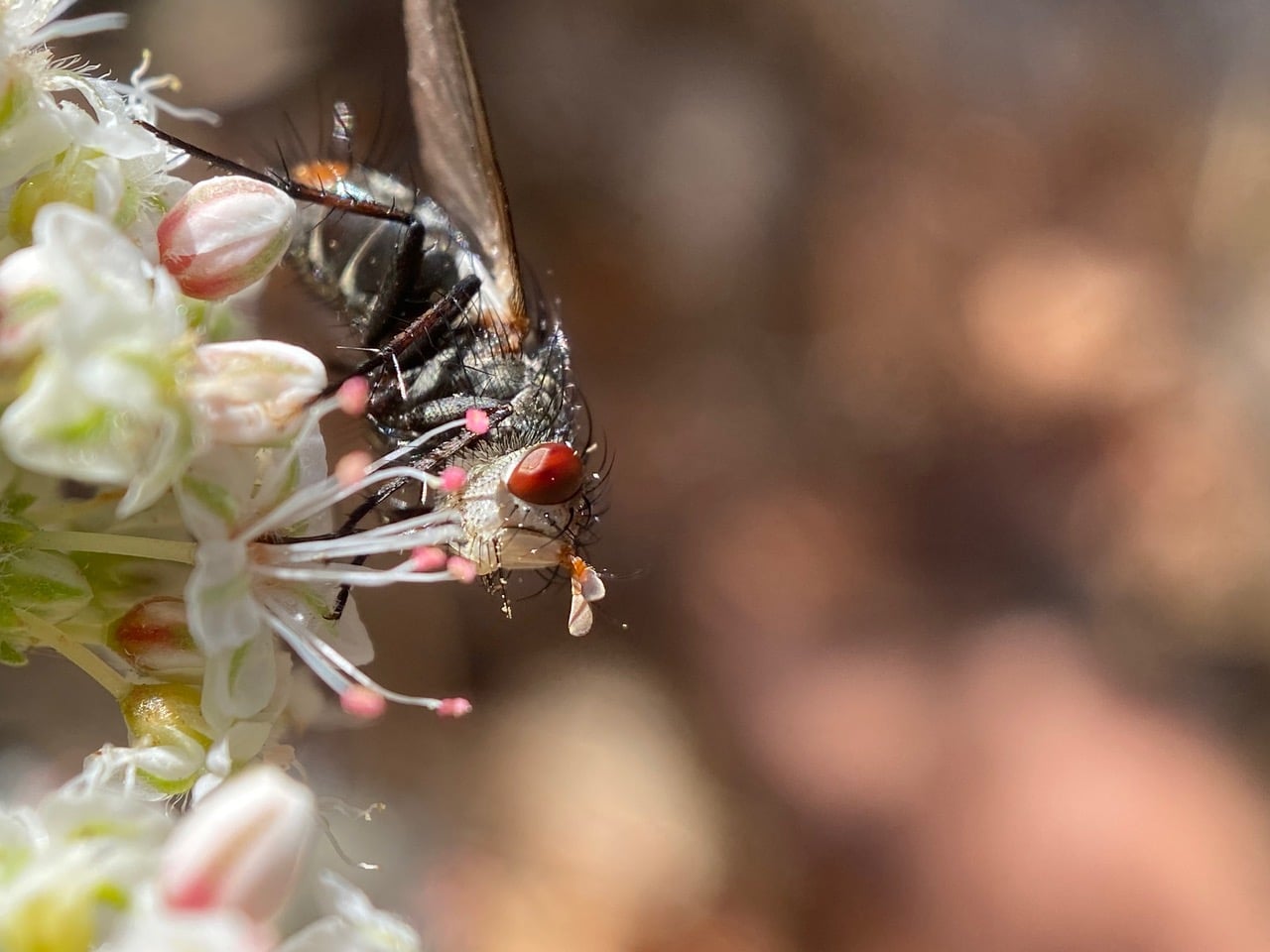
The family Tachinidae is by far the largest and most important group of parasitoid flies. All species are parasitic in the larval stage. Most adults have distinct abdominal bristles, hence the common name. Adults feed on liquids such as nectar and honeydew. They can be found resting on foliage, feeding at flowers or searching for hosts.
Most tachinids attack caterpillars, adult and larval beetles, true bugs, grasshoppers, and other insects. Females lay eggs in or on the host. Tachinid larvae live as internal parasites, consuming their hosts’ less essential tissues first and not finishing off the vital organs until they are ready to pupate. The larvae leave the host and pupate on the ground. Tachinids are very important in natural control of many pests, and many have been used in biological control programs.
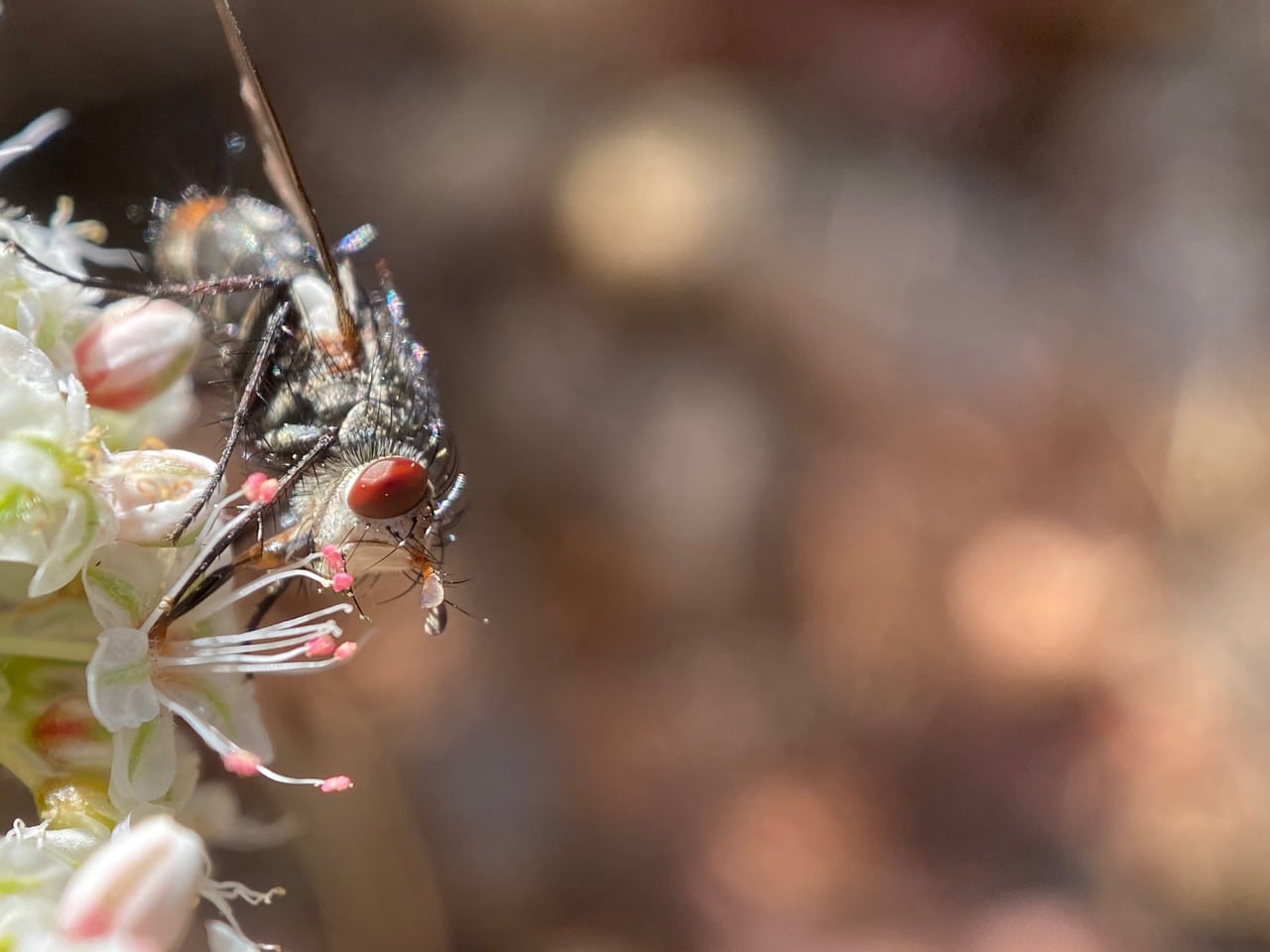
While I am photographing a much smaller fly on the buckwheat flowers, a Bristle Fly suddenly appears on the scene. With no time to change the camera settings, I am forced to take a bunch of pictures of the fly in higher magnification than I would have intended. Such spontaneous close-ups can sometimes show fascinating details.
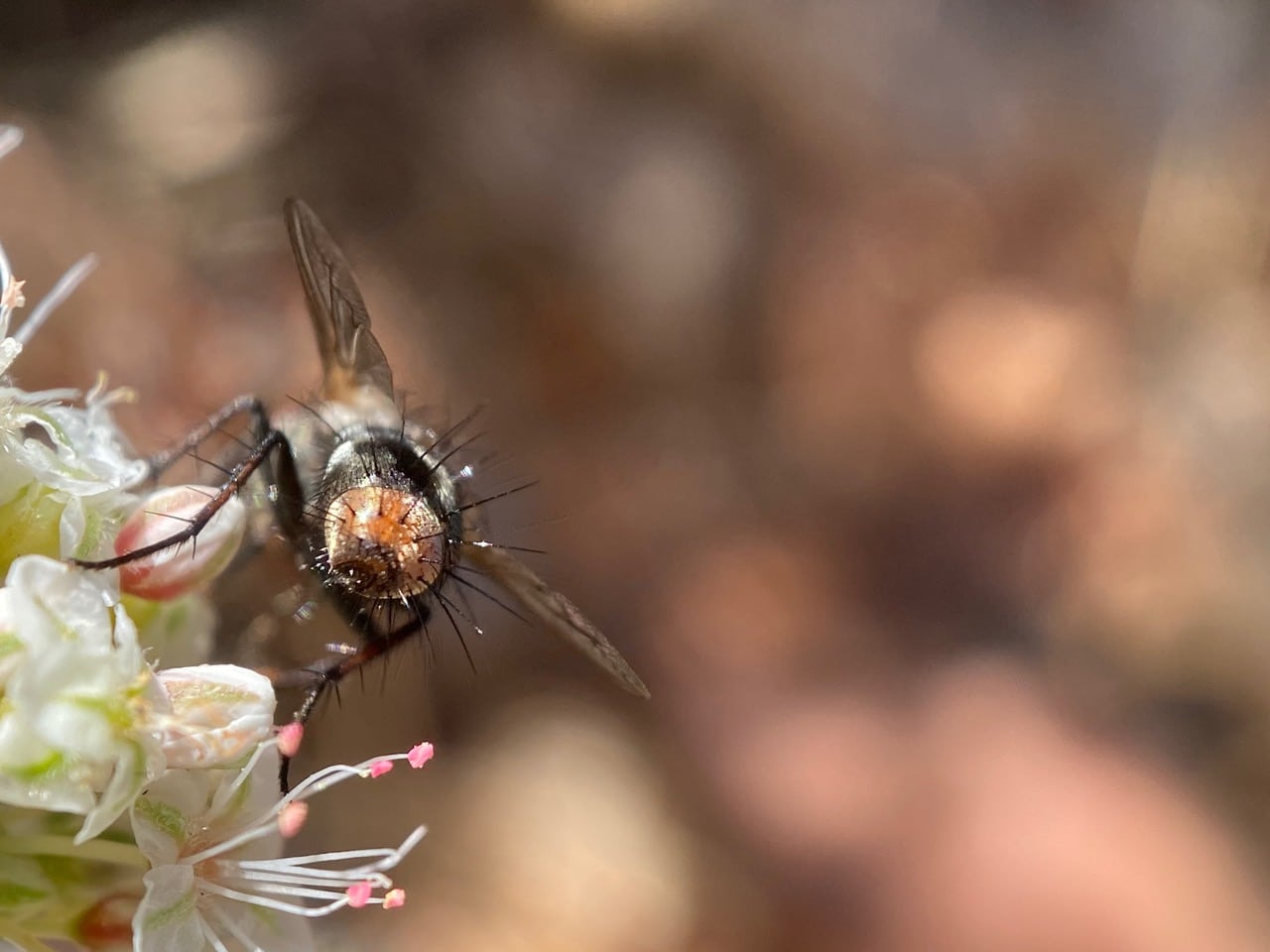
Rear view of the Bristle Fly showing the stiff bristles near the tip of the abdomen.